DCMS Sectors Economic Estimates Gross Value Added 2024 (provisional)
Published 5 February 2026

© Crown copyright 2026
This publication is licensed under the terms of the Open Government Licence v3.0 except where otherwise stated. To view this licence, visit nationalarchives.gov.uk/doc/open-government-licence/version/3 or write to the Information Policy Team, The National Archives, Kew, London TW9 4DU, or email: psi@nationalarchives.gov.uk.
Where we have identified any third party copyright information you will need to obtain permission from the copyright holders concerned.
This publication is available at https://www.gov.uk/government/statistics/dcms-economic-estimates-gva-2024-provisional/dcms-sectors-economic-estimates-gross-value-added-2024-provisional
DCMS Sectors Economic Estimates 2024 (provisional): Gross Value Added
1. Introduction
Release date: 5 February 2026
Next release: Winter 2026/27
Geographic coverage: United Kingdom
Time coverage: 2010 to 2024
Responsible analyst: Rachel Moyce
This release provides estimates of the contribution of DCMS sectors to the UK economy from 2010 to 2023, and provisionally for 2024, measured by gross value added (GVA). Estimates for 2020 and 2021 are affected by the coronavirus (COVID-19) pandemic.
We use current prices to report current sector estimates and chained volume measures for any comparisons over time.
DCMS also publishes a monthly GVA series, starting in January 2019, which is more timely (two to five months lag, as publication is quarterly) but less accurate than this series and can be used as a leading indicator.
In this release we have made a change to the data we use to adjust for inflation. Further details are available in the accompanying technical report.
2. GVA in All DCMS sectors
In 2024, provisional estimates show that DCMS sectors contributed an estimated £247.6 billion to the UK economy. This was 9.4% of total UK GVA.
The following information is worth noting:
- The figures above are measured in current prices.
- Subsequent comparisons over time, and the chart in figures 1a and 1b, use chained volume measures which means percentage changes are adjusted for inflation, except where stated.
- Estimates for 2024 are provisional and subject to change when the National Accounts are published later in 2026 and when the final 2024 Tourism Satellite Account is published in winter 2026/27.
- Data for the tourism sector is available from 2016, however there was a methodology change in 2022. Data for other DCMS sectors is available from 2010.
- There are limitations with comparing tourism GVA estimates over time. See the Further Information section for more information.
Trends since 2023
Provisional annual GVA estimates suggest that DCMS sector GVA grew by 2.6% between 2023 and 2024, while the UK economy as a whole grew by 1.0%. This growth was driven by the creative industries which increased by an estimated 4.6% between 2023 and 2024, and is the largest DCMS sector by GVA. In 2024, DCMS sectors overall contributed an estimated 9.4% to UK GVA.
Longer-term trends
Longer term trends for DCMS sectors presented here do not include tourism, due to data comparability issues. Further information is available in the tourism section of the report.
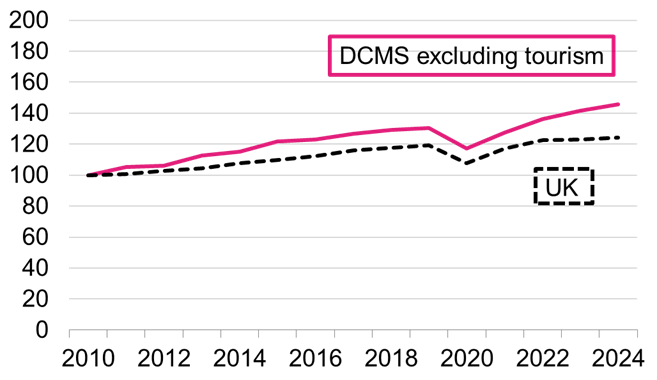
Between 2019 and 2024, DCMS sectors (excluding tourism) grew by an estimated 11.8%, compared to 4.4% growth in the UK economy. There was a large drop (-9.1%) in DCMS sector GVA in 2020 due to the COVID-19 pandemic, but GVA has been increasing since 2021. The increase since 2019 was driven by growth of 19.7% in the creative industries and 6.4% in the overlapping culture sector. In 2024, Included DCMS sectors contributed 7.2% to UK GVA, a slight decrease from 7.3% in 2019 (not adjusted for inflation).
Between 2010 and 2024, DCMS sectors (excluding tourism) grew at a faster rate than the UK economy as a whole (45.9% compared to 24.3%).
Figure 1. Index chart (2010=100), in chained volume measures, DCMS sectors (excluding tourism) and UK, 2010 to 2024
If tourism were included in these estimates, DCMS sector GVA would have fallen by an estimated 1.4% from 2019 to 2024, compared to an increase of 4.4% for the UK economy as a whole. This is due to an apparent fall in the tourism sector of an estimated 30.6%. However, we do not know how much of this drop is due to the sector being particularly affected by the COVID-19 pandemic, or is due to the changes in methodology to the underlying VisitEngland data. The pandemic’s impact was seen elsewhere too, and all DCMS sectors experienced falls from 2019 to 2020, and civil society, gambling, sport all experienced falls overall from 2019 to 2024.
3. GVA in individual DCMS sectors
The DCMS sectors covered in this report are:
- Civil Society
- Creative Industries
- Cultural Sector
- Gambling
- Sport
- Tourism
The data tables also include estimates for the audio visual sector and computer games subsector.
3.1 Sector overlap
Some industries are found within multiple sectors and are likely to drive trends in the same way for both sectors.
For example, in 2024:
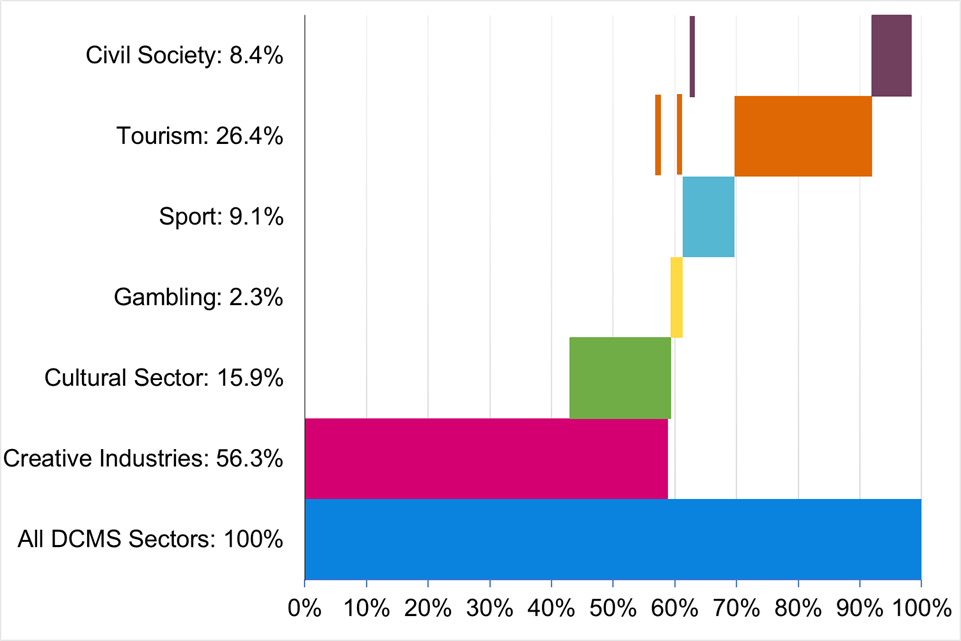
- 58.9% of the DCMS Sector GVA is within the creative industries
- 16.3% of DCMS Sector GVA is within the cultural sector
- However, 15.9% of DCMS Sector GVA is within both the Creative Industries and the cultural sector. This illustrates that the cultural sector is almost fully contained within the creative industries (but not vice versa) and these overlaps include activities such as performing arts and radio and television broadcasting.
When calculating the DCMS Sector total, the GVA from industries within the overlap is counted once. Users should be aware that the estimate for ‘All DCMS sectors’ is therefore lower than the sum of the individual sectors.
Figure 2. GVA and overlaps in DCMS sectors, 2024
For more information, Chapter 2 of the technical report visually outlines the overlap between SIC codes in DCMS sectors, but not the value of GVA within these overlaps.
3.2 Sector findings
In 2024, of all DCMS sectors, the creative industries sector is estimated to have contributed the most in GVA to the UK economy (£145.8bn), followed by the tourism sector (£64.3bn).
For comparison, in 2019, the creative industries were the largest sector (£108.1bn), followed by tourism (£71.7bn) (both in current prices for 2019).
Trends in GVA vary by sector. Between 2023 and 2024, GVA for tourism, creative industries and the cultural sector grew but the civil society and gambling sectors saw falls in GVA. Sport remained about the same.
3.3 Civil Society
Civil society contributed an estimated £18.3bn in 2024, accounting for 0.7% of the UK economy. Civil society GVA fell by 3.8% from 2023 to 2024, leaving it 9.5% lower than in 2019, prior to the pandemic, and 28.2% higher than in 2010, in real terms.
Figure 3. Index chart (2010=100), in chained volume measures (CVM) showing growth of civil society, from 2010 to 2024.
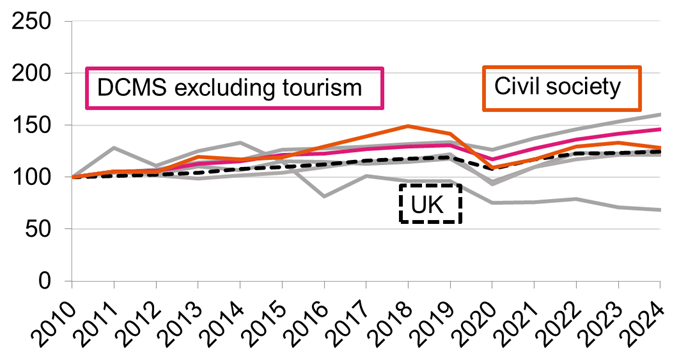
These estimates are based on the non-profit institutions serving households (NPISH) data. This is likely to be an underestimate for the civil society sector as it does not encompass the full spectrum of the sector. The ONS revised NPISH data as part of Blue Book 2025 and these revisions are reflected in our GVA estimates. We now estimate that civil society GVA has fallen from 2019 to 2023, while our previous estimates indicated an increase over this period. Further information on the civil society definition and recent revisions can be found in the technical report.
Note that volunteering, a key element of civil society, has not been included in the figures due to being part of the informal economy. As estimated in the ONS published Household Satellite Account, volunteering contributed £18.0 bn in 2023, the last available year (this includes only formal volunteering activities).
3.4 Creative Industries
The creative industries contributed an estimated £145.8bn in 2024, accounting for 5.5% of UK GVA. The GVA of creative industries increased by 4.6% between 2023 and 2024 leaving it 19.7% higher than pre-pandemic (2019) and 60.3% higher than in 2010, in real terms.
Figure 4. Index chart (2010=100), in chained volume measures (CVM) showing growth of creative industries, from 2010 to 2024.
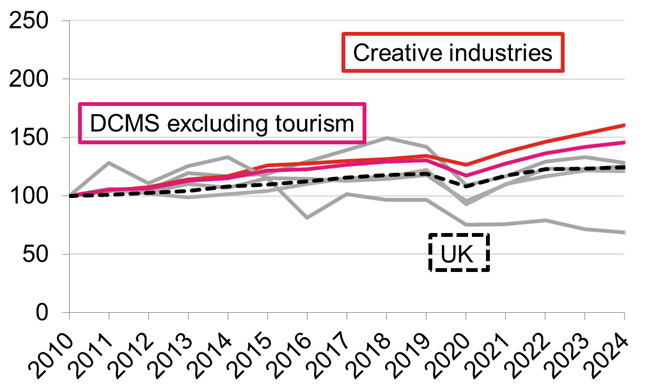
Creative industries GVA increased from 2023 to 2024 by an estimated 4.6%, in comparison to the UK economy as a whole, which grew by 1.0%. In the longer term, from 2010 to 2024 creative industries GVA grew faster than the UK economy (60.3% vs 24.3%).
DCMS has grouped the Standard Industrial Classification (SIC) codes defining the creative industries into nine distinct subsectors, grouped by policy themes. Looking at these subsectors:
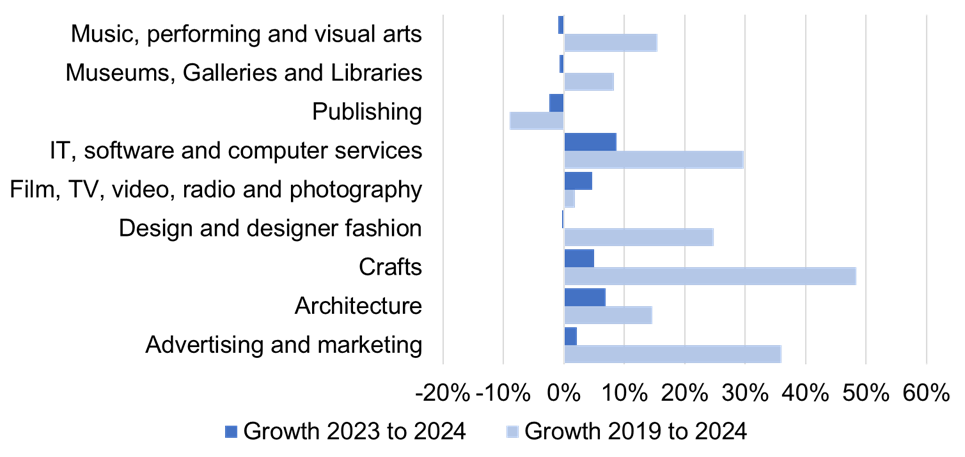
- The increase in creative industries GVA between 2023 and 2024 was driven by the ‘IT, software and computer services’ subsector which grew by an estimated 8.7%, with the next largest positive contributions from the ‘Film, TV, radio and photography’ and ‘Advertising and marketing’ subsectors which increased by 4.6% and 2.1% respectively.
- The largest relative increases in creative industries GVA from 2023 to 2024 were the ‘IT, software and computer services’ subsector, and the ‘Architecture’ subsector, which grew by an estimated 8.7% and 6.8% respectively.
- ‘IT, software and computer services’ is the largest subsector component of the Creative Industries by GVA, contributing an estimated £62.4bn in 2024. It is more than twice the size of the next largest subsector ‘Advertising and marketing’ (£24.3bn).
Figure 5. Growth in creative industries subsectors, in chained volume measures (CVM).
3.5 Cultural Sector
The cultural sector contributed an estimated £40.3bn in 2024, accounting for 1.5% of UK GVA. GVA of the cultural sector increased by 2.4% from 2023 to 2024, leaving it 6.4% higher than pre-pandemic (2019) and 25.4% larger in 2024 than in 2010 in real terms.
Figure 6. Index chart (2010=100), in chained volume measures (CVM) showing change in GVA of the cultural sector, from 2010 to 2024.
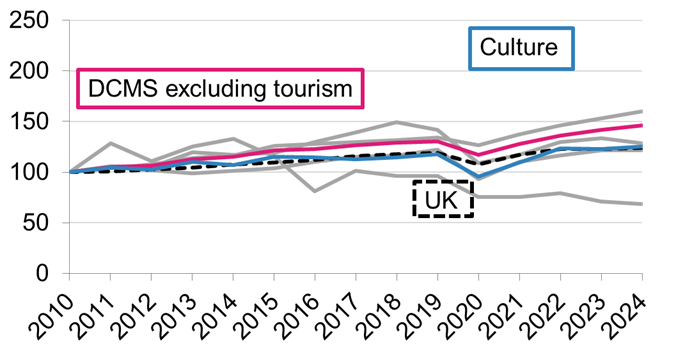
The cultural sector GVA grew by an estimated 2.4% from 2023 to 2024, compared to the UK economy as a whole which grew by 1.0%. In the longer term from 2010 to 2024, culture GVA grew slightly faster than the UK economy (25.4% vs 24.3%).
DCMS has grouped the Standard Industrial Classification (SIC) codes defining the cultural sector into nine distinct subsectors, grouped by policy themes. Looking at these subsectors:
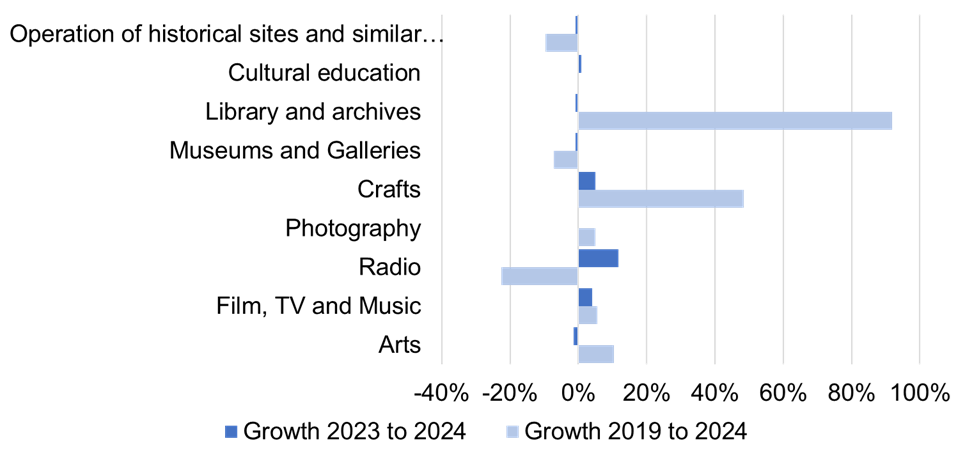
- GVA by five of the nine cultural subsectors fell between 2023 and 2024. The increase in cultural sector GVA was almost entirely due to a 4.1% increase in the ‘Film, TV and Music’ subsector.
- The subsectors that saw the largest relative growth in cultural sector GVA were the ‘Radio’ subsector which grew by an estimated 11.8% and the ‘Crafts’ subsector which grew by an estimated 4.9%.
- The ‘Film, TV and Music’ subsector remains the largest cultural subsector in size economically, contributing an estimated £23.8bn to the UK economy in 2024. It is more than twice the size of the next largest subsector ‘Arts’ (£11.4bn).
Figure 7. Growth in cultural sector subsectors, in chained volume measures (CVM).
3.6 Gambling
Gambling contributed an estimated £5.0bn in 2024, accounting for 0.2% of UK GVA. The GVA of the Gambling sector decreased by 4.0% between 2023 and 2024, in real terms, and was 29.1% smaller in 2024 than pre-pandemic (2019) and 31.7% smaller in 2024 than in 2010, in real terms.
Figure 8. Index chart (2010=100), in chained volume measures (CVM) showing growth of the gambling sector, from 2010 to 2024.
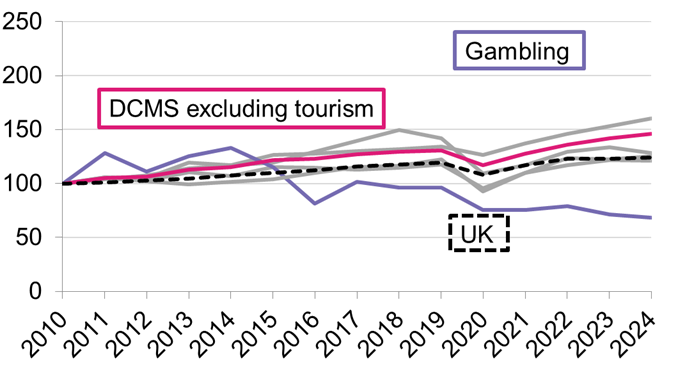
Gambling sector GVA fell from 2023 to 2024 by an estimated 4.0%, while the UK economy grew by 1.0%. In the longer term, from 2010 to 2024, gambling GVA fell by an estimated 31.7% compared to the increasing GVA of the UK economy (24.3%).
It should be noted that the Gambling sector is small, comprising just one two-digit SIC code (SIC 92). Consequently, estimates are prone to sampling variability from year to year (the sector GVA estimates peaked in 2014).
3.7 Sport
Sport contributed an estimated £20.6bn in 2024, accounting for 0.8% of UK GVA. The GVA of the sport sector fell slightly by 0.3% between 2023 and 2024, leaving it 0.8% smaller in 2024 than pre-pandemic (2019) but 21.3% larger in size in 2024 than it was in 2010, in real terms.
Figure 9. Index chart (2010=100), in chained volume measures (CVM) showing growth of the sport sector, from 2010 to 2024.
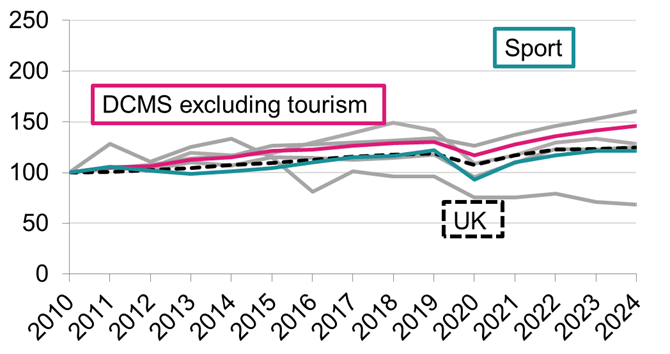
Sport sector GVA is estimated to have fallen by 0.3% from 2023 to 2024, compared to 1.0% growth in the UK economy overall. Over the longer term, from 2010 to 2024, the sport sector grew at a similar, but slower rate compared to the UK (21.3% vs 24.3%).
3.8 Tourism
Tourism directly contributed an estimated £64.3bn in 2024, accounting for 2.4% of UK GVA. Tourism GVA grew by 1.3% from 2023 to 2024.
Figure 10. Index chart (2016=100), in chained volume measures (CVM) showing growth of the tourism sector, from 2016 to 2024.
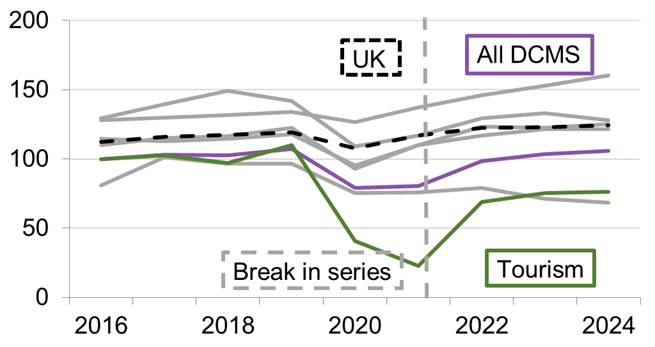
Provisional estimates suggest that the tourism sector GVA increased by 1.3% between 2023 and 2024.
There are limitations when comparing tourism GVA estimates over time and in particular there is a break in the time series in 2022, meaning that estimates from 2022 onwards are not directly comparable with earlier years. This is due to changes in methodology introduced in 2022 to VisitEngland’s Great Britain Tourism Survey (GBTS) which is a critical data source for estimating domestic tourism expenditure and, therefore, tourism direct GVA in the ONS Tourism Satellite Account (TSA), the underlying data source for these estimates. The GBTS survey methodology changed in 2020, however full years of data were not collected in 2020 or 2021 due to the pandemic, and the TSA for these years uses alternative data sources and new modelling techniques. VisitEngland’s Great Britain Tourism Survey (GBTS) is currently labelled as official statistics in development. Further information is available on VisitBritain’s website.
Estimates suggest that tourism GVA in 2024 is 30.6% lower than in 2019 and 23.7% lower than in 2016. However, we do not know how much of this drop is due to the sector being particularly affected by the pandemic, or due to the changes in methodology to the underlying VisitEngland data.
Figures for the tourism sector are only available from 2016.
Tourism also differs from other sectors in that it uses a satellite account approach (DCMS also published a Sport Satellite Account, but this is not included in the overall DCMS definition, which includes a narrower definition of sport) that attempts to calculate the percentage of economic activity, across all UK sectors, that is directly attributable to tourism.
4. Further information
GVA is a measure of the increase in the value of the economy due to the production of goods and services. Its relationship to GDP is as follows:
GVA = GDP + Subsidies - Taxes
GVA is measured either at:
- current basic prices (‘nominal GVA’), which give the best ‘instantaneous’ measure of the value to the economy, but are not adjusted for the effect of inflation.
- chained volume measures (‘real terms GVA’), where the effect of inflation is removed.
The accompanying data tables consist of current prices and chained volume measures for DCMS sectors and subsectors from 2010 to 2023 (provisional), and a GVA index expressed in chained volume measures.
We use current prices to report current sector estimates and chained volume measures for any comparisons over time.
Although TSA revisions in 2025 have improved the comparability of data in some cases, there are still limitations when comparing tourism GVA estimates over time.
In particular there is a break in the TSA time series in 2022, meaning that estimates from 2022 onwards are not directly comparable with earlier years. This is due to changes in methodology to VisitEngland’s Great Britain Tourism Survey (GBTS) which is a critical data source for estimating domestic tourism expenditure and, therefore, tourism direct GVA in the ONS TSA, the underlying data source for these estimates.
The GBTS survey methodology changed in 2020, however full years of data were not collected in 2020 or 2021 due to the pandemic, and the TSA for these years uses alternative data sources and new modelling techniques. VisitEngland’s Great Britain Tourism Survey (GBTS) is currently labelled as official statistics in development. Further information is available on VisitBritain’s website.
As a result, we advise caution when comparing data for tourism and DCMS sectors overall (including tourism) for 2022 onwards with earlier years. It is not possible to separate out the impact of changes in methodology to the underlying VisitEngland data and therefore we do not know how much the trends we are seeing are driven by these methodological changes.
Changes have also been made to the International Passenger Survey (IPS), another data source used in the TSA, in 2024. We are working with ONS to understand the impact these changes have on the TSA.
For this publication, we have decided to publish a time series for tourism because these are the best available estimates of tourism GVA at present.
Methodological information on the sector definitions, data sources, derivation of GVA and limitations of the approach can now be found in the accompanying technical report, along with. a summary of alternative economic measures of these sectors that are published elsewhere.
These Economic Estimates: GVA (gross value added) for DCMS Sectors, official statistics were independently reviewed by the Office for Statistics Regulation (OSR) in June 2019. They comply with the standards of trustworthiness, quality and value in the Code of Practice for Statistics, and should be labelled accredited official statistics. Accredited official statistics are called National Statistics in the Statistics and Registration Service Act 2007.
Our statistical practice is regulated by the Office for Statistics Regulation (OSR). OSR sets the standards of trustworthiness, quality and value in the Code of Practice for Statistics that all producers of official statistics should adhere to. You are welcome to contact us directly with any comments about how we meet these standards. Alternatively, you can contact OSR by emailing regulation@statistics.gov.uk or via the OSR website.
The next update to these statistics will be released in winter 2026/27 once the National Accounts have been published. The GVA figures in this report will all be revised in the next annual updates.
DCMS has developed a suite of economic estimates to understand the economic impact its sectors have on the UK economy. In combination with other economic indicators, GVA estimates help build a comprehensive picture of the UK economy, and of the DCMS Sectors’ importance within it.
The responsible statistician for this release is Rachel Moyce. For enquiries on this release, please email evidence@dcms.gov.uk.
For general enquiries contact:
Department for Culture
Media and Sport
100 Parliament Street
London
SW1A 2BQ
For media enquiries contact: 020 7211 2210.