Council Tax: challenges and changes background information
Published 29 October 2026
Applies to England and Wales

© Crown copyright 2026
This publication is licensed under the terms of the Open Government Licence v3.0 except where otherwise stated. To view this licence, visit nationalarchives.gov.uk/doc/open-government-licence/version/3 or write to the Information Policy Team, The National Archives, Kew, London TW9 4DU, or email: psi@nationalarchives.gov.uk.
Where we have identified any third party copyright information you will need to obtain permission from the copyright holders concerned.
This publication is available at https://www.gov.uk/government/statistics/council-tax-challenges-and-changes-in-england-and-wales-march-2026/council-tax-challenges-and-changes-background-information
1. About this release
This release contains statistics relating to challenges and changes across the Council Tax Valuation Lists in England and Wales. It is the latest in the series of annual publications from the Valuation Office (VO) and includes statistics by administrative area from 1 April 2025 to 31 March 2026. Statistics published in this release have been calculated using challenges and changes data extracted from the VO’s administrative database on 31 March 2026.
Following the implementation of the Valuation Operating System (VOS) for Council Tax in 2025, the data source used for this publication has changed. As a result, this release contains summary statistics for the 2025 to 2026 financial year only and does not include time series tables. Statistics on amendments to Council Tax lists are not available in this release. Information on amendments, insertions and deletions to Council Tax lists will be published separately at a later date.
The new data feed continues to undergo assurance and quality assessment for use in the production of official statistics, while improvements to the underlying source data are being made. Consequently, the statistics presented in this release should be regarded as provisional until the data feed and associated processes have stabilised.
This update includes the following tables:
1.1 Challenges in the financial year 2025 to 2026
-
Table CTCAC1.1: Summary of challenges by administrative area in 2025 to 2026
-
Table CTCAC1.2: Summary of informal challenges by administrative area in 2025 to 2026
-
Table CTCAC1.3: Summary of proposals by administrative area in 2025 to 2026
-
Table CTCAC1.4: Summary of appeals by administrative area in 2025 to 2026
-
Table CTCAC1.5: Summary of appeals resolved without a tribunal by administrative area in 2025 to 2026
-
Table CTCAC1.6: Summary of appeals resolved at tribunal by administrative area in 2025 to 2026
The counts shown in all tables are calculated from domestic property data for England and Wales as at 31 March 2026. Counts in the tables are rounded to the nearest 10; counts of zero are reported as “0” and counts fewer than five are reported as negligible, denoted by “[c]”.
If you have any queries regarding this release, please contact us at statisticsvo@hmrc.gov.uk.
2. Background notes
The VO is a part of HM Revenue and Customs. One of the responsibilities of the VO is to provide Council Tax bands for properties in England and Wales. It does not set the level of Council Tax nor collect the tax; these are tasks for local government. Council Tax is a local tax set by local authority districts to help pay for local services. It uses the relative value of properties to determine each household’s contribution to these local services.
The VO has had responsibility for banding properties for Council Tax since the tax was first introduced in 1993. Before 1993, the VO was responsible for the earlier system of domestic rates.
It is the duty of the VO to make sure that each property is correctly assessed and placed in the right band. This ensures that there is a consistent and objective basis on which local authority districts can determine the amount they charge each household in Council Tax. The VO maintains a high level of professionalism when carrying out this duty.
The VO places each property into a valuation band; there are eight bands for properties in England and nine bands for properties in Wales. The valuation band is assigned to a property on the basis of its value at 1 April 1991 for England (for the 1993 Council Tax Valuation List) and 1 April 2003 for Wales (for the 2005 Council Tax Valuation List); this band then determines the amount of Council Tax to be paid. New properties are assigned a band based on what their value would have been on either 1 April 1991 (properties in England) or 1 April 2003 (properties in Wales). The basis of valuation is set down in regulations made under the Local Government Finance Act 1992. Minor updates were made to the initial regulations in 1994 but they have not been changed since.
The following tables show the breakdown of bands for England and Wales:
England
| Band | Value of property (at 1 April 1991) |
|---|---|
| A | Up to £40,000 |
| B | £40,001 up to £52,000 |
| C | £52,001 up to £68,000 |
| D | £68,001 up to £88,000 |
| E | £88,001 up to £120,000 |
| F | £120,001 up to £160,000 |
| G | £160,001 up to £320,000 |
| H | £320,001 and above |
Wales
| Band | Value of property (at 1 April 2003) |
|---|---|
| A | Up to £44,000 |
| B | £44,001 up to £65,000 |
| C | £65,001 up to £91,000 |
| D | £91,001 up to £123,000 |
| E | £123,001 up to £162,000 |
| F | £162,001 up to £223,000 |
| G | £223,001 up to £324,000 |
| H | £324,001 up to £424,000 |
| I | £424,001 and above |
2.1 Challenges
The VO has responsibility for maintaining accurate Council Tax lists. When evidence suggests that a band may be inaccurate, a taxpayer may submit an informal challenge (previously band review). The VO will investigate and, if necessary, change the band. The taxpayer does not have the right to appeal the outcome of an informal challenge.
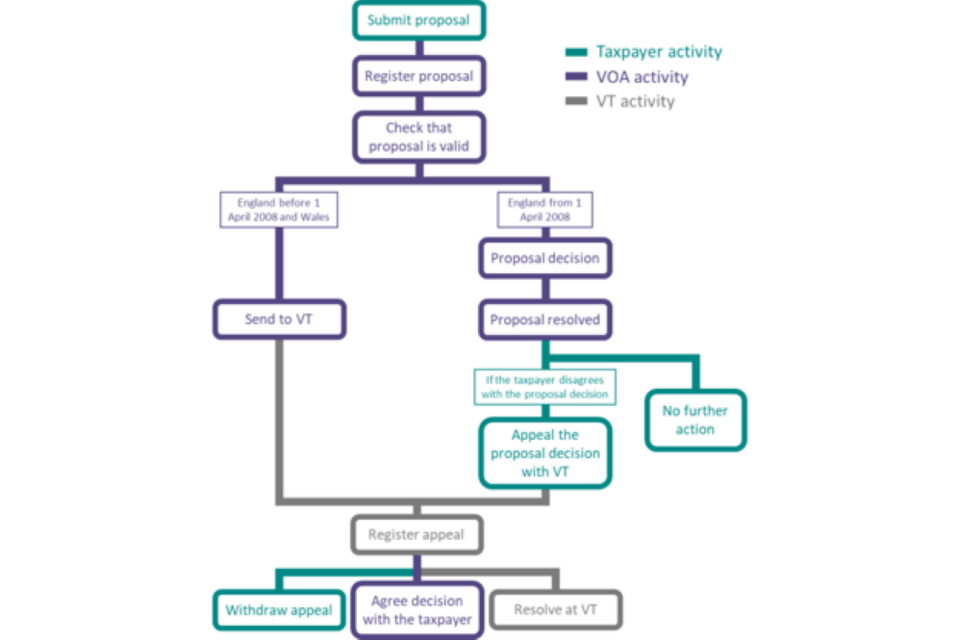
In certain circumstances, set out in legislation, a taxpayer can submit a ‘proposal’ (for example, a new occupier can submit a proposal within the first six months of becoming the taxpayer for their home). If the VO finds that the taxpayer did not meet the criteria required for submitting a proposal, that proposal will be deemed ‘invalid’. If the taxpayer meets the criteria, that proposal will be deemed ‘valid’. The VO will review the band and issue a decision. In both circumstances, if the taxpayer is not satisfied with the decision they have the right to appeal to an independent Valuation Tribunal (VT). Only ‘valid’ proposals are included and counted in this publication.
The proposal system in Wales differs from the system that was introduced in England on 1 April 2008. All proposals received in Wales (or in England prior to 1 April 2008), if unresolved, are automatically transmitted as appeals to Valuation Tribunal Service (VTS) within thirty days of receiving them. Since 1 April 2008 in England, the taxpayer has three months after receiving the proposal decision from VO to appeal it with VTS.
The following infographic illustrates the proposals and appeals process:
2.2 Changes
Changes to the Council Tax Valuation Lists cover all amendments to the Council Tax Valuation Lists as a result of physical changes to a property, changes to the surrounding area or new information being provided.
Challenge outcomes
Each table showing the number of resolved challenges also includes the outcomes of those challenges. Outcomes of a challenge can include:
- a Council Tax band increase
- a Council Tax band decrease
- no change to the Council tax band
- an entry for a property being deleted from a list, e.g. where a property has been demolished
- a list entry may be split into two or more entries, e.g. when a house has been converted into flats
- one or more entries on the list being merged to form a single entry, e.g. when flats are converted to a single property
- a new entry being added to the list, e.g. where a new property has been built
The following table shows the possible outcomes of each type of challenge:
| Challenge type | Band increase | Band decrease | No change to band | Deletion | Split/merger | New entry |
|---|---|---|---|---|---|---|
| Informal challenge | yes | yes | yes | no | no | no |
| Proposal | yes [note 1] | yes | yes | yes | yes | yes |
| Appeal | yes | yes | yes | yes | yes | yes [note 2] |
[Note 1] Whilst band increases as a result of proposals are possible, they rarely take place.
[Note 2] Whilst new entries as a result of appeals are possible, they rarely take place.
Amendments
Note that amendments are not included in this release but will be provided alongside insertions and deletions to the Council Tax lists at a later date.
Amendments may occur either as a result of a challenge, or when a report of a change has been registered with the VO. For example, the VO will register such a report when a property has been altered and then sold. For further information, please visit the VO guidance at: https://www.gov.uk/guidance/council-tax-band-changes.
The bands of properties recorded on the Council Tax Valuation Lists can be changed as a result of: physical alterations made to a property (e.g. extensions or refurbishments); a change to the surrounding area (e.g. a new road built nearby); or from new information that has been brought to light which makes it clear that the original banding was incorrect (e.g. the dimensions of the property are incorrect). As a result, the Council Tax band may increase, decrease or remain unchanged. Property details (e.g. number of bedrooms) may be updated even when the Council Tax band remains unchanged. Amendments may not necessarily occur as a result of a challenge, for example, they may occur when a property has been altered and then sold.
3. Data Information and Methodology
3.1 Updates to previously published statistics
The Valuation Office has moved its Council Tax work onto a new, modern operating system and the data provision for statistics has been updated as part of this work.
The system updates have resulted in some necessary changes in methodology. The way proposals and appeals are recorded has changed in the new system. The old system recorded proposals and appeals together with appeals retaining the registered date of the proposal. The new system records these as separate entities and records both the proposal and appeal registered dates. As such, all appeal statistics relate to appeals registered or resolved within the 2025-2026 financial year. Previous releases included all appeals raised against proposals resolved within the financial year.
Additionally, the date used to determine when an appeal is resolved, and the fields used to determine whether an appeal went to the Valuation Tribunal have changed in the new system. This may lead to some minor differences in the counts.
3.2 Received challenges
Informal Challenges (previously band reviews)
An informal challenge is reported if it was registered on the VO’s administrative system on a date within the given publication period.
Proposals
A proposal is reported using the date it was registered on the VO’s administrative system. Only ‘valid’ (i.e. passed the legal criteria for submitting a proposal) proposals submitted in England from 1 April 2008, or in Wales from 1 February 2026 are reported, with all other ‘valid’ proposals (those submitted in Wales prior to 1 February 2026 or in England prior to 1 April 2008) being recorded in the count of appeals.
Appeals
Appeals are only included in the statistics if the associated proposal was deemed to be ‘valid’ by the VO (i.e. passed the legal criteria for submitting a proposal).
In previous releases, time series tables for appeals showed the number of resolved proposals that were subsequently appealed. As this release only includes statistics for the 2025-26 financial year, appeal statistics are based on the number of appeals received (Table CTCAC1.4) or resolved (Tables CTCAC1.5 and CTCAC1.6) within the financial year.
3.3 Resolved challenges
Challenges are reported as resolved using the date they are recorded as ‘cleared’ in the VO’s administrative system.
3.4 Outstanding challenges
Challenges are reported as outstanding if they have been registered on the VO’s administrative system and have not been resolved.
3.5 Outcomes
Council Tax band increase/decrease/no change
A classification of either ‘increase’, ‘decrease’ or ‘no change’ is determined by comparing the Council Tax band of the property before and after a challenge.
Deleted
A challenge may result in an entry for a property being deleted from the Council Tax Valuation List, e.g. where a property has been demolished. The property will be recorded as inactive and removed from the list.
Split/merger
A property is reported as a split/merger when the number of properties associated with the challenge is different before and after the challenge.
New entry
A property is reported as a new entry if it was not on the Council Tax Valuation List before the challenge. New entries to the list are usually handled by Billing Authority Reports (the taxpayer informs their local Billing Authority of a new entry and the Billing Authority sends a report of that new entry to the VO). Therefore, the number of new entries to the list as a result of challenges tends to be extremely low.
3.6 Assigning geographies
The statistical geographies used in this release have been assigned using the following methodology:
Each property with a Council Tax band held on the VO’s database is assigned to a Billing Authority, each of which have a unique Billing Authority code (BA code). These BA codes have been linked to the codes and names used in the UK statistical geographies maintained by the Office for National Statistics (ONS). For further information on the area codes used in this release, please refer to the ONS Administrative Geography Guidance.
4. Data quality
4.1 Suitable data sources
The information supplied in the tables are based on administrative data held within the VO operational database. Because it is a statutory requirement of the VO to maintain accurate valuation lists, the data are considered accurate. However, while the VO actively seeks to maintain accurate Valuation Lists for Council Tax bandings, some reliance is placed upon the taxpayer to notify the VO of any inaccuracies to their entry in the Valuation List and billing authorities to notify the VO of any changes (including new builds, demolitions or alterations).
There is some uncertainty and variability in this process and all administrative data may be subject to processing and system errors. Consequently, although the VO has made every effort to ensure accuracy of the data underpinning this publication, it is possible that some errors remain. We reflect this by rounding counts to the nearest 10 and suppressing counts lower than 5.
This is the first release of these statistics following the introduction of the new Valuation Operating System and the new data feed continues to undergo assurance and quality assessment while improvements to the underlying source data are being made. Consequently, the statistics presented in this release should be regarded as provisional until the data feed and associated processes have stabilised.
The Valuation Tribunal Service provides regular updates to the VO about appeals raised and resolved. There can be short delays inputting this information onto the VO administrative system. As a result, it is possible that appeals raised or resolved shortly before the data extract date may not be recorded.
4.2 Assured quality
Our quality assurance follows the approach set out in the VO Quality Policy.
As part of the production of this publication, quality assurance takes place:
- during the valuation of properties
- as part of the creation of the data which underpins the publication
- as part of the coding which produces the publication outputs
- as part of automated and manual checks of outputs
- using a comprehensive QA Check List and a QA Issues Log
5. Uses of the data
This publication is being released as part of a drive towards making the VO’s data more accessible as well as continuing to improve, and make more consistent, presentation of information in order to assist users conducting their own analysis of VO data. The data are used to inform government policy and conduct analyses to support the operations of the VO.
The statistics in this publication relate to England and Wales only. Property valuations are not carried out by the Valuation Office (VO) in Scotland and Northern Ireland, where the valuation law and practice differ from England and Wales.
The VO welcomes feedback from users on the information provided in the release. Please forward any comments to statisticsvo@hmrc.gov.uk.
6. CSV metadata
A file which provides the variable names and descriptions appearing in the CSV files is included in this release; it can be found within the CSV zip file on the release page.
7. Timeliness and punctuality
Timeliness refers to the lapse of time between publication and the period to which the data refer. Punctuality refers to the gap between planned and actual publication dates.
This release is usually published on an annual basis. There was a delay to the release of the 2024-25 financial year statistics due to the implementation of the new Valuation Operating System in 2025.
Releases are always published on pre-announced dates at 9:30am. Pre-announcement of the precise date occurs at least four weeks before publication. The VO always pre-announces the month of publication in our 12-month planning schedule.
8. Relevance
Relevance is the degree to which statistical outputs meet users’ needs.
It is important that the statistics produced meet the needs of users, both in coverage and in content. These statistics evolved largely in response to Freedom of Information requests and Parliamentary Questions and were further developed with input from a CT Statistics Advisory Panel, which involved key users of the data.
9. Coherence and comparability
Coherence is the degree to which data that are derived from different sources or methods, but refer to the same topic, are similar. Comparability is the degree to which data can be compared over time and domain, for example, geographic level.
Due to the implementation of the new Valuation Operating System in 2025, there have been changes to the data feed and therefore methodology for these statistics. Consequently, these statistics are not directly comparable to statistics in prior releases. We aim to produce a comparable time series from the new data feed in due course.
10. Accessibility and clarity
Accessibility is the ease with which users are able to access the data, also reflecting the format in which the data are available and the availability of supporting information. Clarity refers to the quality and sufficiency of the release details, and accompanying advice.
The release is available free of charge. All official statistics are made available primarily as Excel spreadsheets with comparable tables in CSV format (see section CSV metadata), a background information document, and a statistical summary document.
11. Confidentiality, transparency and security
Access to the data and release during its publication is limited to the statistics production team only. Occasionally, valuation experts may be consulted as part of the quality assurance process. The list of pre-release recipients is published alongside the release.
Further information on the HMRC Confidentiality and Access policy is published on the GOV.UK website.
12. Further information
More detailed information on Council Tax bands can be found at https://www.gov.uk/council-tax-bands.
The VO blog has further information on Council Tax band challenges.
Timings of future releases are regularly placed on the HMRC [research and statistics calendar](Research and statistics - GOV.UK
Any updates or announcements regarding VO’s statistics can be found on our announcement page.
For further information on the area codes used in this release, please refer to the ONS Administrative Geography Guidance.
13. Glossary
Amendments – amendments are made as a result of: physical alterations made to a property (e.g. extensions or refurbishments), a change to the surrounding area (e.g. a new road is built nearby) or from new information that has been brought to light that makes it clear the original banding was incorrect (e.g. the dimensions of the property are incorrect).
Appeal – where a valid proposal has been made, a taxpayer has the right to appeal against the VO’s decision on the proposal to an independent VT. Appeals are often withdrawn or settled before being heard by the VT.
Band review – now called an informal challenge - a band review is carried out when a potential inaccuracy is brought to the attention of the VO. The VO will investigate the matter and inform the taxpayer of the outcome. The taxpayer does not have the right to appeal the outcome of a band review.
Challenges – these are challenges against the entries in the Council Tax Valuation Lists for England (1993) and Wales (2005), consisting of informal challenges (previously band reviews), proposals and appeals.
Changes – these include any amendments (including those that result from challenges) to the Council Tax Valuation Lists as a result of maintenance changes such as physical changes to the property, changes to the surrounding area or new information being provided. Further details about the circumstances under which a change occurs are included in the changes section.
Deleted – in some cases a challenge may result in an entry for a property being deleted from a list, e.g. where a property has been demolished.
Informal challenge - an informal challenge is carried out when a potential inaccuracy is brought to the attention of the VO. The VO will investigate the matter and inform the taxpayer of the outcome. The taxpayer does not have the right to appeal the outcome of an informal challenge.
New entry – the outcome of a challenge may result in a new entry being added to the list e.g. where a new property has been built.
Property – a separate unit of living accommodation, together with any garden, yard, garage or other outbuildings attached to it, all occupied by the same person(s) and within the same area of land.
Proposals – a formal challenge to a Council Tax list entry. There are limited circumstances under which a proposal can be accepted; for example, a new occupier can make a proposal within the first six months of becoming the taxpayer for their home. In England from 1 April 2008 and Wales from 1 February 2026, the VO will review the band and provide the taxpayer with a written decision, usually within two months; the taxpayer then has up to three months to appeal to a Valuation Tribunal (VT). In England prior to 1 April 2008 and Wales prior to 1 February 2026, the VO transmitted all proposals to the Valuation Tribunal Service (VTS) for appeal within 30 days of receipt.
Split/merger – where a change has been made to a property, a list entry may be split into two or more entries, e.g. where a house has been converted into flats. Conversely, two or more entries on the list can be merged to form a single entry, e.g. where flats have been converted into a single property.
Valuation Tribunal for England (VTE) – this is an independent body responsible for making decisions on Council Tax appeals in England.
Valuation Tribunal Service (VTS) – this is an administrative statutory body which supports the Valuation Tribunal for England and Valuation Tribunal Wales in their work dealing with appeals.
Valuation Tribunal Wales (VTW) – this is an independent body responsible for making decisions on Council Tax appeals in Wales.