International asset recovery
Updated 15 September 2026
Applies to England, Northern Ireland and Wales

© Crown copyright 2026
This publication is licensed under the terms of the Open Government Licence v3.0 except where otherwise stated. To view this licence, visit nationalarchives.gov.uk/doc/open-government-licence/version/3 or write to the Information Policy Team, The National Archives, Kew, London TW9 4DU, or email: psi@nationalarchives.gov.uk.
Where we have identified any third party copyright information you will need to obtain permission from the copyright holders concerned.
This publication is available at https://www.gov.uk/government/statistics/asset-recovery-statistics-financial-years-ending-2021-to-2026/international-asset-recovery
Revision to data and commentary
An error affecting one figure has been identified in recent Asset Recovery Statistics outputs, which has now been revised. Changes made affect the following:
- data relating to the value of proceeds of grand corruption restrained, seized or frozen via civil mechanisms in table 16 of the asset recovery data tables, and
- associated commentary in the International asset recovery section of the Asset recovery statistics: financial years ending 2021 to 2026 publication, specifically in section 2, Grand corruption
All other tables and figures are unaffected.
Data is provided by a Home Office administrative database and from data requested from agencies in Home Office reporting exercises. These statistics are badged as official statistics in development, due to the quality of the administrative datasets which have been used to produce them. Supporting information on known data quality issues with the various data sources used in the bulletin for these statistics are outlined in the User guide to Asset recovery statistics. It should be noted that the Home Office administrative database is a live system and data was extracted in July 2026 for this publication. As case records may be updated after the extract is taken, statistics in future releases may be subject to revision. The administrative database only holds information on cases where the Home Office has been contacted and may not capture all international asset recovery that occurs.
1. Asset sharing
The data presented is provided by a Home Office administrative database and only covers cases where the Home Office has carried out an asset share, therefore not all international asset recovery is captured. This section sets out the value and the volume of proceeds of crime recovered from asset recovery orders with a completed asset share from the financial year ending March 2021 to the financial year ending March 2026 that are:
- executed in England and Wales, or Northern Ireland following the receipt of mutual legal assistance request from another country which resulted in an asset share
- executed abroad following the receipt of mutual legal assistance from England and Wales, and Northern Ireland which resulted in an asset share
In this document, we have defined this as ‘asset sharing’. Within this chapter, the value and volume of proceeds of crime recovered from asset recovery orders linked to grand corruption are not included. Grand corruption statistics are presented in section 2 in this commentary.
The UK engages in asset sharing, which is the division of the funds recovered using asset recovery powers between countries, as a recognition of the joint efforts to recover assets and to encourage further co-operation.
The sharing of confiscated assets is an administrative process between the Home Office and the Government of the requesting or requested country or territory. The usual proportion that is shared is 50:50; however, under certain circumstances the UK may decide to negotiate different proportions, for example, if there are victims involved. Every asset share will be considered on a case-by-case basis.
The statistics presented cover completed asset shares only.
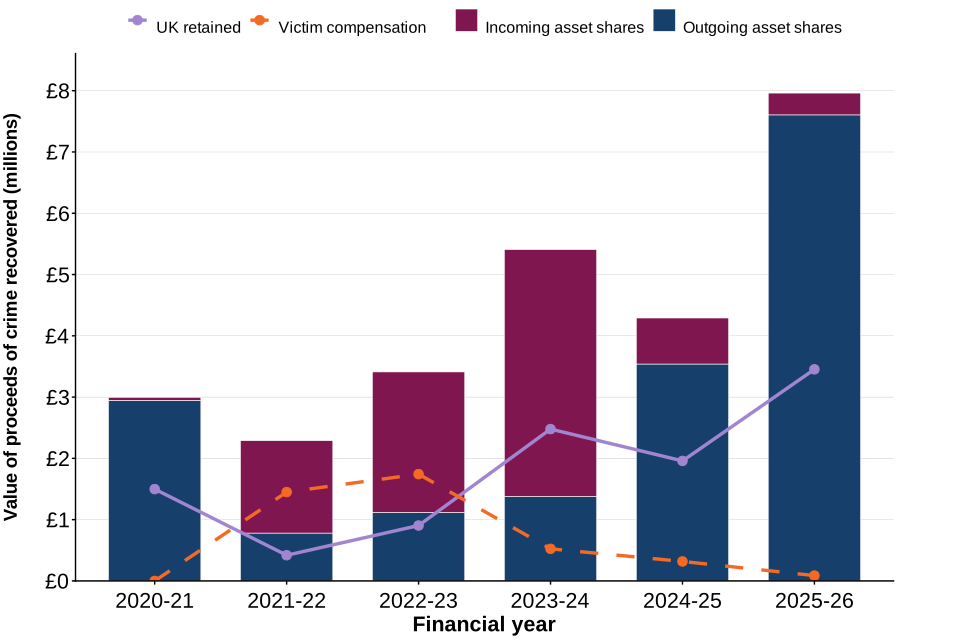
Figure 1: The total value of proceeds of crime recovered and victim compensation which resulted in international asset sharing from the financial year ending March 2021 to the financial year ending March 2026, in England and Wales and Northern Ireland
Source: Home Office
Notes:
- Figures presented for proceeds of crime recovered via international asset sharing is split between value of incoming and outgoing asset shares. Incoming asset shares relate to cases where the UK has recovered assets on behalf of another jurisdiction and has shared the assets. An outgoing asset share relates to cases where a foreign jurisdiction has recovered assets on the UK’s behalf and there has been an asset share.
- The ‘UK retained’ represents the value of proceeds of crime recovered which are retained by the UK government following an asset share.
- ‘Victim compensation’ figures represent funds returned to victims through international asset sharing arrangements.
- Figures presented only capture completed asset shares. There might be other international asset recovery cases where asset sharing did not occur that are not captured within the Home Office database and are therefore not recorded here.
In the financial year ending March 2026, a total of £8.0 million was recovered where an asset share occurred, an 86% increase from the previous financial year, reaching a record high over the 6-year reporting period. The largest asset share recorded in the financial year ending March 2026 was an outgoing request which amounted to £2.5 million. Together with a further outgoing request which resulted in an asset share worth £1.9 million, these 2 high-value orders (£1 million+), accounted for 55% of the total value recovered in the year. In addition, the value of low-value asset shares also increased compared to the previous financial year, indicating that the record level of assets recovered reflected a combination of high volume low-value asset sharing activity alongside smaller number of large asset share cases. The value recovered in the financial year ending March 2026 was more than double the 6-year median of £3.9 million, suggesting performance remains strong and demonstrates the UK’s continued collaboration with other countries and territories.
The increase in the value recovered in the financial year ending March 2026 was primarily driven by outgoing asset shares, which accounted for £7.6 million (96%) of the £8.0 million recovered through asset sharing. Incoming asset shares accounted for the £356,000 (4%). Compared with the previous year, the value of outgoing asset shares more than doubled from £3.5 million to £7.6 million, while the value of incoming asset shares decreased by 53%, from £751,000 to £356,000. This reflects the impact that a small number of high-value outgoing asset share cases can have on the total value recovered through international cooperation in a given year.
This increase compared to the previous year was also reflected in the amount retained by the UK government, with £3.5 million retained by the UK government in the financial year ending March 2026, a 76% increase from £2.0 million the previous year. It should be noted that the value retained by the UK is partially dependent on the value recovered in that year and whether there are identifiable victims to compensate.
The total value of compensation paid to victims through international cooperation decreased by 57% from £327,000 in the financial year ending March 2025 to £140,000 in the most recent financial year. Compensation payments can fluctuate considerably between years as they are dependent on the availability of recoverable assets and the number and value of cases involving identifiable victims. See table 15 of the Asset recovery statistics, financial years ending 2021 to 2026: data tables for more information.
Across the relevant 6-year period operational agencies in England and Wales and Northern Ireland there has been increased cooperation with a growing number of jurisdictions. In financial year ending March 2026, the UK agreed its first asset share with Ghana. To date the UK has completed asset shares with the following countries or territories: Australia, Barbados, Belgium, Cayman Islands, Cyprus, Czechia, Denmark, France, Germany, Ghana, Guernsey, Isle of Man, Italy, Jamaica, Jersey, Liechtenstein, Luxembourg, Malta, Netherlands, New Zealand, Romania, Spain, Switzerland, and the United States of America.
2. Grand corruption
The data presented is taken from administrative databases, managed by the Home Office, supplemented with data requested from agencies in a reporting exercise conducted by the Home Office. The statistics presented will only represent those agencies which have provided a return for this reporting exercise and not necessarily the entire group of agencies who engage in this work.
Users should be aware that the grand corruption figures presented in this publication may include revisions to data submitted by agencies in previous years. These corrections are applied retrospectively to improve accuracy. For this reason, users are advised not to compare grand corruption data across publications. Supporting information on the methodology and limitations of grand corruption data, as well as details on experimental statistics can be found in the User guide to Asset recovery statistics.
This section sets out, from financial year ending March 2021 to financial year ending March 2026, the value of:
- proceeds of grand corruption restrained, seized or frozen via criminal mechanisms
- proceeds of grand corruption restrained, seized or frozen via civil mechanisms
- proceeds of grand corruption recovered via criminal mechanisms
- proceeds of grand corruption recovered via civil mechanisms
- proceeds of grand corruption returned to foreign government following UK law enforcement action
Including grand corruption cases that are:
- executed in England and Wales, or Northern Ireland
- executed abroad following receipt of a mutual legal assistance request from England and Wales, and Northern Ireland
- executed in England and Wales or Northern Ireland following the receipt of mutual legal assistance from another country
There are several routes that can be taken in order to pursue asset recovery cases that are related to grand corruption. Within this section, assets that are recovered outside of Proceeds of Crime Act 2002 (POCA) via Deferred Prosecution Agreements (DPAs) under the Crime and Courts Act 2013 are presented as a separate sub-section. This is to recognise the extensive work that law enforcement agencies engage in to combat grand corruption, which can mean utilising different legislation where appropriate.
The proceeds of grand corruption obtained by POCA orders, executed in England and Wales, or Northern Ireland are a subset of the asset denial and asset recovered statistics outlined in previous chapters.
Grand corruption is often defined as acts of corruption involving the misuse or abuse of high-level entrusted power by senior public officials as defined by reference to the United Nations Convention Against Corruption (UNCAC). Grand corruption threatens political stability and sustainable development. Acts that might fall into this category include bribery of public or private officials, embezzlement, illicit enrichment, abuse of function or the laundering of the proceeds of crime.
Users should note figures presented for proceeds of grand corruption restrained, seized and frozen can relate to ongoing investigations which means no further information can be shared. These cases have been identified at an early stage in the process as cases where agencies intelligence suspects assets derive from grand corruption cases involving foreign states.
For clarity this section has been split into grand corruption cases pursed under POCA and grand corruption cases pursued under the Crime and Courts Act 2013 (DPAs).
2.1 Grand corruption cases pursued under the Proceeds of Crime Act 2002
Table 1: Proceeds of crime denied via criminal and civil routes under POCA from international grand corruption cases, from the financial year ending March 2021 to the financial year ending March 2026, in England and Wales and Northern Ireland
| Financial year | Total value of proceeds of grand corruption denied via civil routes (millions) |
Total value of proceeds of grand corruption denied via criminal routes (millions) |
|---|---|---|
| 2020 to 2021 | £3.3 | £96.4 |
| 2021 to 2022 | £285.2 | £48.4 |
| 2022 to 2023 | £244.1 | £39.2 |
| 2023 to 2024 | £2.5 | £11.3 |
| 2024 to 2025 | £2.3 | £33.6 |
| 2025 to 2026 | £335.4 | £64.2 |
Source: Home Office, NCA ICU, NCA IACCC, SFO and CPS
Notes:
- Table 1 may not include the total value of the proceeds of grand corruption since there may be other agencies that have completed grand corruption work that has not been captured in this exercise.
- The value of proceeds of grand corruption denied refers to those restrained, seized, frozen or using other mechanisms to stop an individual accessing their assets. The value presented only reflects the value that was restrained, seized, frozen (either under civil or criminal mechanisms) under POCA legislation.
- The value of proceeds of grand corruption denied via civil routes relates to civil freezing and seizure powers.
- The value of proceeds of grand corruption denied via criminal routes relates to restraint orders.
In the financial year ending March 2026, the total value of the proceeds of grand corruption denied via criminal mechanisms, under POCA, was £64.2 million, which is a 91% increase compared to the previous financial year (£33.6 million) and 47% higher than the 6-year median (£43.8 million) for this reporting period. The increase seen compared to the previous financial year was predominantly driven by high-value restraint orders. Following a peak of £96.4 million in the financial year ending March 2021, the value of proceeds denied using criminal mechanisms under POCA generally declined until the financial year ending March 2024, before increasing substantially over the subsequent 2 financial years to reach £64.2 million in the financial year ending March 2026.
Since the financial year ending March 2021, £872.8 million has been denied via civil mechanisms under POCA. In the financial year ending March 2026, £335.4 million of proceeds of grand corruption were denied, representing the highest value recorded during the 6-year reporting period and accounting for almost 40% of civil grand corruption proceeds value denied across the period. Following relatively low levels of asset denial recorded in the financial years ending March 2024 and March 2025, the substantial increase in the latest year reflects a small number of exceptionally high-value cases. As a result, the value of assets denied through grand corruption cases can fluctuate considerably from year to year depending on the timing, progression and scale of individual investigations.
Table 2: Proceed of crime recovered via civil and criminal routes under POCA from international grand corruption cases, from the financial year ending March 2021 to the financial year ending March 2026, in England and Wales and Northern Ireland
| Financial year | Total value of proceeds of grand corruption recovered via civil routes (millions) |
Total value of proceeds of grand corruption recovered via criminal routes (millions) |
|---|---|---|
| 2020 to 2021 | £0.3 | [no data] |
| 2021 to 2022 | £18.4 | £43.4 |
| 2022 to 2023 | £36.4 | £93.5 |
| 2023 to 2024 | £0.2 | £55.3 |
| 2024 to 2025 | £2.0 | £0.1 |
| 2025 to 2026 | £2.6 | £0.8 |
Source: Home Office, NCA ICU, NCA IACCC, SFO and CPS
Notes:
- The value of proceeds of grand corruption recovered is based on the total proceeds of crime recovered from forfeiture orders, confiscation orders, civil recovery orders and settlements under POCA legislation
- Table 2 may not include the total value of the proceeds of grand corruption since there may be other agencies that have completed grand corruption work that has not been captured in this exercise.
The total value of the proceeds of grand corruption recovered, under POCA, in the financial year ending March 2026 was £3.4 million.
Compared with the financial year ending March 2025, the value recovered via criminal mechanisms in the financial year ending March 2026 increased by nearly 10-fold from £77,000 to £766,000. Despite this increase, the value recovered was down by 97% compared to the 6-year median of £22.1 million and remained considerably lower than the values in the financial years ending March 2022 to March 2024, when annual recoveries ranged from £43.4 million to £93.5 million.
Within the financial year ending March 2026, £2.6 million was recovered via civil mechanisms, representing a 35% increase compared with the previous financial year (£2.0 million). For the most recent year, bank forfeiture orders accounted for 95% of the amount recovered, followed by cash forfeiture orders which accounted for the remaining 5%. See table 16 of the Asset recovery statistics, financial years ending 2021 to 2026: data tables for more information.
2.2 Asset return
Asset return refers to the process by which the proceeds of corruption are returned to their prior legitimate owner or to compensate the victims of the crime. The UK, as a signatory to the UN Convention Against Corruption is obligated to return funds where the conditions for mandatory return are met; however, the UK also exercises its discretion to return funds in appropriate cases when it is not otherwise mandated (in line with Article 57(3)(c) of the Convention).
The UK’s process for returning assets is set out in the UK’s Framework for transparent and accountable asset return. There are other ways to return assets, including court ordered compensation within DPAs, if the Crown Court recognises that there are victims. Asset return can take a substantial amount of time due to the complex nature of international cases.
Figure 2: The total value of proceeds of grand corruption returned to foreign countries from the financial year ending March 2021 to the financial year ending March 2026, in England and Wales and Northern Ireland

Source: Home Office, NCA, SFO, CPS
Notes:
- The figures presented only capture cases where data has been provided by agencies and the Home Office database, there may be grand corruption cases that are not captured and are therefore not recorded.
- The value of proceeds of grand corruption returned to foreign government is based on the total amount transferred to the foreign state and presented in the financial year the funds were transferred.
- A substantial proportion of the proceeds of grand corruption returned to foreign government will relate to proceeds of grand corruption restrained, seized or frozen in previous financial years. Proceeds of grand corruption that were restrained or seized may be subsequently released or returned to the individual if their legitimacy is subsequently proven.
- The data presented only refers to the value returned under UNCAC not via other alternative methods.
In the financial year ending March 2026, no proceeds of grand corruption were returned to foreign governments. This does not necessarily indicate a lack of activity, rather, it reflects that no cases reached completion during the reporting period. As shown in figure 2, similar fluctuations have been observed throughout the time series, with asset returns ranging from zero in some years to substantial returns in others. This reflects the fact that asset return is often dependent on lengthy and complex processes that can span multiple years before cases are concluded.
2.3 Deferred prosecution agreements
As mentioned above, there are other routes outside of POCA that can be utilised in order to tackle grand corruption, including but not limited to Deferred Prosecution Agreements (DPAs) under the Crime and Courts Act 2013. This is the second year that mechanisms outside of POCA have been highlighted separately and continues the UK’s ongoing commitment to transparency.
A DPA is an agreement that is reached between a prosecutor and an organisation that could otherwise face criminal prosecution, subject to the approval and supervision of a judge. The agreement allows a prosecution to be suspended for a defined period, provided the organisation meets certain specified conditions. DPA’s only apply to organisations and cannot be entered into by individuals. The terms of a DPA may include the payment of a financial penalty, disgorgement of profit and court ordered compensation for victims.
DPAs offer several benefits. They can facilitate cross border cooperation, in both evidence gathering and reaching settlements that reflect the damage that occurred. In addition, DPAs help protect innocent stakeholders (employees, suppliers, pensioners) from the fallout of corporate wrongdoing.
DPAs also require companies to implement robust compliance programmes and undergo monitoring. This allows organisations to improve their internal controls and strengthen institutional standards thereby reducing the likelihood of future misconduct. Furthermore, DPAs incentivise companies to self-report misconduct and cooperate with investigations which leads to further evidence gathering which is needed in these complex corruption cases. Overall, this demonstrates the range of powers available to UK law enforcement agencies to disrupt criminal activity.
Under DPAs related to grand corruption there was £103.3 million in payments agreed under DPAs for 2022 to 2023.
3. International settlements
This is the second iteration of the annual statistical bulletin which includes international settlements. They have been added to provide further transparency on cases which have an international nexus.
3.1 Background
As outlined in this publication, there are several routes that can be taken to recover assets under POCA, including confiscation orders (Crown Court), civil recovery (High Court) and Civil Forfeiture (Magistrates Court). Certain agencies (NCA and HMRC) can also conduct tax assessments in relation to income, gains and profits arising as a result of criminal conduct. These powers are exercised in the public interest by calculating the best route to contribute to the reduction and disruption of crime.
The Secretary of State (Home Office), the Treasury, the Attorney General and Advocate General for Northern Ireland have issued guidance to the relevant authorities in the UK on the use of asset recovery powers in the Proceeds of Crime Act (POCA), including reaching settlement with defendants.
This guidance sets out a non-exhaustive list of circumstances where it might be more feasible to pursue a non-conviction-based outcome, including where assets are located in the UK, but the criminality has taken place outside the jurisdiction.
3.2 International settlements
The guidance also confirms that a relevant authority may agree to accept by way of a settlement a reduced sum in satisfaction of a civil recovery claim, if satisfied that:
- the sum is reasonable, having regard to all relevant circumstances including the chances of recovering the full amount claimed and the time and public funds likely to be expended in attempting to do so
- accepting the reduced sum would not damage public confidence
Settlements are defined as a voluntary agreement between law enforcement agencies and the individual suspected of benefitting from criminal conduct. The terms of a settlement, often outlined in a Consent Order, must be agreed by both parties and a Judge in the High Court or a Magistrate in the lower courts.
Settlements can be used as an alternative method to traditional asset recovery for depriving individuals of their suspected proceeds of crime. They are used to resolve investigations potentially at an earlier stage without the time and expense associated with a trial. While unlawful conduct is at the centre of POCA, settlements do not constitute a finding of guilt in respect of a specific criminal offence. The primary aim is to recover property, from those involved in unlawful conduct as efficiently as possible and in a manner which maintains public confidence. In terms of harm reduction, the real value of pursuing the proceeds of crime comes from the disruptive effect it has on serious organised crime, aiming to derail how these groups benefit from criminality and preventing further crimes taking place. This disruptive effect may make an early settlement more attractive, as it can secure the recovery of property by removing the risk of a case going to trial.
The UK is often seen as an attractive jurisdiction for laundering the proceeds of crime with criminals from other jurisdictions particularly buying expensive property portfolios in central London. Due to this, an increasing number of investigations involve an international element. As outlined in the User guide to Asset recovery statistics under section 4.1, there is a variety of legal conventions that encourage states to assist each other.
Every investigation is commenced with the intention of recovering the maximum amount of the proceeds of crime. However, due to uncertainties inherent in litigation, evidential gaps and limited resourcing civil proceedings should be considered including early settlement.
For the purposes of this publication, we have included the value of international settlements that were agreed between 1 April 2024 to 31 March 2026. It only includes settlements where one of the following applies:
- the investigation originated within England and Wales and Northern Ireland with mutual legal assistance provided from another country
- the investigation originated from another country with mutual legal assistance provided by England and Wales and Northern Ireland
- investigation originated within England and Wales and Northern Ireland with an international nexus
The data and information presented was provided by the NCA after a data collection exercise was completed. The data provided therefore only represents settlements agreed by the NCA and may not include all settlements agreed between 1 April 2024 to 31 March 2026.
None of the settlements included within this publication represent a criminal finding or admission of guilt.
Table 3: International settlements agreed from the financial year ending March 2025 to the financial year ending March 2026, in England and Wales and Northern Ireland.
| Financial year | Total estimated value of settlements (millions) |
Number of settlements |
|---|---|---|
| 2024 to 2025 | £26 | 2 |
| 2025 to 2026 | £55.2 | 3 |
Source: Home Office, NCA
Notes:
- The figures presented only capture cases where data has been provided by the NCA, there may be settlement cases that are not captured and are therefore not recorded.
- Values represent the total estimated settlement amount for that financial year and maybe subject to change after asset realisation.
Within financial year ending March 2026, there were 3 international settlements agreed by the NCA totalling £55.2 million in recoverable property. This is more than double from financial year ending March 2025 where £26 million was deemed recoverable property following a settlement.
In the financial year ending March 2026, three civil recovery settlements totalling £55.2 million were agreed following NCA investigations into assets suspected to represent the proceeds of trade-based money laundering, unauthorised securities trading and international money laundering activity. The cases involved the movement and investment of funds through UK bank accounts, property and other high-value assets, which were suspected to be linked to criminal conduct overseas.
Figures for international settlements reflect amounts agreed between the parties for that financial year and are still subject to final recovery. Recovery work is currently under way to realise the assets included in the settlements.
4. About these statistics
Future releases of this statistical publication are pre-announced on the statistics release calendar on the GOV.UK website. The accompanying User guide to Asset recovery statistics provides information on the different data sources used and the processes for this statistical release, as well as other statistical information about the Bulletin.
Tables and data
Asset recovery statistics, financial years ending 2021 to 2026: data tables provides 6-year time-series data for each POCA Power, ARIS allocations, data collected by the Home Office on the use of ARIS, cryptocurrency and proceeds of crime from international cooperation. Tables 15 and 16 within this dataset contain information regarding international asset sharing and grand corruption.
Feedback
Home Office is keen to receive feedback on its statistical publications to maintain their relevance for users.
Any feedback should be directed to the Asset Recovery Performance team through email: POCAPerformance@homeoffice.gov.uk
Press enquiries for this release should be directed to telephone number: 0300 123 3535.
Other enquiries on these statistics should be directed by email to: CriminalFinancesandAssetRecoveryUnit@homeoffice.gov.uk