Agricultural Land Use in United Kingdom at 1 June 2025
Updated 17 December 2025

© Crown copyright 2025
This publication is licensed under the terms of the Open Government Licence v3.0 except where otherwise stated. To view this licence, visit nationalarchives.gov.uk/doc/open-government-licence/version/3 or write to the Information Policy Team, The National Archives, Kew, London TW9 4DU, or email: psi@nationalarchives.gov.uk.
Where we have identified any third party copyright information you will need to obtain permission from the copyright holders concerned.
This publication is available at https://www.gov.uk/government/statistics/agricultural-land-use-in-the-united-kingdom/agricultural-land-use-in-united-kingdom-at-1-june-2025
This release contains the estimates of land use and crop areas on agricultural holdings in the UK. The notice is compiled using data available at the time of publication.
Results are sourced from the June Surveys run in each country.
The results tables are available at Agricultural Land Use in the United Kingdom. This dataset contains detailed breakdowns for all land use and crop areas, as well as a summary table showing breakdowns by country.
Key points
Agricultural land use
-
The utilised agricultural area (UAA) remained at 16.8 million hectares in 2025 and accounts for 69% of the total area of the UK.
-
The total croppable area is 6.1 million hectares in 2025 and accounts for over a third (36%) of UAA. This shows little change since 2024 and has remained broadly stable over the past decade.
Crops
-
The total area of arable crops saw a 1.1% decrease between 2024 and 2025, falling to just under 4.1 million hectares. This fall was primarily due to a decrease in the area of oilseed crops as well as a fall in other arable crops which together make up almost one quarter of the overall arable crop area.
-
Cereals account for the majority (74%) of the total arable crop area and increased by 1.6%, covering 3.0 million hectares in 2025.
- The area of uncropped arable land decreased by 6.5% to 576 thousand hectares.
-
The area of wheat increased by 9.1% to 1.7 million hectares. This increase is above the 5-year average and has halted a 2-year decline.
-
The area of barley decreased by 9.6% to 1.1 million hectares. This area is below the 5-year average.
-
The area of oilseed crops decreased by 18% to 261 thousand hectares in 2025. Oilseed rape accounts for 92% of this area and fell by 18% to 241 thousand hectares in 2025.
-
Potatoes increased by 7.2%, rising to 127 thousand hectares in 2025.
- In 2025 the total area of horticultural crops increased by 3.5% to 147 thousand hectares. Vegetables and salad for human consumption make up the majority (70%) of this area and increased by 6.7% to 103 thousand hectares in 2025.
Section 1 Detailed results
1.1 Utilised agricultural area
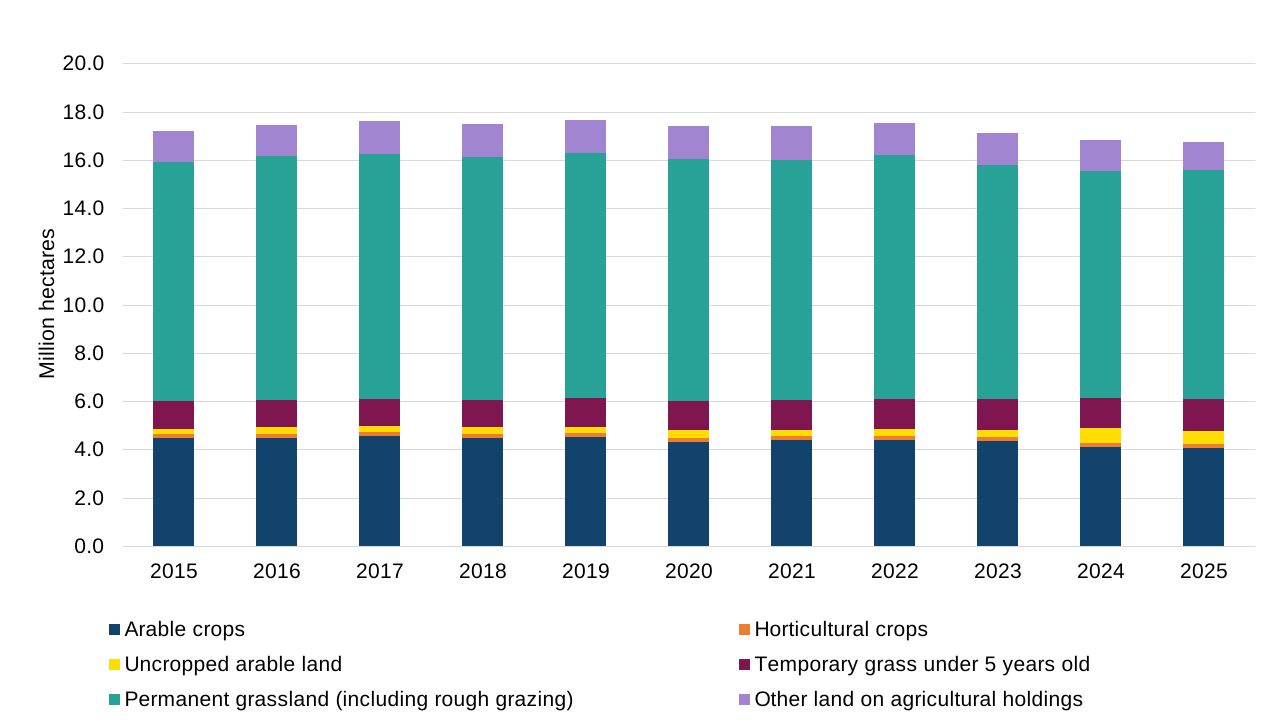
The total utilised agricultural area in the UK remained almost unchanged at 16.8 million hectares in 2025 and continues to account for 69% of the total UK land area.
The utilised agricultural area is made up of all arable and horticultural crops, uncropped arable land including bare fallow and arable land used for environmental benefit, land used for outdoor pigs, temporary and permanent grassland and common rough grazing (Figure 1).
Figure 1: Agricultural land use areas in the United Kingdom at 1 June
1.2 Croppable area
The area of land available for cropping saw a modest decrease of 0.7% to 6.1 million hectares in 2025. This is similar to recent years, sitting a little above the five-year average and the long-term trend indicates overall stability across the past decade. This croppable area represents over a third of the UK utilised agricultural area and consists of cereals, oilseed, potatoes, other arable crops, horticultural crops, uncropped arable land and temporary grassland.
Figure 2 shows that in 2025, the proportion of croppable land used for each purpose remained similar to those in 2024; however, some categories did see value changes. In particular, other arable crops and oilseed crops saw decreases in area, as did uncropped arable land which fell by 6.5%. Cereals, potatoes and horticultural crops all saw increases in 2025, rising by 1.6%, 7.2% and 3.5% respectively.
Figure 2: Total croppable area in the United Kingdom at 1 June
| Year | Cereals | Temporary grass | Oilseeds | Other arable crops | Uncropped arable land | Horticulture | Potatoes | Total croppable area |
|---|---|---|---|---|---|---|---|---|
| 2023 | 51% | 21% | 7% | 12% | 5% | 2% | 2% | 100% |
| 2024 | 48% | 21% | 5% | 12% | 10% | 2% | 2% | 100% |
| 2025 | 49% | 22% | 4% | 11% | 9% | 2% | 2% | 100% |
1.3 Arable crops
The total area of arable crops saw a 1.1% decrease between 2024 and 2025, falling to 4.1 million hectares. This was largely due to a decrease in oilseed crops and other arable crops areas, although this was partially offset by an increase in the total area of cereal crops.
The wheat area increased by 9.1% to 1.7 million hectares in 2025. This is the first increase in wheat area since 2022 but is still lower than the area recorded that year, although slightly ahead of the five-year average. The generally better weather conditions in autumn allowed drilling to proceed without major disruption and aided crop establishment. The barley area decreased by 9.6%, from 1.2 million hectares in 2024 to 1.1 million hectares in 2025. Wet weather in September impacted on the planting of winter barley and is the lowest area since 2020. Spring barley also saw a fall and decreased by 11% to 717 thousand hectares (Figure 3).
The total area of oilseed rape decreased by 18%, from 293 thousand hectares in 2024 to 241 thousand hectares in 2025.
Figure 3: Area of wheat, barley and oilseed rape in the United Kingdom at 1 June (thousand hectares)
| year | 2023 | 2024 | 2025 |
|---|---|---|---|
| wheat | 1,720 | 1,531 | 1,670 |
| barley | 1,137 | 1,194 | 1,080 |
| oilseed rape | 391 | 293 | 241 |
The total potato area increased by 7.2% to 127 thousand hectares in 2025.
Other arable crops covered 688 thousand hectares in 2025, a decrease of 6.0% when compared to 2024. Arable crops for stockfeeding and peas for harvesting dry saw the largest proportional area changes, decreasing by 20% and 32% to 75 thousand hectares and 60 thousand hectares respectively. However, they only account for 20% of the other arable crops area. The biggest area increase within this group was seen by maize, with a rise of 2.9% to 274 thousand hectares which accounts for 40% of the total croppable area.
1.4 Horticultural crops
Horticultural crops covered 147 thousand hectares in 2025, increasing by 3.5% since 2024. This area is mostly used to grow fruit and vegetables, which covered 90% of the total horticultural area.
Figure 4 shows the breakdown of the total horticultural area in 2025. The area of vegetables and salad for human consumption saw an increase of 6.7% between 2024 and 2025 and accounts for 70% of the total horticultural area. Orchards and small fruit together account for a further 20% of the horticultural area with hardy nursery stock and glasshouse accounting for the remaining 10%.
Figure 4: Total horticultural area in the United Kingdom at 1 June
| Year | Vegetables and salad | Orchards | Hardy nursery stock | Small fruit | Glasshouse | Total |
|---|---|---|---|---|---|---|
| 2023 | 69% | 15% | 7% | 7% | 2% | 100% |
| 2024 | 68% | 14% | 9% | 7% | 2% | 100% |
| 2025 | 70% | 13% | 8% | 7% | 2% | 100% |
Section 2 About these statistics
2.1 Data uses and users
- Data on crop areas (both arable and horticultural) help us monitor the long-term trends in cropping. Amongst many other things, this helps us assess the impacts of the abolition of formal set-aside.
- The data will enable us to assess how land areas vary across the UK regions and in different geographic areas (such as the Uplands, National Parks, and River Basin Districts).
- Any changes in the agricultural sector also affect people. For many, it is their livelihood and a way of life.
Results from the England June Survey of Agriculture and Horticulture also have a wide range of uses and users with requests for data being made daily. A document providing information of specific uses and users can be found on our guidance and notes.
2.2 Other survey results and publications
More detailed results from the June Survey can be found on our Structure of the agricultural industry in England and the UK at June web page. This includes various time series of crop areas and livestock numbers dating back as early as 1866 and detailed geographical breakdowns of the results.
The results from the June Survey of Agriculture 2026 in England are expected to be published as follows:
- Cereal, oilseed and uncropped arable land areas and Livestock populations in August 2026.
- Agricultural land use and Agricultural workforce data expected to be available in September 2026.
United Kingdom results are expected to be published in December 2026.
Provisional cereal and oilseed harvest statistics for England are expected to be published in October 2026, with United Kingdom estimates expected in December 2026.
The definitive publication dates for all UK nation releases will be announced on the research and statistics webpage on gov.uk.
2.3 Methodology: June Survey of Agriculture and Horticulture
Data on crop areas and livestock populations are collected in the June Survey of Agriculture and Horticulture carried out by each of the UK agriculture departments. The methodology adopted by each country is below.
England
England results are from the June Survey of Agriculture and Horticulture in 2025. The June Survey of Agriculture and Horticulture has been run predominantly online since 2011, with an option for farmers to complete a paper form if they prefer. The survey is annual and samples around 30,000 holdings most years, with a full census run once a decade. The last census was run in 2021.
The June 2025 survey was sent to a sample of 55,000 commercial holdings and responses were received from 27,000 holdings, representing a response rate of almost 51%. This is a larger sample than usual which will enable us to provide detailed geographical breakdowns later in the year and help to understand changes currently happening within the farming sector, e.g. changes in land use following the introduction of ELM schemes. Commercial holdings are defined as those with more than five hectares of agricultural land, one hectare of orchards, 0.5 hectares of vegetables or 0.1 hectares of protected crops, or more than 10 cows, 50 pigs, 20 sheep, 20 goats or 1,000 poultry.
Table 1 provides details of the sample survey population broken down by farm size. The size of a farm is determined by its Standard Labour Requirement (SLR). i.e. the typical number of full-time workers required on the holding. In the SLR system, each livestock type and land-use has a theoretical amount of labour required each year. This value is multiplied by the land area or livestock numbers and then summed to give the SLR for the holding. For pig and poultry sectors, an additional data collection exercise was run to collect data from a central point for some of the largest companies.
Table 1: June 2025 population size and sampling rate
| Stratum | Description | Sampling rate (%) | Population size | |
|---|---|---|---|---|
| 1 | SLR < 0.5 | 35% | 56,109 | |
| 2 | SLR >= 0.5 and < 1 | 55% | 13,020 | |
| 3 | SLR >= 1 and < 2 | 78% | 12,020 | |
| 4 | SLR >= 2 and < 3 | 78% | 5,652 | |
| 5 | SLR >= 3 and < 5 | 78% | 5,411 | |
| 6 | SLR >= 5 | 78% | 5,710 | |
| 10 | SLR unknown | 97% | 3,968 | |
| All | 52% | 101,890 |
Cattle results are sourced from the Cattle Tracing System (CTS). The data include returns from all holdings with cattle so are not subject to survey error. More information on the use of this administrative data can be found on the survey notes and guidance report
The data are subject to rigorous validation checks which identify inconsistencies within the data or large year-on-year changes. Any records that have not been cleaned by the results production stage are excluded from the analysis.
Population totals are estimated for each question on the survey to account for the non-sampled and non-responding holdings. This survey uses the technique known as ratio raising, in which the trend between the sample data and base data (previous year’s data) is calculated for each stratum. The calculated ratio is then applied to the previous year’s population data to give England level estimates. For holdings where we do not have base data (new holdings or long-term non-responders) the sample estimates are raised according to the inverse sampling fraction.
Cereal and oilseed areas and cattle, sheep and pig populations from the England 2025 June Survey were published on 28 August 2025 and Land use and agricultural workforce data were published on 25 September 2025. All can be viewed on our Statistics about the structure of the agricultural industry web page
More details on the June Survey methodology can be found on the Structure of the agricultural industry: survey notes and guidance web page
Changes to June Survey design
Since the June 2024 Survey of Agriculture, we’ve made changes to how we collect some data, including simplifying the survey form and reducing the number of questions asked. Certain crops are now grouped together instead of being collected separately for example, stock feeding crops, oilseed rape and maize. Consequently, we no longer split oilseed rape into winter and spring varieties. Instead, all figures are now shown under one category, oilseed rape.
Scotland
Final results for Scotland were published by the Scottish Government on 30 October 2025 at: www.gov.scot/collections/june-scottish-agricultural-census
The June Agricultural Census is conducted annually by the Scottish Government’s Rural and Environmental Science Analytical Services division (RESAS). Data are requested from all holdings who submitted a Single Application Form (SAF) in the previous year, together with some other large businesses that would not be eligible for support payments. A sample of smaller holdings which didn’t submit a SAF or who didn’t return a form for the previous census were also sent a census form.
Data for the June census is collected from three sources:
- Land data were extracted from the Single Application Form (SAF) database for holdings that are claiming under the Basic Payment Scheme (BPS).
- All holdings within our sample were sent a census form covering land, livestock and labour. Holdings completing a SAF were not expected to complete section 3 (land area) of the census form.
- All cattle data were collected from the Cattle Tracing Scheme administrative source. Farmers are required by law to register any births, deaths and movements of their cattle to the British Cattle Movement service who maintain an online database. More information can be found online here. By using this data source we effectively have 100 per cent coverage, even for those smaller holdings that were not selected for inclusion in the census.
RESAS categorises all agricultural holdings in Scotland as either a “Main” holding or a “Min” holding. A holding is a “Main” if it meets certain thresholds such as a certain area of land or a certain amount of animals. All “Main” holdings in Scotland are included in the census. The smaller holdings are only surveyed around once every four years to reduce the burden on the smaller farms. Holdings which have not received a form in the past four years are included in the sample.
In 2025, there were 48,330 agricultural holdings in Scotland and within the census 33,927 were selected to complete a census form (the majority of these completed online). Of those who received a request to complete the census 18,818 provided a return, resulting in a final response rate of 55 per cent.
Table 2 below shows the response rates for different types of farms. The first column shows the percentage of holdings that responded. Since some larger farms account for a larger proportion of overall activity or land area in Scotland, the second column shows what percentage of land area, livestock or workforce each category represents. In most cases this is higher than the percentage of holdings, indicating that there is better coverage in the census of larger holdings.
Table 2: Percentage cover of holdings, land area, livestock and workforce for different farm features
| percentage cover of holdings | percentage cover of land, livestock or workforce | |
|---|---|---|
| Total cereals (hectares) | 85% | 96% |
| Arable area (hectares) | 51% | 95% |
| Total crops and fallow (hectares) | 66% | 96% |
| Total sole right agricultural area (hectares) | 54% | 97% |
| Total cattle (number) | 100% | 100% |
| Total sheep (number) | 48% | 73% |
| Total pigs (number) | 30% | 76% |
| Total poultry (number) | 39% | 89% |
| Total working occupiers (number) | 52% | 53% |
| Total employees (number) | 61% | 64% |
| Total agricultural workforce (number) | 53% | 58% |
For further details contact Scottish Government: RESAS Statistics (Agriculture) Email: agric.stats@gov.scot.
Wales
The Welsh population currently stands at around 24,000 active holdings. In 2025 a total of 10,300 farms were sampled. Returns were made both by paper form and online. Online returns comprised 60% of responses received. Final results were based on a response rate of 50%. Final results for Wales were published by the Welsh Government on 10 December 2025 at: https://gov.wales/survey-agriculture-and-horticulture
For further details contact Agricultural & Rural Affairs Statistics, Welsh Government, Cathays Park, Cardiff, CF10 3NQ (telephone: Cardiff 03000 255049). E-mail: stats.agric@gov.wales.
Northern Ireland
In 2025, the Northern Ireland Agricultural and Horticultural Survey was conducted as a full census using online data collection. Data for the pig and poultry sections are also complete censuses extracted from the NI Annual Inventory of Pigs and Update of NI Bird Register respectively. Data for the cattle section was extracted from the Northern Ireland Food Animal Information System (NIFAIS).
Telephone support was provided for farmers who could not complete online and a focussed telephone follow-up of non-responding farms was carried out.
A statistical estimation and imputation methodology was used to create statistics for those who did not provide a return.
A total of 28,370 letters were issued and a final farm register of 25,834 created. Results are based on 15,630 completed questionnaires.
Final results will be published on 11th December 2025 by the Department of Agriculture, Environment and Rural Affairs (DAERA) for Northern Ireland and can be viewed at: www.daera-ni.gov.uk/articles/agricultural-census-northern-ireland
For further details contact DAERA surveys@daera-ni.gov.uk.
2.4: Feedback
We welcome feedback and any thoughts to improve the publication further. Please send any feedback to: farming-statistics@defra.gov.uk.
Section 3 What you need to know about this release
3.1 Contact details
Responsible statistician: Sarah Thompson
Team: Farming Statistics Department for Environment, Food and Rural Affairs
Email: farming-statistics@defra.gov.uk
Tel: 0300 060 0170
3.2 Accredited official statistics
Accredited official statistics are called National Statistics in the Statistics and Registration Service Act 2007. An explanation can be found on the Office for Statistics Regulation website.
Our statistical practice is regulated by the Office for Statistics Regulation (OSR). OSR sets the standards of trustworthiness, quality and value in the Code of Practice for Statistics that all producers of official statistics should adhere to.
These accredited official statistics were independently reviewed by the Office for Statistics Regulation in 2014. They comply with the standards of trustworthiness, quality and value in the Code of Practice for Statistics and should be labelled accredited official statistics.
You are welcome to contact us directly with any comments about how we meet these standards (see contact details). Alternatively, you can contact OSR by emailing regulation@statistics.gov.uk or via the OSR website.
Since the latest review by the Office for Statistics Regulation, we have continued to comply with the Code of Practice for Statistics, and have made the following improvements:
- Reviewed and amended the validation checks carried out on response data including validation against new administrative data sources to better assure ourselves of the quality of the statistics.
- Enhanced trustworthiness by removing pre-release access.