The UK is ready to work across the wider UN membership to ensure emerging technologies help deliver safer seas: UK Statement at the UN Security Council
Statement by Chris Elmore MP, Parliamentary Under-Secretary of State, Foreign Commonwealth & Development Office at the UN Security Council Meeting on Maritime Security
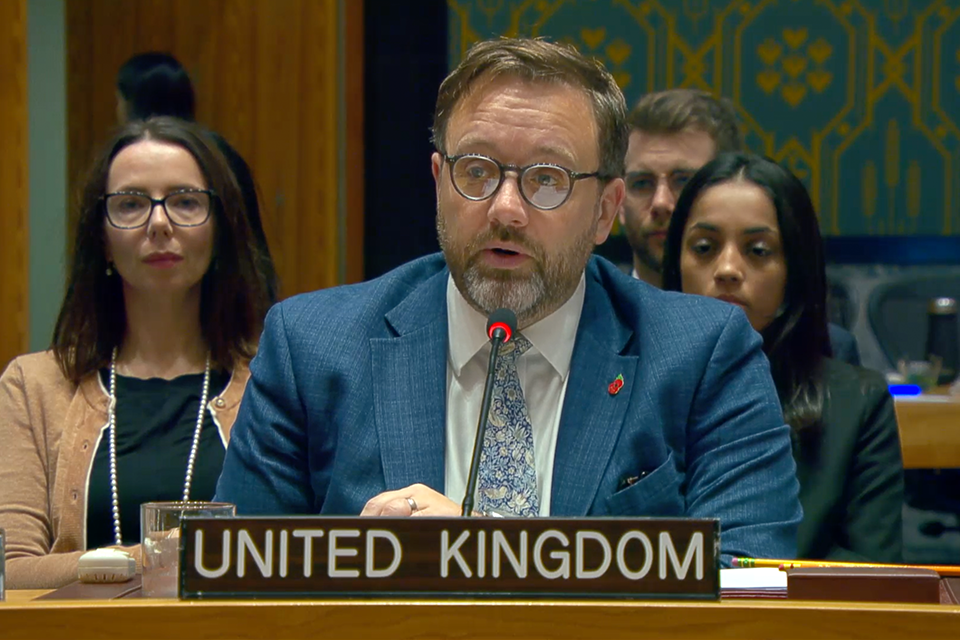
The United Kingdom welcomes this opportunity to consider the implications of emerging technologies for maritime security.
Emerging technologies are transforming our world.
At sea, they offer immense opportunities to improve safety, strengthen maritime domain awareness, and protect the global trade on which all our countries depend.
But these technologies also bring new risks, and we have a collective responsibility to ensure that they are developed and used safely.
The United Kingdom sees three priorities.
First, as ever, states must uphold international law.
Recent events have shown how threats to Freedom of Navigation can have far reaching consequences, disrupting supply chains, driving up costs and affecting food and energy security.
UNCLOS provides the legal framework within which all activities in the ocean and the seas, its primacy must be respected.
States must also protect those at the heart of global shipping: seafarers.
Second, we must ensure that emerging technologies strengthen our security rather than undermine it.
In the maritime domain, these technologies can make ports and shipping more efficient while increasing situational awareness, resilience, and our ability to respond to threats.
As shipping becomes more connected and more digital, the UK is working with the International Maritime Organisation, partners, and industry to ensure emerging technologies are adopted safely and securely.
This year, the International Maritime Organisation adopted the first global, goal-based regulatory framework for remotely controlled and autonomous commercial ships.
The UK is leading work to develop the Maritime Cyber Code, a globally agreed framework to secure the systems and processes connecting the modern maritime sector.
But we cannot ignore the potential for harm.
Technological advances are already changing the nature of conflict.
Uncrewed weapon systems increasingly accessible to state and non-state actors seeking to threaten shipping on, above, and below the water.
As my Foreign Secretary said in this chamber, if we are to realise technology’s potential for good, we must address its risks.
That means rigorous testing and assurance, giving governments the information they need to assess emerging risks, stronger cyber defences, and resilient critical infrastructure.
Third, none of us can address these challenges alone.
When maritime networks are disrupted, the consequences are felt far beyond our seas.
They threaten our shared security and prosperity, and hit the world’s most vulnerable hardest.
We need all countries to speak out against threats to the global maritime domain wherever and however they occur.
We must work together, and with industry, to ensure technological progress delivers for our people.
In the maritime sphere, that also means strengthening cooperation through the International Maritime Organisation, which the United Kingdom is proud to host.
President, the answer to technological change is not to retreat from innovation, but to shape it responsibly.
As our Prime Minister said at the General Assembly, we need to embrace the extraordinary potential of technology to improve people’s lives.
The United Kingdom stands ready to work with Council members, the wider UN membership, industry, and international organisations to ensure emerging technologies help deliver safer seas, more resilient societies, and greater security for all.