Security Minister's speech at the International Security Expo
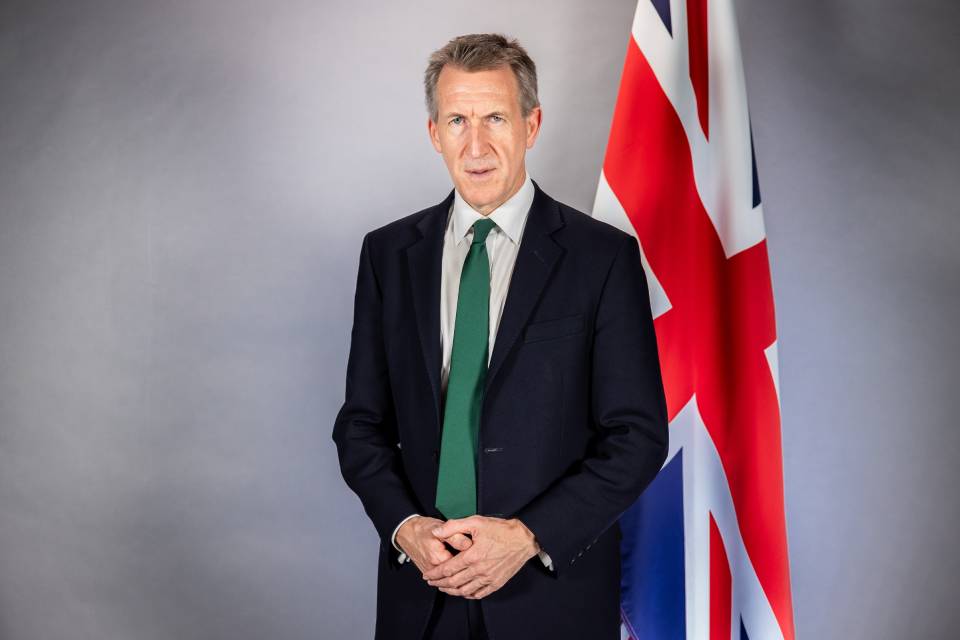
Security Minister Dan Jarvis' speech for the annual International Security Expo on 30 September 2026.
Thank you very much and good morning. It’s a great pleasure to be here and to join you all in this amazing venue.
Believe it or not, today marks 3 consecutive appearances for me at the International Security Expo.
I am hoping, we will see, that it might be third time lucky!
Not that the scheduling gets any easier for me.
It is the third consecutive year I’ve had to explain to colleagues in Liverpool why I couldn’t join them at party conference today.
Fortunately, ‘national security’ remains the most convincing reason available to a Security Minister.
This event has certainly become something of an annual tradition for me.
While the hustle and bustle of party politics carries on in earnest in Liverpool, it means I get to spend important time rubbing shoulders with the robots and drones on display here at Olympia, here in the nation’s capital.
I’ll leave it to you to decide which group is easier to handle.
And just to be absolutely crystal clear, when I refer to robots and drones, that is not a reference to anybody here in this wonderful audience!
I dare say that, unlike at party conference, I’m hopefully less likely to be barracked, or to be accosted by someone dressed as a badger. Anyway, hopefully that will be the case, we will see!
But, seriously, this is an engagement I am always very pleased to keep.
Because every time I attend this event, I leave with a much greater appreciation of the expertise, ingenuity and commitment that exists across the UK’s security sector.
Progress on security legislation
Last year I talked about the range of different threats we face.
Across each of them we are making strong progress, and always striving to do so in close partnership with industry.
At our borders, we have strengthened the Border Security Command and delivered new powers through the Border Security, Asylum and Immigration Act.
Arrests, disruptions and enforcement activity are all up and we have prevented tens of thousands of attempted crossings since the last election.
In March we published the 2026 to 2029 Fraud Strategy, committing over £250 million pounds of investment.
And we have established a new Online Crime Centre, bringing together law enforcement, intelligence agencies, banks, communications providers and technology companies to identify and dismantle fraud networks at scale.
Earlier this year, the government published the Cyber Action Plan.
Backed by more than £210 million pounds of investment, our aim is to strengthen the resilience of public services and improve our ability to respond to cyber incidents, including ransomware.
This will soon be followed by NCAP – the National Cyber Action Plan – bringing industry and the private sector within scope.
Alongside this, the CSRB, the Cyber Security and Resilience Bill, will deliver the most significant update to the UK’s cyber regulatory framework for years.
And in July, the National Security (State Threats) Act 2026 came into force – providing powerful new tools to detect, deter and disrupt those acting on behalf of hostile foreign powers.
In another important step, earlier this year we published the Home Office statutory guidance for organisations in scope of the Terrorism (Protection of Premises) Act.
We know the act as Martyn’s Law after Martyn Hett who, along with 21 other victims, tragically lost his life in the 2017 Manchester Arena attack.
It is a testament to the extraordinary and inspiring courage and leadership of Martyn’s mother, Figen Murray – who I am delighted to see in the audience today after deservedly becoming chair of this expo – and whose campaigning has been absolutely vital in driving the legislation forward.
Figen, thank you for everything that you have done.
As we move towards commencement, we will continue working closely with the private security industry and its regulator – the Security Industry Authority – to support implementation and embed a culture of preparedness across the United Kingdom.
Looking ahead, our focus is also on ensuring the wider regulatory system delivers the protections the public rightly expect.
Earlier this year we saw what effective enforcement looks like with Ofqual restricting an awarding body’s ability to register new learners after serious concerns were identified.
The SIA backed that up with decisive action by removing qualifications from its approved listings, stopping further learner registrations, and ending its relationship with that organisation.
This sends a clear message that the SIA will stamp out malpractice whenever and wherever they find it.
The government also remains committed to recommendations 7 and 8 of the Manchester Arena Inquiry and is reviewing consultation responses, with a formal response to be published as soon as possible.
And the Home Office is working with HRMC, the SIA and the Fair Work Agency to understand what further support we can provide.
Both the SIA and the relatively newly formed Security Guarding Leadership Group – S12 – are represented here today and I encourage those with an interest to go and speak with them directly.
Of course, legislation is only part of the answer.
It is also about developing real-world capabilities.
I’m therefore pleased that in June, I was able to open Europe’s biggest drone testing centre to drive autonomous innovation, support SMEs, boost exports and create jobs.
As the drone threat evolves, so too must our response. That is why we continue to invest in our specialist police counter-drone capabilities.
In April, we also launched the National Canine Training and Accreditation Scheme, providing a single national centre for the accreditation of private-sector explosives detection dog teams.
A reminder that while technology is transforming our sector, some of our most effective security capabilities still run on 4 legs.
And tomorrow, we will launch a public consultation on proposals to strengthen controls under the Poisons Act, including bringing plant toxins into the regime for the first time.
This supports our commitment to respond decisively to the findings of the Southport Inquiry, specifically around strengthening controls where substances present a clear risk.
Last year I also spoke about the importance of moving from developing strategy to implementation and delivery.
The next test, as I see it, is clear: to build out our country’s resilience and sovereign capabilities by leveraging and scaling-up the extraordinary talent and expertise of this sector.
We have all seen how global shocks can expose vulnerabilities and create strategic risks.
That is why this government is placing renewed emphasis on strengthening the sovereign capabilities that underpin both our security and our prosperity.
In April, we launched a £500 million Sovereign AI Fund with a clear message that the UK must be “an AI maker, not just an AI taker”.
The objective is to ensure strategically important AI companies start, scale and remain in the UK, rather than being acquired or moving overseas.
And as the world’s attention shifts dramatically to the risks of AI, I am proud that the UK is home to one of the world’s leading AI Security Institutes.
Earlier this year, the government announced new measures, including the introduction of dedicated National Security Procurement Leads, to leverage some of the annual £400 billion pounds spent on public procurement to strengthen resilience, support British industry and protect critical supply chains.
Because where it is right to do so, government spending should not simply buy capability.
It should also help sustain the skills, technologies, supply chains and industrial capacity that our country relies upon.
The government has already confirmed that British-founded firms have secured billions of pounds of additional public contracts under this approach, helping support jobs, innovation and growth across key sectors of the UK economy.
And there is more we can do.
Because we recognise that technological advantage and industrial resilience are central to our security and economic success.
Artificial intelligence.
Cyber security.
Secure communications.
Counter-drone capability.
Next-generation screening and detection.
Advanced data analytics.
These are strategic capabilities for the United Kingdom.
And many are being developed by businesses right here in this room.
Supporting growth and exports
The numbers, as always, tell a powerful story.
The UK’s security and resilience sector now generates £27.6 billion in annual turnover, supports almost 150,000 jobs, and has grown dramatically over the last decade.
The latest figures for exports reached £12.9 billion in 2024 – accounting for roughly half of all sector revenue – and positioning the UK third globally for market share, after the US and China.
Just as importantly, this is a sector which creates opportunities across the whole country.
More than half of security sector jobs are located outside London, helping drive growth, productivity and prosperity in every region of the UK.
And as Security Minister, I want to do everything to support the continued growth of the sector.
That means creating opportunities both at home and abroad.
The government recognises security as a sector where the UK possesses genuine competitive advantage.
The export statistics demonstrate the trust that partners around the world place in British innovation, British expertise and British standards.
That is why the Home Office is working closely with our diplomatic network to help UK companies compete internationally, as well as with colleagues across BIST – the newly expanded Department for Business, Innovation, Science and Trade.
That support means connecting companies with overseas decision-makers. Encouraging trade missions. And using ministerial and diplomatic engagement to open doors in high-growth markets.
And where fresh opportunities arise, we will always seek to grasp them by bringing together our international partners and our leading security suppliers.
A good example is Morocco’s preparations for the 2030 FIFA World Cup, where the government is supporting British companies compete for billions of pounds worth of contracts across infrastructure and security sectors over the next 3 years.
Where government can help open a door, make an introduction or support a bid, we absolutely will do so.
That is why I’ve recently written out across the diplomatic network to all serving UK Ambassadors and High Commissioners, encouraging each of them to leverage their host country contacts in support of the UK security sector and the annual Home Office Security and Policing event in March, which I know many of you here will be attending and provides another excellent opportunity.
S&P draws in hundreds of exhibitors and thousands of visitors every year, including high-level delegations and buyers from dozens and dozens of countries. As a closed Home Office event, we intend for every part of the Home Office and key government departments and agencies to be represented in order to engage with industry. It is not to be missed.
Before I conclude, I also want to encourage everyone here to spend time engaging with colleagues from across government. And specifically the Joint Security and Resilience Centre.
Known as JSaRC, its purpose is simple.
To listen.
To understand.
And to help create pathways for innovation and partnership.
So please take the opportunity to speak to the JSaRC team.
I want to finish by reflecting on another significant milestone since last year’s expo: the first National Day for Victims and Survivors of Terrorism. An annual event that took place on 21 August and attended by our Prime Minister.
The day was established to honour those whose lives have been changed forever by acts of terrorism, and to ensure their voices remain at the very heart of our national response.
I have to say being at the inaugural ceremony was one of the most humbling experiences of my years in public service.
And it was a reminder – not that any of us in this room needed one – of the single thread that binds us all together.
Ultimately, the goal of every capability that we develop.
Every law that we strengthen.
And every partnership that we build:
Is that together, we protect the people of our country.
Thank you very much.