Professor Akande brings the independence, legal rigour, judgement and breadth of perspective that the Court needs: UK National Statement at the UN General Assembly
Statement by Rt Hon Alex Norris MP, Lord Chancellor and Secretary of State for Justice, on the presentation of the Annual Report of the International Court of Justice.
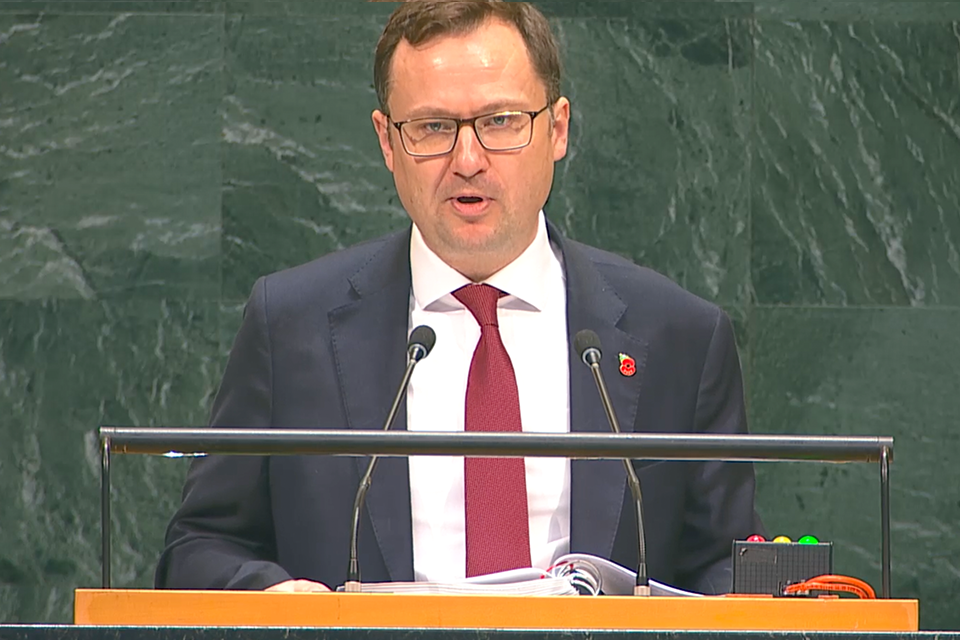
I have the honour to deliver this statement on behalf of the United Kingdom in response to the presentation of the Annual Report of the International Court of Justice.
I thank President Iwasawa for his address and for his leadership of the Court.
And the judges and Registry for their dedicated service to international justice.
This year, we mark the eighth anniversary of the Court’s inaugural sitting.
Established in the aftermath of devastating conflict.
The Court embodies the conviction that the law must provide States with an alternative to coercion and force.
Eighty years later, that conviction remains an urgent necessity.
At a time of conflict, instability and growing pressure on the international legal order.
The Court’s contribution to the peaceful settlement of disputes has rarely been more important.
It enables States mutually to place their disagreements before an independent judicial body to be heard on an equal footing.
And to receive a determination founded in law rather than power.
The sustained demands on the Court demonstrate its impact and importance.
Over a number of years, more States have turned to the Court and participation in its proceedings has grown.
It is crucial, therefore, that it has the resources and capacity to manage that workload effectively.
While maintaining the quality and rigour on which its authority depends.
That is why the United Kingdom’s support is practical as well as principled.
We supported additional resources to meet the Court’s staffing needs and have contributed to the trust fund for its Judicial Fellowship Programme.
Helping young jurists from developing countries to gain professional experience and contribute to the Court’s wider mission.
Investing in the Court’s future also means ensuring that it continues to benefit from judges of the highest calibre.
Drawn from different legal traditions and equipped to address the complex questions before it.
The United Kingdom is therefore proud to support Professor Dapo Akande for election to the Court on 3 November.
The high number of national group nominations, with strong support across every United Nations region, is a reflection of the respect he commands across the international legal community.
At a moment when international law is under pressure.
Professor Akande brings the independence, legal rigour, judgement and breadth of perspective that the Court needs.
He would make a formidable contribution to its work.
As colleagues will know, the United Kingdom has been a steadfast supporter of the Court.
We have accepted its compulsory jurisdiction.
And we again encourage States that have not yet done so to consider accepting the Court’s jurisdiction in accordance with its Statute.
But our support for international justice does not end with this Court.
I am here today to talk about the ICJ, but I must confirm that international institutions must be able to act independently, impartially and with integrity.
And that is why the UK does not support sanctions against the International Criminal Court.
Attempts to impede its work weaken the wider international legal order on which all states rely.
Mr President, back to the ICJ.
For eighty years, the International Court of Justice has helped turn the Charter’s commitment to peaceful settlement into legal reality.
Its enduring significance lies not simply in the disputes it has resolved, but in the fundamental proposition it embodies:
That relations between States must be governed by law, not merely by power.
The United Kingdom will continue to defend that proposition, and to support the Court in carrying out its vital mandate.