Peace cannot be sustainable while half the population is shut out of shaping it: UK statement at the UN Security Council
Statement by Ambassador Kate Foster, UK Deputy Permanent Representative to the UN, at the UN Security Council meeting on Women, Peace and Security.
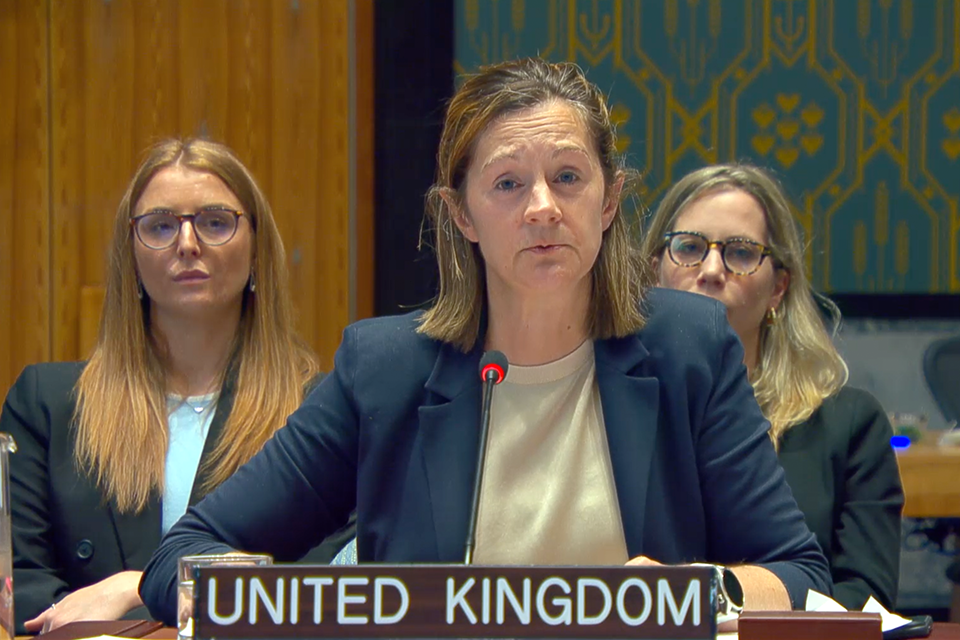
As we have heard today, twenty-six years after the adoption of Security Council Resolution 1325, there remains a profound gap between the commitments we make in this Council and the reality experienced by women and girls in conflict.
We see it across our agenda.
In Gaza, nearly 50,000 women and girls have been killed or severely injured since October 2023.
In Ukraine, women and girls continue to face displacement, violence, and heightened protection risks as a result of Russia’s aggression.
And in Myanmar, the Secretary-General has documented widespread sexual violence alongside severely constrained access to life-saving support.
President, the problem is no longer that we do not know what works.
It is that too often we fail to do it.
I want to highlight three areas where that needs to change.
First, participation must mean real influence.
We welcome the contribution of today’s civil society briefer.
The Council must listen to women, peacebuilders, and civil society.
But listening is not enough. We must act on their analyses and protect those who engage with us from reprisals.
And participation cannot mean bringing women into the room after the important decisions have already been made.
In Afghanistan, for example, women and girls have been systematically excluded from public life and decision-making.
Their voices must be central to discussions about the country’s future.
Peace cannot be sustainable while half the population is shut out of shaping it.
The United Kingdom is backing that principle with practical support.
This March, the United Kingdom committed that by 2030, at least 90 per cent of our bilateral overseas development assistance will have a focus on equality for women and girls, either as a principle or a significant objective.
Last year, we provided approximately $4.6 million to women peacebuilders and women’s rights organisations across fragile and conflict-affected contexts.
This financial year, we will sustain that commitment.
Second, protection must be matched by accountability.
Survivors of conflict-related sexual violence need comprehensive, survivor-centred support, but they also deserve justice.
Yesterday, the United Kingdom announced over $6 million to support survivors of sexual and gender based violence in Sudan, alongside support for human rights defenders documenting atrocities for future prosecutions.
We cannot condemn these crimes year after year while perpetrators believe they can act with impunity.
Accountability matters for survivors, but it also matters for prevention.
Third, we need to confront the ways in which women have been pushed out of public life.
Increasingly, that happens online as well as off.
Digital threats and abuse are being used to intimidate and silence women, creating another barrier to their participation in political and public life.
The United Kingdom has launched an international programme to tackle precisely this form of abuse.
Technology needs to expand women’s ability to participate, not provide new tools to drive them from the debate.
President, women, peace and security is not an optional addition to the work of this council. It goes to the heart of whether the peace we help to build lasts.
26 years after resolution 1325, we do not need another restatement of the case for action.
We have a responsibility now to close the gap between what this Council has promised and what women experiencing conflict actually see.
That means real influence.
That means funding.
That means protection backed by accountability, and ensuring that women can participate safely as the threats against them evolve.v