Home Secretary's speech to NPCC/APCC Summit 2026
The Home Secretary announced around 200 new Local Police Commands will be created across England and Wales in a speech at the annual APCC/NPCC summit.
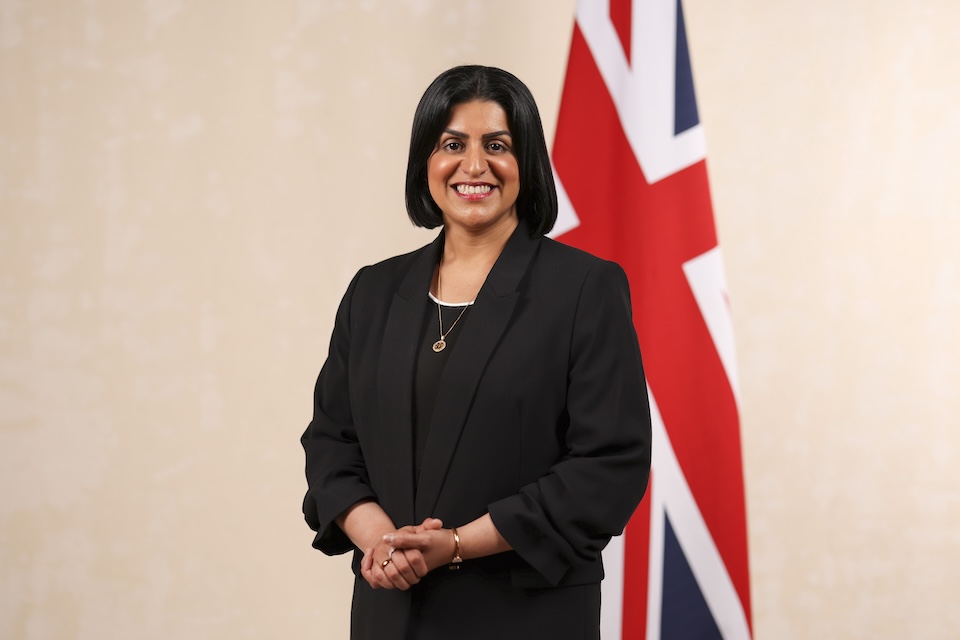
It is a pleasure to join you all today, and it is an honour to pay tribute to the work that you and your forces do.
Every day, your officers are responsible for acts of heroism, too often unremarked and overlooked.
Just a few months ago, I joined a number of officers at 10 Downing Street.
All were nominees for the Police Bravery Awards.
I will never forget speaking to PC Yasmin Mechem-Whitfield, who was there with her mother.
Two years earlier, she had pursued an armed killer through the streets of Hainault, equipped with little more than a taser and PAVA spray.
When she caught up with him, he attacked her with a knife, inflicting life-changing injuries.
But the bravery she showed that day, alongside Inspector Moloy Campbell and PC Cameron King, undoubtedly saved lives.
The same was true of PC Jay Wakefield of Surrey Police, who found an unconscious driver inside a burning vehicle.
Through thick smoke and intense heat, PC Wakefield dragged the man to safety, just moments before the car exploded.
These are the most celebrated stories of heroism, and rightly so. But they are far from the only ones.
In just the last few weeks I received a report on how an off-duty Inspector stopped a stabbing at an underground station.
After getting her own children to safety, the Inspector sprinted towards the attacker and arrested him before enlisting members of the public to help restrain him until officers arrived.
Stories like these happen every day, scarcely noticed and unreported.
But they are not isolated examples.
Instead, they speak to a bigger picture, because something quite remarkable is happening.
For all the talk of lawless Britain, violent crime is at its lowest level since records began in 1981.
Just since this government took office, knife crime is down by 11%, gun crime, by 18%, homicide, by 7%.
And we are finally seeing acquisitive crimes, like shop theft, start to fall.
So, I pay tribute to everyone in this room and to your officers and staff across the country.
Thank you to all of you for your work, because of it we are all safer.
And yet while this is happening, it is also true that trust in policing has been falling.
For years, trust has been high.
Eight in ten have said that the police in their area can be trusted.
That’s a far higher approval rating than any politician could dream of for themselves, but, in the last decade, that story has begun to change.
Trust and confidence have both fallen by 8 and 12 percent respectively.
This matters.
As is so often the case, the Peelian principles say it best:
“The power of the police to fulfil their functions and duties is dependent upon public approval.”
In this country, we police by consent.
Without public trust, that model begins to fray and ultimately breaks.
So those of us in this room must be willing to ask ourselves:
What more can we do to stop this slide?
To do that, we have to understand why that is happening.
I believe the public have three essential expectations of their police.
Firstly, that officers uphold the very highest standards.
Secondly, that the law is applied, to use that old phrase, “without fear or favour”.
And thirdly, that the forces themselves are equipped and able to handle the crime that we face.
Set against those three measures, I think that, despite the everyday acts of heroism, and lower rates of crime, we can identify the cause of falling trust and the action required in order to remedy it.
Let us begin with the question of standards.
The vast majority of police officers are true public servants.
They join because they are called to serve.
Theirs is not just any job – it is the job.
But while this is undoubtedly true of most officers, it is sadly, not true of all.
There were a staggering 16,000 allegations of police misconduct in the year ending March 2025, fully 20 percent more than the year before.
And behind the stats are a series of shocking stories.
These include the 15 officers found guilty of gross misconduct at Charing Cross after the BBC’s Panorama laid bare the appalling culture at the station.
And the “toxic” WhatsApp groups at Cambridgeshire Police, for which a former sergeant has been found guilty of misconduct, 12 other officers have been investigated, and two have been convicted of misconduct in public office.
[Redacted – political content]
This Government is taking action to raise standards:
We have strengthened misconduct procedures, including a presumption of dismissal for gross misconduct, and mandatory suspension for officers charged with domestic abuse or sexual offences.
We have also made vetting a statutory requirement for the first time, giving forces the power to dismiss officers who fail those checks.
These are the tools but it falls on you to use them and, in doing so, to drive misconduct out of your forces.
I know that many of the leaders in this room have been doing so, relentlessly, and I know that that is something that requires personal determination and courage.
I thank you for it because your leadership is vital.
You set a standard that flows downwards and throughout a force.
To have a culture of excellence within policing we need great leadership.
It is for that reason that Lord Blunkett and Lord Herbert’s Police Leadership Commission was so important.
They reported back this summer and I am grateful to them both and to those leaders who contributed to their work.
The report’s conclusions were candid and eye-opening and they cannot be ignored:
Police leadership is inconsistent.
At times, it is frankly inadequate.
What greater illustration is required than the fact that, in July eight serving or former Chief Constables were under investigation for misconduct.
And there was a recent period when one force had three Chiefs because two were simultaneously suspended while under investigation.
These are the consequences of an earlier failure:
The failure to invest in the development of future leaders which left us in the ludicrous position last year of having nine vacancies for Chief Constable with just 23 applicants to fill them.
This Government will address this.
In response to Lord Blunkett and Lord Herbert’s work I can announce today that we will bring new talent into police leadership.
We will do so by introducing a new fast-stream programme from next year which will bring in up to 200 talented recruits each year, from inside and outside policing placing them on a 5 to 10-year path to Superintendent.
This is just the start.
We are considering all of the recommendations made by Lords Blunkett and Herbert and we will publish our full response soon, ensuring all officers and staff, at all ranks, have the highest quality of leadership.
However high our standards, however good our leadership, if the public believe the law is applied differently to different people, trust will inevitably suffer.
So to rebuild trust in policing we must tackle, head on, the corrosive and growing perception of two-tier policing in this country.
Now let me be clear:
I know the vast majority of officers police impartially and that policing without fear or favour is their creed.
But there have been examples of differential treatment and they have harmed policing, allowing some to whip up the false
idea that there is two-tier policing in this country.
Where differential treatment is caused by inconsistencies or a lack of clarity in the law it falls on the Government to remedy that.
We write the laws, you enforce them.
That is why, last year, I commissioned Lord Macdonald to review our public order and hate crime laws.
And we will soon publish that report, alongside the Government’s response.
Where the law is not the issue, but its enforcement, it falls on you to take action.
As a Muslim Home Secretary and a Member of Parliament for one of the most diverse constituencies in this country let no one doubt that equality in policing, and in our forces, matters to me.
None of us can accept the racism and misogyny in our forces that was so flagrantly and repulsively on display at Charing Cross police station.
And it is shameful that, over thirty years after the murder of Stephen Lawrence the proportion of black officers in our forces remains virtually unchanged at not much more than one percent.
But we must also be wary of misguided attempts at course correction, where the pursuit of equality leads instead to differential treatment.
I believe we see this in examples like the old Police Anti-Racism Commitment which was a well-intentioned attempt to address racism that ended up achieving the opposite of its stated goal.
It made statements that are clearly wrong:
To the public, it was patently absurd to tell police officers that fair policing, and I quote: “does not mean treating everyone the same”.
So was the document’s guidance that officers should not be “colourblind”.
I understand what the guidance was trying to achieve.
But the result was a misguided and distortive document that put fire under the idea that this country pursues two-tier policing and so achieved precisely the opposite effect it intended.
I think some forces’ approach to community engagement has stepped further out of the realm of policing, and into the world of politics.
In doing so, they have broken another Peelian maxim:
“Absolutely impartial service to the law, in complete independence of policy.”
Community engagement should mean going to a residents’ association meeting and discussing local issues.
It can be over tea and biscuits, or tea and samosas, but it doesn’t mean engaging with activist groups and campaigners who are pushing their own political agenda.
Learning the shibboleths of different campaigns and relying on single-issue campaigners may have noble intentions but it is a misguided approach.
You serve a community best by protecting it.
To quote Peel’s principles again:
That means “not… pandering to public opinion” but demonstrating “absolutely impartial service” and “complete independence”.
This sounds like common sense because it is.
These principles were true in 1829 and they remain true today.
Confusion has come from over-complexity.
An attempt to stay abreast of intellectual movements that often have their roots on American college campuses which have led us astray do more harm than good.
We need to get back to a common sense approach.
For that reason, I can announce today that I have commissioned the College of Policing to produce a new ‘Impartiality in Policing’ standard.
This will set out exactly what impartiality means in practice such as how to police events, avoiding symbols that might have political connotations, how to do community engagement in the right way, and how to treat offenders and victims without prejudice, favouritism or discrimination.
In short – it will ground policing in the simple principle that we all are equal before the law.
This new standard will be subject to consultation early in the new year.
And I welcome your views on it then.
Now, make no mistake:
There is still work to do on discrimination.
The old hatreds have not gone away.
But the way to tackle them is the same as it has always been:
By policing without fear or favour.
And when it comes to engaging with communities:
Speak to your local residents, do what you can to protect them, but when it comes to political groups:
Leave the politics to the politicians and we will leave the policing to you.
That brings me to the final way in which we rebuild trust.
Your forces need to be set up to succeed.
And I am only too aware that the current system is holding you back.
You are working within force structures that date back to the 1960s.
In the years since then, the world has changed immeasurably.
The impact is now all too clear.
Today our forces, of varying sizes are responsible for local policing, specialist investigations, and often a national policing responsibility too.
Pulled in two or three different directions at once, the result is evident in the experience of people across the country.
More than half the population say they do not see the police in their area.
Some forces lack vital specialist capability, like trained sexual offence investigators, or, as Sir Mark Rowley recently noted, some undertook no undercover work at all last year.
When a serious incident strikes, some forces are unable to respond:
The incident at RAF Fairford drew in every on-duty officer in Gloucestershire.
The recent disorder at Gosport required mutual aid from 13 forces to support Hampshire Police.
As we saw in the Summer of 2024, the dangers are real.
An over-reliance on mutual aid is not enough to stop disorder from spreading across this country.
It is not just in moments of crisis that the cracks in our system are showing.
In this country, where you live determines the policing you get:
A shop theft in one location is three-times more likely to be solved than in the worst performing area.
For residential burglary, that rises to four-times.
And a victim of car theft can be eight-times more likely to get justice, than another victim simply because of where the crime was committed.
The only answer is root-and-branch reform.
To return to Peel again:
“The time has come when we may fairly pronounce, that the country has outgrown her police institutions, the “safest course will be found in the introduction of a new mode of protection”.
We have once again outgrown our old institutions and we must now set up our forces to succeed in today’s era.
My plan for police reform is three-fold.
It begins locally, because it is my firmly held view that local policing is the bedrock of all policing.
Neighbourhood policing is how citizens most often engage with their police.
When it is visible and effective, a sacred bond between officers and their community is built.
Where it is absent, distrust takes root.
Simply putting more money into local policing will not be enough to address this.
Instead, we must reform policing, with a structure that is built from the bottom upwards.
That starts by creating what we will call Local Police Commands.
Across the country, we expect there to be around 200, roughly equivalent to the size of a unitary authority.
This would mean a Command could cover a town like Middlesbrough, or a rural area like Rutland.
In larger authorities, we could have more than one Command, because we always want to preserve the principle that policing will be truly local.
That is because each Command will have a single mission:
To keep its community safe by tackling the crimes that blight everyday life, like antisocial behaviour, burglary, vehicle and phone theft.
Each Command will be led by a named Commander, accountable to the local community and elected officials and both will have a role in setting priorities for the Command.
At the same time, every Command will have to meet standards that are consistent across the country set through a new Local Police Guarantee.
Performance against these will be monitored through a national framework , ensuring every part of the country receives the same, high-quality local policing, so where you live no longer determines the policing that you get.
Above these Commands will sit the next layer of policing: our specialist police services.
These will lead investigations on the most serious and complex crimes.
And so they will guarantee that, regardless of where you live, you will have access to expert policing.
Each will be responsible for delivering specialist functions, like public order, forensics, major crime investigation, firearms and roads policing.
And the administrative duplication that exists across the 43 headquarters will be removed, freeing up thousands of officers to return to neighbourhood policing.
With my apologies to the members of the press who I expect will be watching this with pens hovered over their notebooks I am not here to announce the number of specialist police services that there will be.
We have received the recommendations set out in Lord Hogan Howe’s report and I thank him for it.
There is work now ongoing across Government and outside of it to determine the final number.
The final structure within policing will be our National Police Service.
This new force will be designed to tackle nationwide, and international, threats.
The National Crime Agency and Counter Terrorism Police will, over time, be incorporated into this entity, and responsibility for tackling fraud will also be led by the National Police Service.
The other national responsibilities, littered across the 43 forces today will all be brought under one roof as will all six of the existing national policing entities – like the College of Policing and the NPCC.
By drawing together the best intelligence, technology and expertise the NPS will be a world-class organisation, tackling the most complex and insidious threats that we face.
Taken together, this amounts to the most significant reform to policing, at least since the 1960s, likely since Peel himself.
This will be a police system fit for the challenges posed by our modern world with the potential to make every street in this country safer, and so restoring the trust of the public in their police.
Nearly two centuries ago, Sir Robert Peel established a new model for policing, not based on force or fear but instead, on public consent.
That consent depended upon trust.
Everybody in this room and police officers across the country do so much, every day, to earn that trust.
But as trust begins to fall, we must heed this early warning.
In this speech, I have set out what I think that requires:
A culture set by the highest standards of police leadership.
No tolerance for officer misconduct.
Impartial policing that leaves the politics to me, and the policing to you.
And finally: reformed police forces.
With Local Police Commands that keep every community safe, specialist police services that ensure every crime can be investigated, expertly, anywhere, and a National Police Service that protects us all.
Trust is earned, not given freely.
So let us earn that trust now and for generations to come, by holding ourselves to the highest standards, policing without fear or favour, and embracing reform that is decades overdue.
Thank you.