Foreign Secretary's speech on responding to humanitarian crises at the Global Partnerships Conference: 20 May 2026
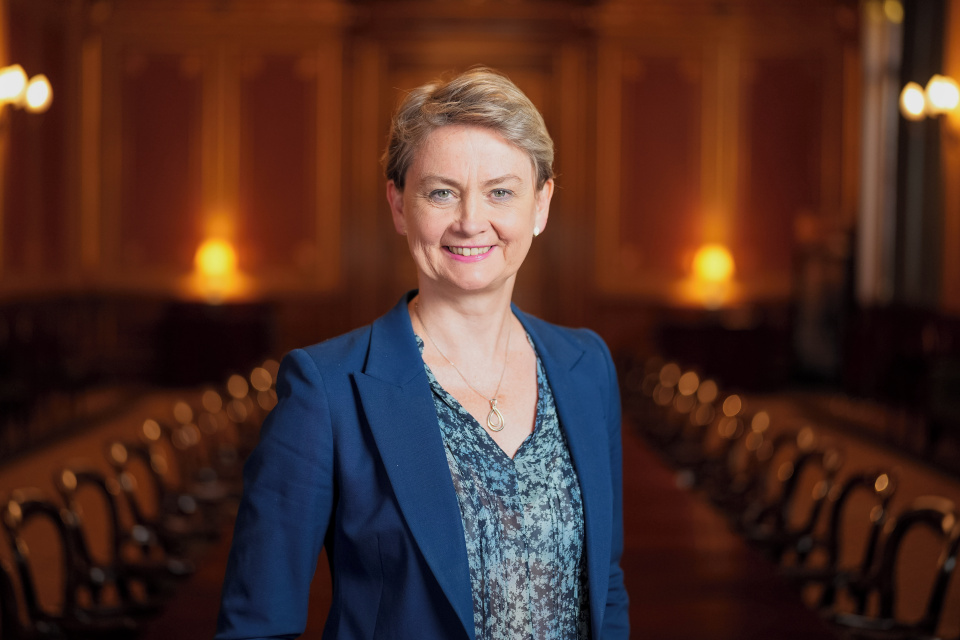
Speech by Foreign Secretary Yvette Cooper at the humanitarian plenary session on Day 2 of the Global Partnerships Conference.
We gather today at a time of great volatility and instability.
Indeed, the reason we wanted to hold this Global Partnerships Conference was exactly because we have such increased volatility all over the world, humanitarian crises, and development challenges.
But we also know that we have determination to pursue those values that we share, to lift people out of poverty, to respond to humanitarian crises.
But we need to do it in new ways. And we need to work together in different ways, and that’s what I think all of these discussions are about.
Issues around power, issues around protection, and issues around partnership, are the key themes to highlight as part of this.
On power, we absolutely have to make sure that when we are responding to humanitarian crises, we are empowering those in local communities to take charge of that response.
The UK has increased our funding for Emergency Response Rooms in Sudan, but we need to be able to build that capacity, and to go further, and recognise that we shouldn’t be seeing people in local communities, simply as victims or survivors of conflict.
They are the first responders, they are the people who actually will have the networks on the ground, who know where the responses are needed, and we need to be able to work with people and support them, particularly making sure that we are empowering women as part of that.
But we must not lose sight of protection, protections against abuse and protection against sexual violence, which we have seen escalating in conflict.
That also includes some of the broader International Humanitarian Law protections and the crucial nature of the risks faced in crisis situations, particularly for children. We are still not doing enough around safeguarding of children and support for children in conflict and considering the long-term consequences for them as well.
And then in terms of partnerships, we know that there are pressures on funding. We have had to make difficult decisions here in the UK.
We made the decision not to walk away from Overseas Development Assistance, and not to walk away from our international work, but actually to hold this Conference, precisely because we believe it is so important.
Although our funding may be lower, we are determined to mobilise more private finance, to mobilise more international finance, to use it in the most effective way possible, and to use that funding in partnership to deliver the most effective results.
That means we also have to do make progress on changes like the UN80 reforms, and the kinds of reforms that Tom Fletcher has set out, as part of making sure we get the most effective response to those who need it, and the most targeted response.
But all of this has to be alongside effective diplomacy and foreign policy.
Development work and humanitarian response is a central part of our foreign policy. It is not an add on or a parallel that goes alongside it. It’s a central part of it.
It’s why we are prioritising conflict resolution - and I spend more time on that than anything else - on Ukraine, on Sudan, and on Israel/Palestine - and now of course on Iran, and the Strait of Hormuz.
The questions are always about, what do you do to deal with the consequences, but also what do you do to deal with the causes?
For us, that means not just thinking about individual conflicts and how we respond to those, but also as we look forward - and the Strait of Hormuz I think, really highlights this – it means thinking about economic resilience for countries across the world.
Because when we look at the fragility of countries, when it comes to climate shocks, or economic shocks, or the impact of conflict - like the restrictions on the Strait of Hormuz, and Iran’s attempt to hijack the global economy - if countries are more vulnerable and less resilient, it means that when shocks happen, they are far more likely to end up experiencing the worst kinds of humanitarian crisis as well.
So alongside those principles of reform around empowerment, around protection, and around partnerships, what we also need to do at this conference is think long term about building our resilience. Because it is our resilience to crises in the future that will be crucial in holding our world together, and enabling us to make progress.