Foreign Secretary speech on violence against women and girls
Foreign Secretary Yvette Cooper MP delivered a speech to mark the launch of a new international coalition – All In – to help end violence against women and girls globally.
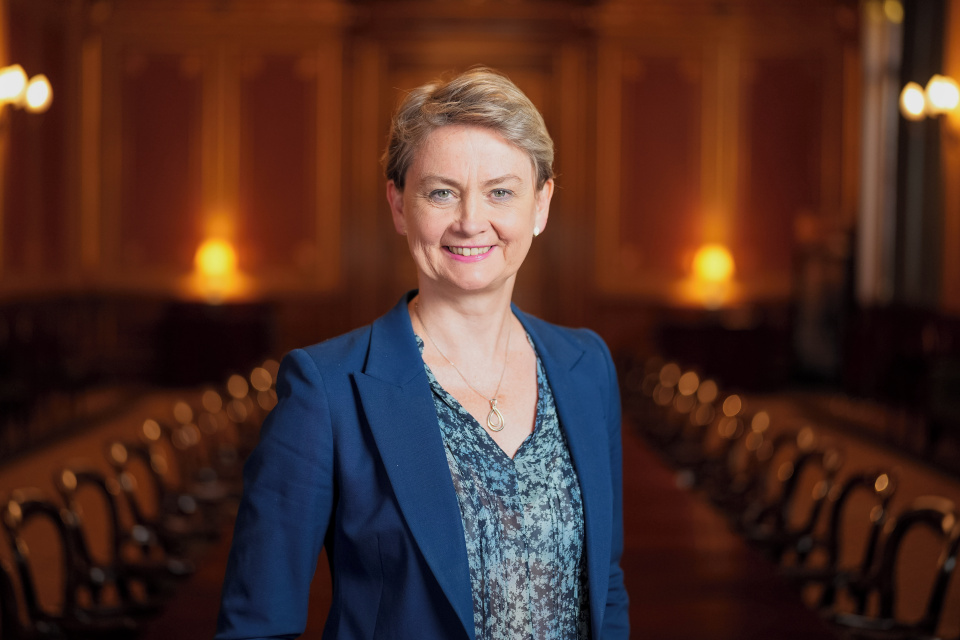
Thank you it is a great pleasure to be here today and to be here among so many impressive leaders and so many women who, as pioneers, have refused to accept the world as it is and whose determination and courage have done so much to change it.
Women who have changed lives here and across the globe as a result of their strength and their determination.
And we’ve seen the hard won gains of that work that have echoed right through history as a result.
But now coming together as part of this ‘All In’ initiative. A dedicated coalition in the fight against violence against women and girls.
I’m delighted that the Foreign Commonwealth and Development Office is co-founding this.
And can I say a special thanks to our co-hosts, the Ford Foundation and Wellspring Philanthropic Fund, for your outstanding and ongoing contribution to tackling violence against women and girls.
And I’m delighted too that the panel includes the UK’s trailblazing Special Envoy for Women and Girls, Baroness Harriet Harman.
I first worked with Harriet on violence against women and girls 30 years ago when she was working on women’s equality. And she has been an inspiration for so many of us in politics here in the UK, but is also still championing women’s equality around the world as well.
But ‘All In’ is the championing of women’s safety, of women’s opportunities, but also equality and freedom.
Because we know safety and security are the foundations of opportunity.
If you don’t feel safe on your streets, you don’t go out to get that job. If you don’t feel safe and secure in your home, you can’t seize the opportunities or build new opportunities for your family.
And it is based on that most important premise – that there is nothing inevitable about violence against women and girls.
And we should never accept it, never discount it, never stand by or walk away from the preventable violence that is holding back women and girls.
That is blighting women’s lives but also undermining families, communities and healthy lives for women, girls, men and boys.
Here today in the UK, the second report of the Angiolini inquiry has been published following the terrible murder of a young woman, Sarah Everard, by a serving police officer.
An account of things that went wrong and still go wrong.
And it’s why we have made tackling violence against women and girls a national mission for this government.
And we will be publishing soon our national strategy to tackle violence against women and girls - led by the brilliant minister and my friend, Jess Phillips.
But today I’m also putting this issue at the heart of our foreign policy. Because this has to be a global focus.
And I want to set out three reasons why I think it’s so important this is a global mission too.
Firstly, of course we have the shared experience of violence against women and girls and gender-based violence across the world – which means also shared opportunities to learn from each other in fighting it and preventing it.
Second, we know that sadly wherever there is conflict or war, too often we see violence against women and girls used as a weapon in that conflict. But also where women’s voices are crucial to peace.
And thirdly, at a time again when new technology is weaving round the world and back again, crossing borders, but also enabling new forms of abuse and violence. It’s by working around the world and back again and working across borders that we can challenge that abuse, but also use that new technology to prevent it.
I wanted to take each of those areas just briefly in turn.
First of all, across the globe we see shared patterns around violence against women and girls.
Here in the UK, 1 in 8 women experienced domestic abuse, stalking or sexual assault last year.
And we have set an unprecedented mission to halve violence against women and girls in a decade.
But we know we can only do that by learning from what happens elsewhere.
Jess and I have talked about the work being done in Spain to tackle domestic abuse and coordinated action across different government agencies and law enforcement.
And we know too the work that we can do, the work the Foreign Office can support and fund.
And in particular, the ‘What Works’ initiative is able to also tackle issues around the world, as well.
Because while we’ve described violence against women and girls here in the UK as a national emergency, the reality is this is also an international emergency.
Be it domestic violence in the home, child marriage, female genital mutilation, the forceable taking of women’s earnings, or the deliberate stopping of a girl from going to school.
One in every three women and girls worldwide will experience physical or sexual violence in their lifetime.
More than 50,000 women and girls are killed every year by a partner or close relative. That is 140 women and girls every day.
And so that is why we have set our mission to halve violence against women and girls in the UK in a decade.
We want to be part of a worldwide mission to prevent this kind of violence and abuse.
The work that ‘What works’ is doing, for example, in Pakistan - the research from the ‘What Works to Prevent Violence’ initiative - is now shaping the education curriculum across 160 schools in one of the provinces.
The work that we have learnt from other countries across the world, but crucially the work in the
‘All In’ position paper that sets out different evidence from all over the globe of the kind of things that can make a huge difference.
Not just that violence is preventable but that it has been prevented and can be prevented in examples around the world.
The second area I wanted to highlight is the fact that we know in the worst conflicts, the worst violence in the world, that gender based-violence, that violence against women and girls is often part of some of the worst atrocities.
And we can look no further than Sudan.
And last week I met the most incredibly brave woman from one of the emergency response rooms which is a community based group and organisations that are trying to respond and protect civilians in the face of terrible conflict.
And many of them are running community kitchens in the face of famine. Providing support for women and girls who have been raped as part of the conflict and as part of the war. And she described to me helping three sisters who were under 13 who had all been raped. And her bravery in providing them with huge support, the bravery of survivors of violence coming together to support each other.
But their voices have to be heard. In making sure we shine a spotlight on the terrible atrocities taking place now in Sudan.
And their voices need to be heard as we push again and again for the desperately needed peace and the ceasefire in Sudan.
But it’s 25 years now since resolution 1325, the pioneering resolution for women, security and peace, which was championed by the Labour government at the time which was about putting women’s voices at the heart, not just of conflict as victims, but at the heart as architects of peace.
So be it in Sudan, in Syria, in Myanmar, the Democratic Republic of Congo, we need to make sure women’s voices are heard in peace too.
And in the Foreign Office with me when we talked about this last week was Lejla Damon who was born of conflict related sexual violence in Bosnia.
And only met her birth mother 32 years later.
But talked with great strength and incredibly movingly about her activism to highlight the challenges faced by survivors and their children.
Something so important as we are part of the current 16 Days of Global Activism.
And that takes me to the third dimension, because this year’s theme of 16 days of activism is ending digital violence against women and girls.
And that technology now that can make it possible for the most horrendous child sexual exploitation and abuse, or the escalation of violence online or the sharing of AI deepfakes, or intimate images shared without consent. Sexualised and violent images that can create further violence and abuse.
All of that takes place as a result of technology around the world but actually we can also work in partnership around the world to challenge it as well. So we are committing to working with others in order to respond not just to the work that the UK is doing on our Online Safety Act and the new guidance on online safety, but also using new technology to keep women safe.
And so StopNCII.org is a new cutting edge technology that prevents, detects and removes such images from the internet.
But as part of our work between the Foreign Office and the Home Office we are supporting the use of that, not just in the UK, but also supporting civil society in Nigeria, in France, in Pakistan to be able to access that technology as well. Part of a raft of collaboration between nations so that we are not just starting from scratch, we are learning from each other.
Evidence and action really matter. But nothing changes any of these things without commitment.
And that’s why ‘All In’ is so important and that’s why being here today is so important.
And that’s why the work that the panel has already led across the world, has driven the work that has been gathered together by the Secretariat. But also the work for ‘All In’ going forward. That is serious leadership, serious ambition, serious commitment to acting on evidence from some of the most inspiring women from around the world who are part of the ‘All In’ panel.
Because the impact is so vital for the work that I know they will do, that we will support. The impact that will have dividends not just for women and girls but for men and boys too.
Because the cost of inaction is estimated at $1.5 trillion every year if we fail.
But we can do this. For our economic resilience, for our health outcomes, for families, communities, countries and continents.
So I ask all of you to join me to be ‘All In’. And I pledge to go ‘All In’ as UK Foreign Secretary, working to ensure that women and girls around the world can thrive and flourish - free from violence and free from fear.