Young Futures Hubs and Transformation Programme: EOI prospectus
Published 8 July 2026
Applies to England

© Crown copyright 2026
This publication is licensed under the terms of the Open Government Licence v3.0 except where otherwise stated. To view this licence, visit nationalarchives.gov.uk/doc/open-government-licence/version/3 or write to the Information Policy Team, The National Archives, Kew, London TW9 4DU, or email: psi@nationalarchives.gov.uk.
Where we have identified any third party copyright information you will need to obtain permission from the copyright holders concerned.
This publication is available at https://www.gov.uk/government/publications/young-futures-hubs-and-transformation-programme-expression-of-interest/young-futures-hubs-and-transformation-programme-eoi-prospectus
Summary
This prospectus is designed for the 50 local authorities invited to submit an Expression of Interest (EOI) to join the Young Futures Hubs and Transformation Programme. It details the background of the programme, the delivery approach, the support provided throughout, and guidance on how local authorities can submit their EOI.
We intend to select up to 22 local authorities, in addition to the 8 Early Adopters, to establish one or more Young Futures Hubs and undertake Local Youth Transformation projects.
Local authorities selected to participate in the programme will receive an initial grant payment of £100,000 in September 2026 to undertake planning and co-creation activity for their Young Futures Hub(s) and Local Youth Transformation Projects.
Participating local authorities will then submit proposals between January to March 2027 for further funding based on their planning and co-creation activity:
- Up to £300,000 FY27/28 per Young Futures Hub
- Up to £500,000 for Local Youth Transformation Projects
- Up to £125,000 for capital and digital projects which support the Young Futures Hub and/or Local Youth Transformation.
To express interest, please read this prospectus and submit an Expression of Interest by 23:59 on Wednesday 29 July 2026 to youthrevenue@dcms.gov.uk
Timeline of EOI Process
| Activity | Date |
|---|---|
| Expression of Interest (EOI) open | 8 July 2026 |
| EOI submission deadline | 23:59 29 July 2026 |
| LAs notified of outcome of EOI process | w/c 24 August 2026 |
| Deadline for LAs to return signed MoUs to DCMS | w/c 7 September 2026 |
Please note this EOI process is for shortlisted local authorities invited to submit interest in participating in both the Young Futures Hubs and Local Youth Transformation Programme. DCMS intends to run a further EOI process in between January - March 2027 for local authorities to participate in the Local Youth Transformation Programme only. More information will be shared in due course.
Introduction
Every young person deserves a future defined by their potential, not their background. Yet, for too long, systemic barriers have obstructed this. Over the past decade, a 73% real-terms reduction in local government spending on youth services—amounting to £1.2 billion—has weakened the foundations of youth support. The cost is clear: nearly 1 million young people in the UK are not in education, employment, or training; large increases in the number of mental health referrals for children and young people in England; and too many continue to experience the impacts of violence. When services are fragmented or unavailable, young people are left to navigate complex systems alone, often falling through the gaps during the critical transitions of adolescence.
We are acting to change this.
On 10th December 2025, the government published Youth Matters: Your National Youth Strategy—the first cross-government plan for young people in 15 years. It is a 10-year commitment to ensuring every young person, regardless of their background, has a safe place to go, someone who cares for them, and a community they feel a part of. It is backed by over £500 million of funding over the next few years from the Department for Culture, Media and Sport for things to do outside of school, support when and where young people need it, more safe spaces, and access to trusted adults. It complements a range of funding committed by other departments.
Young Futures Hubs and Transformation Programme
We are embracing a fundamental shift in how we deliver for young people, moving away from national directives toward place-based empowerment. The £70 million Young Futures Hubs and Transformation programme is the catalyst for this change, it incorporates 2 programmes:
- Young Futures Hubs, a government manifesto commitment in 2024, to create a network of 50 Young Futures Hubs, which will build out on existing youth provision to:
- increase access to opportunities
- improve mental health and wellbeing
- reduce vulnerability to young people being drawn into crime, including knife crime
- Local Youth Transformation, which aims to help local authorities build leadership and capability to improve local youth offers and better meet their statutory duty for youth services.
This programme will deliver on the priorities set out in the 2025 State of the Nation report: safety, empowerment, opportunity, and health.
Our vision for the network of 50 Young Futures Hubs is to create welcoming, inclusive spaces designed by and for young people, where they can connect with trusted adults and build the social capital necessary to thrive. Evidence from other Hub-style initiatives shows a ‘one-stop-shop’ model—which co-locates multidisciplinary support and provides quick, drop-in access— ensures that the right intervention reaches the right young person at the right time. By integrating early intervention and prevention services within Young Futures Hubs across our three core outcomes—improving mental health and wellbeing, expanding opportunities, and reducing vulnerability to crime—we are building a system that places young people at its heart.
To ensure this is sustainable and embedded into wider local youth strategies, we are enabling local authorities to develop their leadership and capability to better meet youth services. By combining the Young Futures Hubs with the Local Youth Transformation programme, we are moving beyond temporary fixes. We are equipping local areas with the capability needed to build a robust, cohesive ecosystem — ensuring every young person has access to the support they need to succeed.
Our vision for the network of 50 Young Futures Hubs is to create welcoming, inclusive spaces designed by and for young people, where they can connect with trusted adults and build the social capital necessary to thrive. Evidence from other Hub-style initiatives shows a ‘one-stop-shop’ model—which co-locates multidisciplinary support and provides quick, drop-in access— ensures that the right intervention reaches the right young person at the right time. By integrating early intervention and prevention services within Young Futures Hubs across our three core outcomes—improving mental health and wellbeing, expanding opportunities, and reducing vulnerability to crime—we are building a system that places young people at its heart.
To ensure this is sustainable and embedded into wider local youth strategies, we are enabling local authorities to develop their leadership and capability to better meet youth services. By combining the Young Futures Hubs with the Local Youth Transformation programme, we are moving beyond temporary fixes. We are equipping local areas with the capability needed to build a robust, cohesive ecosystem — ensuring every young person has access to the support they need to succeed.
Our approach is defined by the three core shifts outlined in Youth Matters:
- From national to local: We are empowering local communities to design and deliver programmes in line with their own unique priorities and needs.
- From fragmented to collaborative: We are transforming a disjointed landscape into a collaborative ecosystem, where services for young people—from mental health and careers support to youth clubs—work together to ensure young people thrive.
- From excluded to empowered: By co-creating every Young Futures Hub and Transformation plan with young people, we are ensuring they are the architects of their own future.
Pilot update
The Young Futures Hubs and Transformation programme builds on two pilots - Young Futures Hubs Early Adopters, which established 8 Young Futures Hubs to test system integration and co-design approaches, and Local Youth Transformation which supported 12 ‘Pathfinder’ local authorities to rebuild capability for local youth offers. The pilot local authorities represented regional spread across England, with a diverse range of commissioning models, local stakeholders, existing local needs and services for young people. Learnings from the pilots have been incorporated into the design of the Young Futures Hubs and Transformation programme.
Section 1: Aims and objectives of Young Futures Hubs and Transformation
The overarching objectives for Young Futures Hubs and Transformation are to:
- Increase opportunity: increase access to enriching activities, and early career support, including the prevention of becoming NEET.
- Improve wellbeing: foster positive mental health and wellbeing, ensuring community support is accessible when and where it is needed.
- Strengthen safety: reduce vulnerability to young people being drawn into crime.
- Integrate support: coordinate the system of support services that intervene early for young people.
- Empower local leadership: improve capability in local authorities to better meet statutory duty for youth services.
- Secure sustainability: embed lasting change, ensuring participating local authorities have the foundation to deliver effective youth services for the long term.
A key principle of the programme is that Young Futures Hubs should build on existing provision and develop local partnerships, and that Young Futures Hubs will be most successful where there is a high-quality, coordinated youth offer with strong local authority leadership. To support this principle, local authorities will be able to access funding for both YF Hub delivery and Local Youth Transformation projects. These joint funding streams help to establish a strong foundation for Young Futures Hubs to operate in, and support local authorities to strengthen local youth services, ensuring access to educational and recreational activities for young people across the whole local authority.
Section 2: Programme delivery model
This section provides information on the programme delivery model to help inform your decision to submit an Expression of Interest. We will provide further details on the programme to those local authorities selected to participate in September 2026.
We recognise that local authorities are best placed to understand their own areas and needs of young people, which is why our delivery approach focuses on working with and supporting local authorities in a way that works for them.
The programme model is split into four stages, visualised in the diagram below:
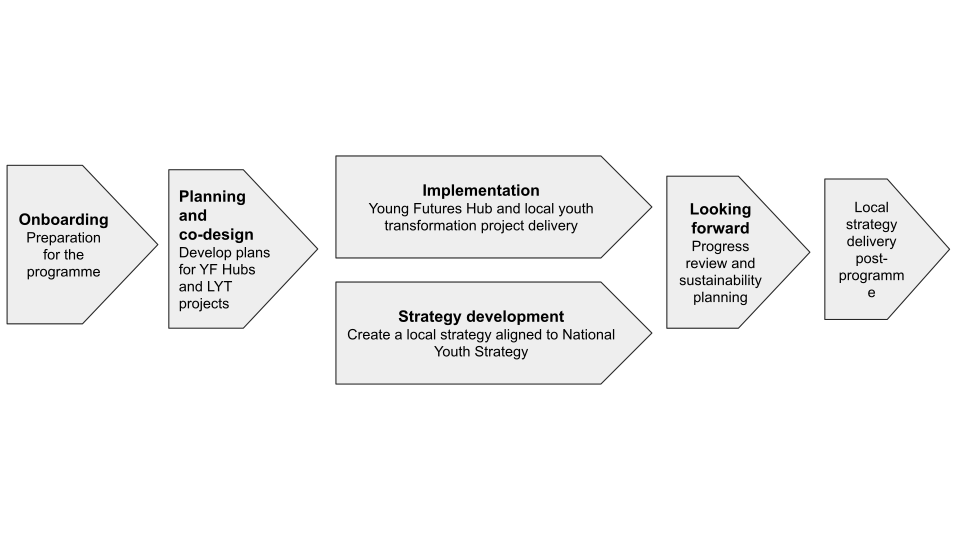
Further detail for each phase is detailed below.
Delivery model (indicative timeline)
Stage One: Onboarding (August to September 2026)
In this initial stage, each local authority will be introduced to their DCMS grant manager, who will share key programme dates and initial preparatory materials to support with internal mobilisation before programme delivery commences in full. Local authorities will also be introduced to the delivery partner and agree a tailored support offer for the programme that reflects their individual starting points and needs.
Stage Two: Planning and co-creation (September 2026 to March 2027)
Each participating local authority will receive £100,000 to undertake preparatory work and co-creation, including reviewing the youth offer across the whole local authority, identifying improvements to strengthen the wider offer for young people, and co-creating their Young Future(s) hub with local partners and young people.
Review of current provision
We recognise that within each local authority there will be an existing landscape of systems, hub-type spaces and services that support young people (for example, but not limited to: family hubs; early support hubs; youth hubs and clubs; multi-disciplinary family help teams; NHS services; and Framework for integrated care (community)). It is vital that local authorities understand the current landscape of provision for young people and families, delivery of the youth services statutory duty (Section 507B of the Education Act 1996) and capability to lead local youth services, including delivery of the Young Futures Hubs, to identify opportunities and areas for improvement.
With support from the delivery partner, we expect local authorities and their partners to conduct an exercise to:
- review the current youth offer and map existing local and national initiatives (including relevant statutory and non-statutory services, health stakeholders and voluntary sector provision), considering any that could be consolidated into, or built out from, to deliver a YF Hub. This should take into account existing mapping work, including the National Youth Agency’s National Youth Sector Census.
- assess delivery of youth services to meet the statutory duty, identifying areas to develop through the programme, taking into consideration and/or using previous recent service/peer reviews
- understand the needs of young people living and studying in their areas, including engaging with and considering those that are harder to reach, such as those with SEND or from ethnic minority groups; and
- identify gaps and local challenges, across the whole local authority youth offer and in relation to YF Hub provision
This will involve provision mapping, stakeholder consultation, youth engagement, analysing data, and will involve services delivered by local authorities as well as those provided by private and third sector organisations.
Co-creation
To ensure our Young Futures Hubs are designed by and for the young people they serve, we expect local authorities to facilitate a collaborative, inclusive co-design process. Key activities include, but are not limited to:
- Meaningful youth engagement: Convene representative workshops and forums with young people—including those harder to reach—to place them at the heart of service design and ongoing feedback.
- Strategic senior buy-in: Establish robust engagement mechanisms with senior leaders across Children’s Services, Health (ICBs), Police, and other key commissioners to ensure decisions carry the authority needed for sustainable delivery.
- Integrated stakeholder collaboration: Actively engage operational and strategic partners across the statutory, VCSE, and private sectors to build shared ownership and create a seamless, multi-disciplinary ecosystem.
Developing an implementation plan
Local authorities will, with support from the delivery partner, develop an Implementation Plan, which should prioritise specific areas of need and/or opportunities identified during review and co-creation work.
Plans will differ between local authorities based on each area’s unique context. We anticipate the plans will cover:
- Young Futures Hubs
- Build on strengths: Detail how you will establish accessible, inclusive hubs by integrating and extending existing local provision.
- Site readiness: Confirm you have a suitable physical location ready. Assess your capital estate early to identify and remove any barriers to participation.
- Partnerships: Explain how you will leverage cross-sector partnerships—such as with health and policing—to provide a seamless, multi-disciplinary service.
- Strategic ambition: Outline an ambitious vision for a cohesive offer that improves mental health, expands opportunities, and reduces crime. Note that hubs are intended to coordinate and extend existing services, not substitute them.
- Youth transformation: Outline your strategic approach to lasting change to build local authority capability and leadership to meet the statutory duty to provide youth services. This could focus projects such as: strengthening local authority leadership, optimising the youth workforce, and improving operational coordination.
Funding allocation
Following a review of Implementation Plans to ensure feasibility and alignment with programme objectives, DCMS will confirm grant funding amounts. Based on local proposals, anticipated funding includes:
- Young Futures Hub delivery: Up to £300,000 for frontline service delivery in FY 27/28. Local authorities will receive further funding until 2028/29 to sustain services and establish additional hubs, subject to delivery performance.
- Local Youth Transformation: Up to £500,000 as a one-off investment to strengthen local authority capability, leadership, and statutory youth service delivery, ensuring a robust, sustainable ecosystem.
- Capital funding: Up to £125,000 to support essential space repurposing or the development of digital projects that improve coordination across the wider youth offer.
Stage 3: Implementation and strategy development – (March 2027 to August 2028)
Implementation
During Stage 3, local authorities will commence delivery of their implementation plans. The delivery partner will provide advice and support for local authorities and their partners (where applicable) to implement their plans. This could include:
- providing ongoing tailored support to mitigate challenges and maintain delivery momentum
- providing practical tools and guidance
- brokering access to thematic experts in identified areas such as youth participation, safeguarding, workforce development
- enabling a dedicated youth voice function
- creating communities of practice to promote knowledge exchange across the local authority cohort
Support will look different for each local authority based on their needs and any changes to the project context throughout participation in the programme. Local authorities in the pilot phase have benefitted from delivery partner support in areas such as:
- facilitating city/region-wide VCS partnership events
- navigating local authority procurement and recruitment processes
- identifying potential providers of youth worker training courses
- mapping workforce development needs
- advising on the application of youth work quality standards and frameworks in local context
- connecting participating local authorities to share learning and advice
- supporting local authorities to secure strategic and political buy-in
During this stage local authorities should commit to engaging positively with the delivery partner and be open to continuous feedback and improvement. They will also feed insights through governance meetings to help the development of Young Futures Hubs and Transformation national policy.
Strategy development
Insights from Pathfinder and Early Adopter local authorities emphasises the importance of prioritising sustainability from the very beginning. Early political and executive support ensures that outcomes remain robust and strategically integrated with core council goals.
In line with the shift from national to local in ‘Youth Matters: Your National Youth Strategy,’ LAs will establish a local youth strategy. This strategy will outline a sustainable, long-term approach to delivering the local youth offer and supporting young people.
To facilitate this, the delivery partner will offer tailored training and expert guidance throughout the strategy design process. This flexible framework will accommodate LAs who are designing a new strategy as well as those enhancing an established one.
Through these local strategies, authorities will champion the local implementation of Youth Matters and best practice. They will set an ambitious local vision and communicate to young people they have somewhere to go, someone who cares for them and a community they feel part of.
Local strategies will not be assessed by DCMS, but should be subject to appropriate council approval processes to ensure necessary executive buy-in and support for implementation post-programme.
Stage 4: Looking forward (July to August 2028)
With support from the delivery partner, each local authority will reflect on changes in their capability and youth offer since joining the programme, and consider further opportunities to strengthen youth services and lead sustainable long term transformation beyond the programme. Local authorities will prepare to commence delivery of their long-term local youth strategy following the programme, identifying any actions to be undertaken to enable a smooth commencement, such as handovers, awareness raising, departmental training, and strategy publication.
Indicative programme timeline
| Activity | Date |
|---|---|
| Stage 1: Onboarding and mobilisation | August to September 2026 |
| Stage 2: Planning and co-creation | September 2026 to February 2027 |
| Initial payment for Stage 2 activity | By 30 September 2026 |
| Submission of implementation plan funding proposals | February to March 2027 (anticipate LAs to submit in tranches) |
| Stage 2 Funding allocated | By end March 2027 (some LAs may receive allocation earlier based on proposal submission) Payment is anticipated to be made in 6 monthly tranches |
| Stage 3: Implementation and strategy development | March 2027 to August 2028 Specific timeframes for YF Hub delivery and Local Youth Transformation delivery will differ for local authorities depending on their ‘readiness’ This will be determined during the planning and co-creation stage. |
| Stage 4: Looking forward | July to August 2028 |
Section 3: Delivery support
Delivery partner
DCMS will appoint an expert delivery partner to work with local authorities across the duration of the programme. The delivery partner will provide a tailored support offer of advice, tools, learning and peer networking opportunities, to support local authorities to design and deliver their projects.
Engagement with the delivery partner will look different for each local authority, but is likely to involve:
- regular meetings and communication with a designated support role
- guidance on appropriate methodologies for assessing provision for young people, e.g. mapping and review existing universal and targeted provision, as well as wider relevant statutory and non-statutory services and VCSE provision to identify gaps and priorities against local need
- guidance on appropriate methodologies for delivering a co-creation process, including youth engagement
- feedback and constructive challenge on the development of project plans and funding submissions
- ongoing support and guidance to deliver plans and mitigate challenges during implementation
- dedicated time to review the positive changes achieved during the programme and support with sustainability planning
- guidance and support to develop a long-term local youth strategy aligned to Youth Matters: National Youth Strategy
- facilitate networking opportunities with other local authorities to share learning and provide peer support
- connect with expertise across mental health, youth crime, careers and Children and Young People services
DCMS grant management
Local authorities will have a dedicated DCMS grant manager who will be your point of contact across the programme.
Local authorities will have 6-weekly online meetings with your grant manager, providing an informal space for 1:1 discussion on project activities, queries, support needs and troubleshooting any risks or issues.
Local authorities will submit quarterly review reports to DCMS, which will provide an update on expenditure, risks, progress against key milestones, successes and lessons learned. Review reports will be discussed in the relevant 6-weekly online meeting.
Section 4: Programme reporting expectations
Reporting expectations are designed to provide the local authority and DCMS with the information needed to monitor delivery progress against the objectives, develop a clear evidence base, understand what ‘good’ looks like, and inform further policy development. Programme reporting is an important element of tracking spend and the delivery of outcomes
Programme reporting expectations will include:
- 6-weekly update meeting (approximately 8 meetings per 12 months) – Local authorities will be expected to attend a 6-weekly online call with the DCMS grant manager, to check on progress, answer queries and support with grant delivery. These calls will be supported by regular engagement with the delivery partner.
- Quarterly progress review - Local authorities will be asked to submit quarterly progress reports providing updates on expenditure, milestones, outcomes and risk/issue mitigation. These updates will also provide an opportunity to highlight any successes, learning and examples of good practice. One of the 6-weekly update meetings will be utilised to review the quarterly progress report.
- Twice-yearly financial payment request - To provide assurance that expenditure is in line with programme expectations, local authorities will be asked to complete a Financial Payment Request twice per year setting out grant usage ahead of any payment.
As part of onboarding, local authorities should ensure the necessary mechanisms are in place to provide the reporting updates described above throughout the programme.
Management information
Collecting and using management information (MI) will be an important way of assessing and monitoring the outcomes of programme delivery. Local authorities will need to collect MI at regular intervals, once Stage 3 (Implementation and Strategy Development) has commenced, from March 2027.
Data that will be required to be collected and returned to DCMS may include, but not be limited to:
- service activities, for example, metrics on the types of open-access and targeted support offered in each YF Hub
- workforce characteristics and activities, for example, metrics on learners accessing youth work qualifications and specialist training courses with any relevant demographics (such as young people accessing Level 1 qualifications, or learners from underrepresented backgrounds)
- local landscape characteristics and activities, for example, metrics on local partnership working and networks, commissioning of new provision to meet an identified gap or coldspot
- usage and reach, for example, metrics on the number of young people supported by a YF Hub and their demographics, the support received and frequency of engagement
- development of new processes and procedures or amendments to existing ones, for example, new referral pathways, safeguarding policies, data sharing processes, quality assurance methodologies
We will work with local authorities to agree an appropriate MI approach that balances sufficient evidence of the overall programme’s effect without being unduly burdensome to provide. This approach will aim to align MI requirements for the programme and evaluation to avoid any duplication.
More details on the data to be collected through MI will be shared in Autumn 2026.
Evaluation
Evaluation is crucial to informing our understanding of how the programme is being delivered in different contexts, to help us assess the impact of the programme, and further inform national policy on Young Futures Hubs and transformation.
Local authorities will be asked to take part in evaluation activities. This will involve working with the commissioned independent evaluator(s).
Evaluation activities that you may be asked to participate in include, but are not limited to:
- interviews
- surveys
- case studies
- collection of additional management information
Local authorities will be expected to facilitate engagement in the evaluation, as required. This may include engagement from LA staff, Young Futures Hubs teams and partners, trusted adults that support young people to engage with Young Futures Hubs, local partners and providers of the wider youth offer, and any other relevant stakeholders. Local authorities will also be required to work with the independent evaluator(s) to consider and develop the approach to MI, data collection and data sharing, including implementation of a core set of metrics to support evaluation activity.
The commissioned independent evaluator(s) will support local authorities in meeting the additional needs of the evaluation.
Participating in the evaluation will also be beneficial to local authorities. It will help understand whether the funding is achieving its intended goals and objectives: identifying areas for improvement, informing decision-making and driving effective service delivery to meet young people’s needs.
Further information on the evaluation will be shared in due course.
Future evaluation requests
There is a strong interest in evaluating the longer-term impacts of Young Futures Hubs and Transformation Team (i.e. beyond the lifetime of this funding).
We expect that local authorities will respond to any reasonable additional requests from the Young Futures Hubs and Transformation Team to support any retrospective assessment or evaluation as to the impact or value for money of the fund. We may also ask for details related to areas of improvement identified during the programme (for example, information relating to new partnerships or workforce development activity), in order to examine the legacy impacts of the fund.
Future engagement
This programme provides us with an opportunity to work together going forward, sharing learnings and supporting policy development more broadly.
In future, we may also seek support in targeted policy development and other activities, for example policy relating to the National Youth Strategy, the local authority statutory duty for youth services, devolution and partnership working. To support this, we ask that local authorities be open to sharing challenges and successes outside of the formal evaluation process with both the grant manager and, where necessary, other policy officials across government.
Section 5: Funding
Each local authority will receive up to £100,000 for Stage 2 - Planning and co-design (September 2026 to March 2027). Following confirmation of participation, we will issue a grant determination under Section 31 of the Local Government Act 2023. The first payment will be made in September 2026.
This funding could be spent on activities such as: establishing a YF Hub steering group (or equivalent) and appointing the project team within the LA; co-creation of YF Hub model with young people and key stakeholders - including compensation for the time of contributors, venue hire and communication activity; staff time to engage with delivery partners on needs assessment.
Funding for Stage 3: Implementation and Strategy Development (March 2027 - August 2028) will be confirmed in February-March 2027, following approval of implementation plans, however we anticipate funding will be:
- Up to £300,000 in FY 27/28 for frontline delivery of a YF Hub. Subject to performance, it is anticipated local authorities receive further funding until end 28/29.
- Up to £500,000, through the Local Youth Transformation Fund. This is intended to be a one - off investment which should establish lasting change, with no on-going costs. Please note, any local authorities who received Local Youth Transformation funding previously through the pilot will not be eligible to apply for this element of funding again.
- Up to £125,000 capital funding. Young Futures Hubs and Transformation isn’t a capital building programme, however, we anticipate that local authorities will require a small amount of capital funding to repurpose existing spaces to deliver their YF Hub(s) or develop digital projects that support the coordination and communication of the wider youth offer.
Further guidance on Stage 3 will be provided in September 2026.
We intend to issue funding as non-ringfenced grants under Section 31 of the Local Government Act 2003. We intend to issue a grant determination for Stage 3 Funding in March 2027.
We reserve the right to review funding for future years.
Section 6: Expressing interest
Local authorities are asked to review this prospectus and consider whether they wish to participate in the Young Futures Hubs and Transformation programme.
50 Local authorities have been invited to submit an Expression of Interest in areas of high prevalence of youth crime (measured through first time entrants in the criminal justice system) and public health need (measured through community needs, child deprivation, and CAMHS waiting lists). This indicates that the youth population in shortlisted Local authorities could benefit significantly from an enhanced youth offer and integrated support for young people that improves access to opportunities, improves mental health and wellbeing, and reduces crime.
The EOI process we are looking to see that local authorities expressing interest in the programme have:
- willingness to participate;
- a strategic vision for strengthening the whole youth offer in their area to deliver the youth services statutory duty;
- a strategic vision for establishing Young Futures Hubs that reflects the needs of young people;
- commitment to the ethos of co-creation with young people and local partners; and
- an effective approach to project management and delivery
We are also seeking to understand the current youth offer, any previous experience of youth service/related transformation programmes, and any previous experience with local youth strategy planning. In addition, we are keen to understand your existing evaluation and data strategy, as well as your interest in improving data systems and engaging in further evaluation. These elements of the EOI will not be assessed or used to inform the selection of local authorities, but will be used to inform the delivery support offer from the delivery partner.
If you wish to be considered for participation in the Young Futures Hubs and Transformation programme, please submit an Expression Of Interest to youthrevenue@dcms.gov.uk.
An EOI template can be found on this guidance page.
By submitting an EOI, you are confirming that:
- the organisation can commit to engaging fully in the Young Futures Hubs and Transformation programme, including reporting and evaluation requests
- the organisation has appropriate safeguarding procedures that protect employees, beneficiaries and volunteers from harm; and
- the organisation has appropriate GDPR procedures in place
- the organisation is not at risk of issuing a Section 114 notice within the lifetime of the project
- the Section 151 Officer or Deputy Section 151 Officer and/or Director of Children’s Services has agreed to participation
- the organisation CEO or CFO has approved participation in the programme
Local Devolution and Continuity of Learning: We recognise that in some areas, local authorities may be impacted by Local Government Reforms, in such instances local authorities will need to implement appropriate processes to ensure continuity of delivery, and if needed, knowledge transfer.
If you choose to decline the offer to express interest, this will not prevent you from participating in the programme any future roll out.
A panel of government officials and external stakeholders will review submitted EOIs. Assume that panel members may have no or limited background knowledge of your local authority and its current youth provision. It is therefore important that the information in your EOI is as clear, concise and unambiguous as possible.
1. Initial sift
We will conduct a light touch review of EOI forms to confirm eligibility.
2. Assessment of eligible EOIs
The EOI form contains five scored questions and a number of unscored questions. Unscored questions will not be assessed but will be used to inform the delivery support offer from the delivery partner.
The information below sets out what we are looking for in each question, the weighting, and the information we will use to make our assessment.
| Question | Measure | Weighting |
|---|---|---|
| 1: Please outline why you wish to participate in the programme. | Through this question we want to understand your motivation for participating in the programme. We’d like to see your understanding of the programme’s aims and objectives and their relevance to young people, local organisations and your council. | 10% |
| 2: Please describe your strategic vision for the youth offer in your area, e.g. where are you now in terms of youth provision and what is your ambition for the future? How would Local Youth Transformation funding support you to achieve this? | Through this question we want to understand your ambition for youth services in your local area. We’re looking to see that you have an understanding of the current youth offer in terms of strengths, gaps and young people’s needs, and can identify elements that the funding could use to improve. We’d like to see how you think Local Youth Transformation will help you to realise your strategic aims. | 25% |
| 3: What is your strategic vision for Young Futures Hubs in your area? How would this meet the needs of local young people? | Through this question we’re looking to see that you have a clear vision for Young Futures Hubs that reflects the needs of young people in your area. We’d like to see your understanding of the current landscape in your area linked to the objectives of Young Futures Hubs, and how Young Futures Hubs would build on or expand on this landscape. | 25% |
| 4: Each LA will undertake a co-design and planning stage between Sept 2026 - Feb 2027, to produce a plan to establish a Young Futures Hub (s) and Transformation project. Please set out how you would deliver this co-design process to develop a high-quality plan co-produced with local stakeholders. | Through this question we’re looking to see your commitment to the ethos of co-creation. We’d like to see a realistic and achievable vision for how you would deliver this requirement, and understand your approach to mitigating any foreseeable risks. Through your response we’re looking for you to give us confidence in your ability to deliver this activity within the proposed timeframes. | 25% |
| 5: Please outline how you will ensure your Young Futures Hubs and Transformation project is effectively managed to achieve the desired outcomes and ensure long term sustainability beyond March 2029? | Through this question we’re looking to see your approach to project management and delivery, and how this would support the effective implementation of your plans. We’re looking to understand how you would ensure the outputs and outcomes from your project remain sustainable and have long term benefits to young people, local organisations and your council. | 15% |
| 6: Please provide a brief overview of your current youth offer | Through this question, we are looking to see your awareness and understanding of current provision for young people, including particular needs or cohorts that provision supports and any gaps. We are looking to see how provision can be built on and strengthened through the programme. | Unscored |
| 7: Should funding be available, would you have interest and capacity to deliver more than one Young Futures Hub? How would this support your strategic vision in Question 3? | Through this question, we are looking to understand which LAs have willingness and capacity to deliver more than one Hub, to inform the distribution of Hubs across participating LAs. We would like to see a clear articulation of how multiple Hubs would strengthen the strategic vision. | Unscored |
| 8: Have you undertaken a youth services review / transformation programme before? If so, when was this and how have the recommendations been taken forwards? | Through this question, we are looking to understand your history of previous youth services reviews or transformation programmes, to inform how the delivery partner may best flex their approach to reflect your starting position. We would like to see the extent to which any recommendations from previous reviews/programmes have been implemented with identified room for improvement through the programme. | Unscored |
| 9: Do you have an existing local youth strategy? If so, when was this developed and to what extent does it align with the National Youth Strategy? | Through this question, we are looking to understand whether your council has any strategic plans for the youth offer, to inform how much guidance the delivery partner may offer to develop a strategy during the programme, and whether existing strategies may benefit from minor tweaks or more substantial development to reflect the National Youth Strategy. | Unscored |
The scored questions will be evaluated and marked on a scale of 0 to 4 where:
0 – Not demonstrated: e.g. does not meet requirements, and/or raises serious concerns
1 – Limited demonstration: e.g. meets some requirements but with gaps and/or some minor concerns
2 – Limited demonstration: e.g. meets most/all requirements, but lacks sufficient detail or evidence in some areas
3 – Good demonstration: e.g. meets all requirements and provides a detailed response but lacks evidence in minor areas
4 – Excellent demonstration: e.g. meets all requirements, provides a detailed response and evidence which demonstrates a particularly strong understanding of the requirements
Key dates
Please see an indicative timeline of key dates below:
- EOI open: 8 July 2026
- EOI deadline: 23:59 29 July 2026
- Notification of selected LAs: week commencing 24 August 2026
Following the EOI review process, we will write to successful applicants to outline expectations of participation in the programme and seek confirmation that the LA can meet these requirements.
Privacy notice
Who is collecting my data
The Department for Culture, Media and Sport (DCMS) helps to drive growth, enrich lives and promote Britain abroad.
We protect and promote our cultural and artistic heritage and help businesses and communities to grow by investing in innovation and highlighting Britain as a fantastic place to visit. We help to give the UK a unique advantage on the global stage, striving for economic success.
The information you have submitted to the Expression of Interest is run by the Department for Culture, Media and Sport (“we” and “us“, “DCMS“). DCMS is the controller for the personal information we process.
Purpose of this privacy notice
This notice sets out how we’ll use your personal data. We have to provide this information as part of our legal obligations set out in Article 13 of UK General Data Protection Regulation (UK GDPR) and the Data Protection Act 2018 (DPA) when data is received directly from you.
The Department for Culture, Media & Sport’s personal information charter (opens in a new tab) explains:
- how we handle your information
- how you can ask to view, change or remove your information from our records
What is personal data
Personal data is any information related to an identified or identifiable natural living person, otherwise known as a ‘data subject’.
A data subject is someone who can be recognised, directly or indirectly, by information such as their name, identification number, location data, online identifier, or about their physical, physiological, genetic, mental, economic, cultural, or social identity. These types of identifying information are known as ‘personal data’.
You can find more in the Information Commissioner’s Office’s (ICO) guide to understanding personal information.
What personal data do we collect
The personal information we collect and process is provided to us directly by you. This includes:
- Personal identifiers, contacts and characteristics, such as your name or contact details
How will we use your data
Data protection law applies to the processing of personal data, including its collection, use and storage.
We use personal information for a wide range of purposes to carry out our functions as a government department. This includes:
- The use of your contact details in relation to the provision of information about the DCMS Young Futures Hubs and Transformation programme, other DCMS grant opportunities in relation to young people and DCMS Youth policy more generally.
What is the legal basis for processing my data
The lawful basis that we rely on to process your personal data will determine which of the following rights are available to you.
Much of the processing we do in DCMS is necessary to meet our legal obligations or to perform a public task. If we hold personal data about you in different parts of DCMS for different purposes, then the legal basis we rely on may be different for each case.
Our legal reason for collecting or processing this data is:
You have freely given your consent. You can contact us at any time to ask for the removal of your contact details from our records and we will comply.
Who will your data be shared with
We may share this information with other government departments and key stakeholders such as Violence Reduction Units involved in the delivery of the cross-government Young Futures programme, to support the selection process and greater join-up between related services for local authorities. We may share this information with other government departments if they express an interest in contacting organisations connected with youth work or DCMS funding.
How long will my data be held for
We will only retain your personal data for 2 years in line with DCMS retention policy if:
- it is needed for the purposes set out in this document
- the law requires us to
Will my data be used for automated decision making or profiling
We will not normally use your data for any automated decision making. If any changes to our service mean we need to start doing so, we will let you know.
Will my data be transferred outside the UK and if it is how will it be protected?
No, your personal data will not be transferred outside the UK or the European Economic Area (EEA), nor will it be transferred to any international organisations.
Links to other websites
This privacy notice does not cover how other organisations process personal information. Where we provide links to websites of other organisations, we encourage you to read the privacy notices for each of those sites.
What are my data protection rights
You have rights over your personal data under the UK General Data Protection Regulation (UK GDPR) and the Data Protection Act 2018 (DPA 2018).
The Information Commissioner’s Office (ICO) is the supervisory authority for data protection legislation, and maintains a full explanation of these rights on their website. DCMS will ensure that we uphold your rights when processing your personal data.
Who controls this data
Data Controllers title: DCMS Youth Policy Unit
Data Controllers address:
DCMS
1st Floor
100 Parliament Street
London
SW1A 2BQ
Data Controllers email address: bys@dcms.gov.uk
How do I complain
If you’re unhappy with the way we’ve handled your personal data and want to make a complaint, contact the department’s Data Protection Officer (DPO) at:
Data Protection Officer
The Department for Culture, Media and Sport
100 Parliament Street
London
SW1A 2BQ
You can also email dpo@dcms.gov.uk.
How to contact the Information Commissioner’s Office
If you believe that your personal data has been misused or mishandled, you can make a complaint to the Information Commissioner’s Office (ICO), who is an independent regulator. You can also contact them for independent advice about data protection, privacy and data sharing.
Information Commissioner’s Office
Wycliffe House
Water Lane
Wilmslow
Cheshire
SK9 5AF
You can also call the ICO on 0303 123 1113.
Any complaint to the Information Commissioner is without prejudice to your right to seek redress through the courts.
Changes to our privacy notice
We may make changes to this privacy policy. In that case, the ‘last updated’ date at the bottom of this page will also change. Any changes to this privacy policy will apply to you and your data immediately.
If these changes affect how your personal data is processed, DCMS will take reasonable steps to let you know.
Last updated: 7 July 2026