Workless households and educational attainment statutory indicators 2026
Published 26 March 2026
Applies to England

© Crown copyright 2026
This publication is licensed under the terms of the Open Government Licence v3.0 except where otherwise stated. To view this licence, visit nationalarchives.gov.uk/doc/open-government-licence/version/3 or write to the Information Policy Team, The National Archives, Kew, London TW9 4DU, or email: psi@nationalarchives.gov.uk.
Where we have identified any third party copyright information you will need to obtain permission from the copyright holders concerned.
This publication is available at https://www.gov.uk/government/publications/workless-households-and-educational-attainment-statutory-indicators-2026/workless-households-and-educational-attainment-statutory-indicators-2026
Presented to Parliament pursuant to Section A1A of the Child Poverty Act 2010 as amended.
Crown copyright 2026
This publication is licensed under the terms of the Open Government Licence v3.0 except where otherwise stated. To view this licence, visit the National Archives.
Where we have identified any third party copyright information you will need to obtain permission from the copyright holders concerned.
Any enquiries regarding this publication should be sent to us at helpingworklessfamilies@dwp.gov.uk.
ISBN: 978-1-5286-6200-0
Workless households and educational attainment statutory indicators 2026
The Welfare Reform and Work Act 2016 amended the Child Poverty Act 2010 and placed a statutory duty on the Secretary of State to publish and lay before Parliament a report containing data on:
- children living in workless households in England
- children living in long-term workless households in England
- the educational attainment of children in England at the end of Key Stage 4
- the educational attainment of disadvantaged children in England at the end of Key Stage 4
The data contained in the report, and the provision about how the terms used in it are to be interpreted, must, so far as practical, be derived from any relevant official statistics.
Find further details in the Child Poverty Act 2010.
Definition of key terms
The Child Poverty Act 2010, as amended by the Welfare Reform and Work Act 2016, specifies that the statutory report must set out how the Secretary of State has interpreted the following terms:
Child:
- for the workless households measures: people aged 0 to 15 years (that is, those who have not yet reached their 16th birthday)[footnote 1]
- for the educational attainment measures: pupils in state-funded schools at the end of Key Stage 4 (typically this would be those starting the academic year aged 15)
Household: a single person or a group of people living at the same address who:
- have the address as their only or main residence
- either share one main meal a day or share living accommodation (or both) and
- where at least one person is aged 16 to 64 years[footnote 2]
Worklessness: a household is considered workless where all adults aged 16 or over are either economically inactive or unemployed[footnote 2].
Long-term Worklessness: a household is considered to be long-term workless where all adults aged 16 or over are either unemployed or economically inactive, and these adults left their last job at least 12 months ago or have never worked (in a paid job)[footnote 1].
Educational attainment: the average attainment 8 score per pupil.
Disadvantage: pupils who meet any of the following criteria: [footnote 3]
- they have been eligible for free school meals in the previous 6 years (from year 6 to year 11 for those at the end of KS4)
- they have been looked after by a local authority for at least one day during the year
-
they have ceased to be looked after by a local authority in England or Wales because of:
- adoption
- a special guardianship order
- a child arrangements order
- a residence order
Parental Worklessness
Statutory measure 1: Children living in workless households in England
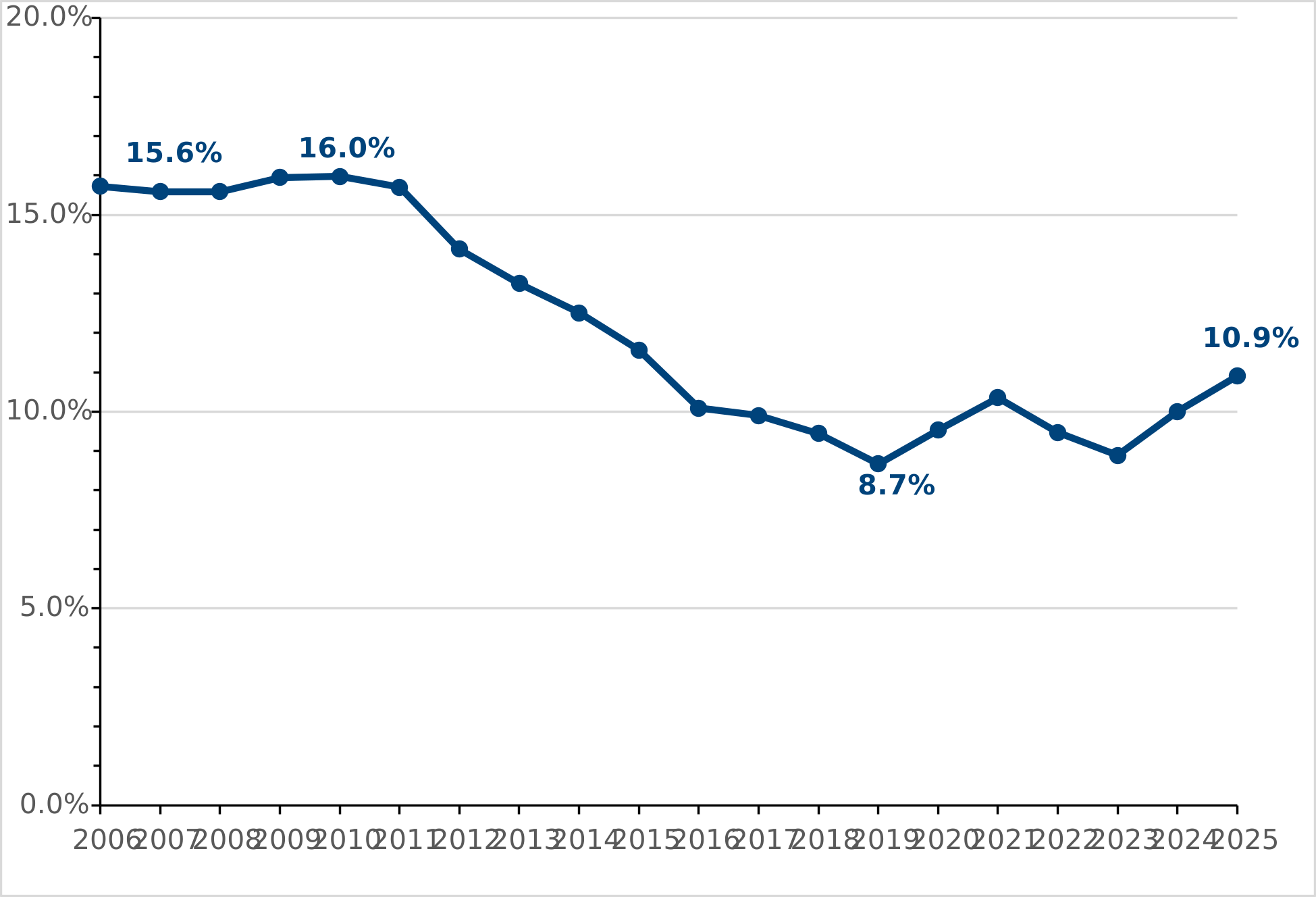
Figure 1: the proportion of children living in workless households in England, 2006 to 2025
10.9% of all children in England (around 1.2 million children) were living in workless households in the fourth quarter of 2025. This has increased from 10.0% the previous year.
The ‘Workless Households’ data uses the Labour Force Survey (LFS) and responses are weighted to official population projections. LFS headline estimates are weighted to 2022 mid-year population estimates for periods from January to March 2019. However, LFS household estimates from October to December 2023 onwards remain weighted to information on the size and composition of the UK population. These weighted estimates are consistent with the population estimates published in November 2023, creating a discontinuity from October to December 2023 onwards. Users should account for this discontinuity when considering movements in the series.
Statutory measure 2: Proportion of children living in long-term workless households in England
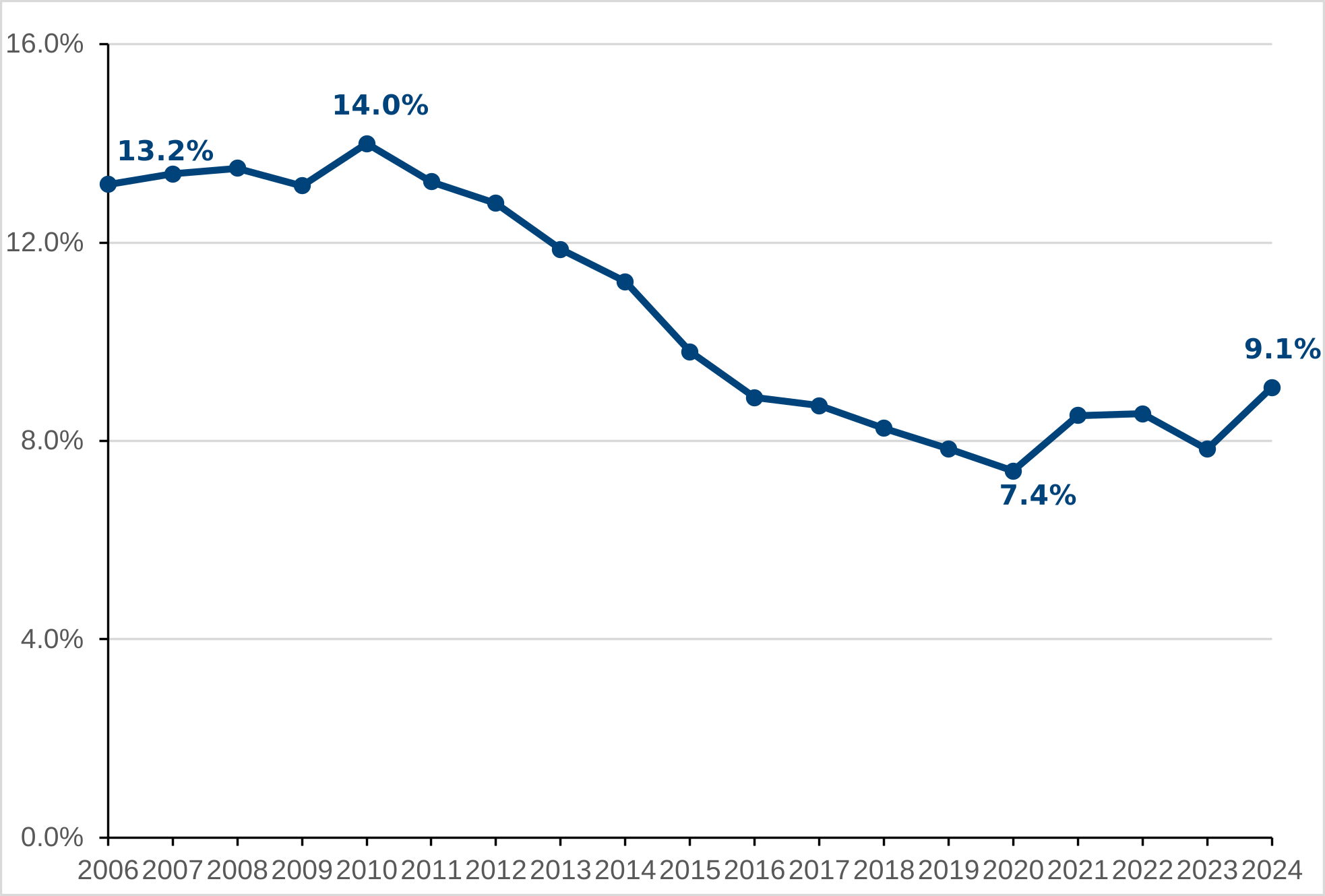
Figure 2: the proportion of children living in long-term workless households in England, 2006 to 2024
9.1% of all children in England (around 998,000 children) were living in long-term workless households in 2024. This has risen from 7.8% the previous year.
Details and Methodology
Due to concerns over achieved levels of response, the Office for National Statistics (ONS) suspended all outputs from the LFS in October 2023. In February 2024, the headline labour market measures from the survey were reintroduced, based on updated population information. The annual population survey (APS) has not been reweighted to the new populations. Consequently, all APS household tables remain weighted to the previous 2021 population totals, which will be inconsistent with those used for the LFS in the latest periods.
- Workless households are households where no one aged 16 years or over is in employment. These members may be unemployed or economically inactive. Economically inactive members may be unavailable to work because of family commitments, retirement, study, sickness or disability.
- A long-term workless household is a household where all adults (that is, those aged 16 years and over) are currently economically inactive or unemployed (workless), and these adults left their last job at least 12 months ago or have never worked (in a paid job).
- A long-term workless household does not necessarily imply that adults within them have been long-term unemployed. Some adults may have been out of work for 12 months or more but had periods of inactivity such as looking after family or illness during that time.
Children in workless households
The percentage of children in workless households is derived from the LFS, which had an achieved sample of over 65,000 people in October to December 2025. To avoid seasonal fluctuations in quarter-on-quarter data results from October to December are compared each year.
Further details can be found in the ONS publication on working and workless households in the UK.
Children in long-term workless households
The percentage of children in long-term workless households is derived from the APS. The survey combines additional interviews with interviews from the LFS.
Further details can be found in the ONS publication on children living in long-term workless households.
Educational attainment
Statutory measures 3 and 4: the education attainment of children and disadvantaged children in England at the end of Key Stage 4
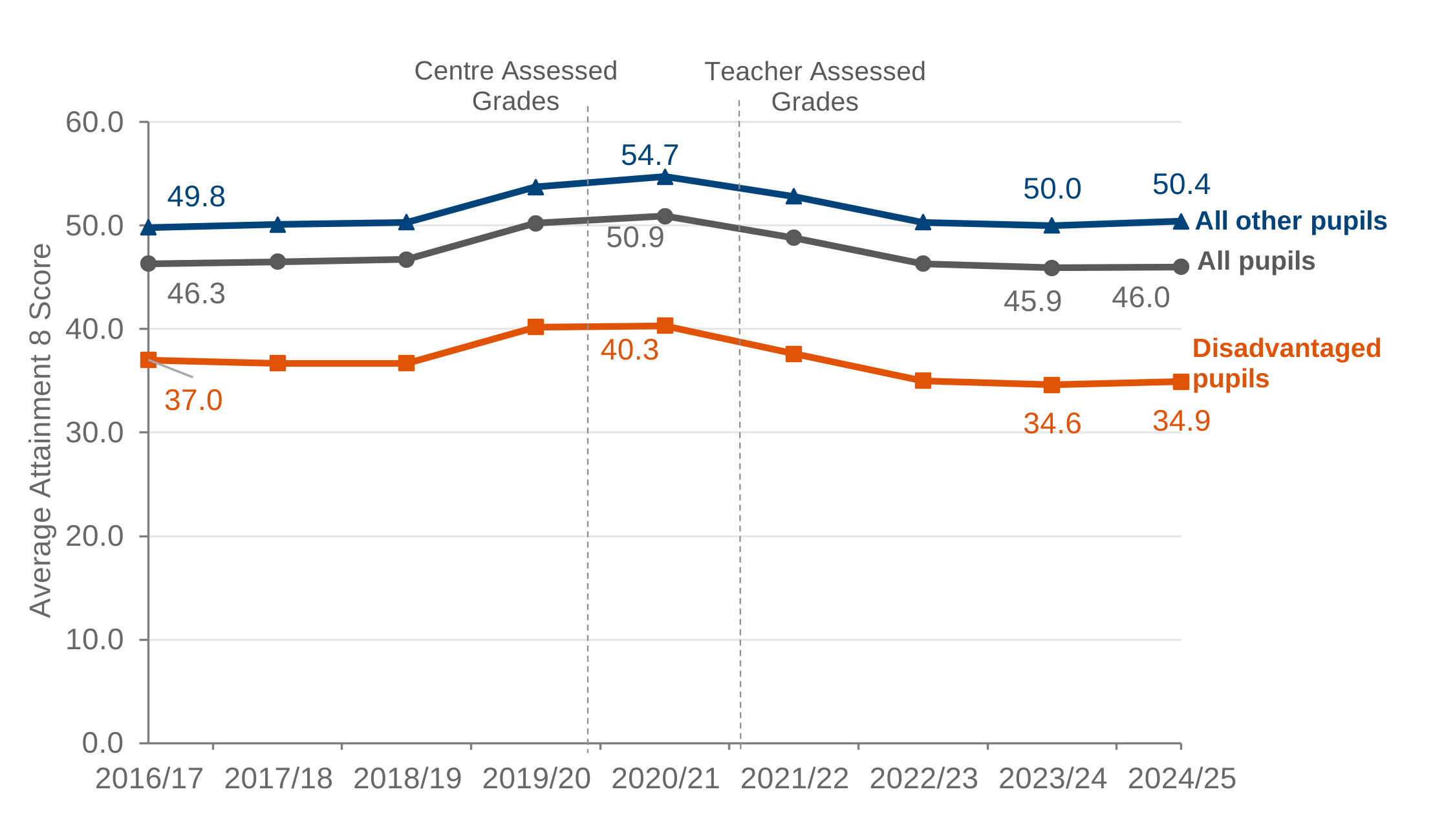
Figure 3: the education attainment of children and disadvantaged children in England at the end of Key Stage 4
In the 2024 to 2025 academic year, the average Attainment 8 score for disadvantaged pupils was 34.9. Comparatively, the average Attainment 8 score for non-disadvantaged pupils was 50.4.
The summer exam series was cancelled in both 2019 to 2020 and 2020 to 2021 due to the impact of the COVID-19 pandemic, where alternative assessed processes were set up to award grades. In 2019 to 2020, pupils scheduled to sit GCSE level exams were awarded the higher grade of either their:
- centre assessment grade (based on what the school or college believe the student would have most likely have achieved)
- calculated grade estimated from a model developed by Ofqual
For 2020 to 2021, pupils were assessed only on content they had been taught for each course. Schools were given flexibility to decide how to assess their pupils’ performance, for example, through mock exams, class tests, and non-exam assessment already completed. GCSE grades were then determined by teachers based on the range of evidence available and they are referred to as teacher-assessed grades.
For 2021 to 2022, as part of the transition back to the summer exam series, adaptations were made to the exams (including provision of information in advance) and the approach to grading for 2022 exams broadly reflected a midpoint between approaches in 2019 and 2021. For more information on changes to measures, please see secondary accountability measures.
The disadvantage gap index: the attainment of disadvantaged pupils
The disadvantage gap index summarises the attainment gap between disadvantaged pupils and all other pupils
The disadvantage gap index has been created to be a more resilient measure (than the binary category of disadvantage) of changes over time in attainment that may have been affected by, for example, the GCSE reforms introduced in 2017 and associated changes to headline measures (e.g. moving away from 5 or more GCSEs to average Attainment 8 scores).
The disadvantage gap index summarises the relative attainment gap (based on the average grades achieved in English and maths GCSEs) between disadvantaged pupils and all other pupils. The index ranks all pupils in state-funded schools in England and assesses whether disadvantaged pupils typically rank lower than non-disadvantaged pupils. A disadvantage gap of zero would indicate that pupils from disadvantaged backgrounds perform as well as pupils from non-disadvantaged backgrounds. We measure whether the disadvantage gap is getting larger or smaller over time.
Whilst the absolute differences (in English and maths GCSE grades) may differ between years, the gap index measures results in terms of how disadvantaged pupils are ranked in comparison to non-disadvantaged pupils, therefore it offers greater comparability between years.
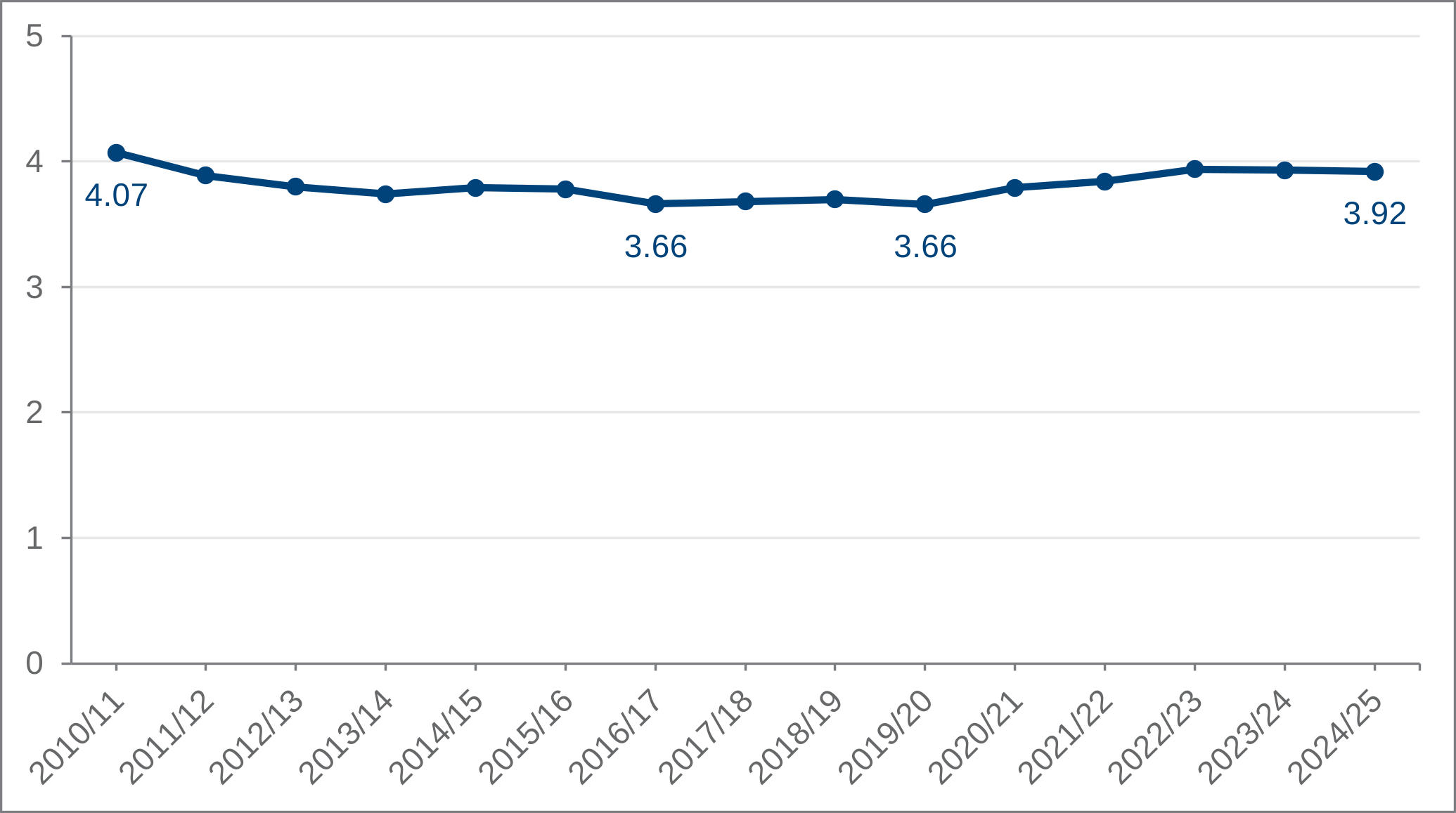
Figure 4: the disadvantaged attainment gap index for England, 2010 to 2011 to 2024 to 2025
There has been a small change in the gap index between 2023 to 2024 and 2024 to 2025; it was 3.93 in 2023 to 2024 and is 3.92 in 2024 to 2025. Since 2010 to 2011 the gap has also narrowed slightly.
Details and methodology
The disadvantage gap index summarises the relative attainment gap between disadvantaged pupils and all other pupils. Because it relies on ranked data and not actual grades, the measure can be calculated in the same way during a period of GCSE reform and enables consistent comparisons over time.
The average scores in English and maths GCSEs for all pupils are ranked and then separated into pupils from disadvantaged backgrounds and all other pupils. The mean of the ranks for the two groups is found and divided by the total number of pupils. These are then subtracted to arrive at a mean rank difference. The mean rank difference ranges between -0.5 (every disadvantaged pupil has higher attainment than all other pupils) and +0.5 (all other pupils have higher attainment than every disadvantaged pupil).
For presentation, the mean rank difference is scaled to 10 and expressed in relation to the performance of all other pupils (the comparator). This does not affect the behaviour of the indicator over time but gives the measure a value between 0 and 10 (or -10 if disadvantaged pupils have higher attainment than non-disadvantaged pupils).
The non-disadvantaged mean rank is (always) given a value of 10. The disadvantaged mean rank is expressed in relation to the non-disadvantaged rank as:
10 - [(mean rank non-disadvantaged / total pupils in cohort – mean rank disadvantaged / total pupils in cohort) x 20].

Figure 5: equation
The Disadvantaged Pupils Attainment Gap Index is the difference between these figures:
- 10 - (result from the equation above) = The Disadvantaged Pupils Attainment Gap Index
This is equivalent to the decimal mean rank difference multiplied by 20.
The minimum possible gap is 0 while the maximum gap is 10 (or -10 if disadvantaged pupils were ahead).
The gap index is a supplementary measure used while the GCSE reforms are ongoing. We will review the use of the gap index once more meaningful comparisons over time of the statutory measures are possible.
For further details, see the accompanying methodology for the gap index.
References
Parental Worklessness
Working and workless households in the UK
Children living in long-term workless households in the UK
Educational attainment
Key stage 4 performance, Academic year 2024/25
-
This is the ONS definition. Further details can be found in Children living in long-term workless households in the UK. ↩ ↩2
-
This is the ONS definition. Further details can be found in Children living in long-term workless households in the UK. ↩ ↩2
-
This is the ONS definition. Further details can be found in Children living in long-term workless households in the UK. ↩