Value of BBC News - Appendices
Published 16 December 2025

© Crown copyright 2025
This publication is licensed under the terms of the Open Government Licence v3.0 except where otherwise stated. To view this licence, visit nationalarchives.gov.uk/doc/open-government-licence/version/3 or write to the Information Policy Team, The National Archives, Kew, London TW9 4DU, or email: psi@nationalarchives.gov.uk.
Where we have identified any third party copyright information you will need to obtain permission from the copyright holders concerned.
This publication is available at https://www.gov.uk/government/publications/value-of-bbc-news/value-of-bbc-news-appendices
1. Methodology detail
1.1 Method overview
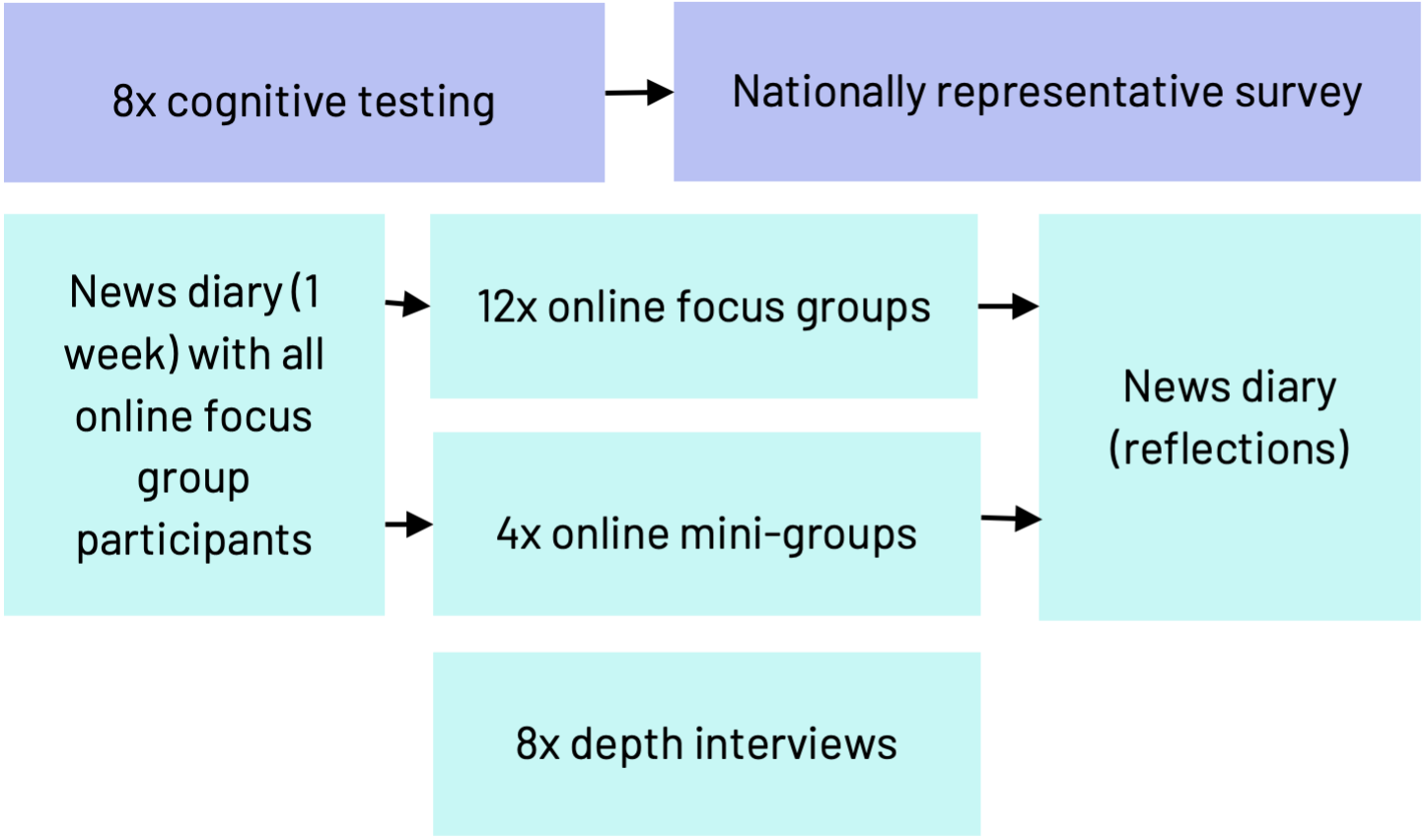
The research used a robust mixed-methods approach, combining a survey to capture the extent of views across the UK with deliberative focus groups and interviews to dig into the reasons underpinning attitudes and capture expectations for the future.
1.2 Quantitative survey
The development of the survey used for the quantitative research went through an extensive, rigorous design process. This was informed by an evidence review of existing research, a questionnaire design workshop held between Ipsos and DCMS in January 2025, an iterative approach to the drafting of the questionnaire by Ipsos – which allowed for multiple rounds of feedback from DCMS, and cognitive testing of the questionnaire.
1.3 Evidence review
The evidence review assessed existing quantitative and qualitative research on news consumption in the UK, attitudes towards BBC news and future developments in the news media industry. From this, it was determined that the quantitative research could provide a more holistic, bigger picture assessment of the value of BBC news than existing research.
Based on the evidence gathered, it was determined that survey measures should avoid simply replicating existing performance metrics for BBC news (such as those obtained from the Ofcom Media Consumption Survey, BBC Performance Tracker, Public Service Media Tracker and research commissioned by the BBC and published in the BBC Group’s Annual Report). A wide range of metrics were therefore collected in the questionnaire to help understand the broad value of the BBC. The statements used to measure these were informed by additional sources including the BBC’s existing Royal Charter, more general research on trust in media conducted by the Reuters Institute as well as the theoretical work by Mazzucato et al. on the public value of the BBC[footnote 1].
Existing quantitative evidence also pointed towards there being differences in opinion between BBC users and non-users, as well as those who engage with BBC news content through different platforms. It was therefore deemed necessary for this survey to capture not just whether someone consumes BBC news, but the means in which they do so. The survey determined whether people engaged with BBC news content through television, radio, websites/apps, podcasts and social media, as well as through different channels within these. From this data, different typologies of BBC user have been created (which are included as crossbreaks in the data tables and, where significant differences are present, referred to in the report).
Furthermore, in order to be able to link understanding of ‘how many’ (the primary purpose of quantitative research) directly with the ‘why’, it was considered necessary to ask some open-ended questions within the survey. Three open-ended questions were included with the aims of understanding: why people say the BBC is valuable (or not) to them personally/to UK society as a whole; why people say the BBC is more or less valuable than, or has the same as value as, other news sources to them personally/to UK society as a whole; what changes people feel the BBC needs to make so that its news coverage meets the needs of society today.
For the open-ended questions related to the value of BBC news, a split sampling approach was used. This meant that half the sample were asked about the personal value of BBC news and the other half of the sample were asked about their perceptions of the value of BBC news to UK society as a whole. The split sampling approach was used to allow for comparisons to be drawn between the personal and societal value of BBC news, as well as to help limit participant fatigue.
1.4 Questionnaire development: Cognitive testing
As part of the questionnaire development, cognitive testing of the survey took place between Thursday 13 and Wednesday 19 February 2025. A total of eight interviews were completed, following sampling criteria that took into account age, gender, social grade, region[footnote 2], political leaning, general news consumption levels and BBC news consumption.
The objective of this exercise was to test understanding of question wording – for example, terminology and definitions related to factors that could influence choice of news sources, the way in which participants used answer scales, the completeness of answer code lists, the overall flow of the questionnaire and participants’ general thought processes when answering questions. This exercise also tested how two specific questions (VALUES_GENERAL and COMPARATOR_PERFORMANCE) functioned when asked in different ways, with the purpose of this being to determine which option represented the optimal approach to ask these. Questions within the survey were refined in line with the findings from the cognitive testing to ensure participants were better able to understand and most accurately answer questions.
1.5 Data collection, sampling and weighting
The data for the quantitative survey was collected among a quota sample of UK adults aged 18-75 using panellists on Ipsos’ online iSay opt-in panel. Comprising 300,000 rigorously recruited participants, the iSay panel reflects diverse UK demographics, ensuring representative samples.
For this survey, a total of 3,325 online UK adults aged 18-75 were interviewed from Thursday 6 to Tuesday 18 March 2025.
A main nationally representative sample of 2,400 UK adults aged 18-75 was interviewed, with quotas set according to age within gender, region, social grade and education. The sample was also balanced according to working status.
Nations boosts were conducted in Northern Ireland, Scotland and Wales with 200 additional adults aged 18-75 interviewed in each of these nations. For these boosts, the same sampling and quota strategy was used as for the main nationally representative sample.
Ethnicity boosts were also conducted across the UK with additional interviews among 125 adults aged 18-75 who identify as having a mixed ethnicity, 100 who identify as being Asian / Asian British and 100 who identify as being Black / Black British. Quotas were not set on the ethnicity boosts.
Data from the main sample and boosts have been combined and weighted to match the overall UK population profile of adults aged 18-75 according to: age, region, social grade, working status and education (all interlocked with gender), age within region, and ethnicity.
1.6 Qualitative approach
The research took a qualitative approach to understand the reasons behind perceptions of the value of BBC News and expectations for the BBC’s role in providing news in the future. The qualitative strand involved:
- 12 online focus groups
- 4 online mini-groups with 16-17-year-olds
- 8 interviews with those who are digitally excluded
The deliberative design meant spontaneous views could be captured before informing participants about the BBC’s Mission and Charter, the range and format of current BBC News provision, the UK media sector and recent changes including consumption habits. Stimulus materials and hypothetical scenarios were used to support this, built on insights generated from the evidence review.
Fieldwork took place between 18th February and 20th March 2025. The main groups consisted of 75 participants across 12 groups, each lasting 2.5 hours. Groups were segmented by region, age and social grade, with a mix of gender, political leaning, BBC News consumption, and ethnicity. A detailed explanation of the sampling approach is provided in the Appendix to this report.
A further four mini-groups were conducted with 16-17-year-olds, each lasting 2 hours. In total, 21 participants/teenagers took part in the research. Each group was based in a specific region covering: South England, North England, Scotland and Wales, with a mix of age (16-17), gender, social grade, news consumption and ethnicity. These mini-groups used a condensed discussion guide, which was tailored to capture perspectives on how well BBC News caters to young audiences and what young audiences want from future news outputs.
Before each group, participants completed an online pre-task in their own time via an online platform. Participants were invited to complete a news diary about their news consumption and perceptions of BBC News.
The online groups were complemented by eight in-depth interviews with those who are digitally excluded, whether due to limited internet or device access, or due to limited digital literacy or confidence. Each consisted of a 60-minute telephone interview. This aspect of the research used a condensed form of the discussion guide and was tailored to those consuming news offline.
1.7 Sample definitions
Digitally excluded / low digital confidence: Digitally excluded participants are defined as those who do not have the confidence, knowledge or equipment to use the internet more than once a month. These participants might be excluded from, or have difficulty participating in, online groups. These could include those with limited or no internet access; people with limited digital literacy skills; people with disabilities; and people whose first language is not English (inc. Welsh speakers).
Socio-economic group / social grade: Socioeconomic group (SEG), sometimes referred to as ‘social grade’, is a classification system based on occupation of the Chief Income Earner of the household. The classifications are:
- AB: high or intermediate managerial, administrative or professional
- C1: Supervisory, clerical and junior managerial, administrative or professional
- C2: Skilled manual workers
- DE: Semi and unskilled manual workers, state pensioners, casual or lowest grad workers, unemployed with state benefits only.
Mixed ethnic groups: Survey participants who identified their ethnicity as one of: White and Black Caribbean, White and Black African, White and Asian or any other mixed/multiple ethnic background.
2. Evidence review sources
1. BBC, 2022. Deprivation Study: What is life like without the BBC?
2. BBC, 2024. BBC Group Annual Report and Accounts 2023/24.
3. Communications and Digital Committee, 2024. The Future of News.
4. Cushion, S 2021. Are public service media distinctive from the market? Interpreting the political information environments of BBC and commercial news in the United Kingdom.
5. Gunter, 2021. How important is the BBC as a News Source?
6. Ipsos, 2022. Ofcom Media Plurality Quantitative Report
7. Ofcom and PwC, 2019. BBC News & Current Affairs Review: PWC Research Qualitative research to provide an in-depth understanding of audience perceptions of BBC news and current affairs content.
8. Ofcom, 2021. Exploration into audience expectations of the BBC in the current media environment.
9. Ofcom, 2022. Drivers of Perceptions of Due Impartiality: The BBC and the Wider News Landscape.
10. Ofcom, 2022. Media Plurality and Online News.
11. Ofcom, 2022. Ofcom Media Plurality Quantitative Report
12. Ofcom, 2022. Ofcom PSM Tracker 2022.
13. Ofcom, 2023. Public Service Media Tracker 2023 Questionnaire.
14. Ofcom, 2024. Annual Report on the BBC 2023-2024.
15. Ofcom, 2024. BBC Performance Tracker 2023-2024 Questionnaire.
16. Ofcom, 2024. News Consumption in the UK 2024.
17. Ofcom, 2024. News Consumption Survey Questionnaire.
18. Ofcom, 2024. Review of Local Media in the UK
19. Mazzucato, M., Conway, R., Mazzoli, E.M., Knoll, E., Albala, S., 2020. Creating and measuring dynamic public value at the BBC.
20. Reuters Institute, 2023. The BBC is under scrutiny. Here’s what research tells us about its role in the UK.
21. Reuters Institute, 2024. Reuters Institute Digital News Report 2024.
22. Reuters Institute, 2025. Journalism, Media, and Technology Trends and Predictions 2025.
23. UK Parliament, 2024. BBC supplementary written evidence (FON0069), House of Lords Communications and Digital Select Committee inquiry: The future of news: impartiality, trust and technology.
24. YouGov, 2023. Which Media Outlets do Britons Trust in 2023?
3. Survey questionnaire
Section 1: Opening demographics
First, we have a few questions about yourself.
Which of the following describes your gender?
Please select one option only.
1. Man
2. Woman
3. Non-binary
4. My gender is not listed
999. Prefer not to say
What was your age last birthday?
[Numeric box - allow range 18-75]
999. Prefer not to say
What is your postcode?
[Open text box]
1. Prefer not to say
What is the highest level of education that you have completed?
This means any educational, professional, vocational or other work-related qualifications for which you received a certificate.
Please select one option only.
1. Degree level or above, SVQ Level 5
2. Other Higher Education below degree level, SVQ Level 4
3. A levels, Scottish Highers, NVQ level 3 and equivalents; includes AS level, Higher Grade, Advanced Higher, CSYS, Scottish Baccalaureate, SVQ and GNVQ level 3, BTEC National, SCOTVEC National Diploma, SVQ Level 3
4. GCSE/O level grade A*-C or 4-9, Scottish O Grade/Standard Grade/National 5/Intermediate 2, NVQ level 2 and equivalents; includes SVQ and GNVQ level 2, BTEC first or general diploma
5. Qualifications at level 1 and below, includes GCSE or O level below grade C or 4, CSE below grade 1, NVQ, Scottish National 1-4/Intermediate 1, SVQ and GNVQ level 1, BTEC first or general certificate, SCOTVEC National Certificate
6. Other (please specify)
7. No qualification
999. Prefer not to say
How would you describe your employment status at present?
Please select one option only.
1. Working full-time (30+ hours)
2. Working part-time (8-29 hours)
3. Unemployed – less than 12 months
4. Unemployed (long term) – more than 12 months
5. Not working – retired
6. Not working – looking after house/children
7. Not working – long term sick or disabled
8. Student – in full-time education studying for a recognised qualification
9. Student – in part-time education studying for a recognised qualification
10. Other
999. Prefer not to say
Which one of the following best describes your ethnic group or background?
Please select one option only.
1. English/Welsh/Scottish/Northern Irish/British
2. Irish
3. Gypsy or Irish Traveller
4. Any other White background (please specify)
5. White and Black Caribbean
6. White and Black African
7. White and Asian
8. Any other mixed/multiple ethnic background (please specify)
9. Indian
10. Pakistani
11. Bangladeshi
12. Chinese
13. Any other Asian/Asian British background (please specify)
14. Caribbean
15. African
16. Any other Black/Black British background (please specify)
17. Arab
18. Any other ethnic group (please specify)
998. Don’t know
999. Prefer not to say
Section 2: Sources of news and news consumption habits
We’d like to begin by asking you a few questions about news media and how you consume the news.
How interested, if at all, are you in the news?
Please select one option only.
1. Very interested
2. Fairly interested
3. Not very interested
4. Not at all interested
998. Don’t know
How interested, if at all, are you in the following types of news?
Please select one option only.
[Statements - randomised]
- Local / regional news
- UK news
- Foreign / international news
- Political news
- Business and financial news
- Sports news
- Science and technology news
- Health news
- Education news
- Arts and cultural news
- Celebrity / entertainment news
1. Very interested
2. Fairly interested
3. Not very interested
4. Not at all interested
998. Don’t know
Thinking about all the different ways you could access the news (e.g. while watching on television or on demand, listening to the radio or podcasts, reading or watching the news online or in print, or on social media).
How often, if at all, do you read, watch, or listen to the news nowadays?
Please select one option only.
1. Several times a day
2. Once a day
3. More than once a week but less often than every day
4. Once a week
5. More than once a fortnight but not every week
6. Once a fortnight or less often
7. Never - I do not follow news stories
998. Don’t know
999. Prefer not to say
Which of the following, if any, do you use for news (i.e. which you have used in the last month or so)?
Please select all that apply.
1. Television (broadcast or on-demand)
2. Newspapers (printed)
3. Magazines (printed)
4. Radio
5. Websites / apps
6. Podcasts
7. Social media
8. Word of mouth (family/friends/colleagues) – in person/by phone/email
9. Other
998. None of these- I don’t follow the news
999. Don’t know
Thinking specifically about television, which of the following do you use for news (i.e. which have you watched in the last month or so for news)?
Please select all that apply.
1. BBC One
2. BBC Two
3. BBC Three
4. BBC Four
5. BBC News Channel
6. BBC Parliament
7. BBC Alba
8. BBC Scotland TV channel
9. ITV1 / ITV Wales / UTV / STV
10. Channel 4
11. S4C
12. Channel 5
13. RTE Channels / Virgin Media One (formerly known as TV3 / TG4)
14. Sky News Channel
15. Sky Sports News
16. GB News
17. CNN
18. Euronews
19. Al Jazeera
20. Other television channel(s) – please specify
- None of these
998. Don’t know
Thinking specifically about printed newspapers (the paper versions, and NOT the websites or apps), which of the following do you use for news (i.e. which have you read in the last month or so for news)?
Please select all that apply.
1. The Sun / The Sun on Sunday
2. Daily Mail / The Mail on Sunday
3. Daily Star / Daily Star on Sunday
4. Daily Express / The Sunday Express
5. Daily Mirror / The Sunday Mirror
6. The Guardian / The Observer
7. The Times / Sunday Times
8. Daily Telegraph / Sunday Telegraph
9. The ‘i’
10. Financial Times
11. The Herald / Herald on Sunday
12. The Scotsman / Scotsman on Sunday
13. Daily Record / Sunday Mail
14. Sunday Post
15. South Wales Echo
16. Western Mail / Wales on Sunday
17. Daily Post
18. Belfast Telegraph / Sunday Life
19. News Letter
20. Irish News
21. Sunday World
22. Metro
23. New European
24. Any printed local newspaper – please specify
25. Other printed newspaper(s) – please specify
- None of these
998. Don’t know
Thinking specifically about radio, which of the following do you use for news (i.e. which have you listened to in the last month or so for news)?
Please select all that apply.
1. BBC Radio 1
2. BBC Radio 2
3. BBC Radio 3
4. BBC Radio 4
5. BBC Radio 5 Live
6. BBC Radio 6 Music
7. BBC World Service
8. BBC Radio Wales
9. BBC Radio Ulster / Foyle
10. BBC Radio Scotland
11. BBC Radio nan Gàidheal
12. BBC Radio Cymru / Cymru 2
13. Any BBC local / regional radio station (please specify)
14. Any other BBC radio station (please specify)
15. Classic FM
16. talkSPORT / talkSPORT2 / talkRADIO
17. Any LBC Radio station
18. Any Heart Radio station
19. Any Absolute Radio station
20. Any Capital Radio station
21. Any Kiss Radio station
22. Any Smooth Radio
23. Any Magic Radio station
24. Times Radio
25. Virgin Radio
26. Hits Radio
27. GB News Radio
28. Cool FM
29. Q Network
30. U105
31.Other radio station(s) – please specify
997. None of these
998. Don’t know
Thinking specifically about websites/apps, which of the following do you use for news (i.e. which have you visited in the last month or so for news)?
Please select all that apply.
1. BBC website / app
2. Google search
3. Another search engine (please specify)
4. Sky News website / app
5. ITV / ITN website/app
6. CNN website/app
7. BuzzFeed website/app
8. HuffPost website /app
9. GB News website / app
10. Channel 4 website / app
11. Guardian/Observer website/app
12. Daily Mail website/app
13. Telegraph website/app
14. The Sun website/app
15. The Times website/app
16. Independent website/app
17. Financial Times website/app
18. Any website/app of another national newspaper (e.g. Daily Mirror or Evening Standard website/app)
19. Any website/app of a local or regional newspaper
20. Websites / apps of news magazines (e.g. The Economist or The Week)
21. Websites / apps such as Apple News or Google News, that bring together news from different news providers (sometimes called ‘news aggregators’)
22. An artificial intelligence website/app (e.g. Chat GPT)
23. Other website/app (please specify)
997. None of these
998. Don’t know
Thinking specifically about the podcasts you use for news (i.e. which you have listened to in the last month or so for news)…
Which news organisations’ podcasts do you usually listen to?
Please select all that apply
1. BBC News Podcasts (E.g. Newscast, Americast, Global News Podcast)
2. Sky News Podcasts (E.g. Electoral Dysfunction, Sky News Daily, Politics at Jack and Sams)
3. ITV News Podcasts (E.g. Talking Politics, What You Need to Know)
4. Channel Four News Podcasts (E.g. The Fourcast)
5. GB News Podcasts (E.g. Chopper’s Political Podcast)
6. Guardian / Observer Podcasts (E.g. Today in Focus, Politics Weekly UK)
7. The Times / Times Radio Podcasts (E.g. Times News Briefing, World In 10)
8. Financial Times Podcasts (E.g. FT News Briefing, Political Fix)
9. Economist Podcasts (E.g. Economist Podcast, The Intelligence from The Economist, Editor Picks)
10. LBC Podcasts (E.g. James O’Brien Daily)
11. Other news podcasts (please specify) (E.g. The News Agents, The Rest is Politics)
997. None of these
998. Don’t know
Thinking specifically about podcasts you use for news (i.e. which you have listened to in the last month or so for news)…Where do you tend to access these?
Please select all that apply.
1. BBC Sounds
2. iTunes
3. Apple podcasts
4. GooglePlay
5. Spotify
6. Acast
7. Amazon Music / Audible
8. Specialist podcast website or app (e.g. Overcastr, Stitcher)
9. YouTube
10. Soundcloud
11. Castbox
12. Globalplayer
13. The website / app of a national newspaper / magazine (e.g. The Guardian, Sun, Times, Independent, Financial Times, Economist etc.)
14. Website / app of a non-BBC radio station
15. Website / app of a non-BBC TV channel
16. Website / app of the podcast itself (please specify website)
17. Podcasts from somewhere else (please specify)
997. None of these
998. Don’t know
Thinking specifically about social media (on any device)… Which, if any, of the following do you use to access news – i.e. which have you used in the last month or so to access news?
Please select all that apply.
1. Facebook
2. Instagram
3. LinkedIn
4. Reddit
5. Snapchat
6. X (formerly known as Twitter)
7. WhatsApp
8. TikTok
9. YouTube
10. Other social media platforms (please specify)
997. None of these
998. Don’t know
From which of the following accounts / pages do you access news on social media (i.e. which have you used in the last month or so to access news)?
This could be on pages you follow / like or information that appears in your news feed. Please select all that apply.
1. BBC News accounts
2. BBC News journalists’ accounts
3. ITV / ITN accounts
4. ITV / ITN journalists’ accounts
5. Sky News accounts
6. Sky News journalists’ accounts
7. Channel 4 accounts
8. Channel 4 journalists’ accounts
9. GB News accounts
10. GB News journalists’ accounts
11. Other news organisations’ accounts
12. Other journalists’ accounts
13. From other people that I follow (including friends / family members)
14. Other (please specify)
- None of these
998. Don’t know
Section 3: Attitudes towards the BBC and public service media
We’d now like to ask a few questions about your opinions towards different providers of the news.
By news we mean news and current affairs across the UK and from around the world.
To what extent, if at all, do you trust the news in general nowadays?
Please select one option only.
1. A great deal
2. A fair amount
3. Not very much
4. Not at all
998. Don’t know
999. Prefer not to say
[Asked to those who do not trust news]
You said you do not trust the news [very much/at all] nowadays.
For which of the following reasons, if any, do you say that?
Please select all that apply.
1. I believe news media outlets are biased in their reporting
2. I think news media outlets are inaccurate
3. I feel that news media is influenced by political agendas
4. I feel that news media is influenced by corporate/business interests
5. I have come across false/inaccurate news information in the past
6. I believe news media is more focused on generating profits than informing the public
7. I feel that news media does not adequately represent diverse perspectives
8. I have lost trust in news media due to scandals or unethical behaviour by journalists
9. I believe that news coverage is too negative / too depressing
10. It’s hard to tell the difference between what is accurate and what is not
11. News media outlets don’t share my values
12. News media outlets are out of touch
13. Another reason (please specify)
14. No reason in particular
998. Don’t know
999. Prefer not to say
Thinking about your general view of all news providers…
Overall, how satisfied or dissatisfied are you with the quality of the news they provide?
Please select one option only.
1. Very satisfied
2. Fairly satisfied
3. Neither satisfied nor dissatisfied
4. Fairly dissatisfied
5. Very dissatisfied
998. Don’t know
999. Prefer not to say
And overall how satisfied or dissatisfied are you with the quality of the news the BBC provides?
Please select one option only.
1. Very satisfied
2. Fairly satisfied
3. Neither satisfied nor dissatisfied
4. Fairly dissatisfied
5. Very dissatisfied
998. Don’t know
999. Prefer not to say
Section 4: Value of news media and BBC News
Thinking now about all of the sources of news that you currently use and may consider using in the future…
Which of the following, if any, are most important to you personally when deciding which sources of news to use?
Please pick all that apply.
1. Whether they provide news that is important to me personally
2. Whether they provide news that is interesting to me
3. Whether their news coverage is informative
4. Whether their news coverage covers local issues
5. Whether they report on news stories that are not covered widely by other news providers
6. Whether their news coverage is unbiased
7. Whether their news coverage is accurate
8. Whether they are transparent about where they get information from and how they use it
9. Whether their news coverage provides a range of different perspectives
10. Whether they provide information that helps me engage with the UK’s democratic process
11. Whether they use different technologies to help me access the news in ways that are easy for me
12. Whether their news coverage represents people like me
13. Whether they provide detailed coverage of news stories
14. Whether their news coverage is easy to understand
15. Whether their news coverage responds quickly enough to current events
16. Whether they have a long history of providing high quality news
17. Whether their journalists / presenters are high calibre
18. None of the above
999. Don’t know
[Statements - randomised]
1. How valuable, if at all, would you say the BBC’s news content is to you personally?
2. How valuable, if at all, would you say the BBC’s news content is to UK society as a whole?
Please select one option only.
1. Very valuable
2. Fairly valuable
3. Not very valuable
4. Not at all valuable
998. Don’t know
Thinking still about the BBC’s news content…
You say that the news content the BBC provides is [to you personally/to UK society as a whole].
Why do you say that?
[Open text box]
997. No reason in particular
998. Don’t know
999. Prefer not to say
Thinking about the value [to you personally/to UK society as a whole] of the news content produced by the BBC News and other news providers…
On the whole, which of the following comes closest to your opinion?
BBC news content [to me personally/to UK society as a whole] is…
1. More valuable than all / nearly all other news providers
2. More valuable than most other news providers
3. About the same value as other news providers
4. Less valuable than most other news providers
5. Less valuable than all / nearly all other news providers
998. Don’t know / not sure
Still thinking about BBC News and the other news providers that you use…
You say that the news content produced by the BBC.
Why do you say that?
[Open text box]
997. No reason in particular
998. Don’t know
999. Prefer not to say
On balance how well or not do you think the news content produced by the BBC does each of the following?
Please select one option only.
[Statements - randomised]
1. Providing news that is important to me personally
2. Providing news that is interesting to me
3. Providing news coverage that is informative
4. Providing news coverage that covers local issues
5. Reporting on news stories that are not covered widely by other providers
6. Providing news coverage that is unbiased
7. Providing news coverage that is accurate
8. Being transparent about where they get information from and how they use it
9. Providing a range of different perspectives
10. Providing information that helps me engage with the UK’s democratic process
11. Using different technologies to help me access the news in ways that are easy for me
12. Representing people like me
13. Providing detailed coverage of news stories
14. Providing news coverage that is easy to understand
15. Providing news coverage that responds quickly enough to current events
16. Having a long history of providing high quality news
17. Having high calibre journalists / presenters
Response options:
1. Very well
2. Fairly well
3. Not very well
4. Not at all well
998. Don’t know
Thinking about the news content produced by the BBC compared to other news providers…
On balance, would you say BBC news content is better or worse than other news providers at each of the following, or about the same?
Please think about your general view of other news providers.
Please select one option only.
[Statements - randomised]
1. Providing news that is important to me personally
2. Providing news that is interesting to me
3. Providing news coverage that is informative
4. Providing news coverage that covers local issues
5. Reporting on news stories that are not covered widely by other providers
6. Providing news coverage that is unbiased
7. Providing news coverage that is accurate
8. Being transparent about where they get information from and how they use it
9. Providing a range of different perspectives
10. Providing information that helps me engage with the UK’s democratic process
11. Using different technologies to help me access the news in ways that are easy for me
12. Representing people like me
13. Providing detailed coverage of news stories
14. Providing news coverage that is easy to understand
15. Providing news coverage that responds quickly enough to current events
16. Having a long history of providing high quality news
17. Having high calibre journalists / presenters
Response options:
1. BBC news content is better at this than all/nearly all other news providers
2. BBC news content is better at this than most other news providers
3. About the same as other news providers
4. BBC news content is worse at this than most other news providers
5. BBC news content is worse at this than all/nearly all other news providers
998. Don’t know / not sure
Section 5: Future issues facing media and BBC’s role
We’d now like to ask you some more specific questions about the BBC and its news coverage.
Which of the following statements best describes your opinion of how well the BBC’s news coverage meets the needs of society today?
Please select one option only.
1. The BBC’s news coverage meets the needs of today’s society extremely well and does not need to be changed
2. The BBC’s news coverage could be changed in small ways but mainly meets the needs of today’s society
3. The BBC’s news coverage needs to be changed quite a lot to meet the needs of today’s society
4. The BBC’s news coverage needs a great deal of change to meet the needs of today’s society
998. Don’t know
999. Prefer not to say
[Asked to those who think BBC needs to change]
You said the BBC’s news coverage [could be changed in small ways/needs to be changed quite a lot/needs a great deal of change] to meet the needs of today’s society.
What changes, if any, would you like to see?
Please provide as much detail as possible, including any reason(s) as to why you would like to see these changes.
[Open text box]
- Nothing in particular
998. Don’t know
999. Prefer not to say
Thinking about the news content the BBC produces over the next ten years…
Which of the following, if any, do you think it is most important for the BBC to focus on?
Please select all that apply.
1. Providing coverage of local news
2. Providing news coverage to international audiences outside of the United Kingdom (e.g. through the BBC World Service)
3. Providing coverage of news stories that are not widely covered elsewhere
4. Providing live updates on breaking news stories
5. Providing a range of different perspectives (including different political perspectives and those with non-mainstream views and ideas)
6. Countering mis/ disinformation through fact checking and verifying information
7. Promoting the use of innovative technologies (such as Artificial Intelligence) in its journalism
8. Providing news content through social media platforms
9. Providing people with news that is personalised to their interests
10. Providing accurate news
11. Providing impartial news
12. Providing news that is important to society as a whole
13. Investing money to ensure it has the highest calibre presenters and journalists
14. Making content that is interesting for young audiences
15. Producing news from places in the UK outside of London
16. Saving money by reducing how much it spends on news
17. Charging people for premium news content to generate money for the BBC
18. None of the above
998. Don’t know
Section 6: Closing demographics
We now have some final questions about you.
Do you use any of the following social media apps/websites (i.e. which have you used in the last month or so)?
Please select all that apply.
1. Facebook
2. Instagram
3. LinkedIn
4. Reddit
5. Snapchat
6. X (formerly known as Twitter)
7. WhatsApp
8. TikTok
9. YouTube
10. Other social media platforms (please specify)
998. None of these
999. Don’t know
As you may be aware, BBC shows and services – including its news output – are funded by money raised by the television licence fee. (It is not necessary though to have a television licence in order to access some BBC news content, such as on the BBC website or on the radio).
Thinking about the licence fee, which of the following statements applies to you personally?
Please select one option only.
1. My household has a television licence, and I am solely responsible for paying for this
2. My household has a television licence, and I am jointly responsible for paying for this
3. My household has a television licence, but I am not responsible for paying for this
4. My household does not pay for a television licence
- Don’t know
998. Prefer not to say
What is your marital status?
Please select one option only.
1. Never married (Single)
2. Domestic Partner (Living as a couple)
3. Married / Civil Partnership
4. Separated
5. Divorced
6. Widowed
998. Prefer not to say
How many people are living or staying at your current address? (Include yourself and any other adults or children who are currently living or staying at this address for at least two months).
Please select one option only.
[Options 1-12+]
[Asked if 2+ people in household]
How many children under the age of 18 are living in your household? Please reference only the children for which you are the parent or legal guardian. (If there are no children under 18 in your household, please select 0)
[Numeric box - allow range 1-20]
999. Prefer not to say
Do you have any physical or mental health conditions or illnesses lasting or expected to last for 12 months or more?
Please select one option only.
1. Yes
2. No
998. Don’t know
999. Prefer not to say
[Asked if has health condition]
Which, if any, of the following long-term health conditions do you have?
Please select all that apply
1. Allergies
2. Alzheimer’s disease or other cause of dementia
3. Arthritis or ongoing problem with back or joints
4. Autism or autism spectrum condition
5. Blindness or partial sight
6. Breathing condition such as asthma or COPD
7. Cancer (diagnosis or treatment in the last 5 years)
8. Chronic fatigue
9. Chronic insomnia
10. Deafness or hearing loss
11. Diabetes
12. Heart condition, such as angina or atrial fibrillation
13. High blood pressure
14. Immune deficiency related disease/illness
15. Kidney or liver disease
16. Learning disability
17. Mental health condition
18. Mobility impairment, such as difficulty walking
19. Neurological condition, such as epilepsy
20. Stroke (which affects your day-to-day life)
21. Speech impairments
22. Another long-term condition or disability
23. I do not have any long-term health conditions
998. Don’t know
999. Prefer not to say
How would you describe your national identity?
Please select all that apply.
1. British
2. English
3. Welsh
4. Scottish
5. Northern Irish
6. Irish
7. Other (please specify)
998. Don’t know
999. Prefer not to say
What is your main language?
By main language we mean your first or preferred language.
Please select one option only.
1. English
2. [Show if Wales] Welsh
3. Other language, including British Sign Language (please specify)
999. Prefer not to say
What is your religion?
Please select one option only.
1. No religion
2. Christian (Including Church of England, Catholic and all other Christian denominations)
3. Buddhist
4. Hindu
5. Jewish
6. Muslim
7. Sikh
8. Any other religion (please specify)
999. Prefer not to say
Which of the following options best describes how you think of yourself?
Please select one option only.
1. Heterosexual or Straight
2. Gay or Lesbian
3. Bisexual
4. Other (please specify)
998. Don’t know
999. Prefer not to say
4. Qualitative materials
Note, topic guides provide an outline of the key issues, themes and areas of questioning used by the facilitator to guide qualitative data collection. The following three topic guides are those used for the adult focus group (4.1) , the younger people’s focus group (4.2), and the depth interviews (4.3) conducted as part of this research project.
4.1 Focus group guide
Welcome presentation
Spontaneous views
Where do you normally go to find out the news?
Probe: TV, radio, online, local/ national newspapers, other places?
How, if at all, does this differ? E.g. by type of news story, time / day, current events?
-
What types of news are you interested in?
- Probe: local news, national news, global news?
-
How important is news to you? Why?
Do you ever look for news in any language other than English?
-
In WALES group: probe specifically on Welsh language news and BBC Cymru Fyw.
-
In SCOTLAND group: probe specifically on Gaelic language news and BBC Alba.
-
If Yes: How does your experience and range of options for consuming news vary?
-
Do you ever consume BBC News in different languages? How do you find this?
Did you notice anything about your own news habits while doing the diary task?
- Was anything surprising?
What do you think about the range of news available in the UK today?
- How important do you think it is to have access to a range of sources (e.g. news providers) when accessing the news?
How important is it that you see a range of opinions and voices on a news story?
-
Is this more or less important than seeing a range of news sources?
-
Clarify if needed:
-
You may see lots of different news sources (especially online) but these may all be taking the same perspective on a news story.
-
Alternatively a single news source may showcase a range of perspectives when reporting on a single news story.
-
-
Do you feel that you often see a range of opinions and perspectives?
-
Do you ever question if there are different perspectives on a news story that you are not seeing or understanding?
-
What type of news are you thinking about when you consider this? Does the type of news make a difference?
How do you decide where to go for news/what do you look for in choosing where to go?
-
Quality, trust, accuracy, impartiality, entertainment, authority, source, brand, relationship with the brand, breadth, whether you are likely to agree with the source etc.
-
What makes these factors important when deciding where to go for news?
-
Does this vary depending on the type of news you are looking for?
-
What does ‘quality’ news mean to you? What is a sign of good or poor quality news?
Throughout this session we will be discussing the different factors that matter to you when you choose where to get your news from. I’m going to quickly talk through what some of those factors might be, and what they mean.
-
Accuracy is about whether the information and facts are correct, and have been confirmed to be true.
-
Impartiality is about whether the story is being told fairly and without bias that favours one side over the other. A news story could be accurate and not impartial for example.
-
Do they cover stories that you find important? Some providers may just not cover stories you find important or in a way that you agree with, and that could be a key factor.
- If needed, examples: they may focus too much or not enough on politics, celebrity news, climate change, economics, global conflicts, your local area, news about people like you?
-
Local news coverage is about whether the news provider focuses only on national or global news, or whether they also tell you about news stories in your area.
-
Independence is about how the news provider is funded, owned or governed, and whether this might influence what they do and don’t report on, and whether there is bias.
-
Transparency is about whether they are open and honest about how the news provider is funded, owned or governed, and how their news is produced, sourced and fact checked.
Looking at these different factors, please each take a moment to pick three that you personally prioritise when choosing where to look for news stories.
-
If you have another factor in mind that is not on this list, choose ‘Other’.
- Are there any factors on this list you feel is the least important to you personally? If so, why?
-
Are there any news sources you avoid? For what reasons?
-
Are there any you like the most because of the factors on screen?
-
How have your priorities changed for you in the last 5 years?
-
Why is that?
-
How about the last 10 years?
-
-
Have any become more or less important?
Now thinking about BBC News specifically, what words come to mind when you think of BBC News?
-
Why does that word come to your mind? What does that mean to you?
-
How do you think other people see BBC News? What might your friends or family say?
How do you each use BBC News, if at all?
-
Is it a source you go to often for news stories?
-
Where do you go? Probe: online (e.g. website, social media), TV (e.g. BBC Breakfast, 6 o’clock or 10 o’clock News), radio (e.g. 5Live, Radio 4), podcasts (e.g. Newscast) etc.
-
Do you use BBC News for some types of news stories, but not for others?
-
Probe: breaking news, fact checking, analysis
-
Can you think of a story you have gone to BBC News to find out about recently?
-
Where do you go instead? For what reasons?
-
Quick presentation:
As we will be talking specifically about BBC News for the rest of the session, we are going to share some information about BBC News, and about news media in general.
Presentation to cover:
-
The BBC’s mission and Charter
-
The range and format of current BBC News provision
-
The UK media: overview of different sources/providers, laying out useful terminology such as live reporting, bulletins, current affairs, analysis.
Reflections on the presentation
-
What did you think of the information shared in that presentation?
-
Was anything new or surprising to you?
Looking back at the factors that you each prioritised in the first session, how well do you feel the BBC performs against them?
-
Which ones does it do well? How so?
-
Which does it not do so well in? How so?
-
What could it do better? How?
-
How does this differ across platforms? E.g. is there a difference between BBC News on radio vs. TV news vs. online?
-
Are there things that aren’t on this list, but you think BBC News does do well?
Is there anything that makes the BBC stand out compared to other providers?
-
If so, how does it stand out? How distinctive would you consider this?
-
What do you feel the BBC should do more and/or less of? For what reasons?
-
How does BBC News compare against other Public Service News Providers (like Channel 4 or ITV News)?
-
What about other news providers (like Sky News, Newspapers like The Times or radio & podcasts)?
How important do you think it is for BBC News to cater to all communities in the UK and deliver services that are easily accessible by all the population?
-
How could they reach wider audiences?
- If relevant: Can BBC News better cater for those who speak English as a second language, including those who speak Welsh?
-
How well is BBC News meeting the current needs of audiences?
-
How about on TV? (probe: Live TV or OnDemand)
-
How about radio?
-
How about online?
-
What should they do more of and/or less of?
-
-
How does this differ across platforms? E.g. is there a difference between BBC News on radio vs. TV news vs. online?
What role do you think the BBC currently plays in providing news to UK audiences?
-
How important is this to you?
-
What about to wider society?
-
To what extent do you think this should be a central purpose for the BBC?
To what extent do you think BBC News is delivering against its public purpose “to provide impartial news and information to help people understand and engage with the world around them”?
-
In what ways does it deliver against this purpose?
-
Where does it fall short?
-
How could it improve?
-
-
Does this differ at all for different audiences?
-
Does this differ at all for different types of news programmes/stories?
-
What about different formats? E.g. is there a difference between BBC News on radio vs. TV news vs. online?
If BBC News did not exist, what do you think would be gained or lost?
-
What would you miss most?
-
What impact would this have on access to accurate and impartial news and information?
-
Where do you think audiences would go instead?
Looking to the future
Quick presentation: Current changes in news media and consumption (5 minutes)
Reflections on the presentation (5 minutes)
-
What did you think about the information shared just now?
-
How do you feel about the changes in how news is shared and consumed? Do these changes feel familiar or surprising?
-
What challenges might BBC News face in the future?
-
How might BBC News need to evolve in the next ten years?
-
What should it do more/less off?
-
What should it focus on?
-
Future scenarios activity
We’ve heard a bit about how the news landscape has changed recently, including how audiences consume news differently. Now we would like to look to the future and think about how the landscape will continue to change.
We are going to imagine it is now the year 2035 – ten years from now.
I will share some details about how this version of the future looks, when it comes to the news in the UK. This is completely hypothetical and imagined to help us think about what could be important in the future. We will pause to discuss what matters to you and what you would/would not want from BBC News as we go.
Scenario 1: Personalised but polarised news
News environment
-
Since 2025, news has become highly personalised, consumed mainly through social media and aggregators, leading to a polarised environment.
-
Algorithms show users content that aligns with their views, limiting exposure to diverse perspectives.
-
While fact-checking organisations and media literacy programmes assist some in identifying bias, social media continues to be largely unregulated and a primary source of news for many people.
-
Some traditional news outlets have shifted to more polarised content, aligning with either right-wing or left-wing ideologies, or sensational headlines, to stay relevant.
-
However, Ofcom continues to enforce impartiality rules for regulated TV and radio broadcasters.
Questions:
-
How likely do you think this future is? What do you like or dislike about it?
-
How do you think this would affect you? What might this mean for different groups in society?
-
What should the role of BBC News for society be in this future?
- How important is this role?
BBC News role and impacts
In this hypothetical scenario, the BBC has recommitted to its public service mission, offering diverse perspectives and in-depth analysis. However, it struggles to engage audiences used to strongly opinionated news, as some do not enjoy the BBC’s approach to impartiality, seeing this as not taking a stance. The BBC explores new formats to maintain relevance.
Questions:
-
What do you think of the BBC News response here?
-
Do you think the BBC should respond in a different way?
-
What might be the benefits or risks to different approaches?
-
-
Can the BBC compete with the appeal of divisive headlines? How?
-
How should BBC News approach social media as a channel?
-
How can BBC News demonstrate impartiality?
-
Now imagine this scenario with no BBC News, would that change how you feel?
-
What impact do you think that would have on you, on your friends and family, and on the country more widely?
-
Probe: would you miss the reporting and analysis provided by BBC News?
-
Scenario 2: Accuracy, speed and volume of news coverage
News environment
-
Since 2025, artificial intelligence (AI) has been widely adopted in news media, enabling faster, cost-effective reporting and content creation.
-
AI has made it easier for anyone to create fake videos and misinformation, which along with human-created misinformation, spreads virally online and complicates the distinction between real and fake news.
-
However, AI aids in combating misinformation as news organisations use AI to analyse data, identify patterns, and fact-check at scale.
-
New laws have emerged to regulate AI use in news and combat misinformation, but enforcement is challenging, especially where entities are based overseas.
Questions:
-
How likely do you think this future is? What do you like or dislike about it?
-
How would it affect you personally?
-
What might this mean for different groups in society?
-
What is the role of BBC News for society in this future?
- How important is this role?
BBC News role and impacts
In this hypothetical scenario, the BBC remains committed to its public service mission, using AI for verification and focusing on explaining stories with clarity and context.
This can lead to slower reporting compared to outlets prioritising speed over accuracy. In breaking news, the BBC struggles to balance speed with precision, frustrating audiences wanting real-time updates.
They’re experimenting with AI formats for faster, trustworthy information. Correcting viral misinformation remains challenging, as debunked falsehoods persist among certain groups.
Questions:
-
What do you think of the BBC News response here?
-
Do you think the BBC should respond in a different way?
-
What might be the benefits or risks to different approaches?
-
-
Should the BBC prioritise speed of reporting (even if this means more inaccuracies), or prioritise accuracy (even if this means it is sometimes slower)?
- What is the impact if BBC News reported incorrect facts due to speed of reporting?
-
If you saw social media posts about a local emergency (such as local flooding), would you choose to follow the story on BBC News if there are fewer details available (due to slower pace of fact checked stories) or on social media where lots of detail is being shared without official verification?
-
What do you feel is BBC News’ role in combating misinformation?
-
Should it only fact check its own stories, or fact check stories reported by others (including social media posts)?
-
Should it be monitoring misinformation in the whole news industry?
-
Should it be doing other things beyond just fact checking, such as developing new ways to help you identify misinformation?
-
-
What would you need to trust that the information reported by BBC News is accurate?
-
How acceptable, if at all, is it for BBC News to use AI in its sourcing or reporting of the news?
-
Why/why not?
-
What transparency would be needed?
-
Are there specific ways it would be more or less acceptable?
-
-
Now think about this scenario and there is no BBC News, would that change how you feel?
- What impact do you think that would have on you, on your friends and family, and on the country more widely?
Scenario 3: Quality behind a paywall
News environment
-
Since 2025, high reporting costs and declining ad revenues have pushed most traditional news outlets to adopt subscription models, targeting audiences willing to pay for trustworthy, fact-checked journalism.
-
Subscribers benefit from human-curated content, in-depth investigations, and expert analysis. This has also created a more sustainable career path for skilled journalists, helping to stabilise parts of the struggling news industry.
-
However, not all organisations have successfully transitioned. Some struggle to convince audiences to pay for news, leading to further consolidation in the industry.
-
Some free news services lack resources, and rely on AI content and lower editorial standards to cut costs, widening the quality gap between paid and free news.
-
This trend benefits those who can afford subscriptions with better news sources, while non-paying audiences face limited choices.
Questions:
-
How likely do you think this future is? What do you like or dislike about it?
-
How would you choose to get your news in this future?
- Would it be different to today? Why?
-
What might this mean for different groups in society?
-
How fair is this hypothetical scenario? Is it acceptable to have two different standards of news for those who can/can’t pay for it?
-
What is the role of BBC News for society in this future?
- How important is this role?
BBC News role and impacts
In this hypothetical scenario, the BBC News website and radio stations remain free to all without a paywall. BBC News on TV and on iPlayer still requires a TV licence, but no additional subscription. The BBC’s public funding allows it to maintain a base level of quality and breadth in its free news offerings.
However, this also impacts the ability of BBC News to attract and retain top journalism talent as subscription-based outlets often offer better compensation. The BBC faces ongoing challenges in maintaining the quality and distinctiveness of its news offering while operating within its public service budget constraints.
Questions:
-
What do you think of the BBC News response here?
-
Do you think the BBC should respond in a different way?
-
What might be the benefits or risks to different approaches?
-
-
How important is it that BBC News is free to access online and on radio (or through a licence fee on TV/ iPlayer)?
-
How would you feel if you needed to pay a subscription or one-off fee to access BBC News?
-
Is it equally as important for global news, national news, and local news to be free?
-
-
Now think about this scenario and there is no BBC News, would that change how you feel?
-
What impact do you think that would have on you, on your friends and family, and on the country more widely?
-
Where would you go for news?
-
Scenario 4: News in your local area
News environment
-
Back in 2025 there were more than 1,000 local news titles. In the ten years since, local news in the UK has rapidly declined, and many independent newspapers, TV, and radio channels have struggled, with only a handful remaining in a few (mostly wealthier) areas.
-
Most local news outlets have shifted to online-only formats, but even these publications have found it difficult to sustain operations.
-
This transition has left many communities dependent on social media for local news, impacting less digitally connected populations.
-
The decline in dedicated local journalism raises concerns about highlighting important local issues and holding authorities accountable, threatening community identity and engagement.
-
Community leaders worry that without robust local journalism, it becomes difficult to maintain local accountability, community identity and engagement.
Questions:
-
How likely do you think this future is? What do you like or dislike about it?
-
What is the role of local news providers?
- How important is this role?
-
What should the role of BBC News for society be in this future?
- How important is this role?
-
Who would be impacted if local news was only available online?
- Is this acceptable?
BBC News role and impacts
In this hypothetical scenario, many in the local news industry view BBC News as a key factor in the sector’s decline, arguing its regional coverage overshadows local outlets.
However, others note that the BBC’s local offerings have also been scaled back in recent years. It continues to provide regional news coverage on radio and online, but doesn’t focus on many specific counties or towns. This broader geographic focus means that many smaller, community-level stories go unreported.
In particular, the BBC’s local coverage often does not report on very local business news, community events, municipal issues like town planning and road works, and grassroots campaigns, leaving gaps that struggling local news organisations cannot always fill.
Questions:
-
How likely do you think this scenario is?
- What do you think about the role of BBC News?
-
What do you think of the BBC News response here?
-
Do you think the BBC should respond in a different way?
-
What might be the benefits or risks to different approaches?
-
Is BBC News helping by providing local news, or making things worse by competing with them?
-
-
Now think about this scenario and there is no BBC News, would that change how you feel?
- What impact do you think that would have on you, on your friends and family, and on the country more widely?
To wrap up, let’s revisit the list of factors, and see how you feel about them after our discussions:
Overall, how do you think BBC News should adapt in the future?
- What would you want BBC News to prioritise?
Thank and close.
4.2 Young persons focus group guide
Welcome presentation & introduction
Spontaneous views
What do you think of when you think about “the news”?
- What does the word ‘news’ mean to you?
What types of news are you interested in?
- Probe: local news, national news, global news, celebrity, sport, entertainment, serious/political news
Where do you normally go to find out the news?
-
Probe: TV, radio, online (includes social media), local/ national newspapers, other places?
-
Probe: social media platforms (TikTok, Snapchat, Instagram, YouTube, etc).
-
Why do you go here?
How often do you check the news?
-
Is it something you actively look for, or just comes up?
- Probe: daily, weekly, monthly. Time of day?
-
Is there anything that is likely to prompt you to search for a specific news story? How do you go about that?
Do you ever look for news in any language other than English?
-
If Yes: How does your experience and range of options for consuming news vary?
-
Do you ever consume BBC News in different languages? How do you find this?
Did you notice anything about your own news habits while doing the diary task?
- Was anything surprising?
How important is it that you see a range of opinions and voices on a news story?
-
Clarify if needed:
-
You may see lots of different news sources (especially online) but these may all be taking the same perspective on a news story.
-
Alternatively a single news source may showcase a range of perspectives when reporting on a single news story.
-
-
Do you feel that you often see a range of opinions and perspectives?
-
What type of news are you thinking about when you consider this? Does the type of news make a difference?
How do you decide where to go for news / what do you look for in choosing where to go?
-
Probe: Quality, trust, accuracy, entertainment, authority, source, brand, relationship with the brand, etc.
-
What makes these factors important when deciding where to go for news?
-
Does this vary depending on the type of news you are looking for?
-
What does ‘quality’ news mean to you? What is a sign of good or poor quality news?
Throughout this session we will be discussing the different factors that matter to you when you choose where to get your news from. I’m going to quickly talk through what some of those factors might be, and what they mean.
-
Accuracy is about whether the information and facts are correct, and have been confirmed to be true.
-
Impartiality is about whether the story is being told fairly and without bias that favours one side over the other. A news story could be accurate and not impartial for example.
-
Do they cover stories that you find important? Some providers may just not cover stories you find important or in a way that you agree with, and that could be a key factor.
- If needed, examples: they may focus too much or not enough on politics, celebrity news, climate change, economics, global conflicts, your local area, news about people like you?
-
Local news coverage is about whether the news provider focuses only on national or global news, or whether they also tell you about news stories in your area.
-
Independence is about how the news provider is funded, owned or governed, and whether this might influence what they do and don’t report on, and whether there is bias.
-
Transparency is about whether they are open and honest about how the news provider is funded, owned or governed, and how their news is produced, sourced and fact checked.
-
Whether the news is interesting.
-
Whether the news provider presents the story in an engaging and easily digestible format
-
Whether the story presented is interesting to you
Looking at these different factors, please each take a moment to pick three that you personally prioritise when choosing where to look for news stories.
-
If you have another factor in mind that is not on this list, choose ‘Other’.
- Are there any factors on this list you feel is the least important to you personally? If so, why?
-
Are there any news sources you avoid? For what reasons?
-
Are there any you trust the most because of the factors on screen?
-
Are there any you like the most because of the factors on screen?
Now thinking about BBC News specifically, what words come to your mind when you think of BBC News?
-
Why does that word come to your mind? What does that mean to you?
-
How do you think other people see BBC News? What might your friends or family say?
How do you each use BBC News, if at all?
-
Is it a source you go to often for news stories?
-
Where do you get this from? Probe: TV, radio, online
- If online probe: BBC website, BBC podcasts, BBC App, BBC on social media (from official accounts, or shared via other users?)
-
Do you choose BBC News yourself, or is it something you consume at home?
-
Do you use BBC News for some types of news stories, but not for others?
-
Where do you go instead? For what reasons?
-
What about sports news, how does BBC Sports compare to other providers? Probe: TV, radio, online etc.
-
-
Can you think of a story you’ve gone to BBC News to find out about recently?
Quick presentation:
As we will be talking specifically about BBC News for the rest of the session, we are going to share some information about BBC News, and about news media in general. Presentation to cover:
-
The BBC’s mission and charter
-
The range and format of current BBC News provision
Reflections on the presentation
-
What did you think of the information shared in that presentation?
-
Was anything new or surprising to you?
-
Did you know the BBC offers all these services?
-
Probe on services aimed at younger audiences e.g. Newsround, The Catch Up
-
Have you used any of these BBC News services recently?
-
Looking back at the factors that each of you said were important before, how well do you feel the BBC does on these?
-
Which ones does it do well? How so?
-
Which does it not do so well in? How so?
-
What could it do better? How?
-
Are there things that aren’t on this list, but you think BBC News does do well?
-
Is there anything that makes the BBC stand out compared to other providers? How distinctive is this?
-
How do you feel [other provider] performs against the factors that you said are important?
-
Why do you say that?
-
How well do you think BBC News caters to young people generally?
-
Why/why not?
-
What should they do more of and/or less of?
-
How important do you think it is for BBC News to cater to young people? For what reasons?
-
Probe on different age groups, experiences growing up, local news
What role do you think the BBC currently plays in providing news to UK young audiences?
-
How important is this to you?
-
What about to wider society?
-
To what extent do you think this should be a central purpose for the BBC?
To what extent do you think BBC News is delivering against its public purpose “to provide impartial news and information to help people understand and engage with the world around them”?
-
In what ways does it deliver against this purpose?
-
Where does it fall short?
-
How could it improve?
-
-
Does this differ at all for different audiences?
-
Does this differ at all for different types of news programmes/stories?
-
What about different formats?
If BBC News did not exist, what do you think would be gained or lost?
-
What would you miss most?
-
What impact do you think this would have on young people?
- What impact do you think this would have on your family/friends?
-
What impact would this have on access to impartial news and information?
-
Where do you think audiences would go instead?
Looking to the future
Quick presentation: Current changes in news media and consumption
Reflections on the presentation
-
What did you think about the information shared just now?
-
How do you feel about the changes in how news is shared and consumed? Do these changes feel familiar or surprising?
-
What challenges might BBC News face in the future?
-
How might BBC News need to evolve in the next ten years?
-
What should it do more/less off?
-
What should it focus on?
-
Future scenarios activity
We’ve heard a bit about how the news landscape has changed recently, including how audiences consume news differently. Now we would like to look to the future and think about how the landscape will continue to change.
We are going to imagine it is now the year 2035 – ten years from now.
I will share some details about how this version of the future looks, when it comes to the news in the UK. This is completely hypothetical and imagined to help us think about what could be important in the future. We will pause to discuss what matters to you and what you would/would not want from BBC News as we go.
Scenario 1: Personalised but polarised news
News environment
-
Since 2025, news has become highly personalised, consumed mainly through social media and aggregators, leading to a polarised environment.
-
Algorithms show users content that aligns with their views, limiting exposure to diverse perspectives.
-
While fact-checking organisations and media literacy programmes assist some in identifying bias, social media continues to be largely unregulated and a primary source of news for many people.
-
Some traditional news outlets have shifted to more polarised content, aligning with either right-wing or left-wing ideologies, or sensational headlines, to stay relevant.
-
However, Ofcom continues to enforce impartiality rules for regulated TV and radio broadcasters.
Questions:
-
How likely do you think this future is? What do you like or dislike about it?
-
How do you think this would affect you? What might this mean for different groups in society?
-
What should the role of BBC News for society be in this future?
- How important is this role?
BBC News role and impacts
In this hypothetical scenario, the BBC has recommitted to its public service mission, offering diverse perspectives and in-depth analysis. However, it struggles to engage audiences used to strongly opinionated news, as some do not enjoy the BBC’s approach to impartiality, seeing this as not taking a stance. The BBC explores new formats to maintain relevance.
Questions:
-
What do you think of the BBC News response here?
-
Do you think the BBC should respond in a different way?
-
What might be the benefits or risks to different approaches?
-
-
Can the BBC compete with the appeal of divisive headlines? How?
-
How should BBC News approach social media as a channel?
-
How can BBC News demonstrate impartiality?
-
Now imagine this scenario with no BBC News, would that change how you feel?
-
What impact do you think that would have on you, on your friends and family, and on the country more widely?
-
Probe: would you miss the reporting and analysis provided by BBC News?
-
Scenario 2: Accuracy, speed and volume of news coverage
News environment
-
Since 2025, artificial intelligence (AI) has been widely adopted in news media, enabling faster, cost-effective reporting and content creation.
-
AI has made it easier for anyone to create fake videos and misinformation, which along with human-created misinformation, spreads virally online and complicates the distinction between real and fake news.
-
However, AI aids in combating misinformation as news organisations use AI to analyse data, identify patterns, and fact-check at scale.
-
New laws have emerged to regulate AI use in news and combat misinformation, but enforcement is challenging, especially where entities are based overseas.
Questions:
-
How likely do you think this future is? What do you like or dislike about it?
-
How would it affect you personally?
-
What might this mean for different groups in society?
-
What is the role of BBC News for society in this future?
- How important is this role?
BBC News role and impacts
In this hypothetical scenario, the BBC remains committed to its public service mission, using AI for verification and focusing on explaining stories with clarity and context.
This can lead to slower reporting compared to outlets prioritising speed over accuracy. In breaking news, the BBC struggles to balance speed with precision, frustrating audiences wanting real-time updates.
They’re experimenting with AI formats for faster, trustworthy information. Correcting viral misinformation remains challenging, as debunked falsehoods persist among certain groups.
Questions:
-
What do you think of the BBC News response here?
-
Do you think the BBC should respond in a different way?
-
What might be the benefits or risks to different approaches?
-
-
Should the BBC prioritise speed of reporting (even if this means more inaccuracies), or prioritise accuracy (even if this means it is sometimes slower)?
- What is the impact if BBC News reported incorrect facts due to speed of reporting?
-
If you saw social media posts about a local emergency (such as local flooding), would you choose to follow the story on BBC News if there are fewer details available (due to slower pace of fact checked stories) or on social media where lots of detail is being shared without official verification?
-
What do you feel is BBC News’ role in combating misinformation?
-
Should it only fact check its own stories, or fact check stories reported by others (including social media posts)?
-
Should it be monitoring misinformation in the whole news industry?
-
Should it be doing other things beyond just fact checking, such as developing new ways to help you identify misinformation?
-
-
What would you need to trust that the information reported by BBC News is accurate?
-
How acceptable, if at all, is it for BBC News to use AI in its sourcing or reporting of the news?
-
Why/why not?
-
What transparency would be needed?
-
Are there specific ways it would be more or less acceptable?
-
-
Now think about this scenario and there is no BBC News, would that change how you feel?
- What impact do you think that would have on you, on your friends and family, and on the country more widely?
[SCENARIO 3 NOT INCLUDED FOR YOUNGER GROUPS]
Scenario 4: News in your local area
News environment
-
Back in 2025 there were more than 1,000 local news titles. In the ten years since, local news in the UK has rapidly declined, and many independent newspapers, TV, and radio channels have struggled, with only a handful remaining in a few (mostly wealthier) areas.
-
Most local news outlets have shifted to online-only formats, but even these publications have found it difficult to sustain operations.
-
This transition has left many communities dependent on social media for local news, impacting less digitally connected populations.
-
The decline in dedicated local journalism raises concerns about highlighting important local issues and holding authorities accountable, threatening community identity and engagement.
-
Community leaders worry that without robust local journalism, it becomes difficult to maintain local accountability, community identity and engagement.
Questions:
-
How likely do you think this future is? What do you like or dislike about it?
-
What is the role of local news providers?
- How important is this role?
-
What should the role of BBC News for society be in this future?
- How important is this role?
-
Who would be impacted if local news was only available online?
- Is this acceptable?
BBC News role and impacts
In this hypothetical scenario, many in the local news industry view BBC News as a key factor in the sector’s decline, arguing its regional coverage overshadows local outlets.
However, others note that the BBC’s local offerings have also been scaled back in recent years. It continues to provide regional news coverage on radio and online, but doesn’t focus on many specific counties or towns. This broader geographic focus means that many smaller, community-level stories go unreported.
In particular, the BBC’s local coverage often does not report on very local business news, community events, municipal issues like town planning and road works, and grassroots campaigns, leaving gaps that struggling local news organisations cannot always fill.
Questions:
-
How likely do you think this scenario is?
- What do you think about the role of BBC News?
-
What do you think of the BBC News response here?
-
Do you think the BBC should respond in a different way?
-
What might be the benefits or risks to different approaches?
-
Is BBC News helping by providing local news, or making things worse by competing with them?
-
-
Now think about this scenario and there is no BBC News, would that change how you feel?
- What impact do you think that would have on you, on your friends and family, and on the country more widely?
Considering the different scenarios we’ve discussed, overall how do you think BBC News should adapt in the future?
-
What do you think it should do more of or less of?
-
How should it develop news that reflects the experiences of young people in the future?
To wrap up, let’s revisit the list of factors, and see how you feel about them after our discussions:
Overall, how do you think BBC News should adapt in the future?
- What would you want BBC News to prioritise?
Thank and close.
4.3 Interview guide
Introduction
Spontaneous views
Where do you normally go to find out the news?
-
Probe: TV, radio, local/ national newspapers, other places?
-
How, if at all, does this differ? E.g. by type of news story, time / day, current events?
-
How do you feel about the options for news available to you as someone who doesn’t go online very often/at all?
What types of news are you interested in?
-
Probe: local news, national news, global news?
-
How important is news to you? Why?
Where do you normally go to find out the news?
-
Probe: TV Channels, Radio channels, specific newspapers, local news?.
-
How, if at all, does this differ? E.g. by type of news story, time / day, current events?
Do you ever look for news in any language other than English?
-
If Yes: How does your experience and range of options for consuming news vary?
-
Do you ever consume BBC News in different languages? How do you find this?
What factors are important to you when you decide where to go for news?
-
Accuracy is about whether the information and facts are correct, and have been confirmed to be true.
-
Impartiality is about whether the story is being told fairly and without bias that favours one side over the other. A news story could be accurate and not impartial for example.
-
Does the provider cover stories that you find important?
-
Local news coverage is about whether the news provider focuses only on national or global news, or whether they also tell you about news stories in your area.
-
Independence is about how the news provider is funded, owned or governed, and whether this might influence what they do and don’t report on, and whether there is bias.
-
Transparency is about whether they are open about these things, and honest about how the news provider is funded, owned or governed, and how their news is produced, source and fact checked.
What makes these factors important when deciding where to go for news?
-
Are there any that are more important than others? If so, why?
-
Are there any factors that are not important to you personally? If so, why?
-
Have any become more or less important?
-
How have your priorities changed for you in the last 5 years?
-
Why is that?
-
How about the last 10 years?
-
-
Are there any news providers you trust the most because of these factors?
-
Are there any news sources you avoid? For what reasons?
Now thinking about BBC News specifically, what words come to your mind when you think of BBC News?
-
Why does that word come to your mind? What does that mean to you?
-
How do you think other people see BBC News? What might your friends or family say?
How do you each use BBC News, if at all?
-
Is it a source you watch/listen to often for news stories?
-
Do you prefer BBC News for some types of news stories, but not for others?
-
Probe: breaking news, fact checking, analysis
-
Where do you go instead? For what reasons? Probe: Newspapers, radio stations, TV channels? Can you think of a story you watched or listened to on BBC News recently?
-
BBC News services
The BBC is a public service broadcaster, which means that they have a duty to deliver impartial and trusted news, UK-originated programmes and distinctive content. They are regulated by Ofcom to make sure they do. Other PSBs include ITV, Channel 4, Channel 5, and in exchange for meeting these standards they get some benefits.
Additionally the BBC has a Royal Charter, which sets out what the BBC’s responsibilities are. This puts a legal, statutory duty on the BBC to deliver programmes, content and services that fulfil a public role.
The BBC’s mission is to act in the public interest, serving all audiences through the provision of impartial, high-quality and distinctive output and services which inform, educate and entertain. It has a specific responsibility to provide impartial news and information to help people understand and engage with the world around them.
The BBC provides news through a range of different services, including national and local television, national and local radio stations, the BBC News website, social media and podcasts.
- Are you familiar with these different services?
As someone who doesn’t go online often/ever, how well do you feel BBC News provides options for you to get news?
-
What do you value / not value about BBC News?
-
How has this changed, if at all, over time?
How well is BBC News meeting the current needs of audiences?
-
What should they do more of and/or less of?
-
How important do you think it is for BBC News to cater to all communities in the UK and deliver services that are easily accessible by all the population?
- How could they reach wider audiences?
-
How does BBC News compare against other Public Service News Providers (like Channel 4 or ITV News)? What do they do well / less well?
What role do you think the BBC currently plays in providing news to UK audiences?
-
How important is this to you?
-
What about to wider society?
-
To what extent do you think this should be a central purpose for the BBC?
As we mentioned earlier, the BBC has a key purpose for its news services, which is “to provide impartial news and information to help people understand and engage with the world around them.”
-
How well do you feel BBC News delivers against this purpose, and in what ways?
-
Where does it fall short?
-
How could it improve?
-
How has this changed over time?
-
-
Does this differ at all for different audiences?
-
Does this differ at all for different types of news programmes/stories?
-
What about different formats?
Looking back at the factors that you said are important to you, how well do you feel the BBC performs against them?
-
Which ones does it do well? How so?
-
What could it do better? How?
-
Are there things BBC News does well, which don’t matter to you as much?
-
If [other provider]:
-
How do you feel [other provider] performs against the factors that you said are important?
-
Why do you say that?
-
Is there anything that makes the BBC stand out from those other providers?
-
If BBC News did not exist, what do you think would be gained or lost?
-
What impact would this have on access to impartial news and information?
-
Where do you think audiences would go instead?
-
What would you miss most?
BBC News and the changing news industry
So far, we have spoken about how you get news stories at the moment and what matters to you. Now we will focus on some key changes that are happening in the news industry, and what you want BBC News to prioritise in the future.
How people access news has changed. Most adults now use online news sources (71%). About the same amount use TV, but this is decreasing.
Half of adults use social media to get news stories.
Sometimes this means that people see fewer news stories that they don’t agree with, because social media prioritises stories that users will like or comment on. This can mean that audiences become more polarised – being less able to understand other viewpoints because they are not exposed to them.
-
How do you feel about this trend?
-
Is this something you have noticed? In your own news, in the news your family read/watch/listen to?
-
How does that impact you as someone who doesn’t go online that often/at all?
-
What do you feel is the role of BBC News to society, in an increasingly divisive environment?
-
How can the BBC compete with the appeal of divisive or sensationalistic headlines?
Another trend we are seeing is that there is an increase in misinformation.
This can be when a story is reported inaccurately, or a story is completely untrue. This often happens on social media, where it can be shared by users and spread very quickly.
Misinformation can be addressed by fact-checking, when researchers and reporters dig into the truth to verify the facts. However, fact checking can take some time and get less attention than the original untrue information.
Misinformation can affect society by increasing tensions, or even affecting democracy and politics.
-
How do you feel about this trend?
-
Is this something you have noticed?
-
What might this mean for different groups in society?
-
What do you feel is BBC News’ role in combating misinformation?
-
Should it only fact check its own stories, or fact check stories reported by others (including social media posts)?
-
Should it be monitoring misinformation in the whole news industry?
-
-
What would you need to trust that the information reported by BBC News is accurate?
Another trend is that many news providers are struggling financially, especially local independent newspapers. Many local newspaper titles have closed, and others have moved away from printed newspapers and only share news online. There has been some criticism that BBC local news coverage is putting independent local news under more pressure by increasing competition in the market, although this is a complex picture.
-
How do you feel about this trend?
-
Is this something you have noticed?
-
How important is local news to you?
-
Do you read it regularly, or just when you are looking up a specific local story?
-
How important is it that there are independent local news providers?
-
How would you be impacted if local news was only available online?
-
-
Where do you get local news from?
-
How does BBC local news in your area compare to the local news coverage from other local news providers? (what stories they cover, how detailed?)
-
What should the role of BBC News be when it comes to local news?
- Are they helping the public by providing local news, or are they making things worse by competing with independent local news providers?
Considering these different trends, how do you think BBC News should adapt in the future?
-
What do you think it should do more of or less of?
-
What would you want BBC News to prioritise in the future?
- Is there anything else that matters to you about getting news stories that I haven’t asked you?
Thank and close