Value of BBC News
Published 16 December 2025

© Crown copyright 2025
This publication is licensed under the terms of the Open Government Licence v3.0 except where otherwise stated. To view this licence, visit nationalarchives.gov.uk/doc/open-government-licence/version/3 or write to the Information Policy Team, The National Archives, Kew, London TW9 4DU, or email: psi@nationalarchives.gov.uk.
Where we have identified any third party copyright information you will need to obtain permission from the copyright holders concerned.
This publication is available at https://www.gov.uk/government/publications/value-of-bbc-news/value-of-bbc-news
Executive Summary
The Department for Culture, Media and Sport (DCMS) commissioned Ipsos UK to research public use of and attitudes towards BBC News. The research aims to provide insights into the BBC’s role and performance within the broader UK news landscape, which will help inform the government’s upcoming review of the BBC’s Royal Charter.
This mixed-method research project combined an evidence review, a quantitative survey, qualitative focus groups and depth interviews. All fieldwork took place between 18 February 2025 and 20 March 2025.
UK News: Current perceptions and behaviour
The majority (57%) of UK adults said they were satisfied with the quality of news coverage in the UK, particularly regular news consumers and those who use print, TV, radio and podcast news.
A majority (67%) of the public also said they trust the news, although they were more likely to trust it ‘a fair amount’ (52%) rather than ‘a great deal’ (15%). The most common reasons for not trusting the news were concerns that news media is influenced by political agendas and bias.
There were concerns about the overwhelming nature of the news cycle, and the prevalence of misinformation. Participants had high awareness that misinformation is common, especially online, and described ways in which they try to identify it.
Qualitative participants described both actively and passively consuming news, with different expectations and needs depending on their behaviours. Younger participants (16-17) particularly valued short-form video content, finding this type of news more engaging and easier to find on social media. Digitally excluded participants relied on TV, radio, and print news, with some feeling that they were missing out on a wider range of sources and opinions online.
BBC News: Current perceptions and behaviour
The majority (60%) of UK adults were satisfied with BBC News, with even more finding it valuable to them personally (72%) and to UK society as a whole (77%). Those who said they do not trust the news in general were more dissatisfied (44%) than satisfied (20%) with the quality of BBC News.
Participants associated BBC News with reliability, British identity, and formality. BBC News’ formality was appealing for some but off putting for others, depending on their personal preferences and the seriousness of the news story.
Those who say BBC News is valuable gave a wide range of reasons, including impartiality, trustworthiness, accuracy, and coverage. Those who said it is not valuable focused most on a perceived lack of impartiality and bias.
The survey found that most people (around 3 in 4) used at least one BBC News service, and about half said BBC News was their most used news source. Qualitative participants described their BBC News usage in ways that range from routine-based habits through to using it for specific purposes such as to fact check a story seen elsewhere. In some cases, participants rarely used BBC News, tending to avoid this content although BBC Sports News was often an exception to this.
What do audiences value in news and how well does BBC News perform against these?
The survey tested 17 attributes of news sources to see which were rated as most important to the public. The most important attributes to people’s choice of news provider were: accuracy (mentioned by 54%), unbiased news (49%), informative news (43%), detailed coverage (33%) and transparency (32%). The qualitative groups also raised preferences for the range of stories covered and the importance of local news for driving choices.
Overall, among the most valued attributes to the UK public, BBC News was seen to perform well on accuracy (73% well), being informative (81%), and providing detailed coverage (79%). These were all also more likely than other attributes to be seen as distinctive strengths of the BBC. When asked to compare BBC News to other providers on these aspects, the most popular response – selected by nearly half (46%-47%) – was that the BBC is better than most others. In contrast, between a sixth and an eighth (12%-16%) said BBC News is worse at these three attributes than most other providers. Other aspects that were more likely to be seen as relative strengths of the BBC included providing news that is easy to understand (46% better than most others vs 11% worse than most others), news that responds quickly to current events (46% better vs 12% worse), having a long history of providing high quality news (56% better vs 11% worse), and having high calibre journalists and presenters (48% better vs 13% worse). However, these were all seen as relatively less important factors.
Although ratings remained generally positive compared to other attributes, BBC News performed not quite as well on providing unbiased reporting (62% well), being transparent (58%) (both of which were in the top five most important attributes), and providing a range of perspectives (63%). These aspects were also slightly less likely to be seen as distinctive strengths of the BBC, with 38%-39% saying BBC News is better than most other providers on these aspects (30-35% said it was about the same, and 19-23% that it was worse than most others). Other less important factors where the BBC has less of a distinctive strength included ‘representing people like me’ (62% thought the BBC performed well, and 36% better than most others) and reporting on news stories not widely covered by other providers (56% well, 35% better than most others).
Although most groups broadly shared the same priorities, there were some differences in emphasis. Furthermore, perceptions of the BBC’s performance on the attributes that people think are most important are related to overall views of the BBC. As might be expected, those who were satisfied with BBC News overall tended to be more satisfied with its performance on all attributes, and particularly on those they rate as most important – accuracy and lack of bias. Those dissatisfied with BBC News also saw those attributes as important, but placed particular emphasis on lack of bias, and were also more likely to say transparency was important to them. While this dissatisfied group was generally more critical of the BBC across the board, they were particularly negative on lack of bias and transparency - two of the attributes that were relatively more important to them.
Qualitative participants discussed the coverage of BBC News. It was perceived to provide good coverage of important global topics but sometimes focused too heavily on a handful of major stories while underreporting others. BBC Local News was appreciated in areas with limited alternative sources but was seen as constrained by its broad regional approach.
BBC News in the future
The public thought there was some need for BBC News to adapt to better meet the needs of UK society, although it was felt that small incremental changes were required rather than major reforms. Just 22% said that BBC News coverage meets the need of today’s society extremely well and does not need to be changed, while 40% thought it mainly meets society’s needs and only needs to change in small ways. This was more than the 29% who felt it needed to be changed quite a lot or a great deal.
The UK public wanted accuracy and impartiality to remain a key focus for BBC News in the future. Further to this they wanted the BBC to ensure that it reflects the views of society rather than its own internal views, that it covers stories that are important to society and counters mis/disinformation through fact-checking and provides live updates to breaking news stories. Qualitative participants also argued BBC News should focus on addressing misinformation, while maintaining and demonstrating impartiality and accuracy.
Other suggestions included:
- Increasing short-form content and social media presence to engage younger audiences
- Providing a mix of story types, such as good news and special interest stories, with personalisation options for users to filter and select which content to be notified for
- Continuing to serve older and digitally excluded audiences through TV and radio news, while ensuring this content is presented in an easily understandable format
- Introducing more programmes that include public opinions on news and current affairs
1. Introduction
Background and research context
The Department for Culture, Media and Sport (DCMS) commissioned Ipsos UK to research public use of and attitudes towards BBC News. The research aims to provide insights into the BBC’s role and performance within the broader UK news landscape, which will help inform the government’s upcoming review of the BBC’s Royal Charter.
The BBC Charter Review will take place in the context of a media landscape that continues to change. Since the beginning of the current Charter period in 2017, there have been significant shifts in the way UK adults consume news. Most notably, according to Ofcom’s News Consumption Survey, the proportion of adults who use online news has grown to be the same as those who use television. In 2024, 71% reported using online news (up from 64% in 2018) and 70% television (down from 79% in 2018). During the same period, the proportion of adults using social media for news has increased from 44% to 52%, while newspaper readership (printed and online) has declined, falling from 51% in 2018 to 34% in 2024, as seen in the chart below.[footnote 1]
Figure 1: Main platforms used for news (%)
| Platform | 2018 | 2019 | 2020 | 2022 | 2023 | 2024 |
|---|---|---|---|---|---|---|
| Online news | 64 | 66 | 65 | 66 | 68 | 71 |
| Television (Broadcast and BVoD) | 79 | 75 | 75 | 74 | 75 | 70 |
| Social Media | 44 | 49 | 45 | 46 | 47 | 52 |
| Radio | 45 | 44 | 43 | 41 | 41 | 40 |
| Newspapers (print and online) | 51 | 49 | 47 | 38 | 39 | 34 |
Source: Ofcom news consumption survey 2024.
Although BBC News remains the most used news source in the UK,[footnote 2]) recent years have seen new providers entering the broadcast market. Notable entrants include GB News and TalkTV (now online only) in the television market, and Times Radio in the radio market.[footnote 3] BBC News also faces greater competition across online sources ranging from social media outlets to podcasts and commercial providers.
Alongside these changes, the news industry is contending with various challenges including:
- Mis- / disinformation – a threat that has led to the emergence of fact checkers
- Polarisation – a societal issue that may decrease people’s exposure to diverse news stories and content that challenges particular viewpoints
- The increased provision of personalised recommendations of news stories – a development which the growth in artificial intelligence (AI) has contributed towards
- Pressures on mass market tabloid newspapers and traditional local news outlets. This has led to concerns about the emergence of a “two tier” media environment, in which regular consumers continue to engage with news produced by reputable outlets while less frequent users have limited engagement with professionally produced news[footnote 4]
- Job cuts and reduced funding for global media providers (including public service broadcasters), which could impact the future of journalism
Research questions
Reflecting this context, the research was commissioned to help provide DCMS with insights into public views towards BBC News provision. It was designed to answer seven research questions:
- How are audiences currently using BBC news services?
- a. Amongst those who use BBC news services, what are their key drivers for doing so?
- b. Amongst those who don’t use BBC news services, what are their key drivers?
- What do audiences in the UK perceive the value of the BBC’s news services to be? Does this differ across demographic groups, and if so, how?
- What are the reasons for that perception?
- What relationship (if any) is there between levels of consumption of BBC news content in different audience groups, and their perceptions of the value of BBC news services?
- How do these perceptions compare with perceptions about other commercial and Public Service Broadcasting (PSB) news providers?
- Do the public believe that the BBC’s role in providing news needs to change, as the media landscape and audience news consumption habits change?
- If so, how could the BBC achieve that?
Method overview
This mixed-method research project combined an evidence review, a quantitative survey, qualitative focus groups and depth interviews. All fieldwork took place between 18th February 2025 and 20th March 2025.
A full description of the methodology can be found in the appendices of this report, with a summary provided below.
Evidence review
- An evidence review of 23 publications
- Used to inform our design
Quantitative survey (Fieldwork: 6 – 18 March 2025)
- A nationally representative survey with 3,325 UK-based adults aged 18-75
- Online via the Ipsos I-Say panel
- Cognitive testing prior to launch to refine the questionnaire
- Sample boosts for UK nations and ethnicity quotas
Qualitative research (Fieldwork: 18 February – 20 March 2025)
All focus group participants kept an online news diary for a week prior to their focus group, via the Indeemo app.
Adult focus groups
- 12 discussion groups with UK-based adults aged 18 – 75
- Online, 2.5 hours long
- Split by location, age, and socioeconomic status
Young people focus groups
- 4 discussion groups with 16 – 17 year olds
- Online, 2 hours long
- Split by region
Depth interviews
- 8 depth interviews, 1 hour, by phone
- Digitally excluded adults aged 18+ (defined as those who do not have the confidence, knowledge or equipment to use the internet more than once a month)
The evidence review served as a scoping exercise, exploring existing research to inform the design of our survey and qualitative engagement.
The nationally representative online survey aimed to understand the prevalence of perspectives and values amongst UK adults aged 18-75. It allowed for analysis of the links between demographics, news consumption habits, attitudes, how audiences perceive the value of BBC News, and what they think BBC News should prioritise in the future. This data provides percentages that reflect the prevalence of the views held amongst the UK public (subject to usual margins of error and confidence intervals – see details below), hence, being referenced throughout the report as ‘the public thinks…’ or ‘% of the public values…’
The qualitative research aimed to explore the nuance and complexities of participants’ views, digging deeper into how they make decisions about their news consumption, how this varies, what they value from BBC News, and what they want from BBC News in the future. This data provides descriptions of participants’ thought processes and verbatim quotes that aim to expand on and illustrate the quantitative findings.
The online news diary was a pre-task that all focus group participants completed on the online Indeemo platform. This encouraged reflections on the news content participants consumed in the week before their focus group, what they valued, and what BBC News means to them.
How to read this report
This report brings together key insights from across the research, drawing on findings from the evidence review, quantitative survey and qualitative methods. Below, we describe the key factors to keep in mind when interpreting the findings.
Quantitative survey findings
- The quantitative survey was designed the to be representative of adults aged 18-75 in the UK. Boosts were included to improve the reliability of the estimates in the nations and for people from ethnic minorities, but the whole survey was then weighted to be representative of the UK adult population as a whole. Given this, findings from quantitative survey respondents are referred to as reflecting the views of ‘UK adults’ or ‘the public’ throughout this report.
- However, because this is a sample of the population, as with any survey, results are subject to a range of potential sources of error, which should be taken into account when interpreting the results. As a guide, results based on the whole sample have a margin of error of approximately +2 percentage points at the 95% confidence interval. In other words, for a survey finding of 50%, we would expect the ‘true’ figure for the population as a whole to be between 48%-52% 19 times out of 20.[footnote 5] The margin of error for smaller sub-groups would be wider. For example, for men the margin of error is +3ppts, for 18-34 year olds it is +4ppts, and for Scotland it is +5-6ppts.
- In some instances, percentages from the survey findings may not add up to 100%. This may be due to computer rounding, questions allowing multiple answers to be selected or the exclusion of ‘Don’t know’, ‘Not applicable’ and/or ‘Prefer not to say’ answers.
- Sometimes we refer to ‘NET’ percentages, where we have combined percentages into a single score to give a clearer picture of overall views. For example, we may have subtracted the percentage of negative responses from the percentage of positive responses to give a NET satisfaction score. Sometimes these may not exactly match the sum of the individual combined percentages, due to computer rounding or where multiple answers that are not mutually exclusive have been combined.
- The quantitative survey contains scale questions. These include both four-point scales, which do not include a midpoint, and five-point scales, which give an option for neutral responses, depending on the nature of each question. For example, when comparing BBC News to other providers, the mid-point in a five point scale is “it is about the same”.
Qualitative research findings
Qualitative research is illustrative, exploratory and based on perceptions. It aims to understand nuance and reasoning for participants’ views.
- We refer to ‘participants’ when reporting on the qualitative findings, as qualitative work should not be considered as representative of the UK population as a whole.
- We provide evidence of the qualitative findings through anonymised verbatim comments. Quotes have been selected to provide insight into how individual participants expressed their views but should not be interpreted as representing the views of all participants.
- Quotations from participants are accompanied by key characteristics to provide context. These characteristics include: gender, location, age group, socioeconomic group, digital exclusion status (see descriptions below). Quotations are presented in grey boxes for readability and clarity.
- Socioeconomic group (SEG), sometimes referred to as ‘social grade’, is a classification system based on occupation of the Chief Income Earner of the household. The classifications are:
- AB: high or intermediate managerial, administrative or professional
- C1: Supervisory, clerical and junior managerial, administrative or professional
- C2: Skilled manual workers
- DE: Semi and unskilled manual workers, state pensioners, casual or lowest grad workers, unemployed with state benefits only.
- Digitally excluded participants are defined as those who do not have the confidence, knowledge or equipment to use the internet more than once a month.
2. UK News: Current perceptions and behaviour
Chapter summary
This chapter describes overall perceptions of news in the UK and current consumption patterns. Key findings include:
- The majority (57%) were satisfied with the quality of the news, particularly among regular news consumers and those who use print, TV, radio and podcast news.
- The most common reasons for not trusting the news were perceptions that news media is influenced by political agendas and bias.
- There were concerns about the overwhelming nature of the news cycle, and the prevalence of misinformation. Participants had high awareness that misinformation is common, especially online, and described ways in which they try to identify it.
- Qualitative participants described both actively and passively consuming news, with different expectations and needs depending on their behaviours.
- Younger participants (16-17) particularly valued short-form news video content, finding it more engaging and easier to find on social media.
- Digitally excluded participants relied on TV, radio, and print news. They sometimes felt they were missing out on a wider range of sources and opinions online.
As well as understanding perceptions specific to BBC News, both the quantitative and qualitative research investigated attitudes towards the provision of news in the UK in general. The research sought to understand how people consume news and their general thoughts towards the breadth of sources available.
General perceptions of news in the UK
The majority are satisfied with the quality of the news.
Overall, the quantitative survey found that 57% were satisfied with the quality of news coverage from providers in general (this includes 15% who were ‘very’ satisfied, the remaining 42% described themselves as ‘fairly’ satisfied). Just 16% were dissatisfied.
Figure 2.1: Satisfaction with the general quality of news
Thinking about your general view of all news providers… Overall, how satisfied or dissatisfied are you with the quality of the news they provide?
| Who | Very satisfied | Fairly satisfied | Neither nor | Fairly dissatisfied | Very dissatisfied | Don’t know | – |
|---|---|---|---|---|---|---|---|
| All respondents | 15% | 42% | 25% | 11% | 5% | 3% |
NET Satisfied 57% NET Dissatisfied 16%
Base: All UK adults aged 18-75 (n = 3325).
Satisfaction levels did not differ much according to demographic criteria, including age, gender, education level, social grade and ethnicity (looking at people from ethnic minorities as a whole, though it is higher among those who are Black).
There were some slight regional differences, with satisfaction levels higher than average in Northern Ireland (75%), compared with Wales (66%), Scotland (61%) and England (56%). Within England, London (64%) stood out for its higher levels of satisfaction. Of those who were dissatisfied, dissatisfaction was highest in the South West (24% dissatisfied vs 56% average satisfied).
Figure 2.2: Satisfaction with the general quality of news by demographic
| Demographic group | % Satisfied | % Dissatisfied |
|---|---|---|
| Male | 61% | 16% |
| Female | 54% | 15% |
| 18-34 | 60% | 16% |
| 35-54 | 55% | 16% |
| 55-75 | 58% | 16% |
| AB | 58% | 16% |
| C1 | 61% | 15% |
| C2 | 57% | 14% |
| DE | 52% | 19% |
| England | 56% | 16% |
| Scotland | 61% | 16% |
| Wales | 66% | 13% |
| Northern Ireland | 75% | 10% |
| Use any BBC platforms for news | 65% | 12% |
| Non BBC User | 32% | 30% |
Satisfaction was higher among more regular news consumers.[footnote 6] Satisfaction was also above average among those who use traditional means of obtaining news such as printed magazines (76% very/fairly satisfied), printed newspapers (72%), television (66%) and radio (64%), as well as podcasts (66%).
Qualitative participants had a wide range of news interests but also found the news overwhelming.
While participants kept up to date with global events, many preferred national or local news as this impacted their lives more directly. Local news was particularly valued by those living outside of England, who said that national news tended to be too focused on England or Westminster politics.
The abundance of news sources and constant influx of information, particularly on social media, resulted in participants feeling overwhelmed. They described the news as being hard to avoid, appearing on social media feeds, on TV at the gym, and during conversations. They also found the news ‘depressing’ due to the number of negative stories in the news. In response, participants reported avoiding the news entirely or opting for local news which they felt had a better mix of positive and relatable stories.
Whenever I watch it, it always seems to be like obviously important stuff, but it always seems to be quite like bad things that are happening around the world, which I do think needs to be reported, but it can be a bit draining to just like watch negative stuff all the time.
- Scotland, age 16-17
A lot of what you see on the news, it’s boring, sad, it’s depressing. Yep, it would be nice to have like, with my local news you tend to have a bit of everything, so you’ll get your more serious stuff for your local area, you normally have stuff that’s good. It’s a nice mix.
- Bristol/Bath, age 49+, C2DE
The majority trust the news, although the strength of trust is limited.
When asked the extent to which they trust the news in general nowadays, two-thirds (67%) said they trust the news at least ‘a fair amount’, though just one in seven (15%) said they trust the news ‘a great deal’. The qualified nature of this trust reflects the varied levels of general trust in the news seen in wider research. For example, the Reuters Institute Digital News Report found that 36% in the UK said they trust ‘most of the news most of the time’, although the slight difference in the wording of the question means results are not directly comparable.[footnote 7]
Slightly greater levels of distrust were found among adults aged 45-54 (36%), those in social grade DE (34%), who have a long-term health condition (35%) and identify as LGBTQ+ (37%). Those from a white ethnic group (31%) were also more likely to not trust the news than ethnic minorities in general (23%), although those from a mixed ethnic group also showed greater than average levels of distrust (36%).
Figure 2.3 General trust in news by demographic
| Demographic group | % Trust | % Do not trust |
|---|---|---|
| Male | 70% | 28% |
| Female | 65% | 31% |
| 18-34 | 71% | 25% |
| 35-54 | 65% | 33% |
| 55-75 | 67% | 31% |
| AB | 69% | 28% |
| C1 | 71% | 26% |
| C2 | 65% | 32% |
| DE | 62% | 34% |
| England | 67% | 30% |
| Scotland | 68% | 31% |
| Wales | 70% | 27% |
| Northern Ireland | 80% | 19% |
| Use any BBC platforms for news | 74% | 24% |
| Non BBC User | 46% | 48% |
Less frequent news consumers express much greater levels of distrust than those who engage with the news daily.
As shown in Figure 2.4, the proportion who do not trust the news ‘very much’ or ‘at all’ was 34% among those who consume news weekly, 48% among those who do so less than weekly and 72% among those who never consume news. Distrust was significantly higher among BBC News non-users (48%).
Figure 2.4: General trust in news by frequency of news consumption
To what extent, if at all, do you trust the news in general nowadays?
| Watching habits | A great deal | A fair amount | Not very much | Not at all | Don’t know | – |
|---|---|---|---|---|---|---|
| All respondents | 15% | 52% | 24% | 6% | 2% |
NET A great deal/Fair amount 67% NET Not very much/Not at all 57%
| Watching habits | A great deal | A fair amount | Not very much | Not at all | Don’t know | – |
|---|---|---|---|---|---|---|
| Daily | 17% | 56% | 22% | 4% | 1% |
NET A great deal/Fair amount 73% NET Not very much/Not at all 26%
| Watching habits | A great deal | A fair amount | Not very much | Not at all | Don’t know | – |
|---|---|---|---|---|---|---|
| Weekly | 10% | 51% | 28% | 6% | 4% |
NET A great deal/Fair amount 61% NET Not very much/Not at all 34%
| Watching habits | A great deal | A fair amount | Not very much | Not at all | Don’t know | – |
|---|---|---|---|---|---|---|
| Less than weekly | 12% | 36% | 36% | 12% | 4% |
NET A great deal/Fair amount 48% NET Not very much/Not at all 48%
| Watching habits | A great deal | A fair amount | Not very much | Not at all | Don’t know | – |
|---|---|---|---|---|---|---|
| Never | 1% | 14% | 32% | 40% | 13% |
NET A great deal/Fair amount 15% NET Not very much/Not at all 72%
Base: All UK adults aged 18-75 (3,325), including those who read, watch or listen to the news daily (n=2454), weekly (n=565), less than weekly (n=169) and never (n=106).
This sentiment was mirrored by qualitative participants who said they do not consume much news. They emphasised avoiding ‘mainstream’ news in particular, due to their lack of trust in these sources.
I don’t go looking for news… If you do a bit of research, you realise how much is not being said on mainstream news… They’re being told what they can and can’t say… It’s all sounding the same, the same messages, the same themes.
- Leeds/Sheffield, age 49+, ABC1
Distrust in the UK news landscape reflected perceived bias, misinformation, and scepticism of ‘mainstream news’.
The most common reasons given by those who do not trust the news ‘very much’ or ‘at all’ were that they believe news media is influenced by political agendas (60%) and that news media outlets are biased (53%). Other frequently mentioned reasons for distrust relate to:
- Being unable to identify what is accurate and what is not (41%)
- Corporate interests influencing news media (40%)
- Scandals / unethical behaviour by journalists impacting upon trust (35%)
- Coming across false / inaccurate news (33%)
- Negative / depressing news coverage (32%)
- News media prioritising profits over informing the public (29%).
Older adults (aged 55-75) were particularly likely to cite concerns about political influence (67%), biased reporting (64%), it being difficult to tell the difference between what is accurate and what is not (50%), concerns about corporate/business influence (45%) and scandals/unethical behaviour by journalists (40%).
Those interested in the news were also more likely to cite concerns about political influence (63%) and biased reporting (57%) as reasons for their distrust. This contrasts with those not interested in the news who were more likely to say their distrust is down to it being difficult to tell the difference between what is accurate and what is not (47%) and the news being too negative (41%).
Qualitative participants shared concerns about bias across the news industry, feeling that news sources often present information from a particular viewpoint and favour some perspectives over others. This was especially the case for political news coverage.
In some cases, participants had lost trust in ‘mainstream news’, feeling that national broadcast news outlets mirror each other in a shared narrative towards a story, which they felt did not always tell the full picture. This was exacerbated by seeing stories or details about an event on social media which they had not seen in traditional sources. This furthered distrust in traditional news providers, leading participants to feel that they ignore or intentionally suppress some information.
The qualitative research showed high awareness of misinformation, with participants describing different techniques and levels of confidence in identifying accurate news.
Participants were acutely aware of misinformation, reporting that they had encountered misinformation themselves, especially on social media. As noted above, being unable to identify what is accurate and what is not and coming across false/inaccurate news were some of the main concerns in the survey among those who did not trust the news. Participants who felt confident in their ability to identify mis/disinformation said that if they were unsure of the validity of a story, they would consume information cautiously, or ‘with a pinch of salt’. However, those who felt more uncertain said they sometimes struggled to know what is true and what is false.
You don’t know what’s fact or fiction anymore.
- Age 65+, C2, digitally excluded
When participants suspected that news content may be misinformation, they described several ways to assess it:
- Looking at the comment section (especially on social media) to see whether other users believe a story is accurate or not.
- Using a search engine to look for the story, and see if it has been reported elsewhere, verified, or debunked.
- Visiting a trusted news organisation (often BBC News) to see if the story has been reported there. This may be on the website, or on official social media accounts.
News consumption behaviours
As well as demographic differences, there was an association between trust in and general satisfaction with news providers, and the frequency and types of sources with which people engage with news.
As has been found in other research such as Ofcom’s News Consumption Survey,[footnote 8] the quantitative survey found significant demographic differences in news consumption habits according to age, gender, and ethnicity. Older adults (especially those aged 55-75), men and those from white ethnicity groups (though it was also higher among those from Black ethnicity groups) were more likely to be daily consumers. Meanwhile, 55-75 year olds were more likely to use television and radio, while online sources – especially social media and podcasts – were used more by those who are younger, as well as those from ethnic minority groups.
There was also a range of levels of interest in different types of news. There was most interest in UK (90% said they were very/fairly interested in this type of news) and local/regional news (86%), followed by health news (77%), foreign/international news (74%) and political news (73%). These tended to be of most interest across age groups, though slightly less so for 18-24 year olds. There was not quite as much interest in celebrity/entertainment news (46%), arts/cultural news (53%) and sports news (54%), though interest in these (and in business, science/tech, and education news) did tend to be higher among younger people than older adults. Men were much more likely to say they are interested in sports news than women (72% to 37%).
Trust and satisfaction in news were also linked to consumption behaviours. The more likely somebody was to be a daily news consumer, the greater their degree of trust in the news and satisfaction with news providers. This could also reflect greater familiarity with the news leading to higher levels of trust. These groups were more likely to use a wider range of sources across platforms compared to those who do not trust and are not satisfied with news providers.
There was a clear distinction between participants’ active and passive news consumption.
In describing their behaviours, qualitative participants distinguished between active news consumption and passive news consumption. They often engaged in both modes of consumption, but their choice of platform reflected the approach:
Passive news consumption
- Not actively choosing to consume news such as coming across news content incidentally while doing something else, such as browsing social media or listening to the radio.
- This was almost entirely based on social media and radio, with news consumed while searching or engaging with entertainment content.
- Younger participants had more predominantly passive news consumption habits compared to other groups, which was linked to their higher use of social media for news.
Active news consumption
- Seeking out news content on purpose, such as visiting a news website, watching a news broadcast, or searching for a specific story.
- This involved a wider range of platforms. For example, using search engines or going to a news providers’ website to find a specific story, or watching TV news or listening to a podcast for general news coverage or deeper analysis.
News consumption was often shaped around daily routine
Qualitative participants established daily habits around consuming news. These were often shaped around morning and evening routines and their choice of platform for accessing the news often depended on this. For example, tuning into TV news during breakfast and dinner, and listening to the radio during the commute. Participants also found out about news stories throughout the day, via social media and push notifications from news apps on their phones. These instantaneous and real-time updates allowed them to keep up with important events with limited effort.
I have notifications that will pop up with headlines. If there’s something I’m interested in, I will then open up the app and read it that way.
- Norfolk, age 49+, ABC1
Participants did not identify differences in looking for news in languages other than English.
In some cases, participants looked for news in other languages, such as Welsh, Spanish and Arabic. This was typically if they were looking for local news from a country where that is the main language. One participant said they specifically look for Welsh language news to practice reading the language and keep their skill fresh. Generally, they did not feel there was any difference in the experience of accessing news in languages other than English.
Participants said they usually find news in languages other than English by googling new stories in that language, or by watching specific language channels on TV. They mentioned that it was not common for news in other languages to appear on their social media feeds organically.
When my parents are watching TV and news, most of the time it’s BBC and Arabic channels, but most of the time on my social media, the news is in English. It’s very rare to see news in Arabic, especially BBC.
- Northern Ireland, age 18-48, ABC1
Younger participants (16-17) particularly valued short-form news video content, finding it more engaging and easier to find on social media.
Participants in the younger groups (ages 16-17), highly valued short-form video news content, finding this more engaging and easier to digest compared to full-length news broadcasts, or reading an article. They valued seeing this type of content on social media as they are unlikely to actively look for news.
Short form content videos I think offers a lot of value because people might not go out of their way to know or to find things… if they see it on TikTok while they’re scrolling, it’s really easy to just watch it and see what’s going on… TikTok is a good source and it’s very helpful for people like me who just want to know but don’t know where to find it.
- North England, age 16-17 (News diary task)
I was scrolling YouTube I came across this BBC News article… Seeing a news headline displayed on my YouTube feed is incredibly convenient and probably a major source of my news consumption.
- South England, age 16-17 (News diary task)
Highlights from interviews with digitally excluded participants
Interviewees relied on television, radio and printed newspapers as their primary sources of news. They liked the scheduled nature of these platforms, which allowed them to regulate their news intake and ‘stay on top of’ the news.
Reading a newspaper, although it’s out of date, the really positive thing is that I can refer back and I can sort of stop and go back to the beginning. Whereas with the TV or online … you can’t stop and it’s really fast … it’s too much for me to take in in one go. I like to be able to stop and read again.
- 65+, C1, Low digital confidence
Digitally excluded participants differed in whether they felt they missed out from not being online. In some cases, interviewees did not feel the need to access news online, being sufficiently served by other platforms. When they wanted to know more, they relied on digitally confident friends and relatives to access information online and report back to them. However, in other cases interviewees felt at a disadvantage, feeling they miss out on a greater range of opinions and information not available in traditional news media.
3. BBC News: Current perceptions and behaviour
Chapter summary
This chapter sets out perceptions and behaviours towards BBC News. Key findings include:
- High levels of satisfaction in BBC News (60%), with most people finding it valuable to them personally (72%) and to UK society as a whole (77%).
- Those who say it is valuable gave a wide range of reasons, including impartiality, trustworthiness, accuracy, and coverage. Those who say it is not valuable focused more on a perceived lack of impartiality and bias.
- Attitudes towards BBC News are related to trust in the wider news landscape. Those who did not trust the news generally were more dissatisfied than satisfied with the quality of BBC News.
- The survey found that most people (around 3 in 4) used at least one BBC News service in the last month or so, and about half said BBC News was their most used news source.
- Participants described their BBC News usage in ways that range from routine-based habits through to using it for specific purposes such as to fact check a story seen elsewhere. In some cases, participants rarely used BBC News, tending to avoid this content although BBC Sports News was often an exception to this.
Following the general news consumption trends described in the last chapter, below we explore attitudes towards BBC News specifically.
General satisfaction with BBC News
Most were satisfied with the quality of BBC News and felt it is valuable.
According to the quantitative survey, the clear majority of UK adults aged 18-75 were satisfied with the quality of BBC News (60%), felt its news content is valuable to them personally (72%), and felt it is valuable to UK society as a whole (77%). These latter findings are consistent with those from the Ofcom BBC Performance Tracker that measures the societal and personal importance of the BBC’s news provision.[footnote 9]
Figure 3.1: Satisfaction with the quality of BBC News
Overall how satisfied or dissatisfied are you with the quality of the news the BBC provides?
| Who | Very satisfied | Fairly satisfied | Neither nor | Fairly dissatisfied | Very dissatisfied | Don’t know | – |
|---|---|---|---|---|---|---|---|
| All respondents | 24% | 36% | 19% | 9% | 9% | 3% |
NET Satisfied 60% NET Dissatisfied 18%
Base: All UK adults aged 18-75 (n = 3325).
Figure 3.2: Satisfaction with the quality of BBC News by demographic
| Demographic group | % Satisfied | % Dissatisfied |
|---|---|---|
| Male | 62% | 19% |
| Female | 57% | 16% |
| 18-34 | 63% | 12% |
| 35-54 | 60% | 19% |
| 55-75 | 57% | 22% |
| AB | 62% | 17% |
| C1 | 63% | 16% |
| C2 | 58% | 19% |
| DE | 53% | 21% |
| England | 59% | 18% |
| Scotland | 59% | 21% |
| Wales | 66% | 15% |
| Northern Ireland | 75% | 12% |
| Use any BBC platforms for news | 69% | 13% |
| Non BBC User | 26% | 35% |
As shown in Figure 3.3, at least seven in ten said BBC News is valuable to them personally (72%) and to UK society as a whole (77%). This was felt with varying degrees of enthusiasm, with 28% (personally) and 32% (to UK society as a whole) saying BBC News content is very valuable, and a slightly greater proportion - 44% (personally) and 46% (to UK society as a whole) – saying it is fairly valuable.
In contrast, a quarter (25%) said BBC News content is not valuable to them personally (15% not very and 10% not at all valuable), while 19% said that it is not valuable to UK society as a whole (11% not very and 7% not at all valuable).
Figure 3.3: Personal and societal value of BBC News content
How valuable, if at all, would you say the BBC’s news content is to you personally / UK society as a whole?
| Who | Very valuable | Fairly valuable | Not very valuable | Not at all valuable | Don’t know | – |
|---|---|---|---|---|---|---|
| To UK society as a whole | 32% | 46% | 11% | 7% | 4% |
NET Valuable 77% NET Not valuable 19%
| Who | Very valuable | Fairly valuable | Not very valuable | Not at all valuable | Don’t know | – |
|---|---|---|---|---|---|---|
| To you personally | 28% | 44% | 15% | 9% | 3% |
NET Valuable 72% NET Not valuable 25%
Base: All UK adults aged 18-75 (n = 3325).
As shown in Figure 3.4, nearly all demographic groups listed felt BBC News is personally valuable to them.
Figure 3.4: Personal value of BBC News content by demographics
| Demographic group | % Valuable | % Not valuable |
|---|---|---|
| Male | 74% | 24% |
| Female | 71% | 25% |
| 18-34 | 78% | 19% |
| 35-54 | 70% | 27% |
| 55-75 | 71% | 27% |
| AB | 78% | 20% |
| C1 | 76% | 23% |
| C2 | 70% | 27% |
| DE | 64% | 31% |
| England | 72% | 25% |
| Scotland | 74% | 23% |
| Wales | 77% | 21% |
| Northern Ireland | 85% | 13% |
| Use any BBC platforms for news | 84% | 15% |
| Non BBC User | 35% | 56% |
When comparing the value of BBC News content to other news providers, the personal and societal value of BBC News was slightly less apparent than when considered on its own. Nevertheless, BBC News’ comparative value remained more positive than negative overall:
- 45% said BBC News is more valuable than other providers both personally and to UK society.
- One in six said BBC News has less personal (17%) and societal (15%) value than other providers.
- A third felt that BBC News content has about the same personal (32%) and societal (33%) value as other news providers.
- 6% and 7% were not sure / don’t know about the personal or societal value of the BBC, respectively.
Survey respondents were asked to explain why they feel BBC News content is valuable (or not) to them personally and to UK society as a whole. Those who said BBC News is valuable provided a broad range of reasons including BBC News’ impartiality, trustworthiness, perceived scope, the topics it covers (all mentioned by 11% of those who felt BBC News was valuable), accuracy/detail, quality of its news, and its provision of breaking news (all mentioned by 8%).
In contrast, for those who said BBC News is not valuable to them, the reasons given were less varied, with a clear focus on perceptions of bias and lack of impartiality (mentioned by 45% of those who felt BBC News was not valuable). Other reasons mentioned by those who do not value BBC News included: lack of relevance (13%), concerns about inaccuracy, BBC News not being trustworthy, and ethical concerns (all mentioned by 9%).
Those aged 45-75 were more likely to find other providers more valuable than BBC News. In contrast, individuals from more affluent social grade groups attached greater value to BBC News compared to other providers. These differences were evident both for the comparative personal and societal value of BBC News.
Regional differences were also evident, with those in Northern Ireland more positive than average about BBC News (this reflects their greater satisfaction with news providers in general). This mirrors the findings of Ofcom’s BBC Performance Tracker,[footnote 10] in which participants in Northern Ireland gave the BBC higher performance scores.
Attitudes towards BBC News are related to trust in the wider news landscape. Those who did not trust the news generally expressed greater dissatisfaction than satisfaction with the quality of BBC News. Notably, 57% of the small minority who said they do not trust the news ‘at all’ were very dissatisfied with the quality of BBC News.
BBC News users were more satisfied than average with the quality of BBC News content and more likely than average to feel BBC News is valuable. Satisfaction levels tended to be somewhat stronger amongst users of BBC services that have a more specific focus or target audiences as illustrated in Figure 3.5. This included audiences of the BBC World Service, BBC Radio 3, BBC Scotland TV and BBC Alba, BBC Radio 5 Live, BBC podcasts and BBC Parliament.
Figure 3.5: Satisfaction with BBC News, by BBC News service users
| Service users | Satisfaction |
|---|---|
| All BBC News users | 69% |
| BBC World service users | 86% |
| BBC Radio 3 users | 85% |
| BBC Scotland users | 83% |
| BBC Alba users | 83% |
| BBC Radio 5 Live users | 83% |
| BBC Podcasts users | 82% |
| BBC Parliament users | 81% |
Base: All UK adults aged 18-75 (n = 3325).
BBC News’ personal and societal value compared to other providers tended to be somewhat greater amongst these audiences. However, the value of BBC News when considered on its own was not distinctive among these audiences when contrasted with other types of BBC News users.
Participants associated BBC News with tradition, reliability, and British identity.
During the focus groups, participants were asked to spontaneously share what words they associate with BBC News and its coverage. They highlighted:
- Trust and reliability. BBC News coverage evoked feelings of trust and reliability. Participants viewed the BBC as an established and accurate source of information
- British identity. Raised associations with British identity, the idea of the BBC as a British institution, and that it was seen as traditional, partly as participants recounted how they grew up with the broadcaster
- Breadth of news coverage. The extensive scope of BBC News coverage, using words like “everywhere” to describe its presence. Participants appreciated the range of news offered including breaking news, international coverage, and local news
- Formal image. Associated with words such as formal, dignified and serious. Participants also said it can be seen as boring, bland and stiff
I prefer that they’re serious, [I] just think it stands out. I just think it’s reliable. It’s quick to the mark, it’s trusted.
- Birmingham, 18-48, ABC1
I think it needs a little bit more of a friendly approach on the news, a bit more banter, a bit more being jovial.
- 65+, C2, Low digital confidence
BBC News user types
Most people consume BBC News content. However different groups access it in different ways.
Consistent with other research on news consumption, such as Ofcom’s News Consumption Survey,[footnote 11] the quantitative data found that most people use BBC News. Around three-quarters (77%) said they use at least one BBC News source, while half (54%) said that, from all the sources they use, they tend to go to a BBC News source most often for news.
However, in line with patterns of news consumption in general, different groups accessed BBC News in different ways, with habits largely driven by age:
- BBC One was used by a greater proportion of older adults (notably around two-thirds – 64% - of 55-75 year olds), whereas other BBC television channels were relatively more likely to be used by adults aged 18-34
- The use of different radio channels reflected the different audiences they cater to. For example, 18-44 year olds were more likely to get news from Radio 1 and 55-75 year olds from Radio 4
- Podcasts and social media were used more by those aged 18-34, though this was not the case for the BBC News website or app
- Older adults were more likely to mention that they go to a BBC News source ‘most often’ for news. Around two-thirds aged 55-75 (63%) used a BBC News source ‘most often’ compared to around half aged 25-54 (47%) and 33% of 18-24 year olds
Users of different BBC sources had varied levels of interest in particular types of news, reflecting their areas of focus. For example:
- Those who used the BBC News Channel, BBC Parliament, Radio 4, Radio 5 Live and BBC podcasts for news were more likely to be very interested in political news
- Those who used BBC Scotland TV / Alba or a nation- / region-specific or local BBC radio channel for news were more likely to be very interested in local / regional news
- Those who used the BBC World Service radio channel for news were more likely to be very interested in foreign / international news
- Those who used BBC Radio 5 Live for news were more likely to be very interested in sports news
- Those who used BBC Radio 1 for news were more likely to be very interested in celebrity / entertainment news
BBC One and the BBC website/app had larger audiences for news compared to other BBC platforms. As a result, the news interests of these users were more diverse and less unique than those of users of other BBC platforms with smaller news audiences.
During qualitative discussions, participants described different patterns of BBC News use:
- Routine BBC News users: These participants described specific times of day where consuming BBC News was part of their routine. For example, routinely reading the BBC News website or app every morning to get a quick overview of the main stories or watching BBC News on TV in the morning or in the evening. These users’ main platforms for BBC News were TV, the BBC website or news app. They particularly valued coverage of important topics.
I usually watch BBC News on Channel One most mornings. That’s the first bit of news I’ll usually see in the day. And then throughout the day I’ll look at the BBC app.
- Manchester, age 18-48, C2DE
- All day BBC News users: These participants described using BBC News services throughout the day in an unstructured way. They followed the official BBC News social media accounts and downloaded the BBC News app with notifications to see headlines pop up.
-
Specific purpose BBC News users: These participants described using BBC News services occasionally or for very specific reasons. The key examples given were:
- When a serious story is breaking: Relying on BBC News as it is seen as trustworthy and fitting with the serious tone.
- As a verification tool to fact check a story: Often used to supplement sources perceived as less accurate such as those on social media.
- To source information for homework or coursework: Participants described doing so for both school homework and degree studies. They said BBC News is reliable and can be trusted as a source for educational research.
These users’ main platforms for BBC News were the BBC website and TV. They particularly valued accuracy, and an informative reporting style.
I’m doing a business degree at the moment so our lecturer in university makes us before every lecture go on BBC News and look at the technology, business and science categories and see what’s going on.
- Manchester, age 18-48, C2DE
- Passive and casual BBC News users: These participants consume BBC News but felt they do not actively choose it over other news providers. For example, they hear news segments while listening to the radio or continue watching the news following a TV programme. They may also look for specific news stories on a search engine and choose BBC News if it is the top search result.
- Non/minimal BBC News users: These participants actively avoid BBC News, often as a result of low trust in the impartiality of BBC News or finding the reporting style too formal. However, even among this group, sports news was seen as a strength as it is particularly engaging, and less impacted by doubts about impartiality.
The closest you’ll get me to the BBC on a regular basis is for the sports news for football and stuff like that.
- Bristol/Bath, age 49+, C2DE
4. What do audiences value in news?
Chapter summary
This chapter provides an overview of the attributes audiences value when choosing a news provider, and how BBC News performs against them. The most important attributes identified were:
- Accuracy (mentioned by 54%)
- Unbiased news (49%)
- Informative (43%)
- Detailed coverage (33%)
- Transparency (32%)
The qualitative groups also raised preferences for the range of stories covered and the importance of local news for driving choices.
Overall, BBC News was seen to perform generally well against the attributes tested, particularly accuracy (73% well) and informative news (81%), and in providing detailed coverage (79%). However, it performed comparatively less well for transparency (58% well) and providing unbiased news (62%), although still positively overall.
The previous chapter provided an overview of how people engage with BBC News sources and the general high levels of satisfaction and value that people see in the BBC’s news content. This chapter provides a deeper dive into what people value in news providers and how BBC News performs on specific attributes.
The quantitative survey asked respondents to prioritise the attributes most important to them when deciding which sources of news to use. Of the 17 attributes tested, three stood out as being most important: whether news coverage is accurate (selected by 54%), unbiased (49%), and informative (43%). Across the vast majority of demographic and attitudinal groups, these were ranked as the three most important attributes, although there were some differences in emphasis, as discussed below.
The qualitative research mirrored these findings, with participants consistently prioritising accuracy, impartiality, and coverage of important topics. Coverage of local news, transparency, and informative content were also commonly prioritised. Younger participants valued convenient and easy to access formats, such as short videos, app notifications, and official social media accounts from news providers.
The quantitative survey asked how well respondents felt BBC News performs against each of the attributes, both on its own merit, and when compared against other news providers. The three columns in the table below (Figure 4.1) show:
1: The proportion selecting each attribute as most important to them when deciding which providers of news to use
2: The proportion saying BBC News content performs very or fairly well at each attribute
3: The proportion saying BBC News content is better than all / almost all or most other news providers at each attribute
The final row in the table presents the average score across the attributes tested.
Figure 4.1: Most important attributes when deciding which news providers to use and BBC News performance against these
| Attribute | % selecting attribute as most important factor when deciding news providers | % saying BBC News performs well (Net) | % saying BBC News content better than other providers (Net) |
|---|---|---|---|
| Providing news coverage that is accurate | 54 | 73 | 46 |
| Providing news coverage that is unbiased | 49 | 62 | 39 |
| Providing news coverage that is informative | 43 | 81 | 47 |
| Providing detailed coverage of news stories | 33 | 79 | 46 |
| Being transparent about where they get information from and how they use it | 32 | 58 | 38 |
| Providing a range of different perspectives | 29 | 63 | 38 |
| Providing news that is interesting to me | 29 | 74 | 41 |
| Providing news coverage that is easy to understand | 29 | 84 | 46 |
| Providing news coverage that responds quickly enough to current events | 28 | 81 | 46 |
| Having a long history of providing high quality news | 27 | 79 | 56 |
| Providing news coverage that covers local issues | 26 | 71 | 44 |
| Having high calibre journalists / presenters | 23 | 74 | 48 |
| Providing news that is important to me personally | 23 | 70 | 38 |
| Representing people like me | 19 | 62 | 36 |
| Reporting on news stories that are not covered widely by other providers | 16 | 56 | 35 |
| Providing information that helps me engage with the UK s democratic process | 15 | 68 | 40 |
| Using different technologies to help me access the news in ways that are easy for me | 11 | 73 | 40 |
| Attribute average | 29 | 71 | 43 |
Base: All UK adults aged 18-75 (n = 3325).
BBC News performance against the values
There was a strong relationship between satisfaction levels with BBC News and how well individuals perceived its performance against the attributes they considered most important.
While most groups broadly shared the same priorities, there were some differences in emphasis, and perceptions of the BBC’s performance on the attributes that people think are most important are related to overall views of the BBC. Both groups named the same top three attributes as most important, though being unbiased was particularly emphasised by those dissatisfied with BBC News. However, there were differences in attributes selected outside of the top three. Those satisfied with BBC News were more likely to prioritise factors such as news that is detailed, interesting, easy to understand, up-to-date, backed up by tradition, and local. On the other hand, those dissatisfied were relatively more likely to mention transparency, covering a range of different perspectives, and representing people like them.
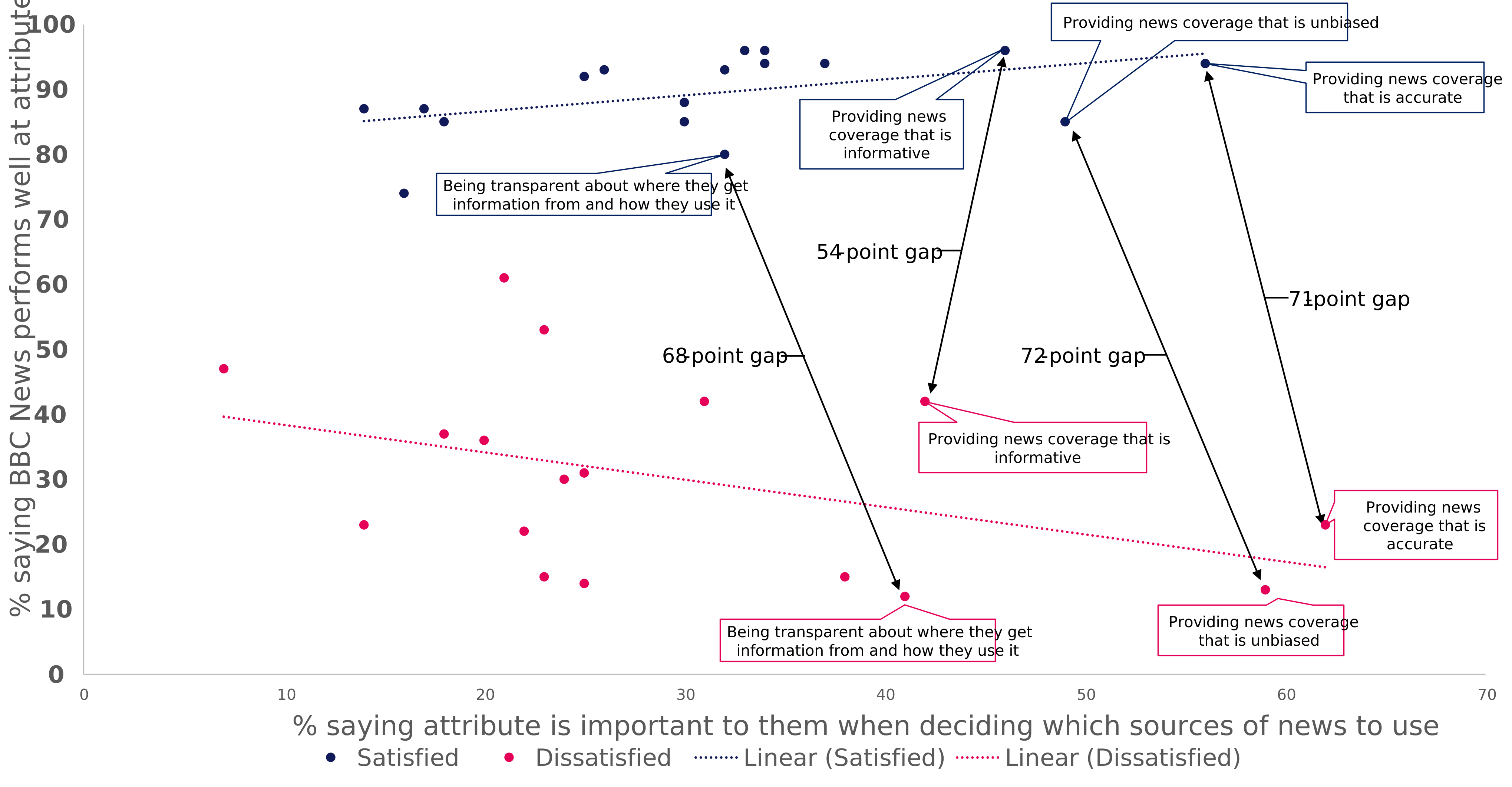
As might be expected, those who were satisfied with BBC News overall tended to be more satisfied with its performance on all attributes. In particular, they tended to be relatively more satisfied with its performance on the attributes they rated as being most important – accuracy and lack of bias. Those dissatisfied with BBC News were generally more critical of the BBC across the board. However, they were particularly negative on those two attributes that were relatively more important to them – lack of bias and transparency. This is shown in the chart below (Figure 4.2), which maps the importance of each attribute (on the x-axis) and the proportion who say BBC News does this well (on the y-axis) among those who are satisfied with BBC News (represented by the blue dots and trend line) and those who are dissatisfied (represented by the red dots and trend line).
The percentage point gap in ratings shown in the chart (i.e. the difference in the proportion saying BBC News does well between those who are generally satisfied with the BBC and dissatisfied with the BBC) tends to be biggest for the attributes that they think are most important. For example, for providing news coverage that is unbiased, there is a 72-percentage-point gap between the proportion of those satisfied with BBC News who say it does this well (85%) and the proportion dissatisfied with BBC News who say it does this well (13%).
Figure 4.2: BBC News individual performance against attributes (among those satisfied and dissatisfied with the quality of BBC News content)
Base: All UK adults aged 18-75 who are satisfied (n=2016) and dissatisfied (n=584) with the quality of BBC News content.
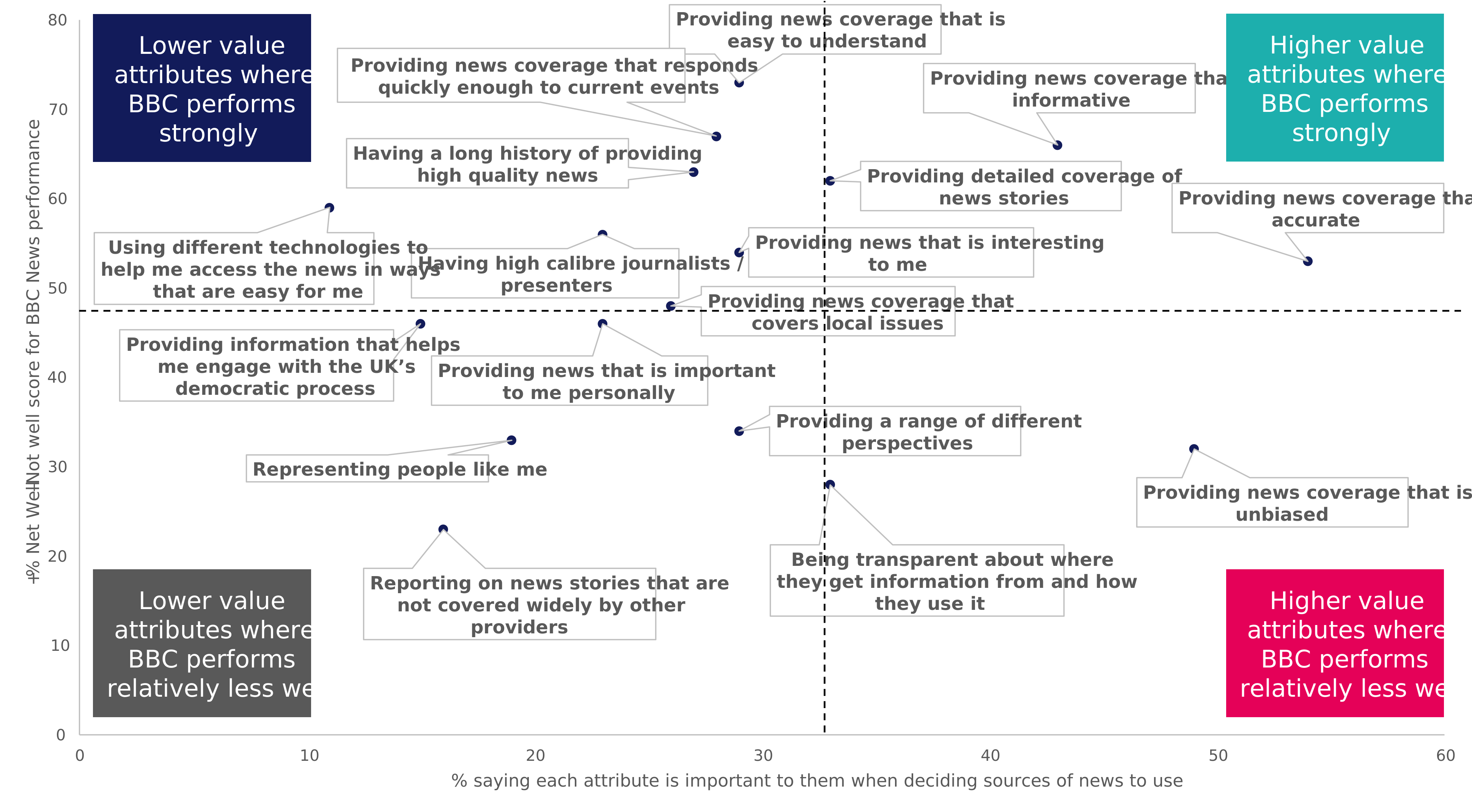
Of the attributes rated as most important in the survey, BBC News performed well on being accurate and informative but slightly less so on providing unbiased news.
Figure 4.3 below compares how the UK public perceived BBC News’ performance on each attribute against the importance of those attributes. This shows the BBC’s strengths in providing accurate and informative news, which were both seen as two of the three most important news attributes. But it also highlights where BBC News could focus on improving, particularly on providing news coverage that is seen as unbiased, another of the most important factors but where BBC News did not perform as well compared to other attributes.
Figure 4.3: BBC News individual performance against attributes
Base: All UK adults aged 18-75 (n = 3325).
The x-axis shows the percentage saying each attribute is most important when deciding sources of news to use. The y-axis shows the net difference figure between those saying BBC News does each attribute well and not well. Benchmarks for each quadrant have been determined based on ranges.
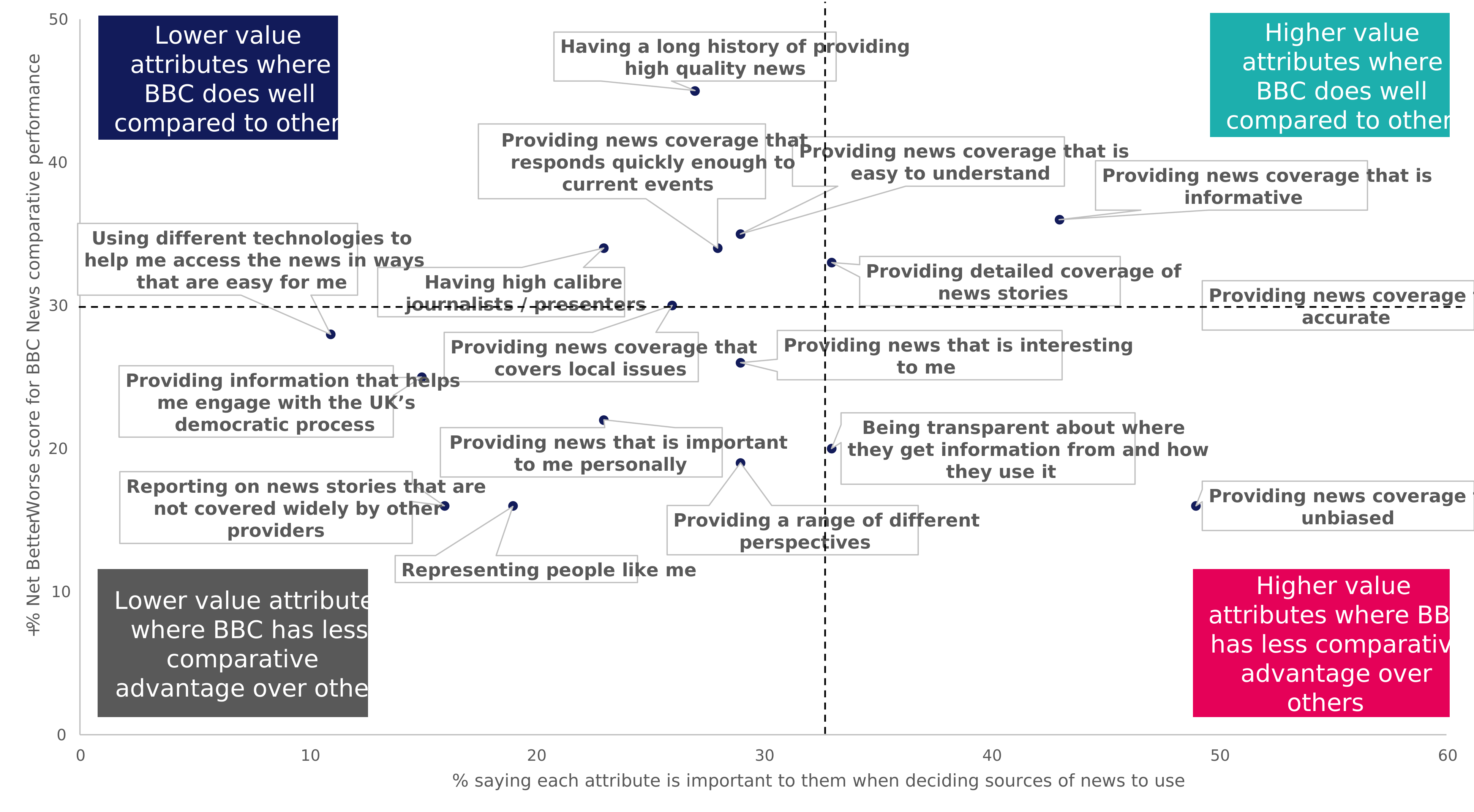
A similar pattern is shown in Figure 4.4, which compares the importance of each attribute against how much people thought BBC News was seen as providing distinctive value over other news providers. Again, BBC News did well at providing informative news, which was the third most important attribute for news providers. It performed strongly in this aspect both on its own merit and when compared to other news sources (81% thought it did this well, and 47% better than most other providers).
When it comes to delivering accurate news, seen as the most important attribute, BBC News also generally performed well, both in its own right (73% think it did this well) and compared to other providers (46% think it is better than most others). The proportion saying BBC News individually does well at providing accurate news was equal eighth highest among the 17 attributes tested. For providing accurate news, it’s comparative performance on this attribute was equal fourth highest.
BBC News performs slightly less well (though still positively overall) at providing unbiased news coverage, the second most important attribute. Most think it performs well on its own merit, though slightly less so than on accuracy and being informative (62% well). When compared to other providers, attitudes towards the distinctive value of BBC News are more split. This suggests it could be another priority for improvement compared with other attributes, even though views are still more positive than negative (39% better than most others, 30% the same, 23% worse than most others).
Figure 4.4: BBC News comparative performance against attributes
Base: All UK adults aged 18-75 (n = 3325).
The x-axis shows the percentage saying each attribute is most important when deciding sources of news to use. The y-axis shows the net difference figure between those saying BBC News does each attribute better and worse than other providers. Benchmarks for each quadrant have been determined based on ranges.
Other attributes that BBC News performs best on are mainly of medium importance.
BBC News scored highly on the detailed nature of its coverage, the fourth most important attribute (79% well, 46% better than most others). However, BBC News’ other highest scoring attributes – ‘having a long history of providing high quality news’, ‘providing news coverage that is easy to understand’, ‘responds quickly enough to current events’, and ‘having high calibre journalists/presenters’ – were of average importance in deciding which providers to use.
Relative to other attributes, BBC News performs less well (though still positively overall) at providing unbiased coverage, being transparent and providing a range of different perspectives. These are three of the six most important attributes when deciding which news providers to use.
Other areas where BBC News performs less well are attributes of relatively low importance such as representing people like me and reporting on stories not widely covered elsewhere.
5. Exploring audience values in depth
Chapter summary
Using data from both the quantitative and qualitative research, this chapter provides more detail on the reasons why different attributes are perceived as important and BBC News’ performance against them. This chapter is split into three key sections:
- Attributes that are particularly important to audiences, where BBC News performs well.
- Accuracy: seen as a distinctive strength of BBC News
- Informative: strong performance with BBC Newsround cited as an example
- Detailed coverage: BBC News performs well, although there are different preferences for what the right level of detail is, with BBC News both praised and criticised for brevity
- Important attributes where BBC News performs less well in comparison to other attributes (although performance is still generally good).
- Unbiased / impartial reporting: despite a generally positive rating, views were polarised. Participants recognised the difficult job of demonstrating impartiality. Scepticism was often due to a perceived closeness with government and over cautious reporting.
- Transparency: BBC News was seen as more transparent than privately owned news providers, but perceptions of transparency have been undermined by scandals, as well as uncertainty towards how the public can hold BBC News accountable if needed.
- Providing a range of perspectives: Participants felt they do not see a range of perspectives on BBC News, particularly on TV broadcast news. There was appetite for more current affairs programmes where public views can be heard.
- The final section of the chapter looks at BBC News’ performance on the breadth of coverage it provides, with a focus on covering important topics, local and regional news.
Where does BBC News perform well against the attributes that matter most?
Accuracy
Accuracy was the most important attribute to audiences.
In the survey, 54% of UK adults aged 18-75 said that accuracy was most important to them when choosing where to get their news. Qualitative participants mirrored this, frequently saying that accurate information is the core purpose of news. They expected traditional TV news broadcasters to provide accurate news, holding them to a higher standard than newspapers and social media.
Participants said that the accuracy of news had risen in importance to them in recent years, with references to incorrect information leading up to the EU referendum, and the reliance on accurate information from TV broadcasts during the Covid-19 pandemic. Participants liked to see reassurance from news providers of the accuracy of content through references to verification and fact-checking processes.
Despite accuracy being the most important attribute overall, it typically only mattered when participants were actively consuming news, rather than passively. For example, those who used social media as their main news source recognised that misinformation was more prevalent on online content. Rather than avoiding news content on social media altogether, they used the methods described in Chapter 2 to verify potential misinformation when they were unsure.
In the survey, BBC News performed well on accuracy, including when compared to other providers. Qualitative participants felt accuracy is a particular strength of BBC News.
Most (73%) said that BBC News performs well on providing news coverage that is accurate, with 29% saying very well. When compared against other news providers BBC News also performed well, with a slightly above average proportion saying BBC News is better than most others at providing accurate news coverage (46%, including 14% better than all/nearly all other providers).
Figure 5.1: BBC News performance on providing news coverage that is accurate
| Who | Very well | Fairly well | Not very well | Not at all well | Don’t know | – |
|---|---|---|---|---|---|---|
| BBC News performance | 29% | 44% | 12% | 8% | 7% |
NET Very/Fairly well 73% NET Not very well/not at all well 20%
| Comparison | BBC better than all/nearly all others | BBC better than most others | About the same | BBC worse than most others | BBC worse than all/nearly all others | Don’t know | – |
|---|---|---|---|---|---|---|---|
| Comparison to other providers | 14% | 31% | 32% | 9% | 6% | 7% |
NET Better than all/most 46% NET Worse than most/all 16%
Base: All UK adults aged 18-75 (n = 3325).
Qualitative participants saw accuracy as one of BBC News’ strongest attributes. BBC News was seen as accurate enough of the time that participants used it as a fact-checking verification tool when they encountered potential misinformation. They reasoned that BBC News is likely under more scrutiny due to its funding structure compared to other news organisations, feeling that the BBC has to deliver a reliable standard of quality and accuracy.
Sometimes websites are known for, like lying or not giving real information. You never heard of BBC giving the wrong information.
- Northern England, age 16-17
A lot of the time if I see something on social media, I will quickly go and check BBC News just to check it’s real…If it doesn’t show up on BBC, I’m kind of like, ‘oh this is not true’ or it’s been slightly fabricated.
- Norfolk, age 49+, ABC1
In some cases, participants mentioned BBC Verify unprompted, having observed it when consuming BBC News. The BBC taking steps to ensure their facts and content are trustworthy was seen as reassuring, as well as providing additional transparency.
You keep seeing this ‘BBC verify’, so they’re obviously trying to ensure that they do report accurately.
- Bristol/Bath, age 49+, C2DE
Digitally excluded participants described having fewer options of news sources and therefore relying more heavily on the accuracy of BBC News. They also had fewer alternative sources to compare BBC News to when considering how much they trust it’s accuracy.
You’ve got to have [BBC News] because otherwise you leave ITV, and as I said, I don’t trust that they’re 100% accurate on important issues. I think you’ve got to have a channel that are more on the ball, you know, BBC are more on the ball with accuracy
- Age 65+, C2, digitally excluded
Informative news content
Providing news content that is informative was the third most important attribute (after unbiased news) when it comes to choosing news providers with 43% mentioning this. Qualitative participants felt that news reporting does not always need to be educational or informative but valued this more highly when the topic of the news story is historically, politically, or technically complicated. They referenced Covid-19 reporting, and recent international conflicts, expressing how they felt more informed about complex history, science and events through BBC News coverage.
Younger focus group participants (16-17) valued news content that takes an informative approach by raising awareness and understanding of causes and social issues. For example, explaining the reason behind student protests or worker strikes, and by highlighting abuses of power.
[Referring to an example news article] I feel this adds value as it is talking about student protests and I feel young people, especially in education, are underrepresented on social media and news.
- South England, age 16-17 (news diary)
The survey showed strong BBC News performance for informative news content.
BBC News performed above average when it comes to providing news coverage that is informative. 81% said BBC News does this well (32% very well), while 47% said the BBC is better than most other news providers at this (with 15% saying it is better than all / almost all other providers).
Figure 5.2: BBC News performance on providing news coverage that is informative
| Who | Very well | Fairly well | Not very well | Not at all well | Don’t know | – |
|---|---|---|---|---|---|---|
| BBC News performance | 32% | 48% | 9% | 6% | 4% |
NET Very/Fairly well 81% NET Not very well/not at all well 15%
| Comparison | BBC better than all/nearly all others | BBC better than most others | About the same | BBC worse than most others | BBC worse than all/nearly all others | Don’t know | – |
|---|---|---|---|---|---|---|---|
| Comparison to other providers | 15% | 32% | 36% | 7% | 5% | 5% |
NET Better than all/most 47% NET Worse than most/all 16%
Base: All UK adults aged 18-75 (n = 3325).
Qualitative participants often referred to BBC Newsround as an example of informative and educational news content. They reiterated that BBC News is a common source of information in schools due to its reliability and educational content.
Newsround was mentioned by adult participants, as well as those under 18. However, those under 18 could remember the value of Newsround more clearly. They said that Newsround provided educational value by using appropriate language that is easy for younger children to understand and integrating fun facts that help them engage with the news content.
I remember watching Newsround in primary school…I remember actually being able to understand what they were saying. They weren’t using too big words for primary school.
- Scotland, age 16-17
In school if we’re learning about news every week or something, it’ll always go to BBC News as the source, so I think they educate quite well.
- Wales, age 16-17
I was actually transported back to BBC Newsround, when you’re a wee kid. I loved it, and I wanted to be a news reporter because their news was brilliant. It spoke to children like children, but didn’t treat them like children. I used to love that news, and so nostalgic for that.
- Northern Ireland, age 49+, C2DE
Providing detailed coverage
Providing detailed news coverage was the fourth most important ranked attribute, with a third of respondents saying it was important when choosing which news provider to use.
For qualitative participants, the importance of detailed coverage varied depending on the type of content they were looking for and for what purpose. Detailed coverage was most valued when participants wanted long-form content, analysis and discussion. For example, when they have longer to spend taking in information, such as when they are cleaning, or driving.
If I’m doing some DIY or something like that, I’ll probably put 5 news at 5 live on because … although it’s got news bulletins in it, you’ve got like more in depth discussion on people that’s involved in it.
- Leeds/Sheffield, age 49+, ABC1
However, participants also valued directness and brevity when looking to quickly understand the main headlines of the day. This preference for shorter and more direct coverage was particularly relevant for adults seeking a quick update of the main headlines, and for 16–17-year-olds who found shorter content more engaging and digestible. However, participants who preferred shorter news stories often said they liked to see links to more detailed coverage to find out more.
BBC News performed well in the survey on providing detailed coverage. Qualitative findings were particularly nuanced, with BBC News content both praised and criticised for brevity.
BBC News performed strongly for providing detailed coverage of news stories (79% said BBC News does this well, 30% very well). 46% said BBC News does this better than other news providers, with 14% that it is better than all / nearly all other providers at this.
Figure 5.3: BBC News performance on providing detailed coverage of news stories
| Who | Very well | Fairly well | Not very well | Not at all well | Don’t know | – |
|---|---|---|---|---|---|---|
| BBC News performance | 30% | 49% | 10% | 6% | 5% |
NET Very/Fairly well 79% NET Not very well/not at all well 17%
| Comparison | BBC better than all/nearly all others | BBC better than most others | About the same | BBC worse than most others | BBC worse than all/nearly all others | Don’t know | – |
|---|---|---|---|---|---|---|---|
| Comparison to other providers | 14% | 32% | 35% | 8% | 5% | 6% |
NET Better than all/most 46% NET Worse than most/all 13%
Base: All UK adults aged 18-75 (n = 3325).
Qualitative participants held varied perspectives on whether BBC News coverage provides the right level of detail. A common view was that BBC News coverage can be surface level, rather than detailed. This was often in reference to TV broadcasts where there is limited time for presenters to go into depth on each story. For example, participants felt BBC News’ efforts to remain impartial sometimes led to coverage being limited and surface level, and therefore lacking the depth sought by audiences. They made comparisons to other Public Service Broadcasters who they felt delivered more informative and detailed news content, such as investigative reports and documentaries.
I would like some of the articles to be a bit more in depth. I know they have this whole thing of being impartial, but some of their articles, you just get the bare bones because they don’t want to say too much on one side or the other. It doesn’t have to be like it’s for or against, it’s just very much just like displaying the sides.
- Birmingham, age 18-48, ABC1
In contrast, routine BBC News users who valued short and clear headlines and younger participants (16-17) appreciated the brevity of BBC News content. They often referred to BBC News app notifications and social media posts as examples where they enjoy quick and summarised BBC News reporting.
I like BBC News as I like fast. It’s a fast way to get news, so if you’re scrolling on TikTok, it’ll be like 40 to 50 second videos. But when they’re on live it’s like 2 hours to 3 hours when they’re talking.
- Scotland, age 16-17
Those who enjoy BBC News’ shorter formats still appreciated convenient access to more detailed information, such as BBC News social media posts linking to full articles.
I like BBC News short form videos on TikTok. [They’re] cut down to only the most important bits of information, but even better when full articles are tagged so you can read more if you want to.
- Scotland, age 16-17
This reflects the general sentiment that BBC News’ broad range of platforms and reporting styles allows different audiences to consume content that suits their preferences, including on the level of detail.
Where does BBC News perform less well against attributes that matter to audiences?
Impartiality and unbiased reporting
Around half of UK adults aged 18-75 (49%) said providing unbiased news coverage was one of the most important factors when choosing which providers to use. This was the second most important attribute in the survey overall. Notably, those dissatisfied with the news in general attached a greater degree of importance to this attribute than those who are satisfied (57% vs 48% listed this).
Impartiality was seen as highly important as qualitative participants wanted to feel reassured that they had heard the full story and were not being pushed towards certain beliefs or conclusions. They saw a responsibility for news organisations to strive for impartiality even if it is not delivered perfectly, but also a responsibility on individual journalists to be impartial.
A lot of news providers will omit certain details and stuff like that. So I think that’s why I go to social media because social media is brutally raw, and you’re always going to get like either opinions or facts.
- Northern Scotland, age 18-48, ABC1
Impartiality was seen to have more importance in some types of news content than others. For example, impartiality was considered highly important in reporting breaking or developing stories and in news bulletins.
However, participants felt that wider current affairs commentary and analysis can be valuable even if it comes from a particular perspective. Often younger groups enjoyed a more entertaining format of debates, in-depth analysis and commentary from public figures. Participants felt that transparency from a news provider about their political alignment also made this more acceptable. They wanted this style of content to be distinct from news reporting so they could distinguish between opinion-driven and factual information to make up their own mind about a story.
I follow The Economist on Instagram, and I know they are left leaning socially and maybe libertarian economically. And because I know that, and they’re honest about it, they make no bones about it, then it doesn’t diminish the usefulness, you just have to take that into account when you’re reading it.
- Northern Scotland, age 18-48, ABC1
BBC News’ performance on providing unbiased news coverage was rated positively overall, but not as strongly as other attributes.
A majority (62%) said BBC News does well at providing unbiased news coverage, with around a quarter (23%) saying it does this ‘very’ well. However, in ranking BBC News’ performance across all attributes, providing unbiased news coverage received the third lowest score. Two-fifths (39%) said BBC News is better than other providers at delivering news coverage that is unbiased.
Notably, across all the attributes tested, the BBC received the highest scores for not performing ‘at all’ well (14%) and for being worse than most other providers (23%) on providing news coverage that is unbiased. This reflects findings from other sources such as data cited in the BBC Group’s Annual Report and the Ofcom News Consumption Survey, which both indicate there is a greater degree of public doubt about the BBC’s performance around impartiality and bias.[footnote 12]
Figure 5.4: BBC News performance at providing news coverage that is unbiased
| Who | Very well | Fairly well | Not very well | Not at all well | Don’t know | – |
|---|---|---|---|---|---|---|
| BBC News performance | 23% | 39% | 16% | 14% | 8% |
NET Very/Fairly well 62% NET Not very well/not at all well 30%
| Comparison | BBC better than all/nearly all others | BBC better than most others | About the same | BBC worse than most others | BBC worse than all/nearly all others | Don’t know | – |
|---|---|---|---|---|---|---|---|
| Comparison to other providers | 14% | 25% | 30% | 13% | 10% | 7% |
NET Better than all/most 39% NET Worse than most/all 23%
Base: All UK adults aged 18-75 (n = 3325).
Qualitative participants believed that BBC News faces a significant challenge in delivering news that a diverse audience considers impartial. Opinions mirrored the overall levels of trust in the UK news landscape. In general, participants felt that BBC News outperforms other news providers in terms of impartiality, but they were not fully convinced. The topic often divided opinions, with some holding strong views on either side of the issue.
You’re never gonna please everybody, and I think that the BBC’s aim is to try and be is as middle of the road as possible. Now, I do think that obviously they’re not 100% impartial and 100% accurate all the time. I think they try, I think they’re better than they used to be… I still think that they do a lot better than all the other news organisations.
- Northern Ireland, age 18-48, ABC1
Remaining impartial was described as particularly important in Northern Ireland to avoid isolating parts of the community, with the BBC performing well through attention to detail and use of specific language.
There were participants with strong doubts and criticisms about BBC News’ approach to impartiality, especially amongst those who were more negative towards the BBC. They felt the BBC is too closely tied to the government to be truly impartial. They suggested the broadcaster is overly cautious, or overly critical of certain political parties or politicians, resulting in biased editorial decisions. Participants also gave examples where they felt BBC News avoided topics, or did not use appropriate language especially in political or international coverage.
When you see them interview people, they obviously choose who they want to interview, who are saying what they want them to say.
- Age 65+, C1, digitally excluded
Sometimes they do sway a wee bit to whatever side the argument is… I felt the BBC ran more with negative sort of stories compared to the other channels…I felt they sort of went more towards that ‘the people going in strike were the villains’ rather than what they were fighting for.
- Scotland South, age 49+, C2DE
Participants in the younger groups (ages 16-17) were familiar with the concept of bias in the news, sometimes referring to lessons on media literacy. In general, they seemed more confident in the impartiality of BBC News than the adult groups, trusting the BBC as a reliable reporter of facts. This was often said by younger participants who did not use BBC News frequently.
I usually expect BBC News to be more honest in its titles, usually looking for less clicks.
- South England, age 16-17 (News diary)
I used BBC to find out more about news stories I had heard about because I know that they provide facts and not opinions.
- Scotland, age 16-17 (News diary)
Even younger participants, who generally believed that BBC News is more impartial than other news providers, mentioned specific cases where they felt BBC News showed bias in its reporting.
To me BBC News is likely one of the most balanced, however I take it with a pinch of salt because there have been many instances when they’ve shown clear bias… It’s likely where I would go if I wanted to be sure of something … but I’d still be a little wary.
- Wales, age 16-17 (News diary)
Transparency
A third of UK adults aged 18-75 (32%) said that being transparent about where news providers get information and how they use it was one of the most important factors when choosing where to go for news. This made it the fifth highest ranked attribute, with its importance being higher among those dissatisfied with news providers (41%).
Transparency from news providers was seen as important to qualitative participants, with wide accountability being crucial to achieving this. They appreciated where news providers are transparent about their political alignment, funding and governance and valued when providers retract errors and take accountability for mistakes. Participants felt this was often lacking in current news provision, with little accountability for journalists and organisations that spread mis or disinformation.
The same people that were punting inaccurate facts, no accountability has been laid at their footsteps…On the 24-hour news cycle that we’re living in, I think accuracy and transparency and accountability really needs to be pillars of what we stand for, how we consume news, but there’s certainly a lack of all three.
- Bristol/Bath, age 49+, C2DE
BBC News’ transparency performance was not as strong relative to other attributes, though most think it still performs well overall.
Relative to the other attributes tested, BBC News performed not as well (but still positively overall) on transparency. 58% said BBC News performs ‘well’ at being transparent, with 22% saying it performs ‘very well’. When BBC News’ transparency was compared against other providers, 38% said BBC News content is better than most others, 33% the same, but 19% worse.
Figure 5.5: BBC News performance at being transparent about where they get information from and how they use it
| Who | Very well | Fairly well | Not very well | Not at all well | Don’t know | – |
|---|---|---|---|---|---|---|
| BBC News performance | 22% | 37% | 19% | 11% | 12% |
NET Very/Fairly well 58% NET Not very well/not at all well 30%
| Comparison | BBC better than all/nearly all others | BBC better than most others | About the same | BBC worse than most others | BBC worse than all/nearly all others | Don’t know | – |
|---|---|---|---|---|---|---|---|
| Comparison to other providers | 14% | 25% | 33% | 11% | 7% | 10% |
NET Better than all/most 38% NET Worse than most/all 19%
Base: All UK adults aged 18-75 (n = 3325).
Participants compared BBC News to other, privately-owned news providers, which they saw as less transparent due to their financial motivations, and the potential influence of their owners. In contrast, they felt that BBC News is more transparent due to its public funding via the licence fee and assumed that because of this there are high levels of scrutiny. On hearing more information about the Royal Charter, participants felt reassured and supported the BBC’s mission to provide impartial news.
In contrast, those sceptical about the BBC questioned how much the public truly know or understand about what decisions are made. They queried how, and whether the public would have any realistic avenues for holding BBC News accountable should they need to.
Who’s governing it? How are they? … How much say do we have in what goes on, and what gets reported, how do we hold them accountable? Can we hold them accountable? I don’t think we can. So if that’s the case, what can you do? You just have to just trust your own sources and trust your own information. If you’re not happy with something you need to look elsewhere.
- Leeds/Sheffield, age 49+, ABC1
There were also references to high-profile scandals that have involved the BBC and its news coverage where participants felt the BBC had not demonstrated transparency. Participants felt these events had damaged trust in BBC News.
Providing a range of different perspectives
Providing a range of different perspectives was of average importance (29%) compared to the other attributes. However, qualitative participants explained how providing a range of perspectives was more important when a story is controversial or complex. When this is the case, seeing a range of perspectives was key to reaching an informed opinion.
Traditional news outlets on TV and radio (and their websites), were seen as less likely to showcase different perspectives. Participants felt these sources tended to take similar positions on news stories, making it more difficult to find a range of opinions. They reported that when looking for a range of perspectives, they typically visit different sources, which can be time-consuming.
For this reason, participants felt they had better access to diverse perspectives online, particularly in comment sections on social media. They valued the range of perspectives offered, seeing how different people interpret events. This helped participants validate or question their own thinking.
I look at the comments section. Maybe it can trigger something that I hadn’t thought about so like seeing other people’s opinions that maybe have looked into the story a little bit more. You tend to see some arguments and stuff like that on there, but I find that that is probably a big factor in how I process information and process my own opinion on things as well.
- Wrexham, age 18-48, C2DE
BBC News did not perform quite as well in providing a range of different perspectives as on other attributes, though still positively overall.
63% said BBC News performs well at providing a range of different perspectives. When compared to most other providers, 38% said BBC News is better at providing different perspectives, 35% about the same, and 20% worse. Relative to the other attributes tested, this is an area where BBC News’ performance is not quite as strong.
Figure 5.6: BBC News performance at providing a range of different perspectives
| Who | Very well | Fairly well | Not very well | Not at all well | Don’t know | – |
|---|---|---|---|---|---|---|
| BBC News performance | 21% | 42% | 19% | 11% | 7% |
NET Very/Fairly well 63% NET Not very well/not at all well 29%
| Comparison | BBC better than all/nearly all others | BBC better than most others | About the same | BBC worse than most others | BBC worse than all/nearly all others | Don’t know | – |
|---|---|---|---|---|---|---|---|
| Comparison to other providers | 14% | 25% | 33% | 11% | 7% | 10% |
NET Better than all/most 38% NET Worse than most/all 20%
Base: All UK adults aged 18-75 (n = 3325).
Qualitative participants did not feel that BBC News effectively provides a range of different perspectives, especially on TV broadcasts where audiences only hear what the reporter says. This is in line with their general perceptions of traditional broadcasters. While recognising the difficult balance of remaining impartial, participants thought BBC News could do more to showcase different perspectives where appropriate, while clearly demonstrating they do not favour one side over another. There were also suggestions for more programmes that invite public perspectives on news stories.
In some cases, participants appreciated BBC News programmes in which opposing politicians debate a topic, describing it as entertaining and useful in bringing different views together. However, they felt other Public Service Broadcasters do a better job than BBC News of asking tough questions to explore these perspectives in depth.
Views towards the range of coverage provided by BBC News
Qualitative participants often spoke about the range of news coverage offered by providers. These were not always described in the same terms tested in the survey so cannot be directly compared with the quantitative findings. However, these discussions provided useful insight into participants’ expectations, and how they feel BBC News performs.
Covering important topics
While views towards international news coverage were not tested in the survey, qualitative participants spoke about the range of stories they wanted coverage of. They expected traditional news broadcasters to cover significant global events, including global politics and international conflicts. This was important so they could understand what is happening around the world, and what might happen in the future, as global news was seen to have more long-term implications.
The survey asked about BBC News’ performance at providing news that is of personal importance. This attribute was of average importance, mentioned by 23% as an important factor when choosing where to go for news. 70% said BBC News performs well at providing news that is of personal importance, with around two-fifths (38%) saying it is better at providing this than most other providers.
BBC News is seen to provide a good coverage of important topics globally. However, it can focus too much on a handful of major stories and underreport others.
Qualitative participants felt that BBC News performs well in its coverage of global news and major breaking stories. This is one reason they use it for a daily download of key stories, trusting that any key headlines from around the world will be reported on. Aside from covering the biggest stories, participants also felt that BBC News does well in covering a wide range of topics, such as politics, sports, crime, celebrity and lifestyle.
However, participants also said that BBC News can focus too much on selected global stories at the expense of less widely reported news, becoming repetitive and with a narrow scope. They described how this can overshadow national and local news, as well as more positive stories. They wanted to see more ‘human stories’, reporting on relatable people in the UK, their opinions and experiences.
I feel it really tends to focus on like the main issues that are going on, like Trump’s presidency, the war in Ukraine, Gaza. But then other things that are in other countries, there’s been wars in Africa the last couple of years, the BBC may have put out the odd online article… I just feel it targets the ones that maybe affect us in this country more, [rather than] poorer countries.
- Manchester, age 18-48, C2DE
This is supported by the quantitative findings. While a majority (56%) said that BBC News does well at covering stories not widely reported-on elsewhere, its score for this attribute was the lowest among the 17 tested. When compared to other providers, 35% said BBC News is better at doing this than most (again the lowest score for the attributes tested). However, covering news stories not covered widely elsewhere was one of the least important factors when choosing news providers, mentioned by only 16%. Although those dissatisfied with BBC News content in general were more likely to say it is important (22%).
Figure 5.7: BBC News performance at providing news coverage that is personally important to people
| Who | Very well | Fairly well | Not very well | Not at all well | Don’t know | – |
|---|---|---|---|---|---|---|
| BBC News performance | 23% | 47% | 16% | 8% | 6% |
NET Very/Fairly well 70% NET Not very well/not at all well 24%
| Comparison | BBC better than all/nearly all others | BBC better than most others | About the same | BBC worse than most others | BBC worse than all/nearly all others | Don’t know | – |
|---|---|---|---|---|---|---|---|
| Comparison to other providers | 11% | 27% | 40% | 10% | 6% | 6% |
NET Better than all/most 38% NET Worse than most/all 16%
Base: All UK adults aged 18-75 (n = 3325).
Figure 5.8: BBC News performance at reporting on news stories that are not widely covered elsewhere
| Who | Very well | Fairly well | Not very well | Not at all well | Don’t know | – |
|---|---|---|---|---|---|---|
| BBC News performance | 17% | 38% | 21% | 11% | 12% |
NET Very/Fairly well 56% NET Not very well/not at all well 32%
| Comparison | BBC better than all/nearly all others | BBC better than most others | About the same | BBC worse than most others | BBC worse than all/nearly all others | Don’t know | – |
|---|---|---|---|---|---|---|---|
| Comparison to other providers | 10% | 25% | 37% | 11% | 8% | 9% |
NET Better than all/most 35% NET Worse than most/all 19%
Base: All UK adults aged 18-75 (n = 3325).
Digitally excluded participants noted how they are more reliant on comprehensive coverage from BBC News on TV, as they are not able or confident to search for other stories online. These participants were aware that their friends or family who can use the internet know of news stories that are not covered by the BBC and sometimes felt this meant they were missing out.
[My friend] said you can get news on the phone and it goes all over the world and broadcasting what’s happening…they say that you get to know more with other channels than BBC… I keep thinking about them showing me how to do it on the phone and everything. I think sometimes [I’m] lacking news to what you could be hearing. You only get so much being told on the BBC to what they seem to know from the worldwide news.
- Age 65+, C1, digitally excluded
Local and regional news coverage
BBC News offers extensive local coverage through its regional and local radio stations, television news programmes, and dedicated website sections. However, according to surveys such as the 2023-24 Ofcom BBC Performance Tracker, the BBC’s performance in providing local news is weaker compared to its coverage of UK and world news. This found that 68% and 70% of respondents believe the BBC performs well in covering world and UK news, respectively, while only 52% say the same for local news coverage.[footnote 13]
The survey found that local news coverage was seen as of medium importance, although qualitative participants felt it directly affected them and their communities.
About a quarter (26%) said news coverage about local issues is of most importance to them, demonstrating this is of medium importance to audiences. However, qualitative discussions identified how local news was seen to offer a better mix of good and bad coverage and human stories, as well as issues that directly relate to individual communities.
This type of [local] news offers value to me and society ‘cause it makes you aware that there is serious crime that can take place even on your doorstep, because some might not realise that you are never far from crime in society.
- Wales, age 16-17 (News diary)
Participants who valued local news did not necessarily expect this to be provided by the main national news providers, including BBC News. They felt in-depth local news could be found from independent commercial organisations as well as social media.
BBC Local News was seen as valuable in areas with few alternative local news sources but limited by its broad regional approach and lack of depth.
71% of UK adults aged 18-75 said BBC News performs well at providing coverage of local issues. Its individual performance on this was around average among the attributes tested. Compared to other providers, 44% said the BBC is better than most at providing local news coverage (around the average for the attributes tested).
Figure 5.9: BBC News performance at providing news coverage that covers local issues
| Who | Very well | Fairly well | Not very well | Not at all well | Don’t know | – |
|---|---|---|---|---|---|---|
| BBC News performance | 24% | 47% | 16% | 7% | 6% |
NET Very/Fairly well 71% NET Not very well/not at all well 23%
| Comparison | BBC better than all/nearly all others | BBC better than most others | About the same | BBC worse than most others | BBC worse than all/nearly all others | Don’t know | – |
|---|---|---|---|---|---|---|---|
| Comparison to other providers | 12% | 32% | 35% | 9% | 5% | 7% |
NET Better than all/most 44% NET Worse than most/all 14%
Base: All UK adults aged 18-75 (n = 3325).
The qualitative discussions reflected this, with the value of BBC News local coverage relating to the areas participants live. BBC Local News services were seen as more valuable in regions or towns where there are not independent news alternatives. Without the BBC’s coverage, they felt residents would be left with very limited news about their area, relying instead on social media.
In areas where there are existing alternatives, participants found these more valuable than BBC Local News, as independent providers cover a wider range of stories and provide more depth and hyper-local focus than the BBC. In comparison, BBC News coverage was seen as broader and less focused on specific towns or cities.
Participants enjoyed programmes such as BBC Look North, appreciating it is broadcast straight after the national news. They valued that it covers a range of stories, and often feels more human than the national news, featuring everyday people. Participants also said they see BBC Local News social media accounts actively posting stories about their area.
Local BBC [News] in the evening is excellent, you know. It’s really really good for news on Yorkshire, where I live.
- Leeds/Sheffield, age 49+, ABC1
I think they do local news coverage pretty well because I always see on Facebook, like they have different accounts for different areas. Sometimes they just pop up, for some reason it’s like BBC News like Cornwall or Shropshire and then North Wales. So, I think they target their news really well.
- Wrexham, age 18-48, C2DE
Digitally excluded participants reiterated their reliance on TV broadcast news for local news coverage, having fewer options available without the internet. These participants said they valued the local news coverage provided by the BBC and other broadcasters, but found it is often not local enough.
I found with the likes of BBC North, I know it covers a large area but unless there’s anything particularly serious happens in Leeds, it is always Bradford and Sheffield, Doncaster…You can watch [ITV] Calendar and [BBC] Look North and you know, that’s really all it amounts to, if you don’t see it on there, well, where do you go? I don’t know how to go online.
- Age 65+, C2, digitally excluded
There were participants in Scotland and Northern Ireland who felt that BBC News coverage for their countries was lacking in comparison to coverage of England. Although, in the survey BBC News’ provision of local news was rated above average in Northern Ireland. For example, one participant described coverage of a train crash in Scotland they felt would have been national news if it had happened in England.
There were also observations that the BBC News website is noticeably slow to update for regions in Northern Ireland compared to the national pages. In some cases, participants felt that regional news in Scotland and Northern Ireland could be surface level and emphasised how this could be improved with investment in local investigative reporting.
I would wake up every morning and look at the website. And the website’s more or less updated. There’d be complete front to back news stories. Whereas I would then go onto the Northern Ireland page, and you’d have the same story up…for a week or a month at a time… I don’t feel like they do enough to report outside of London or report things [that] are actually happening in the UK.
- Northern Ireland, age 18-48, ABC1
It becomes very regionalised. You’ll find a certain region of the UK will basically dismiss the programs that are made for those regional areas with the regional dialects and everything like that…to me it’s just lip service … I’m not talking just about Scotland. I’m talking about other regions as well… if the money was spent there doing the reports doing, you know, the investigations and stuff like that, instead of just being lip service to us and just reading out a few local stories.
- Scotland South, age 49+ C2DE
6. BBC News in the future
Chapter summary
Previous chapters have focused on current perceptions of BBC News’ performance. This final chapter looks forward to the next Charter period, exploring audience expectations for the role of BBC News in the future. Key findings include:
- The public thought there was a need for BBC News to adapt to better meet the needs of UK society, although they felt small incremental changes were required rather than major reforms. While just 22% said that BBC News’ coverage meets the need of today’s society extremely well and does not need to be changed, 40% thought it mainly meets society’s needs and only needs to change in small ways. This was more than the 29% who felt it needed to be changed quite a lot or a great deal.
- People wanted BBC News to focus on addressing misinformation, while maintaining and demonstrating impartiality and accuracy, to cover societally important stories in a way that reflects the views of society not the BBC itself, and to provide live updates to breaking news stories.
BBC News was seen as generally doing well at serving different audiences through its broad range of news services, but could improve by:
- Increasing short-form content and social media presence to engage younger audiences.
- Providing a mix of story types, such as good news and special interest stories, with personalisation options for users to filter and select which content to be notified for.
- Continuing to serve older and digitally excluded audiences through TV and radio news, while ensuring this content is presented in an easily understandable format.
- Introducing more programmes that include public opinions on news and current affairs.
In the next decade, participants wanted BBC News to prioritise being a reliable provider of accurate, impartial and fact checked news, helping audiences navigate an increasingly polarised news environment in the age of online misinformation.
How should BBC News improve and adapt its approach?
Although people thought BBC needs to adapt, evolution not revolution was seen as necessary.
The survey found that most UK adults aged 18-75 thought BBC News content needs to adapt in some way. Overall, seven in ten (69%) thought BBC News coverage could or needs to be changed to meet the needs of society. In comparison, 22% believed the BBC’s news coverage does not need changing as it meets society’s needs extremely well. However, the prevailing sense was that incremental change is required, with 40% agreeing the BBC’s news coverage should only be changed in small ways as it mainly meets today’s needs, compared with three in ten (29%) who think it needs to be changed quite a lot or a great deal.
As the table below shows (Figure 6.1), this view was held consistently across demographics, although those in Northern Ireland were relatively more content with the BBC as it is now, while non-BBC users were most likely to think its news needs to change.
Figure 6.1: To what extent does BBC News need to change to meet the needs of society, by demographic
| Demographic group | % meets society s needs extremely well | % mainly meets society s needs but could be changed in small ways | % needs to be changed quite a lot/a great deal |
|---|---|---|---|
| Male | 25% | 37% | 31% |
| Female | 19% | 42% | 26% |
| 18-34 | 26% | 38% | 28% |
| 35-54 | 21% | 40% | 29% |
| 55-75 | 20% | 41% | 31% |
| AB | 24% | 41% | 29% |
| C1 | 24% | 42% | 26% |
| C2 | 19% | 40% | 30% |
| DE | 20% | 33% | 32% |
| England | 22% | 40% | 28% |
| Scotland | 19% | 36% | 34% |
| Wales | 22% | 38% | 31% |
| Northern Ireland | 37% | 30% | 30% |
| Use any BBC platforms for news | 26% | 44% | 24% |
| Non BBC User | 10% | 23% | 43% |
The focus groups introduced four hypothetical future scenarios, based in 2035, building on the trends identified in the evidence review. The aim was to explore participants’ priorities and values in the context of the changing media environment and understand what they want and expect from BBC News to best serve the public in future.
Participants recognised the challenge BBC News faces in addressing misinformation, while providing its own accurate coverage.
Participants were concerned about the future impacts of misinformation on society as a whole, such as inflating social and political tensions. They expressed concerns that the rise of AI could negatively impact the accuracy of news by quickly producing convincing misinformation.
They were also concerns about audiences who may be more vulnerable to misinformation and sometimes reflected that they find it difficult to tell what is true themselves. Both digitally excluded participants (who tended to be older),[footnote 14] and participants in the younger focus groups (ages 16-17) felt that their age groups may be particularly vulnerable.
BBC News, alongside other regulated broadcast news providers, were seen as crucial for audiences to verify information they have seen from less reputable sources including social media news accounts.
There’s just a difference between traditional journalism and the newer, main pages… If I see BBC or ITV, or Sky, it’s like an accredited news source and people everyone knows about it, so it seems trustworthy… but a random person on Twitter saying ‘This is news’, you’re gonna obviously take with a pinch of salt because you don’t know where it’s come from.
- London, age 18-48, C2DE
In response, participants argued BBC News should prioritise accuracy over speed in its reporting. While acknowledging the risks of delayed reporting, they valued the BBC as a trustworthy source and wanted this prioritised. They worried that if BBC News was to not exist in the future, it would make themselves and society more vulnerable to misinformation.
You’d wait for the BBC story to break. If it’s a couple minutes late that’s fair enough because you know they’ve put the time in and they’ve put the effort in to make sure that what they’re reporting is actually correct rather than just firing out the first thing that they get, they can make sure that is accurate.
- Manchester, age 18-48, C2DE
Participants suggested BBC News could focus more efforts into developing its fact-checking services in the long-term future, correcting and countering misinformation. Ideas for what this could involve included:
- Fact-checking key stories from less familiar news sources, especially those that might rely on AI to report in the future.
- Focusing on significant breaking news stories and verifying what other publishers say during live events.
Participants believed BBC News should maintain its impartial and neutral stance in an increasingly polarised news landscape.
Generally, participants were familiar with the nature of social media algorithms, and how this affects the content they are exposed to. They felt this trend was partly driven by the nature of the social media industry relying on users’ interest and clicks but also felt that there may be organisations actively working to harness algorithms to influence users’ opinions.
I don’t think it’s something that we necessarily, as consumers of the news, have a choice in, because there’s people in the background being paid to target us and that’s just the way that technology is evolving now. And that’s just a growing industry as well.
- Northern Ireland, age 18-48, ABC1
Participants expressed concerns that personalised news feeds could heighten polarisation and societal tensions by limiting exposure to diverse perspectives that challenge users’ existing beliefs. They warned this could lead to isolation and interpersonal conflicts if individuals develop divergent understandings of current events compared to their peers. Participants suggested this trend might result in the “radicalisation” of both left- and right-leaning views, leaving less space for nuanced opinions.
I feel like everyone’s [news] feed is different, so it is really personalised. If you like one thing, more things like that’s gonna pop up…People might start going around saying stuff that they’ve seen, and it might not be true, or someone might have another perspective of it, and then it might start like a problem.
- North England, age 16-17
I think a lot of people right now don’t know that they’re being manipulated…They might think that the news that they’re getting, this polarised news, that’s the right way of thinking… If they go into work, or into school and somebody else has got the same news, but in a completely different side of it, that could cause a lot of conflict, I think which could lead to some sort of isolation and things like that, like, you know you are in your own bubble.
- Scotland North, age 18-48, ABC1
Participants emphasised how BBC News should resist the temptation to become more sensationalist to compete with other providers. However, they recognised the need for BBC News to stay relevant, and the attractiveness of more opinion driven news. In response, they suggested:
- Increasing BBC News’ social media presence, especially to reach younger audiences
- Creating more engaging short-form content and videos that present key news stories and facts in an accessible manner
- Introducing opinion-based commentary as part of current affairs programmes, separate from news broadcasts, to better provide a range of perspectives
- Helping audiences navigate the news environment by reporting on the news as a topic on its own, explaining the different positions taken by a range of sources to improve media literacy. This could empower audiences to make more informed judgements about the news they consume.
You’ve got to find other ways of drawing their attention. And maybe in some ways, make the algorithms work for the BBC News and other channel providers by getting people’s attention in very short bursts, and then hopefully, it draws them into other news stories.
- Leeds/ Sheffield, age 49+, ABC1
Participants recognised paywalls and news accessibility as a growing challenge for the future.
They cited experiences of encountering paywalls on online newspapers like The Times and The Telegraph, where they required a subscription to access content. While recognising the need for funding quality journalism, participants expressed concern that paywalls can exclude people on lower incomes from accessing high-quality, reliable news. This could potentially lead them to rely on lower-quality, free alternatives that do not serve them properly.
Participants understood that BBC News is free to access for all, via the radio, website and social media news services, regardless of whether they pay the licence fee. They emphasised the importance of BBC News remaining free to access in these ways, seeing this as crucial for the BBC to fulfil its mission of providing impartial, high-quality news. However, participants sometimes considered the licence fee as a type of paywall to watching BBC News on TV. They felt strongly that there should never be any further cost for licence fee payers to access BBC News.
A small number of participants expressed openness to paying for more niche or special interest news content on the BBC’s online platforms. But they also believed that the BBC’s wider news content should remain accessible to the public, given its role across society.
I think everybody should be able to access the same [BBC] news, no matter what.
- Scotland South, age 49+ C2DE
Participants thought BBC News should prioritise more localised news over broader regional news in the future.
They felt this would help fill the void left by declining local independent news outlets and provide better access to information on local issues such as transport, community events, crime, and business news. This was also seen as a way to attract audiences to BBC News in the future.
Participants suggested how BBC News could collaborate with local journalists and newspapers to ensure more comprehensive coverage of their area, while supporting local news providers and platforming local voices. They also suggested this might limit duplication of local stories.
[BBC coverage] needs to be more local. It needs to go back to being local rather than covering such a large region where we don’t even know where half of the region is.
Norfolk, age 49+, C2DE
Participants felt BBC News is currently serving audiences well due to its breadth of services, including for under 18s and the digitally excluded. Small adjustments could strengthen this.
Across the qualitative research, participants valued the wide range of ways in which BBC News provides services, offering different platforms and formats. Participants felt this diversity was important as not all audiences can be served by each service type. Where participants had different preferences (e.g. short or long-form, reading, watching or listening, and detailed or summarised) they could access a different service from BBC News.
I think there’s a range of different ways you can access [BBC] news, like podcasts, website, social media, TV as well.
- South England, age 16-17
Younger participants (16-17) generally felt well served by BBC News social media news content, particularly short-form videos. They suggested some ways BBC News could strengthen its appeal to people their age, mostly through alternative formats including:
- Increasing short-form content in video and written form.
- Continuing to make sure news content is convenient and quick to access, particularly through social media.
- Providing more of a mix of news types via short-form social media content, including good news stories, and interesting topics such as science and technology. However, this should be done within reason and not undermine the credibility of BBC News.
I think they should keep up with trends, but like not to the extent where the news is just becoming completely unserious.
- Scotland, age 16-17
- Providing more tailored options, such as filtering by topics of interest on the BBC News App and being able to pick which types of news to receive a notification for.
More notifications… you’re more inclined to click on a notification than you are to kind of search up a story… maybe like an option to pick what you wanna be notified about.
- South England, age 16-17
Highlights from interviews with digitally excluded participants
Digitally excluded participants suggested a range of priorities for BBC News in the future, including:
- Focusing on fact checking and actively fighting disinformation.
- Continuing to cater to different generations through a variety of formats, both older generations (through TV news) and younger generations (through online sources).
They reflected specifically on TV news, which was the main way they accessed BBC News, and suggested programmes could:
- Stick to high-level and easily digestible formats, to avoid overwhelming older viewers.
- Improve the mix of coverage, with less on USA politics, and more on matters such as the NHS, which affects the UK public.
- End broadcasts on a good news story.
- Introduce more programmes like ‘Points of View’, which share a range of opinions.
What should BBC News prioritise in the next ten years?
The quantitative survey assessed 17 potential focus areas for BBC News over the next ten years, asking respondents to rank their importance. Reflecting the most valued attributes, providing accurate (53%) and impartial (49%) news emerged as the top priorities as shown in Figure 6.2. When asked an open-ended question about changes BBC News should make to meet society’s current needs, 24% of those who felt the BBC needed to change in some way mentioned themes related to impartiality, bias, reflecting the views of society and not its own internal views, and being more balanced, while 13% mentioned aspects related to the content itself. These were the two most common themes among those who felt BBC News needs to change.
Countering mis- or disinformation through fact checking and verifying information (39%) was also seen as an important priority, alongside continuing to cover the most important news stories (37%) and providing live updates on breaking news (36%). Secondary priorities included continuing to cover local news (33%), producing news outside of London (31%), and providing a range of different perspectives (31%).
Figure 6.2: Most important things for BBC News to focus on over the next ten years
Thinking about the news content the BBC produces over the next ten years…
Which of the following, if any, do you think it is most important for the BBC to focus on? (%)
| Focus | % who say BBC News should focus on this in the next ten years |
|---|---|
| Providing accurate news | 53 |
| Providing impartial news | 49 |
| Countering mis/ disinformation through fact checking | 39 |
| Providing news that is important to society as a whole | 37 |
| Providing live updates on breaking news stories | 36 |
| Providing coverage of local news | 33 |
| Providing a range of different perspectives | 31 |
| Producing news from places in the UK outside of London | 31 |
| Covering news stories not widely covered elsewhere | 22 |
| Making content that is interesting for young audiences | 22 |
| Providing news to international audiences | 19 |
| Investing money to ensure it has the highest calibre presenters and journalists | 18 |
| Providing news content through social media platforms | 15 |
| Providing news personalised to people’s interests | 12 |
| Saving money by reducing how much it spends on news | 11 |
| Promoting the use of innovative technologies (e.g. Artificial Intelligence) | 10 |
| Charging people for premium news content | 6 |
| None of the above | 3 |
| Don’t know | 6 |
Base: All UK adults aged 18-75 (n = 3325).
A similar pattern was apparent in the qualitative research, where participants wanted BBC News to prioritise accuracy. They reiterated their concerns about misinformation, emphasising the importance of having a trusted source committed to accuracy and reliability. They saw this as the role of BBC News, arguing that the organisation should stay true to its public mission.
I think they have to stay like how they are now, but even more so. If every single other news source, not just social media, is not impartial, then they definitely need to be so there’s at least one. Otherwise it’s just going to be like chaos, and there’ll be a lot of violence and stuff happening. But I mean, it kind of depends if tons of people will even look at that, but it needs to be there.
- Wales, age 16-17
However, participants also believed that BBC News needed to innovate and diversify to attract audiences in an increasingly competitive landscape. This included expanding its presence on social media and podcasts to engage younger audiences. They stressed that any innovation and diversification must continue to prioritise the BBC’s mission of impartiality and accuracy, as this is a key reason why people use their news coverage.
Footnotes
-
Ofcom, News consumption in the UK 2024; and Ofcom, News consumption in the UK 2018. Due to methodological changes to the study, it is not possible to draw comparisons with years before 2018. Since 2018, there have been shifts in data collection method; as a result of face-to-face interviewing not being possible during the Coronavirus pandemic, a mix of online and telephone interviews were used in 2020 and 2021. Data from these years can still be considered comparable. ↩
-
For more on the notion of a “two tier” media environment, see Communications and Digital Committee: The Future of news, 2024. ↩
-
Strictly speaking, margins of error can only be applied to true random probability samples, but they are also generally taken to be a guide to the reliability of well-constructed representative quota samples. ↩
-
The more frequently people engage with news, the more satisfied they are in general. 64% of those who consume news daily are satisfied compared to 46% of weekly news consumers, 36% who engage with news less often and just 6% of the small minority who say they never consume news. ↩
-
For instance, from 2015 to 2024 the Reuters Institute Digital News Report has seen a fifteen-point decline in its measure of trust (which, it should be noted, is obtained in a different manner to that in this survey). See Reuters Institute Digital News Report 2024, pp.64-5. ↩
-
See Ofcom, News consumption in the UK 2024, pp.6-9. ↩
-
The 2023-24 edition of this survey found at least seven in ten say that it is important for society overall (75%) and to them personally (75%) that the BBC provides news and information that helps people understand what is going on in the UK and the world. See Ofcom BBC Performance Tracker 2023-2024. ↩
-
Ofcom BBC Performance Tracker 2023-2024, tables available online. ↩
-
The 2024 edition of the Ofcom News Consumption Survey found 68% of adults consume news from the BBC weekly. See Ofcom, News Consumption Survey 2024, p.9. ↩
-
For example, according to the latest BBC Group Annual Report, among those who follow the news, 37% say BBC News is the source they would most likely to turn if they want impartial coverage – a figure that is lower than that ‘for news your trust the most’ (45%) and ‘if you want accurate news coverage’ (48%). [BBC Group Annual Report and Accounts 2023/24, 2024](https://assets.publishing.service.gov.uk/media/66a0bdc7fc8e12ac3edb0358/BBC_Group_Annual_Report_and_Accounts_2023_24.pdf], p.18. The 2024 Ofcom News Consumption Survey found that, among regular users of these platforms, a greater proportion of BBC TV and radio news users rated BBC news highly for being accurate than did for being impartial. See Ofcom, News Consumption in the UK 2024. Supporting slides, available online. ↩
-
Ofcom BBC Performance Tracker 2023-2024, tables available online. ↩
-
Ofcom research has found that ‘age is the characteristic that’s most likely to identify digital exclusion’. See Ofcom, Digital Exclusion Research: Digital exclusion research – Ofcom Digital exclusion research - Ofcom. ↩