Universal Credit (UC) Full Service 12 months plus
Updated 16 February 2026

© Crown copyright 2026
This publication is licensed under the terms of the Open Government Licence v3.0 except where otherwise stated. To view this licence, visit nationalarchives.gov.uk/doc/open-government-licence/version/3 or write to the Information Policy Team, The National Archives, Kew, London TW9 4DU, or email: psi@nationalarchives.gov.uk.
Where we have identified any third party copyright information you will need to obtain permission from the copyright holders concerned.
This publication is available at https://www.gov.uk/government/publications/universal-credit-full-service-12-months-plus/universal-credit-uc-full-service-12-months-plus
Findings from research with long-term UC claimants on behalf of the Department for Work and Pensions
October 2024
DWP ad hoc research report no. 97
A report of research carried out by Ipsos on behalf of the Department for Work and Pensions.
Crown copyright 2024.Mental health support I suppose, the options to seek help from say a therapist. If that option was there, I would definitely take it.
You may re-use this information (not including logos) free of charge in any format or medium, under the terms of the Open Government Licence. To view this licence, visit http://www.nationalarchives.gov.uk/doc/open-government-licence/
or write to:
Information Policy Team
The National Archives
Kew
London
TW9 4DU
or email psi@nationalarchives.gov.uk
If you would like to know more about DWP research, email socialresearch@dwp.gov.uk
First published October 2024.
ISBN 978-1-78659-730-4
Views expressed in this report are not necessarily those of the Department for Work and Pensions or any other government department.
Executive summary
The DWP commissioned Ipsos to assess the longer-term impact of UC Full Service (UCFS) on attitudes and behaviours in relation to work amongst customers who had been claiming for 12 months or longer. This was done with a view to identifying further improvements to UCFS to enhance the employment outcomes for claimants.
The research comprised three distinct strands: a mixed-mode online and telephone survey, a segmentation analysis of this data, and 60 follow-up depth interviews covering all ten identified segments. Fieldwork took place in November to December 2020; around 15 to 17 months after the initial UC claim date of August/September 2019.
Composition and characteristics of UC claimants
Three-quarters of respondents reported that they were still claiming UC a year and a half after their initial claim. Two-in-five (40%) of these claimants reported they were working, including 15% working full-time.
Claimants who had moved off UC had a more stable work history, and higher skills and qualification levels. The qualitative work showed this group to be more confident, have access to greater resources and experiencing fewer barriers to work than those who expected to continue claiming.
Claimants who had moved off UC were more likely to be men, and more likely to live with a partner; furthermore, that partner was more likely to be in work.
In contrast, those currently claiming UC were more likely to be female, and more likely to be living with dependent children. Among current claimants, men were more likely than women to be working full-time (50% vs. 31%).
Female current claimants were more likely to be in work than their male counterparts, and more likely to be on a permanent contract. However, female claimants in work were more likely to be working part-time than men. This suggests there is potential for female claimants to work full time but they experience barriers to increasing their hours.
Current claimants were more likely to have a health condition or disability that limits their daily activities, particularly conditions that limit them “a lot”.
Attitudes and behaviour towards work
Current and former claimants shared similar general attitudes towards work. General perceptions that there aren’t enough full-time jobs were shaped by the pandemic.
Among former claimants, part-time workers were more likely than average to believe that there aren’t enough full-time jobs.
The priority for those in-work, particularly parents, was to keep their job rather than to increase their hours; increasing hours of work was a particular problem for lone parents either facing childcare barriers or choosing to spend more time with their children.
There is a sizeable minority of current and former claimants who work part-time who don’t think they have the right skills to move to a better job.
Those who had found themselves out of work after a long career in a single company or industry were particularly pessimistic about their ability to find work in the current climate.
Disruption caused by the pandemic, or by personal crises or other pressures, resulted in a safety mindset for some. For those with this outlook, it was more important to avoid challenges such as taking on more hours or additional responsibility, in order to maintain stability. This mindset was often present for those experiencing multiple barriers.
Understanding of UC
General understanding of the UC incentives offer was low for both current and former UC claimants, with only a fifth correctly identifying at least 4 (out of 5) of the UC work incentive statements [footnote 1] as correct. Understanding of potential sanctions was much higher than understanding of UC work incentives.
Awareness of the childcare offer, whilst higher among parents reporting childcare barriers, still accounted for less than half of this group suggesting half were not aware of this support. The qualitative interviews highlighted that this lack of awareness may be preventing some parents from working or increasing their hours.
In general, understanding of the work incentives was higher among those currently in-work for both current and former UC claimants.
Understanding of the UC work incentives tended to be greater among women and those with children, as well as those who were more highly qualified. Those with limiting conditions or disabilities tended to have lower awareness.
Claimants were generally either unaware of the work incentives, or found them difficult to understand. There was an expectation among claimants that someone would explain the work incentives to them, rather than needing to proactively search for the information.
When the support offer was explained, this was positively received, and thought potentially beneficial. Work Coaches would be an effective way to increase understanding of the work incentives, as advice could be tailored to individual needs and circumstances.
Childcare
Two-thirds of current claimants with children experienced childcare barriers. Current claimants were more likely than former claimants to have dependent children and were much more likely to be lone parents.
Current claimants with children were more likely to be in-work than those without children, however, those with dependent children showed high agreement that ‘it would be difficult for me to increase my hours of work now, even if I was offered it’ compared to those without children. Increasing hours of work was a particular problem for lone parents, especially among those who were currently claiming UC.
In the qualitative research, parents tended to have established routines that carefully balanced work, finances and childcare. This could create barriers to increasing working hours and thereby disrupting routines or risking reductions in linked benefits.
Two-in-five parents used formal childcare but a significant proportion of them don’t use any childcare funding. General awareness and understanding of the childcare offer was low among all claimants with most assuming that if they had not been informed of the childcare offer they wouldn’t be eligible. Once informed, parents reacted very positively to the offer, but had questions about whether it would really benefit them in their own specific circumstances. They were keen to be reassured that they would benefit financially in terms both of the percentage covered, and any linked benefits that might be lost.
Among current claimants who had received financial support for childcare, just over half said that it had helped them to move into work or increase their hours.
Working parents made use of a range of childcare to help them maintain their work routine. This included partners, extended family, after school clubs and formal childcare such as nurseries and childminders.
Experience of Jobcentre Plus support
There were no clear differences between current claimants and former claimants in terms of the type or level of support they have received from a Jobcentre Plus Work Coach.
Claimants in the Intensive Work Search regime were more likely than average to recall receiving support from a Jobcentre Plus Work Coach. Linked to this, recall of support was highest among younger males, without children, who were not in-work. Claimants in elementary occupations and skilled trades, and those with Level 1 or 2 qualifications were also more likely to recall receiving support.
The qualitative research suggested that experiences of Work Coaches were highly varied. People who had positive experiences reported that their Work Coach provided both practical and emotional supportive. The key benefits of having a Work Coach focused on personal contact, where the Work Coach was supportive and empathic, and tailored advice to individual needs based on personal circumstances. Less positive experiences were amongst those who felt they did not receive tailored job search support or who had less contact than they needed. Some claimants experienced a lack of responsiveness from their Work Coach and had difficulty using the online journal.
Reported impact and outcomes
Reported improvements in job preparation skills were highest among young men, those without a health condition/disability, and those in less skilled jobs.
Among current claimants, those in the Intensive Work Search regime were most likely to say they know more about how to prepare for an interview and that they are willing to consider a wider range of jobs.
Among former claimants, those in the Working Enough group were less likely than those in the Intensive Work Search or Light Touch groups to report any progress in their skills and knowledge since they made their first claim.
In the qualitative research, those who felt that they had benefitted most from UC were those who felt that support had taken into account their specific circumstances and was appropriately tailored to their own needs.
Individual needs varied considerably, from those who needed intensive support to meet basic needs such as health or housing, to those who did not feel they needed any support over and above the financial support.
From the perspective of claimants and former claimants, the Work Coach relationship was key to ensuring that needs could be effectively understood.
Segmentation analysis
The segmentation analysis identified ten groups of claimants, five in-work segments and five out-of-work segments, each sharing similar attitudes and behaviours with claimants within their segment but being distinctly different to claimants outside their segment.
The segments identified were as follows:
In-Work segments
- Eager (22%) - Claimants in this segment are career minded and seek financial independence. They are proactive in looking for jobs and are motivated by their long-term goals.
- Status Quo (18%) - For claimants in this segment, UC is fulfilling a short-term need/temporary income shortfall for some, but among others longer term claiming behaviours were observed.
- Lone parents, childcare barrier (27%) - The priority of claimants in this segment is to maintain a job that enables them to have the flexibility to fulfil caring responsibilities, lack motivation to look further until children are older and more independent.
- Couple, childcare barrier (17%) - Claimants in this segment are motivated to work and develop their career but prefer flexible hours so that they can still take care of their children.
- Multiple barriers (17%) - The priority for claimants in this segment is maintaining rather than progressing or changing roles. They tend to be more emotionally invested in work and to find a sense of enjoyment and comfort in the social aspect.
Out-of-Work segments
- Capable and Active (23%) - Claimants in this segment feel they are unable to find suitable roles for their skillset. They possess a strong work ethic and are keen to be employed soon.
- Childcare barrier (24%) – Work options for these claimants must be considered in the context of considerable life challenges including caring responsibilities.
- Health related barrier (15%) – Claimants in this segment feel they are unable to find suitable roles for their skillset. They possess a strong work ethic and are keen to be employed soon.
- Skills related barrier (24%) – Claimants in this segment lack skills but are motivated to change and to be positive about Work Coach interactions and engaging with wider UC support offering.
- Multiple barriers (14%) - Claimants in this segment generally lack confidence and perceive (health related) barriers, as well as lack of skills and experience, as limiting their options.
Recommended support to aid progression varies among the segments but can be summarised as follows:
In-Work segments:
- Eager (22%) - Increase mental health support and confidence boosting, and offer more tailored support for different career paths.
- Status quo (18%) - Convey the benefits of engaging with support, and highlight choice and options for training/re-skilling to increase income and enhance prospects.
- Lone parents, childcare barrier (27%) - Future support could highlight the support that could be available including childcare support, mental health support and improving skills.
- Couple, childcare barrier (17%) - Match to job roles that have flexible working hours, and help them to see how this can work for them. Provide additional mental health resources to help those experiencing mental health issues.
- Multiple barriers (17%) - Support with confidence-building and signposting to other resources is highly valued by this group in addition to a range of practical measures including training/education, support with finances and physical/mental health.
Out-of-Work segments
- Capable and Active (23%) - More tailored support to help identify future options whilst taking into account existing skills. DWP can also support claimants with their struggles with mental health.
- Lone parents childcare barriers (24%) - Emotional support and confidence-building is highly valued. Support must demonstrate an understanding that work has to fit with caring responsibilities.
- Health-related barriers (15%) - Signposting to appropriate health resources, confidence building, and practical help with job applications. Match training and job opportunities to claimant’s health condition and their suitability.
- Skills-related barriers (24%) - Support should be wide-ranging and include confidence-building, and practical job market skills as well as training.
- Multiple barriers (14%) - Tailored support needed to identify key barriers, and targeted support including signposting, confidence-building and practical skills.
Research objectives
The DWP commissioned Ipsos to assess the longer-term impact of UC Full Service (UCFS) on claimants’ attitudes and behaviours in relation to work. This was done with a view to identifying further improvements to UCFS to enhance the employment outcomes for claimants.
Specifically, the research examined:
- the longer-term attitudes, behaviours and knowledge of UCFS claimants at least twelve months after their initial claim (including those no longer claiming UC)
- the factors shaping these claimants’ labour market attitudes and behaviours including the interaction of different types of enablers and constraints; and
- the factors affecting employment progression for claimants who have moved into work including the contribution of different work incentive features of UC and interactions with DWP
Methodology
The research comprised three distinct strands:
- A mixed-mode online and telephone survey of 5,040 UC claimants who had made a UC claim in August/September 2019.
Claimants were both in-work and out-of-work. For those in-work, there was no threshold for minimum amount of hours worked to be considered in-work. Those solely self-employed were excluded.
Fieldwork took place in November to December 2020; around 15-17 months after the initial UC claim date. It is worth noting that this period coincided with the second Covid-19 lockdown in England.
- A segmentation analysis was conducted using a statistical technique known as Latent Class Analysis. This identified groups of claimants, each sharing similar attitudes and behaviours with claimants within their segment but being distinctly different to claimants outside their segment.
The segmentation analysis resulted in five in-work segments and five out-of-work segments.
- 60 follow-up depth interviews were then conducted to bring the segments to life. These comprised 30 interviews with people currently in-work, and 30 with people currently out-of-work.
Fieldwork took place in March 2021, and a detailed breakdown of the sample is included in the Appendix.
Reporting conventions
A full glossary of terms used throughout the report can be found in Appendix A.
Understanding the Composition and Characteristics of UC Claimants
This chapter compares the characteristics, current working status and work history of UC claimants and former UC claimants.
Summary
Three-quarters of respondents reported that they were still claiming UC a year and a half after their initial claim. Two-in-five (40%) of these claimants reported they were working, including 15% working full-time.
Among the one-quarter that were no longer claiming UC, 81% said they were in-work including 62% full-time.
Claimants who have moved off UC were more likely to have the following characteristics, which may be more attractive to employers:
- a more stable work history: 79% had ‘worked solidly’ with or without breaks vs. 60% of current claimants
- higher skills: 14% worked in managerial or professional occupations compared to 7% of current claimants. They were also more likely to have a permanent contract (68% vs. 58% of current claimants). In contrast, more current claimants were employed in jobs on a zero-hours contract (21% vs. 13% of former claimants)
- higher levels of qualifications: 28% had a degree or equivalent compared to 16% of current claimants. Linked to this, they were less likely to have no qualifications (7% vs. 14% of current claimants)
In the qualitative research, those who had moved off UC, or who expected to do so soon, had access to greater resources, felt more confident, and experienced fewer barriers to work, than those who expected to continue claiming.
The resources they were able to access included sector knowledge, a professional network, and job-seeking know-how. Due to these resources, they felt more confident and optimistic that their skills were suited to available opportunities. They felt they had the ability to independently seek training or new opportunities. They also took a long-term view of their career and prospects.
I didn’t need any help with my CV. This might be useful for someone who was out of work for a long time or struggling or have difficulties keeping a job. Someone on a lower income. It was more aimed at them, and less at a professional (like me).
Female, in-work, childcare barrier
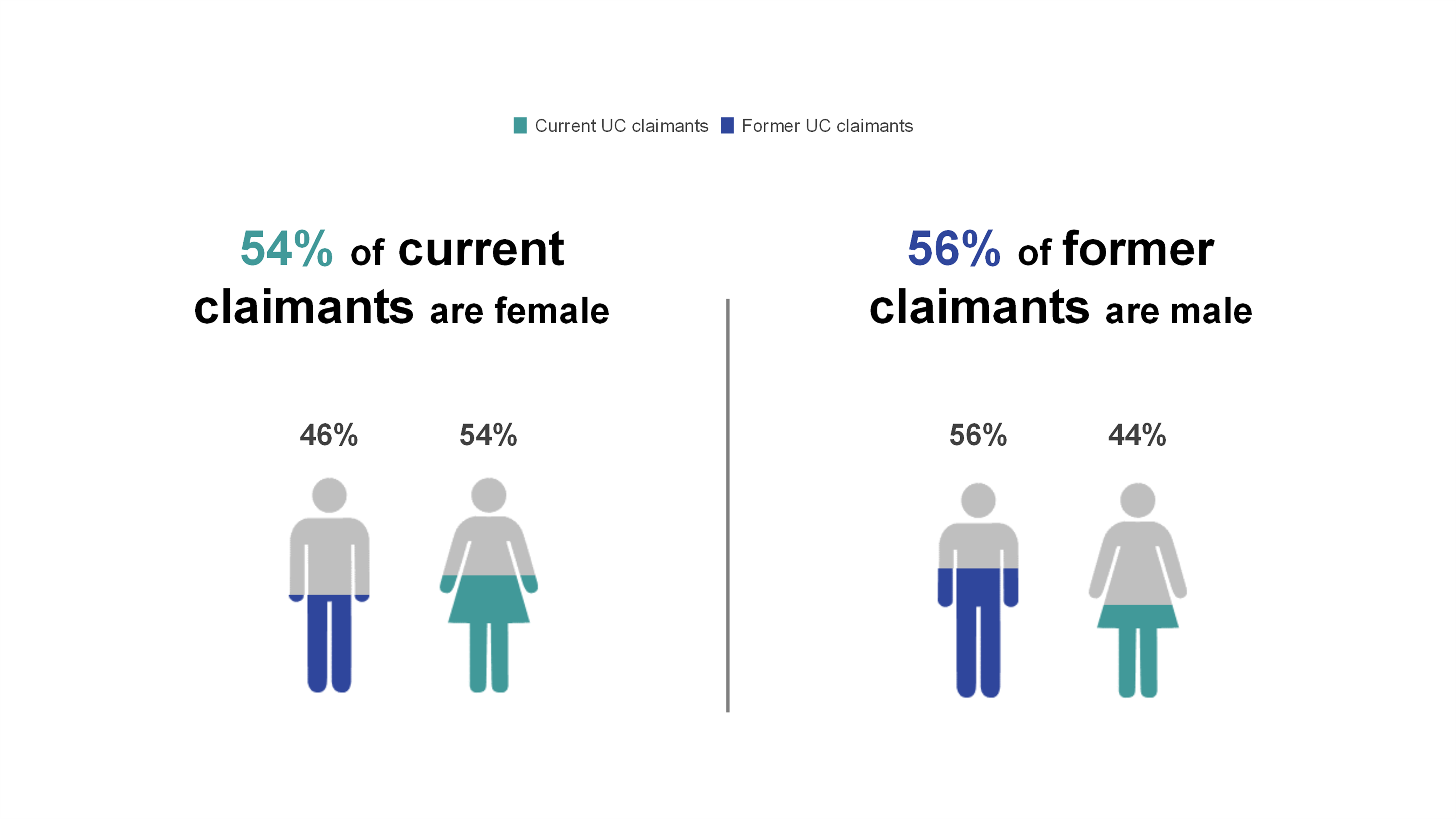
Those who have moved off UC were more likely to be men (56% vs. 46% of current claimants) and to live with a partner (36% vs. 26%). And the partner of those who have moved off UC were more likely to be in-work (72% vs. 46% for current claimants).
In contrast, those currently claiming UC were more likely than former claimants to be female. Almost half (45%) live with dependent children (vs. 23% of former claimants), and three in ten were lone parents (30% vs. 9% of former claimants). Female current claimants were more likely than their male counterparts to be in-work (49% vs. 30%). They were also more likely than men to be on a permanent contract (64% vs. 50%). This suggests that there is potential for them to work full-time but there are barriers preventing them from increasing their hours.
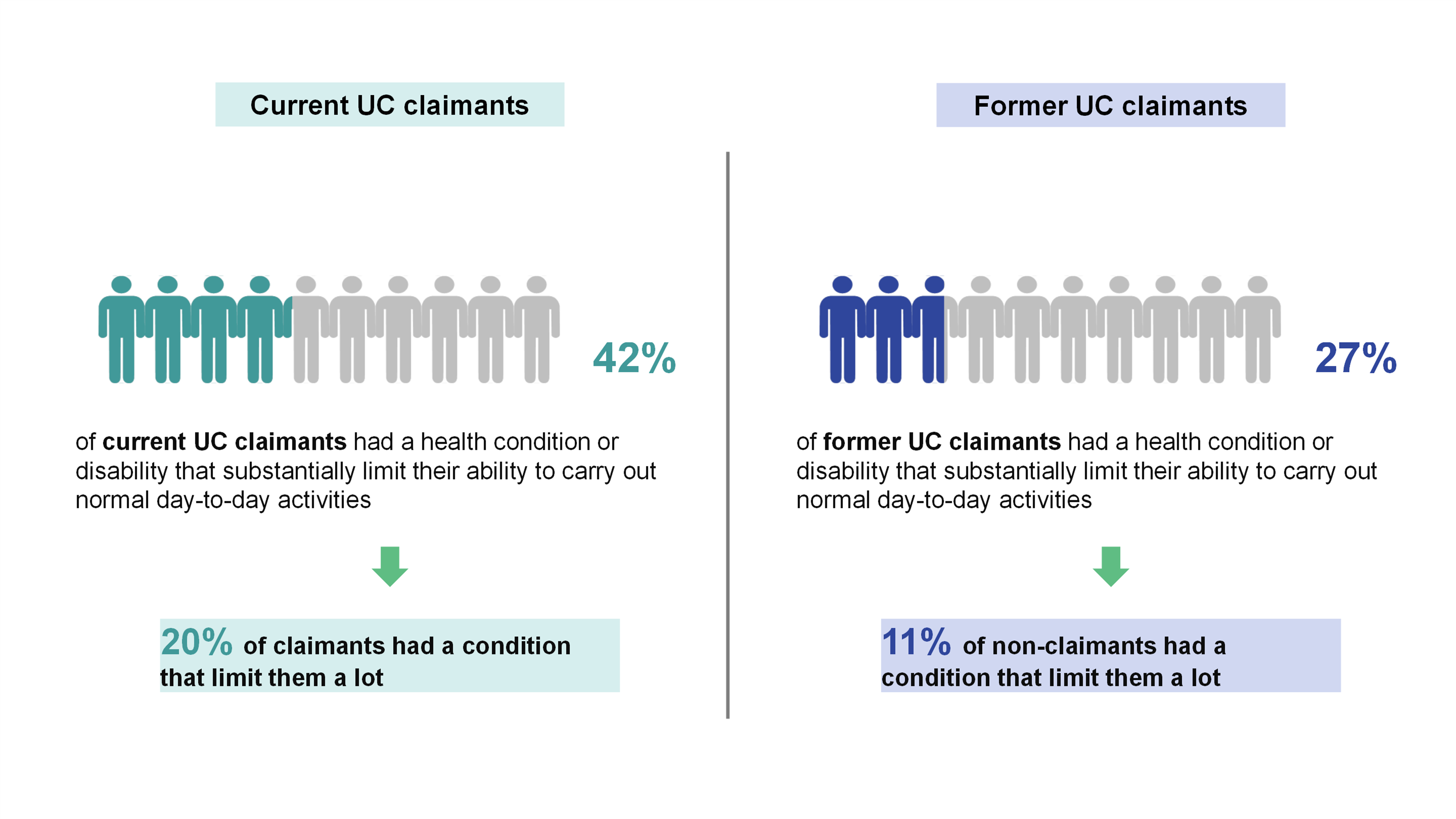
Those currently claiming UC were more likely than former claimants to have a health condition or disability that limits their daily activities (42% vs. 27%) and to have a condition that limits them a lot (20% vs. 11%)
Among both current claimants and former claimants, disabled respondents were less likely to be in work than non-disabled respondents.
Claimant status
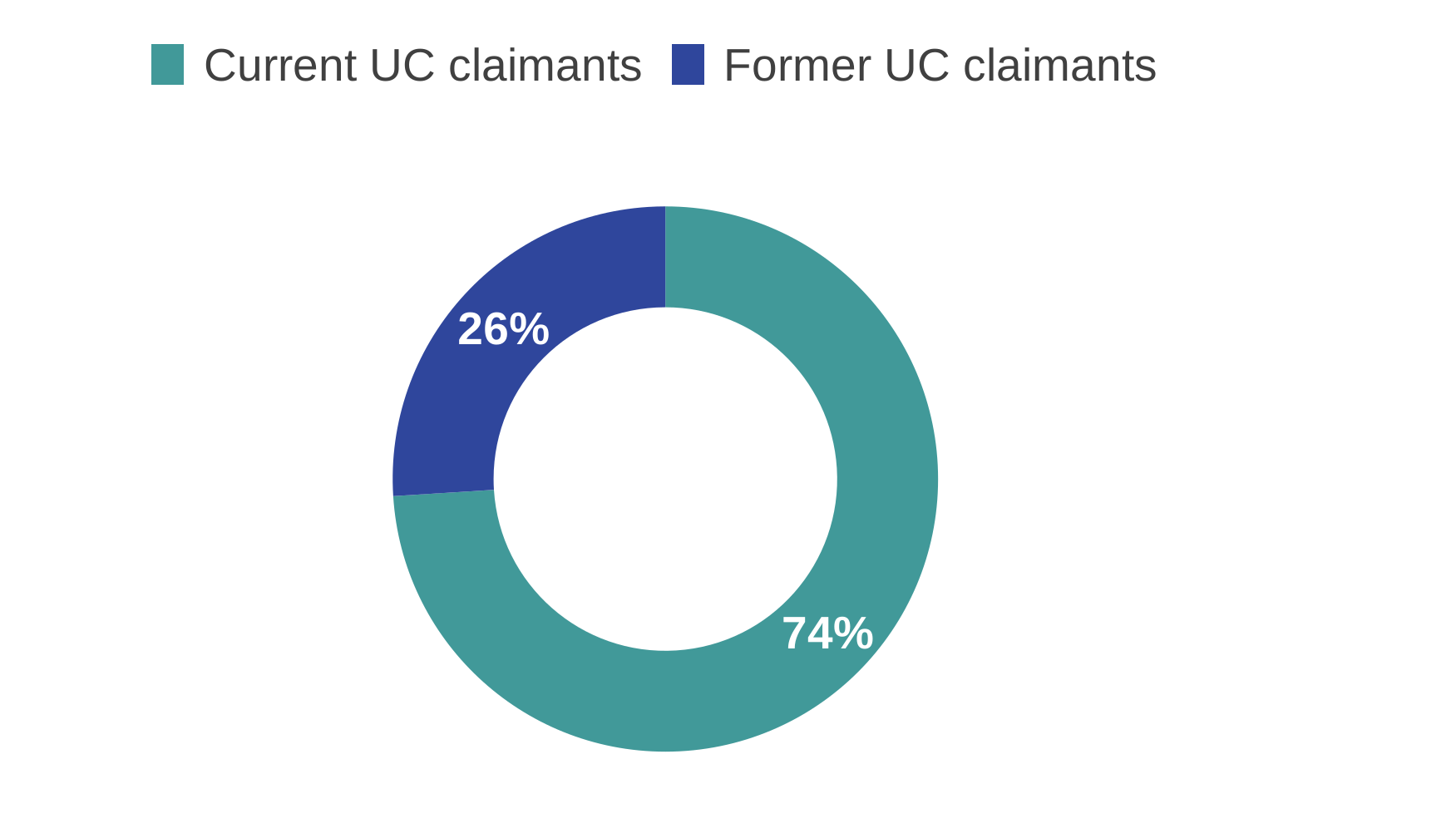
Three-in-four were still claiming UC a year and a half after their initial claim (see Figure 1).
Figure 1: Claimant status
Question: Are you currently receiving Universal Credit payments?
Current UC claimants = 74% Former UC claimants = 26%
Base: Claiming UC (3750); Not Claiming UC (1290)
Working status
Two-in-five current UC claimants were currently also doing some work (see Figure 2).
Figure 2: Working status
| - | Current UC claimants | Former UC claimants |
|---|---|---|
| In work | 40% | 81% |
| 30+ hours per week | 15% | 62% |
| 16 to 29 hours per week | 16% | 15% |
| Less than 16 hours per week | 9% | 4% |
| Not in work | 60% | 19% |
Question: What is your current work status?
Base: Claiming UC (3750); Not Claiming UC (1290)
Former claimants have a more solid work history (see Figure 3), but current in-work claimants have been in their job for longer (Figure 4), suggesting barriers or choice factors preventing them from increasing their hours.
Figure 3: Working Status over time since leaving education
| - | Current UC claimants 60% (net) | Former UC claimants 79% (net) |
|---|---|---|
| Spent most of my time not working | 21% | 9% |
| Spent about as much time working as not working | 19% | 12% |
| Worked solidly with 1 or 2 breaks | 43% | 58% |
| Worked solidly without a break | 17% | 21% |
Question: Which of the following best describes the time you have spent doing paid work since leaving education?
Base: All respondents: Claiming UC (3750), Not Claiming UC (1290); All currently in work: Claiming UC (1761), Not Claiming UC (1050)
Figure 4: Time spent in current job
| How long have you been doing this job? | Current UC claimant | Former UC claimant |
|---|---|---|
| Less than one year | 33 | 45 |
| 1 - 5 years | 44 | 39 |
| 5 years or more | 23 | 16 |
Question: How long have you been doing this job?
Base: All respondents: All currently in work: Claiming UC (1761), Not Claiming UC (1050)
Former claimants were more likely to have a permanent contract and to be working in managerial/professional jobs. These features tend to go hand-in-hand (see Figures 5 and 6).
Permanent contracts were more common among those:
- in more skilled or ‘higher’ occupations
- who have spent longer in the job
- working full-time
Figure 5: Type of contract of most recent job
| What was this job? | Claiming UC | Not claiming UC |
|---|---|---|
| Zero hours’ contract | 21 | 13 |
| Permanent contract | 58 | 68 |
| Temporary/fixed term or seasonal contract | 15 | 14 |
| Something else | 7 | 4.0 |
Question: Was this job…?
Base: All who have worked in last 2 years: Claiming UC (3176), Not Claiming UC (1234)
Figure 6: Current occupation
| What is your current occupation? | Current UC claimants | Former UC claimants |
|---|---|---|
| Managerial / professional occupations | 14% | 22% |
| Elementary occupations | 24% | 20% |
| Caring, leisure and other service | 14% | 11% |
| Sales and customer service occupations | 10% | 7% |
| Administrative and secretarial occupations | 8% | 8% |
| Skilled trades occupations | 7% | 7% |
| Process, plant and machine operatives | 7% | 7% |
| Other | 16% | 17% |
Question: What is your current occupation?
Base: All who have worked in last 2 years: Claiming UC (3176), Not Claiming UC (1234)
Qualification status
Former claimants were more qualified than current claimants, and were therefore more likely to be working in managerial and professional occupations (see Figure 7).
Figure 7: Highest level of qualification
| Highest level of qualification | Current UC claimants | Former UC claimants |
|---|---|---|
| Degree or above | 16% | 28% |
| Level 3 | 20% | 24% |
| Level 2 | 17% | 15% |
| Level 1 | 18% | 14% |
| No qualifications | 14% | 7% |
| Something else / don’t know | 15% | 12% |
Question: What is your highest level of qualification?
Base: Claiming (3750); Not Claiming (1290)
Claimants with higher qualifications were more likely to be in-work and to have a more stable work history; conversely those with a health condition or disability that limit them a lot were more likely to report not having any qualifications at all.
Demographic characteristics
Gender
There were more female current claimants, and they were more likely to be in-work, though mainly part-time. In contrast, there were more male former claimants (See Figure 8).
Figure 8: Demographic profile of current and former UC claimants
Base: Claiming (3750); Not Claiming (1290)
Among current claimants, women were more likely than men to be in-work (49% vs. 30%). They were also more likely than men to be on a permanent contract (64% vs. 50%). This suggests that there is potential for them to work full-time but there are barriers preventing them from increasing their hours.
However, amongst working claimants, men were more likely than women to be working full-time (50% vs. 31%).
Conversely, among former claimants men were more likely than women to be in-work (83% vs. 79%). They were also more likely than women to be working full-time (84% vs. 65%).
Women former claimants were more likely than men to be on a permanent contract (72% vs. 66%). Again this suggests that there is potential for women to increase their hours but they have not done this either due to barriers choice or both.
Age
There were also differences by age. Younger and older claimants were least likely to be in-work compared with those in the middle (see Figure 9).
Figure 9: Age by claimant status
| What is your age? | Claiming UC | Not claiming UC |
|---|---|---|
| Under 25 | 19% | 22% |
| 25-34 | 32% | 31% |
| 35-44 | 25% | 19% |
| 45-54 | 15% | 15% |
| 55+ | 9% | 13% |
Base: Claiming (3750); Not Claiming (1290)
Question: What is your age?
Current claimants under 25 were the least likely to be in-work; this age group had the highest gap (in terms of the percentage in work) when comparing claimants and former claimants (22% vs. 78%).
Among both claimants and former claimants those aged 55+ were less likely to be in work.
Living situation and responsibilities
In terms of living situation, the biggest disparity is in lone parents where a sizeable proportion find it challenging to increase their hours because of their childcare commitment (see Figure 10). Lone parents were mostly female, particularly current claimants (83% vs. 60% for former claimants).
Figure 10: Living situation by claimant status
| Which of these describes your living situation? | Current UC claimants | Former UC claimants |
|---|---|---|
| Live alone | 21% | 25% |
| Partner, no children | 11% | 22% |
| Partner and child(ren) | 14% | 14% |
| Lone parent | 30% | 9% |
| Other | 24% | 29% |
Base: Claiming (3750); Not Claiming (1290)
Question: Which of these describes your living situation?
Current claimants with children were more likely to be in work than those without children (57% vs. 27%).
In terms of home ownership, current claimants were more likely than former claimants to be renting their home and less likely to own their home (see Figure 11).
Figure 11: Home ownership by claimant status
| Are you currently living…? | Claiming UC | Not claiming UC |
|---|---|---|
| Own | 8 | 21 |
| Rent | 65 | 49 |
| Live with relatives or friends | 17 | 22 |
| Other | 7 | 5.0 |
Base: Claiming (3750); Not Claiming (1290)
Question: Are you currently living…?
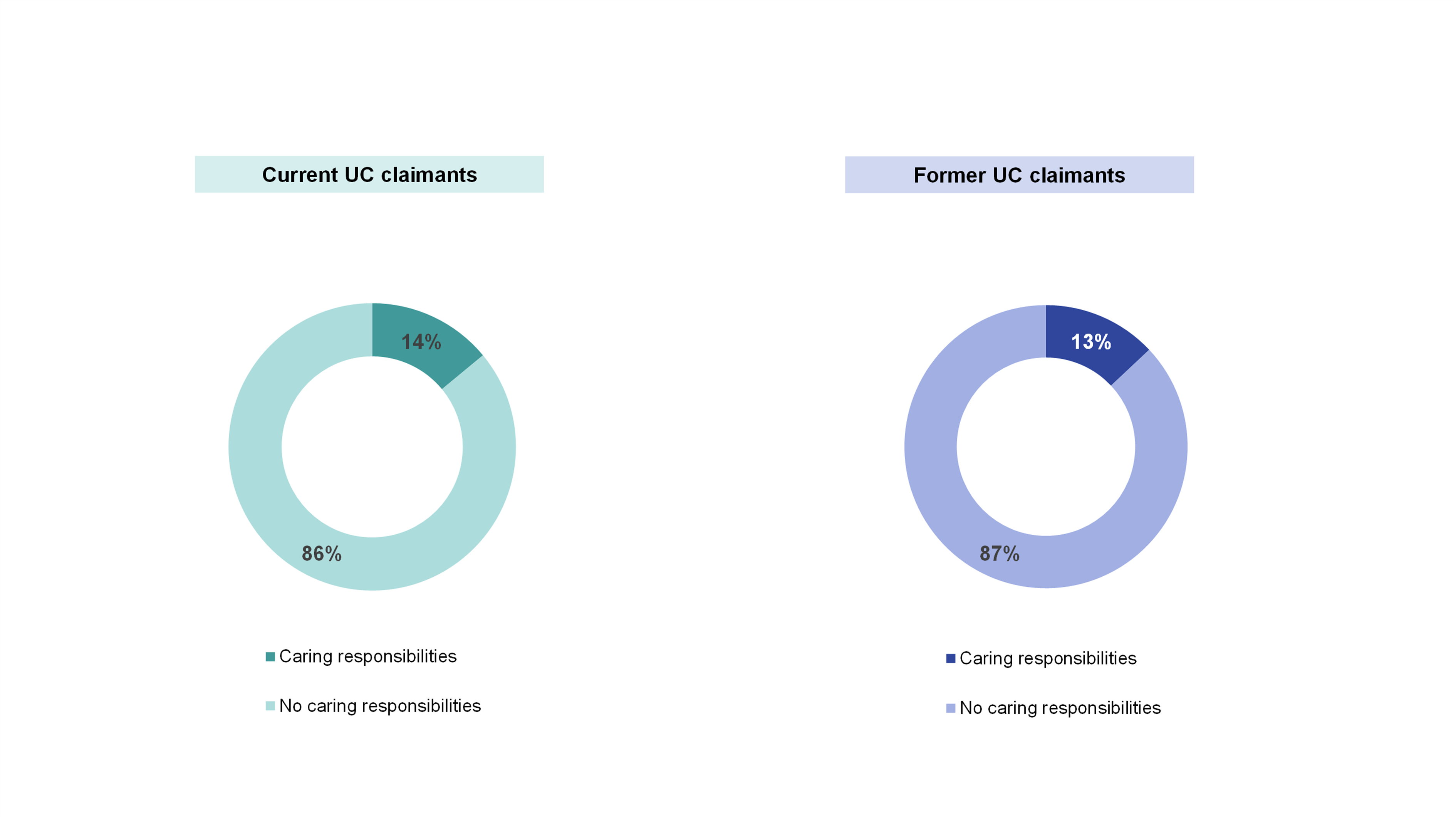
In terms of caring responsibilities, similar proportions were seen between claimants and former claimants.
Figure 12: Caring responsibilities by claimant status
Base: Claiming (3750); Not Claiming (1290)
Current UC claimants
Caring responsibilities: 14% No caring responsibilities: 86%
Former UC claimants
Caring responsibilities: 13% No caring responsibilities: 87%
Question: Do you care for anyone who needs help with everyday life due to illness, disability or old age?
Disability and health conditions
Current claimants were twice as likely as former claimants to declare a health condition or disability that limit them a lot (see Figure 13). A fifth (20%) of claimants reported having a condition that limits them a lot, compared to just 11% of non-claimants.
Figure 13: Health condition and disability by claimant status
Base: Claiming (3750); Not Claiming (1290)
Question: Do you have a health condition or disability that substantially limits your ability to carry out normal day-to-day activities?
Both current and former claimants with a health condition or disability were less likely to be in work, less likely to work full-time and tend to have spent less of their lives working. This applies particularly to those with a condition that limit them a lot.
Section summary
- Claimants who have moved off UC were generally more work-ready than those still claiming in terms of their qualifications, skills and work history. They were also less likely to have additional barriers such as poor health/disability or childcare commitments.
- Current claimants were more likely than former claimants to be females and nearly half have dependent children. Three-in-ten current claimants were lone parents.
- Current claimants with children were more likely to be working than those without but the presence of children appears to be a barrier to moving fully off UC, particularly for lone parents.
- Not working was linked to poor work history, low skills/qualifications and high self-reported health condition or disability.
- Current claimants aged under-25 or over-55 were least likely to be working.
Attitudes and Behaviour Towards Work
Current and former claimants shared similar general attitudes towards work. General perceptions that there aren’t enough full-time jobs were shaped by the Covid-19 pandemic (fieldwork was conducted in the latter part of 2020). Older male claimants and those in the Intensive Work Search regime were more likely to hold this view, as were claimants working in Sales, Customer Service and unskilled jobs.
Among former claimants, part-time workers were more likely than average to believe that there aren’t enough full-time jobs.
The priority for those in-work, particularly parents, was to keep their job rather than to increase their hours. Increasing hours of work was a particular problem for lone parents who were claiming UC; 70% of lone parents who were in-work agreed that it would be difficult to increase their hours – much higher compared to in-work lone parents who were no longer claiming (54%).
There is a sizeable minority of current and former claimants who work part-time who don’t think they have the right skills to move to a better job. Among current claimants, these respondents were more likely to be working in unskilled elementary occupations, with low or no qualifications and have a health condition or disability that limit them a little. Among former claimants, those reporting they lacked the right skills tended to be younger (under 25), without children, with low/no qualification and working in unskilled occupations.
The qualitative research highlighted the additional challenge presented by the pandemic to those with fewer qualifications, who felt that there was more competition for jobs at this time.
Those who had found themselves out of work after a long career in a single company or industry were particularly pessimistic about their ability to find work in the current climate.
Disruption caused by the pandemic, or by personal crises or other pressures, resulted in a safety mindset for some. For those with this outlook, it was more important to avoid challenges such as taking on more hours or additional responsibility, in order to maintain stability. This mindset was often present for those experiencing multiple barriers.
Who is going to employ a disabled person in a middle of a pandemic when there are so many other people out there who are much more able bodied than I am who are also looking for work?
Male, out-of-work, multiple barriers
Attitudes towards work
Current and former claimants shared similar general attitudes towards work (see Figure 14).
Figure 14: Agreement with statements about respondents’ attitude to work
| To what extent do you agree or disagree with these statements | Claiming UC | Not claiming UC |
|---|---|---|
| There just aren’t enough full-time vacancies for everyone at the moment | 65 | 64 |
| At the moment my biggest priority is keeping my current job rather than increasing my hours or pay | 77 | 76 |
| I don’t have the right skills to move to a job with better opportunities or pay | 41 | 39 |
Question: And, to what extent do you agree or disagree with these statements?
Base: All: Claiming UC (3750); Not claiming UC (1290), In work: Claiming UC (1761); Not claiming UC (1050), Working part time: Claiming UC (1107); Not claiming UC (284)
Qualitative research from this and other recent DWP studies suggests that the pandemic has played a key role in shaping perceptions:
- high number of candidates for each job role
- fewer opportunities available in key sectors
I just get lost in the sea of CVs. The companies they suggest are usually big corporations where I’ll send in my CV and never get anything back.
Male, out-of-work, multiple barriers
Barriers to work
Current UC claimants were more likely than former claimants to experience barriers to work and to say they require support to get or progress in work.
Generally, those who have moved off UC were more optimistic about their work prospects than current UC claimants – either in terms of moving into work (37% vs. 25% say this is a realistic goal even without support), or increasing their hours and earnings (30% vs. 12%).
Claimants who believed they can get work without support tended to be men, without children and with higher qualifications, whilst those believing that work was not a realistic goal for them tended to be older claimants, those with a health condition or disability, and those with low/no qualifications.
Current UC claimants were more likely than former claimants to cite various barriers to work, especially childcare barriers (31% vs. 14%) and their physical or mental health or a learning difficulty (38% vs. 23%). This can partly be explained by the characteristics of the two groups; current claimants were more likely to have children and to have a limiting health condition or disability.
However, current claimants were still more likely to report the barriers, even when the analysis focuses on particular sub-groups, e.g. childcare barriers were reported by 65% of claimants with children, compared with 51% of former claimants with children. The only exception was age, cited by equal proportions in each group among those aged 55+.
Childcare barriers were most common among claimants in the Working Enough group, while other barriers (physical or mental health or learning difficulty, lack of relevant skills/qualification/experience, and commute to work) were more commonly cited by claimants in the Intensive Work Search regime.
The qualitative research suggests barriers to work could be complex and often interlinked. Some had more resources to draw upon to overcome barriers they experienced. A disability or health condition might be experienced alongside caring responsibilities or mental health conditions. In addition, people faced challenging personal circumstances including bereavement, redundancy, indebtedness, homelessness and addiction.
The experience of multiple barriers had led some to a crisis point, and the recovery process could be slow and lead to a risk averse mindset and a short-term outlook, preventing longer-term career planning.
Those with similar barriers could feel very differently about their future prospects, depending on their access to support and other resources. Although they sometimes faced similar barriers to those who expected to continue claiming, those who said they had stopped or expected to stop claiming could often access greater resources such as family support, social networks, or a stable home life to help them to overcome barriers and avoid a crisis.
The qualitative research suggested that those with access to support, or with recent experience of the workplace, were more likely to feel optimistic about their future career. Those with experience of working had more knowledge and understanding of how to access opportunities such as jobs and training, and had more faith in their ability to pursue opportunities. Professional networks also provided a source of career advice.
Support requirements
Current UC claimants were more likely than former claimants to require support to get or progress in work (see Figure 15).
Figure 15: Perceived impact of getting support on work goals
All currently not working
| All currently not working | Current claimants | Former claimants |
|---|---|---|
| Even without support, paid work is a realistic goal for me | 25% | 37% |
| With the right support paid work is a realistic goal for me within the next 6 months | 29% | 21% |
| With the right support paid work might be a realistic goal for me but not in the next 6 months | 19% | 11% |
| Even with the right support, paid work is not a realistic goal for me | 13% | 15% |
| Don’t know | 15% | 15% |
All currently working
| All currently working | Claiming UC | Not claiming UC |
|---|---|---|
| Even without support, increasing my hours/work/earnings so I don’t need to claim UC is a realistic goal for me | 12% | 30% |
| With the right support increasing my hours/work/earnings so I don’t need to claim UC might be a realistic goal for me in the next 6 months | 17% | 12% |
| With the right support increasing my hours/work/earnings so I don’t need to claim UC might be a realistic goal for me but not in the next 6 months | 22% | 10% |
| Even with the right support, increasing my hours or work or earnings is not a realistic goal for me | 28% | 19% |
| Don’t know | 21% | 29% |
Question – All currently not working: Regardless of whether you want to work or not, which of the following statements best describes your situation? All currently working: Regardless of whether you want to increase your earnings or hours of work or not, which of the following statements best describes your situation?
Base: All not currently working: Claiming UC (1989); Not claiming UC (240); All currently working: Claiming UC (1761); Not claiming UC (1050)
Barriers
Current claimants were more likely than former claimants to cite various barriers to work (Figure 16). Former UC claimants were more likely than current claimants to say they were happy with their current situation and don’t want to change.
Figure 16: Perceived barriers to improving working situation
| Which, if any, of the following make it more difficult for you to get work / increase your earnings? | Current UC claimants | Former UC claimants |
|---|---|---|
| Childcare | 31% | 14% |
| My physical or mental health or learning difficulty | 38% | 23% |
| My age | 15% | 15% |
| My caring responsibilities | 6% | 3% |
| Lack of relevant skills/ qualifications / experience | 32% | 27% |
| Commute to work | 23% | 16% |
| I don’t want to change – happy with my current situation | 5% | 23% |
| None of these | 6% | 11% |
Question: Which, if any, of the following make it more difficult for you to get work/increase your earnings?
Base: Claiming (3750); Not Claiming (1290)
Those working in managerial or professional occupations were also particularly likely to say they were happy with their current situation (50% of former claimants working in these roles).
Across all key subgroups, current claimants were more likely than former claimants to report a range of barriers (Table 1).
Table 1: Differences in barriers experienced
| Barrier | Sub-group | Current UC claimants | Former UC claimants |
|---|---|---|---|
| Childcare | Those with children | 65% | 51% |
| Physical or mental health or learning difficulty | Those with a limiting disability/condition | 90% | 76% |
| Age | Aged 55+ | 61% | 49% |
| Caring responsibilities | Care for an adult | 40% | 21% |
| Lack of relevant skills/ qualifications/experience | No qualifications | 42% | 27% |
In the qualitative research, those who had stopped claiming or expected to stop claiming made use of additional resources to help overcome barriers. Those experiencing similar barriers could feel very differently about their situation, depending on access to support and personal resources.
Those with access to support felt more positive about their ability to find appropriate work or to improve their prospects in the future. Family, friends, and professional networks were sources of practical and emotional support and career advice.
A stable living situation including financial stability, safe and secure accommodation, enabled those who had achieved this to have the space to consider longer-term career options rather than focusing on immediate priorities.
Current or recent experience of the workplace provided confidence and a template for a future career. This had also helped some to feel that they had a good knowledge and understanding of available opportunities and relevant skills. In addition, those with experience of working or training felt more confident in their own ability to successfully apply for training and jobs.
Overcoming barriers
Those who found barriers most difficult to overcome had often experienced multiple, overlapping factors preventing them from progressing.
Overlapping barriers could result in a short-term focus, and a safety mindset where maintaining stability was the key priority. Disrupted living circumstances could result in a short-term focus on urgent priorities.
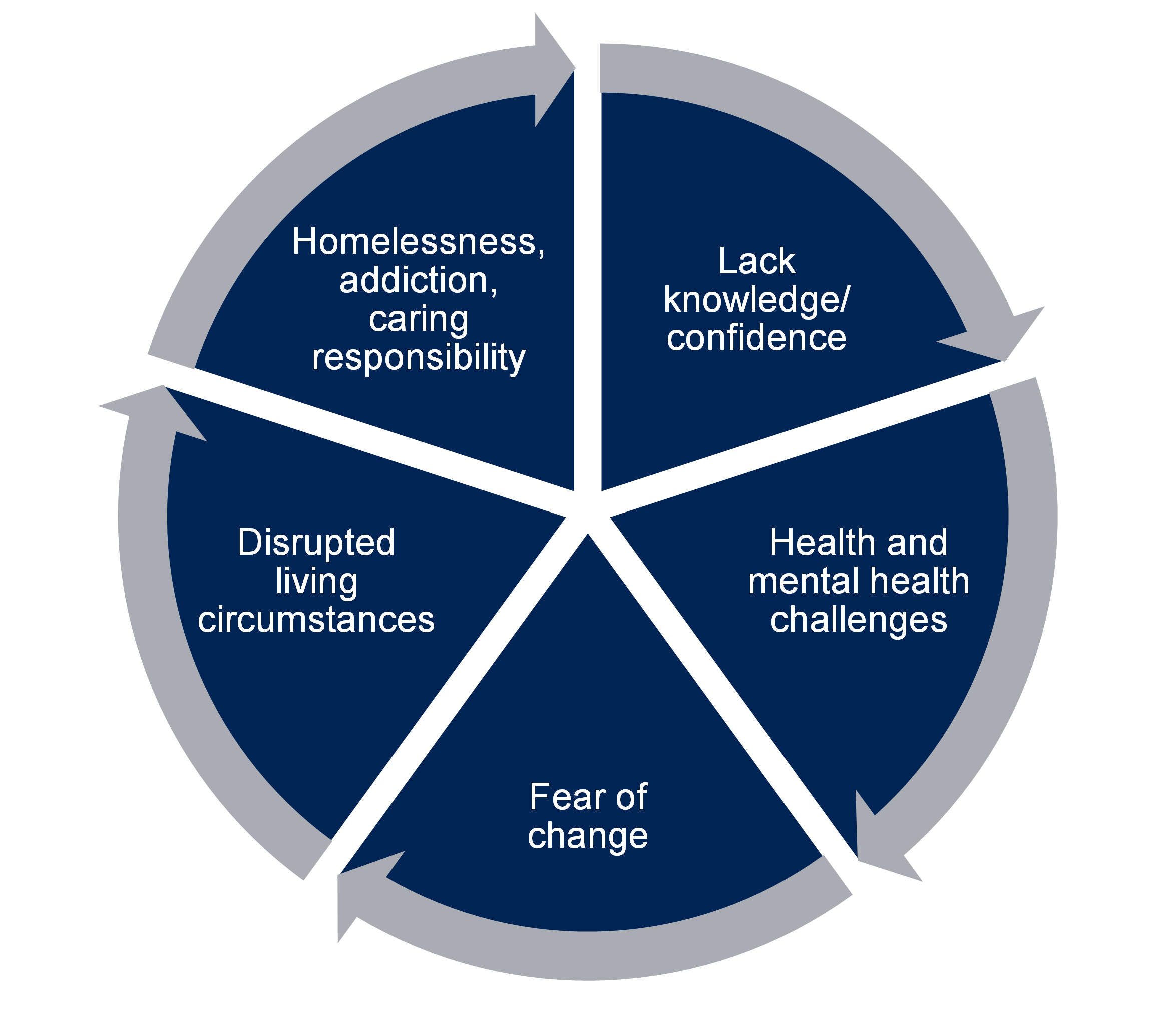
Those who found it most difficult to anticipate stopping claiming often experienced a variety of barriers:
- They may have had less positive recent experience of work, or negative experiences of finding work unrewarding, or destabilising.
- They often lacked confidence and knowledge of available opportunities, and as a result were less aware of their own skills and how they might fit with, or need to be developed in order to meet these opportunities.
- They were more likely to have serious health and mental health challenges, and other circumstances such as homelessness and addiction.
- There was evidence of a fear factor for some who were struggling with health conditions or mental health, the wrong type of work could be destabilising.
I don’t know to be honest, there’s probably stuff I can learn and do to make things easier, I’m not sure.
Male, out-of-work, skills related barriers
[I need help] understanding the value of current skillsets, what needs to be re-tuned to today’s market.
Male, out-of-work, multiple barriers
Increasing hours of work was more difficult for parents especially lone parents who were still claiming UC (see Figure 17). Among those in-work, current UC claimants were more likely than former claimants to agree that ‘it would be difficult for me to increase my hours of work now, even if I was offered it’.
To some extent, this can be explained by differences in household type. Among current UC claimants, agreement is higher among those with dependent children than those without children (67% vs. 43%). The same pattern can be seen among former claimants, although not to the same extent (56% vs. 45%).
Figure 17: Agreement it would be difficult to increase hours of work
| – | Current claimants | Former claimants |
|---|---|---|
| All in work | 58 | 48 |
| Single adult | 43 | 53 |
| Lone parent | 70 | 54 |
| Couple no children | 47 | 44 |
| Couple with child(ren) | 60 | 57.0 |
Question: And, to what extent do you agree or disagree with these statements? “It would be difficult for me to increase my hours of work now, even if I was offered it”
Base: All in work: Single adults: Claiming UC (274); Not claiming UC (284); Lone parent: Claiming UC (842); Not claiming UC (123); Couple no children: Claiming UC (171); Not claiming UC (225); Couple with child(ren): Claiming UC (288); Not claiming UC (158)
The qualitative work suggested that the reasons behind this were a result of lone parents tending to weigh up the benefits of a better job or increased income against the benefits of the status quo.
The research suggested that the pandemic presented a particular challenge to parents, who had to combined home-schooling with work and other caring responsibilities.
Lone parents of young children had established a routine to meet their financial needs through working and claiming, whilst caring for their children. They were keen not to disrupt this situation.
Some feared that by earning more they would lose out on UC payments and also on other linked benefits such as Council Tax benefit. In this sense, there was a lack of financial incentive to working additional hours.
They were also keen to avoid missing out on time with their children, particularly during the disruption of the pandemic, especially where they perceived a minimal financial benefit from this.
There was also a disincentive to consider changing career, if their current job allowed them to successfully combine work and caring. This was particularly the case if their current employer showed understanding and flexibility in relation to their childcare responsibilities.
Obviously the more you work, the more money you are going to bring home. If I work full time, that would make a significant difference, but that’s not realistic. The kids need you, they have to be your first priority.
Female, out-of-work, childcare barrier
…Maybe when they go to secondary school, until then, I just need to find something I can do whilst they are at school. Especially while they are young, they are fully dependent on me. The more I work, the more I will be away from them out of the house. I don’t want to pay someone to look after them.
Female, out-of-work, childcare barrier
The majority of people not currently working wanted to do so, but two-in-five did not think there was enough advice and support. Three-quarters of those who were not in-work agreed that they would be happier and more fulfilled if they were working, but those who were not in-work were more likely than those in-work to feel under pressure from family/friends, and to feel that there is not enough support available to them. (See Figure 18).
Figure 18: Agreement with statements about returning to work
Current UC claimants
| Current UC claimants | Working full-time | Working part-time | Not working |
|---|---|---|---|
| I would be happier and more fulfilled if I was working (more hours) | 26% | 54% | 78% |
| I feel under pressure from my family and friends to increase my hours and pay / get a job | 22% | 25% | 35% |
| There isn’t enough advice and support available to help me increase my hours / get a job | 26% | 36% | 39% |
Former UC claimants
| Former UC claimants | Working full-time | Working part-time | Not working |
|---|---|---|---|
| I would be happier and more fulfilled if I was working (more hours) | 25% | 47% | 77% |
| I feel under pressure from my family and friends to increase my hours and pay / get a job | 18% | 26% | 31% |
| There isn’t enough advice and support available to help me increase my hours / get a job | 24% | 32% | 43% |
Question: And, to what extent do you agree or disagree with these statements?
Base: Working full time: Claiming UC (654); Not claiming UC (766), Working part time: Claiming UC (1107); Not claiming UC (284), Not working: Claiming UC (1989); Not claiming UC (240)
The following groups would be happier working and feel under pressure to find work:
- younger, male claimants
- BME claimants
- those without a solid work history
- those working in unskilled occupations
- those in the Intensive Work Search regime
Lack of support was also more commonly reported by the above groups, comprising male and BME claimants, and those furthest from the labour market (i.e. with no qualifications, a broken work history and in unskilled jobs).
The qualitative research found that some had struggled to access support during the pandemic, whilst negative perceptions of UC support were a barrier to engaging for others. The following findings support other recent labour market qualitative research undertaken for DWP:
Fear factor amongst legacy claimants
Some had experienced overpayment of benefits in the past, resulting in penalties and deductions. This resulted in a fear of overpaying, and a concern that any interaction with JCP could lead to a discovery of accidental overclaiming. The fear of financial loss as a result was enough to prevent proactive engagement with JCP.
I’m worried I will go on some sort of blacklist if I ask them about working more. They will realise I can work more and force me to stop getting support. I can’t afford to not get it!
Female, in-work, childcare barrier
Perception that pandemic had made Work Coach support less accessible
Those who preferred face-to-face contact with JCP, or to speak directly with an adviser on the phone, found it much more difficult to access support online. As phone lines were busy during the pandemic, this group had found it hard to access any support at this time.
I have told them on my journal that I am not working…no response so far… It would be good if they got back to me and gave me some support… like suggestions or a course to do…I have just been looking for jobs all by myself… you can’t even visit recruitment agencies.
Male, out of work, skills related barriers
‘Newer’ claimants lacked understanding of support offer
Some of those who were less familiar with the benefits system tended not to expect JCP to be able to provide them with any useful support beyond financial support. Lack of awareness of the support offer meant that they were unaware that JCP could help them to find work. They instead preferred to rely on their own resources for this.
I don’t know what else they could do that would support me. Just the income. Some income is better than no income.
Female, in work, childcare barrier
Summary
- There was a general perception among both current and former claimants that there aren’t enough full-time jobs. These views were in large part shaped by the pandemic.
- Current UC claimants were more likely than former claimants to experience barriers to work and to say they require support to get or progress in work. Former UC claimants were able to access additional resources to help them overcome barriers.
- Half of out-of-work UC claimants believe they can get work with the right support. Reported timeframe to get work was shorter for younger, more educated, and male claimants.
- One in seven current claimants will require more intensive support to change their mindset as well as to make them more job-ready. These tended to be older claimants, those with a disability/health condition and those without qualifications.
- The priority for those in-work was to keep their job rather than to increase their hours. In-work progression was seen as “unrealistic” by some parents, particularly lone parents who were weighing up the benefits of a better job against their childcare commitments.
Understanding of UC
General understanding of the UC incentives offer was low for both current and former UC claimants, with only a fifth correctly identifying at least 4 (out of 5) of the UC work incentive statements as correct. Understanding of potential sanctions was much higher than understanding of UC work incentives.
Current UC claimants expressed a greater understanding of the work incentives and conditions of UC than former claimants, such as being able to work for more than 16-hours and still claim UC (56% vs. 43%) and being able to claim up to 85% of childcare costs back through UC (26% vs. 18%). Awareness of the childcare offer was higher among parents reporting childcare barriers but still accounting for less than half of this group (47% were aware). The qualitative interviews highlighted that this lack of awareness may be preventing some parents from working or increasing their hours.
In general, understanding of the work incentives was higher among those currently in-work for both current and former UC claimants.
Understanding of the UC work incentives tended to be greater among women and those with children, as well as those who were more highly qualified. Those with limiting conditions or disabilities tended to have lower awareness. This applied in particular to current UC claimants; there was less variation among those who had moved off UC. This can partly be explained by the work status of the two groups; more highly qualified claimants were more likely to be in-work, whereas those with a limiting condition or disability were less likely.
The qualitative research further supports the quantitative findings that there is a lack of knowledge and understanding of work incentives among both current and former claimants.
Claimants were either unaware of the work incentives, or found them difficult to understand. There was an expectation among claimants that someone would explain the work incentives to them, rather than needing to proactively search for the information.
When the support offer was explained, this was positively received, and thought potentially beneficial. Work Coaches would be an effective way to increase understanding of the work incentives, as advice could be tailored to individual needs and circumstances.
These findings support other recent labour market qualitative findings.
Understanding of UC support incentives
Those not working had lower levels of understanding about UC work incentives (see Figure 19).
Figure 19: Understanding of UC support incentives (%true)
Current UC claimants
| Current UC claimants | Working full-time | Working part-time | Not working |
|---|---|---|---|
| On Universal Credit you are better off for each extra hour you work | 32% | 29% | 25% |
| Some people claiming Universal Credit can earn a certain amount before deductions are made | 62% | 65% | 54% |
| You can work for more than 16-hours and still claim Universal Credit | 75% | 72% | 45% |
| You can claim up to 85% of your childcare costs back through Universal Credit | 38% | 30% | 22% |
| People who do not meet their Claimant Commitment may have deductions made from their UC payments | 62% | 65% | 67% |
Former UC claimants
| Former UC claimants | Working full-time | Working part-time | Not working |
|---|---|---|---|
| On Universal Credit you are better off for each extra hour you work | 24% | 27% | 20% |
| Some people claiming Universal Credit can earn a certain amount before deductions are made | 57% | 61% | 47% |
| You can work for more than 16-hours and still claim Universal Credit | 45% | 45% | 34% |
| You can claim up to 85% of your childcare costs back through Universal Credit | 18% | 19% | 15% |
| People who do not meet the requirements of their Claimant Commitment may have deductions made from their UC payments | 63% | 65% | 61% |
Question: In your experience, are each of the following statements true or false: (% true)
Base: Working full time: Claiming UC (654); Not claiming UC (766), Working part time: Claiming UC (1107); Not claiming UC (284), Not working: Claiming UC (1989); Not claiming UC (240)
Lack of general awareness of the work incentives, and confusion around where to find information, resulted in a low understanding, as evidenced in the qualitative research.
In terms of existing knowledge of work incentives, the qualitative research suggested that there was a lack of awareness and understanding of all five work incentives. There was an expectation among claimants that if the work incentives were relevant to them, someone would have mentioned this to them rather than claimants needing to proactively discover this information.
There was also a lack of clarity among claimants around where they would find information on the work incentives. Those who were more proactive used social media groups as sources of knowledge, as well as finding out information from talking to family and friends.
It’s never something they mentioned to me, the other benefits system you knew you’d get 30 free hours. I think they should tell you about it, they should make it very clear if you have two kids, it’s not just age 3 and under, it’s everyone. Let them know this is what you’re entitled to. Make it clear for everyone.
Female, out-of-work, childcare barrier
Reactions to support incentives
When the support offers were explained in the qualitative research, they were positively received, and thought potentially beneficial.
Work Coaches would be an effective way to increase understanding of the work incentives, as the majority of claimants thought that the work incentives were difficult to understand. Advice could then be tailored to individual needs and circumstances, and claimants would have a greater understanding of how the support would be beneficial to them, therefore, increasing likelihood of uptake.
Other recent qualitative research on Labour Market Incentives echoed this finding, suggesting that claimants wanted direct contact with their Work Coach to explain the work incentives and how these might apply to an individual based on their own circumstances.
In terms of specific incentives:
- Wage Top ups : Those who reacted positively to the wage top up support thought it would be helpful for those moving into work, and for claimants working part-time. Claimants felt the wage top ups would act as a financial safety net for those with fluctuating working hours, and those who felt unable to work full-time.
It’s like a safety net I suppose, like I know if my overtime stops, and I go back down to my 30 hours, or even 20 hours, then I know I can have that top up.
Female, in-work, multiple barriers
- Work Allowance: Those who thought the work allowance offer would be beneficial liked the offer as they felt it was reassuring and would reduce the pressure of moving back into work for those who have not been working due to health conditions. Claimants felt the additional financial support would encourage and help them move back into work.
For us this is great because our income goes up and down… so our universal credit payments would go up during the months when my partner doesn’t make much.
Female, in-work, couple, childcare barrier
I think that [work allowance] would definitely be something that will help me to move back into work, as I would be less worried to know that I could earn more before reductions are made.
Female, out-of-work, health related barrier
- Childcare offer: Those who reacted positively to the childcare offer thought the offer would help parents to stay in work who would have struggled financially to pay for childcare.
There were also variations in understanding of UC work incentives linked to barriers to work:
- Those with childcare barriers tended to have a greater understanding of UC work incentives, while understanding was lower among those with other barriers (e.g. relating to age or health/disability).
- The exception is for knowledge that ‘people who do not meet the requirements of their Claimant Commitment may have deductions made from their UC payments’. Knowledge of this was higher among those with barriers relating to age or health/disability than those with childcare barriers.
Table 2: Knowledge of incentives vs barriers to work
| % true | Childcare | Physical or mental health or learning difficulty | Age | Lack of relevant skills/qualifications/experience | Commute to work |
|---|---|---|---|---|---|
| On Universal Credit you are better off for each extra hour you work | 30% | 27% | 30% | 32% | 31% |
| Some people claiming Universal Credit can earn a certain amount before deductions are made | 72% | 66% | 63% | 64% | 70% |
| You can work for more than 16-hours and still claim Universal Credit | 76% | 57% | 55% | 56% | 56% |
| You can claim up to 85% of your childcare costs back through Universal Credit | 47% | 25% | 19% | 25% | 27% |
| People who do not meet the requirements of their Claimant Commitment may have deductions made from their UC payments | 70% | 80% | 81% | 76% | 77% |
| Base: All respondents | (1,297) | (1,388) | (745) | (1,305) | (901) |
Summary
- General understanding of UC work incentives was low and particularly low compared to claimants’ understanding of sanctions under UC.
- Understanding of UC was greater among those in-work, women and those with children. It was lower among those with limiting health conditions or disabilities.
- Awareness of the childcare offer was higher among parents reporting childcare barriers but still accounting for less than half of this group. The qualitative interviews highlighted that this lack of awareness may be preventing some parents from working or increasing their hours.
- The qualitative research suggested low understanding of the work incentives was due a lack of clarity on where to find information on the support offers, and claimants finding them difficult to understand. Work Coaches would be an effective way to increase understanding, so advice can be tailored to individual needs and circumstances.
Childcare
Two-thirds of current claimants with children experienced childcare barriers. Current claimants were more likely than former claimants to have dependent children and were much more likely to be lone parents. Among those with children, current claimants were less likely to have children aged three or under.
Current claimants with children were more likely to be in-work than those without children (57% vs. 27%). However, those with dependent children showed high agreement that ‘it would be difficult for me to increase my hours of work now, even if I was offered it’ compared to those without children. This pattern was seen for both current and former claimants. Increasing hours of work was a particular problem for lone parents, especially among those who were currently claiming UC.
When looking at barriers to work, childcare barriers were reported by 65% of current claimants with children, compared with 51% of former claimants with children. Combined with a greater number of (lone) parents in the current claimant group, this suggests that addressing childcare barriers is key to helping more parents become independent of UC.
In the qualitative research, parents tended to have established routines that carefully balanced work, finances and childcare. This could create barriers to increasing working hours and thereby disrupting routines or risking reductions in linked benefits. This was especially the case for lone parents and parents of younger children who preferred to care for children themselves. Other parents did not experience such barriers and preferred to focus on working towards increasing earnings. The perceived high cost of childcare was a key barrier.
My Work Coach only mentioned that [childcare offer] last month.. that has prevented me in the past from working… I would have started work sooner had I known.
Female, in-work, childcare barrier
Two-in-five parents used formal childcare but a significant proportion of them don’t use any childcare funding.
Current claimants and former claimants were similar in their use of different types of childcare, with both groups most likely to use family and friends. Two-in-five parents used formal childcare. Of those who did, former claimants were more likely than current claimants to use tax-free childcare, whereas around a third of current claimants had childcare costs covered fully or partly by UC. Those currently claiming were also more likely to have up to 15 hours of free childcare for children aged two.
General awareness and understanding of the childcare offer was low among all claimants.
- Positively, just over half (54%) of current claimants who received any government financial support for childcare said that it had helped them to move into work or increase their hours. This was higher than for those no longer claiming (31%).
- In particular, two-thirds of those who have childcare costs covered fully or partly by UC said it had helped them, including 39% who say it has helped them a lot.
- By contrast, those receiving up to 15 hours of free childcare for children aged two were less likely to say it had helped them (40%), compared with other types of financial support.
In the qualitative research, working parents made use of a range of childcare to help them maintain their work routine. This included partners, extended family, after school clubs and formal childcare such as nurseries and childminders.
There was a low awareness and understanding of the childcare offer, with most assuming that if they had not been informed of the childcare offer they wouldn’t be eligible. Once informed, parents reacted very positively to the offer, but had questions about whether it would really benefit them in their own specific circumstances. They were keen to be reassured that they would benefit financially in terms both of the percentage covered, and any linked benefits that might be lost. There were concerns about upfront payment of a large amount needed to cover childcare.
Use of childcare and childcare funding
Two-in-five parents used formal childcare but a significant proportion of them don’t use any childcare funding (see Figure 20).
Figure 20: Childcare used and how it is funded
Which of the following childcare do you use?
| Which of the following childcare do you use? | Current UC claimants | Former UC claimants |
|---|---|---|
| Family and friends | 39% | 38% |
| Nursery | 22% | 23% |
| After school or breakfast or holiday club | 18% | 20% |
| Registered child minder | 7% | 7% |
| None of these | 35% | 34% |
Do you use any of the following to fund your childcare?
| Do you use any of the following to fund your childcare? | Current UC claimants | Former UC claimants |
|---|---|---|
| Tax-free childcare | 5% | 18% |
| Childcare vouchers | 3% | 6% |
| Up to 15 hours of free childcare for children aged two | 16% | 4% |
| 15- 30 hours of free childcare per week for children aged three to four | 22% | 26% |
| Universal Credit covers/covered part or all of my childcare costs | 31% | 4% |
| None of these | 36% | 51% |
| Don’t know | 5% | 4% |
Base: All who have children under the age of 16: Claiming UC (1647); Not Claiming UC (291); All who use formal childcare: Claiming UC (669); Not Claiming UC (128)
The qualitative research found that work responsibilities and childcare routines were finely balanced for working parents, and that balancing work and financial priorities, and childcare was a key focus for parents. There was also some uncertainty about the financial benefits of working.
Working parents had established routines to enable them to combine work and caring for children. They had often arranged work that would enable them to collect children from school, and also used support from partners, grandparents and formal childcare such as after school clubs and childminders.
There were however barriers to using formal childcare. The prohibitively high cost of formal childcare was seen as a key barrier to using additional childcare. Some, especially lone parents and those with pre-school children, felt that they would prefer not to use childcare in order to work whilst their children were younger, as their children would benefit more from their care. In this sense, taking on more childcare was seen as a compromise that would need to come with clear benefits. Childcare options would need to be considered carefully to fit with work routines and school location.
For some parents, there was uncertainty about the financial benefits of working, and an assumption that extra work would result in a loss of linked benefits providing support with housing costs and Council Tax. There was a general lack of clarity for some around what the financial impact might be of increased income, resulting in the fear that benefits would reduce. As formal childcare was seen as very costly, there was a perception for some that using childcare to increase working hours would not be financially beneficial.
This barrier to working additional hours did not apply to all parents, and those who expected to stop claiming tended not to focus on the financial impact of losing benefits. This group did, however, perceive childcare to be very costly and this had prevented them from taking on additional work.
In addition to a lack of awareness, the qualitative research found a lack of understanding of the childcare offer. Existing barriers to taking up childcare mean that the benefits of working additional hours must be clear for parents. Lack of clarity can act as a barrier, leading to the assumption that work will not be financially beneficial.
Although there were pockets of awareness of the childcare offer, in general there was a low awareness and understanding. Those who were aware had become aware via their Work Coach, but in some cases they felt they should have been made aware earlier. A few felt that they would have taken advantage of the childcare offer in order to work more hours, had they been aware of it. Echoing the findings on communication of the other work incentives, parents thought that if the childcare offer had been available to them, someone would have highlighted this to them. The fact that this hadn’t been highlighted therefore suggested to them that they would be unlikely to be eligible. There was some confusion with Local Authority early years provision, which parents had usually heard of and assumed that this was the only provision available.
Parents reacted positively to the childcare offer, and were pleased that the offer suggested they would be eligible for a high percentage of childcare costs. However key questions emerged immediately around the precise details of it, and whether they would be eligible based on their specific circumstances. Parents also wondered about the vague wording around the percentage that would be reimbursed, and what percentage of childcare costs they would actually receive. There were concerns about upfront payment, given the uncertainty about the amount they were eligible to receive.
Parents needed detailed explanation and reassurance about the childcare offer in order to consider disrupting existing benefits and paying large amounts upfront for childcare. This reassurance would be likely to need to come from a Work Coach who could provide an individualised explanation based on their own circumstances.
Increasing working hours
Increasing hours of work was a particular problem for current claimants who were lone parents.
Among those in-work, current UC claimants were more likely than former claimants to agree that ‘it would be difficult for me to increase my hours of work now, even if I was offered it’ (58% vs. 48%).
To some extent, this can be explained by differences in household type. Among current UC claimants, agreement was higher among those with dependent children than those without children (67% vs. 43%). The same pattern was seen among former UC claimants, although not to the same extent (56% vs. 45%).
The key difference between current UC claimants and former UC claimants was among lone parents: for those currently claiming, 70% of lone parents agreed that it would be difficult to increase their hours, but this was much lower among former claimants (54%, see Table 3).
Table 3: Agreement it would be difficult to increase hours of work by respondent parental situation
| % agree | Single adult (current UC claimant) | Lone parent (current UC claimant) | Couple - no children (current UC claimant) | Couple with child(ren) (current UC claimant) | Single adult (former UC claimant) | Lone parent (former UC claimant) | Couple - no children (former UC claimant) | Couple - with child(ren) (former UC claimant) |
|---|---|---|---|---|---|---|---|---|
| It would be difficult to increase my hours of work now, even if I was offered it | 43% | 70% | 47% | 60% | 53% | 54% | 44% | 57% |
| Base: All respondents | (274) | (842) | (171) | (288) | (284) | (123) | (225) | (158) |
Over half of current claimants in receipt of financial support for childcare said it had helped them to move into work or to increase their hours.
Figure 21: Whether financial support has helped claimants and former claimants move into work or work more hours
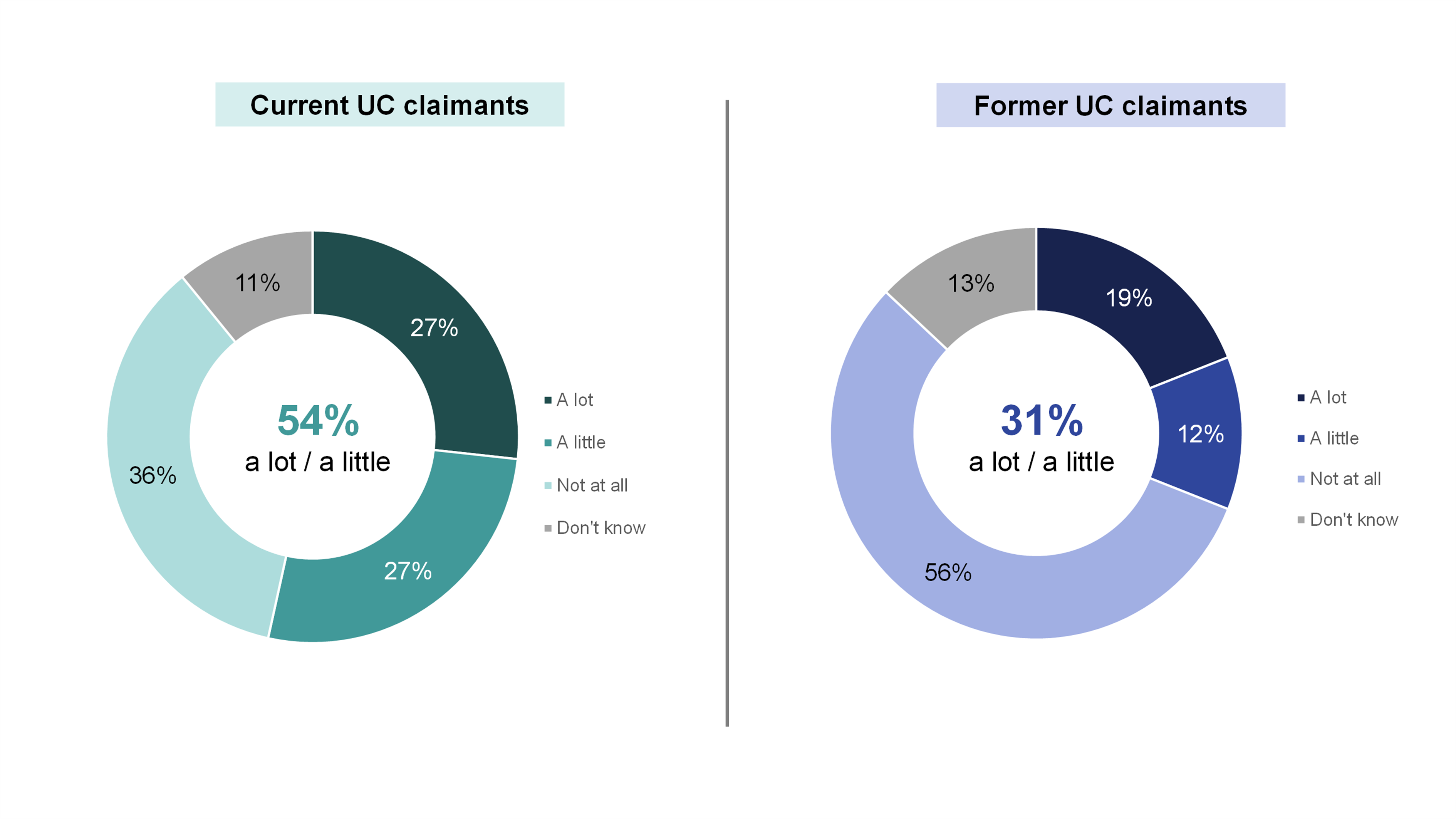
Question: Has this financial support helped you to move into work/work more hours?
Current UC claimants
| A lot | 27% |
| A little | 27% |
| Not at all | 36% |
| Don’t know | 11% |
Former UC claimants
| A lot | 19% |
| A little | 12% |
| Not at all | 56% |
| Don’t know | 13% |
Base: All who received financial support: Claiming UC (401); Not Claiming UC (60)
Summary
- Over half of current claimants with children were in-work; higher compared to current claimants without children.
- Two-thirds of current claimants with children experienced childcare barriers, making it difficult for them to increase their hours of work at this present time. This was a particular issue for current claimants who were lone parents.
- Two-in-five parents used formal childcare but a significant proportion of them don’t use any childcare funding, partly due to low awareness of the UC childcare offer and how it could help their own personal situation. The qualitative research highlighted claimants’ need for clear and tailored information on how the childcare offer would work for them.
- However, over half of current claimants who received financial support for childcare said that it had helped them to move into work or increase their hours, suggesting scope to help more parents become independent of UC through tailored information and advice about the UC childcare offer.
Experience of Jobcentre Support
Current and former claimants reported similar levels of support from a Work Coach; differences seen were linked to conditionality. There were no clear differences between current claimants and former claimants in terms of the type or level of support they have received from a Jobcentre Plus Work Coach. Current claimants were slightly more likely to recall receiving some form of support, however, differences were more pronounced in relation to more general characteristics of claimants.
Claimants in the Intensive Work Search regime were more likely than average to recall receiving support from a Jobcentre Plus Work Coach. Linked to this, recall of support was highest among younger males, without children, who were not in-work. Claimants in elementary occupations and skilled trades, and those with Level 1 or 2 qualifications were also more likely to recall receiving support.
In comparison, recall of support from a Jobcentre Plus Work Coach was lowest among those with children, those with a health condition or disability that limits them a lot, those qualified to degree level and those with no qualifications. Those in the Working Enough group were also less likely to recall receiving support.
The qualitative research suggested that experiences of Work Coaches were highly varied.
Positive experiences were amongst those who found their Work Coach emotionally supportive and those with practical support needs. The key benefits of the Work Coach focused on personal contact, where the Work Coach was supportive and empathic, and tailored advice to individual needs based on personal circumstances.
Less positive experiences were amongst those expecting tailored job search support, and those with less contact than they needed. Some claimants experienced a lack of responsiveness from their Work Coach, and had difficulty using the online journal. This was a particular barrier for those with physical and mental health conditions, who would benefit from phone or face-to-face contact.
The level of rapport between a Work Coach and the claimant also impacted claimants’ experiences, with those who did not build up a relationship with their Work Coach feeling more negative about the support they received.
Support from Jobcentre Plus Work Coaches
Proportions receiving support
Current and former claimants reported similar levels of support from a Work Coach; differences were linked to conditionality. Almost half (48%) of current claimants and 44% of former claimants recall receiving support from a Jobcentre Plus Work Coach (Figure 22). Differences were seen by gender, age and whether they had dependent children. Younger claimants and former claimants were more likely to recall receiving such support
Figure 22: Proportion of claimants and former claimants who recall receiving support from a Jobcentre Plus Work Coach
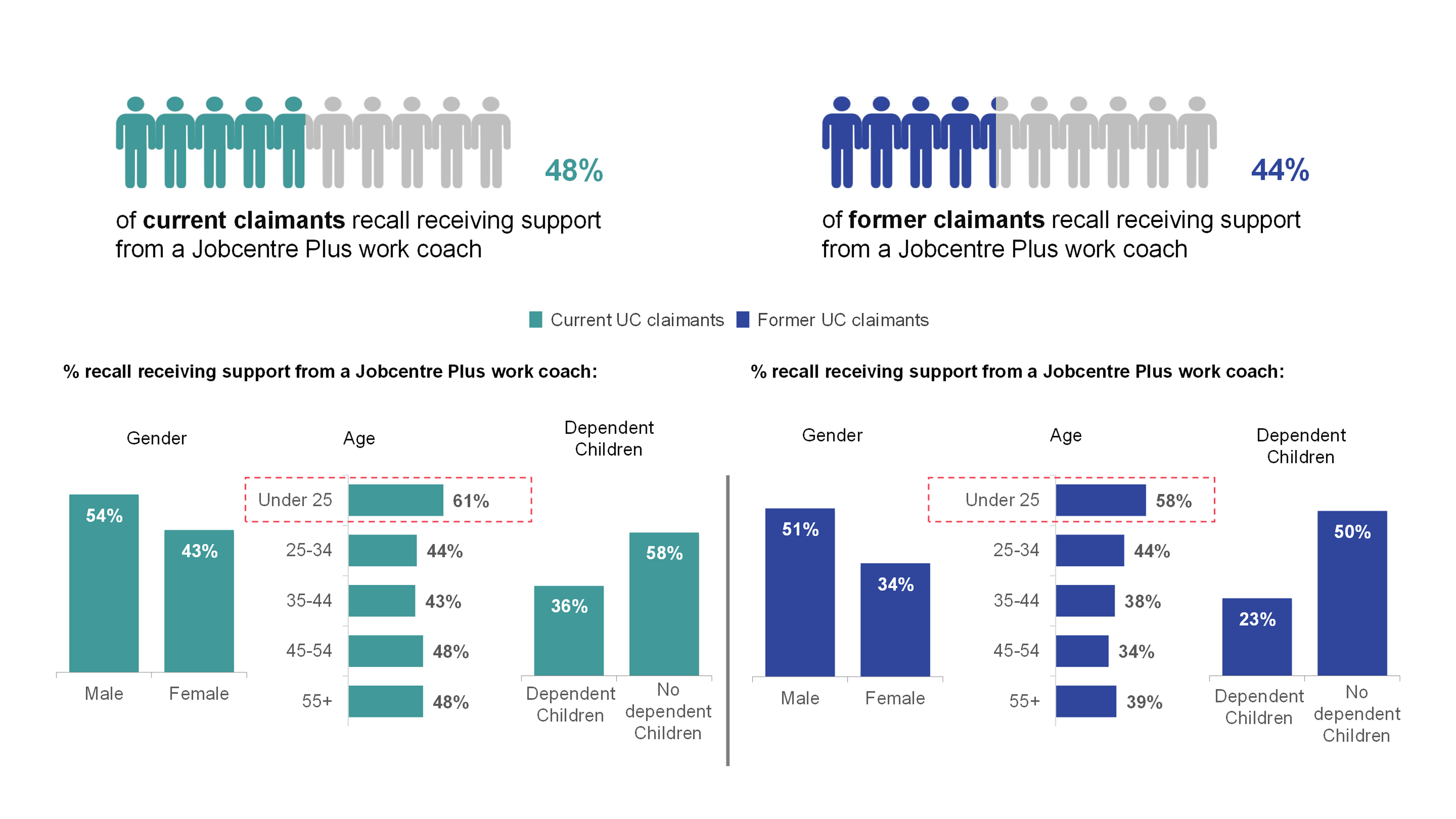
Current claimants
| Male | 54 |
| Female | 43 |
| Under 25 | 61 |
| 25 to 34 | 44 |
| 35 to 44 | 43 |
| 45 to 54 | 48 |
| 55+ | 48 |
| Dependent children | 36 |
| No dependent children | 58 |
Former claimants
| Male | 51 |
| Female | 34 |
| Under 25 | 58 |
| 25 to 34 | 44 |
| 35 to 44 | 38 |
| 45 to 54 | 34 |
| 55+ | 39 |
| Dependent children | 23 |
| No dependent children | 50 |
Base: Claiming (3750); Not Claiming (1290)
Among current claimants receiving support from a Work Coach, recall was highest among those not in-work with low qualifications (see Figure 23).
Figure 23: Claimants’ recall of receiving support from a Work Coach by living situation, conditionality, qualification level, work status and occupation
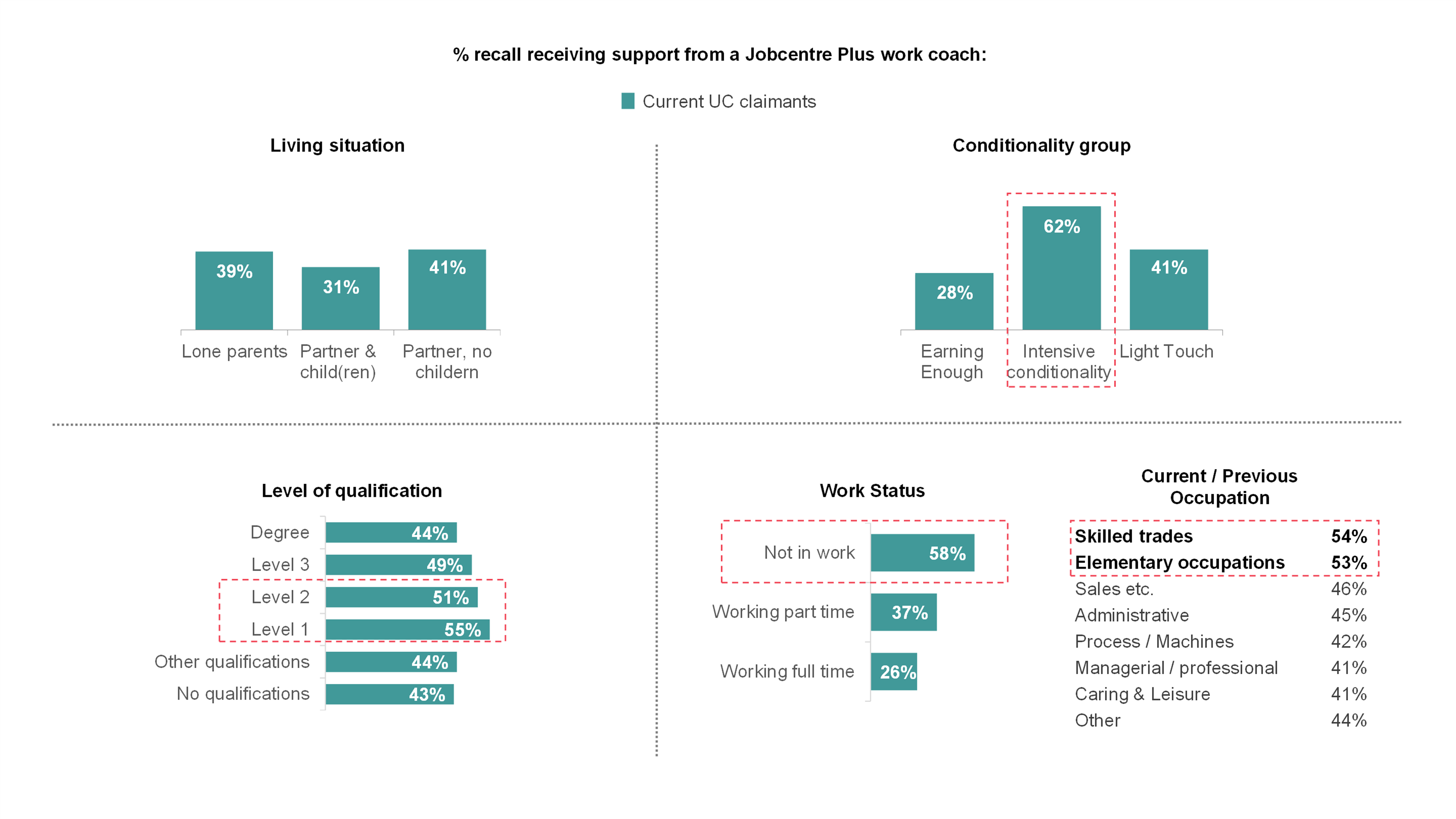
Base: Claiming (3750)
Of those who recalled receiving support from Jobcentre Plus, current claimants were more positive than former claimants about the help they received, with three-quarters reporting they found the interactions helpful (vs. 63% of former claimants). This can partly be explained by those currently claiming being more likely to agree that their Work Coach gave advice that suited their personal circumstances, compared to those no longer claiming (69% vs. 64%).
Among current claimants, those not in-work were particularly likely to say the interactions were helpful, as were those in the Intensive Work Search regime (note that some claimants would fall into both of these groups). Older claimants, and those with no qualifications were more likely to find the interactions very helpful. In contrast, current claimants with a disability that limits them a lot were particularly likely to say the interactions had been unhelpful.
Among former claimants, those under 25 were particularly likely to say the interactions had been helpful.
Similar proportions of current claimants and former claimants agreed that their Work Coach helped them to get into work/progress in work. However, former claimants were more negative about the impact of Jobcentre support.
In both groups, views were less positive among those with a limiting condition/disability, women and those with children.
The comparison between current claimants and former claimants shows the same pattern in relation to use of the UC online journal: similar proportions agreed that it helped them move into work/progress in work but again, former claimants were more likely to disagree.
Ratings of Work Coaches’ support
More current claimants found Jobcentre support helpful than former claimants (see Figure 24).
Figure 24: Whether support from Jobcentre Plus was helpful
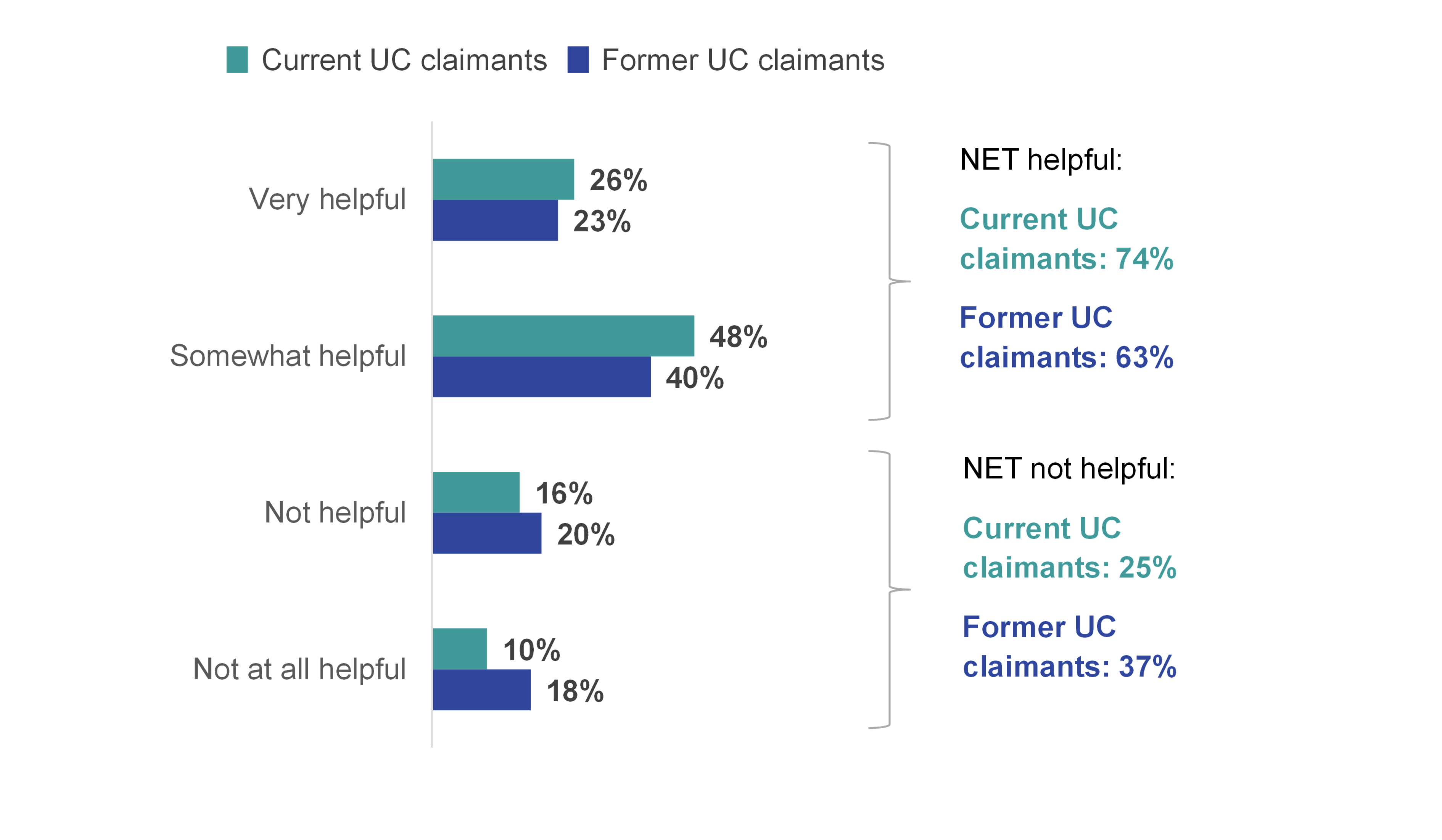
| – | Current UC claimants | Former UC claimants |
|---|---|---|
| Very helpful | 26% | 23% |
| Somewhat helpful | 48% | 40% |
| Not helpful | 16% | 20% |
| Not at all helpful | 10% | 18% |
Question: And was this JobCentre Plus interaction useful in helping you to find work/increase your earnings?
Base: All who had interactions with JCP Claiming (1655); Not Claiming (508)
Among current claimants, those that were not in-work and claimants in the Intensive Work Search regime were more likely to have found the support helpful, however current claimants with a disability that limits them a lot were more likely to say they had not found the support to be helpful.
Among former claimants, those aged under 25 were more likely to have found the support helpful.
Qualitative research in this and other recent studies highlights perceptual differences between legacy claimants and ‘newer’ claimants. These findings echo those from recent
For newer claimants, with less experience of benefits, Universal Credit offered them a financial safety net that they were relieved and grateful to have access to. These claimants tended to be more optimistic about the range of opportunities open to them for the future, even in the current climate of the pandemic.
Newer claimants were more positive towards Universal Credit, being more open to engage with the support offers and the potential personal benefit they would get from them. These claimants were less likely to have had negative experiences of the system.
Longer-term claimants who were out of work, however, were more wary of change resulting in losing benefits and had a fear of the potential sacrifices of working. These claimants were less optimistic about the job market and expected COVID-19 to have a profound impact. They were also pessimistic about the potential for the system to support them into work. Longer-term claimants were more likely to be jaded by past experiences where they had a negative experience of claiming.
When it comes to the specific impact of working with Jobcentre Plus Work Coaches, former claimants were more negative than current claimants about the impact of Jobcentre Plus support (see Figure 25).
Figure 25: Ratings of effectiveness of Jobcentre Plus Work Coaches
Current UC claimants
| Current UC claimants | Strongly agree | Somewhat agree | Neither agree nor disagree | Somewhat disagree |
|---|---|---|---|---|
| My work coach helped me get into work/progress in work | 21% | 24% | 27% | 13% |
| Using the UC online journal helped me move into work/progress in work | 18% | 23% | 27% | 16% |
Former UC claimants
| – | Strongly agree | Somewhat agree | Neither agree nor disagree | Somewhat disagree |
|---|---|---|---|---|
| My work coach helped me get into work/progress in work | 22% | 22% | 18% | 14% |
| Using the UC online journal helped me move into work/progress in work | 16% | 22% | 18% | 15% |
Question: Thinking about the contact you have had with the Work Coach at the Jobcentre, how much to do you agree or disagree that…?
Base: All who had interactions with JCP Claiming (1655); Not Claiming (508)
In both groups, views were less positive among those with a limiting condition/disability, women and those with children.
In the qualitative research, experiences of Work Coaches were highly varied, and impacted by the level of rapport between the claimant and the Work Coach. Positive experiences were amongst those who found their Work Coach provided emotional or practical support as needed. Those with emotional support needs tended to be claimants who experienced a variety of barriers, often with serious physical and mental health conditions, and other circumstances such as homelessness and addiction. These individuals benefited from emotional support in terms of reassurance and confidence building, understanding about their situation, as well as sign posting to other support sources.
Those who had practical support on the job market from their Work Coach were also optimistic about their experiences. Practical support highlighted by claimants included identifying transferable skills to help change career, help with attending training courses such as on CV writing skills, and sign posting to job fairs. Claimants felt their Work Coach to understanding their individual needs was key to ensuring practical support was beneficial.
Less positive experiences were amongst those expecting a tailored job search support, and those who felt they had less contact than they needed. For some, there was a lack of tailored advice, with resources found too generic and not personalised to individuals’ needs.
Some claimants felt there was a lack of responsiveness from their Work Coach, and they had difficulty using the online journal. The pandemic presented a particular challenge for Work Coach interactions, due to limited phone or face-to-face contact. This is especially important for those with mental health barriers.
Negative experiences were also reported by claimants who were unable to build up a relationship with a Work Coach due to seeing different Work Coaches. Some also felt their Work Coach was just going through the motions/tick boxes, rather than actively supporting them into work or to progress in work.
Positive experiences
The qualitative work shed light on what a positive experience with a Work Coach looked like. Overall, positive Work Coach experiences included provision of practical and emotional support, as well as tailored help and advice. Those who had the most positive experiences of Work Coaches were those who had a rapport with their Work Coach and who felt their specific needs and situation were understood.
Example of positive practical work coach support (1)
• Professionally qualified claimant applied for a number of roles in her industry but found herself overqualified.
• The work coach helped identify transferable skills and suggested potential jobs to suit the claimants skillset.
• The claimant was also sent on a CV writing course.
• The support of the work coach resulted in the claimant successfully changing career, and moving into full-time work without the need for further UC support.
Key benefit of work coach support:
• Personal contact with work coach resulted in claimants individual needs, circumstances and ambitions being understood.
• Work coach was supportive and encouraging.
• Transferable skills identified to empower claimant to find a new career.
Varying experiences
The qualitative research uncovered a variety of different Work Coach experiences, and the following quotes give a flavour of that variety:
I had very little actual checking . I think checking in more often, or at all actually, would have been welcome. I think my last experience, with it all being online, has skewed that.
Male, in-work, skills related barrier
I’ve had lots of emails from my Work Coach, sending me job application forms. Someone also rang to go through interview techniques. It’s little things like that they offer to help out, them sending me jobs to apply for, that have been useful…
Male, out-of-work, skills related barrier
Whenever I need them I can message my Work Coach and he gets back to me, if I type in my journal he gets back to me within the next couple of days. He’s friendly and understands what I need.
Male, out-of-work, skills related barrier
My Work Coach was just brilliant.. So supportive and encouraging. She initially helped me find teaching jobs to apply for. Then when I was not getting very far, I felt so disgruntled and she kept encouraging me. We then discussed a change in career, she looked at my transferable skills…she sent me on CV writing course, which was just brilliant!
Female, in-work, childcare barrier
From my experience of DWP, I don’t feel they have anything to offer me that would fundamentally alter my outlook, or my position in life. I don’t mean that in a derogatory way to the DWP, I just feel that I have explored all the avenues.
Male, in-work, multiple barriers
Example of positive practical work coach support (2)
• Claimant with multiple barriers into work due to numerous mental and physical health conditions, as well as caring responsibilities for family.
• The work coach showed empathy and understanding of the claimant’s personal circumstances.
• Practical support was also offered to redo a qualification.
• The support of the work coach resulted in the claimant successfully moving into work, in a job the claimant finds rewarding and motivating.
Key benefit of work coach support:
• Personal contact with work coach resulted in claimants individual needs, circumstances and ambitions being understood.
• Work coach was supportive and encouraging.
• Opportunities to retrain and improve qualifications in sector of interest to claimant.
Unmet support needs
Seven-in-ten current and former claimants reported unmet support needs.
Former and current claimants expressed similar unmet support needs, with similar proportions of each saying that there are types of support that would help or would have helped them move into work or increase their earnings . For both groups, younger respondents and those not in-work were more likely to specify two or more types of support needs (see Figure 26).
Current claimants were slightly more likely than former claimants to say they would like/would have liked support to pursue further or higher education, whilst those who had left UC were slightly more likely to say they would like/would have liked help with financial management.
Figure 26: Additional support claimants and former claimants would have found useful
| – | Current UC claimants | Former UC claimants |
|---|---|---|
| Support and training to find / get a job / new job (e.g. interview skills, CV skills, communication skills) | 25% | 27% |
| Help with the cost of travel to and from work | 25% | 26% |
| Support to pursue further or higher education | 26% | 23% |
| Help with financial management | 17% | 21% |
| Support to manage a physical or mental health condition | 22% | 20% |
| Access to affordable/ good quality childcare | 18% | 13% |
| None/I do not want support | 28% | 32% |
Question: Are there any types of support which would help you to increase your earnings/move into work but you haven’t been able to access?
Base: Claiming (3750); Not Claiming (1290)
The findings were broadly consistent across sub-groups, with little clear distinction of specific types of support for individual groups. One exception of this was ‘access to good/quality/affordable childcare’. Among current and former claimants with children, around three in ten wanted this support but had not been able to access it. This support need increased among those with children aged 3 or below, with 41% of current claimants and 34% of former claimants wanting this support.
There was also variation in claimants support needs based on claimants’ health condition or disability. Those with a disability that limits them a lot were more likely to want support to manage a physical or mental health condition, compared to claimants with a disability that limits them a little, or those with no health condition.
For those who identified caring responsibilities as a barrier to work, support to manage caring responsibilities was mentioned by 41% of current claimants, and 26% of former claimants.
The proportion that don’t want support was higher among those aged 55+ and those who have worked solidly without a break.
The qualitative research highlighted the need for tailored support based on individual circumstances.
The qualitative interviews showed claimants support needs were shaped by the type and extent of barriers claimants faced, and where claimants were at in their stage of journey into work. Therefore, claimants would benefit from support that is tailored to their needs. For example:
-
Claimants with a goal in mind but lacking skills to support them in their job search need practical support to develop skills and help them in applying for jobs.
-
Claimants with a lack of confidence or understanding of the job market need support to help identify opportunities and transferable skills, as well as support to help build confidence.
I want to look at opportunities, as my brain still works, so there is stuff I could still do. But I’ve been in the same industry for nearly my whole adult working life, and I don’t really know how to evaluate what my skillsets are transferable to.
Male, out-of-work, multiple barriers
- Due to low awareness and understanding of the UC work incentives offer, those with childcare barriers into work would benefit from support from their Work Coach to understand the childcare offer based on their own circumstances. This would enable parents to use this offer effectively and move into work.
If I’d known [about the childcare offer], I would have taken them back to the childminder, I would have used that…I’ve never looked into it, nobody has talked to me about it.
Female, in-work, lone parent, childcare barrier
- Those with more complex barriers, such as mental health conditions, disabilities, and those in difficult situations such as homelessness or addiction, would benefit from empathy and understanding, as well as signposting to other services for support.
Mental health support I suppose, the options to seek help from say a therapist. If that option was there, I would definitely take it.
Female, out-of-work, multiple barriers
Preferences in source of support
Jobcentre Plus is the preferred source of support for those not in-work, while employers are the preference among those who are working (see Figure 27).
Claimants who were in-work were most likely to say that they would like to get support from their employer in helping them to increase their hours or earnings. This was particularly the case among former claimants (58% vs. 48% of current claimants).
Those not in-work were most likely to want to get support from Jobcentre Plus in helping them to move into work. This was higher among current claimants than former claimants but was the most frequent response for both groups among those not in-work.
More than a third of those not in-work specify online sources as a preferred type of support (41% among claimants and 37% among former claimants).
Around a third of current claimants who were not in-work say they would like to get support from an employment agency (36%). See Figure 27.
Figure 27: Preferences in source of support
Current UC claimants
| – | In work | Not in work |
|---|---|---|
| Employer / company / line manager | 48% | 1% |
| Jobcentre Plus | 35% | 56% |
| Online Sources | 27% | 41% |
| Employment Agency | 20% | 36% |
| None of these | 8% | 7% |
| Don’t know | 15% | 13% |
Former UC claimants
| – | In work | Not in work |
|---|---|---|
| Employer / company / line manager | 58% | 1% |
| Jobcentre Plus | 24% | 45% |
| Online Sources | 19% | 37% |
| Employment Agency | 19% | 26% |
| None of these | 12% | 8% |
| Don’t know | 11% | 14% |
Question: Who/where would you like to get support from to help you to increase your hours or earnings/move into work?
Base: All who wanted support; Claiming UC: In work (985), Not in work (1299); Not claiming UC: In work (629), Not in work (154)
Among current claimants, those in the Working Enough group were most likely to prefer support from employers (33%), while those in the Intensive Work Search regime were most likely to prefer support from Jobcentre Plus (54%).
The qualitative interviews provided insights into the support preferences of in-work claimants and those who were not working temporarily. There was less appetite for UC support beyond financial support, amongst those who did not expect to be claiming for long.
Those who had moved off UC, or who expected to do so soon, were more likely to use existing sources of support such as current and previous employers, employment agencies and online sources. These claimants don’t yet see JobCentre Plus as a source of support into work.
Some amongst this group see themselves as claiming only for a short period of time and were therefore less open to the wider support offer. Others among this group would prefer not to see themselves as a claimant and see UC primarily as a financial stopgap. These findings also emerged in our recent Labour Market Incentives creative testing qualitative research.
Summary
- Claimants with poor qualifications and skills in the Intensive Work Search regime find the support helpful, suggesting Work Coach support is effective amongst this group.
- It was less common for parents in the Working Enough group to receive Work Coach support. This group requires support to progress, but not in the short-term due to childcare commitments.
- Recall of Work Coach support was relatively low among people with a disability or health condition. This group is also more likely to see work as an unrealistic goal and to view the support given as unhelpful. Face-to-face or telephone contact with a Work Coach, rather than online, would greatly benefit this group of claimants.
- Positive experiences of Work Coach support was linked to tailored and responsive support that caters to different needs – emotional and practical. A good rapport between the claimant and the Work Coach was also important for a positive experience.
- Jobcentre support is best targeted at those out-of-work, whilst those in-work would prefer to receive support from their employer.
Reported impact and outcomes
Reported improvements in job preparation skills were highest among young men, those without a health condition/disability, and those in less skilled jobs.
Current claimants and former claimants were very similar in their perceptions of how their skills and knowledge had improved since they started claiming UC.
- Similar proportions of current and former claimants said they know more about how to prepare for an interview; know more about which jobs fit with their skills; and say they have improved their work-related skills.
- Current claimants were slightly more likely to agree that they are more willing to consider a wider range of jobs and were less likely to disagree that they ‘feel more confident talking to my employer about new opportunities’ than former claimants.
In both groups, respondents were more likely to feel their skills have improved if they are male, aged under 25, without a limiting condition or disability, and working/having worked in less skilled occupations.
Among current claimants, those in the Intensive Work Search regime were most likely to say they know more about how to prepare for an interview (48%) and that they are willing to consider a wider range of jobs (58%).
Among former claimants, those in the Working Enough group were less likely to report any progress in their skills and knowledge since they made their first claim in August/September 2019. For example, 37% said they had improved work-related skills, compared with 54% of Intensive work search regime Conditionality and 48% of Light Touch.
In the qualitative research, those who felt that they had benefitted most from UC were those who felt that support had taken into account their specific circumstances, and was appropriately tailored to their own needs.
Individual needs varied considerably, from those who needed intensive support to meet basic needs such as health or housing, to those who did not feel they needed any support over and above the financial support.
From the perspective of claimants and former claimants, the Work Coach relationship was key to ensuring that needs could be effectively understood. Those who felt that they had experienced a good level of understanding from Work Coaches were more engaged with UC support. Those with the most intensive support needs who had had a positive Work Coach relationship tended to value this highly. Conversely, those who were least satisfied tended to say that support was hard to access or less inappropriate to their needs.
Improvements in job preparation skills
Reported improvements in job preparation skills were highest among young men, those without a health condition/disability, and those in less skilled jobs (see Figure 28).
Figure 28: Percentage agreeing they had seen each type of improvement in their job preparedness
| – | Current claimants | Former claimants |
|---|---|---|
| I know more about how to prepare for an interview | 44% | 44% |
| I know more about which jobs fit with my skills | 49% | 50% |
| I feel more confident talking to my employer about new opportunities | 53% | 49% |
| I have improved my work-related skills | 44% | 47.0% |
| I am more willing to consider a wider range of jobs | 53% | 49.0% |
Question: Thinking about how you feel now compared to when you started claiming Universal Credit in […] how much would you agree or disagree that…
Base: Claiming (3750); Not Claiming (1290)
In both groups, respondents were more likely to feel their skills have improved if they were:
- male
- aged under 25
- without a limiting condition or disability
- working/having worked in less skilled occupations
Actions taken since first claim
Looking at actions taken since claimants first made their claim, the majority had taken a least one action to get work or progress in work, with those not yet working doing more (see Figure 29).
- Current claimants were more likely than former claimants to have spoken to their employer about progression (38% vs 30% among those in-work), and to have applied for a job since their UC claim started (56% vs. 49% among those not in-work).
- Among those in-work, current claimants were more likely than former claimants to say they had talked with their employer about training, increasing their hours, promotion or a pay rise, since they started claiming UC.
- More than half of current claimants who were not in-work said they have applied for a job since the start of their UC claim, slightly higher than the proportion of former claimants.
- More than a third of current claimants who were not in-work had attended a job interview since their UC claim started, similar to the proportion for former claimants.
- Around a quarter of claimants had attended training to improve their qualifications and skills, and this was similar among claimants and former claimants, and those in-work and out-of-work.
Figure 29: Actions taken since first started claiming UC
Current UC claimants
| – | In work | Not in work |
|---|---|---|
| Talked with your employer about training, increasing your hours, promotion or pay rise | 38% | 0 (not applicable) |
| Applied for a (new) job | 36% | 56% |
| Attended a job interview | 28% | 37% |
| Attended training to improve your qualifications/ skills | 26% | 25% |
| None of these | 31% | 33% |
Former UC claimants
| – | In work | Not in work |
|---|---|---|
| Talked with your employer about training, increasing your hours, promotion or pay rise | 30% | 0 (not applicable) |
| Applied for a (new) job | 41% | 49% |
| Attended a job interview | 37% | 36% |
| Attended training to improve your qualifications/ skills | 23% | 25% |
| None of these | 34% | 37% |
Question: Since you first started claiming UC, have you done any of the following …?
Base: Claiming UC: Working (985), Not working (1299); Not claiming UC: Working (629), Not working (154)
Among both claimants and former claimants, these actions were more prevalent among younger respondents, men, those with higher qualifications, and those without a limiting condition or disability. Those in the Intensive Work Search regime were most likely to have taken at least one action (70% among current claimants and 71% among former claimants).
Satisfaction with UC support
In the qualitative research, claimants who felt that support was appropriate to them, and who had developed a good rapport with their Work Coach, were more satisfied with UC support.
A positive Work Coach relationship was key to a good engagement with UC support. Work Coaches had had provided a range of types of valued support.
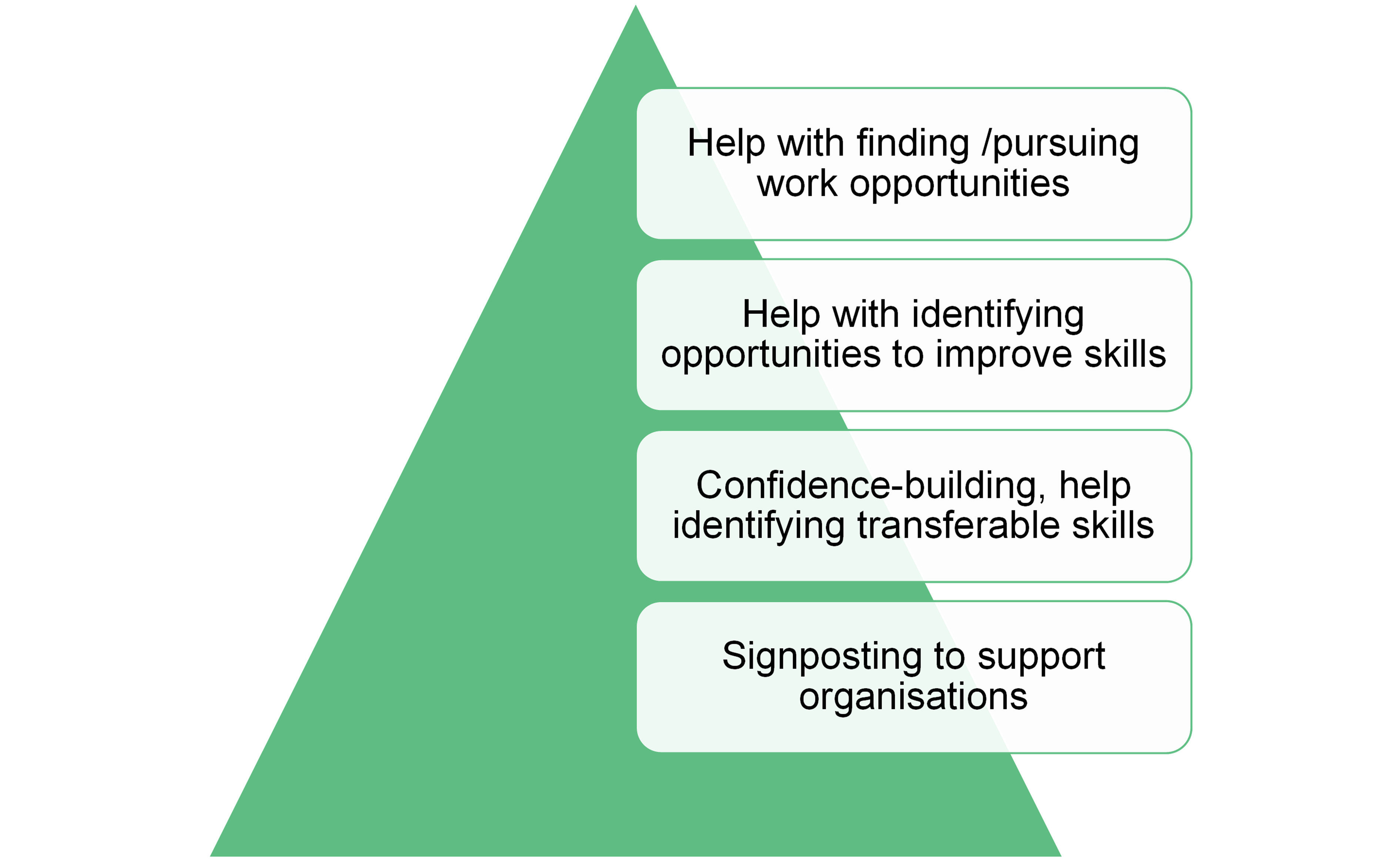
UC claimants’ support needs varied considerably. Where some were coping with major challenges in their current living circumstances or dealing with serious psychological pressures, others had fewer or more specific needs.
Those who were able to benefit most from UC support were those who had been able to access the most appropriate support, and this tended to have come via a Work Coach. Those who felt their Work Coaches were empathetic and understanding and who felt their Work Coach recognised their needs, were more engaged with UC support. Those who did not expect their Work Coach to understand their needs, or who hadn’t been able to access support were less engaged.
Those who did not expect to be claiming for long and therefore didn’t think that they had much to gain from UC beyond financial support, were less engaged with support. This echoes other recent DWP qualitative research on labour market incentives.
Case study: Ross, 18-24
Profile
Ross lives with his grandmother and since leaving school has worked in hospitality and retail. He was made redundant as a result of the pandemic and began claiming in August 2019.
After first being made redundant Ross was affected by depression and anxiety but has since began an online course studying 3D animation and therapy and is now feeling motivated and ready for work.
Motivations
Although initially lacking motivation, Ross was referred to the JETS programme by his UC work coach, is taking online studying and undergoing online cognitive behaviour therapy (that was recommended by his JETS advisor to improve his anxiety). He applies for jobs that are recommended by his work coach and is motivated to get back into work and to have more independency.
Barriers
Lack of confidence and mental health struggles a barrier in the first instance.
Both [my UC work coach and JETS adviser] have been really supportive and helpful. With my work coach, I can talk to them about my problems easily, about how my anxiety and depression means I struggle during interviews. My coach helped with finding vacancies and offered to be a middle person for managing his applications.
Key findings
Positive interactions with work coach and referral to JETS programme resulted in positive outcomes.
Progression outcomes
More former claimants reported in-work progression outcomes than current claimants, particularly those working full-time. Those who have moved off UC were more likely than current claimants to report work progression outcomes, including finding a new job (55% vs. 32%), increasing their hours (33% vs. 22%) and increasing their pay (30% vs. 21%).
Former claimants who had moved into full-time work were more likely to report work related progression, compared to those who were now working part-time. For example, 57% of those working full-time reported they had found a new job, compared with 46% of those working part-time.
Related to this, there was also a different between full-time and part-time workers on reported work progression outcomes among those currently claiming. Over a third (36%) of current claimants in full-time work reported taking on more responsibility, compared to 29% of those in part-time work. Additionally, current claimants working full-time were more likely to report an increase in pay (27% vs. 18% of part-time workers). See Figure 30.
Figure 30: Outcomes from actions taken since started claiming UC
Current UC claimants
| – | In work | Not in work |
|---|---|---|
| Talked with your employer about training, increasing your hours, promotion or pay rise | 38% | 0 (not applicable) |
| Applied for a (new) job | 36% | 56% |
| Attended a job interview | 28% | 37% |
| Attended training to improve your qualifications/ skills | 26% | 25% |
| None of these | 31% | 33% |
| None of these | 31% | 33% |
Former UC claimants
| – | In work | Not in work |
|---|---|---|
| Talked with your employer about training, increasing your hours, promotion or pay rise | 30% | n/a |
| Applied for a (new) job | 41% | 49% |
| Attended a job interview | 37% | 36% |
| Attended training to improve your qualifications/ skills | 23% | 25% |
| None of these | 34% | 37% |
| None of these | 31% | 33% |
Question: And have any of the following happened as a result of the actions you have taken since you started claiming Universal Credit?
Base: All who have taken any action; Claiming UC: Working full time (404), Working part time (714); Not claiming UC: Working full time (470), Working part time (141)
Among current claimants who had seen their pay increase, around half (48%) had noticed an increase in their overall income.
Among current claimants, those in the Working Enough group were most likely to report at least one outcome (62% vs 53% of Light Touch and 46% of Intensive Work Search regime).
Case study: Daiva, 35 - 44
Profile
Daiva is 39 years old and a single parent. She lives in London with her 2 children, ages 11 and 5 years old. She is originally from Lithuania, but has lived in the UK for 16 years.
She initially worked as a cleaner when she came to the UK, then worked in hotels before moving into her current role as a property manager 5 years ago. She works 25 hours a week and uses UC to supplement her income after breaking up with her partner and becoming the sole income earner in her household.
Motivations
Highly motivated – Daiva increased her working hours from 20 to 25 after a recommendation from her work coach. She hopes to start her own business one day.
Barriers
Balancing work and childcare is a struggle for Davia, particularly so during the pandemic while she has been working from home and home schooling.
Money gives you independence. I work for money, I like the stability that money gives you. I came to the UK without speaking any English, now look where I am, worked myself up to property manager.
Key Takeaway
UC has helped provide stability to Daiva and her family. She is motivated and keen to progress in her career and is taking steps to achieve this. She has not used UC childcare support and didn’t know about this.
Summary
- Job preparation skills have improved most among young men, those without a health condition/disability, and those in less skilled jobs
- The majority had taken at least one action to get work or progress in work, with those not yet working doing more.
- Younger, male claimants with higher qualifications, and those without a limiting condition or disability, were more likely to have taken actions to get work or progress in work.
- Work progression outcomes, such as taking on more responsibility and pay increase, were reported more by current claimants in full-time rather than part-time work.
- Among current claimants, those in the Working Enough group were more likely to report at least one positive outcome, compared to those in the Light Touch and Intensive Work Search regime.
Segmentation Analysis
The segmentation analysis identified groups of claimants, each sharing similar attitudes and behaviours with claimants within their segment but being distinctly different to claimants outside their segment.
The segmentation analysis resulted in five in-work segments and five out-of-work segments, which are profiled in this section.
In Work Segments
The segmentation analysis produced five discrete groups of claimants who were in-work, based on their attitudes, behaviours and capabilities (see Figure 31)
Figure 31: The Five In-Work Segments
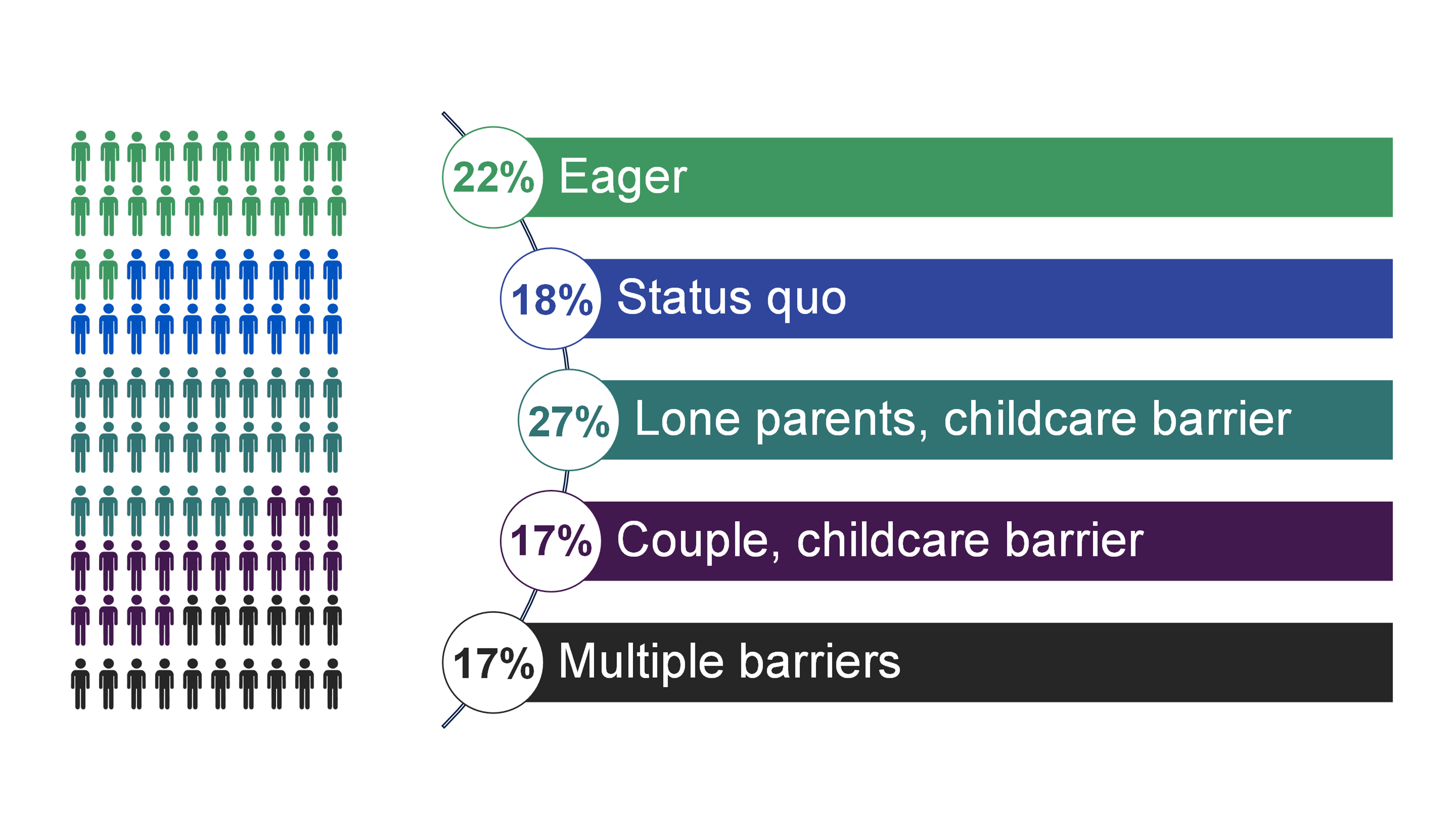
The five in-work segments are: Eager (22%) Status Quo (18%), Lone Parent/Childcare Barrier (27%), Couple/Childcare Barrier (17%), Multiple Barriers (17%)
Base: All in work (2811)
Summary: In-work segments
This section summarises the key differences between the five in-work segments. This is followed by a more in-depth look at each segment, including their demographic characteristics drawing on both the survey and qualitative data.
Universal Credit claim status approximately 18 months after their initial claim for UC
The in-work segments included current UC claimants and those who have moved off UC.
Respondents in the ‘Lone parents, childcare barrier’ segment were most likely to be current UC claimants (87%), while those in the ‘Status quo’ segment were least likely to be claiming UC (36%).
Household composition
One of the main distinguishing features of the segments was their household composition. Two of the segments were defined in terms of whether they were living with a partner and whether they had dependent children:
- within the ‘Lone parents, childcare barrier’ segment, 100% of claimants were lone parents living with children
- within the ‘Couple, childcare barrier’ segment, 94% of claimants were couples living with children
In each of the other segments, around a quarter were living with a partner and less than one in ten lived with dependent children. Around a third of claimants in these three segments lived alone and another third have some other living arrangement (e.g. living with family or friends).
Attitudes to work
The segments varied in their attitudes to work:
- Respondents in the ‘Multiple barriers’ segment were the most likely to agree with several statements, such as “I don’t have the right skills to move to a job with better opportunities or pay” and “I feel under pressure from my family and friends to increase my hours and pay”.
- By contrast, those in the ‘Status quo’ segment were least likely to agree with most statements, such as “There isn’t enough advice and support available to help me increase my hours”, “I don’t have the right skills to move to a job with better opportunities or pay” and “Jobs on offer do not pay enough to make working more hours financially worthwhile”. This indicates individuals in this segment are less likely to see difficulties or challenges in being able to progress in work.
- Respondents with children, specifically those in the ‘Lone parents, childcare barrier’ and ‘Couple, childcare barrier’ segments were most likely to agree that “it would be difficult for me to increase my hours of work now, even if I was offered it”.
Prospects of increasing hours or earnings
There was some variation between the segments in how they perceived their prospects of increasing their hours or earnings.
- Those in the ‘Eager’ segment were most likely to say that ‘even without support, increasing my hours or work or earnings so I don’t need to claim Universal Credit is a realistic goal for me’.
- By contrast, claimants with dependent children, specifically those in the ‘Lone parents, childcare barrier’ and ‘Couple, childcare barrier’ segments, were most likely to say that “even with the right support, increasing my hours or work or earnings is not a realistic goal for me.”
Barriers to work
- By definition, the majority of claimants in the ‘Lone parents, childcare barrier’ and ‘Couple, childcare barrier’ segments said that childcare barriers make it difficult for them to increase their earnings.
- Claimants in the ‘Multiple barriers’ segment were most likely to say that increasing their earnings was difficult because of their physical or mental health or learning difficulty, their age or a lack of relevant skills, qualifications or experience.
- Those in the ‘Eager’ group also cited a lack of relevant skills, qualifications or experience as a barrier, while those in the ‘Status quo’ group were less likely to report many of the barriers and were the most likely to say they don’t want to change and are happy with their current situation.
Support needs
There was some variation between the segments in the unmet support needs that would help them, or would have helped them, to increase their earnings.
- Claimants in the ‘Eager’ segment and in the ‘Multiple barriers’ segment cited numerous support needs, such as support and training to find or get a new job, support to pursue further or higher education, help with financial management and support to manage a physical or mental health condition.
- In the ‘Lone parents, childcare barrier’ and ‘Couple, childcare barrier’ segments, the highest unmet support need was for access to affordable/good quality childcare.
- Those in the ‘Status quo’ group were most likely to say that they did not want any support.
Work-related actions
- All claimants in the ‘Eager’ segment had taken some form of action since they started claiming UC, most commonly applying for a job or attending a job interview.
- By contrast, only around half of those in the ‘Status quo’ and ‘Multiple barriers’ segments had taken any of these actions.
Work-related outcomes
- More than half of those in the ‘Eager’ segment had started a new job since they started claiming UC, and they were also the most likely to have had other positive work outcomes.
- Claimants in the ‘Status quo’ and ‘Multiple barriers’ segments were least likely to have had positive work outcomes.
In-Work Segment Profiles
UC Claimant status
‘Lone parents, childcare barrier’ segment are most likely to be current UC claimants, while those in the ‘Status quo’ segment are least likely to be claiming UC (see Figure 32).
Figure 32: Claimant status of each in-work segment
Eager (45% claiming UC, 55% not currently claiming UC)
| Living alone | 30% |
| Living with partner/spouse and children | 3% |
| Living with partner/spouse, no children | 20% |
| Lone parent with children | 5% |
| Some other living arrangement | 42% |
Status Quo (36% claiming UC, 64% not currently claiming UC)
| Living alone | 33% |
| Living with partner/spouse and children | 4% |
| Living with partner/spouse, no children | 28% |
| Lone parent with children | 4% |
| Some other living arrangement | 31% |
Lone parent (87% claiming UC, 13% not currently claiming UC)
| Living alone | 0% |
| Living with partner/spouse and children | 0% |
| Living with partner/spouse, no children | 0% |
| Lone parent with children | 100% |
| Some other living arrangement | 0% |
Couple (65% claiming UC, 35% not currently claiming UC)
| Living alone | 0% |
| Living with partner/spouse and children | 94% |
| Living with partner/spouse, no children | 5% |
| Lone parent with children | 1% |
| Some other living arrangement | 0% |
Multiple barriers (52% claiming UC, 48% not currently claiming UC)
| Living alone | 38% |
| Living with partner/spouse and children | 0% |
| Living with partner/spouse, no children | 30% |
| Lone parent with children | 6% |
| Some other living arrangement | 27% |
Base: Eager (529); Status quo (508); Lone parents (871); Couple (442); Multiple barriers (461)
Challenges to progressing in work
Those in the ‘Status quo’ segment are less likely to report difficulties or challenges in being able to progress in work, while ‘Multiple barriers’ see the most challenges (Figure 33).
Figure 33: Challenges to progressing in work by segment
| – | Eager | Status quo | Lone parents | Couple | Multiple barriers |
|---|---|---|---|---|---|
| Jobs on offer do not pay enough to make working more hours financially worthwhile | 54% | 28% | 53% | 59% | 75% |
| It would be difficult for me to increase my hours of work now, even if I was offered it | 38% | 36% | 71% | 64% | 55% |
| I don’t have the right skills to move to a job with better opportunities or pay | 36% | 16% | 36% | 38% | 67% |
| There isn’t enough advice and support available to help me increase my hours | 35% | 1% | 24% | 28% | 66% |
Base: Eager (529); Status quo (508); Lone parents (871); Couple (442); Multiple barriers (461)
Those in the ‘Eager’ segment are most likely to feel they can increase hours or earnings without support, while claimants with children feel least able (Figure 34).
Figure 34: Perceived possibility of making progress in work by segment
| – | Eager | Status quo | Lone parents | Couple | Multiple barriers |
|---|---|---|---|---|---|
| Even without support, increasing my hours or work or earnings so I don’t need to claim UC is a realistic goal for me | 33 | 24 | 11 | 15 | 17 |
| With the right support increasing my hours or work or earnings so I don’t need to claim UC might be a realistic goal for me in the next 6 months | 18 | 11 | 13 | 13 | 21 |
| With the right support increasing my hours or work or earnings so I don’t need to claim UC might be a realistic goal for me but not in the next 6 months | 16 | 5 | 25 | 16 | 20 |
| Even with the right support, increasing my hours or work or earnings is not a realistic goal for me | 11 | 25 | 34 | 30 | 19 |
Question: Regardless of whether you want to increase your earnings or hours of work or not, which of the following statements best describes your situation?
Base: Eager (529); Status quo (508); Lone parents (871); Couple (442); Multiple barriers (461)
For those with children, childcare barriers make it difficult for them to increase their earnings, while ‘Multiple barriers’ are most likely to cite numerous challenges (Figure 35).
Figure 35: Barriers to increasing earnings by segment
| – | Eager | Status quo | Lone parents | Couple | Multiple barriers |
|---|---|---|---|---|---|
| Childcare | 1% | 2% | 72% | 67% | 2% |
| My physical or mental health or learning difficulty | 25% | 19% | 18% | 14% | 34% |
| My age | 16% | 13% | 7% | 7% | 23% |
| Lack of relevant skills/ qualifications / experience | 38% | 11% | 23% | 28% | 41 % |
Question: Which, if any, of the following make it more difficult for you increase your earnings?
Base: Eager (529); Status quo (508); Lone parents (871); Couple (442); Multiple barriers (461)
Actions taken since first started claiming UC
All claimants in the ‘Eager’ segment have taken some form of action since they started claiming UC, most commonly applying for a job or attending a job interview (Figure 36).
Figure 36: Actions taken since first started claiming UC by segment
| — | Eager | Status quo | Lone parents | Couple | Multiple barriers |
|---|---|---|---|---|---|
| Talked with your employer about training, increasing your hours, promotion or pay rise | 45 | 25 | 35 | 38 | 26 |
| Applied for a new job | 96 | 7 | 30 | 29 | 14 |
| Attended a job interview | 90 | 5 | 26 | 22 | 3 |
| Attended training to improve your qualifications/ skills | 43 | 9 | 28 | 21 | 16 |
| Eager | Status quo | Lone parents | Couple | Multiple barriers |
|---|---|---|---|---|
| 0% | 53% | 33% | 37% | 45% |
Question: Since you first started claiming Universal Credit, have you done any of the following …?
Base: Eager (529); Status quo (508); Lone parents (871); Couple (442); Multiple barriers (461)
Results achieved since started claiming UC
Claimants in the ‘Eager’ segment are the most likely to have had positive work outcomes, while ‘Status quo’ and ‘Multiple barriers’ are least likely (Figure 37).
Figure 37: Results of actions taken since started claiming by segment
| – | Eager | Status quo | Lone parents | Couple | Multiple barriers |
|---|---|---|---|---|---|
| You have found a (new) job | 63 | 12 | 21 | 18 | 10 |
| You are working more hours | 36 | 10 | 13 | 13 | 10 |
| You have taken on more responsibility at work | 37 | 12 | 21 | 25 | 13 |
| You have gained / will gain a qualification / certificate that will improve your job prospects | 31 | 7 | 20 | 15 | 9 |
| Your pay has increased | 28 | 11 | 14 | 18 | 6 |
| Eager | Status quo | Lone parents | Couple | Multiple barriers |
|---|---|---|---|---|
| 17% | 72% | 53% | 54% | 71% |
Question: And have any of the following happened as a result of the actions you have taken since you started claiming Universal Credit?
Base: Eager (529); Status quo (508); Lone parents (871); Couple (442); Multiple barriers (461)
In-Work Segment 1: Eager (22%)
Claimants in this segment are career minded and seek financial independence. They are proactive in looking for jobs and are motivated by their long-term goals.
Key characteristics
- Young, single adults currently in work who are well-supported by their families.
- Whilst on UC almost all have applied for jobs (96%) and attended interviews (90%).
- About half (43%) have attended training to improve their skills and qualifications.
Key motivations
- Career-oriented: Seeking to develop a long-term career and not just after any job.
- Desire to be financially independent.
- Long-term vision of what they hoped for in their future, including being able to afford a home.
Experience
- UC was a stepping stone in their path towards a career. Found Work Coaches helpful but did not rely on them.
- Minimal support from UC Work Coaches, but experiences were generally positive.
Illustrative quotes
You want to have a sense of purpose. Definitely to try and do something with myself.
Male, 25-34
When things didn’t go well at what I thought was the job of my dreams and I had to move back to live with my parents, my confidence was shot to bits.
Male, 25-34
Barriers faced
The key barriers faced by those in the “Eager” segment are:
- crisis of confidence: lack confidence in their ability to seek and get jobs e.g. CV/interview skills
- low self-esteem can also deter claimants from progressing in work
- claimants have clear ideas of a career and felt help from Work Coaches was not relevant to them
- recent claimants found Covid-19 a barrier as there are fewer roles on offer. One had a job offer rescinded due to the pandemic
Support needs
DWP can support those in this segment better by increasing mental health support and confidence boosting, and offer more tailored support for different career paths claimants might want to seek.
The quantitative survey highlighted the following support needs:
- support and training to find/get a job/new job: 32%
- help with the cost of travel to and from work: 33%
- support to pursue further or higher education: 33%
- help with financial management: 25%
- support to manage a physical or mental health condition: 27%
Case study: Mike, 25 - 34
Profile
Mike previously worked in retail for 10 years since leaving school at 16. He was on UC for about 5 months from August to November 2019 after leaving employment at a music venue.
Whilst unemployed he moved back home to live with his parents, who told him about UC. He suffered from low confidence but had strong family and partner support; which he attributes to his success in finding a new career and job.
Motivations
Mike was very determined to find and develop a new career, and not just a job. He emphasised his need for a sense of purpose. His willingness to try new roles helped him discover his passion for teaching children with special needs.
Barriers
Mike suffered from a lack of confidence when he was first unemployed and on UC. He worried that he did not have the education necessary to be a teacher.
[The work diary] helps you see how hard you have been working. It helps you see you haven’t been sitting [around] doing nothing. You have a list of places you have applied to, where you got to, how it went. I think that was useful but it would really depend on how much time you had with your work coach…The big help I had was I could see how hard I have been working.
Key findings
Claimant found financial support from UC very helpful in getting back on his feet, but was self motivated and did not use work coach very much.
Case study: Anna, 25 - 34
Profile
Anna has been on UC since August 2019. She struggled mentally when her mother passed away. During this time she turned to alcohol and was made homeless.
She applied for UC upon the recommendation of her friends and since then has been able to rent her own place. She has also found herself a job in construction. Anna also helps care for her younger siblings and her father.
Motivations
Anna was motivated as she wanted to afford a roof over her head and reduce her debts. She wanted to save up so she could run a food truck eventually.
Barriers
Anna suffered from mental health issues and alcoholism, which was a barrier to her going back to work. In addition, her debts resulted in her having a poor credit score which prevents her from achieving some of her goals.
UC has helped [me] with the most and did get me back on my feet. It helped with my rent and getting a good night’s sleep, and motivated me to get up in the morning and find a job.
Key takeaway
Claimant had a positive experience with UC and work coach, crediting them with helping her get back on her feet. However she felt there should be more mental health support.
In-Work Segment 2: Status Quo (18%)
For claimants in this segment, UC is fulfilling a short term need/temporary income shortfall for some, but more stagnated/longer term claiming behaviours among others.
Key characteristics
- Older, single adults, mostly no longer on UC.
- Most have not applied for jobs or attended job interviews.
- Almost half (42%) think that there are currently not enough full-time vacancies for everyone. Almost a third (28%) also believe jobs on offer do not pay enough to make working more hours financially worthwhile.
Key motivations
- Generally have lower levels of motivation driven by a preference to maintain current behaviours. Fuelled by either a lack of perceived need or a lack of perceived value in change
- Some evidence of more ‘niche’ industries of which UC/JCP are perceived to possess little knowledge or expertise (e.g. acting)
Illustrative quotes
Most months I’m happy with it…I’m not that worried about money I just want enough to pay my rent, nothing else. Occasionally I’ll get an email from a Work Coach to say, ‘How are you doing?’. I’ve never had any problems.
Male, 55-64
My wife used to be cabin crew so she got made redundant. It’s just been the perfect storm of everything going wrong really…It’s income support rather than jobseekers allowance but I’m seen as a ‘jobseeker’ and I’m not…I’m not against temporary work so long as it’s worth doing…I’ve had virtually zilch [contact with UC/JobCenter Plus]. I’ve basically been left to try and survive…it’s felt very ‘fend for myself’.
Male, 35-44
Barriers faced
Claimants in the ‘Status quo’ segment are less likely to see difficulties or challenges in being able to progress in work:
- claiming UC may have been for an isolated/short term circumstantial need – e.g. as a means of income support in place of furlough or as a stop gap between roles – a temporary short-term fix with little perceived need to engage with Work Coaches or wider UC support offering
- for others, claiming UC is more of a longer term and ingrained behaviour (as a form of wage top-up) – little impetus or motivation for change and/or a lack of value perceived in working additional hours
- often a lack of urgency perceived and either a lack of perceived need or desire for change – ‘If it isn’t broke…’ mentality, or a change of circumstances (i.e. return to full time work) already on the horizon
Support needs
Most commonly, “Status quo” claimants report that they do not need or want any support (43%).
Case study: Mike, 35 - 44
Profile
Mike runs his own company providing audio and video for conferences and events but made a UC claim in March 2020 as result of not qualifying for furlough during the pandemic. His wife had also recently been made redundant and they needed an income in order to keep up with the rental costs for their home.
Mike saw UC as temporary form of income support.
Motivations
Because Mike expected to return to his own company when lockdown restrictions ease, his levels of motivation to seek other employment was low.
Barriers
He perceived working while receiving UC not to be financially worthwhile (few jobs available during the height of the pandemic and typically low income). He had done some Amazon delivery work to top up his income shortfall which he did not declare.
It was more panic because all my work had disappeared, I had no work coming in and this seemed to be the only option I had. I had no support from the Government as such. Furlough money wasn’t going to cover anything so turning to UC was the only option I had. It was survival.
Key takeaway
UC viewed as a ‘means to an end’. Little/no engagement with UC support, does not identify as a ‘jobcentre jobseeker’
Case study: Rob, 45 - 54
Profile
Rob lives on his own in a rented property. He works as an actor, performer and role player for local castle murder mystery tours (since 1991) as well as for a local university.
He uses UC as a means of wage top-up as his acting hours are variable and typically low pay.
Motivations
Rob’s levels of motivation are low – he enjoys what he does and has UC to support his fluctuating income.
Barriers
Rob is committed to continuing his acting/role playing career (despite the low and unpredictable income) – he does not perceive a need for change.
He sometimes felt that work coaches did not understand his situation/preferences.
Work coaches don’t always understand how I work. Years ago someone at the job centre said, ‘Don’t you want a ‘proper’ job?’
Key takeaway
Little engagement with UC support offering. Offers from work coach dismissed as ‘not for me’
In-Work Segment 3: Lone parents, childcare barrier (27%)
The priority of claimants in this segment is to maintain a job that enables them to have the flexibility to fulfil caring responsibilities, lack motivation to look further until children are older and more independent.
Key characteristics
- All single parents, mostly female, with childcare as a barrier for progressing in work or increasing hours/pay.
- Almost a quarter work in caring, leisure and other service occupations.
- Most are currently receiving UC.
Key motivations
- For the majority, the priority at present is keeping their current job, rather than increasing their hours or pay.
- This group feel unable to increase their hours of work or pay, even if it was offered, or the right support was provided.
Illustrative quotes
I have done some extra shifts at work before, and at the end of the day only about £20 better off for a 12 hour day… now is that really worth it for the time away from [my] daughter and the emotional stress of working in a prison?
Female, 25-34
I think I would be better off working/changing my career, but as a mum I have always looked after my kids. I only work for a few hours, I don’t stay the whole day. I cook, clean, do my motherly job. If I’m stuck working and working, I would lose that motherly role, I’m the only parent they’ve got. I’ve got to think about the kids, they need to know their mum is there for them.
Female, 25-34
Barriers faced
The key barriers faced by those in the “Lone parent” segment are:
- work and caring responsibilities have been finely balanced. Lone parents are making the most of flexible work situations to enable them to fulfil caring responsibilities and maintain a routine
- often have other caring responsibilities, and support with childcare from other family members as well as professional childcare
- one or two had very difficult and traumatic experiences in recent years, thus important to have support for mental health impact
- often self-motivated, don’t need support from UC/JCP, or don’t expect JCP to be motivated to help them to find the right sort of work to enable them to work around caring responsibilities
- concerned about potential financial losses of increasing their number of hours of work, especially when sacrificing time with their children
Support needs
This group demonstrate a lack of knowledge and understanding of UC childcare offer. Future support could highlight the available options including childcare support, mental health support and improving skills.
The quantitative survey highlighted the following support needs:
- support to pursue further or higher education: 26%
- access to affordable/good quality childcare: 30%
- none of these/I do not want support: 33%
Case study: Saira, 35 - 44
Profile
Saira has a daughter and was furloughed from her job as retail assistant in a high street store.
She received support from Mind as a result of anxiety about her finances during the pandemic.
She was transferred from Tax Credits to UC but was unaware of the childcare support offer available on UC.
Motivations
Saira is keen to progress to store manager. She’s interested in doing a business degree one day.
Barriers
She finds it hard to imagine stopping claiming, as she is very fearful of losing her UC top-up. She would only work more hours if she progressed to manager.
Everything at the moment is clear, my wages cover the rent then UC covers the bills and anything left over is for living. I’m not sure what would happen (if I took on more hours).
Key takeaway
Claimant would like to re-skill, keen to learn and receive training, but fearful of losing out on benefits by engaging with work coach.
Case study: Sharon, 35 - 44
Profile
Sharon lives with two children in a privately rented flat. She worked as a home care support worker pre-pandemic, topping up with Tax Credits/UC.
The in-home care work she does is well paid, and she knows the agency well so she is waiting for this to re-start.
She is afraid of overpayment as this has happened once before and her benefits were reduced.
Motivations
Sharon is keen to re-start her work providing in-home care whenever possible, she is focused on this as her career.
Barriers
She doesn’t want to increase her working hours as she feels this is too much of a sacrifice in time away from children.
If I’d known I was paying from my own money (whilst working), I would have taken them back to the childminder, I would have used that…I’ve never looked into it, nobody has talked to me about it.
Key takeaway
Claimant had to give up her childminder when her earnings stopped. Was unaware of UC childcare offer.
In-Work Segment 4: Childcare barrier, progression in near future (27%)
Claimants in this segment are motivated to work and develop their career but prefer flexible hours so that they can still take care of their children.
Key characteristics
- mostly females, in-work, in a couple and live with their partner (94%), who also works
- between the ages of 25 and 44
- awareness and understanding of UC offer is low
Key motivations
- biggest priority is having enough to provide for their family
- highly motivated to develop their career and many kept looking for new roles whilst in current positions
- job flexibility, so that they can work hours they want and still take care of their children
Experience
- strong desire to provide for their families drives them to seek new or better work opportunities
- poor understanding of UC offers and how it can benefit them apart from financially.
Illustrative quotes
We need more money in the household.
Female, 25-34
I will progress in the role, but it may take a while. Universal Credit will help me get to that stage in maybe 2 or 3 years, where I am earning enough to come off it.
Female, 21-24
Barriers faced
The key barriers faced by those in the “Couple, Childcare” segment are:
- affordability of childcare is a barrier, but some claimants have help from their partner or families. However, claimants want to be able to spend time with their children
- frustration at poorly paid jobs and mismatched opportunities (over- and under-qualified)
- feel unable to compete in current job market with workers who might be able to work on a lower salary
- some claimants also suffer from mental health barriers after traumatic relationships
Support needs
DWP can support claimants in this segment better by matching them with roles that have flexible working hours and help them to see how this can work for them. DWP can also provide additional mental health resources to help claimants experiencing mental health issues.
The quantitative survey highlighted the following support needs:
- support to pursue further or higher education: 26%
- access to affordable/good quality childcare: 33%
- none of these/I do not want support: 34%
Case study: Angie, 35 - 44
Profile
Angie lives with her husband and 2 young children, aged 5 and 8, at her in-laws’ house. Her children are both in school full time. She was previously a deputy headteacher at a private school in Europe, where they lived in for 10 years.
Angie was on a joint UC claim with her husband till June 2020, when she found a full time role in a different industry.
Motivations
Angie wanted to continue her career or change her career (which she ended up doing). She was motivated as she wanted to be able to move out of their in-laws house and afford their own place.
Barriers
Angie found there was a lack of suitable jobs in schools to match her experience and skillset. She felt overqualified.
I just feel that I have too much experience and was very qualified for the jobs I was applying for in teaching. I remember going for interviews and being surrounded by NQTs (newly qualified teachers) They just want an NQT for that job, not me.. It was a such a waste of time.
Key takeaway
Claimant’s experience were a hurdle in finding a suitable role as they were aimed at less experienced teachers. However, she felt her work coach was brilliant at helping her identify transferrable skills, which helped her secure her current role.
Case study: Margot, 35 - 44
Profile
Margot lives with her husband and 3 children. Her husband works as a builder and his wage only covers their rent. When she was previously working full-time, Margot found balancing work and childcare difficult.
Margot currently works part-time in a housing agency and started UC in March 2020 when her contract ended during the pandemic.
Motivations
Margot is motivated to work as they need to cover their daily necessities and expenses. In the long term she wants to afford a home and to provide for her children’s future.
Barriers
Margot found it difficult to juggle looking after her children and hold a full time job (which she had tried to do before). She also struggled to find the right support to find her a suitable role. Affordability of childcare is also a barrier.
I got one phone call and they looked at my CV and said that it was fine… I didn’t need any help with my CV. This might be useful for someone who was out of work for a long time or struggling or have difficulties keeping a job. Someone on a lower income. It was more aimed at them, and less at a professional (like me).
Key takeaway
Motivated by her long-term financial goals such as house and children, but currently focused on short term needs.
In-Work Segment 5: Multiple barriers (17%)
The priority for claimants in this segment is on maintaining rather than progressing or changing roles. Tend to be more emotionally invested in work and to find a sense of enjoyment and comfort in the social aspect.
Key characteristics
- older adults, predominantly single and live alone. If they do have a partner, their partner tends to not be working
- their priority is focused on keeping their current job rather than increasing hours or pay
- they feel like don’t have the right skills to move into a job with better opportunity or pay and tend to not have qualifications. Also, some have physical/mental barriers
Key motivations
- keeping safe, keeping control, not ‘rocking the boat’
- value the social aspect of work
Illustrative quotes
What motivates me is that I am fortunate enough to have a full time job and that I can survive on it, I can live on it. To me, that is everything. Nothing besides that motivates me. I know that without the job I’m dead. Not literally dead, finished.
Male, 55-64
Money doesn’t really matter to me really, it’s more the job role, making sure I’m satisfied and everybody is happy.
Female, 35-44
Barriers faced
Those in the “Multiple barriers” segment see the most challenges in being able to progress in work:
- many facing wider difficulties/challenging circumstances – financial crisis, dependency on food banks, health/mental health conditions (e.g. multiple breakdowns), domestic abuse, homelessness etc
- physical and mental health unpredictable/fluctuating
- lack of confidence, unwilling to rock the boat, afraid of change, fear of consequences. Experience of living ‘on the edge’ drives a need to maintain control and hold on to what they have
- lack of self-belief, scared of not being able to cope, don’t want to go back to vulnerability
- age perceived to be a barrier for some
Support needs
This group perceive significant challenges in their ability to progress in work, driven by the presence of multiple barriers as well as a general lack of confidence and fear of change. Support with confidence-building and signposting to other resources is highly valued by this group in addition to a range of practical measures.
The quantitative survey highlighted the following support needs:
- support and training to find/get a job/new job: 30%
- help with the cost of travel to and from work: 29%
- support to pursue further or higher education: 27%
- help with financial management: 23%
- support to manage a physical or mental health condition: 24%
Case study: Rebecca, 35 - 44
Profile
Rebecca split up with her partner and started her UC claim as she needed help financially (she was only working part time at nursery so needed UC to top up her wages).
She is affected by both depression and tendonitis.
Rebecca had to quit her nursery role to provide care to her mother after she suffered a stroke but has since begun a new role in August 2020.
Motivations
Rebecca was highly motivated to find work once she no longer needed to provide care for her mother.
Barriers
Rebecca’s personal health barriers and her need to act as a carer for her mother temporarily acted as short term barriers to her return to work.
I couldn’t fault my work coach, he was brilliant. When I told him about the family issues we were having, he spoke to me about it, had a conversation, like he was genuinely interested and cared.
Key takeaway
Good understanding and positive experience of work coach support and the “sympathetic” service received.
Case study: Henry, 55 - 64
Profile
Henry has recently turned 60 and has lived alone for the last 30 years, he works full time for a vehicle rental company just up the road from where he lives, prior to which he mainly worked as a driver.
Henry made his UC claim in August 2019 after being made redundant from his previous job as a truck driver at the end of July, before starting his current job in November.
Motivations
In his period of unemployment Henry was highly self-motivated to change his situation, driven by a need to survive financially and having no one else to depend on.
Barriers
Henry struggled to get acknowledgement from many of the jobs he applied to (despite considering himself easily able to do these) which he attributed to both his age (60) and lack of qualifications.
He has physical health barriers due to a car accident 45 years ago which have resulted in some previous roles proving to be too physically demanding and his options perceived to be limited.
He is also impacted by non-physical heath barriers - Henry is affected by anxiety and has previously experienced a nervous breakdown.
They [work coaches] are there to increase your skills in trying to get a job, whereas my skills of getting a job are perfectly adequate, I just struggle these days with my age and my injuries…they can’t do anything about that.
Key takeaways
Highly driven but self-motivated; perceived UC support offering not to be relevant to his individual needs.
Out Of Work Segments
The segmentation analysis produced five discrete groups of claimants who were out-of-work, based on their attitudes, behaviours and capabilities (see Figure 38).
Figure 38: The Five Out-of-Work Segments
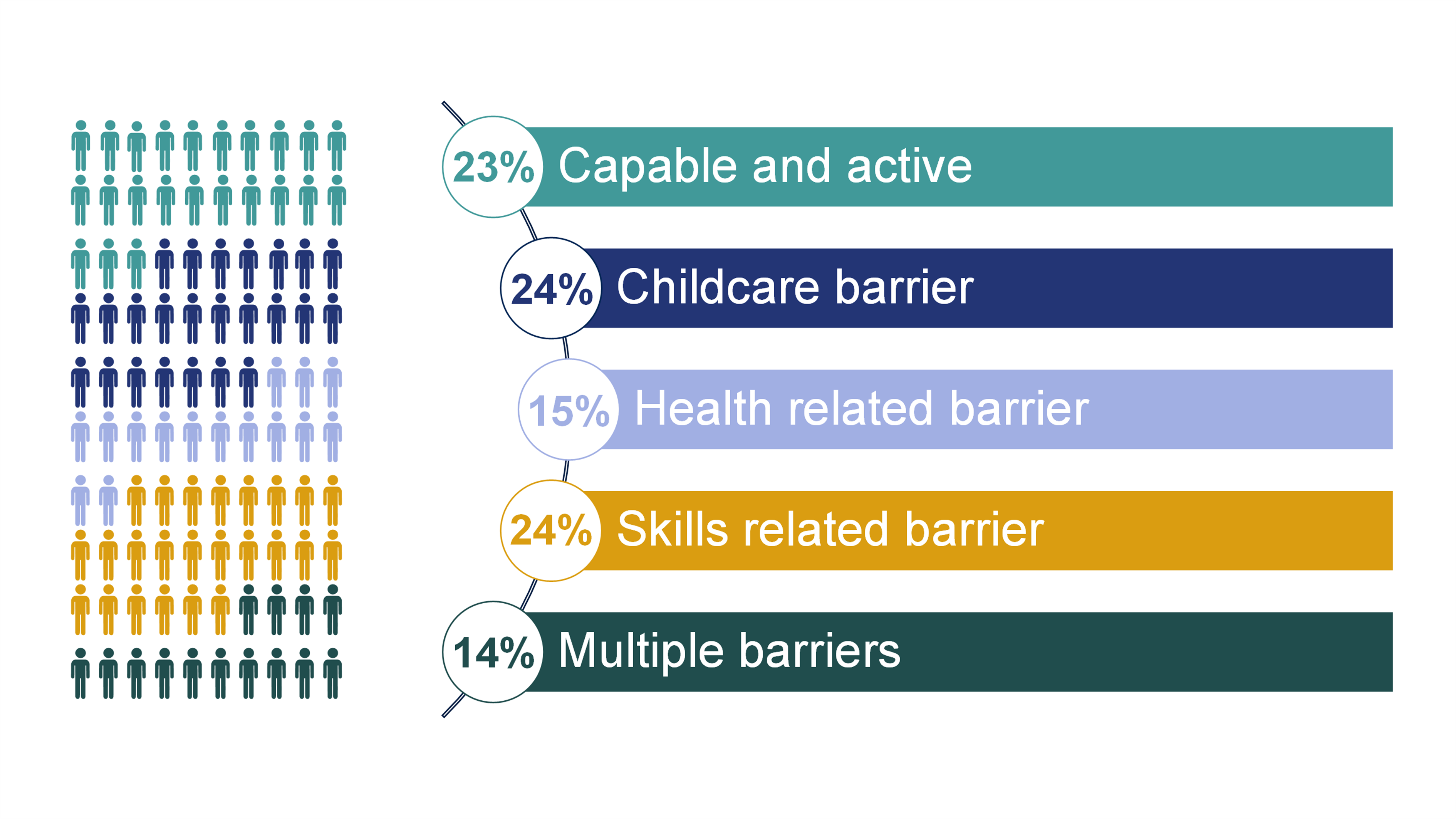
- capable and active: 23%
- childcare barrier: 24%
- health related barrier: 15%
- skills related barrier: 24%
- multiple barriers: 14%
Base: All not in work (2229)
Summary: Out-of-work segments
This section summarises the key differences between the five out-of-work segments. Again, the summary is followed by a more in-depth look at each segment, including their demographic characteristics drawing on both the survey and qualitative data.
Universal Credit claim status approximately 18 months after their initial claim for UC
Most claimants in the out-of-work segments were current UC claimants – between 87% and 94% across the five segments.
Household composition
One of the main distinguishing features of the segments was their household composition.
- Claimants in the ‘Childcare barrier’ segment nearly all lived with dependent children, while a third of those in the ‘Health related barrier’ segment had dependent children. In the other three segments, the proportion with dependent children is no more than one in ten.
- Very few of those in the ‘Skills related barrier’ lived with a partner, while this applied to around three in ten in each of the other segments.
- The majority of those in the ‘Capable and active’ segment’ lived alone, while nearly all of those in the ‘Skills related barrier’ segment had another living arrangement (such as living with family or friends).
Attitudes to work
The segments vary in their attitudes to work.
- Claimants in the ‘Health related barrier’ were least likely to agree with the various statements they were offered, indicating that they were less likely to see specific difficulties or challenges in being able to progress in work. Overall, however, this segment was less engaged with the possibility of moving into work; less than half agreed that they would be happier and more fulfilled if they were working.
- Claimants in the ‘Multiple barriers’ segment were most likely to agree that they don’t have the right skills to get a job and that “there isn’t enough advice and support available to help me get a job”.
- The most striking feature of the ‘Childcare barrier’ segment’ was that most respondents agreed that they would be happier and more fulfilled if they were working, but the majority also agree that “jobs on offer do not pay enough to make working financially worthwhile.”
- Those in the ‘Skills related barrier’ segment were most likely to agree that they feel under pressure from family and friends to get a job.
Prospects of increasing hours or earnings
There was a wide variation between the segments in how close they felt to moving into paid work.
- Those in the ‘Capable and active’ segment were most likely to say that “even without support, paid work is a realistic goal for me”, while those in the ‘Skills related barrier’ segment also felt work was a realistic goal with the right support.
- Claimants in the ‘Health related barrier’ segment’ and those in the ‘Multiple barriers’ segment were least likely to see work as a realistic goal, with the ‘Multiple barriers’ segment also most likely to say that “with the right support paid work might be a realistic goal for me but not in the next 6 months”.
Barriers to work
- By definition, the majority of claimants in the ‘Childcare barrier’ segment said that childcare barriers make it difficult for them to get work.
- As expected, most claimants in the ‘Health related barrier’ segment said that getting a job was difficult because of their physical or mental health or learning difficulty, while this was also a very common barrier among those in the ‘Multiple barriers’ segment.
- Those in the ‘Capable and active’ segment were most likely to say that their age is a barrier to getting work.
- Claimants in the ‘Skills related barrier’ segment were most likely to say that their commute to work is a barrier, as well as citing a lack of relevant skills, qualifications or experience.
Support needs
There was some variation between the segments in their unmet support needs that would help them, or would have helped them, to move into work.
- Support to manage a physical or mental health condition was prevalent across all out-of-work segments and was particularly high for claimants in the ‘Multiple barriers’ segment.
- Both claimants in the ‘Capable and active’ segment and those in the ‘Skills related barrier’ segment wanted support and training to find or get a job.
- As expected, the highest unmet support need of those in the ‘Childcare barrier’ segment was for access to affordable/good quality childcare.
- Those in the ‘Health related barrier’ group were most likely to say that they did not want any support, however, one in five did want support to manage a physical or mental health condition.
Work-related actions
- Most claimants in the ‘Capable and active’ and the ‘Skills related barrier’ segments had taken some form of action since they started claiming UC, most commonly applying for a job.
- By contrast, only a minority of those in the ‘Health related barrier’ and ‘Multiple barriers’ segments had taken any of these actions.
Work-related outcomes
- Claimants in the ‘Capable and active’ and ‘Skills related barrier’ segments were most likely to have had a positive work outcome since they started claiming UC (finding a job or gaining a work-related qualification).
- However, very few claimants in the ‘Health related barrier’ and ‘Multiple barriers’ segments have had positive work outcomes.
Out-of-Work Segment Profiles
UC Claimant status
The majority in the Out-of-Work segments are current UC claimants (see Figure 39).
Figure 39: Claimant status of each out-of-work segment
Capable and active: 87% claiming UC, 13% not claiming UC Childcare barrier: 94% claiming UC, 6% not claiming UC Health related barrier: 88% claiming UC, 12% not claiming UC Skills related barrier: 90% claiming UC, 10% not claiming UC Multiple barriers: 92% claiming UC, 8% not claiming UC
| – | Capable and active | Childcare barrier | Health related barrier | Skills related barrier | Multiple barriers |
|---|---|---|---|---|---|
| Living alone | 70% | 0 | 25% | 0 | 34% |
| Living with partner/spouse and children | 7% | 4% | 16% | 1% | 7% |
| Living with partner/spouse, no children | 22% | 6% | 20% | 2% | 21% |
| Lone parent with children | 0 | 69% | 17% | 0 | 3% |
| Some other living arrangement | 0 | 20% | 97% | 34% | 34% |
Base: Capable and active (553); Childcare barrier (542); Health related barrier (357); Skills related barrier (461); Multiple barriers (316)
Attitudes to working
The majority agree they would be happier and more fulfilled if working, with the exception of the ‘Health related barrier’ segment (Figure 40).
Figure 40: Attitudes to work by segment (% agree)
| – | Capable and active | Childcare barrier | Health related barrier | Skills related barrier | Multiple barriers |
|---|---|---|---|---|---|
| Jobs on offer do not pay enough to make working financially worthwhile | 48% | 60% | 16% | 44% | 63% |
| I would be happier and more fulfilled if I was working | 93% | 87% | 41% | 89% | 63% |
| I don’t have the right skills to get a job | 27% | 29% | 5% | 24% | 57% |
| There isn’t enough advice and support available to help me get a job | 46% | 41% | 3% | 40% | 58% |
Question: And, to what extent do you agree or disagree with these statements?
Base: Capable and active (553); Childcare barrier (542); Health related barrier (357); Skills related barrier (461); Multiple barriers (316)
Claimants in the ‘Capable and active’ segment are most positive about their work prospects, whereas those in the ‘Health related barrier’ and ‘Multiple barriers’ segments are least positive (Figure 41).
Figure 41: Perceived work prospects by segment
| — | Capable and active | Childcare barrier | Health related barrier | Skills related barrier | Multiple barriers |
|---|---|---|---|---|---|
| Even without support, paid work is a realistic goal for me | 47% | 22% | 8% | 35% | 0 |
| With the right support paid work is a realistic goal for me within the next 6 months | 28% | 32% | 11% | 42% | 16% |
| With the right support paid work might be a realistic goal for me but not in the next 6 months | 9% | 24% | 17% | 11% | 35% |
| Even with the right support, paid work is not a realistic goal for me | 7% | 8% | 29% | 5% | 29% |
Question: Regardless of whether you want to work or not, which of the following statements best describes your situation?
Base: Capable and active (553); Childcare barrier (542); Health related barrier (357); Skills related barrier (461); Multiple barriers (316)
Barriers to work
Physical or mental health or learning difficulty is commonly cited as a barriers to work among those in the ‘Health related barrier’ and ‘Multiple barriers’ segments (Figure 42).
Figure 42: Barriers to increasing earnings by segment
| – | Capable and active | Childcare barrier | Health related barrier | Skills related barrier | Multiple barriers |
|---|---|---|---|---|---|
| Childcare | 1% | 72% | 20% | 1% | 2% |
| My physical or mental health or learning difficulty | 42% | 25% | 63% | 42% | 88% |
| My age | 30% | 8% | 11% | 16% | 24% |
| Lack of relevant skills/ qualifications / experience | 32% | 36% | 9% | 47% | 42% |
Question: Which, if any, of the following make it more difficult for you to get work?
Base: Capable and active (553); Childcare barrier (542); Health related barrier (357); Skills related barrier (461); Multiple barriers (316)
Actions taken since first started claiming UC
Most respondents in the ‘Capable and active’ and the ‘Skills related barrier’ segments have taken some form of action since they started claiming UC (Figure 43).
Figure 43: Actions taken since first started claiming UC by segment
| – | Capable and active | Childcare barrier | Health related barrier | Skills related barrier | Multiple barriers |
|---|---|---|---|---|---|
| Applied for a job | 83% | 56% | 8% | 89% | 6% |
| Attended a job interview | 57% | 37% | 1% | 61% | 0 |
| Attended training to improve your qualifications/ skills | 32% | 29% | 7% | 38% | 7% |
| Capable and active | Childcare barrier | Health related barrier | Skills related barrier | Multiple barriers |
|---|---|---|---|---|
| 10% | 28% | 78% | 5% | 82% |
Question: Since you first started claiming Universal Credit, have you done any of the following …?
Base: Capable and active (553); Childcare barrier (542); Health related barrier (357); Skills related barrier (461); Multiple barriers (316)
Results achieved since started claiming UC
Respondents in the ‘Capable and active’ and ‘Skills related barrier’ segments are most likely to have had a positive work outcome since they started claiming UC (Figure 44).
Figure 44: Results of actions taken since started claiming by segment
| – | Capable and active | Childcare barrier | Health related barrier | Skills related barrier | Multiple barriers |
|---|---|---|---|---|---|
| You have found a (new) job | 12% | 10% | 1% | 16% | 0 |
| You have gained / will gain a qualification / certificate that will improve your job prospects | 25% | 23% | 4% | 29% | 5% |
| Capable and active | Childcare barrier | Health related barrier | Skills related barrier | Multiple barriers |
|---|---|---|---|---|
| 66% | 71% | 95% | 62% | 95% |
Question: And have any of the following happened as a result of the actions you have taken since you started claiming Universal Credit?
Base: Capable and active (553); Childcare barrier (542); Health related barrier (357); Skills related barrier (461); Multiple barriers (316)
Out-of-Work Segment 6: Capable and Active (23%)
Claimants in this segment feel they are unable to find suitable roles for their skillset. They possess a strong work ethic and are keen to be employed soon.
Key characteristics
- single adults actively looking for work with 83% applying for jobs
- have not been successful in their job search due to lack of skills or suitable roles for their skillset
- mostly male (70%), above the age of 45
- most live alone but a few live with their partner
Key motivations
- self-motivated and want to be in work. Several claimants are frustrated at their situations and not being able to find work
- desire financial independence in order to pay off debts including rent and bills
Experience
- strong personal work ethic drives them to seek work opportunities
- experience with UC was poor, participants felt unsupported when seeking suitable opportunities for their skillset and circumstances
Illustrative quotes
I want to go back to work as soon as I can, I love working.
Male, 55-64
[Work Coach] has not told me about any schemes, most schemes are for 18–25-year-olds. For people [my] age there needs to be more opportunities, courses and funding. At 38 it’s not too old to start a new career.
Male, 35-44
Barriers faced
The key barriers faced by those in the “Capable and Active” segment are:
- changes in industries claimants have worked in previously resulted in fewer jobs available for them to apply for, and skillset is outdated
- claimants feel their age is against them, and lack suitable skills for available jobs
- frustration at jobs and opportunities put forward to them from Work Coaches that are not within their skillset
- lack of success in job search has resulted some in having a negative mindset. Several claimants also have continued physical and mental health problems
Support needs
DWP can support claimants in this segment better by matching available training with skills needed for available roles. More tailored support to help identify future options whilst taking into account existing skills. DWP can also support claimants with their struggles with mental health.
The quantitative survey highlighted the following support needs:
- support and training to find/get a job/new job: 32%
- help with the cost of travel to and from work: 34%
- support to pursue further or higher education: 29%
- support to manage a physical or mental health condition: 26%
Case study: Jack, 65+
Profile
Jack had been working in the same industry and company for about 30 years. He was made redundant in August 2019 and have been on UC since. Jack has found it hard to find similar positions to the one he was in previously as the specific industry he was working in has changed, with fewer jobs available. He also thinks available positions are in areas too far from where he lives.
Motivations
Jack wants to be able to sustain his daily needs and bills. He also has outstanding debts from divorce and wants to pay them off.
Barriers
Jack believes his age prevents him from finding a job. He also feels there is a lack of suitable jobs to match his skillset due to his niche experience. He also thinks available jobs are not always in a commutable distance from where he lives.
I got one phone call and they looked at my CV and said that I didn’t need any help with my CV. This might be useful for someone who was out of work for a long time or struggling or have difficulties keeping a job. Someone on a lower income. It was more aimed at them, and less at a professional (like me).
Key takeaway
Claimant’s previous career and existing skills are a hurdle in finding a new job as industry is cutting costs
Case study: Thomas, 55 - 64
Profile
Thomas suffers from many health issues including asthma and has been shielding at home due to the pandemic, thus unable to work. He has been on UC since 2019. He has held different jobs in the past, most recently he was a part-time archiver. He loves working and considers himself an important part of any team he is in.
Motivations
Thomas considers himself a people person and is extremely motivated to work. He wants to be able to provide for his children.
Barriers
Thomas has recently suffered from back and knee pain. He thinks there is a lack of suitable jobs that allow him to work comfortably.
I want to go back to work as soon as I can, I love working I want to and need to go back as soon as I can, age is not an issue I like to be active.
Work is paying the bills, trying to bring enough money home to look after the wife and few things for the grandchildren, I love to work.
Key takeaway
Motivated individual who wants to provide for his family but unable to find a suitable role due to his health.
Out-of-Work Segment 7: Lone parents, childcare barriers (24%)
Work options for these claimants must be considered in the context of considerable life challenges including caring responsibilities.
Key characteristics
- lone parents, cite childcare as a barrier
- three quarters of those in this segment are women. A third have attended training to improve their qualifications or skills
- over half have applied for a job but also think that jobs on offer do not pay enough to make working financially worthwhile
Key motivations
- highly motivated to ensure wellbeing of children, especially if they have suffered from parents’ break-up or a bereavement
- maintaining stability is key
Illustrative quotes
I had to give up my job really to look after (my son)… he was so traumatised by everything that had happened… Also the warehouse work is shift work… you have to start at 6am in the morning… Now that’s really hard to do with a 3-year-old.
Male, 35-44
My Work Coach at the moment is one of the nicest people I’ve met. In the past [legacy benefits], I’ve had ones that have been far less than helpful. (She) offers advice, sends me stuff in the journal she thinks will be useful.
Male, 35-44
Barriers faced
The key barriers faced by those in the “Childcare barrier” segment are:
- dealing with a range of difficult circumstances including bereavement, mental health issues
- work must fit around children’s needs, or around access requirements
- restricted in the number of hours that can be worked and how far willing to travel for work
- job needs to be nearby for children, and to enable co-parent support
Support needs
DWP can support claimants with signposting to mental health support, housing and other organisations to support them in facing challenges. Emotional support and confidence-building is highly valued. Support must demonstrate an understanding that work has to fit with caring responsibilities.
The quantitative survey highlighted the following support needs:
- access to affordable/good quality childcare: 40%
- support and training to find/get a job/new job: 34%
- support to pursue further or higher education: 33%
- help with the cost of travel to and from work: 32%
Case study: Ella, 25 - 34
Profile
Ella is a mother to 3 primary school age children.
She has worked for years as a supply teacher for an agency but her income stopped during the pandemic.
During her time away from work she has been able to collect her children from school.
Motivations
Ella is motivated to maintain her ability to care for her children around part time work.
Barriers
She prefers to stay with the job that enables her to have a short commute, work part time, and is suitable to combine with her caring role.
She is concerned about losing UC payments if she were to take on more work.
If I do 3 days a week I’m fine. But if I do more I find that if I do more than that, they start deducting me more.
Key takeaway
Unaware of childcare support, and doesn’t feel this is relevant, prefers to work part-time and be there for children.
Case study: Mark, 35 - 44
Profile
For Mark, the death of his partner meant he now is the sole carer of his young son.
Both he and his child have suffered from the mental health impact of this change, and are seeking support.
He gave up work to focus on looking after his son.
Motivations
Mark is solely focused on supporting his son’s recovery from the loss of his mother.
He is glad not to have been forced back to work.
Barriers
Mark and his son live in a one bedroom flat which is unsuitable for their needs.
His main priority is recovering both his and his son’s mental health before thinking about work.
I had to give up my job to look after him, he was so traumatised by everything that had happened… Also, the warehouse work is shift work, you have to start at 6am in the morning. Now that’s really hard to do with a 3 year old.
Key takeaway
Support and signposting to mental health resources has been valuable, as has emotional support from work coach.
Out-of-Work Segment 8: Health-related barriers (15%)
Claimants in this segment feel they are unable to find suitable roles for their skillset. They possess a strong work ethic and are keen to be employed soon.
Key characteristics
- their health (mental or physical) conditions, many of which are long-term or permanent, limit their ability to carry out normal day-to-day activities
- do not think that having a full-time job is realistic but believe they would be happier and more fulfilled if they were working (41%)
Key motivations
- to pay off debts and have a stable roof over their head
- hope to develop a career and not just a stop-gap job
- several claimants have been in work previously and are self-motivated. They enjoyed it previously and want to be in work, so that they can be social and independent
Experience
- strong desire to be part of society and be financial independent
- claimants feel UC support is basic, does not suit their needs, and has not made much of a difference in their job search
Illustrative quotes
Working gave me freedom, independence and more cash. I could go on holiday and take my son out. I could have adult conversations. It is knowing that you’re getting up and doing something, not just coming home and doing nothing. It also gave me confidence.
Female, 25-34
I’m not sure I can, but I want to try. I want to work – working can help the situation it might help my mental health, it might help. At the same time I need to work. Not working is not helping anything. Financially, mentally, physically. It’s better than claiming benefits.
Male, 35-44
Barriers faced
The key barriers faced by those in the “Health barrier” segment are:
- frustration at physical inability to go for jobs and opportunities. Some claimants have multiple doctor’s appointments that may impede jobs
- finding suitable jobs they can do in their health conditions
- lack of confidence at not being in work, thus have a negative mindset. Several claimants also have continued physical and mental health problems
Support needs
DWP can help claimants in this segment by signposting to appropriate health resources, confidence building, and practical help with job applications. DWP can also match training and job opportunities to claimant’s health condition and their suitability.
The quantitative survey highlighted the following support needs:
- support to manage a physical or mental health condition: 22%
- none of these/I do not want support: 42%
Case study: Theresa, 55 - 64
Profile
Theresa has been diagnosed with fibromyalgia and experiences constant pain all over her body, making it physically difficult for her to work. She was previously a care worker for the disabled but had to give it up when her condition worsened. She has not worked since December 2019. She receives PIP and UC, which is a joint claim with her partner whom she lives with.
Motivations
Theresa wants to be able to sustain her daily needs and bills as she is a single parent. She also wants to be able to find a role she can do from home and be mentally stimulated.
Barriers
Her medical condition means her physical condition and pain day-to-day can vary, making it difficult to manage a full-time role. She also suffers from mental health issues.
I couldn’t travel to and from from a work place as I don’t know what the fibromyalgia will be like on any given day. I can’t plan it. Making plans is really difficult. I just have to play it by ear to see what I’m like on the day. I just want somebody to accept that I’m doing my best, and my best is what I’m doing, I can’t do any more.
Key takeaway
Claimant’s condition varies daily and finding a suitable job that accommodates condition is difficult.
Case study: Derek, 35 - 44
Profile
Derek used to work as a ground digger, has been in work since leaving school at 15 years old. He enjoys working and the sense of purpose it gave him. He has been on UC since 2019, for the last 2 years, when he lost his job and became homeless.
Derek is recovering from alcoholism and mental health conditions and suicidal feelings.
Motivations
Derek wants to be able to live and work for his daughter. He also feels he benefits mentally and financially from having a routine by working.
Barriers
Derek’s mental health has suffered from his addition to alcohol. He now has depression and social anxiety.
The fact that I loved, it. The fact that it keeps me busy. The money side of it. I don’t have to keep going on the phones and all that. The fact that you just go to work and you’re paid each week…my day was always planned and now I’ve got nothing. I’ve got to make my own plans.
Key takeaway
Entrenched mental health issues from his alcoholism are a barrier to claimant working.
Out-of-Work Segment 9: Skills-related barriers (24%)
Claimants in this segment lack skills but are motivated to change and to be positive about Work Coach and engaging with wider UC support offering.
Key characteristics
- single adults who are actively looking for work
- lack of skills is a barrier, with about half citing this to be the case
- mostly male, living with their friends/family, and most likely to face pressure from family and friends to find a job
- most likely to had a positive work outcome since they started claiming UC (in gaining qualifications to aid their search)
Key motivations
- motivated to achieve in order to better self and work search success chances – want to engage in training/certification
- hungry for change and greater independency/sense of personal fulfilment
- tend to be positive about/appreciative of Work Coach support services
Illustrative quotes
I’m hoping to have own business set up next 5/6 years…not having issues with money, not getting into trouble as well.
Male, 25-34
Barriers faced
The key barriers faced by those in the “Skills related barrier” segment are:
- low confidence and anxiety issues are key disabling barriers for some
- lack of relevant qualifications, experience and/or skills perceived to be limiting job search rates of success (and prohibiting applications in some instances)
- lack of employment often part of wider socioeconomic issues (mental health issues, criminal activity, struggling with debt etc.)
- comparatively higher levels of support needed than some other segments (both in terms of practicalities e.g. CV writing, interview techniques, training etc. and emotional support/confidence building)
Support needs
Lack of relevant qualifications, experience and/or skills is driving low confidence and thus higher levels of support needs in this segment. Support should be wide-ranging and include confidence-building, and practical job market skills as well as training.
The quantitative survey highlighted the following support needs:
- support and training to find/get a job/ new job: 32%
- help with the cost of travel to and from work: 33%
- support to pursue further or higher education: 28%
- support to manage a physical or mental health condition: 27%
Case study: Harry, 18 - 25
Profile
Harry lives at home with his mum and younger sister.
He has 2 kids who live elsewhere.
Has been working ‘off and on’ since leaving college in 2018 (manual labouring, site work, warehouse work etc.) and claiming UC since 2019.
Motivations
Key motivations – “money so I can do things with my kids and spend it on myself”
He is proactive in terms of independent job searching (Indeed, job sites, in person etc.)
Barriers
The pandemic has made it hard for Harry to find jobs. Prior to his current job, he had been out of work for 3 months.
He perceived his lack of qualifications to be limiting his applications.
Key takeaway
Positive about experiences of UC and “motivating” work coach support.
Case study: Leon, 21 - 24
Profile
Leon lives between mum’s and partner’s house, he also has an 18 month old son.
He was brought up in the care system, then was set up in a flat and put on UC 2016/2017.
Since leaving education, he has worked in a car shop, and for 2 years as stage crew for events and festivals which ended due to the pandemic.
Motivations
Highly motivated – Leon is very keen to get back into work and to support family.
Barriers
Lack of qualifications – Leon is currently seeking to be accepted to a kick-starter programme.
Childcare is also a barrier (he does not want to work excessively long hours or far from home as needs to be present to support partner and child).
Whenever you need them you can message your work coach and he gets back to me, if I type in my journal he gets back to me within the next couple of days. He’s friendly and understands what you need.
Key takeaway
Highly motivated and expects to stop claiming in next year. Positive experiences of work coach support.
Out-of-Work Segment 10: Multiple barriers (14%)
Claimants in this segment generally lack confidence and perceive (health related) barriers, as well as lack of skills and experience, as limiting their options.
Key characteristics
- limited prior work experience, with almost half spending most of their time not working. The majority are receiving UC at present but see work as a realistic goal in the distant future with the right support
- physical/mental health, or learning difficulties are barriers for the majority, as well as lack of relevant skills for almost half. Almost a third don’t have any qualifications
- for those with a partner, the partner tends to be out of work too
Key motivations
- generally lower levels of motivation driven by a lack of clarity on options and a lack of experience and perceived capability to be limiting choices
- struggle to identify what would be gained or lost financially by working
Illustrative quotes
I felt like I had failed somehow. I felt like all my friends were out getting jobs, and here I was sitting in the job centre, with people in their 50s, people who deserve the money more than me. I felt a bit ashamed of going to the job centre, and ashamed of the position I was in.
Male, 18-20
I want to look at opportunities, as my brain still works, so there is stuff I could still do. But I’ve been in the same industry for nearly my whole adult working life, and I don’t really know how to evaluate what my skillsets are transferable to.
Male, 55-64
Barriers faced
The key barriers faced by those in the “Multiple barriers” segment are:
- most likely to agree that they don’t have the right skills to get a job and that feel there is not enough advice and support available to help them secure a job
- more likely to feel that jobs on offer do not pay enough to make working financially worthwhile (63%)
- physical or mental health or learning difficulties are commonly cited as barriers into work (e.g. Asperger’s, low literacy, Dyslexia, Epilepsy)
- more likely to perceive work as an unrealistic goal
- lack self-belief/lack confidence, pessimistic about job market
- unaware of steps they should be taking in the future, how to go about securing work and lack of faith in DWP ability to help (some negative experiences of Work Coaches; ticking a box, just a number, not personal, perceived lack of understanding of condition)
Support needs
Claimants in this segment tend to be more disengaged from the labour market and struggle to identify the benefits to working, as well as the support available to facilitate this. Tailored support is needed to identify key barriers, and targeted support including signposting, confidence-building and practical skills.
The quantitative survey highlighted the following support needs:
- support to manage a physical or mental health condition: 42%
- support and training to find/get a job/new job: 24%
Case study: Tom, 18 - 24
Profile
Tom is currently living in low income supported housing. He also receives PIP.
Historically, he has been in and out of gig economy work.
He primarily found work using a gig economy app or word of mouth as he finds online applications challenging to complete due to his dyslexia.
Tom also suffers mental health issues, and is currently signed off as sick by DWP (since mid 2020) and not looking for work.
Motivations
Tom’s main current priority is focussing on ‘self’, not searching for work.
Barriers
In addition to his mental health issues, Tom considers his dyslexia a barrier in applying for jobs as he struggles with written applications and writing a CV. He also lacks confidence in his ability to get a job. Furthermore, Tom has previously been on bail and feels this has made it difficult to find employment. In general, Tom is disengaged with searching for work.
I find them (applying for jobs) very tedious. I’m dyslexic as well, so that doesn’t help. And so far in my life I’ve never got a job through applying for one online.
Key takeaway
Disengaged with work search and UC support (work coach, wider support services) driven by dyslexia and mental health issues; struggles to ‘see the point’.
Case study: Adam, 25 - 34
Profile
Lives with his partner and is currently on sick leave from his job as a support worker. As he was new to his job he didn’t qualify for sick leave, and started claiming UC.
Feels that his new job was unsuited to him as it involved a lot of interaction with new people. As he has Asperger’s, he found this stressful and experienced anxiety and depression as a result.
Claims jointly with his partner who is working and studying. They have a four year-old child.
Motivations
Adam is motivated to provide financially for his family and to give him structure and stability in his life.
Barriers
He doesn’t drive and travelling via public transport to work across different locations was time-consuming and draining. He has A levels, and has found most jobs are suited to school leavers or those with a degree. He lacks confidence, and is still coming to terms with his Asperger’s which was diagnosed in adulthood, and is uncertain of the type of work that would be suitable for him. He also needs flexibility for childcare.
When I first started claiming I was trying to get back on top of my mental health. I knew that in the long term I wanted to return to some kind of work. I wanted to become well again.
Key takeaway
He has found sessions with a Workability Coach (via Disability Action) helpful, as they took into account his Asperger’s when considering his work options for the future.
Conclusions
-
The pandemic has given rise to an array of support needs. Work Coaches need to be well equipped to deal with these diverse demands.
-
Work Coaches are key to getting claimants into work but those that rely on telephone and face-to-face interactions have found it difficult to get consistent and responsive support during the pandemic.
-
There needs to be greater understanding of UC work incentives and how they relate to individual circumstances, particularly among claimants that are not in-work.
-
In-work progression will require giving more parents meaningful information about the childcare offer and how it can aid their particular circumstance.
-
Older claimants and those with a long-term disability/health condition require special attention, being furthest from the labour market and least likely to find JCP support helpful.
Recommended support to aid progression among each segment of claimants is made as follows:
In-Work Segments:
- Eager (22%) - Increase mental health support and confidence boosting, and offer more tailored support for different career paths
- Status quo (18%) - Convey the benefits of engaging with support, and highlight choice and options for training/re-skilling to increase income and enhance prospects
- Lone parents, childcare barrier (27%) - Future support could highlight the support that could be available including childcare support, mental health support and improving skills
- Couple, childcare barrier (17%) - Match to job roles that have flexible working hours, and help them to see how this can work for them. Provide additional mental health resources to help those experiencing mental health issues
- Multiple barriers (17%) - Support with confidence-building and signposting to other resources is highly valued by this group in addition to a range of practical measures including training/education, support with finances and physical/mental health
Out-of-Work Segments
- Capable and Active (23%) - More tailored support to help identify future options whilst taking into account existing skills. DWP can also support claimants with their struggles with mental health
- Lone parents, childcare barriers (24%) - Emotional support and confidence-building is highly valued. Support must demonstrate an understanding that work has to fit with caring responsibilities
- Health-related barriers (15%) - Signposting to appropriate health resources, confidence building, and practical help with job applications. Match training and job opportunities to claimant’s health condition and their suitability
- Skills-related barriers (24%) - Support should be wide-ranging and include confidence-building, and practical job market skills as well as training
- Multiple barriers (14%) - Tailored support needed to identify key barriers, and targeted support including signposting, confidence-building and practical skills.
Appendix A: Glossary of Terms
| Term | Definition |
|---|---|
| Claimant Commitment | To claim Universal Credit claimants must agree to conditions set out in their Claimant Commitment. These conditions are based on the conditionality group the claimant falls under and determine their responsibilities to look for work. Failure to comply with the conditions agreed in the Claimant Commitment can lead to sanctions. |
| Current UC Claimants | Everyone who was receiving Universal Credit at the time of the survey, who first made a claim in August/September 2019. To note, there is a possibility that some of these individuals may not have continually claimed UC for the entire period of the research. |
| Former UC Claimants | Everyone who was no longer receiving Universal Credit at the time of the survey, who made a first claim in August/September 2019. To note, there may have been fluctuations in claiming UC over the research period. |
| Conditionality group | Everyone who receives Universal Credit is placed in a conditionality group based on their circumstances and work capability. The group that a claimant is placed in determines what is expected of them during their claim. |
| Intensive work search regime | Claimants in this group are either out-of-work or earning below the Administrative Earnings Threshold (£338 a month or £541 for couples). They are expected to take intensive action to find work and must attend regular Work-focused-Interviews with their Work Coach. |
| Light touch conditionality | Claimants in this group earn above the Administrative Earnings Threshold but less than the conditionality earnings threshold. They are expected to take actions to find more or better paying work and have less frequent contact with their Work Coach. |
| Working enough | Individual or household earnings over the level at which conditionality applies. Required to inform DWP of changes or circumstances, particularly at risk of earnings decreasing or job loss. |
| Universal Credit and Full Service | A means-tested benefit for people of working-age who are on a low income. It replaces six existing means-tested benefits: Income Support; Income-based Jobseeker’s Allowance; Income-related Employment and Support Allowance; Housing Benefit; Child Tax Credit; and Working Tax Credit. Not all Universal Credit claims are on full service. Currently it is only available in certain areas. The full service requires claimant to have an online account where they can manage their claim. Eventually all UC claims will be on full service. |
| Work Coaches | Front line Department for Work and Pensions staff based in Jobcentres. Their main role is to support benefit participants into work by challenging, motivating, providing personalised advice and using knowledge of local labour markets. |
Appendix B: Sample details
Qualitative sample: in work
30 x 60 minutes interviews took place between 2 March and 1 April 2021
| Segment | UC status | Age | Household composition | Type of barriers |
|---|---|---|---|---|
| 1 - Eager | 3 Currently claiming 3 Former claimants |
3 18-24 3 25-34 |
4 Single (no children) 2 Couple (no children) |
2 Physical or mental health or learning disability 4 Lack of relevant skills |
| 2 – Status quo | 3 Currently claiming 3 Former claimants |
6 45+ | 4 Single (no children) 2 Couple (no children) |
Other/None |
| 3 – Single parents, childcare barrier | 4 Currently claiming 2 Former claimants |
3 25-34 3- 34-44 |
6 Single parents | 6 Childcare |
| 4 – Couple, childcare barrier | 3 Currently claiming 3 Former claimants |
3 25-34 3- 34-44 |
6 Couples with children | 6 Childcare |
| 5 – Multiple barriers | 3 Currently claiming 3 Former claimants |
2 25-34 2- 34-44 2 45+ |
4 Single (no children) 2 Couple (no children) |
3 Physical or mental health or learning disability 3 Lack of relevant skills |
The above segments were derived from the quantitative data analysis based on claimants attitudes and behaviours. For further exploration of the segments, please see the UCFS 12 months plus Segmentation report.
Qualitative sample: out of work
30 x 60 minutes interviews took place between 2 March and 1 April 2021
| Segment | UC status | Age | Household composition | Type of barriers |
|---|---|---|---|---|
| 6 – Capable and active | 4 Currently claiming | |||
| 2 Former claimants | 2 25-34 4- 34-44 |
6 Single (no children) | 3 Lack of relevant skills 3 Age |
|
| 7 – Childcare barriers | 6 Currently claiming | 3 25-34 3- 34-44 |
6 Single parents | 6 Childcare |
| 8 – Health-related barrier | 5 Currently claiming 1 Former claimants |
2 25-34 2- 34-44 2 45+ |
6 Other | 4 Physical or mental health or learning disability 2 Lack of relevant skills |
| 9 – Skills related barrier | 6 Currently claiming | 4 18-24 2 25-34 |
6 Couples with children | 2 Physical or mental health or learning disability 4 Lack of relevant skills |
| 10 – Multiple barriers | 6 Currently claiming | 2 18-24 2 25-34 2 45+ |
4 Single (no children) 2 Couple (no children) |
3 Physical or mental health or learning disability 3 Lack of relevant skills |
The above segments were derived from the quantitative data analysis based on claimants attitudes and behaviours. For further exploration of the segments, please see the UCFS 12 months plus Segmentation report.
-
Statements included “On Universal Credit you are better off for each extra hour you work” and “You can work more than 16-hours and still claim Universal Credit”; the full list is in the main body of this report. ↩