
Methodology: understanding children’s social care sufficiency in England
Published 2 July 2026
Applies to England

© Crown copyright 2026
This publication is licensed under the terms of the Open Government Licence v3.0 except where otherwise stated. To view this licence, visit nationalarchives.gov.uk/doc/open-government-licence/version/3 or write to the Information Policy Team, The National Archives, Kew, London TW9 4DU, or email: psi@nationalarchives.gov.uk.
Where we have identified any third party copyright information you will need to obtain permission from the copyright holders concerned.
This publication is available at https://www.gov.uk/government/publications/understanding-childrens-social-care-sufficiency-in-england/methodology-understanding-childrens-social-care-sufficiency-in-england
This document describes the methods we used in both the quantitative and qualitative strands of our Understanding children’s social care sufficiency in England project.[footnote 1]
The quantitative strand focused on developing an index that combines data across several key domains to provide an overall indication of children’s social care sufficiency (the amount of suitable accommodation available for children in care and care leavers) across the country. The index brings together multiple administrative datasets to produce a system-level view of sufficiency across the country. It is designed to support an understanding of the local and national context in which children are placed, rather than to assess the performance of local authorities.
Alongside this, we carried out qualitative work to explore the experiences, perspectives and decision-making of local authority staff in relation to placement sufficiency. The qualitative work was designed to complement the quantitative analysis by providing contextual insight into the factors that shape local placement practice.
The 2 strands were developed in parallel. We considered the findings together to support a fuller understanding of placement sufficiency in England.
Code of Practice
Although these statistics are not official statistics, the work has been developed in line with the Code of Practice for Statistics, considering:
Trustworthiness
- Engagement with a wide range of stakeholders throughout development.
- Transparent publication of indicator‑level data.
- Clear communication that rankings should be interpreted with caution.
Quality:
- Use of high-quality administrative sources.
- Recognition that administrative data may be used for purposes beyond the original intent.
Value:
- Provides the first standardised national measure of sufficiency.
- Supports discussion, planning and understanding across the sector.
Contact details
We are keen to receive feedback on this index for future updates. If you have any comments on how we can improve the index, please contact us at socialcaredata@ofsted.gov.uk.
Purpose of the composite index
We have used a composite index because no single dataset provides a complete view of sufficiency. Ideally, sufficiency analysis would consider whether each individual child’s needs are well matched to local provision. However, detailed information about individual needs and provider-level care capacity sits within local authority care plans and is not held in national datasets. As a result, the index uses proxy measures to assess the wider system conditions that influence sufficiency.
Children’s social care operates within a complex landscape shaped by local need, provider availability, workforce capacity and geographical factors. The index brings these elements together in a structured way, enabling comparisons across areas and supporting analysis of how patterns change over time. While composite indicators are a useful summary tool, they do have limitations and should not be used in isolation. All underlying indicator-level data is published alongside this report to allow local authorities to explore their own results in more detail.
Development approach
The index was developed through an iterative process that drew on administrative data, statistical testing and extensive engagement with experts. We consulted with Ofsted policy teams, the Department for Education (DfE), local authorities and academics. Feedback from these groups helped refine the domains, identify gaps and strengthen the indicators.
The structure of the index is based on 5 domains, 4 of which contribute to index scores and ranking:
- Availability
- Carers and practitioners
- Compatibility and accessibility
- Safety and wellbeing
- Context
Within each domain, indicators are grouped into subdomains where this provides clearer structure or enables comparison across placement types. All decisions on inclusion were informed by data quality considerations and the need for fair national comparisons.
The index uses snapshot data as at 31 March, alongside in-year data for a small number of indicators (such as missing incidents). We included data supplied by providers ahead of children’s home inspections under the social care common inspection framework (SCCIF), known as ‘Annex A data’, from the most recent inspection available for homes that were active on 31 March.
Constructing the index
The composite index aggregates information in a stepwise structure:
- shrinkage is applied to indicators
- subdomain scores are calculated using a weighted sum of normalised indicators
- domain scores are calculated using a weighted sum of subdomain scores
- index score is calculated using a weighted sum of domain scores
- scores are ranked to create national deciles
This structure enables users to access data that is the right level of granularity to meet their needs.
Figure 1: Schematic view of the composite index
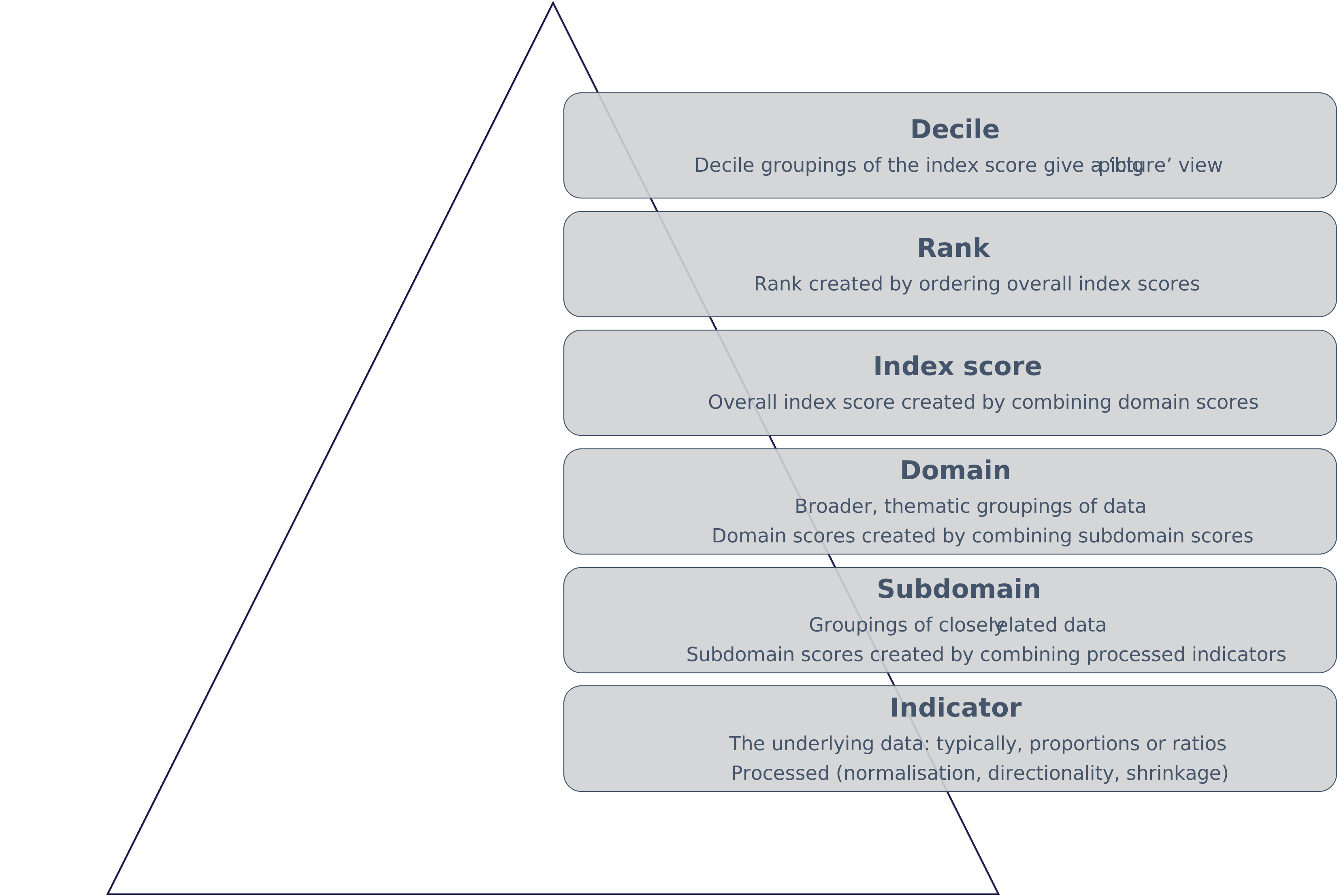
Figure 1 represents the hierarchy of the composite index as a pyramid, with the most granular element at the bottom and the most general output at the top. At the bottom are the indicators, described as ‘The underlying data: typically, proportions or ratios. Processed (normalisation, directionality, shrinkage).’ Next up are the subdomains, which are described as ‘Groupings of closely related data. Subdomain scores created by combining processed indicators.’ Next are the domains: ‘Broader, thematic groupings of data. Domain scores created by combining subdomain scores.’ On top of this is the index score, described as ‘Overall index score created by combining domains scores.’ Next is rank: ‘Rank created by ordering overall index scores.’ Finally, at the top of the pyramid is decile: ‘Decile groupings of the index score give a “big-picture” view’.
Interpreting results
The index can highlight where a local authority appears relatively strong in one dimension but weaker in another, helping to identify areas for deeper investigation. However:
- ranks should not be interpreted on their own
- changes in rank may reflect shifts nationally as well as locally
- the index provides a high‑level picture, not a direct assessment of practice
- contextual factors outside the control of a local authority (such as local provider markets or building availability) also affect provision
The index should be used as a starting point for discussion, not as a performance judgement. Local authorities operate in diverse environments, and further analysis will always be required to understand the causes behind any pattern.
Relationship to inspecting local authority children’s services
Although results are presented at local authority level, the index does not assess how well an authority meets the needs of its children. Local authority boundaries are used only as a geographical unit of analysis to explore national patterns of sufficiency. Factors such as the local presence of private providers or local property markets influence provision but lie outside local authority control. For this reason, the index is not expected to correlate with inspecting local authority children’s services (ILACS) outcomes and is not a proxy for inspection ratings.
Data sources
The index uses:
- Ofsted’s administrative system (Cygnum)
- Ofsted’s Annex A data from children’s homes inspections[footnote 2]
- Ofsted’s annual fostering data collection[footnote 3]
- Ofsted’s annual children’s social care survey (also known as the ‘Point in time survey’)[footnote 4]
- DfE’s annual children looked after data return (also known as SSDA903)[footnote 5]
All data refers to 31 March for the relevant year of the snapshot, except for incidents of children going missing and Annex A data. Annex A data is included for children’s homes that were active as at 31 March. For each home, we have used the most recent Annex A return available at or before the snapshot date. This may relate to an inspection carried out some time before the snapshot and reflects the most up-to-date information held for each home at that point in time.
These sources reflect the best available national administrative data, though they were not originally designed for sufficiency analysis and therefore have inherent limitations. These include gaps in coverage, differences in local recording practices, and limited information on context and need, which should be considered when interpreting the findings.
Geographical coverage
Due to very small numbers of providers and children in care, estimates are not produced for the City of London or the Isles of Scilly.
Some local authorities did not have any children’s homes as at the snapshot date. Their overall scores are included in the index, but the lack of data for children’s homes means that the following areas were not assessed on metrics calculated based on children’s homes located within the area:
- Rutland
- Kensington and Chelsea
- Lambeth
- Southwark
- Westminster
These local authorities may include indicators for children placed externally in children’s homes outside of these local authorities.
There were no registered supported accommodation premises located in Rutland as at 31 March 2025, so indicators calculated based on the location of supported accommodation premises are not included for this local authority. We have included other supported accommodation measures for Rutland. These were calculated based on the headquarters of the supported accommodation providers or for children placed externally in supported accommodation outside the local authority (supported accommodation (SA) endings not in care plan, SA travel time, SA children in care in LA, SA children in care going missing, SA health assessments).
Missing data
For some indicators, such as survey data on whether children feel safe where they live, there is missing data for some local authorities because it is not compulsory to provide this data. In other cases, data is missing for some local authorities because it has been excluded due to removal of outliers. For measures that involve estimating yearly turnover, we have excluded some data because the period covered by the existing data is too short to reliably extrapolate from.
Rounding and suppression
In the accompanying dataset, index scores are rounded to 2 decimal places. Indicator figures are rounded to 4 decimal places to allow distinction between them. Larger indicators (travel time in minutes, local authority expenditure) are rounded to the nearest whole number. In the domains that feed into the model, data is presented in the dataset after shrinkage has been applied, but it has not been normalised. Measures in the ‘context’ domain have not had shrinkage applied or been normalised.
Some measures in the ‘context’ domain are from data published elsewhere. These retain the same rounding rules as the source publications, which are cited and linked to in the methodology document.
The following symbols have been used in the release:
- ‘z’ for not applicable
- ‘x’ for not available
- ‘k’ for a value that would round to zero but is not zero, for example where a percentage is <0.5%
For percentages and proportions, where the numerator or denominator is small then the figure is replaced by ‘c’.
For averages, where the count of values making up the average is small then the figure is replaced by ‘c’.
Model construction and testing
1. Data selection
The first stage involved deciding the domains that should form the index. We proposed ideas and refined their scope after consulting with policy colleagues and academics. We then identified indicators that could reliably represent the themes within each domain. We reviewed the data available across Ofsted systems and DfE collections, assessing each potential indicator against 4 criteria:
- statistical properties: indicators needed to have an adequate spread of data and sufficient unique values to enable ranking
- data quality and completeness: indicators had to be measurable in a consistent way and with sufficient coverage across local authorities
- conceptual fit: indicators needed to clearly support the purpose of the domain they sat within
- comparability: indicators had to support fair comparison across local authorities
Ethics and accountability
Development was supported by Ofsted’s internal governance structures, including the Committee for Research and Analysis, to ensure ethical use of administrative data and transparent decision‑making throughout.
2. Structuring the model
We took an iterative, consultative approach to designing the index. Early drafts of domains and indicators were tested and refined through:
-
feedback from Ofsted and DfE policy teams
-
engagement with academics through methodology steering groups
-
engagement with sector representatives
-
repeated analytical testing using live data
This iterative process helped ensure the structure was conceptually coherent, statistically sound, and meaningful to users.
Assigning directionality
For each indicator we determined which direction represented a ‘higher’ or ‘lower’ result for the purpose of the index. This standardisation was necessary to ensure consistent interpretation during later aggregation.
Home or host attribution
For most indicators derived from DfE’s children looked after data return, data was attributed to the home local authority, as this is the authority responsible for the child and for making placement decisions. An exception was the ‘Point in time survey’, where responses relate to the child’s host authority because the measure reflects the child’s experience of where they live.
3. Statistical processing
Shrinkage
Low numbers in some local authorities mean that indicators can fluctuate substantially as a result of small real-world changes. For example, if an area has 2 children’s homes and the registered manager leaves in one of them, the registered managed vacancy rate will change by 50%. In the context of the index, shifts of this magnitude would have a substantial effect. To improve the stability of data relating to small areas, we applied a shrinkage technique (empirical Bayesian shrinkage estimation), using the same approach as the Index of Multiple Deprivation.[footnote 6] This involves combining local authority level data with regional data in a weighted average, allowing the local value to ‘borrow strength’ from a larger group. Shrinkage pulls extreme local values toward a regional average, improving stability without overriding genuine variation.[footnote 7] Shrinkage was not applied to the availability indicators or to the travel time indicators. This is because the underlying data for availability are generally robust, drawing on relatively large counts of places and children in care. For the travel time indicators, some inputs are modelled estimates, so applying shrinkage on top would not meaningfully improve reliability.
Figure 2: Example of shrinkage estimation applied to an indicator
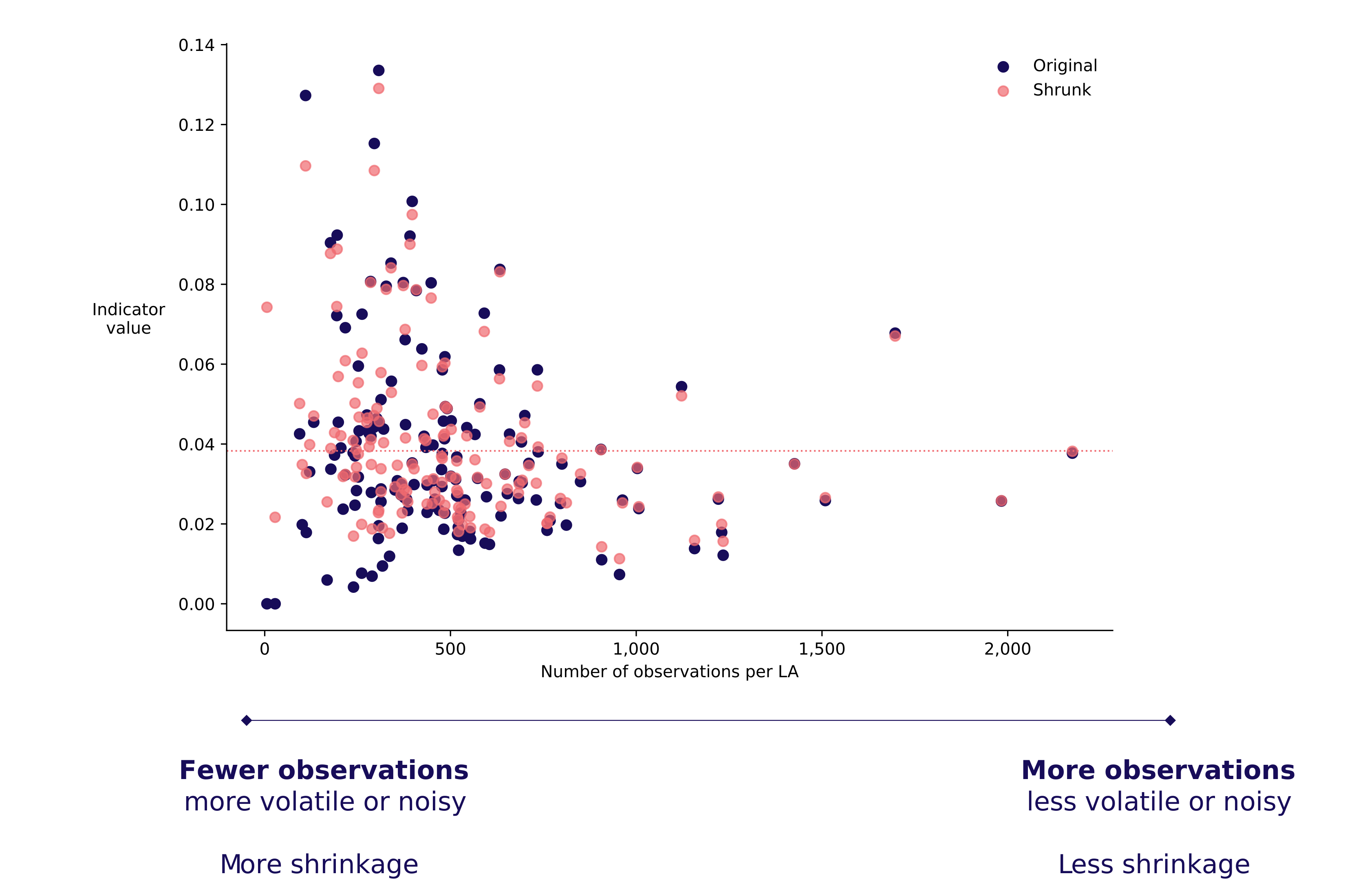
Description for Figure 2: this scatter plot has the number of observations per local authority on the x-axis and the indicator value on the y-axis. The original indicator values are plotted in one colour and the shrunk values are plotted in another colour. A horizontal line shows the mean indicator value. Annotations on the bottom indicate that at the left side of the chart there are fewer observations so more shrinkage is applied, and at the right side there are more observations so less shrinkage is applied. The data points on the left side of the chart are more spread out on the y-axis and they tend towards the horizontal mean line towards the right of the chart. In the shrunk data, extreme values for small local authorities are pulled in towards the mean more than less extreme values and/or larger local authorities.
Normalisation
Normalisation is applied after shrinkage. Indicators use different measurement scales. To ensure they could be combined fairly, we applied percentile ranking standardisation, rescaling each indicator to a [0,1] range. This prevents indicators with naturally larger numeric ranges from dominating the index.
4. Index construction
We used the COINr package to build and test the index.[footnote 8]
Weighting
Weights determine the relative influence of each indicator and domain. We applied equal weighting at the domain level, because:
- there is no strong theoretical justification for weighting domains differently
- subjective weighting produced distortions, favouring local authorities with large amounts of provision
- factor analysis based weightings also skewed results towards areas with more provision, potentially penalising smaller authorities
At the indicator level, equal weights were applied, except for the supported accommodation indicators, which were weighted at half the value of the other indicators within their subdomain. Supported accommodation is only an appropriate provision type for a subset of young people aged 16 to 17. It is also a relatively new sector, and the available data has limitations, because baseline rates (such as manager vacancies) are not yet well established; capacity can be invisible because providers are not required to notify Ofsted about premises until a child is placed; and we cannot reliably determine how many places are occupied by over‑18s or care leavers. We do not want a local authority’s score to be heavily influenced by supported accommodation data due to its current limitations, so these indicators were down‑weighted accordingly.
Because indicators are grouped into subdomains, indicators in domains with more items have lower effective weight; these effective weights are published in the accompanying data. To avoid implicit double counting, we excluded indicators with strong correlations, retaining only those providing distinct information.
Figure 3: Domain, subdomain and indicator weights in the overall model
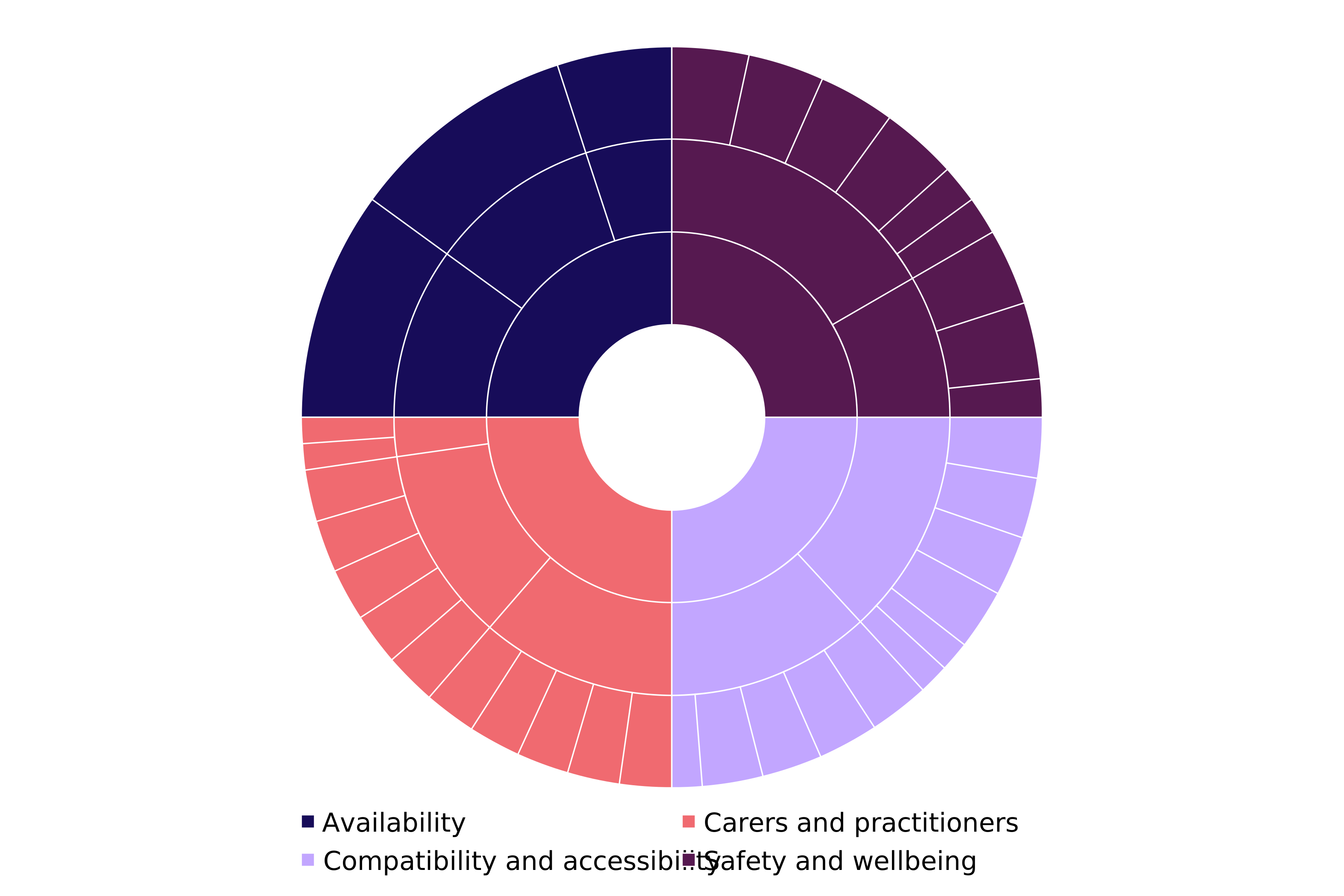
View the data for Figure 3 in an accessible table format.
Aggregation
Subdomains, domains and the overall index were created using a weighted arithmetic mean. Local authorities are allocated to deciles rather than given a single national rank, to avoid over‑interpretation of small differences.
5. Sensitivity testing
Our analysis used equal weighting (25%) for the 4 domains in the model as we do not want to promote any one domain over another. To test the impact of using different domain weighting on the overall index score we increased the weight of one domain, keeping the others equal. The 4 test cases are listed below:
- Availability 40% – Carers 20% – Compatibility 20% – Safety 20%
- Availability 20% – Carers 40% – Compatibility 20% – Safety 20%
- Availability 20% – Carers 20% – Compatibility 40% – Safety 20%
- Availability 20% – Carers 20% – Compatibility 20% – Safety 40%
This test allows us to see the sensitivity of the index scores to the changing domain weights and to look for evidence that the index is not overly dependent on one domain. The table below shows the proportion of LAs that remain in the same decile after each test, as well as the absolute mean, mean and median decile difference and standard deviation for those LAs whose decile changes.
We can see the proportion of LAs that remain in the same decile ranges from 0.48 to 0.53, indicating that approximately half of LAs do not change decile due to the weighting changes. Of the LAs that do change decile, the mean absolute decile difference is consistently less than 1, indicating that most changes are small. The mean decile difference is 0 in all tests, showing that no systematic directional bias has been introduced by reweighting any single domain. The index structure appears balanced, and no single domain dominates the overall index score, justifying our equal weighting structure.
Table 1: Sensitivity testing overview
| Test number | Proportion of local authorities that remained in the same decile | Mean absolute decile difference | Mean decile difference | Median decile difference | Standard deviation |
|---|---|---|---|---|---|
| 1 | 0.477 | 0.689 | 0 | 0 | 0.774 |
| 2 | 0.523 | 0.503 | 0 | 0 | 0.755 |
| 3 | 0.530 | 0.530 | 0 | 0 | 0.817 |
| 4 | 0.523 | 0.530 | 0 | 0 | 0.797 |
In addition, a test was carried out involving perturbations of the weights to explore the overall robustness of the model. We varied weights at the indicator, subdomain and domain levels and recalculated the index 1,000 times. For each local authority, we then calculated the 5th and 95th percentile rank for each local authority shown in the graph below.
Figure 4: Median rank and 5th–95th percentile range from perturbation tests, by overall index ranking and decile
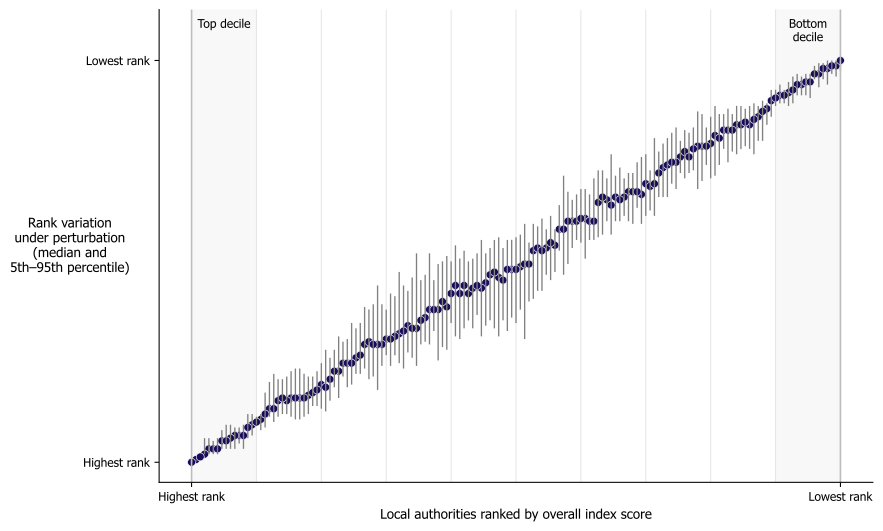
Description for Figure 4: this plot shows local authorities ranked by their overall index score on the x-axis and their median rank during perturbation tests on the y-axis. A vertical error bar for each local authority represents the range between the 5th and 95th percentiles obtained during perturbation testing. Vertical bands indicate the deciles. The chart shows that this range is smaller for local authorities in the top and bottom deciles and larger for those in the middle, indicating that more extreme results are less likely to change with adjustments to the model weights.
Local authorities at the top and bottom of the index showed narrow 5th to 95th percentile ranges, meaning they are robust under different weight schemes, as the model consistently identifies the highest and lowest ranked local authorities despite the weighting changes. Local authorities in the middle of the index showed wider ranges, as mid-ranking areas tend to have more similar underlying scores and are therefore more sensitive to weighting changes.
Indicator removal
To test the impact of each indicator on the overall index score, we ran a sensitivity analysis in which we removed one indicator at a time and measured the impact on the overall index ranking. Table 2 presents the proportion of LAs that remain in the same decile, as well as absolute mean, median and mean decile difference and standard deviation for the LAs that changed decile.
Removing indicators from either the ‘carers and practitioners’, ‘compatibility and accessibility’ or ‘safety and wellbeing’ domains results in an average of 65%, 65% and 61% of local authorities remaining in the same decile, respectively and of the LAs that change decile, most change on average by only 1 decile. The index therefore demonstrates good stability with respect to these domains. Removing indicators from the ‘availability’ domain results in a smaller proportion (29%) of LAs remaining in the same decile, with the LAs that change decile changing on average by approximately 2 deciles. The sensitivity analysis shows that the ‘availability’ indicators have a greater influence on the index rankings than indicators in the other domains. This result is conceptually consistent with the role of availability as a foundational determinant of sufficiency: without sufficient provision, other aspects of the system cannot function effectively.
Table 2: Indicator-removal testing overview
| Domain | Proportion of local authorities that remained in the same decile: Min | Proportion of local authorities that remained in the same decile: Max | Mean absolute decile difference for local authorities that changed decile: Min | Mean absolute decile difference for local authorities that changed decile: Max | Median decile difference for local authorities that changed decile: Min | Median decile difference for local authorities that changed decile: Max | Standard deviation for local authorities that changed decile: Min | Standard deviation for local authorities that changed decile: Max |
|---|---|---|---|---|---|---|---|---|
| Availability | 0.185 | 0.371 | 1.432 | 2.173 | 1 | 1 | 1.578 | 2.622 |
| Carers and practitioners | 0.570 | 0.728 | 1.000 | 1.138 | -1 | 1 | 1.011 | 1.199 |
| Compatibility and accessibility | 0.510 | 0.801 | 1.000 | 1.189 | -1 | 1 | 1.015 | 1.271 |
| Safety and wellbeing | 0.510 | 0.788 | 1.000 | 1.315 | -1 | 1 | 1.013 | 1.462 |
View the full data for Table 2 in an accessible table format.
Correlation analysis
We examined correlations within subdomains, domains and across the index. Indicators within a subdomain were expected to be related but not so closely correlated as to be redundant. Where indicators were too highly correlated (for example, several health indicators), we removed selected indicators to ensure each indicator added value.
Figure 5: Correlation matrix showing the correlations between indicators in the different subdomains of the ‘Compatibility and accessibility’ domain
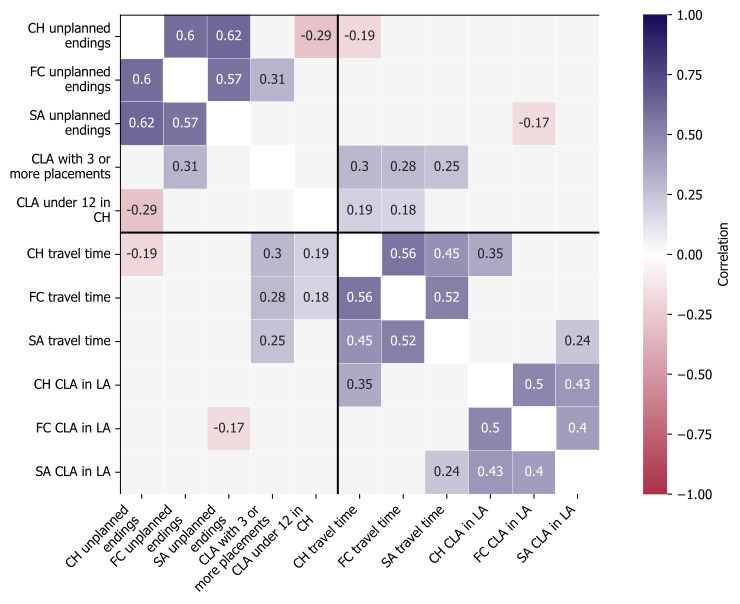
Description for Figure 5: this figure shows that 8 indicators within the ‘accessibility’ subdomain of the ‘compatibility and accessibility’ domain have a statistically significant positive correlation ranging from 0.24 to 0.56, while 7 indicators in this subdomain do not have a statistically significant correlation. In the compatibility subdomain, 4 indicators have a statistically significant positive correlation ranging from 0.26 to 0.62, 1 has a statistically significant negative correlation of -0.29, and 5 indicators in this subdomain do not have a statistically significant correlation.
Availability domain
The purpose of this domain is to capture the number of children’s social care places located in each local authority in relation to the number of children from that area who are looked after.
Subdomains
The ‘availability’ domain is made up of 3 subdomains: children’s homes, foster care and supported accommodation. These are presented separately to enable users to explore how placement availability varies across different types of provision. The children’s homes and foster care subdomains are given equal weight (1), and the supported accommodation subdomain is weighted at 0.5.
Each ‘availability’ subdomain contains a single indicator. As a result, the weighting of each indicator within this domain is higher than that of indicators in the other domains. This reflects the central role of availability in assessing sufficiency.
Indicators
Table 3: Availability domain indicator details
| Subdomain | Indicator description | Indicator name | Direction | Indicator weight | Data source |
|---|---|---|---|---|---|
| Children’s homes (CH) | Ratio of CH places to children in care | CH places to CLA | Higher is better | 1 | Children’s social care in England 2025 (Ofsted) and Children looked after data return (DfE) |
| Foster care (FC) | Ratio of FC places to children in care | FC places to CLA | Higher is better | 1 | Fostering data collection 2025 (Ofsted) and Children looked after data return (DfE) |
| Supported accommodation (SA) | Ratio of SA places to children in care aged 16 to 17 | SA places to CLA 16 to 17 | Higher is better | 1 | Children’s social care in England 2025 (Ofsted) and Children looked after data return (DfE) |
Access detailed indicator specifications for all domains here.
The number of children’s home places excludes short break only provision because short breaks provide temporary respite rather than full time accommodation. Including them would overstate the number of places available for children who require ongoing care.
Fostering places are assigned to local authorities differently depending on whether they are registered with an agency run by a local authority or with an independent fostering agency. Places in local authority fostering agencies are assigned to the authority that operates the agency. For joint local authority fostering agencies, the distribution of registered places between lead and partner authorities is estimated using the ratio of children in care in each area. Places in independent fostering agencies are assigned to the local authority in which the fostering household is physically located, based on postcode information supplied in our annual fostering collection. Unmatched or cross-border postcodes mean that just under 1% of independent fostering agency places could not be linked to a local authority in England and are therefore excluded from the indicator.
Supported accommodation places are assigned to a local authority based on the physical location of the premises, rather than the local authority where the provider is registered. The provider’s registered local authority reflects the organisation’s administrative base, but premises may operate elsewhere. Using the premises location therefore provides a more accurate measure of the places available to young people in each area.
For each ratio, the number of children in care is based on the number of children for whom each local authority was responsible on 31 March, excluding those receiving a series of short term breaks. For the supported accommodation ratio, only children aged 16 to 17 on 31 March are included.
Limitations
The ratios used in this domain provide an indication of how the volume of places in each local authority aligns with the number of children in care from that area. However, they do not reflect the individual needs of children. As with residential placements in children’s homes, supported accommodation will not be the most appropriate option for every young person aged 16 to 17. While supported accommodation is a registered form of provision and plays an important role in the sector, some children may be placed there before they are fully ready. These ratios are therefore not intended to imply that every type of place is suitable for every child within this age group.
Because of the way the supported accommodation sector is regulated, providers are only required to notify Ofsted of premises once a child is placed there. As a result, there may be additional potential capacity that is not yet known.
Using 31 March snapshots is a practical way to understand and compare capacity over time. However, this approach may underrepresent children in shorter-term placements, such as those in supported accommodation, because many of these placements do not span a full year and may not appear in either of 2 consecutive snapshots. Since certain groups, such as unaccompanied asylum‑seeking children, are more likely to be accommodated in supported accommodation than in other types of care, this may introduce some bias into the data.
Carers and practitioners domain
This domain assesses how effectively carers and practitioners in children’s social care provision in each local authority are recruited, retained, and supported to achieve the required qualifications. It considers whether providers have sufficient staffing levels and whether staff and carers hold the appropriate training and credentials to meet regulatory and practice expectations.
The domain is structured by provision type (children’s homes, fostering and supported accommodation) to reflect differences in workforce roles, qualification pathways and regulatory requirements. The indicators collectively provide an assessment of the capacity and capability of the local workforce to meet the needs of children in care.
Subdomains
This domain is made up of 3 subdomains: children’s homes, foster care, and supported accommodation. Because staffing structures and qualification requirements vary across these types of provision, each subdomain is compiled separately to ensure differences in workforce expectations are accurately reflected. The children’s homes and foster care subdomains are given equal weight (1), and the supported accommodation is weighted at 0.5.
Indicators
Table 4: Carers and practitioners domain indicator details
| Subdomain | Indicator description | Indicator name | Direction | Indicator weight | Data source |
|---|---|---|---|---|---|
| Children’s homes | Proportion of CH with a registered manager (RM) in place at some point during the 12 weeks before the snapshot | CH RM in post | Higher is better | 1 | Provider registration and associations data (Ofsted) |
| Children’s homes | Mean yearly turnover rate of RMs for CHs located in the LA | CH RM turnover | Lower is better | 1 | Provider registration and associations data (Ofsted) |
| Children’s homes | Mean proportion of permanent staff with level 3 qualification for CHs located in the LA | CH caring staff level 3 | Higher is better | 1 | Provider registration data and children’s home Annex A data (Ofsted) |
| Children’s homes | Mean ratio of caring staff (headcount) to children in residence at time of last inspection | CH caring staff to children in care | Higher is better | 1 | Provider registration data and children’s home Annex A data (Ofsted) |
| Children’s homes | Mean estimated annual turnover rate of permanent staff (headcount) per children’s home | CH caring staff turnover | Lower is better | 1 | Provider registration data and children’s home Annex A data (Ofsted) |
| Foster care | Proportion of IFA households located in the LA that were registered with an IFA with an RM in place at some point during the 12 weeks before the snapshot | Independent fostering agency (IFA) RM in post | Higher is better | 1 | Provider registration data, associations data, and fostering data collection (Ofsted) |
| Foster care | Mean yearly turnover rate of RMs at IFA level, for IFA households located in the LA | IFA RM turnover | Lower is better | 1 | Provider registration data, associations data, and fostering data collection (Ofsted) |
| Foster care | Proportion of foster carers (mainstream and kinship; local authority fostering agency (LAFA) and IFA) active as at 31 March who had completed their training, support and development workbook within the mandated timeframe | FC training completion | Higher is better | 1 | Provider registration data and fostering data collection (Ofsted) |
| Foster care | Proportion of all mainstream foster carers (LAFA and IFA) in-year leavers who were leaving before 5 years for reasons not leading to permanency | FC leavers within 5 years | Lower is better | 1 | Provider registration data and fostering data collection (Ofsted) |
| Foster care | Ratio of newly approved mainstream foster carers (approved in-year and still active as at 31 March) to children in care as at 31 March | New FC to children in care | Higher is better | 1 | Provider registration data, fostering data collection (Ofsted), and Children looked after data return (DfE) |
| Supported accommodation | Proportion of SA premises located in the LA that are registered with a SA provider with a registered service manager (RSM) in place at some point during the 12 weeks before the snapshot | SA RSM in post | Higher is better | 1 | Provider registration data and associations data (Ofsted) |
| Supported accommodation | Mean yearly turnover rate of RSMs at provider level, for supported accommodation premises located in the LA | SA RSM turnover | Lower is better | 1 | Provider registration data and associations data (Ofsted) |
Access detailed indicator specifications for all domains in our ODS file.
Data on registered managers is based on the 31 March snapshot and identifies whether a provider had a registered manager in post within the 12 week period before that date. Data on caring staff comes from Annex A returns provided by children’s homes at the time of inspection. The reporting period for each Annex A return is unique and covers the period since the home opened or since its last Annex A return, so data on annual caring staff turnover has been estimated based on in-period leavers.
Data on registered managers is sourced from regulatory information submitted directly by providers to Ofsted and is expected to be reliable and complete. In contrast, Annex A data, while detailed, is collected at the point of inspection and does not undergo validation at the time of submission. Common errors include mistyped or transposed numbers, for example the number of care workers who are subject to regulation 32 and have a level 3 qualification may be larger than the number of care workers who are subject to regulation 32, or the number of in-year leavers may be an order of magnitude larger than the year-end total and previous in-year leavers totals for the same provider.
For this reason, we excluded outliers from Annex A data only. Data from other sources may contain extreme values, but these are generally regarded as genuine due to the collection and validation processes in place. Outlier exclusion for Annex A was one sided: extremely high values are unlikely for proportion based metrics, whereas low or zero values are common and plausible. Values exceeding twice the interquartile range above the 75th percentile were excluded.
As in the ‘availability’ domain, the distribution of data for joint local authority fostering agencies was estimated using the ratio of children looked after in each area. Kinship carers are included in the training, support and development metric, as both mainstream and kinship carers are required to complete mandatory training within specified timescales (12 months for mainstream carers and 18 months for kinship carers).
Limitations
For children’s homes carers data, Annex A reports were used as the primary data source. These provide good coverage of homes, but the underlying data is not aligned, as inspections are carried out at different times throughout the year. As some newly registered homes had not yet been inspected, they are underrepresented.
Data availability also varies by provider type. Information on management is included for independent fostering agencies but not for local authority fostering agencies, due to differences in reporting requirements and data completeness. For supported accommodation, data on registered service managers reflects the fact that this type of provision is newly regulated and many providers have opened recently. As a result, the distribution of values is limited, and most providers have a registered service manager in place. While the metric is included due to its importance, it provides limited differentiation between local authorities. The down weighting of supported accommodation indicators, including this one, is discussed in the first section.
Compatibility and accessibility domain
This domain considers how well placements meet the individual needs of children. While a full assessment of suitability would require detailed information about each child’s needs – which is held within local authority care plans and not available to Ofsted or the DfE – proxies can be used to understand how well placements are working in practice.
The measures focus on 2 key aspects: the extent to which placements are stable and appropriately matched and how close placements are to a child’s home area. Together, these indicators provide insight into whether local placement provision supports consistent care and maintains children’s connections to their families, schools and home communities.
Subdomains
This domain is made up of 2 thematic subdomains: compatibility and accessibility. These subdomains are equally weighted (1), and the supported accommodation indicators within each domain are weighted at 0.5, compared to the other measures at 1.
- Compatibility: this subdomain captures how well placements support continuity and minimise disruption. It includes indicators, such as placement changes that were not specified in a child’s care plan, and overall placement stability, which reflect how effectively placements are meeting children’s needs in practice.
- Accessibility: this subdomain assesses how far children are placed from their home area, using travel time and whether the child is placed within their home LA. Accessibility is an important dimension of suitability, as placements located far from home may affect a child’s ability to maintain vital relationships and access education and local support networks.
These measures serve as proxies in the absence of direct data on children’s individual needs. They enable consistent comparison of LAs’ ability to provide stable, appropriate placements.
Indicators
Table 5: Compatibility and accessibility domain indicator details
| Subdomain | Indicator description | Indicator name | Direction | Indicator weight | Data source |
|---|---|---|---|---|---|
| Compatibility | Proportion of distinct placements (each involving a change in placement type, carer, or both) in CHs that ended for a reason not in the child’s care plan in the last year | CH endings not in care plan | Lower is better | 1 | Children looked after data return (DfE) |
| Compatibility | Proportion of distinct placements (each involving a change in placement type, carer, or both) in FC that ended for a reason not in the child’s care plan in the last year | FC endings not in care plan | Lower is better | 1 | Children looked after data return (DfE) |
| Compatibility | Proportion of distinct placements (each involving a change in placement type, carer, or both) in SA that ended for a reason not in the child’s care plan in the last year | SA endings not in care plan | Lower is better | 0.5 | Children looked after data return (DfE) |
| Compatibility | Proportion of children in care as at 31 March who had 3 or more placements in the last year | CLA with 3 or more placements | Lower is better | 1 | Children looked after data return (DfE) |
| Compatibility | Proportion of children in care aged 12 and under and not flagged as having a disability in their child-in-need assessment who are placed in a children’s home as at 31 March | CLA 12 and under in CH | Lower is better | 1 | Children looked after data return (DfE) |
| Accessibility | Mean estimated travel time (minutes) by car from home to placement as at 31 March for children in care in CH | CH travel time | Lower is better | 1 | Children looked after data return (DfE) and travel time |
| Accessibility | Mean estimated travel time (minutes) by car from home to placement as at 31 March for children in care in mainstream FC (LAFA and IFA; not kinship) | FC travel time | Lower is better | 1 | Children looked after data return (DfE) and travel time |
| Accessibility | Mean estimated travel time (minutes) by car from home to placement as at 31 March for children in care in SA | SA travel time | Lower is better | 0.5 | Children looked after data return (DfE) and travel time |
| Accessibility | Proportion of children in care in CHs as at 31 March who are accommodated within their home LA | CH children in care in LA | Higher is better | 1 | Children looked after data return (DfE) |
| Accessibility | Proportion of children in care in FC as at 31 March who are accommodated within their home LA | FC children in care in LA | Higher is better | 1 | Children looked after data return (DfE) |
| Accessibility | Proportion of children in care in SA as at 31 March who are accommodated within their home LA | SA CLA in LA | Higher is better | 0.5 | Children looked after data return (DfE) |
Access detailed indicator specifications for all domains in our ODS file.
Indicators within each subdomain are disaggregated by placement type (children’s homes, fostering, supported accommodation) wherever feasible. This enables comparison across different forms of provision while still supporting analysis at the broader thematic level.
Indicators on placement changes that are not specified in a child’s care plan draw on episode-level SSDA903 data. A ‘distinct placement’ is defined as any episode involving a change in placement type, carer or both. A child may have multiple distinct placements during the period and is counted separately for each. Placements that are ongoing at 31 March, those that end for reasons set out in the child’s care plan, or those involving only a change in legal status appear in the denominator but not the numerator. Only episodes coded as ‘Episode ceases, and new episode begins on the same day’ (X1) and not identified as care plan specified or status changes contribute to the numerator. While endings that are not specified in a child’s care plan are generally treated as signs of instability, national data cannot distinguish between endings that are harmful and those that are necessary or positive.
Fostering indicators include both mainstream and kinship foster care, reflecting the aim to assess whether local authorities are matching all children to placements that support stability. Excluding kinship would mask situations where poor matching within kinship arrangements also results in placement endings that are not in a child’s care plan.
Placement instability is measured using the proportion of children in care at 31 March who had 3 or more placements in the past year, following the approach used in DfE official statistics. This measure is not disaggregated by placement type because children with recent instability often move across multiple placement types; judging their stability on the basis of their placement on 31 March could misrepresent their recent experience or unfairly attribute instability to their current setting.
For the indicator on younger children placed in children’s homes, we identify children aged 12 or under at 31 March who are not recorded as having a disability in the child in need field (any value other than N2). This does not confirm that the child has no disability, but indicates that disability is not recorded as the primary reason for being in care. The indicator is intended to distinguish children living in children’s homes because of specialist disability related needs from those who may be placed there due to shortages of alternative placements. As with other indicators, this is a ‘big picture’ measure designed to illuminate national patterns rather than the appropriateness of individual cases.
Distance measures are based on estimated travel time between a child’s recorded home postcode and their placement postcode. Home postcode reflects the address at entry to care and may not be current. Where either postcode is missing or unmatchable (for example, in confidential placements or where providers report only a registration address), travel times cannot be directly calculated. Postcodes are matched to lower super output areas (LSOAs), and driving travel times between LSOA centroids are produced using the travel time application programming interface.[footnote 9]
Driving time is used because public transport data had lower match rates. For a small number of placements – primarily those far from the child’s home – driving times could not be calculated; these are estimated using a simple regression model based on observed travel times. Travel time is used as a proxy for displacement rather than to imply that a child should be travelling regularly between home and placement.
Distance indicators for fostering exclude kinship placements. In these cases, a further from home placement with known relatives may be preferable to a closer placement with unrelated carers; including kinship would therefore risk misrepresenting decision making quality.
Proportion in LA indicators measure whether children are placed with providers registered in their home local authority. For fostering and supported accommodation, the provider’s registration does not always reflect its physical operating footprint, which means the indicator may not perfectly align with where children in care are actually living.
Limitations
Indicators derived from DfE’s children looked after data return are influenced by variation in local recording practice. Differences in how placement changes, placement endings not in a child’s care plan, and assessed needs are coded may affect comparability. Placement endings not in a child’s care plan are treated uniformly in this index, although national data cannot distinguish between endings that reflect breakdown and those that occur for legitimate or positive reasons.
Distance indicators depend on address‑based data that may not represent current or physical locations. For example, the child’s home postcode might be out of date, or the provider’s registration postcode may not be for the address of the child’s foster home or supported accommodation. Travel time estimates provide a consistent measure of displacement but do not account for geography, transport options or practical barriers to maintaining relationships. The regression model used to estimate missing travel times may over‑estimate travel time for long‑distance journeys. Within the model, this means that placements further from a child’s home may be penalised more harshly.
Closer placements are not necessarily better placements. For some children, being placed away from home is appropriate, for example due to safeguarding considerations, specialist therapeutic needs or risk management. Accessibility indicators therefore describe system-level patterns, not desired outcomes for every child.
Finally, indicators using provider registration (such as ‘in‑LA’ measures) may not reflect the actual operating geography of fostering agencies or supported accommodation providers, particularly for large regional or national organisations. These measures should therefore be interpreted as high‑level indicators of local sufficiency rather than direct evidence of placement appropriateness.
Safety and wellbeing domain
This domain assesses how well the health and protection needs of children in care are being met within each local authority. A full evaluation of children’s health and safety would require detailed individual level information, but the indicators available provide important insight into whether children receive annual health assessments and report feeling safe in their placements.
The measures in this domain therefore focus on 2 key areas: indicators of safety, such as incidents of children going missing and children’s own perceptions of safety, and annual health assessments of children. Together, these indicators provide a broad picture of whether local authorities are meeting their responsibilities to promote children’s wellbeing and keep them safe.
Subdomains
This domain is made up of 2 subdomains: safety and health. These subdomains are equally weighted (1), and the supported accommodation indicators within each domain are weighted at 0.5, compared to the other measures at 1. Each captures a different aspect of children’s wellbeing:
- Safety: this subdomain draws on indicators such as incidents of children going missing and children’s self reported feelings of safety. These measures provide an indication of the extent to which placements provide a secure environment and whether children feel protected within their care arrangements.
- Health: this subdomain examines whether children receive the required health assessments and checks, providing insight into how effectively local authorities support children’s physical health needs.
These indicators offer a practical way to compare local authorities’ performance in supporting the health and safety of children in care, recognising that more detailed individual level information on need is not available.
Indicators
Table 6: Safety and wellbeing domain indicator details
| Subdomain | Indicator description | Indicator name | Direction | Indicator weight | Data source |
|---|---|---|---|---|---|
| Safety | Proportion of children in care placed in CH who went missing for over 24 hours once or more during the year | CH CLA going missing | Lower is better | 1 | Children looked after data return (DfE) |
| Safety | Proportion of children in care placed in FC (mainstream and kinship) who went missing for over 24 hours once or more during the year | FC CLA going missing | Lower is better | 1 | Children looked after data return (DfE) |
| Safety | Proportion of children in care placed in SA who went missing for over 24 hours once or more during the year | SA CLA going missing | Lower is better | 0.5 | Children looked after data return (DfE) |
| Safety | Mean ‘Point in time’ (PiT) survey response from children in care in CH in response to the question ‘Do you feel safe where you live?’ (0 = Never, 3 = Always) | CH CLA feeling safe | Higher is better | 1 | PiT survey (Ofsted) |
| Safety | Mean PiT survey response from children in care in FC in response to the question ‘Do you feel safe where you live?’ (0 = Never, 3 = Always) | FC CLA feeling safe | Higher is better | 1 | PiT Survey (Ofsted) |
| Safety | Mean PiT survey response from CLA in SA in response to the question ‘Do you feel safe where you live?’ (0 = Never, 3 = Always) | SA CLA feeling safe | Higher is better | 0.5 | PiT Survey (Ofsted) |
| Health | Proportion of children in care placed in CH with their annual health assessment carried out during the year | CH health assessments | Higher is better | 1 | Children looked after data return (DfE) |
| Health | Proportion of children in care placed in FC with their annual health assessment carried out during the year | FC health assessments | Higher is better | 1 | Children looked after data return (DfE) |
| Health | Proportion of children in care placed in SA with their annual health assessment carried out during the year | SA health assessments | Higher is better | 0.5 | Children looked after data return (DfE) |
1. Access detailed indicator specifications for all domains in our ODS file.
As in the previous domains, indicators within each subdomain are broken down
by placement type where appropriate. This allows differences between provision types to be examined, while also supporting an overarching view of patterns within each thematic subdomain.
Missing from care indicators are derived from DfE’s children looked after data return. These figures differ from those published in the official statistics, because for this model we calculate the proportion of children with at least one missing incident lasting over 24 hours. This threshold provides stronger differentiation between local authorities and focuses on longer episodes, which are typically – although not always – associated with higher levels of concern. Children are counted according to the placement type they were in when a particular missing incident occurred (children’s homes, foster care or supported accommodation).
Ofsted’s ‘Point in time’ survey provides insight into how children and young people feel within their care setting. The survey is issued annually to Ofsted‑registered providers, who then distribute it to children and young people in their care. In this domain we draw on responses from those living in children’s homes, local authority or independent fostering households, and supported accommodation. This survey is not mandatory, so there is some missing data and numbers may be low, resulting in suppression in the published data.
We use responses to the question: ‘Do you feel safe where you live?’ Responses are coded on a 4‑point scale from 0 (‘Never’) to 3 (‘Always’). For each placement type within each local authority, we calculate the mean score of all responses from provision in that area. This provides a high‑level measure of perceived safety across different types of care settings.
Several potential health indicators were reviewed, including annual health assessments, dental checks, immunisations, and developmental assessments for younger children. These measures are highly correlated with each other and with the annual health assessment data. To avoid redundancy and over‑weighting similar constructs within the composite model, we include only the proportion of children receiving their annual health assessment, calculated separately by placement type.
The strengths and difficulties questionnaire (SDQ) provides valuable insight into children’s emotional and behavioural wellbeing. However, because SDQ scores reflect a range of underlying needs and characteristics that fall largely outside local authority control, this indicator is in the contextual section and does not contribute to the composite index.
Limitations
Interpretation of the indicators should take account of several limitations to data quality and comparability. Administrative data on missing from care episodes is influenced by local variation in recording practices, including differences in how incidents are classified, logged and followed up. Annual health assessment data is similarly affected by variation in local processes for scheduling, completing and recording assessments, which may lead to under- or over-reporting in some areas.
Specific limitations and guidance related to data from the children looked after data return can be found in the methodology of Children looked after in England including adoptions .
SDQ scores provide important, if limited, insight into the mental health of children in care. These are aggregated to local authority level for inclusion in the contextual data domain of this model. At present, we do not have access to more granular data on the mental health needs of children. We also do not have access to data on CAHMS or similar services that would enable us to explore the extent, quality and compatibility of access to mental health services for children in care across England. This is a limitation in the current index and our reporting would be improved by more targeted data collection in this area.
The Ofsted ‘Point in time’ survey also has important limitations. The survey is circulated and administered differently across providers and local areas, producing variation in response rates and introducing the possibility of self selection bias. Children and young people may interpret the ‘feeling safe’ question differently, and the degree of support offered to complete the survey varies between settings, affecting the comparability of average scores.
Survey anonymity further constrains how the data can be used. Respondents are linked only to the registered provider, not to the specific fostering household or supported accommodation premises where they live. As a result, scores are attributed to the local authority where the provider is registered, which may differ from the physical location of the care setting or accommodation. This is particularly relevant for large independent fostering agencies or supported accommodation providers that operate across multiple local authorities.
Context domain
The ‘context’ domain brings together data that may influence a local authority’s ability to deliver sufficient children’s social care, or that provides important contextual information for interpreting results across the other domains. This domain is not scored, reflecting 2 key considerations:
- Many contextual factors fall outside the control of local authorities (for example, the proportion of children with special educational needs and/or disabilities).
- It is not appropriate to assign a direction of performance to these indicators, and therefore they cannot be incorporated into the scoring model.
Instead, the context domain is designed to support interpretation by highlighting local circumstances that may shape demand, capacity, or the operating environment for children’s social care.
Subdomains
Indicators within the context domain are divided into supply- and demand-related metrics.
Indicators
Table 7: Contextual domain indicator details
| Subdomain | Indicator description | Indicator name | Data source |
|---|---|---|---|
| Demand | Number of Child in need (CIN) episodes per local authority as at 31 March | CIN | ‘Children in need: 2024 to 2025’, Department for Education (DfE), October 2025. |
| Demand | Percentage of children in care who were unaccompanied asylum seeking children (UASC) per local authority as at 31 March | UASC | ‘Children looked after in England including adoptions, Reporting year 2025’, DfE, November 2025. |
| Demand | Percentage of children with special educational needs (SEN) support or SEN without an education, health and care plan (EHCP) | SEN/EHCP | ‘Special educational needs in England, Academic year 2024/25’, DfE, June 2025 (updated May 2026). |
| Demand | Average (mean) Income Deprivation Affecting Children Index (IDACI) rank (where 1 is most deprived) for LSOAs in the LA | IDACI | ‘English indices of deprivation 2025’, Ministry of Housing, Communities and Local Government, October 2025 (updated November 2025). |
| Demand | Average strengths and difficulties questionnaire (SDQ) score for children aged 5 to 16 years with SDQ score per local authority | SDQ | ‘Children looked after in England including adoptions, Reporting year 2025’, DfE, November 2025. |
| Supply | Average house prices | House prices | ‘UK House Price Index for March 2025’, HM Land Registry, May 2025. |
| Supply | Proportional change in number of CH, 2021 to 2025 | CH change in 5 years | ‘Children’s social care data in England 2021’, Ofsted, July 2021 (updated March 2022). ‘Children’s social care in England 2025’, Ofsted, July 2025 (updated August 2025). |
| Supply | Regional Care Cooperative (RCC) membership | RCC membership | ‘Regional care cooperatives pathfinder regions’, DfE, February 2026. |
| Supply | Percentage of own LA children placed in LA-run provision in home LA | CLA in LA-run provision | ‘Children looked after in England including adoptions, Reporting year 2025’, DfE, November 2025. |
| Supply | Proportion of CH places in LA provided by large providers | CH large providers | ‘Ownership of children’s social care providers in England 2025’, Ofsted, November 2025. ‘Children’s social care in England 2025’, Ofsted, July 2025 (updated August 2025). |
| Supply | Proportion of FC places physically located in LA provided by IFA large providers | IFA large providers | ‘Ownership of children’s social care providers in England 2025’, Ofsted, November 2025. ‘Ofsted annual fostering data collection 2025’, Ofsted, April 2018 (updated April 2026). |
| Supply | Proportion of SA places in premises located in LA provided by large providers | SA large providers | ‘Ownership of children’s social care providers in England 2025’, Ofsted, November 2025. ‘Children’s social care in England 2025’, Ofsted, July 2025 (updated August 2025). |
| Supply | FC households registered to provide only family and friends fostering (formal kinship care) | FC kinship | ‘Ofsted annual fostering data collection 2025’, Ofsted, April 2018 (updated April 2026). |
| Supply | Proportion of children placed within the local authority boundary who are children from other LAs placed externally | CLA from other LAs | ‘Children looked after in England including adoptions, Reporting year 2025’, DfE, November 2025. |
| Supply | Net gain of children by responsible LA | CLA net gain | ‘Children looked after in England including adoptions, Reporting year 2025’, DfE, November 2025. |
| Supply | Average expenditure on services for children in care in 2024–25 financial year per child in care during the year | Expenditure per CLA | ‘Children looked after in England including adoptions, Reporting year 2025’, DfE, November 2025. ‘LA and school expenditure, Financial year 2024-25’, DfE, December 2025. |
Access detailed indicator specifications for all domains in our ODS file.
The indicators used in this domain draw on national administrative datasets to provide a high-level picture of the pressures on children’s social care and the availability of provision across local authorities. The demand indicators describe the volume and characteristics of children requiring support, including the number of children in need, the proportion who are unaccompanied asylum-seeking children, levels of special educational needs, relative deprivation, and the proportion of children whose SDQ scores raise concerns. These measures help illustrate the scale and complexity of local need.
The supply indicators capture the resources, market conditions and placement dynamics within each area. They include local authority expenditure on children’s social care, housing market costs, trends in the number of children’s homes, geographical context, participation in regional commissioning arrangements, and patterns of internal and external placements. Additional market indicators describe the structure of local provision, including large provider presence, the composition of the foster care workforce, and the local balance of children placed in or out of area.
Limitations
The indicators rely on administrative data from multiple sources, each with its own reporting timetable and definitions. As a result, the measures do not always relate to the same period and may reflect differing local recording practices. Several indicators – such as deprivation ranking or house prices – act as contextual proxies rather than direct measures of placement sufficiency.
The data does not capture all aspects of need or provision, such as the suitability or quality of placements, the specific complexity of children’s needs, or local commissioning strategies. Market level indicators are constrained by what is published, and foster care capacity figures may not fully reflect availability. For these reasons, the indicators should be interpreted as contextual rather than evaluative and used alongside qualitative evidence and local insight.
Qualitative methodology
A favourable ethical opinion for the qualitative research was obtained from the Research Ethics Committees at Kingston University London and Ofsted.
A purposive sampling approach was used to ensure coverage across regions in England. Eligible participants were children’s social care commissioners, placement or home‑finding staff, and social workers in English local authorities.
Participants were recruited through a 2‑stage process to protect anonymity. The Social Care Data and Analysis Team at Ofsted sent an email to commissioners outlining the aims of the study and providing the participant information sheet. Interested eligible participants then contacted the researcher directly to arrange an interview and provide written consent.
Data were collected through semi‑structured interviews held online via MS Teams, lasting between 48 and 60 minutes. Transcripts were generated automatically, checked for accuracy against the recordings, and pseudo‑anonymised before analysis. All data management procedures complied with ethical requirements and GDPR.
Themes from the research were developed inductively under predefined broad topics of interest to the study (for example, perceptions of factors shaping sufficiency). Pseudo-anonymised transcripts were uploaded to qualitative data analysis software NVivo, and each was analysed individually. Transcripts were read and analysed line by line, with codes (inductively developed from the text) being attached to sections of text (for example, factors relating to the profile of children coming into care), until the entire transcript had been coded. Once all transcripts had been individually coded, codes were rearranged in conceptual hierarchies to develop broader themes pertaining to the topics of interest. The NVivo software helped to manage qualitative data and enabled more rigorous, comprehensive and faster analysis of the contents of interviews.
Annex: data tables for figures
This section contains the underlying data in an accessible table format for figures, where applicable.
Data for Figure 3: Domain, subdomain and indicator weights in the overall model
| Domain | Subdomain | Indicator name | Relative indicator weight in overall model |
|---|---|---|---|
| Availability | Children’s homes (CH) | CH places to CLA | 0.1 |
| Availability | Foster care (FC) | FC Places to CLA | 0.1 |
| Availability | Supported accommodation (SA) | SA places to CLA 16 to 17 | 0.05 |
| Carers and practitioners | CH | CH RM in post | 0.02273 |
| Carers and practitioners | CH | CH RM turnover | 0. 02273 |
| Carers and practitioners | CH | CH caring staff level 3 | 0. 02273 |
| Carers and practitioners | CH | CH caring staff to CLA | 0. 02273 |
| Carers and practitioners | CH | CH caring staff turnover | 0. 02273 |
| Carers and practitioners | FC | IFA RM in post | 0. 02273 |
| Carers and practitioners | FC | IFA RM turnover | 0. 02273 |
| Carers and practitioners | FC | FC training completion | 0. 02273 |
| Carers and practitioners | FC | FC leavers within 5 years | 0. 02273 |
| Carers and practitioners | FC | New FC to CLA | 0. 02273 |
| Carers and practitioners | SA | SA RSM in post | 0. 01136 |
| Carers and practitioners | SA | SA RSM turnover | 0. 01136 |
| Compatibility and accessibility | Compatibility | CH endings not in care plan | 0.02632 |
| Compatibility and accessibility | Compatibility | FC endings not in care plan | 0.02632 |
| Compatibility and accessibility | Compatibility | SA endings not in care plan | 0.01316 |
| Compatibility and accessibility | Compatibility | CLA with 3 or more placements | 0.02632 |
| Compatibility and accessibility | Compatibility | CLA 12 and under in CH | 0.02632 |
| Compatibility and accessibility | Accessibility | CH travel time | 0.02632 |
| Compatibility and accessibility | Accessibility | FC travel time | 0.02632 |
| Compatibility and accessibility | Accessibility | SA travel time | 0.01316 |
| Compatibility and accessibility | Accessibility | CH CLA in LA | 0.02632 |
| Compatibility and accessibility | Accessibility | FC CLA in LA | 0.02632 |
| Compatibility and accessibility | Accessibility | SA CLA in LA | 0.01316 |
| Safety and wellbeing | Safety | CH CLA going missing | 0.03333 |
| Safety and wellbeing | Safety | FC CLA going missing | 0.03333 |
| Safety and wellbeing | Safety | SA CLA going missing | 0.01667 |
| Safety and wellbeing | Safety | CH CLA feeling safe | 0.03333 |
| Safety and wellbeing | Safety | FC CLA feeling safe | 0.03333 |
| Safety and wellbeing | Safety | SA CLA feeling safe | 0.01667 |
| Safety and wellbeing | Health | CH health assessments | 0.03333 |
| Safety and wellbeing | Health | FC health assessments | 0.03333 |
| Safety and wellbeing | Health | SA health assessments | 0.01667 |
See Figure 3.
Full data for Table 2: Indicator-removal testing overview
| Domain | Subdomain | Indicator name | Proportion of local authorities that remained in the same decile | Mean absolute decile difference for local authorities that changed decile | Mean decile difference for local authorities that changed decile | Median decile difference for local authorities that changed decile | Standard deviation for local authorities that changed decile |
|---|---|---|---|---|---|---|---|
| Availability | Children’s homes (CH) | CH places to CLA | 0.311 | 2.173 | 0 | 1 | 2.622 |
| Availability | Foster care (FC) | FC Places to CLA | 0.185 | 2.081 | 0 | 1 | 2.361 |
| Availability | Supported accommodation (SA) | SA places to CLA 16 to 17 | 0.371 | 1.432 | 0 | 1 | 1.578 |
| Carers and practitioners | CH | CH RM in post | 0.662 | 1.059 | 0 | -1 | 1.095 |
| Carers and practitioners | CH | CH RM turnover | 0.682 | 1.000 | 0 | 0 | 1.011 |
| Carers and practitioners | CH | CH caring staff level 3 | 0.689 | 1.021 | 0 | -1 | 1.043 |
| Carers and practitioners | CH | CH caring staff to CLA | 0.570 | 1.077 | 0 | 1 | 1.118 |
| Carers and practitioners | CH | CH caring staff turnover | 0.662 | 1.020 | 0 | 1 | 1.039 |
| Carers and practitioners | FC | IFA RM in post | 0.656 | 1.038 | 0 | 0 | 1.066 |
| Carers and practitioners | FC | IFA RM turnover | 0.656 | 1.038 | 0 | 0 | 1.066 |
| Carers and practitioners | FC | FC training completion | 0.728 | 1.024 | 0 | -1 | 1.049 |
| Carers and practitioners | FC | FC leavers within 5 years | 0.649 | 1.057 | 0 | -1 | 1.092 |
| Carers and practitioners | FC | New FC to CLA | 0.629 | 1.107 | 0 | -1 | 1.160 |
| Carers and practitioners | SA | SA RSM in post | 0.623 | 1.088 | 0 | 1 | 1.134 |
| Carers and practitioners | SA | SA RSM turnover | 0.616 | 1.138 | 0 | 0 | 1.199 |
| Compatibility and accessibility | Compatibility | CH endings not in care plan | 0.563 | 1.121 | 0 | 0 | 1.190 |
| Compatibility and accessibility | Compatibility | FC endings not in care plan | 0.662 | 1.059 | 0 | 1 | 1.095 |
| Compatibility and accessibility | Compatibility | SA endings not in care plan | 0.788 | 1.000 | 0 | 0 | 1.016 |
| Compatibility and accessibility | Compatibility | CLA with 3 or more placements | 0.603 | 1.133 | 0 | 0 | 1.193 |
| Compatibility and accessibility | Compatibility | CLA 12 and under in CH | 0.510 | 1.189 | 0 | -1 | 1.271 |
| Compatibility and accessibility | Accessibility | CH travel time | 0.596 | 1.049 | 0 | 1 | 1.080 |
| Compatibility and accessibility | Accessibility | FC travel time | 0.583 | 1.048 | 0 | 1 | 1.078 |
| Compatibility and accessibility | Accessibility | SA travel time | 0.775 | 1.000 | 0 | 0 | 1.015 |
| Compatibility and accessibility | Accessibility | CH CLA in LA | 0.636 | 1.127 | 0 | -1 | 1.186 |
| Compatibility and accessibility | Accessibility | FC CLA in LA | 0.629 | 1.107 | 0 | 0 | 1.160 |
| Compatibility and accessibility | Accessibility | SA CLA in LA | 0.801 | 1.000 | 0 | 0 | 1.017 |
| Safety and wellbeing | Safety | CH CLA going missing | 0.570 | 1.169 | 0 | -1 | 1.237 |
| Safety and wellbeing | Safety | FC CLA going missing | 0.517 | 1.041 | 0 | 1 | 1.067 |
| Safety and wellbeing | Safety | SA CLA going missing | 0.788 | 1.000 | 0 | 0 | 1.016 |
| Safety and wellbeing | Safety | CH CLA feeling safe | 0.523 | 1.111 | 0 | -1 | 1.175 |
| Safety and wellbeing | Safety | FC CLA feeling safe | 0.649 | 1.094 | 0 | -1 | 1.144 |
| Safety and wellbeing | Safety | SA CLA feeling safe | 0.735 | 1.000 | 0 | 0 | 1.013 |
| Safety and wellbeing | Health | CH health assessments | 0.517 | 1.315 | 0 | 1 | 1.462 |
| Safety and wellbeing | Health | FC health assessments | 0.510 | 1.243 | 0 | -1 | 1.365 |
| Safety and wellbeing | Health | SA health assessments | 0.669 | 1.040 | 0 | 0 | 1.069 |
See Table 2.
-
This work combines quantitative analysis carried out by Ofsted’s Social Care Data and Analysis team and qualitative research conducted by Kingston University on behalf of Ofsted. ↩
-
‘Children’s homes: inspection forms’, Ofsted, February 2017 (updated April 2026). ↩
-
‘Ofsted annual fostering data collection’, Ofsted, April 2018 (updated April 2026). ↩
-
‘Children’s social care surveys: guidance for providers’, Ofsted, January 2016 (updated February 2026). ↩
-
’Children looked after return: guide to submitting data’, Department for Education, March 2014 (updated November 2025). ↩
-
‘English indices of deprivation 2025: technical report’, Ministry of Housing, Communities and Local Government, October 2025. ↩
-
M. Ghosh and J. N. K. Rao, ‘Small Area Estimation: An Appraisal’, in ‘Statistical Science’, Volume 9(1), 1994, pages 55 to 76. ↩
-
Becker et al., ‘COINr: An R package for developing composite indicators’, in ‘Journal of Open Source Software’, Volume 7(78), 2022, article 4567. ↩
-
Travel Time: An API for Calculating Accurate Real-World Travel Times. ↩