UK National Action Plan for Open Government 2024-2025 Co-creation Self-assessment
Published 4 December 2025

© Crown copyright 2025
This publication is licensed under the terms of the Open Government Licence v3.0 except where otherwise stated. To view this licence, visit nationalarchives.gov.uk/doc/open-government-licence/version/3 or write to the Information Policy Team, The National Archives, Kew, London TW9 4DU, or email: psi@nationalarchives.gov.uk.
Where we have identified any third party copyright information you will need to obtain permission from the copyright holders concerned.
This publication is available at https://www.gov.uk/government/publications/uk-national-action-plan-for-open-government-2024-2025-co-creation-self-assessment/uk-national-action-plan-for-open-government-2024-2025-co-creation-self-assessment
Disclaimers
- This self-assessment relates to a plan co-created under the 2022 to 2024 Sunak Conservative governments.
-
- The Central Digital and Data Office (CDDO) was the business unit previously responsible for open government policy. This responsibility transferred to the Civil Service Strategy Unit within Cabinet Office in April 2025.
Introduction
The UK’s Sixth National Action Plan for Open Government 2024-2025 (NAP6) was published on 18th December 2023. It set out commitments to promote the open government core values of transparency, accountability and public participation. The plan built on the previous five UK National Action Plans and has been coordinated by the Central Data and Digital Office (CDDO), part of Cabinet Office, in partnership with the UK Open Government Civil Society Network (UK OGN). The implementation period of NAP6 is from 1st January 2024 to 31st December 2025.
The action plan includes commitments to act by both government and civil society across four key thematic areas: open contracting, aid transparency, civil society engagement on anti-corruption and the country review mechanism for the UN Convention Against Corruption (UNCAC). In addition to the commitments in the plan, there is also a section expressing interest to build capability amongst government and civil society on the topics of digital governance, freedom of information, beneficial ownership, open justice, government transparency returns, and further collaboration on open government both domestically and internationally.
Following the publication of NAP6 the opportunity has been taken to review the co-creation process through a self-assessment with the aim of improving the future process. This document covers the entire duration of the co-creation process between civil society and government and is informed by feedback through the UK Multi-Stakeholder Forum for Open Government (MSF) held in January 2024, as well as wider feedback from civil society and government. A key focus of discussion at the MSF was the importance of sharing experiences, learning and ideas for improvement that will help to improve co-creation in future.
Background
As a condition of UK membership of the Open Government Partnership (OGP), each national member has committed to work with civil society to co-create open government commitments that form a national action plan. The UK government listened to feedback about the process of developing previous action plans and, in agreement with civil society, introduced an improved structure to the process for NAP6. Initial focus was on reinvigorating the MSF through introducing a 12-month horizon of meetings and agreeing a clear forward plan for overseeing the development and implementation of NAPs. This allowed a timetable to be agreed for monitoring progress of the implementation of the Fifth National Action Plan for Open Government 2021-2023 (NAP5) alongside the co-creation of NAP6. The MSF has developed to become an effective forum to exchange perceptions on progress and is now the key gateway event overseeing the NAP process. This refinement in approach has been of benefit to civil society and government participants alike by providing greater clarity of our shared purpose.
Co-creation
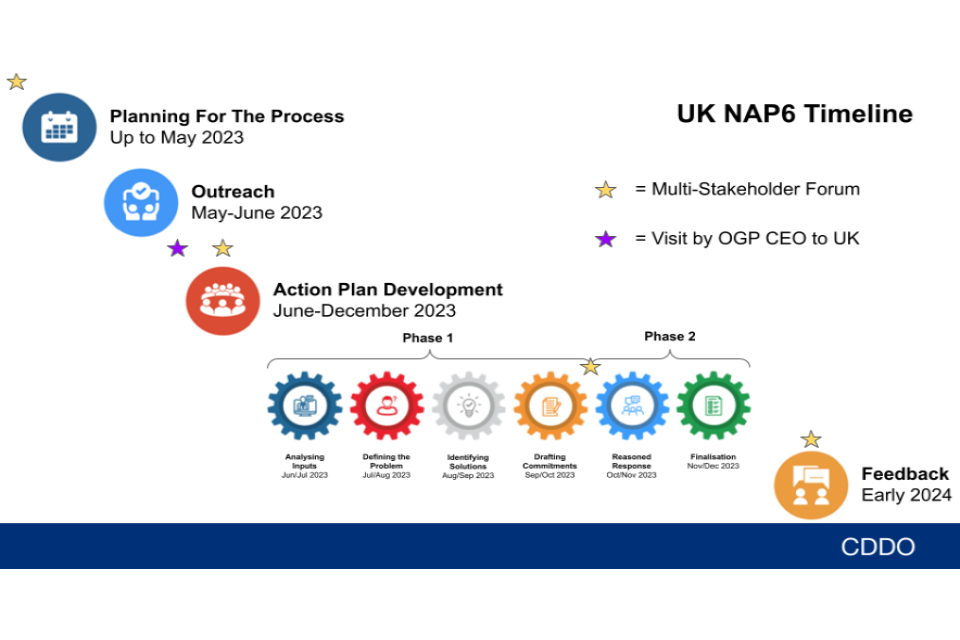
NAP6 co-creation was launched in Spring 2023 and concluded following publication in 2024. The timetable for completion (see Figure 1: UK NAP6 timetable) revolved around four stages: planning, outreach, action plan development and feedback. Each stage relates to separate aspects of co-creation, but all aimed to focus collaboration to enable the development of a national action plan at pace. The action plan development stage consisted of six steps: analysing inputs, defining the problem, identifying solutions, drafting commitments, reasoned response, and finalisation. These steps were divided into two phases: phase 1 concerned the co-development of draft commitments by thematic stakeholder groups, whilst phase 2 relates to completing the overall action plan.
Figure 1: UK NAP6 timeline
Planning and outreach
The initial focus of planning was on developing the action plan timeline which included a 9 month horizon of key gateway meetings during the co-creation process, and a clear structure for overseeing its co-creation. The co-creation timetable was shared as part of the April 2023 MSF (PDF, 53.6KB), which was followed by a month-long outreach stage to gather initial ideas, problems, and evidence. Civil society-led outreach was open to the public from 12th May to 11th June 2023. Short extensions were provided to facilitate some delayed submissions and a total of 61 civil society submissions were considered and assessed regarding potential to develop ambitious commitments. In parallel to the public call for ideas, internal government outreach was led by CDDO.
An analysis (PDF, 104KB) of initial ideas was undertaken by CDDO to assess the potential for developing commitments for NAP6 including: significance, relevance to open government, and the capability of civil society and government to engage in the process in the available time. The assessment also considered the UK Co-creation Brief (2023) provided by the OGP Independent Reporting Mechanism, as well as considering the written updates on NAP5 progress. This outreach and initial analysis was undertaken at substantial pace due to overall time constraints in order to provide the basis for discussions at the June 2023 MSF. There is a joint recognition by civil society and government that the outreach stage would benefit in future from more time and resources, and employ different types of outreach that enable greater reach to stimulate a more extensive set of contributions. This would allow more opportunities for civil society-government collaboration to be identified, and therefore provide the MSF with more information ahead of the co-development stage. Internal government outreach could be strengthened by developing an internal open government community to share knowledge, experience, and expertise around the open government agenda.
Action plan development
The public and internal government outreach phase was reviewed as part of the June 2023 MSF (PDF, 178KB) and discussion focused on the feasibility of developing significant commitments. Civil society and government agreed to take forward commitments across a range of thematic areas: open contracting, aid transparency, civil society engagement on anti-corruption, the country review mechanism for the UN Convention Against Corruption (UNCAC). A further three themes required further consideration before a decision could be made: beneficial ownership, freedom of information, and open justice. These themes were not taken forward by the MSF. Thematic Stakeholder Groups (TSGs) made up of government and civil society representatives were identified, with the latter led by three key sets of stakeholders: BOND Transparency Working Group, UK Anti-Corruption Coalition, and UK Open Contracting Advisory Group. These TSGs then took on responsibility for developing individual draft commitments.
The process for delivering draft commitments received positive feedback from NAP stakeholders and reflected a significant improvement on the previous Fifth National Action Plan for Open Government (NAP5). The reinvigoration of the MSF to regulate co-creation established a shared civil society-government purpose and clear expectations to drive ideas from concept to draft commitments. This has been successful due to the development of a close and candid working relationship between CDDO and the UK OGN Steering Committee and due to the efforts of civil society and civil servants in developing NAP6 commitments. This could be further improved through a focus on stakeholder training and induction to the UK NAP process to ensure an understanding of the necessary time and resources to engage in co-creation from the outset. Civil society-government stakeholders worked at pace to deliver commitments in less time than in previous NAPs and this often placed significant demands on those involved in developing draft commitments. The increased pace was driven by two factors: an unavoidable delay to the start of the co-creation process and a hard deadline of 31st December by which NAP6 had to be published, which was imposed by the rules governing National Action Plans set by OGP.
Reasoned response and finalisation
The changes in approach to outreach and action plan development created the conditions for mature and mutually agreed draft commitments to be finalised.
Civil society and government representatives worked together with a shared purpose to deliver draft commitments in-time for the October 2023 MSF (PDF, 65.7KB). Thematic stakeholders worked together to provide updates and government representatives highlighted open government activities outside NAP6 co-creation, such as the “Open Justice, the way forward” consultation. Only one of the four commitments was completely drafted by this point, and there was discussion as to whether to extend the co-creation timeline beyond Christmas or to adhere to the hard deadline of 31st December set by OGP. A joint decision was made that it was in the best interest of the UK to deliver NAP6 by the end of 2023 to meet the deadline specified by the OGP National Handbook.
Originally, the NAP6 timeline envisioned a specific reasoned response step, but by the time of the October 2023 MSF it had become clear that reasoned response was - and ought to be - running throughout co-creation, and was not a single step in the process. This is reflected in the constructive and honest conversations throughout the development of NAP6.
The strength of civil society-government co-creation combined with effective coordination of the final internal government approval by CDDO meant that NAP6 was approved with minor textual changes and the addition of one area to the “building capability” section of the plan. This is in contrast to NAP5, when substantial changes were made at the end of the process by government. Publication of the action plan on GOV.UK and submission of the action plan to OGP took place on 18th December 2023.
Feedback
Following the publication of NAP6, UK civil society leaders welcomed its publication, but stressed more must be done (UK OGN 2023). They cited mutual collaborative experiences in NAP6 development and emphasised a strong interest to build on this progress as a foundation for future co-creation.
Feedback on the NAP6 co-creation process was actively solicited from the UK OGN Steering Committee, from internal government discussions and during the January 2024 MSF (PDF, 72.7KB). This feedback has contributed to the writing of this report, and will be used to inform planning for the next UK NAP.
Planning for the Seventh National Action Plan for Open Government (NAP7)
Three main areas for improvement have been identified from the UK NAP6 co-creation that should inform planning for the co-creation of the Seventh National Action Plan for Open Government (NAP7).
Broaden the approach to the outreach
The primary method of public outreach used for NAP6 of soliciting submissions through an online form was judged to be most effective when submissions were concise and focused on specific areas of interest, allowing an initial assessment against identified criteria. This approach was less useful for receiving single submissions on a wide variety of topics, or for receiving complex submissions on a single topic. A different approach is needed to support these different levels of input to ensure a clear assessment of civil society capability to engage in co-creation and the potential for ambitious commitments can be made.
Future outreach would benefit from using a broader set of methods, be better resourced, and take place over a longer period of time. This could include employing several submission methods such as those highlighted by the Policy Lab and featured in the Open Policy Making toolkit, which identifies collaborative approaches and ways of working informed by a broad range of expertise and user needs.
Utilise existing civil society-government communities
It is clear that generating civil society and government collaboration depends on building effective relationships between stakeholders. As a result, it is important to identify existing capability to engage in co-creation, or work to build such capability, before entering the process. This effort to develop capability should happen as a matter of routine rather than a bespoke activity for the National Action Plan on Open Government, allowing commitments in the NAP to harness existing networks rather than attempt to create them on an ad hoc basis. Civil society has highlighted their need for sufficient resources to enable participation, particularly for the action plan development stage as the process can be time-consuming and intensively draws upon significant non-government expertise. Reflections from officials have also identified the challenge of wider public engagement, including having sufficient capacity to do so. Future NAP planning should include a focus on harnessing existing networks and addressing civil society needs.
Preserve and pursue flexibility of open government co-creation
The hard deadline to publish NAP6 by 31st December which was imposed by OGP rules placed substantial time demands on both civil society and government, and limited the ambition of some commitments. Civil society and government noted the unintended consequence of the relevant rule, whilst recognising that deviation from the deadline would detract from the positive efforts to reinvigorate open government in the UK. Future co-creation will benefit from the increased flexibility in the new OGP minimum participation requirements, but it is recognised there is scope for greater flexibility whilst ensuring the integrity of commitments in action plans. It is vital that sufficient time is provided for co-creation to be effective.
The fundamental challenge in promoting open government is the tension between the high profile mechanism of actions plans and the need to further mainstream open government at all levels and branches of government. There are a range of factors that constrain the windows of opportunity for co-creation, such as: the electoral cycle; differing timescales for the development of different policy areas during a term of office; different electoral cycles across levels of government; and the focus of government and civil society efforts either within or outside of the action plan process. The recent UK experience has allowed us to develop valuable insights into improving future flexibility of national action plans that may enable these tensions to be reconciled, and these should be developed as part of NAP7 planning.