UK Fusion Energy Ltd Annual Report and Accounts 2025/26 (accessible version)
Published 13 October 2026

© Crown copyright 2026
This publication is licensed under the terms of the Open Government Licence v3.0 except where otherwise stated. To view this licence, visit nationalarchives.gov.uk/doc/open-government-licence/version/3 or write to the Information Policy Team, The National Archives, Kew, London TW9 4DU, or email: psi@nationalarchives.gov.uk.
Where we have identified any third party copyright information you will need to obtain permission from the copyright holders concerned.
This publication is available at https://www.gov.uk/government/publications/uk-fusion-energy-ltd-annual-report-and-accounts-202526/uk-fusion-energy-ltd-annual-report-and-accounts-202526-accessible-version
Annual Report and Accounts 2025/26
UK Fusion Energy Ltd
(Formerly UK Industrial Fusion Solutions Ltd)
Company Registration Number: 14620804
1. Company Information
UK Fusion Energy Ltd (UKFE) is a private company, limited by shares, registered in England and Wales, and is a wholly owned subsidiary of the UK Atomic Energy Authority (UKAEA). These accounts cover the financial year 1 April 2025 to 31 March 2026.
UK Fusion Energy Ltd changed company name on 12th March 2026, from UK Industrial Fusion Solutions Ltd to UK Fusion Energy Ltd.
1.1 Registered office
C7, Culham Campus
Abingdon
Oxfordshire
OX14 3DB
1.2 Auditors
Comptroller and Auditor General
National Audit Office
157-197 Buckingham Palace Road
Victoria
London
SW1W 9SP
2. Contents
Chief Executive Officer’s Statement
UK Fusion Energy and its purpose
Benefits, Monitoring and Evaluation
Corporate Performance Measures (CPMs)
Principal Risks and Uncertainties
Our People, Our Culture, Our Values
Statement of Directors’ and Accounting Officer’s responsibilities
Other Parliamentary disclosures
Independent Auditor’s Report to the Members of UK Fusion Energy Limited
Statement of Comprehensive Net Income
Statement of Financial Position
Statement of Changes in Taxpayers’ Equity
Notes to the Financial Statements
3. Introduction
3.1 Our year in review
Delivery
- STEP Fusion design matured from Concept to Preliminary Design
- Construction Partner appointed (ILIOS Consortium)
- Magnets System Partner appointed – Tokamak Energy
Scale
- £2.5bn government five-year commitment to fusion (24/25-29/30)
- £1.3bn allocation over the 4 years to STEP Fusion Programme
- £118.8m Programme spend 25/26
Industry
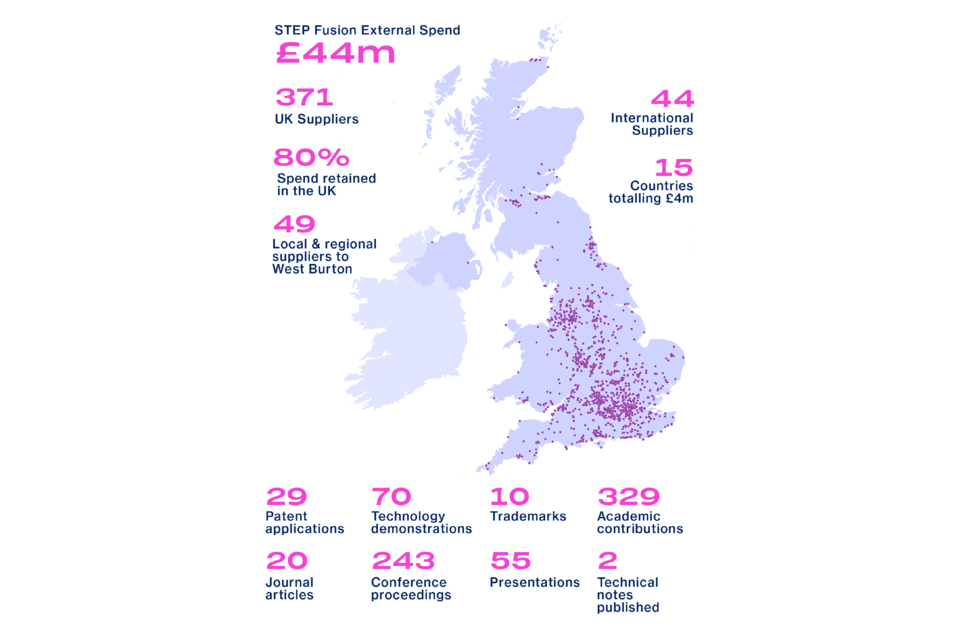
- 371 UK Suppliers
- 80% spend retained in the UK
- 49 West Burton regional suppliers
Innovation
- 329 academic contributions
- 70 technology demonstrations
- 29 patent applications
- 10 trademarks
Organisation
- Function led to programme led
- 53% workforce increase (124 to 190 staff)
- 144% follower growth across social channels (4,238 to 10,319)
3.2 Chair’s Statement
It is a great pleasure to present our Annual Report in what has been a momentous year for UK Fusion Energy Ltd (UKFE). Significant progress has been made in the design of STEP, our prototype fusion power plant. Other key achievements include the development of our strategic role as a fusion systems integrator, and receipt of very significant investment from the UK Government. We also changed our name to UK Fusion Energy Ltd, reflecting our commercial focus and supply-chain leadership.
A major milestone was the appointment of our Whole Plant Construction Partner, ILIOS. Their involvement as a strategic partner reflects our commitment to integrating world-class engineering knowledge and skills to deliver STEP and develop industrial capabilities that will underpin design and construction of future fusion powerplants.
Over the year UKFE has strengthened its executive and engineering team and is delivering on its mission on the path to demonstrate electricity production from fusion energy. In doing so, we are propagating a fusion industry and becoming a systems integrator for further fusion power plants.
To support this endeavour UKFE established its Strategy and Investment Committee. Its purpose is to develop, shape and guide our investment framework and create opportunities for significant long-term private investment, setting UKFE and STEP further on the path to commercialising fusion. I am particularly grateful to Dr. Luc Bardin as Chair of this committee for his expert leadership.
The development of STEP has established capabilities that extend far beyond the design of a single prototype powerplant. Progress in demonstrating technologies for subsystems – such as magnets, with Tokamak Energy - and the creation of new intellectual property, is producing a powerful foundation of knowledge and expertise. Design and engineering expertise is brought together through our digital engineering approach and use of AI.
This is establishing UKFE as a leading fusion systems integrator, strengthening confidence in the long-term commercial potential of the programme.
The Board is encouraged by the constructive engagement with regulators and policymakers as our safety and environmental cases continue to mature. Creating a regulatory environment that is both rigorous and proportionate is fundamental to the successful deployment of fusion energy, helping to unlock private investment, accelerate industrial participation and reinforce the UK’s position as a global leader in the development and commercialisation of fusion technologies.
Important progress was also made at West Burton, where key site decisions and early consultation activities have provided a strong foundation for gaining consent to develop the site. Beyond enabling STEP itself, these activities are helping to establish the conditions for a major new clean energy cluster that will support regional growth, attract industrial capability and contribute to the development of a broader fusion ecosystem in the UK.
None of these achievements could have been delivered without the tireless work of our brilliant engineers and problem-solvers across UKFE and in the STEP team, under the excellent leadership provided by Paul Methven and our executives, and without the wise, advice, guidance and deep strategic support of our Board. I wish to thank them all.
Prof David Gann CBE FREng, Chair UK Fusion Energy Ltd, June 2026
3.3 Chief Executive Officer’s Statement
This first full year of UK Fusion Energy Ltd (UKFE) (and the 6th year of the STEP Programme), has seen significant progress on all fronts with many elements moving from promise to delivery, especially key contracts. The company is maturing well, delivering what we said we would and making meaningful steps towards the end goal of a prototype fusion energy plant and a fusion industrial base. Against a backdrop of heightened geopolitical uncertainty and renewed focus on energy security, our focus has been on converting long-term ambition into tangible programme delivery.
The plant design has stabilised, and detail is increasing daily, with some critical innovations embedded to improve maintainability and to reduce complexity and cost. We have significantly increased our technology demonstration work, with many test rigs operating and more in manufacture and design that will provide essential data to underpin the overall plant design. We are generating IP at multiple levels and ever more quickly, with a number of innovations progressing to patent application. All this information is managed through our strong digital thread, hosted on the 3DExperience platform and backed by a strategic support contract we agreed this year with Dassault Systemes. We have also enhanced cyber security through the year, working with UKAEA Group on common systems, as well as implementing UKFE’s additional access protections. Regulatory engagement has continued very positively as our safety and environmental cases evolve, and in December 25 we submitted to DEFRA our application for The Justification of Practice for Fusion Energy, an essential step in the chain of consents and permissions we will need to build and operate the plant. DEFRA will consult on that in the coming year.
In March 26 UKAEA Group took active ownership of half of the West Burton site, now leased to UKFE to deliver STEP, and the remainder of the site will transfer ownership in 2028 when EDF complete their coal plant decommissioning work. Site characterisation continued through the year and supported a decision in November 25 to locate the Tokamak, our principal facility, in the south of the site. That decision has enabled master planning to move ahead and from January to March 2026 we ran the first, non-statutory, phase of consultation on our Development Consent Order to build the principal facilities. That was well received and has provided us with an understanding of concerns that we will work through the next year before launching the next formal stage of consultation in early 2027.
UKFE has grown through the year and now has key partners on board, making our Operating Model come to life. Our own headcount increased by 53% and we shifted from an historic functional way of working to a programme led approach.
After 3 ½ years of market engagement and competitive dialogue we appointed the ILIOS consortium as our Construction Partner for STEP. ILIOS brings deep experience in major project infrastructure delivery into our Integrated Delivery Team and will also help us refine our plant design through that lens. We also appointed our first System Partner, Tokamak Energy Ltd, who will lead on magnets. Both of these contracts, and that with Dassault, show our approach of working with the best strategic partners and evidence our aim of delivering value through industry.
Finally, I’m delighted with the continuing and increasing commitment of Government to fusion energy and STEP. This year fusion secured greatly increased funding of £2.5bn over 5 years in a challenging Spending Review, of which approximately £1.3bn will support STEP, and as the year closed the Government also published its UK Fusion Strategy 2026 which set the clear ambition for UKFE to become a global fusion plant integrator and enabled the launch of the UK Fusion Energy Ltd Strategy this April. With strategy, site and first partners in place, we are well set to drive even harder next year.
Paul Methven CB, CEO UK Fusion Energy Ltd and Senior Responsible Owner for STEP Fusion
4. Strategic Report
4.1 UK Fusion Energy and its purpose
UK Fusion Energy Ltd (UKFE) exists to deliver STEP and successive fusion power plants by acting as a national fusion systems integrator, and working with industrial partners to develop and deploy the technologies and capabilities required. UKFE will translate decades of scientific leadership into commercial leadership by leading the creation of a credible and competitive fusion industrial base.
STEP Fusion Programme
The organisation’s first task is to deliver the Spherical Tokamak for Energy Production (STEP) Fusion programme: a prototype fusion power plant to be built and operated in the UK, demonstrating the key characteristics of a commercial fusion plant including; net energy production, fuel self‑sufficiency, safety, maintainability and a credible path to economic viability.
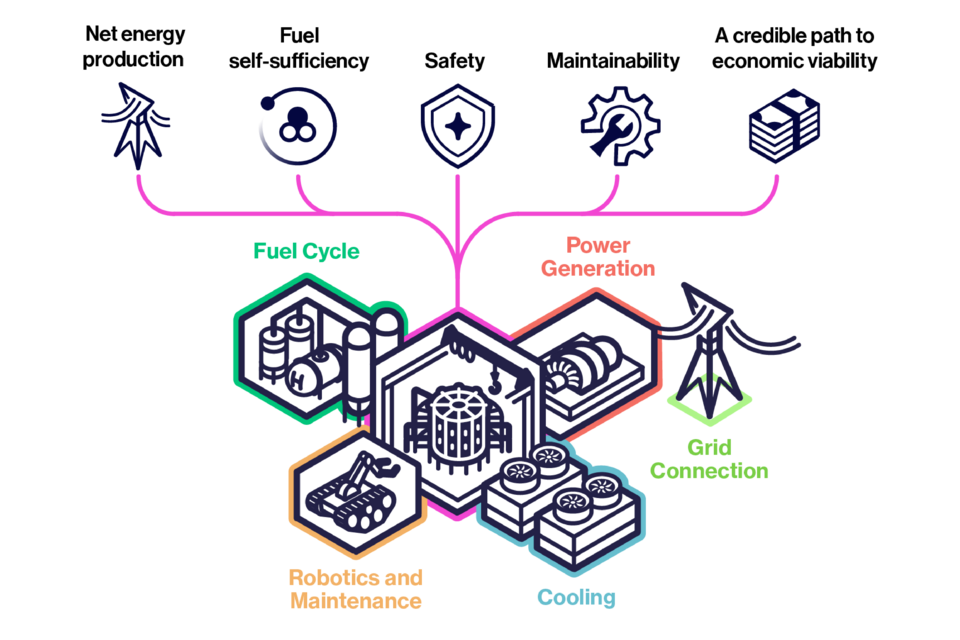
(Figure 1)
National fusion systems integrator
Through the STEP Fusion programme, UKFE will secure and develop strategic partners and a wider supply chain that can deliver successive commercial fusion power plants in the future.
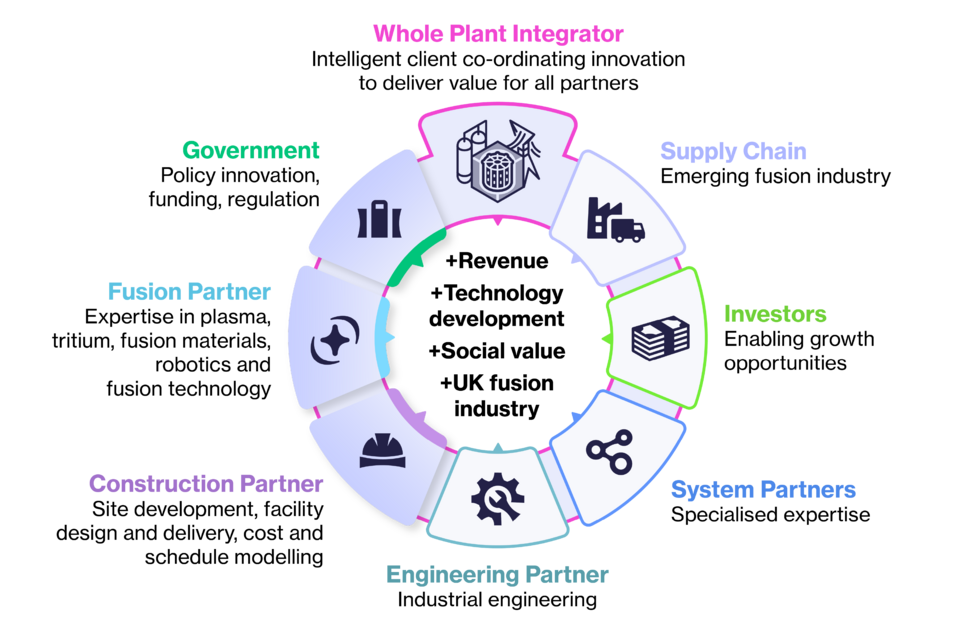
(Figure 2)
Backed by UK Government
UKFE was created as a wholly owned subsidiary of UK Atomic Energy Authority Group (UKAEA) to separate the accountability of delivery from the UK’s national fusion laboratory function of UKAEA. Within the UKAEA Group, UKFE operates as the delivery body for STEP, with UKAEA National Fusion Laboratory acting as Fusion Partner and providing deep technical, scientific and operational expertise. UKFE is sponsored by the Department for Energy Security and Net Zero (DESNZ).
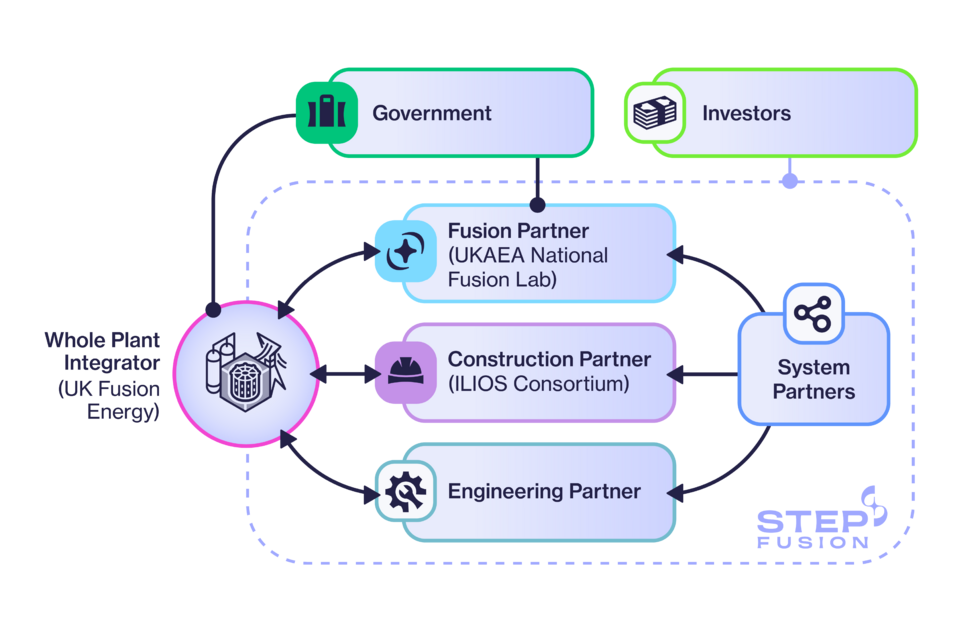
(Figure 3)
The UK Governments Fusion Energy Strategy, published in March 26, sets out the national ambition for fusion and confirms the UK’s commitment to pursuing fusion as a long‑term source of clean, secure energy. UKFE’s role is to execute that ambition by acting as an intelligent client and whole‑plant integrator, bringing together public investment, industrial capability and system design authority in a single accountable organisation.
Building capability
Delivery requires the integration of thousands of interdependent systems - including plasma, magnets, fuel cycle, heat extraction, power conversion, safety and maintenance, alongside site development, regulatory engagement and industrial mobilisation. UKFE’s operating model addresses this directly, bringing together a range of capabilities within a single integrated delivery team that is agile and innovative. UKFE combines programme control, design authority and partner integration.
Value is created throughout the journey, not only at the point of plant operation. Fusion is a tough challenge and solving it creates new technologies, products and services, not just applicable across multiple fusion programmes but well beyond. During the reporting period, UKFE focused on the first full year of Tranche 2a of the STEP programme, a deliberate mobilisation and de-risking phase designed to mature design, demonstrate critical technologies, secure the delivery site, embed programme controls and identify industrial partners. This approach reflects the UK Governments Fusion Energy Strategy’s emphasis on learning through delivery, pacing investment appropriately, and building enduring UK capability alongside programme progression.
4.2 The Year in Context
Global
During 2025/26, the global fusion landscape accelerated as multiple national programmes and private ventures transitioned from exploratory research into delivery‑led development. Internationally, governments and investors increased focus on industrial capability, delivery credibility and speed to deployment, recognising fusion as a long‑term solution to energy security and decarbonisation and also focussing on its huge potential for spin-offs and adjacent benefits in the very near term.
National
In the UK, Government commitment to fusion strengthened throughout the year. Funding stability on the backdrop of a very significant Spending Review settlement launched delivery of Tranche 2a of STEP, while confidence increased around delivery, industrial integration and readiness for subsequent phases. The publication of the UK Government’s Fusion Strategy in March 2026 confirmed the national ambition for fusion and established the framework within which UK Fusion Energy will operate going forward under its own strategy, which was published on 14th April 2026.
Organisational
UK Fusion Energy entered 2025/26 as a newly established delivery organisation, having assumed responsibility for the STEP programme from UKAEA in November 2024. At the start of the year, the organisation was completing transition from mobilisation into delivery readiness, with programme structures, controls and partner models still being embedded.
During the year, UK Fusion Energy moved decisively beyond stand‑up. Governance, assurance and programme‑led operating arrangements are now embedded and functioning routinely. The organisation operates as an integrated delivery body, combining design authority, programme control and partner integration within a single accountable structure, reflecting the needs of a first‑of‑a‑kind fusion power plant programme, and it continues to evolve to meet the fast-changing demands inherent in such a major programme.
Then - (Entering 2025/26)
- The Full Business Case for Tranche 2a had just been approved, but funding remained uncertain as the Spending Review was in progress
- STEP was refining the plant concept design
- Programme controls and baselines still evolving
- The West Burton site was under option and being characterised to help select the precise location for the tokamak facility
- The competition for key Industrial Partners had commenced
- UK Fusion Energy newly established and completing early transition milestones
Now - UKFE ends the year with (31 March 2026)
- A very significant funding settlement for fusion enabling multi-year commitments with certainty
- STEP design matured to a defined baseline ready to enter preliminary design, with many innovations embedded
- Target Operating Model defined and on track
- Competitive Dialogue concluded and the ILIOS consortium appointed as Construction Partner.
- Tokamak Energy appointed as the first System Partner just after year end
- UKFE’s strategy finalised
- The option on the West Burton site exercised and UKAEA Group took ownership of half of the site, leased to UKFE to deliver STEP with the remainder to follow in 2028
- UK Fusion Energy operating with routine governance, assurance and delivery control.
- A growing portfolio of Intellectual Property
- Tokamak location on site defined
- First stage of Development Consent Order consultation completed
Performance - What we set out to do
Tranche 2a of the STEP programme is defined as a deliberate mobilisation and de‑risking phase. The purpose of the year was not physical construction, except for many test rigs, but to establish the conditions required for delivery at scale.
Specifically, UK Fusion Energy set out to:
- Mature the STEP design from early concept to a stable baseline capable of entering preliminary design without significant change
- Establish disciplined programme fundamentals across scope, schedule, cost and risk, enabling coherent decision‑making and continued external assurance
- Demonstrate and de‑risk critical technologies through targeted testing and evidence‑led analysis
- Embed a programme‑led operating model capable of integrating industrial partners as delivery responsibility expanded
- Secure and operationalise the West Burton site as the long‑term home of STEP
- Contract strategic and system partners
- Track economic, industrial and social value generated during the pre‑construction phase
Success for Tranche 2a was therefore defined by readiness, confidence and control, rather than visible construction output.
Programme Timeline
Tranche 2a:
Design:
- Design of remountable primary magnet coils
- Detailed plasma scenario
- Integrated tokamak design and system integration approach defined
- Design of breeder blanket
Technology:
- Technology selections
- Major testing facilities established
- Technology proof of concept
- Manufacturing development programmes initiated
- Materials and supply chain de-risking programmes initiated
Capability:
- System partners engaged
- Whole plant partners onboarded and delivering
- Production facilities established
- Initial PIMS and digital backbone established
- Modelling and simulation capability embedded
Site:
- Temporary site office embedded
- Initial site preparatory works
- CDM notification of major projects
- Ash removal commenced
- DCO application submitted
- New UKFE HQ design complete
Tranche 2b:
Design:
- Full requirement set established
- Release bulk materials and long-lead items to procurement
- Design definition detail matured
- Complete design baseline and system interfaces defined
Technology:
- Progressive, at-scale technology testing alongside design and manufacturing development
- Systems technology verification
- Component and system qualification programmes underway
- Manufacturing feasibility and optimisation
Capability:
- Updating models and simulations
- Early production release
- Production facilities established
- Increasing PIMS capability
- Production supply chain mapping
- Supply chain capability proven across key materials and components
Site:
- Progressive regulatory approvals and safety case development
- Expansion and facilities development
- Pre-construction safety documentation for major construction
- Preparatory and development works
- DCO application approvals
Tranche 3:
Design:
- System integration matured and design validated at system level
- System assembly
- Full manufacturing design release
Technology:
- Full system and in-situ validation and qualification
- Iterative validation of system and component design
Capability:
- Production capability commissioned and exercised
- Increasing PIMS capability
- Continuous digital modelling, simulation and verification informing design and operations
Site:
- Pre-operations safety sign-off
- Plant assembly
- Progressive construction and system assembly
2040s:
Prototype design mature
Key technologies proven, industrialised, and protected (IP established)
End-to-end construction, delivery and operational capability established
Operational plant and plasma operations on-site
This year (2025/2026)
Site:
- Phase 3 Ground Investigation Complete
- Extension of Interim Accommodation
- Stage 1 Public Consultation Completed
- Draft Concept Masterplan
Capability:
- Construction Partner Contract Awarded
- First Systems Partner contract awarded
- Model Based Systems Engineering Development & Deployment
- Justification of Practice Application Submitted
Technology:
- Demonstration of Key plasma control principles
- Materials & Qualification Plan
Design:
- Whole Plant Review
- Fusion Technical Advisory Group Review
- Whole Plant Safety Review
- System Operating Philosophy
Technical Report
Tokamak Design Overview
Designing a fusion power plant means carefully balancing requirements of the plasma behaviour with the practical engineering limits of the machine. Because of the intrinsic uncertainties involved in integrating these complex systems, experimental validation is essential to develop viable solutions.
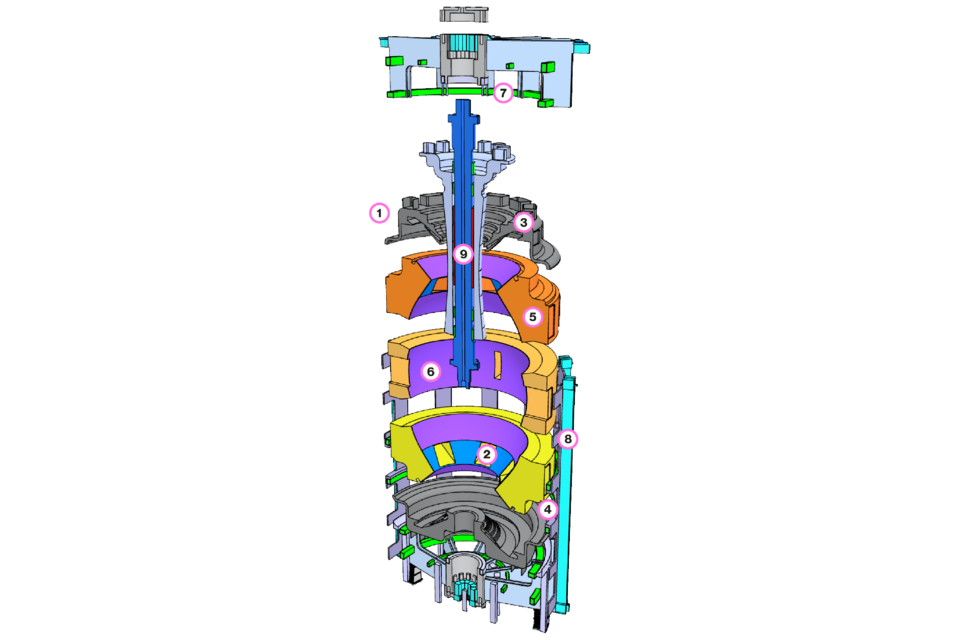
(Figure 4)
- Vacuum Vessel – Provides protection and the vacuum necessary to maintain the plasma
- Limiters – Protect the machine by enforcing an outer limit to the shape of the plasma
- Divertors & Cryopumps – Remove fusion products and heat from the plasma
- Control Coils – Correct and fine-tune the position of the plasma, and ensure stability
- Breeding Blanket – Capture neutrons to produce tritium, and transfer heat away to generate power
- Outer & Inner First Wall – Provide protection and transfer radiant heat from the plasma away from the tokamak
- Poloidal Field Coils – Help to shape and confine the plasma
- Toroidal Field Coils – Help confine the plasma, and feature remountable joints for maintenance access
- Central Solenoid – Drives current in the plasma during start-up to ensure it can be confined by the magnetic field - Diagnostics – Enable real-time measurements of the plasma and tokamak systems - Pellet Injectors – Inject new fuel into the plasma in the form of frozen pellets - External Gyrotrons – Heat the plasma to fusion conditions and drive current within it, allowing the plasma to be confined by the magnetic field in steady-state
Plasma
Building confidence through technological demonstration
Over the past year, progress in plasma science has increased confidence in several core aspects of the STEP design. In particular, work using a design known as the Super X divertor - tested on the UK’s MAST Upgrade experiment - has shown promise in safely handling the intense heat produced by the plasma.
Control
Two important challenges remain.
- The first is keeping the plasma stable and well balanced inside the machine. In 2025, novel control experiments on the Swiss TCV tokamak demonstrated the feasibility of achieving this operating condition.
- The second is preventing sudden bursts of energy at the edge of the plasma, known as Edge Localised Modes (ELMs). Experiments on MAST-Upgrade demonstrated successful control in ELMs in a spherical tokamak for the first time, marking a major step forward.
Capability
Detailed turbulence modelling under STEP-relevant plasma conditions has also improved understanding of plasma confinement. Additional microwave heating capability is planned for MAST-Upgrade to enable plasma experiments that are more representative of STEP’s operating conditions. These experiments will provide more rigorous validation of the turbulence models and are expected to help identify optimised plasma scenarios consistent with achieving net electrical power generation.
(Figure 5)
Efficiency
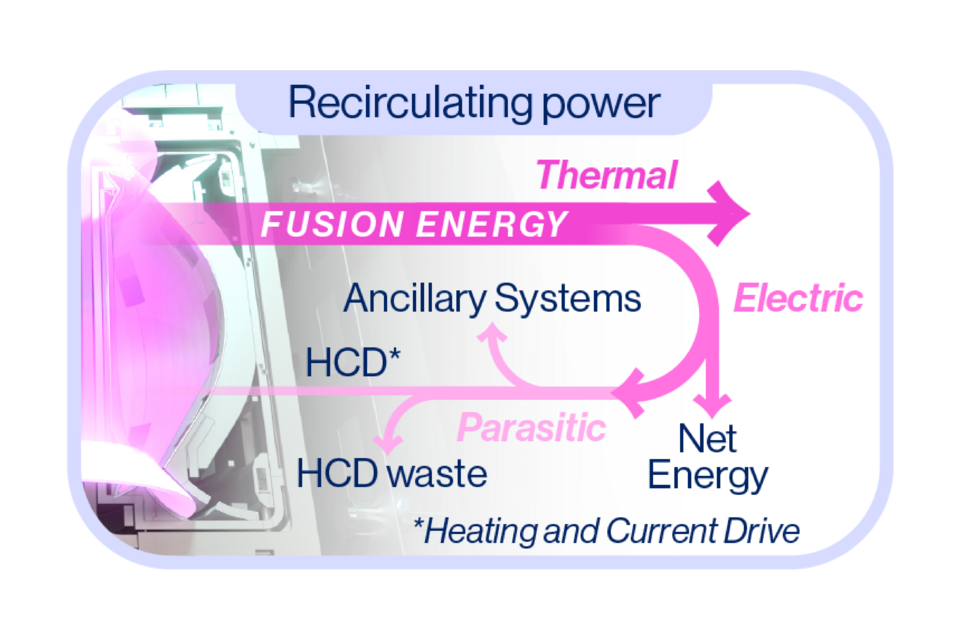
A major focus this year has been reducing the amount of power the plant needs to run itself (known as recirculating power). By improving how energy is delivered into the plasma and reducing losses, we can lower the total fusion power required. This enables a smaller, more cost-effective machine while increasing confidence in performance.
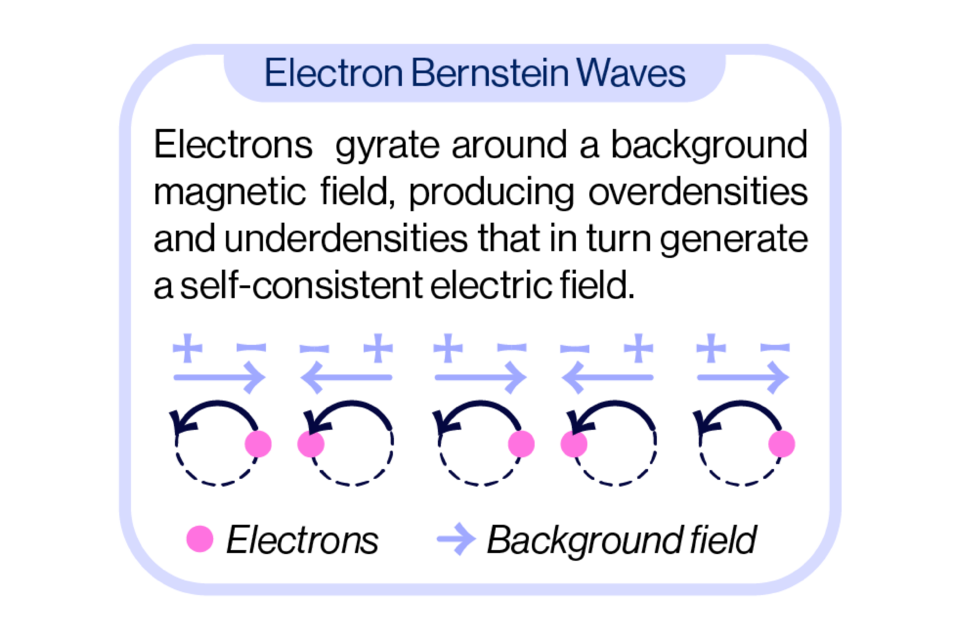
New techniques using Electron Bernstein Waves, a specialised way of sending energy into very dense plasma, could further improve efficiency and flexibility. Recent experiments performed on TCV have helped validate the approach works as expected.
(Figure 6)
Magnets
Testing and Validation
Significant progress has also been made in developing the powerful magnets needed to contain the plasma. These magnets use High Temperature Superconductors (HTS) and have been tested with encouraging results in international collaborations.
- Soel National University - Zero degradation under 70% of the worst-case Lorentz force loading conditions.
- Advance Conductor Technologies - Achieved joint resistances below those required for STEP.
- Tokamak Energy - Demonstrated effective methods for characterising superconducting tapes and cables.
The tests confirmed that the materials perform reliably under extreme forces, key components meet design targets and show good agreement with modelling predictions.
The magnet system is being designed in a modular way so the machine can be more effectively maintained. Tests for the clamping mechanism of re-mountable joints have shown they can achieve the required performance, matching predictions from computer models.
Innovation
Another key challenge is safely managing a sudden loss of superconductivity, known as a quench. Proof-of-principle testing successfully demonstrated a new self-powered heater protection concept, which uses stored magnetic energy within the coil pack to energise heaters. Experimental results again showed strong agreement with model predictions.
Manufacture of the heater system for the segmented coil arrangement, under the Sub-Scale Model Coil (SSMC) programme, is now underway following completion of the detailed design phase. Testing at representative operating temperatures is planned for the second half of FY26/27. In parallel, meaningful progress has also been made in demonstrating remote alignment of the lower coil joints, increasing confidence in the associated maintenance and handling schemes.
WEST BURTON – Establishing a National Delivery Base and Physical Home of STEP
During 2025/26, the West Burton site was actively acquired by the UKAEA Group, securing the long‑term home of STEP. UK Fusion Energy established increased operational presence at the site, progressing master planning, environmental assessment, planning engagement and early enabling works. The location of the STEP plant on site was also determined during the year, setting key baselines and assumptions for future works. Non‑statutory Development Consent Order consultation was delivered, supported by extensive community and stakeholder engagement, alongside continued ecological, geotechnical and site characterisation activity.
What changed
West Burton transitioned from a proposed location to an operational programme site with core planning assumptions. STEP activity now operates from a defined physical base, enabling design, delivery and partner mobilisation to proceed in parallel rather than sequentially.
What it enables next
UK Fusion Energy proceeds into statutory planning and construction preparation from a secured site, supporting accelerated delivery under the Strategy.
4.3 Benefits, Monitoring and Evaluation
Benefits framework
UK Fusion Energy applies a structured benefits framework aligned to the programme’s approved Whole Programme Objectives and current Business Case. Benefits are grouped into four broad categories:
- Economic and industrial benefits
Including development of UK supply chains, stimulation of private investment, and creation of high‑value capability applicable beyond fusion.
- Innovation and knowledge benefits
Including generation of intellectual property, technology transfer, and spill‑over into adjacent markets such as advanced manufacturing, digital engineering and materials science.
- Regional and social benefits
Particularly linked to the STEP site at West Burton, including skills development, local employment and contribution to regional regeneration.
- Strategic and system benefits
Including UK leadership in fusion systems integration, regulatory and delivery knowledge, and reduced risk for future fusion power plant deployment.
These benefits are expected to materialise progressively and unevenly over time. Early benefits are predominantly associated with capability building, innovation and industrial engagement, while later phases will deliver increasing economic and regional impacts.
UK Fusion Energy recognises that the value created through the STEP programme extends beyond the delivery of a prototype fusion power plant. As a first‑of‑a‑kind national infrastructure programme, STEP is designed to generate economic, industrial, social and strategic benefits throughout its lifecycle, including during early design and pre‑construction phases.
(Figure 7)
During 2025/26, the focus was on establishing clear benefit categories, ownership and monitoring arrangements, ensuring that value is identified, evidenced and reported as it emerges, rather than only retrospectively at later delivery stages.
Monitoring and Evaluation
During the reporting period, UK Fusion Energy established formal arrangements to ensure that benefits are actively managed and monitored, rather than treated as passive outcomes.
A benefits register is now in place, identifying individual benefits, their expected timing, dependencies and accountable owners. This register is reviewed through programme governance and informs both Board oversight and engagement with Government.
Monitoring arrangements distinguish between:
- Benefits that are directly attributable to UK Fusion Energy activity (for example, IP generation, procurement activity and partner engagement), and
- Benefits that are influenced by the programme but depend on wider system factors (for example, follow‑on private investment or downstream industrial growth).
This distinction ensures that reporting remains proportionate and evidence‑based, while still supporting transparency around wider programme impact.
Commercial Transition to Delivery
Objective: The objective was to appoint a construction partner who could:
- Deliver safely and reliably in a technically complex setting
- Engage early to inform design, sequencing, and delivery strategy
- Operate transparently and collaboratively
- Align with the organisation’s culture and defined behaviours
Competitive Dialogue: a structured identification process was undertaken and included:
- Early market engagement to understand capability and delivery approach
- Assessment of track record on comparable programmes
- Evaluation of technical competence, risk management, and delivery realism
- Direct engagement with senior leadership to test alignment on culture and ways of working
ILIOS was selected and the contract placed on 2nd April 2026. Mobilising is now well advanced with ILIOS being integrated into programme governance and operating arrangements.
Alongside the appointment of the Construction Partner, UK Fusion Energy made material progress in establishing its wider commercial ecosystem during the year. Contracts were agreed with Tokamak Energy as the Magnets System Partner and Dassault Systèmes as the Product Lifecycle Management Partner, providing critical capability in both physical delivery and digital integration. Together, these appointments mark the transition from exploratory market engagement to a structured, system‑partnered delivery model.
4.4 Corporate Performance Measures (CPMs)
During 2025/26, UK Fusion Energy’s Business Plan set a range of objectives and milestones. The most significant of these were the Corporate Performance Measures, designed to focus effort and drive progress across design maturity, site development, organisational capability and partner mobilisation. CPMs are deliberately stretching.
Full Business Case: (Whole Tranche) Formal commitments setting out programme-wide objectives and milestones.
Business Plan: (Four-year Horizon) Detailed delivery commitments for year one, with forward-looking priorities for years two to four. Updated annually.
CPMs: (In-year Performance) A targeted subset of business plan objectives subject to enhanced governance, detailed measurement and regular review.
The majority of CPMs were achieved or partially achieved. Where measures were not achieved in full, this primarily reflects deliberate prioritisation, dependency management, or the inherent challenges of first‑of‑a‑kind delivery, rather than loss of delivery control.
Taken together, CPM outcomes demonstrate improving delivery confidence on STEP and support the ambition for UK Fusion Energy set out in our Strategy.
Delivery is structured through a clear hierarchy of planning and milestones. The Full Business Case sets out the programme’s formal objectives and milestones, which are translated annually into a four-year rolling Business Plan and a broader set of delivery and organisational milestones supporting both in-year progress and long-term capability development.
CPM Delivery in Detail
CPM 1 & 2 - Develop the concept design and deliver planned technology demonstrations
The CPM covering development of the STEP concept design was fully achieved. The latest baseline was released in March 2026, capturing material design decisions including adoption of a direct power cycle, system architecture updates and integration trade‑offs that reduced plant complexity and improved cost and performance margins.
Supporting safety and environmental evidence was delivered through the Preliminary Safety Report and Preliminary Environmental Report, providing a coherent and proportionate basis for design progression and regulatory engagement.
The technology demonstration CPM was partially achieved. Significant progress was made across plasma control experiments, integrated technology demonstration planning, and materials and shielding testing. However, high‑heat‑flux testing of plasma‑facing components was not fully completed within the financial year due to manufacturing and supply chain constraints. These constraints were identified early, managed through iterative development cycles, and did not undermine overall design confidence.
CPM 3 - Progress West Burton site development
The CPMs relating to West Burton site development were partially achieved.
Non‑statutory Development Consent Order engagement commenced as planned, supported by extensive community, regulator and stakeholder engagement. A clear plan for DCO delivery, including biodiversity net gain approaches, was issued within the reporting period.
The final decision on the precise tokamak location on site was taken later than planned, though still in year, following further technical and regulatory due diligence. While this resulted in partial CPM achievement, the additional work reduced downstream risk and enabled site development, DCO planning and design maturity to progress from a firmer evidential baseline.
CPM 4 - Develop UKFE capability to lead and manage the STEP Integrated Delivery Team
All CPMs relating to organisational capability and transition milestones were fully achieved.
Critical roles were identified and recruited, programme‑led operating arrangements were embedded, and the foundations of an Integrated Delivery Team were established.
These outcomes confirm that the organisation transitioned from stand‑up to delivery readiness during the year, with governance, assurance, controls and ways of working operating as intended.
CPM 5 - Select and contract WPPs
The CPM covering selection and contracting of Whole Plant Partners was achieved.
The Competitive Dialogue process concluded during the year, with a preferred Construction Partner identified and all necessary internal and external approvals obtained. Contract execution occurred immediately after the reporting period. This marked a decisive shift from delivery planning to contracted delivery capability.
CPM 6 - Outline definition of the STEP supply chain
CPMs relating to supply chain definition were partially achieved. Significant analytical work was completed to map supply chain capability and identify priority engagement areas, but Board approval and formalisation of some outputs extended beyond the reporting period. Similarly, while substantive work was completed on international partnership proposals, final approvals remained dependent on government processes and were not concluded within the year.
CPM 7 - Develop International Partnerships and Third-Party Investment Proposals
CPMs relating to international partnerships were partially achieved. While substantive work was completed on international partnership proposals, final approvals remained dependent on government processes and were not concluded within the year.
What CPM performance tells us about readiness
CPM performance in 2025/26 provides clear evidence that UK Fusion Energy is operating at increased delivery maturity compared with the start of the year.
- Design development is controlled through baselined, integrated decision‑making
- Programme fundamentals across scope, schedule, cost and risk are established
- The site is secured and operationally active
- Organisational capability is embedded and ready to integrate industry partners
- Contracted delivery capability is in place
Partial CPM achievement has been transparent and purposeful, reflecting considered trade‑offs rather than under‑performance. As a result, the organisation enters 2026/27 positioned to execute delivery under the published UK Fusion Energy Strategy.
4.5 Financial Review
Overview
In 2025/26 UK Fusion Energy Ltd was initially allocated a budget of £106.4m, with an additional £13.5m of DESNZ uplifts for the full year to 31 March 2026. Outturn for the year on both capital and operating costs was within 1% of the budget at £118.8m (comprising of £106.7m operating expenditure [financial statements note 5] and £12.1m capital expenditure [financial statements note 7]).
During the year we made our first material capital investments, creating a tangible asset base and strengthening our balance sheet as a key part of our long-term strategic financial objectives.
The company also secured £1.3bn of Government investment across the 5-year period of 25/26 to 29/30, ensuring sufficient funding to deliver the Tranche 2a programme of work and beyond. The level of investment reflects the strength of the programme in delivering economic value to the UK, taking fusion from research to commercial success, generating high quality jobs, multiple spin-offs and boosting the economy nationally and in the East Midlands.
The annual accounts later in this report provide financial statements and further information, with highlights below:
Capital expenditure
At West Burton, UK Fusion Energy Ltd has spent £1.5m on the extension of office space to accommodate the additional resources as the strategic focus moves to delivery on site. £9.2m has been invested (through additional DESNZ in-year funding) in a high-performance computing centre designed to support our GPU and CPU intensive research workloads which will be housed in the region.
As part of the land acquisition of the West Burton site from EDF on 23rd March 2026 by UKFE’s parent entity UKAEA, we have recognised a £17.9m revalued right-of-use asset in relation to the 99-year peppercorn lease that we now hold which covers the development, construction, operation and decommissioning stages.
Operational expenditure
Spend with Industry:
During the year, UK Fusion Energy Ltd has increased its commercial capacity to support securing more external contracts. In support of delivery of our strategic objectives to develop the fusion supply chain, external spend with industry increased to 54% of total spend (2025/26: 47%).
Spend by programme area:
The spend focus on design development and technology demonstrations during 2024/25 continued into 2025/26 to support the activity to further mature and improve the STEP design. The proportion of spend growth as funding increased has been consistently utilised across all the main programme areas. The proportion of spend growth as funding increased has been consistently utilised across all main programme areas
2025 Total spend by Programme = £35.4m
£24.4m design & technology
£3.2m UKFE delivery
£3.2m site mobilisation
£2.7m Digital capability
£1.8m Programme delivery
2026 Total spend by Programme = £106.7m
£69.1m design & technology
£12.7m UKFE delivery
£11.3m site mobilisation
£8.4m Digital capability
£5.2m Programme delivery
4.6 Principal Risks and Uncertainties
This section outlines the risk profile of the organisation. Detail on UKFE approach to risk management and control is included in the Accountability Report.
Navigating Uncertainty in a First-of-a-Kind Endeavour
The UKFE and STEP Fusion programme operating model recognises that uncertainty is intrinsic; nobody has yet solved the fusion energy challenge and so our structures and delivery approach are designed to accommodate and capitalise on this: phased delivery enables management of uncertainty through tranches, building capability while delivering value at each stage. The programme is structured to evolve, with each tranche delivering tangible outcomes while informing and reducing risk for the next. A critical part of each tranche is mobilisation for the subsequent tranche, as demonstrated during FY25/26 through appointment of ILIOS as Construction Partner and procurement of the West Burton site.
UKFE Risk Appetite
Prior to establishment of UKFE the STEP programme followed the UKAEA Public Sector Research Establishment (PSRE) risk management approach, including scoring scheme and risk appetite. With establishment of UKFE and transfer of STEP programme responsibility in November 2024, a revised risk scoring scheme and risk appetite statement, which recognised the differences between STEP (as a major programme) and UKAEA PSRE (as a national laboratory) was agreed. The current UKFE/STEP risk appetite is shown below.
Very Low (Averse)
Zero tolerance; avoidance of risk is a priority:
- Fraud and financial compliance
- Safety and health of people
- Compliance with legislation
Low (Minimalist)
Forced or very low tolerance; preference for very safe options with minimal risk where potential benefit/reward is not a key driver
- Values, culture and behaviours
- Ethical
- Security
- Information management and integrity
- On site operations
Moderate (Cautious)
Limited/balanced tolerance; preference for safe options with some risk tolerated where justifies rewards.
- Budget
- Protection of environment
- Intellectual property
- Reputation of public relations
- Compliance with non-legislative requirements and good practise
- Property
- Programme management
- Commercial
High (Open)
Willing to consider all potential options and choose the one most likely to result in successful delivery even when risks are high.
- Policy development
- External investment and business development
Very High (Bold)
Eager to be innovative and choose activities offering potentially very high rewards even if these activities carry very high risk.
- Technology development and engineering definition
Strategic Risk Landscape
The STEP programme and UKFE strategic risks reflect the scale and complexity of the challenge. These risks are actively managed through a structured framework, with clear ownership, defined mitigations, and regular review. The most significant risks, those that could impact the programme’s ability to deliver its mission and Whole Programme Objectives (WPOs) or UKFE operation as a company as part of UKAEA Group are summarised below, alongside previous, and future mitigation actions.
| Risk | Appetite | Mitigations | Trend |
|---|---|---|---|
| Design Solution (Technical Viability): Inherent complexity and uncertainty in the design and technology demonstrations. | Very High | Completion of concept design and entry into Preliminary Design phase during FY25/26. Independent review by the Fusion Technical Advisory Group recognised quality and depth of work, while highlighting the need for clearer decision criteria for risk‑based progression. Remaining novel technical challenges are prioritised within future work programmes, Including technology demonstration activity. | Stable |
| UKFE Compliance: UKFE discharging of legal and regulatory compliance to UKAEA Group or Government. | Very Low | Establishment and maturation of UKFE corporate capability, including appointment of Company Secretary, Director of Safety, Quality and Mission Assurance and Head of Legal. Completion of internal audits covering partner relationships, corporate services and enterprise risk management. Strengthening of governance and assurance arrangements. | Improving |
| Stakeholder Support: Shifts in the national/international environment reduce long-term support. | High | Strong and sustained stakeholder engagement through the year. Key achievements include Full Business Case approval, £2.5bn funding allocation in Spending Review 2025, publication of the UK Fusion Strategy (March 2026), and transition from UKIFS to UKFE. There remains positive engagement with local communities and authorities at West Burton through DCO Stage 1 and Supercluster activity. | Improving |
| Regulatory Environment: Regulatory evolution constrains innovation or adds cost/time. | Moderate | Proactive and sustained engagement with regulators and Permissioning bodies, including HSE, EA and Historic England. UKFE led development of a new Justification of Practice for fusion energy in the UK. While not focussed on Fusion, the Governments Nuclear Regulatory Review recommendations, accepted by Government, are supportive and offer wider opportunities for UKFE and STEP. Focus in FY25/26 is supporting development of the fusion regulatory framework, preparation at West Burton and DCO statutory engagements. | Improving |
| Partner Performance: Delivery performance of Whole Plant Partners. | Moderate | Strengthened fusion partner governance, assurance and delivery, including internal audits and business‑to‑business relationship assessments. Completion of Competitive Dialogue and appointment of ILIOS as Construction Partner in March 2026. Focus now shifts to embedding partner capability into the programme‑led operating model and Integrated Delivery Team. | Stable |
| Third-Party Investment: External investment not attracted into STEP. | High | Development of the UK Fusion Strategy and UKFE Strategy, positioning UKFE as integrator of STEP and future fusion power plants. Strong market and industry response, reinforcing the UK’s attractiveness for fusion investment. Planned development of a structured investment prospectus aligned to increasing delivery confidence. | Improving |
| Fusion Supply Chain Development: Inability to catalyse a competitive UK fusion industry. | Moderate | Appointment of ILIOS as Construction Partner was a major success. Following consideration, it was decided not to appoint an Engineering Partner at this time. The relevant capability is being addressed through market-led sourcing, for example Tokamak Energy as Magnets Champion. Other system partner contracts are expected in FY26/27 and further market testing for an EP will be conducted in later years. | Improving |
| Delivery Capacity & Capability: Insufficient capacity or competence across UKFE and partners. | Moderate | Growth of UKFE to ~200 FTE and ~470 FTE across STEP overall. Completion of key senior appointments, including Chief Commercial Officer, Director of Safety, Quality and Mission Assurance and Director of Organisational Performance. Definition of the programme‑led operating model and transition towards a full Integrated Delivery Team. Expansion of West Burton site accommodation to support growth. | Improving |
| West Burton Site Viability: Site becomes non-viable due to physical, legal, or stakeholder issues. | Moderate | Extensive site characterisation, environmental and geotechnical studies, and stakeholder engagement. Completion of non‑statutory DCO engagement and confirmed plant location decision. Acquisition of the site by UKAEA Group. Detailed enabling works and statutory DCO phase are planned for FY26/27, along with increase on and off-site STEP development. | Improving |
| Information Management and Cybersecurity: Loss of sensitive data and/or Intellectual Property. | Low | Significant investment in information security and business resilience capability, including dedicated internal leads. Enhanced corporate IT provision via UKAEA, establishment of a Security Operations Centre, and progression of the Plant Information Management System. Ongoing strengthening of controls and monitoring. | Improving |
While currently described as threats, each of the risk themes above also carry significant opportunities, which, if managed correctly, generate significant benefits. For example, maturity of the design solutions will generate IP, patents, etc., and while lack of a supply chain generates delivery threat, there is a massive industrial, economic, and social opportunity to build a new industry based in the UK. As risks (threats) are managed and mitigated, benefits (as identified in the Full Business Case) will mature and progressively be realised.
4.7 Environment & Sustainability
Overview and Governance
UK Fusion Energy (UKFE) manages its environmental responsibilities within the UK Atomic Energy Authority’s (UKAEA) ISO 14001‑certified Environmental Management System, providing a structured framework for environmental risk management, regulatory compliance, and continual improvement. Environmental considerations are integrated into programme governance, risk management, and design assurance processes to ensure the responsible use of public resources as the STEP programme matures.
As a pre‑construction programme during FY25/26, UKFE’s environmental performance data is captured within UKAEA’s Culham site reporting boundary. Consequently, this section provides a narrative assessment of governance, risks, and readiness rather than quantitative performance metrics. With the acquisition of the West Burton site in March 2026, UKFE will develop site‑specific environmental metrics for future reporting cycles.
Principal Environmental Risks and Dependencies
The development of a first‑of‑a‑kind fusion power plant presents a distinct environmental risk profile. The principal environmental risks and dependencies managed during FY25/26 include:
- Carbon emissions associated with future construction activities and materials selection
- Water abstraction, flood risk, and groundwater vulnerability, particularly in relation to site development at West Burton
- Biodiversity impacts, including compliance with statutory Biodiversity Net Gain (BNG) requirements
- Land availability for mitigation and environmental offsetting
- Regulatory approvals and permits, including engagement with the Environment Agency (EA), Natural England, and the Planning Inspectorate (PINS)
These risks are managed through early design integration, environmental assessment, structured regulator engagement, and alignment with UKAEA’s environmental governance processes.
Sustainability and Carbon Management
During FY25/26, UKFE made significant progress in embedding whole‑lifecycle and carbon‑informed decision‑making across the programme. A methodology to quantify and manage lifecycle carbon was developed to support early design decisions, recognising that material and construction choices made at this stage will have long‑term environmental consequences.
Lifecycle thinking and Design for Environment principles are being progressively embedded into engineering and programme assurance activities, with a focus on materials efficiency, construction impacts, operational performance, and end‑of‑life considerations. A draft lifecycle carbon model was produced to provide an indicative view of carbon expenditure across the programme and to inform early governance decisions. This model will be refined and integrated into UKFE’s digital design environment during FY26/27 to enable improved forecasting and scenario analysis as design maturity increases.
Regulatory Engagement and Planning
UKFE maintained regular and constructive engagement with the UK’s fusion regulators - the Environment Agency and the Health and Safety Executive - throughout FY25/26. This engagement supported shared understanding of regulatory expectations for a first‑of‑a‑kind fusion facility and enabled early consideration of proportionate regulatory approaches as the design develops.
To support long‑term planning and regulator capacity, UKFE entered into three‑year charging agreements with both regulators during the year, providing greater certainty and transparency as the programme progresses.
Non‑statutory Development Consent Order (DCO) engagement commenced in early 2026, and the Justification of Practice submission was completed in December 2025. Preparation of the Environmental Impact Assessment Scoping Opinion is underway, ahead of planned statutory consultation in FY26/27.
Ecological surveys completed:
- Breeding birds
- Badger
- Bats
- Botanical & Hedgerow
- Arboriculture
- UK habitats (Biodiversity assessment)
- Reptiles
- Invertebrates
- PSYM & Macrophytes
- Fish
- Newt
- River morphology
- Hydrographic surveys
- Macroinvertebrates & Diatoms
West Burton Site
In March 2026, UKAEA Group exercised its option to acquire the West Burton site. Approximately half of the 330 hectare site transferred fully to UKAEA Group ownership and the remainder will follow automatically when EDF complete their ongoing decommissioning of the old coal fired power station. Management arrangements were put in place and UKFE operate as a tenant with full Construction Design Management (CDM) accountability for work on the transferred parts of the site. Environmental monitoring, surveys, and watching briefs continued throughout FY25/26 to ensure that ecological, hydrological, and heritage sensitivities are well understood and inform the emerging site masterplan.
Flood and groundwater risk assessments have been initiated, reflecting known localised risks. As permanent construction has not yet commenced, climate change adaptation measures will be fully incorporated as design and construction planning progresses during FY26/27, supported by the programme’s construction partner.
Progress was also made in planning for Biodiversity Net Gain (BNG) requirements, including habitat mapping, baseline condition assessments, and identification of mitigation approaches. An updated BNG plan was developed during the year, setting out UKFE’s commitment to meeting updated statutory requirements ahead of the DCO submission.
No UKFE environmental incidents were recorded at West Burton during FY25/26. Emergency preparedness arrangements will be developed further as UKFE assumes fuller operational control of the site during the next reporting period.
Sustainability Reporting and Future Compliance
UKFE aligns its environmental reporting with Managing Public Money, FReM, and UKAEA’s corporate reporting framework. While UKFE is not yet subject to mandatory climate disclosure thresholds, early adoption of Task Force on Climate-related Financial Disclosure (TCFD) aligned reporting principles remains a priority as operations expand.
During FY26/27, UKFE will continue to develop its environmental management arrangements to support future reporting against UK Sustainability Reporting Standards and ISSB requirements, including clearer identification of climate‑related risks, adaptation measures, and financial impacts as the programme transitions from design to delivery.
Site characterisation work
- Ongoing borehole (gas and groundwater) monitoring
- River Trent flow observations
- Site wide topographical survey
- Site wide buried utilities survey
- Noise monitoring
- Aire quality monitoring
- Weather monitoring
- 2D & 3D drone mapping and surveys
- Continued ground investigation works
Site mobilisation
- Flue Gas Desulfurisation (FGD) units from the side of chimneys have been processed/removed following previous blowdown.
- Turbine hall is undergoing processing after previous demolition event.
- Modular offices have been lifted into place and are undergoing internal fit out.
- Biomass facility/conveyor has been removed and processed.
- Rail loop has been completely removed as part of the Brown & Mason demolition contract.
- Ash extraction by Hargreaves has now expanded.
4.8 Our People, Our Culture, Our Values
Delivery success depends not only on technical and programme excellence, but on establishing a clear, consistent culture across an increasingly complex, multi‑partner environment.
During the year, we developed our workforce, strengthening delivery-critical capability, embedding workforce control, and advancing the culture and leadership agenda aligned to the Target Operating Model (TOM). Recruitment progressed at pace to support STEP Tranche 2a, with over 100 priority and specialist roles filled across engineering, programme delivery, assurance and enabling functions, while overall headcount and attrition remained tightly controlled.
A zero-based baseline review and enhanced workforce reporting improved executive grip on capacity, vacancies, contingent labour and prioritisation, enabling more informed decision-making and compliance with pay remit expectations. Leadership capability was materially strengthened through key senior appointments, supporting safe, high-performance delivery as the organisation scaled.
UKFE has defined and embedded three cultural imperatives that drive day‑to‑day delivery across the organisation and its delivery partners.
Cultural Imperatives
Best for Programme: Prioritising whole‑programme outcomes over functional, organisational, or personal preferences.
Guided Empowerment: Acting confidently within a clear mandate, with appropriate delegation and support.
Friendly Professionalism: Producing high-quality work, and engaging stakeholders and partners collaboratively
Values
- We champion safety
- We all matter
- We act as one
- We embrace change
- We are pioneering
- We deliver
Behaviours
- Safety-orientated
- Accountable
- Compassionate
- Inclusive
- Collaborative
- Communicative
- Adaptable
- Resilient
- Courageous
- Innovative
- Focused
- Efficient
4.9 Section 172 (1) Statement
This statement sets out that the directors of the company have acted in the way that they consider, in good faith, would be most likely to promote the success of the company for the benefit of its members, as required under the Companies Act 2006.
In exercising their duties to promote the success of the company, the directors have considered:
- the likely consequences of any decision in the long term
- the interests of the company’s employees
- the need to foster the company’s business relationships with suppliers, customers and others.
- the impact of the company’s operations on the community and the environment
- the desirability of the company maintaining a reputation for high standards of business conduct
- the need to act fairly between members of the company.
Further detail around how the directors have met these requirements can be evidenced in the Environmental Sustainability Report and key performance indicators sections of the Strategic Report, as well as in the Directors’ Report and Governance Statement within the Accountability Report.
Approved by the Board on 20th August 2026 and signed on 20th August 2026 on its behalf by:
Paul Methven CB, CEO, UKFE Ltd
5. Accountability Report
5.1 Directors’ Report
The directors present their report together with the financial statements of the company for the year ended 31 March 2026. The company is registered in England and Wales and has registration number 14620804.
UK Fusion Energy Ltd (UKFE) is a private company, limited by shares, registered in England and Wales, and is a wholly owned subsidiary of the UK Atomic Energy Authority (UKAEA). These accounts cover the financial year 1 April 2025 to 31 March 2026.
Directors
Directors are those Officers of the Company as appointed on Companies House.
Dr. Luc Bardin, Non-Executive Director
Dr. Tim Bestwick OBE, Chief Executive Officer, UKAEA (from 1st August 2025)
Prof. Sir Ian Chapman, Non-Executive Director (Chief Executive Officer, UKAEA until 31st July 2025, Non-Executive Director for full year)
Prof. David Gann CBE, Non-Executive Chair
Grazka Kazmierska, Finance Director
Paul Methven CB, Chief Executive Officer
Julie Nerney, Non-Executive Director
Kaveh Pourteymour, Non-Executive Director
John Staples, Non-Executive Director
Prof. Charlotte Valeur, Non-Executive Director
Following Prof. Sir Ian Chapman’s departure as UKAEA CEO on 31 July 2025, Dr. Tim Bestwick OBE became the UKAEA Group CEO. He was appointed as a UKFE Director on 1 August 2025 and is the UKFE Accounting Officer. Prof. Sir Ian Chapman remains on the UKFE Board as a Non-Executive Director.
Conflicts of Interest – The UKFE Board
Board members update UKFE Ltd on conflicts of interest on appointment and when they arise. All business interests are disclosed and recorded in the Register of Interests. Should a conflict be identified, members are excluded from the affected part of the meeting and prevented from receiving any relevant materials where appropriate.
Duty to promote the success of the Company
Through their roles, the directors act in line with their duty to promote success of the company. The best interests of the company are paramount in decisions taken by the Board and the directors also recognise their collective responsibility to foster the company’s business relationships with suppliers and other stakeholders, through their decision making.
Principal activities
The principal activities of UKFE Ltd are set out in the Strategic Report.
Dividends
The Company did not pay a dividend for FY 2025/26 (2024/25: £nil).
Company policy on payment of creditors
UKFE supports the Better Payment Practice Code in its treatment of suppliers with the aim of paying undisputed invoices as soon as possible. The key principles are to settle the terms of payment with suppliers when agreeing the transaction, to settle disputes on invoices without delay and to ensure that suppliers are made aware of the terms of payment and to abide by those terms.
Monitoring of payments made during the year ended 31 March 2026 shows that 96.2% of approved invoices were paid within 30 days of invoice receipt (2024/25: 94.6%).
No claims were made against UKFE Ltd in 2025/26 for the late payment of invoices under the Late Payment of Commercial Debts (Interest) Act 1998.
Charitable and political contributions
UKFE made no charitable or political contributions during the reporting period.
Disclosure of information to auditors
As far as the directors and the Accounting Officer are aware, there is no relevant audit information of which the auditors are unaware. The directors and accounting officer have taken all necessary steps required to make themselves aware of any relevant audit information and to establish that the auditors are aware of that information.
Approved by the Board on 30th July 2026 and signed on 30th July 2026 on its behalf by:
Prof. David Gann CBE, Chair, UK Fusion Energy (UKFE) Ltd
5.2 Statement of Directors’ and Accounting Officer’s responsibilities
The Directors and Accounting Officer are responsible for ensuring that the Annual Report and financial statements are prepared in accordance with applicable law and regulations and that proper accounting records are maintained that disclose, with reasonable accuracy at any time, the financial position of UKFE Ltd and which enable them to ensure that the financial statements comply with the Companies Act 2006. They are also responsible for safeguarding the assets of the company and for taking reasonable steps for the prevention and detection of fraud and other irregularities.
The Directors and Accounting Officer are responsible for the maintenance and integrity of the corporate and financial information included on the company’s website. The accounts are prepared on an accruals basis and must give a true and fair view of the state of affairs of UKFE Ltd and of its income and expenditure, Statement of Financial Position and cash flows for the financial year.
In preparing accounts, the Directors and Accounting Officer are required to comply with the requirements of the Government Finance Reporting Manual (FReM) and the Companies Act 2006, and in particular to:
- observe the accounts direction issued by the Secretary of State DESNZ, including the relevant accounting and disclosure requirements and apply suitable accounting policies on a consistent basis
- make judgments and estimates on a consistent and reasonable basis
- confirm that applicable accounting standards as set out in the Government FReM have been followed and disclose and explain any material departures in the financial statements.
- prepare the financial statements on a going concern basis
- confirm that the Annual Report and Accounts is fair, balanced and understandable and take personal responsibility for the Annual Report and Accounts and the judgements required for determining that it is fair, balanced and understandable
The DESNZ’s Principal Accounting Officer, acting on behalf of HM Treasury, has designated the Chief Executive Officer of UKAEA as the Accounting Officer of UKFE Ltd. The responsibilities of an Accounting Officer, including responsibility for the propriety and regularity of the public finances for which the Accounting Officer is answerable, for keeping proper records and for safeguarding UKFE’s assets, are set out in Managing Public Money published by the HM Treasury.
Fair, balanced and understandable requirement
The Accounting Officer confirms that the Annual Report and Accounts are fair, balanced and understandable and takes personal responsibility for the Annual Report and Accounts and the judgments required for determining that they are fair, balanced and understandable.
As the Accounting Officer and CEO of UKFE Ltd we have taken all reasonable steps to make ourselves aware of any relevant audit information. To the best of our knowledge, there is no relevant audit information of which the auditors are unaware.
Signed on behalf of the Board.
Dr. Tim Bestwick OBE, Accounting Officer, UKAEA Group
Paul Methven CB, CEO, UK Fusion Energy (UKFE) Ltd
5.3 Governance Statement
Scope of responsibility and purpose of the governance statement
As CEO of UKFE Ltd, I have delegated responsibility from the UKAEA Group Accounting Officer for maintaining a sound system of governance and internal control that supports the achievement of UKFE Ltd policies, aims and objectives, whilst safeguarding public funds and assets. This Governance Statement, for which I am personally responsible, sets out how I have discharged my responsibility to manage and control UKFE resources during the period from 1 April 2025 to 31 March 2026. It sets out the governance framework and control structure of UKFE, its stewardship and corporate governance, and the framework in place to evaluate the effectiveness of the risk management process.
Corporate Governance
UKFE Ltd is a company limited by shares and is a wholly owned subsidiary of the UK Atomic Energy Authority. In 2025/26 UKFE has continued to operate under the corporate governance structure established at set-up of the Company in November 2024, with some strengthening of processes and governance where a need has been identified through continuous improvement.
Corporate Structure Document
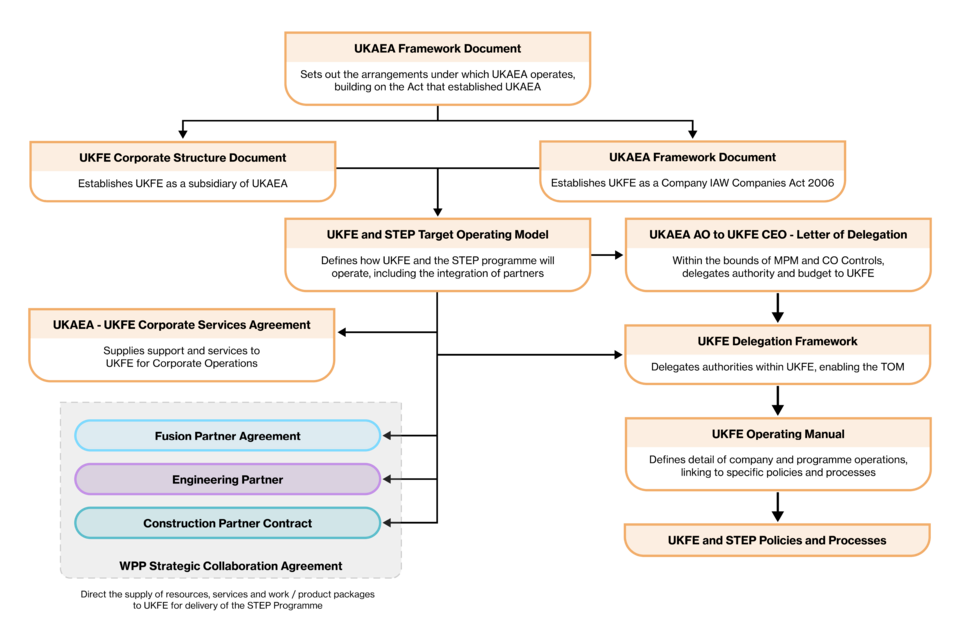
The UKFE Corporate Structure Document sets out the overall governance framework and formal operating relationships between UKFE and UKAEA Group in its role as Shareholder. It establishes the Company’s core responsibilities and establishes a reference point to support both UKFE and UKAEA in how they make key decisions. The Delegated Authority Letter from the UKAEA Group Accounting Officer to the UKFE CEO further sets out the transfer of formal delegated spending authorities and budget allocations within specific limits and guidelines. The UKFE Delegation Framework delegates these authorities within UKFE, with financial and commercial approvals underpinned by system controls.
Key Documentation outlining the UKFE operating structure and relationship with UKAEA
The UKFE Corporate Structure Document and Delegated Letter of Authority sit within a hierarchy of key documents and processes that support the UKFE Target Operating Model and the Company’s relationship with UKAEA Group. Key elements of these procedures and agreements support the corporate governance framework in UKFE and in delivering compliance and providing assurance to the Group and are referred to as relevant in this Statement.
UKFE Target Operating Model – Documentation Hierarchy and Relationships
(Figure 8)
UKFE maintains a suite of policies to support the effective running of the organisation, establish clear standards, guide decision-making, support the UKFE control framework and ensure compliance with laws, regulations and relevant public sector requirements.
For many policies and processes in current operation, UKFE has adopted the relevant UKAEA position and many of the activities that support those processes are still undertaken by UKAEA under the Corporate Services Agreement, though accountability rests with UKFE. Therefore, UKFE takes considerable assurance from UKAEA’s compliance with its arrangements.
Over the year as it has matured as an organisation, UKFE has revised some of these policies to ensure an effective, efficient and controlled operating environment for UKFE to deliver its mission, progressively moving towards a programme led (rather than functionally led) way of working. Whilst UKFE is responsible for maintaining its own suite of policies, it pays due regard to impacts on controls, assurance and provision of services through the Corporate Services Agreement when revising or updating policies.
Management Information and Quality of Data
UKFE monitors and reviews its strategic reporting to ensure high quality management information is supplied to the Executive and the Board. Through the reporting period, information was produced and supplied by both UKFE itself and UKAEA, through the Corporate Services Agreement. The quality and timeliness of information is considered to be acceptable and has allowed the Board to make informed decisions and receive adequate assurance on both programme and company matters. UKFE ensures that its management information and reporting arrangements are subject to review and continuous improvement in order to make the most effective use of data and technology to better support delivery of the programme and further the aims of the Company. A finding from the internal Board Evaluation exercise undertaken in the summer noted that in some areas papers would benefit from more clarity, brevity and strategic focus, and this has been fed back into the business.
Compliance with Corporate Governance in Central Government Departments: Code of Good Practice
UKFE has reviewed its compliance with the provisions of corporate governance in central government departments: Code of Good Practice April 2017, and assesses that it complies with the code, with the following explained exceptions:
| Provision | Explanation |
|---|---|
| 5.5 The head of internal audit should periodically be invited to attend board meetings, where key issues are discussed relating to governance, risk management processes or controls across the department and its ALBs. | The UKAEA Group Head of Internal Audit attends the Audit and Risk Assurance Committee and has unfettered access to Board members. |
| 5.14 The terms of reference of the audit and risk assurance committee, including its role and the authority delegated to it by the board, should be made available publicly. | The terms of reference of the audit and risk assurance committee are not available on the UKFE website as it is a private limited company rather than a government department. |
Governance Model
The key Corporate Layer Governance bodies within UKFE are as follows. All are in operation with agreed Terms of Reference and have full membership. In August 2025 UKFE set up a new sub-committee of the UKFE Board – the Strategy and Investment Committee – to develop the UKFE strategy and to exploit opportunities and realise value as the Company evolves.
- UKFE Board: Led by an independent non-executive Chair, this fiduciary Board provides strategic leadership and oversight of the Company (both as a limited company and as a subsidiary of a Non-Departmental Public Body (NDPB)) and therefore of the company’s current sole programme, Spherical Tokamak for Energy Production (STEP). The Board also comprises a Shareholder Representative (UKAEA CEO / AO), a Sponsor Department Representative (Director of Fusion and Advanced Nuclear Energy), the UKFE CEO, UKFE Finance Director and other independent Non-Executive Directors.
- Audit and Risk Assurance Committee (ARAC): A committee of the UKFE Board, the role of the UKFE ARAC is to support and advise the UKFE Board and the UKFE CEO by independently overseeing audit and compliance, and reviewing the approach taken to the management of risks including but not limited to the integrity, efficacy and effectiveness of all matters relating to sound systems of internal control, including, but not limited to the safety, health and environmental (SHE) management system, the risk management processes, the integrity of the financial statements, and the UKFE annual report. The ARAC also reviews the approach taken to maximising opportunities to generate value and growth.
- People and Culture Committee (PCC): A committee of the UKFE Board with responsibility for ensuring the proper and effective composition of the Board and designing and determining the policy for remuneration for the Chair, Non-Executive Directors, Executive Directors and the next level of senior management, including any person appointed as UKFE Company Secretary. It will also maintain oversight of the UKFE People agenda, organisational culture, and workforce development, as well as ensuring equality, diversity and inclusion (ED&I) remain at the forefront of the programme.
- Strategy and Investment Committee (STIC): A committee of the UKFE Board with a focus on developing and making recommendations on the future strategic direction of the Company, determining how UKFE can maximise and realise value as the Company evolves, ensuring that risks and opportunities related to strategy and investment are effectively managed and exploited. This committee was set up in September 2025.
- UKFE Executive Committee: Chaired by the UKFE CEO, this body manages the day-to-day operations of UKFE, within the boundaries set by the founding documents and the delegations received from the UKAEA AO. It focuses on ensuring the capability needed to deliver the STEP Programme is in place as well as the effective and compliant operation of the Company, leaving the Programme Board to focus on STEP delivery.
- The STEP Programme Board: A sub-committee of the UKFE Board, chaired by the STEP Senior Responsible Owner (SRO) who is also the UKFE CEO, this body supports the SRO in managing the STEP Programme as part of the Government Major Projects Portfolio (GMPP), taking inputs on the enabling capability of UKFE as a Company but focusing on programme delivery.
- UKFE Contract Permissioning Panel: Reporting to the UKFE Executive Committee, this Panel is the UKFE Approving Authority for significant Packages to be placed with Whole Plant Partners or any other external suppliers.
UKFE Governance Structure in 2025/26
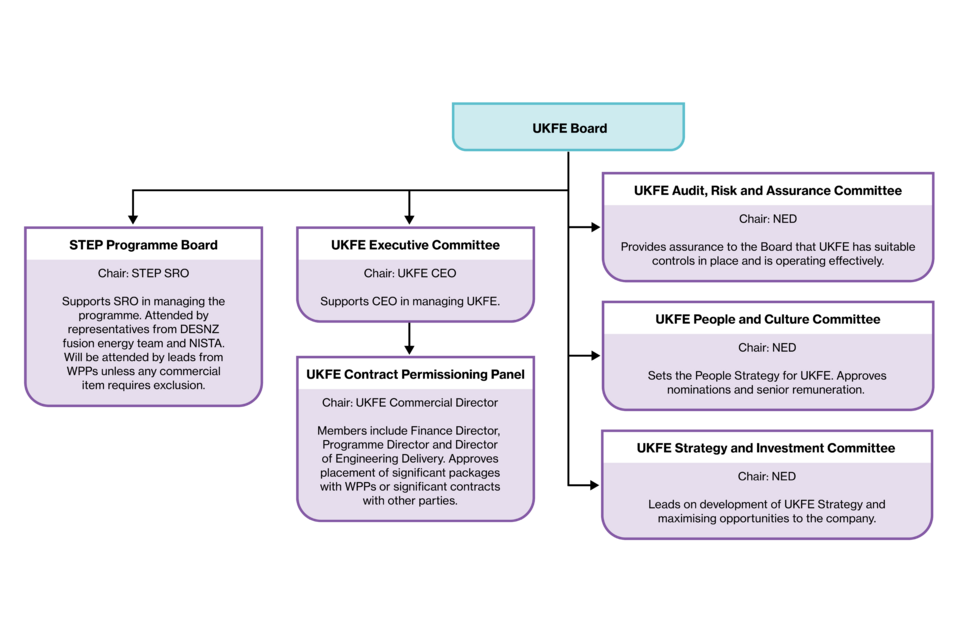
(Figure 9)
In addition, the UKFE Risk and Change Committee (RCC), a sub-committee of the Programme Committee, reviews both programme and corporate risks monthly, and changes to programme deliverables and scopes of work, with escalation as necessary into the STEP Programme Board and the UKFE Executive Committee. In March 2026 the RCC agreed updated Terms of Reference with a change of name and scope to the Risk and Opportunities Committee. From next year, change will be managed through appropriate Company or Programme governance depending on the type of change and the Risk and Opportunities committee will consider management of opportunities as well as risk.
Risk Management
In 2025/26 UKFE continued to develop its approach to managing both company and programme level risks and to increase maturity in its Enterprise Risk Management (ERM) processes. UKFE operates a three-tier risk management framework aligned with the STEP programme’s phased delivery model:
- Tier 1 (Strategic Risks): Long-term risks to STEP mission delivery and UKFE’s organisational viability. Such risks are owned by UKFE Directors and Executives and reviewed monthly.
- Tier 2 (Tranche Risks): Risks specific to the current tranche (e.g. Tranche 2a). Generally owned at Senior Leadership levels and reviewed by UKFE Executive Committee or STEP Programme Committee.
- Tier 3 (Project Risks): Operational or Project level risks owned and managed by delivery teams, often technical leads. Reviewed monthly at the Programme Steering Team.
UKFE has a risk management strategy and plan, forming part of the wider UKFE Operating Manual, and reviews risks monthly within the Executive at the Risk and Change Committee (RCC), which reports directly to the Programme Board and the UKFE Executive Committee on strategic level risks. A risk report has been reviewed at each Audit Committee, as well as specific deep dives on effective management of key strategic risks. The Board’s agenda includes scrutinising and advising on risk management bi-annually, and the Board reviewed a UKFE Strategic Risk update in October 2025.
The UKFE risk assessment and escalation approach assesses and escalates risk through the tiers as outlined below:
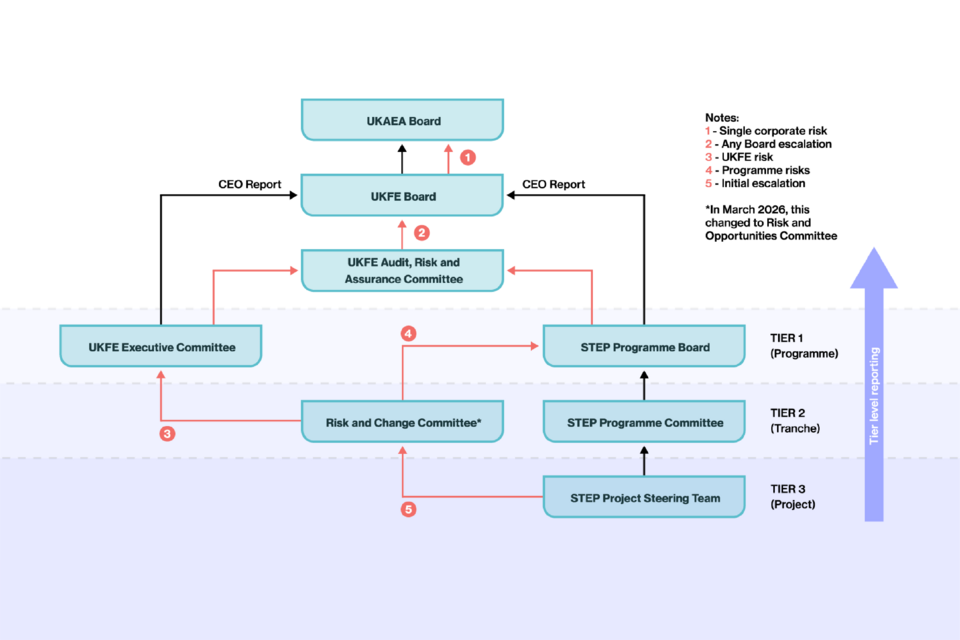
(Figure 10)
UKFE’s risk appetite aligns to its strategy. Our approach is to minimise our exposure to risks to our people and their safety, our reputation and corporate governance whilst accepting and encouraging an increased degree of risk in pursuit of our key strategic objectives. Specifically, we must seek, and be comfortable with, increased exposure in some technology areas where innovation (and the required mindset and attitude) is essential for STEP to be a success.
Across 2025/26 a set of UKFE company and STEP programme risks are under active management across both STEP programme, and UKFE company structures and governance. While formally owned and managed through company or programme governance structures, it is essential both categories of risk are understood as a whole; this is achieved through the RCC and UKFE ARAC covering all risks.
Our detailed product-level technical risks are managed in the Plant Information Management System (PIMS), a digitally based Product Lifecycle Management system utilised in UKFE to better enable integrated design, assumption and risk management, data management and control of Intellectual Property. Non-technical risks are managed through a corporate Enterprise Risk System which, through this year, now uses the CGR platform.
The UKFE approach to Risk Management was audited during the year, with an audit finding of ‘Moderate’, reflecting the developing maturity of company and programme processes, along with recommendations to take forward as UKFE moves fully to its Target Operating Model with the Construction Partner onboarded in 2026/27. Planned continuous improvements to risk management across UKFE and STEP include integrated reporting, risk tools, scoring schemes and risk management capability and capacity.
Assurance
UKFE’s Assurance Strategy adopts the Three Lines of Defence model. The Company continues to mature assurance mechanisms through an assurance map, to assess the effectiveness of its governance and control arrangements within the three lines of defence model (as outlined below) and will increasingly look to assurance effectiveness and efficiency (performance) of processes as well as compliance.
UKFE Three Lines of Defence Model in 2025/26:
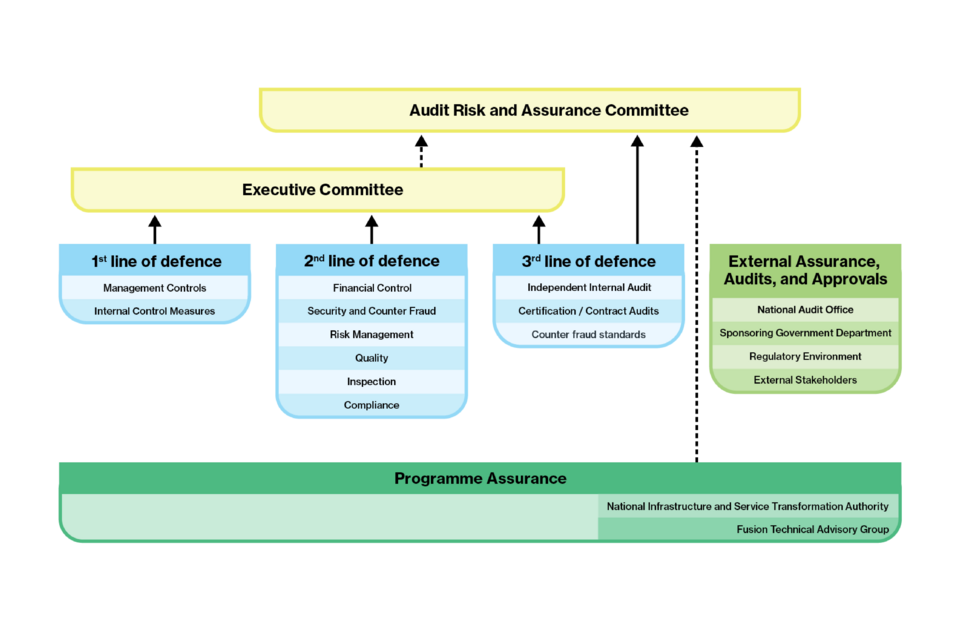
(Figure 11)
The UKFE assurance framework is continuing to take shape in the form of three lines of defence being embedded across the organisation as the basis for all assurance activities throughout UKFE. There are ongoing activities to strengthen the assurance across UKFE through a variety of avenues, including gaining ISO accreditation for ISO 9001, 45001 and 14001.
Alongside this, there is an agreed approach on adherence to the Governmental Functional Standards, with the target to achieve ‘Good / Shall’ level compliance in all Standards relevant to UKFE operations. A baseline assessment was completed in 2025/26 to give the initial measurement and will continue to be re-assessed annually.
The initial assessments are in line with the relative maturity of UKFE with some highlighted areas of development and actions plans with a view to improve compliance. Progress of these plans is reviewed quarterly. These action plans continue to evolve, with an expectation that most functions will increase their scores on their standards as UKFE continues to evolve the maturity of its operating processes.
Group Internal Audit
UKFE’s internal audit services are provided by UKAEA Group Internal Audit which operates across the UKAEA Group in accordance with the Government Functional Standard GovS009: Internal Audit and the Global Internal Audit Standards including the public sector Application Note. It provides assurance on the adequacy and effectiveness of UKFE risk management, control, and governance frameworks driven by the strategic objectives, risk appetite, and potential risk exposures of UKFE. It also provides UKFE with assurance on Group processes and services provided by UKAEA.
Operating in line with the UKFE Internal Audit Charter, approved by the UKAEA Accounting Officer and the UKFE ARAC, Group Internal Audit executes their responsibilities through the delivery of a 3-year rolling programme that extends across multiple audit disciplines and reports progress regularly to the UKFE ARAC.
The breadth of the internal audit function extends to the management system audit programme focused on operational safety, health, environment, and quality performance and monitoring adherence to ISO 9001, 14001 and 45001. This provides a holistic view of assurance across operational and functional areas to the UKAEA Accounting Officer and UKFE ARAC.
Audit Results
Focusing assurance on the top corporate risks, key controls, and significant changes faced across UKFE in 2025/26, this year’s audit plan delivered UKFE specific audit engagements across the following risk areas:
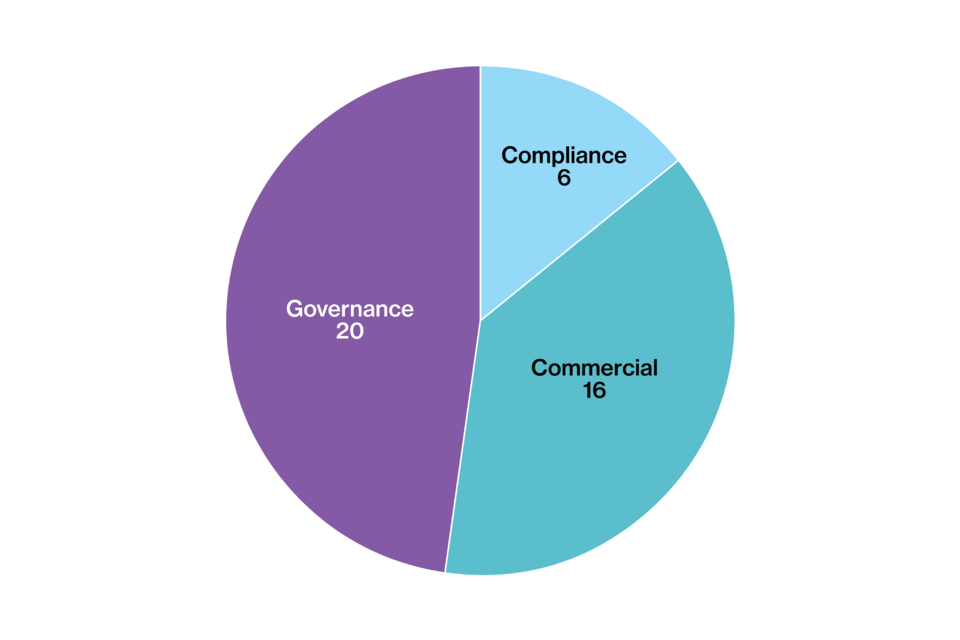
(Figure 12)
The audit opinions of engagements conducted in those areas is displayed below:
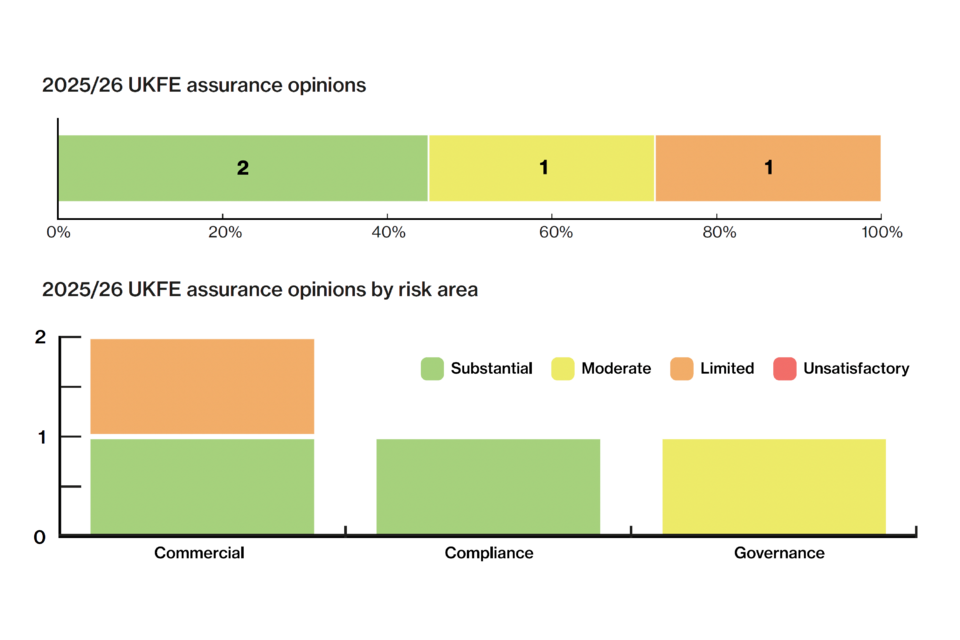
(Figure 13)
UKFE also gained assurance from UKAEA Group audits where UKFE was in scope of the audit or UKAEA processes or services were provided to UKFE. These were conducted over the following risk areas:
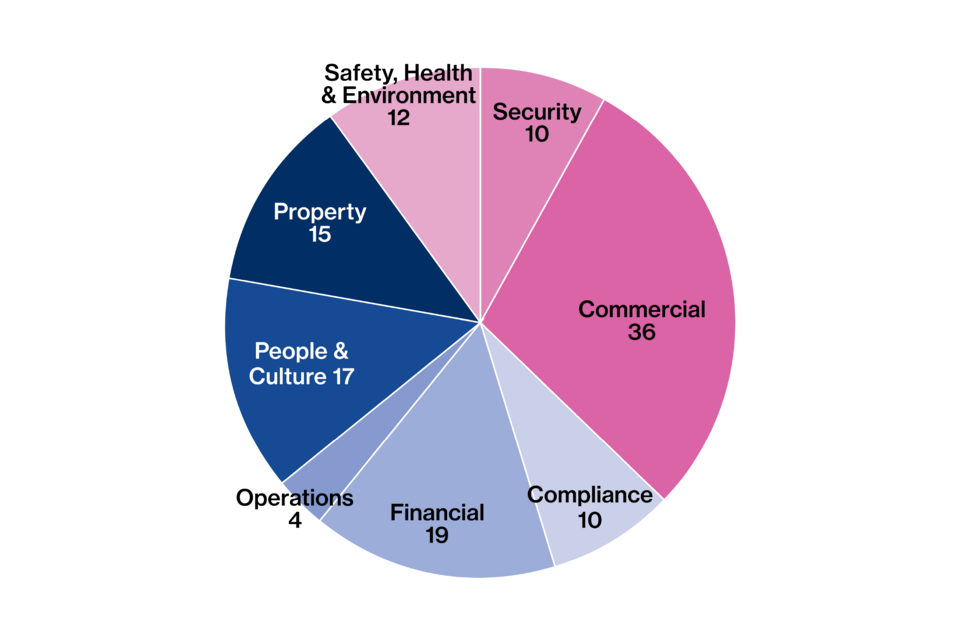
(Figure 14)
The audit opinions of engagements conducted in those areas is displayed below:
UKAEA Group Assurance Options
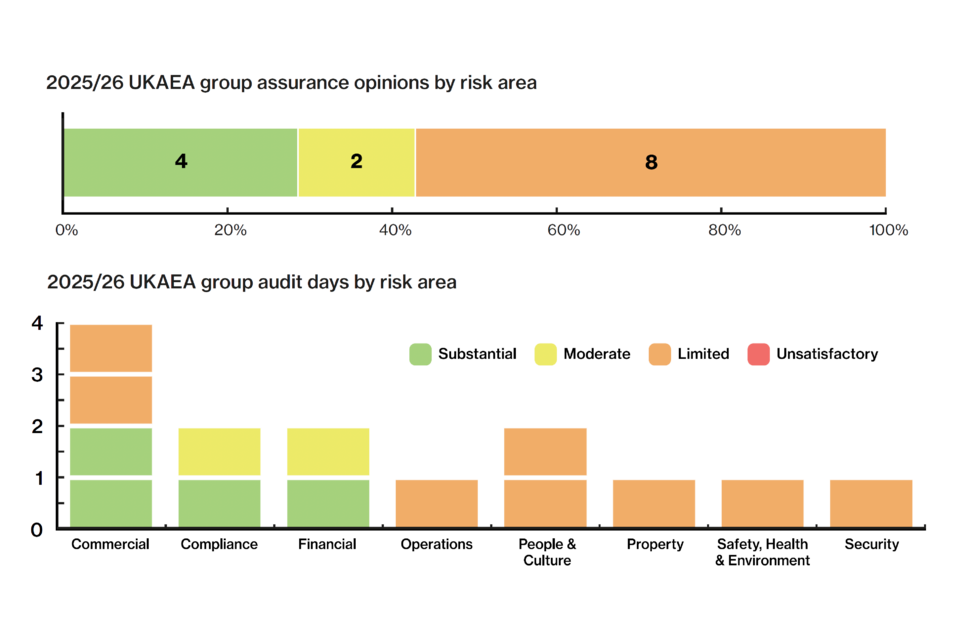
(Figure 15)
Moderate Assurance opinions reflect arrangements with a generally sound system of internal control, governance and risk management with some improvements identified to enhance their adequacy and effectiveness. Limited Assurance opinions reflect arrangements where significant weaknesses in internal control, governance and risk management exist, such that objectives are at risk of not being achieved and prompt management action is required
The audit results highlighted the following areas in UKFE and UKAEA Group requiring improvement:
Projects and Programme
UKFE TM3a Readiness
UKFE has made notable progress in organisational structuring, communication, workforce planning, and governance oversight in readiness for TM3a. However, weaknesses exist in safety governance, documentation, and the maturity of security processes. These gaps present material risks to safe and compliant operation if not addressed ahead of TM3a implementation.
Security
Cyber Security – Microsoft 365 and Endpoint Vulnerability Assessment
The audit identified that improvements are required in the configuration of the corporate windows environment, BYOD (Bring Your Own Device policies and onboarding and offboarding processes and malware management. Immediate actions have been implemented with projects being implemented to address the longer-term actions.
Safety and Health
Quality, Safety, Health, Environment, Risk and Assurance
The audit identified material weaknesses in Safety & Health arrangements, including a rise in high‑potential incidents, underdeveloped assurance across control lines, and consistent failure to deliver planned improvements. Excessive and poorly designed documentation continues to hinder safe operations, while incident investigations do not consistently address root causes, increasing the risk of recurrence. Overall, a more robust, streamlined and risk‑focused approach is required to restore effective control and sustain safe performance.
Commercial
Corporate Service Agreement
The audit highlighted that governance, delivery, and oversight of the Corporate Service Agreement (CSA) were underdeveloped, with improvement actions at an early stage and progress against the enhancement programme behind schedule. Improvement actions have been implemented to clarify governance structures, service management practices, and engagement across stakeholders.
Fusion Partner Agreement
The audit highlights weaknesses in Fusion Partner governance and control arrangements, including non‑compliance with delegated authority, gaps in oversight of work packages, and weaknesses in resource planning. Performance reporting lacks accuracy and transparency, while fragmented intellectual property management and unclear asset ownership increase delivery risk. Strengthened governance, clearer accountabilities, and more robust performance and risk management are required to support future delivery and partner integration.
People
Annual Bonus Review
The audit identified weaknesses in CPM controls, including system issues, inaccuracies in reported outcomes, and insufficient governance and oversight. Improvements are needed to strengthen system reliability or contingency controls, enhance assurance, and ensure consistent, well‑documented management of performance measures.
People and Culture Function
While improvements were highlighted the audit identified ongoing operational pressures and system‑level weaknesses contributing to workforce stress, including gaps in workforce planning and the effectiveness of the people‑systems landscape. Previous audit actions have not been demonstrably effective, with some issues re‑emerging. Resource constraints and competing priorities are limiting improvement delivery, while governance, performance metrics, and process accessibility require strengthening.
Strategy
Campus & Property Planning / Strategy/Hard Facilities Management
The audit identified underdeveloped estate governance and risk management arrangements during a period of significant change. Key gaps included the absence of a unified Estate Strategy, immature risk oversight, and insufficient performance reporting. In addition, the Estates transformation lacks structured programme management and workforce planning, limiting delivery confidence and alignment to strategic objectives.
Group Internal Audit Opinion
Based on the audit work undertaken for the year and considering all available evidence, the Group Head of Internal Audit has provided me with a moderate assurance opinion that there is a generally sound system of internal control, governance and risk management within UKFE for the 2025/26 year.
In forming this opinion the following has been considered:
- All audits were undertaken in the year with revised changes approved by UKFE ARAC.
- 100% of the agreed UKFE audit programme has been completed.
- Limited audit opinion from the UKFE TM3a Readiness Audit highlighting weaknesses in safety governance, documentation and the maturity of security processes.
- Substantial audit opinions from the Procurement Act, Government Procurement Cards and U4BW (UKFE’s Enterprise Resource Management system) – UKFE Readiness Audits.
- UKFE risk culture is continuing to improve across the organisation, the top risks are reported regularly to the UKFE Executive and the UKFE Audit and Risk Assurance Committee. The UKFE Enterprise Risk Management Audit received a Moderate audit opinion and the audit programme is reviewed quarterly against existing and emerging risks. Risk appetite is embedded in the risk management system and has been reviewed by the UKFE Board.
- 100% of audit recommendations accepted by management from completed audits with robust and timely action plans in place. There is continued support from management to ensure that audit actions are completed on time with 86% of UKFE actions completed on time with no actions overdue at year end.
- Observations from the U4BW change advisory board embedded assurance which show good control and monitoring.
Safety Governance
UKFE has taken decisive action in response to the TM3a readiness internal audit, strengthening its safety governance and risk management arrangements at West Burton. Interim safety measures have been established with EDF following the transition of operational control, ensuring robust oversight and continuity of safe operations during this critical phase.
Corporate Services Agreement
The Corporate Services Agreement (CSA) with UKAEA remains a key enabler of UKFE’s operating model, providing essential corporate capabilities that underpin effective delivery as a subsidiary NDPB and company.
In response to internal audit findings, UKFE has enhanced governance and oversight of the CSA, including the establishment of a Corporate Service Performance Committee to drive greater transparency, accountability, and performance management across service delivery.
Recognising its reliance on Group-provided services for key controls, UKFE has worked in partnership with UKAEA to strengthen assurance arrangements and address control weaknesses identified by Group Internal Audit. This includes a focused programme to improve the effectiveness, consistency, and maturity of core control frameworks across the Group.
Fusion Partner Agreement
UKFE is also working closely with UKAEA on implementing the recommendations from the Fusion Partner Audit, including improved governance, asset management and resource planning.
Other controls and processes
UKFE policies and processes sit in the UKFE document hierarchy under the Operating Manual. Other key controls and notable events in 2025/26 are noted below:
Whistleblowing
UKFE follows the Group Whistleblowing procedure; there were no whistleblowing concerns reported in the year to 31 March 2026.
Counter Fraud
UKFE follows the Group Fraud Response policy and is supported by a number of Group processes to deliver counter fraud activities through the Corporate Services Agreement. UKFE set up company specific Counter Fraud risk management processes in 2025/26 and assesses itself against the Counter Fraud Government Functional Standard, meeting ‘Good/Shall’ level requirements in 2025/26. UKFE operated a Counter Fraud Action Plan in 2025/26, achieving most elements, with a small number partially achieved, notably a UKFE specific training and communications plan to staff, with this now being a priority for 2026/27.
There were no reports of fraud identified in the period to 31 March 2026.
Data incidents
There were no reportable data breaches or data loss incidents in the period to 31 March 2026.
Authorised Signatory Policy
UKFE has implemented an Authorised Signatory policy to strengthen controls around formal authority to sign documents and commit UKFE to expenditure or liabilities in line with its delegations.
Declaration of outside interests
UKFE follows Group policy on declaration of outside interests, runs an annual exercise in March for all senior staff, and staff in relevant roles to complete a declaration. The UKFE Board and UKFE Executive Committee check potential conflicts of interest at the start of each meeting.
Cabinet Office controls
UKFE complies with relevant Cabinet Office controls, with the review of potentially relevant transactions undertaken by the Commercial team as outlined in the UKFE delegation manual.
Paul Methven CB, CEO, UKFE Ltd
5.4 Board and Committee Report
UKFE Board Report
| UK Fusion Energy Board | |
|---|---|
| Terms of Reference | Approved in March 2024 |
| Roles and Responsibilities | The UKFE Board provides strategic oversight of the Company ensuring delivery of the Company’s Strategic Objectives, in accordance with the purposes as set out below, regulatory and common law duties, and responsibilities under the UKFE Corporate Structure Document. The Company’s strategic objective is to lead and integrate the capability and knowhow to deliver the commercial fusion energy plants of the future, through leading the design, build and operation of a cost-effective UK prototype and to develop capacity and capability in the supply chain to support and service such activities. |
| Chair | Prof. David Gann CBE |
| Number of Meetings | Thirteen (13) |
| Non-Executive Director | Attended / Due |
|---|---|
| Prof. David Gann CBE | 12/13 |
| Dr. Luc Bardin | 12/13 |
| Prof. Sir Ian Chapman | 10/13 |
| Julie Nerney | 11/13 |
| Kaveh Pourteymour | 10/13 |
| John Staples | 11/13 |
| Prof. Charlotte Valeur | 11/13 |
| Dr. Tim Bestwick OBE | 10/10 |
| Executive Member | |
| Paul Methven CB | 13/13 |
| Grazka Kazmierska | 12/13 |
| Board Attendee | |
| Jamie Stapleton | 8/13 |
Gender Diversity chart F3:M8
Overview and Key Duties
The Board met formally on 13 occasions during the reporting period, including the Annual General Meeting held in November 2025.
The Board is responsible for:
- Establishing the overall strategic direction of UKFE within the policy and resources framework agreed with the responsible government minister
- Reviewing corporate objectives, goals, and performance against these
- Approving the annual accounts, budget, and corporate business plan
- Reviewing and approving proposals to start new activities or to discontinue existing activities
- Ensuring that high standards of corporate governance are always observed
- Reviewing corporate risks, and reviewing the safety, environmental, and security performance of UKFE
In addition to routine business and updates, issues covered at Board meetings throughout the year included:
- April 2025 - Communications Strategy, Collaboration with Singapore, Product Integrity
- May 2025 - Benefits realisation, Tokamak Complex maintenance, Non-Executive mentoring scheme
- June 2025 - Financial Management of partner agreements, West Burton update
- July 2025 - Whole plant design, operating model transition, developing a plasma solution
- August 2025 - Demystifying AI, West Burton update
- September 2025 - Intelligent client, Culture transformation, Investment updates
- October 2025 - Board evaluation, Intellectual Property, Cyber Security
- November 2025 - Board Committee updates, Annual Report update
- December 2025 - West Burton Business Park opportunities, Procurement update, Technical update
- January 2026 - Plant partner contract award, Transition update
- February 2026 - Strategy update, Business Plan, Digital update
- March 2026 - Onboarding of construction partner, board committee updates
The Board receives a technical update each quarter to provide information and assurance on different aspects of the programme including key technical risks, breeder blankets, fuel cycle and power and cooling.
The Board delegates responsibility for day-to-day and business management control to the CEO who is assisted by senior management.
Directors’ Independence
The Non-Executive Directors constructively challenge and help develop proposals on strategy, and bring strong and independent judgement, knowledge, and experience to the Board’s deliberations. They are of high calibre and sufficient number that their views carry significant weight in the Board’s decision making. The Non-executive Directors are:
- Prof. David Gann CBE, Chair of the Board
- Dr. Luc Bardin, Non-Executive Director and UKAEA Non-Executive Director, Chair of the Strategy and Investment Committee
- Prof. Sir Ian Chapman, Non-Executive Director and CEO of UKAEA (until 31st July 2025)
- Dr. Tim Bestwick OBE, Non-Executive Director and CEO of UKAEA (from 1st August 2025)
- Julie Nerney, Non-Executive Director, Chair of the Audit and Risk Assurance Committee
- Prof. Charlotte Valeur, Non-Executive Director, Chair of the People and Culture Committee and Senior Independent Director
- Kaveh Pourteymour, non-executive director
- John Staples, non-executive director and Director for Advanced Nuclear Strategy and Fusion Energy in the Department for Energy Security and Net Zero (resigned as a Director on the 20th April 2026 as he left his position in the Department)
The Board complies with the principles and provisions of the Corporate Governance Central Government Departments Code of Good Practice to the extent appropriate to the Company.
All the Non-Executive Directors are independent of the UKFE executive team.
Additionally, none of Prof. Charlotte Valeur, Julie Nerney and Kaveh Pourteymour
- Has been an employee of UKFE within the last five years.
- Has, or has had within the last three years, a material business relationship with UKFE.
- Receives remuneration from the Company other than a director’s fee and expenses incurred in carrying out their duties.
- Has close family ties with any of UKFE’s advisers, directors or senior employees.
- Holds cross-directorships or has significant links with other directors through involvement in other companies or bodies.
- Has served on the Board for more than nine years.
For the other Non-Executive Directors:
- Prof. David Gann CBE was previously Chair of UKAEA (Aug 2018 – July 2023)
- Dr. Luc Bardin was a non-executive director of UKAEA (the shareholder)
- Prof. Sir Ian Chapman was an employee and executive member of the UKAEA (the shareholder) until July 2025. As UKAEA CEO, Prof. Sir Ian Chapman was also the Accounting Officer for UKFE. Prof. Sir Ian Chapman is no longer an employee of UKAEA
- John Staples is an employee of DESNZ (Sponsoring Department)
- Dr. Tim Bestwick OBE is the CEO of UKAEA
Board Composition
Prof. David Gann CBE, FREng, Chair
David is the Chair of UK Fusion Energy Ltd, and prior to that Chair of the UK Atomic Energy Authority. David was previously Pro-Vice-Chancellor Development & External Affairs at Oxford University and Vice-President (Innovation) at Imperial College London. David frequently advises governments and was a member of the UK Government’s Innovation Expert Group and the Ministry of Defence’s Technology and Innovation Board. He has a PhD in Industrial Economics, is a Chartered Civil Engineer and Fellow of the Royal Academy of Engineers.
Paul Methven CB, CEO & Senior Responsible Owner for STEP
Paul was appointed Chief Executive Officer of UK Fusion Energy Ltd in October 2023. He joined the STEP programme in September 2020 from the Ministry of Defence, where he was Director of Submarine Acquisition at the Submarine Delivery Agency. In this role he was responsible for Dreadnought, and has previously led several other complex major programmes across the MoD
Prof. Sir Ian Chapman, Non-Executive Director
Ian was appointed CEO for UK Research and Innovation in August 2025. Before joining UKRI Ian was Chief Executive of the UKAEA. He has held several international roles in fusion, including chairing the International Atomic Energy Agency International Fusion Research Committee. His research has been recognised with multiple international awards, including the Institute of Physics Glazebrook Medal for leadership in 2021. In 2023, he was knighted in the King’s New Year Honours, made an Honorary Fellow of the Nuclear Institute and elected a Fellow of the Royal Society.
Prof. Charlotte Valeur, Non-Executive Director
Charlotte is an Investment Banker and experienced FTSE Chair and Non-Executive Director. Her long board-level experience spans a host of sectors and industries and covers IPOs, M&A and restructuring. She is a recognised international authority and Professor. in corporate governance and leadership, and author of Effective Directors, Questions to Ask.
John Staples, Non-Executive Director
John is Director for Advanced Nuclear Strategy and Fusion Energy in the Department for Energy Security and Net Zero. He is responsible for UK policy regarding fusion energy and advanced nuclear technologies. Previously, John was Director for Net Zero Strategy, leading the team responsible for ensuring the UK government meets its decarbonisation targets. Prior to that he worked in Her Majesty’s Treasury for over a decade in a range of senior roles. His work there included setting up the UK Infrastructure Bank and developing the UK’s National Infrastructure Strategy.
Julie Nerney, Non-Executive Director
Julie has been leading impactful and sustainable change in organisations for over 30 years in C-suite and Board level roles, supporting organisations through every stage of their life cycle. She has delivered high profile and complex government programmes, including a leadership role in the London 2012 Olympic and Paralympic Games. She holds a range of Non-Executive Director roles, including at the UK Supreme Court. She is a bestselling author and guest speaker on Oxford’s Saïd Global Leadership Development programme.
Kaveh Pourteymour, Non-Executive Director
Kaveh is currently Group Chief Digital Information Officer Rolls Royce plc and is an experienced digital transformation leader with over 30 years’ experience spanning energy, aerospace, manufacturing, complex systems engineering and digital modelling. Throughout his career, Kaveh has successfully implemented cutting edge solutions to enhance business performance delivered through operating models that incorporated diversity and inclusion at their heart.
Dr. Luc Bardin, Non-Executive Director
Luc serves as a Non-Executive Director on both the UKAEA Group Board and the UKFE Board, which he originally joined to support the creation of UKFE/STEP and its transition from UKAEA, including serving on the STEP site selection committee. On the UKFE Board, he contributes over 30 years of experience as a global CEO, leading major project delivery, strategic partnerships and alliances, business development, and complex commercial arrangements across energy, defence, healthcare, and advanced systems engineering. His internationally recognised expertise in organisational development and strategic partnering provides unique and highly valuable insight to the UKFE mission.
Grazka Kazmierska, Finance Director
Grazka is a Management Accountant with 20 years experience working in public sector and has held roles in several central government departments both as an analyst and in finance. Most recently she worked in senior Finance at UK Research and Innovation, before moving to UKFE in June 2024. As Finance Director, Grazka is responsible for ensuring effective financial management and control across UKFE and guiding financial planning to support the objectives of the organisation.
Dr. Tim Bestwick OBE, UKAEA Group, CEO
Tim is an engineer by background, he joined UKAEA in 2018 after leading commercialization and campus development at UKRI-STFC. Before this he worked for IBM, Sharp and the optoelectronic start-ups Kamelian and Bookham Technology. Tim has a strong interest in commercializing public-sector technology and has been instrumental in starting and growing multiple technology businesses. He was awarded an OBE in the King’s Birthday Honours List in 2023 for services to the commercialization of science, technology, and innovation. Tim also chairs the Harwell Campus Board and the UK’s ‘Space Partnership’ Board.
Jamie Stapleton, Board Advisor
Jamie is a passionate digital leader with 15+ years in the global energy sector, serving Utilities, Renewables, O&G, Datacentres, and eMobility. Specialising in innovation and transformation, he has built, scaled, and led global teams that transform outcomes using next generation technologies and innovative business model approaches. Jamie’s career spans leadership positions with ABB, Schneider Electric, and Invensys. He is recognized for building strong partnerships, championing innovation, and leading digital transformation in AI, IoT, and edge computing.
Evaluation of Board Performance and Internal Review
An internal board evaluation was completed in October 2025. The self-evaluation exercise comprised of an evaluation of the Chair conducted by the Directors and individual appraisal discussions with the Directors completed by the Chair.
The evaluation identified many positive attributes including a well sized and diverse board with opportunities to expand representation in areas such as technical and legal, productive meetings, aligned culture and values and strong commitment and engagement from the members. Areas for improvement included greater clarity and brevity for board papers, formalisation of succession planning and increased technical training.
The UKFE board plans to undertake an externally led review before the end of 2026.
People and Culture Committee
| People and Culture Committee | |
|---|---|
| Terms of Reference | Last reviewed and approved in September 2025 |
| Roles and Responsibilities | The Committee is responsible for all matters relating to people, including remuneration and nominations. The terms of reference specify these as: oversight of the UKFE People and culture agenda, as well as ensuring equality, diversity and inclusion (ED&I) is at the forefront of the programme and acting as both a Nominations and Remuneration committee in ensuring the proper and effective composition of the Board and designing and determining the policy for remuneration for the Chair, Non-Executive Directors, Executive Directors and the next level of senior management, including any person appointed as UKFE Company Secretary. |
| Chair | Prof. Charlotte Valeur |
| Number of Meetings | Four (4) |
| Committee Members | Attended / Due |
| Prof. Charlotte Valeur | 4/4 |
| Dr. Luc Bardin | 4/4 |
| Julie Nerney | 4/4 |
| Prof. David Gann CBE | 4/4 |
| Committee Attendees | |
| Paul Methven CB | 4/4 |
| Fiona Kinnear (People representative) | 3/3 |
| Charlene Martin (People representative) | 3/3 |
Gender diversity chart F2:M2
Matters covered
For the reporting period from 1 April 2025 the matters covered included the following:
- People and Culture priorities and strategy
- STEP headcount and metrics
- Workforce plan and resourcing
- Senior staff objectives
- Board skills and matrix
People and Culture Committee Chair’s Report
The People and Culture Committee (PCC) plays a critical role in supporting the Board’s oversight of one of UKFE’s most significant strategic challenges: ensuring the organisation has the workforce, leadership capability and culture required to deliver the STEP programme and fulfil its role as a fusion integrator.
During the reporting period, UKFE has continued its transition from organisational establishment towards a mature programme delivery organisation. As workforce numbers have grown and the programme has increased in scale and complexity, the Committee’s focus has evolved from building organisational foundations to ensuring UKFE develops the capability, leadership and governance required to deliver a major national infrastructure programme whilst supporting the growth of the wider UK fusion sector.
A significant area of focus has been ensuring workforce growth remains aligned to programme priorities whilst strengthening capability in critical delivery areas. The Committee has overseen the early integration of partner organisations into programme delivery, recognising the importance of establishing shared ways of working and a common culture across organisational boundaries. The Committee has also provided challenge and oversight on workforce planning, organisational capability, leadership appointments and workforce controls, recognising that successful delivery will depend on UKFE’s ability to attract, retain and deploy highly specialised capability in a competitive market.
The Committee has also overseen the development of UKFE’s leadership and culture agenda. Delivering STEP requires more than technical excellence; it requires leaders capable of operating across organisational boundaries, making decisions in conditions of uncertainty and fostering a culture that supports accountability, collaboration and delivery. During the year, the Committee supported the development of UKFE’s Cultural Imperatives and wider culture programme, recognising culture as a critical enabler of programme performance.
In parallel, the Committee has continued to oversee the development of governance, performance, reward and employee relations arrangements required to support a growing and increasingly complex organisation, whilst ensuring workforce risks and organisational health remain subject to appropriate board scrutiny.
The PCC met on four occasions during the reporting period and continued to provide assurance and recommendations to the Board on matters relating to workforce capability, organisational maturity and delivery readiness. As UKFE moves into its next phase of development, the Committee will remain focused on ensuring the organisation is equipped to meet the long-term challenges of delivering one of the UK’s most ambitious and complex infrastructure programmes and supporting the development of a future UK fusion industry.
Prof. Charlotte Valeur - People and Chair Committee Chair
Audit and Risk Assurance Committee
| Audit and Risk Assurance Committee (ARAC) | |
|---|---|
| Terms of Reference | Last reviewed and approved in December 2025 |
| Roles and Responsibilities | The Committee supports and advises the Board and the UKFE CEO by independently reviewing the approach taken to the management of both risks and opportunities, including but not limited to: the integrity, efficacy and effectiveness of all matters relating to sound systems of internal control, including, but not limited to the safety, health and environmental (SHE) management system, the risk management processes, the integrity of the financial statements, and the UKFE annual report. The approaches to maximising opportunities to generate value and growth, including, but not limited to, the capture and exploitation of intellectual property, attracting and onboarding inward investment and establishing effective commercial partnerships. |
| Chair | Julie Nerney |
| Number of Meetings | Six (6) |
| Committee Members | Attended / Due |
| Julie Nerney | 6/6 |
| Prof. Charlotte Valeur | 6/6 |
| Kaveh Pourteymour | 5/6 |
| Neil Phimister, Independent Member | 6/6 |
| Jill Evans, UKAEA Member | 6/6 |
| Committee Attendees | |
| Paul Methven CB, CEO | 2/6 |
| Grazka Kazmierska, Finance Director | 6/6 |
| Judith Ward, Director of Safety, Quality and Assurance | 1/1 |
| National Audit Office | 6/6 |
| Internal Audit | 6/6 |
Gender Diversity chart F3:M2
Matters covered
The Committee considers standing reports at each scheduled meeting that cover financial matters (including counter fraud), risk and assurance matters and internal and external audit updates.
For the reporting period from 1st April 2025 the Committee also reviewed and considered the following:
- ARAC terms of reference
- Internal audit charter 25/26
- Risk strategy
- Policies (including accounting policies)
- Draft annual governance statement
- Security report (physical / personnel)
- Cyber security and management of IT security incidents
- Risk deep dives on cyber and people and capability
- Intellectual property rights
Audit, Risk and Assurance Committee - Chairs Report
ARAC met on six occasions throughout the year; four were scheduled business meetings with two extraordinary meetings to review the year end accounts and audit report for 2024/25 and to scrutinise the proposed allocation of budgets within UKFE for 2026/27. In both cases, ARAC made recommendations for onward approval by the Board.
As UKFE has evolved and matured as an organisation, so has the focus and operation of the ARAC. We have deepened and embedded the standard agenda framework to give us regular assurance on key areas of activity, including financial matters, risk management, safety, health and environmental (SHE), security, other assurance matters and both internal and external audit. In addition to the standing updates and reports at each meeting, the committee has built in flexibility to review and consider emerging audit and risk assurance matters escalated by the executive team or from other committees.
We have also extended the time and space available to conduct regular deep dives into areas of both greatest risk and opportunity. This signalled a shift in our focus to complement our work on ensuring there are sound systems of internal control. The ARAC pays equal attention to how those internal systems ensure that we are both mitigating our risks and maximising the opportunities available to us in this first of a kind, iterative and inherently entrepreneurial endeavour.
Our deep dives in the past year have considered the arrangements in place for the provision of our corporate services, how we are protecting and exploiting the intellectual property created, the commercial arrangements that will enable us to establish a new supply chain ecosystem to support fusion, and our preparedness to assume our site management responsibilities at the West Burton site.
As part of the committee’s own development and continuous improvement, members reflect at each meeting on what worked well and areas for improvement for next time. We have also been commended for best practice twice in the past year by our external auditors. We continue to keep all elements of the ARAC under active review to ensure that it best supports our evolving needs as we scale.
With the production of UKFE’s first strategy, the focus this year will be to continue to ensure that we have effective arrangements for the mitigation of risk and exploitation of opportunities arising from that strategy, and that our underpinning systems of internal control remain sound and evolve to meet our needs as we grow, including the onboarding of industrial partners and any external investors.
Julie Nerney - Audit, Risk and Assurance Committee Chair
Strategy and Investment Committee
| Strategy and Investment Committee (STIC) | |
|---|---|
| Terms of Reference | Last reviewed and approved in December 2025 |
| Roles and Responsibilities | The Committee supports the UK Government’s national fusion goals, especially through UKFE and STEP. It provides expert input, strategic guidance and deep alignment to help UKFE operate in a complex and fast-changing environment. The Committee provides an ongoing, structured process for strategic decision-making around direction, investment, capability, and delivery. |
| Chair | Dr. Luc Bardin |
| Number of Meetings | Six (6) |
| Committee Members | Attended / Due |
| Dr. Luc Bardin | 6/6 |
| Prof. Charlotte Valeur | 5/6 |
| Prof. David Gann CBE | 6/6 |
| Paul Methven CB | 6/6 |
| John Staples | 5/6 |
| Committee Attendees | |
| Charles Price | 6/6 |
Gender diversity chart F1:M4
Matters covered
- UK Fusion Energy Strategy released in April 2026
- Partnerships and procurement
- Intellectual Property
Strategy and Investment Committee - Chairs Report
The Strategy and Investment Committee (STIC) was formally established as a committee of the UKFE Board in September 2025. It was created to provide a dedicated forum for the in-depth consideration of strategic direction, partnerships and investment, to support the executive team and to make qualified input and recommendations to the UKFE Board, the UKAEA Group, the Department and the cross-departmental Strategic Investment Group (SIG).
Since its inception, the Committee has operated at a deliberately intensive cadence, reflecting both the pace of change in the fusion sector and the foundational nature of the work. We have held six meetings on a monthly rhythm, complemented by a half-day engagement with the full Board to test emerging conclusions and secure shared understanding.
This sustained tempo has allowed the Committee to work through scenarios, options and risks with the rigour set out in our Terms of Reference. It has also enabled a genuinely shared evidence base across Non-Executive Directors, the executive team and the Department, essential to credible decision-making.
The principal outcome has been the clarification of, and broad alignment behind, the UKFE strategy, published in April 2026. This marks a significant milestone for the organisation and provides a clear external reference point for our partners, investors and stakeholders.
A defining feature of the work has been the development of the purpose of UKFE as the integrator of fusion plants, starting with the foundational leadership of building STEP. This articulation of role gives coherence to the choices the organisation must make on capability, partnerships and investment, and provides a stable anchor as the wider fusion ecosystem evolves.
Looking ahead, the Committee will continue with its role, not only in the oversight of strategy delivery but also in shaping the next phases, refining the investment framework, and adapting the strategy as evidence and circumstances develop. I would like to thank my fellow Committee members, contributors and the Secretariat for their commitment and the quality of debate they have brought to these first months of operation.
Dr. Luc Bardin - STIC Chair
UKFE Executive Committee
| UKFE Executive Committee | ||
|---|---|---|
| Terms of Reference | Last reviewed and approved in 19/05/2025 | |
| Roles and Responsibilities | The role of the ExCom is the overall oversight and decision-making supporting the Chief Executive Officer (CEO) in the overall management of the Company and its performance. It focuses on strategic leadership, management, and direction, ensuring the most effective prioritisation of resources, ensuring compliance with regulatory and common law duties, and responsibilities under the UKFE Corporate Structure Document. The scope of the committee includes, but is not limited to, the following: Enacting the strategic aims and objectives of the Company. Providing effective governance of the Company within a governance framework of prudent and effective controls. Ensuring the financial and human resources are in place for the Company to meet its objectives. Ensuring the Company has policies and processes in place that cover all legal, regulatory and public body obligations, and that these are reviewed regularly. Reviewing the risk landscape. Ensuring all policies and processes are adhered to, and that the Company operates within its delegations. Ensuring compliance with any statutory or administrative requirements for the use of public funds; that it operates within the limits of its statutory authority, and in accordance with any other conditions relating to the use of public funds; and that, in reaching decisions, it considers guidance issued by the Sponsor Department. Ensuring that as part of the above compliance there are appropriate internal mechanisms for the monitoring, governance and external reporting of any conditions arising from the above documents and ensuring that the Chief Executive Officer (CEO) and the Company as a whole act in accordance with their obligations under the above documents. Overseeing the Company’s intellectual property strategy and portfolio and ensuring that this is aligned to corporate policy and strategy objectives. Ensuring that the Board receives and reviews regular financial and management information concerning the management of the Company. Managing the internal controls environment and endorsing regular reports for presentation to the UKFE Audit, Risk and Assurance Committee and, as appropriate, the UKFE People and Culture Committee. Ensuring the Board is kept informed of any changes which are likely to impact on the strategic direction of the Company or on the attainability of its targets. Translating the Board’s strategy into a Business Plan under the governance of the Board and developing and implementing corporate business plans, strategy, policies, procedures, and corporate budgets to be/which have been approved by the Board. Championing wellbeing, safety and environmental protection and ensuring high standards in these aspects in the workplace. Reviewing and developing UKFE organisational capability. Escalating key decisions that are outside of its delegated authority to the UKFE Board. | |
| Chair | Paul Methven CB, Chief Executive Officer of UK Fusion Energy Ltd, and Senior Responsible Owner for STEP Fusion | |
| Number of Meetings | Twelve (12) | |
| Executive Directors | Attended / Due | |
| Paul Methven CB | 9/12 | |
| James Cowan | 9/12 | |
| Dan Bishop (Joined 8/26) | 7/8 | |
| Grazka Kazmierska | 12/12 | |
| Kara Turner | 11/12 | |
| Sounak Dutta | 11/12 | |
| Chris Waldon | 10/12 | |
| Debbie Kempton | 6/12 | |
| Howard Wilson | 10/12 | |
| Daisy Benson | 12/12 | |
| Fiona Kinnear | 7/12 | |
| Charles Price | 11/12 | |
| Ryan Ramsey (Joined 2/26) | 2/2 | |
| Judith Ward (Joined 3/26) | 1/1 | |
| Ben Bradley (left 12/25) | 9/9 | |
| Committee Attendees | ||
| Tristram Denton | 3/12 |
Gender diversity chart F6:M9
Matters covered
- Functional Lead updates
- TOR Annual Review
- CPM Performance
- Asset Management Strategy
- Operational Transition
- Board Mentoring Opportunities
- Competitive Dialogue Updates
- Annual Report and Accounts
- Secure by Design
- UK Fusion Energy Strategy
- Communication Strategy
- Quarterly Business Review
- Assurance Framework
- Cyber Security
- DCO
- Business Planning
- Subcommittee Stand-up TOR review
- West Burton site acquisition updates
- Intellectual Property Governance Framework and Policy
- Pay remit and compliance
5.5 Remuneration and Staff Report
This remuneration report is prepared in accordance with HM Treasury’s Financial Reporting Manual with Directors’ remuneration disclosures as required under Companies Act 2006.
Directors’ Remuneration
Remuneration Policy
The remuneration of Executive Directors appointed to the UKFE Board is agreed by DESNZ via UKAEA Group.
The remuneration of Non-Executive Directors appointed to the UKFE Board is agreed by the Board with the approval of the Group Accounting Officer. The UKFE People and Culture Committee makes recommendations to DESNZ on the overall remuneration package for Directors who are appointed to the UKFE Board. The Non-Executive Directors who form the committee are not involved in decisions relating to their own remuneration.
In reaching its recommendations, the Committee has regard to the following considerations:
- the need to recruit, retain and motivate suitably able and qualified people to exercise their different responsibilities; and
- the funding available to UKFE.
The Committee takes account of the evidence it receives about wider economic considerations and the affordability of its recommendations.
Service contracts
Non-Executive Directors who are members of the UKFE Board are appointed as follows:
-
Non-Executive Chair appointed by the UKAEA Group Board with agreement from the Secretary of State for DESNZ.
-
UKAEA Chief Executive Officer, as Group Accounting Officer, appointed as ex-officio non-executive director.
-
One Non-Executive Director appointed by the UKAEA Group Board for a transitionary period with agreement with the Company Chair.
-
One Non-Executive Director appointed by DESNZ, as the Sponsor Department with the approval of the SoS and following consultation with the Company Chair.
-
Other appointments to the Company Board of Non-Executive board members will be made by the Company Chair, with the approval of the UKFE Board or appropriate board committee such as the People and Culture Committee and the Group AO.
Appointments are normally for a three-year term, but some initial terms of up to four years have been used to provide staggered expiry dates over the next few years.
Remuneration and pension entitlements
The individual components of the remuneration packages are:
- Salary and fees
The CEO and Finance Director as Executive Directors receive a basic salary and performance bonus. The Chair and Non-Executive Directors receive fees for their services. Submissions were made by the UKFE CEO via UKAEA Group and reviewed by the UKAEA Remuneration Committee (REMCO), with outcomes subsequently returned to the CEO for implementation.
- Non-taxable benefits
Executive Directors are also reimbursed for reasonable expenses incurred in line with the policy for UKFE employees. These reimbursements are not included in the following table.
- Performance-related bonuses
The performance bonuses for Executive Directors are calculated in accordance with performance against agreed objectives and recommended by the People and Culture Committee to the Group Accounting Officer.
The total bonus is made up of two components: the performance of UKFE against specific quantified targets, and the performance of the individual against specific targets. The performance-related bonuses shown in the table are calculated on the basis of assessment by the People and Culture Committee of performance against the relevant specific targets.
Board Directors’ Remuneration (subject to audit)
Individual Board Directors’ remuneration for the full year 2025/26 is shown in the following table, with salaries, allowances, fees and bonuses disclosed on an accrual’s basis.
| Year ended 31 Mar 26 | Fees / Salary and allowances | Benefits (a) | Annual bonus (b) | Pension benefit (c) | Total |
|---|---|---|---|---|---|
| £k | £k | £k | £k | £k | |
| Prof. David Gann CBE | 35.0 - 40.0 | 1.2 | - | - | 40.0 - 45.0 |
| Prof. Sir Ian Chapman* | 10.0 - 15.0 | - | - | - | 10.0 – 15.0 |
| Dr. Tim Bestwick OBE** (d) | - | - | - | - | - |
| Paul Methven CB | 210.0 - 215.0 | - | 25.0 – 30.0 | 44.0 | 285.0 - 290.0 |
| Grazka Kazmierska | 115.0 - 120.0 | - | 10.0 - 15.0 | 24.0 | 155.0 - 160.0 |
| Prof. Charlotte Valeur | 15.0 - 20.0 | - | - | - | 15.0 – 20.0 |
| Kaveh Pourteymour | 15.0 - 20.0 | - | - | - | 15.0 - 20.0 |
| Julie Nerney | 15.0 - 20.0 | - | - | - | 15.0 - 20.0 |
| Dr. Luc Bardin | 15.0 - 20.0 | 1.2 | - | - | 15.0 - 20.0 |
| John Staples*** | - | - | - | - | - |
Notes:
* Prof. Sir Ian Chapman resigned as UKAEA CEO and UK Fusion Energy Ltd Accounting Officer on 31 July 2025, remaining on the board as a Non-Executive Director. He was not remunerated last year as he was appointed as ex-officio Non-Executive Director as part of his role as UKAEA CEO in that year.
** Dr. Tim Bestwick OBE became UKAEA CEO and UK Fusion Energy Ltd Accounting Officer on 1 August 2025.
*** John Staples resigned 20 April 2026. He did not receive remuneration in either year as he was appointed as ex-officio Non-Executive Director as part of his role as Director of Advanced Nuclear Strategy and Fusion Energy at DESNZ.
| 5 months from 1 Nov 24 to 31 Mar 25 | Fees / Salary and allowances | Benefits (a) | Annual bonus (b) | Pension benefit (c) | Total |
|---|---|---|---|---|---|
| £k | £k | £k | £k | £k | |
| Prof. David Gann CBE | 15.0 – 20.0 | 0.8 | - | - | 15.0 – 20.0 |
| Prof. Sir Ian Chapman | - | - | - | - | - |
| Dr. Tim Bestwick OBE | - | - | - | - | - |
| Paul Methven CB (e) | 85.0 - 90.0 | - | 10.0 - 15.0 | 5.0 | 100.0 - 105.0 |
| Grazka Kazmierska (f) | 45.0 - 50.0 | - | 0.0 - 5.0 | 2.0 | 50.0 - 55.0 |
| Prof. Charlotte Valeur | 5.0 - 10.0 | - | - | - | 5.0 - 10.0 |
| Kaveh Pourteymour | 5.0 - 10.0 | - | - | - | 5.0 - 10.0 |
| Julie Nerney | 5.0 - 10.0 | - | - | - | 5.0 - 10.0 |
| Dr. Luc Bardin | 5.0 - 10.0 | - | - | - | 5.0 - 10.0 |
| John Staples | - | - | - | - | - |
Notes:
- The estimated non-cash benefits relate to the tax liability on travel expenses for Board and other meetings at Culham which were met by UKFE.
- Annual bonuses of Executive Directors are subject to approval by DESNZ. Non-Executive Directors do not receive a bonus payment.
- The value of pensions benefits accrued during the year is calculated
20x the real increase in pension
plus the real increase in any lump sum
minus the contributions made by the individual
The real increases exclude increases due to inflation or any increase or decrease due to a transfer of pension rights. In some cases, the pensions benefit is negative in real terms where pay increases and additional service have not offset the effect of inflation.
- Dr. Tim Bestwick OBE did not receive remuneration from UKFE in the reporting period for services as a Director of the Company. As the UKAEA Interim Chief Executive Officer and Group Accounting Officer he was appointed as ex-officio non-executive director.
- The 2024/25 full year equivalent salary for Paul Methven CB was £205k - £210k.
- The 2024/25 full year equivalent salary for Grazka Kazmierska was £115k - £120k.
Pension entitlements (subject to audit)
Executive Directors are members of the United Kingdom Atomic Energy Authority Combined Pension Scheme (CPS) which pays an annual pension based on pensionable final earnings together with a lump sum at normal retirement age. Benefits are also payable in the event of death or ill health retirement.
Further details of the pension schemes and unfunded pensions can be found later in the Remuneration and staff report.
The pension entitlements shown in the table below are those that would be paid annually on retirement based on service to 31 March 2026 and include the value of added years paid for by Directors.
| Accrued pension as at 31 Mar 26 | Lump sum as at 31 Mar 26 | Real increase in accrued pension (a) | Real increase in lump sum (a) | |
|---|---|---|---|---|
| £k | £k | £k | £k | |
| Methven, Paul | 10 - 15 | 40 - 45 | 2.5 - 5 | 7.5 – 10 |
| Kazmierska, Grazka | 0 - 5 | 5 - 10 | 0 – 2.5 | 2.5 - 5 |
Notes: (a) The real increase has been calculated after subtracting inflation.
The following table sets out the Cash Equivalent Transfer Value (CETV) of the Executive Directors’ accrued pension entitlements which have been calculated by the Scheme managers in accordance with the Occupational Pension Schemes (Transfer Values) Regulations 1996 as amended, having taken actuarial advice. The transfer values do not represent sums paid or payable to the Directors but represent a potential liability of the pension scheme.
| CETV at 1st Apr 25 | Real increase in CETV (a) | CETV at 31 Mar 26 | ||
| £k | £k | £k | ||
| Methven, Paul | 290 | 50 | 373 | |
| Kazmierska, Grazka | 24 | 21 | 56 |
Notes: (a) The real increase has been calculated after subtracting inflation.
Accrued pension, lump sum and total CETV amounts are calculated including benefits from employments prior to UKFE.
Members of the pension scheme have the option to pay Additional Voluntary Contributions; neither the contributions nor the resulting benefits are included in the above tables.
Fair Pay disclosures (subject to audit)
Remuneration ratios
| 2025/26 | 2024/25 | |
|---|---|---|
| £k | £k | |
| Highest paid Director’s total remuneration excluding pension benefit | 240-245 | 95-100 |
| (Full year equivalent remuneration) | 240-245 | 235-240 |
| Salary and allowances | Performance pay and bonuses payable | |
| Highest paid Director - percentage change from the previous financial year(a) | 2.4% | 0.0% |
| Employees taken as a whole, excluding the highest paid Director - average percentage change from the previous financial year(b) | 10.0% | 8.7% |
Notes:
- This calculation is based on the annualised mid-point of the band used in disclosing Directors’ remuneration for each of salary and performance pay and bonuses payable
- Calculated as the total on an annualised basis for all employees (apart from the highest paid Director) as at 31 March, divided by the full-time equivalent number of employees (excluding the highest paid Director) as at 31 March.
Employee Remuneration ratios
| Salary | Other pay and benefits (a) | Total remuneration | Highest paid Director’s remuneration as a multiple of the percentile (b) | |
|---|---|---|---|---|
| £ | £ | £ | Ratio | |
| 2025/26 | ||||
| 25th percentile | 51,695 | 2,812 | 54,507 | 4.4 |
| Median percentile | 64,587 | 11,214 | 75,801 | 3.2 |
| 75th percentile | 86,758 | 4,720 | 91,478 | 2.6 |
| 2024/25 | ||||
| 25th percentile | 48,503 | 7,841 | 56,344 | 4.2 |
| Median percentile | 59,723 | 10,644 | 70,367 | 3.4 |
| 75th percentile | 69,866 | 11,211 | 81,078 | 2.9 |
Notes:
(a) Other pay and benefits include bonus and allowances such as specialist allowances, market premium and responsibility allowances.
(b) Calculated using midpoint of £5k disclosure band for highest paid Director’s remuneration on a full-time basis (£240k - £245k).
In 2025/26 no employees received remuneration in excess of that of the highest paid Director.
Remuneration of employees ranged from £30k-£35k to £240k-£245k. (2024/25 full-year equivalent £25k-£30k to £235k-£240k).
Total remuneration includes salary, non-consolidated performance-related pay and benefits-in-kind. It does not include severance payments, pension benefits, employer pension contributions or the cash equivalent transfer value of pensions.
Staff numbers and costs
| Staff costs (subject to audit) | 2025/26 | 2024/25 |
|---|---|---|
| £k | £k | |
| Directly employed staff: | ||
| Salaries, bonuses and allowances | 9,593 | 3,189 |
| Social security costs | 1,383 | 379 |
| Pension costs – defined contribution plans (see below) | 1,737 | 554 |
| Total Directly employed staff costs | 12,713 | 4,122 |
| Temporary staff | 5,774 | 1,731 |
| Total Staff Costs | 18,487 | 5,853 |
Staff numbers (subject to audit)
The average number of full-time equivalent staff during the year was as follows:
| 2025/26 | 2024/25 | ||
|---|---|---|---|
| Directly employed staff | 139 | 91 | |
| Temporary staff | 51 | 33 | |
| Total | 190 | 124 |
Temporary (non-payroll) staff may be ‘off-payroll workers’ who are engaged via an intermediary, or they may be on the payroll of another organisation within the supply chain.
Most of the temporary staff are engaged to carry out specialist work in UKFE’s technical teams.
Staff composition as at 31 March 2026 (not subject to audit)
All figures in the tables below relate to actual staff numbers at the year-end rather than to full time equivalents.
| Board and senior staff | ||||
|---|---|---|---|---|
| Male | Female | Total | ||
| Board members | 7 | 3 | 10 | |
| Executive Committee members | 7 | 5 | 12 | |
| Senior staff | 18 | 7 | 25 |
Sickness absence (not subject to audit)
The average sickness absence per employee for UKFE for the 12-month period to 31 March 2026 was 6.2 days (5-month period to 31 March 2025: 1.8 days).
UKFE Pension Arrangements (subject to audit)
(a) Defined benefit schemes
All eligible employees of UKFE are entitled to be members of the CPS of the UKAEA for the year ended 31 March 2026. The CPS is a contributory unfunded statutory defined benefit public service pension scheme. The scheme is managed and administered by UKAEA with the approval of DESNZ. Contributions made to the scheme are used to meet the payment of scheme benefits. Any surplus of contributions over payments is surrendered to HM Government via the Consolidated Fund. Any deficit is met by parliamentary vote with payment from the Consolidated Fund.
The government does not maintain a separate fund to provide for the scheme’s future liabilities, and future benefits will be paid out of the Consolidated Fund to the extent that, at the time of payment, benefits exceed contributions, and parliament votes the necessary funds. The employer contribution was established at 21.5% (2024/25: 21.5%) of pensionable earnings from 1 April 2022.
UKFE employees also participate in the UKAEA and Associated Employers Additional Voluntary Contribution Scheme which is a defined contribution arrangement. There is no employer contribution to this arrangement.
The scheme is fully insured and administered by the Prudential Assurance Company Limited to which contributions are paid. The scheme covers those employees of the UKFE, and of other employers, who are members of the CPS and who have opted to pay additional contributions.
In accordance with the FReM, the schemes are accounted for as defined contribution schemes.
Employer contributions are calculated in accordance with HM Treasury methodology ‘Superannuation Contributions Adjusted for Past Experience’ and are based on the expected cost of members’ benefits as they accrue. The contributions paid by UKFE during the year totalled £1,770k (2024/25: £521k).
(b) Defined contribution schemes
UKFE participates in a defined contribution scheme, the Additional Voluntary Contribution (AVC) scheme which is fully insured schemes administered by Prudential (a trading name of Prudential Distribution Limited, which is a subsidiary of M&G plc.) to whom contributions are paid.
The AVC scheme includes members from the UKFE and from other employers who are members of CPS and who have opted to pay additional voluntary contributions. No employer contributions are made to this scheme.
(c) Unfunded retirement benefits
There were no unfunded requirement benefits applicable to UKFE.
Staff Policy
UKFE’s pay policy is determined by our sponsoring department, DESNZ.
Our Trade Union is Prospect, and we have an extant framework on how we engage and consult. We use our existing mechanisms to seek their feedback and thinking on current issues.
UKFE is committed to promoting equality, diversity, and inclusion inside and outside of the organisation, and to ensuring that the working environment is welcoming, supportive, and inclusive for all.
- People: “UKFE will take positive action to improve the opportunities and lived experience of all individuals working at, or interacting with, the organisation.”
- Environment: “UKFE will take positive steps to identify and improve the physical working environment for all of its people, particularly those with disabilities, whether they are visible or hidden.”
- Communication and engagement: “UKFE will improve internal and external communications to fully reflect its ED&I commitment and progress to maximise the awareness and engagement of all stakeholders.”
- Policies and practices: “UKFE will integrate equality, diversity and inclusion into all our policies and practices.”
UKFE’s equal opportunities policy requires that all job applicants enjoy equal opportunity for employment on the basis of ability, qualifications, experience and suitability for the work. We deliver in-house training on diversity and equality, unconscious bias and specific recruitment training. These courses cover equality, diversity and inclusion, ensuring that line managers are aware of their responsibilities towards, and the benefits of, these topics.
UKFE’s equal opportunities policy provides a framework for ensuring that equality is considered throughout the employment of staff. For those who become disabled during their employment, we provide occupational health facilities which provide direct support to the employee and advise line managers on modifications and restrictions which are required. In addition to the training mentioned above, People Department Business Partners provide coaching on flexible working and unconscious bias to ensure that employees with disabilities are given equal opportunity in training, career development and promotion. UKFE is also registered with the Disability Confident Scheme.
Expenditure on consultancy and temporary staff
Expenditure on temporary staff (the provision of workers to cover business-as-usual or service delivery activities within an organisation) was £5,775k (2024/25: £1,731k), as detailed in the Staff costs note within the Notes to the Financial Statements (5.1). This level of spend reflects the need for flexibility in a growing and fast-changing organisation, where temporary resource has been essential to maintain delivery momentum and provide critical capability while permanent recruitment continues to scale up.
UKFE spend on consultancy (the provision to management of objective advice relating to strategy, structure, management, or operations of an organisation, in pursuit of its purposes and objectives) was £4,473k (2024/25: £699k). Such advice is sought when UKFE does not have the skills set required within its support services and the particular requirement falls outside the ‘business-as-usual’ environment. When used appropriately, consultancy can be a cost effective and efficient way of getting the temporary and skilled external input that UKFE needs.
Off-payroll appointments
(a) Highly paid off-payroll worker engagements as at 31 March 2026, earning £245 per day or greater
Number of existing engagements: 38
Of which the number that have existed at the time of reporting for:
Less than one year: 18
Between 1 and 2 years: 20
(b) All highly paid off-payroll workers engaged at any point during the year ended 31 March 2026, earning £245 per day or greater
Number of temporary off-payroll worker engagements in force during the year ended 31 March 2026: 54
Of which:
Number not subject to off-payroll legislation: 47
Number subject to off-payroll legislation and assessed as within the scope of IR35: -
Number subject to off-payroll legislation and assessed as not within the scope of IR35: 7
Number of engagements reassessed for consistency/assurance purposes during the year: 7
Of which:
Number of engagements that saw a change to IR35 status following the review: -
(c) Off-payroll engagements of board members and/or senior officials with significant financial responsibility between 1 April 2025 and 31 March 2026
Number of off-payroll engagements of board members and/or senior officials with significant financial responsibility during the financial year: -
Total number of individuals on payroll and off-payroll that have been deemed ‘board members and/or senior officials with significant financial responsibility’ during the financial year: -
Exit Payments (subject to audit)
There were no Exit Payments made by UKFE in the 2025/26 Financial Year.
5.6 Other Parliamentary disclosures
Fees and charges (subject to audit)
UKFE Ltd does not receive fees and charges for public services, as defined by HM Treasury in Managing Public Money. There are therefore no related disclosures.
Losses & special payments
There were no losses of special payments in the year (on an accruals basis) that require disclosure
Remote contingent liabilities
Under IAS 37 Provisions, Contingent Liabilities and Contingent Assets, UK Fusion Energy Ltd discloses contingent liabilities where the possibility of an outflow of economic benefits is considered remote. These relate to obligations that have a very low likelihood of crystallising and therefore do not require recognition as provisions.
As at 31 March 2026, the Company had remote contingent liabilities arising from indemnities provided in connection with land access licences for adjoining farmland at the West Burton site. These licences permit non-intrusive topographical and tree surveys. The indemnities include caps of £5 million across five licences and £1 million across two licences, all of which are scheduled to expire by July 2026.
Given the non-intrusive nature of the survey activities and the absence of identified risk factors, the probability of any liability arising is assessed as remote.
Related party disclosures
UK Fusion Energy Ltd occupies an area of non-operational land at the West Burton Power Station site and adjoining St Ives Bungalow under a 99-year peppercorn lease granted on 23rd March 2026 by its parent, UKAEA. In accordance with the FReM and the public sector application of IFRS 16, the lease has been recognised using the fair value of the underlying land due to the nominal lease payments.
An independent valuation undertaken during the year assessed the land and building at £17,904k, and this remeasurement has been reflected in the UK Fusion Energy Ltd’s statement of financial position through Other Comprehensive Income. No rental payments were made or are payable, and no balances were outstanding with the parent department at year end in relation to this arrangement.
Dr. Tim Bestwick OBE, Accounting Officer, UKAEA Group
Paul Methvan CB, CEO, UK Fusion Energy (UKFE) Ltd
5.7 Independent Auditor’s Report to the Members of UK Fusion Energy Limited
Opinion on financial statements
I have audited the financial statements of UK Fusion Energy Ltd for the year ended 31 March 2026 under the Companies Act 2006.
- The financial statements comprise UK Fusion Energy Ltd’s:
- Statement of Financial Position as at 31 March 2026;
- Statement of Comprehensive Net Income, Statement of Cash Flows and Statement of Changes in Taxpayers’ Equity for the year then ended; and
- the related notes including the significant accounting policies.
The financial reporting framework that has been applied in the preparation of the financial statements is applicable law and UK adopted International Accounting Standards.
In my opinion the financial statements:
- give a true and fair view of the state of UK Fusion Energy Ltd’s affairs as at 31 March 2026 and its profit for the year then ended; and
- have been properly prepared in accordance with UK adopted International Accounting Standards; and
- have been prepared in accordance with the requirements of the Companies Act 2006.
Opinion on regularity
In my opinion, in all material respects, the income and expenditure recorded in the financial statements have been applied to the purposes intended by Parliament and the financial transactions recorded in the financial statements conform to the authorities which govern them.
Basis for opinions
I conducted my audit in accordance with International Standards on Auditing (UK) (ISAs (UK)), applicable law and Practice Note 10 Audit of Financial Statements and Regularity of Public Sector Bodies in the United Kingdom (2024). My responsibilities under those standards are further described in the Auditor’s responsibilities for the audit of the financial statements section of my report.
Those standards require me and my staff to comply with the Financial Reporting Council’s Revised Ethical Standard 2024. I am independent of UK Fusion Energy Ltd in accordance with the ethical requirements that are relevant to my audit of the financial statements in the UK. My staff and I have fulfilled our other ethical responsibilities in accordance with these requirements.
I believe that the audit evidence I have obtained is sufficient and appropriate to provide a basis for my opinion.
Conclusions relating to going concern
In auditing the financial statements, I have concluded that UK Fusion Energy Ltd’s use of the going concern basis of accounting in the preparation of the financial statements is appropriate.
Based on the work I have performed, I have not identified any material uncertainties relating to events or conditions that, individually or collectively, may cast significant doubt on UK Fusion Energy Ltd’s ability to continue as a going concern for a period of at least twelve months from when the financial statements are authorised for issue.
My responsibilities and the responsibilities of the directors with respect to going concern are described in the relevant sections of this report.
Other information
The other information comprises the information included in the Annual Report, but does not include the financial statements and my auditor’s report thereon. The directors are responsible for the other information.
My opinion on the financial statements does not cover the other information and, except to the extent otherwise explicitly stated in my report, I do not express any form of assurance conclusion thereon.
My responsibility is to read the other information and, in doing so, consider whether the other information is materially inconsistent with the financial statements or my knowledge obtained in the audit, or otherwise appears to be materially misstated.
If I identify such material inconsistencies or apparent material misstatements, I am required to determine whether this gives rise to a material misstatement in the financial statements themselves. If, based on the work I have performed, I conclude that there is a material misstatement of this other information, I am required to report that fact.
I have nothing to report in this regard.
Opinion on other matters prescribed by the Companies Act 2006
In my opinion the part of the Remuneration and Staff Report to be audited has been properly prepared in accordance with HM Treasury’s Financial Reporting Manual.
In my opinion, based on the work undertaken in the course of the audit:
- the information given in the Strategic Report and the Directors’ Report for the financial year for which the financial statements are prepared is consistent with the financial statements; and
- the Strategic Report and the Directors’ Report have been prepared in accordance with applicable legal requirements.
Matters on which I report by exception
In the light of the knowledge and understanding of UK Fusion Energy Ltd and its environment obtained in the course of the audit, I have not identified material misstatements in the Strategic Report or the Directors’ Report.
I have nothing to report in respect of the following matters in relation to which the Companies Act 2006 requires me to report to you if, in my opinion:
- adequate accounting records have not been kept or returns adequate for my audit have not been received from branches not visited by my staff; or
- the financial statements and the parts of the Remuneration and Staff Report to be audited are not in agreement with the accounting records and returns; or
- certain disclosures of director’s remuneration specified by law are not made; or
- I have not received all of the information and explanations I require for my audit;
- a corporate governance statement has not been prepared by the parent company; or
- The directors were not entitled to prepare the financial statements in accordance with the small companies’ regime and take advantage of the small companies’ exemption in preparing the Directors’ report and from the requirement to prepare a strategic report; or
- the Governance Statement does not reflect compliance with HM Treasury’s guidance.
Responsibilities of the directors for the financial statements
As explained more fully in the Statement of Directors’ and Accounting Officer’s responsibilities, the directors are responsible for:
- maintaining proper accounting records;
- providing the C&AG with access to all information of which management is aware that is relevant to the preparation of the financial statements such as records, documentation and other matters;
- providing the C&AG with additional information and explanations needed for his audit;
- providing the C&AG with unrestricted access to persons within UK Fusion Energy Ltd from whom the auditor determines it necessary to obtain audit evidence.
- ensuring such internal controls are in place as deemed necessary to enable the preparation of financial statement to be free from material misstatement, whether due to fraud or error;
- preparing financial statements, which give a true and fair view, in accordance with the Companies Act 2006;
- preparing the Annual Report, which includes the Remuneration and Staff Report, in accordance with the Companies Act 2006 and (in respect of additional elements including directors’ remuneration) HM Treasury’s Financial Reporting Manual; and
- assessing UK Fusion Energy Ltd’s ability to continue as a going concern, disclosing, as applicable, matters related to going concern and using the going concern basis of accounting unless the directors either intends to liquidate the entity or to cease operations, or has no realistic alternative but to do so.
Auditor’s responsibilities for the audit of the financial statements
My responsibility is to audit and report on the financial statements in accordance with the applicable law and International Standards on Auditing (UK) (ISAs (UK)).
My objectives are to obtain reasonable assurance about whether the financial statements as a whole are free from material misstatement, whether due to fraud or error, and to issue a report that includes my opinion. Reasonable assurance is a high level of assurance but is not a guarantee that an audit conducted in accordance with ISAs (UK) will always detect a material misstatement when it exists. Misstatements can arise from fraud or error and are considered material if, individually or in the aggregate, they could reasonably be expected to influence the economic decisions of users taken on the basis of these financial statements.
Extent to which the audit was considered capable of detecting non-compliance with laws and regulations including fraud
I design procedures in line with my responsibilities, outlined above, to detect material misstatements in respect of non-compliance with laws and regulations, including fraud. The extent to which my procedures are capable of detecting non-compliance with laws and regulations, including fraud is detailed below.
Identifying and assessing potential risks related to non-compliance with laws and regulations, including fraud
In identifying and assessing risks of material misstatement in respect of noncompliance with laws and regulations, including fraud, I:
- considered the nature of the sector, control environment and operational performance including the design of UK Fusion Energy Ltd’s accounting policies, and corporate performance measures.
- inquired of management, UK Fusion Energy Ltd’s head of internal audit and those charged with governance, including obtaining and reviewing supporting documentation relating to UK Fusion Energy Ltd’s policies and procedures on:
- identifying, evaluating and complying with laws and regulations;
- detecting and responding to the risks of fraud; and
-
the internal controls established to mitigate risks related to fraud or noncompliance with laws and regulations including UK Fusion Energy Ltd’s controls relating to UK Fusion Energy Ltd’s compliance with the Companies Act 2006, and Managing Public Money.
- inquired of management, UK Fusion Energy Ltd’s head of internal audit and those charged with governance whether:
- they were aware of any instances of non-compliance with laws and regulations; and
- they had knowledge of any actual, suspected, or alleged fraud;
- discussed with the engagement team regarding how and where fraud might occur in the financial statements and any potential indicators of fraud.
As a result of these procedures, I considered the opportunities and incentives that may exist within UK Fusion Energy Ltd for fraud and identified the greatest potential for fraud in the following areas: revenue recognition, posting of unusual journals, complex transactions and bias in management estimates. In common with all audits under ISAs (UK), I am required to perform specific procedures to respond to the risk of management override.
I obtained an understanding of UK Fusion Energy Ltd’s framework of authority and other legal and regulatory frameworks in which UK Fusion Energy Ltd operates. I focused on those laws and regulations that had a direct effect on material amounts and disclosures in the financial statements or that had a fundamental effect on the operations of UK Fusion Energy Ltd. The key laws and regulations I considered in this context included Companies Act 2006, Managing Public Money, employment law and tax Legislation.
Audit response to identified risk
To respond to the identified risks resulting from the above procedures:
- I reviewed the financial statement disclosures and testing to supporting documentation to assess compliance with provisions of relevant laws and regulations described above as having direct effect on the financial statements;
- I enquired of management, the Audit and Risk Assurance Committee and inhouse legal counsel concerning actual and potential litigation and claims;
- I reviewed minutes of meetings of those charged with governance and the Board and internal audit reports;
- I addressed the risk of fraud through management override of controls by testing the appropriateness of journal entries and other adjustments; assessing whether the judgements on estimates are indicative of a potential bias; and evaluating the business rationale of any significant transactions that are unusual or outside the normal course of business; and
I communicated relevant identified laws and regulations and potential risks of fraud to all engagement team members and remained alert to any indications of fraud or non-compliance with laws and regulations throughout the audit.
A further description of my responsibilities for the audit of the financial statements is located on the Financial Reporting Council’s website at: www.frc.org.uk/auditorsresponsibilities. This description forms part of my report.
Other auditor’s responsibilities
I am required to obtain sufficient appropriate audit evidence to give reasonable assurance that the expenditure and income recorded in the financial statements have been applied to the purposes intended by Parliament and the financial transactions recorded in the financial statements conform to the authorities which govern them.
I communicate with those charged with governance regarding, among other matters, the planned scope and timing of the audit and significant audit findings, including any significant deficiencies in internal control I identify during my audit.
Matthew Kay, Senior Statutory Auditor, 27th August 2026
For and on behalf of the Comptroller and Auditor General (Statutory Auditor)
National Audit Office
157-197 Buckingham Palace Road
Victoria
London
SW1W 9SP
6. Financial Statements
6.1 Statement of Comprehensive Net Income
| Note | Year ended 31 Mar 26 | 5-month period ended 31 Mar 25 | |
|---|---|---|---|
| £k | £k | ||
| Income | |||
| Revenue | 4 | 106,629 | 35,369 |
| Other income | - | - | |
| Total operating income | 106,629 | 35,369 | |
| Expenditure | |||
| Staff costs | 5.1 | 18,487 | 5,853 |
| Purchase of goods and services | 5.2 | 88,091 | 29,494 |
| Depreciation, amortisation and impairment | 90 | 7 | |
| Other operating expenses | 5.3 | 42 | 18 |
| Total operating expenditure | 106,710 | 35,372 | |
| Operating (loss)/profit | (81) | (3) | |
| Profit/(loss) before tax | (81) | (3) | |
| Current tax (charge)/credit | 6 | 2,529 | 1,038 |
| Profit/(loss) for the year | 2,448 | 1,035 | |
| Other comprehensive net income | |||
| Net gain / (loss) on revaluation – Right of Use assets | 17,904 | - | |
| Net gain / (loss) on revaluation – Property, plant and equipment | 7 | - | |
| Tax (charge) / credit relating to components of other comprehensive income | (4,476) | - | |
| Total comprehensive net income for the year | 15,883 | 1,035 |
The final section (Notes on the Financial Statements) is an integral part of these financial statements.
6.2 Statement of Financial Position
as at 31 March 2026
| Note | 31 Mar 26 | 31 Mar 25 | |
|---|---|---|---|
| £k | £k | ||
| Non-current assets | |||
| Property, plant and equipment | 7 | 12,580 | 554 |
| Right-of-use assets | 8 | 17,910 | 16 |
| Intangible assets | 9 | 41 | 51 |
| Other non-current receivables | 10 | 2,528 | 1,069 |
| Total non-current assets | 33,059 | 1,690 | |
| Current assets | |||
| Trade and other receivables | 11 | 16,369 | 6,436 |
| Cash and cash equivalents | 12 | 12 | 12 |
| Total current assets | 16,381 | 6,448 | |
| Total assets | 49,440 | 8,138 | |
| Current liabilities | |||
| Trade and other payables | 13 | 15,328 | 6,475 |
| Deferred government grant income | 15 | 4,231 | - |
| Lease liabilities | 14 | 21 | 20 |
| Total current liabilities | 19,580 | 6,495 | |
| Total assets minus current liabilities | 29,860 | 1,643 | |
| Non-current liabilities | |||
| Deferred government grant income | 15 | 8,463 | - |
| Deferred tax | 16 | 4,476 | - |
| Total non-current liabilities | 12,939 | - | |
| Assets less liabilities | 16,921 | 1,643 | |
| Taxpayers’ equity | |||
| Capital grants reserve | - | 605 | |
| Revaluation reserve | 13,435 | - | |
| Retained earnings | 3,486 | 1,038 | |
| Total taxpayers’ equity | 16,921 | 1,643 |
The final section (Notes on the Financial Statements) is an integral part of these financial statements.
Approved by the Board on 20.08.2026 and signed on its behalf by:
Dr Tim Bestwick OBE, Accounting Officer, UKAEA Group
6.3 Statement of Cash Flows
for the year ended 31 March 2026
| Note | Year ended 31 March 2026 | 5-month period ended 31 Mar 25 | |
|---|---|---|---|
| £k | £k | ||
| Cash flows from operating activities | |||
| Profit/(loss) for the year | 2,448 | 1,035 | |
| Adjustments for non-cash transactions: | |||
| -Depreciation, amortisation and impairment | 90 | 7 | |
| Changes in working capital: | |||
| -(Increase)/decrease in trade and other receivables | (9,932) | (7,505) | |
| -Increase/(decrease) in trade and other payables | 8,853 | 6,475 | |
| -Increase/(decrease) in current deferred government grant income | 15 | 4,231 | - |
| -Increase/(decrease) in non-current deferred government grant income | 15 | 8,463 | - |
| -(Increase)/decrease in non-current tax assets | (1,459) | - | |
| Adjustment for working capital movements not passing through profit/loss | (2,099) | - | |
| Net cash inflow/(outflow) from operating activities | 10,595 | 12 | |
| Cash flows from investing activities | |||
| Purchase of property, plant and equipment | (10,595) | (556) | |
| Purchase of intangible assets | - | (53) | |
| Net cash inflow/(outflow) from investing activities | (10,595) | (609) | |
| Cash flows from financing activities | |||
| Capital grant from sponsoring department | - | 609 | |
| Net cash inflow/(outflow) from financing activities | - | 609 | |
| Net increase/(decrease) in cash and cash equivalents in the year | - | 12 | |
| Cash and cash equivalents at the beginning of the year | 12 | - | |
| Cash and cash equivalents at the end of the year | 12 | 12 |
The final section (Notes on the Financial Statements) is an integral part of these financial statements.
6.4 Statement of Changes in Taxpayers’ Equity
for the year ended 31 March 2026
| Capital grants reserve (a) | Revaluation reserve (b) | Retained earnings (c) | Total | |
|---|---|---|---|---|
| £k | £k | £k | £k | |
| Balance at 1 Nov 24 | - | - | - | - |
| Profit / (loss) for year | - | - | 1,035 | 1,035 |
| Other comprehensive income | - | - | - | - |
| Capital grant from sponsoring department | 608 | - | - | 608 |
| Depreciation transfer | (3) | - | 3 | - |
| Balance at 31 Mar 25 | 605 | - | 1,038 | 1,643 |
| Profit / (loss) for year | - | - | 2,448 | 2,448 |
| Other comprehensive income | - | 13,435 | - | 13,435 |
| Capital grant from sponsoring department (d) | (605) | - | - | (605) |
| Depreciation transfer | - | - | - | - |
| Balance at 31 Mar 26 | - | 13,435 | 3,486 | 16,921 |
Notes:
(a) Capital grants reserve - Relates to capital grants received from UK Fusion Energy’s sponsoring government department less the associated depreciation.
(b) Revaluation reserve - Reflects the unrealised element, net of tax, of the cumulative balance of gains/(losses) on revaluations of land and buildings, plant and equipment (c) Retained earnings - Represents total assets less liabilities, to the extent that the total is not represented by other reserves.
(d) Capital grant from sponsoring department 2025/26 – IAS 20 grant-in-aid recognition with respect to capital expenditure adjusted to deferred government grant income for FY24/25 opening balance
The final section (Notes on the Financial Statements) is an integral part of these financial statements.
6.5 Notes to the Financial Statements
1 General information
UK Fusion Energy Ltd is a private company, limited by shares, registered in England and Wales, and is a wholly owned subsidiary of the UK Atomic Energy Authority (UKAEA). UKAEA is a Non-Departmental Public Body (NDPB) registered in England. UKAEA’s registered office is Culham Campus, Abingdon, Oxfordshire OX14 3DB.
The address of UK Fusion Energy Ltd’s registered office is C7 Culham Campus, Abingdon, Oxfordshire, OX14 3DB.
The period covered by these accounts is for the year ended 31 March 2026. The comparative period represents the 5-month period from the Company’s incorporation to the year-end of its parent undertaking, to which the Company’s accounting reference date is aligned.
2 Basis of preparation
These Financial Statements have been prepared in accordance with International Financial Reporting Standards (IFRSs) and with the requirements of the Companies Act 2006 applicable to companies reporting under IRFSs. As a wholly owned subsidiary of the UKAEA, a Non-Departmental Public Body, the company also adopts the interpretations of IFRS and additional disclosure requirements contained in the Government Financial Reporting Manual (FReM) for 2025/26, where these are compatible with the requirements of the Companies Act. The parent’s financial statements are available at www.gov.uk/government/publications/ukaea-annual-report-and-accounts-2025-to-2026.
The financial statements have been prepared on a going concern basis. The Company’s parent is UKAEA, who is largely dependent on funding from the Department of Energy, Security and Net Zero (DESNZ) to meet liabilities falling in future years. UKAEA have a confirmed funding allocation from DESNZ for the 2026/27 Financial Year and a budget of £167.5m for UK Fusion Energy for 26/27 has been approved by the UKAEA Board. The Company’s main responsibility is to deliver the STEP programme, for which a Full Business Case was approved by HM Treasury in March 2025. Following the commitment in the June 2025 Spending Review to invest £2.5bn in Fusion research over 5 years, including funding specifically to invest in the STEP programme in West Burton, the Company has reason to believe that future funding will be forthcoming beyond the 2026/27 year. Therefore, the Directors of the Company consider it is appropriate to adopt a going concern basis for these Financial Statements.
The financial statements are presented in pounds sterling, which is UK Fusion Energy’s functional currency, and have been prepared under the historical cost convention, except for land and buildings, leasehold improvements and plant and equipment which are revalued quinquennially (Note 7 and Note 8).
The preparation of financial statements in conformity with IFRS requires judgements, estimates and assumptions to be made that affect the application of accounting policies and the reported amounts of income, expenditure, assets and liabilities. Estimates and underlying assumptions are reviewed on an ongoing basis. Revisions to accounting estimates are recognised in the period in which the estimates are revised and in any future periods affected. Information about significant areas of estimation uncertainty and critical judgements in applying accounting policies that have the most material effect on the amounts recognised in the consolidated financial statements is included in the notes to the financial statements.
3 Material accounting policies
The principal accounting policies applied by UK Fusion Energy in the preparation of these financial statements are set out below. These have been applied consistently in dealing with all items that are considered material to the financial statements.
3.1 Revenue recognition
Revenue is recognised when a performance obligation has been met i.e. at the point when delivery of a product or service transfers control to the customer and specific criteria have been met as described below. Revenue is shown net of value added tax, returns, rebates and discounts.
Grant in Aid relating to revenue expenditure is recognised in the Statement of comprehensive net income in the same period as the related expenditure that it is intended to fund, in accordance with IAS 20 ‘Accounting for Government Grants and Disclosure of Government Assistance’.
Grant-in-aid relating to non-current asset expenditure shall be held in deferred government grant income, with recognition in profit or loss on a systematic basis over the periods in which UKFE recognises as expenses the related costs for which the grant-in-aid is intended to compensate.
In line with UKFE Delegation letter, and the STEP business case, UKFE receives reimbursement of operating and capital expenditure associated with STEP activities. As corporation tax is not explicitly covered in the Delegation letter, UKFE has analysed corporation tax effects to be outside this reimbursement mechanism and no intra-group asset or liability is recognised either in respect either of tax effects, or the West Burton lease which is provided on a peppercorn basis by UKAEA to the company but has been revalued to reflect its market value.
The receipt of Grant in Aid does not give rise to a net cash inflow for the purposes of UKFE’s overall funding position. Grant in Aid is drawn down solely to meet expenditure requirements and utilised immediately to fund operating and capital expenditure.
3.2 Employee benefits
(a) Short-term employee benefits
Short-term employee benefits are recognised in the year in which the related service is provided. A liability is recognised for the amount expected to be paid under short-term bonus arrangements if UK Fusion Energy has a present legal or constructive obligation to pay this amount as a result of past service provided by employees and the obligation can be estimated reliably.
(b) Retirement benefits
Obligations for contributions to defined contribution schemes are recognised as an expense when they are due.
UK Fusion Energy has no further payment obligations once the contributions have been paid. UK Fusion Energy is part of the Combined Pension Scheme, administered by UKAEA. This is an unfunded multi-employer defined benefit scheme. In accordance with the FReM, these schemes are accounted for as defined contribution schemes in these financial statements and the obligations recognised are limited to the contributions due.
3.3 Research expenditure
Expenditure on research activities, undertaken with the prospect of gaining new scientific or technical knowledge and understanding, is recognised in the Statement of comprehensive net income when incurred.
3.4 Foreign currency translation
Transactions in foreign currencies are translated to the functional currency of UK Fusion Energy using the exchange rates at the dates of the transactions. Monetary assets and liabilities denominated in foreign currencies at the reporting date are retranslated to the functional currency using the exchange rates at that date. Foreign exchange gains and losses resulting from the settlement of transactions and from the translation of monetary assets and liabilities are recognised in the Statement of comprehensive net income.
3.5 Current and deferred tax
The tax charge or credit for the period comprises current and deferred tax. Tax is recognised in the Statement of comprehensive net income, except to the extent that it relates to items recognised directly in taxpayers’ equity. In this case, the tax is also recognised in taxpayers’ equity.
Current tax is the expected tax payable or receivable on the taxable income for the year, using tax rates enacted or substantially enacted by the reporting date, plus any adjustment to tax payable in respect of previous years.
Research and Development Expenditure Credits (RDEC) payable by HM Revenue and Customs are treated as tax credits in line with the provisions of IAS 12 ‘Income Taxes’ and are included within current tax (charge)/credit in the
Statement of comprehensive net income (see Note 0).
Deferred tax is recognised, using the liability method, on temporary differences arising between the tax bases of assets and liabilities and their carrying amounts in the financial statements. Deferred tax is determined using tax rates (and laws) that have been enacted or substantially enacted by the reporting date and are expected to apply when the deferred tax asset is realised, or the deferred tax liability is settled. Deferred tax assets are recognise only to the extent that it is probable that future taxable profit will be available against which temporary differences can be utilised.
3.6 Property, plant and equipment
To date, UKFE has not included staff costs in the valuation of property, plant and equipment. This includes staff costs incurred from the Fusion Partner.
Plant and equipment, excluding assets with short useful lives, are revalued using appropriate indices as published by the Office for National Statistics for each class of asset.
Subsequent costs are included in the asset’s carrying amount or recognised as a separate asset, as appropriate, only when it is probable that future economic benefits associated with the item will flow to UK Fusion Energy and the cost of the item can be measured reliably. All other repairs and maintenance are charged to the Statement of comprehensive net income during the financial period in which they are incurred.
Property, plant and equipment capitalisation thresholds are as follows:
Plant and equipment £100k
Software £20k
Other £5k
Assets under construction are not depreciated. Depreciation on other assets is calculated using the straight-line method to allocate their cost or revalued amounts to their residual values over their estimated useful lives, as follows:
Plant, machinery and equipment up to 25 years
The assets’ residual values and useful lives are reviewed, and adjusted if appropriate, at each reporting date.
Property, plant and equipment may have component parts with different useful lives. In accordance with the provisions of IAS 16 ‘Property, Plant and Equipment’, each part of any newly recognised item of property, plant and equipment with a cost that is significant in relation to the total cost of the item is depreciated separately.
An asset’s carrying amount is written down immediately to its recoverable amount if the asset’s carrying amount is greater than its estimated recoverable amount (Note 3.10).
3.7 Leases
UK Fusion Energy recognises right‑of‑use assets and lease liabilities for all leases in accordance with IFRS 16 Leases, as interpreted by the Government Financial Reporting Manual (FReM). A lease is recognised when UK Fusion Energy obtains the right to control the use of an identified asset for a period of time in exchange for consideration.
Lease liabilities are initially measured at the present value of future lease payments, discounted using the interest rate implicit in the lease, or where this cannot be readily determined, UK Fusion Energy uses its incremental borrowing rate / discount rate(s) as advised by HM Treasury. Right‑of‑use assets are initially measured at cost and subsequently depreciated on a straight‑line basis over the shorter of the lease term or the useful life of the underlying asset.
Short‑term leases (12 months or less) and leases of low‑value assets are expensed to the Statement of comprehensive net income on a straight‑line basis.
Lease payments included in the measurement of the lease liability comprise:
- fixed lease payments (including in-substance fixed payments), less any lease incentives
- the amount expected to be payable by UK Fusion Energy as lessee under residual value guarantees
- the exercise price of purchase options, if UK Fusion Energy as lessee is reasonably certain to exercise the options
- payments of penalties for terminating the lease, if the lease term reflects the expected exercise of an option to terminate the lease
Under IFRS 16 tenant lease breaks available to UK Fusion Energy have only been included in the calculation of the lease liability where there is a high degree of certainty that UK Fusion Energy would exercise them. UK Fusion Energy currently does not anticipate exercising any available lease breaks.
Lease liabilities are presented as a separate line in the Statement of Financial Position.
The lease liability is subsequently measured by increasing the carrying amount to reflect interest on the lease liability (using the effective interest method) and by reducing the carrying amount to reflect the lease payments made.
UK Fusion Energy remeasures the lease liability (and makes a corresponding adjustment to the related right-of-use asset) whenever:
- the lease term has changed or there is a change in the assessment of the likelihood of exercising a purchase option, in which case the lease liability is remeasured by discounting the revised lease payments using a revised discount rate.
- the lease payments change due to changes in an index or rate or a change in expected payment under a guaranteed residual value, in which cases the lease liability is remeasured by discounting the revised lease payments using the initial discount rate (unless the lease payments change is due to a change in a floating interest rate, in which case a revised discount rate is used).
- a lease contract is modified and the lease modification is not accounted for as a separate lease, in which case the lease liability is remeasured by discounting the revised lease payments using a revised discount rate.
At the lease commencement date the costs of right-of-use assets comprise the initial measurement of the corresponding lease liability, lease payments made at or before the lease commencement date, any initial direct costs incurred, plus the amount of any provision for reinstatement (whenever UK Fusion Energy incurs an obligation for costs to dismantle and remove a leased asset, restore the site on which it is located or restore the underlying asset to the condition required by the terms and conditions of the lease, a provision is recognised and measured under IAS 37).
Right-of-use assets are subsequently measured at cost less accumulated depreciation and impairment losses. Right-of-use assets are depreciated over the shorter period of lease term and estimated useful life of the underlying asset. If a lease transfers ownership of the underlying asset or the cost of the right-of-use asset reflects that UK Fusion Energy expects to exercise a purchase option, the related right-of-use asset is depreciated over the estimated useful life of the underlying asset. The depreciation starts at the lease commencement date. UK Fusion Energy applies IAS 36 ‘Impairment of Assets’ to determine whether a right-of-use asset is impaired and accounts for any identified impairment loss.
3.8 Peppercorn leases
Where UK Fusion Energy holds a peppercorn lease (i.e. a lease with lease payments significantly below market value, typically nil or nominal), the right-of-use asset is initially measured at direct costs as per IFRS 16, then immediately re-measured. The difference between the fair value of the right-of-use asset and the lease liability is recognised as a non-cash Other comprehensive income in the Statement of comprehensive net income. This treatment achieves the same effect in net asset terms as required by the FReM, but by revaluing through Other Comprehensive Income, maintains full compliance with unadapted IFRS.
Subsequent measurement of peppercorn right-of-use assets follow the same depreciation and impairment principles as other right-of-use assets.
3.9 Intangible assets
Intangible assets comprise acquired computer software licences and are stated at cost, net of amortisation and any provision for impairment. The cost of intangible assets, less estimated residual value, is amortised on a straight-line basis over their estimated useful lives of up to five years.
3.10 Impairment of non-financial assets
Assets that are subject to depreciation or amortisation are reviewed for impairment whenever events or changes in circumstances indicate that the carrying amount may not be recoverable. An impairment loss is recognised for the amount by which the asset’s carrying amount exceeds its recoverable amount. The recoverable amount is the higher of an asset’s fair value less costs to sell and value in use. For the purposes of assessing impairment, assets are grouped at the lowest levels for which there are separately identifiable cash flows.
3.11 Financial instruments
UK Fusion Energy’s financial assets comprise trade and other receivables, cash and cash equivalents.
All financial assets of UK Fusion Energy were held at amortised cost at 31 March 2026 (2024/25: £nil).
The majority of UK Fusion Energy’s financial liabilities relate to trade and other payables.
All financial liabilities of UK Fusion Energy were held at amortised cost at 31 March 2026 (2024/25: £nil).
3.12 Cash and cash equivalents
Cash and cash equivalents include cash in hand, deposits held at call with banks and other short-term highly liquid investments with original maturities of three months or less.
3.13 IFRS issued but not yet effective
The following new standards, amendments and interpretations to existing standards are not yet effective and have not been early adopted by UK Fusion Energy IFRS 18 ‘Presentation and Disclosure in Financial Statements’ will replace IAS 1 ‘Presentation of Financial Statements’ and is effective for annual reporting periods beginning on or after 1 January 2027 in the private sector. The public sector implementation date is not yet confirmed. The impact of IFRS 18 on the public sector is still being assessed.
4 Operating income
| Year ended 31 Mar 26 | 5-month period ended 31 Mar 25 | |
|---|---|---|
| £k | £k | |
| Grant in Aid from sponsoring department | 106,629 | 35,369 |
| Total revenue | 106,629 | 35,369 |
| Total operating income | 106,629 | 35,369 |
5 Operating expenditure
5.1 Staff costs
Staff costs comprise:
| Year ended 31 Mar 26 | 5-month period ended 31 Mar 25 | |
|---|---|---|
| £k | £k | |
| Directly employed staff: | ||
| Salaries, bonuses and allowances | 9,593 | 3,189 |
| Social security costs | 1,383 | 379 |
| Pension costs – defined contribution plans (see below) | 1,737 | 554 |
| 12,713 | 4,122 | |
| Temporary staff | 5,774 | 1,731 |
| Total | 18,487 | 5,853 |
| Less: Costs capitalised | - | - |
| Total Expenditure | 18,487 | 5,853 |
Full details of UK Fusion Energy’s pension schemes are given in the Remuneration Report.
The total employer’s pension contributions paid by UK Fusion Energy to the CPS during the year were £1,770k (2024/25: £521k).
Total Directors’ Remuneration including pension contributions made by UK Fusion Energy Ltd is below:
| Year ended 31 Mar 26 | 5-month period ended 31 Mar 25 | |
|---|---|---|
| £k | £k | |
| Salaries and bonuses | 373 | 195 |
| Benefits in kind | - | 1 |
| Pension contributions charged in year – defined benefit | 71 | 29 |
| Total | 444 | 225 |
5.2 Purchase of goods and services
| Year ended 31 Mar 26 | 5-month period ended 31 Mar 25 | |
|---|---|---|
| £k | £k | |
| Professional and technical services | 43,464 | 16,778 |
| Plant, equipment and spares | 7,930 | 3,000 |
| Research services | 6,811 | 2,880 |
| Software | 788 | 1,138 |
| Consultancy | 2,189 | 699 |
| Site maintenance and services | 285 | 286 |
| Travel and subsistence | 403 | 220 |
| IT equipment | 2,644 | 82 |
| Design and construction | 7,375 | 7 |
| Pensions administration | 8 | 4 |
| Gases | 0 | 2 |
| Electricity | 0 | 0 |
| Other | 28,283 | 5,007 |
| Total | 100,180 | 30,103 |
| Less: Costs capitalised | (12,089) | (609) |
| Total expenditure recognised in Statement of comprehensive net income | 88,091 | 29,494 |
| Operating leases - lessee rentals: | ||
| - Short term leases - plant, machinery and vehicles | 10 | 4 |
| - Leases of low value assets - plant, machinery and vehicles | - | - |
| Auditors’ remuneration: | ||
| Fees payable to the National Audit Office - audit of the accounts of UK Fusion Energy | 95 |
5.3 Other operating expenses
| Year ended 31 Mar 26 | 5-month period ended 31 Mar 25 | |
|---|---|---|
| £k | £k | |
| Foreign exchange differences | 42 | 18 |
| Interest expense on lease liabilities | - | - |
| Total other operating expenses | 42 | 18 |
6 Tax (charge)/credit
| Year ended 31 Mar 26 | 5-month period ended 31 Mar 25 | |
|---|---|---|
| £k | £k | |
| Current tax | ||
| Current tax credit (RDEC) | 2,540 | 1,069 |
| Current tax charge for year | (12) | (31) |
| Adjustments relating to previous years | 1 | - |
| 2,529 | 1,038 | |
| Total tax (charge)/credit | 2,529 | 1,038 |
The Research and Development Expenditure Credit (RDEC) became mandatory from 1 April 2016. The RDEC is beneficial for UK Fusion Energy and offsets the tax charge on any non-trading profits from property and other activities.
The current tax on the UK Fusion Energy’s profit before tax differs from the theoretical amount that would arise using the weighted average tax rate applicable to profits of the consolidated entities as follows:
| Year ended 31 Mar 26 | 5-month period ended 31 Mar 25 | |
|---|---|---|
| £k | £k | |
| Profit/(loss) for the year | 2,448 | 1,035 |
| Add back: Tax charge/(credit) | (2,529) | (1,038) |
| Profit/(loss) before tax | (81) | (3) |
| Tax calculated at the standard UK corporation tax rate of 25% | 20 | 1 |
| Tax effects of: | ||
| - Reversal of timing differences | (17) | (1) |
| - Items not deductible for tax purposes | (15) | (31) |
| - Capital gains tax arising on sale of land | - | - |
| - R&D expenditure credit under s104A CTA 2009 | (847) | (356) |
| - Current year profit offset against deferred tax asset | 847 | 356 |
| - Non-trading profits offset by RDEC credit | - | - |
| - Net RDEC claim 2025/26 | 2,540 | - |
| - Net RDEC claim 2024/25 | - | 1,069 |
| - Tax losses for which no deferred income tax asset was recognised | - | - |
| - Adjustments for previous periods | 1 | |
| Current tax (charge)/credit for the year | 2,529 | 1,038 |
The tax (charged)/credited to taxpayers’ equity during the year is as follows:
| Year ended 31 Mar 26 | 5-month period ended 31 Mar 25 | |
|---|---|---|
| £k | £k | |
| Deferred tax (charge)/credit relating to fair value gains on property, plant and equipment | (4,476) | - |
7 Property, plant and equipment
| Plant and equipment | Assets under construction | Total | ||
|---|---|---|---|---|
| £k | £k | £k | ||
| Cost or valuation | ||||
| Balance at 31 Mar 25 | 556 | - | 556 | |
| Additions | - | 12,089 | 12,089 | |
| Disposals | - | - | - | |
| Revaluations | 7 | - | 7 | |
| Transfers | 363 | (363) | - | |
| At 31 Mar 26 | 926 | 11,726 | 12,652 | |
| Depreciation and impairment | ||||
| Balance at 31 Mar 25 | (2) | - | (2) | |
| Depreciation charge | (70) | - | (70) | |
| Disposals | - | - | - | |
| At 31 Mar 26 | (72) | - | (72) | |
| Net book value | ||||
| At 31 Mar 25 | 554 | - | 554 | |
| At 31 Mar 26 | 854 | 11,726 | 12,580 |
Assets under construction include the Modular Data Centre being constructed and associated infrastructure and firewalls (£10,205k) and leasehold improvements to new extended office space (£1,494k), both at the West Burton site.
UK Fusion Energy determined that the valuations were still appropriate as at the reporting date. The additions during the year include expenditure on the development of the STEP programme
For further information on this, please see the Performance Report.
The value of plant and equipment additions in year which were funded by government grant comprises £12,089k (2024/25: £556k): funded by capital grant from sponsoring department.
8 Right-of-use assets
| Land and Buildings | Plant, equipment and vehicles | Total | |
|---|---|---|---|
| £k | £k | £k | |
| Cost or valuation | |||
| Balance at 31 Mar 25 | - | 20 | 20 |
| Additions | - | - | - |
| Remeasurement | 17,904 | - | 17,904 |
| Disposals | - | - | - |
| At 31 Mar 26 | 17,904 | 20 | 17,924 |
| Depreciation | |||
| Balance at 31 Mar 25 | - | (4) | (4) |
| Depreciation charge | - | (10) | (10) |
| Disposals | - | - | - |
| At 31 Mar 26 | - | (14) | (14) |
| Net book value | |||
| At 31 Mar 25 | - | 16 | 16 |
| At 31 Mar 26 | 17,904 | 6 | 17,910 |
The right-of-use plant, equipment and vehicle assets above relate to leases entered into by UK Fusion Energy for vehicles for transporting equipment.
9 Intangible assets
| Software | Total | |||
|---|---|---|---|---|
| £k | £k | |||
| Cost | ||||
| Balance at 31 Mar 25 | 53 | 53 | ||
| Additions | - | - | ||
| At 31 Mar 26 | 53 | 53 | ||
| Amortisation and impairment | ||||
| Balance at 31 Mar 25 | (2) | (2) | ||
| Amortisation charge | (10) | (10) | ||
| At 31 Mar 26 | (12) | (12) | ||
| Net book value | ||||
| At 31 Mar 25 | 51 | 51 | ||
| At 31 Mar 26 | 41 | 41 |
10 Other non-current receivables
| 31 Mar 26 | 31 Mar 25 | |
|---|---|---|
| £k | £k | |
| Amounts falling due after more than one year | ||
| Corporation tax | 2,528 | 1,069 |
| 2,528 | 1,069 |
11 Trade and other receivables
| 31 Mar 26 | 31 Mar 25 | |
|---|---|---|
| £k | £k | |
| Amounts falling due within one year | ||
| Trade receivables | 3 | 3 |
| Prepayments and accrued income - other | 549 | 67 |
| VAT | 3,283 | 1,094 |
| Corporation tax receivable | 1,039 | - |
| Amounts due from group undertakings | 11,495 | 5,272 |
| 16,369 | 6,436 |
There are no impaired assets in any of the classes of trade and other receivables.
12 Cash and cash equivalents
| 31 Mar 26 | 31 Mar 25 | |
|---|---|---|
| £k | £k | |
| At 31 Mar 25 | 12 | - |
| Net change in cash and cash equivalent balances | - | 12 |
| At 31 Mar 26 | 12 | 12 |
| The following balances were held: | ||
| Commercial banks and cash in hand | 12 | 12 |
| 12 | 12 |
13 Trade and other payables
| 31 Mar 26 | 31 Mar 25 | |
|---|---|---|
| £k | £k | |
| Amounts falling due within one year | ||
| Trade payables | 2,654 | 1,410 |
| Accrued costs | 12,104 | 4,666 |
| Corporation tax | - | 31 |
| Social security and other taxes | 351 | 211 |
| Other payables | 219 | 157 |
| 15,328 | 6,475 |
14 Lease liabilities
| Total | ||
|---|---|---|
| £k | ||
| Balance at 31 Mar 25 | 20 | |
| Additions | 1 | |
| Repayments | - | |
| At 31 Mar 26 | 21 | |
| Balance at 31 Mar 25 | ||
| Due within one year | 20 | |
| Due after one year | - | |
| 20 | ||
| At 31 Mar 26 | ||
| Due within one year | 21 | |
| Due after one year | - | |
| 21 |
A maturity analysis of lease liabilities is given in the table below:
| 31 Mar 26 | 31 Mar 25 | |
|---|---|---|
| £k | £k | |
| Undiscounted lease payments to be made after the reporting date: | ||
| Not later than one year | 21 | 20 |
| Total lease payments | 21 | 20 |
| Less: Interest element | - | - |
| Total present value of obligations | 21 | 20 |
15 Deferred government grant income
| 31 Mar 26 | 31 Mar 25 | |
|---|---|---|
| £k | £k | |
| Amounts falling due within one year | 4,231 | - |
| Amounts falling due greater than one year | 8,463 | - |
| At 31 Mar 26 | 12,694 | - |
The deferred government grant income relates to grant-in-aid for non-current asset expenditure as per IAS20. The balances are held in deferred government grant income, with recognition in profit or loss on a systematic basis over the periods in which UKFE recognises as expenses the related costs for which the grant-in-aid is intended to compensate.
16 Deferred tax liabilities
| Land and buildings | Total | |
|---|---|---|
| £k | £k | |
| At 31 Mar 25 | - | - |
| Movements during 2025/26 | ||
| Charged / (credited) to Statement of comprehensive net income | ||
| -Change in tax rate | - | - |
| Charged / (credited) directly to taxpayers’ equity | ||
| -Revaluation | 4,476 | 4,476 |
| -Change in tax rate | - | - |
| At 31 Mar 2026 | 4,476 | 4,476 |
Movements in the deferred tax provision relating to revaluation of land and buildings are charged or credited to the revaluation reserve.
Following the revaluation (after initial recognition) of the West Burton right of use asset up to its fair value, UKFE analyses a temporary difference between the carrying value of the right of use asset in the accounts and the tax base of £nil. This remains £nil since with corporation tax deductions for leases being allowed on a payments basis, and lease being of a peppercorn nature, the future depreciation on this peppercorn lease will not provide a benefit for corporation tax in line with its accounting.
A deferred tax liability is therefore recognised based on this difference, which will vary over time as a result of any further revaluation and the unwinding of the lease term.
UKFE has evaluated the potential impact of transfer pricing adjustments and assesses itself and UKAEA to be within the scope of the UK-to-UK exemption included in Finance Act 2026. As a result no transfer pricing adjustment is made in measuring the deferred tax liability.
17 Related party transactions
UK Fusion Energy is a wholly owned subsidiary of UKAEA. UKAEA is regarded as a related party. During the year UK Fusion Energy had various transactions which were collectively material with UKAEA
UK Fusion Energy occupies an area of non-operational land at the West Burton Power Station site and adjoining St Ives Bungalow under a ninety-nine‑year peppercorn lease granted on 23rd March 2026 by its parent department, UKAEA. In accordance with the FReM and the public‑sector application of IFRS 16, the lease has been recognised using the fair value of the underlying land due to the nominal lease payments.
An independent valuation undertaken during the year assessed the land and building at £17,904k, and this remeasurement has been reflected in the UK Fusion Energy’s statement of financial position through Other Comprehensive Income. No rental payments were made or are payable, and no balances were outstanding with the parent department at yearend in relation to this arrangement.
No Board member, key manager or other related party has undertaken any material transactions with the Group during the year, except for remuneration as disclosed in the Remuneration and staff report.
All related party balances are unsecured and interest free.
18 Events after the reporting date
In accordance with the requirements of IAS 10 ‘Events After the Reporting Period’, post Statement of financial position events are considered up to the date on which the Accounts are authorised for issue. This is interpreted as being the date of the Audit Certificate.
19 Commitments
UK Fusion Energy had no financial commitments under non-cancellable contracts at 31 March 2026.
20 Financial risk management
Due to the nature of its activities, UK Fusion Energy is not exposed to the same degree of financial risk as that faced by other business entities. Financial instruments play a much more limited role in creating or changing risk and generally financial assets and liabilities are generated from day-to-day operational activities and not held to change the risks facing UK Fusion Energy in undertaking its activities.
(a) Foreign exchange risk
Foreign exchange risk arises when commercial transactions or recognised assets or liabilities are denominated in a
currency that is not UK Fusion Energy’s functional currency. UK Fusion Energy operates internationally and is exposed to minor foreign exchange risk arising from various currency exposures, primarily with respect to the Euro.
(b) Interest rate risk
As UK Fusion Energy has no borrowings or significant interest-bearing assets, UK Fusion Energy income and operating cash flows are substantially independent of changes in market interest rates.
(c) Credit risk
UK Fusion Energy’s income is received primarily from public sector bodies in the UK and the exposure to credit risk is therefore considered to be low.
(d) Liquidity risk
UK Fusion Energy is financed by UKAEA. UK Fusion Energy has a facility to request temporary working capital funding from UKAEA should the need arise.
There was no borrowing by UK Fusion Energy during the current year.
[1] A new energy revolution: The UK’s plan for delivering fusion energy.
[2] Policy Paper: Spending Review 2025.
[3] ILIOS is a strategic partnership led by a joint venture between Kier and Nuvia, and supported by AECOM, AL_A Architects and Turner & Townsend.
[4] The STEP budget in 24/25 was £67.4m of which £36m was allocated to UKFE for the 5 months that the Company was operating and had responsibility of the programme.