UK Export Finance: gender pay gap report 2024 to 2025
Updated 25 March 2026

© Crown copyright 2026
This publication is licensed under the terms of the Open Government Licence v3.0 except where otherwise stated. To view this licence, visit nationalarchives.gov.uk/doc/open-government-licence/version/3 or write to the Information Policy Team, The National Archives, Kew, London TW9 4DU, or email: psi@nationalarchives.gov.uk.
Where we have identified any third party copyright information you will need to obtain permission from the copyright holders concerned.
This publication is available at https://www.gov.uk/government/publications/uk-export-finance-gender-pay-gap-report-2024-to-2025/uk-export-finance-gender-pay-gap-report-2024-to-2025
1. Gender Pay Gap
This report is published in line with Equality Act 2010 (Specific Duties and Public Authorities) Regulations 2017 which came into effect on 31 March 2017 and require organisations with 250 or more employees to publish their gender pay gap data annually. Published data should include mean and median gender pay gaps; the mean and median gender bonus gaps; the proportion of men and women who received bonuses; and the proportions of male and female employees in each pay quartile.
The gender pay gap (GPG) shows the difference in the average pay between all men and women in a workforce. If a workforce has a particularly high gender pay gap, this can indicate there may be a number of issues to deal with, and the individual calculations may help to identify what those issues are.
The GPG is different to equal pay. Equal pay deals with the pay differences between men and women who carry out the same jobs, similar jobs or work of equal value. It is unlawful to pay people unequally for the same work because they are a man or a woman.
This report sets out the figures in more detail and what we are doing to close the gender pay gap in the organisation.
2. Gender make-up of the Department
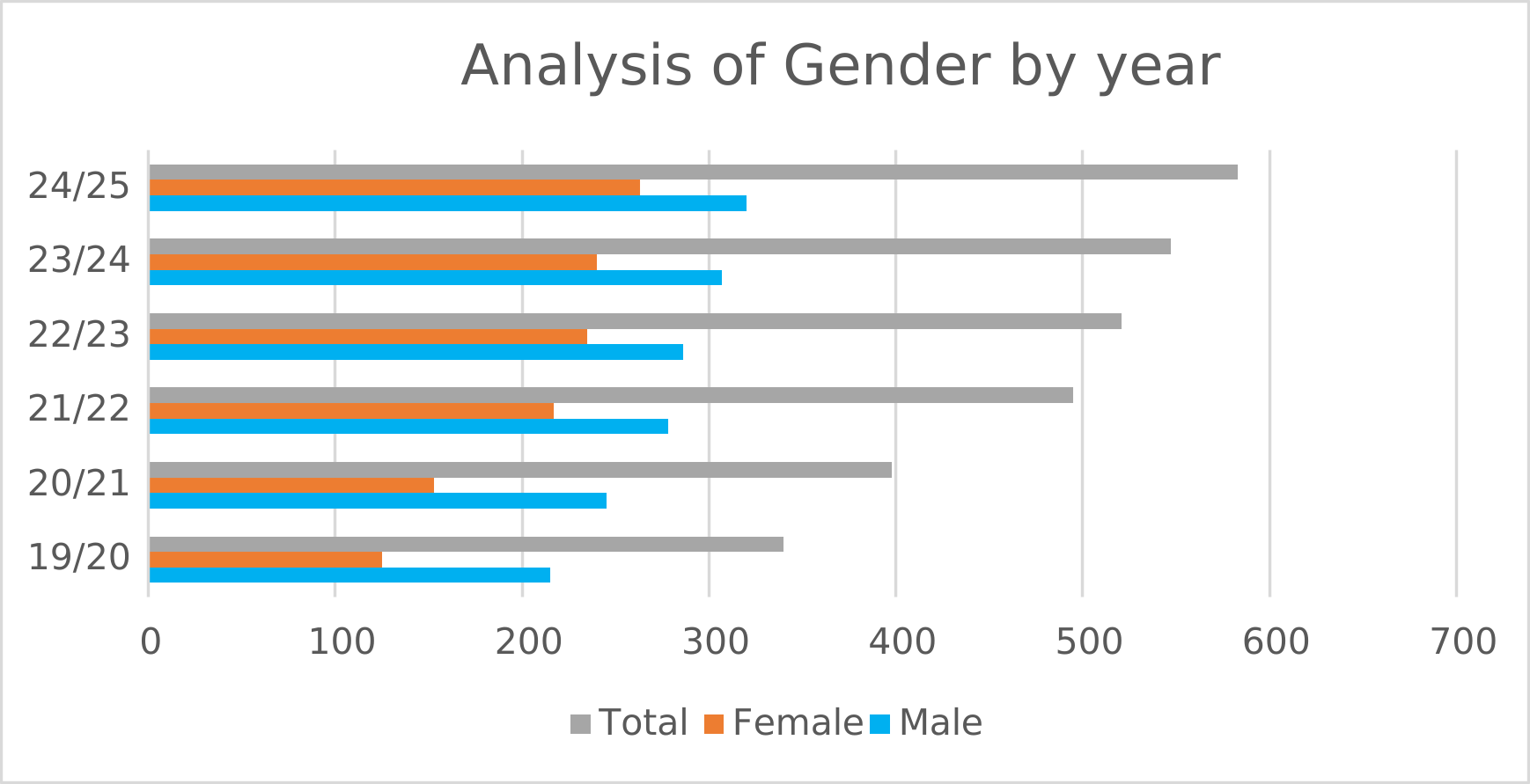
As of 31 March 2025, UKEF had 583 employees, of whom 45% identified as female, an increase of 1% from 2024.
8.40% of UKEF employees were graded Senior Civil Servants (SCS); of these 26.53% identified as female, an increase of 1.03% from 2024.
UKEF’s headcount has continued to rise over the last nine years, and the proportion of female employees has also risen over this period.
2.1 Impact over the last 9 years
| Year | 16/17 | 17/18 | 18/19 | 19/20 | 20/21 | 21/22 | 22/23 | 23/24 | 24/25 |
|---|---|---|---|---|---|---|---|---|---|
| Number of employees | 264 | 305 | 321 | 340 | 398 | 495 | 521 | 547 | 583 |
| % Female | 36 | 38 | 39 | 37 | 38 | 44 | 45 | 44 | 45 |
| % of employees SCS | 4 | 6 | 5.30 | 6.18 | 6.78 | 5.86 | 6.33 | 8.59 | 8.40 |
| % of SCS are female | 20 | 24 | 29 | 29 | 33 | 28 | 33 | 25.50 | 26.53 |
2.2 Analysis by Grade
| Year | 19/20 | 20/21 | 21/22 | 22/23 | 23/24 | 24/25 | ||||||
|---|---|---|---|---|---|---|---|---|---|---|---|---|
| Grade | Male | Female | Male | Female | Male | Female | Male | Female | Male | Female | Male | Female |
| AA/AO EO | 32 | 26 | 26 | 27 | 24 | 42 | 30 | 36 | 29 | 35 | 23 | 36 |
| HEO | 31 | 23 | 38 | 33 | 43 | 43 | 36 | 45 | 38 | 47 | 39 | 36 |
| SEO | 63 | 36 | 77 | 49 | 82 | 63 | 69 | 64 | 61 | 53 | 65 | 69 |
| Grade 7 | 48 | 20 | 55 | 22 | 73 | 36 | 90 | 49 | 95 | 53 | 108 | 67 |
| Grade 6 | 26 | 14 | 31 | 13 | 35 | 25 | 39 | 30 | 49 | 40 | 49 | 42 |
| SCS | 15 | 6 | 18 | 9 | 21 | 8 | 22 | 11 | 35 | 12 | 36 | 13 |
| Total | 215 | 125 | 245 | 153 | 278 | 217 | 286 | 235 | 307 | 240 | 320 | 263 |
3. UKEF’s gender pay gap
UKEF uses Civil Service grades ranging from Administrative Assistant (administrative level grade) to Senior Civil Servant (executive level grade). Grades vary according to the level of responsibility that staff have. Each grade has a set pay range with pay gaps in between grades.
All recruitment and promotions are undertaken based on fair and open competition in line with the Civil Service recruitment principles, furthermore, all applications are anonymised at the initial sift stage. To ensure a robust process, where possible the interview panels for recruitment and promotion consist of a balanced gender split.
3.1 Ordinary pay: trend over the last 9 years
| 16/17 | 17/18 | 18/19 | 19/20 | 20/21 | 21/22 | 22/23 | 23/24 | 24/25 | |
|---|---|---|---|---|---|---|---|---|---|
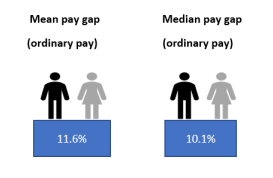
| Mean pay (%) | 15.97 | 15.25 | 12.23 | 13.90 | 13.00 | 14.20 | 11.90 | 11.90(3) | 11.60 |
| Median pay (%) | 16.26 | 12.22 | 11.97 | 13.50 | 15.60 | 18.30 | 16.40 | 14.80 | 10.10 |
3.2 Mean and Median Pay for 2025
| Grade | Male | Female | Total | Mean Pay - Male (£) | Mean Pay - Female (£) | Mean - GPG (%) | Median Pay - Male (£) | Median Pay - Female (£) | Median GPG (%) |
| AA / AO * | 2 | 1 | 3 | ||||||
| EO | 21 | 35 | 56 | 19.15 | 19.04 | 0.57 | 19.09 | 19.09 | 0.00 |
| HEO | 39 | 36 | 75 | 21.62 | 21.58 | 0.18 | 21.80 | 21.76 | 0.19 |
| SEO | 65 | 69 | 134 | 27.48 | 26.98 | 1.83 | 26.48 | 26.62 | -0.50 |
| Grade 7 | 108 | 67 | 175 | 35.36 | 34.35 | 2.84 | 35.65 | 33.13 | 7.06 |
| Grade 6 | 49 | 42 | 91 | 44.17 | 43.83 | 0.78 | 43.6 | 43.95 | -0.80 |
| Total | 320 | 263 | 583 | 35.29 | 31.19 | 11.61 | 32.87 | 29.55 | 10.10 |
Note:
(1) *Data set is less than 10, therefore, information has not been published.
(2) UKEF had 588 employees as of 31 March 2025, however, for GPG reporting purposes only 583 are included. For the purpose of GPG reporting only individual who are on “full-pay” are included.
(3) 2024 report published that the mean GPG for 23/24 was 11.8%, however, following an update from Cabinet Offices and the annual ACSES data, this figure was revised to 11.9%.
Individuals who are graded at AO to EO level received a “spot” salary, whereas grades HEO and above are subject to a minima and maxima band.
Both the mean and median pay gap for SEO’s and Grade 6 improved compared to the 2024 figures previously published.
It is also pleasing to note, that even though UKEF’s mean GPG has only reduced by 0.3% from 23/24, there has been improvement across some of the grades. Individuals at the SEO and Grade 7 level have seen positive movement compared to 23/24.
3.3 Comparison of mean GPG 2024 vs 2025
| Grade | Mean - GPG 2024 (%) | Mean - GPG 2025 (%) |
|---|---|---|
| AA / AO | Spot rate of pay | Spot rate of pay |
| EO | Spot rate of pay | Spot rate of pay |
| HEO | -0.86 | 0.18 |
| SEO | 4.28 | 1.83 |
| Grade 7 | 1.10 | 2.84 |
| Grade 6 | 2.56 | 0.78 |
| SCS (All) | 4.38 | 8.71 |
As a government department UKEF must operate within the parameters detailed in the annual Civil Service Pay Remit guidance , whilst UKEF will adopt these proposals, where possible it is UKEF’s ambition to try and close the GPG further across all of its grades.
4. Bonus pay
UKEF’s performance awards were paid as a set value depending on grade and performance level.
In addition to annual performance awards, for non-SCS staff UKEF also recognises outstanding employee contributions and small awards are made throughout the year.
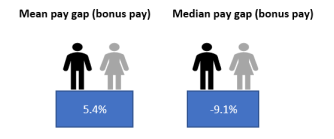
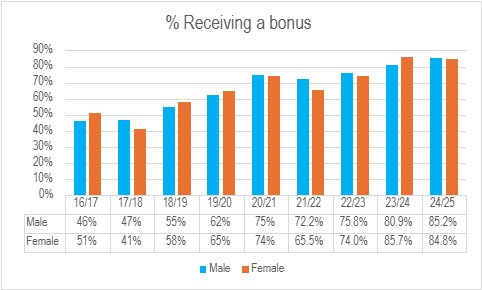
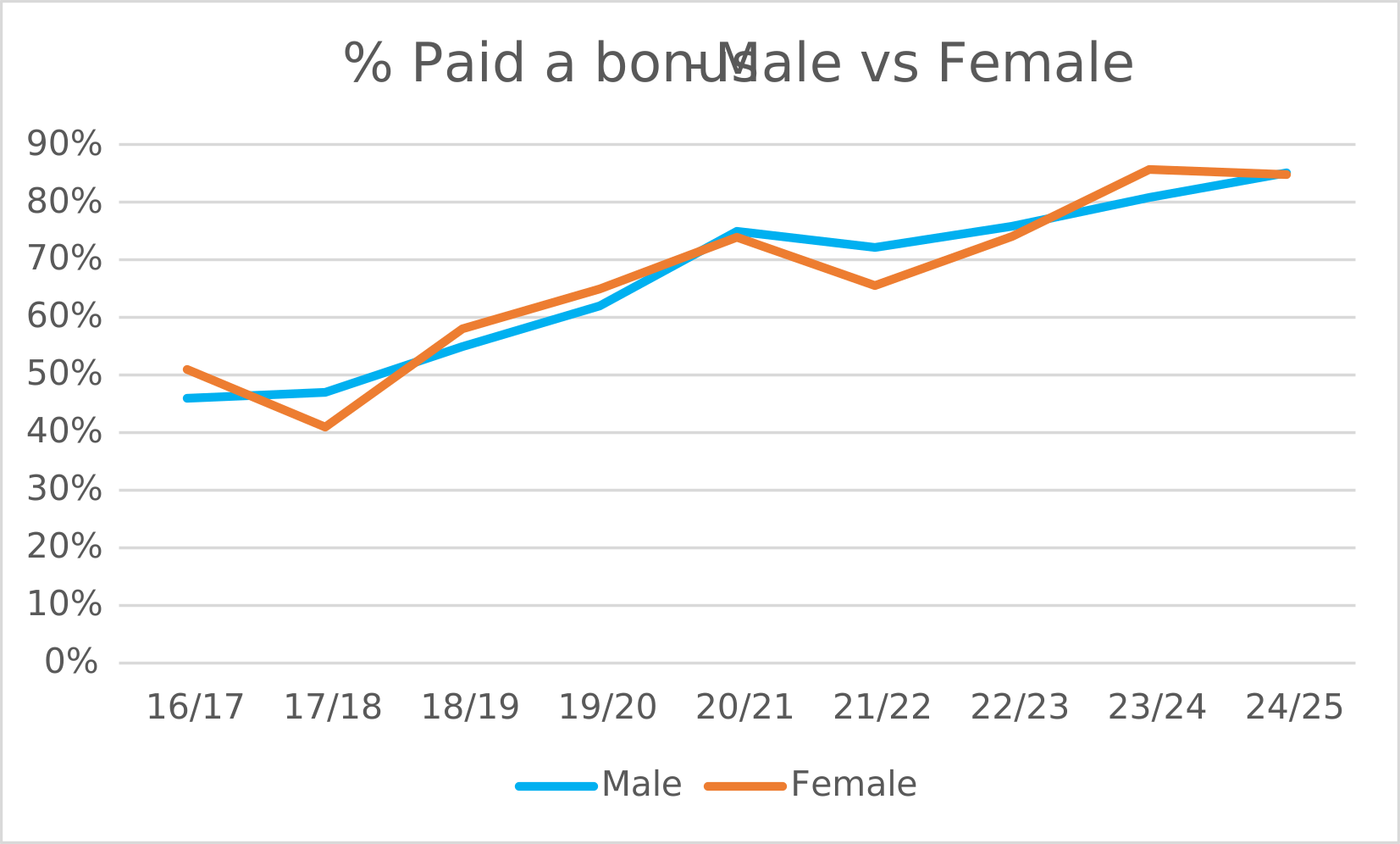
Compared to 23/24, the mean bonus gap reduced significantly from 7.6% to 5.4% in 24/25, however, it was disappointing that whilst the percentage of male employees (85.2%) compared to female employees (84.4%) receiving a bonus had narrowed, the number of female employees receiving a bonus dropped by 0.9%.
4.1 Bonus pay trend over the last 9 years
| 16/17 | 17/18 | 18/19 | 19/20 | 20/21 | 21/22 | 22/23 | 23/24 | 24/25 | |
|---|---|---|---|---|---|---|---|---|---|
| Mean bonus pay gap (%) | 22.36 | 20.57 | 24.68 | 23.70 | 13.10 | 27.70 | 23.20 | 7.60 | 5.40 |
| Median bonus pay gap (%) | 7.80 | 25.09 | 31.06 | 8.70 | 9.00 | 19.70 | 20.30 | 6.40 | -9.10 |
4.2 Percentage of male and female employees paid a bonus
5. Analysis by grade
5.1 Bonus by grade and gender
| Grade | Male | Female | |||||||
| No Bonus | Bonus | Total Employees | Received Bonus (%) | No Bonus | Bonus | Total Employees | Received Bonus (%) | ||
| AA / AO * | |||||||||
| EO | 7 | 14 | 21 | 67 | 11 | 24 | 35 | 69 | |
| HEO | 4 | 35 | 39 | 90 | 6 | 31 | 37 | 84 | |
| SEO | 10 | 57 | 67 | 85 | 11 | 58 | 69 | 84 | |
| Grade 7 | 16 | 92 | 108 | 85 | 3 | 64 | 67 | 96 | |
| Grade 6 | 3 | 48 | 51 | 94 | 7 | 35 | 42 | 83 | |
| SCS | 7 | 29 | 36 | 81 | 2 | 11 | 13 | 85 | |
| Total | 48 | 276 | 324 | 85.2 | 40 | 224 | 264 | 84.8 |
Note: *Data set is less than 10, therefore, information has not been published
UKEF had 11 new employees join the department in February and March 2025 therefore, in line with the rules relating to performance awards, whilst they were employed as of 31 March 2025, they would have not been eligible for any performance awards.
With regards to UKEF’s performance awards (bonuses), payments are deferred. Therefore, for the purposes of the 2025 GPG report, performance awards paid in June 2024 relate to employees’ performance in 23/24. Performance awards are pro-rated if an employee has not completed 12 months’ service or if they work part-time.
There were 504 employees (this excludes SCS) who were eligible for annual 23/24 performance awards. These were paid in June 2024 and fall within the remit of the 2024 GPG report. Of the eligible employees, 97.96% received an award. This equated to 97.79% of female employees compared to 98.12% of male employees. Performance awards are tiered and 59.29% of female employees received either a tier “1” or “2” award, compared to 50.75% of male employees.
Annual performance awards for SCS are also paid in arrears. For the 23/24 performance year, awards to SCS were also made in June 2024.
Unlike delegated grades, only SCS who achieve an “exceeding” or “high performing” rating will receive a year-end award. For 23/24 performance awards, 52% of eligible SCS received an award.
Several individuals were also promoted during 23/24. Therefore, they were graded as SCS as at the end of GPG year 2024. Of this total eligible cohort, 53.8% of female employees received an award compared to 51.4% of male employees.
5.2 Bonus: trend over the last 9 years
| Paid a bonus (%) | |||||||||
|---|---|---|---|---|---|---|---|---|---|
| 16/17 | 17/18 | 18/19 | 19/20 | 20/21 | 21/22 | 22/23 | 23/24 | 24/25 | |
| Male | 46 | 47 | 55 | 62 | 75 | 72.2 | 75.8 | 80.9 | 85.2 |
| Female | 51 | 41 | 58 | 65 | 74 | 65.5 | 74.0 | 85.7 | 84.8 |
6. Pay by quartiles
6.1 Pay by quartile: trend over the last 9 years
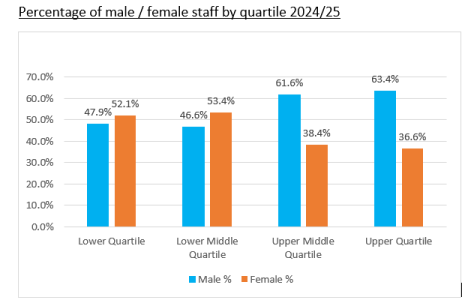
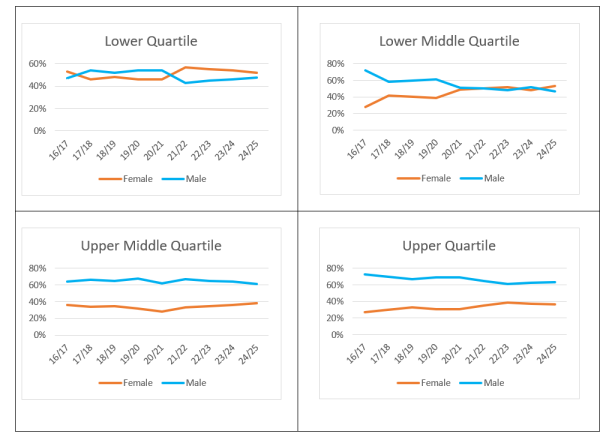
When the workforce is segmented into quartiles based on pay, and those quartiles are compared on gender grounds, the data shows that across the quartiles female representation in 24/25 has reduced in the lower quartile, and there has been an increase in female representation across the lower middle and upper middle quartiles.
6.2 Proportion of women by salary by quarter
| Quartile | 16/17 | 17/18 | 18/19 | 19/20 | 20/21 | 21/22 | 22/23 | 23/24 | 24/25 |
|---|---|---|---|---|---|---|---|---|---|
| Lower Quartile (%) | 53 | 46 | 48 | 46 | 46 | 57 | 55 | 54 | 52 |
| Lower Middle Quartile (%) | 28 | 42 | 40 | 39 | 49 | 50 | 52 | 48 | 53 |
| Upper Middle Quartile (%) | 36 | 34 | 35 | 32 | 28 | 33 | 35 | 36 | 38 |
| Upper Quartile (%) | 27 | 30 | 33 | 31 | 31 | 35 | 39 | 37 | 37 |
6.3 Percentage of male / female staff by quartile 2024/25
6.4 Percentage of male / female staff by quartile over the last 9 years
7. Work on closing the gender pay gap
The mean GPG from 2024 (11.9%) has marginally reduced over the last 12 months to 11.6% in March 2025. At the same time, the median GPG has also decreased by a more significant margin of 4.7% over the same period.
UKEF has a clear ambition to reduce the GPG further and in our People Strategy for 2024-2027 we have committed to reducing this further to 9.9% by 31 March 2026.
UKEF values a diverse and representative workplace, one that will attract and retain talented people from all backgrounds and give everyone, including those already working for us, the opportunity to achieve their full potential. We have committed to reviewing our demographic data annually to better understand what actions can be taken to continue to make UKEF a great place to work. We are proud of our annual People Survey scores and continue to benchmark ourselves against other government departments.
In 2025 we re-committed to the Women in Finance Charter, publicly affirming UKEF’s commitment to improve gender diversity. We also agreed new equality objectives as part of the Public Sector Equality Duty (PSED) requirements, one of which is to increase the percentage of women in SCS roles by 31 March 2029.
Working pro-actively with the Chief Executive Officer and the Gender Network, UKEF has addressed some of the actions from the 2024 report. We have also ensured that on-going actions continue to be monitored, whilst at the same time, we have looked to implement new ideas.
The Gender Network continues to have a strong voice within UKEF and has organised and delivered events in the past year. This includes marking International Women’s Day with awards and recognition for colleagues, writing blogs, supporting their members, and working collaboratively with other staff diversity networks and HR.
7.1 On-going actions (from 2024)
- The gender network felt that women, particularly at Grade 7 and Grade 6 level, have experienced potential barriers to promotion. In 24/25, 52% of female employees were promoted compared to 48% of male employees. There was also an improvement at Grade 7 level, where 56% of the promotions were female employees
- We offer shared parental leave, as well as job share and part-time opportunities, and have guidance to help line managers ensure those returning from parental/adoption leave feel supported and welcomed
- We continue to promote the various talent schemes which are available across the grades to ensure that opportunities are available to female employees to support their career development
Attracting more women into UKEF also remains a key target.
- We continue to anonymise the application process to reduce unconscious bias and, at the SCS level, it is mandated that the “long list” it must contain female candidates.
- We have ensured that there is broader diversity on interview panels (both gender and ethnicity) and that this is representative of UKEF as an organisation. Internal recruitment frameworks have been reviewed in the last 12 months, and clearer guidance has been issued to recruitment panels.
- We continue to work with line managers to discuss how roles are advertised to ensure we can offer greater flexibility on both a part time/flexible working basis. A wider use of careers sites was undertaken, specifically sites which target broader gender and ethnic diversity. UKEF has seen an increase in part-time staff from 6.22% in 23/24 to 7.14% in 24/25, of which 85.7% of part-time positions are taken up by female employees
Annual Pay Remit
The annual pay remit was implemented in August 2024 and under Cabinet Office guidance departments were allowed to implement an “average” award of 5% for delegated grades.
- Rather than implement an ‘across the board’ pay increase of 5% to all delegated staff, UKEF adopted a targeted approach, focusing predominantly on the junior grades, as well as increasing the salary minima of some of the pay bands
- By adopting a targeted approach, rather than an ‘across the board’ pay increase, the GPG improved across delegated grades by 0.17%
- This resulted in an average salary increase of 4.95% for female employees, compared to 4.76% for male employees
Recruitment activity
- In 24/25 the number of recruitment campaigns (172) reduced compared to 23/24. Again, UKEF continued to see a significant proportion of staff either move laterally within the organisation or benefit from internal promotions
- The number of female candidates who were successful appointed increased from 42% in 23/24 to 47% in 24/25
- The number of female employees who were promoted internal within UKEF was 52%, with a significant percentage of these promotions being across the SEO and Grade 7 structure
UKEF continues to develop its diversity and inclusion priorities. Over the 24/27 period of the People Strategy, UKEF will look to review and monitor how best it can continue to attract and retain a wide range of talent from diverse demographic groups.
All SCS employees are required to have an objective relating to diversity and inclusion as part of the annual performance management process. This could include actions to support with gender equality, and the gender pay gap.
The Cabinet Office’s new Diversity and Inclusion Expenditure Guidance came into force in May 2024. This has limited the extent to which we could offer targeted support for the progression of female staff this period. Notwithstanding this, Learning and Development remains a central component of our People Strategy. We have continued to take steps to encourage development and provide a wide range of opportunities.
During the reporting period, we have:
- Participated in the Civil Service Future Leaders Scheme, which accelerates the development of high potential Grade 7 and Grade 6 staff. Three members of staff were successful in their applications, all of whom were female
- Supported and funded the enrolment of five female members of staff onto the Crossing Thresholds programme, which is specifically designed to support women progressing their careers
- Stepping into Leadership is aimed at individuals who are graded SEO to Grade 6. In 2024, we offered this to 21 participants, of whom 33% were female
- We supported and funded 7 places on the Beyond Boundaries programme. 5 of these places were filled by female employees
- We are exploring new ways to increase the visibility and reach of the Crossing Thresholds programme across the organisation. This year, we promoted applications from under‑represented groups, including women, for the Stepping into Leadership programme that are aligned to the department’s PSED objectives
7.2 Planned new action for the coming year
UKEF published its Public Sector Equality Duty (2024-25) report in November 2025 where we outlined our commitment to eliminate unlawful discrimination and harassment, as well as advancing equality of opportunity for people who share and don’t share protected characteristics.
As part of our wider commitments our objectives also include:
- To increase the proportion of women in Senior Civil Service (SCS) roles by 31 March 2029
- To increase the proportion of staff with disabilities, both overall and within SCS roles, by 31 March 2029
- To increase the proportion of ethnic minority staff within SCS roles by 31 March 2029
- Undertake a communications exercise to ensure staff undertake a review of their personal sensitive data
- Data from 24/25 recruitment activity has shown that UKEF attracts significantly less female applicants (36.5%) compared to male applicants (59.1%). 4.4% did not disclose their gender. Therefore, UKEF will look to undertake a more detailed forensic review of people data (to include, but not limited to, recruitment and performance rating data) to better understand areas to focus on. This will include data by grade and gender (as well as other protected characteristics)
- Review Marketing Information relating to recruitment interview panel composition and re-publicise opportunities for staff to sit on interview panels
- Review guidance around Success Profiles and strengths-based interviewing
- Review external recruitment page to enhance information relating to diversity and inclusion
- Undertake a review of salaries to identify if there are any discrepancies
- Review resources available on menopause
- Explore the use of wider jobs sites in order to attract a more diverse candidate pool
Pay is a key driver of the GPG, and whilst UKEF is subject to the annual pay remit and the parameters set by the Cabinet Office and HM Treasury, UKEF is committed to working with the Government People Group to, where possible, review its current approach to remuneration.
8. Staff included in the Gender Pay Gap data
- Information is based upon individuals employed by UKEF on 31 March 2025.
- Contractors (off payroll workers) are out of scope for this report.
- Information prepared 16 March 2026.
- The GPG data is taken from Civil Service ACSES data, and this did not include Fast Streamers who are funded by the Cabinet Office.[1]
- The information provided for this GPG report details the proportion of UKEF employees who have declared each of the protected characteristics when recording personal information in UKEF’s HR system, as of 31 March 2025.
- We confirm that data reported by UKEF is accurate and has been calculated according to the requirements and methodology set out in the Equality Act 2010 (Specific Duties and Public Authorities) Regulations 2017: John Thompson and Lucy Wilding, Co-Heads of HR, UKEF.
[1] a) Under the guidance 583 full-pay relevant employees are included in the mean and median GPG (5 individuals are excluded).
b) For the purposes of the mean and median bonus pay gap calculation, only individuals who received a consolidated payment are included. This represented 500 (out of 580) employees.