UK digital verification services trust framework (1.0)
Updated 9 June 2026

© Crown copyright 2026
This publication is licensed under the terms of the Open Government Licence v3.0 except where otherwise stated. To view this licence, visit nationalarchives.gov.uk/doc/open-government-licence/version/3 or write to the Information Policy Team, The National Archives, Kew, London TW9 4DU, or email: psi@nationalarchives.gov.uk.
Where we have identified any third party copyright information you will need to obtain permission from the copyright holders concerned.
This publication is available at https://www.gov.uk/government/publications/uk-digital-verification-services-trust-framework-1-0/uk-digital-verification-services-trust-framework-1-0-pre-release
0. Version and certification validity notes
0.a. This 1.0 publication of the UK digital verification services trust framework (‘trust framework’) will come into force under section 28 of the Data (Use and Access) Act 2025 on the date the first conformity assessment body (‘CAB’) is accredited to certify against it, which will be no earlier than 1 September 2026.
0.b. The non-statutory gamma (0.4) version of the trust framework, published on 26 June 2025 and the statutory gamma (0.4) published on 1 December 2025 will remain valid for a limited period of time for the purposes of:
-
certification, such that certificates issued against those versions will remain valid and any audit and surveillance in respect of those certificates are conducted against those versions as relevant, subject to 0.c below; and
-
Part 2 of the Act (where relevant and where there exist certificates which are valid against them) such that references to the DVS trust framework are to be read as references to the non-statutory gamma (0.4) and the statutory gamma (0.4) versions.
0.c. The statutory gamma (0.4) version of the trust framework is only to remain valid for new certifications following the coming into force date of this 1.0 trust framework in the circumstances below:
-
the DVS applied for certification against the statutory gamma (0.4) trust framework before the day on which this 1.0 trust framework comes into force but the certification process had not been completed by that date, such that a certificate was issued by an accredited CAB after that date; or
-
the DVS applying for certification, at the point at which they apply for new certification, holds a certificate confirming they comply with the requirements under the non-statutory gamma (0.4) or the statutory gamma (0.4) versions of the trust framework and the application is made by that DVS before the certificate expires and within 15 months of the day on which this 1.0 trust framework comes into force.
0.d. The non-statutory gamma (0.4) and the statutory gamma (0.4) versions of trust framework referred to in 0.b will no longer apply for the purposes of certification and Part 2 of the Act, and certificates issued against them will expire and should be ignored for those purposes if any of the following apply:
-
27 months have elapsed since the day on which this 1.0 trust framework comes into force (including that day);
-
a service uplifts to the 1.0 publication and has a certificate issued to confirm that; or
-
the service’s non-statutory gamma (0.4) or statutory gamma (0.4) certification expires.
0.e. All previous publications of the trust framework were titled the ‘UK digital identity and attributes trust framework’. As the first revised statutory trust framework publication under the Data (Use and Access) Act 2025, we have aligned the title of this publication with the term given to the trust framework in the legislation: ‘DVS trust framework’. These two titles refer to different versions of the same document.
0.f. We published a pre-release of this 1.0 publication on 3 March 2026 for business readiness purposes. We have made one change to the content of the trust framework between the pre-release and this final publication to amend 4.1.c. and 4.1.d so that a single service can be certified under the OSP role concurrently with other roles. The rule preventing this concurrent certification was new in the 1.0 pre-release, so this change will represent no practical change for OSPs uplifting their certification from gamma (0.4) to this 1.0 publication. Note that this final 1.0 publication still prevents a single service from holding concurrent CSP certification with other roles.
Part 1 - Background and context
1. Introduction
1.a. This is the 1.0 publication of the DVS trust framework. The trust framework is a set of rules for an organisation to follow if they want to have their service certified as a trustworthy digital verification service (‘DVS’). A DVS is a service that enables people to digitally prove who they are, information about themselves or their eligibility to do something. The trust framework aims to make it easier and more secure for people to use these services.
1.b. The trust framework is based on the government’s digital identity principles outlined in the response to the Call for Evidence published on digital identity on 1 September 2020. The principles are:
-
Privacy. When personal data is accessed, users will have confidence that there are measures in place to ensure confidentiality and privacy. Where possible, users select what personal data is shared. Providers will have privacy standards to uphold and will need to prove their ongoing compliance.
-
Transparency. Users must be able to understand by who, why and when their identity and attribute data is used when using DVS.
-
Inclusivity. Those who want or need a digital identity should be able to obtain one.
-
Interoperability. Setting technical and operating standards for use across the UK’s economy will help to enable international and domestic interoperability.
-
Proportionality. Users’ needs and other considerations such as privacy and security will be balanced so digital verification services can be used with confidence across the economy.
-
Good governance. Standards will be linked to government policy and law. Governance of the digital identity and attributes ecosystem will be clear, coherent and align with the government’s wider strategic approach to digital regulation.
1.c. The trust framework is maintained by the Office for Digital Identities and Attributes (OfDIA), part of the Department for Science, Innovation and Technology (DSIT). The relevant legal provisions for the trust framework are set out in sections 28 and 31 of the Data (Use and Access) Act (2025) (‘the Act’).
1.1. What the trust framework does
1.1.a. The trust framework helps people use and reuse trustworthy digital identities and attributes, with people and organisations across the United Kingdom and internationally. It is intended to accelerate innovation, investment and uptake, while helping to ensure that services are safely developed and deployed for the benefit of all who wish to use them.
1.1.b. The trust framework generally draws on existing standards, guidance, best practice and legislation. DVS providers can have their services independently certified against these rules to prove they meet the high standards set out in the trust framework.
1.1.c. In this way, the trust framework and its associated certification process is designed to address a key barrier to the use of DVS: that one organisation does not know how another creates digital identities or attributes. Establishing consistent language and requirements will help organisations and people interact and build trust that the information they receive from one another is accurate and reliable.
1.2. What the trust framework does not do
1.2.a. This trust framework does not:
-
supersede the requirements in any other contracts, policies or legislation that organisations already need to meet, including data protection legislation;
-
explain the legislative or governance arrangements DSIT has established to support DVS. This information is available on GOV.UK;
-
provide a technical architecture for DVS;
-
prevent DVS providers from pursuing even higher standards and levels of innovation, where such actions align with the principles of the trust framework and benefit users;
-
set commercial arrangements for organisations; or
-
set out the design for a centralised or mandatory national digital identity system.
2. Feedback received and updates
2.a. The trust framework is being developed iteratively. This allows for testing to ensure that its rules are appropriate, proportionate and deliver on the government’s digital identity principles. Iteration also helps ensure alignment with international best practice, as new standards are issued and the digital identity market matures.
2.b. In line with section 31 of the Act, the Information Commissioner’s Office (ICO) and other appropriate stakeholders across industry, civil society, and the public sector have been consulted on the content of the trust framework through written surveys and working groups. The trust framework will continue to be updated as changes are needed, and the market develops.
2.1. Changes made for the 1.0 publication
2.1.a The previous, gamma (0.4) publication of the trust framework was designed to significantly uplift the minimum standards services adhere to. This publication (1.0) of the trust framework is intended to iteratively build upon that high baseline. As such, the majority of the changes in this version of the trust framework are in the supporting documents that underpin the trust framework.
2.1.b. This rest of this section sets out key changes to this document and its supporting documents in this publication.
2.1.1. The UK CertifID trust mark
2.1.1.a. Providers certified against this publication, and listed as such on the register of digital identity and attribute services will, for the first time, be able to use the new UK CertifID trust mark (the ‘trust mark’). Wherever people or businesses see the trust mark displayed, they can be confident that the product or service can be trusted to be secure, meeting the rules set out in the trust framework and subject to oversight by OfDIA.
2.1.1.b. The Act enables the Secretary of State to issue the licence to use the trust mark to registered services. Issuance is undertaken by OfDIA on the Secretary of State’s behalf. Section 14 sets out the new rules governing when and how the trust mark can be used.
2.1.2 Alignment with the Data (Use and Access) Act 2025
2.1.2.a. As set out in section 0, as this is the first revised statutory trust framework publication under the Act, we have aligned its title with the term it is given in the Act: ‘DVS trust framework’. All previous publications of the trust framework were titled the ‘UK digital identity and attributes trust framework’.
2.1.2.b. To align the trust framework with the scope it is given in the Act, we have also focused the trust framework’s rules on the identities and attributes of natural persons, i.e. individuals, rather than companies or organisations.
2.1.3. Holder service providers
2.1.3.a. During policy testing, we heard that additional rules were needed to better support relying parties and other services to accept digital identities and attributes stored in holder services.
2.1.3.b. To achieve this, we have added new rules for holder service providers to help relying parties understand and integrate with their services by requiring that they are able to share metadata about confidence in identities, authentication methods, identity and attribute provenance, and binding to the user. More details are available in section 7 on holder service providers.
2.1.3.c. To align with the National Cyber Security Centre (NCSC)’s commitment to encourage the adoption of passkeys, we’ve made clear how syncable authenticators (of which passkeys are an example) can be used as part of our authentication guidance, which holder service providers are required to follow.
2.1.4. Orchestration service providers
2.1.4.a. This publication introduces our first dedicated rules for orchestration service providers. There are now requirements in section 8 requiring orchestration service providers to be able to confirm whether the services they orchestrate are on the DVS register. This reflects the growing significance of confirming DVS registration in the market. We provide the option for this be done with reference to a cache of the register, or to be done against the live register. This anticipates the introduction of programmatic capability for the register later this year, which will allow real-time checks of the register using an application programming interface (API).
2.1.4.b. The technical options for orchestrating identities and attributes otherwise remain broad and open to innovation. We expect the role of orchestration services to become more important over the coming years, and we will continue to monitor the market and to determine whether some orchestration service providers would be better served by new rules, new sub-roles, or a new role entirely in a future publication of the trust framework.
2.1.5. Vouching and digital evidence
2.1.5.a. We have amended the supporting documents to provide a clearer role for secure vouching in identity checking at lower levels of confidence. The vouching guidance has been rewritten to provide a clearer way for a vouch to be scored as evidence as part of an identity checking process. The rewritten vouching guidance retains some requirements from previous versions, for example the requirement for the person vouching to be in a listed position of authority. It sets a number of new requirements, for example to specify which scores a vouch can be given in accordance with the identity checking guidance.
2.1.5.b. The identity checking guidance has also been clarified to make clearer how digital evidence can be scored for validity. While the substance of the rules has not been changed, which rules apply to digital evidence, which apply to physical evidence, and which apply to both has been made clearer.
2.1.6. The data schema
2.1.6.a. The 1.0 publication is accompanied by an updated data schema. The schema is newly reformatted to improve usability, with a revised and modernised data model, data dictionary and data taxonomy. We’ve aligned, where appropriate, with major data sharing and presentation standards to make the schema a more practical resource for industry adoption and expanded its scope to cover priority areas and data points from across government and industry.
2.1.6.b. As in previous publications, use of the data schema remains optional for certified services.
2.1.7. Interaction between services and roles
2.1.7.a. The gamma (0.4) publication introduced the component service provider role to enable providers who specialise in particular parts of the identity, attribute and authentication process to certify the parts that they provide, so they can more easily integrate into other certified services.
2.1.7.b. This has highlighted the reliance that certified services can have on the certification of those in their supply chain. To mitigate the risks of this reliance, we’ve set new requirements in section 11.7 for all providers to use their risk management framework to capture the risk of services they rely on losing their certification, and the risk to others if they lose their certification.
2.1.7.c. Knowing which roles a DVS is certified against helps those who want to use that DVS to understand if it meets their needs. In order to give clarity on the service offerings of DVS providers to those they work with, we have added new rules in sections 4.1.c. and 4.1.d. which mean that a service certifying as a component service cannot have a concurrent certification under any other role.
2.1.7.d. If you provide a component service alongside other roles, you will need to have the component service certified separately. This will help those you work with understand what has been certified when they work with you. The identity service provider, attribute service provider, holder service provider and orchestration service provider roles remain certifiable alongside one another and in any combination.
2.1.8. Navigability of supporting documents
2.1.8.a. The supporting documents for the trust framework have now all been given a version number so that the trust framework can specify which version services must follow as part of their certification against this trust framework publication and future publications.
2.1.8.b. Every paragraph is now numbered across the supporting documents to make them as navigable as this document and enable cross-referencing between documents.
2.1.8.c. The guidance on attributes, which was previously spread across three supporting documents, has been consolidated into one, and the identity checking guidance has been restructured so some technical elements which were spread out across sections and across different webpages are all contained in annexes to the main publication. The guidance on delegated authority has also been revised to better link to the guidance on identity checking.
2.1.9. Inclusion, accessibility and service design
2.1.9.a. Rules in section 10 on inclusion and accessibility that, previously, only identity service providers, attributes service providers and holder service providers were required to follow, are now mandatory for all provider types. This means that providers of all types will now be required to submit an inclusion monitoring report and demonstrate that they follow accessible design standards in their service.
2.1.9.b. Rules on confirming user understanding, previously set out alongside privacy rules, are now set out in section 10 alongside the inclusion and accessibility rules. This emphasises that these rules are intended to inform service design, rather than simply as a part of a service’s compliance with the requirements of data protection legislation.
2.1.10. Security and fraud
2.1.10.a The trust framework reflects that DVS providers have a role not only in preventing identity fraud, but also in supporting users who fall victim to it. Now that Action Fraud has been replaced by Report Fraud, we have incorporated requirements previously set out in Action Fraud guidance directly into the main body of the trust framework in section 12.5.5, tailoring and extending them. We will review whether there are new Report Fraud materials we can point to in future publications.
2.1.11. Prohibited data processing
2.1.11.a. We have extended the rules in section 12.7.3 which prohibit the processing of identity and attribute data for certain purposes. These rules now apply to metadata about this data, not just the identity and attribute data itself. This metadata can reveal things about a person much like identity or attribute data itself can.
3. Terms and definitions
3.a. Please see the glossary for a full list of terms and definitions.
3.1. Digital identities and attributes
3.1.a. In the context of the trust framework and its supporting documents, a digital identity is a digital representation of a person. Unless otherwise stated, ‘person’ refers a natural person, in the sense of an individual human, rather than a legal person, like a company. A digital identity enables a person to prove who they are during interactions and transactions. It is also a way for organisations or users to check that other users are who they say they are. Digital identities can be used online or in person and may be created for single point-in-time use or be reusable.
3.1.b. Attributes are individual pieces of information that describe something about a person, like their age. In the context of the trust framework and its supporting documents, attributes are about individuals only, though may concern an individual’s relationship to an organisation. A combination of attributes can be used to create a digital identity and help people prove that they are who they say they are.
3.1.c. Attributes can also help prove a user is eligible or entitled to do something, such as buying age-restricted goods, or acting on behalf of an organisation. In these circumstances, it often is not necessary for the relying party to know the user’s full identity before they can complete an interaction, and attributes can be used on their own. In other situations, this proof could be added to an existing digital identity.
3.2. Levels of confidence
3.2.a. The trust framework enables identities to be checked to different ‘levels of confidence’. A level of confidence is a measure of how well an identity checking process protects against identity risks, based on the strength and the thoroughness of the checks performed on the claimed identity. Certified providers can prove identities to four levels of confidence:
-
Low
-
Medium
-
High
-
Very High
3.2.b. The trust framework itself does not set out how to reach a particular level of confidence. Instead, this is set out in a separately published guidance document called ‘How to check someone’s identity’ (also known as ‘Good Practice Guide 45’ or simply ‘GPG 45’).
3.2.c. The guidance outlines how to score different parts of the identity checking process and how to combine those scores into ‘identity profiles’. These identity profiles are then mapped onto the levels of confidence. The recognised identity profiles can be grouped by their corresponding level of confidence and include:
-
Low level of confidence: L1A, L1B, L1C, L2A, L2B, L3A
-
Medium level of confidence: M1A, M1B, M1C, M1D, M2A, M2B, M2C, M3A
-
High level of confidence: H1A, H1B, H1C, H2A, H2B, H2C, H2D, H2E, H3A
-
Very high level of confidence: V1A, V1B, V1C, V1D, V2A, V2B, V2C, V2D, V3A
3.3. Other terms used in this document
3.3.a. We use ‘provider’ to refer to an organisation that offers DVS under the trust framework. Where a provider has had their service or product certified against the trust framework, we refer to it as a ‘certified service’.
3.3.b. We use ‘the register’ to refer to the register of digital identity and attribute services, a public list of providers offering certified services established and maintained under section 32 of the Act. Where a provider has a certified service listed in the register, we refer to them as a ‘registered provider’ and their service as a ‘registered service’.
3.3.c. We use ‘you’ and ‘your service’ in this document to direct a provider to the specific rules their organisation and service(s) must follow, and the recommendations they can follow, in order to be certified against the trust framework.
3.3.d. The word ‘must’ is used for any rules that a provider has to prove they have met in order for their service to be certified.
3.3.e. The words ‘can’, ‘may’ or ‘could’ are used to draw providers’ attention to optional standards and guidance they may wish to consider depending on their circumstances. However, these will not be requirements for certification.
3.3.f. We use ‘relying party’ to refer to an organisation that uses (or ‘consumes’) digital verification products or services. In the context of the trust framework, we primarily assume they are consuming digital identities and attributes from certified services, but relying parties may also provide attributes for certified services to assess.
3.3.g. We use ‘participant’ as a collective term to refer to all organisations that interact with the trust framework and take part in the wider digital identity and attributes market. This includes certified services and relying parties.
3.3.h. We use ‘supplementary code’ to refer to additional rules made under section 29 of the Act that providers can certify against, alongside the trust framework, to demonstrate that they meet the requirements of a particular sector or use case.
3.3.i. We use ‘user’ to refer to a person who uses digital verification services to prove something about themself. This includes people with delegated authority to act on behalf of somebody else, such as carers or parents.
4. How organisations participate in the trust framework
4.a. How you choose to participate in the trust framework will determine whether your service(s) needs to become certified and, if so, which trust framework rules are relevant. It is possible for your organisation and/or your service(s) to fulfil multiple roles under the trust framework. If so, you will need to follow the rules for each role. More information is available in section 4.1. on certifiable roles.
4.b. DVS providers who wish to participate in the trust framework must get their service certified against trust framework rules by an approved trust framework conformity assessment body (‘CAB’). CABs must be accredited to ISO 17065 by the UK Accreditation Service (UKAS) and approved by OfDIA to certify a service against trust framework rules.
4.c. In cases where there is suspicion that trust framework rules are not being followed, an investigation of a certified service’s compliance with the trust framework will be launched by the CAB the provider has contracted with for certification.
4.d. Other participants do not require certification against the trust framework to adopt digital identities, but they may choose to engage with certified services as part of their business operations. More information is available in section 4.2. on other market participants.
4.1. Roles with certifiable services
4.1.a. Providers that wish to have their service certified against the trust framework’s rules must perform at least one of the following roles:
4.1.b. To be certified, a CAB will need to check that a service follows all the rules for the role(s) it performs. Each role is associated with different capabilities, as the table below summarises:
| Service capabilities | Identity service provider | Attribute service provider | Holder service provider | Orchestration service provider | Component service provider |
|---|---|---|---|---|---|
| Checks identities | ✓ | ||||
| Collects, creates or checks attributes | ✓ | ||||
| Holds identities and/or attributes over time | ✓ | ||||
| Orchestrates interactions between participants | ✓ | ||||
| Provides specific part(s) of the identity checking or authentication processes | ✓ | ||||
| Relevant sections | Section 5; Sections 10-14 | Section 6; Sections 10-14 | Section 7; Sections 10-14 | Section 8; Sections 10-14 | Section 9; Sections 10-14 |
Figure 1
4.1.c. A service can perform more than one role concurrently and have this reflected on their certificate. Identity service provider, holder service provider, attribute service provider, and orchestration service provider can all be performed concurrently and in any combination as part of one service. For example, a holder service that derives new attributes from the identity information it holds must seek certification as both a holder service provider and attribute service provider to be certified.
4.1.d. However, a single service cannot be certified under any other role if it is certified as a component service. For example, a provider who provides an identity service and also provides a part of this identity service to others as a component service must have their identity service and component service certified separately.
4.1.e. The rules for providers are outcome based. By following them, services will achieve certain goals. The rules do not require the use of specific technologies or processes, but direct services to follow open technical standards where possible to strengthen interoperability between participants. This means providers of certified services will be able to innovate and develop products and services to better support users, without being restricted to using certain technologies.
4.1.f. Once issued, a certificate is generally valid for three years, unless it is suspended or revoked. A certificate applies only to the certified service and cannot be used to imply that any other service, or an organisation as a whole, is certified. The certified service will be subject to regular auditing during that period and must be re-certified prior to its certificate expiring in order to maintain its certified status. OfDIA may require providers of certified services to uplift to a more recent publication of the trust framework less than three years after a certificate has been issued in order to maintain certification. More information about the certification process is available from the CABs.
4.1.g. Certified services may apply to be listed in the public register of digital identity and attribute services. More information is available in section 13.
4.1.1. Identity service provider
4.1.1.a. An identity service provider checks a user’s identity for one-off use at a single point in time. It can provide services across a range of relationships between users, businesses and government, but will generally work directly with relying parties.
4.1.1.b. An identity service provider can specialise in checking users’ identities or offer identity checking alongside other services. An example of this might be a bank, solicitor, library or postal organisation.
4.1.1.c. An identity service provider does not need to do all parts of the identity checking process itself, but it is responsible for the overall process and its outcome. For example, it may contract with one or more component service providers or other third parties that specialise in providing specific part(s) of the process.
4.1.1.d. If a provider is creating, quality-checking, collecting or sharing attributes as part of its service, for example to create a digital credential, it is also an attribute service provider.
4.1.1.e. If a provider holds and/or supports the reuse of a digital identity, it is also a holder service provider.
4.1.2. Attribute service provider
4.1.2.a. An attribute service provider collects, creates, checks or shares pieces of information that describe something about a user. It can provide services across a range of relationships such as between users, businesses and government.
4.1.2.b. An attribute service provider can share users’ attributes with relying parties, identity service providers and holder service providers if they confirm a user’s understanding and assess the quality of the attributes before sharing them in order to support those they share them with to understand how much they can trust them.
4.1.2.c. An organisation does not need to do all parts of the attribute collection, creation, checking or sharing processes. It may wish to contract with one or more component service providers or other third parties that specialise in providing a specific part(s) of the process.
4.1.2.d. Sources of attributes include:
-
the public sector, such as organisations providing attributes found in documents, databases and credentials such as passports, driving licences, birth certificates
-
attributes issued by private sector organisations, such as a mobile number, bank account balance, credit score, or mortgage;
-
an identity created by a certified DVS, either created as part of the same service or shared by another service; and
-
attributes issued by checking services such as organisations that confirm the validity and provenance of attributes provided by another service.
4.1.2.e. An attribute service provider could choose to collect attributes to create a digital credential.
4.1.2.f. If a provider holds and/or supports the reuse of attributes for a user, it is also a holder service provider.
4.1.3. Holder service provider
4.1.3.a. A holder service provider creates a user-facing device, service, software or app that allows a user to collect, store, view, manage or share identity and/or attribute information. It securely holds and shares this information, and ensures it is not illegitimately changed, but cannot create new information itself unless it is also performing the identity service provider or attribute service provider role. The user can control what information their holder service stores, when it can be shared, and who it is shared with.
4.1.3.b. Users can keep many different things in their holder service. One form of holder service, called a ‘digital wallet’, is commonly used on mobile phones to hold things such as payment card details or tickets. Other forms of holder services could include:
-
reusable digital identities and attributes;
-
personal online data stores;
-
personal data vaults; or
-
services hosting data owned or controlled by many users in a community, e.g., a data co-operative.
4.1.3.c. Holder services can include an ‘account’ functionality. This is a user interface that allows a user to consistently access and manage information held in their holder service. It also allows a provider to directly support and remotely manage a user’s holder service, for instance to facilitate identity recovery processes and respond to fraud incidents.
4.1.3.d. Relying parties can connect directly with a holder service to get information about a user, or there can be another party involved to help with the exchange of information.
4.1.3.e. If a provider wants to check an identity, in addition to holding it for later reuse, it is also an identity service provider.
4.1.3.f. If a provider wants to create new attributes based on information held in a holder service, including deriving attributes, it is also an attribute service provider.
4.1.4. Orchestration service provider
4.1.4.a. An orchestration service provider makes sure data can be securely shared between participants through the provision of their technology infrastructure. It is not always user-facing.
4.1.4.b. Orchestration services can take many forms and may, therefore, describe themselves in various ways. These may include:
-
identity and attribute broker service providers;
-
identity and attribute hub service providers; and
-
identity access management service providers.
4.1.4.c. We also recognise an emergent role for orchestrators that authenticate and validate the integrity of data received from other trust framework providers. These services may wish to pursue certification as orchestration service providers. We will continue to monitor the market and consider whether some orchestration service providers would be better served by new rules, new sub-roles, or a new role entirely in a future publication of the trust framework.
4.1.4.d. The technical options for orchestrating identities and attributes remain broad and open to innovation. The trust framework sets out the outcomes for orchestration service providers.
4.1.5. Component service provider
4.1.5.a. A component service provider specialises in designing and building components that can be used during part(s) of the identity checking or authentication processes. Identity, attribute or holder service providers can contract with one or more component service providers to provide specific part(s) of their service.
4.1.5.b. For example, component service providers could develop hardware and/or software to:
-
provide identity evidence (e.g. facilitate a vouch);
-
validate identity evidence (e.g. mobile account validation);
-
check identity evidence is genuine (e.g. passport chip reading);
-
provide identity fraud services (e.g. fraud database checking);
-
provide biometrics verification (e.g. face biometrics); or
-
provide non-biometric or biometric authentication (e.g. fingerprint biometrics on a mobile device).
4.2. Other participants in the market
4.2.1. Relying party
4.2.1.a. A relying party is an organisation such as an airline, bank or retailer that might not check users’ identities and/or attributes themselves but instead relies on a digital verification service.
4.2.1.b. For example, a relying party might need to make sure a user is who they say they are before letting them do something. To do this, the relying party can ask an identity service provider to prove a user’s identity. A relying party might also need to check if a user is eligible to do something. It can do this by requesting attributes, or information about attributes, from an attribute service provider.
4.2.1.c. Relying parties do not need to be certified against the trust framework, but they will be subject to flow down terms from any certified services they have a relationship with to ensure the security of the supply chain.
4.2.1.d. In the context of the trust framework, a relying party is an organisation that receives, interprets and – depending on the use case – stores information received from certified services. Organisations which provide additional functions related to the information received, for instance binding it to an individual, will likely also be playing another role under the trust framework alongside being a relying party and may wish to be certified.
4.2.1.e. A digital verification service may only play a small part in a relying party’s wider interactions with a user. For example, a bank may rely on a certified service as part of its onboarding process to check a user’s identity. In this instance, it would be misleading for the bank to claim that its onboarding process was certified against the trust framework, given the certified service is used for identity checking only. Digital verification service providers are responsible for ensuring third parties do not misrepresent the certified and registered status of the services they provide to them (see 11.1.c).
4.3. Relationships within the market
4.3.a. It is up to individual organisations to determine commercial relationships and decide who to work with. Certified services will derive significant assurance, interoperability and user protection advantages from working with other certified services. Relying parties will also derive significant user protection, reliability and security benefits from working with certified services (subject to business need and any regulatory requirements).
4.3.b. During certification, providers will be required to inform CABs which organisations they work with when providing services that are within the scope of the trust framework. This will help CABs to assess whether appropriate protections are in place throughout a supply chain and evaluate possible risks to other participants. For instance, numerous providers relying on one fraud monitoring service could create a single point of failure in the digital identity and attributes market. CABs will then anonymise and aggregate this information before submitting it to OfDIA who will use it to assess the market, including any emerging risks.
4.3.c. The following are examples of some possible relationships within the market. Please note these are not exhaustive and are for illustrative purposes only.
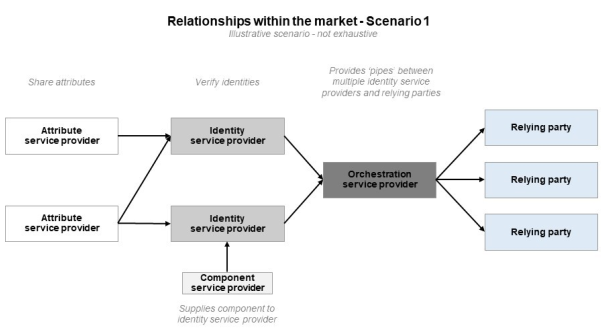
Figure 2
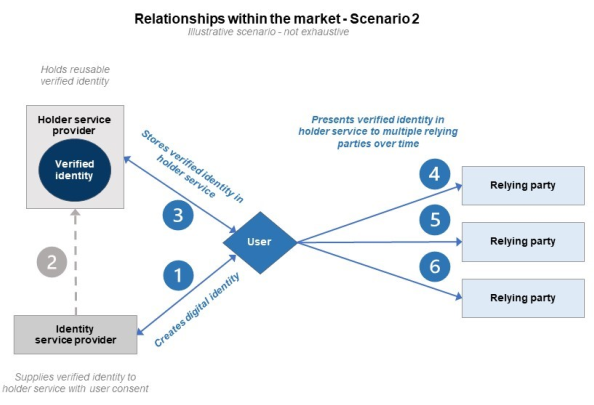
Figure 3
4.4. Supplementary codes
4.4.a. The trust framework’s rules set a baseline for good digital verification services across the UK economy. Individual sectors or use cases may have additional requirements that exceed those in the trust framework, for instance to meet specific legislative or regulatory obligations. To make it easy for relying parties to know how they can use digital verification services to meet these requirements, OfDIA can work with those operating in, or who are experts on, certain use cases or sectors to translate them into additional rules that providers can certify against as part of the trust framework certification scheme. This set of additional certifiable rules is known as a supplementary code.
4.4.b. OfDIA is responsible for the publication and maintenance of supplementary codes. OfDIA has determined four key principles it will follow to create new supplementary codes:
-
like the main trust framework, supplementary codes must be based on consultation with appropriate persons, including relevant regulators;
-
like the main trust framework, supplementary codes will be version controlled and developed iteratively;
-
the rules of a supplementary code must strengthen rather than undermine the trust framework’s rules; and
-
the rules of a supplementary code must fulfil a market and user need.
4.4.c. All the supplementary codes are collected on GOV.UK. There are three supplementary codes at the time of this publication, which describe rules for providers conducting digital right to work, right to rent and Disclosure and Barring Service identity checks.
Illustrative example 1
An employer is hiring a new employee and needs to conduct a right to work check. The employer would like to conduct the check digitally.
The Home Office allows employers to conduct right to work checks on British and Irish citizens by using a DVS in accordance with their guidance for employers. OfDIA in turn sets rules for providers who offer DVS in such cases, which are set out in the supplementary code for digital right to work checks.
This means the employer can work with a DVS that is certified against both the trust framework and the supplementary code for digital right to work checks.
The DVS conducts the check on the company’s behalf, confirms the result to the company. The check is successful, so the DVS shares a photo of the employee with the company.
The employer then satisfies themself that the photograph and biographic details provided by the DVS match the employee, meaning they are able to onboard the employee with confidence that the right to work check has been completed in a compliant way.
Part 2 - Rules for providers by role
5. Rules for identity service providers
5.a. Identity service providers must follow these rules and those in Part 3.
5.1. Creating a digital identity
5.1.a. You must use the ‘How to check someone’s identity’ guidance as a methodology to explain your service. This is known as ‘Good Practice Guide’ (GPG) 45. You must demonstrate how each aspect of your service maps onto GPG 45, for instance by detailing the kinds of evidence and checking methods your service can use to reach a ‘medium’ level of confidence.
5.1.b. You must also be able to share this information with relying parties and other services you work with, if it is requested. This must include the relevant GPG 45 strength, validity, activity history, identity fraud and/or verification scores that your service can achieve, as well as how your service can combine them to reach different profiles and levels of confidence. You could do this by following the trust framework data schema.
5.1.c. If your service uses components from third parties, you must accurately describe how each component maps onto the relevant part of GPG 45. Using components sourced from certified component service providers may make it easier to demonstrate this.
5.1.d. If you work directly with relying parties, you must agree the level(s) of confidence or profile(s) that are suited to their needs and meet any contractual obligations that arise as a result.
5.2. Accepting expired documents
5.2.a. You must not use expired documents if you know in-date documents are available which can be used to achieve the intended outcome (e.g., to meet a certain level of confidence or fulfil a regulatory need).
5.2.b. There is no obligation to accept expired documents, but if you do choose to accept them, you must:
-
demonstrate consideration of any legislation or guidance that may be relevant to a specific sector or use case; and
-
only accept passports up to a maximum of 12 months after they have expired.
5.2.c. You could apply additional restrictions to your acceptance of expired documents. For example, you may choose to only accept expired passports with near-field communication (NFC) chips issued by specific authorities, or for a maximum of 6 months. You could decide to set restrictions yourself, or they could be agreed with other organisations you work with, such as a relying party.
6. Rules for attribute service providers
6.a. Attribute service providers must follow these rules and those in Part 3.
6.1. Creating attributes
6.1.a. You must use the ‘How to create, bind and share attributes’ guidance (‘the attributes guidance’) as a methodology to explain your service. You must demonstrate how each aspect of your service maps onto the guidance, for instance by detailing how reliable an attribute you create is and how it has been stored.
6.1.b. You must have a way of assessing the quality of attributes that you create or share. You could follow the scoring methodology in the attributes guidance or you could follow your own processes. You must also be able to share this information with relying parties and other services you work with, if it is requested. Relying parties and other services you work with can use your assessment to decide which attributes meet their needs.
6.1.1. Sharing attributes
6.1.1.a. Before you share an attribute, you must check:
-
if the person or organisation requesting it has the right to see it; and
-
whether you will share it in a way that meets the privacy and data protection rules in section 12.7.
7. Rules for holder service providers
7.a. Holder service providers must follow these rules and those in Part 3.
7.1. Holding identities and attributes
7.1.a. Your service must store information securely and ensure it is not illegitimately accessed or changed. You must prevent any unauthorised persons from accessing a user’s holder service account by following the guidance on how to use authenticators to protect an online service. This is also known as Good Practice Guide (GPG) 44.
Illustrative example 2
George is travelling on holiday abroad with her three-year-old child. She holds both of their digital boarding passes, issued by the airline, as attributes in her preferred digital wallet app.
The wallet has been certified as a holder service and is protected by an appropriate form of biometric authentication.
Airline staff request their boarding passes at the gate. George has to scan her face on her device before it will allow her to present the boarding pass. This ensures that only George can access the information stored in her holder service. George’s child would not be able to access their boarding pass without her.
7.1.b. You must be able to provide GPG 44 the levels of protection your service achieved in a specific transaction to relying parties and other services you work with. You could additionally provide which specific authenticators were used and what quality level was achieved. For example, metadata you share could specify that medium-quality passkey was used by a user to authenticate into your service.
7.1.c. Your service must also be able to provide the following information to relying parties and other services you work with:
-
whether an identity or attribute you hold comes from a registered service;
-
whether an identity you hold meets specific GPG 45 level(s) of confidence and identity profile(s), if this information is available to you;
-
whether an attribute you hold has been reliably linked to a person. This is called binding. If you bind the attribute, you must follow the rules on binding in the attributes guidance to do so; and
-
whether the person presenting an identity or attribute is the person to whom it was originally issued. If they are not, then you could check if the user has the necessary authority to act on someone else’s behalf in line with section 12.2. on delegated authority.
Illustrative example 3
Gabrielle is trying to prove she is a registered university student to access a student-only discount at a bookstore. She stores a digital identity in a holder service app. The identity includes attributes derived from authoritative university data by a registered attribute service and the app is protected by an appropriate form of biometric authentication.
Bookstore staff request to see Gabrielle’s proof of student status. Gabrielle has to scan her face in the app before it will allow her to present her student status. This confirms it is Gabrielle trying to present her own information. Gabrielle’s friend would not be able to access her information.
Gabrielle then holds her phone to a scanner presented by the bookstore staff. Metadata exchanged in the scan confirms that the attribute came from a registered service, that it was issued to Gabrielle and that she is the one presenting it here and now. The bookstore can be sure Gabrielle is a current student and eligible for the discount.
7.1.d. You must also make clear to relying parties and other services you work with whether an identity or attribute you hold has expired and/or been lost, stolen or revoked, if this information is available to you. For instance, you could check the status of an attribute or credential with an authoritative source before it is presented.
7.2. Reusing a verified digital identity or attribute in a holder service
7.2.a. If you are an identity or attribute service provider and want to allow a user to repeatedly assert information about themself that you have verified, you must store the digital identity and/or attributes in a holder service. Your service must follow the rules in section 10.3. on confirming a user’s understanding before you use their data to do this.
7.2.b. You must be able to show the user what level(s) of confidence and identity profile(s) their identity meets according to GPG 45, in an easily accessible way, if that information is available to you.
Illustrative example 4
Hayley has already had her identity checked to a medium level of confidence with a high street bank to sign up to their online banking app.
Following the trust framework, the bank used the details provided by Hayley during the sign-up process to create a verified digital identity. Hayley can store this identity in the bank’s holder service, and the bank makes it easy for Hayley to check which level of confidence under GPG 45 her identity reaches.
Hayley can then use this service in the future to prove her identity and share attributes without doing an identity check from scratch.
Illustrative example 5
In the future, Patrick may be able to store a Qualified Certificate (QC) in a holder service. A qualified trust service provider (QTSP) will have bound his verified identity to this QC. Patrick could then present this QC from his holder service, allowing a relying party to validate his e-Signature.
7.3. Managing a user’s holder service account
7.3.a. You must have processes to revoke, suspend, close, recover and make changes to a user’s holder service account. This includes supporting the appropriate identity and/or attribute services, which could be another service you provide, to make legitimate changes to information held in a user’s holder service account. For example, if a digital credential is altered or revoked by its issuer, you must be able to reflect these changes in the user’s holder service account.
7.3.b. You must close a holder service account if:
-
the user wants to close it;
-
you have evidence it was created fraudulently, including using a synthetic identity; or
-
you become aware of the user’s death, although you may leave the user’s account open for a limited time if needed to manage requests related to their account, for example to manage settling estates.
7.3.c. You must have processes in place to take action against a user who does not follow the terms of use they agreed to. These must include a process for closing their holder service account and preventing access to your service if the issue cannot be resolved.
7.3.d. If an identity in a user’s holder service account has been inactive for 14 months, the user’s identity must be checked again following GPG 45 before the inactive identity can be used or shared again. This check must meet either the same level of confidence originally met or a higher level of confidence than the one originally met.
7.3.1. Notifying a user of changes to their holder service account
7.3.1.a. You must have a process in place to notify the user of any changes to their holder service account as well as any identities and attributes held within it. This includes any legitimate changes made by the identity or attribute service that issued it. You must also have a process in place to notify the user if you have received a request to close their holder service account. Your notification processes must notify the user of requested changes to their account using more than one channel, and must not undermine any of the rules on risk management (section 11.7), fraud management (section 12.4.) and responding to incidents (section 11.5.).
Illustrative example 6
Company A, which provides a holder service, maintains a list of email addresses and phone numbers for users of its holder service. As a result, when changes are made to a user’s holder service account, Company A uses email and text message to notify the user, as well as on-device push alerts.
Company B, which also provides a holder service, has designed the service so it is impossible to link any data it holds about users with any specific user’s account. As a result, when changes are made to a user’s holder service account, Company B alerts the user with in-app pop-ups and on-device push notifications.
7.3.1.b. You must provide users with means to respond to these notifications, for instance by querying the change or closure.
7.3.1.c. If a user wants to change the contact details associated with their holder service account, you must authenticate the user before allowing them to make these changes.
8. Rules for orchestration service providers
8.a. Orchestration service providers must follow these rules and the rules in Part 3.
8.1. Reporting the DVS registration of others
8.1.a. You must have a mechanism to confirm whether any given service you orchestrate is listed on the register.
8.1.b. If this confirmation is made with reference to a saved record (or ‘cache’) of information from the register, you must have a policy for how often you update this cache. For example, your policy could be that this cache is updatedas regularly as the register itself.
8.1.c. If you agree to provide this confirmation to a relying party or another DVS and you make this confirmation with reference to a cache, you must agree with them how recent your cache will be at minimum for any given check.
9. Rules for component service providers
9.a. Component service providers must follow these rules and those in Part 3.
9.1. Providing components of GPG 45 or GPG 44
9.1.a. Some component service providers may provide part(s) of the identity checking or authentication processes outlined in GPG 45 or GPG 44.
9.1.1. GPG 45 components
9.1.1.a. If you provide part(s) of the GPG 45 identity checking process, then you must follow the rules for identity service providers in sections 5.1. and 5.2.
9.1.1.b. Where GPG 45 identity checks that you carry out fail, you must be able to share information about why with a relying party or other service you work with, using clearly defined and coded failure modes.
9.1.2. GPG 44 components
9.1.2.a. If you provide part(s) of the GPG 44 authentication process, then you must demonstrate how each aspect of your service maps onto GPG 44, for instance by detailing how authenticators are created, managed and captured by your component.
9.1.2.b. You must also be able to share this information with relying parties and other services you work with, if it is requested. This must include the specific quality levels of any authenticators your service can provide, as well as how your service can reach different levels of protection.
9.1.2.c. Where a GPG 44 authentication process that you carry out fails, you must be able to share information about why with a relying party or other service you work with using clearly defined and coded failure modes.
Part 3 - Rules for all service providers
10. Inclusivity, accessibility and service design
10.1 Making your products and services inclusive
10.1.a. Making your products and services inclusive means as many people as possible can use them, no matter who they are. This includes people who do not have traditional identity documents, such as passports, or who may find it difficult to prove their identity to access services online. However, there are reasons someone might be legitimately excluded. For example, for certain products and services that cannot be legally accessed until the age of 18, it is fair to restrict service access on account of someone’s age.
10.1.b. You must comply with the Equality Act 2010, or equivalent legislation in Northern Ireland, when considering how to make sure no one is excluded because of their ‘protected characteristics’. Public sector organisations or non-public sector organisations carrying out public functions must also comply with the public sector equality duty detailed in the Equality Act 2010.
10.1.1. How to make your product or service more inclusive
10.1.1.a. There are many reasons why a user may be unintentionally or unnecessarily excluded from using a product or service. Common reasons include users being asked to provide specific evidence as proof of their identity, or services relying on specific databases to check users’ information.
Illustrative example 7
A service that only accepts a UK passport as proof of someone’s identity will exclude users who do not have, cannot find or cannot afford a UK passport.
Illustrative example 8
A service that only checks users’ information against a credit reference agency database will stop users who do not have a credit history from creating a digital identity. This could exclude users because of their age or financial circumstances. The service could, for example, offer users vouching instead of – or as well as – a credit history check to check that their claimed identity has existed over time.
10.1.1.b. Using a wide variety of identity and attribute evidence can be a way to improve inclusion. You, or another provider with which you work, can look to accept a wide variety of evidence, provided it can still combine to meet a relying party’s needs. You could choose to accept a declaration from someone that knows the user (known as a ‘vouch’) as evidence of the user’s identity, or part of their identity. If you make use of vouches – whether you are conducting them yourself, sharing with others, or making use of vouches shared with you – you must follow the vouching guidance.
10.1.1.c. You might also exclude users if your service uses any software or hardware that has only been developed and tested with a specific user group. To improve the inclusivity of your service, you could ensure that all aspects of it have been performance tested with a variety of users from different demographics.
10.1.2. Submitting an annual inclusion monitoring report
10.1.2.a. You must submit an inclusion monitoring report at least annually. The anonymised and aggregated results of these reports will provide an evidence base to inform policy development to support our inclusion aims.
10.1.2.b. The report will explore what avenues your service offers to acquire a digital identity and/or attributes. It will also collect information on what technology your service uses, what identity evidence is accepted by your service and include an opportunity for you to explain any inclusion measures you are planning to take in future. You are not required to collect information on users solely for the purposes of inclusion reporting.
10.1.2.c. Details on how to submit an inclusion monitoring report will be provided by your CAB directly.
10.1.3. Allowing users to retake a check
10.1.3.a. There are many reasons why an identity or attribute check might fail. If a user fails a check and there is no suspicion of fraud (refer to section 12.4.1. on fraud monitoring for more details), you must have a process to allow the user to undergo an identity or attribute check again, with corrected data if applicable.
10.1.3.b. You may wish to determine whether the check failed due to:
-
a transposition error – for example, dates might appear in different formats or names with punctuation might have been transposed differently; or
-
a failure in technology – for example, there might be an issue with readings from the NFC chips in passports, resulting in a false-negative result.
10.1.3.c. If a check still fails, you could use alternative identity evidence and methods of identity checking, following GPG 45. You could:
-
check the user’s identity using a different identity profile for the same level of confidence as when you first checked the user’s identity;
-
check the user’s identity using the same identity profile but alternative data sources; or
-
check the user’s identity using the same identity profile but a different process.
10.1.3.d. If there is a suspicion of fraud, you must follow the rules in section 12.4. on fraud management.
10.2. Making your products and services accessible
10.2.a. If you are a public sector organisation, you must follow the accessibility requirements for public sector bodies.
10.2.b. If you are a public sector organisation that develops products or services for the public in Wales, you might be subject to Welsh Language Act (1993) or the Welsh Language (Wales) Measure (2011). You must check your legal obligations carefully. The Welsh Government has published a detailed Bilingual Technology Toolkit to help organisations provide a good user experience in both Welsh and English.
10.2.c. If you are a private sector organisation, and if your service is user-facing, you must also make sure your service is accessible. You could do this by following:
-
Web Content Accessibility Guidelines (WCAG 2.2) to AA level; or
-
The European Telecommunication Standards Institute (ETSI) standard for accessibility requirements EN 301 549 V3.2.1 (2021-03).
10.2.d. If you do not follow these guidelines or standards, you must evidence that your service fulfils the principles of POUR: that it is Perceivable, Operable, Understandable and Robust. More information is available from the World Wide Web Consortium.
10.2.e. You and/or the relying party or other service you work with could also offer users more than one way to use a product or service. For example, where feasible and appropriate to do so you could offer users the option of posting their identity evidence to you or carry out checks in-person to support users that are unable to use an online service.
10.2.f. You can also make your service more inclusive by ensuring you have the appropriate systems in place for delegated authority (see section 12.2).
10.3 Confirming a user’s understanding of how their data will be shared
10.3.1. Confirming user understanding
10.3.1.a. If your service has direct contact with users, as opposed to only providing services to other organisations, you must confirm that the user understands how their digital identities or attributes data will be shared or disclosed. This must include any data processing undertaken by third-party services or components you use as part of your service, and is in addition to your legal requirements to provide a privacy notice and determine the lawful basis for processing personal data (see section 12.7).
10.3.1.b. You could collect confirmation of user understanding directly, or another provider you work with could collect confirmation on your behalf.
10.3.1.c. When confirming understanding you must:
-
use clear, plain language that is easy to understand;
-
ask the user to positively confirm their understanding;
-
name your organisation;
-
specify why you or others in your supply chain are processing the data and what you are going to do with it, including whether the data will be retained in databases for future fraud checks;
-
describe or name the third-party services that will process the user’s data. For example, you could confirm the user’s data will be checked with a credit reference agency; and
-
record when and how a user confirmed their understanding, and what they were told at the time.
10.3.1.d. You must also clearly explain to the user:
-
what the consequences of refusing to confirm their understanding would be, including the impact on their ability to access services; and
-
whether they can withdraw this confirmation at a later stage, and what the implications of doing this would be.
10.3.1.e. You may wish to provide additional information about what it means for a user to confirm their understanding, for example by providing more information on the relationship between confirming a user’s understanding and requirements under data protection legislation. In these situations, you could include this information in your privacy notice, in line with the requirements in section 12.7.1.
Illustrative example 9
Raya has to complete a right to rent check before leasing her new flat. Her landlord offers her the option of a digital right to rent check, using a service certified against the trust framework and the supplementary code for digital right to rent checks.
Raya starts the digital check and reads an explanation of how her identity data will be processed, shared and disclosed in the identity checking process.
Raya is not confident she understands the information provided, so she declines to confirm her understanding. Without Raya confirming her understanding of how her data will be disclosed, the provider is unable to offer Raya a digital check.
Raya returns to her landlord who instead undertakes a right to rent check using physical documents.
10.3.2. Confirming a user’s understanding for holder services
10.3.2.a. If you are a holder service provider, you must follow the requirements in section 10.3.1 to confirm a user’s understanding of how you will share and disclose their identity and attribute information when a user first signs up to use your service.
10.3.2.b. You must reconfirm a user’s understanding by following the requirements in section 10.3.1:
-
if you make any changes to how your service handles their data;
-
if your service’s purpose deviates from that which the user originally confirmed their understanding about when signing up; and
-
if it has been more than 14 months since you last reconfirmed their understanding.
10.3.2.c. Where feasible, you could also reconfirm a user’s understanding whenever there is a request that their data is shared or disclosed to a third-party, including a relying party, so long as this does not conflict with any requirements in sections 12.4 and 12.5. As outlined in section 12.7.1, this is a separate process to any legislative requirements to recontact data subjects which may be relevant.
10.3.2.d. As noted above, you must take all third-party services throughout your supply chain into account when confirming a user’s understanding.
11. Operational requirements
11.1. Business probity
11.1.a. When doing anything related to the trust framework, you must not bring the trust framework into disrepute or damage its reputation, optics or trustworthiness. You must check your legal obligations carefully and must always act lawfully.
11.1.b. You must not state or imply that your service(s) or organisation are endorsed by the government, DSIT or OfDIA. You also must not state or imply that you have a relationship with the government that you do not have. This includes through the misuse of logos, for example through the use of departmental logos, coat of arms, or Crown branding. These may also be subject to Crown copyright.
11.1.c. You must not misrepresent the certification status of service(s) you offer or allow others you work with to misrepresent their services through reliance on your certificate(s). For example, if you offer more than one service, you must be clear which of the services you offer have been certified and which have not. Similarly, you must not allow a third party to claim that they offer a certified service solely because some aspects of it are delivered by your certified service. This does not preclude the third party from disclosing that a certified service forms part of their supply chain, particularly where the certified service is conducting specific activities in line with regulatory requirements.
11.1.d. You must evidence that:
-
your organisation is a legitimate entity, for example, by supplying your Companies House registration number, Charities Commission registration number, Data Universal Numbering System (DUNs) number, Legal Entity Identifier (LEI) or other information that identifies your organisation as a registered entity in the UK or another jurisdiction;
-
your director(s), or equivalent depending on your legal status, does not have any restrictions or constraints inhibiting their ability to carry out their duties, such as outstanding bankruptcy proceedings or court summons;
-
your organisation (and parent company if applicable), ultimate beneficial owners, director(s) and people with significant control, or equivalent depending on your legal status, do not appear on a UK Sanctions List;
-
your organisation is not involved in any outstanding proceedings which could affect the provision of your digital verification service, such as patent disputes, court orders, or criminal or small claims court proceedings; and
-
your organisation does not have any convictions or pending sanctions cases relating to corruption, bribery, money laundering, terrorism financing or fraud as defined in law such as the Money Laundering Regulations (2017), and the Fraud Act (2006).
11.1.e. You must declare to your CAB and OfDIA any ICO investigations into your organisation that are relevant to your service. If any concerns are or have been raised by the ICO, you must provide evidence of how you have responded, or are in the process of responding, to OfDIA. For example, you may have made changes to your service design as a result.
11.1.f. If you are involved in or considering an acquisition or other trigger event covered by the National Security and Investment Act 2021, you may need to notify the government and get approval before you can complete it. For further information you could consult the guidance on GOV.UK. You must also evidence that you and the acquirer will continue to follow the trust framework and any other conditions of your trust framework certification.
11.2. Responding to complaints and disputes
11.2.a. You must have documented processes for dealing with complaints and disputes, whether these involve users or other participants in the trust framework.
11.2.b. You must publish easily accessible details about these processes, including the contact details your customers can use to contact you about a complaint or dispute. You could publish the timelines you expect to meet when dealing with complaints and disputes, and information about your escalation processes.
11.2.c. Your complaints and disputes procedures must take account of relevant regulatory channels. You must also retain records of any complaints or disputes in line with your information management system and provide OfDIA or your CAB with information about complaints if requested.
11.3. Staff and resources
11.3.a. You must demonstrate that you have ways to:
-
make sure your staff (including contractors) have the right experience, training (such as data protection training), competencies and qualifications needed to do their job;
-
do background checks on your staff; and
-
make sure any personal, cryptographic or sensitive information you keep can only be accessed by authorised staff.
11.3.b. You could evidence this by:
-
following the ‘applicable skills and security awareness’ control in ISO/IEC 27001;
-
following equivalent industry standards such as the National Cyber Security Centre (NCSC) Cyber Assessment Framework (CAF), or the National Institute of Standards and Technology (NIST) Cybersecurity Framework; and/or
-
following BS7858 on screening individuals.
11.3.c. You must have a Senior Responsible Officer (SRO) in your organisation responsible for managing operational matters relating to your service. The SRO will be directly notified of any important changes to the trust framework, certification and other matters. You must:
-
provide your CAB with accurate contact details for your SRO and keep these up-to-date (you can provide details for more than one person); and
-
demonstrate that you have processes in place to appoint a new SRO if needed.
11.3.d. Your SRO must inform OfDIA and your CAB of any material changes to your organisation or service within 48 hours of those changes happening. This includes ceasing to provide the certified service or changes to:
-
your service’s technology;
-
your directors, or equivalent;
-
ultimate beneficial owners, or equivalent;
-
people with significant control, or equivalent; and
-
any information covered by the business probity rules in section 11.1.
11.4. Service and quality management
11.4.a. You must have service and quality management processes in place that cover all areas of your organisation that are covered by the trust framework. Your service and quality management process could be set out in a collection of documents that describe your organisation’s objectives and explain how you will achieve them.
11.4.b. For example, your objectives could include:
-
investigating and fixing all faults within 2 hours – this refers to your service management; and
-
making sure every member of staff completes 5 hours of security training every month – this refers to your quality management.
11.4.c. The trust framework does not mandate certification to any particular standards to meet your objectives. You could follow a recognised industry standard, such as ISO 9001, ISO/IEC 20000 or the Information Technology Information Library (ITIL). Depending on which sector you operate in, you could also follow Six Sigma.
11.4.d. You must have policies or documentation that describe how you approach service management in areas such as:
-
service design;
-
service transition; and
-
service operation.
11.4.e. Your management system documentation must include the following information:
-
how your management processes are organised;
-
how you measure how well you have met your objectives;
-
who in your organisation is responsible for meeting the objectives;
-
how you carry out routine operational tasks;
-
what standards you follow;
-
what tools, funding, people and other resources you need;
-
how you plan to improve the quality of your products or services on an ongoing basis (known as ‘continuous improvement’);
-
how you deal with customer relationships; and
-
how you resolve service disappointments.
11.5. Information management
11.5.a. Your organisation must have an information management system that follows industry standards, such as ISO/IEC 27001 and the ISO/IEC 27701 extension. If you do not follow these standards, you must still ensure your information management system meets the criteria detailed in this section.
11.5.b. An information management system is a collection of documents that explains:
-
why your organisation needs to keep the information it keeps, covering both personal and non-personal data;
-
how you create, organise and store information;
-
who has access to the information;
-
how information is classified;
-
how you share information (including why it is shared, who it is shared with, how often it is shared, what format it is in and how it is protected);
-
how long you retain and how you protect data; and
-
how you archive information.
11.5.1. Archiving information
11.5.1.a. You must have an archiving policy that:
-
meets any legislative or regulatory requirements that apply to your organisation; and
-
follows any standards or best practice relevant to the industry or sector your organisation is part of.
11.5.1.b. It must also explain:
-
how archived information is used to support your organisation’s work;
-
why your organisation needs continued access to archived information;
-
the risks of not having access to archived information;
-
how archiving information protects the interests and legal rights of your organisation and others you work with; and
-
the relationship between this information and any other records, data or evidence you keep.
11.5.2. Disposal schedule
11.5.2.a. You must have a documented disposal schedule that records how you manage and delete information. It must show:
-
that you have policies in place to meet any legislative or regulatory requirements about keeping and deleting information;
-
what information was created but later deleted;
-
what format the information is in (for example, if it was physical or digital);
-
where information is located; and
-
how information is transferred for disposal, if this is relevant.
11.5.3. Data management
11.5.3.a. You must have a documented data management policy that explains how you create, obtain, hold, transform, share, protect, document, dispose of and preserve data. It must include:
-
file naming conventions;
-
how you create and manage metadata;
-
how your organisation makes sure data is available when it is needed;
-
how you know data is accurate and complete; and
-
how you maintain and secure your data.
11.5.3.b. Your data management policy must cover the full data and metadata lifecycle. It must explain how architectures, policies, practices and procedures are implemented and maintained.
11.6. Information security
11.6.a. Information security incorporates cyber security as well as broader security considerations. You must have an information security management system that follows an industry standard, such as ISO/IEC 27001, and complies with requirements in UK data protection legislation. If you do not follow this standard, you must still ensure your information security management system meets the criteria detailed in this section. This must ensure your organisation can control and evaluate how you handle data when it is stored, transmitted or otherwise processed.
11.6.b. Your information security management system must be based on the principles of the ‘CIA Triad’:
-
confidentiality (11.6.1), which involves preserving authorised restrictions on information access and disclosure, including means for protecting personal privacy and proprietary information;
-
integrity (11.6.2), which involves guarding against improper information modification or destruction and ensuring information non-repudiation and authenticity; and
-
availability (11.6.3), which involves ensuring timely and reliable access to and use of information.
11.6.c. At minimum, you must also have documents that cover the following to support your information security policy:
-
technical controls;
-
organisational controls; and
-
physical security controls.
11.6.d. NCSC guidance on building and operating a secure online service can support you in the development of your information security management system.
11.6.e. You could also conform with and be certified against Cyber Essentials or Cyber Essentials Plus.
11.6.1. Confidentiality
11.6.1.a. You must make sure any information your organisation keeps can only be accessed by authorised users. For example, you could require that users need an authenticator (such as a password) to access the information.
11.6.1.b. You could also use an access-control list or role-based access control to protect information held by your organisation. If you do, they must specify:
-
which people or systems can access your information;
-
how they are granted access; and
-
what they can do with your information.
11.6.1.c. This could be explained in your organisation’s password control policy or access control policy.
11.6.1.d. You must have a policy that classifies confidential information, describes who has access to what and ensures that there are appropriate levels of protection for confidential information. This could follow ISO 27001 Control objective A.8.2 Information Classification. At minimum this must detail:
-
the types of information you are storing;
-
how critical to business processes or service provision that information is;
-
the risks of misuse or mishandling and the consequences of the data being lost or hacked; and
-
the value of that data/information to your business or to a bad actor.
11.6.2. Integrity
11.6.2.a. You must have policies to maintain the integrity of any information your organisation holds. You might need to provide these and demonstrate compliance with them for legal reasons, for example if you suffer a breach. Your organisation must also have an information security policy that explains how you will:
-
stop information from being modified, either by accident or on purpose (including how you will protect it against malicious acts);
-
provide assurances that information is trustworthy and accurate;
-
keep information in its ‘correct state’ (the format or reason for collecting the information must not change);
-
restore information to its correct state if you suspect it has been tampered with;
-
use secure communication protocols to help secure data in transit;
-
perform data validation and verification;
-
make regular backups and prepare recovery plans;
-
maintain data versioning and timestamps;
-
keep audit trails and logs and protect them; and
-
implement error handling mechanisms.
11.6.3. Availability
11.6.3.a. You must have policies and procedures to make sure that any information your organisation keeps is consistently managed and only readily accessible by authorised users. At minimum, you will need:
-
tools and processes that can cope with the amount of requests you expect to get; and
-
a backup policy, in case you need to recover any information, which must explain your Recovery Time Objective.
11.6.3.b. You must explain how these work in your:
-
data support and operations plan;
-
policy and business/organisation continuity plan;
-
disaster recovery plan; and
-
information security policy.
11.6.3.c. You must avoid single points of failure, where any component such as a server or a network connection could result in your whole system stopping working. You could achieve this by implementing power supply management, load balancers and regular maintenance and monitoring. You could also implement redundant systems and network redundancy to enhance data availability.
11.6.4. Technical and security controls
11.6.4.a. You must have a document that explains what hardware and software you use to protect information, such as firewalls, intrusion detection systems and encryption techniques. It must also explain what software you use to monitor and control access to information.
11.6.4.b. You could follow NCSC guidance on Secure Design Principles and the NCSC CAF.
11.6.5. Organisational controls
11.6.5.a. You must have a document that explains how you will continue to meet security rules. For example, it could explain what information security training your staff will regularly have to complete. It must explain what roles are in your organisation and what parts of the information security process they are responsible for.
11.6.6. Physical security controls
11.6.6.a. You must have a document that explains what security controls protect the physical locations where the following things are kept:
-
any information your organisation has; and
-
any technology that helps you provide your products or services.
11.6.6.b. It could include how you:
-
assessed the risks of hosting information in different locations;
-
secure any data centres or locations you use that are operated by third parties; and
-
protect information and technology when they are accessed from a remote location (e.g. outside of the usual place of work).
11.6.7. Security governance
11.6.7.a. You must take steps to ensure that your information security policy is followed at all times and that you have a way for managing security risks. This is also known as ‘security governance’.
11.6.7.b. You must:
-
make a security plan based on security risks you have identified;
-
have a process for investigating and responding to security risks;
-
report security risks in a way that is proportionate to your organisation and product or service; and
-
have a robust assurance and review process.
11.6.8. Using security measures to protect the information you collect
11.6.8.a. You must use technical and organisational safeguards to protect personal data. Your security measures must also guarantee the confidentiality and integrity of information. This means they need to reliably protect information from:
-
loss or misuse;
-
unauthorised use, access, modification or disclosure; and
-
fraudulent use.
11.6.8.b. To do this, you must demonstrate that you:
-
use robust safeguards (for example, pseudonymisation, anonymisation and encryption);
-
use security measures that ensure confidentiality, integrity and availability;
-
test your security measures regularly, using the same tests each time, and improve them whenever you can;
-
can quickly restore access to personal data if there is a physical or technical incident; and
-
know how you will inform people if there is a security breach, so they can protect themselves from potential identity theft.
11.6.8.c. You must also show how you meet these rules in your ongoing internal audits.
11.6.9.d. You could follow ICO guidance on data security to help you implement security measures appropriate to the risks to your service.
11.7. Risk Management
11.7.a. You must have a risk management framework that follows industry standards, such as:
-
ISO/IEC 27005; or
11.7.b. If the standard you follow is not one of the above, your risk management framework must still include guidance about how to:
-
identify risks to your organisation, including where they can come from and the impact they could have;
-
identify risks to your users, which could include phishing attacks, man in the middle attacks and imposter attacks;
-
find out how likely it is that risks could materialise;
-
measure how effective your current processes are at managing risks;
-
compare any risks you have identified to the established risk criteria;
-
monitor risks;
-
report risks to your stakeholders;
-
measure residual risk;
-
write, implement and maintain your organisation’s risk strategy; and
-
protect your organisation from internal risks, including producing a whistleblowing policy and a bribery and corruption policy.
11.7.c. You could use NCSC guidance on cyber security-related risk management to develop your risk management framework.
11.7.d. You must set out and communicate the risks you will and will not take in pursuance of your organisational goals. This is often referred to as a statement of risk appetite and it will help those who are responsible for making risk management decisions understand where the risk management boundaries lie.
11.7.e. If you provide your service to another certified service (for example, if you are a component service providing certified components to other certified services), then your risk management framework must cover how potential failures or interruptions in your service could impact other services and their certification status. You must have a documented procedure to support those other certified services to handle risks of potential failures or interruptions in your service on their certified service via your contracts and account for supply chain frailty.
11.7.f. If your service depends on other digital verification services, then your risk management framework must cover how potential failures or interruptions to those other services could impact your service and certification status. You must have a documented procedure for handling risks via your contracts and account for supply chain frailty.
11.8. Keeping records
11.8.a. You must record what your service did to create, manage, share or consume a digital identity or attribute. You must do this in a way that meets the requirements in Article 30 of the UK GDPR.
11.8.b. You must keep your own copies of any records. You must dispose of these records when you no longer have any use for them.
11.8.c. When sharing identity or attribute information with a relying party or another service, you may need to make sure they get a copy of any records about that digital identity or attribute.
11.8.d. Before you start keeping records, you must have:
-
clear rules for keeping, managing and disposing of them;
-
a records management policy and a disposal statement; and
-
a named person in your organisation who oversees records management.
11.8.e. You must have rules that cover your day-to-day records management. At minimum, these must cover:
-
which records to keep;
-
who keeps them;
-
how to keep them, covering the formats and media you use; and
-
when to dispose of them – this is usually covered in a disposal statement.
11.8.f. The rules for your organisation can be as detailed as you need them to be. These rules could be a part of your records management policy or maintained separately.
11.8.1. Records management policy
11.8.1.a. You must have an up-to-date and internally published records management policy. The policy must include:
-
a commitment to managing records, including what is covered and why;
-
the policy’s objectives (for example, to help you meet standards or legal requirements);
-
how the records management policy relates to your organisation’s other policies, such as data security, complaints or fraud policies;
-
the job roles in your organisation and what their records management responsibilities are; and
-
specific plans for records that are particularly important or sensitive.
11.8.1.b. To help employees understand why it is important to follow the management rules and keep records correctly, you must demonstrate that it is easy for anyone in your organisation to find and use the policy.
11.8.1.c. You must demonstrate you have agreed the records management policy at a senior level. It could be part of your wider information management strategy.
11.8.2. Other record keeping responsibilities
11.8.2.a. You must also:
-
have documented guidance on naming conventions;
-
know how (and how often) you are going to check that your records are being managed according to your policy; and
-
make sure that access to records is controlled and monitored.
11.8.3. Disposing of records
11.8.3.a. Your organisation must have clear, documented rules on how long to keep records for, in line with ICO guidance on retention policies, to assist in demonstrating compliance with the storage limitation principle set out in the UK GDPR. When you no longer need information, you must dispose of it in a safe and secure way. Before you decide whether to keep or dispose of a record, you must consider whether you may need it for:
-
legal reasons;
-
performance analysis;
-
complaints and disputes responsibilities;
-
fraud analysis; or
-
audits or other investigations.
11.8.3.b. You might need to keep just part of the record. For example, a provider conducting age verification checks might retain the fact that they have completed a successful check that a user meets an age threshold, but not retain the data used to complete that check.
11.8.4. Disposal statement
11.8.4.a. Your organisation must have a formal written disposal statement. It must include the types of record you handle and:
-
how long you keep each type;
-
how you dispose of each type; and
-
your processes for archiving and destroying records.
11.8.5. What people in your organisation need to do
11.8.5.a. Anyone who handles records must follow the records management policy. This includes temporary staff and contractors. You must demonstrate that you have processes in place to ensure that everyone who works for your organisation knows:
-
which information needs to be added to the record-keeping system;
-
what your records management policy is; and
-
what they must do to comply with data protection legislation and (if your organisation is a public authority) the Freedom of Information Act (2000) or where relevant, the Freedom of Information (Scotland) Act (2002). For more information, see the ICO guidance on freedom of information requests.
11.8.6. Accountability for records management
11.8.6.a. You must choose a named person with accountability for overseeing your records management. They are ultimately responsible for making sure your records are accurate, accessible and secure. They must:
-
check your records are being managed according to the records management policy and disposal statement;
-
make sure you meet your legal and regulatory requirements;
-
set up or maintain your record-keeping systems;
-
identify important or sensitive records that need specific management plans;
-
set up a way to document who has accessed, added or changed a record; and
-
act as a single point of contact for records management issues.
11.9. Withdrawing from the trust framework
11.9.a. In case your service no longer has a valid trust framework certificate or is removed from the register, you must demonstrate you have a transition plan and policies to:
-
notify all users of your product or service;
-
notify any relying parties that consume identities and/or attributes you have created;
-
notify other DVS you provide your service to; and
-
notify your CAB and OfDIA.
11.9.b. In case you retire your product or service, you must also demonstrate you have a transition plan and documented processes to:
-
provide users, other services you work with and relying parties with a reasonable period of time to migrate to other providers;
-
provide your CAB with time to reflect this in your certification and, where relevant, the certification of other DVS you provide your service to;
-
provide OfDIA with time to update the register; and
-
dispose of any data you hold in an appropriate way.
12. Service requirements
12.1. Making your products and services interoperable with others
12.1.1. Data schema
12.1.1.a. The trust framework data schema provides guidance for services and relying parties on how to organise and exchange information in a consistent way to enable interoperability.
12.1.1.b. You could use the data schema to help ensure your service is interoperable with other certified services and relying parties. It is recommended that the data schema is followed across the market to encourage interoperability between organisations, in the UK and internationally.
12.1.1.c. The data schema has been written to be consistent with different industry approaches for data exchange and technical standards, such as OpenID Connect and W3C’s Verifiable Credentials data models.
12.1.2. Receiving messages from trust framework participants
12.1.2.a. If your service shares data with or receives data from other trust framework participants, you must be able to validate the integrity of messages you are receiving from those participants.
12.1.3. Sharing digital identities and attributes
12.1.3.a. When sharing a user’s digital identity or attribute information with another service or relying party, you must provide enough information for them to be able to:
-
identify the person; and/or
-
decide if the person is eligible for something.
12.1.3.b. To support the service or relying party to match what you share with the person they’re dealing with , you could provide a:
-
first name;
-
last name; and
-
a unique identifier for the user, such as a user or account number or, where sufficient, their date of birth.
12.1.3.c. A relying party could ask you for information to check if a user is eligible to do something rather than, or in addition to, identifying them. This could include their:
-
date of birth, age, or confirmation that their age is above a certain limit;
-
nationality;
-
place of birth;
-
previous name(s);
-
email address;
-
address;
-
phone number;
-
gender;
-
occupation;
-
income;
-
tax reference number;
-
biometric information;
-
passport number;
-
qualifications;
-
employment history;
-
non-UK identity card number; or
-
role in an organisation.
12.1.3.d. The relying party will need to decide if the information is sufficient for what they need. Knowing where the attribute comes from and how it has been checked could help them make this decision.
12.2. Checking if a user can act on behalf of an organisation or another person
12.2.a. Some users may be acting on behalf of an organisation or another person when they interact with you. This is known as ‘delegated authority’. There are a number of reasons why this might be appropriate, such as:
-
the user might have been formally appointed using a lasting power of attorney (LPA) to look after someone else’s money and property;
-
the user may be a parent or legal guardian acting on behalf of a child where the child is not old enough to access a service themselves; or
-
the user might be appointed to act on behalf of an organisation. To permit a user to act on an organisation’s behalf, you must check their identity, check that the organisation exists and check they can act for that organisation.
12.2.b. A user will only have delegated authority if they have been given permission to make decisions and complete tasks on behalf of the other person or organisation. A user may have delegated authority on a one-time basis, related to one specific task or service, or something more comprehensive. A user does not necessarily have delegated authority if they are helping someone do something. This could include:
-
a user helping a friend who is not confident using a computer to fill in an online form; or
-
anyone who offers ‘assisted digital support’ to users of a product or service.
12.2.c. You can choose whether to offer delegated authority as part of your service. If your service permits delegated authority of any type, you must follow the delegated authority guidance, including checking if the user has the necessary authority to act on someone else’s behalf, and demonstrate how you meet the guidance’s requirements. The details of their agreement with the other person might exist as an attribute.
12.2.d. If you are a holder service provider, you can allow a user to hold details about the identity or attributes of another person or of an organisation if they have authority to act on that person or organisation’s behalf.
12.3. Encryption and cryptography
12.3.a. The requirements in this section outline the minimum expectations for encryption and cryptographic controls and security measures. These are deliberately described as technology and vendor agnostic to cover numerous solutions. How you apply or implement these controls and methods is not prescribed as it is reasonable that the details of your specific implementation will be based on your chosen technologies.
12.3.b. You must carry out a thorough risk assessment of threats that could manifest for your service. In some cases, this will mean you need to exceed trust framework requirements, especially where there is a high risk due to the sensitivity of data.
12.3.c. You must implement cryptographic controls that follow industry standards and best practice for encryption and cryptographic techniques. These must ensure you can protect the confidentiality and integrity of electronic information in transit or at rest, and can mitigate against physical or logical threats.
12.3.d. You must have cryptographic controls that can authenticate the identities of both the sender and recipient to one another. The controls must protect against repudiation.
12.3.e. You must describe these controls and processes in an encryption and cryptographic controls policy document. You must also regularly test and update these controls.
12.3.f. Data on any type of media must be protected from theft.
12.3.g. You must protect your networks from typical hacking activities, such as sniffing data packets across the network. You must also have a robust process to monitor network activity.
12.3.1. Encryption
12.3.1.a. When dealing with data at rest:
-
all user-writable partitions on portable devices and portable storage media must be encrypted at the media-level (e.g., full disk encryption);
-
information held encrypted at rest must also be integrity protected;
-
where multiple layers of encryption are available such as media-level and database field level, you must ensure each layer is applied proportionally to mitigate risks;
-
the encryption software deployed on devices must restrict the number of authentication attempts within any given time interval; and
-
encryption software deployed on devices must also have sufficient entropy as part of the authentication mechanism. Where passwords are used as the authentication mechanism, the passwords must be of sufficient length to match the password policy defined for the system.
12.3.1.b. When dealing with data in transit, encrypted communications channels must be protected using protocols, protocol suites, and techniques in accordance with industry standards and best practices. You could use one of the following methods:
-
at the application layer, using Transport Layer Security (TLS), ensuring this is the latest version;
-
at the network layer, using Internet Protocol Security (IPsec); or
-
following the NCSC guidance on using IPSec to protect data and consulting the most up-to-date cryptography profiles.
12.3.1.c. You could also consult the following NIST guidance:
12.3.2. Cryptography
12.3.2.a. For further information on handling cryptographic modules, you could consult the following:
-
NIST FIPS 140-2 – Security Requirements for Cryptographic Modules; and
-
NIST FIPS 140-3 – Security Requirements for Cryptographic Modules (140-3 aligns with standards from ISO/IEC).
12.3.2.b. The specific standards and best practices you follow may vary depending on the maturity of the technical approach. As well as the standards above, you could consult the following standards:
-
NIST SP 800-175B – Guideline for Using Cryptographic Standards in the Federal Government: Cryptographic Mechanisms;
-
ETSI TS 103 458 – Application of Attribute Based Encryption (ABE) for PII and personal data protection on Internet of Things (IoT) devices, WLAN, cloud, and mobile services.
12.3.2.c. Additional guidance for encryption algorithms can be found in the ISO/IEC 18033 family of standards.
12.3.2.d. For guidance on hash functions, you could read the following standards:
-
ISO/IEC 9797-2 – Information security — Message authentication codes (MACs);
-
ISO/IEC 9797-3 – Information technology — Security techniques — Message Authentication Codes (MACs);
-
ISO/IEC 10118-1 – Information technology — Security techniques — Hash-functions;
-
NIST FIPS 180-4 – Secure Hash Standard (SHS);
-
NIST FIPS 202 – SHA-3 Standard: Permutation-Based Hash and Extendable-Output Functions; and
-
NIST SP 800-107 – Recommendation for Applications Using Approved Hash Algorithms.
12.3.2.e. For key management and generation, you could follow:
-
ISO/IEC 11770-1 – Information technology — Security techniques — Key management;
-
ISO/IEC 18031 – Information technology — Security techniques — Random bit generation; and
-
ISO/IEC 18032 – Information security — Prime number generation.
12.3.3. Entity authentication
12.3.3.a. To evidence how you achieve entity authentication for verification of the sender, there are several cryptography-based mechanisms and protocols you could apply. These could include symmetric systems, digital signatures, zero-knowledge techniques, and checksums. These topics are covered in: ISO/IEC 9798-1 – Information technology — Security techniques — Entity authentication.
12.3.4. Digital signatures
12.3.4.a. Digital signature mechanisms are essential to provide services such as entity authentication, data origin authentication, non-repudiation, and data integrity.
12.3.4.b. It must be computationally unfeasible for an attacker:
-
to produce a valid signature on a new message;
-
to recover the signature key; or
-
in some circumstances, to produce a different valid signature on a previously signed message.
12.3.4.c. It must be computationally unfeasible, even for the signer, to find two different messages with the same signature.
12.3.4.d. If your service includes electronic signatures, and unless you can evidence that another standard achieves the same outcomes, you must follow current Digital Signature Standards, such as:
-
NIST FIPS 186-5 – Digital Signature Standard (DSS);
-
ETSI TS 119 312 – Electronic Signatures and Infrastructures (ESI); Cryptographic Suites;
-
ISO/IEC 9796-2 – Information technology — Security techniques — Digital signature schemes giving message recovery;
-
ISO/IEC 14888-1 – IT Security techniques. Digital signatures with appendix;
-
ISO/IEC 18370-1 – Information technology — Security techniques — Blind digital signatures; and
-
ISO/IEC 20008-1 – Information technology — Security techniques — Anonymous digital signatures.
12.3.4.e. There are techniques, symmetric and asymmetric, for the provision of non-repudiation services. Digital signatures can be used to provide non-repudiation by ensuring that the sender and receiver of a message cannot deny that they, respectively, sent or received the message. You could follow ISO/IEC 13888-1 – Information security — Non-repudiation to achieve these techniques.
12.4. Fraud management
12.4.a. You must follow best practice guidance on fraud management. Best practice can vary between sectors and regulatory environments. For example, this could include:
-
The Chartered Institute of Finance and Accountancy (CIPFA) Code of practice on managing the risk of fraud and its associated guidance notes and assessment tool;
-
The Association of Certified Fraud Examiners (ACFE)’s fraud risk management guide; and/or
-
Guidance from the Chartered Institute of Management Accountants.
12.4.1. Fraud monitoring
12.4.1.a. You must have processes in place to monitor for threats to your service and attempted fraud (whether successful or not). Where relevant to your service, these must include:
-
misuse of your service – where your service is not being used in compliance with your terms of service or the trust framework;
-
impersonation – where someone is using the identity of someone else;
-
synthetic identity – where someone is using a made up identity;
-
takeover – where someone uses an account that is not theirs; and
-
document fraud – where counterfeit, forged or camouflaged documents are being used within your service.
12.4.1.b. Your monitoring processes must take into account all channels that are used to deliver your service.
12.4.1.c. Where relevant to your service, your monitoring processes must include:
-
known fraud – you must undertake checks to establish whether there is a potential link to previous incidents of known fraud. This must be done at registration and at sufficient intervals to manage the risk of enabling the use of a synthetic identity or impersonation of a real person. This must include a check on if the individual has been a victim of fraud; and
-
evidence failures – you must monitor whether a user fails an evidence check that they should pass, especially in the case of repeated failure. You must have a process to establish whether the failure is indicative of potential fraud.
12.4.1.d. Your fraud monitoring processes must be assessed during internal audits. You must conduct fraud audits at least annually. You must also have a process to establish whether incidents where there is a suspicion of fraud should trigger additional fraud audits or exceptional audits conducted by an independent internal auditor or a third-party.
12.4.1.e. If an identity has been checked at a low level of confidence, has been recently repaired or you have recently detected fraud activity associated with that identity, it is considered ‘higher-risk’, and you must put additional security policies in place. These could include details about how you will work with relying parties to manage higher-risk identities. If you determine an identity to be higher-risk for other reasons, you could apply similar additional security policies.
12.4.2. Policies and procedures for fraud management
12.4.2.a. You must make sure you follow all relevant legislative requirements for the sector(s) you work in or with, including:
-
thresholds for investigating;
-
data sharing agreements;
-
fraud dispute and resolution processes; and
-
interacting with individuals you believe or suspect to have committed fraud.
12.4.2.b. You must do a risk analysis and identify the potential ways that someone may use your service for fraud or to carry out fraud against your service.
12.4.2.c. When setting thresholds for investigating, you must consider whether the thresholds could unfairly impact genuine users or allow inappropriate or unacceptable activity to take place. You must demonstrate you review your thresholds at least annually to make sure that they are still effective.
12.4.2.d. If you suspect any criminal activity has taken place, you must have processes in place to prevent further criminal activity and ensure your cooperation with appropriate law enforcement agencies.
12.4.2.e. You must also have a clear understanding of legal and regulatory mechanisms for sharing fraud data. What these are may depend on which industry or sector you are working in.
12.4.3. Reporting fraud
12.4.3.a. You must:
-
define a set of indicators to make sure reporting and analysis is consistent;
-
have a standardised, structured, clear reporting process for all connected services, organisations, users, regulators, and agencies;
-
have minimum operational rules for monitoring fraud and threat alerts;
-
following an incident, send reporting and analysis to the relevant authorities to help manage the threat of identity fraud and identity misuse;
-
keep a log of any revoked or suspended accounts;
-
keep a log of any breaches; and
-
advise when an external source has been breached.
12.4.3.b. Information your report could include is, for example:
-
the claimed identity;
-
all information that was gathered or used during the proofing process;
-
any persistent identifiers;
-
the indicators discovered, where they came from and details of any actions taken.
-
IP addresses used by the user; and
-
date, time and session identifiers.
12.4.3.c. The indicators your report includes could relate to:
-
evidence that is known to be lost, stolen or revoked;
-
evidence that is not known to exist;
-
a unique reference number, issue data or expiry date from evidence that is known to be false;
-
an email address or phone number that might be compromised, or that has been used to create a lot of accounts recently;
-
a user that does not look like the person on a piece of evidence;
-
biometric information that does not match what is on the evidence; or
-
any other information you have used to determine that the user may not be genuine.
12.4.4. Intelligence and fraud analysis
12.4.4.a. You must have a way to:
-
actively look for suspicious activity;
-
monitor transactions, including for harvesting of data where a third-party is using your service to gather information and data about your users;
-
detect indications of coercive behaviour; and
-
carry out threat intelligence.
12.4.4.b. You could carry out this analysis using methods such as:
-
device monitoring – analysing if the device can be linked to other registrations, to known fraud or suspicious devices;
-
anomaly detection – analysing if there are discrepancies or patterns in key information that are indicative of a potential attack or fraud; and
-
velocity detection – analysing if there is repeated use of key information and behavioural discrepancies, such as if the user is not ‘realistic’ or ‘normal’.
12.4.4.c. Where transactions are part of your service, you could follow the NCSC guidance on transaction monitoring for online services.
12.4.5. Sharing threat indicators
12.4.5.a. You must:
-
have a structured and secure way to send and receive relevant identity and attribute data and intelligence;
-
notify all relevant parties, including the victim, if there is a fraud incident;
-
have a process for sharing information around detected and mitigated fraud threats; and
-
have a process for reporting cyber security and fraud incidents.
12.4.5.b. You could sign up to an agreed shared signals approach for sharing threat and fraud intelligence with other trust framework participants.
12.4.5.c. If fraud or crime is suspected (either during initial interaction with the user or on an ongoing basis) that meets the approved threshold for your industry or sector, you must save the relevant metadata and artefacts (where doing so complies with relevant data protection and other legal considerations) for investigation.
12.4.5.d. You could use open and/or common standards to share cyber threat indicators with other participants, for example STIX and TAXII.
12.5. Responding to incidents
12.5.a. You must have processes for dealing with incidents that could have an impact on your product, service or users. These incidents might be related to:
-
fraud, for example if a user’s identity is being used by someone else to sign in to your service;
-
service delivery, for example if users cannot use your product or service because it is temporarily unavailable; or
-
a data breach.
12.5.b. Your processes must follow industry best practice, such as the NCSC guidance on incident management and the NCSC best practice on logging and monitoring, in addition to any legislative requirements.
12.5.c. You must publish easily accessible details about your incident response processes, including the contact details your customers can use to report an incident. You could also publish the timelines you expect to meet when dealing with incidents.
12.5.d. You must have processes in place to identify, notify and support a user whose information has been compromised due to incidents such as fraud or a data breach. For users with a holder service account, refer to section 12.5.4. which details how to do this.
12.5.e. You must have processes in place to manage requests from law enforcement agencies, your CAB, OfDIA or another trust framework participant if they are investigating an incident. You must ensure that you comply with the data protection legislation when responding to any such request.
12.5.1. Responding to a fraud incident
12.5.1.a. You must follow industry best practice and guidance if you suspect that fraudulent activity has taken place, for example if a user is:
-
using a synthetic (made up) identity; or
-
pretending to be someone they are not, alive or dead.
12.5.1.b. You must have an incident response plan that:
-
makes sure effective and timely action is taken if fraud happens;
-
explains who in your organisation will be involved in responding to the incident;
-
minimises losses for users;
-
ensures you collect evidence that could be required for future investigations;
-
notifies the relevant organisations if an identity or attribute is found to be fraudulent;
-
covers any necessary communication security rules; and
-
explains how you will provide law enforcement agencies with information about the incident, in line with legal and regulatory requirements.
12.5.1.c. You must have policies for how you will support a relying party’s investigation if they alert you to a suspected fraud incident involving your product or service.
12.5.1.d. If you discover a suspected fraud incident, you can refer to the flow down terms to establish what support a relying party can provide to investigate the incident.
12.5.2. Responding to a service delivery incident
12.5.2.a. You must have a process for managing and responding to service delivery incidents. This process must follow industry good practice, such as the Information Technology Infrastructure Library (ITIL) service management processes. If you follow different best practices, your process must cover how you will:
-
log, categorise, prioritise and assign incidents;
-
create and manage tasks;
-
manage and escalate service level agreements (SLAs); and
-
resolve and close incidents.
12.5.3. Responding to data breaches
12.5.3.a. You must have documented processes for responding to a data breach. These processes must comply with the requirements under data protection legislation regarding data breaches, as explained in the ICO guidance on how to respond to data breaches. To report a breach, you can use the ICO’s online form.
12.5.3.b. Data breaches can lead to:
-
identity theft;
-
threats to a user’s safety or privacy;
-
emotional or financial damage to a user; and
-
reputational damage to you, and reduced trust in the digital identity ecosystem.
12.5.3.c. If a data breach happens, you must have a process to inform any users whose personal data might have been affected. You must contact them using a method that is appropriate for your users, product or service. You must also inform both OfDIA and your CAB with information about the incident within 72 hours of discovering a data breach, in addition to, where relevant, meeting legal requirements to inform the ICO.
12.5.4. Responding to suspicions that a user’s holder service account is compromised
12.5.4.a. There are a variety of ways that a holder service account can become compromised. This could be the result of deliberate fraudulent activity where an impostor has obtained unauthorised access. This could also happen because there has been a data breach.
12.5.4.b. If a user suspects their holder service account is at risk of being compromised, you must be able to freeze or temporarily suspend it if they request this.
12.5.4.c. If you suspect a user’s holder service account has been compromised, you must complete an investigation to confirm whether fraud has taken place.
12.5.4.d. If during your investigation, you suspect someone who should not have access to a holder service account has either accessed or used it, you must have processes in place to:
-
suspend the holder service account until you establish if the user is genuine;
-
let the user know their holder service account has been suspended;
-
establish if the user is genuine; and
-
ask the user to look at their recent holder service account activity, and check if there are any interactions they do not recognise.
12.5.4.e. Your investigation process must mitigate the risks that you could cause emotional distress to a genuine user or educate an attacker on how your fraud controls work.
12.5.4.f. If your investigation concludes that the holder service account has been compromised, you must have a process in place to inform the rightful user (where contact is possible) and support them through the holder service account recovery process if they request it. This recovery process must follow the guidance in section 6 of GPG 44 that outlines what to do if an authenticator has been forgotten, lost or stolen.
12.5.4.g. If you also checked the user’s identity, you must check the user’s identity again following GPG 45. This check must meet either:
-
the same level of confidence originally met but a different identity profile;
-
the same level of confidence and identity profile but different identity evidence; or
-
a higher level of confidence than the one originally adopted. You could also consider using different identity evidence.
12.5.5. Helping a user repair their identity
12.5.5.a. Identity repair refers to users regaining the use of their rightful identity, such as after becoming a victim of identity theft.
12.5.5.b. You must publish easily accessible contact details that your users can use to get support from you for identity repair.
12.5.5.c. You must also have documented processes in place to advise users on the steps they can take if they have become a victim of fraud.
12.5.5.d These processes must:
-
advise the user on immediate measures that can be put in place to protect their account (e.g. withholding pending transactions, changing passwords and securing their wifi);
-
advise the user on referring to Report Fraud;
-
assess the user’s vulnerability and provide support or signpost them to a victim support service or Citizens Advice;
-
inform the user of the process for claims of bank/finance fraud processes, or alternatively, advise the user of the fraud reimbursement process for your organisation; and
-
explain how the user can restore their accounts if they have been compromised.
12.5.5.e. These processes must also advise the user on:
-
contacting credit referencing agencies (e.g. Equifax, Experian and Transunion);
-
opening a credit checking service to ensure their details have not been used to open accounts they are unaware of;
-
contacting creditors with whom they have an account (e.g. banks, credit card companies, store cards, phone and utility companies) or, if these accounts have not been affected, advising them that they should monitor their accounts to ensure they remain protected;
-
reviewing all passwords for banking, emails and social media and changing them where necessary
-
changing passwords associated with accounts that could be compromised, and using a password manager can securely generate and store your passwords;
-
the role of identity protection services, (e.g. Cifas);
-
advising the user to register their details with the Mailing Preference Service and the Telephone Preference Service;
-
registering for free alerts about activity on their property via the Land Registry; and
-
any other advice related specifically to your service or sector.
12.5.5.f. Where you are able to confirm an instance of identity theft has occurred, you could, where requested, provide rightful users with evidence to support their onward identity repair.
12.6. Telling users about your product or service
12.6.a. You must make sure your users know exactly what your product or service does. You must clearly explain:
-
any terms and conditions of use that the user needs to be aware of;
-
any fees that the user will need to pay to use your product or service; and
-
how you make money from your service (‘business monetisation statement’, clearly labelled as such), where relevant. This must be separate from the terms and conditions and easy for the user to access.
12.7. Privacy and data protection rules
12.7.a. Personal data is any information relating to an identified or identifiable natural person. You must follow data protection legislation whenever you do anything with users’ personal data. The ICO data protection guidance for organisations explains what requirements you must meet, and you must check your legal obligations carefully.
12.7.b. The trust framework does not determine which lawful basis you should use to process personal data. Choosing an appropriate lawful basis is your responsibility if you are a data controller. The lawful basis for processing data is distinct from the additional requirement in the trust framework to confirm a user understands how their data will be shared and processed. The rules for confirming a user’s understanding are set out in section 10.3.
12.7.c. Due to the importance of personal data to digital verification services, you will be audited as part of the trust framework certification process to ensure you are complying with data protection legislation and, in particular, that you are meeting the following legislative requirements or related best practice.
12.7.d. This list is not exhaustive of all data protection legislative requirements, but instead highlights areas which are particularly important for certified services. Any ICO guidance referenced explains the law and sets out recommended good practice to meet statutory obligations.
12.7.e. You must:
-
have appointed a data protection officer (DPO) to carry out the tasks defined in Article 39 of the UK GDPR, even if you do not meet legislative requirements outlined in Article 37 of the UK GDPR;
-
identify whether you are a data controller (including joint controller) or data processor, and demonstrate that you have understood your resulting obligations;
-
if you are a data controller, have completed a Data Protection Impact Assessment (DPIA), also known as a ‘privacy impact assessment’, for your service(s), before processing any data. This must include, amongst other things, justification for your lawful basis for processing, and detail all forms of personal data which may be processed or created as a result of your service (e.g. analytics data);
-
be registered with the ICO as a data protection fee payer, unless you are exempt;
-
have processes in place to ensure compliance with the ‘data minimisation’ principle, particularly when sharing data with other organisations, within the parameters of your particular service or use case;
-
have processes in place to ensure ‘data accuracy’, including accuracy of personal data you collect and create;
-
have established a clear process to ensure compliance with the ‘storage limitation’ principle and have set retention periods for the data you hold;
-
have a clear process to manage requests related to ‘right of access’, ‘right to rectification’, ‘right to data portability’ and ‘right to erasure’. These rights have been highlighted for auditing, but you must have a clear process for all data protection rights;
-
have given consideration to how your service safely accommodates and protects children. If your service is likely to be accessed by children in the UK, you must comply with the Age Appropriate Design Code;
-
meet the requirements of Article 22A-C of the UK GDPR and any regulations made under Article 22D, where automated decision-making is part of your service. This includes having a clear process for managing user requests about their rights with regards to automated decision-making. The ICO guidance on automated decision-making and profiling can help you meet legislative obligations; and; and
-
follow legislative requirements where your service processes biometric or other special category data. When processing special category data, you need to ensure you have identified a specific condition for the processing under Article 9 of the UK GDPR. The ICO guidance on special category data can help you meet legislative obligations.
12.7.1. Transparency
12.7.1.a. If you are a data controller, you must comply with the UK GDPR principle of ‘transparency’ by using a privacy notice. In addition to the information which you must provide to data subjects under either Article 13 or 14 of the UK GDPR, for the purposes of the trust framework, where section 10.3 applies, your privacy notice must:
-
specifically emphasise the lawful basis you are using for processing personal data; and
-
make clear what the role of the user confirmation is.
12.7.1.b. You must regularly review the information you provide to users through the privacy notice and update it as required. You must also inform users of any new uses or changes to the third-party organisations you partner with, before making any such changes.
12.7.2. Privacy by design and default
12.7.2.a. You must follow privacy best practice, including legal requirements, and the ICO guidance on ‘privacy by design and default’.
12.7.2.b. If you are a data controller, you must also demonstrate that your privacy compliance process follows an industry standard such as ISO/IEC 27701. If you do not follow this standard, you must demonstrate that you have processes to achieve the same outcomes.
12.7.3. Prohibited processing of personal data
12.7.3.a. In addition to legislative requirements in respect of the processing of personal data, you must not collect and process identity or attribute data, including metadata about identity and attribute data, to:
-
‘profile’ users for third-party marketing purposes; or
-
create aggregate data sets that could reveal sensitive information about users. You may create aggregate data sets where appropriate anonymisation techniques have been used and you are confident sensitive information will not be revealed about users, or that the user could be re-identified. The ICO has developed guidance on anonymisation that could be helpful to refer to.
12.7.3.b. Your service must not collect, share or otherwise process identity or attribute data without having confirmed the user’s understanding of how their identity and attribute data will be shared and disclosed in accordance with section 10.3.
12.8. Using biometrics in your service
12.8.a. Biometric data (including physical and behavioural biometrics) has a broad range of applications amongst DVS, including its use for both authentication and identification. If you use a user’s biometrics for any purpose, you must follow the rules of this section. When processing biometric data, you must comply with the requirements of data protection legislation. Processing biometric data for identification purposes is processing of special category data, and you must also comply with all the relevant requirements in respect of processing special category data under data protection legislation. This includes completing a Data Protection Impact Assessment as described in section 12.7.e. It may be helpful to review the ICO guidance on biometric recognition.
12.8.b. If you are an identity service provider creating an identity, or a component service provider supporting other service(s) to create identities, for GPG 45 confidence profiles up to and including medium, if you offer a non-biometric check as well as a biometric check, you must offer the non-biometric alternative to users at the same time that the biometric option is offered.
12.8.1. Performance and security of biometric solutions
12.8.1.a. Any biometric technology you use must have been developed and tested to be inclusive and accessible. You must specifically be able to demonstrate in a biometric testing report that you have considered whether:
-
the number of ‘false matches’ and ‘false non-matches’ in your system are appropriate for your security and usability needs;
-
the attack presentation classification error rate (APCER), and bona fide presentation attack classification error rate (BPCER) in your system are appropriate for your needs; and
-
the performance of any biometric technology you use is consistent across demographics.
12.8.1.b. You must also follow industry standards that cover performance, presentation attack detection and security testing and bias reduction, such as ISO/IEC 19795 and ISO/IEC 30107. If you do not follow these standards, you must demonstrate that you have processes to achieve the same outcomes.
12.8.2. Testing
12.8.2.a. There are two types of biometric tests that you must perform if you are using a biometric system in your service:
-
performance testing – how well a system performs in terms of matching a person to their reference template, for example the photo in their passport; and
-
security testing – how susceptible a system is to attacks, for example presentation attacks, injection attacks and cyber attacks.
12.8.2.b. Biometric testing can be delivered in the following ways:
-
external independent testing delivered by an ISO 17025 ISO/IEC accredited testing laboratory recognised by the International Laboratory Accreditation Cooperation (ILAC) mutual recognition agreement; or
-
internal testing delivered within your organisation. This must follow a recognised testing methodology that meets international standards.
12.8.2.c. Biometric testing reports must include information about the specific test environment evaluated. They must also make clear how the test environment relates to your service. For example, test reports relating to a building entry system are not suitable evidence for a remote onboarding system on a mobile device.
12.8.3. Transparency
12.8.3.a. You must explain the performance and security of biometric technologies you use to relying parties, to other services you work with and to your users. This information must be easily accessible and include details of how testing was carried out.
12.8.3.b. When capturing biometric data, you must explain to users what will happen to that data. This includes whether the data is being used for a face match or checked against multiple records, how long the data will be retained, where it is stored and whether it will be used as training data for artificial neural networks. This information must be communicated in easily accessible language.
12.9. Working with relying parties
12.9.a. Relying parties do not need to be certified against the trust framework in order to adopt digital identities. However, it is vital that their practices do not undermine the principles of the trust framework.
12.9.b. Where you work directly with a relying party, you must set out flow down terms through your contractual arrangements. These flow down terms seek to ensure relying parties support providers in meeting their certification obligations.
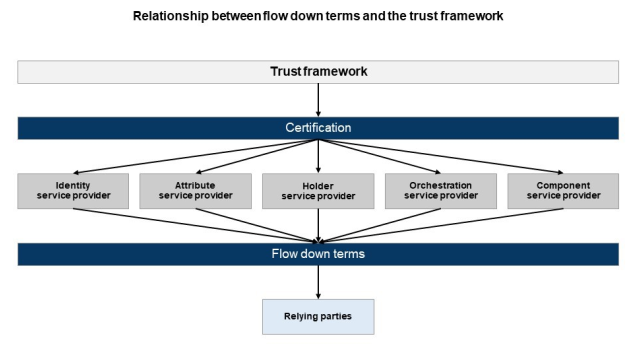
Figure 4
12.9.c. There is flexibility in how you agree and implement these responsibilities with relying parties. But the terms must ensure the relying party understands its responsibilities that flow down from its contract with you, as well as confirm the boundaries for liability between you and the relying party. You must evidence terms specifically confirming the role of the relying party in supporting:
-
data minimisation requirements, including avoiding excessive processing;
-
the resolution of incidents and complaints; and
-
holder service provider requirements for checking identities and/or attributes again where applicable.
Illustrative example 10
Victoria is shopping in a clothes shop and decides to create a digital identity with the shop’s chosen identity service provider so she can participate in a new digital shopping experience.
Victoria is unhappy with the experience of creating her digital identity and makes a complaint to the shop.
The provider and shop have agreed to work together to help customers with complaints. Given the topic of Victoria’s complaint, the shop passes it to the identity service provider to ensure it is suitably resolved without needing Victoria to make a separate complaint with them directly.
13. The register of digital identity and attribute services
13.a. The register is a public, managed list of providers with services certified against the trust framework and any supplementary codes. It is maintained by OfDIA.
13.b. To apply to join the register, you must make an application by following the process set out on GOV.UK. You do not have to be listed on the register.
13.c. You must not misrepresent the registration status of your organisation or the services you offer or allow others you work with to misrepresent their organisation or services through reliance on your registration. This does not preclude a third party from disclosing that a registered service forms part of their supply chain, particularly where the registered service is conducting specific activities in line with regulatory requirements.
13.d. The necessary legal provisions related to the DVS register are set out in sections 32 to 44 of the Act.
13.e. The rules in the remainder of section 13 assume you are listed on the register.
13.1. Presence on the register
13.1.a. OfDIA will regularly carry out checks to maintain the integrity of the register. You must comply with these checks. You must have documented processes in place that demonstrate how you would respond and comply. These checks could include:
-
certificate validation checks, including supplementary code certifications;
-
security checks;
-
requests for further information related to your presence on the register; or
-
requests for applications to be resubmitted.
13.1.b. You can apply to amend your entry on the register. The process for applying for amendments is set out in guidance on GOV.UK.
13.2. Withdrawal and removal from the register
13.2.a. You can apply to withdraw from the register. The process for applying for withdrawal is set out in guidance on GOV.UK.
13.2.b. Your service will be removed from the register if the relevant certificate is suspended, revoked, or expires and is not renewed before the certificate’s expiry date. OfDIA will endeavour to inform you in advance if it intends to take this action. It is your responsibility to ensure a certificate is renewed in good time to ensure your continued presence on the register. Renewing your certification up to 60 days prior to your certificate’s expiry date will help avoid removal from the register.
13.2.c. If you only have one registered service and it is withdrawn or removed from the register, your entry as a registered provider will also be removed.
13.2.d. You must have a transition plan and policies in place in case you or your service are withdrawn or removed from the register. These must outline your commitment to:
-
before applying for withdrawal, give your users and relying parties at least three weeks’ notice that you plan to withdraw;
-
on withdrawal or removal, immediately notify all users and relying parties when your service is no longer listed on the register;
-
on withdrawal or removal, immediately cease all activities that promote yourself as a registered provider and/or your service as a registered service, including in promotional materials, communications, marketing and your website.
14. The UK CertifID trust mark
14.a. The UK CertifID trust mark is a unique visual mark that signals that a service has been independently certified against the trust framework and has successfully applied to be listed on the register. The legal provisions related to the trust mark are set out in section 50 of the Act.
14.b. The UK CertifID trust mark is a registered trade mark. It is owned by the Secretary of State for Science, Innovation and Technology and OfDIA authorises and licenses its use (on behalf of the Secretary of State) to registered DVS providers as licensed users.
14.c. Where OfDIA, on behalf of the Secretary of State, issues the licence to use the trust mark to registered DVS providers, it will issue a unique identifying number (‘trust mark identifier’) which links it exclusively to the registered service. If you have multiple registered services, you will be issued with multiple licences to use the trust mark, and a trust mark identifier to be used alongside the trust mark for each service.
14.1. Eligibility for licenced use of the trust mark
14.1.a. You must only use the UK CertifID trust mark with authorisation from OfDIA. Use of the trust mark will be authorised when all the following eligibility conditions are met:
-
the service holds a valid certificate against the 1.0 publication of the trust framework ; and
-
the service is listed on the register of digital identity and attribute services.
14.1.b. Before OfDIA can authorise your use of the trust mark when the eligibility conditions are met, you must have agreed to the Terms of Use for the trust mark as part of the certification process. Your CAB will make the Terms of Use available to you and will check during the audit process whether you have signed them.
14.2. Using and controlling the trust mark
14.2.1. Using the trust mark
14.2.1.a. Use of the trust mark by registered DVS providers is recommended but not mandatory.
14.2.1.b. When you use the trust mark on public-facing materials, such as a website, promotional or marketing materials, you must ensure it and your trust mark identifier are used only in respect of the specific service that has been registered and to which the trust mark identifier relates. For example, you must not use the trust mark in a way that implies that it applies to an organisation as a whole, or to services which have not been registered.
14.2.1.c. You must only display the trust mark on your materials, publications and communications in accordance with the Trust Mark Usage Guidelines (the ‘usage guidelines’). You must also demonstrate to your CAB you have appropriate processes in place for ensuring this. These guidelines, which are set out on GOV.UK, cover rules for trust mark size, positioning, accessibility and contain illustrative examples of correct applications.
14.2.1.d. The usage guidelines may be changed from time to time. Where there are any changes, your CAB will notify you of these changes and you must comply with them within 6 weeks of being notified. You must also demonstrate to your CAB that you have processes in place to ensure your trust mark usage remains compliant with the usage guidelines.
14.2.2. Controlling the use of the trust mark
14.2.2.a. You must:
-
keep an up-to-date record of all instances where you use the trust mark and your trust mark identifier, and share this information with OfDIA when requested to support its monitoring activities;
-
notify OfDIA if you believe the trust mark or your trust mark identifier is being misused, for example by an unauthorised third party; and
-
have systems and processes in place to ensure and demonstrate your compliance with this section 14.2.2.
14.2.2.b. You must not:
-
authorise use of the trust mark or your trust mark identifier by others; or
-
apply for, obtain, register or use any trade marks, service marks, domain names, company names, trading names or social media accounts that include any part of the trust mark or anything confusingly similar.
14.2.3. Taking corrective actions
14.2.3.a. You must have processes in place to demonstrate how, upon request from your CAB or OfDIA, you will share information relating to non-conformity and misuse of the trust mark or your trust mark identifier, and how you will take the requested corrective actions within 4 weeks of being notified of the request.
14.3. Ceasing use of the trust mark
14.3.a. You must have processes in place to ensure your use of the trust mark and your trust mark identifier, including in public-facing materials, will cease within 4 weeks of the occurrence of any of the following (whichever is earlier):
-
your service no longer meets the conditions set out in section 14.1;
-
your usage of the trust mark or your trust mark identifier does not conform to the usage guidelines, and you have not completed corrective actions as requested by your CAB within the prescribed time frame; or
-
your receipt of a notification from OfDIA or your CAB that you no longer meet the eligibility criteria and must stop using the trust mark.
Part 4 - Additional information
15. Table of standards, guidance and legislation
This is a table of all standards, guidance and legislation referred to in the trust framework for ease of reference. Not all will be applicable to every trust framework participant, and it is recommended that you read the relevant rules for your organisation in full.
16. Glossary of terms and definitions
| Term | Definition |
|---|---|
| Accreditation | The independent, third-party evaluation of a conformity assessment body against recognised standards, conveying formal demonstration of its impartiality and competence to carry out specific conformity assessment tasks. |
| Anonymisation | Transforming personal data in such a way that individuals are not, or no longer are, identifiable. |
| Attribute | A piece of information that describes something about a person or an organisation. A combination of attributes can be used to create a digital identity. |
| Attribute service provider | An organisation providing a service that collects, creates, checks or shares pieces of information that describe something about a user. |
| Audit | The independent verification activity, such as inspection or examination of a product, process or service to ensure compliance to requirements. |
| Authenticator | Something that users can use to access a service. It could be some information (like a password), a piece of software or a device. |
| Biometric information | Measurements of a biological or behavioural attribute, like an iris or fingerprint |
| Certification | Represents a written assurance by an independent third-party, accredited by the UK Accreditation Service (UKAS), of the conformity of a product, process or service to specified requirements. |
| Certified service | A digital verification service that has been certified against the trust framework. |
| Component service provider | An organisation providing a service that specialises in designing and building components that can be used during part(s) of the identity checking or authentication processes. |
| Compromised account | An account has been compromised if a threat actor has accessed it. This could happen because someone has been a victim of coercion, social engineering, phishing or other cyber attacks. |
| Conformity assessment body (CAB) | A body accredited by the UK Accreditation Service (UKAS) to certify a product, process or service to specified requirements. Approved trust framework conformity assessment bodies are accredited to undertake certification against the trust framework in keeping with ISO/IEC 17065. |
| Contra-indicators | A way of categorising any wrong or contradictory information that you might get from, or about, users. |
| Credential | A collection of attributes that can be used to confirm a person or organisation’s suitability to undertake activities or prove things about themselves. |
| Cryptography | Technologies primarily based on maths and computer science for protecting information so that it is only accessible to authorised recipients. |
| Data minimisation | Processing the minimum amount of personal data needed to deliver an individual element of a service. |
| Data protection legislation | The UK General Data Protection Regulation(UK GDPR), the Data Protection Act 2018 and regulations made under the Data Protection Act or the UK GDPR. |
| Data schema | Provides guidance for certified services and relying parties on how to organise and exchange information in a consistent way to enable interoperability. It describes the outcomes of different identity verification processes outlined in GPG 45 and GPG 44 in a machine-readable format. |
| Delegated authority | When a user is authorised to act on behalf of someone else. |
| Digital identity | A digital representation of who a user is. It lets them prove who they are during interactions and transactions. They can use it online or in person. |
| Digital verification service (DVS) | Services that enable people to digitally prove who they are, information about themselves or their eligibility to do something. |
| Digital wallet | A user-facing app, commonly used on mobile phones, to securely hold and share digital information such as payment card details or tickets, as well as identity and/or attribute information. |
| Electronic signature | Data in electronic form which is attached to or logically associated with data in electronic form, and which is used by the signatory to sign. |
| Encryption | A mathematical function that encodes data in such a way that only authorised users can access it. |
| False match | When a user is matched by a biometric system to the record of someone who is not them. |
| False non-match | When a biometric system fails to match a user to their own record. |
| Firewall | A network security system that monitors and controls incoming and outgoing network traffic. |
| Hash function | When data is converted into a fixed-length value. A hash cannot be reversed to reveal the original data. |
| Holder service account | A user interface that allows a user to consistently access, manage and protect information held in their holder service. It also allows a provider to directly support and remotely manage a user’s holder service. |
| Holder service provider | An organisation that creates a user-facing device, service, software or app that allows a user to collect, store, view, manage or share their identity and/or attribute information. |
| Identifier | A piece of information that can be used to make a connection between an attribute and a person. |
| Identity repair | A process that makes it possible for a user to use their rightful identity after experiencing identity theft. |
| Identity service provider | An organisation providing a service that checks a user’s identity for one-off use at a single point in time. It can do this using online or offline channels, or a combination of both. |
| Industry standards | Relevant established standards from organisations including but not limited to ISO/IEC, ITU, ETSI, ENISA, ANSI, NIST, BSI. |
| Internet Protocol (IP) address | A numerical label assigned to any device connected to a computer network that uses Internet Protocol. |
| Intrusion detection system | Software that automatically looks for possible incidents during events in a computer system or network. |
| The register of digital identity and attribute services | A public, managed list of providers with services certified against the trust framework that is maintained by OfDIA. |
| Metadata | Data that provides information about other data. |
| Orchestration service provider | An organisation providing a service that makes sure data can be securely shared between participants in the trust framework through the provision of their technology infrastructure. |
| Participant | A collective term to refer to all organisations that interact with the trust framework and participate in the wider digital identity and attributes market. This includes certified services and relying parties. |
| Personal data | Any information relating to an identified or identifiable natural person |
| Personal data store | A service which lets an individual store, manage and deploy their key personal data in a highly secure and structured way. |
| Phishing | An attempt to trick users into submitting personal information by asking them to click on links within, for example, scam emails or text messages. |
| Provider | An organisation that offers digital verification services. Where a provider has had their service certified against the trust framework, we refer to it as a ‘certified service’. |
| Pseudonymisation | A security technique that replaces or removes information in a data set that identifies an individual. It does not change the status of the data as personal data (ICO Guidance). |
| Qualified trust service | A service offered by a qualified trust service provider that meets the rules in the UK electronic identification and trust services for electronic transactions (eIDAS) regulation (assimilated direct legislation). |
| Relying party | An organisation that relies on (or ‘consumes’) certified products or services. |
| Relying party flow down terms | Terms included in contractual arrangements between certified services and relying parties. |
| Shared signals | When intelligence is shared across the trust framework to reduce the impact of fraud on its participants and users. |
| Supplementary code | A set of additional rules that DVS can certify against, in addition to the trust framework’s rules, to demonstrate that they meet the requirements of a particular sector or use case. |
| Trust framework | A set of rules, which multiple parties can follow to share identities and attributes in a trusted way. This document, the UK DVS trust framework, is designed to help people use and reuse trustworthy digital identities and attributes with people and organisations across the United Kingdom and internationally. ‘Trust framework’ is used throughout the document itself to refer to the UK DVS trust framework. |
| UK Accreditation Service (UKAS) | UKAS is the national accreditation body for the UK. Accreditation bodies are appointed by the Government to assess and accredit organisations that provide certification services. |
| The UK digital identity trust mark | A unique visual mark that signals to users and relying parties that a service is certified against the trust framework and listed on the register of digital identity and attribute services. |
| Unique identifier | Unique data used to represent someone’s identity and associated attributes. |
| User | A person who uses digital verification services to prove something about themself. This can include people with delegated authority to act on behalf of somebody else, such as carers or parents. |
| Verifiable credential | A specific kind of tamper-resistant credential that has been digitally signed to allow for its authorship to be cryptographically verified. |