Traffic Commissioners for Great Britain: Annual Report 2025-2026
Published 30 September 2026
Applies to England, Scotland and Wales

© Crown copyright 2026
This publication is licensed under the terms of the Open Government Licence v3.0 except where otherwise stated. To view this licence, visit nationalarchives.gov.uk/doc/open-government-licence/version/3 or write to the Information Policy Team, The National Archives, Kew, London TW9 4DU, or email: psi@nationalarchives.gov.uk.
Where we have identified any third party copyright information you will need to obtain permission from the copyright holders concerned.
This publication is available at https://www.gov.uk/government/publications/traffic-commissioners-annual-report-2025-to-2026/traffic-commissioners-for-great-britain-annual-report-2025-2026
1. Traffic Commissioners for Great Britain: Annual Report to the Secretary of State 2025-2026
(For the year ending 31 March 2026)
Annual report presented to the Secretary of State pursuant to Section 55 of the Public Passenger Vehicles Act 1981.
2. Foreword by the Senior Traffic Commissioner
Our transport industries have been subject to tremendous challenges - and opportunities. Hostilities in the Gulf have impacted shipping generally and the price of fuel in particular. Operators are finding profit margins narrowing or disappearing completely, whether that be in general haulage or a rural bus service. Those suffering from lengthy payment terms are suffering the most.
There are also opportunities. Businesses are turning to AI to solve problems with promising results. Traffic Commissioners are working with DVSA on ways in which AI could assist the licence application process with trials underway using technology to read bank statements.
It is against this background that we have refreshed our strategic objectives. In a highly dynamic world, our objectives may at first sight seem pedestrian. The truth is that we are heavily constrained by legislation and the demands on legislative time in Parliament are huge. Commissioners have been working closely with the Department of Transport on a package of measures that can deliver service improvements, and we are hopeful of a consultation and call for evidence later this year.
Meanwhile, we are getting on with what we can, from improving how we provide advice and guidance through to improving processes to make the tribunal process more effective. We are increasing our focus on the way in which businesses are taking proper care of their employees, and not just drivers.
The last twelve months have seen three Commissioners, one full-time and two fee-paid, leave this jurisdiction to take on roles as judges elsewhere. They have all told me that they love the work of a Traffic Commissioner but the flexibilities and benefits available elsewhere make the role unattractive for their circumstances. Flexible working is widespread amongst even senior civil servants and I am sure that it is an essential ingredient in establishing a stable team of Commissioners.
This is the first full year where the Office of the Traffic Commissioner has enjoyed its own Chief Operating Officer reporting directly to DVSA’s CEO. That has provided the separation between our support staff and DVSA’s enforcement officers that had long been lacking. It has brought a different approach and an interest at a high level in developing the OTC that is starting to feed through into tangible improvements such as increased development of the Vehicle Operator Licensing system.
I will close this foreword with a huge thank you to my predecessor Richard Turfitt. He has provided a source of knowledge and wisdom that has been invaluable and I am immensely grateful to him. I was pleased to see his contribution to road safety being recognised with the award of the OBE in the New Year Honours List.
3. Our purpose
The Traffic Commissioners for Great Britain (TCs) are independent regulators for the goods vehicle and public service vehicle (PSV) industries and their professional drivers.
Collectively, we act as a non-departmental tribunal and licensing authority, sponsored by the Department for Transport (DfT). Our mission is to promote safe, fair, efficient and reliable passenger and goods transport through effective licensing and regulation of the commercial vehicle industries.
Our shared vision is for Traffic Commissioners to be recognised by our stakeholders as providing proportionate, accountable, consistent and transparent decision-making - a model of independent regulation.
4. What we do
We work to keep Great Britain’s roads safe by licensing and regulating the commercial vehicle industries. With DfT, its agencies, the police and industry stakeholders we support the compliant, licensed operation of goods vehicles and PSVs. We do this by:
- publishing guidance and directions regarding the operator licensing regime and tribunal activities
- holding regulatory hearings to examine evidence and take proportionate action to maintain safety standards and promote fair competition in the industry
- holding conduct hearings to examine evidence and take proportionate action to ensure professional driving standards are upheld
- targeting tribunal resources so that the most serious cases are dealt with quickly and fairly
- delivering efficient, digital licensing services to responsible new applicants and compliant operators
- liaising with other regulatory bodies to identify and share knowledge around non- compliance
- educating and communicating with industry about the value of compliance and the licensing regime
Traffic Commissioners seek to reduce regulatory burdens and support compliant businesses. The following statistics are unable to record the instances where the advice or assistance provided by individual Traffic Commissioners has resulted in improved compliance and road safety.
5. Traffic Commissioner Strategic Objectives 2026 - 2029
The previous version of the Traffic Commissioner Strategic Objectives ran from 2023 to 2025. We reported on the progress made against these objectives in our last Annual Report for the year ending March 2025. We have spent this reporting year reviewing how those objectives could be further developed to assist and improve the industries we regulate.
Making really big changes requires primary legislation. We have to be realistic about that. The Department for Transport will be bringing forward a consultation and call for evidence but whether that can translate into real change will depend on parliamentary priorities.
Many of our previous objectives remain as relevant now as they were in 2023 and we are using this as an opportunity to develop rather than replace those objectives. As always, our primary concern is to ensure the safety of our roads as provided for by the legislation. Our new Strategic Objectives can be found here.
Our overarching aims remain as:
-
To deliver a modern and effective operator licensing regime that ensures operators are fit to hold a licence whilst minimising the regulatory burden on the compliant.
-
To promote and develop a safe road transport industry, which delivers compliance, fair competition and protects the environment.
We have considered how the work that we do support these aims and have grouped these into a number of different areas.
5.1 Delivering a Better Service
The three headline measures that we currently publish and which now appear in the DVSA Business Plan will remain. These are:
- Determine goods vehicle applications within an average of 35 working days.
- Determine public service vehicle applications within an average of 35 working days.
- Public inquiry cases are to be listed for hearing within 12 weeks of a traffic commissioner’s decision to call that inquiry.
In addition to these we are now including a further three measures. The OTC will also publish the performance against these measures on our behalf for the purposes of transparency. These will be:
- Determine applications for Section 19 and Section 22 permits within an average of 35 working days.
- Applications to register, vary or cancel a local bus registration service to be processed or referred to Traffic Commissioner within 10 working days of receipt of the complete information.
- Driver hearings to be listed for a date that is within ten weeks of a Traffic Commissioner’s decision to call that hearing. There will also be a commitment to reduce this time to six weeks by May 2029.
We believe that the addition of these measures demonstrates a commitment to those that use or rely upon our statutory functions. We will continue to make a case for DVSA to publicly report on their performance across all the service levels contained in the Service Level Agreement agreed with us.
Making the application process more intuitive and easier to navigate will enable the Office of the Traffic Commissioner to make the process more efficient and further reduce processing times. The rework required when handling incomplete applications uses valuable resources that can be better spent elsewhere.
Work has already begun pursuing the concept of ‘right first time’ for applications. We will further develop this work so that the initial guidance or instructions contained in OTC correspondence is clear. Currently 75% of applications require at least one letter to be sent with a third of applications requiring at least two letters. Our progress on this will be evidenced by a reduction in the number of letters required to be sent to applicants.
Similarly, inefficient processing practices or staff who are not sufficiently trained and thereby empowered to process applications also extend the average processing time. We will consider adopting measures that reflect the savings that can be made through further improving the quality and efficiency of the processing of applications. This will include asking more questions up-front where it is relevant to do so and requiring supporting documents (except adverts) to be supplied at point of submission.
The licensing function must take account of changes in business practices and, where the legislative framework allows, continue to adapt. We will examine areas where these changes are more prevalent and ensure that processes and action taken reflects modern business practices. Examples of these may be how financial standing is demonstrated or the redeployment of transport managers.
Many Government and private businesses now employ a system of text messaging that alerts subscribers to the presence of emails or important changes. We will work with DVSA to introduce similar functionality into the Vehicle Operator Licensing system so that applicants and operators can receive text messages advising of letters sent to their self-service account. This should help to ensure that responses can be speedier and avoid users failing to identify that they have important correspondence relating to their application or licence.
Previous objectives and annual reports have referred to the need for a reform of the licensing fee structure to ensure that the principle of ‘user pays’ is delivered. We will continue to promote the need for fee reform but will also identify how the service might evolve by harnessing the opportunities that fee reform may bring. This will include considering the specific support required across the different sectors within the transport industry and ensuring the accessibility of services. We will ensure that operators have appropriate points of contact for our services and that we are able to react promptly to genuinely urgent items. We will also consider how technology can be utilised to improve access to services.
5.2 Engagement
We will continue to engage extensively with the industry through attendance at events or meetings. Every year Traffic Commissioners will attend a number of events organised through the industry trade associations or other bodies, using the opportunity to promote our priorities of road safety and how operators and transport managers can help ensure that their operations remain compliant.
Many operators seek assistance from professional service providers, either to assist in the application or public inquiry processes or in the general running of the business in relation to their obligations in the operator licensing system. Consultants can provide a valuable and competent service to their clients; however, they are not regulated like practicing solicitors or barristers. All Traffic Commissioners have seen examples of applicants or operators being let down by consultants. We will seek to provide further guidance to help applicants and operators identify the best support available to them, and also to provide guidance for use by consultants on the expectations of Traffic Commissioners.
We have worked to improve how we engage with the goods and passenger vehicle industries through our use of email messaging, especially providing advice for new operators or those who have compliance failings. We will continue to expand on this work with advice directed to transport managers and directors, or messages focussed on particular areas of the industries. The latter will build on work already underway in Wales for the scaffolding and farming industries.
The provision of safe and reliable transport in the voluntary sector remains a key consideration for Traffic Commissioners. We will continue to work with other stakeholders on improving the guidance that is available to this sector on how they can ensure that the vehicle operation is as safe as that for commercial enterprises.
It is appreciated that written contact is not always the most effective form of communication. We will explore other methods of communication such as video messages, virtual seminars or workshops.
We also recognise the importance of engaging with those who are impacted by those that we regulate. Greater engagement with victims of road incidents will help to better inform how we carry out our functions and give us a better understanding of the risk.
The legal sharing of information across Government can bring benefits in creating a coherent and joined up approach to the provision of services and regulation. We will work to identify whether data currently held elsewhere within Government could bring service or regulatory benefits to our service users and improve our gatekeeping or regulatory role.
5.3 A Traffic Commissioner service fit for the future
The Road Safety Strategy published by the Government in January 2026 raises important questions on how we can all work to improve road safety. We see this as an opportunity to support the Government by better defining a role for our jurisdiction.
We will continue to promote legislative change for an improved operator licensing system that removes unnecessary administrative burden and cost to the transport industry, whilst ensuring that road safety is not impacted. Working with stakeholders we will identify areas where change would bring benefits and use our expertise to advise Government and the Department as appropriate.
It is important that the Traffic Commissioner function remains modern and relevant. We will work with the Department for Transport to ensure that vacancies for Traffic Commissioners and deputies attract the best possible candidates. However, it is equally important to ensure that the post remains attractive in order to retain commissioners. A high turnover rate of Commissioners places a strain with a potential under-representation in areas and increases road safety risks. We will continue to advise the Department on how Commissioners can be retained through the availability of effective career development pathways and other incentives.
Ensuring that the service remains fit for the future is impacted by the support and sponsorship provided by the Department for Transport and the services provided by the DVSA. The establishment of a Chief Operating Officer in 2024 provides an opportunity to delegate departmental functions to that post to relieve the pressure on civil servants and improve efficiency in the support we receive. We will work to identify which functions are appropriate for delegation and advise the department on implementation and the legal implications.
5.4 Drivers
We have highlighted the importance for employers to provide support to their drivers giving prominence to the benefits to their welfare, their health and their safety. This work will continue and we will champion driver welfare considerations in the guidance available to operators and transport managers.
In 2025, we reviewed the Senior Traffic Commissioner Statutory Document No.6 relating to drivers. This review sought to clarify certain elements and increase the emphasis placed on risk. We will seek to further explore whether we can establish the effectiveness of the starting points adopted following disqualification.
There are well developed and available avenues to engage with operators, but we do not yet have the benefit of similar for drivers. We are keen to improve the advice and guidance that we can provide to drivers but also to identify effective means for direct communication.
We also intend to engage with the Sentencing Councils to raise the awareness of the Traffic Commissioner role in relation to professional drivers and the expectations of those drivers. This work will help to ensure a joined-up approach is taken in cases where drivers appear before the court with regards their driving entitlement and are then referred to a Traffic Commissioner for determination of their professional licence.
6. Summaries from England, Scotland and Wales
As in previous years we have collated the collective observations of the Traffic Commissioners into defined narrative sections. Adopting this format, the following sections again combine those themes and observations of the Commissioners.
7. Traffic Commissioners for England
Sarah Bell, Tim Blackmore, Miles Dorrington, David Mullan, Kevin Rooney and Richard Turfitt
7.1 Fit for the Future
The statutory creation of the Traffic Commissioners is nearly 100 years old. As we look towards that milestone, we are conscious of our responsibility to ensure that the regulatory framework remains effective, in which to deliver proportionate decisions in the interests of road safety and fair competition into a second century. Without the Traffic Commissioners, regulation of commercial vehicle standards would largely fall to criminal proceedings or appellate courts after harm has occurred. This is a preventative jurisdiction allowing for intervention before a danger to other road users materialises. Traffic Commissioners use their specialist skills, to remove unsafe operators and drivers from the road before serious incidents occur.
To ensure the Traffic Commissioners remain effective and continue to support the road transport industries we have identified a number of priority areas for reform. One of these is tribunal rules. It is essential that the case management surrounding each of our public inquiries is clear, efficient, and delivers good value for the public purse whilst fulfilling our regulatory role.
During the year, we have implemented an online case management system, enabling faster and more transparent exchange of information between operators, representatives and Traffic Commissioners, but to maximise the full potential of this system we would require Tribunal Rules.
Alongside digital reform, we continue to work with the Department for Transport on the wider operator licensing review. A regulatory system approaching 100 years old must continue to evolve if it is to remain credible, accessible and effective. One clear example of the need to recognise technological change is the requirement for operator discs, noting the successful removal of tax discs from vehicles in 2014. Similar efficiencies could be realised for commercial vehicle operators.
7.2 Traffic Commissioner recruitment and retention
Another important area of focus needs to be Traffic Commissioner recruitment and retention. During the past year, we have seen another of our colleagues leave office, and a new Traffic Commissioner has since been appointed for Scotland. Retaining experienced Commissioners is vital to maintaining consistency, expertise and confidence in regulatory decision-making.
We need a cohort of Traffic Commissioners who reflect all aspects of society, as this diversity gives us strength. However, recruitment can be challenging, particularly for those with family or caring responsibilities. Current terms and conditions include none of the basic employee-type rights or protections that might be taken for granted in private and public sectors such as long-term sick pay, maternity or paternity leave, bereavement leave, caring allowances, whistle-blowing or anti-bullying provisions. This creates a significant risk that highly capable candidates may be deterred from applying. We therefore urge the Department for Transport to revisit the terms and conditions of appointment so potential changes can be considered.
7.3 Road Safety Strategy
Theme 4 of the Department for Transport’s Road Safety Strategy focuses on “robust enforcement to protect all road users”, recognising the need for coordinated, proportionate intervention to deter unsafe behaviour, and manage risks across the road transport system.
The Traffic Commissioners are statutory regulators of HGV, bus and coach operators and vocational drivers. Government publications and independent reviews confirm that Traffic Commissioners play an “important and strategic role… principally in road use safety” and provide an effective regulatory mechanism for the commercial transport sector.
A key part is the targeted removal of unsafe operators and drivers. Effective enforcement begins with effective legislation. The Traffic Commissioners intervene in operator’s licences when safety standards are not met. By intervening at an early stage, we help prevent repeated non‑compliance and reduce the likelihood of serious incidents, demonstrating the preventative value of the Traffic Commissioner regime within the Safe System approach.
Traffic Commissioners also strengthen professional standards for drivers by regulating vocational licence holders and taking appropriate action where drivers demonstrate poor conduct, repeated infringements or other safety issues. This reflects the strategy’s recognition that road safety must be delivered through a system that manages human error, rather than relying on individual responsibility alone.
Through statutory guidance and clear expectations for transport managers, we set standards for maintenance, safety systems and responsible operation. This guidance supports the Safe System approach and contributes to safer operation across the industry. The strategy also calls for coordinated enforcement, and we will continue to work with the DVSA, the Police and other agencies to support a coherent and effective road safety framework that results in the evidence that enables robust decisions against the non-compliant.
7.4 Driver Welfare
This year has seen a renewed focus on driver welfare. Traffic Commissioners have engaged with research undertaken by Loughborough University and considered its proposals with interest. We have also noted the publication of the RHA’s “Guide to Maintaining Driver Health”: Guide-to-Maintaining-Driver-Health_260126.pdf and the mental health initiatives developed by Logistics UK through: Thrive Logistics UK. In public inquiries and driver conduct hearings, we regularly see the impact poor physical and mental health has on drivers and the contribution to workforce shortages. The official statistics from the DfT on HGV driver vacancies shows the challenge in the recruitment and retention of drivers and the importance of improving this working environment.
We also considered Transport Focus’s report on rest areas for commercial drivers: Lorry Drivers’ Facilities Survey - Year two summary report - Transport Focus and welcomed the training now provided by the CPT for PCV drivers on violence against women and children.
Traffic Commissioners are keen to support improvements in the working environments for all drivers. However, we are increasingly seeing cases of driver isolation, and it is imperative that coworkers and employers take steps to check on one another and provide support for those working away from home.
We are aware of a recent prosecution relating to a company who were providing D4 medical certificates to HGV licence holders or applicants. These certificates are supposed to provide assurance that the person is medically fit to drive HGVs, however in this case unhealthy drivers were being passed fit. The consequences of a medically unfit person driving a large commercial vehicle can be catastrophic. Operators need to be aware of the potential for this type of fraud and take reasonable steps to ensure drivers are medically fit to drive their vehicles.
During this year, we have seen an increase in cases involving drug driving. These cases have serious implications not only for individual drivers but also reflect on the operator systems, management oversight and good repute. Operators should not expose themselves or the public to unnecessary risks and must have effective systems for testing, education and driver engagement. Roadside drug tests are now commonplace, and the consequences of a positive test for insurance, professional competence, and the ability to earn a living are significant.
Operators should be testing their drivers. They need to understand what their drivers do at the weekend; they need to be talking to their drivers and helping them understand the lasting effects of substances. We believe operators need to do more to educate their workforce and ensure that drivers are fit to drive.
7.5 Understanding the challenges faced by industry
Traffic Commissioners are acutely aware of the challenges currently facing HGV and PSV operators. We have seen reports of increased insolvencies across the sector and recognise that the cost of doing business has risen sharply. Delayed payments can have serious knock-on effects across of a business impacting maintenance systems and other safety critical parts of an operation through no fault of the operator.
Operators are often affected by external factors beyond their control, and events that were once considered exceptional have occurred repeatedly in recent years. The logistics industry is particularly vulnerable to global disruption, with events far beyond the UK having immediate operational impacts. As regulators, we are considering how best to support operators through these pressures while continuing to uphold safety standards in a volatile and unpredictable environment.
Operators are reminded of the guidance that we published in February 2024 on the steps to take when applying to a Traffic Commissioner for a period of grace. As the article suggests in its title ‘Don’t leave it too late’.
7.6 Artificial Intelligence
Traffic Commissioners have attended educational sessions on the use of AI within the industry. An increasing number of operators are using AI for logistics and route planning, and there may be scope in its potential application for predictive maintenance, telematics and fleet optimisation.
AI is not a reliable solution to every problem, but when used appropriately it may support improved compliance and operational efficiency. While AI may assist both operators and regulators, it cannot replace human judgement in regulatory decision‑making. Accountability for compliance, road safety and professional standards remains firmly with operators and transport managers.
We have seen ourselves how AI has been used in the creation of documents for the purposes of a hearing. This can offer assistance to those preparing cases but comes with its own risk of stating incorrect references to caselaw or other detail relevant to the hearing.
7.7 Recognition Schemes
We continue to support maintenance recognition schemes such as the Maintenance Provision Rating Scheme (MPRS) and the positive and welcome increasing engagement from workshops. Participation in such schemes does not replace the need for full compliance but can provide valuable assurance when supported by strong management systems. We have seen growing interest from workshops seeking to join MPRS, reflecting the importance of consistent maintenance standards across the industry. At the time of writing there are 227 in the scheme and 170 expressing interest in joining.
Earned Recognition and similar initiatives reinforce the principle of one rule and one standard across the industry. Recognition is earned through sustained compliance and does not operate as an alternative to regulatory oversight.
The PSV Industry
7.8 Bus Services Act
The Bus Services Act 2025, which took effect on 27 October 2025, has significantly reshaped the franchising framework. The Act provides local transport authorities with expanded powers over routes, fares, standards and operational requirements. It also allows authorities to establish their own bus companies again and modernises registration and service standards, including new safety, accessibility, and data‑transparency requirements.
Throughout 2025 and into 2026, several authorities announced or progressed franchising plans, including West Yorkshire, who developed the “Weaver Network”, with contracts due in 2026 and phased launch from 2027. Cambridgeshire & Peterborough, Liverpool City, the West Midlands and South & West Yorkshire are also advanced franchising proposals. Traffic Commissioners are actively engaging with these authorities to support effective implementation and successful outcomes.
7.9 Public Service Vehicles Accessibility Regulations (PSVAR)
Failures to comply with PSVAR requirements are being considered at public inquiries. Rising costs have driven greater demand for retrofitting, and delaying action risks increased costs and operational disruption.
Many operators are awaiting the outcome of the DfT’s ongoing review, particularly those reliant on home‑to‑school and rail‑replacement exemptions. Retrofitting provides flexibility for operators wishing to retain older but mechanically sound vehicles. Accessibility standards also bring increased training obligations, and we expect operators to ensure drivers are equipped to meet passenger needs.
7.10 Bus Open Data Service (BODS)
Over the past year, BODS has become an important national dataset supporting real‑time bus information, regulatory compliance, and transport planning.
Reliable and consistent data improves the quality of evidence available during compliance reviews and public inquiries. These datasets can corroborate operator statements on service levels, reliability trends, and operational planning quality.
Growing public reliance on real‑time data strengthens expectations that operator data must be timely, accurate, and consistently maintained and failures may increasingly constitute evidence of poor systems and management oversight. Improved operator knowledge reduces justification for persistent non‑compliance with data duties, increasing the expectation that operators keep their BODS submissions accurate and up to date.
7.11 Senior Traffic Commissioner’s Statutory Documents
The past year saw the most substantial revision to the Statutory Document on vocational driver conduct in over a decade, following a formal consultation between April and May 2025 and the publication of the updated version in November 2025.
The updated document introduces clearer and more consistent starting points for assessing driver conduct, supported by new case examples such as route planning errors and bridge strikes.
Driver conduct hearings are not a second sentencing exercise but involve a balanced assessment of a driver’s overall history, fitness and risks posed to other road users, including the likelihood of harm and the effectiveness of control measures in place. In refreshing the document, our aim has been to ensure starting points that are proportionate and which deliver the focus on risk suggested by the legislation.
The document also introduces new guidance covering non‑attendance, abusive behaviour, and company drug and alcohol test failures.
Overall, the revisions reinforce expectations of transparency, clear written reasons in all decisions, and the appropriate use of virtual hearings.
7.12 Smarter regulation
During this past year we, together with the Office of the Traffic Commissioner, have made significant strides in implementing smarter regulation. The aim of the Traffic Commissioners is to make sure that operators are able to satisfy their legal requirements but also to get it right first time and cut out unnecessary steps that hinder businesses. Our role as gatekeepers is as important as providing speedy and effective processes within our licensing system. We have developed improvements to our last transport manager letters, helping operators understand what change is required.
As we revise our processes, we seek to ensure that the questions asked of operators will make it more likely that those entering our industry are entering with knowledge and the correct levels of training and experience in order that they can show ‘I am trained and competent in operator licencing’ right from the start.
8. Traffic Commissioner for Scotland
Richard Turfitt
As I sit to draft this report, we avidly await the arrival of Sharon Clelland as the first full-time Traffic Commissioner for Scotland in nearly two years. The staff in Edinburgh deserve and require the oversight of a permanent colleague on site. Like the Senior Traffic Commissioner, the Scottish post should always be backfilled, when there are extended periods of absence.
One of my predecessors once described being Traffic Commissioner for Scotland as the best job in the world. I have genuinely enjoyed my time and the engagement with many operators based in this traffic area and their representatives. That is not to say that the Scottish traffic area is without its challenges. I am anxious to ensure that my successor is free of some of the unnecessary blockers, which I have encountered, and Sharon can be assured of my continued support as she settles into the post.
In advance of her arrival, I have given directions on the publication of Traffic Commissioner decisions. I have introduced processes to speed up the production of reasons and to ensure that necessary details are available to assist wider understanding of this role. The tribunal centre in Edinburgh now enjoys a dedicated Hearing Centre Manager and there have been recent additions to bring the team up to strength. They will be in a better position to support the DTCs in the preparation of cases and the prompt production of reasoned decisions. I have also given instructions to ensure that examples of non-compliance are brought to hearing quicker rather than be delayed awaiting additional assessment.
The OTC Head of Policy represented me at meetings with Scottish Government representatives in January 2026 to discuss how the bus franchising process will work in Scotland. Unlike in the rest of the jurisdiction, the legislation in Scotland requires the Traffic Commissioner to appoint a three-person panel to assess any scheme. Work continues on a Memorandum of Understanding with the Scottish Government allowing any costs to be recovered.
I am not the first occupant of this post who has highlighted the need to settle the funding for the Traffic Commissioner for Scotland as new devolved responsibilities come online. I cannot help but compare the resource dedicated to the Traffic Commissioner for Wales for educational engagement and the different ambitions for support of Welsh businesses. Much more could be done with effective funding, particularly whilst we await fee reform in Great Britain.
In the meantime, I have continued to enjoy the support of LUK and RHA in our efforts to support and educate the goods industry. I also had a useful meeting with the Chair of CPT Scotland and have identified the opportunity for PSV operators in Scotland to benefit from the type of compliance education events which are available elsewhere in the jurisdiction, whilst also reinvigorating policy engagement which lapsed over the last two years.
Traffic Commissioners are not alone in facing recruitment delays. The increasing pressures on stretched enforcement resources can be seen in the standard of evidence submitted. I am genuinely concerned that large areas of Scotland are not left without Examiner cover and question an organisational plan which does not appear fitted to the geography and communities of this country.
I am grateful to officials from Transport Scotland and DfT based in Edinburgh for having given up their time to support the recruitment of a permanent Traffic Commissioner for Scotland. The businesses and communities of Scotland should be assured by the exercise conducted for the new Traffic Commissioner for Scotland.
I am disappointed that the lessons to be taken from this lengthy exercise have not been drawn together. They would usefully have informed the on-going exercise in Wales. From my experience, the additional requirements specified under a protocol with the Scottish Government are entirely justified given the legal issues arising from different devolved settlements.
I accept that there is a risk from ‘review fatigue’ but one of the issues, which I would hope can now be addressed, is how to retain Traffic Commissioners in post. The last five Commissioners to depart from post were highly qualified female colleagues. Recommendation 13 of the function review (published in April 2023) specifically identified the need for future appointment exercises to consider how the diversity of the Bench might be made more representative, whilst ensuring that all positions continue to be filled on merit. It was suggested that Traffic Commissioners should be more representative of the public they serve, not just the regulated industries. It is concerning that whilst industry initiatives such as Women in Bus and Coach, seek to champion the benefits of greater inclusion, there has been no move to genuinely understand why those colleagues left and to explore different working models. Any such work will need to start with a recognition of the equivalent judicial posts and benefits, rather than downplaying the role.
Last year’s assurance statement referred to the need for officials to better recognise the expertise of Traffic Commissioners and give sufficient weight on our concerns. Work on updating the Framework should be based on informed understanding, if we are to avoid further examples of officials interfering in judicial listing. Legal risks were formally escalated to the Department via the Director General in December 2023. There has yet to be a substantive response. It does not assist that the outcome of a review of the impact of DVSA’s “target operating model” has yet to been shared with Traffic Commissioners. The introduction of an electronic bundling system without tribunal rules to support directions has, as predicted, placed even greater pressure on small and under-staffed teams. The reorganisation of OTC by DVSA tested the goodwill of staff and Commissioners alike. It led to the haemorrhaging of staff from Edinburgh. As I reported previously, the pressures on the centralised bus registration team in Leeds were not disclosed. However, I am now in a position to confirm that the Vehicle Operator Licensing system has been updated to include Scottish legislation.
I thank the OTC staff, DTC colleagues, and stakeholders for supporting me during this temporary appointment. I hope that the above initiatives will be the start of further improvements. Small and medium sized operators (the majority of transport business in Scotland) should not be forgotten in the pursuit of deregulatory measures. I wish good luck to those working within the regulated industries and for the benefit of Scotland, as we face a further period of uncertainty. I take confidence from the fact that the joint actions of industry and regulator saw us through the pandemic and will surely inform planning going forward. Last, I congratulate Sharon on taking up her new role and wish her undoubted success for the future.
9. Traffic Commissioner for Wales
Victoria Davies
As I write my final contribution for our Annual Report, I am filled with a profound sense of gratitude and pride reflecting on my tenure as the Traffic Commissioner for Wales over the past six years. It has been an enormous pleasure and privilege to serve alongside dedicated and talented people, and I am honoured to have witnessed first-hand the resilience, innovation, and unwavering commitment that define the commercial vehicle industry.
This past year, like many before it, has presented both challenges and opportunities. Through collective effort, the ongoing staffing/recruitment challenges have been addressed, and I am delighted to be able to report on the engagement work I have been able to take forward this year with the newly appointed dedicated Engagement Manager for Wales. We have explored how best we might connect with sectors of the industry that are harder to reach but who would benefit most from direct engagement and education. Our first campaign targeted Welsh scaffolders. The campaign launched in both Welsh and English last October and involved every licence holding scaffolder in Wales receiving a daily message highlighting issues relevant to compliance in that industry. Our second campaign launched in March this year and was targeted at farmers and agricultural hauliers who hold an operator’s licence in Wales. This targeted engagement and education is an exciting development which should result in improved compliance and fewer calls to public inquiry. I have, of course, continued with face-to-face engagement this year at various industry events, often supported by my Engagement Manager, who has been pleased to engage directly with stakeholders in Welsh.
As I step down from my role, I reflect positively on what has been achieved in Wales. I would like to extend my heartfelt thanks to those who have supported me as the Traffic Commissioner for Wales and who have made the post so rewarding. First and foremost, I want to thank the extremely dedicated OTC staff who work tirelessly to provide a first-class service. My Traffic Commissioner colleagues have been an invaluable support, and I am grateful to them all. The assistance and support I have received from the Welsh Government has been unstinting over the years, and I am also grateful to DfT, the RHA, Logistics UK, CPT Cymru, CaBAC and Bus Users Cymru. Finally, my thanks go to the excellent and dedicated DVSA examiners in Wales who carry out a vital role in keeping our roads safe and protecting the public.
Cofion cynnes
10. Acknowledgements
This reporting year has seen the departure of Victoria Davies, who has moved from her role as the Traffic Commissioner for Wales to sit as a Judge in the Immigration and Asylum Tribunal, along with Deputy Traffic Commissioners Catherine Moxon and Tehniat Watson who have taken up roles as Judges in other Tribunals. We recognise and appreciate the hard work and dedication of Deputy Traffic Commissioners and full time Traffic Commissioners during a year which has seen us at below the usual complement of experienced post holders. It demonstrates how vital it is that we have the right people with the required judicial skills in the role. It is also equally important that we retain qualified decision makers.
The end of the year saw the appointment of Sharon Clelland as the Traffic Commissioner for Scotland, we welcome Sharon to the role but also acknowledge and thank Richard Turfitt for his work as the interim Traffic Commissioner for Scotland alongside his other duties.
We also extend our thanks to the Department for Transport and the devolved governments in Wales and Scotland for their support during the year, particularly during the various recruitment campaigns for Traffic Commissioners and Deputies. In this we also acknowledge the support provided by the trade associations in promoting the recruitment campaign helping to ensure a strong pool of candidates.
We, once more, recognise the hard work and expertise demonstrated by those who support us in the Office of the Traffic Commissioner. We wish those who have moved to new challenges every success in their new roles, in particularly Kevin Aveyard who previously led the licensing team.
It is appropriate to take this opportunity to recognise the valuable contribution made by Loveday Ryder during her tenure as Chief Executive Officer of the DVSA. She made a significant contribution in developing a mutually respectful and productive relationship between the DVSA and Traffic Commissioners.
11. Risk Assurance Statement
Transparency Data: Information relating to the salaries, spending, gifts and hospitality of traffic commissioners is published on GOV.UK.
In accordance with the Regulators’ Code, the Traffic Commissioners for Great Britain support the principles of the Growth Duty contained in section 108 of the Deregulation Act 2015. The Traffic Commissioners recognise their responsibility to have regard to the desirability of promoting economic growth while exercising their relevant functions.
The Traffic Commissioners have reviewed their functions and determined that, while they are in scope of the Growth Duty as regulators, tribunal and other civil proceedings are excluded from this duty under Section 111(2)(b)(ii) of the Deregulation Act 2015. Accordingly, this assurance statement applies to all regulatory functions except those constituting civil proceedings.
During the reporting period, the Traffic Commissioners have continued to take steps to ensure that their policies and decisions support fair competition and reduce unnecessary burdens on compliant operators, while maintaining public safety and environmental standards. Engagement with stakeholders and internal reviews have supported this approach.
The Traffic Commissioners will continue to monitor their compliance with the Growth Duty and ensure that the distinction between in-scope and out-of-scope functions is clearly maintained.
This Risk Assurance Statement reflects the maturity of our governance arrangements, pending any future restructuring of the tribunal Chamber. A differently constituted Audit and Risk sub-committee previously identified the need for more formal reporting processes whereby higher-level risks are communicated to the sponsoring Department and that facility has been utilised.
Previously identified risks regarding issues with recruitment and retention of Traffic Commissioners and Deputy Traffic Commissioners remain relevant. Departing Traffic Commissioners often give in excess of three months of notice and although we have seen some improvement in the time taken to advertise vacant roles, the length of the process invariably leads to posts remaining vacant for extended periods of time, requiring to be covered by an already stretched Traffic Commissioner resource. The absence of a full-time Traffic Commissioner presents a real risk to the listing of safety-related cases and to the efficient determination of applications.
The recruitment of five new Deputy Traffic Commissioners in 2025 will have a long-term benefit to our work. However, the amount of time taken to train new Commissioners needs to be fully appreciated and accounted for. Last year, as in the previous year, we invited the Department to consider why it has been unable to retain recently appointed Traffic Commissioners beyond 4 or 5 years. Looking at ways to improve the retention of good Commissioners is as important as making improvements to the recruitment process.
Overall oversight of operational risk continues to be exercised by the Traffic Commissioner Board, with designated Traffic Commissioner leads in areas such as Quality Assurance and Data. As before, the Traffic Commissioners’ risk culture is defined, communicated, and promoted through the Governance Policy Guidance and is subject to periodic assessment by the Board’s Audit and Risk subcommittee, utilising established audit and reporting methods.
Service levels are intended to dictate the delivery of functions on our behalf. The assurance processes are intended to ensure that the quality of service is also maintained. We previously reported on some of the negative impacts arising from the DVSA’s restructure of the Office of the Traffic Commissioner, most notably in areas of driver conduct, hearing centre resilience, and bus registrations in Scotland. Although improvements have been made in some areas, there is still more to do to ensure that service users receive a good quality service. Last year we invited DVSA to learn the lessons of the change process, an independent audit has been conducted but the Commissioners have yet to be given access to the findings.
However, a good quality service requires an appropriate level of funding. The DVSA accounts suggest a significant funding gap between the income generated by the Traffic Commissioner functions and the expenditure. There has been no significant fee increase to pay for the service provision for over 15 years. We look forward for the progression of a review into the funding of the service provided.
We continue to benefit from established data management processes, with our own Data Protection Officer in place. The arrangements to support the independent data controllers are frequently reviewed through the Audit and Risk subcommittee and the Data Assurance Working Group.
12. Provision of Support Services to the Traffic Commissioners
Paragraph 7 of Schedule 2 of the Public Passenger Vehicles Act 1981 provides that: “Subject to the approval of the Treasury, the Secretary of State may appoint such persons to act as officers and servants of a traffic commissioner as he considers appropriate”. This support is necessary in order to carry out our functions and is provided by the Driver and Vehicle Standards Agency (DVSA) and those DVSA staff who are deployed to the Office of the Traffic Commissioner.
It is important that the services the Traffic Commissioners may reasonably expect is set out and agreed by the relevant parties. The agreed level of services that the DVSA provide to the Traffic Commissioners, and by extension the regulated industries, is contained in a Service Level Agreement (SLA) that is regularly reviewed.
12.1 Performance Measures
The SLA sets out 14 separate measures covering all aspects of our functions that the OTC will record and report on to the Traffic Commissioner Board. The table below shows the performance over the 2025/26 reporting year.
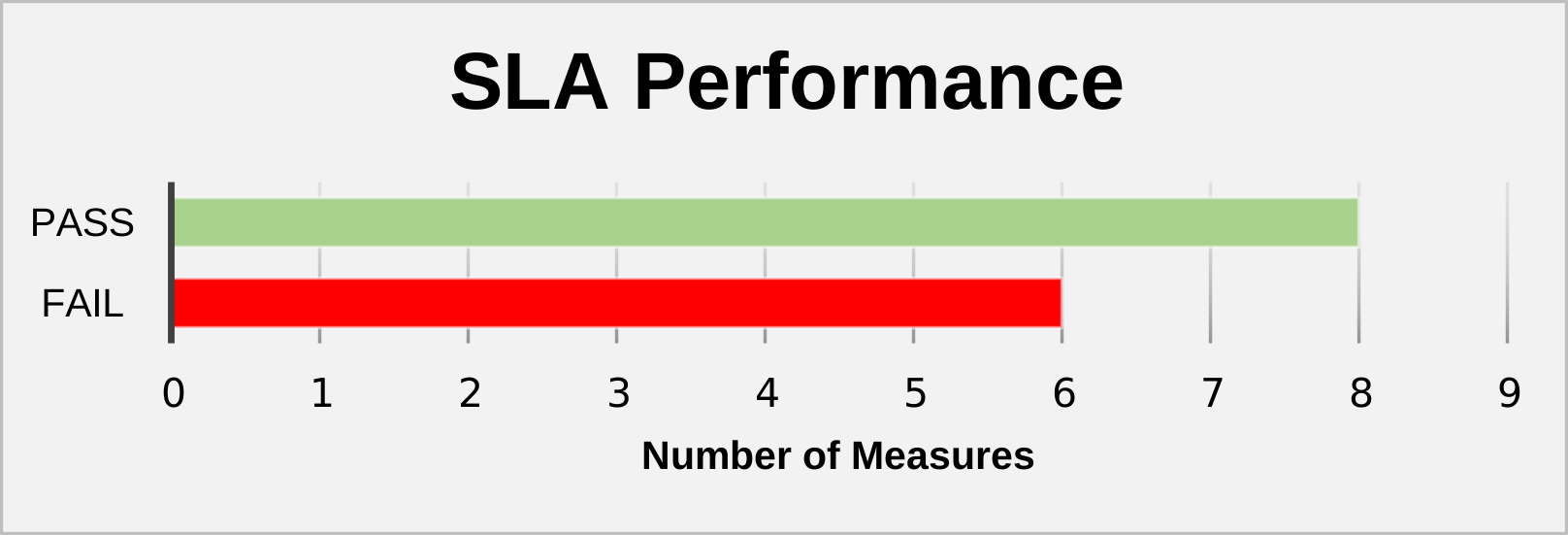
We report quarterly performance on three of these measures due to their importance to those that we regulate.
| Measure | Target | Performance |
|---|---|---|
| Public Inquiries to be listed to a date that is within 12 weeks of the decision to call the PI | 95% | 77% |
| Average processing time to determine applications for goods vehicle operator licences (or to provide interim authority) where a PI or Preliminary Hearing is not held | 35 days | 35 days |
| Average processing time to determine applications for PSV operator licences where a PI or Preliminary Hearing is not held | 35 days | 42 days |
The SLA also covers a number of other important commitments to ensure the effective running of the support services. These include:
- ensuring that the legal requirement for the Traffic Commissioners’ independence is recognised and respected;
- defining service level standards to the Traffic Commissioners and their corresponding agreed service levels, in order to deliver a service to operators and applicants that can be relied upon as part of their business planning;
- assisting OTC staff by clearly defining their roles and responsibilities and avoiding a conflict of interest due to their employment by DVSA;
- setting out how data is handled and stored providing sufficient data assurance to Traffic Commissioners;
- assisting in the management of resources across the Office of the Traffic Commissioner;
- providing clearly defined targets that will deliver improved budget setting and Traffic Commissioner Strategic Objectives.
In addition to the administrative support provided by the OTC staff the SLA details the support functions that are provided by the wider DVSA. These include the provision of IT, data handling, audit, risk and performance reporting and Estates and Facilities.
As part of the commitment to Estates and Facilities, DVSA should carry out regular risk assessments of all accommodation for TCs and review them not more than every two years and in line with its statutory duties. Suitability of the accommodation, in particular with regard to the tribunal functions of the Traffic Commissioners, is to be taken into account. This includes a requirement for business continuity plans for each location, to be reviewed every six months.
The SLA recognises that operator fees pay for the services provided, and in exchange DVSA will ensure that OTC has a workforce of the right size and shape, with the right skills to provide the following services now and in the future.
The DfT Accounting Officer is responsible for agreeing the budget required to fund the Traffic Commissioners’ regulatory activity with DVSA in January of each year. It is also essential for Traffic Commissioners to be provided with an accurate record of not only expenditure by DVSA but also the actual cost of the services provided to Traffic Commissioners, where this is not clear from the expenditure alone. A report containing this information for all schemes relevant to the income from the licensing fees and expenditure on the work of the Traffic Commissioners should be provided by DVSA at each Traffic Commissioner Board. A representative of DfT will sit on the quarterly OTC fees group and should be providing assurances to the Traffic Commissioner Board that appropriate financial processes are being followed.
13. Statistics
13.1 Goods vehicle operators
Table 1: Licences continued and in issue
Table 2: Numbers of specified vehicles on licences
Table 3: Applications for new licences and to vary existing licences
Table 4: Results of opposed applications for new licences and for publishable variations to licences
Table 5: Complaints against existing operating centres
Table 6: Action taken at public inquiry for non-compliance
Table 7: Results of unopposed new and variation applications heard at public inquiry
13.2 Public service vehicle operators
Table 8: Licences continued and in issue
Table 9: Discs in issue
Table 10: Applications for new licences and to vary existing licences
Table 11: Results of applications heard at public inquiry
Table 12: Special Restricted public service vehicle operator licences
Table 15: Number of Standard, Large and Community Bus Permits issued
Table 16: Action taken at public inquiry for non-compliance (under the Public Passenger Vehicles Act 1981)
13.3 Local bus services
Table 13: Live, new, variations and cancelled
Table 14: Flexible bus registrations
Table 17: Action taken against operators (under the Transport Acts 1985 and 2000)
13.4 Public Inquiries, Upper Tribunal Appeals, Driver Conduct & Impounding Hearings
Table 18: Total number of completed Public Inquiries
Table 18a: Total number of completed preliminary hearings and Senior Team Leader interviews
Table 19: Public service vehicle and goods vehicle operator - Appeals to the Upper Tribunal
Table 20: Large Goods Vehicle and Passenger Carrying Vehicle driver conduct cases - action against drivers
Table 21: Applications for the return of impounded vehicles
Please note that some of the statistics set out in the tables are compiled manually by OTC staff. To minimise the potential for inaccuracies the figures have been subject to a validation exercise undertaken by OTC managers who have provided the Traffic Commissioners with their assurance that the figures are accurate to the best of their knowledge.
The statistics are a record of work undertaken in the 2025-26 reporting year, care should be taken when trying to compare data across reporting years. For example, an application may have been received in the last reporting year and then determined in this reporting year. Similarly, tables reporting the number of public inquiries held may not equal the sum of the columns which set out the regulatory action taken, this is because more than one action may be taken against an operator. In some cases, it is not possible to use the figures contained in some of the tables as a direct comparison to previous years due to a number of factors.
In particular, we draw attention to the following explanatory notes:
- Table 1: Goods vehicle operators – Licences continued and in issue. From the 2022-23 annual report the figures include Standard International licences issued to operators of Light Goods Vehicles.
- Table 2: Goods vehicle operators – Numbers of specified vehicles on licences. From the 2022-23 annual report the figures include Standard International licences issued to operators of Light Goods Vehicles.
UK Licence for the Community replaced Community Licences in December 2020. Operators are also issued with an office copy and certified copies which have to be carried in vehicles on international journeys. - Tables 3 and 4: Goods vehicle operators. The headings for columns C and D on Table 3 alongside columns E and F on Table 4 have been amended from “number of applications processed” to “number of applications determined” to make it clearer that an application is counted once it has been decided.
- Table 6: Goods vehicle operators – Action taken at public inquiry for non-compliance. The number of public inquiries held may not equal the sum of the columns which set out the regulatory action taken, this is because more than one action may be taken against an operator.
- Table 7: Goods vehicle operators – Results of unopposed new and variation applications heard at public inquiry. This table only shows applications that were heard at public inquiry. Some applications are heard at preliminary hearings, but these are not included in the figures in this table. Table 3 shows the total number of applications determined.
- Table 10: Public service vehicle operators – Applications for new licences and to vary existing licences. The figures for withdrawn applications included those treated as withdrawn because the fee had not been paid.
The heading for columns C and D have been amended from “number of applications processed” to “number of applications determined” to make it clearer that an application is counted once it has been decided. - Table 11: Public service vehicle operators – Results of applications heard at public inquiry. This table only shows applications heard at public inquiry. Some applications are heard at preliminary hearings, but these are not included in the figures in this tables. Table 10 shows the total number of applications determined.
- Table 13 and 14: Local Bus Service Registrations It is not possible to draw direct comparisons across different reporting years for the following reasons.
Prior to 2019-20 the total number of live local bus service registrations included an element of double-counting as services running in multiple local authority areas were recorded multiple times, e.g. a service running between the West Midlands and Staffordshire was presented as two services when it should have been counted as a single service. This has now been rectified.
The implementation of the Bus Open Data requirements has identified a number of services that, although registered with a Traffic Commissioner, have not operated for some time. The OTC has carried out a data cleansing exercise to remove these services. This exercise has also identified services across Great Britain that were registered to entities that no longer held the correct licences.
In addition, the Bus Services Act 2017 enables local authorities to take on the responsibility for registering local bus service registrations under an Enhanced Partnership Scheme or franchising scheme. The registration data for services operated wholly within an applicable scheme are now held by the local authority and have been removed from these data tables. Currently, services wholly registered in Hertfordshire, the West Midlands Combined Authority area and the West of England Combined Authority and North Somerset Council are delegated to the relevant authorities. Services operated in Greater Manchester under franchising or service permits are also excluded. - Table 15: Number of standard, large and community bus permits issued – this table relates to permits issued under section 19 and section 22 of the Transport Act 1985.
The numbers of permits issued by local authorities or designated bodies cannot be verified. A small number of permit issuing bodies have been unable to provide returns or have provided incomplete returns to the Traffic Commissioners. The figures provided for permits issued by the Traffic Commissioners are correct.
Data is also available on all valid, refused and revoked permits issued by the Traffic Commissioners within the last 5 years, this publication is updated on a weekly basis and is available here: https://www.gov.uk/government/publications/section-19-section-19-large-and-section-22-permits-issued-under-the-transport-act-1985 - Table 16: Public service vehicle operators – Action taken at public inquiry for non-compliance (Under the Public Passenger Vehicles Act 1981). The number of public inquiries held may not equal the sum of the columns which set out the regulatory action taken, this is because more than one action may be taken against an operator.
- Table 17: Local bus services – Action taken against operators (under the Transport Act 1985 and 2000). The figures include all cases heard under section 26 of the Transport Act 1985 and section 155 of the Transport Act 2000. In addition to bus reliability this also includes cases related to The Public Service Vehicles (Open Data) (England) Regulations 2020.
In Scotland a penalty is imposed under Section 39 of the Transport (Scotland) Act 2001. - Table 19: Appeals to the Upper Tribunal - the number of appeals heard cannot be directly compared to the number of appeals made in the year, as some of the appeals heard will have been made in the previous year, and some may still be pending.
- Table 20: Large Goods Vehicle and Passenger Carrying Vehicle driver conduct cases – Action against drivers. The figures for military drivers were first reported for the reporting year 2019-20.
- Table 21: Applications for the return of impounded vehicles - the number of applications received and determined may be greater than the number of vehicles impounded as more than one application may be made for the return of a vehicle where there is a dispute regarding the ownership of a vehicle.
They can be found here
14. Contact Details
Further details about the commissioners and their other publications can be found at: https://www.gov.uk/government/organisations/traffic-commissioners
Queries regarding Statistics -
Email: tcco@otc.gov.uk
Traffic Commissioners for Great Britain
Quarry House
Quarry Hill
Leeds
LS2 7UE
Media Enquiries -
Email: pressoffice@otc.gov.uk
https://www.gov.uk/government/organisations/traffic-commissioners/about/media-enquiries