The role of local media in communities affected by the summer riots
Published 17 March 2026

© Crown copyright 2026
This publication is licensed under the terms of the Open Government Licence v3.0 except where otherwise stated. To view this licence, visit nationalarchives.gov.uk/doc/open-government-licence/version/3 or write to the Information Policy Team, The National Archives, Kew, London TW9 4DU, or email: psi@nationalarchives.gov.uk.
Where we have identified any third party copyright information you will need to obtain permission from the copyright holders concerned.
This publication is available at https://www.gov.uk/government/publications/the-role-of-local-media-in-communities-affected-by-the-summer-riots/the-role-of-local-media-in-communities-affected-by-the-summer-riots
Executive summary
Context and methods
In July and August 2024 a series of riots, largely instigated by far-right groups, took place in several towns and cities across the UK. The riots marked a period of tension within communities, prompting wider discussions about what constitutes community values and identity. Against this backdrop, the Department for Culture, Media and Sport (DCMS) commissioned the Behavioural Insights Team (BIT) to explore the nature of local media coverage of the riots, how it was consumed in local communities and its role in influencing public perception and response to the riots.
The research combined analysis of ~30,000 news articles published between July and August 2024 using advanced data science techniques and qualitative deep-dives in three selected areas affected by the riots with varying levels of local media presence. The deep-dives involved 24 in-depth interviews with community members, leaders and journalists in Rushmoor, Birmingham, and Liverpool, and a content analysis of 24 articles from local media outlets covering the three areas.
Analysis of news articles
Figure 1. Prevalent topics in riot reporting
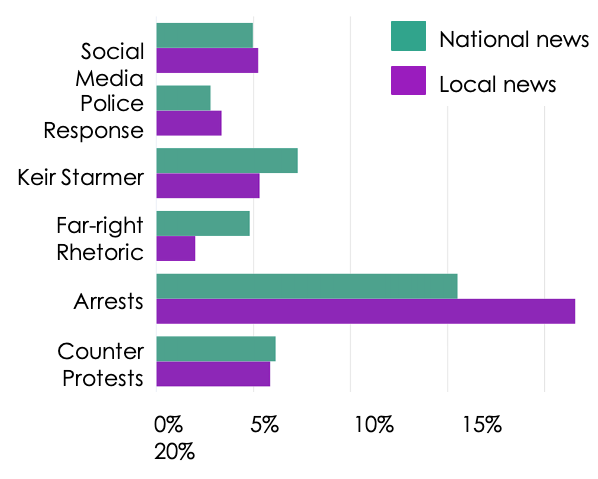
Figure 1 shows the most prevalent topics in the analysis of news articles as a percentage of total coverage, split by national and local outlets.
National media saw more coverage of political themes, and local media reported more on arrests and sentencing, far-right violence targeting asylum seekers, and business disruptions.
Other prominent topics included:
- A notable focus on young individuals participating in violent disorder
- Reports covering targeted violence against asylum seeker accommodations
- Negative impacts of the riots on businesses and retail
- Emphasis on the geographical scale of the unrest and its spread
- Discussions around misinformation and its role in inciting violence
- Public figures condemning the riots
Local area deep-dives
Participants in Rushmoor consumed local news from a limited range of outlets compared to Birmingham and Liverpool, which were seen to have more variety. This reflects the Public Interest News Foundation (PINF) map, which indicates that Liverpool and Birmingham have more extensive local media presence whilst Rushmoors is more limited. Across all three areas, participants recognised the long-term decline in local print media.
The primary reason for consuming local media in general among participants of this research was to stay informed of local news and events that were seen as directly relevant to their lives. Motivations for accessing social media were similar, and it was often accessed alongside local media. In contrast, national media was consumed specifically to gain a broader outlook.
In general, local media was felt to represent local stories, engage local communities and shape residents’ feelings towards their local area, in both positive and negative ways. Journalists in particular highlighted their role in providing balanced information and scrutiny on local decisions, but said they faced barriers doing so. The most notable barrier was financial, with outlets thought to be constrained in paying journalists for in-depth research or in taking legal risks.
During the riots, local media consumption was mainly driven by the desire for information and reassurance related to anxieties around safety and spread of the unrest. Participants’ choice of local media outlets was also motivated by preferences around the speed of reporting, degrees of trust in the sources, perceptions of the quality of coverage, and sometimes convenience.
Participants conceptualised the role of local media coverage of the riots in several ways. Firstly, they said it highlighted the community response, showcasing unity more prominently than national outlets. It was also thought to provide a platform for peace advocates, who were praised for their efforts in de-escalating tensions. This was contrasted with the more inflammatory content shown on social media. Additionally, local media offered detailed information on planned riot gatherings, though opinions were divided on whether this amounted to ‘scaremongering’ or mobilised communities to engage in counter-protests. Finally, it reported on arrests, revealing perpetrators’ identities. This was perceived to send a strong anti-riot message but concerns were raised about the impact of ‘naming and shaming’ on social cohesion.
Participants in Liverpool and Birmingham were generally satisfied with local reporting, though some in Liverpool felt the coverage exaggerated the scale of the violence. In Rushmoor, there were concerns about a lack of balanced reporting, for example, the minimal or absent coverage of counter-protests and the perspectives of asylum seekers who were targeted by rioters. More detail is presented in the area based summaries.
In the articles we reviewed, three key themes emerged: condemnation of the riots, causes and motivations, and responses to the riots. Condemnation was prominent, with articles frequently quoting local and national leaders who denounced the unrest and called for calm. Some described rioters as not representative or part of the local community. Causes and motivations were less prominent, but when discussed, articles often referenced the initial Southport killing, as well as issues of racism and far-right ideologies. Finally, responses to the riots were often framed positively, with a strong emphasis on community solidarity, leadership efforts, and police interventions.
Discussion and conclusions
Overall, the research demonstrates the important role played by the media during the riots, by informing the public of the events as they unfolded as well as reporting on the response and aftermath.
The coverage was wide ranging, with arrests and sentencing the most prominent topic overall according to the large scale analysis of news articles. There were differences between national and local coverage - political themes such as immigration and commentary on far-right rhetoric featured more in national coverage, whereas locally the most prominent topics were the police response, arrests and sentencing, business disruptions, and far-right violence.
The qualitative research highlighted several ways in which local media coverage of the riots shaped public perceptions and dialogue.
Most notably, participants felt that local media played a part in de-escalating tensions by amplifying the voices of community leaders, religious leaders and the police. Coverage of planned rioting and counter-demonstrations helped to mobilise communities to take a stand according to some, although others saw this as ‘scaremongering’. Participants praised coverage of the community response to the riots (e.g. fundraising and clean up efforts) which was felt to counteract negativity. Nevertheless, a lack of balance was noted where certain topics, such as the experiences of those targeted by rioters and counter-demonstrators, were felt to feature less.
To conclude, this study highlights the important contribution of local media both day to day and in times of crisis, using the riots as an example. The findings highlight how local media can go beyond providing news and information to shape how communities think and feel about their local area, and perceive and respond to events that affect their community.
Area-based summaries
These summaries synthesise findings from the interviews and content analysis in each area.
Birmingham
Local media presence
-
Birmingham is a ‘news oasis’ according to the PINF Local News Map (with 11 local outlets).
-
Interview participants considered local media presence to have declined over the years, with fewer print versions of local newspapers available.
Rioting in Birmingham
-
The rioting in Birmingham was limited and participants said local coverage reflected this. The main disorder occurred in the nearby village of Tamworth.
-
A rumoured far-right rally never occurred, but at an anti-racist demonstration in central Birmingham, a violent breakaway group attacked a pub.
Local media reporting on the riots
-
The content analysis and interviews revealed wide coverage of key events: the violence in Tamworth, counter-protests, and community response.
-
There was a view that the coverage was aimed at ‘trying to de-escalate the situation’ (Community member, Birmingham).
-
For example, a BBC news article focused on mosques in Birmingham thanking local authorities and police for their efforts to restore peace in the area.
-
There was heavy emphasis from the media on the counter-protests, articles featured pictures of anti-racism demonstrations.
-
However, a journalist noted from their personal experience that local media now lacks depth and that his contract prohibited him from writing more in-depth articles on local events.
-
Articles also included calls to action from police urging readers to challenge what they see online and members of the Muslim community urging people to counter-protest peacefully and report any Islamophobia.
-
One article linked the riots to falling footfall in the city centre, stating that this negatively affected local businesses.
Liverpool
Local media presence
-
Data from the PINF local news map suggests that Liverpool has relatively extensive local media presence (a total of nine outlets are listed).
-
Views on the presence and quality of local media were mixed. Journalists described it as healthy and ‘lively’ due to the growth of independent publishers. Community leaders were more critical, perceiving the quality of local journalism as poor, particularly of commercially owned outlets.
Rioting in Liverpool
-
There was violent disorder in Liverpool city centre on 3rd August with clashes between an anti-racist rally and an anti-immigration demonstration.
-
Spellow Library was also set alight and forced to close.
-
Liverpool received a share of a recovery funding from the government for areas which were badly hit by the riots.
Local media reporting on the riots
-
Reporting on the riots focused on the violence in the city and the resultant sentencing, often highlighting the identity of perpetrators as local residents.
-
The community response, such as city clean-up efforts and compensation for those affected, were also covered.
-
Views of local media coverage of the riots were mixed. In one respect, it was seen as scaremongering and even exaggerating the scale of the riots.
-
Others felt the events were reported accurately and that outlets like the Liverpool Echo ‘tell it how it is’.
-
It was also noted that reporting on sentencing was welcomed as this sent a strong message that the riots in Liverpool were unacceptable. There was a view that the riots were not reflective of the Liverpudlian community.
Rushmoor
Local media presence
-
Data from the PINF local news map suggests that Rushmoor has more limited local media presence (a total of two outlets are listed).
-
Local media presence was described by a journalist as ‘patchy’, with the digital Surrey Live, named as the main news provider. Print editions of local newspapers were said to have died out.
Rioting in Rushmoor
-
Rushmoor is a borough in Hampshire with two towns: Aldershot and Farnham.
-
A protest took place outside Potters International Hotel, Aldershot on 31st July involving around 200 people, some of whom engaged in criminal acts.
Local media reporting on the riots
-
In articles reviewed in the content analysis, local media reporting focused on the violence outside Potters International Hotel. Later, an event aiming to foster unity in the neighbourhood in response to the riots was also covered.
-
Some articles centered on condemnation of the rioting by the MP and the police response to the protests, while others focused on the sentencing of locals involved.
-
Perceptions of a lack of balance in local reporting of the events were a prominent and recurring theme in Rushmoor among interview participants.
-
Local leaders were disappointed to see limited to no coverage on the counter-protests.
-
Others criticised some reports for omitting that the hotel was housing asylum seekers. This was thought to have been driven by the need to be ‘diplomatic’ and avoid backlash.
1. Introduction
1.1 Context
In July and August 2024 a series of riots, largely instigated by far-right groups, took place in several towns and cities across the UK. The unrest started with attacks against a local mosque in Southport, and spread to cities like London, Manchester and Liverpool.[footnote 1] The riots marked a period of tension within communities and a breakdown in community cohesion, prompting wider discussions about what constitutes community values and identity.
1.2 Aims and objectives
Against this backdrop, this research sought to explore the perceived role of local media within specific communities impacted by the riots in shaping public dialogue and perceptions around community values and identity. The research involved a data science content analysis of local and national media text across the UK. The analysis sought to understand how the 2024 summer riots were covered and to answer the following questions:
- What is the nature of UK media coverage of the 2024 summer riots, based on the emerging topics in the news?
- How does the nature of the media coverage differ between local and national news outlets?
Qualitative deep-dives focusing on three areas affected by the riots (Liverpool, Birmingham and Rushmoor) aimed to answer:
- What is the role of local media in influencing public understanding, perceptions and dialogue surrounding the 2024 summer riots?
- How did local communities consume local media to form opinions on or mobilise in response to the 2024 summer riots?
Chapter 2 provides further detail on the methodology. Chapter 3 then presents the findings from the data science content analysis while Chapter 4 explores insights from the deep-dives. Chapter 5 concludes the report by discussing overall findings.
2. Methodology
2.1 Data science content analysis
2.1.1 Data collection, classification and processing
We collected ~30,000 news articles published between 29 July and 31 August 2024 relating to the riots and their aftermath (see Appendix A). Publicly available online articles were collected using the Perigon API, which has access to over 500 news outlets in the UK with an online presence. This includes major outlets such as the Times, Guardian, and BBC, as well as local outlets such as the Liverpool Echo and Wirral Globe.
Using a Large Language Model (LLM) with manual validation of a subset of the outputs, we filtered articles for relevance, ensuring the dataset related directly to the riots, their causes, and broader socio-political impact. We used a similar approach to classify each outlet as ‘local’ or ‘national’.[footnote 2] The LLM approach with manual validation was used due to the volume of data to classify. After classification we had 16,685 articles from local outlets and 4,162 from national outlets.
Summaries of the articles were taken forward to analysis, as full articles often contain extraneous content such as background details, general commentary and unrelated topics that could dilute the primary themes. The article summaries were then processed for topic modelling by removing irrelevant information, such as URLs, and splitting data into individual sentences to enable more granular analysis.
2.1.2 Topic modelling
To uncover themes we used BERTopic to perform topic analysis. Topic modelling is a natural language processing (NLP) technique that identifies distinct clusters of semantically similar text, which are iteratively refined to ensure coherence and remove noise. The BERTopic model generated clusters of sentences representing distinct themes in media coverage. To improve interpretability, we used an LLM to generate topic names and descriptions from the BERTopic output. This automated labeling was manually reviewed and refined to ensure accuracy.
To provide an overview of each topic, we summarised the key points from sentences within each cluster, with example sentences for context. We also analysed how different types of news outlets (local and national) covered each topic by comparing a topic’s proportional coverage in each outlet type, helping to indicate potential differences in framing and focus.
2.2 Local area deep-dives
The qualitative research was centred around three deep-dives of local areas affected by the riots. Our approach combined a content analysis of media articles and interviews with community members, leaders and journalists in each area.
2.2.1 Sample design and recruitment
Deep-dive areas were drawn from the Ministry of Housing, Communities and Local Government (MHCLG) list of areas affected by the disorder.[footnote 3] They offer regional diversity and varied strength of local news presence, as indicated by the Public Interest News Foundation Local News Map.[footnote 4] Rushmoor was chosen as an area with limited local media presence while Birmingham and Liverpool’s were more extensive.
For the content analysis, we used purposive sampling to select 24 text-based local media articles across the three areas from a range of outlets (see Appendix B). A total of 24 interviews were conducted, split equally across areas. We interviewed 12 professional stakeholders, including local journalists and community leaders (local councillors, religious leaders and community organisation representatives). We also interviewed 12 community members who had consumed local media at the time of the riots and who ranged in age group and ethnicity. All participants were recruited by a recruitment agency and offered £75 to take part.
2.2.2 Data collection
The content analysis explored how local media covered the riots, examining the content and its variations across regions with differing local media presence. It also compared coverage among local outlets within the same communities. The interviews were conducted by video call in January and February 2025 and lasted between 45-60 minutes. The interviews explored: uses and perceptions of local media, views of local media coverage of the riots and the community response. A list of local media articles were shared with participants prior to the interviews to minimise recall issues time lapsed since the events (see Appendix C).
2.2.3 Analysis
For the content analysis, we developed a codebook to label and describe key features of each article. This included source characteristics, features used (e.g. headlines, audiovisual content), and themes related to the local community and riots. The Framework approach was used for data management of interview transcripts. We then conducted thematic analysis on both datasets to synthesise the findings in relation to the research questions.
2.2.4 Interpreting the findings
The interviews conducted as part of the qualitative deep-dives are small in scale by design and offer highly contextual insights. As such, they provide rich and detailed insights that are not intended to be applied to the wider population. When presenting interview findings in this report we avoid the use of statistics, or quantitative descriptions like ‘most’ or ‘many’, that denote prevalence. This is because, unlike quantitative research which aims for statistical representation, qualitative sampling prioritises diversity within the sample and focuses on exploring a range of experiences and behaviours in depth.
2.3 Limitations
Some interview participants’ recall of local media coverage was limited due to interviews taking place six months after the riots. The pre-reading from various outlets helped mitigate this but some views may have been shaped by the pre-reading rather than direct recollections.
The data science and area-based content analysis used publicly available online text, excluding print and broadcast media, potentially leaving gaps. Furthermore, the area-based content analysis findings are based on a small sample of local media coverage, which may not fully reflect broader reporting.
3. Analysis of news articles
3.1 Prevalent topics in media coverage
Arrests and sentencing
Arrests, sentencing and the legal repercussions of the riots was the most prevalent topic in the articles analysed. News reports detailed court proceedings and the wider criminal justice response. Some high profile cases were discussed, and the discourse highlighted the scale of law enforcement action and severity of legal repercussions. This topic was covered proportionally more in local outlets than in national ones (22% of total vs 16%).
Counter-protests and anti-racism demonstrations
Coverage of anti-racism and counter-protests emerged as the second most prevalent topic. Media reports highlighted widespread demonstrations, in multiple locations, advocating for refugee and minority rights, as well as public opposition to racist rhetoric. This topic was covered similarly in national and local outlets (6.1% of total and 6.2%, respectively).
Keir Starmer’s response to the riots
Coverage of Keir Starmer’s response framed the riots as his first major crisis, highlighting calls for decisive action. Discourse focussed on his emphasis on justice through legal measures, while also advocating for community solidarity and addressing societal issues. His stance drew both praise and criticism, reflecting wider debates on law and order.
Sir Keir Starmer has been praised for his handling of the riots, particularly his ability to get courts and prosecutors to clamp down on violence and stop its spread.
- (The Sun)
This topic was covered proportionally more in national media than in local outlets (7.3% of total vs 5.2%, respectively).
The role of social media
Media coverage highlighted social media’s role in spreading narratives and misinformation during the riots, emphasising challenges in regulating online content and ensuring information reliability. Concerns were raised about how false claims spread rapidly online, fueling tensions and unrest. Debates emerged over online safety and whether stricter controls or temporary restrictions should apply during civil disorder. Reporting also touched on broader policy concerns, including misinformation, algorithmic amplification of divisive content, and tech companies’ responsibility in managing online discourse.
The role of social media has been seen as a key influence in inciting violence, with many believing it has fueled the unrest.
- (LBC News)
This topic was covered similarly in local and national media (4.9% of total vs 5.0%, respectively).
Commentary on far-right rhetoric and immigration
The far-right’s role in unrest and its connection to immigration discourse was a prominent theme in media coverage. Reports highlighted far-right rhetoric as a contributing factor to violence, framing these groups as instigators of the riots. This was often reported alongside discussions on public sentiment towards immigration, illustrating tensions over national identity and policy.
Some reports depicted right-wing groups as actively involved in organising violence, while others highlighted political pressure on leadership to take a firm stance against the far-right. The debate around immigration was also central, with concerns about public backlash and social stigma associated with anti-immigration views. National media covered this topic more than local outlets (4.8% of total vs 2.1%, respectively).
Police preparedness and response
Articles frequently highlighted police reassurances of public safety and their commitment to tackling violence and discrimination. Reports also praised proactive law enforcement measures, including the deployment of riot officers and pre-emptive policing strategies aimed at preventing further unrest. The media framed police readiness as a key factor in managing tensions, with reports emphasising the scale of police mobilisation and their role in maintaining order. Some coverage focused on police coordination efforts across different regions, illustrating a wider strategy to prevent escalation.
Nottinghamshire Police have assured the public that the county is ‘perfectly safe’ and have prepared a policing operation.
- (Nottingham Post)
Local outlets reported on this topic more frequently than national media (3.3% of total vs 2.8%, respectively).
3.2 Other topics of interest
There were also a number of other topics of interest to DCMS - less prevalent than the previously listed, but some still featuring amongst the 20 topics most reported on. In this section we briefly highlight these topics and how they were characterised.
Media coverage highlighted concerns about youth involvement in the riots, with reports raising questions about the role of younger generations in civil unrest. Reports also covered far-right attacks on asylum seekers, which focussed on targeted violence, arson, and threats against asylum seeker accommodations, which appeared more frequently in local media than national outlets (3.4% vs. 2.5% of total coverage). The riots’ impact on business and retail was another focus, with reports detailing reduced footfall, early closures, and financial losses for businesses again more prominent in local media than in national coverage (2.1% vs. 1.2%). Some reports emphasised the geographical scale of the unrest and the spread of riots across the UK, which affected multiple cities and highlighted the broader reach of the disorder. Public figures’ condemnation of the riots also emerged as a topic of interest, with reports highlighting public figures’ statements emphasising law and order while calling for accountability for those involved in the riots.
Lastly, the media reported on mis-infomation and its role in inciting violence, noting that false claims about the Southport stabbing suspect played a significant role in fueling the riots, linking misinformation to anti-Muslim and anti-immigrant sentiment. While this topic shares similarities with the broader theme of social media’s role in the unrest (discussed in Section 3.1), this topic focuses specifically on false claims about the Southport suspect and their role in inciting violence.
As one report described:
The murders of Southport were targeted by anti-immigrant and anti-Muslim groups as misinformation spread online that the suspected attacker was a radical Islamist.
- (Yahoo News)
3.3 Topics with largest differences in national v. local reporting
Figure 2 shows the topics with the biggest differences in coverage between national and local outlets, illustrating which topics featured more locally and which featured more nationally. Contrary to the previous sections this is across all topics, irrespective of how prevalent the topics were overall.
Figure 2. Topics with the largest proportional difference in national v. local media
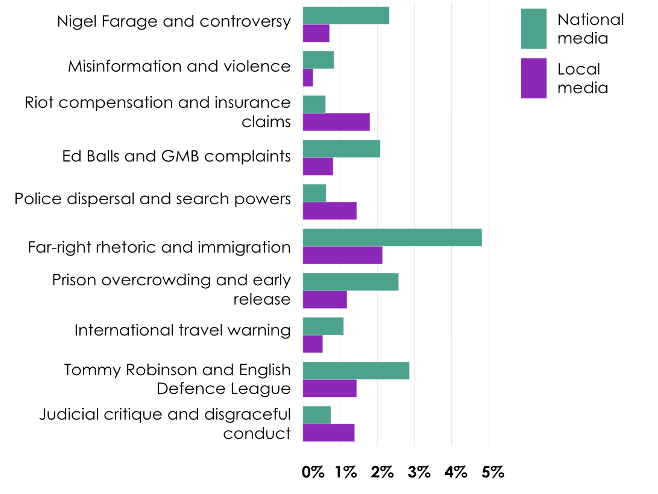
Note: Percentages represent the number of sentences on that topic by the total number of sentences, per outlet.
Nigel Farage and controversy was the most disproportionately covered topic, receiving considerably more attention in national articles. Similarly, coverage on Ed Balls and Good Morning Britain complaints was more prominent in national media, reflecting a focus on political figures and far-right movements. In contrast, local outlets reported more on riot compensation and insurance claims, police dispersal and search powers, and judicial critique and disgraceful conduct indicating a stronger emphasis on the immediate legal and logistical consequences of the unrest.
See Appendix D for a deeper exploration of these topics.
4. Local area deep-dives
This chapter discusses findings from interviews and content analysis of local media coverage of the riots in three areas affected by the riots. The areas were selected for their contrasting local media presence. Liverpool and Birmingham have relatively extensive local media presence and Rushmoor’s is more limited.
4.1 Interview findings
This section covers community members’, community leaders’ (religious leaders, local councillors and representatives of community organisations) and journalists’ perceptions of the strength of local media presence in their areas (section 4.1.1) and consumption of local media (section 4.1.2). We then discuss the role local media appears to play in these communities (section 4.1.3) and the way in which local media was consumed in relation to the riots (section 4.1.4).
4.1.1 Views of local media presence
Perspectives on local media presence in Birmingham and Rushmoor were similar. Journalists explained that funding shortages had led to a decline in local media presence, particularly in the number of available newspaper editions. While Birmingham was seen by community members as offering more choice, including TV, radio and multiple newspapers, Rushmoor’s options were viewed as more limited and dependent on regional outlets. These perceptions align with Rushmoor having more limited local media presence according to the PINF map. In contrast, while Birmingham is classified as a ‘news oasis’, these views may reflect its historically stronger media presence and larger decline over time.[footnote 5]
Views in Liverpool were more divergent. For example, the editor of a local news outlet described the sector as ‘reasonably healthy for a city of its size’ and increasingly ‘lively’ due to the growth of independent publishers. Community leaders were more critical, particularly of commercially owned outlets, which they felt offered poorer quality local journalism than local radio and independent outlets.
Across areas, a shift away from hard copies of local papers towards online formats was noted. There were mixed views of this, while online was seen as more up to date, as illustrated in the quote below, community members also found cookies and pop-ups annoying.
By the time you read the paper, the news is old. I used to buy newspapers religiously, […] over the years everything’s online and online’s more up to date because it’ll say news from an hour ago.
- (Community member, Liverpool)
4.1.2 Local media consumption
Reasons for consuming local media
There were four main types of local media that community members and leaders consumed: online and print newspapers; regional BBC TV news; regional radio stations; and local magazines and community publications. These types of local media included both independent and corporate outlets. Regional correspondents of national broadsheets were also mentioned as a source of local news. These sources were consumed for different purposes and types of coverage: community news and information on community initiatives, travel and infrastructure updates (often on the radio) and information on local public services including new libraries, playgrounds and housing.
Perceived quality of local media
Perceptions of quality varied by different types of local media, specifically online and print newspapers, regional radio stations and regional TV news.
Opinions of online and print newspapers varied more widely than views of other types of local media, possibly due to the diversity of outlets in this category. Across areas, community members and leaders expressed concerns about the depth and quality of coverage, sensationalism, and perceived inaccuracies in reporting of ‘hard news’ such as local politics. Participants described the use of attention-grabbing or ‘clickbait’ headlines, content that felt less relevant to the local community, and writing issues like grammatical errors particularly among online newspapers. As a result, some community members were cautious about trusting local media for topics like local politics and policy initiatives. Local media was nonetheless regarded as generally reliable when covering community-focused topics such as local fairs and charity work.
Journalists in Birmingham and Rushmoor concurred with the view that quality was declining. Instances of a lack of “real local content” were noted, with some outlets thought to produce localised versions of national stories rather than original content. The overall decline in funding, alongside a focus on quantity and 24-hour reporting, were thought to be affecting the quality of journalism in all three areas.
Nowadays a journalist has got to sit down banging out numerous stories a day, not spending two weeks working on one story
- (Journalist, Birmingham)
In contrast, both online and print newspapers were valued by others for their timely and relevant coverage, informative and neutral reporting, in-depth journalism and readability. They were also valued for providing a platform for local stories.
I tend to find them to be quite readable. They’re about the right size. And you kind of get the right information that you need.
- (Community member, Birmingham)
In some cases the same outlets received both positive and negative feedback, reflecting diverse preferences of their readership.
Regional radio stations** were generally viewed positively for informed, well-balanced accounts, local stories and unbiased reporting. Similarly, regional TV news, specifically on the BBC, was regarded positively for its impartiality, quality, up-to-date coverage, comprehensive local knowledge and informative content.
4.1.3 Role of local media in communities
Local media was thought to contribute to local communities in two main aspects: knowledge and accountability and community relationships and engagement. Views were underpinned by interlinked factors like the strength of local media presence and experience of engaging or working with media outlets.
Knowledge and accountability
Information and awareness. Local media was widely viewed as an important source of information on local affairs. Notably, community members in Birmingham and Liverpool regarded well known local newspaper outlets positively for keeping residents up to date.
Participants across areas recognised the role of local media in providing a platform for local stories that were not of national interest. For example, a community representative in Rushmoor said that the local paper regularly covered community events and fundraisers run by local charities. Participants in Liverpool recalled coverage on recent local events and issues, such as the reopening of a historic cinema and a campaign to reduce the volume of multi-occupancy properties.
Community leaders said that local media (especially radio) could be a useful tool for keeping local communities informed of their work. For example, a local councillor used radio interviews to promote ‘positive stories’ (such as spending announcements) to counteract ‘negative coverage’ about local government (such as budget cuts). Community organisations agreed that local radio was more receptive to local stories than other outlets, particularly commercial newspapers.
However, community members and leaders noted that it was not easy to have their voice heard due to the need for stories to be ‘bold’ and ‘exciting’ to be featured. This is illustrated by the quote below. This was less of a barrier when posting on social media.
It might be a really important issue but I’m thinking to myself that ain’t going to get the headlines […] So I feel that people have to think about that stuff far more if they want to make an impact and of course for different communities or smaller groups that’s a hard job to navigate
- (Local councillor, Liverpool)
A community organisation representing asylum seekers and refugees described having to ‘pick and choose’ which journalists they worked with, and emphasised the importance of building relationships with writers who were ‘on their side’ and would take an interest in their work.
Social media and local media played a role in providing localised content. Social media was preferred by some because it offered more footage on local happenings, eye witness accounts and more instant coverage. Perhaps reflecting the more limited local media presence there, participants in Rushmoor more prominently described localised community Facebook groups as a hub for local information. Local media was however thought to offer more balanced and neutral accounts and was either preferred or seen to complement social media.
Accountability and scrutiny. Journalists stated that they had a responsibility to provide the public with access to balanced information on local government decisions. Some felt this had been strong in the past but that scrutiny was now ‘not what it should be’. Most notably, financial constraints were said to prevent outlets from paying journalists for in-depth research or taking legal risks. A journalist from a commercial publishing group explained that decisions were driven by organisational risk and the need to attract a broad audience. This may help to explain the view of some community leaders that independent outlets were ‘doing a lot more investigatory journalism’.
Community relationships and engagement
Social cohesion. Community members believed that neutral and inclusive reporting could lessen tensions and conflicts in communities. In Birmingham, participants described coverage as generally sensitive to and inclusive of the local context, particularly in relation to diversity. They gave examples of local media reporting on religious events such as Ramadan. Participants drew comparisons with other forms of media - particularly social media, which was described as more ‘inflammatory’, due to the presence of unfiltered content. Community organisations also referred to the role of local media in counteracting negative narratives around issues such as immigration, for example, by telling stories about the positive impacts on local communities.
Pride in place. Community leaders and members said that the portrayal of place by local media impacted how people felt towards their local area. Journalists said that they had a part to play in making people feel good about where they live. Community members offered examples of ‘positive’ stories such as reports of local events and new facilities. However, other types of news (such as crime) were generally felt to feature more, and there was agreement that local media could do more to showcase positive aspects of places and incentivise people to take pride in their local area. A community leader based in Handsworth, Birmingham said that coverage of events such as the closure of local services and violence/fatalities put a ‘negative spin’ on the local area and contributed to local people becoming despondent.
Civic engagement. Local media was valued as a way of motivating people to take action in their community by publicising fundraising campaigns to ‘save’ local places/services at risk of closure, raising awareness of local charities and advertising community volunteering opportunities. However, some felt that mainstream outlets did not pick up on the full range of activities in their area11, particularly ‘grassroots’ initiatives, which were often better publicised on social media. Participants gave examples of local media contributing to the economy, for example, by raising awareness of business openings/closures and advertising jobs. However, this was a less prominent theme and insights on this were therefore more limited.
4.1.4 Views of local media coverage of the riots
Consumption of media on the riots
Participants consumed information on the riots from a range of sources. National media such as BBC and Sky News, often used alongside local media, were preferred by those who prioritised the national picture. Social media, most notably WhatsApp, Tik Tok and Facebook, was considered an important source of information across age groups.
In terms of local media, newspapers - predominantly digital versions - and broadcast news - particularly regional TV news and regional or local radio - were the two main types highlighted.
Consumption differed between areas. In Rushmoor, use of TV news (particularly BBC) and social media (particularly Facebook) was more widespread than news titles (print/digital). In Birmingham and Liverpool, a wider range of local outlets were mentioned, possibly reflecting extensive local media presence in these areas.
Drivers of consumption
A range of interlinked factors influenced where participants chose to get their information on the riots**. The **desire for information and reassurance was the main motivation for consuming local media. This was related to anxieties about safety and spread of the unrest. As illustrated by the quote below, community members sought reassurance that it was safe to go out, whilst community leaders sought information that would help them protect service users and inform their response to the events.
I wanted to know if it was safe for me to go out, as a Muslim.
-(Community member, Birmingham)
Speed of reporting was also important, perhaps due to the fast moving nature of the events. The speed of reporting associated with different outlets varied. For some, social media provided ‘real-time updates’ that were not available elsewhere. Others were satisfied with the updates they received from outlets such as the digital news platform, Birmingham Live. Radio was also mentioned due to reporters broadcasting from the scene.
Perceptions of trust influenced where participants went for information. Some continued to consume information from outlets they knew and trusted. There was a notable level of distrust in social media which was sometimes linked to the misinformation felt to have contributed to the unrest. There were exceptions, such as where participants were consuming uninterrupted and unedited ‘live streams’ and/or content posted by people they knew.
Perceptions of quality and value also influenced consumption, and were judged on the extent to which outlets reported from the scene and incorporated local people’s experiences and opinions. Where this was lacking, participants’ consumption of local media was limited due to the view that it offered little additional value to what was being reported nationally. Radio and independent outlets were said to be better at doing this.
Finally, in some cases, participants’ choice of outlet was driven by convenience - they consumed the coverage that was most visible / accessible to them, such as the articles that appeared first in search engine results.
Perceptions of media coverage and how this shaped public perceptions
This section describes participants’ views of local media coverage of the riots and how this coverage shaped public perceptions and dialogue.
Place and community identity. Footage of violence and disorder, which was viewed across national, local and social media, created fear and could be potentially damaging to the reputation of a place, according to participants. Community members in Liverpool reflected on how accounts of the city centre riots and the damage to a local library had put the city in a ‘bad light’, and could create the impression that ‘everyone was racist’,
It seemed like they were trying to make out as though there was thousands of people destroying the city when it was relatively small groups of people in the city
-(Community member, Liverpool)
Nonetheless, communities coming together in response to the riots** was felt to feature more prominently at a local level, and helped to counteract negativity. Reports on the community response to the riots (such as the fundraising and reopening of a library that was damaged during the unrest in Liverpool) was felt to send a message that the riots did not reflect ‘how we really are’.
Participants also recalled reports of rioters not being welcome in, or reflective of, the local community. Reporters and local community representatives who contributed to this kind of coverage wanted to represent the majority and send a message that the rioting was not acceptable. However, they acknowledged that this came with the risk of causing further divisions by alienating members of the local community who were involved.
Social cohesion. Local media was praised for helping to de-escalate tensions by giving a platform to religious leaders and others who were calling for peace. In Birmingham, participants thought that this played a role in the city avoiding any major unrest. Participants compared this to social media where rumours about potential attacks on mosques fuelled anger among younger generations in particular,
You have more active young people who would literally go and congregate and say, “Yeah, if it’s on, it’s on then, isn’t it?” “ Social media played a part in this.’
- (Community organisation representative, Birmingham)
Detailed information about planned rioting was also noted to be widely available in local news. There were mixed views about the extent to which this heightened or diffused tensions. Seen by some as ‘scaremongering’, others pointed to the fact that these reports mobilised counter-protests and brought people together. In Liverpool, for example, a community member described an anti-racism gathering that took place in response to speculation about a potential protest.
It did bring a sense of people sort of saying we’re not settling for it
-(Community member, Liverpool)
There were conflicting views on the impact of reports on arrests which named and pictured perpetrators as well as saying where they were from. Journalists said that they were kept well informed by police, and that it made sense to cover arrests due to the pace of arrests and court appearances. It also filled a gap in coverage after the events. There was agreement that this sent a strong message to people that rioting was not acceptable and possibly acted as a deterrent. However, concerns were expressed about the negative consequences of ‘naming and shaming’ on community cohesion (by highlighting that many people who were charged were local) and on those individuals who could face a backlash.
Perceptions of balance differed by area. Participants in Liverpool and Birmingham were generally satisfied with local reporting of the events, though some in Liverpool felt the coverage exaggerated the scale of the violence which was actually limited to a small part of the city. A perceived lack of balance was a prominent and recurring theme in Rushmoor. Firstly, some local leaders recalled seeing limited to no coverage on the counter-protests,
We had anti-protesting groups confronting the protesters and that balance wasn’t shared, I don’t think, equally because it didn’t show that element fully, which I thought was quite disappointing.
(Local councillor, Rushmoor)
Others highlighted a lack of ‘compassion’ towards those targeted (asylum seekers in the Potters Hotel) with some reports omitting that the hotel was housing asylum seekers. These elements were considered important parts of the overall story. Their omission was thought to have been driven by the need to be ‘diplomatic’ and avoid backlash given ongoing sensitivities surrounding the hotel (leaders told us that anti-immigration demonstrations at the hotel were a frequent occurrence).
If a paper starts saying ‘come on lets start thinking about the plight of these people’‘¦it’s quite possible that those offices could have been attacked
- (Religious leader, Rushmoor)
This desire to avoid ‘stirring the pot’ was also thought to have influenced the way that the unrest was described in some reporting, particularly the portrayal of violent rioters as a ‘minority’ at an otherwise peaceful demonstration.
Across areas, some noted a lack of discussion of the wider causes of the events. This reflects the findings from the content analysis presented in section 4.2.2. There was concern that this was a missed opportunity to address longstanding tensions.
It’s just gone quiet. It’s like, we had the big sentences and it’s as if everybody said, “ that’s that problem fixed.” And I know it’s not fixed.
-(Community organisation, Liverpool)
An editor of a commercial outlet said that they had considered doing an in-depth piece towards the end of 2024 to draw conclusions on the motivations of rioters and the implications of the riots for the local community but had found it difficult to find a “common thread”. A further challenge that may explain the limited coverage was the difficulty of striking the right balance between giving a voice to rioters and highlighting why they felt angry, whilst not highlighting extremist views or contributing to circulation of false information.
4.2 Analysis of local media articles
This section describes the findings from the area-centered content analysis which aimed to understand the nature of local media coverage of the riots in the three deep dive areas. Details of the articles we reviewed can be found in Appendix B. Three key themes, discussed below, emerged in the local coverage of the riots in Liverpool, Birmingham and Rushmoor: condemnation of the riots (section 4.2.1), causes and motivations (section 4.2.2)** and **the response (section 4.2.3).
4.2.1 Condemnation of the riots
Condemnation of the riots was widespread in articles from across different types of outlets (both independent and corporate). This had three dimensions:
Statements and calls for peace. Articles often quoted local and national leaders/ representatives who spoke out to condemn the unrest and appeal for calm. At a local level, the coverage included statements from police forces, religious leaders and local MPs (among others). They were quoted describing the events as ‘disgraceful’ and the perpetrators as ‘thugs’ and ‘hooligans’. There were also calls from community leaders for communities to come together to talk and listen rather than resorting to violence, as illustrated by the quote below from an Imam,
We’re going to be sitting down, making friends with many of the people on the other side. This is the way that we do it, you talk to each other and you listen to each other.
- (Liverpool Echo, commercial, digital)
As discussed in section 4.1.4 local media outlets were praised by interview participants for the platform they gave to local leaders to try and deescalate tensions.
Identity and place. In condemning the riots and perpetrators, local news coverage drew on concepts of community and place identity. There were several examples of this. In Birmingham, the coverage of a large anti-racism protest evoked a sense of local community identity by describing counter-protesters as ‘Brummies’ who were ‘fighting back’ and ‘taking a stand’ against racism. In one article published in Liverpool, the rioting that occurred in the city centre was directly contrasted with the perception of the city as ‘diverse and accepting’.
Some articles made claims about where rioters were from, either branding them as outsiders or as fellow community members. Some reports described the rioters as not representing the local community, while others claimed that many rioters were in fact local residents. These articles included first hand accounts from journalists who had recognised local accents among rioters, expressing their shock at this and refuting the narrative that most were ‘outsiders’,
The vast majority of voices I heard were very clearly people from across Merseyside
- (Liverpool Post, independent, digital)
In the interviews, journalists described this as a challenge they encountered when covering the riots (see section 4.1.4).
Impacts. The coverage we reviewed highlighted the physical, emotional, and financial impacts of the riots to victims and the wider community. The physical and emotional damage of the riots were reported widely in our sample. Local media outlets reported on the physical damage to infrastructure and property including shops, community buildings, cars and wheelie bins. This was often conveyed by images of property damage in the aftermath of violence and disorder. Violence and abuse was reported against counter-protestors, migrants and police, although injuries following violence were only reported against police.
The social and emotional impacts on those being targeted by rioters were discussed to varying extents. In Rushmoor, some articles described asylum seekers as ‘innocent victims’ of intimidation and violence, but did not feature any first hand accounts. In the articles we reviewed from Birmingham, direct quotes and statements from residents who felt vulnerable and unsafe were more prevalent. More generally, third person narrative was commonly used to describe the impact of the riots, although one feature article was written from the perspective of a journalist who was caught up in the violence in Liverpool.
Reports on the negative impacts of the riots on community cohesion featured widely, however, other perspectives were present in the articles we reviewed. In one example, an article published by an independent outlet from Liverpool deviated from this narrative, arguing that ‘the events do not represent a complete breakdown in communities’.
Reporting on the financial impact of the riots was more exceptional. Reported impacts to businesses included looting and theft, highlighted in Liverpool, and reduced revenue, highlighted in Birmingham, as a result of shops closing and customers avoiding shopping destinations out of concern about riots.
4.2.2 Causes and motivations
Articles did not always discuss the causes of the riots but those that did often referenced the initial Southport killings, as well as racism and far-right ideologies. Discussions about wider causes of the riots were more limited in the coverage we reviewed. Where they were discussed, one article suggested that the unrest was symptomatic of a lack of ‘constructive discussion about ‘difficult topics’ like race and migration’. Several also referenced conflicting claims about the causes of the riots, which ranged from anger and dissatisfaction among ordinary people, to far-right ideology and ‘exploitation’ of recent events (the Southport killings).
The extent to which the coverage explicitly linked local events to the unrest in other places varied, even within areas. In Rushmoor, whilst reports did reference the wider picture, some questioned the link between the two. This may reflect a history of anti-immigration demonstrations at the site where the violence broke out.
Perpetrators and their motivations were described in many different ways. Articles presenting rioters as ideologically-driven described them as ‘far-right’ or racist, sometimes naming groups such as the English Defence League and Patriotic Alternative. In other instances, rioters were described as ‘ill-informed’ or ‘mindless’. More exceptionally, they highlighted different degrees of organisation: ranging from organised members of specific ideological groups to mindless ‘football hooligans’.
Some of the coverage emphasised the exceptionalism of rioters, describing them as a minority. This was most pertinent in the articles we reviewed from Rushmoor, in which several articles referred to statements from police and local MPs that described a protest becoming violent when ‘a minority of otherwise peaceful protesters engaged in violence’.
4.2.3 Response to the riots
Responses to the riots were typically framed positively. This included providing reassurance about community and leadership responses, and highlighting the ability of the police to restore order and hold perpetrators to account.
The community response was widely discussed in the articles we reviewed. Counter-protests were a key theme within this. This included reports on past counter-protests and those that were being planned in response to the riots. Counter-protests were generally described positively, with recurring phrases such as ‘restoring unity’ and ‘reclaiming the streets’. In contrast, the division between the two sides was also articulated, for example, in a BBC article in Liverpool which reported on ‘clashes’ between the far-right and anti-racist protests in the city centre.
Articles also described events that emphasised the rebuilding of communities such as mass clean-up efforts. In the interviews, there was generally strong recall and awareness from participants of coverage on communities coming together in the aftermath of the riots (see section 4.1.4 for further discussion).
The role of local police and local leaders in managing the unrest and restoring order was a key theme. Mirroring what was found in the topic modelling on police preparedness, articles highlighted increased presence, visibility, and powers for police. In addition, there were reports on the presence of local councillors and MPs engaging with residents to demonstrate support; and the role of council services and government support to rebuild communities, including the government compensation scheme.
The role of police in enforcing criminal justice and accountability was another key theme, highlighting that rioters’ actions would have consequences. This supports the findings from the topic modelling on the high prevalence of coverage on arrests and legal proceedings especially in local media coverage. Articles described ongoing investigations, arrests, and sentencing, and warnings of arrest for rioters. Many descriptions of arrests referenced specific individuals. Much of the coverage of police action was supportive or sympathetic. Views on this type of coverage and the implications are described in section 4.1.4.
As well as reporting events and providing opinion, several articles included calls to action for the public to challenge what they see online; to apply to the riot compensation scheme; to unite; to counter protest peacefully; to report islamophobia to the police; and to come forward with information.
5. Discussion of findings
5.1 Nature of national and local media coverage of the 2024 summer riots
The large-scale media analysis identified several key themes where the reporting on the summer riots differed nationally and locally. Nationally we saw more reporting on political themes such as immigration and commentary on far-right rhetoric, as well as stronger focus on public figures. Locally we identified more attention to direct social and legal impacts, such as the police response, arrests and sentencing, business disruptions and far-right violence. This resonates with findings from the deep-dives suggesting local media was used to understand the community response.
5.2 How and why communities consumed local media in relation to the riots
The interviews that formed part of local deep-dives suggest local media played a key role in informing residents of rioting in the area and of how local authorities and communities responded. Local news was typically consumed alongside national and/or social media, which served distinct purposes. National news provided a broader picture on the events, whilst social media offered real-time updates.
Digital news outlets and local TV and radio broadcasts were key sources of local news for participants of this research. Their consumption of print news was reportedly limited, perhaps reflecting the general decline in print media[footnote 6], as well as the desire for timely updates on the events as they unfolded.
The findings suggest participants’ choice of outlet was linked to the availability and range of outlets locally. In Rushmoor, an area with more limited local media presence, local TV news and social media appeared to be the main sources of local information. In Birmingham and Liverpool, where local media presence is stronger, participants described using a wider range of local outlets, including print and digital news titles. Perceptions of quality, value and trustworthiness also influenced consumption. This led people to consume content from the sources they were familiar with (although social media remained a key source for some despite a lack of trust). Quality and value was mainly judged by the extent to which outlets reported from the scene and incorporated local people’s experiences and opinions.
5.3 How local media shaped public perceptions of the riots
The findings from the deep-dives suggest that local media reports of the riots shaped perceptions in several key ways. Coverage of the violence, intimidation and racism contributed to existing feelings of concern and fear among communities, particularly among those who felt personally vulnerable or worked with vulnerable community members. However, this was also the main driver of consumption - people wanted to be kept informed on how events were unfolding in their area.
The coverage we reviewed conveyed that the riots were unacceptable and called for peace, both directly and through amplifying the voices of community leaders, religious leaders and the police. Local media was therefore described as playing a part in the deescalation of tensions by giving a platform to influential figures who wanted to deter further violence. Detailed reports on criminal justice proceedings at a local level also contributed to this theme of condemnation and deterrence, although some interviewees felt disclosing perpetrators’ identities could be divisive.
Counter-protests were framed in positive terms in local media articles, as a sign that communities were fighting back against racism, and that the rioting was not reflective of the wider community. Some interviewees felt that reports on planned rioting and counter-demonstrations mobilised communities to take a stand, whilst others described this as ‘scaremongering’. Where coverage on counter-protests was lacking, participants highlighted a lack of balance.
Local media also gave a platform to local community leaders who were calling for peace and reported on community initiatives, which provided hope and reassurance. Therefore, while there was some discomfort with local media being divisive and lacking balance, the findings suggest it played a key role in delivering information of the rioting locally, condemning the riots and helping to deescalate tensions.
To conclude, this study highlights the important contribution of local media both day to day and in times of crisis, using the riots as an example. The findings highlight how local media can go beyond providing news and information to shape how communities think and feel about their local area, and perceive and respond to events that affect their community.
Appendix A Technical details: data science content analysis
Search strategy
From Perigon we gathered news articles that covered the summer riots and were published in UK based news outlets from 30 July until 31August 2024. To obtain the relevant content, we used the following key words: ‘summer+riot(s)’, ‘the riots’, ‘UK+riot(s)’, ‘2024 riots’, ‘riot(s)+Southport’, ‘disorder+Southport’, ‘counter protest’, ‘rioter’, ‘public disorder’. ‘public order’, and ‘violent disorder’. These keywords were based on an initial manual review of the news published during this period on the riots and consultation with DCMS stakeholders.
Data classification
We classified article relevance and outlet type using OpenAI’s ‘gpt-4o-mini’ model, which was given the article title and summary and asked to classify as either ‘relevant’, ‘not relevant’, or ‘unsure’ (so as to reduce the chance of falsely classifying an article as relevant). A sample of the results were manually validated. Articles classified as relevant were taken forward to analysis.
Outlets were defined as either ‘national’, ‘regional’, ‘local’, or ‘unclear’. ‘Regional’ and ‘local’ outlets were then merged into ‘local’, and outlets marked as ‘unclear’ were disregarded.
The prompts were made iteratively as we validated the outputs of the classifications.
The final prompt we used for relevance classification was:
You are a classifier tasked with determining the relevance of articles to the 2024 United Kingdom riots. These riots were a significant event that began after a mass stabbing occurred in Southport on July 29, 2024. The incident led to widespread unrest, protests, and riots across major cities in the UK, sparking national and international attention.
The following context outlines the key aspects of the riots: >
1. Trigger event
The riots began as a response to a mass stabbing in Southport, which left multiple victims injured or dead. This event intensified long-standing tensions related to policing, justice systems, and public safety.
2. Key themes
- Political debates: Discussions on law enforcement, systemic racism, and policing practices.
- Public protests: Demonstrations demanding justice reform and greater accountability from authorities.
- Social unrest: Driven by economic inequality, distrust in institutions, and calls for policy change.
- Far-right riots and violence: Often framed as a reaction to perceived threats or frustrations stemming from the Southport incident and its fallout.
- Anti-racist protests and counter-demonstrations: Emerging as a response to far-right riots and broader societal injustices.
3. Broader impacts
- Consequences of the riots: Property damage, public safety concerns, and policy changes.
- Media and public reactions: Shifts in sentiment towards the government, police, or protest movements.
- Long-term implications: Discussions on societal cohesion and justice reform.
4. Personal experiences and accounts
- First-hand accounts: Personal stories from individuals involved in or impacted by the riots.
- Community testimonies: Perspectives from protestors, victims, or witnesses.
Relevance criteria
An article should be classified as:
1 (Relevant)
An article is relevant if it discusses:
- The Southport stabbing or events directly related to it.
- The riots, protests, or unrest that followed the Southport incident.
- Far-right riots or violence, including motivations, actions, and consequences.
- Anti-racist protests or counter-demonstrations, including their causes, participants, and outcomes.
- Broader societal or political themes tied to the riots, such as public sentiment, political actions, or justice reform debates.
- Consequences of the riots, including damage, arrests, or government responses.
- Personal experiences or first-hand accounts related to the riots, such as testimonies from individuals, community stories, or lived experiences.
0 (Not Relevant)
An article is not relevant if it does not discuss any of the above topics or is unrelated to the Southport incident and its aftermath.
2 (Unsure)
An article should be classified as “unsure” if the title and summary do not provide enough information to determine relevance.
Your response must strictly be one of the following integers:
- 0 (Not Relevant)
- 1 (Relevant)
- 2 (Unsure)
- Output only the integer and nothing else.
The final prompt we used for the outlet type classification was:
You are an expert in UK media with a detailed knowledge of news outlets, including their reach, audience, and typical classification. Your task is to classify news outlets into one of the following categories:
1. National
Outlets serving a UK-wide audience and providing coverage of events, issues, and topics of interest to the entire country. They often have large circulations or significant online readerships and are not limited to a specific region.
Examples:
- The Guardian
- The Times
- BBC News
- The Daily Mail
- Sky News
2. Regional
Outlets covering a specific area within the UK, such as a county or region. These outlets typically focus on regional news, events, and topics relevant to a larger geographical area than a single town or city.
Examples:
- Yorkshire Post
- Manchester Evening News
- WalesOnline
3. Local
Outlets focusing on a specific town, city, or small community. These outlets often provide in-depth coverage of local events, community news, and other highly localized topics.
Examples:
- Cambridge Independent
- Southport Visiter
- Hackney Gazette
4. Unclear
Use this category if insufficient information is provided to confidently classify the outlet.
When classifying an outlet, consider the following factors:
- Audience reach: Does the outlet primarily serve a specific town/city, a broader region, or the entire UK?
- Content scope: Does the outlet cover topics and events of national interest, regional importance, or primarily local matters?
- Geographic focus: Is the outlet’s focus highly localized (town/city), regional (county/area), or national (UK-wide)?
Your output should be exactly one of the following:
- ‘National’
- ‘Regional’
- ‘Local’
- ‘Unclear’
Be concise, accurate, and ensure your classification is based on the criteria outlined above.
Appendix B Technical details: local area deep-dives
Content analysis sample
A total of 24 news articles from a range of corporate, independent and local BBC owned outlets[footnote 7] were reviewed (see tables below). The majority had a regional geographical remit, with only one outlet classed as hyperlocal.[footnote 8] The articles were predominantly short, factual news stories alongside a smaller number of feature articles/opinion pieces. All were under 1,000 words, and half were under 500. The majority were published in early August 2024 (covering the main period of unrest and counter-protests). A handful of articles were published later (September 2024) which tended to focus on the response (e.g. community attempts to build unity) and impacts (e.g. the effects of the riots on retail visitor numbers).
The articles used a combination of factual reporting (e.g. the times of the protests, number of arrests) and anecdotal evidence (e.g. personal accounts of the riots). Information was sometimes supported by hyperlinks to other news reports or to social media posts. The use of quotes was also widespread and captured statements from local officials (e.g. police, politicians) and viewpoints of community members. Images featured widely, and videos to a lesser extent, and some were user-generated. They typically pictured the disorder, perpetrators, the emergency services and counter protesters.
Birmingham articles
| Outlet title | Ownership | Title | Publication date |
|---|---|---|---|
| Birmingham Live | Corporate | Hundreds fill Jewellery Quarter in Birmingham as far-right a no-show | 7 Aug 2024 |
| Birmingham Live | Corporate | Birmingham sends message as crowds come out to stand against racism | 8 Aug 2024 |
| Birmingham World | Corporate | Birmingham shops ‘severely impacted’ by riots, latest figures reveal sharp drop in visitors | 2 Sept 2024 |
| BBC | BBC | Arrest over disturbances as community helps pub | 6 Aug 2024 |
| BBC | BBC | City mosques thankful for efforts to restore peace | 9 Aug 2024 |
| Birmingham Dispatch | Independent | ‘This is not Tamworth’: race riots hit the West Midlands | 5 Aug 2024 |
| Birmingham Dispatch | Independent | ‘Fascist scum out of Brum’ | 8 Aug 2024 |
| Birmingham Mail | Corporate | Crack down - but let’s also listen | 7 Aug 2024 |
| Express and Star | Corporate | West Midlands Police issues update on Birmingham Jewellery Quarter protest | 8 Aug 2024 |
Liverpool articles
| Outlet title | Ownership | Title | Publication date |
|---|---|---|---|
| Liverpool World | Corporate | Liverpool riots: I got trapped in the far-right protests and my view of the city has changed | 4 Aug 2024 |
| Liverpool Echo | Corporate | Imam hopes tonight was a ‘sign that peace has been restored’ | 7 Aug 2024 |
| Liverpool Echo | Corporate | ‘This is the Liverpool we know’ as city stands firm against hatred | 7 Aug 2024 |
| Liverpool Post | Independent | A weekend of racist violence | 5 Aug 2024 |
| Liverpool Post | Independent | Covering an orgy of violence | 4 Aug 2024 |
| Mersey Reporter | Independent | Deadline for compensation for Merseyside residents and businesses affected by riots is now | 5 Sept 2024 |
| BBC | BBC | City clean-up begins after ‘deplorable’ riots | 4 Aug 2024 |
| BBC | BBC | City protests see two officers hurt and six people arrested | 3 Aug 2024 |
| Liverpool Express | Other | Liverpool welcomes Government funding following riots | 12 Sept 2024 |
Rushmoor articles
| Outlet title | Ownership | Title | Publication date |
|---|---|---|---|
| Surrey Live | Corporate | ‘Intimidating’ protest breaks out at Aldershot hotel after Southport attack unrest | 1 Aug 2024 |
| Surrey Live | Corporate | Surrey Police issue statement after ‘violent disorder’ as officers ramp up presence | 6 Aug 2024 |
| Farnham Herald | Independent | Two-hundred people gather in Alton to unite community after riots | 19 Sept 2024 |
| Hampshire Independent | Independent | Seven men arrested after violence at migrant hotel | 9 Aug 2024 |
| Farnham Herald | Independent | Second Farnham man jailed for part in Aldershot asylum seeker hotel protest | 5 Sept 2024 |
| BBC | BBC | ‘Mob-type’ protest at asylum hotel condemned by PCC | 1 Aug 2024 |
Interview sample
Community members
| Age | Rushmoor | Birmingham | Liverpool |
|---|---|---|---|
| 18-34 | 1 | 1 | 2 |
| 35-54 | 1 | 2 | 1 |
| 55+ | 2 | 1 | 1 |
| Ethnicity | Rushmoor | Birmingham | Liverpool |
|---|---|---|---|
| White | 3 | 1 | 3 |
| Non-White | 1 | 3 | 1 |
Professional stakeholders
| Role | Rushmoor | Birmingham | Liverpool |
|---|---|---|---|
| Religious leader | 1 | 1 | |
| Community organisation | 1 | 1 | 2 |
| Councillor | 1 | 1 | 1 |
| Journalist | 1 | 1 | 1 |
Appendix C Interview topic guides
Below are the topic guides used to interview the three types of participants included in the local area deep-dives: journalists, community members and community leaders.
Topic guide for interviews with journalists
1. Contextual information
Section aim: to gather background information about the participant
I would like to start by asking you some questions to introduce yourself
-
Background
- Who they work for e.g. name of outlet (if applicable)
- How they would describe their role
- Length of time in current role / in the field in general
-
About where they work
- Media type (e.g. print, online)
- Outlet type (e.g. corporate, independent)
- Size of organisation
- Base and geographical reach/remit
-
About their audience
- Size of audience
- Sociodemographic characteristics (if known)
- Briefly, how they would describe their area in terms of the following
- Local identity
- Local values
- Extent of social cohesion
2. Perceptions of local media
Section aim: to explore perceptions of local media and its role within the community
I’m interested in hearing about your perception of local media in your area
-
How they would describe local media presence in their area
- Strength of overall presence
- Whether and how this has changed over time (if known)
- What outlets are available
- Print news
- Online
- Via websites
- Via social media
- Radio
- TV
- Perceptions of what different outlets offer
- How is their outlet similar or different to other local outlets
- Coverage
- How is their outlet similar or different to other local outlets
- Gaps in coverage in local area
- Strength of overall presence
-
News consumption within the local community [explore perceptions of how this compares between different sections of the community]
- Where the local community gets its news
- Sources used (probe whether local, national and/or social media)
- Reasons for using these outlets
- Demand/interest in local media
- What might attract residents to local media vs other sources
- How they know the above and how confident they are that this is accurate
- The role played by local media as a source of news and information within their community (allow spontaneous responses before moving on to the prompts below), in relation to (probe for reasons, examples and variation between outlets)
- Social cohesion (e.g. diffusing / heightening tensions)
- Civic engagement (e.g. motivating participation or not)
- Belonging and civic pride (e.g. building pride / deepening divisions)
- Local values (e.g. unifying / polarising based on local values)
- Community voice (e.g. offering a voice for all parts of local communities / reporting dominant narratives)
- Public perceptions/dialogue
- How influential they think local media is in shaping perceptions within their community
- Local economy (e.g. contributing to growth or not)
- Public service scrutiny (e.g. holding local public services to account or not)
- Other
- If none of the above
- Whether and how local media coverage used to contribute in any of the ways above
- If/ how this has changed in recent years
-
Relationship with the local community [both their own experience/their media outlets experience. Cover how this compares between different sections of the community]
- Whether and how they work with the local community e.g. community groups/organisations [ask for specific examples]
- What for
- Why they chose to do this
- What their experience of this was like - what went well/less well
- How effective local media is or could be as a way of reaching different communities
- Whether and how they work with the local community e.g. community groups/organisations [ask for specific examples]
3. Local media coverage of the summer 2024 riots
Section aim: to capture perceptions of how the riots in their area were covered by the media and explore their personal experience of covering the riots.
We’d now like to focus on local media coverage of the summer 2024 riots.
- Description of what they/their newsroom covered and how [discuss using specific examples where possible]
- How did this change over time
- How they made decisions about what to cover / what factors influenced their coverage
- Coverage of other outlets e.g. finding a different angle
- Interactions with community members/organisations during the events (e.g. local councillors, religious leaders)
- What this looked like
- Why they chose to do this
- What their experience of this was like - what went well/less well
- In the context of the riots, what role did local media, and specifically the content they produced, play (allow spontaneous responses before moving on to the prompts below and ask for examples) in relation to:
- Countering disinformation
- Social cohesion (e.g. diffusing / heightening tensions)
- Civic engagement (e.g. mobilising the local community in response to the events)
- Belonging and civic pride (e.g. building pride / deepening divisions)
- Local values (e.g. unifying / polarising based on local values)
- Community voice (e.g. representing specific voices from the community)
- Which voices/narratives they wanted to give a voice to and why
- Public perceptions/dialogue (e.g. shaping public perceptions of the events)
- Local economy (e.g. covering impact on local businesses)
- Public service scrutiny (e.g. holding politicians/the CJS to account or not)
Priority topic to cover
-
Factors influencing content produced [allow spontaneous responses before moving on to the prompts below to explore how these factors influenced the local media coverage. Explore to what extent these factors were unique to the riots vs other local events]
- Personal safety concerns
- Cooperation from police, ambulance, local authority
- Resource/capacity
- To what extent they felt resourced to cover the events
- Disinformation in circulation
- Whether and how this created additional burden
4. Concluding thoughts
Section aim: to wrap up the discussion and capture final thoughts
- Reflections on the challenges and limitations faced when reporting on the riots
- Reflections on the role of local media in their area more generally
- Overall, what local media offers compared with other types of media
Is there anything else you would like to add on the topic before we end the interview?
Topic guide for interviews with community leaders and representatives
1. Contextual information
Section aim: to understand participants’ roles and responsibilities, the organisations they work for and the communities they represent
I would like to start by asking you some questions to introduce yourself
-
Role and responsibilities
- Length of time in role
-
About where they work
- Aims and purpose
- Types of activities/actions it engages in
- Geographical reach/remit
-
About the community they represent
- Socio-demographic characteristics
- How homogenous or not
- Rough size of community
- If represent a minority group, characteristics of the wider community
-
How they work with the community they represent
- How they communicate with their community to hear their views
- How they communicate with their community to share messages
- Views of effectiveness and depth of engagement
- Briefly, how they would describe their area in terms of the following
- Local identity
- Local values
- Extent of social cohesion
2. Perceptions of local media
Section aim: to explore perceptions of local media and its role within the community
I’m interested in hearing more about local media in your area
-
How they would describe local media presence in their area
- Strength of overall presence
- Awareness of different outlets and what they typically cover
- Print news
- Online
- Via websites
- Via social media
- Radio
- TV
- Perceptions of what different outlets offer
-
News consumption within the community they represent
- Where their community gets its news
- Sources used (probe whether local, national and/or social media)
- Reasons for using these outlets
- What might attract residents to local media vs other sources
- How they know the above and how confident they are that this is accurate
Once participants have shared what local media they/their local community access and why, move on to the next section on the riots to ensure coverage of this topic in depth. If time allows return to further discuss the role of local media in their community more generally.
- The role played by local media as a source of news and information within their community (allow spontaneous responses before moving on to the prompts below), in relation to (probe for reasons, examples and variation between outlets)
- Social cohesion (e.g. diffusing / heightening tensions, bringing people together or dividing people)
- Civic engagement (e.g. motivating people to get involved in their local community or not)
- Belonging and civic pride (e.g. building pride / deepening divisions)
- Local values (e.g. unifying / polarising based on shared values)
- Community voice (e.g. offering a voice for all parts of local communities / reporting dominant narratives)
- Public perceptions and dialogue
- How influential they think local media is in shaping perceptions within their community
- Local economy (e.g. contributing to growth or not, supporting local businesses)
- Public service scrutiny (e.g. holding local public services to account or not, giving the public information on the running of public services)
- If none of the above
- Whether and how local media coverage used to contribute in any of the ways above
- If/ how this has changed in recent years
-
Their organisation’s relationship with local media
- Whether they have worked with local media in the past (probe for reasons for or against this and explore specific examples)
- What for
- Why they chose to do this
- What their experience of this was like
- How effective local media is or could be as a way of reaching their community
- How this compares with other forms of communication
- Whether they have worked with local media in the past (probe for reasons for or against this and explore specific examples)
3. Local media coverage of the summer 2024 riots
Section aim: to explore perceptions of local media coverage of the riots
We’d now like to focus on local media coverage of the summer 2024 riots. Did you get a chance to read some of the articles we shared with you?
- Local media they used to get information about the events (map the full range and clarify whether local/national/social if unclear)
- In relation to events taking place in other areas and their own area
- Medium
- TV
- Radio
- Online news apps/websites
- Online via social media
- Coverage type
- Article - news story
- Article - feature
- Opinion piece/blog
- Video/audio
-
Reasons for their choices, in consuming particular local media outlets or if relevant, for not consuming local media (allow spontaneous responses before using the prompts below)
- Topics covered
- Relevance e.g. to interests/ local area / their community
- Speed of reporting
- Quality of reporting
- Availability (i.e. local media presence)
- Accessibility (e.g. formats available)
- Perceived trustworthiness / reliability
- Features / characteristics (e.g. length, format, style)
- Other preferences
-
How coverage across different sources compared (particularly local/ national/ social)
- Topics covered
- Arrests and legal proceedings
- Anti-racism / counter-protests
- Far-right racism
- Police preparedness and response
- Tone
- Language
- Imagery
- Interpretation
- Accuracy
- Timeliness/ speed of reporting
- Topics covered
-
What, if anything, local media offered / could have offered compared with other sources (national/social media)
-
(If they did use local media) What local media offered that national media or social media did not cover
-
(If they did not use local media) What local media could have offered during this period that national media and social media didn’t/ couldn’t
-
- What, if anything, national and social media offered that local media did not / could not cover
4. Community perceptions and response and the role of local media within this
Section aim: to explore how the events affected perceptions and response in the local community and the role local media played in this
-
Briefly, how the local community experienced and perceived the events (if representing a minority explore both their own community and the wider community)
-
How local media informed local public perceptions in relation to the unrest (Allow spontaneous responses before exploring the prompts below. Probe comparisons between different local media outlets. If representing a minority explore both their own community and the wider community)
- Social cohesion (e.g. diffusing / heightening tensions, bringing people together or dividing people)
- Civic engagement (e.g. motivating people to get involved in their local community participation or not, mobilising the community response)
- Belonging and civic pride (e.g. building pride / deepening divisions)
- Local values (e.g. unifying / polarising based on shared local values)
- Community voice (e.g. offering a voice for all parts of local communities / reporting dominant narratives)
- Local economy (e.g. contributing to growth or not, supporting local businesses)
- Public service scrutiny (e.g. holding local public services to account or not, giving the public information on the running of public services)
- If none of the above, probe reasons why not
- [How did your community respond to the unrest?] Community responses to the unrest
- If representing a minority group, how their community responded
- How different sections of the community responded
- Whether and how local media played a role in this (probe for specific examples)
- How local media covered community responses to the unrest (probe for views on this)
5. Concluding thoughts
Section aim: to wrap up the discussion and capture final thoughts
- Overall views of the role played by local media in their area
- Overall, what local media offers compared with other types of media
Is there anything else you would like to add on the topic before we end the interview?
Topic guide for interviews with community members
1. Contextual information
Section aim: to gather background information about the participant, and get them talking about the topic.
I would like to start by asking you some questions about yourself
-
What they do day to day e.g. employment / study / hobbies
- About their local area
- Where they live
- How long they have lived there
- How they would describe their local area
- About their community
- What community/communities they identify with/belong to e.g. religious/faith based
- How they would describe the local community
- General views on local media in their community [cover briefly]
- When they think of ‘local media’, what comes to mind
- Availability
- Impressions
- When they think of ‘local media’, what comes to mind
2. Media consumption and local media in their community
2. Media consumption and local media in their community
Section aim: to understand their individual habits and behaviours around media consumption, reasons for consuming specific types of media outlets and views on the role of local media in their community.
I would like to know more about the types of media outlets you use
-
Where they get information about i) local news/events ii) national news/events (map out local and national sources, for each source explore details of usage and drivers of consumption)
- Outlets used
- Medium
- Broadcast (TV, radio)
- Online e.g. news sites
- Social media platforms e.g. Nextdoor, Facebook, Twitter
- Coverage type
- Article - news story
- Article - feature
- Opinion piece/blog
- Video/audio
-
Usage [cover the following points for each type of outlet mentioned]
- Frequency of use (e.g. multiple times a day, daily, weekly etc.)
- When they tend to access it
- How long they have consumed it for
- How much they use each source relative to each other
-
Reasons for their media consumption choices
- Why they consume local media in general
- What they think local media offers compared to national/social media
- Why they consume local media more/ less than other forms
- Reasons for using specific local outlets/types of local media [refer back to outlets they mentioned]
- What purpose(s) and/or content(s) they use or consume each outlet for
- What makes them choose certain types or outlets over others
- Topics covered
- Relevance e.g. to interests, to/ local area / their community
- Speed of reporting
- Quality of reporting
- Availability (i.e. local media presence)
- Accessibility (e.g. formats available)
- Perceived trustworthiness /reliability
- Features /characteristics (e.g. length, format, style)
- Other preferences
- What they like most about these types or outlets
- Why they consume local media in general
Once participants have shared what local media they access and why, move on to the next section on the riots to ensure coverage of this topic in depth. If time allows return to further discuss the role of local media in their community more generally
-
What role does local media play in their community (allow spontaneous responses before moving on to the prompts below), in relation to (probe for reasons, examples and variation between outlets)
- Social cohesion (e.g. diffusing / heightening tensions, bringing people together or dividing people)
- Civic engagement (e.g. motivating people to get involved in their local community or not)
- Belonging and civic pride (e.g. building pride / deepening divisions)
- Local values (e.g. unifying / polarising based on shared values)
- Community voice (e.g. offering a voice for all parts of local communities / reporting dominant narratives)
- Public perceptions and dialogue
- How influential they think local media is in shaping perceptions within their community
- Local economy (e.g. contributing to growth or not, supporting local businesses)
- Public service scrutiny (e.g. holding local public services to account or not, giving the public information on the running of public services)
- Other
-
If none
- Reasons why they think it doesn’t contribute in any of these ways, or at all
- Whether and how local media coverage used to contribute in any of the ways above, if/ how this has changed in recent years
- What role they would expect/hope it to play in their community, and reasons why
3. Local media coverage of the summer 2024 riots
Section aim: to explore perceptions of local media coverage of the riots
We’d now like to talk about local media coverage of the summer 2024 riots, thinking specifically about what was reported in your area. Did you get a chance to read some of the articles we shared with you?
Note that participants may have had a look at some of the articles we shared with them before the interview to jog their memory. If not, reassure that we are interested in what they are able to remember.
-
Where they got information about the events (map the full range and clarify whether local/national/social if unclear)
- In relation to events taking place in other areas and their own area
- Medium
- TV
- Radio)
- Online news apps/websites
- Online via social media
- Coverage type
- Article - news story
- Article - feature
- Opinion piece/blog
- Video/audio
-
What the coverage was like [explore views on how different sources compared, particularly local/national/social]
- Topics covered
- Arrests and legal proceedings
- Anti-racism / counter-protests
- Far-right racism
- Police preparedness and response
- Tone
- Language
- Imagery
- Interpretation
- Accuracy
- Timeliness/ speed of reporting
- Topics covered
-
Reasons for their choices, in consuming particular local media outlets or if relevant, for not consuming local media (allow spontaneous responses before using the prompts below)
- Topics covered
- Relevance e.g. to interests, to/ local area / their community
- Speed of reporting
- Quality of reporting
- Availability (i.e. local media presence)
- Accessibility (e.g. formats available)
- Perceived trustworthiness /reliability
- Features /characteristics (e.g. length, format, style)
- Other preferences
-
What, if anything, local media offered or could have offered compared with other sources (national/social media)
-
(If they did use local media) What local media offered that national media or social media did not cover
-
(If they did not use local media) What local media could have offered during this period that national media and social media didn’t/couldn’t
-
-
What, if anything, national and social media offered that local media did not / could not cover
-
How they would describe: public perceptions and dialogue around the events in their community
- What part did local media play in shaping these perceptions [start by asking in relation to what is raised spontaneously, before asking specifically about the following]
- Social cohesion (e.g. diffusing / heightening tensions, bringing people together or dividing people)
- Civic engagement (e.g. motivating people to get involved in their local community or not, mobilising the community response)
- Belonging and civic pride (e.g. building pride / deepening divisions)
- Local values (e.g. unifying / polarising based on shared values)
- Community voice (e.g. offering a voice for all parts of local communities / reporting dominant narratives)
- Local economy (e.g. contributing to growth or not, supporting local businesses)
- Public service scrutiny (e.g. holding local public services to account or not, giving the public information on the running of public services)
- Other
- If none of the above, probe reasons why not
- What part did local media play in shaping these perceptions [start by asking in relation to what is raised spontaneously, before asking specifically about the following]
-
How they would describe: community responses to the unrest
- Whether, and how, they think local media played a role in this (probe for specific examples)
- How local media covered community responses to the unrest (probe for views on this)
4. Concluding thoughts
Section aim: to wrap up the discussion and capture final thoughts
- Overall views of the role played by local media in their area
- Overall, what local media offers compared with other types of media
Is there anything else you would like to add on the topic before we end the interview?
Appendix D Topic exploration
Nigel Farage and controversy
Coverage of Nigel Farage’s response to the Southport riots included accusations that his remarks incited unrest and fueled conspiracy theories. Critics, including MPs and political commentators, accused him of inflaming tensions, with some drawing comparisons between him and far-right figures like Tommy Robinson. His defence of his social media video questioning whether truth was being withheld about the Southport stabbings was reported across many outlets. While Farage defended his statements as legitimate concerns about law and order, the discourse around his comments reflected broader political divisions and concerns about misinformation spreading in times of crisis.
Former Tory MP Tobias Ellwood has accused Nigel Farage of deliberately inflaming tensions.
- (The Express)
Reform leader Nigel Farage was accused of inciting rioters after he made controversial comments about the Southport stabbings, where he questioned ‘whether the truth is being withheld from us’ about the attack.
- (The Daily Mail)
Nigel Farage, condemned over Southport comments, slams Tommy Robinson comparison.
- (Indy100)
Misinformation and violence
Coverage highlighted the role of misinformation in fueling the riots, with false claims about the suspect’s identity circulating widely online. Reports showed that social media posts falsely stated the attacker was a Muslim immigrant, an asylum seeker, or a radical Islamist, despite official confirmation that he was a British-born citizen. The rapid spread of these misleading claims, which reached millions of views, was linked to violent protests targeting mosques and Muslim communities. The media also examined the role of far-right groups in amplifying these narratives and the broader consequences of misinformation in escalating civil unrest.
The unrest followed false rumours that the suspect was a refugee.
- (The Mirror)
False accusations were spread on social media claiming the attacker was an immigrant, but these were only the sparks of the fire.
-(Bella Caledonia)
The unrest was fueled by misinformation spread by right-wing activists falsely claiming that a Muslim immigrant was behind the attack.
- (Independent)
Riot compensation and insurance claims
Coverage on riot compensation and insurance claims discussed the legal and financial avenues available for those affected by property damage. Reports outlined the eligibility criteria under the Riot Compensation Act, which allows uninsured victims to claim damages for homes, businesses, and vehicles. However, some insurers excluded riot-related claims, leading to uncertainty over payouts. The role of police and crime commissioners in facilitating compensation was also highlighted, with concerns over bureaucratic hurdles and the definition of ‘riot’ potentially limiting claims. Discussions also touched on delays in processing payouts and government efforts to expedite compensation for businesses and homeowners.
UK households and businesses affected by riots have 42 days to apply for compensation, according to the Association of British Insurers (ABI).
- (Birmingham Mail)
The Riot Compensation Act allows victims to claim for compensation if their home, car, or business property was not insured effectively.
- (Bristol Post)
Business Secretary Jonathan Reynolds has urged the Association of British Insurers (ABI) to swiftly resolve claims made by businesses damaged by rioters.
- (BBC News)
Ed Balls and Good Morning Britain complaints
Media coverage has reported a wave of viewer complaints about Good Morning Britain (GBM), largely centering on two controversial interviews conducted by presenter Ed Balls. One involved his wife, Home Secretary Yvette Cooper, which critics argued was a conflict of interest and lacked impartiality. The second featured Labour MP Zarah Sultana, who clashed with Balls over the framing of recent UK riots, leading to accusations that the interview was confrontational and dismissive.
Many complaints highlighted concerns over journalistic integrity, with critics arguing that the show failed to maintain a neutral stance. Viewers also expressed frustration with what they saw as repeated interruptions of guests, particularly during discussions of sensitive topics. Ofcom has reportedly received over 15,000 complaints, making it one of the most controversial periods for the programme in recent years. ITV has defended its handling of the interviews, insisting they were fair and impartial.
The media also covered Ed Balls’ emotional response to the Southport stabbing incident. Several reports focused on Balls struggling to hold back tears during a tribute segment, where he drew a comparison between the victims and a Taylor Swift dance club event where young girls had made friendship bracelets.
Ed Balls sparks GMB outrage as fans have same Yvette Cooper interview complaint.
- (The Express)
Viewers called for Ed Balls to be sacked following a heated debate over her comments about the riots.
- (The Sun)
Good Morning Britain presenter Ed Balls was moved into tears as he discussed the tragic stabbing incident in Southport, which claimed the lives of three young girls.
- (Devon Live)
Balls managed to contain his tears as he recalled the memory of making friendship bracelets at a Taylor Swift dance club.
- (The Mirror)
Police dispersal and search powers
Authorities across multiple regions have implemented a series of emergency police powers in response to escalating violence, protests, and public disorder. These measures include Section 60 Orders, granting police enhanced stop-and-search powers, and Section 34 Dispersal Orders, allowing officers to remove individuals from certain areas to prevent further unrest. Merseyside Police, Greater Manchester Police, and forces in other areas were reported to have deployed these orders to minimise violence and disrupt antisocial behaviour. Multiple police forces were reported to extend measures amid concerns of further unrest.
Merseyside Police has introduced a 24-hour Section 60 Order in the area, giving officers enhanced stop and search powers designed to minimise serious violence.
- (Daily Record)
Greater Manchester Police issued a dispersal order for the whole of Manchester city centre until 7pm, giving them extra powers to deal with anyone engaging in or causing anti-social behaviour.
- (Yahoo News)
Lancashire Police has extended its dispersal orders in Blackpool and Blackburn town centres to prevent potential riots.
- (Blackpool Gazette)
Far-right racism and immigration
This topic is covered in the main report in section 3.1, as it was also one of the most prevalent topics overall.
Prison overcrowding and early release
Media reports highlight government announcements of new prison places being readied for rioters. Coverage focuses on concerns around prison overcrowding, with references to the current capacity of UK prisons. Alongside expanded facilities, reports mention emergency measures like housing defendants in police cells and early release schemes for certain offenders. Such steps are commonly framed as necessary temporary measures, with commentators describing the situation as a growing crisis within the criminal justice system.
Justice Minister Heidi Alexander stated that thugs involved in disorder have a ‘prison place waiting for them’.
- (The Mirror)
Over 567 additional prison spaces are being made available for the next month to handle the increase in convicted criminals.
- (Lincs Online)
Downing Street announced that rioters could be released from prison after serving 40 per cent of their sentence, based on the sentence convicted criminals have been given
- (The Independent)
International travel warnings
This topic contains sentences reporting on travel warnings by multiple countries in response to UK unrest. Reports note that Malaysia was the first to advise its citizens against visiting, urging them to register with the High Commission and avoid protest areas. Other nations - including Nigeria, India, Australia, Indonesia, the UAE, and Canada - are also said to have updated their advisories, citing an ‘unstable security situation’ and risk of violence linked to anti-immigration demonstrations.
Coverage highlights official calls for vigilance and references concerns over a potentially escalating threat to public safety. Some reports frame the growing list of travel warnings as a significant reflection of global unease about conditions in the UK.
Malaysia has issued a travel warning to its citizens visiting the UK, the first country to do so, following a week of violent protests.
- (Manchester Evening News)
India, Australia, Nigeria, Malaysia, Indonesia, and the UAE have issued travel warnings due to ongoing anti-immigration riots in the UK
- (Liverpool Echo)
The Australian government advised citizens to ‘exercise a high degree of caution’ and avoid areas where protests are occurring due to potential disruption and violence
- (The Express)
A handful of countries have issued safety warnings for their citizens visiting the UK’¦ due to the recent wave of far-right violence.
- (Huffington Post)
Tommy Robinson and the English Defence League
Media accounts link the riots in Southport and other areas to the English Defence League (EDL), a far-right group described as Islamophobic and once led by Tommy Robinson. Former First Minister Humza Yousaf was reported calling for the EDL to be designated as a terrorist organisation, while the Home Office was reported to be reviewing whether the group should be proscribed. Robinson is reported as denying responsibility for inciting violence but stands accused of stoking unrest from abroad. Coverage depicts EDL supporters chanting slogans like ‘we want our country back,’ amid reports of attacks on mosques.
Following the violence, Deputy Prime Minister Angela Rayner said the Home Secretary would consider adding the English Defence League (EDL) to the list of proscribed groups in the UK.
- (i News)
Former First Minister Humza Yousaf, has called for the English Defence League (EDL) to be banned under terror laws following the unrest.
- (Scotsman)
Tommy Robinson, real name Stephen Yaxley-Lennon, has been accused of inciting far-right riots from a five-star hotel in Cyprus where he posts about the unrest on social media.
- (Yahoo News)
Judicial critique and disgraceful conduct
Reports on court proceedings focus on judges delivering strong condemnations of those involved in violent riots. They describe the offenders’ actions as ‘disgraceful,’ ‘mindless,’ and ‘shameful,’ stressing that these disturbances have ‘damaged’ local communities and undermined public order. Rulings mention the intent to deter further unrest by imposing custodial sentences and highlighting that those who join the violence should expect serious penalties. Judges also reference the ‘racist in character’ element of the disorder, emphasising the distress caused to both residents and the broader community.
The judge described their actions as ‘mindless thuggery’ and said they had ‘disgraced and damaged the reputation’ of their local community.
-(Yahoo News)
Judge Andrew Menary KC stated that those who deliberately participate in such disorder will face sentences designed to deter others.
- (Daily Record)
Judge Coxon condemned the disorder, stating that it was fostered by social media malignancy and was ‘racist in character’.
- (The Star)
-
BBC News (2024) Why are there riots in the UK? (Accessed 27 February 2025). ↩
-
Outlets were first classified as ‘national’, ‘regional’, ‘local’, or ‘unclear’. ‘Regional’ outlets were then relabelled as ‘local’, and differences in local and national reporting were analysed. ↩
-
MHCLG (2024) Community Recovery Fund: Guidance. (Accessed 27 February 2025) ↩
-
Public Interest News Foundation (2024) Local News Map. (Accessed 27 February 2025) ↩
-
Burrel, I (2024) The lost world of West Midlands media The Dispatch. Available at: (Accessed 27 February 2025). ↩
-
Ramsay, G., & Moore, M. (2016) Monopolising local news: Is there an emerging local democratic deficit in the UK due to the decline of local newspapers? King’s College London. ↩
-
Ownership type was the primary sampling criteria. Corporate ownership was defined as being part of a wider group such as Newquest or Reach, unlike independent companies. ↩
-
Defined as a relatively small geographical area/community ↩