HAUS case studies
Updated 18 February 2026
Applies to England

© Crown copyright 2026
This publication is licensed under the terms of the Open Government Licence v3.0 except where otherwise stated. To view this licence, visit nationalarchives.gov.uk/doc/open-government-licence/version/3 or write to the Information Policy Team, The National Archives, Kew, London TW9 4DU, or email: psi@nationalarchives.gov.uk.
Where we have identified any third party copyright information you will need to obtain permission from the copyright holders concerned.
This publication is available at https://www.gov.uk/government/publications/the-mhclg-appraisal-guide/haus-case-studies
HAUS model application case study 1: Bristol Frome Gateway
Overview
This case study is a summarised version of a PHD thesis composed by Eleanor Eaton at the University of Bath. It explores how the HAUS (Health Appraisal of Urban Systems) model performs when used to assess the health impacts of an urban regeneration site in the UK. The site, Frome Gateway, is situated in the centre of Bristol and has been designated as an important site for mixed-use redevelopment by the Bristol City Council. In this study, the model has been used to monetise the health impacts of developments proposed by the council’s Strategic Regeneration Framework. To keep things simple non-health impacts are not shown in the analysis.
Modelling was performed using an earlier version of the HAUS model. Some pathways and assumptions within the latest version of HAUS have been updated since this study was carried out.
Four different options were analysed, allowing the appraiser to assess the health impacts of the baseline counterfactual, the minimum policy compliant, the strategic approach and an ideal option. This case study describes how the model was calibrated and used by the appraiser, the results, the model’s capabilities and limitations. Overall, we see an improvement in most health outcomes as the options become more ambitious, leading to a reduction in most of the direct, indirect and disutility costs associated with ill health.
About the site
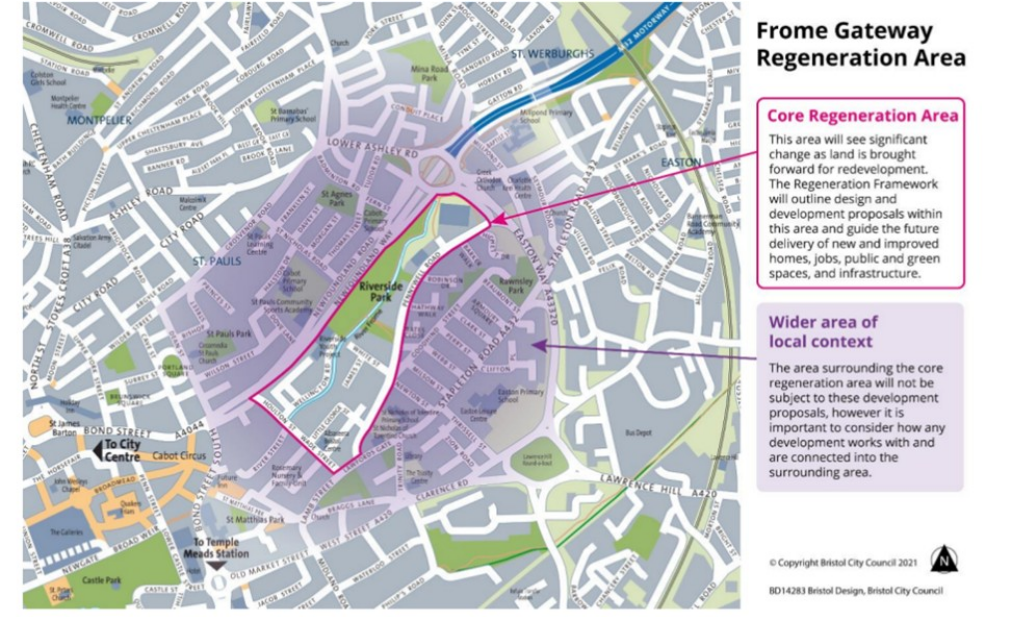
Frome Gateway is a 14.7 Ha piece of land surrounding the River Frome in Bristol, with 2,091 residents and a mixture of industrial and service uses. The site sits within Laurence Hill Ward, a densely populated area, and one of the most deprived in the country with high levels of unemployment and poverty. Frome Gateway is bordered to the north west by Newfoundland Way, a major route into the city from the M32.
Figure 1: Map of Frome Gateway Regeneration Area
HAUS model
Here, the model is used to monetise health outcomes for the 2,091 residents within the site, and a further 6,435 residents who are within 300m of the site, who will also be impacted by the urban development. The model is based on a number of assumptions: the lifetime of the project (the appraisal period), and therefore the health outcomes attributable to this project, is set as 25 years. There is a five-year lag before any health effect is fully realised. The Green Book standard discount rate is used to compare costs and benefits across time.
Option testing is also done, allowing us to evaluate how health impacts change with different urban development plans. In this case study, there are 4 different options – each with their own assumptions – demonstrating a further use of the HAUS model in decision support:
- Option A (Unmanaged Approach): This is the baseline. It is assumed that there are no changes to the current environmental conditions, allowing us to compare the effects of other options.
- Option B (Minimum Policy Compliant): Here, there are minor improvements in walking infrastructure, green space and sustainable drainage, which are likely to encourage more physical activity among residents, and decrease flood risk.
- Option C (Strategic Approach): This replicates the minimum standards set out in Option B, while adding in some improvement in traffic flow around the site.
- Option D (Ideal): This deviates from the scope of the regeneration project to explore what developments could help bring about the best possible health outcomes for residents.
Table 1: Measures that were introduced in each option
| Categories | Option A | Option B | Option C | Option D |
|---|---|---|---|---|
| Walking and cycling infrastructure | yes | yes | yes | |
| Additional green space | yes | yes | yes | |
| Flooding risk mitigation | yes | yes | yes | |
| Air pollution reduction | yes | yes | ||
| Noise pollution reduction | yes | yes | ||
| Traffic calming measures | yes | yes | ||
| Access to healthy food | yes | |||
| Additional affordable housing | yes |
Site data was obtained from researchers at the Bristol City Council and the project design team. In situations when specific local data was unavailable, averages from national sources were used. Life expectancy data was standardised and derived from ONS data. The Global Burden of Disease was the primary source of information on national incidence of different health problems. Due to the level of uncertainties within the assumptions, sensitivity analysis was also done to assess robustness. This was done around input parameters such as duration of illness, exposure-health response functions, and population. The testing is done by firstly just changing inputs one by one, then changing multiple at a time and observing the how results vary.
Monetised Health Impacts
Figure 2: Value of attributable changes to health compared by option
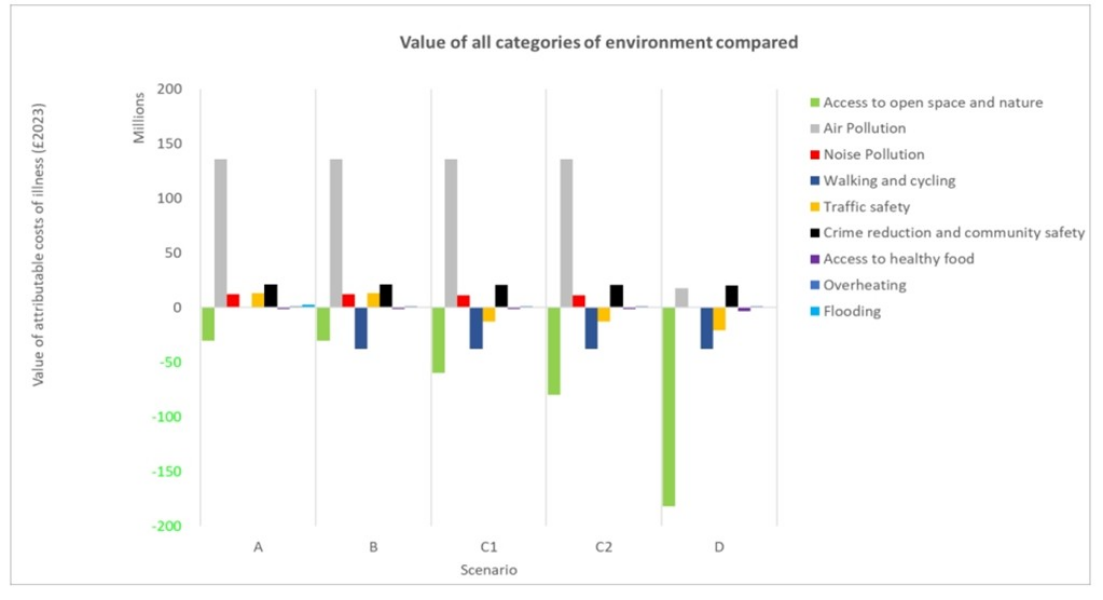
In Figure 2, Option A represents the baseline health impacts from the existing urban features of the site under consideration. These are valued using the total social cost poor health. A value above the horizontal axis means that the site has features which increase ill health and costs. A value below the line indicates that there are positive site features which reduce the costs of ill health. The longer the line the bigger the monetised impact. Impacts are broken down by each of the key pathways.
The other options B through to D show how the costs of ill health change as the urban design of the area is improved in line with table 1.
In each of the tested options, air pollution has the largest cost. This is because it affects a significant proportion of the population of internal and external residents and has been linked to premature mortality and severe illnesses such as cancer – brought about by high levels of NO2 and PM2.5. It is only in the final, ideal option, that these risks are mitigated due to the extra measures implemented by the council. On the other hand, we can see that the benefits of having access to open space steadily increase across the options as more green space is implemented. This demonstrates the health benefits from improving walking infrastructure and green space, helping to reduce the direct and indirect costs of ill-health, as well as the wellbeing costs. Figure 2 also shows the impact of improving traffic safety by comparing the costs in Option B and in Option C. These cost-saving benefits from specific actions can help inform development, or in this case, regeneration plans.
Table 2: Health Appraisal Table for all options (£m, 2023 present values)[footnote 1]
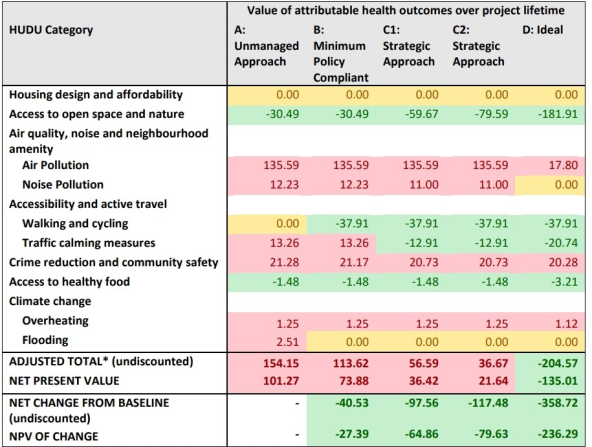
Summary of estimated value of health outcomes over 25 years (8,526 people within 300m of Frome Gateway Site).
*Adjusted indicates the sum of all categories has been adjusted for overlaps between health outcomes to avoid double counting.
(Negative values (in green) indicate reductions in health costs, positive values (in red) indicate additional health costs).
Table 2 sets out the costs of poor health under the baseline Option A and the values for other options. A positive value (in red) represents a health cost from the urban feature, a negative value (in green) represents a cost saving from the urban feature. The row setting out NPV of change becomes more negative as we move from the baseline option to option D representing improved health outcomes from better urban features.
Overall, we see that the council’s regeneration plans, indicated in Option C2 (a variation of option C) can achieve almost £80 million NPV relative to the baseline. In Option B we observe only a slight reduction in costs as here only walking infrastructure is improved, hence why that’s the only category that sees significant change. By Option C, we see much larger reductions in costs. The categories with the biggest improvement were the traffic calming measures and the access to open space and nature. The reduction in traffic costs is likely due to the restricting of traffic flow on Pennywell Road, which runs alongside the site. The decrease in nature costs is a result of tree planting and creating parks. Unsurprisingly, the ideal option brings about even higher benefits for the site, adding in the maximum provision of affordable homes and downgrading Newfoundland Way to reduce traffic.
Importantly, when using the result from the health appraisal it needs to take careful consideration of:
- additionality in line with existing MHCLG guidance
- the economic and social impacts of each option, such as the placemaking impacts of regeneration and the fiscal impacts of the provision of more housing
- overlap with other benefits considered in MHCLG and other departmental guidance on appraisal to mitigate double counting of effects
Conclusion
This example shows how the HAUS model can be used to monetise the health outcomes of urban development in a local setting for economic appraisal and to support decision making.
This case study has demonstrated the uses of the HAUS model in a real-world context. The model was calibrated for analysis of the site using local and national data. It shows that the model is able to provide insights on complex determinants of health in multiple options.
The model is not without its drawbacks: it requires a significant amount of data for calibration; it is unable to identify which demographics bear the majority of the burden of illness, which if included would help with public health interventions; and it does not include any weighting adjustments for income inequality to capture the impact of ill health on disadvantaged communities. These are topics for future research.
HAUS model application case study 2: East Norwich
Background
This is the second case study to explore how the HAUS model might be used in strategic planning/ policy development.
The first case study showed how the HAUS model might be used to explore the health impacts of the redevelopment of a single site in the Bristol Frome Gateway. It looked at four options and showed how the health impacts of changes to the urban environment might be valued for each.
This case study also focusses on a single large urban regeneration scheme, East Norwich, which has received grant funding through Homes England (HE) towards infrastructure improvements which will help to bring the scheme forward. This is an example of a site under consideration, but typically when a new funding scheme comes in, it is not known which specific sites will be funded, which makes it difficult to apply HAUS.
The case study shows what the expected health outcomes from the East Norwich Regeneration scheme are and whether these materially affect value for money in terms of the HE grant funding that has been allocated.
Methods and data
The HAUS model was applied to develop standard typologies for a large-scale urban core redevelopment scheme with three levels of environmental conditions in the UK; average, good and poor. We defined basic assumptions for what these three states might look like using data from various published sources such as air and noise quality maps, national flood risk assessments. Applying these typologies to a standard population representing UK demographics, we estimated unit values for the value of these three states. Data on demographics are derived from National Statistics (Office for National Statistics (ONS), mid-2021 and mid-2022). These values are then applied in a high-level assessment of the value of attributable changes to health in a before and after study.
This information was applied and tested with the East Norwich scheme to reflect on some of the issues and challenges with using HAUS in this way. Data is derived from the East Norwich Masterplan (Stages 1 and 2) (Avison Young, 2021) (Norwich City Council, 2022), and the accompanying Development Report (East Norwich Partnership, 2022).
Defining unit values – what does “poor, good and average” look like?
In order to reduce the data load, we simplified the full list of impact pathways used in the HAUS model into their relevant characteristic groupings e.g. Green Space, Noise or Road Safety. We then set up a standardised version of the HAUS model with 3 scenarios; “Average”, “Good”, “Bad”; and two further categories - “Best” or “Worst” - for sensitivity testing. Assumptions were made in order to enter a value to describe exposure to a specific pathway for each of these scenarios in the full model. These were then aggregated into unit values for each characteristic.
“Average” aims to reflect normal or average conditions in UK urban populations. For threshold values, we have entered 0 if a threshold for change has not been met, and 1 where it has. For proportion values, where there is expected to be variation within a geographical area, such as access to gardens, we have used the % of people who have access to gardens as the baseline measure.
“Good” reflects a high quality level of conditions. For threshold values, if a condition for positive health change has been met, this is entered as 1. For proportional pathways where data is not available, we assume a 10% increase in exposure to a good characteristic.
“Poor” reflects poor or inadequate conditions. For threshold values, if a condition for negative health change has been met, this is entered as 1. Where studies indicate outcomes based on proportional change, we assume a 10% change in exposure to the hazard in the population.
“Best” indicates all people in the population are exposed to the maximum level of a good, e.g. Places to Play.
“Worst” indicates the worst possible outcome, for example, 100% risk of exposure to a hazard.
A key challenge here was describing the difference between pathways which have a threshold value and those which measure levels of exposure in terms of the percentage of a population who might be exposed to a feature. This is related to the evidence base which informs the HAUS model. For example, pathways relating to the greenness of an area are expressed as a threshold value. This is because the base studies use comparative methods to observe changes to health in terms of the difference between two populations with an interquartile range difference in exposure. On the other hand, fear of crime is expressed as a proportion value: that is, the proportion of people in a given area who are prevented from leaving the home due to concerns about their personal safety. This is because the base studies observed the effects on those people within a cohort who stated they had high fear of crime. In the model, we have entered these as a percentage of people who might experience that state in a whole population. For those pathways which are driven by threshold values, “Good” and “Bad” are the same as “Best” or “Worst”, because the threshold for change is met in “Good” or “Bad”.
Standardised Unit Values
For this case study, modelling assessed conditions in the area around the site and the wider population who could be affected by changes set out in the masterplan. This informed the selection of key factors - such as flood risk, green space, and crime - which then guided the development of standardised unit costs. While this approach has proven valuable, a complete set of standardised unit costs for all characteristics in the model is being refined and is not yet included in the published version of HAUS.
Estimated Unit Values for each level of environmental condition rating are given in Table 3 below. Values are calculated for a standardised population of 1,000 people, over a timescale of 30 years.
A negative value represents a cost saving arising from characteristics which improve health impacts. A positive value indicates health costs from characteristics which worsen health impacts. For example, the average or normal air quality conditions which are estimated to hold at UK level have a large positive present value cost of £23.5 million per 1000 people. Average air quality has an adverse health impact. For the good scenario, where levels of air pollution are assumed to fall significantly, the present value costs fall to £0.5m as health improves.[footnote 2]
Table 3: Standardised costs (+ve) and benefits (-ve) for each level of environmental condition rating per 1000 people (£s, 2024 present values)
| HUDU Category and characteristics | Average | Worst | Poor | Good | Best |
|---|---|---|---|---|---|
| 01 Housing design and affordability | * | * | * | * | * |
| 03 Access to open space and nature | |||||
| Green space | -2,094,278 | 0 | -1,884,850 | -27,823,358 | -27,797,891 |
| Places to Play | -2,426,703 | 0 | -1,978,696 | -2,800,042 | -3,733,389 |
| 04 Air quality, noise and neighbourhood amenity | |||||
| Air quality | 23,449,287 | 107,483,998 | 23,449,287 | 483,079 | 0 |
| Noise | 7,926,084 | 19,815,209 | 10,898,365 | 2,972,281 | 0 |
| Proximity to main road | 436,932 | 2,912,883 | 2,912,883 | 0 | 0 |
| 05 Accessibility and active travel | |||||
| Cycling infrastructure | 0 | 98,763 | 98,763 | -265,843 | -265,843 |
| Road Safety | 1,053,005 | 5,319,309 | 5,319,309 | -2,505,134 | -2,505,134 |
| Walkability | -4,969,245 | 0 | -200,841 | -4,969,245 | -4,969,245 |
| Within walking distance | 0 | 463,651 | 463,651 | 0 | 0 |
| 06 Crime reduction and community safety | |||||
| economic status of area | 0 | 0 | 0 | -5,862,703 | -5,862,703 |
| Fear of crime | 225,377 | 1,641,228 | 370,386 | -87,792 | -187,959 |
| 07 Access to healthy food | |||||
| Fast food outlets | 0 | 758,552 | 758,552 | 0 | 0 |
| Food environment | 0 | 220,181 | 220,181 | 0 | 0 |
| Small stores | 0 | 0 | 0 | -526,286 | -526,286 |
| 11 Climate change | |||||
| Flooding | 10,269,478 | 351,324,236 | 11,593,700 | 3,513,242 | 0 |
| Grand Total | 33,869,936 | 490,038,011 | 52,020,689 | -37,871,800 | -45,848,450 |
Application to the East Norwich Regeneration Scheme
Exploring the planning documents for the East Norwich scheme, we set up a simpler version of the model based on how we think East Norwich compares against average conditions for the UK at T0 (before the development) and T1 (after the development). These are determined as average, good or poor (see Table 4 below). Assumptions which inform these condition scores are summarised in Table 5 (below Table 4).
Table 4: Estimated scores for East Norwich for environmental conditions
| Category | Characteristic | UK Average | Norwich T0 | Norwich T1 |
|---|---|---|---|---|
| 01 Housing design and affordability | ||||
| Conditions | N/A | N/A | N/A | |
| Indoor air quality | N/A | N/A | N/A | |
| Renewal of interiors | N/A | N/A | N/A | |
| Safety/ Accessibility for Vulnerable groups | N/A | N/A | N/A | |
| Tenure | N/A | N/A | N/A | |
| Affordability | N/A | N/A | N/A | |
| 03 Access to open space and nature | ||||
| Green space | Average | Good | Good | |
| Places to Play | Average | Average | Good | |
| 04 Air quality, noise and neighbourhood amenity | ||||
| Air quality | Average | Average | Average | |
| Air quality - Industrial | N/A | N/A | N/A | |
| Noise | Average | Average | Average | |
| Proximity to main road | Average | Average | Average | |
| 05 Accessibility and active travel | ||||
| Cycling infrastructure | Average | Average | Good | |
| Public transport links | N/A | N/A | N/A | |
| Road Safety | Average | Average | Average | |
| Walkability | Average | Poor | Good | |
| Within walking distance | Average | Average | Good | |
| 06 Crime reduction and community safety | ||||
| Economic status of area | Average | Average | Average | |
| Fear of crime | Average | Poor | Good | |
| Homelessness | N/A | N/A | N/A | |
| Regeneration | N/A | N/A | N/A | |
| 07 Access to healthy food | ||||
| Fast food outlets | Average | Average | Average | |
| Food environment | Average | Average | Average | |
| Fruit &Veg access | Average | Average | Average | |
| Small stores | Average | Average | Average | |
| Supermarket | N/A | N/A | N/A | |
| 11 Climate change | ||||
| Cold | N/A | N/A | N/A | |
| Damp | N/A | N/A | N/A | |
| Flooding | Average | Poor | Good | |
| Overheating | N/A | N/A | N/A |
N/A: Characteristic not considered in this study.
Table 5: Summary of assumptions related to East Norwich
| Category | Assumption | Source |
|---|---|---|
| Access to open space and nature | Large area of the development site is green/ blue space. No significant changes to size of provision in redevelopment plans, but improvements to quality/ biodiversity of the green spaces. Additional play spaces will be added. | Stage 2 Master Plan Summary (Avison Young, 2022) |
| Air quality, noise, etc | Air quality is assumed to be within threshold values for PM2.5, PM10 and NO2. Although more vehicle movements may occur in relation to new housing, assume no significant increase in pollution levels. Noise levels assumed to be average for UK, with around 40% of homes exposed to levels above 50dba (assume no increase in relation to new development). |
2024 Air Quality Annual Status Report, Norwich City Council (2024) Local Air/ Noise Maps at http://extrium.co.uk/noiseviewer.html |
| Accessibility & Active Travel | Plans include additional cycling infrastructure. Some barriers to walking in baseline, new walking infrastructure, including road and river crossings improve permeability and quality of public realm. |
Stage 2 Master Plan Summary (Avison Young, 2022) |
| Crime reduction & community safety | Assume current conditions, including unused or derelict buildings and poor quality underpasses lead to unsafe public environment. Redevelopment of area changes this to good. | Stage 2 Master Plan Summary (Avison Young, 2022) |
| Access to healthy food | (No mention in plans – assume as average with no change in future). | Stage 2 Master Plan Summary (Avison Young, 2022) |
| Climate change | Area prone to flooding (in Flood risk area 3) in baseline. Infrastructure improvements include flood mitigation works. | Stage 2 Master Plan Summary (Avison Young, 2022) |
Results: Value of benefits for residents within the area of influence
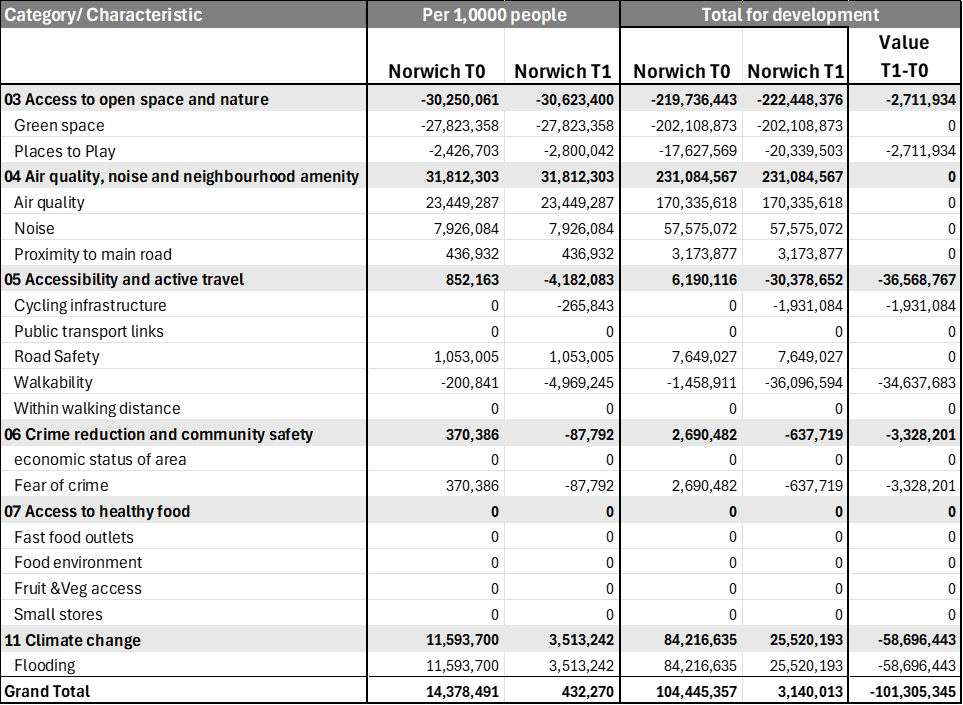
Results are given in Table 6. Values are estimated for a standardised population of 1,000, and for the development as a whole. We calculate the overall impact of the redevelopment site, based on assumptions around the range of influence which the redevelopment area might have for residents who live beyond the site boundary. This assumes that benefits for residents within boundary area are accounted for by existing appraisal methods. Plans indicate that 3,632 new housing units will be introduced into the area. We estimate there are currently around 5,000 – 7,000 people living within a 1km radius of the site.
A key challenge is calculating the population size which is likely to be affected by the development. In other applications of HAUS we have made estimates based on specific population densities within walking distance of the site boundary. In case study 1 these were standardised to give a broad estimate of 2 households outside the site boundary for every home within the development. Each household is assumed to have an average occupancy of 2. As this area is less densely populated, we suggest a population outside the site boundary equal to the population within the boundary (i.e. a ratio of 1 affected household per each new home in the development).
With these assumptions applied, estimates indicate that the total value of the East Norwich investment may be £101.3 million in averted societal health costs. The largest factors here are flood risk mitigation and improved walkability. Modelling suggests that before development, the area has a negative effect on the health of the wider population, with the largest risks relating to air quality, flood risk and noise pollution. Although the East Norwich scheme is not anticipated to impact on underlying air and noise risks, the overall impact of the investment is anticipated to result in the area moving towards a net benefit for health.
Table 6: East Norwich results - marginal and per development estimates (£s, 2024 Present Value)
Does this provide value for money in terms of the HE grant funding that has been allocated?
In total it is anticipated that the expected sum of all health benefits from the East Norwich scheme could be £101.3 million over 30 years. The total cost of the investment is £135 million. On their own the health benefits would result in a BCR of around 0.75. The East Norwich Regeneration Area Delivery Report (Avison Young, 2022) sets out the original case for viability of the £135 million scheme without considering health benefits. The report identified significant benefits from the investment, including regeneration of brownfield land, additional housing stock and employment/ growth for the local community. These benefits were not monetised at the time, however when combined with health benefits we can confidently say that the Value for Money of this investment is at least Acceptable and probably better.
Sensitivity analysis
Sensitivity analysis explores the effects of low/ high ranges of values (Table 7). In all scenarios tested, the East Norwich scheme is expected to become an area which has a positive impact on health for people in the surrounding area, supporting the conclusions already drawn about the value for money of the scheme.
Table 7: Health Impacts Sensitivity Analysis
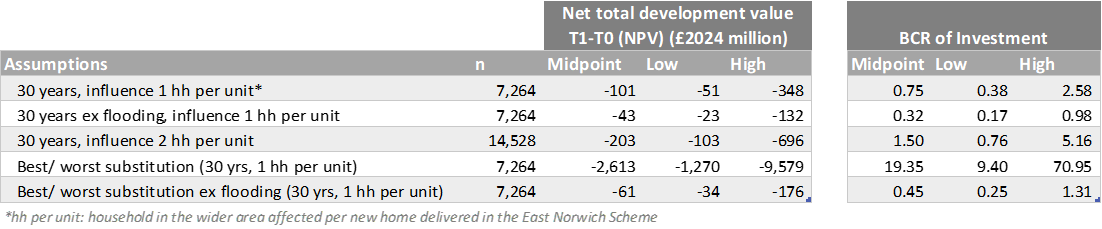
Table 7 also demonstrates that where we change the assumption on “good” and “poor” conditions to the categories of “best” and “worst” this also has a dramatic effect on the value of overall expected benefits. In particular, flooding is an outlier and can be highly influential on outcomes. Air pollution is also an outlier, though in this case study air pollution remains the same in all scenarios, so doesn’t influence the expected net value of health changes. When we adjust assumptions to exclude flooding this further reduces the benefits of the scheme. This demonstrates the scale of the potential health change for flooding: in the underlying study, health effects were observed for residents who had experienced inundation of flood water in their home. The worst case scenario here reflects this event happening to all residents every year – this is highly unlikely to happen. On the other hand, the “poor” scenario is more realistic and reflects the cost of a level of risk reflecting the classification for high risk areas in the UK: equivalent to a 3 in 100 year risk of experiencing a flood risk event (Environment Agency, 2024).
References
Avison Young, 2021. East Norwich Masterplan Stage 1 part 1. Online: N.c. council. Available from: https://www.norwich.gov.uk/ENMPart1 [Accessed 2024-09-24].
Department for Communities and Local Government. Department for Communities and Local Government, Valuing the external benefits of undeveloped land. www.communities.gov.uk: Stationery Office.
Department for Levelling Up Housing and Communities (DLUHC). Department for Levelling Up Housing and Communities (DLUHC), 2023. DLUHC Appraisal Guide. www.gov.uk.
East Norwich Partnership, 2022. East Norwich Regeneration Area Delivery Report. N.C. Council. Available from: https://www.norwich.gov.uk/downloads/file/8091/appendix_5_-_east_norwich_delivery_report [Accessed 2024-09-24].
Eaton, E., 2024. HAUS model application case study: Brownfield, Infrastructure and Land Fund.
Environment Agency, 2024. Long term flood risk [Online]. www.gov.uk. Available from: https://check-long-term-flood-risk.service.gov.uk/ [Accessed 2024-11-08].
Homes England, 2024. CBA Model. (Unpublished).
Homes England and AMION. H. England, 2023. Measuring the placemaking impacts of housing-led regeneration. Homes England.
Norwich City Council, 2022. Cabinet report: East Norwich Stage 2 Masterplan. N.C. Council. Available from: https://www.norwich.gov.uk/masterplan [Accessed 2024-09-24].
Office for National Statistics (ONS), mid-2021 and mid-2022. Population Estimates for Electoral Wards in England and Wales by Single Year of Age and Sex [Online]. Online [Accessed 2024-09-04].
-
Note that non-health impacts are not shown in this table to keep the example simple. A complete set of impacts, including non-health related, are shown in Case Study 2. ↩
-
Modelling has only been done for external characteristics to the home for the moment: This is because the typologies we are exploring relate to wider benefits for residents living near to site boundaries, but not within development areas, assuming that the benefits for occupiers of new homes will overlap with existing considerations made by the hedonic price values which are used in current appraisal methods. Modelling is carried out on a reduced number of impact-pathways: those that were marked “proceed” in robustness checking. ↩