Government Efficiency Framework (GEF) Summary, key definitions and criteria guide
Updated 24 November 2025

© Crown copyright 2025
This publication is licensed under the terms of the Open Government Licence v3.0 except where otherwise stated. To view this licence, visit nationalarchives.gov.uk/doc/open-government-licence/version/3 or write to the Information Policy Team, The National Archives, Kew, London TW9 4DU, or email: psi@nationalarchives.gov.uk.
Where we have identified any third party copyright information you will need to obtain permission from the copyright holders concerned.
This publication is available at https://www.gov.uk/government/publications/the-government-efficiency-framework/government-efficiency-framework-gef-summary-key-definitions-and-criteria-guide
1. GEF summary, key definitions and criteria guide
The Government Efficiency Framework (GEF) sets common standards and definitions, allowing departments to consistently categorise, hold and report efficiency data.
1.1 Who is it for
The GEF should be adopted by accounting officers, finance directors, chief operating officers, budget holders, senior responsible owners, and finance/project teams – those involved with the monitoring, delivery, appraisal, and evaluation of efficiency savings.
1.2 The GEF:
-
defines what an “efficiency” is.
-
distinguishes between cash releasing and non-cash releasing (but monetisable) efficiency savings.
-
sets out the two types of efficiencies: technical (doing something better, faster or for less) and allocative (by re-allocating resources in a wholly different way changing inputs, processes and outputs).
-
standardises how we track and monitor efficiency savings and provides guidance and best practice on benefits realisation.
1.3 Efficiency and Productivity
Efficiency means being able to spend less to achieve the same – or greater – outputs, or to achieve higher outputs while spending the same amount. It does not include decisions to reduce costs with the intention to achieve less – these are non-efficiency savings.
Productivity, at a high level, measures how many units of output are produced from one unit of input. Any measure where productivity increases and output remains the same or increases is a means of achieving greater efficiency. Sometimes productivity can increase while outputs decrease. This type of productivity would not constitute an efficiency gain – to be classified as an efficiency, outputs or outcomes must stay the same or increase.
As this framework is primarily a financial tool, its focus is on productivity and efficiency when they can be measured in financial terms.
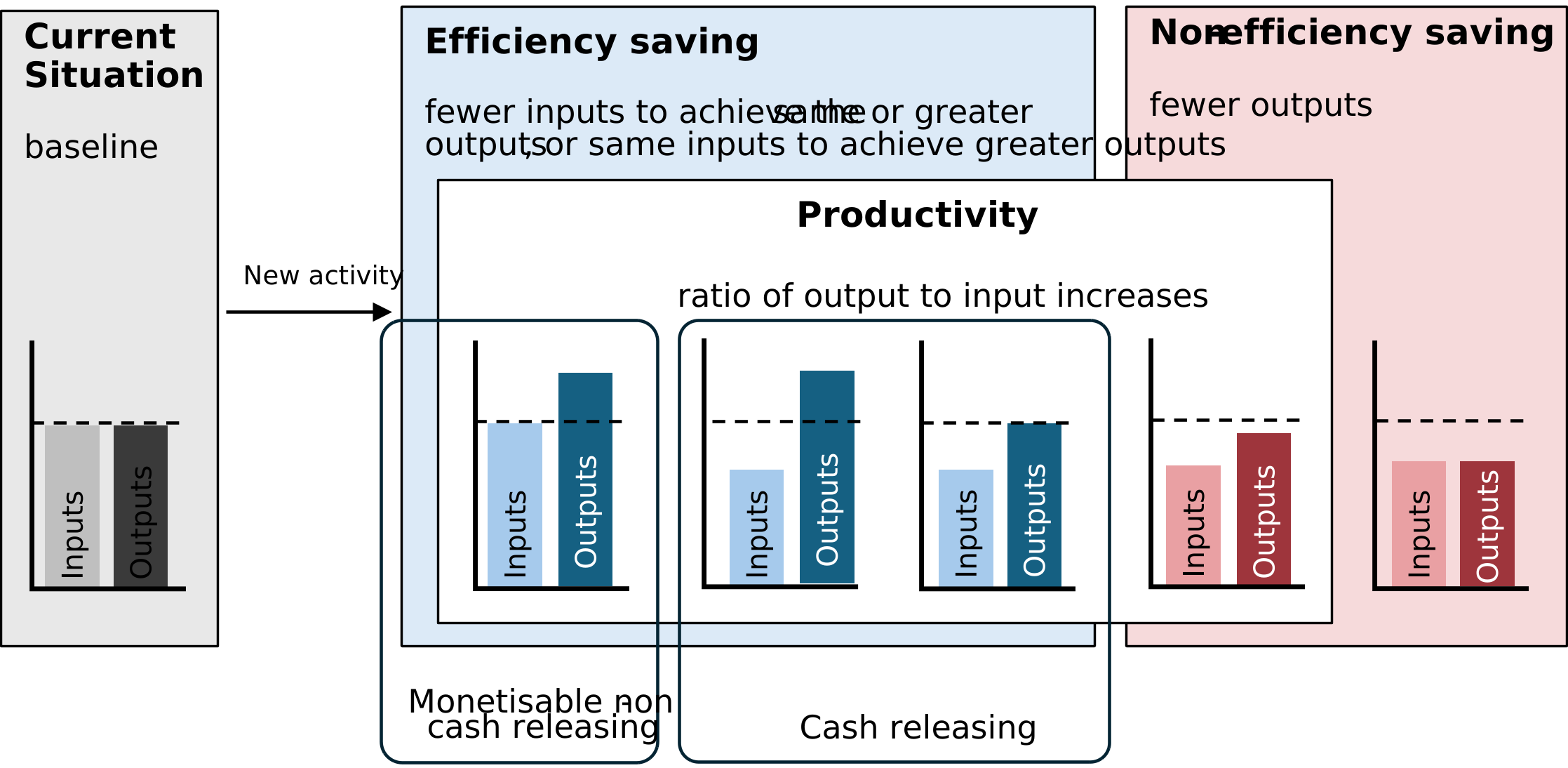
The diagram below sets out the interaction between efficiency and productivity and what happens to the relationship between inputs and outputs (or outcomes) for different types of savings.
1.4 Efficiency criteria
Efficiencies must adhere to all the criteria below:
-
They should be calculated with quality data. They should lead to a direct reduction in spending for cash releasing efficiencies [or be evidenced through a comprehensive methodology for monetisable non-cash releasing efficiencies].
-
They should be calculated net of costs and disbenefits.
-
They should not have an adverse impact on performance, outcomes, another department, or local government.
-
They should be sustainable/recurring (not just an efficiency for one year) and not reallocating/deferring costs.
-
They should be scored once net of any double counting between different organisations.
-
The nature of the saving should be clear (i.e. pay, procurement).
-
They should be calculated accurately, readily understood, reasonable and verifiable with quality data, and auditable.
If a saving materialises because a programme is stopped or cancelled, this is not a cash releasing efficiency saving as the original baseline outcome has not been achieved. Rather, this would be considered a (non-efficiency) saving.
If a decision has been made to reallocate or reprioritise funding to achieve a wholly different outcome or ministerial priority, or with the intention to reduce or achieve less than the original outcome, this is a reallocation and would not be considered an allocative efficiency. Through this process, a department may also realise non-efficiency savings.
1.5 Efficiency reporting
Monitoring efficiencies helps organisations to understand how budgets are being managed; ensure investment in public services delivers the anticipated benefits; instil a culture of continuous improvement where data is used to inform decision making; and make judgments on scope for further efficiency based on benchmarks and past performance.