Support service use by people with experience of rough sleeping
Published 11 December 2025
Applies to England

© Crown copyright 2025
This publication is licensed under the terms of the Open Government Licence v3.0 except where otherwise stated. To view this licence, visit nationalarchives.gov.uk/doc/open-government-licence/version/3 or write to the Information Policy Team, The National Archives, Kew, London TW9 4DU, or email: psi@nationalarchives.gov.uk.
Where we have identified any third party copyright information you will need to obtain permission from the copyright holders concerned.
This publication is available at https://www.gov.uk/government/publications/support-service-use-by-people-with-experience-of-rough-sleeping/support-service-use-by-people-with-experience-of-rough-sleeping
Foreword
This report explores the findings of research exploring how local statutory services support the needs of people currently rough sleeping or who have recently slept rough. The research sought to understand what is working well, the challenges around accessing services for people rough sleeping, and what can be improved.
The findings draw on workshops held with service users in 3 local authorities across the country, focusing on their experiences of journeys through different services. The research employed a peer-led methodology where Groundswell staff with lived experience of homelessness were involved in the design and delivery of the research.
I would like to thank Groundswell and their researchers for their hard work conducting the workshops, analysing the findings and producing this report, and the analysts in MHCLG who provided input to the research materials and reviewed the outputs.
MHCLG continues to develop its evidence base on the causes of and solutions to homelessness and rough sleeping. Alongside this report, we have published other research reports on rough sleeping, including process research on the first year of Rough Sleeping Initiative, the first interim report from the Housing First Pilots evaluation, the Complex Needs Evaluation and the findings of a large-scale survey using the Rough Sleeping Questionnaire developed by researchers in the department. In addition, we have published evidence on wider homelessness, including the review of the Homelessness Reduction Act and a report on the costs of Temporary Accommodation.
Further details about our evaluations and new research are available in our Homelessness and Rough Sleeping research programme.
Stephen Aldridge
Chief Economist & Director for Analysis and Data
Ministry of Housing, Communities and Local Government
1. Introduction
On behalf of the Ministry of Housing, Communities and Local Government, Groundswell has conducted research exploring how local statutory services are supporting the needs of people who are currently rough sleeping or have recently slept rough. This research intends to uncover what is working well, what the challenges are for accessing services for people rough sleeping and what can be improved.
This report explores the findings of workshops conducted by Groundswell’s Researchers, who have experience of homelessness, in 3 local authority areas across England. It presents findings based on the experiences of participants’ journeys through services in these local authority areas and begins to highlight themes that cut across localities and stages of participants’ journeys.
2. Methodology
Groundswell’s research employed a peer-led methodology where Groundswell staff with lived experience of homelessness were involved in the design and delivery of the research. Peer-led methodologies have several advantages, with a key benefit being that peer researchers can reduce problematic power relationships that can exist when conducting data collection with people who are experiencing social exclusions like homelessness. This can increase the chances of participants engaging with researchers, and richer data can be gathered.
Considering the small scale of this study, the aim of gaining rich, nuanced information about how and why services are or are not working, we employed workshop style focus groups to achieve this. Workshops began with a warmup task to explore understandings of ‘statutory services’, defining the term as a reference point for further discussions. They then had 2 key elements:
1. Storytelling about previous engagement with statutory services. Participants selected show cards from a pile that named different statutory services or services funded by statutory funds[footnote 1] and were asked to share an experience of engaging with the service named on the show cards.
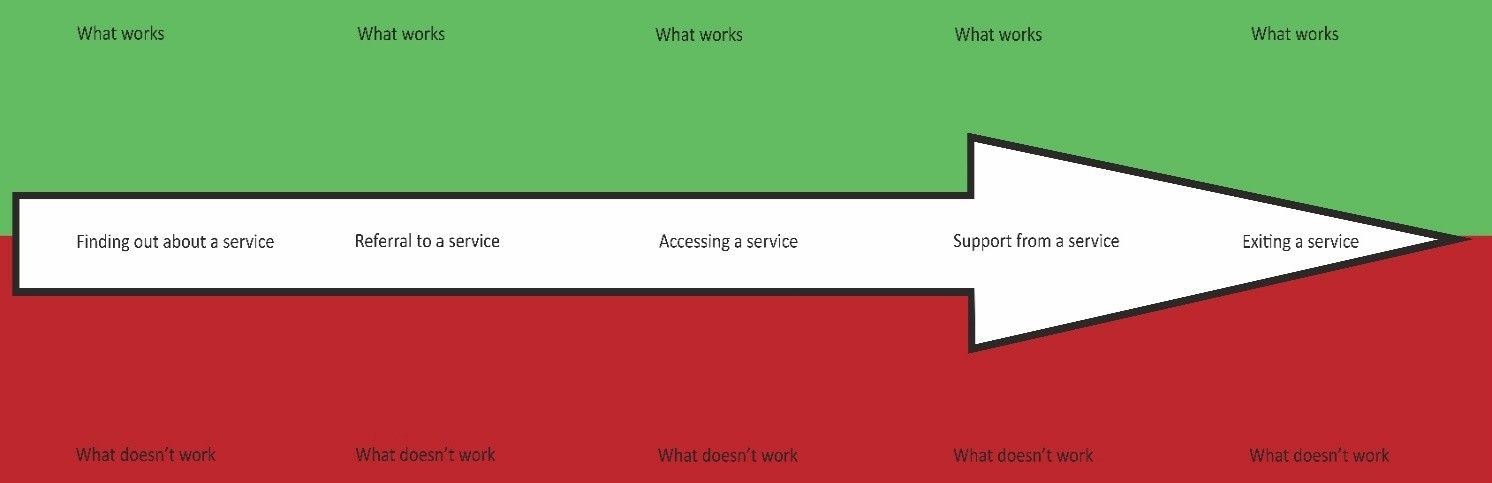
2. Journeys through services. Using a printed flow chart (see image below) as a prompt, participants were asked to share their opinions on how services can support people on their journeys through them. The flow chart was printed on 5 A3 sized pieces of paper and included the following stages of engaging with a service: ‘Finding out about a service’, ‘Referral to a service’, ‘Accessing services’, ‘Support from services’ and ‘Exiting services’. Participants were asked to highlight ‘What works’ and ‘What doesn’t work’ in relation to working with services, to write their thoughts on post-it notes and then give an example that explains why they wanted to make this point.
Throughout the workshop a researcher facilitated the conversations and probed participants for additional information and specific examples.
A total of 6 workshops with a total of 30 participants were conducted in Nottingham, Charnwood and Southampton. The workshops lasted between an hour and 90 minutes, and each group was conducted by 2 members of Groundswell staff – at least one of whom had lived experience of homelessness. The focus groups in Nottingham were conducted at a day centre and a drop in at a community centre. In Charnwood and Southampton, both groups were conducted in day centres. All workshops were audio-recorded, professionally transcribed and then analysed using NVivo. All participants gave informed consent to participate and were offered an incentive of £10 in cash or in voucher form to say thank you for their time.
3. Participant profile
Participants were asked to complete a monitoring form at the end of the workshops. These forms captured demographic information as well as information around participants’ previous experiences. Monitoring forms were self-completed and in some cases by people who may have faced literacy and language challenges, and therefore the following information is included to provide a picture of those who participated in workshops. The profile of the participants is as follows:
- 6 of 30 participants were female with the rest reporting to be male
- participants were aged between 28 and 65 years old with the average age being 39 years old
- 66% reported to be UK nationals with the rest of the participants reporting to be EU or EEA nationals
- all but 2 participants had slept rough in the last year; half of the participants had slept rough in the last week
- 89% reported experiencing mental health issues; 74% reported experiencing substance misuse issues
3. Limitations
As with any research project, it is important to consider the possible limitations. The main limitation was associated with the small-scale nature of this work. As outlined above this research was conducted in 3 locations in the South and Midlands of England. It cannot, therefore, be presented as being representative of the community of people experiencing homelessness across England.
Other considerations are associated with the demographics of the participants and the complex needs they have. For example, one of the groups was entirely made up of Polish migrants. While these participants are entitled to some statutory services, not all were eligible for all statutory services available and they, therefore, found it difficult to comment on some of the services like the DWP and housing options. Another challenge with the research was that some participants had difficult behaviours, perhaps as a result of mental health problems, substance misuse and/or learning difficulties. However, the research team at Groundswell are highly experienced in dealing with individuals and groups who present such challenges.
Further to this, it is important to note that this research was self-selecting and required a certain level of engagement for 60 to 90 minutes. Therefore, this research may not capture the views of those who find it more difficult to engage in such group discussions and activities. Staff in these services played an important role in encouraging people to participate, but this may have meant that those who participated may have been those staff thought more likely to engage. Furthermore, as it will become apparent in this report, some participants were very upset about their situation and felt they had been neglected by national and local government. Consequently, it was difficult at times despite the researcher’s facilitation, for them to give or think of positive examples of when and how they had been well supported by statutory services.
4. Research findings
The following section explores the themes of discussions raised in the workshops. These include: Finding out about services, Referral to services, Accessing services, Support from services and Exiting services.
Finding out about services
Understanding what support services are available, what they offer and how to access them was a key challenge that was discussed in the workshops. Participants felt that having this information would aid in navigating the ‘system’, particularly when people are new to rough sleeping. However, it could often be difficult to find this information, even from other services. One participant explained their perspective:
The problem that I had was that when I was made homeless, I hadn’t a clue what was happening, not a clue. Six months down the line if I knew what I know now, to what I knew then, things would have been different. I would have gone to statutory services.
A common point raised by participants was how some support services could have a lack of information about other services. Participants felt there was a need for information to be more readily available from service to service. One participant detailed his experience:
I mean, if you go into any probation office and say ‘can I have a print out of the local soup vans?’, they […] don’t know what you are talking about. Something as basic as that. Surely that should be – I should be able to go in a town hall and ask for that surely? What are you talking about? Don’t know what you are talking about. Soup runs, what are they? And that is probation.
Some participants gave examples where a support service had provided incorrect information and how this had caused real challenges. For example, participants spoke of having to walk between different places multiple times in order to gain access or get a query answered.
Participants highlighted how they had used the internet as a tool to find local support services. While other participants highlighted that this required access to the internet to begin with, there was an acknowledgement that information was online if you could access the internet and knew how to look for information. A participant recalled their experience of trying to contact support services:
[I typed in] Homelessness Loughborough. Support services. And it came up. Well the council came up. And… the Falcon Centre came up. But then at the time, I didn’t realise that you can’t go to one without going to the other. You have got to come here to get the referral to go there. You can’t go there directly. They must have a referral from the council, probation, here or… whoever.
Even when a statutory service is being accessed participants felt that they did not have information proactively shared with them, and different options for working with the service were not always apparent. One participant told us of his interactions with the job centre, and how he had had to be proactive in exploring how payments could work better for him:
I told them I am not very good at managing money and that. And I said is there any way of me getting like… getting paid like… well, is there any other payment plan? He was like yeah, you can get paid…. Rarely… very, very rare but some people do get paid every day. But it’s very rare occasions. So they said to me, like the best we can do is fortnightly.
Participants commonly spoke about how ‘word of mouth’ with other people who were street homeless was usually the first step to identifying services, typically day centres, which then played a key role in helping them to navigate statutory services.
Accessing services
How services are accessed was a key area of discussion in workshops. Many challenges the participants faced were specific to being street homeless and/or unsuitably housed. For example, participants spoke about the difficulty in accessing support without a fixed address – this was a problem particularly prevalent in accessing support from the DWP. The following quote highlights the broader challenge of accessing services without a fixed address:
Because if you haven’t got an address, a lot of places won’t help you in [City]. It’s like they have - they say they have got all these services but if you are homeless - they are for homeless people, but if you are homeless you cannot access them, so what is that about?
Health, wellbeing and the difficulty with personal care were also highlighted as key challenges for engaging with statutory services. There were cases where participants reported being too unwell to go to work assessments. Participants also spoke of the difficulty in attending appointments and feeling ‘judged’ when their personal hygiene was not as good as they would have wished. Wearing dirty clothing and having to carry large bags were other barriers to accessing services.
There was a general sense among participants that the processes and systems to access statutory services were often not set up to accommodate people who are street homeless or facing extreme poverty. A common example given was around having to call to make appointments and/or difficulty getting the funds to make phone calls. As one participant expressed:
But no one ever tells you what you can have free… number to phone, they just basically let you phone them, and it costs you a fortune if you are on pay-as-you-go.
Another common issue raised by participants was also around the need for ‘Local Connection’, particularly around accessing accommodation, but also regarding other statutory provided provisions like mental health, drug and alcohol and, in some cases, day centres. The following quote illustrates the experience of one participant’s challenge in obtaining a local connection:
I had to be a resident in this area for 3 months before they would help. So where was I going to stay? You know? That is not our problem; that’s what I was told. So you can sleep in a bus shelter, you can sleep… in the park but once your 3 months are up come back and see us, and then we can help you.
Some participants gave examples of where they felt they had a legitimate claim to a local connection, but this could either not be proved or had been refused. There were also cases where participants had had to advocate strongly for themselves to prove their local connection. The following quote is from a participant who had to fight to be accepted as having a local connection:
I was determined to get a connection. And I explained to the council; I went to go and see them. And said look, I have been here, I have [been] there. I had a stroke, everything else, so I would still have been in the area if I didn’t have my stroke. So that is where I should go. […] Hmm, give me 5 minutes. Come back and went … there is your bidding number and everything else. So I thought, yes, I have won!
Once again, participants spoke about how non-statutory services had played a key role for them in supporting access to statutory services. This could either be in supporting individuals through advocating on their behalf or offering very practical measures that could support access, like offering day centre addresses as a care-of address in correspondence with statutory services.
Referrals to services
The key role that ‘referrals’ play as a route to accessing services was discussed widely in the workshops. Some participants spoke of how a referral from one professional had led them to receive support from another service, and how the process had been smooth and seamless. However, there are also cases where participants found getting referred to services both difficult and confusing. As one participant highlighted:
What’s weird is I was in the [Accommodation] 3 years ago. And I wanted to get referred from the [Day Centre]. So I come here and got referred. Now when I went back into the [Accommodation], and I have been only there 3 weeks, I have had to go into the council to get the council to refer me to the [Day Centre]. So the [Day Centre] can refer me to [Accommodation].
Participants emphasised the need for access requirements and referral processes to be fully explained when a referral is being made. There was an understanding that referral processes were necessary, but in some cases, there was a feeling that it relied too much on having an existing link with another service that would be willing and proactive in making a connection. Some participants felt that referrals should not be exclusively made by professionals and that there should be options for self-referrals and shared examples of where they had successfully done this. One participant explained how they referred themselves to a drug and alcohol support service:
But I didn’t let the courts make the referral. I have done it myself. Because referring myself, I made it myself; I phoned up myself. And that started the ball rolling. So it gives me an edge.
In addition to this, it seemed that most successful referrals associated with mental health, housing and addiction services were made through charities rather than statutory services. One participant explains their referral process in the following extract:
I was referred from here to the… [Day Centre…] They can refer you anywhere. They can refer you to mental health issues, housing issues, alcohol issues, drug issues. All sorts of other referral from one source. But your initial referral comes from here, to the [Accommodation] and then a multitude of in-house referrals for whatever support you need.
The referral and access criteria that many services operated were discussed widely with participants, with many feeling that some services made it too difficult to access services. Commonly, there was discussion around how people who displayed the highest need were most likely to get support, but this meant there was an incentive to take action that is damaging to their health and wellbeing. As one participant told:
Unless you try and section yourself, or try and commit suicide or you have got specific alcohol or drug needs, you feel like… The more mental you are, the more you do stuff to yourself, the more help you get. And that is how it is.
Some participants explained that they had to adapt behaviour significantly or to fulfil irrelevant criteria. There was also a feeling that criteria were becoming more stringent, and therefore, services were harder to access. One participant explained his interaction when he had to get into hostel accommodation:
One thing I was really peed off about is I was offered a hostel place. And they turned around… They goes, I can get a place if I go to this … [Group] which was … play f*cking chess. Chess club. An hour and a half of chess. If I went to this appointment […] I know nothing about chess whatsoever, can’t stand the game… they goes then you can have a room. And I thought what?
Participants felt that having stringent eligibility criteria or enforcing behavioural change was disempowering and did not reflect a person-centred approach. The following interaction was typical of discussions in workshops in all 3 areas:
Participant 1: All these things you have got to do, jump through all these hoops and they won’t do one single little thing, and it’s kind of … know what I mean?…
Participant 2: The balance of power is … all the emphasis is on you.
Participant 3: Oh yeah, of course it is, yeah. Definitely.
Receiving support
Attributes of ‘good’ support
Support provision and how it is provided was explored in depth in the workshops with participants sharing past examples of ‘good’ and ‘bad’ support. The key factor that participants highlighted as making a difference was the relationship that was built with support workers and their willingness to engage and often go beyond what was expected of them. For some participants, having personal experience of homelessness themselves was a factor that helped to build relationships due to shared understandings. However, there was an acknowledgement that whether you had a support worker who could engage with you was often the ‘luck of the draw’. As these participants explain:
Participant 1: “It all depends on the person you are sat facing. Plain and simple. If you’re sat facing someone who doesn’t care about the job they do, they have no empathy, no nothing; you’re going to get nowhere. Short of you going down there. It’s all down to the individual you are facing. If you have got someone doing a job for the right reason, they will help you.
Participant 2: “If they care, it works. I sat before somebody who wasn’t the slightest bit interested. And you could tell. And he just looked the computer screen. And… oh… Go away. You know.
Participant 1: “Yeah. At {Name of Accommodation Project] you have got a handful of people who you know that will help you out and they will help you as much as they can. But then the handful that don’t care, they are getting paid. And as long as they are getting paid… Yeah, exactly. Not bothered. They don’t bother.
Participants highlighted attributes of support workers that shaped whether they felt the support was ‘good’ like being non-judgmental, positive in outlook, proactive and having the knowledge and expertise in order to support an individual to navigate the system. One woman shared her positive experience of her support worker:
…when my homelessness occurred, I was extremely negative in everything. She was exceedingly positive in everything. And I didn’t believe her. And basically, she said, well, I will tell you it will happen. It might not happen tomorrow, but it will happen. And I had great difficulty believing her due to experiences that had occurred with the council and one or two others. But everything she said to me happened. And she basically took me down the journey and kept saying don’t worry when you are worrying, don’t be anxious when you are anxious. Don’t think these silly things when you are thinking silly things. And she was unbelievable. Absolutely unbelievable. But at [Accommodation project] it’s a different ball game because people have different needs. So you might have somebody who only needs half an hour, an hour. You might have somebody who needs 24/7 care. And that is difficult because staff get side-tracked onto somebody who takes up their time and others regrettably fall – well not fall by the wayside, but others get overlooked. And it happens on a daily basis there.
Commonly, participants spoke about support workers ‘going the extra mile’ and acting in a way that they felt was beyond their remit. When probed, this was often explained as offering additional practical support. This could be supporting people to attend appointments at another service, and in many cases, was concerned with advocating on behalf of individuals. This was often discussed in relation to non-statutory services like day centres. As one participant explained:
Interviewer: How important is that key worker for you?
Participant: Very important. She took me to see Citizen Advice this morning. To start going through all paperwork and stuff like that. And they are going to get in contact with me… and they are going to contact the people that need to be contacted and… Because I can’t do it. I used to be able to. I am not stupid. But… I am at that point where I can’t do it on my own. I need help. And that’s it.
It was felt that having consistency in support was also a key element in terms of regular engagement with the same support worker. The following quote from a participant illustrates the negative impact changing support workers can have:
Participant 1: It’s that random, you can go in – even probation – you can go in one week and they are like oh, sorry you have got a new worker this week, it really is that bad. You can literally walk down somewhere one week and go the next week and it’s sorry, he’s not here no more.
Interviewer: Does that happens a lot?
Participant 2: Yeah, it really is absolutely ridiculous.
Interviewer: How does that effect you?
Participant 1: It’s a terrible knock-on effect isn’t it? Because you know… you are living day-by-day aren’t you? It’s the only way you can live at the moment; you can’t do it any other way. You literally can’t. If you try something different it won’t work. So yeah. And literally hours of pressure.
Participants also highlighted how a service can have an environment and ‘ethos’ that can aid the delivery of good quality support. A welcoming environment in a service that was open access and can be made use of when needed was key. As one participant explained:
You walk in here, you have got a nice smiley face, they ask you what is up with you. Obviously, [Day Centre], if they know you, you can come in here. I have been in here for about 4 years. And [Name] knows me, and staff know me. So soon as I come in, you actually know… What are you doing now? I am homeless., Oh, I am really sorry for you, what can we do for you? Straight away. It’s not… Oh, you are homeless, so what! Kind of thing… the first thing they ask you when you walk through the door is do you want a drink of tea.
Attributes of ‘bad’ support
Participants were asked to explain what didn’t work in terms of the delivery of support. Most commonly, participants spoke of where services took an approach to support where the service offered did not fit their need. This was often described in terms of a standardised approach to people that did not take into account individual needs or challenges. This was most commonly discussed in relation to accommodation, one participant spoke of her circumstances:
I was in [Accommodation Project] which is a bit further down [the road]. And it’s a non-drinking establishment, supported and that. But they weren’t. They put me in there with 4 blokes. I have just come out of domestic violence. And I became the flipping cleaning up, you know… and I just went off on one. Absolutely flew off the handle and they evicted me. Not address the fact that these are not doing anything, it was me kicking off.
Participants described feeling ‘like a number’ in a system and having limited control over how support is delivered. Participants spoke of ‘box-ticking’ and the frustration of filling out forms, and repeatedly answering irrelevant questions with services when they felt like there was no chance of getting support in return. This is particularly challenging for people when they are in crisis, or the questions asked trigger past trauma. As one participant detailed:
They… are looking – you have got to tick all their boxes. And if they tick boxes to tick and you don’t tick them, you only tick 9 of them, they will look at the tenth and the excuse to not offer you what your statutory rights are, as you’ve been saying. And that went through every single hoop and every single interview. And it was like…. Like you were in a police interrogation with them. Some of the paperwork that they filled in… the majority of it was irrelevant. And you are there in this state of complete crisis and wondering what the hell is going on, and this person has got your… basically… possibility of finding you a bed for that night. And you know from the beginning that A. they are not interested and B. they are not going to find you a bed for the night. And it was at that time that I needed to be signposted to the likes of the [Day Centre], and other people who were going to generally help you. But the council were absolutely appalling. And since my experience with the council, I have heard even more horrendous stories from individuals, and I know you shouldn’t take anything second hand. But… Everybody can’t be wrong.
Participants also spoke about a lack of joined-up support, and working with multiple agencies could be a challenge to navigate and keep track of. Participants spoke of cases where they had been provided support by different providers and offered advice and actions that, in some cases, was contradictory. This was illustrated through an exchange between the local authorities and charities in one city where it was reported that charities would hand out sleeping bags for people sleeping rough, and the next day the council refuse collection disposed of them. One participant illustrated this:
I mean, you have got charities going around giving you a sleeping bag and a tent, you know. And, obviously, these are being funded, whatever, they have been donated or whatnot. And they are paying the councils to go around the next day and dispose of them. What’s all that about?
In two of the focus groups, participants discussed the restrictions placed on staff by the services they work in and the wider systems that the services work within. Participants who had spent significant periods engaging with services reflected that they felt this was more restrictive recently. There was an acknowledgement that as supportive as the staff can be, they may be limited by what they can offer. As one participant highlighted:
But like this gentleman said, it’s very hard. I am not sure if the council wants to help or they… the guy I saw was really, really helpful. But his hands were tied. That’s the only way I could describe it.
Participants also highlighted how not receiving appropriate support from a service could have a significant impact on individuals:
Made me feel really shit about myself, because I was like yeah, I am at rock bottom, can’t even get help from the place that I am meant to be getting help from. Just made me feel quite suicidal, to be honest.
Exiting a service
Discussions around exiting services highlighted how there were mixed experiences surrounding the exit. Examples given for positive circumstances were instances like moving into permanent accommodation or completing a detox. Negative circumstances included being banned from a service, abandoning accommodation or discharge to the streets from a hospital or prison. Participants also gave the distinction over when exiting a service is done by choice, or whether it had been out of their control. However, even when an exit is by choice, it could be for negative reasons as the following participant told us:
I did it a lot with [housing project] to be honest. It just felt like I weren’t being listened to or anything like that. I weren’t making any sort of progress. So I was like yeah, I am gone.
Several participants discussed evictions from temporary accommodation and a sense that the process for these could be unjust, or decisions did not take into account all of the evidence. In some cases, it could feel as if there is not a transparent process for how decisions are made. One participant recalls their experience of being evicted from their accommodation:
I didn’t even get a 7-day notice. I woke up one morning and there was police at my door. Give me 5 minutes to get my stuff and get out […] Yeah, well, I thought that the other person that was involved should have been thrown out as well. Know what I mean? So there was no evidence, nothing. But they were involved in the same situation. So I thought he should have been thrown out as well.
Participants explained that with statutory services, there should be a safety net that should not be banning people from accessing them, as they are there to support people when they are at their most vulnerable. Participants felt that when you could no longer access services, there was a period where people were at risk and services need to consider how support can continue to be provided. As this participant explains:
It’s like you have burnt your bridge basically. But you need departments that will…. There probably is departments out there that help, help, help, no matter what, when you fail they will do it again. And when you fail they will do it again. It is probably sad that it has to be like that, because no one should have to put in that much work but… the amount of stress it is on the streets, it has to be like there. The amount of hard work it is being homeless and stuff. It’s not going to be easy fixing it.
Whether exiting a service is under positive or negative circumstances, participants agreed that this is exactly the time when additional support was needed the most. Transitions from service to service, or when moving into other accommodation were times when people were in greatest need and when consistency in support and overlap could make a real difference in smoothly going through that transition. One participant explained how he was supported into accommodation and the value of that consistency:
Have moved on, I have gone where I have gone now. But certainly… if there is anything you need, you can get in touch. Doesn’t matter, I know you are not part of this service now, but if you need anything or if you get stuck wherever you are, if you need any help, we are always here for you. You know, I just access that, like I said before. If I ever… need help with anything, I won’t go. Because I am in supported housing. But there is no… We are not supervised 24 hours a day. We have a [Worker] to ask them. Twice a day. Well, twice in the evening. My support worker from here has picked me up and took me to hospital because I couldn’t travel on the bus because of bouncing up and down, you know. And…. Comes to see me where I live once a week. And if they change support workers they… You get a phone call saying so and so has left the job or moved on, so you have got a new person. But it is always explained. So…
5. Cross-cutting themes
The following section of this report explores themes that cut across the different stages of an individual’s journey through a support service.
Personal relationships and continuity in support
A key finding is how strong personal relationships with staff who are proactive, non-judgmental and who have good knowledge of the system is key to good quality support. Having consistency and regular contact with support staff allows individuals to build trust and is particularly important at times of transition. In many cases, relationships extended beyond the individual staff and to the wider service; this was often described as the ‘ethos’ of a service. As one participant explained:
It’s the only reason I come down today, is because every single person over there, apart from one, has been really proactive. And even… I am not part of this now. […]. And if I ever have any problems, this will be my first port of call. It’s like that leaflet that gentleman has got there that’s not printed by the [Accommodation Service], that is printed by [Day Centre]. These are the ones that help you more than anyone. And these are not a statutory service.
The importance of lived experience
Participants placed importance on lived experience being valued in support services as an asset in the staffing of staff, but also in terms of including service users voices in decision making. Participants commonly highlighted the difference in the support they received from people who understood from personal experience the issues they were facing. The following statement was typical in all of the focus groups conducted:
The critical thing I will say about support worker is… she hasn’t got the life experience to do the job. And she is holding a book saying right I need to do that, that and that. So you normally find the people that have been through the system themselves, they are the best person to go and work in that environment. And you can always spot them a mile off.
Another participant explained:
A judge - the best judge would be an ex-criminal. The best police officer would be an ex-criminal, then you would know exactly what you need. But you need people… they make the rules up that have never lived our lives. They have never even been down the street … like… [unclear] the street in their lives, know what I mean?
Open access and flexible support
Participants often spoke about how there was a need for flexibility around support, and the routes to access support. And that support should be tailored to the individual’s needs and circumstances. In terms of access to services, participants highlighted the need for different ways to access services, including self-referrals. There was much discussion around services being rigid in their ‘offer’ and staff being restricted in how they could support people. Not only did this mean their needs were not met but also this had an impact on individuals in terms of feeling like a number in a system. As one participant explained:
I think you will find that is unanimous with everyone around the table. Because any time I have been - even though I am not part of [Day Centre]. – any time I need something, if I get stuck, I phone them up and I come in here. And say have you got this, can you help me with that.
Increasing difficulty in accessing statutory services
Participants commonly discussed how, in recent years, statutory services have become more difficult to access and engage with. This was felt in terms of the availability of services in terms of capacity, and also the processes for accessing support, which participants particularly discussed in terms of bureaucracy and rigid systems that are particularly challenging for people who are experiencing homelessness. Participants shared perspectives around systems becoming more rigid, with a sense that what statutory services could offer, was reduced compared to earlier experiences. And the systems were becoming more rigid, with examples given relating to local authority housing offices, benefits and mental health provision. A participant explained their experience:
So when I was made homeless, I did actually think probation would reach out a helping hand to say we are going to help you; and the answers to my questions were due to austerity. We are not in a position to provide any support whatsoever, so I said does that mean that basically if I am on the streets I could be anywhere and you haven’t a clue where I am, what happens? And they were not interested. Not interested whatsoever. And all they are interested in is ticking their little boxes and nothing else.
Another participant shared their experience of trying to navigate the online benefit system when dealing with the stresses of being street homeless:
We can’t use a computer so obviously – and like he said he is… your anxiety is sky-high as well. On the streets. You think oh, I have a chance to get some money here. I have worked all my life. And then all of a sudden, hang on, you have got to put it on computer. That is a big drop for somebody who is low anyway. You can’t use a computer; then he is going to think oh, bugger it. [over talking] frustrated or whatever. And they end up not doing the claim. Because… how I am going to do this?
Mistrust of statutory services
Participants commonly displayed mistrust of statutory services and non-statutory services, particularly accommodation-based, that receive statutory funding. Participants discussed mistrust of the systems, policies and procedures that were in place, feeling that they were not there for the benefit of service users. Often, overly bureaucratic systems were further embedded in this mistrust. Enforcement practices led by the local authority or the police were also given as a reason to mistrust statutory services. One participant talked about the strained relationship between the police and homeless people living in his locality:
Everyone has got a very low opinion of us because we are homeless. It comes from the police, the government, members of the public, and just because we are homeless doesn’t mean we are scumbags. It doesn’t mean that – and I am sorry, but that’s how it feels. And even the police are very disrespectful, you know? I have got no time for them… they walk around thinking they are all that and a fucking bag of chips. They are not, trust me; they are no different to any of us.
Another participant told us how they felt that the staff in hostels may be, whether deliberately or not, trying to keep people in accommodation in order to prevent others from moving in:
We are in agreement. Because all they want to do is keep the rooms full. That is just – you understand that. But sometimes you think there is other people who need the service. So can’t you work faster to move them on? Because there is a lot of people on the streets at the moment. I am sure it is quite easy to keep a resident in here than to bring someone in, do all the forms again. Do the housing benefit, get them on a list, etc., etc. So there is no rush to move anyone on because they are just going to get paid.
Navigation of systems and coordination of care
Participants highlighted the importance of having support from people with specialist knowledge to navigate systems and who could, where necessary, advocate on their behalf. Support workers that can coordinate support and help individuals to understand entitlements and ensure that people receive the support they are entitled to. The support received from the probation service, in cases where the service worked well, was given as a good example of this. Reasons given were that it includes an assigned worker, automatic and instant access (straight from prison), packages to meet the needs of the individuals, and how they work as an intermediary across other support services.
One participant explained the positive relationship they built with their probation officer:
My probation officer is really good. She is very supportive. She helps us out. [Name] comes in with me, and we sit and talk as a couple. I find it difficult to deal with people sometimes. So she come with me. But she is really, really good. […] Because I am so sick, right, of all – I am looking down there right, and I am sick of all these people because none of them have a fucking clue what’s going on. And [… ]The only time I ever got help was through probation. If you work with them a little bit, they are the only people who really help. They are squeezed in the middle of everything else, aren’t they.
Non-statutory services as intermediaries
Another key theme that emerged from this research is the role of non-statutory services in managing and negotiating statutory services. The charity sector was identified to be key in making statutory systems accessible. Participants identified that charities were a vital ‘first point of call’ when they face challenges but also integral in supporting them to make referrals and, where necessary, advocate on their behalf. One participant told us of the difficulty of knowing how to get support when they first became homeless and how a charity supported them:
The problem that I had was that when I was made homeless, I hadn’t a clue what was happening - not a clue. Six months down the line if I knew what I know now, to what I knew then, things would have been different. I would have gone to statutory services. But probation were horrendous. And after 2 or 3 days of being out on the streets, I don’t know why - I still don’t know why to this day – I ended up in [Name of support worker]’s office, […] and that was the best thing that ever happened to me, because they have access to everybody. And where I was a little person way down the ladder… might have a bit of a voice who can shout, not many people hear that voice. But she or her team had a huge voice, and when they barked, everybody listened. And it was access through her that got me, technically, where I am now.
Catch-22
Finally, a key theme identified through the research has been participants speaking of ‘catch-22s’ in service provision where mutually conflicting elements make it difficult to access support. One participant uses the example of being identified as rough sleeping by outreach teams:
So you have got the catch 22 of you want to be somewhere that’s secluded so nobody can see you so that you are safe. And you have given the directions to the housing… outreach, they haven’t found you for whatever reason, whether they have been or not. But then it’s the problem that you can’t just go to housing and say I am homeless; I am rough sleeping. You have to be seen to be…
Another participant spoke of the challenges of getting a bank account without an address or ID:
Because I haven’t got a bank account, because I haven’t got any photo ID. Right, so I can’t have a bank account. So it got paid into my post office account. So I could not transfer it into… the landlord. So that sat in my account for the month. When I came back I found out I lost the place and I am back out on square one again. Know what I mean? […] Everybody says you have got to have photo ID now to open up everything. Where the hell do we get photo ID from?
6. Conclusion
In conclusion, this study has revealed the many challenges that people who are rough sleeping can face in terms of engagement with statutory services and has highlighted pockets of good practice that exist in supporting people who are street homeless. Participants highlighted examples where services that have flexibility in their offer, and which provide personalised support can make a positive difference to their lives. Participants also emphasised the essential role that good relationships with staff play in delivering support built on positive, non-judgmental and proactive approaches to working with clients. Participants shared many examples of where they were stuck in positions where their situation made it difficult to be supported to address their situation. Broadly, there was a sense that statutory provision, particularly benefits and services provided by the local authority, were becoming harder to engage. Participants highlighted the need for support to navigate these systems from specialist staff, whether statutory or not, to be able to put in place the correct package of support to address complex needs.
-
Physical Health: Accident & Emergency unit, Hospitals, Pharmacies, G.P./Doctors Surgery.
Mental health and substance misuse: Drugs services, Alcohol services, Talking therapy.
Council services: Housing Options, Social Services, Youth Services.
Criminal Justice: Probation, Victim Support, Police.
Job Centre & DWP: Returning to work support, Careers service, JSA, ESA or Universal Credits. ↩