Statutory species targets Environment Act target delivery plan
Updated 16 July 2026
Applies to England

© Crown copyright 2026
This publication is licensed under the terms of the Open Government Licence v3.0 except where otherwise stated. To view this licence, visit nationalarchives.gov.uk/doc/open-government-licence/version/3 or write to the Information Policy Team, The National Archives, Kew, London TW9 4DU, or email: psi@nationalarchives.gov.uk.
Where we have identified any third party copyright information you will need to obtain permission from the copyright holders concerned.
This publication is available at https://www.gov.uk/government/publications/statutory-species-targets-environment-act-target-delivery-plan/statutory-species-targets-environment-act-target-delivery-plan
The Environment Act sets 2 targets on species abundance, and one on reducing the risk of species extinction.
These targets only include terrestrial and freshwater species, with the exception of seabirds and a small number of fish living in coastal waters. Many marine species are highly mobile and widely dispersed and so assessments are done at a much larger scale (such as the North-East Atlantic). There are existing abundance indicators for marine species in the UK Marine Strategy and in the OSPAR assessments.
Unlike other Environment Act targets where interim targets have a one-to-one relationship to the statutory targets, to support the species targets we have set several different interim targets.
The interim biodiversity targets will make a significant contribution to the delivery of the statutory species targets, but delivery of the biodiversity interim targets alone will not be sufficient. Delivering the statutory species targets also relies on other interventions that we are making across the EIP as shown in Figure 1.
This delivery plan outlines what is required to meet the statutory species targets and explains how interim targets and wider EIP activities contribute to the current approach. It also sets out how we are improving the evidence base and how this supports ongoing adaptation and improvement of our delivery plans over time.
Statutory Environment Act targets
Under the Environment Act, we set 3 outcome-based targets for species:
-
halt the decline in species abundance by 2030
-
increase species abundance so that by 2042 it is greater than in 2022, and at least 10% greater than 2030
-
improve the Red List Index for England for species extinction risk by 2042, compared to 2022 levels
Interim targets
To support delivery of the statutory species targets we have set 4 interim biodiversity targets:
-
restore or create a total of 250,000 hectares (ha) of a range of wildlife-rich habitats outside of protected sites by December 2030
-
reduce the number of establishments of invasive non-native species by at least 50% by December 2030, compared to levels seen in 2000
-
by December 2030 50% of Sites of Special Scientific Interest (SSSI) features to have actions on track to achieve favourable condition
-
by December 2030, double the number of farms providing sufficient year-round resources for farm wildlife, compared with 2025
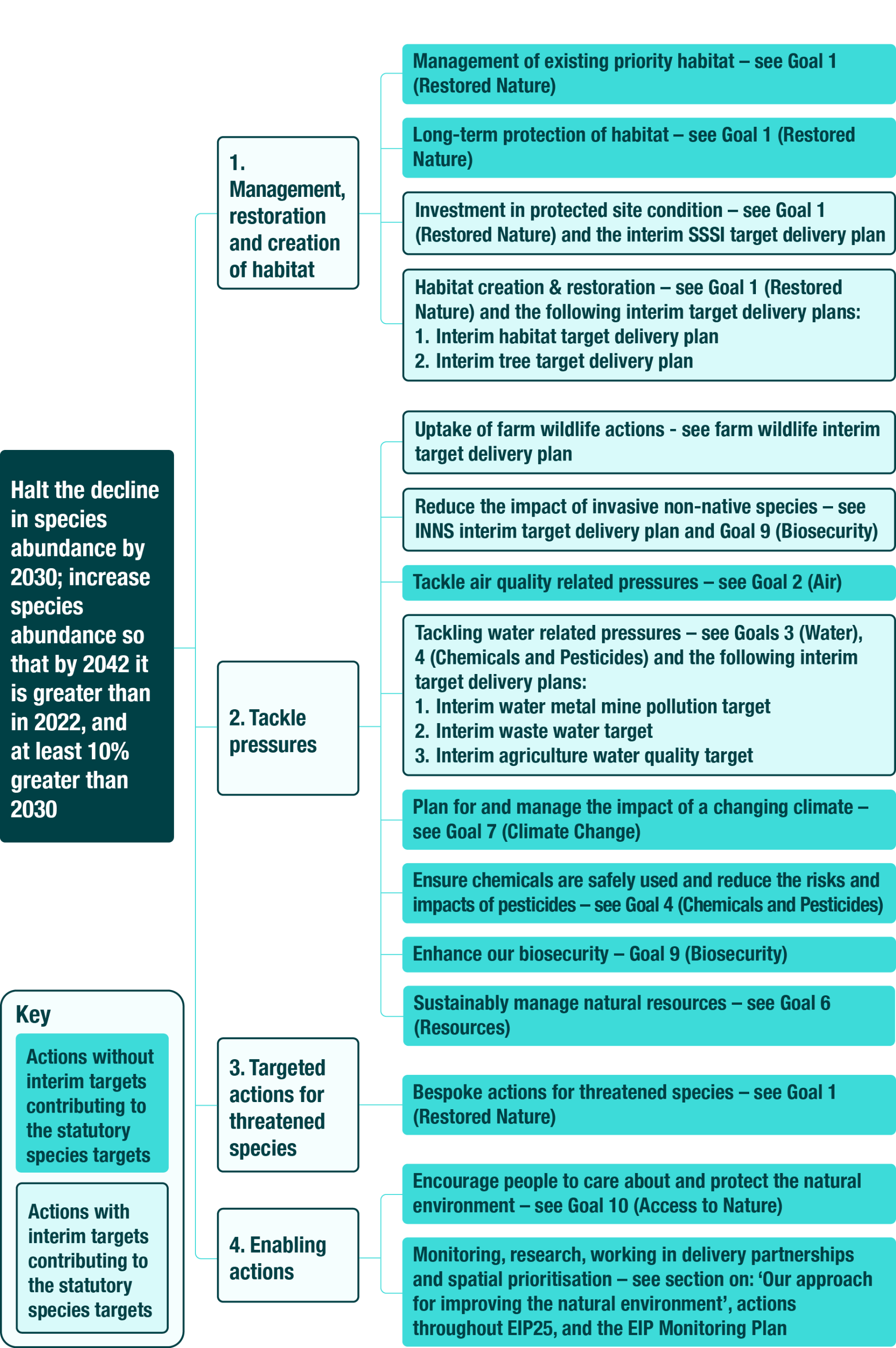
Figure 1. Link between key actions needed to meet the statutory species targets and the Environmental Improvement Plan (EIP) interim targets
Delivery plan for statutory species targets
We have a good understanding of the actions needed to improve biodiversity and have detailed insights from a wide-ranging body of evidence. Based on this evidence, this delivery plan is built around the 4 groups of actions we are taking to deliver the statutory targets, outlined below.
We will:
-
create, restore, manage and protect more wildlife-rich habitat (explained in the commitments and actions in EIP Goal 1: Improved Biodiversity).
-
take targeted action to conserve and recover threatened species (explained in the commitments and actions in EIP Goal 1: Improved Biodiversity).
-
reduce the pressures on habitats and species – including through:
a. delivering widespread support for farm wildlife (explained in EIP Goal 1: Restored nature).
b. tackling air quality related pressures – (explained in EIP Goal 2: Air).
c. removing aquatic pressures and delivering healthy water catchments for wildlife to flourish, through reduction of pollution (explained in EIP Goal 3: Water).
d. actions to ensure chemicals are safely used and to reduce the risks and impacts of pesticides whilst maintaining food security (explained in EIP Goal 4: Chemicals and pesticides).
e. sustainably managing natural resources such as fisheries (explained in EIP Goal 6: Resources).
f. planning for and management of the impact of a changing climate on our land, seas, water, air and soil (explained in EIP Goal 7: Climate change).
g. reducing the impact of invasive non-native species and enhancing our biosecurity to protect our natural environment and boost the health and resilience of plants, animals and ecosystems (explained in EIP Goal 9: Biosecurity).
-
essential enabling actions, as recommended in the Evaluation of Biodiversity 2020 report (BE0170), this includes monitoring, research, working in delivery partnerships and spatial prioritisation. The Land Use Framework sets out our plan to ensure there is enough land to deliver our targets, including identifying how much land use change may be required and how government will explore opportunities to focus spend where it can make the greatest impact. We also will enhance and improve the equity of access to nature, to encourage more people to care about and nurture the natural environment (covered in EIP Goal 10: Access to nature).
There will be an ecological time lag between the implementation of an action and seeing a positive species response. This means that front loading of these actions is crucial to meeting our statutory species targets.
The full detail of the interventions, commitments and actions across the EIP which are relevant to delivery of the statutory species targets are summarised in Table 1, 2, 3 and 4. Further detail on the specific actions which will drive delivery of each intervention is included in the full text of the EIP and detailed in the EIP Monitoring Plan – table 2.
Summary of delivery measures across the EIP
Table 1: Create, restore and manage more wildlife-rich habitat
| EIP goal | Commitments |
|---|---|
| Goal 1: Restored nature | 7. Effectively conserve and manage 30% of the UK’s land by 2030 (30by30). 8. By December 2030 50% of SSSI features to have actions on track to achieve favourable condition (Environment Act interim target). 9. Increase the contribution that Protected Landscapes are making to Environment Act and EIP targets, measured through the Protected Landscapes Targets and Outcomes Framework. 10. Restore or create a total of 250,000ha of a range of wildlife-rich habitats outside of protected sites by December 2030. (Environment Act interim target). 11. Increase England’s tree canopy and woodland cover by 0.33% of land area by December 2030 from the 2022 baseline of 14.9%, This is equivalent to a net increase of 43,000ha. (Environment Act interim target). 12. Support farmers and land managers to create or restore 48,000km of hedgerows by 2037 and 72,500km of hedgerows by 2050. 13. By 2043, increase saltmarsh by 15% compared to 2009 levels, seagrass by 15% compared to 2024 levels, and create functional oyster reef habitat at ecosystem scales in 5 to 8 suitable English water bodies. |
| Goal 7: Climate change | 63. Restore approximately 280,000ha of peatland in England by 2050. |
| Goal 8: Environmental hazards | 78. Work with local authorities to provide further tools and support through Natural England’s Green Infrastructure Framework and associated Green Flag Award standards to plan and deliver trees, quality green spaces and other natural features in towns and cities to support communities, help reduce peak temperatures, and support resilient ecosystems. 79. Continue to support woodland creation and peatland restoration projects to protect soils, rivers and biodiversity, and provide natural flood management and climate mitigation and resilience benefits, through funding and by recording hectares planted or restored. |
Table 2: Targeted action to conserve and recover threatened species
| EIP goal | Commitments |
|---|---|
| Goal 1: Restored nature | 14. Take targeted action to conserve and recover threatened species. 15. Halt the decline in species abundance by 2030. (Environment Act statutory target). 16. By December 2030, double the number of farms providing sufficient year-round resources for farm wildlife, compared with 2025. (Environment Act interim target). |
Table 3: Reduce the pressures on habitats and species
| EIP goal | Commitments |
|---|---|
| Goal 1: Restored nature | 15. Halt the decline in species abundance by 2030. (Environment Act statutory target). 16. By December 2030, double the number of farms providing sufficient year-round resources for farm wildlife, compared with 2025. (Environment Act interim target). |
| Goal 2: Air | 19. Deliver 2030 emissions targets to reduce anthropogenic emissions for the following pollutants against a 2005 baseline level: • ammonia (NH3) 16% reduction, • nitrogen dioxide (NO2) 73% reduction, • sulphur dioxide (SO2) 88% reduction, • Particulate Matter (PM2.5) 46% reduction, • non-methane volatile organic compounds (NMVOCs) 39% reduction |
| Goal 3: Water | 23. Support catchment partnerships as a framework for coordinating action between the public, private and third sectors. 25. Reduce phosphorus loadings from treated wastewater by 55% by December 2030 against a 2020 baseline. (Environment Act interim target). 26. Reduce total nitrogen, phosphorous and sediment pollution from agriculture to the water environment: a. by at least 12% by December 2030, compared to 2018 levels b. by at least 18% in catchments containing protected sites in unfavourable condition due to nutrient pollution by December 2030. (Environment Act interim targets). 27. Construct 8 mine water treatment schemes and 20 diffuse interventions to control inputs of target substances to rivers, and complete 55 catchment studies by December 2030. (Environment Act interim target). 28. Restore chalk streams to better ecological health, ensuring protections and investment towards these habitats. 29. Drive further investment to improve the water environment. 37. Reduce the impact of storm overflows on the environment and human health by reducing spill numbers and prioritising sensitive sites, in line with the SODRP. |
| Goal 4: Chemicals and pesticides | 41. Take action on PFAS through a new PFAS plan. 46. Deliver the domestic pesticides reduction target, as set out in the 2025 UK Pesticides NAP, to reduce each of the 20 metrics of the Pesticides Load Indicator (PLI) by at least 10% by 2030 in the arable sector compared to 2018. 47. End the use of neonicotinoid pesticides (clothianidin, imidacloprid and thiamethoxam) that are known to carry substantial risks to pollinator populations. |
| Goal 6: Resources | 57. Bring at least 40% of England’s agricultural soil into sustainable management by 2028, increasing to 60% by 2030. |
| Goal 7: Climate change | 66. Enhance the adaptive capacity and resilience of the treescape by increasing its extent, connectivity and diversity, improving its condition and conserving the genetic diversity within and between species. |
| Goal 8: Environmental hazards | 76. Deliver an improved evidence-base to monitor wildfires, through fire and rescue service incident data. 77. Fund research to address the risk of wildfire. |
| Goal 9: Biosecurity | 80. Maintain UK capacity and science capability to predict, detect and assess, respond to and recover from threats from invasive non-native species (INNS), animal and plant pests and diseases. 81. Reduce the rate of establishment of invasive non-native species by at least 50% by December 2030, compared to 2000 levels. (Environment Act interim target). 82. Maintain the effective structures, systems and governance processes the UK has in place to support the prevention of INNS, animal and plant pests and diseases. 83. Maintain UK capacity and technical capability to carry out surveillance and diagnosis of INNS, animal and plant pests and diseases. 84. Have plans and resources to respond to prioritised risks and issues, ensuring the delivery of contingency responses to, and recovery from, INNS and animal and plant pest and disease outbreaks. 85. Increase public and stakeholder awareness of the impact of INNS, animal and plant pests and diseases to drive positive behaviour change, including through strong community-based partnership. |
Table 4: Essential enabling actions
| EIP goal | Commitments |
|---|---|
| Cross Cutting | 1. Mobilise private investment and finance to restore and protect nature in England. 2. Publish LNRS to cover the whole of England for use by public, private and voluntary sectors to deliver on nature recovery and wider environmental commitments by end of 2025 or shortly after. 3. Use the National Estate for Nature (NEN) group to support the delivery of statutory nature targets and 30by30 on members’ estates, trial innovative land management approaches and provide engagement routes to support and replicate action. 4. Enable Protected Landscapes organisations to make land greener, wilder, and more accessible to all. 5. Build green skills for the future, including in agriculture, land management and water. 6. Address barriers to sustainable choices across society. |
| Goal 3: Water | 38. Review the regulatory framework for sewage sludge spreading to agricultural land to ensure it effectively manages the risks to the environment and health. |
| Goal 6: Resources | 58. Improve the quality, consistency and availability of soil data by 2029. 59. Create and implement a new farming roadmap. |
| Goal 7: Climate change | 65. Integrate climate resilience into decision making across the EIP programme to support the delivery of our outcomes in the context of climate change. 67. Make terrestrial protected site designation and management more dynamic and adaptive to the changing climate. 70. Enable societal shift towards sustainable practices, to contribute to achieving net zero and adapting our society and environments to the impacts of climate change. 71. Enable business to contribute towards achieving net zero and adapt our economy and environments to the impacts of climate change. |
| Goal 8: Environmental hazards | 78. Work with local authorities to provide further tools and support through Natural England’s (NE) Green Infrastructure Framework and associated Green Flag Award standards to plan and deliver trees, quality green spaces and other natural features in towns and cities to support communities, help reduce peak temperatures, and support resilient ecosystems. |
| Goal 10: Access to nature | 86. Make sure that everyone has access to green or blue space within a 15-minute walk from home. 87. Reduce physical and intangible barriers to accessing green and blue spaces to increase the frequency of visits from those currently least likely to access them. 88. Develop measures to improve responsible access that protect and enhance nature and visitor experiences, aiming to increase the number of people visiting the countryside and coast for leisure and tourism purposes. 89. Reduce barriers to access, boost children’s connection with nature and increase their understanding of the natural world and how to protect it. 90. Improve the condition, diversity and character of our landscapes and the condition of the historic environment and heritage features, including designated geological sites and scheduled monuments. |
Monitoring and evaluation summary
Due to ecological lags, the outcome-based species indicators will be slow to show any changes (more detail on these indicators is set out in the Environmental Improvement Plan Annual Progress Report (APR) for 2025 to 2026).
To ensure our delivery plans remain adaptive, we will track the actions we take, and near-term and longer-term outcomes.
We are identifying sources of these data and any monitoring gaps, with a focus on data which shows how much of each action we are delivering, and short-medium term recovery indicators which show progress ahead of changes in our species indicators.
Our monitoring and evaluation programme will use monitoring data, contextual information and policy evaluations to assess and understand our progress in delivering the suite of statutory targets.
The evaluation framework provides a long-term plan for producing impact, process, and value for money evaluations.
The monitoring and evaluation programme is adaptive so we can regularly feed evaluation findings and updated or new evidence into the delivery plan, making changes where needed.
Modelling projects are underway to further improve our ability to predict the combined contributions of planned activities towards species outcomes over time. These include:
-
the biodiversity policy analysis tool, which will provide a national level trajectory for the species abundance targets and an assessment of the contribution of key levers
-
an innovative biodiversity spatial model, which will enable understanding of how the amount, timing, combination and configuration of interventions impacts their contribution towards target delivery. The model enables us to account for the existence of strong spatial patterns in where interventions occur and how species respond to land use and management
-
an interactive tool enabling assessment of how varying levels of reduction in important pressures on freshwater invertebrates and fish contribute to the probability of achieving abundance targets
-
a policy tool to develop a trajectory for the species extinction target, exploring potential scenarios for changing species extinction risk levels over time