Chapter 3: How have social mobility conditions changed across the UK?
Published 18 December 2025

© Crown copyright 2025
This publication is licensed under the terms of the Open Government Licence v3.0 except where otherwise stated. To view this licence, visit nationalarchives.gov.uk/doc/open-government-licence/version/3 or write to the Information Policy Team, The National Archives, Kew, London TW9 4DU, or email: psi@nationalarchives.gov.uk.
Where we have identified any third party copyright information you will need to obtain permission from the copyright holders concerned.
This publication is available at https://www.gov.uk/government/publications/state-of-the-nation-2025-the-evolving-story-of-social-mobility-in-the-uk/chapter-3-how-have-social-mobility-conditions-changed-across-the-uk
Highlights
Our main data source, the Labour Force Survey (LFS), allows us to look at changes in intermediate outcomes (mobility outcomes in younger people) going back to 2018. Mobility patterns across local authorities (LAs) have remained broadly the same over this short period, but we will continue to monitor them.
However, we can look at changes in the drivers, or enablers, of mobility over a much longer period, going back to the year 2000. Across this longer period, there is still considerable stability, with most movements being short-range. Results for the 3 composite indices of drivers (Conditions of Childhood, Labour Market Opportunities for young people, and Innovation and Growth) show considerable overlap between the 3 lists of disadvantaged LAs. This means that several LAs are facing disadvantages across 2 or 3 indices.
Entrenched disadvantage, and decline into disadvantage, are particularly clear in the former mining and industrial areas in the North East of England, Yorkshire and the Humber, the West Midlands, Wales and Scotland. Our results show little sign of the gap closing in the first 2 decades of the 21st century.
In contrast, the advantage is most evident in London and its commuter belt. London boroughs dominate among areas of persisting advantage on both the indices of Conditions of Childhood and Innovation and Growth.
As with any analysis, we should be careful not to infer a causal connection between place and outcome. For example, within all major conurbations (built-up areas of towns joined together), some places attract wealthier residents who can afford the higher house prices. Is there something particular about the area that’s leading to its good outcomes or is it simply that already-successful people are moving there? This type of selective migration is referred to by economic geographers as ‘sorting’, and it may play a role in generating more affluent neighbourhoods outside London and the South East. Similar processes may also generate less affluent areas in the south of England.
The Labour Market Opportunities for young people index showed that several rural LAs in Scotland have declining opportunities. Rural areas in other parts of the UK also regularly show up as disadvantaged on the other indices. They generally involve long and expensive travel distances to major centres for further education (FE), and for high-skilled jobs and training. With the continuing shift to a post-industrial economy, young people may fall further behind their peers in areas of the country with greater access to high-skill training and employment.
The Innovation and Growth index includes some new areas outside London with favourable conditions: Aberdeen, Brighton, Bristol, Cheshire West and Chester, Edinburgh, Oxfordshire, Reading and West Berkshire. These suggest that there are other potential development hubs in addition to London.
Introduction
Composite indices
As with last year’s report, we include composite indices, covering some of our drivers and intermediate outcomes. We call them composite indices because they summarise multiple drivers or intermediate outcomes in one score. They give us a summary of how different geographical areas of the UK compare on the main dimensions of mobility identified in the data.
The composites also allow us to be more confident in concluding any differences between geographical areas. Estimates for individual areas, in most cases, involve sampling errors (since they are based on sample surveys, like the LFS).[footnote 1] So there’s always a risk that differences between areas for a specific measure could be a result of random sampling errors. To get around this imprecision, we summarise findings across multiple indicators that seem to be related. And, when they all give a similar picture, we can confidently say that there are real differences between the areas. We can then ask whether these are due to the areas themselves or the individuals living within them.
Intermediate outcomes since 2018
Our State of the Nation 2024 report shows the results from a new composite index of early-career mobility, called Promising Prospects. This index covers the highest qualifications, hourly earnings, and professional and working-class occupations of young people. It divides people up according to which upper-tier LAs they had grown up in.[footnote 2] We found that most LAs were near the average, but a few were significantly better or worse. Those who had grown up in prosperous parts of London and the adjoining Home Counties had the most favourable mobility prospects, while those from rural counties, and former mining and shipbuilding towns had the least.[footnote 3]
Our data source for these indices, the LFS, only allows us to go back to 2018. This is because the questions about where people grew up were first included in the LFS in 2018, and measures of socio-economic background (SEB) are only available from 2014.
Drivers of mobility across the UK since 2000
We also developed 3 composite indices of the drivers – the conditions that help or stop social mobility:
-
The Conditions of Childhood index, which aims to measure the socio-economic situation of parents with dependent children.[footnote 4]
-
The Labour Market Opportunities for young people index, which looks at the job types and salaries of young adults.
-
The Innovation and Growth index, which tries to capture the conditions that help local economic growth.
Our research has shown that these 3 drivers account for much of the variation in the Promising Prospects index. Of the 3, the Conditions of Childhood index is the most statistically important.[footnote 5] In this chapter, we consider how these composite indices have changed over time, across the UK.
Questions about a person’s current residence and LA, rather than childhood residence, are available back to 2000. We can therefore develop composite indices of the drivers of social mobility from 2000 to 2024. This is because the drivers are the current conditions that favour or stop social mobility.
Intermediate outcomes since 2018
Introduction
For our 2024 report, we developed a composite index called Promising Prospects, which allowed us to compare mobility prospects across LAs. The index was based on 4 intermediate outcomes: university degrees, professional jobs, working-class jobs and average hourly earnings, taking SEB into account. Promising Prospects tries to answer the question: “if you take people of the same SEB, but who grew up in different places, who has the best prospects?”
We found (similarly to other researchers) that most upper-tier LAs had middling prospects, but a few LAs showed prospects that were particularly favourable or unfavourable. The LAs with favourable prospects were concentrated in London and the Home Counties. Those with the least favourable prospects were more geographically diverse – some large rural areas with no cities (such as Dumfries and Galloway) and others were former mining or heavy industry areas in the north of England and Scotland.
Changes since 2018
To construct this index of intermediate outcomes, we have to be able to measure SEB and identify where people grew up. This limits us to the period from 2018 to 2024, when the LFS (the data source for all 4 indicators) included the relevant questions.
To maintain sample sizes and gain reliable estimates, we pool (combine) the data into 2 blocks of years: from 2018 to 2020 and from 2021 to 2024. This allows us to examine how things have changed across LAs. This is not enough to show a trend over time, given the presence of only 2 data points, but it is a starting point.
Table 3.1: Summary of the composite Promising Prospects index, based on intermediate outcomes.
| Indicator | Data used |
|---|---|
| Intermediate outcome (IN) 2.3 Highest qualification (university degree) | Net levels of a university degree among young people in each area after controlling for SEB. |
| IN3.3a Occupational level (professional occupation) | Net proportions of young people in professional-class jobs in each area after controlling for SEB. |
| IN3.3b Occupational level (working-class occupation) | Net proportions of young people not in working-class jobs in each area after controlling for SEB. |
| IN3.4 Hourly earnings | Mean hourly earnings among young people in each area after controlling for SEB. |
Our main finding is that there was considerable stability between these 2 periods. The overall correlation between scores in the 2 periods was high at 0.80. In the case of the most favourable LAs, 8 were in the top 10 in both periods. Two dropped out of the top 10 (Buckinghamshire and Hertfordshire) but continued to have relatively favourable scores in the second period. Two entered the top 10 (Enfield and Lewisham), having already had fairly favourable scores in the first period. So the overall picture of favourable prospects being concentrated within London remains unchanged.
Table 3.2: Top and bottom 10 local authorities (LAs) for the 2018 to 2020 and 2021 to 2024 periods.
| Among 10 most favourable in both periods | Dropped out of top 10 in second period | Entered top 10 in second period | Moved up out of bottom 10 in second period | Dropped into bottom 10 in second period | Among 10 least favourable in both periods |
|---|---|---|---|---|---|
| Barnet Brent Ealing Harrow Hillingdon Hounslow Richmond upon Thames Surrey |
Buckinghamshire Hertfordshire |
Enfield Lewisham |
Cornwall Newcastle upon Tyne North Lanarkshire South Tyneside |
Barnsley Hull Rhondda Cynon Taf South Ayrshire |
Dumfries and Galloway Durham Gateshead Northern Ireland Scottish Borders Sunderland |
Source: Our calculations based on pooled LFS data from 2018 to 2024.
Notes: In both periods, the top 10 had z-scores above 1.90, and the bottom 10 had scores below -1.40.[footnote 6] This asymmetry reflects the asymmetry of the overall distribution that our State of the Nation 2024 report showed.
There was somewhat more turnover among the least favourable LAs – 6 were among the 10 in the least favourable category in both periods. The 4 which entered the bottom 10 in the second period all had relatively unfavourable scores in the first period, so there was considerable continuity. And 3 of the 4 that moved up out of the bottom 10 in the second period also continued to have relatively unfavourable scores. One striking exception was Newcastle upon Tyne, which came close to the national average in the second period.
The drivers of mobility since 2000
Although we cannot measure actual levels of social mobility by area further back than 2018, we do have the data to show the drivers of social mobility from 2000. The drivers are the socio-economic conditions that help or stop social mobility for the young people who grew up in different LA areas.
Similar to last year’s annual report, we have produced composite indices of 3 drivers – Conditions of Childhood, Labour Market Opportunities for young people, and Innovation and Growth. Last year, the Conditions of Childhood index measured socio-economic conditions in an area, such as the rate of childhood poverty; the Labour Market Opportunities for young people index measured the occupational positions and unemployment rates of young people in an area; and the Innovation and Growth index measured conditions such as the level of business expenditure in an area.
Our research suggests that, from a statistical point of view, the first of these 3, the Conditions of Childhood index, is the most important for understanding differences between LAs in the levels of mobility achieved by young people, although the second and third drivers provide additional insights.
To produce consistent indices for the whole of the 2000 to 2024 period, we made some changes to them, which are described in more detail in this footnote. However, the conceptual basis and methodology of the 3 remain the same as before.[footnote 7] One important aspect of the indices is that they are designed to help users compare LAs. They tell us which areas had the most and least favourable socio-economic conditions for the future mobility prospects of young people who grew up there.
We would normally expect considerable stability over time in these indices, especially for the Conditions of Childhood index.[footnote 8] This is because many socio-economic conditions are constrained by the geography of the area and its natural resources and built environment (such as housing, factories and offices, and other aspects of infrastructure such as roads and railways). While investment can bring change, this is typically a slow process and there is considerable continuity over time. However, since the composite indices compare the relative positions of LAs within each period, we would expect to find some movement both up and down between periods.
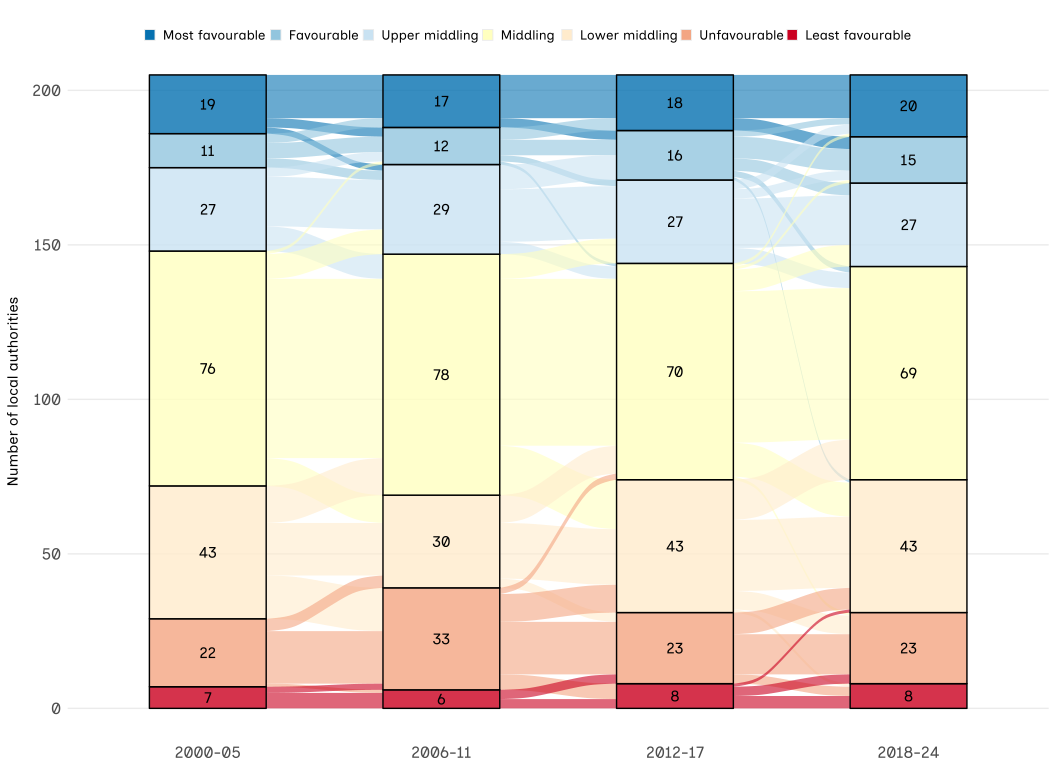
In our State of the Nation 2024 report we ranked LAs as having ‘most favourable’, ‘favourable’, ‘middling’, ‘unfavourable’ and ‘least favourable’ conditions. We follow the same basic classification with the revised index, but have now further distinguished ‘lower middling’, ‘middle middling’ and ‘upper middling’ groups. We find that there is a high level of stability over time in the composition of these 3 middling groups. In the figures below we use the following colour-coding: Most favourable, favourable, upper middling, middle middling, lower middling, unfavourable, least favourable.
The measures for each LA are estimated using a multilevel model which shrinks values from LAs with small sample sizes to reduce the risk of implausibly extreme results.[footnote 9]
Finally, we must emphasise that these composite measures are designed to compare LAs. In this sense, they are relative measures, telling us about young people’s mobility (in the case of Promising Prospects), or the drivers of mobility (in the case of other composites).
Changes in the Conditions of Childhood index
How the measure works
The first composite index based on drivers is called Conditions of Childhood. It measures the socio-economic conditions of families with children. This covers childhood poverty, parental education, parental working-class occupation and parental professional occupation.
Research shows that children growing up in disadvantaged socio-economic conditions have poorer chances of obtaining high-level occupations in their careers than those growing up in more advantaged conditions.[footnote 10] There are also likely to be spillover effects, with poorer mobility outcomes even for people with more advantaged family backgrounds who live in the same neighbourhoods. These effects can act through, for example, peer influences, or exposure to violence.[footnote 11]
Therefore, areas with higher levels of disadvantage typically have lower levels of overall social mobility.
The revised index uses the following 4 indicators, which have been consistently measured in the nationally representative LFS’s across the whole 2000 to 2024 period. The main change we made is to replace the indicator used previously on children in poverty (for which the data at LA level does not go back to 2000) with a new measure of the income levels of households with children.
Table 3.3: Summary of the Conditions of Childhood index, based on drivers.
| Indicator | Data used |
|---|---|
| Driver (DR) 1.2 Childhood poverty | Estimated hourly pay for individuals aged over 21 years with dependent children in their family. |
| DR 1.3 Distribution of parental education | Estimated proportion of degree-level education among individuals aged over 21 years with dependent children in their family. |
| DR 1.4a Distribution of parental occupation (professional) | Estimated proportion of professional-class occupations among individuals aged over 21 years with dependent children in their family. |
| DR 1.4b Distribution of parental occupation (working class) | Estimated proportion of working-class occupations among individuals aged over 21 years with dependent children in their family. |
Trends over time
Figure 3.1: There is stability over time in LAs’ positions on the conditions of childhood index.
Change over time in the number of LAs across categories for the conditions of childhood index.
Explore and download the data: Conditions of childhood (State of the Nation data explorer)
Source: Our calculations based on pooled LFS data from 2000 to 2024.
Notes: See the technical annex for details of the construction of the index.
Entrenched disadvantage
In table 3.4, we show the LAs which largely remained in an ‘unfavourable’ or ‘least favourable’ position throughout the 24-year period. In order to increase sample sizes, we distinguish 4 periods, the first 3 covering 6 years each, and the fourth (when LFS samples dropped in size) covering 7 years.[footnote 12]
Table 3.4: Most of the LAs experiencing ‘entrenched disadvantage’ over time on the Conditions of Childhood index were in the West Midlands or north of England.
LAs that were in ‘unfavourable’ or ‘least favourable’ positions both in the 2000 to 2005 and 2018 to 2024 periods on the Conditions of Childhood index.
| 2000 to 2005 | 2006 to 2011 | 2012 to 2017 | 2018 to 2024 | |
|---|---|---|---|---|
| Hartlepool | -1.19 (U) | -0.75 (LM) | -1.33 (U) | -1.27 (U) |
| Oldham | -1.02 (U) | -1.04 (U) | -1.40 (U) | -1.45 (U) |
| Doncaster | -1.37 (U) | -1.48 (U) | -1.18 (U) | -1.32 (U) |
| Barnsley | -1.36 (U) | -1.10 (U) | -1.24 (U) | -1.25 (U) |
| Walsall | -1.13 (U) | -1.26 (U) | -1.17 (U) | -1.38 (U) |
| Sunderland | -1.25 (U) | -1.10 (U) | -1.25 (U) | -1.20 (U) |
| Redcar and Cleveland | -1.25 (U) | -1.13 (U) | -1.13 (U) | -1.46 (U) |
| North Lincolnshire | -1.35 (U) | -1.10 (U) | -1.04 (U) | -1.43 (U) |
| Merthyr Tydfil | -1.20 (U) | -1.54 (LF) | -1.18 (U) | -1.15 (U) |
| Wolverhampton | -1.23 (U) | -1.05 (U) | -0.81 (LM) | -1.53 (LF) |
| Blackburn with Darwen | -1.17 (U) | -1.16 (U) | -1.06 (U) | -2.14 (LF) |
| North East Lincolnshire | -1.43 (U) | -1.31 (U) | -1.73 (LF) | -1.87 (LF) |
| Leicester | -1.37 (U) | -1.49 (U) | -1.74 (LF) | -1.80 (LF) |
| Newham | -1.62 (LF) | -1.62 (LF) | -1.27 (U) | -1.03 (U) |
| Stoke-on-Trent | -1.71 (LF) | -1.59 (LF) | -1.60 (LF) | -1.21 (U) |
| Blaenau Gwent | -1.96 (LF) | -1.79 (LF) | -1.59 (LF) | -1.23 (U) |
| Middlesbrough | -1.62 (LF) | -1.14 (U) | -1.27 (U) | -1.75 (LF) |
| Sandwell | -1.65 (LF) | -1.49 (U) | -2.01 (LF) | -1.65 (LF) |
| Kingston upon Hull | -1.76 (LF) | -1.91 (LF) | -2.03 (LF) | -1.93 (LF) |
Source: Our calculations based on pooled LFS data from 2000 to 2024.
Notes: Local authorities are categorised into 7 ranked groups based on their ‘z-scores’. These groups have been abbreviated in the table as: most favourable (MF), favourable (F), upper middling (UM), middling (M), lower middling (LM), unfavourable (U), least favourable (LF).
These scores are estimates based on survey data, so may not be exact for every LA. Please use them as a guide, rather than precise measurements. See the technical annex for details of the construction of the index.
In total, 19 LAs were classified as having either ‘most unfavourable’ or ‘unfavourable’ positions both in the first and last period. These were:
- Hartlepool, Middlesbrough, Redcar and Cleveland, and Sunderland in the North East of England
- Oldham and Blackburn with Darwen in the North West of England
- Barnsley, Doncaster, Kingston upon Hull, North East Lincolnshire, North Lincolnshire in Yorkshire and the Humber
- Sandwell, Stoke-on-Trent, Walsall and Wolverhampton in the West Midlands
- Leicester in the East Midlands
- Merthyr Tydfil and Blaenau Gwent in South Wales
There was only one LA classified as ‘most unfavourable’ or ‘unfavourable’, Newham, in London, and none in Scotland or South West and South East England.
Several of these areas were formerly important centres where coal mining was a major industry in the first half of the 20th century, while many of the others were cities which had histories of manufacturing and shipbuilding. Relatively few were rural areas. While the decline of mining and manufacturing as major employers dates back 40 or 50 years, it is likely that these areas are still suffering the after-effects of the de-industrialisation of the 1980s.
Relative decline
In table 3.5, we show the LAs which had moved down over the 21st century into the ‘unfavourable’ and ‘least favourable’ categories. Most of these changes are fairly modest, such as the 9 LAs that moved from the ‘lower middling’ category in the 2000 to 2005 period down to the ‘unfavourable’ category in the most recent 2018 to 2024 period. For example, the scores for Blackpool, Durham and Pembrokeshire shift from just below the threshold to just over the threshold for being classed as ‘unfavourable’. Of perhaps more concern is Rochdale, which moved from the ‘lower middling’ down to the ‘least favourable’ category.
Conwy and Denbighshire in north Wales are also notable, both moving the longer distance from the middle category down to the ‘unfavourable’ category.
A distinct process might be involved in the cases of rural and sparsely populated LAs compared to those in former industrial centres. Detailed case studies are required to gain more understanding of these changes.
Table 3.5: LAs where conditions of childhood became unfavourable over time included both rural areas in Wales as well as former mining and industrial areas.
LAs that moved down from a ‘middling’ into an ‘unfavourable’ or ‘least favourable’ position by the 2018 to 2024 period on the Conditions of Childhood index.
| 2000 to 2005 | 2006 to 2011 | 2012 to 2017 | 2018 to 2024 | |
|---|---|---|---|---|
| Conwy | -0.29 (M) | -0.40 (M) | -0.86 (LM) | -1.03 (U) |
| Denbighshire | -0.30 (M) | -0.07 (M) | -0.61 (LM) | -1.19 (U) |
| West Dunbartonshire | -0.79 (LM) | -0.63 (LM) | -0.39 (M) | -1.19 (U) |
| North Lanarkshire | -0.82 (LM) | -0.57 (LM) | -0.57 (LM) | -1.05 (U) |
| Durham | -0.92 (LM) | -0.77 (LM) | -0.61 (LM) | -1.04 (U) |
| Bradford | -0.78 (LM) | -0.93 (LM) | -1.03 (U) | -1.06 (U) |
| Pembrokeshire | -0.99 (LM) | -1.21 (U) | -0.70 (LM) | -1.08 (U) |
| Luton | -0.66 (LM) | -1.16 (U) | -1.10 (U) | -1.05 (U) |
| North Ayrshire | -0.71 (LM) | -1.31 (U) | -1.05 (U) | -1.45 (U) |
| Blackpool | -0.85 (LM) | -1.36 (U) | -1.57 (LF) | -1.00 (U) |
| Rhondda Cynon Taf | -0.80 (LM) | -1.00 (U) | -0.63 (U) | -1.17 (U) |
| Rochdale | -0.82 (LM) | -0.67 (LM) | -1.25 (U) | -1.55 (LF) |
Source: Our calculations based on pooled LFS data from 2000 to 2024.
Notes: Local authorities are categorised into 7 ranked groups based on their ‘z-scores’. These groups have been abbreviated in the table as: most favourable (MF), favourable (F), upper middling (UM), middling (M), lower middling (LM), unfavourable (U), least favourable (LF).
These scores are estimates based on survey data, so may not be exact for every LA. Please use them as a guide, rather than precise measurements. See the technical annex for details of the construction of the index.
Escape from disadvantage
Table 3.6 shows LAs that have moved up into more favourable conditions. As with table 3.5, table 3.6 shows that most movement is short-range. Eight LAs moved the short distance from the ‘unfavourable’ category into the ‘lower middling’ category. More strikingly, however, Tower Hamlets moved from the ‘least favourable’ category at the beginning of the century to a lower middling position 2 decades later. Encouragingly, progress was spread across the country and not confined to London.
Table 3.6: Progress was not confined to London but was spread across parts of the UK.
LAs that moved out of ‘unfavourable’ or ‘least favourable’ positions in the 2000 to 2005 period into ‘middling’ positions in the 2018 to 2024 period on the Conditions of Childhood index.
| 2000 to 2005 | 2006 to 2011 | 2012 to 2017 | 2018 to 2024 | |
|---|---|---|---|---|
| Neath Port Talbot | -1.11 (U) | -1.27 (U) | -0.42 (M) | -0.33 (M) |
| Caerphilly | -1.06 (U) | -0.96 (LM) | -0.95 (LM) | -0.84 (LM) |
| Torbay | -1.13 (U) | -0.67 (LM) | -0.73 (LM) | -0.75 (LM) |
| South Tyneside | -1.08 (U) | -0.87 (LM) | -0.90 (LM) | -0.58 (LM) |
| Nottingham | -1.32 (U) | -1.05 (U) | -0.96 (LM) | -0.94 (LM) |
| Manchester | -1.07 (U) | -1.05 (U) | -0.71 (LM) | -0.60 (LM) |
| Barking and Dagenham | -1.13 (U) | -1.06 (U) | -1.08 (U) | -0.86 (LM) |
| East Ayrshire | -1.14 (U) | -1.21 (U) | -1.34 (U) | -0.54 (LM) |
| Knowsley | -1.34 (U) | -1.47 (U) | -1.17 (U) | -0.89 (LM) |
| Tower Hamlets | -1.89 (LF) | -1.52 (LF) | -1.07 (U) | -0.68 (LM) |
Source: Our calculations based on pooled LFS data from 2000 to 2024.
Notes: Local authorities are categorised into 7 ranked groups based on their ‘z-scores’. These groups have been abbreviated in the table as: most favourable (MF), favourable (F), upper middling (UM), middling (M), lower middling (LM), unfavourable (U), least favourable (LF).
These scores are estimates based on survey data, so may not be exact for every LA. Please use them as a guide, rather than precise measurements. See the technical annex for details of the construction of the index.
Different social and economic processes may bring these changes. One process is that of ‘gentrification’ as younger professionals who cannot afford the (rising) house prices in, for example, central London move into neighbouring boroughs with slightly more affordable housing. A rise in house prices (and rents) may be a response to the economic dynamism of London as a post-industrial global city. Again, case studies are required to understand this in more detail, but there are likely to be population movements between neighbouring boroughs in large metropolitan areas with effective transport networks.
Population movements of this kind could also explain some of the declines into disadvantage. Rural areas might see an exodus of young people with high qualifications moving out into expanding metropolitan areas with greater opportunities for professional work, leaving behind a somewhat more disadvantaged population.[footnote 13]
Persistent advantage
We can also look at movements of LAs into and out of favourable positions on the Conditions of Childhood index. Table 3.7 shows the LAs that remained in a ‘favourable’ or ‘most favourable’ position.
Table 3.7: Persistent advantage is most clear in and around London but also occurs around other major cities.
LAs that were in ‘favourable’ or ‘most favourable’ positions both in the 2000 to 2005 and 2018 to 2024 periods on the Conditions of Childhood index.
| 2000 to 2005 | 2006 to 2011 | 2012 to 2017 | 2018 to 2024 | |
|---|---|---|---|---|
| Richmond upon Thames | 4.26 (MF) | 3.85 (MF) | 3.48 (MF) | 2.56 (MF) |
| Kingston upon Thames | 2.29 (MF) | 2.30 (MF) | 1.93 (MF) | 1.94 (MF) |
| Kensington and Chelsea | 2.03 (MF) | 2.39 (MF) | 1.69 (MF) | 2.05 (MF) |
| Hammersmith and Fulham | 1.63 (MF) | 2.25 (MF) | 1.96 (MF) | 2.17 (MF) |
| Wandsworth | 2.75 (MF) | 2.43 (MF) | 3.10 (MF) | 2.64 (MF) |
| Windsor and Maidenhead | 2.71 (MF) | 1.95 (MF) | 2.31 (MF) | 2.19 (MF) |
| Surrey | 2.21 (MF) | 2.19 (MF) | 1.92 (MF) | 2.08 (MF) |
| Wokingham | 2.36 (MF) | 2.45 (MF) | 2.50 (MF) | 2.38 (MF) |
| Edinburgh | 1.69 (MF) | 1.55 (MF) | 1.72 (MF) | 1.52 (MF) |
| East Dunbartonshire | 1.66 (MF) | 1.69 (MF) | 2.10 (MF) | 1.69 (MF) |
| East Renfrewshire | 2.29 (MF) | 1.53 (MF) | 1.22 (F) | 1.62 (MF) |
| West Berkshire | 1.54 (MF) | 1.13 (F) | 1.69 (MF) | 1.59 (MF) |
| Buckinghamshire | 2.00 (MF) | 2.00 (MF) | 1.67 (MF) | 1.48 (F) |
| Barnet | 1.79 (MF) | 1.83 (MF) | 1.72 (MF) | 1.37 (F) |
| Hertfordshire | 1.58 (MF) | 1.71 (MF) | 1.48 (F) | 1.42 (F) |
| Harrow | 1.61 (MF) | 0.89 (UM) | 0.66 (UM) | 1.24 (F) |
| Brighton and Hove | 1.52 (MF) | 1.37 (F) | 1.41 (F) | 1.24 (F) |
| Bath and North East Somerset | 1.60 (MF) | 1.40 (F) | 1.17 (F) | 1.44 (F) |
| Camden | 1.45 (F) | 2.48 (MF) | 2.18 (MF) | 2.14 (MF) |
| Bromley | 1.48 (F) | 1.63 (MF) | 1.77 (MF) | 1.60 (MF) |
| Oxfordshire | 1.38 (F) | 1.35 (F) | 1.60 (MF) | 1.60 (MF) |
| Ealing | 1.18 (F) | 0.98 (UM) | 0.52 (UM) | 1.58 (MF) |
| Merton | 1.24 (F) | 1.20 (F) | 2.01 (MF) | 1.27 (F) |
| Solihull | 1.35 (F) | 1.03 (F) | 0.91 (UM) | 1.23 (F) |
Source: Our calculations based on pooled LFS data from 2000 to 2024.
Notes: Local authorities are categorised into 7 ranked groups based on their ‘z-scores’. These groups have been abbreviated in the table as: most favourable (MF), favourable (F), upper middling (UM), middling (M), lower middling (LM), unfavourable (U), least favourable (LF).
These scores are estimates based on survey data, so may not be exact for every LA. Please use them as a guide, rather than precise measurements. See the technical annex for details of the construction of the index.
In table 3.7 we see that 12 LAs were in the ‘most favourable’ category (coloured blue) both in the 2000 to 2005 and 2018 to 2024 periods whereas table 3.4 showed only a few LAs were in the least favourable category (coloured red) throughout.
Table 3.7 reflects the findings reported in our State of the Nation 2024 report, that the most favoured LAs tend to be in London and the Home Counties. However, they are joined by Edinburgh and 2 authorities in the commuter belt around Glasgow, as well as Solihull (in the Birmingham commuter belt).
Progress towards greater advantage
Table 3.8 shows the 11 LAs that had improved their position over time and moved up into ‘favourable’ or ‘most favourable’ positions. This has some parallels with table 3.6 (showing progress out of unfavourable positions into middling positions) and table 3.7 (showing persistent advantage). Several London boroughs made great progress over the 2 decades moving from middling positions to relatively advantaged ones. This perhaps reflects the same processes of gentrification that we mentioned in the context of Tower Hamlets. While London boroughs once again appear in table 3.8, similar changes are also happening in the Manchester commuter belt (Stockport, Cheshire West and Chester, and Trafford).
Table 3.8: Progress towards greater advantage is clear in the commuter belt around Manchester as well as in London and its commuter belt.
LAs that moved up from a ‘middling’ position in the 2000 to 2005 period to a ‘favourable’ or ‘most favourable’ position in the 2018 to 2024 period on the Conditions of Childhood index.
| 2000 to 2005 | 2006 to 2011 | 2012 to 2017 | 2018 to 2024 | |
|---|---|---|---|---|
| Westminster | 0.71 (UM) | 1.05 (F) | 1.89 (MF) | 1.24 (F) |
| Sutton | 0.94 (UM) | 0.85 (UM) | 1.33 (F) | 1.70 (MF) |
| Cheshire West and Chester | 0.59 (UM) | 0.57 (UM) | 0.70 (UM) | 1.61 (MF) |
| Trafford | 0.62 (UM) | 1.42 (F) | 1.13 (F) | 1.47 (F) |
| Lewisham | 0.58 (UM) | 0.76 (UM) | 1.29 (F) | 1.35 (F) |
| Reading | 0.78 (UM) | 0.71 (UM) | 1.20 (F) | 1.04 (F) |
| Aberdeenshire | 0.71 (UM) | 0.49 (M) | -0.11 (M) | 1.02 (F) |
| Islington | 0.62 (UM) | 1.49 (F) | 0.46 (M) | 1.60 (MF) |
| Stockport | 0.33 (M) | 1.06 (F) | 1.09 (F) | 1.13 (F) |
| Lambeth | 0.40 (M) | 0.72 (UM) | 0.86 (UM) | 1.77 (MF) |
| Southwark | 0.27 (M) | 0.37 (M) | 0.83 (UM) | 1.44 (F) |
Source: Our calculations based on pooled LFS data from 2000 to 2024.
Notes: Local authorities are categorised into 7 ranked groups based on their ‘z-scores’. These groups have been abbreviated in the table as: most favourable (MF), favourable (F), upper middling (UM), middling (M), lower middling (LM), unfavourable (U), least favourable (LF).
These scores are estimates based on survey data, so may not be exact for every LA. Please use them as a guide, rather than precise measurements. See the technical annex for details of the construction of the index.
Different processes might be involved with the rising position of Reading. Although the London Underground Elizabeth Line brings Reading within commuting distance of the city, social geographers normally assign it to a separate commuting zone from London.[footnote 14] The Reading travel-to-work area includes Wokingham and Bracknell Forest, and parts of West Berkshire, Hampshire and Oxfordshire. This area should be thought of as a separate economic centre and labour market from London. As we shall read later, Reading also scores highly on the Innovation and Growth index.
Decline from advantage
Table 3.9 shows the 6 areas that declined from their favourable positions at the turn of the 21st century. As before, most of the movement is only short distances and nearly all areas remained relatively advantaged throughout.
Table 3.9: The areas that dropped out of the favourable category are all outside London.
LAs that moved down from a ‘favourable’ or ‘most favourable’ position in the 2000 to 2005 period to a ‘middling’ position in the 2018 to 2024 period on the Conditions of Childhood index.
| 2000 to 2005 | 2006 to 2011 | 2012 to 2017 | 2018 to 2024 | |
|---|---|---|---|---|
| Rutland | 1.62 (MF) | 0.79 (UM) | 1.13 (F) | 0.64 (UM) |
| Stirling | 1.35 (F) | 1.60 (MF) | 1.41 (F) | 0.93 (UM) |
| Bracknell Forest | 1.37 (F) | 0.96 (UM) | 0.54 (UM) | 0.77 (UM) |
| Cambridgeshire | 1.12 (F) | 1.29 (F) | 0.92 (UM) | 0.83 (UM) |
| Cheshire East | 1.13 (F) | 1.26 (F) | 1.22 (F) | 0.61 (UM) |
| Monmouthshire | 1.39 (F) | 0.72 (UM) | 0.86 (UM) | 0.42 (M) |
Source: Our calculations based on pooled LFS data from 2000 to 2024.
Notes: These scores are estimates based on survey data, so may not be exact for every LA. Please use them as a guide, rather than precise measurements. See the technical annex for details of the construction of the index.
Conclusions
In summary, our analysis shows that there is considerable stability over time in LAs’ positions on the Conditions of Childhood index. Twenty-four LAs have been persistently advantaged, outnumbering the 11 that moved up out of the middling categories and the 6 that moved down into middling ones. Where there is movement up or down, change has been gradual rather than transformational.
While detailed case studies are needed to fully understand why particular authorities have changed their position, some patterns do seem to be reasonably clear. First, we see the long shadow of history – in particular a history of de-industrialisation.[footnote 15] Many of the areas experiencing entrenched disadvantaged were ones where mining and traditional manufacturing have declined or disappeared. Second, we see the impact of post-industrialism with global cities and their service economies leading the way. Furthermore, while London is the UK’s pre-eminent global city, the shift to post-industrialism is not restricted to London but can be seen elsewhere, both in other parts of the South East outside London and around Manchester in the North West of England. For more information, take a look at the discussion about the Innovation and Growth index on page 79.[footnote 16]
We also need to remember that in large metropolitan areas such as London, Birmingham, Glasgow and Manchester there will be complex processes of migration between neighbouring boroughs within the commuting zones. This reflects a variety of factors such as stage in the life-cycle (early careers through to retirement), housing and rental prices, and affordability of transport.
Changes in the Labour Market Opportunities for young people index
How the measure works
The Labour Market Opportunities for young people index measures the economic situation in each LA of young people at the start of their careers. There is substantial evidence that there are long-term scarring effects of early-career unemployment and low-skilled work on people’s future prospects for upward mobility.[footnote 17] The concern is that some local labour markets may have fewer entry-level vacancies or are focused on low-skilled work that provides little training or skill development and fewer pathways for career progression.
The ideal measure of labour market opportunities for young people would cover the number and type of vacancies for entry-level jobs. Unfortunately this data is not currently available across LAs. So we developed a proxy measure for our State of the Nation 2024 report based on the actual unemployment rates and occupational levels of young people in each area.[footnote 18] For technical reasons, this measure proved unsuitable for time series analysis and so we revised the index. We replaced the indicator of young peoples’ unemployment rates with a measure of their earnings to ensure comparison over time.[footnote 19]
Table 3.10: Summary of the Labour Market Opportunities for young people index, based on drivers.
| Indicator | Data used |
|---|---|
| DR 3.3a Type of employment opportunities for young people (professional) | Estimated proportion of young people aged 16 to 29 years with a professional occupation. |
| DR 3.3b Type of employment opportunities for young people (working class) | Estimated proportion of young people aged 16 to 29 years with a working-class occupation. |
| DR 3.4 Hourly pay for young people | Estimated hourly pay for economically active individuals aged 16 to 29 years. |
The Labour Market Opportunities for young people index, which combines indicators driver 3.3 and driver 3.4, benefits from comprehensive data availability. Data for drivers 3.3 and 3.4 is accessible from the LFS for the period 2000 to 2024 by LA level. These extensive datasets allow a straightforward trend analysis.
Trends over time
The results for the Labour Market Opportunities for young people index are quite similar to those for the Conditions of Childhood index. Many of the same LAs appear in both lists of entrenched disadvantages and persistent advantages[footnote 20]. However, there are more ‘middling’ LAs on the Labour Market Opportunities for young people index and fewer ones at the extremes of ‘most favourable’ or ‘least favourable’. This means that LAs are more equal on labour market opportunities than on conditions of childhood.
There is also more change in LA scores on the Labour Market Opportunities for young people index than for the Conditions of Childhood index.[footnote 21] This could reflect that the pattern of opportunities for young people is often more sensitive to the ups and downs of the economy than for older people.[footnote 22]
Figure 3.2: The labour market opportunities for young people index features more ‘middling’ LAs and fewer extreme cases.
Change over time of the number of LAs across categories for the labour market opportunities for young people index.

Explore and download the data: Labour market opportunities for young people (State of the Nation data explorer)
Source: Our calculations based on pooled LFS data from 2000 to 2024.
Notes: See the technical annex for details of the construction of the index.
Entrenched disadvantage
Turning to the detailed results, we focus on the LAs with unfavourable labour market conditions. First, in table 3.11, we show the LAs which were in an ‘unfavourable’ or ‘least favourable’ position both in the earliest and most recent of our 4 periods.
Table 3.11: Few LAs experienced entrenched disadvantage, although all were outside London and the South East.
LAs that were in ‘unfavourable’ or ‘least favourable’ positions both in the 2000 to 2005 and 2018 to 2024 periods on the Labour Market Opportunities for young people index.
| 2000 to 2005 | 2006 to 2011 | 2012 to 2017 | 2018 to 2024 | |
|---|---|---|---|---|
| Stockton-on-Tees | -1.07 (U) | -0.25 (M) | -0.35 (M) | -1.30 (U) |
| Cornwall | -1.25 (U) | -0.92 (LM) | -0.87 (LM) | -1.06 (U) |
| Durham | -1.20 (U) | -0.54 (LM) | -0.94 (LM) | -1.11 (U) |
| North Ayrshire | -1.11 (U) | -1.30 (U) | -0.97 (LM) | -1.04 (U) |
| Middlesbrough | -1.20 (U) | -1.06 (U) | -0.61 (LM) | -1.13 (U) |
| North Lincolnshire | -1.00 (U) | -0.76 (LM) | -1.29 (U) | -1.23 (U) |
Source: Our calculations based on pooled LFS 2000 to 2024.
Notes: Local authorities are categorised into 7 ranked groups based on their ‘z-scores’. These groups have been abbreviated in the table as: most favourable (MF), favourable (F), upper middling (UM), middling (M), lower middling (LM), unfavourable (U), least favourable (LF).
These scores are estimates based on survey data, so may not be exact for every LA. Please use them as a guide, rather than precise measurements. See the technical annex for details of the construction of the index.
Whereas 19 LAs appeared in the parallel table for the Conditions of Childhood index (table 3.4 on page 59), only 6 appear in table 3.11 for the Labour Market Opportunities for young people index. No LA meets the threshold score for counting as ‘most unfavourable’. This partly reflects the greater instability of the labour market for young people as well as the great equality between LAs that we noted in figure 3.2.
Of the 6 in table 3.11, 3 were in the north of England – a region that is also over-represented in table 3.4. The tables both include former mining areas such as Durham and North Ayrshire, although it also includes the rural area of Cornwall.
Relative decline
Table 3.12: Labour market conditions became less favourable for young people in several rural districts of Scotland and one in Wales.
LAs that dropped down into an ‘unfavourable’ position by the 2018 to 2024 period on the Labour Market Opportunities for young people index.
| 2000 to 2005 | 2006 to 2011 | 2012 to 2017 | 2018 to 2024 | |
|---|---|---|---|---|
| Moray | 0.00 (LM) | -0.74 (LM) | -1.17 (U) | -1.26 (U) |
| Dundee | -0.99 (LM) | -0.19 (LM) | -0.28 (LM) | -1.07 (U) |
| Neath Port Talbot | -0.92 (LM) | -0.57 (LM) | -1.26 (U) | -1.03 (U) |
| Fife | -0.73 (LM) | -0.70 (LM) | -0.54 (LM) | -1.11 (U) |
| Argyll and Bute Islands | -0.74 (LM) | -0.26 (M) | -1.15 (U) | -1.19 (U) |
| Scottish Borders | -0.99 (LM) | -1.32 (U) | -0.83 (LM) | -1.04 (U) |
| Shetland Islands | -0.70 (LM) | -0.43 (M) | -1.08 (U) | -1.08 (U) |
| Na h-Eileanan Siar (Outer Hebrides) | -0.90 (LM) | -0.61 (LM) | -1.03 (U) | -1.10 (U) |
Source: Our calculations based on pooled LFS data from 2000 to 2024.
Notes: These scores are estimates based on survey data, so may not be exact for every LA. Please use them as a guide, rather than precise measurements. See the technical annex for details of the construction of the index.
Fewer LAs dropped down into an unfavourable situation than was the case with the Conditions of Childhood index (shown in table 3.5 on page 60). A major difference, however, is the presence of a number of rural areas, especially in Scotland – Argyll and Bute Islands, Moray, Scottish Borders, Shetland Islands and Na h-Eileanan Siar (Outer Hebrides).
These results should be treated with caution as estimates are volatile and there are few steady trends across periods.[footnote 23] Nonetheless, the pattern does suggest that there is an emerging problem of lack of opportunity for young people in more rural areas with long travel distances to major centres of FE and employment. The cost of commuting is particularly heavy for young people given their lower wages (and benefits).
Escape from disadvantage
There are more examples of LAs that have moved up out of the ‘unfavourable’ category than have moved down into it. This reflects the finding that there was an increase in the proportion of ‘middling’ LAs on this index over time.[footnote 24]
A notable feature of table 3.13 is the progress made by council districts in Wales. Blaenau Gwent, Swansea, Ceredigion, Gwynedd, Isle of Anglesey, Merthyr Tydfil, Rhondda Cynon Taf and Pembrokeshire all improved their positions. This list covers a mix of urban and rural areas, and is not the reverse of the Scottish case shown in table 3.12. One factor differentiating the Scottish and Welsh cases might be the travel distances to major urban centres, but more in-depth studies are required.
Table 3.13: Several districts of Wales moved out of unfavourable positions on the Labour Market Opportunities for young people index.
LAs that moved up from ‘unfavourable’ or ‘least favourable’ positions in the 2000 to 2005 period into ‘middling’ positions in the 2018 to 2024 period on the Labour Market Opportunities for young people index.
| 2000 to 2005 | 2006 to 2011 | 2012 to 2017 | 2018 to 2024 | |
|---|---|---|---|---|
| West Dunbartonshire | -1.08 (U) | -0.65 (LM) | -0.82 (LM) | 0.03 (M) |
| Stoke-on-Trent | -1.18 (U) | -0.60 (LM) | -0.55 (LM) | -0.56 (LM) |
| Swansea | -1.15 (U) | -0.90 (LM) | -0.89 (LM) | -0.62 (LM) |
| Gwynedd | -1.05 (U) | -0.81 (LM) | -0.42 (M) | -0.87 (LM) |
| Isle of Anglesey | -1.33 (U) | -0.88 (LM) | -0.70 (LM) | -0.94 (LM) |
| Lincolnshire | -1.03 (U) | -0.83 (LM) | -0.64 (LM) | -0.93 (LM) |
| Rhondda Cynon Taf | -1.28 (U) | -0.95 (LM) | -1.02 (U) | -0.66 (LM) |
| Merthyr Tydfil | -1.07 (U) | -1.06 (U) | -0.06 (M) | -0.79 (LM) |
| Hartlepool | -1.08 (U) | -0.40 (M) | -1.25 (U) | -0.83 (LM) |
| Kingston upon Hull | -1.28 (U) | -1.28 (U) | -0.52 (LM) | -0.93 (LM) |
| Blaenau Gwent | -1.16 (U) | -1.26 (U) | -1.34 (U) | -0.79 (LM) |
| Ceredigion | -1.31 (U) | -1.45 (U) | -1.36 (U) | -0.65 (LM) |
| East Ayrshire | -1.00 (U) | -1.32 (U) | -1.18 (U) | -0.64 (LM) |
| Pembrokeshire | -1.05 (U) | -1.53 (LF) | -0.42 (M) | -0.90 (LM) |
| North East Lincolnshire | -1.68 (LF) | -1.16 (U) | -0.42 (M) | -0.40 (M) |
Source: Our calculations based on pooled LFS data from 2000 to 2024.
Notes: Local authorities are categorised into 7 ranked groups based on their ‘z-scores’. These groups have been abbreviated in the table as: most favourable (MF), favourable (F), upper middling (UM), middling (M), lower middling (LM), unfavourable (U), least favourable (LF).
These scores are estimates based on survey data, so may not be exact for every LA. Please use them as a guide, rather than precise measurements. See the technical annex for details of the construction of the index.
Conclusions
In summary, labour market opportunities for young people trends differ noticeably between Wales and rural Scotland. This might be because greater distances in rural areas of Scotland make access to major cities or large conurbations especially difficult and costly. The same is also true for larger rural authorities in England such as Cornwall.
Changes in the Innovation and Growth index
How the measure works
A favourable educational, technical and economic infrastructure often promotes local growth, encouraging investment and expanding professional and business opportunities in the area. This provides opportunities for upward mobility. In contrast, areas with lower levels of human capital, a weaker infrastructure and less investment are more likely to miss out on economic growth.[footnote 25] The impact on social mobility tends to be indirect, operating via local growth rates, but is nonetheless potentially important. It is important to measure an area’s capacity for innovation and test whether a favourable environment can promote growth and upward mobility in the future.
Table 3.14: Summary of the composite Innovation and Growth index, based on drivers.
| Indicator | Data used |
|---|---|
| DR 5.3 Postgraduate education | Estimated proportion of higher degrees among economically active individuals aged 25 to 64 years. |
| DR 5.4 New economy occupations | Estimated proportion of new economy occupations among economically active individuals aged 25 to 64 years. |
| DR 5.5 Economic output | Gross value added per head. |
The concept of ‘new economy’ occupations refers to those roles at the leading edge of research, innovation and development across the growth areas of a post-industrial economy. As well as natural and social scientists, this includes engineers and technologists, scientific technicians, IT and computer specialists, graphic, industrial and other creative designers, and business and financial professionals.[footnote 26] The data for driver (DR) 5.3 and 5.4 is accessible from the LFS for the period 2000 to 2024 by LA level. Data for the DR 5.5 indicator is accessible from the Office for National Statistics’ Gross Value Added dataset for the period 2000 to 2022.[footnote 27]
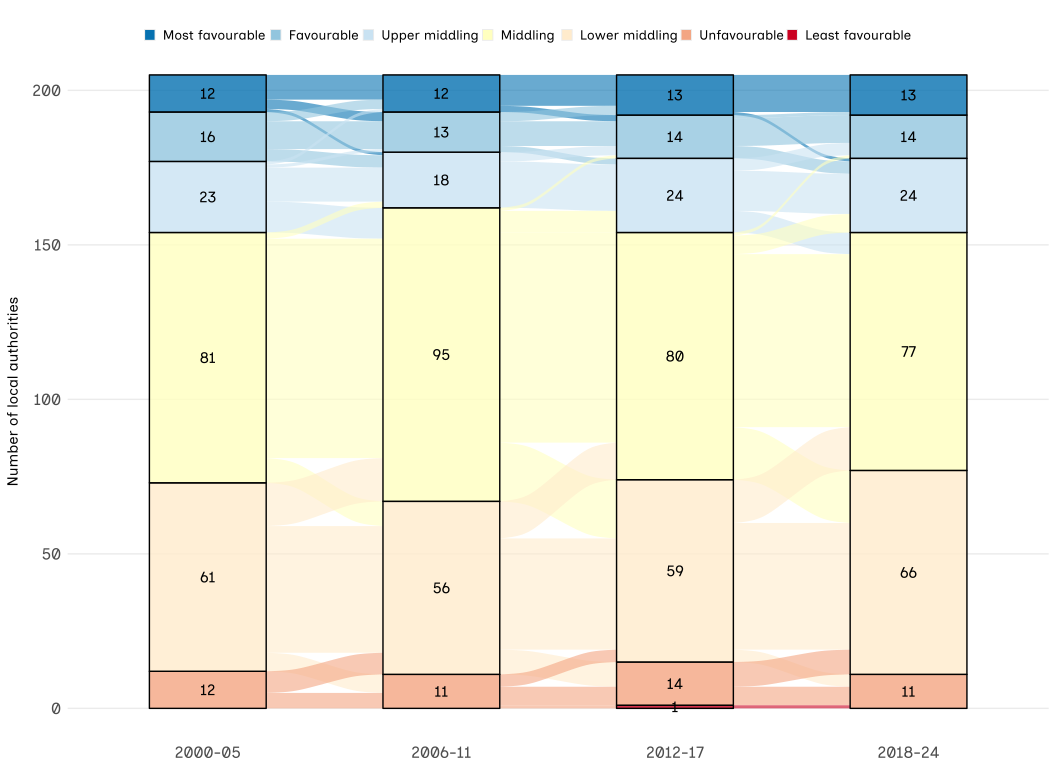
The resulting composite index has acceptable technical properties and ‘equivalence of meaning’ over time. However, it is more unbalanced than the previous 2 drivers: it has a longer tail of areas with favourable circumstances (25 to 28 LAs) and a shorter tail of areas with unfavourable circumstances (11 to 15 LAs).[footnote 28]
Trends over time
Figure 3.3. The innovation and growth index skewed towards the positive: many areas are favourable, but only a few are unfavourable.
Change over time of the number of LAs across categories for the innovation and growth index.
Explore and download the data: Innovation and growth (State of the Nation data explorer)
Source: Our calculations based on pooled LFS data from 2000 to 2024.
Notes: These scores are estimates based on survey data, so may not be exact for every LA. Please use them as a guide, rather than precise measurements. See the technical annex for details of the construction of the index.
Entrenched disadvantage
We start with those LAs that experienced entrenched disadvantages in the Innovation and Growth index. There were in fact only 5 LAs in this situation – Merthyr Tydfil and Blaenau Gwent in south Wales along with Barnsley, Doncaster and North-East Lincolnshire in Yorkshire and the Humber. Four of the 5 had formerly been major centres of coal mining. As table 3.4 showed, all 5 also experienced entrenched disadvantage on the Conditions of Childhood index.
Table 3.15: The LAs experiencing entrenched disadvantages for the Innovation and Growth index also experienced the same disadvantage on the Conditions of Childhood index.
LAs that were in ‘unfavourable’ or ‘least favourable’ positions both in the 2000 to 2005 and 2018 to 2024 periods on the Innovation and Growth index.
| 2000 to 2005 | 2006 to 2011 | 2012 to 2017 | 2018 to 2024 | |
|---|---|---|---|---|
| Merthyr Tydfil | -1.12 (U) | -0.98 (LM) | -0.96 (LM) | -1.06 (U) |
| Barnsley | -1.17 (U) | -1.02 (U) | -1.07 (U) | -1.10 (U) |
| Blaenau Gwent | -1.17 (U) | -1.17 (U) | -1.52 (LF) | -1.23 (U) |
| Doncaster | -1.03 (U) | -1.01 (U) | -1.30 (U) | -1.14 (U) |
| North East Lincolnshire | -1.03 (U) | -0.90 (LM) | -1.38 (U) | -1.38 (U) |
Source: Our calculations based on pooled LFS data from 2000 to 2024.
Notes: Local authorities are categorised into 7 ranked groups based on their ‘z-scores’. These groups have been abbreviated in the table as: most favourable (MF), favourable (F), upper middling (UM), middling (M), lower middling (LM), unfavourable (U), least favourable (LF).
These scores are estimates based on survey data, so may not be exact for every LA. Please use them as a guide, rather than precise measurements. See the technical annex for details of the construction of the index.
Relative decline
There were also 6 LAs that dropped down from a ‘middling’ to an ‘unfavourable’ position between the 2000 to 2005 and 2018 to 2024 periods. All 6 had been ‘lower middling’ in the first period, and so the movements were quite small. It is also notable that 4 of the 6 – Blackburn with Darwen, North Lincolnshire, Redcar and Cleveland and Sandwell – had also appeared in the list of authorities experiencing entrenched disadvantage on childhood conditions.
Table 3.16: The LAs dropping down into unfavourable positions on the Innovation and Growth index were also disadvantaged on the Conditions of Childhood index.
LAs that dropped from a ‘middling’ into an ‘unfavourable’ position by the 2018 to 2024 period on the Innovation and Growth index.
| 2000 to 2005 | 2006 to 2011 | 2012 to 2017 | 2018 to 2024 | |
|---|---|---|---|---|
| Blackburn with Darwen | -0.91 (LM) | -0.67 (LM) | -0.76 (LM) | -1.12 (U) |
| North Lincolnshire | -0.72 (LM) | -0.70 (LM) | -0.92 (LM) | -1.14 (U) |
| Redcar and Cleveland | -0.86 (LM) | -0.63 (LM) | -0.73 (LM) | -1.21 (U) |
| Sandwell | -0.85 (LM) | -0.88 (LM) | -1.18 (U) | -1.02 (U) |
| North Ayrshire | -0.83 (LM) | -1.08 (U) | -1.06 (U) | -1.07 (U) |
| East Ayrshire | -0.96 (LM) | -1.06 (U) | -1.20 (U) | -1.13 (U) |
Source: Our calculations based on pooled LFS data from 2000 to 2024.
Notes: Local authorities are categorised into 7 ranked groups based on their ‘z-scores’. These groups have been abbreviated in the table as: most favourable (MF), favourable (F), upper middling (UM), middling (M), lower middling (LM), unfavourable (U), least favourable (LF).
These scores are estimates based on survey data, so may not be exact for every LA. Please use them as a guide, rather than precise measurements. See the technical annex for details of the construction of the index.
Escape from disadvantage
Table 3.17 shows that there were 7 LAs that had moved in the opposite direction, up from an unfavourable position in the first period to a middling position in the most recent period. Again, these movements were small and there was little evidence of major sustained progress over time.
Table 3.17: Most upward movements on the Innovation and Growth index were modest.
LAs that move up from ‘unfavourable’ positions in the 2000 to 2005 period into ‘middling’ positions by the 2018 to 2024 period on the Innovation and Growth index.
| 2000 to 2005 | 2006 to 2011 | 2012 to 2017 | 2018 to 2024 | |
|---|---|---|---|---|
| Isle of Wight | -1.10 (U) | -0.71 (LM) | -0.06 (M) | -0.65 (LM) |
| North Lanarkshire | -1.09 (U) | -0.87 (LM) | -0.83 (LM) | -0.94 (LM) |
| Knowsley | -1.17 (U) | -1.03 (U) | -1.04 (U) | -0.86 (LM) |
| Hartlepool | -1.03 (U) | -0.59 (LM) | -1.26 (U) | -0.96 (LM) |
| Na h-Eileanan Siar (Outer Hebrides) | -1.10 (U) | -0.67 (LM) | -0.29 (M) | -0.99 (LM) |
| Pembrokeshire | -1.15 (U) | -1.16 (U) | -0.91 (LM) | -0.99 (LM) |
| Walsall | -1.05 (U) | -0.78 (LM) | -1.09 (U) | -0.92 (LM) |
Source: Our calculations based on pooled LFS data from 2000 to 2024.
Notes: Local authorities are categorised into 7 ranked groups based on their ‘z-scores’. These groups have been abbreviated in the table as: most favourable (MF), favourable (F), upper middling (UM), middling (M), lower middling (LM), unfavourable (U), least favourable (LF).
These scores are estimates based on survey data, so may not be exact for every LA. Please use them as a guide, rather than precise measurements. See the technical annex for details of the construction of the index.
Persistent advantage
Just as in the case of the Conditions of Childhood index, London boroughs figure prominently among those consistently advantaged over the 21st century on the Innovation and Growth index. Several LAs outside London such as Aberdeen, Brighton and Hove, Bristol, Edinburgh, Oxfordshire and Reading also appear on the list. All of these cities were identified by the Centre for Cities as being in the top 20 leading the economy.[footnote 29] Bristol, Edinburgh and Oxford were also identified by Oxford Economics as global cities in the world top 200.[footnote 30]
Table 3.18: In addition to London boroughs, favourable centres for innovation and growth include Aberdeen, Brighton and Hove, Bristol, Edinburgh, Oxfordshire and Reading.
LAs that were in ‘favourable’ or ‘most favourable’ positions in the 2000 to 2005 and 2018 to 2024 periods on the Innovation and Growth index.
| 2000 to 2005 | 2006 to 2011 | 2012 to 2017 | 2018 to 2024 | |
|---|---|---|---|---|
| Camden | 6.84 (MF) | 6.79 (MF) | 6.45 (MF) | 5.82 (MF) |
| Westminster | 4.80 (MF) | 5.37 (MF) | 4.70 (MF) | 5.16 (MF) |
| Islington | 2.99 (MF) | 3.15 (MF) | 2.64 (MF) | 2.83 (MF) |
| Tower Hamlets | 2.34 (MF) | 2.67 (MF) | 2.97 (MF) | 2.50 (MF) |
| Richmond upon Thames | 2.34 (MF) | 1.96 (MF) | 1.91 (MF) | 2.06 (MF) |
| Hammersmith and Fulham | 2.06 (MF) | 1.74 (MF) | 1.71 (MF) | 2.13 (MF) |
| Edinburgh | 1.90 (MF) | 1.46 (MF) | 2.09 (MF) | 1.69 (MF) |
| Reading | 1.74 (MF) | 1.62 (MF) | 1.57 (MF) | 1.58 (MF) |
| Oxfordshire | 1.53 (MF) | 1.46 (F) | 1.60 (MF) | 1.68 (MF) |
| Kensington and Chelsea | 2.15 (MF) | 1.95 (MF) | 1.47 (F) | 1.49 (F) |
| Brighton and Hove | 1.52 (MF) | 1.04 (F) | 1.38 (F) | 1.09 (F) |
| Hackney | 1.40 (F) | 1.15 (F) | 1.35 (MF) | 2.07 (MF) |
| Wandsworth | 1.39 (F) | 1.97 (MF) | 1.87 (MF) | 1.66 (MF) |
| Southwark | 1.14 (F) | 1.86 (MF) | 2.04 (MF) | 1.82 (MF) |
| Lambeth | 1.39 (F) | 1.40 (F) | 1.83 (MF) | 1.89 (MF) |
| Haringey | 1.50 (F) | 1.08 (F) | 1.09 (F) | 1.46 (F) |
| Bristol | 1.23 (F) | 1.06 (F) | 1.13 (F) | 1.49 (F) |
| Aberdeen | 1.24 (F) | 1.44 (F) | 1.12 (F) | 1.11 (F) |
| Kingston upon Thames | 1.09 (F) | 1.32 (F) | 1.22 (F) | 1.39 (F) |
| Barnet | 1.10 (F) | 1.46 (F) | 1.41 (F) | 1.38 (F) |
| Merton | 1.33 (F) | 1.48 (F) | 0.93 (UM) | 1.16 (F) |
Source: Our calculations based on pooled LFS data from 2000 to 2024.
Notes: Local authorities are categorised into 7 ranked groups based on their ‘z-scores’. These groups have been abbreviated in the table as: most favourable (MF), favourable (F), upper middling (UM), middling (M), lower middling (LM), unfavourable (U), least favourable (LF).
These scores are estimates based on survey data, so may not be exact for every LA. Please use them as a guide, rather than precise measurements. See the technical annex for details of the construction of the index.
Progress towards greater advantage
There was also progress outside London as well as within London on the Innovation and Growth index, notably in Wokingham and West Berkshire (which both fall into the Reading travel-to-work area) and in Hounslow (which is part of the Slough and Heathrow labour market, not the main London travel-to-work area).[footnote 31] Cheshire West and Chester (which falls in the Greater Manchester travel-to-work area) is the only LA on this list that is not in the south of England.
Table 3.19: There was progress outside London on the Innovation and Growth index as well as within London.
LAs that moved up from ‘middling’ positions in the 2000 to 2005 period to a ‘favourable’ position in the 2018 to 2024 period on the Innovation and Growth index.
| 2000 to 2005 | 2006 to 2011 | 2012 to 2017 | 2018 to 2024 | |
|---|---|---|---|---|
| Wokingham | 0.82 (UM) | 1.67 (MF) | 1.46 (F) | 1.44 (F) |
| Lewisham | 0.68 (UM) | 0.70 (UM) | 1.27 (F) | 1.28 (F) |
| Hounslow | 0.58 (UM) | 1.04 (F) | 0.93 (UM) | 1.14 (F) |
| West Berkshire | 0.82 (UM) | 0.87 (UM) | 0.54 (UM) | 1.20 (F) |
| Cheshire West and Chester | 0.50 (UM) | 0.51 (UM) | 0.61 (UM) | 1.20 (F) |
| Sutton | 0.28 (M) | 0.23 (M) | 0.48 (M) | 1.01 (F) |
Source: Our calculations based on pooled LFS data from 2000 to 2024.
Notes: These scores are estimates based on survey data, so may not be exact for every LA. Please use them as a guide, rather than precise measurements. See the technical annex for details of the construction of the index.
Decline from advantage
The indices show the relative ranking of LAs within each period rather than their ‘absolute’ position, so some authorities show a decline because they’ve been overtaken by other LAs. Seven LAs declined from a ‘favourable’ or ‘most favourable’ position in the first period to an ‘upper middling’ position in the most recent period. Most of these changes were rather small, but it is notable that 5 of the 7 were outside London. This parallels the findings for the Conditions of Childhood index where the declining areas were also predominantly outside London and its commuter belt (table 3.9 on page 18).
Table 3.20: Decline on the Innovation and Growth index was uncommon but typically short-range.
LAs that moved down from a ‘favourable’ or ‘most favourable’ position in the 2000 to 2005 period to an ‘upper middling’ position in the 2018 to 2024 period on the Innovation and Growth index.
| 2000 to 2005 | 2006 to 2011 | 2012 to 2017 | 2018 to 2024 | |
|---|---|---|---|---|
| Windsor and Maidenhead | 1.54 (MF) | 0.75 (UM) | 1.09 (F) | 0.95 (UM) |
| Surrey | 1.20 (F) | 0.87 (UM) | 1.06 (F) | 0.79 (UM) |
| Bath and North East Somerset | 1.08 (F) | 0.56 (UM) | 0.79 (UM) | 0.87 (UM) |
| Cambridgeshire | 1.03 (F) | 1.62 (MF) | 1.51 (MF) | 0.82 (UM) |
| Cardiff | 1.45 (F) | 1.06 (F) | 1.03 (F) | 0.85 (UM) |
| Ealing | 1.22 (F) | 0.84 (UM) | 0.53 (UM) | 0.96 (UM) |
| Harrow | 1.19 (F) | 0.96 (UM) | 0.81 (UM) | 0.97 (UM) |
Source: Our calculations based on pooled LFS data from 2000 to 2024.
Notes: Local authorities are categorised into 7 ranked groups based on their ‘z-scores’. These groups have been abbreviated in the table as: most favourable (MF), favourable (F), upper middling (UM), middling (M), lower middling (LM), unfavourable (U), least favourable (LF).
These scores are estimates based on survey data, so may not be exact for every LA. Please use them as a guide, rather than precise measurements. See the technical annex for details of the construction of the index.
Conclusions
Overall, there is extensive overlap between the LAs that were in unfavourable positions on the Innovation and Growth index and those in unfavourable positions on the Conditions of Childhood and Labour Market Opportunities for young people indices. All 18 LAs listed in tables 3.15, 3.16 and 3.17 have already appeared in the earlier tables for disadvantaged areas in relation to the other indices, Conditions of Childhood or Labour Market Opportunities for young people. So these areas can be thought of as the most ‘challenged’ LAs regarding future mobility prospects.
Tables 3.15, 3.16 and 3.17 also reinforce the story told by the other 2 indices – that former mining and industrial areas face particular problems alongside challenges facing sparsely populated rural areas where young people have long distances to travel to major centres for FE and high-skilled employment.
Summary
On all 3 indices, there is considerable stability over time, with most movements up or down being short-range. Results for the 3 indices are broadly in line with each other, with a great deal of overlap between the 3 lists of disadvantaged LAs.
Entrenched disadvantage and decline into disadvantage is particularly evident in the former mining and industrial areas in the North East of England, Yorkshire and the Humber, and the West Midlands. Former mining areas in Wales and Scotland are also notably disadvantaged. This pattern almost certainly reflects the long shadow of de-industrialisation, lasting for 50 years or more.[footnote 32] What is deeply shocking is that these scars have persisted for so long.[footnote 33] The problems of areas with poor mobility prospects are not going away. Our results show little sign of the gaps closing in the first 2 decades of the 21st century.
In contrast, long-term advantage is most evident in London and the commuter belt around London. There is notable overlap between the areas of persisting advantage on the indices of Conditions of Childhood and of Innovation and Growth, with London boroughs dominating both lists.[footnote 34]
However, there are also some important differences between the results for the 3 indices. First, it is notable that there are LAs with favourable conditions of childhood in the commuter belts around major metropolitan areas such as Birmingham, Manchester and Glasgow. It is likely that within all major conurbations some specific localities will attract more wealthier residents who can afford the higher house prices. We should not underestimate the importance of this kind of ‘sorting’ process in generating more prosperous neighbourhoods in all the regions of the country outside London and the South East. This point is very important when drawing policy-related conclusions from the analysis, because if sorting is the main reason for the differences we observe among areas, different interventions might be needed to improve outcomes in some areas. Sorting processes will also generate less affluent neighbourhoods even within the most affluent parts of the south of England.[footnote 35]
Secondly, the Labour Market Opportunities index showed several rural LAs in Scotland having declining opportunities for young people. Rural areas in other parts of the UK also regularly show up as disadvantaged on the other indices too. Living in rural areas involves long (and expensive) travel distances to major centres for FE and for high-skilled jobs and training. With the continuing shift to an economy dominated by professional services, young people in rural areas may fall further behind their peers in areas of the country with greater access to high-skill training and employment.
Thirdly, the Innovation and Growth index includes some new areas outside London with favourable conditions – Aberdeen and Bristol – that are not present in the lists for the Conditions of Childhood or Labour Market Opportunities for young people indices. In addition, several other areas outside London have favourable conditions for innovation and growth – Brighton and Hove, Cheshire West and Chester, Edinburgh, Oxfordshire, Reading and West Berkshire. These suggest that there are other potential development hubs in addition to London. This is consistent with the evidence that a number of other British cities such as Bristol, Edinburgh and Manchester count as ‘world cities’, which are magnets for international businesses and highly skilled migrants. Research also suggests that there are additional ‘escalator’ city-regions across the UK that are associated with superior mobility chances for those who move there.[footnote 36]
Finally, as summarised in the introduction to chapter 3, all of these composite measures are relative, in the sense that they tell us whether mobility, or the drivers of mobility, are relatively better in one LA than another. For a look at the absolute levels of mobility, and how they have changed over time, we turn to chapter 4.
Case studies
Dr Rob Ward
Age 40, CEO at DigitalCNC and Industrial Research Fellow at the University of Sheffield

I had a difficult childhood. I grew up in Boroughbridge, North Yorkshire. My mum had 2 kids before she was aged 19. We had no money. My dad was a farmhand. Mum was working 3 or 4 jobs at any one time. I never really knew my dad back then because they separated quite early. Mum then entered an abusive relationship. We managed to get away and she married a lovely man who was a joiner. But we had no money. I never saw the adults as they were always at work. I joined the Army Cadets at age 13 years and it completely changed my life. It was so cheap. A weekend away cost 4 quid. You were given a uniform which meant everyone was the same. Whereas at school we got our clothes from the market, here, everyone was on a level-playing field. I loved it so much I thought: this is what I’m going to do for a career. At age 17 years I passed the exam to become an officer – which was unheard of for anyone in my family – and went to university. After I completed my studies, I joined the Navy, but it was very difficult to have a family while in the forces. I was away all the time and it was time for a change.
I decided to become an academic. I came to Sheffield and went to the Advanced Manufacturing Research Centre doing research for companies like Rolls-Royce and Boeing. I started building a network incredibly quickly. I did an engineering doctorate while working on industrial research projects and started lecturing at the university. I now lead the Robotics and Autonomous Manufacturing Systems Lab [at the University of Sheffield]. We’re doing amazing things – advanced manufacturing, artificial intelligence, robotics. In the end, we applied my research to a project with Rolls-Royce and I received funding to develop the research into commercial software. From last November we started getting serious and partnered with Yorkshire AI Labs. It takes people like me who haven’t got any idea about the real world when it comes to business and teaches them how to scale a company properly.I’ve dropped down to one day a week at university and taken on the CEO role. No one told me about the process of owning a business. Now I’m in the community and these guys have done it, they’ve scaled. For me that was alien. You don’t have access to that skillset from my background.
I’ve had vital mentorship. Traditionally, an academic will start a business. They don’t know what they’re doing and they make all the mistakes, and then try to go to investors again and ask for more money. What these guys at AI Labs do is try to do as much as we can before taking investment. This minimises the rounds of investment so we keep more of the company, and ultimately keep more control and make more money.
As a kid, there was the electricity being cut off, bills piling up. If things went wrong, I couldn’t ring my mum and say I need help with the rent. I had no one to fall back on so I wanted that security. I always wanted stability so being an entrepreneur wasn’t on the cards. But that’s changed now I understand the rewards.
We’re manufacturing software using AI to help companies become more productive and we’re in a really lucky position. Sheffield has built an innovation ecosystem through the Advanced Manufacturing Research Centre.
Funding remains challenging. There needs to be more access to capital in the north and more funding for prototyping. Some of the research grants we’ve proposed and been rejected from – I’m seeing other start-ups in America bring out similar projects and I’m thinking: that should have been us! It could be us!
Anastacia Jamfrey
Age 35, Project Manager, BAE Systems, Lancashire

I didn’t really know what I wanted to do when I was younger. A lot of the people around me weren’t working and I suppose it was hard to know what was possible. I grew up on a council estate in County Durham. My dad was a security guard and my mum was unemployed for most of my childhood. We didn’t have very much money and the carpets and curtains I saw in other people’s houses seemed like a real luxury to me.
My teachers said I was bright, but I had a lot going on in my life and I wasn’t really interested in studying. I got pregnant when I was aged 15 and gave birth just 2 days after I sat my final GCSE exams. After a year, I tried to carry on at sixth form, but childcare was a problem and I ended up dropping out halfway through.
Over the next few years, I completed lots of level 1 and level 2 courses, everything from food hygiene to childcare and even a level 1 Electrics and Plastering course. I tried everything. I eventually got a job in a call centre, but I hit a really difficult point after my father died and I began to struggle with my mental health. I decided to move to Blackpool to get a fresh start. I was unemployed and losing confidence, but I was soon put in touch with Movement to Work (which helps young people aged 16 to 30 years gain employment and opportunities) through the job centre and was placed on a programme with The Prince’s Trust (now The King’s Trust).
Here, I completed a work placement and secured a subcontractor role as a quality engineer at BAE Systems (a UK-based multinational aerospace, arms and information security company). Movement to Work helped me to learn more about apprenticeships. I’d never really considered an apprenticeship before, I just didn’t think it was for me. But the course helped me to realise what opportunities were out there. Even though my confidence was low, I decided to have a go and apply for a business management apprenticeship at BAE Systems. I didn’t have a maths GCSE which was a requirement for the programme, but rather than reject me outright, the business looked at my potential and decided to support me to get my maths level 2 functional skills qualification so that I could eventually take up the role. It was an absolutely life-changing decision for me and I realised that this was where I wanted to work for the rest of my life. Through the business, I’ve completed my Association of Project Management Qualification and am now working towards a degree in project management and chartered status. I’ve been at BAE Systems for 10 years, but if you had told me when I was aged 15 what kind of life I’d be living now, I would never have believed you. I still wake up every day and think, is this actually my life? I look at everything I’m doing, my career, where I live, my family, and my entire life has been completely transformed. Doing the apprenticeship opened so many doors for me – doors I never even knew existed.
Richard Hamer
Age 61, Education Director, BAE Systems

Throughout my career, I’ve always found that young people are very appreciative of the help and support you give them. I’ve worked for BAE Systems for 21 years as an HR professional, developing young people, and I’m very privileged to do the work I do. The development of young people is absolutely critical to the success of our business and is a key part of our investment in skills, training and education. Last year we spent £230 million on skills. A lot of our roles require complex engineering skills that can’t always be recruited for on the open market. Apprenticeships have been core to how BAE Systems and its predecessors have nurtured these skills for many years. Twenty years ago, we had fewer than 1,000 apprentices; the figure currently stands at around 4,600. Approximately 88% of our latest cycle of apprenticeship roles are engineering and manufacturing focused, but we have an increasing number spanning HR, business administration and project management. We’ve found there is a large and rising demand for apprenticeship roles. This year, we received more than 30,000 applications for 1,200 apprenticeship roles, and 60,000 applications overall, including those for graduate roles. We liaised with the Universities and Colleges Admissions Service to create a landing page where we can direct unsuccessful apprentice applicants to other live vacancies. We used to rely quite heavily on assessment centres to recruit apprentices, but it’s not a system that works for everyone and it can be hard to get a true understanding of our applicants.
We’ve been working with the Prince’s Trust, now the King’s Trust, who have helped us to really examine our traditional recruitment processes. We realised that many young people from disadvantaged backgrounds didn’t have a good understanding of how to apply or prepare for the interview process or assessment centres.
Through the King’s Trust, we have introduced an additional route based on work placements with the Movement to Work programme, where we can actually see young people do the job. We’ve found that explaining your ability to do a task at an interview, and actually doing a task in real life are 2 very different skills. And with work placements taking place over the course of several weeks, we get a very good understanding of that individual, their needs, and their potential.
Since 2014, we’ve offered more than 1,000 placements through Movement to Work. We’ve gained more than 300 apprentices or recruited for roles through this route (300 others either went on to further training or gained employment elsewhere). We’ve also worked to lower our grade entry requirements where possible. Lowering the grade requirements has not led to a drop in programme completion rates – more than 90% of apprentices complete their courses. We’ve found that if we give people a chance, they will often succeed and thrive.
We can usually train people to have the right skills, but the thing that makes apprentices thrive and succeed will always be their mindset. Our best apprentices not only show great care for their work, but are caring and understanding of others. Ultimately, we are a team and we succeed because we support each other.
Valy Ely
Age 65, Wakefield, Yorkshire

I live in Castleford, but I grew up in a mining village called Kippax in West Yorkshire. I did my A levels at the sixth form and I was thinking about going to university, but my parents didn’t want me to go. They were very loving parents, but their horizons just didn’t stretch that far. I applied to nursing and was accepted to train at Pontefract Hospital. I was lucky to have a 40-year career there, but this wouldn’t have happened today because I didn’t have my maths CSE or O level. I had a very rewarding career, but I took early retirement and I was miserable. I went back out to work and was offered a job at a local further education college, helping young people with their studies. It was a challenging role where many students were trying to get their maths and English GCSE resits and I decided it was finally time to get my maths GCSE too. It meant that I would be able to give better support to the students. It was a huge boost to my esteem when I passed and I spent 3 years using the new skills I’d learnt helping others. I’ve lived in my local area for a long time and seen a lot of change. A lot of people yearn for the good old days, but I don’t. We live in very different times. Many young people in the area still struggle to get work. There’s a lot of zero-hours contract agency work in the warehouses, people work for a few weeks and then the contracts end, often very abruptly and it’s very demoralising.
It’s not easy for young people here. There are some local opportunities, such as funded apprenticeships, but they are few and far between and a lot of the opportunities ask for GCSE maths and English, which not everyone can get. There is a lot of unmet need in Castleford and there needs to be more investment. When you talk about poverty, of course some people will suffer from financial hardship, but there is also poverty of experience and expectation, and that can be intergenerational. It’s so much more than just money, it’s about how people feel about themselves and how they believe they can change. Often the value of getting people back into education is that it’s a chance to change mindsets. Working in the college made me see there is opportunity. The trick is to get people to find and enjoy those opportunities. The people here are very industrious and want to work, but we need to ensure there are enough local opportunities for them.
-
The LFS is a study of the employment circumstances of the UK population. It is the largest household study in the UK and provides the official measures of employment and unemployment. Office for National Statistics, ‘Labour force survey’, 2021. Published on ONS.GOV.UK ↩
-
Social Mobility Commission, ‘State of the Nation 2024: local to national, mapping opportunities for all’, 2024. Chapter 3: mobility across the UK. Published on GOV.UK. ↩
-
Home Counties refers to those bordering or near London, namely Hertfordshire, Sussex, Essex, Kent, Surrey, Berkshire and Buckinghamshire. ↩
-
A dependent child is aged 0 to 15 years in a household (regardless of family setting) or a young person aged 16 to 18 years within full-time education or still living with parents or guardians. ↩
-
See our technical annex for detailed information on this research. ↩
-
A z-score is a statistical measure of how far a given observation is from the average, without units and relative to other data. Positive values are above average, negative values are below. Mathematically, it tells us how many standard deviations the observation is from the arithmetic mean. For example, a z-score of +1 means the observation is one standard deviation above the mean. ↩
-
There is considerable similarity between the new results and what was published in our State of the Nation (SON) 2024 report for the Conditions of Childhood index. Of the 32 LAs scored in SON 2024 as having ‘favourable’ or ‘most favourable’ positions, 26 also have ‘favourable’ or ‘most favourable’ positions with the revised index for the 2018 to 2024 period. Similarly, of the 33 LAs scored in SON 2024 as having ‘unfavourable’ or ‘least favourable’ positions, 25 also have ‘unfavourable’ or ‘least favourable’ positions with the revised index. Some changes would be expected anyway, as the revised index covers a longer period than the SON 2024 index. ↩
-
For example, Henry Overman and Xiaowie Xu, ‘Spatial disparities across labour markets’, 2024. Published on ACADEMIC.OUP.COM. This shows considerable continuity over time in the spatial dispersion of average wages and employment rates across the UK over the first 2 decades of the 20th century. ↩
-
A multilevel model takes account of the results for all LAs when looking at the result for an individual LA. So, if an LA ends up with an extreme value, and especially if the sample size for that LA is small, the model adjusts the estimated value to be closer to the average for all LAs. ↩
-
Raj Chetty and Nathaniel Hendren, ‘Impacts of neighborhoods on intergenerational mobility I: childhood exposure effects’, 2018. Published on ACADEMIC.OUP.COM. ↩
-
Eric Chyn and Lawrence Katz, ‘Neighborhoods matter: assessing the evidence for place effects’, 2021. Published on AEAWEB.ORG. ↩
-
For more detailed information on the LFS sample size drop, please refer to chapter 1, page 26. ↩
-
Further research has shown that moving out of disadvantaged areas is strongly associated with social mobility. For example, Antony Fielding, ‘Migration and social mobility: south-east England as an escalator region’, 1991. Published on TANDFONLINE.COM; Ian Gordon and others, ‘Urban escalators and intergenerational elevators: the difference that location, mobility, and sectoral specialisation make to occupational progress’, 2015. Published on JOURNALS.SAGEPUB.COM; Henry Overman and Xiaowie Xu, ‘Spatial disparities across labour markets’, 2024. Published on ACADEMIC.OUP.COM. ↩
-
Office for National Statistics, ‘Travel to work area analysis in Great Britain: 2016’, Published on ONS.GOV.UK. For a detailed analysis of spatial variation across travel-to-work areas please see Henry Overman and Xiaowie Xu, ‘Spatial disparities across labour markets’, 2024. Published on ACADEMIC.OUP.COM. ↩
-
Patricia Rice and Anthony Venables, ‘The persistent consequences of adverse shocks: how the 1970s shaped UK regional inequality’, 2021. Published on ACADEMIC.OUP.COM. It shows that the 1970s shock to male employment, a result of declining numbers of jobs in mining and manufacturing, was spatially concentrated and still visible in the same areas in 2015. ↩
-
In addition to London, other British cities in the world top 200 for both economics and education are Edinburgh, Bristol, Leeds, Cambridge, Glasgow, Manchester, Birmingham and Oxford. Oxford Economics, ‘Oxford economics global cities index 2025’, Published on OXFORDECONOMICS.COM. ↩
-
Paul Gregg and Emma Tominey, ‘The wage scar from male youth unemployment’, 2005. Published on RESEARCHPORTAL.BATH.AC.UK; Yaojun Li and Anthony Heath, ‘Persisting disadvantages: A study of labour market dynamics of ethnic unemployment and earnings in the UK (2009-2015))’, 2018. Published on TANDFONLINE.COM. ↩
-
A proxy measure is a stand-in used to estimate or represent something else that is difficult to measure directly. ↩
-
Principal Component Analysis (PCS) showed that the relationship, at the LA level, between unemployment rates and occupational levels was much weaker in the 2018 to 2024 period than in the 3 earlier periods. A composite index based on unemployment rates and the 2 occupational indicators did not have equivalence of meaning over time. PCA technique distils several correlated variables into a single dimension associated with the largest amount of variation in the outcomes of interest. Details of the PCA are shown in the technical annex. ↩
-
The LA correlation between the indices of Conditions of Childhood and Labour Market Conditions for young people was 0.70 in the 2000 to 2005 period, 0.64 in the 2006 to 2011 period, 0.62 in the 2012 to 2017 period and 0.61 in the 2018 to 2024 period. ↩
-
The correlations between LA scores in the first period and scores in the following periods were 0.90, 0.86 and 0.81. ↩
-
Anthony Heath and others, ‘Social progress in Britain’, 2018. Published on GLOBAL.OUP.COM. ↩
-
Volatile estimates indicate significant, often unpredictable, fluctuations from period to period, making it difficult to discern steady trends. This volatility in LFS data is primarily driven by: declining survey response rates, which impact sample representativeness; reduced sample sizes, which lead to increased sampling error and challenges or changes in survey methodology that can introduce further variability; and hypercyclical patterns in young people’s economic fortunes. Younger individuals often experience greater cyclical variation in their economic fortunes compared to older, more established workers. During economic downturns, young people tend to be disproportionately affected, while those in mid-career with settled jobs are less impacted. ↩
-
In the first 3 periods, 149 LAs were classified as ‘middling’ on the Labour Market Opportunities for young people index but this increased to 168 in the 2018 to 2024 period. For example, Henry Overman and Xiaowie Xu, ‘Spatial disparities across labour markets’, 2024. Published on ACADEMIC.OUP.COM. This shows some decline in spatial differences in wages, after an initial increase in the early 2000s. ↩
-
Human capital refers to the skills and knowledge that help people to be economically productive. ↩
-
We based this concept on the work of the Centre for Cities. See Centre for Cities, ‘Cities Outlook 2025’, Published on CENTREFORCITIES.ORG. While the Centre for Cities work examined the characteristics of firms using web-scraping methods (extracting data from websites), we have used occupational titles as these are available at LA level in the LFS for the full 2000 to 2024 period. For more details on how we constructed the new indicator ‘New economy jobs,’ see our technical annex. ↩
-
Gross value added is the measure of the value of goods and services produced in an area, industry or sector of an economy. ↩
-
The Innovation and Growth index contains more ‘middling’ areas than the other 2 indices. It also shows considerable stability over time with mainly small changes from period to period and very high correlations (around 0.95) between periods. See the technical annex for further details. ↩
-
Centre for Cities, ‘Cities Outlook 2025’, figure 10. Published on CENTREFORCITIES.ORG. The other cities in the top 20 were Aldershot, Bournemouth, Cambridge, Cardiff, Exeter, Leeds, London, Manchester, Milton Keynes, Southend, Warrington and Worthing. ↩
-
Oxford Economics, ‘Oxford economics global cities index 2025’, Published on OXFORDECONOMICS.COM. ↩
-
Travel-to-work areas broadly correspond to geographical labour markets. For further details see Mike Coombes and the ONS, ‘Travel to work areas’, 2015. ↩
-
Patricia Rice and Anthony Venables, ‘The persistent consequences of adverse shocks: how the 1970s shaped UK regional inequality’, 2021. Published on ACADEMIC.OUP.COM. ↩
-
Internal migration by younger workers from economically declining areas of the country towards developing areas at the forefront of the post-industrial revolution might have been expected, on standard theories of the operation of free markets, to equalise opportunities across the country even without government intervention. But there is little evidence that this will be achieved in our lifetimes. For a detailed discussion and critique of the economics of levelling up (to increase opportunities across the UK) see Paul Collier, ‘Left behind: a new economics for neglected places’, 2024. Published on PENGUIN.CO.UK. ↩
-
London is also predominant on the list of LAs with persistent advantage on the Labour Market Opportunities for young people index. ↩
-
Social Mobility Commission, ‘The long shadow of deprivation: differences in opportunities across England’, 2020. Published on GOV.UK; The Sutton Trust, ‘The opportunity index’, 2025. Published on SUTTONTRUST.COM. For more detailed analysis of the roles of sorting processes between places and the effects of place, see Henry Overman and Xiaowie Xu, ‘Spatial disparities across labour markets’, 2024. Published on ACADEMIC.OUP.COM. ↩
-
Tony Champion and others. ‘How far do England’s second-order cities emulate London as human-capital ‘escalators’?’ 2013. Published on ONLINELIBRARY.WILEY.COM. ↩