Social enterprise: market trends 2023
Updated 19 November 2025

© Crown copyright 2025
This publication is licensed under the terms of the Open Government Licence v3.0 except where otherwise stated. To view this licence, visit nationalarchives.gov.uk/doc/open-government-licence/version/3 or write to the Information Policy Team, The National Archives, Kew, London TW9 4DU, or email: psi@nationalarchives.gov.uk.
Where we have identified any third party copyright information you will need to obtain permission from the copyright holders concerned.
This publication is available at https://www.gov.uk/government/publications/social-enterprise-market-trends-2023/social-enterprise-market-trends-2023
1. Executive Summary
This report has been produced by the Department for Culture, Media and Sport (DCMS) which coordinates government policy on social enterprises. In Chapter 2, the report examines the definition of social enterprises. Following this, the report examines the scale and size of social enterprises compared to the small business population in Chapter 3. It then compares the characteristics of social enterprises to those of Small and Medium-sized Enterprises (SMEs), which are defined in this report as enterprises within the small business population which are neither traditional non profits nor social enterprises (Chapter 4). Finally, in Chapter 5, the report looks at social enterprises’ business performance compared to SMEs.
Data for this report is drawn from the 2023 Longitudinal Small Business Survey led by the Department for Business and Trade (DBT).
Number of social enterprises (Chapter 3)
-
According to the DCMS definition of the term, 6.2% of the UK small business population are social enterprises. The estimated number of social enterprises is approximately 347,000.
-
Social enterprise employers make up 6.6% of the UK small business employer population, which is estimated to be approximately 96,000 employers. In 2021, the proportion of social enterprise employers made up 7.4% of the UK SME employers. When comparing the proportion of social enterprise employers to 2021, the decrease in 2023 is not significant.
Profiles of social enterprises (Chapter 4)
When compared to SME employers, social enterprise employers are more likely to:
-
Be ‘small’ businesses, and less likely to be ‘micro’ businesses,
-
Have been operating for more than 10 years compared to SMEs,
-
Be operating in ‘Accommodation and Food’, ‘Health and Social Work’ and ‘Other service’ sectors,
-
Be located in the North West in England,
-
Be women-led.
Business performance and support (Chapter 5)
It is estimated that the number of people employed by social enterprises is approximately 1,067,000.
In terms of business performance, when compared to SME employers, social enterprise employers are more likely to:
-
Expect financial growth in the next 12 months.
-
Have fewer employees compared to the last 12 months,
-
Report ‘level of energy prices’, ‘late payment’ and ‘National Living Wage’ as obstacles to success.
-
Seek external advice or information to help them grow their businesses. The top reasons to seek advice or information were: ‘Business growth’, ‘Financial advice accounting for general running of business’, ‘Legal issues’.
2. Introduction
2.1 Background
The analysis in this report is based on data from the Longitudinal Small Business Survey (LSBS). This survey was launched in 2015 by the Department for Business and Trade (DBT) as an annual panel study of UK businesses with fewer than 250 employees. It is designed to represent the UK’s Small and Medium-sized Enterprise (SME) population [footnote 1].
Every second year, questions included in the LSBS enabled the identification of social enterprises within the sample. For the 2017 and 2019 survey, this analysis was commissioned and published by the Department for Culture, Media and Sport (DCMS) [footnote 2] [footnote 3]. For the 2021 [footnote 4] and 2023 survey, the analysis was undertaken by DCMS in-house.
The 2023 report uses a decision tree logic model to identify social enterprises. This identification of social enterprises in the LSBS matches the approach previously employed by earlier reports. This is discussed in further detail in section 2.3.
Similarly to earlier reports, the 2023 report presents data on characteristics of social enterprises employers in percentage terms, with 95% confidence intervals used to classify whether differences from the wider SME employers - which for these purposes are defined as the combination of traditional and socially oriented SMEs - are statistically significant. It uses the Business Population Estimates 2023 only to estimate the number of social enterprises (total, employer and non-employer).
The total sample size for 2023 LSBS was 9,681. There were 6 responses where it was not possible to determine whether or not the organisation was a social enterprise. There were an additional 21 responses that were excluded as having more than 249 employees. This brings the effective unweighted sample size for this report and the total number of analysed responses to 9,654, which was used in the calculations.
Throughout the following chapters, the bold numbers in the tables indicate differences between SME employers and social enterprise employers that are statistically significant at the 95% level. Statistical significance indicates that the difference between two variables is unlikely to be due to chance. Throughout the publication, reported figures focus on statistically significant differences between groups, meaning we are more confident that these differences from our survey are likely to reflect the entire population. Non-significant differences may be reported on, but these will always be disclosed throughout the report.
2.2 Objectives of this report
The 2023 Social Enterprise: Market Trends report has two objectives:
-
Provide percentage estimates of the number of DCMS defined social enterprises in the UK small business population.
-
Describe the key characteristics of social enterprises and compare them to that of SMEs.
2.3 Decision Tree Methodology
This report follows the analytical framework established and adopted by the previous market trends reports by applying a decision tree logic model to identify social enterprises (figure 2.3).
The decision tree is based on a set of questions related to the following enterprise characteristics:
-
Legal form and charitable status: identifies organisations that have a social purpose and/or restrictions on profit/asset distributions.
-
Income from trading: identifies organisations that earn at least 50% of income from trading or commercial activities.
-
Organisational goals: identifies organisations that have social and environmental goals of greater or equal concern to financial goals.
-
Use of profit/surplus: identifies organisations that have rules/restrictions to use at least 50% of their surplus or profit to further social and environmental goals.
Using the decision tree, organisations can be filtered into the following categories based on their answers to the above questions:
-
Social enterprises: Organisations which have a social mission, receive at least half their annual income from trading and reinvest at least half of their annual surplus/profit into their social mission. This is the DCMS definition of social enterprises, and these are the social enterprises that the report focuses on.
-
Traditional non-profit organisations: Organisations which receive less than half of their annual income from trading, such as charities.
-
Social Oriented Enterprises: Organisations that have a social mission but reinvest less than half of their surplus/profit into their social mission.
-
Commercial SMEs: Enterprises that do not have an explicit social mission.
Figure 2.3: Decision tree to identify social enterprises
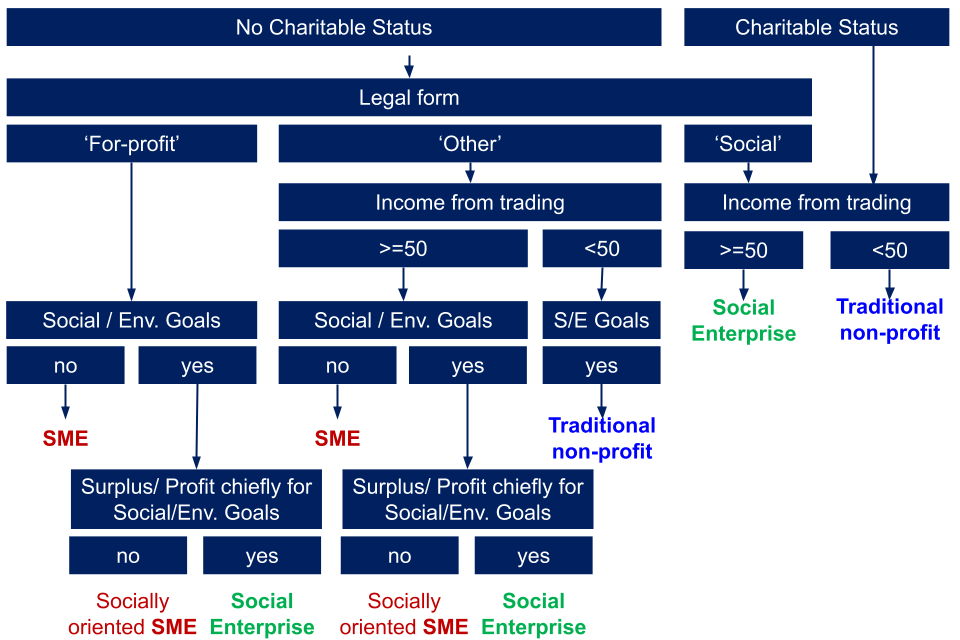
1. Env = Environmental and S/E = social or environmental
2. Chiefly = at least half
The picture above visually presents the logic of how social enterprises are determined and concludes that social enterprises are organisations which have a social mission, receive at least half their annual income from trading and reinvest at least half of their annual surplus/profit into their social mission.
This means the definition used for social enterprises is relatively broad compared to other definitions. For example, Social Enterprise UK (SEUK) has used their own definition and sample of social enterprises. Their survey included organisations who agreed that their business has:
primarily social objectives whose surpluses are principally reinvested for that purpose in the business or community, rather than being driven by the need to maximise profit for shareholders and owners. [footnote 5]
3. Number of Social Enterprises
This chapter provides estimates of the proportion and number of social enterprises based on the LSBS data.
3.1 Proportion of social enterprises
Based on the decision tree (shown in figure 2.3), Figure 3.1 provides a breakdown of the classification of all types of organisations.
Using the DCMS definition, social enterprises make up 6.2% of the UK small business population: using the Business Population Estimates 2023, this means there are an estimated 347,000 [footnote 6] (320,000 - 373,000 [footnote 7]) number of social enterprises. The rest of the business population is made up of 89.4% of SMEs, of which 72.2% are traditional SMEs and 17.2% are socially-oriented SMEs, and 4.3% of organisations are traditional non-profit businesses.
Figure 3.1: Percentage of different organisation types, total
| Type of organisation | Percentage (%) |
|---|---|
| Traditional SMEs | 72.2 |
| Socially oriented SMEs | 17.2 |
| Social enterprises | 6.2 |
| Traditional non-profit | 4.3 |
1. The unweighted baseline is N = 9,654 for the small business population. 6 cases were marked as ‘unclassified’ due to missing data.
2. Percentages are rounded so may not add up to 100%.
3. Based on classification of sample according to decision tree, weighted to be representative of UK small business population.
In terms of employers, social enterprises make up 6.6% of organisations with employees (employers) and 6.1% of organisations without employees (non-employers). Using the Business Population Estimates 2023, it is estimated that the number of social enterprise employers is approximately 96,000 (88,000 - 103,000), and approximately 251,000 (231,000 - 271,000) social enterprises are non-employers [footnote 8]. In 2021, the proportion of social enterprise employers made up 7.4% of the UK SME employers. When comparing the proportion of social enterprise employers to 2021, the decrease in 2023 is not significant.
Figure 3.2: Percentage of different organisation types, employers vs non-employers
| Type of organisation | Employees (%) | No employees (%) |
|---|---|---|
| Traditional SMEs | 72.3 | 72.2 |
| Socially oriented SMEs | 16.2 | 17.6 |
| Social enterprises | 6.6 | 6.1 |
| Traditional non-profit | 4.9 | 4.1 |
1. The unweighted baseline is N = 1,860 for non-employers and 7,794 for employers. 6 cases were marked as ‘unclassified’ due to missing data.
2. Percentages are rounded so may not add up to 100%.
3. Based on classification of sample according to decision tree, weighted to be representative of UK small business population.
4. Profiles of Social Enterprise Employers
72.4% of social enterprises have no employees.
For the remainder of the report, findings are drawing comparison between social enterprise employers and the wider cohort of SME employers (which for the purposes of this report are defined as the combination of traditional and socially oriented SMEs). This report refers to this combined category of SMEs as SME employers.
Percentages are based on 7,302 [footnote 9] survey responses.
4.1 Size of Social Enterprises
The majority (75.9%) of social enterprises are micro businesses.
Social enterprises were more likely to be ‘small’ businesses, and less likely to be ‘micro’ businesses, compared to SME employers..
Figure 4.1: Employment size
| Employment size | SME employers (%) | Social enterprise employers (%) |
|---|---|---|
| Micro (1-9 employees) | 82.5 | 75.9 |
| Small (10-49 employees) | 15.0 | 21.1 |
| Medium (50-249 employees) | 2.5 | 3.0 |
1. The unweighted baseline is N = 7,302 (SME employers = 6,660, social enterprise employers = 642). 6 cases were marked as ‘unclassified’ due to missing data.
2. Bold numbers in the tables indicate differences between SME employers and social enterprise employers that are statistically significant at the 95% level. Statistical significance indicates that the difference between two variables is unlikely to be due to chance.
3. Percentages are rounded so may not add up to 100%.
4.2 Age of Social Enterprises
73.1% of social enterprise employers have been in existence for ten years or more. 49.7% of social enterprises have been established for over 20 years.
Figure 4.2: Age of enterprises
| Age of enterprises | SME employers | Social enterprise employers |
|---|---|---|
| 0-5 Years | 13.5 | 15.0 |
| 6-10 Years | 16.7 | 12.0 |
| 11-20 Years | 28.1 | 23.4 |
| More Than 20 Years | 41.5 | 49.7 |
| Unknown | 0.1* | 0.0* |
1. The unweighted baseline is N = 7,302 (SME employers = 6,660, social enterprise employers = 642). 6 cases were marked as ‘unclassified’ due to missing data.
2. Bold numbers in the tables indicate differences between SME employers and social enterprise employers that are statistically significant at the 95% level. Statistical significance indicates that the difference between two variables is unlikely to be due to chance.
3. Percentages are rounded so may not add up to 100%.
4. * signify where there were less than 30 observations for the cells, therefore results should be treated with caution.
4.3 Sector presence of Social Enterprises
The largest proportion of social enterprise employers operate in the ‘Accommodation / Food’ (15.2%) sector, followed by ‘Health/ Social Work’ (13.9%).
Compared to SME employers, social enterprise employers are more likely to operate in:
- Accommodation and Food (15.2% compared to 10.1% for SME employers)
- Health and Social Work (13.9% compared to 2.0% for SME employers)
- Other service (6.7% compared to 3.3% of SME employers) [footnote 10]
Figure 4.3: Sector of Enterprises
| Sector | SME employers | Social enterprise employers |
|---|---|---|
| Primary | 4.1 | 6.1* |
| Manufacturing | 6.7 | 3.0* |
| Construction | 14.7 | 9.1 |
| Wholesale/Retail | 18.5 | 11.5 |
| Transport/Storage | 3.7 | 3.0* |
| Accommodation/Food | 10.1 | 15.2 |
| Information/Communication | 5.7 | 2.4* |
| Financial/Real Estate | 5.4 | 4.2* |
| Professional/Scientific | 14.1 | 7.9 |
| Administrative/Support | 9.4 | 7.9 |
| Education | 1.0 | 3.6 |
| Health/Social Work | 2.0 | 13.9 |
| Arts/Entertainment | 1.3 | 5.5 |
| Other Service | 3.3 | 6.7 |
1. The unweighted baseline is N = 7,302 (SME employers = 6,660, social enterprise employers = 642). 6 cases were marked as ‘unclassified’ due to missing data.
2. Bold numbers in the tables indicate differences between SME employers and social enterprise employers that are statistically significant at the 95% level. Statistical significance indicates that the difference between two variables is unlikely to be due to chance.
3. Percentages are rounded so may not add up to 100%.
4. * signify where there were less than 30 observations for the cells, therefore results should be treated with caution.
4.4 Regional presence of Social Enterprises
Most social enterprises are located in the North West (12.1% compared to 8.3% of SME employers).
Figure 4.4: Region of enterprises
| Regions | SME employers | Social enterprise employers |
|---|---|---|
| East Midlands | 8.2 | 5.5* |
| East of England | 11.8 | 9.7 |
| London | 11.2 | 10.9 |
| North East | 2.4 | 3.0* |
| North West | 8.3 | 12.1 |
| South East | 17.0 | 17.0 |
| South West | 11.4 | 11.5 |
| West Midlands | 9.1 | 7.9 |
| Yorkshire and the Humber | 7.6 | 6.1 |
| Scotland | 6.3 | 7.9 |
| Wales | 3.9 | 5.5 |
| Northern Ireland | 2.7 | 3.0 |
1. The unweighted baseline is N = 7,302 (SME employers = 6,660, social enterprise employers = 642). 6 cases were marked as ‘unclassified’ due to missing data.
2. Bold numbers in the tables indicate differences between SME employers and social enterprise employers that are statistically significant at the 95% level. Statistical significance indicates that the difference between two variables is unlikely to be due to chance.
3. Percentages are rounded so may not add up to 100%.
4. * signify where there were less than 30 observations for the cells, therefore results should be treated with caution.
4.5 Legal Status of Social Enterprises
Social enterprises take varied legal forms and how they are identified in different contexts, and by different governments and agencies can vary considerably according to the selection criteria used.
Almost half of social enterprise employers (51.5%) have private limited company status, limited by shares, compared to 78.1% of SME employers.
17.4% of social enterprise employers are private companies limited by guarantee status (this is compared to 3.1% of SME employers, thus social enterprise employers are over-represented in this category).
Figure 4.5: Legal status of enterprises
| Legal status | SME employers | Social enterprise employers |
|---|---|---|
| Charitable Incorporated Organisation | 0.0* | 9.0 |
| Limited liability partnership | 1.1 | 1.8* |
| Partnership | 7.3 | 5.4* |
| Private company limited by guarantee | 3.1 | 17.4 |
| Private limited company, limited by shares (LTD) | 78.1 | 51.5 |
| Sole proprietorship/trader | 7.5 | 4.8* |
| Other | 0.8 | 4.8* |
| Unknown | 2.0 | 5.4* |
1. The unweighted baseline is N = 7,302 (SME employers = 6,660, social enterprise employers = 642). 6 cases were marked as ‘unclassified’ due to missing data.
2. Bold numbers in the tables indicate differences between SME employers and social enterprise employers that are statistically significant at the 95% level. Statistical significance indicates that the difference between two variables is unlikely to be due to chance.
3. Percentages are rounded so may not add up to 100%.
4. * signify where there were less than 30 observations for the cells, therefore results should be treated with caution.
4.6 Gender and Leadership in Social Enterprises
In the LSBS survey, women-led businesses are defined as those majority-led by women, that is controlled by a single woman or having a management team of which a majority are women. ‘Majority’ here means more than 50%.
There are more women-led social enterprise employers than SME employers (23.8% compared to 14.5%) and social enterprise employers are less likely to be entirely male led than SME employers (30.4% compared to 47.0%). However, it’s important to note that 10.7% of social enterprise employers were unable to provide an answer compared to 4.5% of SME employers.
Figure 4.6: Women-led enterprises
| Women-led | SME employers | Social enterprise employers |
|---|---|---|
| Women Led | 14.5 | 23.8 |
| Equally Led | 25.8 | 22.0 |
| Women in Minority | 8.3 | 13.1 |
| Entirely Male Led | 47.0 | 30.4 |
| Unknown | 4.5 | 10.7 |
1. The unweighted baseline is N = 7,302 (SME employers = 6,660, social enterprise employers = 642). 6 cases were marked as ‘unclassified’ due to missing data.
2. Bold numbers in the tables indicate differences between SME employers and social enterprise employers that are statistically significant at the 95% level. Statistical significance indicates that the difference between two variables is unlikely to be due to chance.
3. Percentages are rounded so may not add up to 100%.
4. * signify where there were less than 30 observations for the cells, therefore results should be treated with caution.
4.7 Ethnicity and Leadership in Social Enterprises
In the LSBS survey, a minority ethnic group led enterprise is defined as an enterprise led by a person from a minority ethnic group (MEG) or one which has a management team with at least half of its members from an ethnic minority.
There is a similar number of social enterprise employers and SME employers who are MEG-led (around 7%), which is not a statistically significant difference.
Figure 4.7: Minority ethnic group (MEG) led enterprises
| Minority ethnic group | SME employers | Social enterprise employers |
|---|---|---|
| MEG-Led | 6.7 | 7.2 |
| Non MEG-Led | 90.8 | 89.8 |
| Unknown | 2.5 | 3.0* |
1. The unweighted baseline is N = 7,302 (SME employers = 6,660, social enterprise employers = 642). 6 cases were marked as ‘unclassified’ due to missing data.
2. Bold numbers in the tables indicate differences between SME employers and social enterprise employers that are statistically significant at the 95% level. Statistical significance indicates that the difference between two variables is unlikely to be due to chance.
3. Percentages are rounded so may not add up to 100%.
4. * signify where there were less than 30 observations for the cells, therefore results should be treated with caution.
4.8 Area of Deprivation of Social Enterprises
The Index of Multiple Deprivation (IMD) measures the relative deprivation of a geographical area (typically the size of around 15,000 individuals or 650 households) across seven dimensions of deprivation.
- Health
- Employment
- Income
- Education
- Crime
- Living environment
- Barriers to housing and services
The IMD is calculated differently across England. Scotland, Wales and Northern Ireland. The scores are combined based on their relative rank and depicted below (from the 20% most deprived to 20% least deprived areas).
Figure 4.8 shows, social enterprise employers have a higher level of representation in the 2nd quartile than SME employers (23.5% and 18.1% retrospectively). Furthermore, social enterprise employers (16.9%) are less likely to operate in the least deprived quartile (5th quartile) than SME employers (21.3%).
Figure 4.8: Prevalence of social enterprise and SME employers in areas of deprivation (ranging left to right most deprived to least deprived quintile.)
| IMD quartiles | SME employers | Social enterprise employers |
|---|---|---|
| 1 (most deprived) | 12.1 | 15.1 |
| 2 | 18.1 | 23.5 |
| 3 | 23.7 | 21.7 |
| 4 | 24.9 | 22.9 |
| 5 (least deprived) | 21.3 | 16.9 |
1. The unweighted baseline is N = 7,302 (SME employers = 6,660, social enterprise employers = 642). 6 cases were marked as ‘unclassified’ due to missing data.
2. Bold numbers in the tables indicate differences between SME employers and social enterprise employers that are statistically significant at the 95% level. Statistical significance indicates that the difference between two variables is unlikely to be due to chance.
3. Percentages are rounded so may not add up to 100%.
4. * signify where there were less than 30 observations for the cells, therefore results should be treated with caution.
4.9 Energy Efficiency of Social Enterprises
Social enterprise employers are more likely to have installed energy efficiency measures in the last 12 months than SME employers (9.6% compared to 5.8%).
The main reason that prompted both social enterprise and SME employers to take action for energy efficiency was ‘to reduce energy costs’.
Figure 4.9: Energy efficiency of enterprises
| ** Energy efficiency (Y/N)** | SME employers | Social enterprise employers |
|---|---|---|
| Energy Efficient | 5.8 | 9.6 |
| Not Energy Efficient | 16.8 | 17.5 |
| Unknown | 77.3 | 72.9 |
1. The unweighted baseline is N = 7,302 (SME employers = 6,660, social enterprise employers = 642). 6 cases were marked as ‘unclassified’ due to missing data.
2. Bold numbers in the tables indicate differences between SME employers and social enterprise employers that are statistically significant at the 95% level. Statistical significance indicates that the difference between two variables is unlikely to be due to chance.
3. Percentages are rounded so may not add up to 100%.
4. * signify where there were less than 30 observations for the cells, therefore results should be treated with caution.
5. Business Performance
5.1 Turnover (compared to 12 months ago)
80.1% of social enterprise employers said that, taking into account all sources of income in the last financial year, they generated a profit or surplus. This is not different from the proportion of SME employers.
As shown in Table 5.1, there was no difference between SME and social enterprise employers, as they had experienced similar growth in the last 12 months. About a third of social enterprise employers (34.3%) have experienced significant or substantial growth, whilst just under a third (28.3%) have experienced no change in their annual turnover.
Figure 5.1: Turnover (compared to 12 months ago)
| Turnover | SME employers | Social enterprise employers |
|---|---|---|
| Substantial / Significant growth | 29.7 | 34.3 |
| Moderate / Minor growth | 9.5 | 10.2 |
| No change | 31.2 | 28.3 |
| Moderate / Minor shrinkage | 17.1 | 16.3 |
| Substantial / Significant shrinkage | 10.7 | 9.0 |
| Unknown | 1.8 | 1.8* |
1. The unweighted baseline is N = 7,302 (SME employers = 6,660, social enterprise employers = 642). 6 cases were marked as ‘unclassified’ due to missing data.
2. Bold numbers in the tables indicate differences between SME employers and social enterprise employers that are statistically significant at the 95% level. Statistical significance indicates that the difference between two variables is unlikely to be due to chance.
3. Percentages are rounded so may not add up to 100%.
4. * signify where there were less than 30 observations for the cells, therefore results should be treated with caution.
5.2 Expected turnover in the next 12 months
Social enterprise employers are more likely to expect an increase in their turnover in the next 12 months (47.6% compared to 37.5% of SME employers).
Figure 5.2: Expected turnover in the next 12 months
| Expected turnover | SME employers | Social enterprise employers |
|---|---|---|
| Increase | 37.5 | 47.6 |
| Stay the same | 14.0 | 7.8 |
| Decrease | 46.0 | 42.2 |
| Unknown | 2.6 | 2.4* |
1. The unweighted baseline is N = 7,302 (SME employers = 6,660, social enterprise employers = 642). 6 cases were marked as ‘unclassified’ due to missing data.
2. Bold numbers in the tables indicate differences between SME employers and social enterprise employers that are statistically significant at the 95% level. Statistical significance indicates that the difference between two variables is unlikely to be due to chance.
3. Percentages are rounded so may not add up to 100%.
4. * signify where there were less than 30 observations for the cells, therefore results should be treated with caution.
5.3 Number of employees (compared to 12 months ago)
Total number of employees is calculated by adding together the approximate number of employees on the payroll and the number of working owners and partners together in employer and non-employer social enterprises. It is estimated that the number of people employed by social enterprises is approximately 1,067,000 (993,000 - 1,141,000) [footnote 11].
In terms of number of employees compared to 12 months ago, social enterprise employers were more likely to have fewer employees (35.3%) than SME employers (27.8%).
Figure 5.3: Number of employees (compared to12 months ago)
| Number of employees | SME employers | Social enterprise employers |
|---|---|---|
| More than currently | 18.2 | 21.6 |
| The same | 53.9 | 43.1 |
| Fewer | 27.8 | 35.3 |
| Unknown | 0.1** | 0.0 |
1. The unweighted baseline is N = 7,302 (SME employers = 6,660, social enterprise employers = 642). 6 cases were marked as ‘unclassified’ due to missing data.
2. Bold numbers in the tables indicate differences between SME employers and social enterprise employers that are statistically significant at the 95% level. Statistical significance indicates that the difference between two variables is unlikely to be due to chance.
3. Percentages are rounded so may not add up to 100%.
4. * signify where there were less than 30 observations for the cells, therefore results should be treated with caution.
5.4 Expected number of employees in one year’s time
Similarly to expected turnover, social enterprise employers were more optimistic about their expected number of employees in one year’s time. 29.7% of social enterprise employers expected to have more employees in the next 12 months, whilst 6.1% expected to have fewer employees.
Figure 5.4: Expected number of employees in one year’s time
| Expected number of employees | SME employers | Social enterprise employers |
|---|---|---|
| More than currently | 24.6 | 29.7 |
| The same | 63.9 | 64.2 |
| Fewer | 10.8 | 6.1 |
| Unknown | 0.7 | 0.0* |
1. The unweighted baseline is N = 7,302 (SME employers = 6,660, social enterprise employers = 642). 6 cases were marked as ‘unclassified’ due to missing data.
2. Bold numbers in the tables indicate differences between SME employers and social enterprise employers that are statistically significant at the 95% level. Statistical significance indicates that the difference between two variables is unlikely to be due to chance.
3. Percentages are rounded so may not add up to 100%.
4. * signify where there were less than 30 observations for the cells, therefore results should be treated with caution.
5.5 Potential obstacles to success
Based on respondents’ accounts, the most common obstacles faced were:
- ‘The level of energy prices’ (62.7%)
- ‘Regulations/red tape’ (45.8%)
- ‘Staff recruitment and skills’ (44.8%)
Compared to SME employers, social enterprise employers were more likely to select:
- The level of energy prices (62.7%, SME employers: 55.6%),
- Late payment (41.4%, SME employers: 32.4%),
- National Living Wage (37.3%, SME employers: 26.1%)
Figure 5.5: Potential obstacles to success
| Potential obstacles to success | SME employers | Social enterprise employers |
|---|---|---|
| Availability/cost of suitable premises | 19.2 | 17.2 |
| Competition in the market | 49.7 | 41.4 |
| Late payment | 32.4 | 41.4 |
| National Living Wage | 26.1 | 37.3 |
| Obtaining finance | 17.3 | 30.5 |
| Regulations/red tape | 41.7 | 45.8 |
| Staff recruitment and skills | 39.9 | 44.8 |
| Taxation, VAT, PAYE, National Insurance, business rates | 46.6 | 40.7 |
| The level of energy prices | 55.6 | 62.7 |
| UK exit from the EU | 30.9 | 28.8 |
| Workplace pensions | 12.1 | 10.2* |
| Other issues rating to costs | 30.3 | 32.2 |
| Any other major issues or obstacles | 10.6 | 15.3 |
| None of these | 5.6 | 6.8* |
| Unknown | 0.2* | 0.0 |
1. The unweighted baseline is N = 2,452 (SME employers = 2,226, social enterprise employers = 226). 6 cases were marked as ‘unclassified’ due to missing data. Please note, this question was only asked from respondents in Cohort B.
2. Bold numbers in the tables indicate differences between SME employers and social enterprise employers that are statistically significant at the 95% level. Statistical significance indicates that the difference between two variables is unlikely to be due to chance.
3. Options for this question were multiple selection meaning respondents could choose more than one option, therefore percentages will not add up to 100%.
4. * signify where there were less than 30 observations for the cells, therefore results should be treated with caution.
5.6 Reasons for seeking information or advice
There are significantly more social enterprise employers (31.9%) who have sought external advice or information in the last 12 months compared to SME employers (24.8%).
In terms of the reasons for seeking information, the main reasons were:
- Business growth (9.0%),
- Financial advice accounting for general running of business (7.2%),
- Legal issues (6.0%)
Compared to SME employers, these reasons were not significantly different.
Figure 5.6: Reasons for seeking information or advice
| Reasons for seeking information and advice | SME employers | Social enterprise employers |
|---|---|---|
| Advice on day-to-day business running/strategy | 0.90 | 0.6* |
| Building/land purchase/leasing/alteration/improvement | 0.2* | 1.2* |
| Business growth | 6.20 | 9.00 |
| Business survival or operation through Coronavirus-19 pandemic and beyond | 0.2* | 0.6* |
| E-commerce/technology | 1.40 | 0.6* |
| Employment law/redundancies | 2.20 | 2.40 |
| Energy use/costs | 0.0* | 0.6* |
| Exporting | 0.60 | 0.00 |
| Financial advice e.g. accounting, for general running of business | 5.90 | 7.20 |
| Financial advice e.g. how and where to get finance | 1.80 | 3.6* |
| Health and Safety | 1.80 | 2.4* |
| Human resources/HR in general (inc. recruitment) | 1.10 | 3.0* |
| Importing | 0.2* | 0.00 |
| Improving business efficiency/productivity | 3.20 | 4.80 |
| Industry/sector specific support/advice/information | 0.60 | 1.2* |
| Innovation | 0.90 | 1.2* |
| Legal issues | 3.50 | 6.00 |
| Management/leadership development | 0.80 | 0.6* |
| Marketing | 2.60 | 1.2* |
| Reducing or off-setting carbon emissions/other emissions | 0.30 | 0.6* |
| Regulations | 1.80 | 3.0* |
| Relocation | 0.1* | 0.6* |
| Sales | 0.1* | 0.0* |
| Succession (inc. closing/selling business) | 0.70 | 0.6* |
| Taking action to protect the environment/reducing impact on the environment | 0.60 | 1.2* |
| Tax/national insurance law and payments | 3.70 | 3.6* |
| Trade mission attendance | 0.0* | 0.0* |
| Training/skills needs | 1.10 | 1.2* |
| Workplace pensions | 0.4* | 0.6* |
| Other | 1.70 | 1.8* |
| Unknown | 0.2* | 0.6* |
1. The unweighted baseline is N = 7,302 (SME employers = 6,660, social enterprise employers = 642). 6 cases were marked as ‘unclassified’ due to missing data.
2. Bold numbers in the tables indicate differences between SME employers and social enterprise employers that are statistically significant at the 95% level. Statistical significance indicates that the difference between two variables is unlikely to be due to chance.
3. Options for this question were multiple selection meaning respondents could choose more than one option, therefore percentages will not add up to 100%.
4. * signify where there were less than 30 observations for the cells, therefore results should be treated with caution.
5.7: Information or advice sought from
Compared to SME employer, social enterprise employers are more likely to seek advice from:
- Consultant/ general business adviser (9.6%)
- Accountant (9.0%),
- Business networks/ trade associations (5.4%).
Figure 5.7: Information or advice sought from
| Information or advice sought from | SME employers | Social enterprise employers |
|---|---|---|
| Accountant | 9.2 | 9.0 |
| Bank | 0.9 | 1.2* |
| Business networks/trade associations | 4.7 | 5.4 |
| Business Wales | 0.0* | 0.6* |
| Consultant/general business adviser | 9.0 | 9.6 |
| Chamber of Commerce | 0.4 | 0.0* |
| (Specialist) financial adviser | 1.3 | 3.0* |
| Friend or family member | 0.5 | 1.2* |
| .GOV website | 1.4 | 2.4* |
| Internet search/google/other websites | 1.9 | 1.2* |
| Inter-Trade Ireland | 0.0* | 0.0* |
| Invest NI | 0.0* | 0.0* |
| Local Council/Authority | 1.3 | 3.6* |
| Local Enterprise Partnerships | 0.5 | 0.6* |
| Solicitor/Lawyer | 3.1 | 4.2 |
| Tax Agent | 0.3 | 0.6* |
| The Pensions Regulator | 0.1* | 0.0* |
| Universities/other education sector | 0.4 | 0.0* |
| Work colleagues | 0.5 | 0.6* |
| Find business support website | 0.2* | 0.6* |
| Government (inc. government departments/agencies) | 0.6 | 1.2* |
| Other | 2.2 | 3.6** |
| None/have not sought information or advice/will not seek it | 0.2* | 0.6* |
| Unknown | 0.1* | 0.0* |
1. The unweighted baseline is N = 7,302 (SME employers = 6,660, social enterprise employers = 642). 6 cases were marked as ‘unclassified’ due to missing data.
2. Bold numbers in the tables indicate differences between SME employers and social enterprise employers that are statistically significant at the 95% level. Statistical significance indicates that the difference between two variables is unlikely to be due to chance.
3. Options for this question were multiple selection meaning respondents could choose more than one option, therefore percentages will not add up to 100%.
4. * signify where there were less than 30 observations for the cells, therefore results should be treated with caution.
-
DBT, Longitudinal Small Business Survey: technical report 2021 ↩
-
DCMS and DBT, Social enterprise: market trends 2017 ↩
-
DCMS and DBT, Social enterprise: market trends 2019 ↩
-
DCMS, [Social enterprise: market trends 2021] (link is pending) ↩
-
Social Enterprise UK (SEUK), Mission Critical – State of Social Enterprise Survey 2023, Methodology section, pg. 37. ↩
-
Please note, the number of social enterprises are estimates and not exact numbers, this is rounded to the nearest thousand. ↩
-
Please note, the actual number is estimated to be within the range in brackets. The true number of social enterprises is expected to fall within this range. ↩
-
Please note, the number of social enterprises are estimates and not exact numbers, this is rounded to the nearest thousand.
Please note, the actual number is estimated to be within the range in brackets. The true number of social enterprises is expected to fall within this range. ↩ -
The effective unweighted sample size is N=7,302 as this section of the report only relies on social enterprise and SME employer data. 6 enterprises could not be classified as social enterprise, traditional non-profit, commercial or socially-orientated SME due to missing data. ↩
-
‘Other services’ covers categories that are not covered by the UK Standard Industrial Classification (SIC) 2007. ↩
-
Please note, the number of employed by social enterprises are estimates and not exact numbers, this is rounded to the nearest thousand.
Please note, the actual number is estimated to be within the range in brackets. The true number of social enterprises is expected to fall within this range. ↩