School and college voice: December 2025
Updated 24 September 2026
Applies to England

© Crown copyright 2026
This publication is licensed under the terms of the Open Government Licence v3.0 except where otherwise stated. To view this licence, visit nationalarchives.gov.uk/doc/open-government-licence/version/3 or write to the Information Policy Team, The National Archives, Kew, London TW9 4DU, or email: psi@nationalarchives.gov.uk.
Where we have identified any third party copyright information you will need to obtain permission from the copyright holders concerned.
This publication is available at https://www.gov.uk/government/publications/school-and-college-voice-omnibus-surveys-for-2025-to-2026/school-and-college-voice-december-2025
Introduction
The Department for Education (DfE) commissioned Verian to recruit and maintain a panel of school and college leaders and teachers in England, known as the school and college voice (SCV). The SCV is designed to collect robust evidence to help DfE understand the perspectives of teachers and leaders. This allows us to make more effective policy.
The SCV works as a series of short surveys across the academic year, covering a range of new and longstanding policy issues. This report is about the findings from the December 2025 survey wave of the SCV.
Methodology
The SCV survey is answered by teachers and leaders who have agreed to participate in short, regular research surveys on topical education issues.
We select teachers and leaders randomly using records from the school workforce census (SWFC) and invite them to take part in an online survey. For the first survey of the academic year, we send invitation letters and emails to teachers and leaders. For other surveys in that same academic year, we send the invitation by email and text message to the teachers and leaders who agreed to join the panel in the first survey.
We ran the December 2025 survey between 2 and 15 December 2025. The respondents were:
| Audience | Responses |
|---|---|
| Primary school leaders | 370 |
| Secondary school leaders | 458 |
| Primary school teachers | 494 |
| Secondary school teachers | 497 |
Questions with fewer than 30 responses (before weighting) are not included in this report, and base sizes of below 100 should be treated with caution. Complete findings can be found in the published data tables, which include more detail on how different groups answered each question.
The report makes some comparisons to previous surveys conducted in previous academic years, for example the School and college panel omnibus surveys for 2024 to 2025. These comparisons are helpful to understand how trends may be changing. However, the survey methodology changes over time and so comparisons to previous years are not as reliable as survey findings within each academic year.
In this report, we round figures to the nearest whole number.
We use consistent terminology to describe percentages that fall within specific bands, as follows:
- very few – 0% to 10%
- a small minority – 11% to 32%
- a minority – 33% to 47%
- about half – 48% to 52%
- the majority – 53% to 66%
- a large majority – 67% to 89%
- almost all – 90% to 100%
We do not describe 0% and 100% as ‘none’ and ‘all’ because figure rounding may mean this is not accurate. For instance, 100% may be 99.6% of respondents, rounded to the nearest whole number. Unless otherwise stated, when we refer to the ‘average’, we are reporting the arithmetic mean.
Further information on the survey methodology is available in the accompanying technical report.
Topics covered in this survey
The survey included questions about:
- assessment at key stage 3 (KS3)
- data collection on pupil experience in school
- school uniform
- wraparound childcare: private, voluntary or independent (PVI) providers and childminders
- careers guidance support for schools
- special educational needs and disabilities (SEND) curriculum in practice
- generative artificial intelligence (AI)
- awareness of workforce policy resources
- Regional Improvement for Standards and Excellence (RISE)
- behaviour
- knife crime as a safeguarding issue
- sexual violence, harassment and misogyny in schools
Assessment at key stage 3
We asked secondary school teachers and leaders which subjects, if any, their school summatively assessed students on during KS3. Summative assessments take place at the end of a unit, term, or academic year to evaluate pupils’ overall achievement and check whether learning goals have been met. It provides a snapshot of progress against set standards and can help teachers inform future planning.
Figure 1: Subjects that are summatively assessed during key stage 3
| Response | Leaders | Teachers |
|---|---|---|
| Reading | 84% | 76% |
| Writing | 72% | 72% |
| Maths | 91% | 79% |
| None of the above | 4% | 3% |
| Don’t know | 2% | 14% |
Base: Secondary leaders (n = 458) and secondary teachers (n = 497). Data table reference = “ks3assessment_skills”.
We then asked secondary school leaders, whose schools summatively assessed reading, writing and/or maths skills during KS3, how the results of these assessments were used.
Figure 2: How the results of summative assessments are used
| Response | Percentage |
|---|---|
| Providing data for internal tracking and monitoring | 92% |
| Reporting attainment to parents/carers | 88% |
| Supporting decisions about setting or streaming | 87% |
| Contributing to end-of-year grades or levels | 72% |
| Evaluating overall curriculum effectiveness | 66% |
| Informing whole-school performance analysis | 61% |
| Benchmarking against national or external standards, for example within multi-academy trust | 47% |
| Contributing to staff performance reviews or appraisal | 9% |
| Other | 2% |
| Don’t know | 0% |
Base: Secondary leaders whose school summatively assessed reading, writing and/or maths skills during key stage 3 (n = 425). Data table reference = “ks3assessment_summative”.
Secondary school teachers of KS3 English or maths, whose school summatively assessed reading, writing and/or maths skills during KS3, were also asked how the results of these assessments were used formatively in their department.
Figure 3: How the results of assessments are used by teachers’ departments
| Response | Percentage |
|---|---|
| Identifying gaps in student understanding or skills | 93% |
| Providing targeted feedback to students | 76% |
| Informing adaptive teaching | 75% |
| Informing lesson planning | 66% |
| Guiding classroom questioning and discussion | 54% |
| Setting short-term learning goals | 39% |
| Informing peer and self-assessment activities | 32% |
| Other | 8% |
| Don’t know | 2% |
Base: Secondary school teachers of KS3 English or maths, whose school summatively assessed reading, writing and/or maths skills during key stage 3 (n = 110). Data table reference = “ks3assessment_results”.
Data collection on pupil experience in school
We asked all primary and secondary school leaders whether their school collected data on a range of specific factors related to pupils’ experiences in school.
Figure 4: Data collected by schools on pupil experience
| Response | Primary | Secondary |
|---|---|---|
| Feelings of safety in school | 87% | 91% |
| Feelings of enjoyment of school | 83% | 86% |
| Perception of behaviour in school | 77% | 84% |
| Perception of enrichment offer (for example, activities, trips) | 51% | 76% |
| Sense of school belonging | 49% | 76% |
| Quality of staff-pupil relationships | 46% | 54% |
| Quality of pupil-pupil relationships | 46% | 54% |
| Perception of pastoral offer | 35% | 66% |
| Other | 8% | 5% |
| Don’t know | 2% | 3% |
| School doesn’t collect such data | 7% | 4% |
Base: Primary leaders (n = 370) and secondary leaders (n = 458). Data table reference = “pupilexperience_measures”.
We then asked primary and secondary school leaders, whose school collected data in relation to pupils’ experiences in school, what the findings were used for.
Figure 5: How pupil experience data are used
| Response | Primary | Secondary |
|---|---|---|
| Discussions in whole staff or leadership meetings | 85% | 90% |
| Sharing with governors and other stakeholders | 79% | 79% |
| Identifying trends and patterns in pupil experience across different cohorts | 71% | 85% |
| School-wide and cohort-specific interventions and practices | 63% | 76% |
| Monitoring change over time to evaluate the impact of interventions and practices | 58% | 72% |
| Targeted interventions for individual pupils | 51% | 58% |
| Tailoring professional development for staff | 47% | 55% |
| Adjustments to teaching strategies | 47% | 43% |
| Other | 3% | 1% |
| None of the above | 1% | 0% |
Base: Primary leaders (n = 333) and secondary leaders (n = 428) whose school collected pupil experience data. Data table reference = “pupilexperience_used”.
School uniform
We asked all primary and secondary school leaders if they were aware of the updated statutory guidance on the cost of school uniforms that was published by DfE in October 2025.
Figure 6: Whether leaders were aware of the statutory guidance on the cost of school uniforms
| Phase | I know a lot about it | I know a little about it | Aware, but I know nothing about it | I had not heard of it | Total |
|---|---|---|---|---|---|
| Primary | 30% | 48% | 8% | 13% | 100% |
| Secondary | 39% | 46% | 7% | 8% | 100% |
Base: Primary leaders (n = 370) and secondary leaders (n = 458). Data table reference = “schooluniform_guidance”.
A large majority of both primary leaders (79%) and secondary leaders (85%) said they knew a little or a lot about it.
We also asked all primary and secondary school leaders which changes, if any, their school had made to the number of compulsory branded items required by their school since the publication of the developing uniform policy and procuring uniform supplies guidance in November 2021. This includes statutory guidance on the cost of school uniforms, which came into force in September 2022.
Figure 7: Changes that schools have made to the number of compulsory branded uniform items since statutory guidance was published
| Phase | Reduced number of branded items | Increased number of branded items | No change to number of branded items | Don’t know | Total |
|---|---|---|---|---|---|
| Primary | 44% | 0% | 53% | 3% | 100% |
| Secondary | 54% | 1% | 38% | 7% | 100% |
Base: Primary leaders (n = 370) and secondary leaders (n = 458). Data table reference = “schooluniform_action”.
We asked primary and secondary school leaders how many compulsory branded items their school’s uniform policy required in the 2025 to 2026 academic year. For secondary school leaders, we asked them not to include school tie (if applicable). Branded items were defined as including both those with a logo and also clothing or bags with distinctive characteristics that make them unique to the school or trust. If an item could not be purchased at a range of retailers, this was considered to be a branded item.
The majority of primary school leaders (60%) said their school did not require any compulsory branded uniform items. A minority (33%) said that 1 to 3 items were required, very few (3%) said that 4 or more items were required and 5% did not know.
The majority of secondary school leaders (56%) said their school required 1 to 3 items, 22% said that 4 to 6 items were required and 1% said that 7 or more items were required. Overall, 5% of secondary school leaders reported that their uniform policy did not require any compulsory branded uniform items and 15% did not know the figure.
We asked primary and secondary school leaders whether they had an arrangement in place which gives new parents access to second hand uniform ahead of the new school year. Examples of such arrangements included parent-to-parent exchanges, a school wardrobe of free or discounted second hand items, and other established schemes. Almost all primary school leaders (93%) and a large majority of secondary school leaders (86%) said that they did have such arrangements in place.
Wraparound childcare: private, voluntary or independent (PVI) providers and childminders
We asked primary school leaders if their school offered supervised wraparound childcare. This was defined as including wraparound childcare on the school premises, either run directly by the school or by a private provider.
Figure 8: Whether primary schools offered supervised wraparound childcare
| Audience | Before school only | After school only | Before and after school | No | Total |
|---|---|---|---|---|---|
| Primary | 14% | 1% | 78% | 7% | 100% |
Base: Primary leaders (n = 370). Data table reference = “wraparound_offer”.
Almost all primary school leaders (93%) said their school offered supervised wraparound childcare either before school, after school, or both.
We asked all primary school leaders whose school offered supervised wraparound childcare whether their school used a PVI childcare provider to deliver any wraparound care on their school site. A small minority (26%) said that they used a PVI provider.
We then asked those primary school leaders who said they used a PVI childcare provider what the main reasons for doing so were. They were shown a list of potential reasons and asked to select all that applied.
Figure 9: Reasons why a PVI childcare provider was used to deliver wraparound childcare
| Response | Percentage |
|---|---|
| Staffing – School staff cannot take on additional childcare responsibilities on top of their usual workload | 78% |
| Convenience – Lower administrative burden for the school | 71% |
| Flexibility – PVI are able to provide longer and more flexible hours | 42% |
| Legacy – School has always used a PVI provider | 39% |
| Recruitment – School is unable to recruit additional staff to deliver wraparound childcare | 39% |
| Financial – More cost efficient | 34% |
| Quality – PVI offers higher-quality childcare | 16% |
| Parental demand – Parents prefer a PVI provider | 4% |
| Other | 5% |
| Don’t know | 2% |
Base: Primary leaders whose school used a PVI childcare provider to deliver wraparound childcare (n = 100). Data table reference = “wraparound_pvireasons”.
In November 2024, childminders were given more flexibility to provide wraparound childcare in a non-domestic setting, such as a school. All primary school leaders were asked how likely, if at all, their school was to use childminders for wraparound childcare on their school site.
Figure 10: Extent to which primary school leaders thought their school was likely to use childminders for wraparound childcare on site
| Audience | Very likely | Fairly likely | Not very likely | Not at all likely | Don’t know | Total |
|---|---|---|---|---|---|---|
| Primary | 2% | 4% | 26% | 60% | 9% | 100% |
Base: Primary leaders (n = 370). Data table reference = “wraparound_childminder”.
A large majority of primary school leaders (86%) said their school was not very or not at all likely to use childminders for wraparound childcare on their site.
Careers guidance support for schools
Careers hubs are partnerships between the Careers and Enterprise Company, combined and local authorities, and Local Enterprise Partnerships. They improve careers guidance for young people by working directly with schools, colleges, apprenticeships providers and employers.
We asked secondary school leaders whether their school received support from their local careers hub to improve the delivery of their careers guidance programme. The majority of secondary school leaders (61%) said that they did receive support from their local careers hub, while 11% said that they did not and 28% said they did not know.
We asked secondary school leaders, whose school had received support from their local careers hub, how helpful their school found the support.
Figure 11: Extent to which leaders found support from their local careers hub to be helpful
| Audience | Very helpful | Fairly helpful | Not very helpful | Not helpful at all | Don’t know | Total |
|---|---|---|---|---|---|---|
| Leaders | 26% | 50% | 5% | 2% | 18% | 100% |
Base: Secondary leaders whose school received support from their local Careers Hub (n = 284). Data table reference = “careerguidance_helpful”.
A large majority of secondary school leaders whose school had received careers hub support (75%) said that the support had been very or fairly helpful.
We then asked secondary school leaders, whose school had received careers hub support, what types of support their school currently accessed from their local careers hub or the Careers and Enterprise Company to help deliver their careers programme.
Figure 12: Types of support accessed from local careers hub or Careers and Enterprise company
| Response | Percentage |
|---|---|
| Training for careers leaders | 44% |
| Facilitating employer engagement and/or encounters | 40% |
| Resources to promote understanding of technical and vocational options | 37% |
| Access to advice or best practice resources | 36% |
| Securing or facilitating work experience | 33% |
| Access to providers of technical education and apprenticeships | 28% |
| Access to peer-to-peer or practitioner support networks to share good practice | 24% |
| Facilitating peer/expert reviews, or external assessment of your careers programme | 17% |
| Training for teachers/tutors to support your careers provision | 15% |
| Other | 3% |
| Don’t know | 25% |
Base: Secondary leaders whose school received support from their local Careers Hub (n = 284). Data table reference = “careerguidance_access”.
We asked all secondary school leaders who it was that provided the professional careers guidance interviews in their school.
Figure 13: Providers of professional careers guidance interviews used in secondary schools
| Response | Percentage |
|---|---|
| Careers adviser employed by the school | 61% |
| Other staff member employed by the school | 27% |
| Careers adviser employed by an external/contracted party | 25% |
| Careers adviser employed by the local authority | 13% |
| Other staff member employed by an external/contracted party | 2% |
| Other staff member employed by the local authority | 1% |
| Other | 2% |
| Don’t know | 1% |
Base: Secondary leaders (n = 458). Data table reference = “careerguidance_employ”.
SEND curriculum in practice
Inclusive teaching is an approach that ensures all students, regardless of background or ability, and including those with additional needs, feel valued and supported in the classroom. It involves reviewing teaching methods and materials to meet all needs and promote equal participation and achievement.
We asked all primary and secondary school leaders which challenges, if any, they faced in helping teachers deliver inclusive teaching in mainstream classrooms. They were shown a list of potential challenges and asked to select all that applied.
Figure 14: Challenges that leaders faced in helping teachers deliver inclusive teaching
| Response | Primary | Secondary |
|---|---|---|
| Insufficient time for repetition and overlearning of key concepts | 67% | 60% |
| Challenges in accessing or implementing assistive technology | 44% | 42% |
| Difficulty organising flexible grouping to support diverse learners | 34% | 44% |
| Lack of confidence in scaffolding learning effectively | 21% | 29% |
| Inconsistent application of targeted questioning techniques | 15% | 35% |
| Limited use or understanding of pre-teaching strategies | 19% | 27% |
| Challenges in simplifying language and instructions for learners with additional needs | 13% | 22% |
| Limited awareness or use of modelling thinking aloud | 13% | 16% |
| Uncertainty around implementing peer support, self-assessment, or peer-assessment | 11% | 17% |
| Other | 20% | 8% |
| None of the above | 14% | 10% |
| Don’t know | 0% | 2% |
Base: Primary leaders (n = 370) and secondary leaders (n = 458). Data table reference = “sendpractice_challenges”.
Generative artificial intelligence (AI)
We asked primary and secondary school teachers whether they had used generative AI tools in their role as a teacher. Generative AI was defined as technology that uses learning algorithms to produce content that can include audio, code, images, text, simulations and videos. ChatGPT was given as an example of generative AI.
A large majority of both primary school teachers (82%) and secondary school teachers (78%) said they had used generative AI tools in their role as a teacher, for example to write assignments or to write and format letters to parents.
We asked primary and secondary school teachers, who said they had used generative AI in their role as a teacher, which tasks they had used generative AI to support. They were shown a list of potential uses of AI and asked to select all that applied.
Figure 15: Ways in which teachers have used generative AI
| Response | Primary | Secondary |
|---|---|---|
| Creating resources for lessons/curriculum resources for pupils to use | 75% | 84% |
| Planning lessons/curriculum content | 61% | 54% |
| Adapting materials according to the needs of individual students | 53% | 47% |
| Communicating and engaging with parents/carers | 43% | 38% |
| Supporting pupils with SEND | 45% | 29% |
| Assessments, plagiarism checks, marking and feedback | 8% | 34% |
| Delivering lessons (for example, using AI tools during live teaching in class) | 15% | 14% |
| Teacher training or sharing resources with other teachers | 11% | 15% |
| Other | 11% | 11% |
Base: Primary teachers (n = 400) and secondary teachers (n = 389) who had used generative AI tools in their role as a teacher. Data table reference = “ai_tasks”.
We also asked primary and secondary school teachers, who had not used generative AI as part of their role as a teacher, why they had not used it.
Figure 16: Reasons why generative AI tools were not used
| Response | Primary | Secondary |
|---|---|---|
| I don’t know enough about how generative AI tools could be used in my role | 61% | 47% |
| I am concerned about the risks of using generative AI tools | 35% | 47% |
| My school has restricted the use of generative AI tools | 10% | 10% |
| Generative AI tools are not applicable for my role | 3% | 6% |
| My school does not have the technology required to use generative AI tools | 4% | 4% |
| Other | 22% | 20% |
Base: Primary teachers (n = 91) and secondary teachers (n = 108) who had not used generative AI tools in their role as a teacher. Data table reference = “ai_notused”.
We asked all primary and secondary school teachers whether pupils were ever permitted to use generative AI tools, such as ChatGPT, in the work they were set. Very few primary school teachers (3%) and a small minority of secondary school teachers (19%) said that pupils were permitted to use generative AI tools. A large majority of both primary school teachers (72%) and secondary school teachers (71%) said that pupils were not permitted to use generative AI tools.
We then asked all primary and secondary school teachers whether pupils had ever been provided with guidance or support on using AI safely and effectively. Among primary school teachers, 28% said that their pupils had been provided with guidance on using AI, 39% said that they had not been given guidance, 20% said that they did not know and 12% said this was not applicable. Among secondary school teachers, 43% said that their pupils had been provided with guidance on using AI, 23% said they had not been given guidance and 34% said they did not know.
We asked all primary and secondary school teachers whether they had done a range of specific activities relating to AI with pupils in their lessons.
Figure 17: Ways in which teachers have used or talked about AI with pupils in lessons
| Response | Primary | Secondary |
|---|---|---|
| We have discussed the benefits and risks of generative AI | 31% | 50% |
| I have explained the risks of plagiarism in using generative AI | 12% | 61% |
| We have discussed different ways in which generative AI can be used | 21% | 33% |
| I have demonstrated using generative AI to pupils | 15% | 17% |
| Pupils have been given the opportunity to use generative AI in class | 4% | 9% |
| Other | 2% | 2% |
| None of these | 55% | 26% |
| Don’t know | 3% | 0% |
Base: Primary teachers (n = 494) and secondary teachers (n = 497). Data table reference = “ai_lessons”.
We asked all primary and secondary school leaders whether they had heard of the Using AI in education: support for school and college leaders resources, published by DfE in June 2025. These were designed to support staff in schools and colleges to use AI safely and effectively in their role. A large majority of primary (85%) and secondary (83%) leaders had heard of these resources.
Figure 18: Whether leaders had heard of the Department for Education’s online resources for the safe and effective use of AI
| Phase | I know a lot about them | I know a little about them | Heard of, but know nothing about them | No | Total |
|---|---|---|---|---|---|
| Primary | 12% | 57% | 16% | 15% | 100% |
| Secondary | 16% | 50% | 17% | 17% | 100% |
Base: Primary leaders (n = 370) and secondary leaders (n = 458). Data table reference = “ai_resourceawareness”.
We asked primary and secondary school leaders, who had heard of the online resources and knew at least a little about them, whether they had used the resources. Overall, 54% of primary school leaders and 52% of secondary school leaders who were aware of the resources said that they had used them.
Awareness of workforce policy resources
We asked primary and secondary school leaders whether they had heard of 5 specific DfE workforce resources and programmes. There were minor changes to the response options since these questions were last asked in November 2024. Refer to the data tables for the full question text.
Figure 19: Whether leaders were aware of Department for Education workforce resources and programmes
| Response | Primary | Secondary |
|---|---|---|
| The improve workload and wellbeing for school staff service (formerly the school workload reduction toolkit) | 68% | 63% |
| The education staff wellbeing charter | 46% | 48% |
| DfE Flexible working toolkit | 40% | 51% |
| The school/college leaders’ mental health and wellbeing service | 33% | 30% |
| Flexible working ambassador multi-academy trusts (MATs) and schools | 3% | 8% |
| None of these | 20% | 19% |
Base: Primary leaders (n = 370) and secondary leaders (n = 458). Data table reference = “workresources_heard”.
Among primary school leaders, awareness of the education staff wellbeing charter was higher in December 2025 (46%) than when this question was previously asked in November 2024 (39%). The proportion of primary school leaders aware of the flexible working toolkit was higher in December 2025 (40%) compared to November 2024 (30%). Awareness of the other workforce resources and programmes remained broadly stable among primary school leaders.
Among secondary school leaders, awareness of the education staff wellbeing charter was higher in December 2025 (48%) than when this question was previously asked in November 2024 (39%). The proportion of secondary school leaders aware of the flexible working toolkit was also higher in December 2025 (51%) compared to November 2024 (30%). Awareness of the other workforce resources and programmes remained broadly stable among secondary school leaders.
Overall, 80% of primary school leaders in December 2025 had heard of at least one of the specified workforce resources and programmes, compared with 75% in November 2024.
Among secondary school leaders, the proportion who had heard of at least one of the specified workforce resources and programmes was higher in December 2025 (81%) compared to November 2024 (71%).
We asked leaders, who said they had heard of at least one of these programmes, which of those they had heard of they had used in the last 12 months. There were minor changes to the response options since these questions were last asked in November 2024. Refer to the data tables for the full question text.
Figure 20: Leaders’ usage of Department for Education workforce resources and programmes in the past 12 months
| Response | Primary | Secondary |
|---|---|---|
| The improve workload and wellbeing for school staff service (formerly the school workload reduction toolkit) | 38% | 29% |
| The education staff wellbeing charter | 19% | 20% |
| The school/college leaders’ mental health and wellbeing service | 13% | 11% |
| DfE flexible working toolkit | 10% | 13% |
| Flexible working ambassador MATs and schools | 0% | 1% |
| None of these | 49% | 53% |
Base: All primary school leaders (n = 298) and secondary school leaders (n = 375) who had heard of at least one of the DfE programmes. Leaders who answered this question were only given the programmes they said they had heard of as options. Data table reference = “workresources_used”.
Among primary and secondary school leaders who heard of at least one of the specified workforce resources and programmes, the proportion who had used each of them remained similar to the data from November 2024, when the question was last asked.
We asked primary and secondary school teachers whether they had heard of 4 specific DfE workforce resources and programmes.
Figure 21: Whether teachers were aware of Department for Education workforce resources and programmes
| Response | Primary | Secondary |
|---|---|---|
| The improve workload and wellbeing for school staff service (formerly the school workload reduction toolkit) | 26% | 25% |
| The education staff wellbeing charter | 17% | 19% |
| DfE flexible working toolkit | 11% | 14% |
| Flexible working ambassador MATs and schools | 2% | 1% |
| None of these | 62% | 63% |
Base: Primary teachers (n = 494) and secondary teachers (n = 497). Data table reference = “workresources_heard”.
Overall, 38% of primary school teachers and 37% of secondary school teachers said that they had heard of at least one of the specified workforce resources and programmes.
We asked teachers, who said they had heard of at least one of these programmes, which of those they had heard of they had used in the last 12 months.
Figure 22: Teachers’ usage of Department for Education workforce resources and programmes in the past 12 months
| Response | Primary | Secondary |
|---|---|---|
| The improve workload and wellbeing for school staff service (formerly the school workload reduction toolkit) | 7% | 17% |
| The education staff wellbeing charter | 7% | 11% |
| DfE flexible working toolkit | 5% | 6% |
| Flexible working ambassador MATs and schools | 0% | 1% |
| None of these | 85% | 74% |
Base: All primary school teachers (n = 187) and secondary school teachers (n = 185) who had heard of at least one of the DfE programmes. Teachers who answered this question were only given the programmes they said they had heard of as options. Data table reference = “workresources_used”.
Regional Improvement for Standards and Excellence (RISE)
Across spring 2025, the government launched the RISE programme.
We asked all primary and secondary school leaders whether they were aware of RISE.
Figure 23: Whether leaders were aware of RISE
| Phase | I know a lot about it | I know a little about it | Aware, but had only heard the name | I had not heard of it | Total |
|---|---|---|---|---|---|
| Primary | 10% | 36% | 27% | 27% | 100% |
| Secondary | 18% | 41% | 19% | 22% | 100% |
Base: Primary leaders (n = 370) and secondary leaders (n = 458). Data table reference = “rise_aware”.
The proportion of primary school leaders who had at least heard of RISE was higher in December 2025 (73%) compared to June 2025 (50%). There was also a higher proportion of secondary school leaders who had heard of RISE, from 56% in June 2025 to 78% in December 2025.
Since March 2025, RISE has offered conferences focused on improving national priorities such as school performance in attainment, attendance and reception quality. We asked all primary and secondary school leaders, who were aware of RISE, whether they were aware of, or had attended, these conferences.
Figure 24: Whether leaders were aware of and had attended RISE conferences
| Phase | I have attended | I am aware but have not attended | I am not aware | Not sure | Total |
|---|---|---|---|---|---|
| Primary | 10% | 37% | 52% | 1% | 100% |
| Secondary | 13% | 45% | 39% | 3% | 100% |
Base: Primary leaders (n = 269) and secondary leaders (n = 354) aware of RISE. Data table reference = “rise_conference”.
Behaviour
We asked primary and secondary school teachers how good or poor the behaviour of pupils at their school had been over the previous week of term.
Figure 25: How teachers rated pupil behaviour over the previous week of term
| Phase | Very good | Good | Neither good nor poor | Poor | Very poor | Don’t know | Total |
|---|---|---|---|---|---|---|---|
| Primary | 9% | 49% | 15% | 16% | 9% | 1% | 100% |
| Secondary | 10% | 44% | 22% | 18% | 5% | 1% | 100% |
Base: Primary teachers (n = 494). Secondary teachers (n = 497). Data table reference = “behaviour_rating”.
Overall, 58% of primary school teachers and 54% of secondary school teachers said that the behaviour of pupils at their school over the previous week had been good or very good.
When last asked in May 2025, a higher proportion of primary school teachers (69%) and secondary school teachers (60%) rated behaviour as good or very good.
We also asked primary and secondary school leaders how good or poor pupil behaviour was over the previous week of term.
Figure 26: How leaders rated pupil behaviour over the previous week of term
| Phase | Very good | Good | Neither good nor poor | Poor | Very poor | Don’t know | Total |
|---|---|---|---|---|---|---|---|
| Primary | 24% | 62% | 7% | 6% | 2% | 0% | 100% |
| Secondary | 20% | 51% | 15% | 10% | 3% | 1% | 100% |
Base: Primary leaders (n = 370). Secondary leaders (n = 458). Data table reference = “behaviour_rating”.
A large majority of primary school leaders (86%) and secondary school leaders (71%) rated pupil behaviour over the previous week of term as good or very good.
When last asked in May 2025, a higher proportion of primary school leaders (91%) and secondary school leaders (81%) rated behaviour as good or very good.
We then asked primary and secondary school teachers how often their school had been calm and orderly over the previous week of term.
Figure 27: How often teachers felt their school had been calm and orderly over the previous week of term
| Phase | Every day | Most days | Some days | Never | Don’t know | Total |
|---|---|---|---|---|---|---|
| Primary | 13% | 43% | 37% | 6% | 1% | 100% |
| Secondary | 16% | 48% | 29% | 6% | 1% | 100% |
Base: Primary teachers (n = 494). Secondary teachers (n = 497). Data table reference = “behaviour_calm”.
The majority of primary school teachers (56%) and secondary school teachers (64%) said their school had been calm and orderly every day or most days in the past week of term.
When last asked in May 2025, a higher proportion of primary school teachers (66%) and a similar proportion of secondary school teachers (60%) said their school had been calm and orderly every day or most days.
We also asked primary and secondary school leaders how often their school had been calm and orderly over the previous week of term.
Figure 28: How often leaders felt their school had been calm and orderly over the previous week of term
| Phase | Every day | Most days | Some days | Never | Don’t know | Total |
|---|---|---|---|---|---|---|
| Primary | 35% | 52% | 12% | 1% | 0% | 100% |
| Secondary | 35% | 47% | 17% | 1% | 0% | 100% |
Base: Primary leaders (n = 370). Secondary leaders (n = 458). Data table reference = “behaviour_calm”.
A large majority of primary school leaders (87%) and secondary school leaders (82%) said their school had been calm and orderly every day or most days over the past week of term.
When last asked in May 2025, a similar proportion of primary school leaders (90%) and secondary school leaders (84%) said their school had been calm and orderly every day or most days.
We also asked primary and secondary school teachers in how many lessons they taught during the past week of term pupil misbehaviour had stopped or interrupted teaching or learning.
Figure 29: Proportion of teachers’ lessons interrupted by pupil misbehaviour over the previous week of term
| Phase | All lessons | Most lessons | Some lessons | Rarely | Never | Haven’t taught any lessons | Total |
|---|---|---|---|---|---|---|---|
| Primary | 16% | 27% | 37% | 18% | 2% | 1% | 100% |
| Secondary | 7% | 22% | 43% | 23% | 4% | 2% | 100% |
Base: Primary teachers (n = 494). Secondary teachers (n = 497). Data table reference = “behaviour_interrupt”.
A large majority of primary school teachers (79%) and secondary school teachers (72%) said that at least some lessons over the past week of term had been stopped or interrupted due to pupil misbehaviour.
When last asked in May 2025, a similar proportion of primary school teachers (76%) and secondary school teachers (72%) said that at least some lessons had been stopped or interrupted.
We also asked primary and secondary school leaders in how many lessons they taught during the past week of term pupil misbehaviour had stopped or interrupted teaching or learning.
Figure 30: Proportion of leaders’ lessons interrupted by pupil misbehaviour over the previous week of term
| Phase | All lessons | Most lessons | Some lessons | Rarely | Never | Haven’t taught any lessons | Total |
|---|---|---|---|---|---|---|---|
| Primary | 4% | 10% | 30% | 28% | 5% | 23% | 100% |
| Secondary | 2% | 8% | 29% | 35% | 18% | 7% | 100% |
Base: Primary leaders (n = 370). Secondary leaders (n = 458). Data table reference = “behaviour_interrupt”.
A minority of primary school leaders (44%) and secondary school leaders (39%) said that pupil misbehaviour had stopped or interrupted at least some lessons they had taught in the past week.
Knife crime as a safeguarding issue
We asked primary and secondary school leaders whether their school was currently actively dealing with knife crime as a safeguarding issue. We defined this as a leader at the school having taken action, however small, as a result of recognising a safeguarding risk to a pupil in relation to knife crime.
Figure 31: Proportion of leaders who said their school was currently dealing with knife crime as a safeguarding issue
| Survey date | Primary | Secondary |
|---|---|---|
| December 2025 | 17% | 45% |
| June 2025 | 18% | 49% |
| December 2024 | 8% | 42% |
| May 2024 | 16% | 53% |
| March 2024 | 11% | 47% |
| December 2023 | 9% | 42% |
| April 2023 | 9% | 43% |
| January 2023 | 7% | 47% |
| September 2022 | 11% | 41% |
| May 2022 | 10% | 51% |
| February 2022 | 8% | 48% |
Base: Primary leaders (n = 370) and secondary leaders (n = 458). Bases refer to most recent data: refer to previous reports for base sizes at each data point. Data table reference = “knife_action”.
Figure 32: Proportion of leaders who said their school was currently dealing with knife crime as a safeguarding issue
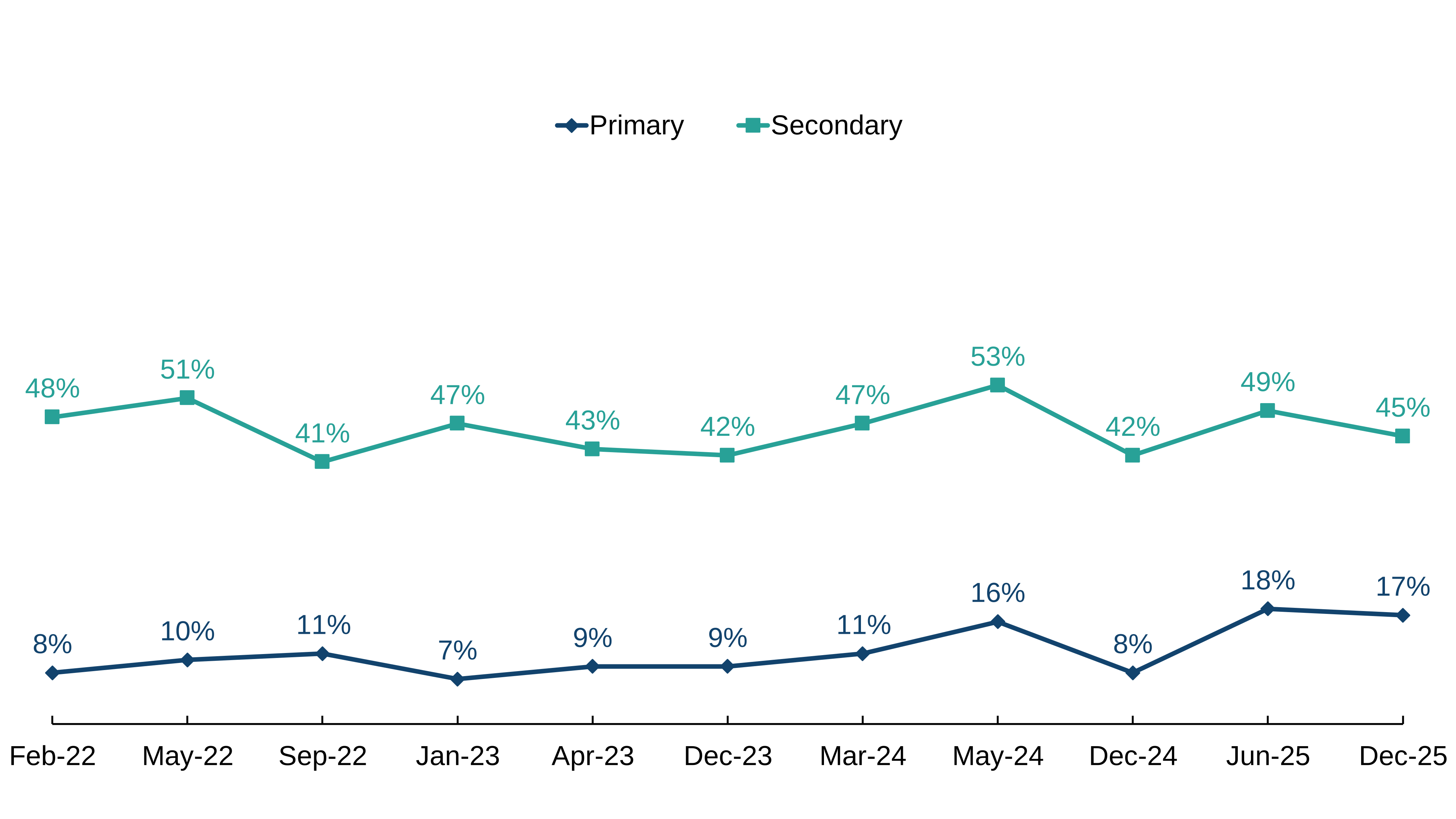
Base: Primary leaders (n = 370) and secondary leaders (n = 458). Bases refer to most recent data: refer to previous reports for base sizes at each data point. Data table reference = “knife_action”.
We asked primary and secondary school leaders who said they were actively dealing with knife crime as a safeguarding issue how many individual safeguarding incidents involving knife crime their school was actively dealing with at that moment in time. By combining the data from this question with administrative data about the number of pupils in each school, it is possible to calculate the number of individual knife crime safeguarding incidents per thousand pupils.
In those schools that were actively dealing with knife crime as a safeguarding issue, an average of 1.21 safeguarding incidents per thousand pupils were actively being dealt with at the time of the survey.
Among leaders who reported that their schools were actively dealing with knife crime as a safeguarding issue, 25% of primary school leaders and 45% of secondary school leaders preferred not to say how many incidents they were actively dealing with at that moment in time. Any schools with missing data, relating either to their number of pupils or their current number of knife crime safeguarding incidents, were excluded from the calculation of the number of safeguarding incidents per thousand pupils.
Sexual violence, harassment and misogyny in schools
We asked primary and secondary school leaders if they consented to answer questions on the topics of sexual violence and sexual harassment.
Sexual violence was defined as sexual offences under the Sexual Offences Act 2003. This includes but is not limited to rape, assault by penetration, sexual assault, and causing someone to engage in sexual activity without consent. Sexual harassment was defined as ‘unwanted conduct of a sexual nature’ that can occur online and offline and both inside and outside of school. For example, sexual remarks about someone’s appearance, sharing of unwanted explicit content, unwanted sexual comments and messages (including on social media), or physical behaviour such as deliberately brushing up against someone.
Those leaders who consented (96% of all primary and secondary school leaders) were asked whether child-on-child sexual violence or sexual harassment was an issue that their school had actively dealt with since September 2025.
Figure 33: Whether schools have actively dealt with child-on-child sexual violence or sexual harassment since September 2025, as reported by leaders
| Phase | Yes | No | Prefer not to say | Don’t know | Total |
|---|---|---|---|---|---|
| Primary | 23% | 72% | 2% | 3% | 100% |
| Secondary | 59% | 25% | 3% | 12% | 100% |
Base: Primary (n = 359) and secondary leaders (n= 433) who consented to answer questions on the topic of sexual violence and sexual harassment against women and girls. Data table reference = “attitudegirls_action”.
We then asked primary and secondary school leaders, whose schools had dealt with sexual violence or sexual harassment, how many individual safeguarding incidents involving child-on-child sexual violence or sexual harassment their school had actively dealt with since September 2025.
Figure 34: Number of individual safeguarding incidents involving child-on-child sexual violence or sexual harassment schools have actively dealt with since September 2025, as reported by leaders
| Incidents | Primary | Secondary |
|---|---|---|
| Prefer not to say | 4% | 9% |
| Don’t know | 11% | 32% |
| 1-2 | 61% | 26% |
| 3-5 | 21% | 28% |
| 6-10 | 3% | 5% |
| 11+ | 0% | 1% |
Base: Primary (n = 88) and secondary leaders (n = 257) whose schools have dealt with sexual violence or harassment this academic year. The base for primary leaders is lower than 100 and the data should therefore be treated with caution. Data table reference = “attitudegirls_number”.
We asked primary and secondary school teachers if they consented to answer questions on the topic of misogyny. Almost all primary school teachers (99%) and secondary school teachers (99%) said they were happy to answer questions about misogyny.
Those teachers who consented to answer questions about misogyny were asked how often they witnessed pupils making misogynistic comments or displaying misogynistic behaviours towards female pupils. Misogyny was defined as showing feelings of hating girls and women or a belief that boys and men are better than girls and women.
Figure 35: How often teachers witnessed pupils being misogynistic towards female pupils
| Phase | Every day | At least once a week | At least once a month | Less often | Never | Don’t know | Total |
|---|---|---|---|---|---|---|---|
| Primary | 1% | 5% | 8% | 40% | 42% | 4% | 100% |
| Secondary | 3% | 16% | 21% | 39% | 18% | 3% | 100% |
Base: Primary teachers (n = 489) and secondary teachers (n = 491) who agreed to answer questions about misogyny. Data table reference = “attitudegirls_misogynypupils”.
We also asked primary and secondary school teachers how often they witnessed pupils making misogynistic comments or displaying misogynistic behaviours towards female teachers or other female school staff.
Figure 36: How often teachers witnessed pupils being misogynistic towards female staff
| Phase | Every day | At least once a week | At least once a month | Less often | Never | Don’t know | Total |
|---|---|---|---|---|---|---|---|
| Primary | 1% | 4% | 7% | 27% | 55% | 6% | 100% |
| Secondary | 5% | 14% | 20% | 33% | 23% | 4% | 100% |
Base: Primary teachers (n = 489) and secondary teachers (n = 491) who agreed to answer questions about misogyny. Data table reference = “attitudegirls_misogynystaff”.
We then asked primary and secondary school teachers how well they would say their school teaches its pupils about misogyny.
Figure 37: Teachers’ views on how well their school taught about misogyny
| Phase | Very well | Fairly well | Not very well | Not at all well | Don’t know | Prefer not to say | Total |
|---|---|---|---|---|---|---|---|
| Primary | 11% | 37% | 12% | 6% | 32% | 1% | 100% |
| Secondary | 14% | 48% | 18% | 6% | 14% | 0% | 100% |
Base: Primary teachers (n = 489) and secondary teachers (n = 491) who agreed to answer questions about misogyny. Data table reference = “attitudegirls_misogynyteach”.
Overall, 48% of primary school teachers and 62% of secondary school teachers said that their school teaches its pupils about misogyny fairly or very well.
We asked primary and secondary school teachers if they consented to answer questions on the topic of sexual harassment. Almost all primary school teachers (97%) and secondary school teachers (98%) said they were happy to answer questions on this topic.
Those teachers who consented to answer questions about sexual harassment were asked how often they witnessed, or received reports of, pupils at their school making comments or displaying behaviours that they would consider to be sexual harassment.
Figure 38: How often teachers witnessed or received reports of sexual harassment by pupils
| Phase | Every day | At least once a week | At least once a month | Less often | Never | Don’t know | Total |
|---|---|---|---|---|---|---|---|
| Primary | 0% | 0% | 4% | 28% | 62% | 5% | 100% |
| Secondary | 1% | 6% | 10% | 50% | 26% | 7% | 100% |
Base: Primary teachers (n = 481) and secondary teachers (n = 486) who agreed to answer questions about sexual harassment. Data table reference = “attitudegirls_harass”.
We then asked teachers how well their school acted to prevent pupils from experiencing sexual harassment carried out by other pupils.
Figure 39: Teachers’ views on how well their school acted to prevent pupils experiencing sexual harassment by other pupils
| Phase | Very well | Fairly well | Not very well | Not at all well | Don’t know | Prefer not to say | Total |
|---|---|---|---|---|---|---|---|
| Primary | 46% | 32% | 2% | 1% | 19% | 1% | 100% |
| Secondary | 33% | 51% | 7% | 0% | 9% | 0% | 100% |
Base: Primary teachers (n = 481) and secondary teachers (n = 486) who agreed to answer questions about sexual harassment. Data table reference = “attitudegirls_harassprevent”.
Overall, 78% of primary school teachers and 84% of secondary school teachers said their school acted to prevent pupils experiencing sexual harassment by other pupils either very or fairly well.
We also asked teachers how well their school dealt with incidents of sexual harassment which had been carried out by a pupil at their school against another pupil. The data for this question have been rebased to exclude those who selected the response “Not applicable - my school has not had an incident of sexual harassment carried out by a pupil against another pupil”. Overall, 29% of primary school teachers and 3% of secondary teachers said their school had no incidents of sexual harassment between pupils.
Figure 40: Teachers’ views on how well their school dealt with incidents of sexual harassment between pupils
| Phase | Very well | Fairly well | Not very well | Not at all well | Don’t know | Total |
|---|---|---|---|---|---|---|
| Primary | 48% | 25% | 1% | 1% | 25% | 100% |
| Secondary | 37% | 35% | 3% | 1% | 24% | 100% |
Base: Primary teachers (n = 350) and secondary teachers (n = 470) who agreed to answer questions about sexual harassment. The data have been rebased to exclude those who said that the question was not applicable as their schools hadn’t had any such incidents. Data table reference = “attitudegirls_harasshandle”.
Overall, 73% of primary school teachers and 72% of secondary school teachers, in schools where such an incident had happened, said their school dealt with incidents of sexual harassment between pupils either very or fairly well.
We asked teachers how confident they were that their school provides staff with the right level of support to identify and respond to incidents of sexual harassment involving a pupil. Examples of responsive action were defined to include following any reporting procedures (for example, to pastoral staff or designated safeguarding leads) or action taken in line with behaviour policies or safeguarding responsibilities, delivering or referring pupils to interventions, and could be for either the perpetrator(s) or victim(s) of an incident.
Figure 41: Teacher confidence that their school provided staff with right level of support to identify and respond to sexual harassment involving pupils
| Phase | Very confident | Fairly confident | Not very confident | Not at all confident | Don’t know | Total |
|---|---|---|---|---|---|---|
| Primary | 49% | 39% | 4% | 2% | 7% | 100% |
| Secondary | 42% | 46% | 7% | 2% | 4% | 100% |
Base: Primary teachers (n = 481) and secondary teachers (n = 486) who agreed to answer questions about sexual harassment. Data table reference = “attitudegirls_harassconfident”.
A large majority of both primary school teachers (87%) and secondary school teachers (88%) said they were either very or fairly confident that their school provides staff with the right level of support.
Finally, we asked teachers how well their school teaches its pupils about sexual harassment.
Figure 42: Teachers’ views on how well their school taught about sexual harassment
| Phase | Very well | Fairly well | Not very well | Not at all well | Don’t know | Prefer not to say | Total |
|---|---|---|---|---|---|---|---|
| Primary | 17% | 42% | 7% | 3% | 30% | 1% | 100% |
| Secondary | 28% | 47% | 11% | 2% | 12% | 0% | 100% |
Base: Primary teachers (n = 481) and secondary teachers (n = 486) who agreed to answer questions about sexual harassment. Data table reference = “attitudegirls_harassteach”.
Overall, 59% of primary school teachers and 75% of secondary school teachers said their school teaches its pupils about sexual harassment either very or fairly well.
Glossary of terms
Special Educational Needs and Disability (SEND)
A child or young person has SEND if they have a learning difficulty or disability which calls for special educational provision to be made for them. A child of compulsory school age or a young person has a learning difficulty or disability if they:
- have a significantly greater difficulty in learning than the majority of others of the same age
- have a disability which prevents or hinders them from making use of facilities of a kind generally provided for others of the same age in mainstream schools or mainstream post-16 institutions
Some children and young people who have SEND may also have a disability under the Equality Act 2010 – that is ‘…a physical or mental impairment which has a long-term and substantial adverse effect on their ability to carry out normal day-to-day activities’. Where a disabled child or young person requires special educational provision, they will also be covered by the SEND definition.