Near miss with track workers near London Bridge station, 30 July 2025
Published 23 December 2025

© Crown copyright 2025
This publication is licensed under the terms of the Open Government Licence v3.0 except where otherwise stated. To view this licence, visit nationalarchives.gov.uk/doc/open-government-licence/version/3 or write to the Information Policy Team, The National Archives, Kew, London TW9 4DU, or email: psi@nationalarchives.gov.uk.
Where we have identified any third party copyright information you will need to obtain permission from the copyright holders concerned.
This publication is available at https://www.gov.uk/government/publications/safety-digest-062025london-bridge/near-miss-with-track-workers-near-london-bridge-station-30-july-2025
1. Important safety messages
This incident demonstrates the importance of:
- controllers of site safety being familiar with their location of work, the identity of lines, and the direction of rail traffic, particularly in complex areas
- attending pre-work briefings in person when required, so that plans and diagrams can be examined and any uncertainties resolved
- correctly identifying the meaning of ‘on approach to’ and ‘beyond’ when on site, particularly at points where the normal direction of trains may not be apparent.
2. Summary of the incident
At about 00:37 on Wednesday 30 July 2025, the driver of a passenger train reported a near miss with two track workers between Blackfriars and London Bridge main line stations. The incident occurred on a sharply curved section of track with a 20 mph (32 km/h) speed limit. The driver was unable to see the track workers until they were less than 60 metres ahead because of a train passing in the opposite direction on the curve.
The train was travelling at 19 mph (31 km/h) as it approached. On seeing people on the line ahead, the driver made an emergency brake application and the train stopped before it reached the track workers’ position. Forward-facing CCTV from this train shows that the track workers climbed onto a lineside walkway once they became aware of the train, with one assisting the other to get clear of the track. No one was injured in the incident, and no damage was caused.
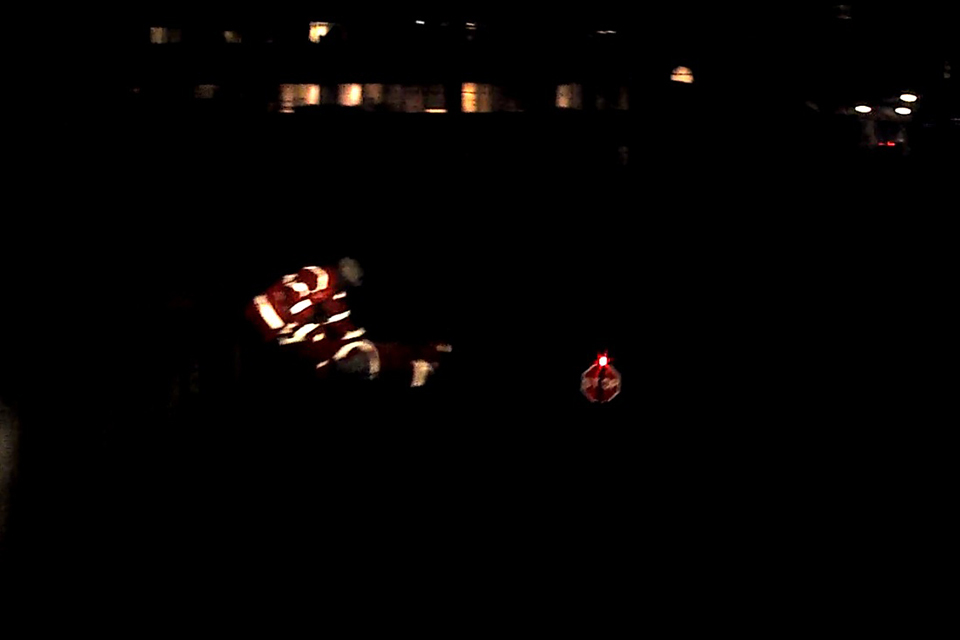
Forward-facing CCTV image from incident train showing track workers climbing onto a lineside walkway. The red possession limit board is on the track ahead (courtesy of Govia Thameslink Railway (GTR)).
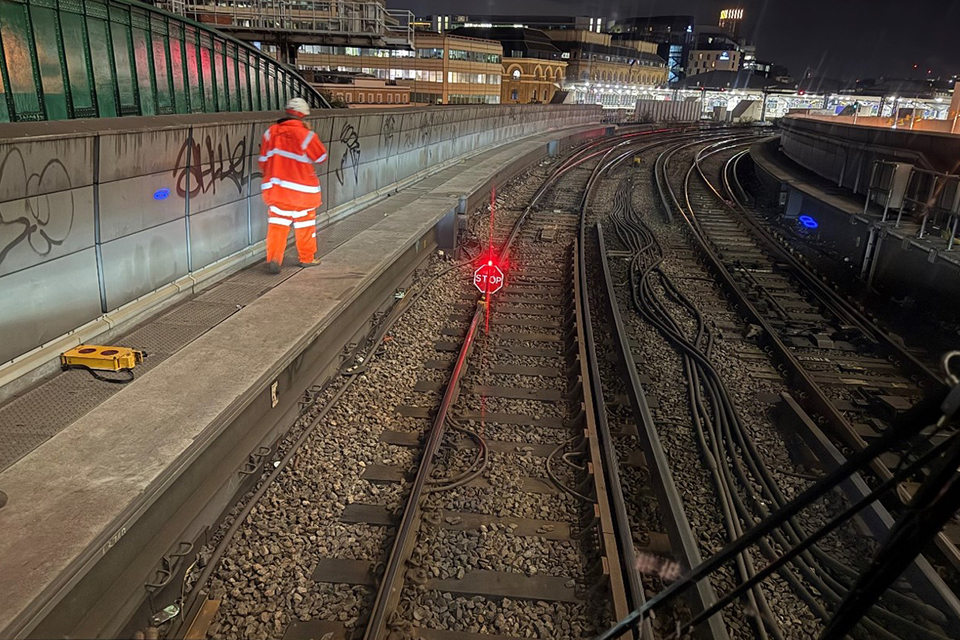
Image from cab of incident train after stopping, showing the possession limit board with London Bridge station ahead (courtesy of GTR).
The track workers involved were a possession support controller of site safety (PS COSS) and a possession support assistant (PSA) who were in the process of establishing a possession for overnight maintenance work. Both were employed by Vital Human Resources Ltd (Vital), working on behalf of Network Rail.
3. Cause of the incident
The incident occurred because the PS COSS placed a possession limit board (PLB) on a section of the Down Charing Cross line that was still open to trains.
The Down Charing Cross line is used by southbound trains travelling from Blackfriars or Waterloo East towards London Bridge. The line divides at 7152 points to give access either to platform 6 or to platform 7 at London Bridge station. Platform 6 was included in the possession, whereas platform 7 remained open to traffic. The train involved was signalled towards platform 7. The PLB should have been placed beyond 7152 points to block the line towards platform 6, and on approach to 7160 points, close to the platform end.
The PS COSS was relatively new to the role and had been qualified for less than 3 months. Although this was the first time they had worked in this role at London Bridge, they were accompanied by a PSA who was a qualified and experienced PS COSS. The two staff had worked together several times before, usually with their roles reversed.
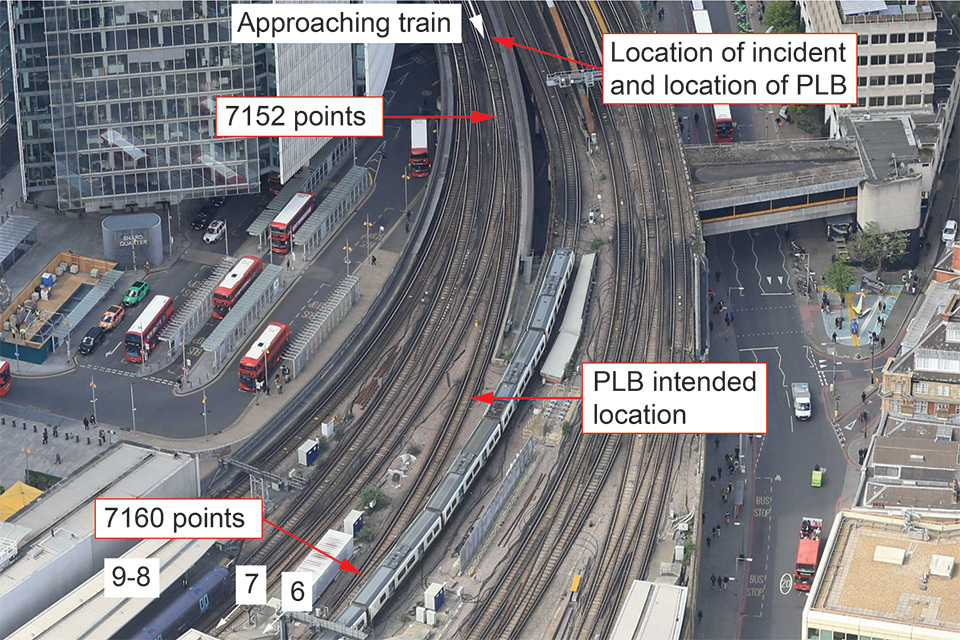
Aerial view of northern approach to London Bridge station (courtesy of Network Rail Routeview).
Several days before the work was due to take place, the PS COSS had received the safe work pack giving details of the task. The PS COSS was responsible for placing a PLB on behalf of the person in charge of possession (PICOP), and work site marker boards on behalf of the engineering supervisor (ES) once the possession had been established. The pack included a marked-up aerial photograph showing where the PLB had to be placed. It instructed the PS COSS to walk off the ramp end of platform 6 at London Bridge station in the direction of Waterloo East, using a safe walking route, and place the PLB and detonators between 7152 points and 7160 points. The instruction also highlighted that ‘Platforms 7, 8 and 9 at London Bridge remain open to traffic’.
The shift for both trackworkers started at 22:00 on the evening of 29 July. However, the PS COSS arrived at London Bridge after 23:00, due to issues with their travel into London. Consequently, they did not attend a planned in-person briefing with the ES and had to be briefed by phone instead. As the PS COSS was undertaking this role for the first time at this location, Vital stated it had expected the PS COSS to arrive at the planned start time to allow sufficient time for site familiarisation, manage the signing-in process, and complete pre-task co-ordination.
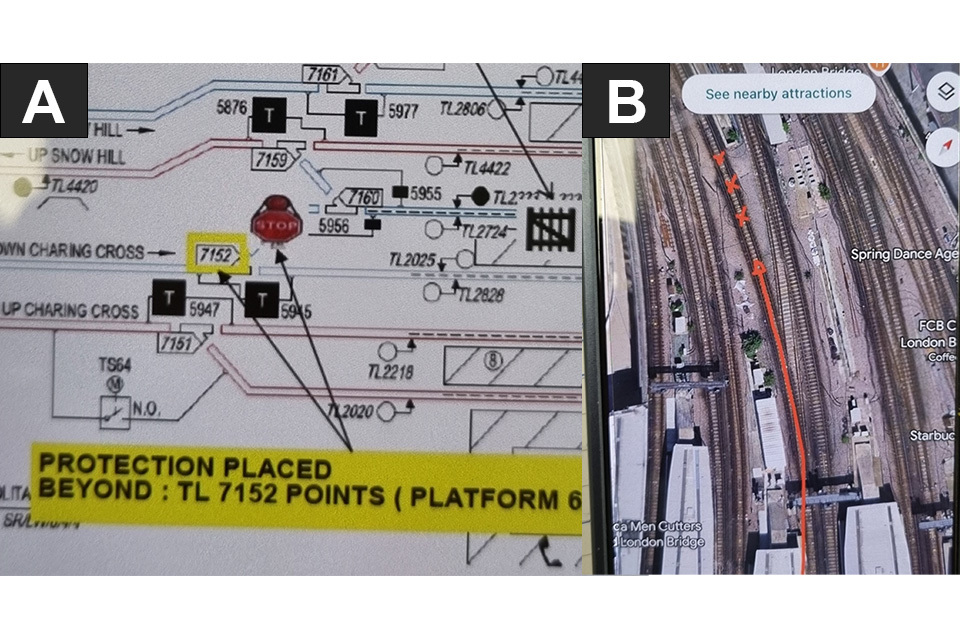
Images from PS COSS’s mobile phone showing annotated diagrams to indicate where PLB should be placed.
At 00:11, the PICOP contacted the PS COSS to confirm that they had signal protection and could go onto the track to place the PLB. Shortly afterwards, the PS COSS and PSA accessed the track from the north end of platform 6, carrying a PLB and other protection equipment. The pair passed 7160 points before the PSA, who was familiar with the area and the required task, put the PLB down in the correct location (that is, between 7160 points and 7152 points). At 00:29, the PS COSS contacted the PICOP to confirm that protection was in place beyond 7152 points.
Following this call, the PS COSS became concerned that the PLB was in the wrong location and moved it to the other side of 7152 points, further from the platform end. The PSA challenged the PS COSS about this, and they were both looking at the safe work pack to resolve the issue when a train passed on the adjacent line. A few seconds later, the train involved in the near miss approached on the line the two track workers were standing on.
The phrases ‘on approach to’ and ‘beyond’ are used on the railway to indicate the position of infrastructure features and locations, including the desired position of PLBs and other protection equipment. Both terms reference the normal direction of travel for trains using the line affected but this can be misinterpreted if the normal direction of trains is unclear. This could occur if, for example, someone is approaching an area on foot in the absence of trains, if lines allow bi-directional working, or in complex areas such as the approaches to stations and points. In such cases, the direction of traffic needs to be established from the information provided in the safe work pack and by safety and possession briefings. This underlines the importance of site familiarisation and pre-task co-ordination in ensuring that staff have the necessary knowledge and awareness of the location and task to be undertaken.
4. Previous similar occurrences
A number of similar incidents have previously been investigated by RAIB.
Incidents with particular similarities to the one at London Bridge which were investigated by RAIB include:
- Teignmouth Boat Yard (safety digest 03/2023). In this incident a passenger train narrowly missed a track worker who was placing a work site marker board. Although uninjured, the track worker was forced to jump into an adjacent line to avoid being struck. The train involved collided with the work site marker board less than 2 seconds after the track worker jumped clear. The incident occurred because the track worker had incorrectly assumed that the down main line they were placing the marker board on had been blocked to rail traffic.
- Stoats Nest (RAIB report 07/2019). A track worker was struck and fatally injured by a passenger train in the vicinity of Stoats Nest Junction, near Purley, after they had placed equipment on the track as part of the arrangements for the protection of a possession. The track worker walked along the track until they reached the end of the protected area and continued walking with their back to rail traffic, on an open line. They may have believed that no trains would approach on the line they were walking along.
A wider summary of previous RAIB learning, including more similar incidents relating to track worker near misses, can be found on RAIB’s website.