Overspeeding at Grantham South Junction, 26 September 2025
Published 6 May 2026

© Crown copyright 2026
This publication is licensed under the terms of the Open Government Licence v3.0 except where otherwise stated. To view this licence, visit nationalarchives.gov.uk/doc/open-government-licence/version/3 or write to the Information Policy Team, The National Archives, Kew, London TW9 4DU, or email: psi@nationalarchives.gov.uk.
Where we have identified any third party copyright information you will need to obtain permission from the copyright holders concerned.
This publication is available at https://www.gov.uk/government/publications/safety-digest-052026-grantham-south-junction/overspeeding-at-grantham-south-junction-26-september-2025
1. Important safety messages
This incident demonstrates the importance of:
- infrastructure managers identifying all the potential risks at a location when assessing the effectiveness of risk mitigations implemented at similar locations. An example of this would be the possibility of ‘reading through’
- train crew adhering to operating rules regarding access to driving cabs, and being aware of the risk of distraction to drivers which may occur if there is unauthorised or unnecessary access
- train crew promptly reporting operational incidents to allow the trains and infrastructure involved to be inspected and any necessary investigations started.
2. Summary of the incident
Just after 09:00, train 1Y80, the 07:08 LNER service from Middlesbrough to London Kings Cross, passed through a set of points with a maximum permitted speed of 25 mph (40 km/h) at a speed of 56 mph (90 km/h). Some passengers reported through social media that they had received minor injuries.
The service had been booked to run on the Up Fast line beyond Grantham station but was signalled onto the Up Slow line at Grantham South Junction to allow a following service to pass.
Signal D22 is fitted with a special control known as ‘approach release’ for trains taking the turnout from the Up Fast to the Up Slow line at Grantham South Junction. For these trains, signal D22 remains at red (danger) until the approaching train is close enough for the associated position light junction indicator to be legible, although due to the track curvature, this can occur before the signal comes into view.
The illuminated junction indicator associated with signal D22 advises the driver of the divergence, which is located around 610 metres beyond the signal. Following an earlier incident at this location, Network Rail had modified the controls of signal D22 so that when the diverging route is set it will only clear from red to yellow (caution).
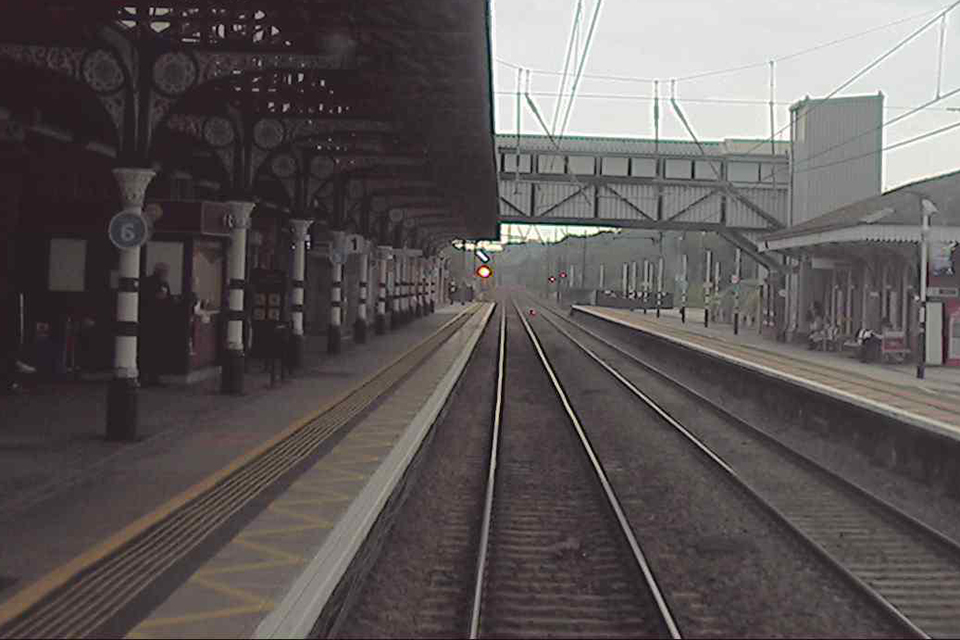
FFCCTV image from train 1Y80 showing signal D22 displaying a yellow aspect and diverging route indication (courtesy of LNER).
Observing the preceding signals on approach to signal D22, the driver involved had reduced the speed of the train to approximately 24 mph (38 km/h). Forward‑facing CCTV (FFCCTV) from train 1Y80 shows that signal D22 had already cleared to a yellow aspect with the junction indicator illuminated for the diverging route, as it came into view.
After passing signal D22, the driver initially kept the speed of the train below 30 mph (48 km/h). After around 350 metres, the driver began to apply traction power, increasing it as the train approached the junction. The train lurched as it was diverted by the points towards the Up Slow line, causing some standing passengers to be thrown to the floor and luggage to fall from overhead racks, injuring passengers. The driver initially shut off traction power but then, after around 4 seconds, they reapplied power and continued the journey to London. The driver did not report the incident to LNER.
The train manager became aware that one passenger had been injured by a falling suitcase caused by the train’s movement. They checked on the passenger and reported the injury to LNER control. Before this report, other passengers had raised concerns about the sudden lurch of the train via social media. Because of these concerns, LNER control staff asked the train manager about the nature of the incident, but they gave a limited description in response. LNER only became aware of the full seriousness of the incident in November after reviewing internal CCTV from the train and data from the OTDR (on-train data recorder) as part of its internal investigation. LNER then notified RAIB and Network Rail of the incident.
3. Cause of the incident
The incident occurred because the driver of train 1Y80 did not correctly handle their train for the diverging route after passing signal D22. This led to the driver accelerating their train as if it were taking the straight-ahead route at Grantham South Junction, which has a higher maximum permitted speed of 115 mph (185 km/h).
A comparison of data obtained from the OTDR on train 1Y80 and FFCCTV images shows that, around the location the train began to increase speed, the next signal ahead on the Up Fast line, signal D12, had come into view and was displaying a green (proceed) aspect. This signal is located beyond Grantham South Junction and so did not apply to train 1Y80, which was being routed onto the Up Slow line.
RAIB considers it likely that the driver reacted to this green signal (known as ‘reading through’) causing them to accelerate towards the higher permitted speed of the straight-ahead route. This is supported by the fact that the driver continued to apply traction power until the train was deflected towards the Up Slow line at the junction points. This response to the signal on the Up Fast line beyond the junction was either as a consequence of the driver not correctly observing the route information provided by signal D22 or forgetting this information after passing it.
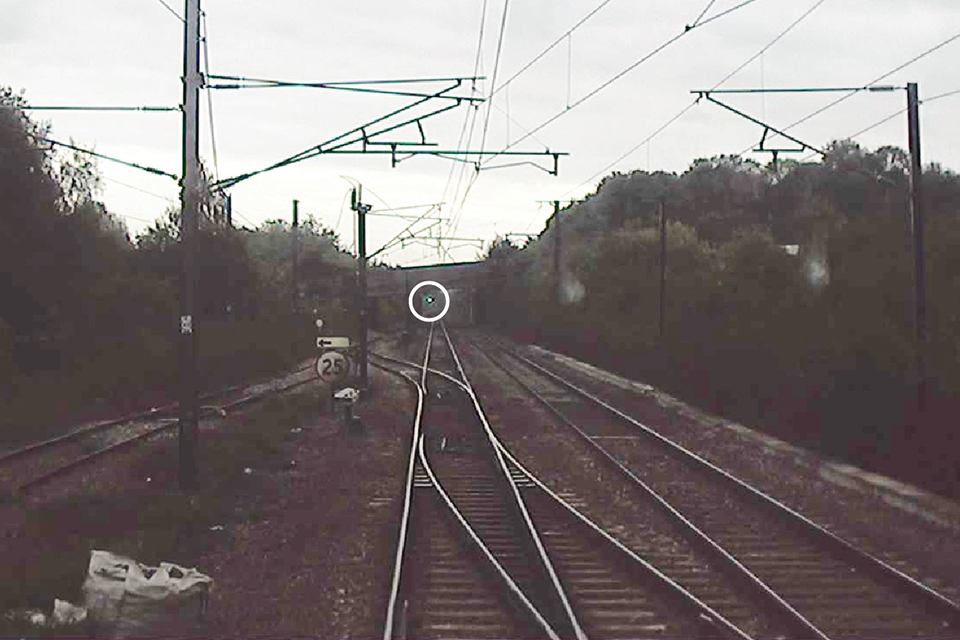
FFCCTV image from train 1Y80 showing the Up Fast line signal displaying a green aspect (in white circle) which did not apply to train 1Y80 (courtesy of LNER).
When interviewed by LNER, the driver stated they had seen signal D22 and the junction indicator and that they had called out the aspect as part of their risk triggered commentary. They were unable to recall the overspeeding incident but did state that a bird strike had possibly led them to either apply the brake or accelerate around the Grantham area. Otherwise, the driver did not report any unusual events from the journey.
As part of its investigation, LNER reviewed CCTV images from train 1Y80 including the internal CCTV from the passenger saloon. The images show that the train manager had entered the driving cab around 9 minutes before the overspeed and left around 3 minutes afterwards. While LNER permits its train managers to enter the driving cab if required by their duties, they are instructed to keep this to a minimum to avoid unnecessary distraction of the driver. Neither the driver nor the train manager had initially stated that the train manager had been in the driving cab at the time of the incident.
RAIB has concluded that the driver was possibly distracted from the driving task by the prolonged presence of the train manager in the cab. This, coupled with the variation from the previously booked route, may have contributed to the driver not observing the route information provided by signal D22 or forgetting this information after passing the signal.
Before this incident, as part of its route risk assessment, LNER had identified the risk of a driver accelerating beyond signal D22 to a speed which might derail a train being routed to the Up Slow line at Grantham South Junction. The risk controls assigned were focused on the briefing and training of drivers, and the use of driving techniques such as risk triggered commentary. The assessment did not discuss the risk of reading through.
Witness evidence was that, although the driver could not recall previously taking a train over this route, they were aware of Grantham South Junction and the associated potential risks.
4. Previous similar occurrences
A number of overspeed incidents have previously been investigated by RAIB on the mainline railway. Some of these incidents have resulted in passenger injuries and the trains involved coming close to derailing.
In April 2022, an overspeed incident occurred at Spital Junction, Peterborough, when a passenger train passed over three sets of points at the junction at excessive speed (RAIB report 06/2023). The maximum permitted speed over the junction is initially 30 mph (48 km/h), reducing to 25 mph (40 km/h). The train’s data recorder indicated that the points had been traversed at a speed of 76 mph (122 km/h). The report found that the overspeeding was caused by a recently qualified driver not reacting appropriately to the signal indication they had received on approach to the junction. The driver had not driven a train over that signalled route before.
Two recommendations from this investigation remain open:
- Recommendation 2 called on Network Rail to identify junctions fitted with approach controls where the risk from overspeeding could lead to derailment, injuries or damage. The recommendation asked for Network Rail to then share this information with train operators whose trains use the identified junctions to facilitate a collective reassessment of the risk of trains overspeeding at those junctions.
- Recommendation 3 called on Network Rail, in conjunction with train operators, to use the findings from the assessments carried out for recommendation 2 to jointly consider and implement risk mitigation measures at the identified junctions.
A second overspeed occurred at Spital Junction, Peterborough, at the same signal in May 2023, when another passenger train passed over the three sets of points at the junction at excessive speed (RAIB report 10/2024). The train’s data recorder indicated that the points had been traversed at a speed of 66 mph (106 km/h). Again, the report found that the overspeeding was caused by the driver of the train, who had 10 years of experience and was a driver mentor, not reacting appropriately to the signal indication they had received on the approach to the junction.
Network Rail added a control to the signal involved at Spital Junction which prevented it from clearing to any aspect other than yellow. This was intended to stop drivers accelerating after passing the signal, as they would expect the next signal to be red.
An overspeed incident at Manor Park, East London, occurred in September 2024 when a passenger train passed over a set of points at a diverging junction at a speed of 45 mph (72 km/h). The maximum permitted speed over these points is 25 mph (40 km/h) for the diverging route. RAIB published a safety digest (RAIB safety digest 01/2025) explaining that the driver became confused about the train’s location after being diverted from its booked route. As a result, the driver did not reduce the train’s speed before passing over the junction.
In February 2025, an overspeeding incident occurred at Grantham South Junction. A passenger train departed from Grantham station after a planned stop and accelerated until it reached a set of points at the junction with a maximum permitted speed of 25 mph (40 km/h) for the diverging route. The train was signalled towards the diverging route and traversed the points at around 55 mph (87 km/h) instead. RAIB carried out a preliminary examination and identified there was a strong likelihood that the factors present in this incident were similar to those identified during the two earlier investigations into the overspeeding incidents at Spital Junction, Peterborough.
RAIB wrote to the Office of Rail and Road (ORR, the health and safety regulator for railways in Great Britain) (RAIB news story), to draw its attention to this incident, and the rail industry’s responses to the recommendations made in both Spital Junction reports. RAIB highlighted that this incident illustrated again the issues associated with relying completely on train drivers reacting appropriately to a junction or route indicator to control the risks presented by trains taking diverging low-speed turnouts on high-speed through routes.
Following the February 2025 Grantham overspeed, Network Rail applied the same controls on signal D22 as had been applied to the junction signal involved at Spital Junction. The actions of the driver of train 1Y80 indicate that the intent of this change was initially effective. However, this change did not consider the potential for a driver reading through to the next signal.
In December 2025, an overspeeding incident occurred at Cambridge Junction, Hitchin, Hertfordshire (RAIB safety digest 02/2026). During this incident, a passenger train was routed from the Down Slow line over points for a diverging route with a maximum permitted speed of 25 mph (40 km/h). CCTV evidence shows that the signals for this route displayed the expected indications; however, the train traversed the points at 56 mph (90 km/h). RAIB concluded that this incident occurred because the driver expected the train to go via the higher speed route over the flyover towards Cambridge and the information provided by the signalling system did not change that expectation.
In December 2025, ORR convened a cross-industry meeting with Network Rail, train operating companies and freight operating companies. The main purpose of the meeting was to improve co‑operation between Network Rail and train operators, and to increase the rate of progress in addressing recommendations 2 and 3 from the investigation of the April 2022 incident at Spital Junction.
In January 2026, Network Rail informed ORR about how it is carrying out joint risk assessments with train operators for the high-risk junctions that it and the train operators had identified. This was to demonstrate how co‑operation and collaboration are taking place between parties on addressing this shared system risk.
Separately, ORR has also written to other industry organisations and trade unions to consider how to improve co‑operation across the industry on managing overspeeding risk. ORR has advised RAIB that, although these recommendations remain open, it also acknowledges that they have been taken into consideration and that action is being taken by the rail industry to close them.