Derailment at Hopetown Junction, Darlington, 31 January 2026
Published 15 April 2026

© Crown copyright 2026
This publication is licensed under the terms of the Open Government Licence v3.0 except where otherwise stated. To view this licence, visit nationalarchives.gov.uk/doc/open-government-licence/version/3 or write to the Information Policy Team, The National Archives, Kew, London TW9 4DU, or email: psi@nationalarchives.gov.uk.
Where we have identified any third party copyright information you will need to obtain permission from the copyright holders concerned.
This publication is available at https://www.gov.uk/government/publications/safety-digest-032026-hopetown-junction/derailment-at-hopetown-junction-darlington-31-january-2026
1. Important safety messages
This accident demonstrates the importance of:
- track maintenance staff implementing effective management of track gauge, particularly in lesser-used locations which may not be monitored by track recording trains
- track inspection staff identifying and recording signs of dynamic gauge widening, such as chair shuffle, deteriorating sleepers and loose screws, so that corrective actions can be appropriately scheduled
- requests for authority for passenger trains to operate over non-passenger lines being followed up by an appropriate review by the local track engineer of the track condition, including the potential for any dynamic gauge widening to occur under the type of train to be operated.
2. Summary of the accident
At around 13:19, a passenger train derailed, and then rerailed, at Hopetown Junction, near to Darlington North Road station. The train involved was a passenger charter service from Derby to Shildon. This was formed of a High Speed Train (HST) set owned by ROMIC Group and operated by Rail Adventure UK.
The train had been routed from the Darlington North Road Goods Loop line, over the crossover at Hopetown Junction and onto the Bishop Auckland Single line towards Shildon. The train crew were initially unaware that anything was amiss and the train continued normally to Shildon, where the driver was alerted to the derailment after reports by the passengers and staff on board.
A subsequent examination of the train and track found evidence that several wheels had derailed, and then rerailed, within the length of the crossover at Hopetown Junction.
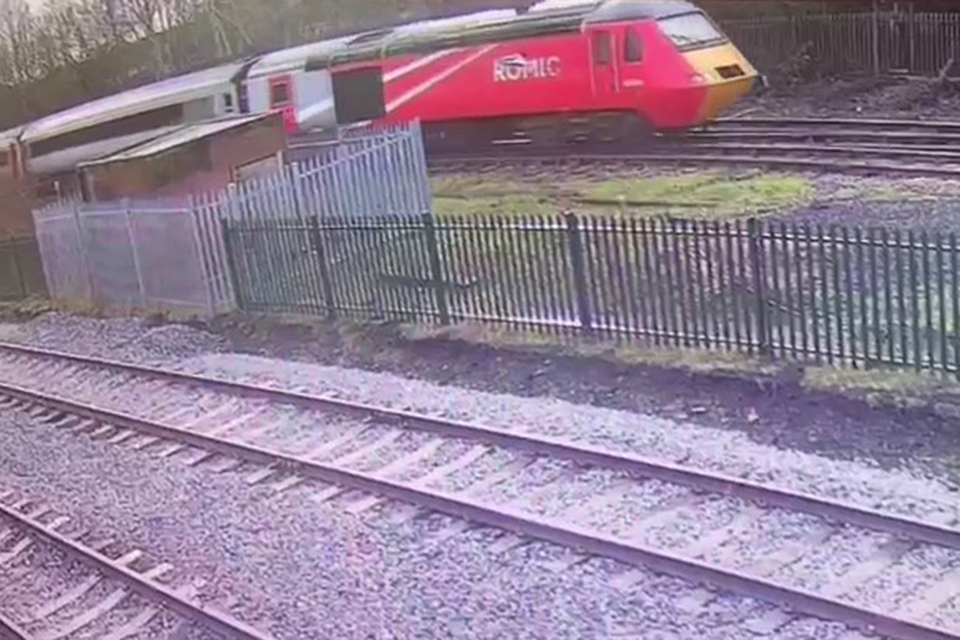
The train at the derailment location (courtesy of Darlington Railway Preservation Society).
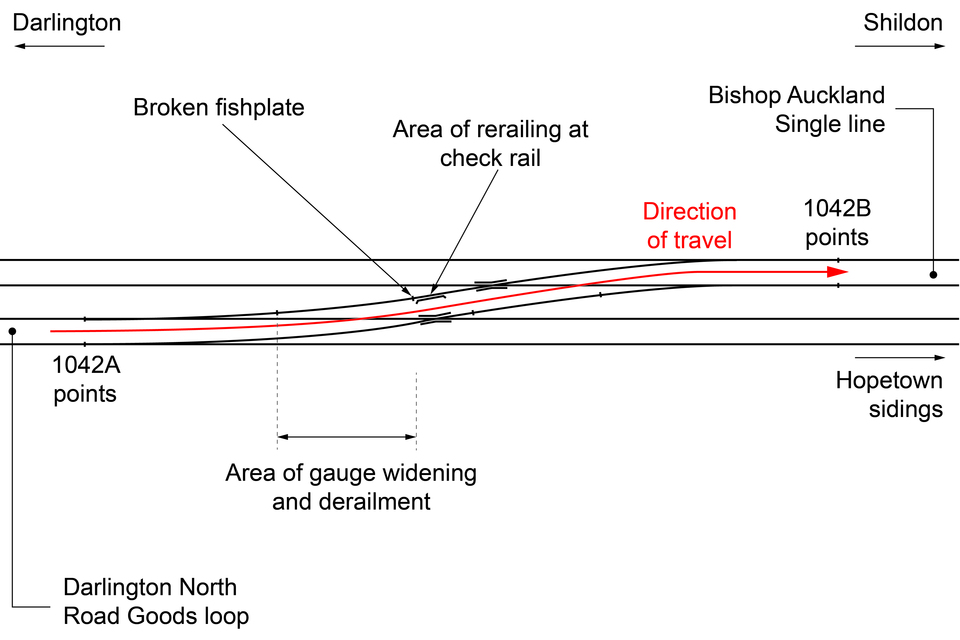
The track layout at Hopetown Junction.
3. Cause of the accident
The derailment occurred because the track under the train failed, resulting in the rails spreading apart. This allowed several wheels to drop into the space between them, known as the ‘four-foot’. A number of these derailed wheels then struck rail fastenings and a ‘fishplate’. Fishplates are used to join two sections of rail together using bolts. The fishplate bolts failed in shear due to the derailed wheels striking the fishplate. The derailed wheels then struck rail fastenings adjacent to a length of check rail, and climbed back onto the railhead, allowing the train to continue running.
Passengers in several coaches of the train later reported to staff on board that there had been a lurch and banging as it passed over the crossover at Hopetown Junction, but that the banging had stopped after exiting the crossover.
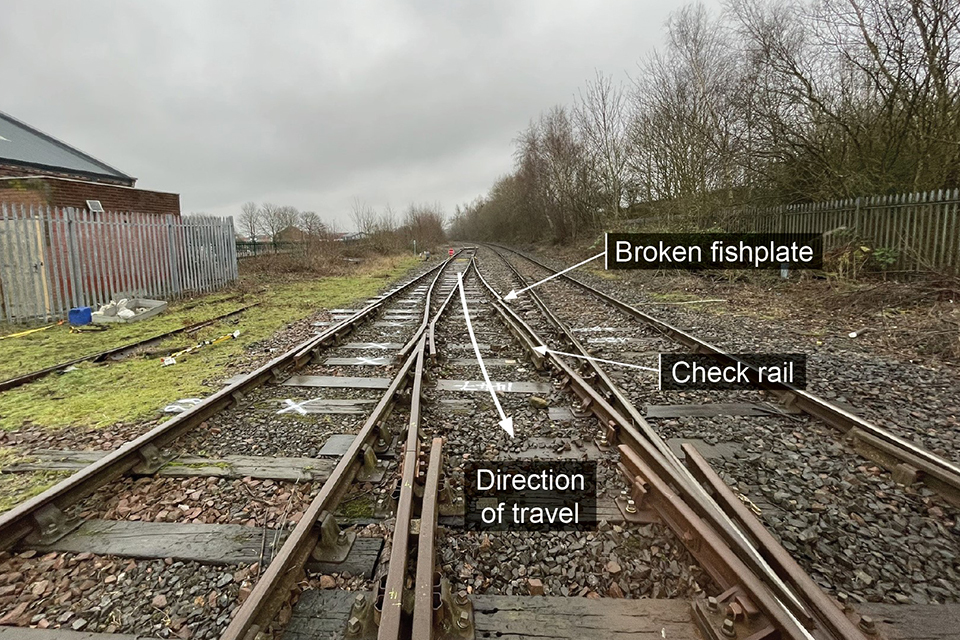
Damage to the crossover after the derailment.
The charter train had arrived on the North Road Goods Loop line, which bypasses the platform at Darlington North Road station, as part of a movement onto newly commissioned track into Hopetown sidings. The loop line and the sidings were classed as non-passenger lines. After visiting the sidings, the train reversed direction and moved back onto the North Road Goods Loop line, before reversing direction a second time to move over the crossover towards Shildon. It was during this move that the train derailed.
RAIB examined the train after it had returned to the depot. A number of marks were found on several wheels. These were consistent with wheels dropping between the rails due to wide gauge, making contact with rail fastenings and a fishplate, and then climbing back onto the railhead. The marks were therefore considered by RAIB to be a result of the derailment. There was no evidence to indicate that the condition of the train contributed to the accident.
When the derailment occurred, the train was moving from the Darlington North Road Goods Loop line, over crossover points 1042A and 1042B, onto the Bishop Auckland Single line. The subsequent examination by RAIB of the track showed that the sleepers through the points, in the immediate vicinity of the derailment, were in a poor condition.
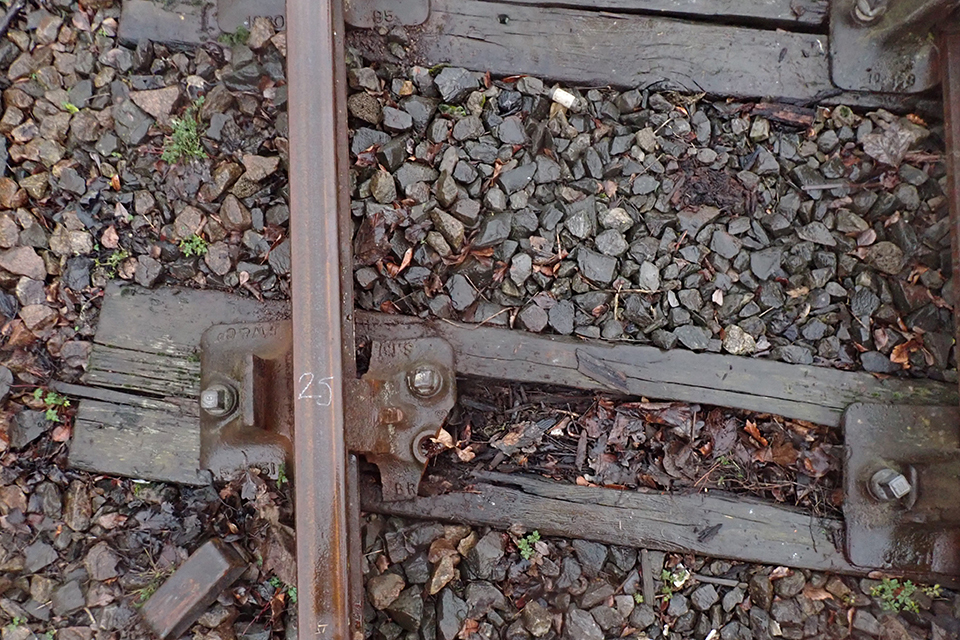
A timber sleeper inside the crossover after the derailment, showing rotten wood and insecure rail fastenings.
Several sleepers were split and decaying, with little solid timber into which the rail fastenings were secured. Some of the sleepers showed wear marks where the chairs, in which the rail was secured, had been experiencing lateral movement, known as ‘shuffle’. This showed that the screws that secured them into the sleeper were insecure, probably because of the state of the timber.
The crossover carried very little traffic. RAIB searched Network Rail’s train movement records and found that the last train to pass over it before the charter train was a video inspection vehicle on 14 January 2026, travelling in the opposite direction. No other trains were found to have used the crossover after 11 November 2025, which was the limit of the available data.
Footage from the video inspection vehicle on 14 January 2026 shows that the fishplate joint (the bolts from which were found to be broken after the derailment) was intact at that time. This strongly suggests that the fishplate bolts broke under the charter train, which was the next one to traverse the crossover.
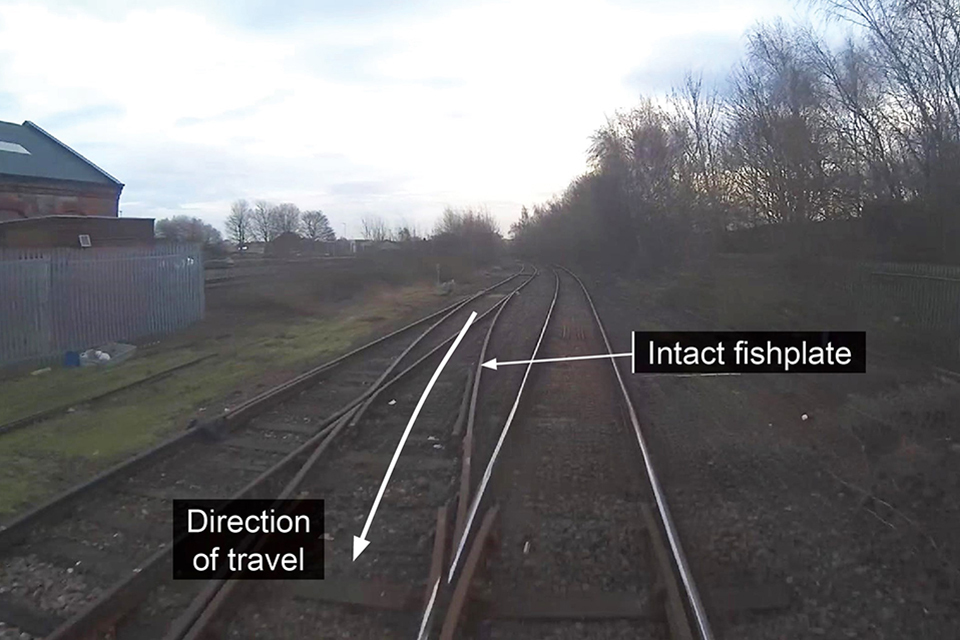
The crossover on 14 January 2026, showing fishplate joint still intact (courtesy of Network Rail).
The track through the crossover had been subject to Network Rail’s routine inspection and maintenance regime for jointed track. This required a basic visual inspection (BVI) every 2 weeks. The last of these took place on 30 January, the day before the derailment. None of the record sheets for the last five BVIs recorded any issues with the track at the derailment location, with the only notes being either ‘no new defects found’ or ‘no actionable defects found’.
The track was also subject to a supervisor’s inspection every 13 weeks. The last of these which took place before the derailment was on 19 December 2025. This noted that there were no new faults found. The previous supervisor’s inspection on 12 September 2025 recorded that the track on the North Road Goods Loop line was life expired, but that there were no faults found that would have required maintenance activity.
The line between Darlington and Bishop Auckland was not subject to track geometry measurement by Network Rail’s measurement trains, meaning that there was no measurement of dynamic track gauge. Dynamic track gauge measurement is when the gauge is measured under the load of a train, and can help identify track widening due to insecure rail fastenings or sleepers. The video inspection vehicle was not equipped to record dynamic track gauge. There was a separate schedule for taking manual measurements of static (non-dynamic) track gauge.
Network Rail standards define a process for how passenger trains are authorised to operate over sections of track that are normally only intended for non-passenger use. Such track is normally only used by freight or out-of-service passenger trains. This process requires Network Rail’s charter train planning team to request authorisation from the local track engineer and operations manager, confirming that the track is safe and that any other mitigations required can be put in place.
The track engineer is required to complete a form, which is then checked and authorised by the operations manager, before being returned to the train planning team. This form includes a tick box asking if ‘the Track Engineer responsible for the line has confirmed that the track is in a fit state for the passage of a loaded passenger train’. There are other boxes asking if there are any other operational requirements for staff, and if the vegetation state is suitable for the passage of a loaded passenger train.
The local track engineer received this request on 13 January 2026, during their first week in that role at Darlington. There was no defined process for what the track engineer needed to do to determine if the track was suitable for a passenger train. After seeking guidance from the assistant track engineer, who advised that the track condition was not very good, the track engineer decided that it would be necessary to inspect it. They took staff to site on 15 January to inspect the North Road Goods Loop line and the connection into the Hopetown sidings, to fully understand the condition. This inspection included a trolley-based track geometry survey and manual geometry measurement and inspection of points 1042A and 1042B.
The inspection records showed that there were a few track twist and gauge faults along the straight track of the loop line, and these were rectified early the following week. Because a battery had run out, the team were unable to use the trolley to measure the geometry through the points. However, a set of manual measurements were taken through the two sets of points, including on the section where the train was to derail, and no gauge discrepancies that required action were found. These measurements would not have included any potential dynamic gauge widening effects resulting from the weight of a passing train.
During the inspection, the track engineer walked along the crossover and noted that some of the sleepers, including some on the plain line section, were in poor condition. They also noted that some sleepers had been replaced further back on the loop line, but not on the crossover. But their view was that the rail fastenings and joints were tight, and that it would be safe for the charter train to use the crossover.
As a result of this inspection, the track engineer completed the L2/OPS/015/F01 form, stating that the track was available to use, and returned this to the charter train planning team on 19 January.
4. Previous similar occurrences
A number of derailment accidents have previously been investigated by RAIB on mainline railways. Some of these accidents have resulted in significant damage to the track and to the trains involved.
Incidents with similarities to the accident at Hopetown Junction which were investigated by RAIB include:
- Derailment at Windsor and Eton Riverside station (RAIB report 11/2010). A passenger charter train derailed as a result of wide track gauge due to defective sleepers and ineffective rail fastenings. Some track inspections had identified defects, but these had not been sufficiently prioritised to result in repairs being actioned.
- Charter train derailment near Southampton Eastern Docks (RAIB safety digest 04/2017). A passenger charter train derailed as a result of wide track gauge due to defective sleepers and worn rail fastenings. Track inspections did not take place at the scheduled intervals, or at all, and the inspections that were undertaken had not resulted in corrective action to the track where the derailment occurred.
- Derailment at Liverpool Street station (RAIB report 27/2014). A passenger train derailed, and rerailed, due to wide track gauge which resulted from sleepers and rail fastenings deteriorating to the point that they were unable to maintain track gauge. Multiple track inspections had not identified the failures inside a complex points arrangement because the measurements were only being taken statically with no load.
Although the causes were different, RAIB has investigated accidents where trains have derailed and subsequently rerailed before continuing normally. Examples of these took place at Washwood Heath West Junction (RAIB report 01/2016) and Dunkeld and Birnam (RAIB safety digest 01/2019).
A wider summary of previous RAIB learning, including more similar accidents relating to derailments, can be found on the RAIB’s website.