Overspeed at Cambridge Junction, Hertfordshire, 11 December 2025
Published 14 April 2026

© Crown copyright 2026
This publication is licensed under the terms of the Open Government Licence v3.0 except where otherwise stated. To view this licence, visit nationalarchives.gov.uk/doc/open-government-licence/version/3 or write to the Information Policy Team, The National Archives, Kew, London TW9 4DU, or email: psi@nationalarchives.gov.uk.
Where we have identified any third party copyright information you will need to obtain permission from the copyright holders concerned.
This publication is available at https://www.gov.uk/government/publications/safety-digest-022026-cambridge-junction/overspeed-at-cambridge-junction-hertfordshire-11-december-2025
1. Important safety messages
This incident demonstrates the importance of:
- drivers being aware of the need to maintain alertness when approaching junction signals, so that all the information the signal provides is acted upon
- drivers not making assumptions about the route set ahead based on commonly set routes and their previous experience
- route risk assessments identifying junctions where there is a significant speed reduction on the diverging route beyond the junction signal and making drivers aware of these locations
- infrastructure managers and train operating companies recognising that there is a risk of overspeeding even when the point of divergence at the junction is very close to the junction signal.
2. Summary of the incident
At 10:39 on 11 December 2025, train reporting number 1T20, the 10:12 London King’s Cross to Ely service, operated by Great Northern, travelled at too high a speed across Cambridge Junction. The junction is located immediately north of Hitchin station in Hertfordshire. At this junction, trains travelling north on the East Coast Main Line (ECML) can diverge onto the line towards Cambridge.
Train 1T20 was routed from the Down Slow line to take the diverging route over the junction towards Cambridge by passing over six sets of points and a switch diamond. For this route, the first two sets of points have a permanent speed restriction of 25 mph (40 km/h). The permanent speed restriction for the remainder of this route, over the other points and the switch diamond, is 40 mph (64 km/h). However, when the train began to traverse the first two sets of points it was travelling at 56 mph (90 km/h) instead of 25 mph (40 km/h).
This caused the train to lurch sideways as it traversed the junction, with several passengers falling from their seats onto the floor and the few passengers who were standing being thrown off balance. No injuries were reported following the incident and there was no damage caused to the train or to railway infrastructure.
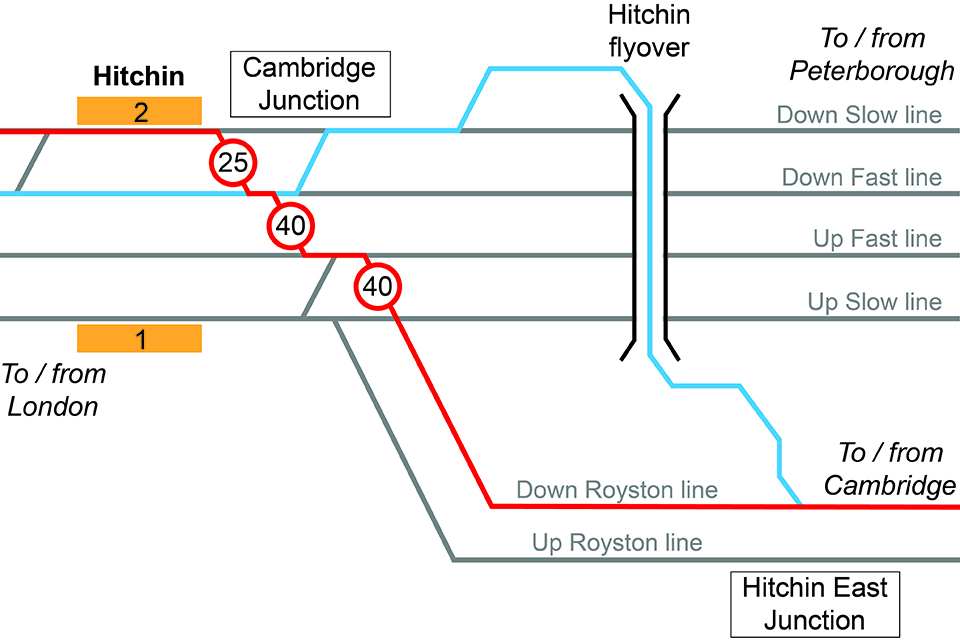
Track layout at Cambridge Junction with path taken by train 1T20 shown in red and its timetabled path shown in blue.
The driver realised the train was traversing the junction and applied the train’s brakes causing it to slow. By the time the train’s rear carriage crossed the first two sets of points, the train was still travelling at 44 mph (71 km/h). When the front of the train had started to traverse the rest of the junction, it was travelling at 55 mph (89 km/h) although it had slowed to 42 mph (68 km/h) by the time the rear of the train reached this point.
3. Cause of the incident
This incident occurred because the driver did not correctly react to the information provided by the signalling system. As a result of this, the train was driven as if it were taking the route via the flyover towards Cambridge, which initially has a higher maximum permitted speed.
The signal for the junction, YB1507 signal, is located under the station canopy at the north end of platform 2 at Hitchin station. It is a three-aspect LED colour light signal with a single aperture that can display either a green, yellow or red aspect. It is also fitted with a junction indicator. When the train passed this signal, it was displaying a green (proceed) aspect. Its junction indicator correctly displayed that the train was pathed along the second signalled route to the right from the signal. This was the route across the junction and onto the Down Royston line towards Cambridge.
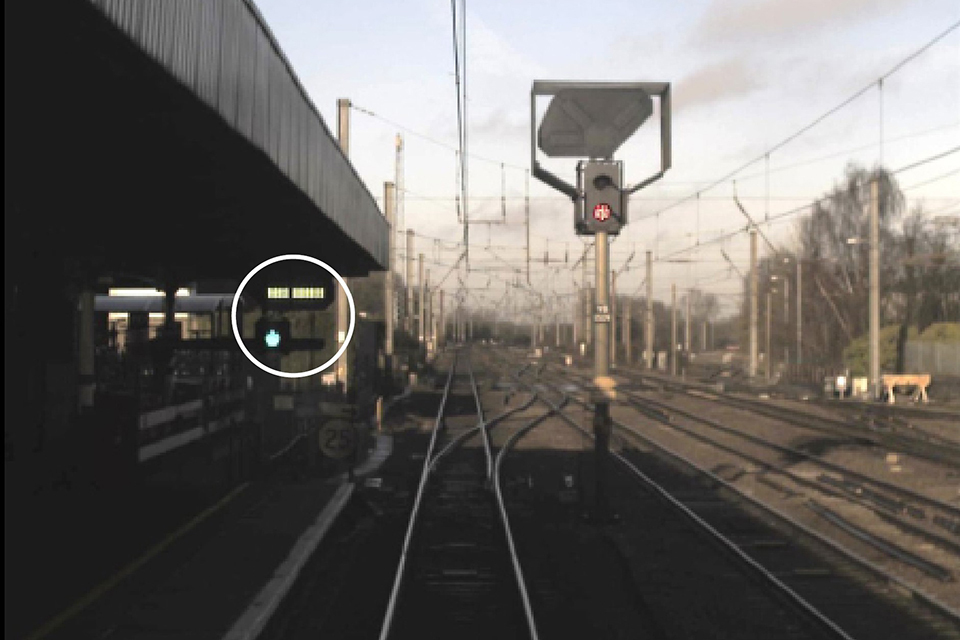
Forward-facing CCTV image from the incident train showing YB1507 signal on the left displaying a green aspect and its junction indicator with a position 5 indication (circled in white). YB1509 signal next to the track on the right is displaying a red aspect and applies to the adjacent Down Fast line (courtesy of Great Northern).
At junctions where there is more than one line for a train to take, the signalling system provides drivers with information about which route the train will be taking. At Cambridge Junction, relevant signals are fitted with junction indicators to provide this information. The type fitted to YB1507 signal is an LED style junction indicator, which can display position 1, 4 and 5 indications using a matrix of white LEDs. The position 1 indication is for the route to go over the Hitchin flyover towards Cambridge, position 4 is to join the Down Fast line and go straight on towards Peterborough, and position 5 is to cross the junction to go towards Cambridge. When the junction indicator is unlit, this informs the driver that their train is routed to continue along the Down Slow line towards Peterborough.
The signal and junction indicator were changed to their current types in 2013 when signalling infrastructure in the area was replaced as part of the work for the new flyover at Hitchin. The flyover provides trains bound for Cambridge on the ECML down lines with a way to pass over the top of the ECML up lines, rather than crossing these lines on the level at Cambridge Junction. The initial design and sighting assessment of the replacement YB1507 signal took place at the end of 2010.
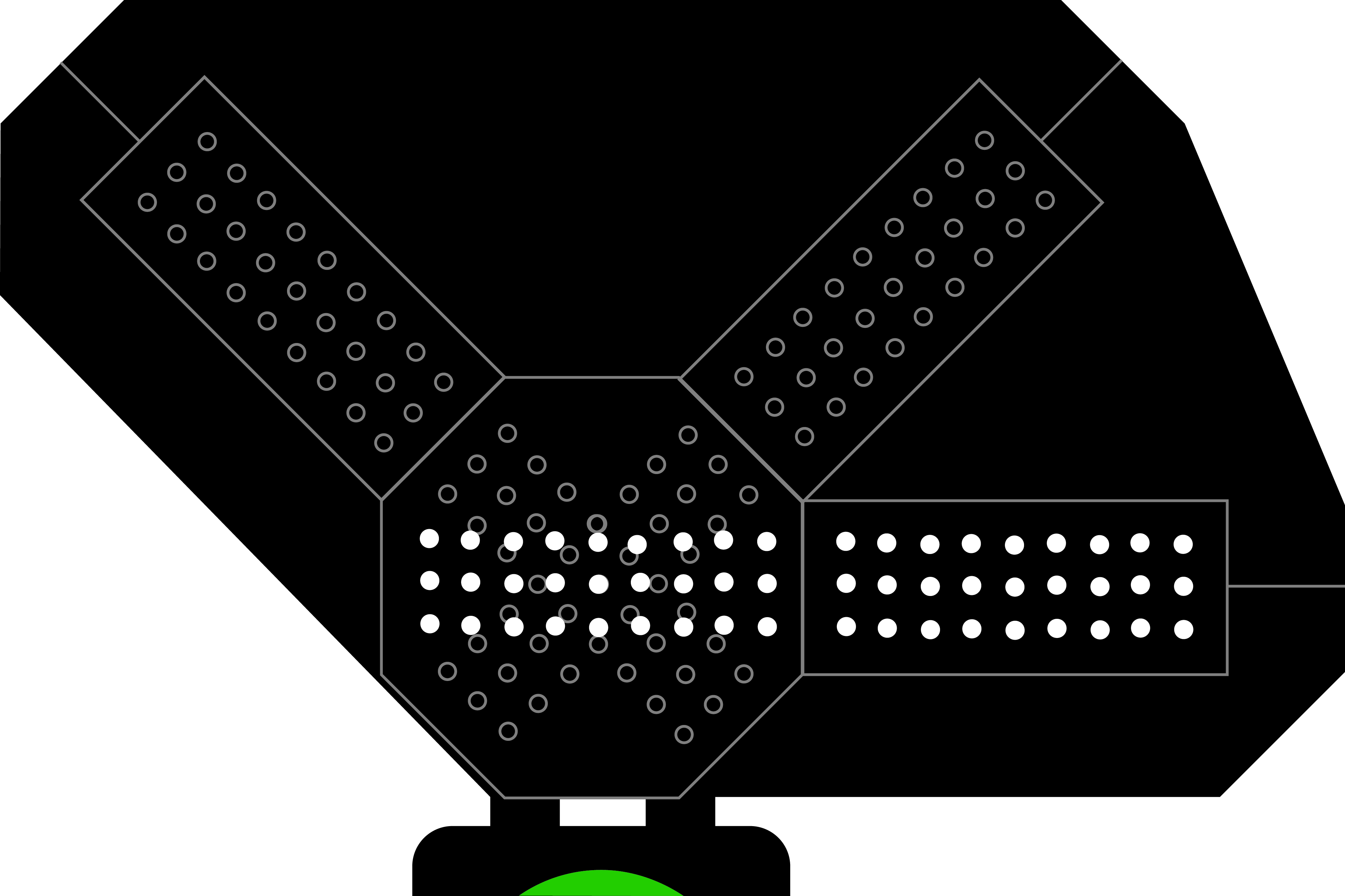
An LED style junction indicator displaying a position 5 indication.
The sighting assessment noted that the signal needed to be readable by a driver from a minimum distance of 441 metres away, but this was increased to 500 metres when the risks associated with the signal were considered. The assessment identified four risks which meant drivers needed more time to read the signal. One risk was due to the signal having a junction indicator with multiple indications which was mounted in an unusual position. Another was there being another signal located parallel with it (YB1509 signal for trains on the Down Fast line). A further risk was the signal being approach released for some of the routes from it. The final risk was potential distractions from the station platform area. The sighting assessment found that the actual readable distance for the signal was 625 metres, which was more than the required readable distance of 500 metres.
The location of YB1507 signal and its junction indicator under the station canopy means they are positioned lower down than normal (as can be seen when compared to YB1509 signal). The sighting assessment noted that the top part of the position 1 and 4 indications might not be visible to drivers on the approach to the signal, when between 280 and 180 metres from it. This was due to the station canopy support being in the way. However, the assessment concluded that more than the minimum viewable proportion of these position 1 and 4 indications, as required by railway group standards, would remain visible throughout. During this incident, the position 5 indication was lit, so was fully visible to the driver throughout.
On the approach to Cambridge Junction, there are also preliminary route indicators (PRIs) which can provide drivers on the Down Fast and Down Slow lines with advance information about which route their train will be taking at the junction. These are located between the junction signals and the previous signals and provide an arrow indication to show the route set at the junction signal. However, PRIs are only illuminated when the junction signal is displaying a proceed aspect. Due to the configuration of the signalling system at the junction, there is no PRI arrow indication for the route to cross Cambridge Junction on the level to go towards Cambridge. This is because trains taking this route are approached released from red by the signalling, meaning the junction signal will remain at a red aspect until after the train has passed the PRI.
The approach release from red control means that, even when the route is set from YB1507 signal across the junction to the Down Royston line, the signal will remain at red so the driver will receive a cautionary aspect at the previous signal. The aspect on YB1507 signal will only be allowed to step up to show a proceed aspect for this route once the train reaches a predetermined location, which is when the junction signal is readable by the driver. At this point, the driver should also receive information from the signal about the route divergence as the train should be sufficiently close to the signal for its junction indicator to also be readable.
Train 1T20 departed from London King’s Cross station on time and travelled on the Down Fast line until just south of Stevenage. Here the signaller advised the driver that the line ahead was blocked by a failed train and that their train would be diverted onto the Down Slow line. This meant train 1T20 followed a stopping service, which was also going to Cambridge. To get the two trains back into their timetabled order, and to avoid further delaying train 1T20, the signaller routed the stopping train via the Hitchin flyover so it could then be held at Hitchin East Junction. This would allow train 1T20 to overtake it by crossing Cambridge Junction and proceeding along the Down Royston line.
As train 1T20 approached Hitchin, it passed YB1481 signal (the signal preceding YB1507 signal) which was displaying a single yellow aspect. In response to this, the driver applied the train’s brakes and slowed down from 70 mph (113 km/h) to about 25 mph (40 km/h). When YB1507 signal came into the driver’s view, it was displaying a red aspect. It then changed to display a green aspect with a position 5 junction indication. In response to this change of signal aspect, the driver demanded traction from the train, and it began to accelerate. At this point the train was about 585 metres from the signal. By the time the train arrived at the signal, about 32 seconds later, it was travelling at 56 mph (90 km/h).
Very soon after passing the signal, the train reached the first set of points which were set to take the train across the junction. The train lurched to the right and it was only at this point that the driver realised the train was taking the route over the junction and applied the train’s brakes. After crossing the remainder of the junction, at 10:40 the driver contacted the signaller to ask if their train should have been routed to the Down Royston line over Cambridge Junction. The signaller confirmed that this was correct, explaining that the stopping train was waiting on the flyover, and the call ended.
At 10:43, the driver called the signaller again to report that they had crossed the junction at too high a speed. The driver explained that they had misread the junction indicator and thought it had been displaying a position 1 indication instead of a position 5 indication. The signaller instructed the driver to bring their train to a stand at Royston station while they spoke to control to decide what to do next. After speaking to control staff, the driver was authorised to continue to Cambridge station where they were relieved by another driver.
After consulting with the local Network Rail maintenance team, staff in control placed a restriction on the points which had been passed over at too high a speed. By 14:52, maintenance staff had examined the 25 mph (40 km/h) points and the restriction was removed from them, as no faults were found. The restrictions on the remaining points were removed at 02:55 the next day, after they had been examined and no defects found.
RAIB concluded that this incident occurred because the driver expected the train to go via the higher speed route over the flyover towards Cambridge and the information provided by the signalling system did not change that expectation. Having approached at a reduced speed as a result of the preceding signal displaying a single yellow aspect, the driver reacted to signal YB1507’s change of aspect when the train was over 500 metres from it and then drove the train as if it was routed towards the flyover. While the signal remained visible throughout, the information it was displaying did not change the driver’s understanding about which way the train was routed. Witness evidence indicates the driver might have misread the position 5 indication as a position 2 indication (both are horizontal indications). If the train had approached on the Down Fast line and been routed onto the flyover as originally timetabled, the junction indicator for YB1509 signal would have displayed a position 2 indication.
The driver was newly qualified, having passed out to drive unaccompanied 11 days earlier. In the initial stages of their driver training, they observed GTR trains being driven by a driver based at Sevenoaks, so most of their in-cab experience was over routes south of Finsbury Park. When they began driving with an instructor on the route between London and Cambridge, they had very limited experience of driving over all the routes at Cambridge Junction. However, by the time they had reached the end of their training, they were evaluated by GTR on their knowledge of all their designated routes and passed their initial competence assessment.
During their training, the driver had only once driven a train over the level route at Cambridge Junction from the Down Slow line to the Down Royston line. This was a train that had been timetabled to stop at Hitchin. They had never driven a non-stop train over this specific route. To support the training of their route knowledge, the driver had been given access to route learning videos as well as route learning plans. However, during their training, the risk of misreading the position displayed by the junction indicator at YB1507 signal had not been discussed.
In its route risk assessment, GTR had identified that there was a risk of wrong routing at YB1507 signal, with trains bound for Cambridge being routed instead towards Peterborough. This was due to previous mis-routing incidents at YB1507 and YB1509 signals.
In its assessment, GTR had not identified the risk of the junction indicator at this signal being misread by a driver. However, since the introduction of the flyover, the level route across the junction to the Down Royston line is rarely used and no passenger trains are timetabled over this route. Data from a rail industry system showed that in the 2 weeks before, from Monday to Friday, between zero and four trains used this route each day. These included at most one or two passenger trains each day. It is likely that these trains were routed off their timetabled path by a signaller for regulation purposes to change the order of trains heading towards Cambridge, as happened on the day of this incident.
This incident again illustrates that, once a junction signal changes to display a proceed aspect, the acceleration rates achievable by modern passenger trains mean that these trains can still reach a speed that is high enough for a significant overspeed to occur at a diverging junction, even in a relatively short distance.
4. Previous similar occurrences
A number of overspeed incidents have previously been investigated by RAIB on mainline railways. Some of these incidents have resulted in passenger injuries and the trains involved coming close to derailing.
Incidents with similarities to the one at Cambridge Junction which were investigated by RAIB include:
- An overspeed incident at Spital Junction, Peterborough, which occurred in April 2022 when a passenger train passed over three sets of points at the junction at excessive speed (RAIB report 06/2023). The permanent speed restriction over the junction for the diverging route is initially 30 mph (48 km/h) reducing to 25 mph (40 km/h). The train’s data recorder indicated that the points had been traversed at a speed of 76 mph (122 km/h). The report found that the overspeeding was caused by a recently qualified driver not reacting appropriately to the signal indication they had received on approach to the junction. The driver had not driven a train over that signalled route before.
- A second overspeed at the same signal at Spital Junction, Peterborough, occurred in May 2023 when another passenger train passed over the same three sets of points at the junction at excessive speed (RAIB urgent safety advice 02/2023 and RAIB report 10/2024). The train’s data recorder indicated that the points had been traversed at a speed of 66 mph (106 km/h). Again, the report found that the overspeeding was caused by the driver of the train, who had 10 years of experience and was also a driver mentor, not reacting appropriately to the signal indication they had received on the approach to the junction.
- An overspeed incident at Manor Park, East London, which occurred in September 2024 when a passenger train passed over a set of points at a diverging junction at a speed of 45 mph (72 km/h). The permanent speed restriction over these points for the diverging route is 25 mph (40 km/h). RAIB published a safety digest (RAIB safety digest 01/2025) explaining that the driver became confused about the train’s location after being routed off its booked route. As a result, the driver did not reduce the train’s speed before passing over the junction.
- RAIB reviewed a further overspeed incident that happened at Grantham South Junction in February 2025. A passenger train departed from Grantham station after a planned stop and accelerated until it reached a set of points at the junction with a permanent speed restriction of 25 mph (40 km/h) for the diverging route. The train was routed towards the diverging route and traversed the points at around 55 mph (87 km/h) instead. RAIB carried out a preliminary examination and identified there was a strong likelihood that the factors present in this incident were like those identified during the two investigations into trains overspeeding at Spital Junction, Peterborough. RAIB wrote to the Office of Rail and Road (RAIB news story published 3 April 2025) to draw its attention to this incident.
- Following a second overspeed incident at Grantham South Junction, which occurred in September 2025, RAIB decided to publish a safety digest (on which work is ongoing). This time, the train was a non-stopping service through Grantham station which was also signalled to take the diverging route at the junction. However, instead of traversing the points at 25 mph (40 km/h), it passed over them at 56 mph (90 km/h).
Underlying both incidents at Spital Junction was a factor associated with train operators and Network Rail not effectively controlling the risk of overspeeding at diverging junctions. This underlying factor from the investigation into the first overspeeding event at Spital Junction led to two recommendations:
- Recommendation 2 called on Network Rail to identify junctions fitted with approach controls where the risk from overspeeding could lead to derailment, injuries or damage. The recommendation asked for Network Rail to then share this information with train operators whose trains use the identified junctions to facilitate a collective reassessment of the risk of trains overspeeding at those junctions.
- Recommendation 3 called on Network Rail, in conjunction with train operators, to use the findings from the assessments carried out for recommendation 2 to jointly consider and implement risk mitigation measures at the identified junctions.
These recommendations, which are relevant to both Spital Junction incidents and this incident at Cambridge Junction, are still open. Network Rail started work to implement these recommendations, by identifying junctions where there was a risk of overspeeding. However, further overspeeding incidents have occurred while this work is taking place.
In December 2025, the Office of Rail and Road (ORR, the health and safety regulator for railways in Great Britain) convened a cross-industry meeting with Network Rail, train operating companies and freight operating companies. The main purpose of the meeting was to improve co‑operation between Network Rail and train operators, and to increase the rate of progress in addressing recommendations 2 and 3 from the investigation of the first overspeeding event at Spital Junction.
In January 2026, Network Rail informed ORR about the way it is carrying out joint risk assessments with train operators for the high-risk junctions that it and the train operators had identified. This was to demonstrate how co‑operation and collaboration are taking place between parties on addressing this shared system risk.
Separately, ORR has also written to other industry organisations and trade unions to consider how to improve co‑operation across the industry on managing overspeeding risk. ORR has advised RAIB that, although these recommendations remain open, it acknowledges that the recommendations have been taken into consideration and that action is being taken by the rail industry to close them.