Near miss at Helpston manually controlled barrier level crossing, 21 October 2025
Published 9 March 2026

© Crown copyright 2026
This publication is licensed under the terms of the Open Government Licence v3.0 except where otherwise stated. To view this licence, visit nationalarchives.gov.uk/doc/open-government-licence/version/3 or write to the Information Policy Team, The National Archives, Kew, London TW9 4DU, or email: psi@nationalarchives.gov.uk.
Where we have identified any third party copyright information you will need to obtain permission from the copyright holders concerned.
This publication is available at https://www.gov.uk/government/publications/safety-digest-012026-helpston/near-miss-at-helpston-manually-controlled-barrier-level-crossing-21-october-2025
1. Important safety messages
This incident demonstrates the importance of:
- signallers only using sealed releases in line with the requirements of the Rule Book and any relevant local instructions
- infrastructure managers ensuring that foreseeable operational requirements are appropriately covered by training and local instructions to prevent informal practices from developing, which may become adopted during normal operations
- infrastructure managers ensuring that effective assurance arrangements exist so that emergency or out-of-course systems do not become routinely used during normal operations.
2. Summary of the incident
At 08:16 on Tuesday 21 October 2025, a near miss occurred at Helpston manually controlled barrier (MCB) level crossing, situated near Peterborough.
During this incident, the signaller on duty at Helpston signal box used the ‘raise barriers’ control for Helpston MCB level crossing, having forgotten that a freight train was approaching the crossing. The barriers became fully raised, and the wig-wag road traffic lights extinguished, while the freight train was still on the crossing. The signaller then realised what had happened and used the ‘lower barriers’ control to start the lower sequence.
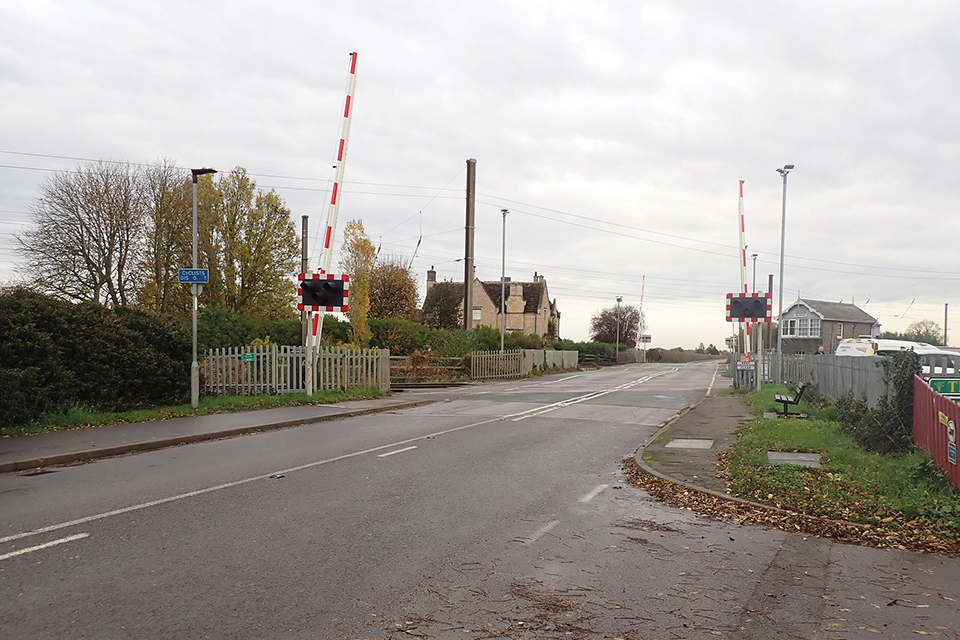
Helpston MCB level crossing with (on right side) Helpston signal box.
One of the waiting car drivers started to move their vehicle towards the crossing after the barriers started to rise. There is conflicting witness evidence about how far the car moved. The train driver did not report seeing any road vehicles enter the crossing as the train approached and no road vehicles were struck by the passing train.
No one was injured in the incident and no damage was caused.
3. Cause of the incident
This incident occurred because the signaller used a sealed release which allowed them to manually raise the barriers at Helpston MCB level crossing, despite there being a train approaching. A sealed release is provided for equipment, including level crossing barriers, to allow their operation in the event of an equipment failure, when engineered safeguards may need to be overridden.
Helpston MCB level crossing spans six railway lines on a skew. These are the Up and Down Fast and Up and Down Slow lines of the East Coast Main Line, and the Up and Down Stamford lines. The crossing is controlled by Helpston signal box which also controls a further four level crossing which are sited remotely and which are monitored using CCTV. The signal box is located between the East Coast Main Line and the Stamford lines.
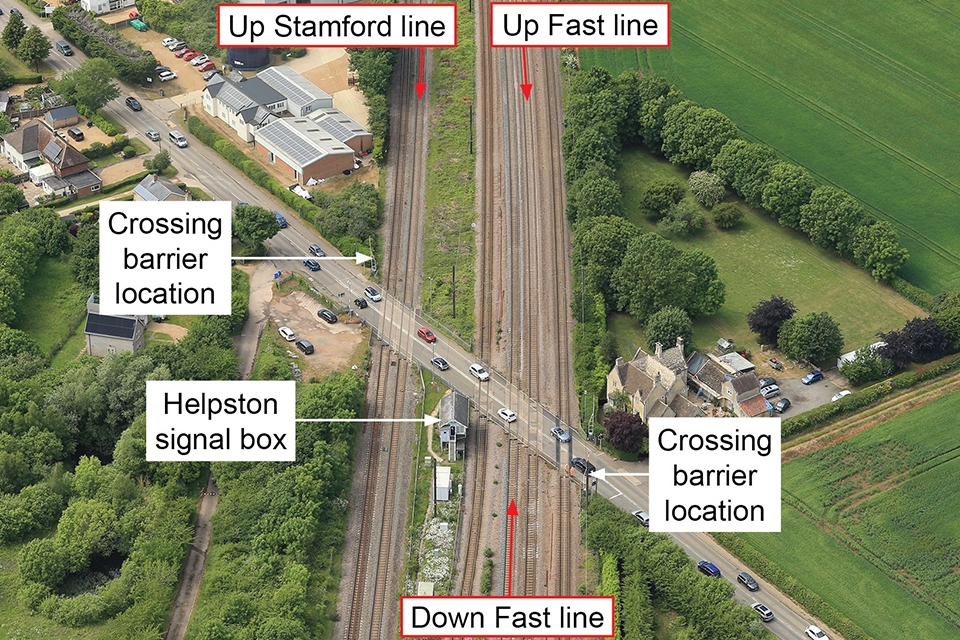
Helpston MCB level crossing with the directions of approach of the trains involved (courtesy of Network Rail with RAIB annotations).
Under normal circumstances, the signaller in Helpston signal box operates Helpston MCB crossing by commanding the barriers to lower using the lower barriers control. This will activate the wig-wag road traffic lights and an audible alarm. Once the barriers are fully lowered, the signaller will check that no vehicles or people are trapped within the crossing by looking through the signal box’s windows. When they are sure that the crossing surface is clear, the signaller will use the ‘crossing clear’ control to notify the signalling system of this. The signaller can then use the main signalling panel in the signal box to set routes for trains to pass over the crossing.
The controls for the crossing are mounted on a pedestal, situated next to windows overlooking the crossing. These controls allow the barriers to be lowered and raised manually. A control on the main signalling panel allows the crossing to be operated in ‘auto’ and ‘manual’ modes. While the barriers are always lowered manually, the controls are usually left switched into ‘auto’ mode. This means that they will raise automatically once trains have been confirmed by the interlocking to have passed over the crossing, unless the interlocking has detected that a route is still set over the crossing or another train is approaching it.
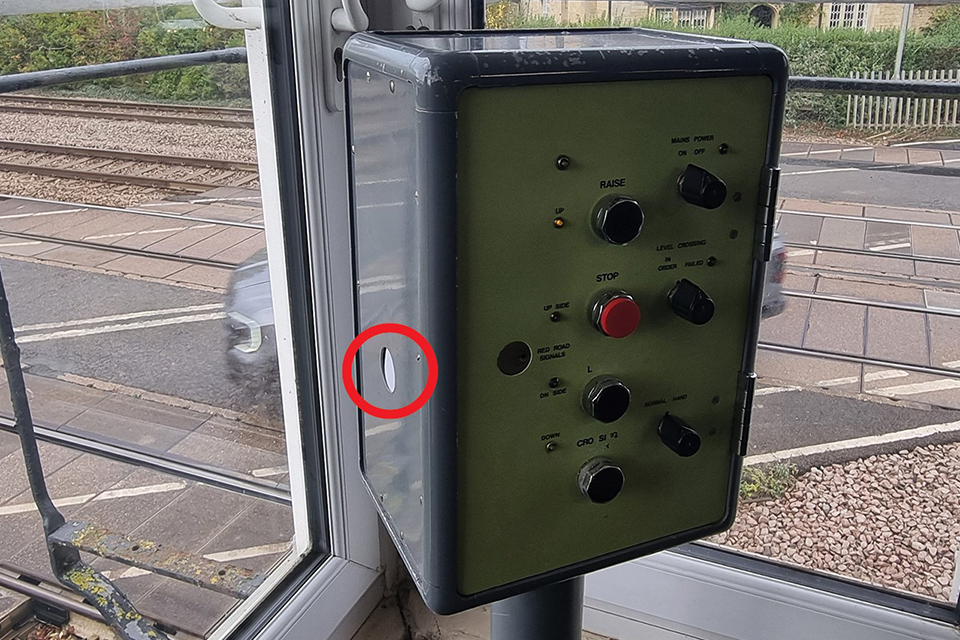
The crossing controls – the hole to access the sealed release plunger is on the left of the box (circled).
Switching the crossing into manual mode will prevent this automatic raising function. This would be done by the signaller where operational circumstances require the barriers to remain lowered for an extended period. This could occur if they are aware that successive trains are due to pass over the crossing within a short time but the route over the crossing has not yet been set for the next train. In manual mode, the barriers are raised by the signaller once they have judged this to be appropriate. The crossing controls can only be used to raise the barriers manually if the interlocking has determined that the crossing is clear of trains and that no routes are set over it for approaching trains. This prevents the signaller from inadvertently raising the barriers, and road users from being endangered by trains.
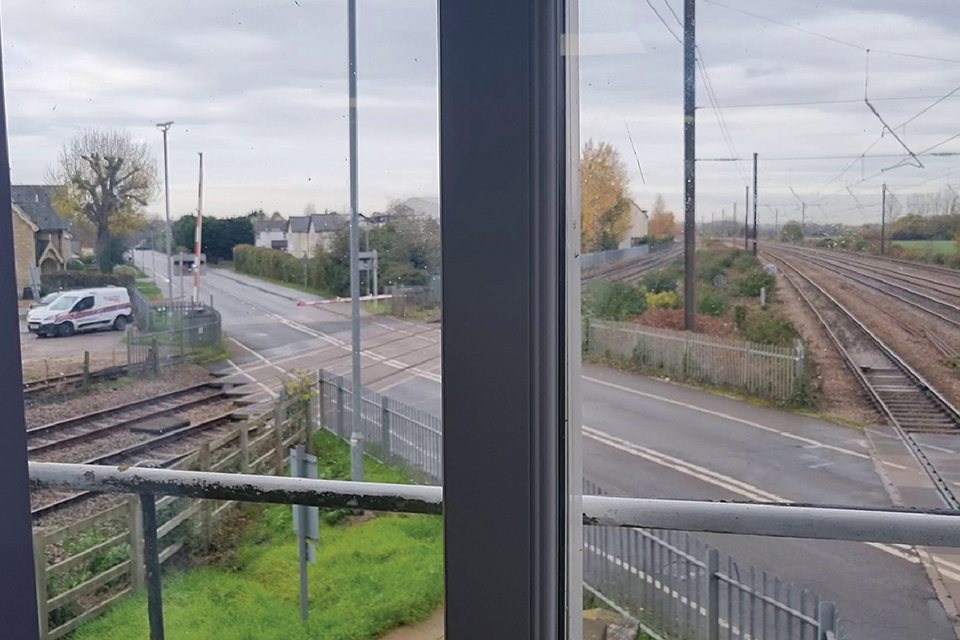
View of the Stamford lines from Helpston signal box. The East Coast Main Line is to the right of the picture.
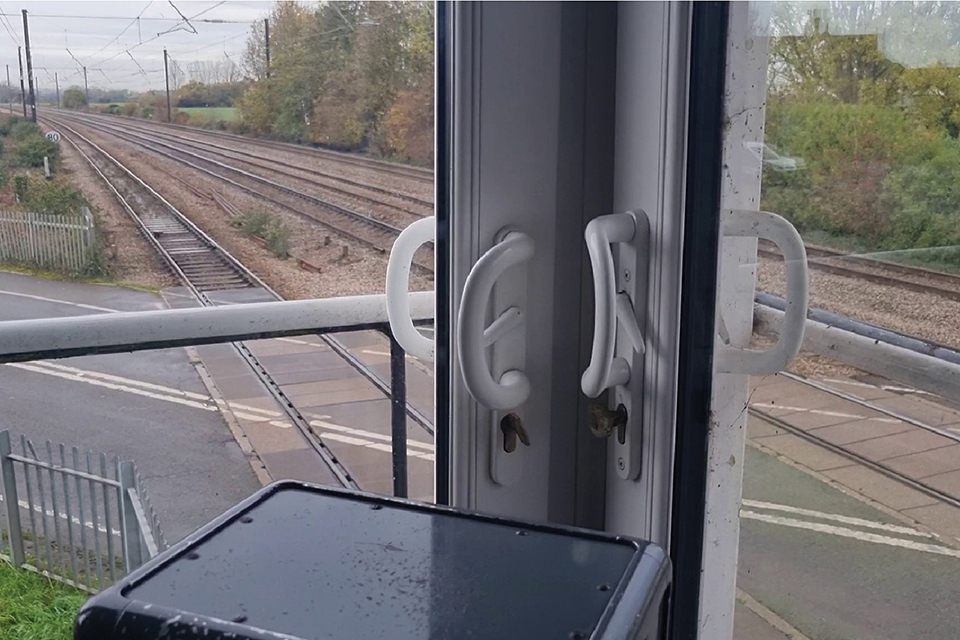
View of the East Coast Main Line from Helpston signal box. The top of the crossing control box is visible at the bottom centre left of the picture. The Stamford lines are out of sight to the left.
The sealed release plunger at Helpston signal box is accessed via a hole on the side of the box containing the crossing controls and can only be used when the crossing controls are switched to manual mode. This access hole should be covered by a paper seal. The purpose of the paper seal is to act as a deterrent to unauthorised use, and to indicate when the release plunger has been used. To override the safeguards and raise the barriers, the signaller must break the seal and then press the plunger at the same time as the crossing raise button, making it a two-handed action. The sealed release plunger bypasses the safeguards for manually raising the barriers provided by the interlocking.
Rule Book GERT8000 Module GSR ‘General Signalling Regulations’, issue 18.1 dated November 2024, which was in force at the time of the incident, states that:
‘If a sealed release is provided, you must only use it if…
- controlled level-crossing barriers are locked down by failure of a track circuit or by the occupation of a track circuit by a failed train and you have the driver’s confirmation that the train will not be moved without your authority.
Before using a sealed release, you must make sure each time:
- that it is safe to do so
- that the portion of line is clear and no movement is about to be made over it.
Before operating a release to raise level-crossing barriers, you must also make sure that:
- the protecting signals are at danger and their controls are in the normal position
- the auto raise switch (if provided) is in the ‘manual’ position.
If you have used a sealed release, you must tell Operations Control and make an entry in the Train Register.’
Once a sealed release has been used, and its use has been reported and recorded, the seal should be replaced by maintenance staff.
On 21 October 2025, the signaller at Helpston signal box signed in for work at 05:45. They were due to work a 12-hour shift from 06:00 to 18:00. From 08:00 the signaller’s work was observed by a local operations manager (LOM). The LOM, who was the signaller’s manager, was undertaking a routine visit to the signal box as part of their normal duties.
At 08:12:29, signalling data shows that the signaller started the crossing lowering sequence for three trains that were approaching. These were a passenger train on the Down Fast line, a second passenger train on the Up Fast line (both of which have a permissible speed of 125 mph (201 km/h)), and a freight train on the Up Stamford line (which has a permissible speed of 75 mph (121 km/h) although the freight train’s maximum permitted speed was 60 mph (97 km/h)). The barriers were recorded as being fully down at 08:13:04 and crossing clear was given at 08:13:10.
By 08:15:13, just over 2 minutes later, the passenger train on the Down Fast line had passed over the crossing. The second passenger train had passed the crossing on the Up Fast line by 08:15:53. Signalling data records the barrier controls being set to manual mode at 08:15:46, shortly before the second train passed over the crossing. At this point the freight train was still approaching the crossing, with signalling data showing that it occupied the track section on approach to the crossing at 08:15:44.
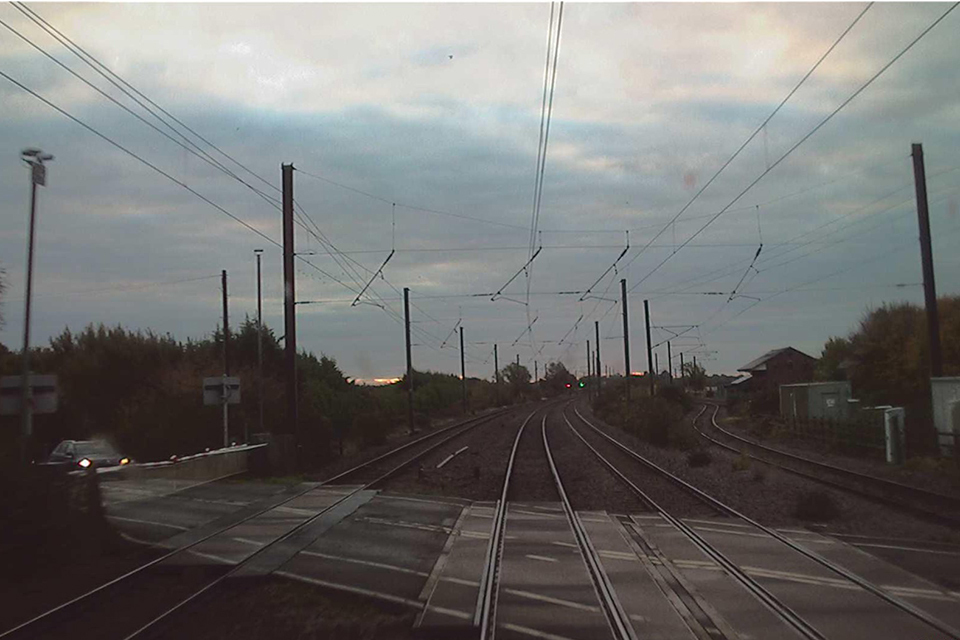
Forward-facing CCTV from the second passenger train as it passed over the crossing (courtesy of Hull Trains).
After the second passenger train had passed over the crossing, witness evidence is that the signaller tried to manually raise the barriers. Signalling data recorded this as happening at 08:16:04, about 11 seconds after the second train had passed over the crossing. As they did this, the signaller looked out of the crossing windows to the right and towards the Up and Down Fast and Up and Down Slow lines. They did not look towards the Stamford lines.
The signaller found that they were unable to raise the barriers. This was because the interlocking had detected the freight train approaching on the Up Stamford line and was preventing this from happening. However, the signaller had forgotten that this train was approaching and assumed that the barriers had developed a fault. This was based on a recent barrier failure which they had experienced with this level crossing.
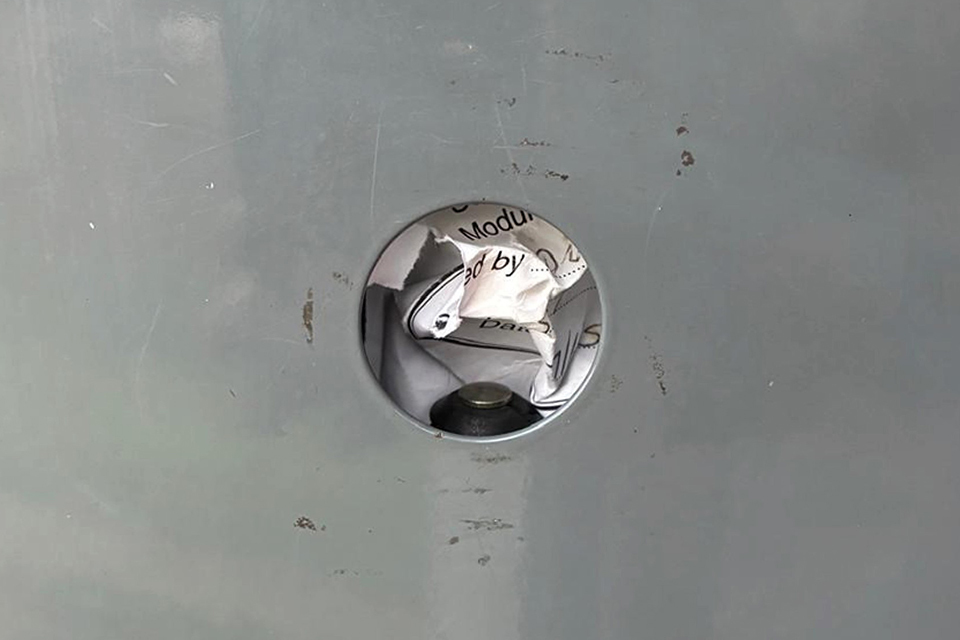
The remains of the paper seal inside the hole which allows access to the sealed release plunger.
Believing that they were dealing with an equipment failure, the signaller decided to use the sealed release plunger to raise the barriers. The paper seal which should have covered the plunger was already broken and had been left inside the plunger access hole. Documentary evidence shows that this seal had been broken on 4 July 2025 and that, while this had been logged by the signaller on duty, it had not been reported for repair.
Signalling data shows that the sealed release plunger was used to raise the barriers at 08:16:07, and that the barriers started to rise at 08:16:09. This occurred as the freight train was approaching the crossing. The freight train occupied the track circuit immediately beyond the crossing at 08:16:14. At this point the barriers were continuing to rise and the wig-wag road traffic signals extinguished at 08:16:15. The barriers are recorded as being in their fully raised position at 08:16:21.
After raising the barriers manually, the signaller looked to their left. As soon as they saw the freight train on the Up Stamford line, they immediately used the lower barriers control. The signalling data recorded this command at 08:16:21. The signaller immediately reported the incident to the LOM who was observing them, who then took over the operation of the signal box until a mobile operations manager arrived.
Helpston signal box is normally staffed by a single signaller. Witness evidence indicated that, at the time of the incident, it was possible that the signaller was distracted by the presence of the LOM in the signal box.
RAIB’s preliminary examination found that a local practice had developed at Helpston signal box which saw the sealed release being routinely used to raise the barriers during possessions after engineering trains or on-track plant had passed over or worked near the crossing. In these circumstances, witness evidence was that the only other option to using the sealed release was to manually raise and lower each barrier using a pump in its pedestal unit, which would not activate the road traffic lights or audible alarms. The practice of using the sealed release in this way was not documented in the Helpston signal box local instructions and managers were unaware that it had been adopted.
RAIB found that the signaller involved in this incident had been trained to use the sealed release during possessions. RAIB also found that the signaller did not clearly understand the circumstances in which a sealed release should be used, or the associated Rule Book requirements. Data shows that the sealed release plunger had been used 183 times between mid-February 2025 and the incident, a period of around 8 months. Almost all of these uses of the plunger had been by the signaller involved in this incident. While multiple plunger uses were often associated with a single raise barriers event, this shows that the signaller had been routinely using the plunger to manually raise the barriers.
The 4-month period when the seal over the plunger was broken and not replaced also suggests that there was an acceptance of a non-compliant local practice regarding sealed release use by staff in this signal box.
There is no evidence that any assurance activities undertaken by Network Rail were effective at detecting these variances between operating practice and the relevant operating rules.
4. Previous similar occurrences
A number of incidents involving the operation of level crossings by signallers have previously been investigated by RAIB. Some of these incidents have resulted in collisions between rail vehicles and road users. RAIB reports discussing incidents with similarities to the incident at Helpston include:
- A fatal accident at Moreton-on-Lugg which occurred in January 2010 where a train struck two cars on a level crossing (RAIB report 04/2011). The report found that the signaller raised the barriers when a train was approaching, and there was no engineered safeguard in the signalling system to prevent this error.
-
An incident at Lydney which occurred in March 2011 where a train passed over an MCB crossing with the barriers in the raised position (RAIB report 20/2011). Nobody was injured and there was no near miss with a road vehicle. The report found issues with the communication between the signaller and the level crossing keeper, in addition to a lack of understanding of how various aspects of the signalling system were impacted by raising and lowering barriers.
- An accident at Redcar which occurred in May 2024 where a train struck a car on a level crossing (RAIB report 05/2025). The investigation found that the signaller had opened a crossing to road traffic. An approaching train was stopped at the protecting signal for the crossing, which was held at ‘stop’ by the interlocking. The signaller forgot that the crossing was open to road traffic and verbally authorised the train to pass the protecting signal.
- An incident at near Craven Arms which occurred in July 2024 saw a near miss between an HGV and an engineering train after the train was signalled over the crossing while the barriers were in the raised position and the crossing was open to road users (RAIB safety digest 08/2024). RAIB found that the controls the signaller used to operate the crossing circumvented the engineered safeguards intended to prevent such an occurrence and that there were inconsistencies between operating practice and operating rules which had not been detected by local managers.
A wider summary of previous RAIB learning, including more similar incidents relating to management assurance, can be found on RAIB’s website.