Rough sleeping and complex needs process evaluation: Rough Sleeping Social Impact Bond case studies
Published 11 December 2025
Applies to England

© Crown copyright 2025
This publication is licensed under the terms of the Open Government Licence v3.0 except where otherwise stated. To view this licence, visit nationalarchives.gov.uk/doc/open-government-licence/version/3 or write to the Information Policy Team, The National Archives, Kew, London TW9 4DU, or email: psi@nationalarchives.gov.uk.
Where we have identified any third party copyright information you will need to obtain permission from the copyright holders concerned.
This publication is available at https://www.gov.uk/government/publications/rough-sleeping-and-complex-needs-process-evaluation/rough-sleeping-and-complex-needs-process-evaluation-rough-sleeping-social-impact-bond-case-studies
Key findings
Introduction
The Rough Sleeping and Complex Needs Process Evaluation was funded by MHCLG (then MHCLG) and carried out by the Centre for Regional Economic and Social Research (CRESR) at Sheffield Hallam University. The evaluation examined how two funding initiatives – Rough Sleeping Grant and Rough Sleeping Social Impact Bond (SIB) – provided support for people who had slept rough and had complex needs[footnote 1] (co-occurring mental health and substance misuse needs).
The aim of the process evaluation was to provide evidence on different approaches taken to working with people who are sleeping rough and have co-occurring mental health and substance misuse needs, and to identify the lessons learned in designing, setting up and delivering these across the RSG and Rough Sleeping SIB funding programmes.
This report presents findings and learning from six case studies carried out to understand the range of ways in which the Rough Sleeping SIB programme had supported those who had multiple support needs and vulnerabilities and lived experiences of rough sleeping. In each case study, face-to-face interviews were carried out with key stakeholders including:
- Local authority commissioners
- Rough Sleeping SIB team managers
- Rough Sleeping SIB workers
- Staff from partner organisations, and
- People with lived experience of rough sleeping with co-occurring needs; and receiving support via a Rough Sleeping SIB project.
The programme has developed some important lessons and practices for relieving rough sleeping and responding effectively to those with complex needs. The following sections summarise the key learning that has emerged. Detailed evidence and analysis are provided in Chapter 2 and Chapter 3.
Establishing a Rough Sleeping SIB
Establishing the Rough Sleeping SIBs required skilled and determined local authority staff. Local authorities with less experience of the SIB process reported that they would have welcomed more time to: decide what was required locally; determine who should be supported; seek an investor; and secure a suitable service provider. More experienced authorities, by contrast, reported that they were ‘ahead of the game’ and as such, could secure a ‘better deal’ with investors.
Commissioners recognised the Rough Sleeping SIB as an opportunity to make a telling difference for those people who were ‘entrenched’ in a cycle of insecure accommodation, rough sleeping, poor mental health and substance misuse; where their current provision had not adequately provided for the cohort in the past. It was also an opportunity to bring in more resources to tackle rough sleeping.
The housing market context was a key consideration when establishing the SIBs. It was important to take account of local housing availability compared with the housing needs of the SIB cohort. In areas where affordable housing and supported housing options were constrained, it was reported to be far harder to establish a SIB as this increased the investors’ risks of not achieving an adequate return from accommodation-related targets. For one case study, the two-tier local authority system added complexity, mainly due to the separation of housing duties (held by district councils) and health and social care (held by the county council). It was necessary to secure formal buy-in from both upper and lower authorities, in particular when the model proposed involved a combination of housing and homelessness support and the provision of housing stock. This required a longer lead-in time to establish a SIB.
The Rough Sleeping SIBs were established with a ‘one-size-fits-all’ approach to the outcomes that had to be achieved to receive payments (see the ‘rate card’ in Figure 1.2). However, local contexts in terms of the provision of health, social care and housing were different. Some stakeholders reported that particular outcomes were difficult to achieve (such as employment), and critical aspects were neglected – physical health provision for instance, to which ends Rough Sleeping SIB teams dedicated a significant amount of effort. Tight timescales meant that people with a lived experience could not adequately engage in co-production of appropriate, challenging and stretching outcomes. In some cases, delays in the initial contracting stages meant that Rough Sleeping SIBs did not start on time. End dates were not adjusted, and therefore set-up periods were ‘rushed’ in some cases.
The level of governance in the six Rough Sleeping SIBs varied. In some, this had been given little thought at the start of the programme which affected Rough Sleeping SIB teams’ ability to form close partnerships with other services and embed themselves in the broad system of support.
The Rough Sleeping SIBs were provided by larger support organisations, with a track record of delivering similar initiatives and a ready-made organisational infrastructure. In the early stages of the Rough Sleeping SIB, local teams underestimated the complexity of their cohorts’ needs.
Delivering a Rough Sleeping SIB
Team structures in all Rough Sleeping SIBs had morphed and developed, as working practices were embedded and challenges were overcome. Teams were led by a project manager who, in addition to management duties, also carried a proportionate caseload. This was reported to provide valuable insights into the nature of the work required with service users and the issues associated with working within the local support system. However, another key driver for carrying a caseload was to relieve pressure on SIB workers and make the financial model ‘stack up’.
Caseloads for individual full-time SIB workers varied. There were challenges for SIB workers in holding relatively large caseloads. The needs of the cohort were higher than was the case in previous programmes, leading providers to misjudge the level of resources needed. It appeared that some SIBs were understaffed as a result. Staff rarely bemoaned their caseload and adopted strategies such as being flexible to the changing needs of their service users, working more or less intensively with people as required. However, it was apparent that some SIB workers were feeling under pressure or struggling with the demands of the role.
Most Rough Sleeping SIBs added specialist workers to support the efforts of SIB workers. This included mental health specialists, drug and alcohol workers, police officers and social workers. Not all these roles were funded directly via the Rough Sleeping SIBs but secured through linkages with other services and direct commissioning by the host local authority, using funds including the Rough Sleeping Initiative (RSI). This provided better integration with specialist services. For some, it was necessary to ‘buy in’ specialist support as a more productive way of ensuring that rate card outcomes could be met, where established services could not be adequately accessed. This was particularly the case for mental health where a dedicated worker could offer advice, support and carry out assessments more effectively than relying on local services.
Key aspects of the SIB worker role included flexibility to work in a person-centred approach, time to form a deep understanding of the person’s needs and develop a trust-based relationship and a mandate to advocate for people and attain better service access and sustainment for them. The role of the SIB worker is a contested one and appears to differ by area and provider. Workers differentially explained their role as key working, coordinating, advocating, navigating and befriending. To some extent, the job appeared to encompass all of these facets, and there was often a tension between acting as a key worker or being a navigator towards other services that would intensively help and support service users. The flexibility of the role meant that these definitions varied between individual workers in the same team, allowing workers to use their own skills and expertise to shape the way they work.
Managers reported that the SIB worker should not be a ‘key worker’, but instead have a complementary and enabling role in the local support system. Yet, it was acknowledged that staff often adopted a key worker role when there were gaps in service provision. Also, SIB workers reported instances of other professionals ‘pulling back’ from a person once the SIB was involved. This was based on misunderstandings of the SIB team’s function and high-pressured services seeking to manage their caseloads.
SIB workers and managers reported that service users who were most difficult to engage with required the most time and effort, yet were less likely to ‘generate’ high payment by result (PbR) claims. Despite this, the evidence suggested that SIB teams concentrated mainly on the needs of their service users, rather than prioritising clients who would generate the highest levels of PbR returns.
Rough Sleeping SIB workers had space to develop a positive relationship with their service users, which was reported to have positive implications for getting better access to housing, health and other services; it engendered lower risks for services and a greater chance of sustainment and positive outcomes.
Working with other services
All Rough Sleeping SIBs had created and fostered partnerships with housing, health and welfare services. It was reported that partnership building was resource-intensive and an ongoing process that required re-defining and refining. The SIBs had to establish themselves in the local service community, develop an understanding of their position in that community and gain some trust. However, there was evidence that SIB teams were poorly equipped to do this as they lacked the resources (time) and the authority to do so. Some SIBs benefited from the involvement of LA commissioners and senior leaders to promote the SIB and ensure that other services were responsive. Therefore, a top-down approach to partnerships, alongside the development of ‘worker-to-worker’ relationships were important to the success of Rough Sleeping SIBs.
Partner organisations held a broad recognition of the SIB aims and objectives, but did not always understand the SIB model well, particularly the need to provide an evidence base of outcomes on which to make PbR claims. SIBs did report though that this had improved as partnerships matured.
Despite good progress with partnerships, there remained difficulties in gaining access to services where capacity was limited, and working with services that were not responsive to the needs of this service user cohort.
SIB workers were invariably adept at utilising local informal voluntary services to help their service users with food, clothing, furniture and social activities. However, workers also reported that this informal sector could be counterproductive to the SIBs’ broad aims by supporting people’s existence on the street – for example, by providing tents, sleeping bags and places to sleep out – and that a better strategy into which all stakeholders are invested and are working towards would be beneficial.
The Rough Sleeping SIB teams played a critical role in bending formal and informal services towards the needs of their clients, while providing additional support at the same time. This is a central aim. However, evidence suggests that partner services require transformation to better support people who may be sleeping rough and have co-occurring needs. Alongside this transformation, the SIBs played a key role in improving people’s engagement and sustainment with other services.
Working with housing providers and services
Finding suitable housing was a key challenge for all Rough Sleeping SIBs. Teams frequently reported a lack of options for those requiring supported housing, and a lack of affordable housing for those seeking more permanent accommodation. The SIBs had very limited access to ring-fenced accommodation. Instead they had to seek and negotiate access to housing via traditional routes for each person they supported.
For people with multiple complex needs, decent housing was regarded by SIB teams as a prerequisite for sustaining treatment and recovery of health and from substance misuse. To achieve this, SIB teams regularly relied on hostel accommodation. It was reported that this varied in quality (of physical and support aspects). In some areas, hostel provision was reported to be poor, and there was a lack of other supported housing options. However, some hostels were reported to be supportive places, especially for service users with more stability in their lives. SIBs often relied on accommodation that did not offer the levels of support that individuals required. In such cases, SIB workers often provided extra support to enhance the accommodation’s ‘support offer’.
Such temporary accommodation was precarious for the Rough Sleeping SIB cohort. It was reported that people were excluded from temporary accommodation for issues such as drug use and antisocial behaviour, which they were often ‘powerless’ to avoid. The involvement of a SIB worker in someone’s life helped to foster better access to housing providers by giving the reassurance that support was on hand and that the service user was being assisted toward recovery in a holistic way – dealing with other needs like mental health and drug addiction.
Local connection rules were a barrier to finding suitable accommodation for some service users. SIB workers reported that helping service users with homeless applications was complicated and time-consuming, and often required providing evidence that was very difficult to obtain. Responsibilities were reported to be passed between local authorities, and this was very time-consuming for SIB workers.
Housing first style models were discussed as a rapid rehousing approach that could be well-suited to the needs of service users. These schemes were still relatively small-scale, and in some places it was reported that it did not offer enough support to tenants dealing with multiple complex needs. Additionally, some housing first style schemes were reluctant to accept those from the SIB cohort because they were already receiving some extra support via the SIB.
Overall, ring-fenced accommodation that SIB teams could draw on would provide a marked advantage.
Working with mental health services
Gaining access to mental health assessments and treatments was a key challenge for the Rough Sleeping SIBs. The poor availability of mental health services for the SIB cohort was regularly discussed by SIB workers as a limitation on the help they could deliver.
The degree of mental health difficulties amongst the SIB cohort was higher than providers had anticipated, but SIB workers reported that their position allowed them to better assess and understand their clients’ mental health needs by virtue of spending a prolonged period being with, and speaking with them. However, this gained knowledge was often difficult to translate into better mental health treatment, mainly due to the lack of capacity in mental health services. Services were reported to be significantly stretched in certain areas and could be inflexible to the situations of service users. Strict interview schedules and a lack of outreach services were a barrier for the cohort.
Where local services were offering outreach and in-reach services, this had a comparative advantage for SIB service users, providing better access to assessments and treatments. SIB workers had a role to play in this process by locating service users and enabling better ongoing engagement. In several areas, SIB teams had formed partnerships with voluntary sector mental health services that had previously not supported people with lived experience of rough sleeping. SIB workers offered their support, skills and experience to open up these services to the SIB cohort.
In several areas, people with co-occurring mental health and substance misuse needs were being ‘bounced’ between two services; the conundrum being that mental health services would prefer that a person’s drug usage is dealt with prior to treatment, and vice versa for drug treatment services.
Working with drug and alcohol services
Compared to mental health services, stakeholders reported that it was easier to access drug and alcohol services in some form. SIB workers nonetheless had a role to play in ensuring that their service users could gain better access to drug and alcohol services. All teams had formed partnerships with services and there were indications that SIB workers were able to ‘open doors’ and better sustain their service users’ involvement with treatment.
However, there were key barriers for SIB service users accessing drug and alcohol treatments. Keeping appointments was challenging for those with co-occurring needs and a particular feature of drug and alcohol services was the number of appointments and the length of time they took. Beyond forgetfulness or chaotic situations that might cause someone to miss an appointment, long appointments took away time from earning enough money (usually from begging) to purchase enough drugs to satisfy a habit. For those with prior experience of the particular service, the process of engaging with a service and getting treatment was perceived to be too long and was therefore offputting.
Work and volunteering opportunities
There were some positive instances of service users finding work and volunteering opportunities or starting training. However, SIB teams reported that service users required much support and resolution of their health and addiction issues before concentrating on finding employment and training. Staff reported that they expected gains in this area to come later in the SIBs’ three-year delivery period.
Services to support people into employment, volunteering and training were relatively scarce. Where they did exist, they were not well set up to respond to the needs of the SIB cohort. However, it was clear that SIB teams in general were concentrating their resources and efforts towards housing and health needs, rather than work and volunteering.
Workforce development
All Rough Sleeping SIB providers successfully formed teams, though in some cases it had taken longer than anticipated and affected implementation timescales. Recruitment was driven by the need to acquire staff with the relevant competencies and attitudes rather than a specified set of skills developed in particular professional frameworks or contexts. Staff were drawn from a range of professional backgrounds which built teams with mixed skills relevant to the complexity of the needs of their beneficiaries.
Across the SIBs, workers were taking on a multiplicity of sometimes ill-defined roles, and this had consequences for both the recruitment and retention of staff. It appeared that the sector had yet to develop clearly defined and common professional standards and competencies associated with working with people with complex needs who are sleeping rough.
Interviews with SIB staff revealed a huge sense of personal commitment to supporting their service users. There was a clear sense across all the SIBs that those in key worker and support roles (however defined) were often working very long hours and were subject to high levels of stress. Working with the SIB cohort often meant being available at unsociable hours, working across multiple agendas, juggling relationships with many services, working with clients who, as a result of their complex needs and experiences, could be difficult, untruthful and abusive, and often dealing with disappointment when progress was slow.
There were concerns for the long-term wellbeing of staff working in very challenging circumstances, which may impact on future sustainability and turnover in these roles. All SIBs had experienced problems with capacity due to staff absence and turnover. Some of this was as a result of illness, and thus unexpected. In other cases, staff on fixed term contracts (as a result of time-limited funding) had moved to permanent roles elsewhere. Informal support within teams, including sharing out of workloads, was beneficial to wellbeing and helped to reduce stress. In two areas, staff had access to regular clinical supervision, which was reported to benefit their wellbeing and helped them develop their practice.
All Rough Sleeping SIB workers reported that they had access to training and skills development. It included health and safety, risk management benefits, housing and domestic abuse. However, staff reported that their most effective upskilling was ‘on-the-job’ working; sometimes shadowing other workers. The lack of a defined role for SIB workers created challenges for training and skills development. The ‘catch-all’ nature of the role made it difficult to define an affordable, yet comprehensive training programme.
Progress and outcomes
Rough Sleeping SIBs had made progress in the areas of accommodation and better managed needs, but far less progress in terms of employment and education achievements. It was reported that the latter could develop towards the end of the programme as service users’ lives stabilised.
SIB workers invested substantial time, energy and effort into helping service users to sustain accommodation placements and this was ensuring that longer-term placements were being achieved; however, this was not always in a single placement. A key lesson was the need for flexible and sustained support for people who are not accessing treatment or are struggling to manage behaviours.
Beyond the difficulties accessing appropriate accommodation, a key limiting factor was the lack of clear housing pathways from temporary to more stable housing.
Supporting service users to better manage their needs was an area where the SIBs were able to demonstrate progress, reflecting the central aim of the SIB programme to connect service users to the range of services they required and supporting them to successfully sustain their engagement with services and interventions.
The SIB enabled service users to reconnect with services, but also provided the opportunity for people to connect with services in ways that had not been previously possible. SIB workers’ improved understanding of their clients’ needs was a driver to improving the treatment or support offered.
For the SIB cohort, progress towards recovery was often characterised as ‘small steps’. It often took time, and many small steps, for people with complex needs to experience substantial change in their lives. In other cases, there had been a more transformative effect, and all the SIB workers identified examples of individuals whose lives had been turned around by the support they had received.
SIB workers reported that the SIB rate card did not accurately reflect the personalised, flexible and sustained support provided, or that progress was unique to individuals, who sometimes valued different outcomes.
The evidence from the case studies identified a range of enablers to achieving progress and outcomes for service users:
- Flexible, person-centred and unconditional support, which is available long-term.
- Timely access to appropriate accommodation.
- Good relationships and connections between agencies, facilitating appropriate referral and treatment pathways.
- Willingness to share learning between agencies around ‘what works’ in supporting people with complex needs, and the ability to flex service delivery models accordingly.
- Time and resources to help with social and practical needs not addressed by the rate card.
- Providing opportunities for re-engagement when placements or referrals are unsuccessful.
- An appetite for change on the part of the service users, and a willingness and ability to engage with the SIB.
There were also key barriers to achieving progress and outcomes for service users. The lack of suitable accommodation, both in terms of adequate supported housing and affordable move-on accommodation was a limiting factor for the SIBs. The resultant over-reliance on hostels and temporary placements made it more difficult for service users to ‘stabilise’ their lives. Delays in access to mental health services in particular, but also drug treatment services limited the effectiveness of the SIBs, though this was partly mitigated where SIBs could ‘buy in’ their own specialist workers.
1. Introduction
1.1 Background
In December 2016 the government committed £51 million to homelessness prevention schemes across England. This included targeted support for people sleeping rough and those at risk of rough sleeping across several funding streams. This evaluation was concerned with two of these streams:
- £20 million for Rough Sleeping Grants (RSGs) to provide targeted support for people at imminent risk of sleeping rough or those who are new to the streets.
- £11 million to support locally commissioned Social Impact Bonds (SIBs) to help those sleeping rough, and with the most complex needs.
In addition, £20 million was released for Homelessness Prevention Trailblazers to pilot new initiatives to tackle homelessness in local authority areas.
1.2 The rough sleeping and complex needs process evaluation
The Rough Sleeping and Complex Needs Process Evaluation was funded by MHCLG (then MHCLG) and carried out by the Centre for Regional Economic and Social Research (CRESR) at Sheffield Hallam University. The evaluation examined how two funding initiatives – Rough Sleeping Grant (RSG) and Rough Sleeping Social Impact Bond (SIB) – provided support for people who had slept rough and had complex needs[1] (co-occurring mental health and substance misuse needs). The evaluation focuses only on projects supporting this particular cohort (referred to as ‘projects in scope’), rather than on all projects funded by the RSG and Rough Sleeping SIB.
The aim of the process evaluation was to provide evidence on different approaches taken to working with people who are sleeping rough who have co-occurring mental health and substance misuse needs, and to identify the lessons learned in designing, setting up and delivering these across the RSG and Rough Sleeping SIB funding programmes.
This includes specific objectives:
- To understand what the different projects working with this service user group are delivering, considering the needs of the service users, any multi-agency partnerships and any constraints in the local context.
- To understand the influence of the funding mechanism on design, set up and delivery.
- To identify the process factors that stakeholders identify as working well across the design, set up and delivery of the interventions, where the challenges lie, and how these have been or may be addressed.
- Where services are near to the end of their funding period, explore any plans for sustaining the intervention in original or redesigned form and the reasons behind this.
These objectives were met through research focused on 12 projects. Six were Rough Sleeping SIBs, and six were initiatives funded by the Rough Sleeping Grant. Table 1.1 provides an overview of the 12 case studies.
Table 1.1: Case Studies
| Area | Project | Fund | Funding Total (£) | Launch Date |
|---|---|---|---|---|
| A | Rough sleeping outreach | RSG | 263,700 | April 2017 |
| B | Rough sleeping outreach | RSG | 390,736 | July 2017 |
| C | Rough sleeping outreach | RSG | 166,209 | September 2017 |
| D | Housing first style initiative | RSG | 393,000 | September 2017 |
| E | Housing first style initiative | RSG | 211,629 | January 2018 |
| F | Housing first style initiative | RSG | 376,652 | March 2017 |
| G | Rough Sleeping SIB | SIB | 1,000,000 | January 2018 |
| H | Rough Sleeping SIB | SIB | 1,251,000 | November 2017 |
| I | Rough Sleeping SIB | SIB | 1,261,980 | November 2017 |
| J | Rough Sleeping SIB | SIB | 3,000,000[footnote 2] | November 2017 |
| K | Rough Sleeping SIB | SIB | 1,449,020 | September 2017 |
| L | Rough Sleeping SIB | SIB | 1,540,000 | January 2018 |
Qualitative and quantitative data collection was carried out. Interviews were undertaken with a range of stakeholders, including local authority commissioners, delivery teams, partner services and service users who had used the projects in scope and had experienced rough sleeping and complex needs. A questionnaire survey of service users was analysed, project outcome logs were analysed, and an assessment of the costs and resourcing of the projects was made.
The evaluation has produced the following reports:
- Report 1: Key Findings from the Evaluation
- Report 2: Understanding Service User Experiences and Progress
- Report 3: Learning from Six Rough Sleeping Grant Case Studies
- Report 4: Learning from Six Rough Sleeping Social Impact Bond Case Studies (this report)
Also, three short briefing notes, aimed at practitioners and commissioners, are available on the following subjects: Workforce Development, Access to Services, and Meeting Accommodation Needs.
1.3 The Rough Sleeping Social Impact Bond
The £11 million Rough Sleeping Social Impact Bond (Rough Sleeping SIB) fund is supporting people who have been sleeping rough long-term and have multiple complex needs. The criteria for referral onto the Rough Sleeping SIB programme was defined as follows.
Only individuals who meet the below criteria can be referred onto the SIB programme:
- Aged over 18, and;
- Single or not living with their family, and;
- Not pregnant and without dependent children, and;
- Homeless as defined in the homelessness legislation, and;
- A history of rough sleeping (seen rough sleeping at least 6 times over the last 2 years or have spent at least 3 years interacting with homelessness services, including hostels but excluding time spent in care), and;
- Has at least two other complex needs, including but not necessarily limited to:
- Substance misuse;
- A history of offending (5+ offences in the last five years or 1 offence in the last year);
- A history of anti-social behaviour;
- Mental health problems (including self-reported); and
- Are currently not being adequately or effectively supported through existing service provision, including supported housing residents at risk of eviction where support from this programme would help them to sustain the placement or make a planned move to more suitable accommodation.
Those in any of the below groups cannot be referred onto the SIB programme:
- Those with no recourse to public funds;
- People aged under 18;
- Current supported housing residents not at risk of eviction as outlined above.
The Rough Sleeping SIB is being used to fund seven local authorities across rural and urban areas in England to deliver locally commissioned SIBs. The SIB projects can claim outcomes funding from October 2017 to March 2021. Six of these SIBs were in scope for this evaluation.
The SIB is a way of funding social policy through a payment by results (PbR) contract where up-front costs to establish project delivery are temporarily covered by social investment. Outcomes and payment rates are set and the funder (MHCLG in this case) pays out when those outcomes are achieved. This differs from a standard payment by results contract, as the risk of the contract is taken by the social investor who provides up-front funding to providers to establish and run the service. Once outcomes are achieved, and then verified, funding is released to the provider, who then repays the social investor. Figure 1.1 outlines the general structure of the SIB and how it operates.
Figure 1.1: The SIB Model
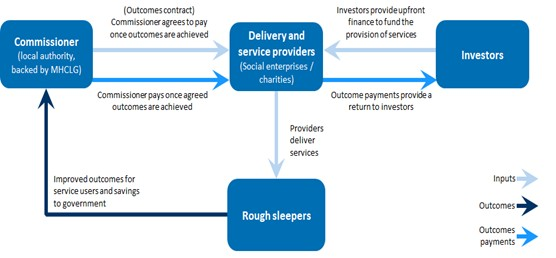
Source: Department for Media, Culture and Sport
For this SIB, specific outcomes (known as the ‘rate card’) were agreed, and this is outlined in Figure 1.2.
Each quarter period, service providers will submit the outcomes (along with supporting evidence) that have been achieved to the LA. Once satisfied, the LA will submit a claim to MHCLG, who make spot checks and make payments. Providers can then repay the loan provided by their social investor. The outcomes against which payments can be claimed are contained in the Rough Sleeping SIB Rate card (Figure 1.2).
Figure 1.2: The Rough Sleeping SIB Outcome Rates Card[footnote 3]
| Outcome | Rate[footnote 4] |
|---|---|
| Accommodation | |
| Entering accommodation | £600 |
| 3 months in accommodation | £2,500 |
| 12 months in accommodation | £5,600 |
| 18 months in accommodation | £8,100 |
| 24 months in accommodation | £9,900 |
| Better managed needs | |
| General wellbeing assessment x2 | £100 |
| Mental Health – entry into engagement with services | £200 |
| Mental Health – sustained engagement with support | £600 |
| Alcohol misuse entry into engagement with structured treatment | £100 |
| Alcohol sustained engagement with structured treatment | £1,100 |
| Drug misuse entry into engagement with structured treatment | £120 |
| Drug misuse sustained engagement with structured treatment | £2,600 |
| Entry into employment | |
| Improved education/training | £500 |
| Volunteering 13 weeks | £400 |
| Volunteering 26 weeks | £800 |
| Part time work 13 weeks | £1,900 |
| Part time work 26 weeks | £3,700 |
| Full time work 13 weeks | £2,400 |
| Full time work 26 weeks | £4,600 |
The Rough Sleeping SIBs targeted an identified cohort of people with complex needs who had been sleeping rough long-term (see above). They provided a core service which was characterised by long-term key worker support designed to facilitate improved access to services and accommodation and to support service users to make progress towards sustained outcomes which included long-term accommodation, reduced substance misuse, reduced involvement with the criminal justice system, improved health and wellbeing and engagement with volunteering, training and employment.
1.4 This report
This report provides key learning from case studies in six Rough Sleeping SIBs. It draws on data collected through fieldwork in the six areas carried out between June and September 2019 and involving semi-structured interviews with key project stakeholders (managers, frontline delivery staff, local authority housing/homelessness leads, commissioners, and partner organisations) and interviews with service users.
2. Findings from the Rough Sleeping SIB case studies
2.1 Introduction
This chapter presents the findings from the case study SIBs. Interviews with stakeholders and service users were carried out with each of the six SIB case study projects. This chapter discusses the findings of this enquiry to highlight the effectiveness of different processes that respond to the needs of those who sleep rough and have complex needs. The chapter also presents data from the SIB rate card to assess progress in relation to the delivery of outcomes.
2.2 Establishing a SIB
This section discusses the initial establishment of the SIBs; how they were set-up and what it was that attracted commissioning bodies, providers and investors to become involved. The section also presents a case study of one area that began developing a Rough Sleeping SIB but eventually withdrew.
Establishing a Rough Sleeping SIB was described by stakeholders as detailed negotiation between the funder (MHCLG in this case), the commissioning body (local authority), the social investor and – eventually via a tender process – the service provider. As one commissioner remarked it was “a steep learning curve and not for the faint hearted”. While LA commissioners were experienced at contracting service providers, the ‘steep learning curve’ was mostly associated with negotiating with investors and understanding the principles and processes involved in establishing a payment by results model. Those with a previous experience of setting up a SIB reported the advantage that had provided.
Yes, we were ahead of the game. We knew exactly how to lever in the investors, and we could talk to them directly. It also saved us time that we were familiar with the procurement processes for appointing organisations to deliver it. We knew what to look for.
Conversely, other stakeholders reported that their local authority had no previous experience of setting up a SIB nor working to a payment by results model. To begin with, lead officers often had to grasp the concept of the SIB themselves and then ‘sell’ a radical model to others in the local authority including senior leaders and local councillors. As one described:
This wasn’t an easy sell. They needed to have some faith in me, and I needed the bottle to go for it. … We got there in the end, but it was far more time-consuming than I’d appreciated.
It was apparent in discussions with stakeholders that the ability to proceed with a SIB rested on highly skilled LA officers to drive it, senior management and political support and time resources to devote to it. Some stakeholders believed that some local authorities would struggle in this regard.
However, it is also important to recognise that all commissioners saw the Rough Sleeping SIB as an opportunity to make a telling difference for those people who were ‘entrenched’ in a cycle of insecure accommodation, rough sleeping, poor mental health and substance misuse. Many were concerned that their current provision was not adequately providing for such a cohort who were experiencing a system of revolving doors – in and out of services with little sustainment or positive longer-term outcomes. In addition, several stakeholders suggested that the SIB was an opportunity to go beyond crisis response to homelessness and complex needs:
With the budget the way it is, all we can really do is the crisis work. Grants and SIBs are what we need to bid for to do more. It means that we can do some prevention. I’d also say that the SIB was attractive because it was three years.
Indeed, the three-year funding opportunity that the SIB offered was seen as a distinctive advantage over other government grant schemes such as the Rough Sleeping Grant and the Rough Sleeping Initiative, which tended to have shorter timescales – typically 12 to 18 months. As one commissioner commented:
We need more longer-term investments in combating rough sleeping and dealing with serious health [problems] and addictions. It’s difficult for us to budget properly. Grants mean we can do good things, but how do we sustain it? And how do we budget and plan our activities over a reasonable period? 12 months is too short. But it’s what there is.
Another key motivation for some commissioners was the promise of a relatively simple scheme for them to administer once up and running. One stakeholder reported that beyond checking the claims made against the rate card targets, the SIB looked after itself. However, interviews did reveal that there were very different levels of engagement between commissioners, providers and investors. This is discussed further in section 2.4.
In most cases, commissioning authorities tendered for provider organisations via their procurement rules and processes. However, having an understanding of local provision, capacity and expertise was a consideration for commissioners at the set-up stage. As one reported:
We had a fair idea of who was out there, who had the capacity to undertake this. It was a fair open process, but we needed some certainty that there were organisations that could do it.
For the SIBs in this study, larger organisations were selected as delivery partners. Reasons for this were mainly practical. Larger and longer-standing organisations had appropriate skills, resources to engage with procurement processes effectively and had the necessary infrastructure for moving more promptly to delivery. This included having recruitment processes, office space and management and administrative infrastructures in place.
Providers discussed their motivations for getting involved. Many saw the SIB as an opportunity to further engage in responding to homelessness, but they also saw it as an opportunity to work in a more radical and flexible manner over a longer period – three years – something that one provider stakeholder described as a rare tendering opportunity.
I think for [us, the SIB provider] we’ve been working with rough sleepers, probably for about 40 years, this is how we started as a charity, so this might be the reason why we went for it, because this is what we do, this is what we’re known in [the region] for doing. […] So, we’re already providing it, already been commissioned by the local authority, so I guess this is probably why we went for it.
Another stakeholder saw the SIB as a valuable addition to the work of her organisation:
We’ve been doing a lot of outreach with rough sleepers already, but it’s always a bit hit and miss. With the SIB, it was dedicated time to support someone over three years. I don’t know if payment by results is the right way to go, but you do know what you’ve got to achieve. We see so many people who just don’t get the help they need to get sorted out. We can’t say ‘there are people who can’t be helped’, so you’ve got to try something different. Admit that what’s happening now isn’t working with putting the blame on the person who’s sleeping rough with, let’s say, schizophrenia.
As the above statement demonstrates, interviews revealed that provider organisations’ main motivation to get involved with SIBs was to pursue their key organisational (and charitable) objectives.
Set-up challenges
This section presents a case study of SIB set-up challenges that were not overcome. This section discusses some of the challenges that (mainly) providers encountered as they worked towards full delivery.
One aspect that stood out clearly from interviews with stakeholders was the challenge of creating a project team structure that adequately matched available resources with the requirements of the role. Teams evolved over time as they gained a better understanding of their service users’ needs and developed their working practices. Teams adjusted staffing levels to strike a balance between frontline delivery (direct work with service users) and other specialist and administrative roles. In one area, for example, an outcomes officer was initially appointed to develop systems for collecting information needed to prove that rate card outcomes had been met. Once systems were in place, and staff were familiar with them, and what evidence to gather, the decision was taken to transfer this resource to frontline work. The project manager subsumed the role as outcomes officer.
It definitely was needed in the beginning because we didn’t know what we were doing and setting everything up is quite challenging and making sure we had the right kind of system to record stuff and projections and everything, getting all of that set up was really important.
All SIB project managers carried a caseload themselves. Subsuming tasks that the payment by results model demanded created pressure, which showed through in the interviews with managers.
So, I made the decision at that point that I would absorb the outcomes role, but unfortunately, I’ve absorbed the outcomes role and I’ve got clients and I’m about to get 38 more clients [across the team]. So, it’s not ideal.
For those local authorities without previous experience of setting up a SIB, the timetable for doing so proved challenging. The tight timetable caused pressure as attracting and negotiating with an investor and appointing a provider were new tasks, and officers reported that they were dealing with a set-up that they had little experience of. By contrast, the more experienced local authority reported that they were ‘ahead of the game’; that they knew who the key investors and providers were, and understood how to best negotiate, procure and contract with them. Others reported that a longer set-up period, alongside some professional support, would have been useful.
Barriers to establishing a SIB
This section presents a case study of a two-tier local authority where a SIB was planned, but ultimately did not go forward (referred to as Council X). This provides useful information regarding the key challenges and suggests that SIBs require a specific ‘environment’ to get off the ground.
Background
Council X was keen to explore the possibility of developing a housing first style model to enhance their homelessness support provision, which had recently been integrated with a broader system of homelessness prevention services, and the SIB was viewed as an opportunity through which to lever in additional resource to do this. The scope of the SIB was developed in consultation with key homelessness and housing providers active within the county. The anticipated value of the SIB was £1.5 million and the proposed target population was circa 150 individuals whose rough sleeping was entrenched. They were based across four district council areas.
Following a ‘market engagement’ exercise, an Invitation to Tender (ITT) was issued yet despite initial interest from several homelessness providers only one tender response was submitted. Feedback from providers who had been involved in the market engagement but did not respond to the ITT indicated that they did not view the SIB, according to the terms set out in the ITT, as financially viable. The one provider that did submit a response - a locally-based homelessness charity providing county-wide outreach services – also expressed concern about financial viability but decided to submit a proposal with a view to negotiating following the award of the contract.
During this negotiation process several options for improving the financial viability of the SIB were explored. These included: negotiation based on service user level modelling of the likelihood of key outcomes being achieved; exploration of alternative funding sources, including for specialist mental health and drug and alcohol support; and discussions with other potential providers with whom to collaborate and share risk. Despite a willingness on all sides to “try and make [the SIB] work” it was felt that the financial risk involved was too great and the provider reluctantly withdrew from the process.
Factors associated with the failure to launch the Rough Sleeping SIB
Following an analysis of the data collected, four inter-linked factors associated with the failure to commission the Rough Sleeping SIB have been identified.
Process factors
Timing was identified as a crucial factor that affected the development of the SIB. Council X had expected that bidders would have secured offers of social investment prior to the submission of their tender, and a ‘speed dating’ event was organised to link-up potential investors with providers, but no offers were secured. The procurement and commissioning processes were seen to be held up due to changes and delays to the SIB terms and conditions by MHCLG. This meant that the “rules of the game” were not clear to bidders until quite late in the process which did not allow sufficient time to negotiate between bidders and investors, particularly as the turnaround period between the issuing of the ITT and submission deadline was around six weeks, which was reported to be a relatively short timeframe.
Financial factors
The rate card and tariff for the SIB, which provides the basis on which providers are paid for different outcomes, was identified as a major factor affecting the financial viability of the SIB. Essentially, the provider did not feel confident enough that it would be able to support sufficient numbers of people sleeping rough to achieve enough of the more stretching and most financially ‘valuable’ outcomes – such as sustained engagement with drug treatment (£2,600) or sustained employment (up to £4,600 if sustained for 6 months) to cover the cost of delivering the service. Thus, the proposed SIB model was deemed too risky to attract the social or wider public investment necessary to commence service delivery.
Contextual factors
A number of contextual factors meant that the SIB appeared a higher risk proposition than in other areas.[footnote 5] First, the rural and dispersed geography of the county, particularly the districts on which the SIB was targeted, added considerable complexity to service delivery. It takes more time to travel between locations and the co-ordination of multi-agency meetings or appointments is more complicated and time-consuming. Commissioners were keen to link the SIB with a housing first style scheme as a key housing ‘offer’. However, this was reported to be problematic as the costs of delivering a housing first style intervention in such a county were believed to be higher than in metropolitan areas (where a number of the SIBs are being delivered).
Second, the housing market context in the county made it very difficult for a housing first style initiative to be developed. Supply of housing stock, in particular good quality affordable social housing, was far outstripped by demand, both from within the county but also outside.[footnote 6] This meant that social landlords were minded to prioritise less complex tenants where the prospect of a stable and sustained tenancy was higher, rather than for housing first style provision. During the SIB development process the county’s district councils were unwilling and/or unable to allocate a specific number of properties to users of housing first style services.
Governance factors
Governance factors are linked to the way local public housing and homelessness services are organised. At a local authority level, the responsibility for statutory homelessness duties provided an added layer of complexity. Although Council X led the SIB development process and is the lead commissioner for homelessness services, it does not own housing stock or have any control over how housing is allocated, as this is the responsibility of district councils. As previously mentioned, the district councils did not formally allocate any properties for users of housing first style services that were to be supported through the SIB. For this complexity to be overcome the strategic priorities of both tiers of local government would need to be aligned (or aligned more closely than they were in this case).
Governance is also an important factor at a provider/service level. Here, governance refers to the formal (i.e. contractual) and informal (i.e. personal) networks, relationships and communications between service commissioners and service providers. In Council X, it was argued that these were not sufficiently established or embedded at the time the SIB was being developed to support the SIB to get off the ground. Interestingly, it was reflected that these links were much stronger at the time of fieldwork (April 2019) following collaborative commissioning initiatives around mental health and the integrated homelessness services.
Key learning from the case study
The findings of this section reinforce and build on the existing evidence base about the challenges associated with commissioning a SIB and suggest several factors to consider, where, if the opportunity came around again it would have a better chance of getting off the ground.
Establishing a SIB can be a difficult procedure and it is not uncommon for a proposed SIB project not to be commissioned.[footnote 7],[footnote 8] Evidence on why SIBs may fail to get off the ground,[footnote 9] combined with data for this evaluation, suggest that the following three factors may be important.
Technical Complexity:
It is widely acknowledged that developing and implementing a SIB is a complex undertaking. These complexities can directly affect whether a SIB is commissioned or not. Of note are the challenges associated with understanding which outcomes to measure and the costs and benefits associated with achieving them. These challenges extend to how outcomes can be attributed to particular interventions associated with the SIB, how the data and evidence are collected and reported, and how outcome-related contracts are designed to take account of these complexities. For providers and social finance intermediaries these technical complexities create further challenges associated with calculating the level of financial risk associated with a particular SIB, and therefore the extent to which it is an investible or deliverable proposition. Of the Rough Sleeping SIBs examined in the rest of this report, several reported that previously running a SIB programme had contributed to the successful establishment of a programme.
For SIB development, generally a one-size-fits-all approach to tariff setting and rate cards is unlikely to be appropriate for a SIB programme where the operating context varies significantly across localities. Policymakers interested in developing such programmes should map the contingent factors that are likely to have an impact on input costs (i.e. delivery costs) and the likelihood of outcomes being achieved and consider varying the rate card or tariff accordingly. Considering this, a bottom-up approach to developing outcome tariffs may produce a different SIB model that is sensitive to local context and need. Providers highlighted the importance of involving people with lived experience in the development of appropriate, challenging and stretching outcomes. This would have required a longer initial set-up timeframe.
The SIB process is affected by programme level factors beyond the direct control of local authorities, meaning that timescales for procuring a provider and launching a SIB are tight and constrain the amount of development that can be carried out. SIBs may be made more accessible to local authorities by ensuring that sufficient time is allowed to develop the delivery model and identify investors prior to commissioning and adjusting timescales if and when delays to the process occur.
Relationships:
The importance of positive and flexible relationships between key actors is a consistent theme in the broader literature on SIB practice and development.[footnote 10] Several relationship issues have been identified as particularly relevant when a SIB does not end up being commissioned. These include collective and collaborative leadership through which key relationships are developed and a shared understanding and shared definitions of problems to be solved by the SIB are agreed; and effective and productive communication, for if communication between key parties breaks down this can threaten the SIB development process.
Governance:
It is possible that efforts to develop a SIB may challenge established local governance processes, systems and networks through which services are commissioned. It can affect the whole ‘cycle of commissioning’ through which services are designed, procured and monitored/evaluated, including the suspension of quasi-market competitive principles on which most services are procured. For example, commissioners have expressed concern about the potential for accusations of conflicts of interest as a result of increased and early collaboration between different parties during the SIB development process. This is despite the fact that effective early collaboration has been found to be essential in overcoming some of the technical difficulties associated with SIB design development, as well as other known ‘success factors’ such as the development of a shared understanding of the problem being addressed, and strong interpersonal, multi-organisational relationships.
The broader evidence base on SIBs highlights the importance of long-standing and embedded governance mechanisms and broader provider networks in successful SIB development and delivery. The evidence suggests that SIBs can struggle to develop, and prosper, if these are not sufficiently embedded and do not adequately involve key players, especially from health and housing. Areas where these mechanisms or networks are already well embedded have a comparative advantage, but additional development work in other areas may be needed before a SIB can ‘go live’.
For local authorities seeking to implement a housing led SIB, the housing market context is a key consideration. The SIB development process should take account of the supply of stock, understanding the limits of the supply of appropriate social housing stock; alongside the likely demand for stock from different actors, and for different purposes. Linked to this, in areas where there is a two-tier local authority system, it will be necessary to secure formal buy-in from both upper and lower tier authorities, in particular when the model proposed involves a combination of housing and homelessness support and the provision of housing stock.
2.3 Delivery of the Rough Sleeping SIB
This section examines the delivery of Rough Sleeping SIBs, outlining how delivery has occurred and evaluating the benefits it has had and the challenges that have been encountered. It is important to note that, in general, the six Rough Sleeping SIBs in scope were operating in very similar ways. This owed much to the similarities of the cohort in each area, and the use of a uniform ‘outcome rates card’ of outcomes upon which providers were paid for achieving. In addition, there were three providers across the six SIBs who shared experiences and practices.
Team structures, caseloads and management
Since the Rough Sleeping SIBs started, team structures in all cases had morphed and developed, as working practices were embedded, challenges were overcome and the working model bedded in. Team size varied, largely reflecting differences in the size of the cohort that each Rough Sleeping SIB was contracted to work with. In every Rough Sleeping SIB, each team was led by a project manager who had responsibilities line managing team members, allocating workplans and submitting PbR claims and evidence to their commissioning local authority. In addition, the project managers carried their own caseload. They reported that this was critical to gaining an understanding of the needs of those in the cohort, having experience of the practices that team members undertook, and the difficulties faced when trying to help service users and fit them to services. Several also reported that carrying a caseload was important to ease the pressure on their teams and ensure that caseloads for individual workers remained manageable.
Alongside the project manager, a team typically had a number of frontline SIB workers and some (usually part-time) administration. However, there were important variations. While the number of SIB workers in a team reflected mainly the size of the service user cohort, there were variations in the size of caseloads carried by workers in different SIBs. This ranged from 29 to 42.
For the majority of Rough Sleeping SIBs, the number of project workers has increased as the project has developed and extended its range to the full cohort, in order to keep lower caseloads and maximise time available to spend with service users. Delivery was tapered in most cases, scaling up gradually and providing teams with ‘space’ to develop their ways of working, establish linkages with the wider service community and recruit over a longer period of time.
Most Rough Sleeping SIB teams had added specialists to support the efforts of SIB workers. This included mental health specialists, drug and alcohol workers, police officers and social workers. Not all these roles were funded via the Rough Sleeping SIB, however, but secured through linkages with other services and direct commissioning by the host local authority, using funds including from the Rough Sleeping Initiative. There were two principal reasons: to add specialist support to the team and provide better integration with specialist services; and for several SIBs, to ‘buy in’ specialist support as a more productive way of ensuring that rate card outcomes could be met in light of the paucity of access to local specialist services. This was particularly the case for mental health where a dedicated worker could offer advice and support and carry out assessments more effectively than relying on local services.
There were a number of lessons around managing caseloads. Staffing models had been built on several assumptions that were not fully accurate. The most important of these was the assumption that cohorts would be individuals with needs covering a broad range from less complex to very complex. This reflected the wisdom gathered from previous experiences of SIBs, and all reported that they had drawn on the experiences of, and learning from, the London Homelessness SIB,[footnote 11] where the cohort had a broader profile of needs. However, stakeholders across all the Rough Sleeping SIBs reported that the vast majority of people in their cohorts had very complex needs, required intensive support and it was proving harder to navigate them to suitable services, both because of the needs and because of the difficulties associated with accessing services. As Chapter 3 will demonstrate, the experience of the Rough Sleeping SIB was that service users were characterised as deeply entrenched in cycles of rough sleeping, had severe trauma, lacked hope and personal ambition, had little or no personal ability (or power) to access services and were in need of close, attentive support and advocacy.[footnote 12]
Therefore, SIB teams were faced with a dilemma; whether to recruit more staff and reduce caseloads, but risking their models becoming financially unviable. While caseloads could be reduced, the pressure to achieve greater PbR results could increase, as one commissioning officer explained:
The more resources they put in, the more outcomes they’ve got to generate to pay for them resources. At this moment in time, they’re under-achieving so… Ideally more resources would be preferred, but obviously if they put more resources into it they’ve got to generate more outcomes, I’m not convinced at this moment in time that they’d be able to generate enough outcomes to justify the increased resource. Whether they should have put more resources in in the first place or not is a different scenario, and again that’s something we’ll reflect on when we come to evaluate it. I suppose when they put that business model together it’s all based on projected outcomes and they haven’t met them outcomes, so I think they’ll be in a difficult position to justify putting more resources in, although if they don’t they’re unlikely to achieve the outcomes. It’s Catch 22, but it’s something they’ll have to manage.
Generally, service users who were interviewed were positive about the support they had received from the Rough Sleeping SIBs (see Chapter 4), however several also recognised that there were often competing demands on the time of their Rough Sleeping SIB worker:
The only thing I’d say about [Rough Sleeping SIB worker] is cos she’s got quite a few clients, when you’re with her she’s quite often on the phone a lot, but I can understand that cos obviously when we ring her she’s with someone else but she still speaks to us.
Rough Sleeping SIB workers rarely bemoaned their caseloads; instead reported the kind of strategies they employed to manage them. This often involved being flexible to the immediate needs of their assigned service users, recognising that people needed varied levels of support at different times of their journey. One worker with a caseload of 29 explained how caseloads were managed in her team:
Looking at the 29 clients I’m working with, I’m not engaged with all, I think I’m engaged with about 24 at the minute. I think mine are very varied, I’ve got some that are away and I don’t think they’ll go back to rough sleeping, they’re in a place in their lives where they really want to make that significant change and start to go forward and I’ve got some that are going to really struggle with that and unable to even consider having a roof over their head.
Another worker explained that this kind of case management was key to making the role a workable one, but at the same time investing time in developing a positive relationship and gaining a deep understanding of service users’ needs:
I’m not fully engaged with all of mine, maybe 25. It is challenging trying to meet the needs of these individuals. What I’ve found is because I’m so focused on very personalised relationship building, these folk do maybe call on me more than they would if I hadn’t spent so much time building those relationships, there are other people in their supportive network that they don’t necessarily call upon and that’s something for me to think about and manage over the next two and a half years. Actually, we don’t have time to see 25 clients over the course of a week, even two weeks. [There are] some clients that need more time and more interaction and that’s very difficult to balance alongside all the other elements of the work. It is challenging.
However, many workers were keen to caution that the needs of their service users were likely to fluctuate rapidly and unexpectedly, requiring a high level of flexibility and an organised approach to maintaining an ‘open door’ for all:
No one person’s the same and I find naturally as time goes by things can suddenly change in one client’s situation which two weeks ago they weren’t needing that much time and because you build that relationship with them, then something will change and have quite a dramatic effect on their lives and naturally you become that person, that first one, and that’s hard when you’ve got a caseload of 24 or whatever to have things in the diary that you’ve got to do with someone else and suddenly something’s got to change.
Despite such flexible ways of working, it was apparent that many workers felt the strain of the challenges managing their caseloads. Many described this juggling act as ‘challenging’, ‘difficult’, ‘stressful’ and sometimes ‘impossible’. Section 2.5, below, explains how local teams managed this situation.
In areas where Rough Sleeping SIB teams had more success finding accommodation for service users, caseload management was more manageable. Workers reported that when their clients had more stable accommodation, that was associated with more stability in their lives which made it more straightforward to work with them. By contrast, areas where housing was difficult to access faced the challenge of responding to proportionately more people who were still precariously accommodated in emergency accommodation or sleeping rough:
That’s one of the benefits of having people moving on into their own accommodation and leading their own lives cos that frees up our time to work with people who aren’t at that point yet. The ones in flats for instance, them being involved in the client involvement group, they come in and see us, we do a little bit of work for 20 minutes and then we spend the rest of the day with them getting to know them even more, we sort out the things that need to be sorted and it’s not as if you’re even doing work.
Workers and managers also reflected on the impact that the SIB PbR model had on the way caseloads were managed. Many workers and managers attested that the service users who required the most time and were the hardest to engage, were also least likely to meet the outcomes on which the project was paid. Whereas, service users whose needs were (relatively) easier to assist stood a better chance of meeting rate card outcomes – provided that Rough Sleeping SIB workers invested significant time.
We’ve got five that we haven’t signed up officially, only got one that we don’t know where he is. We’ve got these four, they’re the most challenging, we do have interactions with them but we’re nowhere near getting them to sign a piece of paper. That’s part of the focus of I need a new boost of staff to be able to really try.
This rational assumption was articulated by Rough Sleeping SIB workers, however in practice they generally managed their caseloads in ways that prioritised dealing with the needs of their service users, rather than giving priority to maximising outcome payments.
Some Rough Sleeping SIBs had managed to reduce their caseloads. For example, one project manager was able to make a case to employ an extra frontline worker and so reduce average caseloads from 35 to 29, based on the unexpectedly high needs of their service users, and a perception that other services were unable to provide the intensity of support required to achieve positive change. The project manager was asked whether the reduction in caseloads had enabled more time to be given to each client.
100%. It’s difficult because originally I think our roles were seen as coordinators, so we would be coordinating the support by other agencies, in reality whilst there is an element of that to our roles, actually a lot of our roles is about relationship building with the clients, so that involves us spending large amounts of time with the clients and what we found is actually when we’re on leave for example and we ask other agencies to step in and do bits and pieces, they often don’t do it, you either spend your time chasing other people or you just do it yourself.
Another important aspect to caseload management is the way that the Rough Sleeping SIB worker role is defined. As the worker intimated above, a coordinating role is different from that of a key worker. This is discussed in more detail below. However, it should be noted that Rough Sleeping SIBs whose model operates at higher caseloads (40-45 service users) did view their role as coordinators and navigators and purposely tried to maintain that ideal:
It depends how you look at the SIB and what you think SIB should do. I know some SIBs would say we are, they want to do most of the work with the clients, however I think the SIBs are set up to coordinate the support and make sure the support plan is correct for the client and get the clients to engage with the support plans in terms of engaging with the partner agencies, drug and alcohol teams and hostel workers, stuff like that. It’s a high caseload definitely and it would make sense to have a smaller caseload to be able to do more intense work, but I think it’s not that bad. If you have experienced staff who know how to manage their time and prioritise it can be workable.
The nature of location had an effect on cases. In two large rural areas, staff held caseloads of 15 to 20 and staff reported that a lot of their time was spent travelling, sometimes up to 40 miles, to see clients who they sometimes could not locate. Additionally, staff also reflected that part of their job was to compensate for the paucity of other services who could support the cohorts. One worker was asked whether his caseload of 18 was manageable:
Is it manageable? Sometimes it is and to be honest sometimes it’s not. It’s manageable when things are going right, but it’s not manageable when you get a crisis. I think, obviously there are cuts etc. It’s not easy to access mental health for my clients. I’ve found, it’s not easy to access [the drug and alcohol service]. One of my clients is currently detoxing in hospital. I wanted her to come from hospital and have a plan which would be, she wanted to go into rehab, that’s not possible with [the drug and alcohol service] cos of the time it takes to set up, the paperwork etc, so there’s a missing link.
The role of SIB workers
One way that marks out the Rough Sleeping SIBs is the difference in the way that they engage and work with those with a lived experience of rough sleeping and complex needs – their service users. This manifests in several ways; flexibility to work in a person-centred manner, time to form a deep understanding of the person’s needs and to develop a trust-based relationship, and a mandate to advocate for people and attain better service access and sustainment for them.
Stakeholders reflected positively on the flexibility of the Rough Sleeping SIB model when compared to many mainstream commissioned services. It was felt that staff had the freedom to work in a service user-centred and needs led way rather than the standardised one-size-fits-all approach required by some service specifications. One project manager summed this up:
I was told that we can do anything we like to help our clients, as long as it’s legal.
When looking at the kind of activities that SIB workers offer to their service users, it is apparent that this is the case, and in doing so they can go much further than other services who have limited time and must operate around fixed parameters.
One young man talked about the extra things that the SIB workers did and why it made a difference. He was asked how the SIB worker had helped him and he reflected on a recent previous experience of seeing an outreach worker, followed by his engagement with his SIB worker, Neil:
Everything, there’s nothing he hasn’t done. When I was homeless I was having trouble getting into rehab cos I need to get off the drugs, and went, he was meant to be sorting it out for me, he didn’t sort anything out, John went and I was in between and I just wanted to get in there and get off and solve my problems, Neil come along, I was in there and the plan was once I come out of there I get a flat, so I went in there and through conversations with Neil, cos I can play anything, I can play keyboard and organ and anything and I said I’d love to get a guitar, I’ve never had a guitar to learn with, I’m in the rehab and he come and said ‘I’ve got you a housewarming present’, he got me a guitar.
I give him keys to my flat cos I trust him 100 per cent, when I’m short of money or I’ve got no money they go and buy me some shopping or get behind with my electric or gas, pay that, but I want to try and do everything perfect.
Neil sorted something out, he put me down for that PIP thing, I’ve got to send the appeal letter, I got a letter saying I’ve got to be in court, but he said me money should go up £600. If that’s the case, I’ll buy me house [joking]. £600 would make me so much more better off, £600 more when I get paid. I only get £240 a month.
Cos he [Neil] actually done things. John never done anything, he just wanted to meet up, go to a café for him to have a coffee and then leave, basically done nothing.
This man’s account is typical of the practical ways that SIB workers were able to help. But what was equally apparent was the emotional support that SIB workers also had the ability to give. A SIB service user discussed how she had been supported during a very difficult time when her mental health was so poor that she was incapable of caring for herself:
To be specific, I was so mentally gone just recently, when I was starting to get my head back together I was realising, hang on, the SIBs team took us to court and that went positive and I couldn’t remember any of these appointments cos my mental health was so gone, I was just nowt [nothing] but appreciative of the people who were there for us because if I’d have been left to my own devices to have to try get to these places myself and stuff I don’t think I’d have been able to.
This account from a SIB worker in London is typical of the flexibility required, the varied activities carried out, and the determination needed.
A SIB worker’s experience
If we worked in a team where it was dictated to us how we worked our hours or how we worked with clients, if we weren’t trusted to manage our own work then I don’t think we’d be able to do it. I think it’s only because we’re given autonomy and supported through it cause we all juggle our days. Yesterday I was trying to get someone to a script[footnote 13] for 11. At 20 past 10 I saw him, I didn’t think he was in the mood, it was pouring with rain and we had a discussion about and eventually I was like ‘we can do all these things to get you there, do you want to?’ and eventually he was ‘actually my head’s not in it today’ so I’ll rearrange, then I had time and I went off to see someone else to rearrange something for later on. We’re pretty good at picking up each other’s clients as well, we have quite an overlap of clients we’re working with and I take time to get to know [colleague’s] clients as a matter of course cos they’re people who are always around and I talk to them and if I can help them I will and I want them to know that’s the ethos of the team, it’s not – ‘you’re [colleague’s] client, I’m not going to talk to you’.
As touched upon earlier when discussing caseloads, analysis of interviews with project managers and workers revealed that the role of a SIB worker is, to some extent, a contested one and appears to be different in different areas. This was partly explanatory of the differing caseloads seen across the six Rough Sleeping SIBs. Examining how different workers explained their role, a number of different versions emerged; key working, coordinating, advocating, navigating and befriending. In truth, the job appeared to exert all of these facets to a degree, and there was often a tension between acting as a key worker or being a navigator – towards other services that would intensively help and support their clients.
Some felt that the flexibility of the role meant that workers could self-define their role, based on their personal and professional attributes. One worker was asked how she describes her role to others:
I think it depends who the person is. If it’s someone working in different services in the city, I describe it as to work with these particular clients for a sustainable amount of time. And also … that my role is not accommodation, it’s not drug and alcohol services. What I can do is build a relationship with that client that doesn’t have to be this is the direction we’re taking, I’m just trying to help this individual sustain these areas and really move forward and look at their goals and having that consistency for a good bit of time which is often where services are unable to give that time.
Clearly, this worker, along with many others, was keen that fellow professionals understood that the Rough Sleeping SIB was not a replacement for other services; rather a complementary role. However, it was clear that some SIB workers felt they were ‘pulled into’ the role of key worker because they were plugging gaps in service provision. One Rough Sleeping SIB manager explained how and why this had happened:
I think we’re all equally guilty of putting ourselves in a position of key workers, lead workers, which comes from the right place. But that’s definitely something we could improve on. I think SIB has been asked to fill in gaps and rather than looking at things in a strategic way, so recognising where the gaps are and maybe linking in with services that could fill this gap, we are just going there to fill in the gaps, therefore I don’t think we are especially fantastic at coordination of all the work going on [locally].
It should be acknowledged that the Rough Sleeping SIB teams have developed and changed over time, and the observation above is a reflective one, taken as the team were around a third of the way through the programme. The manager was also formulating a strategy to overcome this ‘key worker trap’, by challenging the system and asking it to provide an adequate level of service to SIB service users:
I think it would be us challenging certain things more. We’re kind people, we would not want to upset others. Hostels… unfortunately this will be my first example. There are some fantastic key workers and some people who should probably never work in this sector. It starts from the way they speak about clients, to clients et cetera, you would need to challenge that from the beginning. So, at one point we will be asking supported accommodation providers to provide us with a copy of their KPIs to see exactly what they are supposed to be doing and going back and saying that’s not done and that’s not done.
Regardless of the way in which SIB workers approached the role, it was apparent that having time to foster relationships with clients had significant benefits and delineated it from other services. Workers reported that meetings with clients could last over two hours, and that they could see the same person three or four times a week.
A supported housing officer commented on the contrast between working with SIB and non-SIB stayers:[footnote 14]
I think our work has been much the same with SIB and non-SIB clients, but we have more support to do that work so sometimes our client can abandon if they have been rough sleeping for long periods of time, they’re quite comfortable rough sleeping. Sometimes we lose them so if we have a SIB worker involved it helps us get them back. If someone is not using their room, we are supposed to close it after seven days, so we will do everything we can to get them back. SIB are a massive help with that.
Similarly, the long-term temporal nature was also a step change, as a Rough Sleeping SIB worker explained:
It’s a big factor to the programme for me, that long-term work but also very personalised support and building relationships with these clients built on trust and respect, you’re not going to disappear in six months.
The ability to spend time on a particular problem or issue was beneficial for the service user, but it was also of benefit to other services’ ability to better engage with people who, by virtue of their complex needs, could be erratic, irrational and aggressive. The following case study is an account that demonstrates how working in partnership with the Rough Sleeping SIB led to better outcomes for one resident.
A hostel manager’s account
We had a client who was quite a heavy drinker. She was lovely when sober but as the day progressed, she became more and more feisty. There was one evening when she became aggressive and challenging towards staff and so we issued her with an immediate termination of her licence. And then she saw her SIB worker the next day. The SIB worker called and asked to have a meeting the next day to discuss if there was anything else we could do differently, so we met with SIB worker, client and staff and agreed a plan to take her back. The staff were reluctant to take her back because she had been quite unpleasant so the worker did a fair bit of negotiating with them and the client about expectations and what would be different, what would happen if this didn’t work out this time round. I think for that client there were no other options, she had been evicted from every other hostel and so we were very much her last chance and if she was evicted from us then she would have nowhere else to go. She has now moved on to lower support at level 2 accommodation staffed Monday to Friday, she has reduced her drinking and doing quite well. I do think if it hadn’t been for the SIB involvement, we definitely would have terminated her licence and she would have been back to rough sleeping and I don’t know how that would have ended up because she wasn’t particularly well.
This is a very positive episode. However, in another Rough Sleeping SIB area, staff were frustrated as they perceived that other services were ‘pulling back’ because of their involvement with a client. The worker reported that it was, “sometimes difficult to get agencies to accept responsibility and do what they are supposed to do”. Where this occurred, the team’s workers had lost faith in the service and it was easier to undertake the task to, “make sure it is actually completed than pass it back and not be sure it will be done”. Were that to happen, the SIB client would not have benefited, and it would have repeated the disappointment and ‘let down’ experienced in the past. Therefore, SIB clients would be repeating past patterns.
2.4 Working with other Services (Partnerships and Multi-Agency Agendas)
As discussed, Rough Sleeping SIBs aim to support their clients in a range of ways, and this includes making links with other services to improve the coherency and quality of the services offered to someone. This section discusses the ways in which Rough Sleeping SIBs have worked in partnership with other services and support mechanisms.
Creating and fostering partnerships
All the Rough Sleeping SIBs had made strides in creating and fostering partnerships with services including housing, health and welfare. It was apparent that fostering relationships with these services accounted for a significant proportion of time in the initial period, but that it was also an ongoing process to define and refine those arrangements. At the time of fieldwork, development was ongoing in some areas, and stakeholders reported that there was still work to do. Rough Sleeping SIBs had to establish themselves – become recognised in the local service community, develop an understanding of their position in that community and gain some trust. While interviews with partners revealed that there was generally a broad recognition of the Rough Sleeping SIBs, their understanding of the Rough Sleeping SIB was limited. For example, a weakness was apparent when partners were not conversant with the SIB model and the rate card, and this led to difficulties for Rough Sleeping SIB teams trying to gather evidence of the progress service users made. As the discussion below reveals, the work of the Rough Sleeping SIB was highly praised and had a beneficial role to play, yet knowledge of its operating system was limited:
Yeah, from what I know the people who SIB are directing their resources at are people who are really difficult to engage, so it’s absolutely invaluable to have them there because they often have better access and know the client better than we do, even if we’ve done our assessment so we’d definitely involve them. With any person it’s more about what that person wants and needs.
Interviewer: Are you aware of the outcomes that the SIB has been set up to achieve?
I think I was told once, but I can’t remember.
In all Rough Sleeping SIBs, team managers and staff reported that gaining evidence from other organisations was difficult and sometimes required time and patience to get hold of the documents needed to make the PbR claim. Having a better understanding of the importance of the ‘paper trail’ may help to alleviate this, but it should also be noted that other services reported that they were often very stretched and that providing evidence on this was a disruption to their normal way of working and created an additional burden. In addition, several SIBs reported that gaining evidence from others had improved over time as partnerships developed and, critically, individual staff developed professional working relationships with each other.
Networks of support services for those with multiple complex needs are, themselves, complex; and this varied by place. For the Rough Sleeping SIBs to reach their full potential, it was regarded as important to be embedded into such networks. However, there was evidence from interviews that Rough Sleeping SIB teams lacked the resources (time) and the authority to do so. In one area (H), the local authority’s commissioning team and homelessness service took an active role in promoting the work of the SIB and giving it ‘gravitas’ in the local area. The LA helped to provide the SIB with a ‘prominent position’ and gave it the authority it required to make demands on other services. Having this power, or authority, had the advantage of achieving better ‘buy-in’ at a senior level.
A top-down approach to partnerships was therefore important to the success of Rough Sleeping SIBs. Additionally, Rough Sleeping SIB workers reported that the interpersonal relationships formed with workers at other services helped them to secure better access to these services. This bottom-up approach, where frontline workers built effective working practices, was very beneficial and Rough Sleeping SIB teams reflected that this was improving as the project matured, providing them and their clients with better access to services. This resulted from a combination of understanding each other’s aims and understanding the benefits that could accrue from the partnership. Other services reported that a key benefit was the trust and understanding that Rough Sleeping SIB workers could develop with their service user, which made engagement easier. Partners reflected on these benefits; that Rough Sleeping SIB workers’ flexibility meant that they could accompany people to appointments, get them there at the right time and ensure that the services’ ‘rules’ were adhered to better. While such ‘rules’ were clearly a barrier for the SIB cohort, SIB workers often found they had to work around them and had less power to challenge and change them.
In doing so, this was reported to significantly improve a person’s engagement and sustainment in the service. Moreover, partners were reassured that a Rough Sleeping SIB worker was engaged and could provide added value. This could include giving reassurance to the service user, giving more explanation (or reiterating) about the therapy or support plan that was offered and ‘being around’ when the service user experienced incidents and difficulties that could negatively affect their sustainment with a service, treatment plan or their housing.
While progress with partnerships and embedding within local service networks had progressed in the Rough Sleeping SIBs, it was clear that there remained limitations of gaining access to services and working with services that were not geared towards the needs of this service user cohort. When busy Rough Sleeping SIB teams came up against these challenges, direct key working with a service user was often their pragmatic and immediate response, rather than acting solely as a navigator. In areas where service provision was poor, or under pressure, Rough Sleeping SIB workers were more likely to be doing direct work to plug the gaps.
I think we have a choice between either concentrating and working with those other agencies and trying to put something in place or just going out there and working with the client and getting the client to the doctors.
Embedding into the wider network of support was also reported to include the broader informal and voluntary services established to support people who were homeless. Individual Rough Sleeping SIB workers became adept at getting to know how such services could support their clients in ways such as meals, food banks, clothing and furniture and social activities. This was very positive, and service users often reported that their recovery had been aided by such charitable and voluntary groups. However, it was reported by Rough Sleeping SIB teams that such support was sometimes disconnected with any wider strategy or with the aims of the Rough Sleeping SIB and could be counterproductive. For example, staff at one Rough Sleeping SIB operating in an area where a large informal support sector existed reflected on its positive and negative aspects:
There’s all that informal support going on isn’t there, people giving money for one thing, but also those co-dependency things, churches that allow people to kip in their back yards and things like that, it’s sort of unhelpful in a way isn’t it, a well-intentioned unhelpfulness is it?
What we find as well, I’ve got two clients who have just moved out of a church garden near XXX station, I’ve got a guy with a tent on the same street, and they’ll tolerate it and come to us six weeks later saying ‘there’s a big problem’ and you have to say ‘the issue is you shouldn’t have tolerated it’ without being rude or anything because then the client is telling me ‘it’s fine, they’ve said it’s ok’ but mixed messages.
This suggests that better strategy is required, that all stakeholders work towards. That, of course, can be very difficult to achieve. The failure to fix such strategic disconnects and reshape services that are more responsive to people with multiple complex and co-occurring needs should not be levelled at Rough Sleeping SIB teams. They have limited power, resources and time (being three-year projects) to effect necessary system change. The role of the LA is crucial, however several LA officers reported that they had fewer resources to oversee and create such change, at a time when rough sleeping had risen. While officers reported that their overall funding to tackle rough sleeping had increased, this was mainly attributable to grants for specific purposes that did not help produce effective and longer-term strategy.
The following sections look at Rough Sleeping SIBs’ engagement with services: housing, mental health, drug and alcohol services and work and volunteering services.
Housing
All six SIBs were engaged in securing decent accommodation for their service users. While local housing markets varied, it was notable that finding suitable housing solutions was a major challenge in all areas. Moreover, for those with co-occurring complex needs, decent housing was regarded by Rough Sleeping SIB teams as a prerequisite for sustaining treatment and recovery of health and substance misuse.
Rough Sleeping SIB workers frequently reported a lack of housing options for those whom they were supporting. Traditionally, temporary hostel accommodation has provided a route out of homelessness and rough sleeping, and Rough Sleeping SIBs were drawing heavily on such resources. Some Rough Sleeping SIB teams had, at times, relied on emergency accommodation which, by its nature, was prvoided with minimal support for residents. As one Rough Sleeping SIB manager commented when asked whether hostels were the right place for SIB service users:
They’re the only place. I don’t think they’re good for clients but they’re the only place.
There were questions over the suitability of hostel accommodation for those with a high level of need, stemming from the quality of the accommodation and the level of support that was provided by hostel staff. One SIB worker explained that in her area, two hostels had closed recently, and the remaining provision was poor:
I have a client, complex situation but broadly speaking mobility difficulties. She had two weeks in a hostel and then refused to pay service charge and she’s not happy there and I’m just so conscious of her experience in this really decrepit hostel and I couldn’t help feeling for her, thinking why am I paying a service charge, if you unpick what you are paying for. So, she’s still in there and we’re trying to get her to a more appropriate hostel, cos the hostel is quite institutionalised. So, she walked in and all she’s being told is, “here’s the service charge, visitors at these times, hand your key in”, so I think she’s not reacted well to that approach.
Another SIB worker in the same area discussed how out-of-step the local hostels had become with good practice and with local strategy to promote trauma informed services:
The commissioning team which commissions all the services, are so hot on PIE[footnote 15] and trauma-informed care and really pushing for things to start changing. And you go to hostels and think Jesus, the very basics, the way people speak to each other, to clients, the way they speak about clients. … And time and time again they’re re-traumatising, that’s from interactions with staff and with other clients.
It would be unfair to report that hostels per se were unsuitable, and SIB workers did acknowledge that for some service users, hostels had provided a safe and secure environment.
Every hostel’s different, so you might get one hostel that is amazing. We’ve got a client we’ve just put somewhere, and she’s spent the first week there having showers every day, constantly cleaning her clothes. Clearly struggling mentally with something and then she’s abandoned.[footnote 16] And they’ve kept her bed open for two weeks while we try and get her back in, and they’ve said we don’t mind if she stays one night a week cos we realise she’s struggling and this is going to be a process, she’s clearly got some trauma there, they’re really amazing and understanding and supportive. Other hostels would go, “they’re not engaging so we’ve got someone else waiting”.
One service user also reflected on his time at a hostel, and how it had provided a stepping stone towards more permanent accommodation:
Yeah course, you’ve got your beggars and your drug addicts and drinkers, it’s a wide spectrum of people. But I got on with it and then got offered [a flat]. I got my own place sort of thing, a bit of a move on plan as well, so within a couple of years I should be back to sort of self-sufficiency.
Clearly, therefore, the hostel sector can be responsive to the needs of people with complex needs. But this was not the case for many service users, and when a hostel was the only viable housing option, it was problematic:
There are people who stop using or drinking in hostels, I think it would be unfair to say there aren’t, for whatever reason they are extremely determined and despite all these obstacles they are focusing on their recovery and do make the change. I think it’s extremely difficult, so there are people who are motivated to stop using or drinking. However, because of the environment, because of the knocking on the door constantly, lending money, borrowing money, it’s really difficult. We also have people who are saying unless I’m in different housing I won’t be able to do anything because as soon as I come out of detox I’m thrown back into this environment and I’m back to square one.
In another area, the SIB team’s experiences of local hostels had been poor, a problem conflated by a very high-priced housing market offering ‘almost nothing affordable’. Their key concern was that the hostels could not offer the right support for those with multiple needs:
…hostels are full of stressed, underpaid, inexperienced workers. In general people don’t last that long, there’s quite a big turnover of staff. And sometimes you get young, enthusiastic staff that are great, but you get a lot of locums, a lot of people who just see themselves as glorified receptionists that aren’t really doing the casework. And you’re asking, ‘when did you last have a key work session with this person?’ There’s no creativity, you ask them can you ask this person a question and they’ll go ‘oh yeah they said no’, there’s no time spent getting to know people, they’re running a hostel, it’s an institution.
Because of high staff turnover in hostels, Rough Sleeping SIB workers reported that there was a lack of continuity of support for people and this was often negative for their recovery.
Staff at hostels change constantly. … My clients in three years have had 10 different key workers. We work with the more complex clients and you don’t get anywhere. There’s no consistency there and even though SIB provides the consistency for two or more years, if their hostel worker changes all the time it makes our life more difficult because we don’t have the capacity to hold their hands every day.
In areas where SIB teams could reasonably seek more permanent accommodation, it was often the case that their needs were deemed to be too high by housing providers. As an example, London is well served by the Clearing House, a service that provides rapid housing support to people who become homeless by using housing from a consortium of social providers. The Rough Sleeping SIBs had some success re-housing people through Clearing House, but they also needed access to housing with higher levels of support provision:
We use Clearing House which is great, but increasingly the housing associations are expecting a certain level of independent living skills which for some of our clients, they’re not quite there yet but they don’t really get on that well in a hostel and we could do with them being in a flat.
Clearing Housing do offer some places for people with higher needs, where extra support is provided. However, it was reported by SIB workers that demand for such places far outstripped supply.
This illustrates the housing dilemma for the Rough Sleeping SIBs; that supported housing on offer may not be adequate for people with complex needs, that it is in short supply and unsupported housing may be unsuitable. Some SIBs were spending time trying to use the private rented sector (PRS), with different degrees of success. While the PRS could offer the flexibility of location, finding affordable accommodation was difficult, and service users had to be “well on their way to recovery” to sustain it. Several SIBs took the view that the PRS was not the correct option for their service users:
.Dealing with the private rented sector is really tricky, to find anywhere with low enough rent that will accept housing benefit that’s decent quality, we’ve not been putting people into the private rented sector. I know [another Rough Sleeping SIB provider] have been using those a lot, a little studio flat in a room kind of place, but we’ve just felt that’s not really what we want.
Another challenge for the Rough Sleeping SIB teams has been the rules around local connection. Someone who is homeless can make an application to the nearest Local Authority, however if they do not have a legitimate local connection to the area, the LA may refer them to an area where they may have a local connection.[footnote 17] For people who had slept rough over a long period, not having a local connection was an additional barrier to gaining housing support. One service user expressed the difficulties that it caused:
That’s what it’s called, the local connection. Something should be done about that because homeless people are going to be here one day and here the next day and in another borough the next day and to get help they’ve got to come all the way back to that borough, that’s silly. I don’t know if it’s professional ethics with the boroughs but then that one will not let you go to that one and I had big issues with that one, big arguments cos I found it ridiculous, maybe I don’t understand the whole picture but I had big issues with it.
It emerged during fieldwork that Rough Sleeping SIB teams were regularly supporting people in close relationships who wanted to remain together. This was often a challenge, and something that homeless accommodation and pathways were ill-equipped to respond to:
One of our biggest challenges as well in terms of housing people is local connection, especially with couples. One of the couples we’re currently working with, he’s got a [LA 1] connection, she has a [LA 2] connection. We can’t house them together unless the commissioners agree to swap and sometimes it takes months of advocacy to engineer something like that happening. Or it might just be for a single person, there’s nowhere suitable for them in the borough, you have to then get all the commissioners on board, and commissioners will have their own agenda and they might have a list as long as your arm of people that they’re owed a swap for already from the place you want to move that person to.
In all areas, the affordability of accommodation for service users was very challenging. Even with the assistance of state benefits, many people perceived that they were unable to afford independent accommodation. One service user was living in a hostel at the time, but he was very pessimistic about his chances of finding something more independent before he found work. He also said that finding stable work was very hard. He was asked about his current accommodation and the support he received there:
No, they call it supported housing. There’s no support, there’s nobody actually living in, no workers there. But I have to see a key worker once a fortnight and we go through stuff to help me move on.
Interviewer: What’s it like trying to look for stuff then?
I haven’t actually started cos my affordability’s so low. Just doing other bits and pieces for work so I can start working again to bring my affordability up cos at the moment there’s no chance.
In another area (L), the Rough Sleeping SIB team had appointed an accommodation worker, dedicated to seeking accommodation for service users. Even with this resource, they struggled to find suitable housing for Rough Sleeping SIB service users:
We’re really struggling to get accommodation and it’s not for lack of trying. We’ve got [worker] who’s an accommodation worker who’s got a real history. Our clients don’t have… private rents don’t want to rent them, if we find a private landlord that they might be able to afford on Universal Credit it’s usually not an approved landlord so we can’t put them into that accommodation. We’ve been in talks with the local authority since probably May last year [with] the local authority provider, running a trial. They’re going to do a trial with two properties, but again we agreed that in December and here we are in June and we’re not any further forward. So, I think we have to assume we’re not going to get any more accommodation at this stage and that’s what we’re doing. Our current projections … the figures look really glum.
As in other areas, the involvement of a Rough Sleeping SIB worker in someone’s life could help to foster better access to housing providers by giving the reassurance that support was on hand and that the service user was being assisted toward recovery in a holistic way. This was highlighted in one Rough Sleeping SIB (H), where the involvement of the SIB was helping to reshape and redefine the housing support provided to the SIB cohort. The team managed to negotiate an allocation of five flats from a large Housing Association, specifically for SIB service users. The team could then use these for those who have, in the past, not managed well in hostels. Although the accommodation was classified as low support, the housing association was reassured that the extra support provided by the Rough Sleeping SIB team would help to maintain and sustain the tenancies:
I think a lot of the time the SIB gives lower support providers a bit of a safety net. The other providers we’re trying to move them on to will look at the paperwork and go “oh no this is far too risky with no staff on site”, and knowing that they have a SIB worker who will be going out seeing them, who will be providing extra support – sometimes enables other providers to take a risk on them.
This Rough Sleeping SIB (H) had therefore began to develop a range of housing options that people could move onto. However, staff cautioned against visualising housing pathways as a linear model of moving from high support towards independent accommodation. Such a model would still leave gaps for some:
I think the system works for some people; it doesn’t work for everyone and so for example there are clients who used substances in a very chaotic way but also have quite high levels of social care or physical health needs and there doesn’t seem to be services that meet their needs, for those clients it’s very difficult and they don’t really fit. There are clients who seem like they will always need a high level of support whereas the Homelessness Pathway is designed for people in two years to move from high support to independent living. Not everybody is able to fit into that box.
Discussions with service users and staff across the 6 Rough Sleeping SIBs highlighted how precarious temporary and supported housing could be for those with complex needs. There were many accounts of people being excluded from temporary accommodation for a range of issues, such as drug use and antisocial behaviour, which, as one Rough Sleeping SIB worker explained were the kinds of behaviours that often happened when someone faced an array of difficult issues and were often ‘powerless’ to avoid. However, there was evidence that Rough Sleeping SIB teams had been successful at preventing tenancy (or licence) failure and promoting greater sustainment. With housing being so difficult to come by in the first place, Rough Sleeping SIB teams were often keenly focused on sustainment, as one team manager (G) suggested:
So keeping people in accommodation has been our biggest success and that is relentless fighting, and profiling of what we do and how we support people and making sure that providers know we’re there and we’ve got a really good relationship with lots of accommodation providers across Bristol, so that’s been really important.
In another area, a Rough Sleeping SIB worker commented on the positive relationships that had developed with local housing providers that ‘bucked the trend’ and provided greater stability for service users by reducing evictions:
We do a lot of preventative work with the landlords. We work with [a housing association] … we’ve got a really good relationship with them. So, when there are issues, we work together. So … as opposed to just saying “right you’re evicted, you’re back on the streets”. I think having the link worker and working with [the housing association] has definitely been a good preventative measure to enable people to stay in their accommodation. We’ve done that a lot.
During fieldwork, housing first style models were frequently discussed as a rapid rehousing approach that could be well-suited to the needs of Rough Sleeping SIB service users.[footnote 18] In several areas, housing first style models were being delivered and Rough Sleeping SIBs were actively engaged with them. There was some evidence though, that these schemes were still relatively small-scale, and did not offer an especially high level of support to tenants. In one area (G), for example, the housing first style scheme had been keen to work with the Rough Sleeping SIB team because it could offer extra support to sustain tenancies.
Yes, Housing First is expanding in [Area G]. Because there is no full team in Housing First, Housing First made a deal with SIB so four of our clients have been accepted on Housing First. At the moment, we are providing the housing first level of support for those four individuals. Two of them have already moved into their own tenancies, two of them are awaiting offers of accommodation.
By contrast, the Rough Sleeping SIB in another area (L) had to argue a case to gain access to its local housing first style scheme:
The reason why, at first the Housing First places were not offered to SIB cause it was believed that SIB is already providing quite complex and flexible approach for people’s needs. The argument from our side was that people didn’t have a choice whether they wanted to be on SIB or not and we felt it was extremely unfair to take this opportunity from our clients simply because they were picked by somebody else as the SIB cohort.
Here we see that local decision-makers often have to ration and ‘spread’ a range of services across a wide group – a system in which nobody gets the best of everything, but everyone gets something. While not a particularly strong model, it is understandable that such decisions are made locally.
Another Rough Sleeping SIB team (J) were not convinced that the local housing first style scheme was suitable for their service users (though it should be stressed that, in this case, the team had access to different rapid-housing options):
[The Local Authority] has Housing First which means clients get a Band A.[footnote 19] The workers don’t do anything; they don’t have any expertise. So, with our clients in the [scheme] we still do all the support. They have four people on their caseload, and they don’t do anything cause they’re just unconfident with the clients, they don’t know how to work with the systems out there and you can try and teach them but you can’t lead a horse to water.
Whether this is, in fact, the case is not known, but it does highlight that there are varied perceptions of housing first style interventions and that their effectiveness for people with multiple complex needs is contingent on the way they are delivered.
As discussed, therefore, Rough Sleeping SIB teams plough significant time and effort into seeking accommodation for their service users. There have certainly been successes, and teams have managed to provide housing providers with the reassurance to either accept tenants that may otherwise be excluded or work with providers to stabilise tenancies when things go wrong. However, many Rough Sleeping SIB workers reported that it would be much more favourable to have some ring-fenced supported accommodation to draw on:
If we’re doing something like this again, I would certainly look at trying to get one of the [local social housing providers] to get on board straight away and have a defined set number of properties would have been ideal. But there would probably have been a lot of prep work around that before. You know how these funding things happen, they happen and prep work’s always squeezed.
Mental Health Services
Across the Rough Sleeping SIBs, gaining access to mental health services was challenging for staff. As stated previously, in the initial stages of the projects, all six SIBs reported that their service users’ needs were higher than expected. In particular, most reported that the degree of mental health illnesses was higher than had been anticipated. Interestingly also, it was often reported by SIB workers that as they got to know their service users better, poor mental health revealed itself to a greater degree – aspects of poor health that would not necessarily be detected during a short interview or assessment. As one worker explained, people who had been involved with lots of services and professionals had a ‘patter’ – a story and a way of describing their situation that masked their poor mental health.
The poor availability of mental health services was regularly discussed by Rough Sleeping SIB workers. In one area (G), a worker’s immediate response was that services were “non-existent”, borne out of much frustration that the immediate needs of her client could not be met:
I think for that kind of [health] service, when you get into those delays, I think it is fair to say the service is non-existent because you can’t sit your client down and say, “in three months, you’re going to get a phone call”. … And there’s only a certain type of client I think could cope with that, because they’re further in their journey. I’ve got one client who I’ve referred recently to the well-being service and he knows too well that something won’t happen [immediately] but he’s ok, he’s doing other things in his life to support his well-being.
Another common theme was the service response for people with co-occurring mental health needs and substance misuse. In all areas, Rough Sleeping SIB workers had experienced their clients being bounced between the two services; the conundrum being that mental health services would prefer that a person’s drug usage is dealt with prior to treatment, and vice versa for drug treatment services.
These guys with dual diagnosis are somewhere in the middle and everyone tries to push it to the other side. Mental health would say first he needs to deal with drug and alcohol so we’re able to assess him. Drug and alcohol services will say main support need is mental health, so you need to tackle that. I think the answer would be that you need to tackle both things simultaneously in order to sort out issues.
It was sometimes the case that mental health referrals were also stymied if the service users had not yet found ‘stable’ accommodation. One worker explained:
… the mental health services won’t take them until they address the drugs and vice versa. And recently with one of my clients, accommodation was thrown into it, they need to be in stable accommodation.
The lack of coordination between services, therefore, appeared to be an important barrier. This extended to sharing information too. SIB workers often reported instances where they had not been informed when their client was discharged from a service. This often prevented the SIB worker from offering follow-on support and helping to sustain recovery.
One of the explanations provided by Rough Sleeping SIB workers and stakeholders from mental health services was that their thresholds had changed, and their capacity had been reached, by other groups who were more stable in their housing and did not have other co-occurring needs. And services were focused on acute cases where there was an immediate risk of harm to themselves or others.
The thresholds have gone up so people aren’t being seen by services, they’re so saturated that they are dealing with people in real crisis at certain times and it doesn’t feel like, it feels like our client group are not of primary concern cos they’re out of sight, out of mind, they’re not coming into services.
Furthermore, some stakeholders suggested that the Rough Sleeping SIBs had a positive effect of working with people and navigating them towards mental health services, but for those services, the Rough Sleeping SIBs were ‘producing extra demand’ that had not been envisaged and was difficult to accommodate. As one commissioner offered:
We haven’t the services to deal with all these people in crisis and so those that are at a lesser of a crisis don’t get through the door.
Even where service users were at a crisis point, workers reported that ‘the system’ often did not function well for their service users. One worker (J) explained the recent experience of her client, Craig:
In the last two months I had a client who hit a crisis and was talking about wanting to end his life and walking in the road and trying to get hit by cars. And he presented at A&E himself and he explained this, and they kept him in and had a mental health professional observing him 24 hours a day, and he wanted to be sectioned cos he was feeling so low. Over the course of a month he continued to try and access a bed in a secure psychiatric ward, and he was never able to do so cos a bed was never available. And eventually he was referred from A&E to a house in one of the boroughs, which it turned out – their sole purpose was to try and prevent people being admitted to the wards. They kept him there, again assessed him, again decided he should go to the psychiatric ward, again they couldn’t find a bed. He ended up being put into a hotel, which for someone who is saying they’re so low they want to end their life, to end up somewhere which isn’t supervised, where there isn’t anyone to talk to, I think it’s just an example of how bad things are, particularly for mental health.
The SIB worker was assisting Craig with finding more suitable housing at the time of the interview, but they were struggling to find supported accommodation with a suitable level of support. Similarly, a worker from another area (K) reported a similar experience:
I know there are services there but one client in particular, it was an absolute shambles. It was so difficult and frustrating to get him re-engaged with mental health services. It’s just mental health services are so affected by the cuts, they’re overworked, they don’t have the capacity to deal with things. So, our clients are not their priority and so you have to use six-hour emergency referrals and you hear back three days later about there will be an appointment coming up and a week later you still haven’t heard. … For a long time he was seen by mental health professionals, they were saying it was the drugs, he wasn’t on drugs, we had to go to the drug service, it was running against a brick wall and making referrals and referrals, the GP got involved, even the GP couldn’t get anywhere. So, it’s really difficult to get the appropriate support.
In some areas, mental health services were working in partnership with Rough Sleeping SIBs, however tailoring a service that better suited the needs of people sleeping rough was proving difficult. One Rough Sleeping SIB manager (J) explained the difficulties encountered:
But if you go to local mental health services, they’re not as flexible, they would say the client needs to come in, he needs to engage, he needs to cooperate, and many times even if they do outreach teams, they don’t do that type of outreach we’re doing, we go when the client is more likely to be at a location, not during the day when the client can be anywhere. So, I think flexibility from the mental health services would be more ideal, from local mental health services.
By contrast, the same manager reported that Rough Sleeping SIB workers had partnered with a local voluntary service to provide outreach support, and that their flexible working practices were advantageous to meeting the needs of the Rough Sleeping SIB cohort:
Now we’re working with [an organisation] to try to do assessments with clients on the street and that was really helpful cos they were flexible enough to come out in the morning, late at night to do these assessments and they really helped some of those clients to access appropriate accommodation and sort out benefits, so it was very useful.
Clearly, traditional pathways into mental health support were proving difficult for service users and Rough Sleeping SIB workers. However, in one area (N), the Rough Sleeping SIB team had partnered with a local charity that offers a range of services including supported housing to people struggling with their mental health. The charity had not previously worked with people with a lived experience of rough sleeping, and its lead officer discussed how SIB workers were helping:
Working with homeless people is very new to our service and taking people who might have come from a hostel environment or been street homeless and having the SIB, I would say they anchor us, cos it’s a new area for us to work with that client group and we couldn’t have took the kind of risks and opportunities that we have without their support and back-up.
Substance misuse
Rough Sleeping SIB teams reported that issues of drug and alcohol addiction were very high amongst their cohorts, and this was supported by the questionnaire data.[footnote 20] Unlike mental health services, most stakeholders reported that it was possible to access drug and alcohol services in some form. But they were often very busy, and not always responsive and flexible to the needs of the Rough Sleeping SIB cohorts.
A discussion with two Rough Sleeping SIB service users, friends who were recovering from drug addiction:
How’s your script going, you said you were on a script, is it going ok?
Yeah really well, we’re both on them, unsupervised now.
Are you dropping down?
Not yet, that will probably happen soon, so it’s going alright.
We’ve been giving clean samples, drink it in there, we want to be able to get it twice a week.
And then see people in a chemist that you keep seeing, can you get this, can you get that, that’s the idea to get away from that… cos it sticks in your head a lot still even though you’re clean.
And it must be quite traumatic thinking back to when you were using?
Yeah
Every day was like Groundhog Day, your day would start the same and end the same.
Well I nearly died; I went down to 6 stone on the street.
She lost 4 stone.
Cos we were crack and heroin addicts, but we were doing them together and the weight just went.
And you’re not eating properly every day, looking after yourself, we were always clean and that, we always had clean clothes. I used to nick clothes; I know it’s wrong but…
As in the area of mental health services, Rough Sleeping SIB workers had a role to play in ensuring that their service users could gain better access to drug and alcohol services. All teams had formed partnerships with services and there were indications that Rough Sleeping SIB workers were able to ‘open doors’ and better sustain their service users’ involvement with treatment. For example, the drug and alcohol service in one area (G) reported that the SIB workers continued their involvement with clients once they entered the service. This was seen as beneficial, considering that their main source of funding had been cut in recent years, so they were unable to work with as many people and were managing with limited resources. Also, the Rough Sleeping SIB worker knew the client better, understood their needs more and could act as the main point of contact between the client and the drug and alcohol service. Often, the Rough Sleeping SIB worker ‘had a better chance’ of relaying complex information about treatment to the client.
As a result of the partnership, the service reported that it took a more flexible approach towards Rough Sleeping SIB clients. It had more tolerance of missed appointments and understood how making appointments was a barrier. By keeping in touch with the SIB worker, the service had more reassurance that the client would sustain treatment, despite missing agreed conditions – such as appointments. An example of a positive outcome for a SIB service user was given; someone known to the service had been engaging and disengaging in treatment for about five years. But after referral via the Rough Sleeping SIB, he had reached a stage where he was no longer injecting heroin. The lead officer described this as a significant step change for this person and attributed it to the extra support provided by the Rough Sleeping SIB and the extra flexibility they could offer because of that support.
Similarly, in another area, good communications between teams was helping to ‘keep a look-out’ for people who might have been in danger of disengaging with their treatment:
Most of the clients, I know where they sleep rough, I know where they go with their friends, even if they’re in a hostel I know in the day where they go. But the drug and alcohol team don’t know that. So, if they don’t see a client for two or three days they call and say this guy hasn’t been to pick up their script and I’ll go and find him and say, “go and pick up your script”.
Rough Sleeping SIB workers had gained a very good understanding of the barriers that their service users faced to get to treatments. As discussed above, keeping appointments was challenging for those with co-occurring needs and a particular feature of drug and alcohol services was the number of appointments and the length of time they took. Beyond forgetfulness or chaotic situations that might cause someone to miss an appointment, Rough Sleeping SIB workers reported that a key barrier was the time this took away from earning enough money (usually from begging) to purchase enough drugs to satisfy their habit.
I guess because of the pressures on time, they have to act in quite a draconian way. So, if you’re late to your appointment by 10 minutes, you’ve missed your appointment and then you’re like yeah, but our client’s been waiting here for an hour sometimes for you to be ready. So, from the client’s perspective, they’re quite jaded anyway, it’s why am I bothering engaging with these people.
And also, because they spend all their time gathering money to spend on drugs and it takes them half an hour to get there, half an hour there, half an hour to get back, they’ve lost (in their minds) an hour and a half of begging time. The biggest barrier for my guys engaging with [this service], is that when they go there they’re put on a very low dosage if they’re heroin addicts, so it’ll be 20ml and they’re like “that’s useless” and they have to wait one or two weeks to get put up and another one or two weeks, so it’s a four to six week process.
Both service users and workers reflected that getting into substance misuse treatment was lengthy and could result in not being able to ‘score’ and not being adequately ‘scripted’ (e.g. being able to access a substitute to heroin such as methadone). In one area with a number of different drug and alcohol services, there was differential access issues for clients:
They’re not easy for us. I work in seven different [areas] and every one has its own drug and alcohol team and they all operate in different ways. Some of them you’ll have to attend three appointments before you get a methadone script. If you’re in residence [in one area] you can go to [the specialist homeless GP] in the morning and walk out with a methadone script. … It’s really hard to know how they all operate and [in another area], if I ask them for a scripting appointment, they only have one doctor who can prescribe and thousands of clients, so it can take three or four weeks to get an appointment. And if you miss that, which you probably will… It’s taken me seven months with one client who’s in a hostel just round the corner here. I’ve taken him to get scripted, re-started maybe 10 times and he’s off script again now cos he missed an appointment last week, so we’ve got to start again.
Clearly, while there were mixed experiences, there were some positive examples. As described above, getting scripted was often a major challenge. One Rough Sleeping SIB reported that it had been very successful making referrals to the local drug and alcohol service after it adopted a ‘fast-track’ pathway for people who had co-occurring complex needs. Additionally, for SIB service users who were finding it more difficult to engage in treatment, the teams worked together to provide some extra support and encouragement. One service user who had, in the past, struggled to continue engaging with treatment, had benefited from the Rough Sleeping SIB:
I’m on a methadone script. I go to [the service] once a month now but [my Rough Sleeping SIB worker] will normally come with me.
Interviewer: Is it important to have someone from the SIB team to go with you?
It’s better for me, yeah. I was getting support from [the service] since I got out of prison, but it’s been better since [SIB].
In one Rough Sleeping SIB, the team had been lobbying commissioners to think about outreach and in-reach services for its service users as a way to overcome this barrier; where assessments and prescriptions can be done by going out to the client, preferably in accommodation but also to the street. The SIB team had been going partway towards this model by helping with assessments:
The thing we think would work really well with our client group, if scripting could be made easier. Some drug and alcohol services have an outreach team and come out and speak to the client. But the issue is they cannot prescribe from the street, the client has to come down and do an assessment. But now the relationships are better with them, we tend to help them, the initial assessment we can complete with a client on the street or in their accommodation so when they come in they don’t have to wait an extra 20, 30 minutes to do the assessment so we try to do that.
Work and volunteering
In general, there were reports from Rough Sleeping SIB teams of some positive instances of clients finding work and volunteering opportunities or starting training. However, the majority of Rough Sleeping SIB workers reported that their service users required much support and resolution of their health and addiction issues before concentrating on finding employment and training.[footnote 21]
I do struggle with the volunteering and employment [targets] because I think a lot of clients are quite stuck with the drug and alcohol use. Services in [the area] will tend to see a client about once a month, so we can support clients to engage with community programmes but often they won’t want to do that so it’s quite difficult to move forward in that sense.
As alluded to in this quotation, Rough Sleeping SIB teams were either not pushing hard to partner with services that could help service users into employment or were finding that such services were limited locally.
One Rough Sleeping SIB team was keen to promote and encourage service users to start thinking about work and volunteering. There were several reasons for this approach. Firstly, in the local housing market, financial inclusion was an important determinant of future and sustained ‘success’. Moving on from temporary accommodation was very difficult to acquire without extra income to supplement state benefits. Secondly, the team were conscious that when service users were rehoused, it could be lonely and isolating. Voluntary work or training could help people make more (and different) social connections. Though the team had made modest inroads into their work and volunteering targets, Rough Sleeping SIB workers held it as a primacy to their role, in contrast to workers elsewhere who had, “put it on a back burner for now”, as one worker commented. Similarly, conversations with some of the team’s service users suggested that they had ambitions to find employment. One man had recently found some temporary accommodation with the help of his Rough Sleeping SIB worker and was settled on a methadone script as a treatment for his heroin addiction:
I’m back into the mind-set of going back to work, cos eventually that’s the main goal. I’m thinking about voluntary. In an old people’s home maybe.
Other services
The preceding sections have looked at the key partners that Rough Sleeping SIB teams identified during fieldwork. In addition, teams made linkages with an array of other services. Local voluntary and community services that supported people who were homeless were often accessed by Rough Sleeping SIB workers to provide some extra help and support. This included projects that offered day centres, food banks, information hubs and social activities. In one area, much progress had been made by working with the probation service (H). This created a better system of communications so that Rough Sleeping SIB workers were aware of when their service users would be released from prison and what support they were being offered by the probation service.
2.5 Workforce development
This chapter looks at evidence of the SIB’s experiences in recruiting, developing and supporting staff who are working with people with complex needs with experience of rough sleeping . The data is presented under three headings: recruitment and retention, training and skills development, workload and wellbeing.
Recruitment and retention
Whilst all the SIB projects had recruited staff, in some cases this had taken some time and there had been knock-on effects for implementation timescales. Project leads were clear that recruitment was driven by the need to acquire staff with the relevant competencies and attitudes rather than a specified set of skills developed in particular professional frameworks or contexts. One interviewee from case study Area J described it thus:
It’s not necessarily about having people who have a lot of experience, in fact all my team are very experienced, but it’s not about what you have on your CV. It’s your attitude.
Finding staff with the right ‘attitude’ was not always easy and as such staff had been recruited from a range of settings. In Area H, for instance, one SIB worker had been seconded from a local drug project, another had previously worked in the probation service and another had worked in housing services. The building of inter-disciplinary teams in the SIB projects brought a range of skills and experience relevant to the complexity of the needs of their beneficiaries. However, it was also clear that across the SIBs, workers were taking on a multiplicity of sometimes ill-defined roles, and that this had consequences for both the recruitment and retention of staff. Going forward, it would be beneficial for the sector to develop a more clearly defined and common set of professional standards and competencies associated with working with people with complex needs who are sleeping rough. This would provide greater clarity across the sector around the expectations of those working in these roles and would also enable those who want to take up opportunities in this area to have a stronger sense of how these roles fit into wider career and professional pathways.
All the case study projects reported that they had experienced problems with capacity due to staff absence and turnover. Some of this was as a result of illness, and thus unexpected. In other cases, staff on fixed term contracts (as a result of time-limited funding) had moved to permanent roles. In all cases however, there were significant impacts on small teams, and project leaders reported that they were dealing with high levels of temporary cover and voids.
Training and skills development
In all the SIB projects, workers said that they had access to training and skills development. This varied, depending on the capacity of provider organisations to provide access to in-house and external training. Typically, SIB workers had accessed training around a range of issues relevant to their role, including health and safety, risk management, benefits, housing and domestic abuse. Some workers also described picking up skills ‘on the job’ through the day-to-day process of engaging with clients and services, and sometimes shadowing others working with people with complex needs who are sleeping rough. Sometimes this was as a result of mismatches between need and the availability of formal training opportunities. One interviewee told us:
That’s all on-the-job trial and error, I’ve actually not done training for benefits because by the time one rolled round, I’d been doing it for six months and I thought I haven’t got a day to give up for that. But the benefits, so long as you’re persistent you can get where you want, that’s the key, knocking on the door.
The lack of a defined role for SIB workers also created challenges in relation to training and skills development. One worker articulated a sense of frustration that the catch-all nature of the role made it difficult to demonstrate that he had participated in training that was helping him to develop professional expertise:
We are basically a Jack of all trades, experts in nothing, experts in everything, we can do benefits, drug treatment, counselling even though we’re not trained counsellors, we can do motivational interviewing. One of my clients once said to a doctor ‘this is a pauper’s PA I call him’ I’m like ‘are you joking?’ but we can do everything to support our clients and we know a lot about all the different services cos we work with all of them. And like you said you can’t train anyone to do this job, you have to be incredibly robust and very personable, you have to know how to get to know people. What I would say is I don’t think we have enough training in terms of I want to be more trained, I want to know about mental health, about substance treatment, I want to have the qualifications, my degree had nothing to do with what I’m doing today, I want something to show that I’m an expert at what I do.
In two of the SIBs, workers were able to access clinical supervision as a means to develop their practice. This was seen by those interviewed to be beneficial, and a useful complement to informal supervision and support arrangements, which are discussed below.
Workload and well-being
There was a clear sense across all the SIBs that those in key worker and support roles (however defined) were often working very long hours and were subject to high levels of stress. The reality of working with people sleeping rough with complex needs often meant being available at unsociable hours, working across multiple agendas and juggling relationships with many services, working with clients who, by virtue of their complex needs, could be difficult, untruthful and abusive, and often dealing with disappointment when progress was slow, or stuttered. One project leader commented that staff struggled to take their overtime:
My team are all really hard working, they work loads of overtime. I’m constantly telling them to take their time because they don’t get paid for overtime. They have to take it; they lose it if they don’t take it within a certain few weeks.
There were a range of strategies in place to deal with these challenges, and all those interviewed highlighted the importance of open, trusting and supportive relationships with colleagues as vital to coping with the day-to-day stresses of the role. Informal supervision, team meetings and the opportunity to talk over issues with colleagues were also strategies employed to help staff maintain a sense of wellbeing. In one SIB, the manager also described the process of ‘sharing out’ difficult clients or issues across the team so that staff did not feel isolated or under undue stress.
The evidence from the interviews is that there is a huge sense of personal commitment amongst staff to supporting people with complex needs who are sleeping rough. Nevertheless, it was also true that the interviews raised concerns for the long-term wellbeing of staff working in very challenging circumstances and this may well impact on future sustainability and turnover in these roles.
2.6 The progress made
This section looks at progress towards achieving outcomes, from the perspectives of those delivering the projects, set against the three established rate card outcome groups: accommodation; better managed needs; and employment and education.
Accommodation
Interviewees working in SIBs identified accommodation as the area in which they had been able to make most progress, reflecting the primary focus of the SIBs to support people with complex needs who had been sleeping rough for long periods of time to move off the streets.
Good relationships between the SIB and accommodation providers were seen to be critical in securing access to accommodation. One interviewee commented:
Keeping people in accommodation has been our biggest success and that is relentless fighting, and profiling of what we do and how we support people and making sure that providers know we are there and we’ve got really good relationships with lots of accommodation providers …. so that’s been really important.
For service users, access to accommodation was a hugely important step towards building a new life:
I’ve been in my flat for seven, eight months that [the SIB team] got for me and just been slowly but surely putting my life back together and getting back out into mainstream society.
[The SIB team] helped me get my flat. It’s the first permanent place I’ve called home after 12 years. I’ve got a welcome mat that says, ‘you are home’.
Interviews revealed that SIB workers put substantial time, energy and effort into helping service users to sustain accommodation placements. This was not always in a single placement, and a key lesson from the SIBs is the need for flexible and sustained support for people who are not accessing treatment or are struggling to manage behaviours.
However, access to appropriate accommodation was sometimes problematic and although temporary accommodation in hostels was a potential stepping-stone to sustained permanent accommodation it was seen by some service users to be far from ideal and they highlighted concerns for their safety and recovery. Reflections included:
I was working with a client this morning who’s desperate to get into rehab but unfortunately he isn’t able to make those steps, turn up for meetings for weeks and weeks whilst still being surrounded, he’s in a hostel so he’s surrounded by people who aren’t on that same journey, he’s trying to escape that but actually there is nowhere to escape. Asking him to go to a meeting and then return to the hostel and be surrounded it, it’s something he isn’t able to do.
Basically, you walk in there and before you walk out the next day, you’re minus underpants, minus jeans, minus shoes, everything got stolen, you look away for a second and they’re gone. …. No blokes want to go there, it’s just a certain clique of people live there, and they wait for all the new people to come in and as soon as they come in it’s ‘how are you mate? What have you got?’ that’s all they’re about, it’s sad but it’s true.
Better managed needs
Supporting service users to better manage their needs was also an area where the SIBs were able to demonstrate substantial progress, reflecting the central aim of connecting people with complex needs to the range of services they required and supporting them to successfully engage with services and interventions. For both workers and service users this has meant engaging with an array of agencies and organisations including health services (for mental and physical health needs), drug and alcohol support services, criminal justice agencies, Department for Work and Pensions and banks (for benefits and financial services), accommodation providers, employers, training and volunteering placements, and voluntary sector support services. What was crucial however was that the SIB provided an opportunity for people to engage with services in ways that had not previously been possible. For example:
For Bob, he’s currently working with a psychiatrist on going through his psychiatric history, which is really convoluted: huge, boxes and boxes of information, and he’s been through some quite traumatic experiences in the mental health system and misdiagnosed lots of times and mistreated there and to have someone who can be commissioned through the SIB to go through that and to really manage things like anxiety around their past, that’s an outcome they’ve been asking for for years and no-ones been able to do it until SIB got involved.
SIB workers were keen to point out that progress here was often in the form of ‘small steps’: a successful referral or a client agreeing to engage with a service when they had not previously done so. One commented:
Yeah, there’s small battles you win, for example the person I spoke to you about with the mental health issues, it was better to get him re-engaged with mental health services and he finally is, there’s another client who used to be a rough sleeper for years and he wouldn’t engage with any outreach teams, wouldn’t even speak to them and for some reason I managed to get him a cup of coffee at the first meeting and had a good conversation and I got him straight into a clearing house place.
The learning here is that it can take time, and many small steps, for people with complex needs to experience substantial change in their lives. In other cases, there had been more transformative effects, and all the SIB workers identified examples of individuals whose lives had been turned around by the support they had received. One commented:
You have maybe 15, 20, 30% really change their lives … we have some very good case studies where we’ve managed to get clients who have been 27 years on the street, didn’t engage with no-one and in a short time they’re doing brilliantly without any other support and they try to look after themselves. Commissioners, local outreach services, they’re amazed how people manage to move on, it’s not everyone but you have those clients who, because of the approach we take, we managed to achieve those kind of things and that’s amazing.
SIB workers also reflected that the SIB rate card didn’t accurately reflect the personalised, flexible and sustained support provided, or that progress was unique to individuals, who sometimes valued different outcomes.
You see a lot of them are not related to outcomes but things we need to do for Bill’s sake and to make his life better. That’s where we’re at in terms of outcomes for him. Really we’re not going to get much more for him, we might get some more accommodation but he still needs quite a lot of intensive support, he’s got a learning disability assessment at the beginning of this month, he’s got a mental health social worker now and we’re supporting him with those appointments, he’s got real issues and this accommodation that he’s got is the longest he’s been accommodated since he was 16. So unfortunately, the outcomes don’t always reflect the amount of work that’s gone into it.
One worker identified the importance of being able to provide co-ordinated support to a couple:
I’ve got a couple and both are my clients … within the space of year they’ve gone from on the streets into temporary accommodation and they both have their own flats through Housing First and I think the success in that is the ability that we’ve had to coordinate both of their treatment at the same time, even though they’re independent people, be able to overview both of them and make sure they have their individual access to support … These people have been on the streets 10 years, not worked in hostels, not worked in any system and then Housing First ‘let’s give them a flat’. Yeah, they need really intense support to keep those flats, but they’ve had their flats for six months now.
Another commented on being able to support an individual to develop independence and interests:
One good outcome that we are achieving through SIB is getting a person a fishing permit so he can have an activity to do that’s not related to being homeless and away from that life, but it’s also something that they want to do and more importantly there’s going to be supervision or positive risk taking that can be implemented, which is a really good outcome.
These examples highlight the additional progress made by people with complex needs which is not reflected in outcomes card data.
Employment and education
There has been less progress in relation to employment and education outcomes. In the main, SIB workers felt that the people they were supporting were some distance from the labour market and that these outcomes (if they were to be achieved) were some way down the line. One commented:
There is some concern around the education outcomes cos a lot of them just aren’t ready and you don’t want to flog a dead horse if you don’t need to and you can’t just force them to do it.
However, some service users did have ambitions to engage with employment and education, and a small number had done so.
I wish I could have an accommodation and at the same time a full-time job, that’s what I wish.
I did an NVQ course so I’m looking for work at the moment.
I’ve been thinking about going to college to enhance my Health & Social Care qualification. It’s more sort of proof that I can maintain something over a long period of time and that regardless of whatever happens I still keep going and don’t just jack it in and fall off the deep end. So, it’s a possibility I could end up going to college in September.
It is likely that a larger number of these outcomes will be achieved as the SIB progresses and as service users continue to make progress.
3. Beneficiaries and the SIB process
3.1 Introduction
This chapter focuses purposively on the service user ‘voice’ to explore the Rough Sleeping SIB programme from their perspective.[footnote 22] It shows how service users have engaged with and benefited from the Rough Sleeping SIB programme, specifically what made their experience of this programme different from previous service encounters. The chapter begins by providing an overall picture of service users and their multiple and complex needs, exclusions and lived experiences as a way of setting out the context for the kind of issues that SIB projects have been attempting to address. It moves on to provide evidence, from face-to-face interviews with service users, of change for individual service users, including positive outcomes around accommodation, service engagement, addiction, physical and mental health, employment and volunteering and other unanticipated outcomes. The chapter ends with a brief summary to reflect on the effectiveness of the SIB programme from a service user perspective.
3.2 The complex needs of service users
Most projects highlighted that the needs of service users were even more complex than originally anticipated. Interviewees reported that many service users required very intensive engagement at the beginning of their engagement to build trust, followed by intensive and sustained support to address initial and emergent needs and engage with a wide range of services. As the projects have progressed, the need to balance ongoing support for existing service users alongside identifying and supporting new service users, many of whom were rough sleeping, was identified as a particular challenge.
Although these outcomes are not captured through the SIB outcome rates card, the service user-centred approach taken by the projects meant that many immediate needs, such as poor physical health, often had to be addressed before issues such as substance misuse treatment, housing or employment. Despite these challenges a number of projects reflected that this was the ‘correct service user group’ to target through the SIB, it was just that supporting them was more resource intensive than envisioned and, as one respondents said, “there are no easy wins”.
Although the SIB projects acknowledged the diversity of their service user group, interviews revealed a general pattern of needs that service users presented with across projects: long and repeated episodes of homelessness and rough sleeping; underlying mental health issues and low self-esteem; drug and alcohol dependencies; histories of criminality; estrangement from family; experience of trauma in early life; and financial issues. In addition, SIB workers reported that service users often had physical health needs, and these were usually the most pressing need to deal with. However, physical health improvements were not a rate card outcome, and did not therefore provide direct financial benefit to the provider.
This SIB worker (Area G) gives a flavour of some of the issues common across the client group in their description below. These needs were – to varying degrees – typical to the SIB service user group and the quote illustrates how SIB workers responded to these needs:
They’re quite an exhausting client to work with in that they have a lot of demands on workers, they have personality disorder and complex attachment patterns from children trauma, quite significant physical violence in their past, but that accumulates into a desire to have their needs met in a very specific way and a very timely way […] I guess their needs around keeping to appointments, managing their anxiety, trying to contain them when they go over the edge, and the SIB have been really responsive to that, being able to manage that in a trauma-informed way. This chap is also experiencing ongoing financial abuse from other people in the street community and hostel communities so it’s about managing their relationships and social needs, keeping himself safe.
On the whole, then, service users’ biographies are characteristic of people experiencing multiple exclusion homelessness in the UK in terms of the extent and nature of severe and multiple disadvantage they have experienced (Fitzpatrick et al., 2013).[footnote 23] However, SIB workers were keen to point out the spectrum of service user needs within their cohorts. One Rough Sleeping SIB (Area J), for instance, differentiated between clients who were the most entrenched, who may have spent long and repeat periods sleeping rough and needed very intensive support, and those who had recently ended up sleeping on the streets but who often had independent living skills, were ready to live on their own, and did not need very much support. For the latter group, their homelessness was caused predominantly by housing affordability issues.
The SIB teams talked about the more entrenched side of the cohort and how particular complex needs presented particular challenges for supporting that client and ensuring they had the most appropriate services in place. This included clients with drug or alcohol dependencies who faced barriers accessing treatment for their mental health issues (and vice versa); clients who lacked formal identification so had problems opening a bank account and accessing benefits and a space in a hostel; and clients who had lived in extremely poor conditions for a long period of time and had several physical and mental health (as well as trust) issues as a result. The complexity of the needs of a large part of the client group had implications in terms of the approach taken to working with service users; the general consensus was that it takes time.
The vignette below gives a sense of the kind of needs service users were facing in their lives prior to engagement with the SIB.
Danny (Area L)
Danny was 39 years old at the time of interview, and had been in and out of hostels, mental health facilities, rehabs, and prison since he was 16. He had diagnoses of bipolar, psychosis, and severe emotional personality disorder. Danny had had drug and alcohol dependencies from a very young age and had gone through detoxes several times in his life. He struggled to cope with these issues on his own and talked about how his body was covered in scars from self-harm. Danny disclosed how he had been exposed to severe trauma and abuse in his childhood and had a lack of support around him at the time for him to be able to deal with this in a healthy way. He described the ‘vicious cycle’ of taking drugs as a way of escaping these issues but ultimately, they made his problems worse; he developed agoraphobia, he said, partly due to the drugs he was using. Danny also had a drink dependency and described how that made keeping a hostel place incredibly difficult: “like I say the drink inevitably just ruined us, sent us back into all the hostels in 2015 and then just bouncing from hostel to hostel.”
3.3 Service users’ experiences and perceptions of previous support services
The SIB fieldwork generated interesting data from service users around previous encounters with services. Interviews with both the SIB staff as well as service users covered previous engagement with services – barriers to accessing those services and service users’ experience once through the door.
Although service landscapes varied slightly across different local authorities, the majority of SIBs generally agreed that services were difficult to access, under-funded and largely not designed with their client group in mind. These views were reinforced by service users themselves. Service users also acknowledged their own part in previous service encounters not working; mainly that they were not in the right place to engage at the time; were going through a period of drug or alcohol misuse, for instance. In one case, a service user put off accessing support due to the stigma and shame he felt being homeless. However, when things were not working well, they felt the service abandoned them instead of giving them another chance.
A common experience with other services revolved around feeling frustrated or let down by a lack of continuity of support; services were seen as having given up on them after having failed to deliver what they were promised to do. This included asking for help [from a former service] and not receiving it (or even worse, the service not appearing to even be trying). This is reflected in how Bobby described his encounter with Social Services as he was growing up and leaving care and Liam’s experience of services in the past.
Interviewer: […] has there been any services that have supported you?
Social Services when I was growing up and leaving care.
Interviewer: And what were they like, what was your experience of them?
Huh, not the best. […] wouldn’t recommend them to be honest. Just left me to my own devices, weren’t bothered. (Bobby)
Interviewer: So, you mentioned a bit about the support you’ve received before and you’ve been disappointed by it. Can you tell me a bit more about that?
Basically, I’ve been shit on by them. I don’t blame them cos I’ve got addiction problems. But they’ve never pursued or stuck, it’s hard to explain. (Liam)
Some previous housing services – hostel accommodation in particular - were seen as offering very little support and previous key workers were largely seen as absent or unable to offer enough support around a range of issues:
I lived in X at one point and my key worker, I think I seen her once the whole six months I was there so there wasn’t much support there at all. (Gabby)
I had a key worker, but they can only deal with housing things, anything to do with the [hostel provider] they can deal with, it wasn’t enough. (Roger)
I might get up to half an hour, it depended on how many other clients that person had got to see, so it was once a week, it would be a case of not seeing them every day, I might see them around every day but sometimes they wouldn’t have time to talk. Sometimes I wouldn’t talk to anyone for three or four days because I just didn’t want to let off steam and I’d rather sit down and talk to someone and be able to digest what my head’s going through and sit down with someone that would look at it with a different perspective and say this is what we can do, this is what you should do, this is where you go, this is who you see. (Phil)
Interviews with service users also revealed how quick eviction from hostels could be – and sometimes over seemingly misunderstandings, as Jack describes below. The consequences of this encounter left Jack with a severe mistrust of housing services, and led to him disengaging completely and sleeping rough for eight months:
You weren’t allowed to smoke in the room and they found some ash on the skirting board so I got kicked out of there so they put me into X and it was about 7 o’clock at night, I had this bag, I’m on a lot of medication, take about 15 tablets a day, went into the room and chucked everything on the bed, there were a few loose tablets in here so I literally just walked in the room for the first time ever, put down my bag, went to McDonald’s, came back and there was an eviction notice cos of these tablets. So I’ve gone to my chemist, got a print out of what the medication is, what it looks like, where I get it from, what I need it for and a copy of my prescription to say that it was my medication but they still didn’t care, they just kicked me out so cos of that I just lost confidence in them and stopped working with them and I just lived in a doorway for about eight months. (Jack)
The needs of the SIB client group are multiple and complex, and often ‘too complex’ for certain services. Some service users had failed to access support in the past because they needed someone to advocate for them, especially with perceived professionals; as James explained:
I’m no good at talking to people but not like professional people like doctors, psychiatrists, someone from that team always comes to me appointments and I think that’s great.
According to SIB staff, drug and/or alcohol abuse was a key factor rendering some service users ineligible or ‘too complex’ for mental health services. Yet dual diagnosis was very common amongst SIB service users, and service users’ mental health is not always recognised as separate from a substance misuse need. A lack of flexibility was deemed to be the main barrier to their client group.
3.4 Service users’ experiences of the SIB programme
Initial engagement
Typically, initial engagement with SIB service users happened during outreach when service users were sleeping rough. A number of service users made it clear that their trust of people had been eroded after spending time on the streets. It was therefore crucial for SIB workers to take their time to build up rapport with the individual. In many service users’ accounts, SIB workers often gained validation by following through on their promises, something most service users had little experience of from previous services. Jeff’s account of his initial engagement with a SIB (H) below is very typical of service users’ experience across all projects.
I started talking to one of the workers, one of the street outreach guys […] I kept bumping into him cos I must have been on his work path or his circuit, I kept bumping into him and he’s a nice guy so I started talking to him and he started telling me a few things and I told him my situation. A lot of those guys would come up to me and say to me we can do this for you, we can do that for you, he actually went out of his way and done, here it is, so from then on I stuck with [him]. (Jeff)
Jeff’s SIB worker soon helped him secure some accommodation, and this positive outcome so early in the process further secured his trust in the service. Jeff also spoke about the ease of building a rapport with his SIB worker: “he’s real good at what he does and he’s genuine about it. I liked him straight away”. Being able to bond quickly with SIB workers came up several times throughout interviews with service users from all projects, and in all cases, it seemed to be key to service users sticking with the project – as well as being something distinct from their prior service encounters. Service users picked up that SIB workers cared, and this made all the difference. A conversation with service users Mike and Danny highlighted this:
Interviewer: But it was different this time?
Yeah I think as well, I got on with my worker, the first few times I met her it was come on we’ll go out for something to eat and that and we started out better than I ever had done before. (Mike)
At first I didn’t know if I could engage because I’ve had a lot of stress since I’ve moved out – a few health things, and just one thing after another, like in the past I would’ve really went off the deep end but because I’ve been in a secure place and I’ve had really caring teams – this [hostel] team and the SIBS team – and I’m not just saying this cos I’m doing this interview – but I think every single one of their members of staff give a F-U-C-K and it makes such a difference. (Danny)
Activities / approach to working
Common across all projects’ approach to working with clients was long-term (up to three years), personalised support, or “time and consistency” as one project lead phrased it. What was really evident from spending time with the projects on case study fieldwork was the intensive care and effort that SIB workers put into supporting and building a relationship with their clients. Support also appeared to be much less conditional than in other services (one SIB manager referred to this as ‘unconditional positive regard’); SIB workers would work at the same pace as the client and understand that progress was not always linear but they would always persevere with a client.
We’re here to make life easier, not make your life harder, not going to be in your face saying you must do this, must do that, it’s to support you, fill the gaps that other services are obviously falling short… (SIB worker, Area H)
Rather than doing something to people it’s actually doing it with them collaboratively. (SIB Manager, Area L)
The SIB workers admitted that their role was often unclear and depended very much on the service user’s needs and changed and evolved with that service user. Despite the outcomes specified on the SIB rate card, SIB workers all expressed a sense of autonomy as being essential to their role; for some workers, the SIB model allowed a greater degree of flexibility and creativity.
Autonomy is essential and the needs of service users change frequently. The SIB gives the flexibility to work in a different way and try new things “think out of the box”. Not all things are run past the manager, but workers feel they are supported to make decisions. (SIB worker, Area H)
Among their many activities, SIB workers mentioned accompanying clients to appointments, advocacy, befriending/emotional support, referral/signposting, meeting clients from prison and just ‘being there’ for reassurance. For illustration, one SIB worker gave a detailed account of the work that happens behind two key interventions that are quite typical for working with service users who have been on the streets with a substance misuse issue: getting people on the correct benefits and getting them on a methadone script and/or engaged with a drug and alcohol agency.
We’ve made a Universal Credit claim online and I’ve been managing that claim, she had an ID appointment where they have to verify who she is at 10am, cycled round and found her, agreed to be a certain place at 12 o’clock, she wasn’t there, wasn’t answering the phone so I ended up going to the appointment and having to say I’m afraid she’s not going to come today, and I have to do that three times before I get her down to an appointment. (SIB worker, Area J)
Perceptions of engagement
Service users were very forthcoming about how support offered through the SIBs differed – for the better – from services they had been involved in previously in terms of type and nature of support provided. Service users felt assured that their SIB worker would be there for them whatever the problem: “any problem I’ve got I can ring him, and he’ll help out”. Remarks that service users made about the value of support were striking:
Normally we meet once a week, today he’s bought me some shopping, got me some electric, took me to my appointment and without this, I’d be dead without this.
I’ve been through quite a lot and sometimes I just need someone to talk to….X [worker] is really good, she really understands. If I didn’t have her, I’d be lost without her.
When asked directly about what it was about the service that was different than previous services, clients raised a number of points. This included positive reinforcement and the non-judgemental attitude of the SIB worker; being listened to; SIB workers delivering on promises as the quotes from service users illustrate below.
Other services promise you the world and they give you nowt [nothing], these at least if they promise to take you somewhere they’ll be there, or they’ll ring me up and say ‘I’ve rang up and got the appointment another day cos I cannot come’ they’ll at least change it and tell you why they cannot come, where other services just promise you. (James)
Yeah and by a few days I smoke all my money, last week I didn’t get any trainers, I went to get my money, I was supposed to get trainers, I just ended up smoking it all, crack, and she’s like ‘come on, let’s do it again, do it next time’ it’s not just ‘you’re an idiot, why did you do that?’ it’s more like you can do it, keep going, don’t give up. (Deb)
3.5 Service user outcomes: how has the SIB helped from a service user perspective?
Interviews with service users covered how life had changed for them (if it had done) as a result of their engagement with the SIB. In all cases, service users commented that life had changed for the better for them in some way. Some clients described these changes as being negligible because other areas of their lives might not have changed. This was the case for Fran (Area H) who, despite not perceiving it as such, had undergone quite considerable change:
My life’s hardly changed cos I’m still drinking and still using drugs but that’s down to me, I think it’s more mental health, I haven’t cut myself in quite a while and I just, I don’t know, sometimes I get in a rut and I stay in it, but cos I got her I can climb back out of it, I might go back into it but I can actually see over the top of the hill and then fall back down, but it’s not staying at the bottom, it’s trying to get to the top of the hill. (Fran)
The positive outcomes experienced by clients as part of being involved with the SIB covered a range of areas, including: improved tenancy sustainment; positive changes in physical and mental health; decreasing use of substances or severity of addiction; greater willingness to engage (with support, activities, community); greater financial stability; improved employability skills; and a general improvement in confidence, self-esteem and outlook for the future.
Improved tenancy sustainment
For service users, getting off the street and being allocated a place in a hostel or supported accommodation provided the starting point to recovery in a range of other areas and allowed them to think about next steps. Al was able to start applying for his driving license and compiling his CV since he moved off the street into his accommodation. Al had been in his flat for eight months and felt like he could slowly begin piecing his life back together. Sometimes SIB support involved moving people into more appropriate accommodation – for instance, Bobby was unhappy in the shared accommodation he was in when he first came out of prison. He described the conditions there as ‘dark and damp’, and he felt himself ‘stuck’ in his room with nothing to do. The SIB team had placed him in more suitable supported accommodation, and with help from the team, he was getting out a bit more. Likewise, Liam had been on and off the streets and in and out of hostels since he went through a divorce and mental health crisis twelve years ago. He had long-term physical health problems as well as substance misuse issues. The SIB team helped Liam secure his current flat, which he described as the “first permanent place [I’ve] called home after twelve years”.
Improved physical and mental health
The SIB teams helped clients access services for physical and mental health. This included referring to mental health teams; helping clients keep track of and attending health appointments with them; and helping clients take up other activities which improved their mental health and wellbeing. Getting individuals off the street and into accommodation alone improved their physical health significantly. George was 63 years old when we interviewed him and had nowhere to stay when he moved to the UK from abroad and spent three years on the streets before becoming involved with the SIB. Through the SIB, George had secured a private tenancy and since becoming housed, had noticed dramatic improvements in his health. As he said when asked about the improvement:
R: Oh yeah tenfold, I’m even starting to put weight on. I can afford it.
James’ SIB worker had helped him access support for his mental health, which had just begun reaching crisis point. At the time of interview, he was regularly seeing a psychologist and had been referred for an assessment with a psychiatrist.
Substance misuse
Although in some cases, service users were still using substances, their use had decreased and/or they were accessing support for their addiction. In several instances, participants noted their substance use had decreased since becoming involved in the SIB:
I used to just go into town and just take drugs and get paralytic, that was a constant thing, I used to take drugs really bad, I have calmed down a lot on them. (Fran)
And all of the stress that I’ve been going through lately cos I’ve knocked drink on the head – I did have three drinks lately up until I got my results but now it’s back with zero alcohol and alcohol was my biggest problem. (Danny)
Many of these positive outcomes were achieved with the help of the SIB team who had arranged for their clients to go through a planned detox or helped them to slowly reduce their methadone dose. Several service users said that this is something they would not have done had it not been for the SIB.
R: I needed it [getting treatment]. But I wouldn’t have pursued it as much if the SIB team hadn’t been there to just gently give us a nudge in that direction. (Liam)
I was on 135ml Methadone a day and since X’s been my key worker, he’s helped me with it, and I got down to 25ml a day. So, what I’m doing now, I seen the doctor, he said I’ve got the funding to get into the rehab and so I’m going to rehab to get fully off the Methadone. (Jerry)
Greater willingness to engage
Being able to work at their own pace with SIB workers, in many cases, encouraged service users to stay engaged, whereas in previous services working ‘at other people’s speed’ they would disengage. Al suffered with depression for the first few months of moving from the streets to his private rented flat but getting involved with a number of organisations and activities through his SIB worker had helped improve his mental health and keep him active. After three years of being on the streets, he described how he was beginning to put his life back together and feeling part of mainstream society.
Greater financial stability
Several service users described being in a more stable financial position as a result of being involved in the SIB. SIB workers supported clients to claim the correct benefits and to manage debts. This help ranged from assisting with form-filling to arranging appointments for debt management and making phone calls to advocate on their behalf to various benefits offices. Paul and Al explain below how their SIB workers helped in this respect:
I’m coping a lot more cos in the past I’ve run up debts cos of service charges where I’m managing my money better cos I sat down with Ian and worked out a budget and it was like this is what you’ve got to pay, this is what you’re left so that’s what you’ve got to live off for the month. I paid off debts that I’ve accumulated over the years and that was through Ian’s help getting me debt management, it was him getting me an appointment to see a debt management where I go and sit down with them and say this is what I can afford to pay, so now I’m paying off my debts, three years from now I’ll be debt-free. (Paul)
Yeah they helped me with benefits, I didn’t know anything about that and I was shocked because I knew there was something out there and they’d help you but not as much as that, they’ve gone right out of their way for me, I can’t believe some of the things that have happened for me. (Al)
Improved employability skills
Although in many cases, service users were not yet in a position to look for work, they nevertheless took up courses, classes and activities to try to improve their employability for the future (as encouraged by their SIB worker). Three service users commented:
The end of last year I went downstairs into the multi-skills workshop and from there it’s gone on to I picked tiling, I enjoyed doing it, put me onto a course and everything.
I’ve been studying the theory stuff for the last two months, I’m taking my [driving] theory test tomorrow.
I’ve been thinking about going to college to enhance my Health and Social Care qualification. It’s more sort of proof that I can maintain something over a long period of time and that regardless of whatever happens I still keep going and don’t just jack it in and fall off the deep end. So, it’s a possibility I could end up going to college in September.
Improvement in confidence, self-esteem and outlook for the future
After spending time working with the SIB, service users showed a great sense of positivity about the future and ambitions to take the next steps (thinking about carrying out some of the skills and activities independently).
I was in the gutter, I had nae outlook on life. Now, with the help of these, I know I’ve done some of it, but these have got to take some credit cos I’m gonna try and go to an appointment without, cos I know they’re not going to be there all me life. I’m going to try to just go to an appointment, not owt big, I couldn’t go to a house assessment on me own, but I might just try … cos now I’ve got these [the SIB team] for 18 month… (James)
Roger felt better equipped to contact other services himself, which was a huge step when he was so used to other people taking responsibility:
Yes, I’m used to other people doing it for me and that didn’t really work cos it was always a case of they just pass the phone over to me anyway, so now it’s a case of this is who you need to talk to, I’ll sit here and hold your hand if I need to, but you need to talk to someone, this is who you talk to. Yeah cos it’s actually given me the confidence to go to agencies and say this is my problem, can you help me, or can you put me in contact with someone else. (Roger)
3.6 Summary
This chapter has provided an account of the experiences of those who have been supported by six Rough Sleeping SIBs. It suggests that, overall, service users have had a positive experience. There are several points to note:
The needs of service users were even more complex than originally anticipated by Rough Sleeping SIB teams.
The SIB programme was perceived to differ from other services because it worked at the same pace as service users and delivered on promises (people perceived that other services had, in the past, let them down).
The positive outcomes experienced by clients as part of being involved with the SIB covered a range of areas, including: improved tenancy sustainment; positive changes in physical and mental health; decreasing use of substances or severity of addiction; greater willingness to engage (with support, activities, community); greater financial stability; improved employability skills; and a general improvement in confidence, self-esteem and outlook for the future.
4. Conclusions and Lessons
Case studies across the six Rough Sleeping SIBs have revealed some important lessons for relieving rough sleeping and responding effectively to people with complex needs. The following sections discuss and summarise the key learning that has emerged.
4.1 Establishment
Local context is very important. In the case of the Rough Sleeping SIB, the availability of, and access to, appropriate housing is critical, and it proved to be a key barrier. Service users required a range of accommodation, from temporary, to supported, to more permanent (and affordable) options. Service users required a pathway, into supported housing and onto more permanent housing. In many areas, these housing options are limited and require further investment.
Rough Sleeping SIB teams made a difference by ‘bending’ local services to better meet the needs of their service users. But the evidence was clear that key services, including health and addiction treatments were often ill-equipped to meet the needs of this cohort. To better meet the needs of the cohort, key services required targeted investment and purposeful integration with a strategy to support the recovery of people who have regularly failed to sustain an involvement with services and have, too often, returned to rough sleeping.
Even where the local service context might be viewed as sub-optimal, introducing a Rough Sleeping SIB was still felt to be highly beneficial. The limitation is that investors will question their return on investment if rate card outcomes (such as sustained housing) are difficult to achieve. Therefore, locally derived outcome targets that balance the reality of the local context with the need to make positive outcomes may break this ‘investment deadlock’.
But, to improve the impact and outcomes, key stakeholders need to consider that far broader transformations are required across the network of service and support delivery. Locally co-produced rough sleeping strategies that have universal support, alongside appropriate funding mechanisms, can facilitate this broader transformation.
The process of setting up a SIB was evidenced to be a challenging one, and for many local authorities would be a new venture. Longer lead-in times and dedicated support would ease the challenge and open up future SIB programmes to a wider range of local authority areas. This would be particularly relevant for two-tier local authorities where housing functions are held separately form health and social care functions.
Strong governance arrangements can improve the way that SIB teams operate, help to ‘open doors’ to key services and ensure that learning and good practice is shared and actioned. This evaluation demonstrated that SIB workers gained an impressive understanding of the needs of their service users and the reasons why those needs had gone unmet. This concentration of local knowledge is a significant outcome of the Rough Sleeping SIB, and its potential should be tapped.
4.2 Delivery
The freedom and flexibility given to SIB workers (by commissioners and providers) to take a needs-based approach made a significant difference. SIB workers found this empowering, service users recognised a ‘step change’, other services benefited, and the evidence suggested that better outcomes were being achieved.
The time that SIB workers had to get to know their service users was another key driver for success. It is, therefore, important to consider caseloads that can facilitate this and have consideration of the wellbeing of staff.
The Rough Sleeping SIB teams adopted a position of unconditionality and ‘stickability’ with their service users; trying again when things did not go to plan and not giving up. This is made possible by having freedom, flexibility and time. Taking a needs-based approach was critical for those people whose needs were the highest in the cohort. SIB workers worked harder with these service, though returns via payment by results were likely to be lower. Principled working practices, therefore, mitigate against strategies that prioritise maximising payment by results. The choice of provider in this respect is an important one.
The inclusion of specialist roles adjoined to Rough Sleeping SIB teams is very beneficial. It provides quicker action for service users, enables SIB workers to operate more rapidly, and provides a better interface with key services such as Mental Health. Commissioners and providers may consider building in such support in their business plans. The use of other rough sleeping-related funding streams for this purpose was used effectively by some in the programme.
SIB workers could be defined in a number of ways – key workers, coordinators, advocates, navigators and befrienders. These are difficult roles to perform consecutively and stakeholders should consider what they want from their workforce. It should be acknowledged that SIB workers go beyond navigating and coordinating when they struggle to gain access to other services. Such replacement of other services, rather than enhancement, has benefits, but it will not outlast the intervention.
4.3 Local positioning
Rough Sleeping SIB teams are most effective where they can integrate into the local service community and play a role that supports a clear strategic and common focus. A broad range of stakeholders are required to achieve this; teams cannot achieve it alone.
Housing outcomes for service users are improved because SIB workers can advocate and engage with the housing system to source accommodation. The involvement of a SIB worker reassures landlords and lowers the risk of tenancy (or licence) failure. However, access to accommodation was a key limiting factor for the SIBs. Where it is possible to make some dedicated provision for SIB workers to access, or a distinctive pathway, this will be beneficial. Stakeholders should regularly assess whether the local supply of supported accommodation is adequate. Decent accommodation for those with co-occurring health needs provides the foundation for recovery.
Rough Sleeping SIB teams provided better access to, and sustainment in, mental health and substance misuse services. However, the evidence suggested that local provision (especially for mental health) is often overstretched. Stakeholders should consider that SIB teams will stimulate more demand for these services, demand that was previously ‘hidden’.
4.5 Workforce development
The Rough Sleeping SIB programme has attracted skilled, passionate and motivated staff. The work can have emotional implications and it is important to ensure that effective supervision is prioritised and funded. SIB workers who had access to regular clinical supervision spoke highly about its benefits to their wellbeing and professional development.
SIB workers were taking on a multiplicity of sometimes ill-defined roles which had consequences for both the recruitment and retention of staff. The sector would be enhanced by developing clearly defined and common professional standards and competencies associated with working with people with complex needs who are sleeping rough. Evidence from SIB service users demonstrated the positive attitudes they had for their SIB workers and noted the step-change when compared to previous experiences. Personalised and professional support, therefore, has a key role to play.
-
The term ‘complex needs’ was used throughout the evaluation and in this report to refer to people who were sleeping rough and also experiencing one or more other needs which included mental and physical ill-health, substance addiction and offending behaviour. In many cases these needs are severe and long-standing. ↩
-
This includes a contribution of £1m from the host authority. ↩
-
Rates for sustainment of outcomes are cumulative. ↩
-
Note that although these factors are specific to this county, they are likely to affect other similar areas. ↩
-
A number of other local authorities actively seek to house social tenants in the county and can often pay higher rents than the district council are able to. ↩
-
Fraser, A et al (2018) Evaluation of the Social Impact Bond Trailblazers in Health and Social Care – Final report. PIRU, London School of Hygiene & Tropical Medicine. ↩
-
Ronicle, J et al (2018) The LOUD SIB Model: The four factors that determine whether a social impact bond is launched. Ecorys and PIRU, London School of Hygiene & Tropical Medicine. ↩
-
The above two reports are the only two we are aware of to consider the factors associated with unsuccessful SIB commissioning in detail. ↩
-
See for example: Disley, E. et al (2015) The payment by results Social Impact Bond pilot at HMP Peterborough: final process evaluation report. Ministry of Justice (UK); Tan, S et al (2015) An evaluation of Social Impact Bonds in Health and Social Care. PIRU, London School of Hygiene & Tropical Medicine & RAND Europe. ↩
-
See also the accompanying report – Understanding Service User Experiences and Progress. ↩
-
A prescription of legal drugs as a substitute for illegal drugs, to aid detox or reduction of illegal drug use. For example, prescribing methadone for a heroin addiction. ↩
-
Those staying in homeless accommodation such as hostels or supported accommodation. ↩
-
Psychologically Informed Environments. ↩
-
i.e. left the hostel. ↩
-
For further information, see: What is a local connection?. ↩
-
See also the Complex Needs Evaluation Report – Lessons from the Rough Sleeping Grant Case Studies. ↩
-
Referring to a housing allocation banding that gives applicants a priority need, which significantly improves their chances of being offered a property. ↩
-
See the Complex Needs Evaluation report – Understanding Service User Experiences and Progress. ↩
-
See also the Complex Needs Evaluation report – Understanding Service User Experiences and Progress. ↩
-
See also the report – Understanding Service Users Experiences and Progress. ↩
-
Fitzpatrick, S., Bramley, G. and Johnsen, S. (2013) Pathways into multiple exclusion homelessness in seven UK cities, Urban Studies, 50(1), pp. 148-168. ↩