Corporate Plan 2026-2029
Published 4 November 2026
Applies to England

© Crown copyright 2026
This publication is licensed under the terms of the Open Government Licence v3.0 except where otherwise stated. To view this licence, visit nationalarchives.gov.uk/doc/open-government-licence/version/3 or write to the Information Policy Team, The National Archives, Kew, London TW9 4DU, or email: psi@nationalarchives.gov.uk.
Where we have identified any third party copyright information you will need to obtain permission from the copyright holders concerned.
This publication is available at https://www.gov.uk/government/publications/regulator-of-social-housing-corporate-plan-2026-2029/corporate-plan-2026-2029
Foreword from our Chair
Now in the third year of our more proactive regulatory regime, I am pleased to share this updated three-year corporate plan setting out how we will regulate for more and better social homes. This plan sets out how we will build on the successful implementation of the most recent reforms to further develop our regulation to support growth. It includes our strategic objectives for 2026 to 2029 and how we plan to achieve them. These objectives reflect the two key imperatives – growth and quality of social housing – that underpin our regulation.
Social landlords and investors in social housing have a major role to play in increasing the supply of housing in England. Our regulation of landlords’ governance, efficiency and financial viability has already provided the stability and confidence needed to support £105bn of lending into the sector. Building on this, our economic regulation will need to support the additional private finance required alongside the government’s investment of £39 billion in new social and affordable homes over 10 years.
In this plan, we set out how we intend to go further in supporting growth and driving landlord improvement and have now started a discussion with all stakeholders with an interest in the future of social housing. This discussion will inform a review of our economic standards. Having modernised our consumer standards, the time is right to update our economic regulation. Social housing provision is growing and diversifying, and our regulation needs to evolve with it. Our new economic regulation will need to promote a sector that is growing, of good quality and resilient.
Across England, social landlords are improving their homes and services to tenants in response to our regulation of the strengthened consumer standards we introduced in 2024. This can be seen in the improvement plans that landlords are putting in place following our inspections and the record year on year increases in their investment in major repairs and maintenance of homes. We will drive further improvements in social homes as we complete our four-year inspections programme and by continuing to take robust action through our interventions and enforcement when necessary.
Our new standards to increase professionalism in the sector and drive greater transparency come into force from October 2026. Following directions from government, we will be introducing further standards to improve energy efficiency and implement new updated minimum standards for decency of homes. Our regulatory oversight of social landlords will ensure that these new standards are delivered and that social housing tenants get the intended benefits of these new requirements.
Investing to improve quality at the same time as delivering new social housing to support growth and meet the ever-increasing need for social homes will continue to be a challenge. Our outcome-based approach to regulation provides a flexible and supportive framework for social landlords and investors to innovate where that supports effective delivery of these crucial and stretching ambitions.
To deliver our objectives, we are committed to further developing our organisation so that it has the skills, capacity and technology to continue to drive efficiencies and deliver effective regulation that supports growth and maintains confidence in the social housing sector. Our values continue to be at the heart of how we work. This plan is the last that we will issue in the current three-year cycle. The next plan will be informed by a fundamental review of our vision, purpose and strategic objectives, and building on the discussions we will be having with stakeholders about our approach to economic regulation.
The Board and RSH colleagues look forward to the challenges ahead, remain focussed on meeting our objectives and working to achieve our vision for more and better social homes.
Bernadette Conroy, Chair
Who we are
Our purpose
We are the Regulator of Social Housing (RSH), an executive non-departmental public body, sponsored by the Ministry of Housing, Communities and Local Government (MHCLG). We regulate for a viable, efficient, and well governed social housing sector able to deliver quality homes and services for current and future tenants.
Our vision
Our vision is for a mix of good quality social homes in England for those whose housing needs are not being met by the market.
Tenants will live in safe, well-maintained and energy efficient homes that are affordable. They will be able to hold their landlord to account for the delivery of effective landlord services. Services to tenants will be driven by a culture of accountability, good governance, and sound financial management, supporting overall confidence in social housing. Social landlords, in both the private and local authority sectors will be seen as the trusted providers of quality social homes, and responsive services informed by listening to tenants.
Where things do go wrong, they will be resolved effectively. The relationship between tenants and landlords will be underpinned by shared expectations of fairness and respect and a shared understanding of their respective rights and responsibilities. Landlords will demonstrate that they understand the diverse needs of tenants, and their services will reflect that.
The security and quality of tenants’ homes is protected by landlords’ strong financial track record. Banks and capital markets have continued confidence to invest in social housing. This investment will ensure that the supply of affordable housing grows to meet the significant demand for homes, supports economic growth and decarbonisation.
Our fundamental objectives
Our fundamental objectives are set out in the Housing and Regeneration Act 2008 (as amended). These are:
Economic
- to ensure that registered providers are financially viable and properly managed, and perform their functions efficiently and economically
- to support provision of social housing sufficient to meet reasonable demands (including by encouraging and promoting private investment in social housing)
- to ensure that value for money is obtained from public investment in social housing
- to ensure that an unreasonable burden is not imposed (directly or indirectly) on public funds, and
- to guard against the misuse of public funds.
Consumer
- to support the provision of social housing that is well-managed, safe, energy efficient and of appropriate quality
- to ensure that actual or potential tenants of social housing have an appropriate degree of choice and protection
- to ensure that tenants of social housing have the opportunity to be involved in its management and hold their landlords to account
- to ensure that registered providers act in a transparent manner in relation to their tenants of social housing, and
- to encourage registered providers to contribute to the environmental, social and economic well-being of the areas in which the housing is situated.
Accountability
The Chief Executive of RSH is also our Accounting Officer. This means they are accountable to Ministers and Parliament for the management of our resources and the delivery of our objectives, as set out in this Corporate Plan, and can be asked to appear before the Public Accounts Committee and Select Committees. Our Annual Report and Accounts is laid before Parliament following the end of each financial year and sets out how we have managed our resources and delivered our objectives.
Our Accounting Officer is part of our Board and leads a team of staff responsible for the regulation of registered social housing landlords, in line with our fundamental objectives and statutory remit. The Board provides strategic leadership and acts as an advisory body to support and challenge the Accounting Officer and the Executive Team in directing the business of RSH. While the Chair of the Board is accountable to the Secretary of State for Housing, Communities and Local Government, the Accounting Officer has a separate direct line of accountability to Parliament as well.
We have a statutory Advisory Panel, comprising a range of sector stakeholders, including tenants. The aim of the panel is to offer challenge and insight to RSH on its functions. This sits alongside an extensive programme of regular stakeholder engagement. As we are funded through fees paid by registered landlords, we also have a Fees and Resources Advisory Panel (FRAP), made up of representatives of private registered providers, local authorities, tenants, lenders, and government. The FRAP provides advice to RSH on our fees, resources and activities.
Context we work in
Over the period of this plan, we will continue to proactively regulate to our consumer standards to drive improved outcomes for tenants. We will also continue to regulate to our economic standards to ensure landlords are well governed, financially viable and are using their resources effectively. In delivering the outcomes of our standards, landlords will be navigating a challenging operating environment and responding to new and emerging policy.
Policy environment
Given the government’s ambitions for increasing the supply of housing, there will continue to be a policy focus on landlords’ role in delivering new social and affordable homes. Strategic partners who will help deliver the Social and Affordable Homes Programme (SAHP) have now been announced and the programme’s Continuous Market Engagement route will provide further investment in new supply and regeneration. Landlords operating within certain locations should work with established Mayoral Strategic Authorities to deliver the strategic direction each authority has set for the SAHP in its area. We are working with Homes England and the Greater London Authority to support the delivery of the SAHP programme.
The government’s new policy on rents for social housing was announced in January, and we have updated our Rent Standard to reflect the new requirements. Social housing rents are generally permitted to increase each year by CPI plus one percentage point. Where rents are below ‘formula rent’, landlords may increase them by an additional £1 per week from April 2027 and £2 per week from April 2028. Landlords should ensure they correctly set and increase rents, according to the requirements in the government’s policy statement and our standard.
All landlords should be delivering the specific requirements of our consumer regulation. Tenants need safe, well-maintained homes, effective services, and to be treated by their landlord with fairness and respect. In July 2026 we published revisions to the Transparency, Influence and Accountability standard – including Social Tenant Access to Information (STAIRs) requirements – and a separate Competence and Conduct (C&C) standard. We will expect landlords to be able to provide us with evidence of assurance they are delivering the outcomes of these new requirements from October 2026.
Our regulatory standards also require private registered landlords to maintain financial viability and effective governance arrangements. Over the period of this plan, we will revisit and update our economic standards to ensure we continue to manage risks in the sector.
Government continues to respond to the recommendations of the Grenfell Tower Inquiry. There have been several recent reforms that underpin landlords’ fundamental responsibility to keep tenants safe in their homes.
The government has introduced regulations that require social landlords to carry out electrical safety checks. The new regulations already apply to new tenancies granted after 1 December 2025 and will apply to all existing tenancies from 1 May 2026. Following consultation, we have introduced a new Tenant Satisfaction Measure (TSM) through which social landlords will report on the proportion of their homes where required electrical safety checks have been carried out. This TSM will be in place for the 2026-27 reporting year for large landlords and will sit alongside existing building safety TSMs, covering statutory obligations for gas, fire, asbestos, water and lift safety checks.
The government has introduced new regulations and guidance on Residential Personal Emergency Evacuation Plans (PEEPs). The regulations come into force on 6 April 2026 and aim to improve the safety of residents of specified buildings in England who would have difficulties evacuating by themselves in the event of a fire. Landlords must establish if the regulations apply to any of their residential buildings and if so, take action where required to meet requirements.
Landlords must ensure they continue to understand and meet the requirements set by the Building Safety Regulator (BSR) for managing fire and structural safety risks in high-rise residential buildings. Landlords responsible for such buildings must meet their legal duties, including reporting safety occurrences, keeping certain information, and delivering resident engagement strategies. We have a Memorandum of Understanding (MoU) with the BSR that provides a framework for both regulators to communicate, cooperate and exchange information.
Last year, the government published a joint plan with social landlords and regulators to accelerate remediation of social housing in England. Landlords with 11m+ buildings in their portfolios who have signed the plan should deliver their commitments to fix buildings, find unsafe buildings requiring remedial works, and support residents. Government remediation funding is now open to applications from social landlords to support an increase in the pace of remediation. We will continue to consider data on the progress landlords are making towards remediating fire safety defects in their high-rise buildings.
There are also several recent and forthcoming government reforms related to the quality of social housing.
Awaab’s Law came into force for the social rented sector from 27 October 2025. Landlords must address within fixed time limits all emergency hazards, and damp and mould hazards, which present a significant risk of harm to tenants. Landlords should also prepare for the future phased expansion of Awaab’s Law. In November 2026, and then again in 2027, the requirements will extend to include almost all remaining hazards in the housing health and safety rating system (HHSRS) where they present a significant risk of harm.
Following consultation, the government has announced an updated Decent Homes Standard (DHS) and a new minimum energy efficiency standard (MEES) for social housing. The changes include an updated definition of disrepair, a revised list of building components that must be kept in a reasonable state of repair, and an expanded set of core housing facilities that must be provided. The new DHS will incorporate the MEES as well as strengthened expectations around tackling damp and mould. The new DHS will apply to all social homes from 2035 with elements of the MEES required by 2030. Landlords should ensure they understand and meet the new requirements when they come into effect.
Landlords that operate heat networks should be aware of the new regulatory regime and how it applies to them. Ofgem has become the regulator for heat networks, extending protections for heat network customers to match those of mainstream energy consumers. The regulatory regime commenced on January 27, 2026, and those within the scope of the regulations must register with Ofgem within one year of this date. The initial rules are to protect customers, with further rules for operators and suppliers to follow in 2027, including pricing and Guaranteed Standards of Performance.
The Renters’ Rights Act, passed last year, makes changes to the assured tenancy regime used by private registered providers. One major change will be that no new assured shorthold tenancies and fixed term assured tenancies will be able to be granted, and existing tenancies of this type will become periodic assured tenancies. Most of the changes the Act makes for private registered providers will come into force once the government has consulted on and updated its Tenure Direction to us, and we have revised our Tenancy Standard accordingly.
Sector environment
Wider economic conditions for landlords continue to be challenging. The cost of borrowing has increased, with many landlords having to refinance existing debt at higher rates of interest. Landlords are also facing labour cost inflation and labour shortages in some areas, such as construction and building safety. For landlords that sell private homes to fund their social housing activity, uncertainty in the housing market is affecting the level of income they can generate.
In the face of these challenges, the sector has proven resilient. Private providers continue to demonstrate robust liquidity, and the sector is able to raise the funds required to support investment in new and existing supply. Spend on repairs and maintenance by these landlords in 2025 was 42% (£2.4bn), higher in real terms than the pre-pandemic peak reported in 2020. Forecasts suggest that this investment in existing stock is set to continue to increase. Despite the challenges, private providers continue to invest significantly in new supply, spending £14.2bn on development and delivering 54,000 new social homes in 2025. Private registered providers adjusted their forecast development activity downwards in 2025, to 274,000 new units over the next five years. However, these figures reflect plans prior to the government’s announcement of the new ten-year affordable housing grant programme and inflation linked rent settlement.
While operating within tight margins, landlords will be investing to improve the quality, safety and energy efficiency of existing homes. Some landlords will need to fund fire safety remediation and works to address damp, mould and other hazards. Landlords are also rising to the challenge of supplying new homes for the thousands of people on social housing waiting lists in England. Private registered providers should consider how they can best use government grants and private investment to meet demand for new social and affordable housing. Local authority registered providers should note the government’s intention to prioritise Social Rent and council housebuilding in future funding allocations.
Increasing levels of private investment in social housing look set to continue over the period of this plan, helping to fund the sector. Alongside this, new investment models are emerging. These approaches have the potential to bring new providers and capacity into the sector. They may also carry additional risk for landlords, which will need to be managed to protect tenants’ homes and ensure that the reputation of the sector and investment track record is maintained. In particular, we continue to be concerned about the specific risks posed by lease-based provision of Specialised Supported Housing and landlords using this model need to be able to manage the risks inherent within it.
What we do
We regulate for a viable, efficient, and well governed social housing sector able to deliver quality homes and services for current and future tenants. We have set ourselves four strategic objectives for the three-year period of this plan. These have been developed in consultation with our Board and colleagues to ensure our objectives encapsulate the broad range of our activities:
| Driving improvement | Deliver improved outcomes for current and future tenants of social housing through our robust regulation of registered landlords |
|---|---|
| Maintaining confidence | Maintain stakeholder and investor confidence in social housing by sharing our insight, research and analysis to enable landlords to respond appropriately to sector risks, challenges and opportunities and deliver more quality homes and landlord services |
| Working with others | Inform the development and delivery of effective social housing policy, by working with a range of stakeholders, including tenants and government |
| Building the organisation | Develop and maintain a diverse, skilled and engaged workforce, by creating an inclusive culture that enables continuous learning and having corporate functions and systems that support and enable effective regulation |
All colleagues’ work objectives support delivery of one or more of these priorities through the operational activities linked to each strategic objective. This means that everyone understands how their role contributes to the achievement of our objectives, whether they are frontline regulators or in one of our supporting and enabling functions.
We have set out below the high-level activities which will support the delivery of our four strategic objectives, the key challenges in their delivery, and how we will know if we have been successful.
Driving improvement
Deliver improved outcomes for current and future tenants of social housing through our robust regulation of registered landlords
Our core purpose is to regulate for a social housing sector able to deliver quality homes and services for current tenants, while also maintaining the financial viability and investment required to deliver for future tenants. This means that this objective remains our key focus for the next period. It covers much of our work and includes delivery of our expanded remit that we implemented from April 2024. We continue to build on our experience of regulating landlords and responding when things go wrong, applying the same scrutiny and focus across both our strengthened consumer standards and our economic standards.
We continue to deliver our programmed inspections of large landlords (those that own 1,000 or more social homes), aiming to inspect each at least every four years, as set out in our inspection plan. We also carry out inspections which are not programmed where we consider this to be the most appropriate way to investigate an issue or potential issue that we assess to be material to the delivery of the outcomes of our standards. We use a model which underpins the methodology for our programmed inspections; however, we tailor each inspection to enable us to focus on what we consider to be the key issues and risks specific to individual landlords.
We consider a range of evidence when prioritising landlords for inspection, including the risks about which we are concerned.
For all landlords, including local authorities, our programmed inspections look at service outcomes for tenants, and the landlord’s transparency with, and accountability to tenants. For all programmed inspections, we gather information from a range of different sources including the regulatory data we collect from landlords, the TSMs, referrals from the Housing Ombudsman and others, and our annual intelligence reviews. We use all these to inform any regulatory action we take.
For private registered providers, we also look at areas relating to their governance and financial viability and value for money.
Our programmed inspections of local authorities look at whether they are delivering the outcomes of the consumer standards. We may also consider issues relating to the Rent Standard because this also applies to local authority landlords.
All landlords have now published their performance against the TSMs for two years. The results of the second year of the TSMs indicate modest improvements on reported health and safety performance in management information, particularly for checks on asbestos, water and lifts. Large landlords must also report their TSM performance to us annually. We review the TSM submissions of all large landlords. It is a key source of regulatory intelligence, including when scoping an inspection.
Every year we carry out stability checks of large private registered providers. These checks assess landlords’ most recent business plans and annual accounts. We review actual and forecast financial performance and consider evidence of any significant changes in the landlord’s risk profile, for example material changes to their business plan or strategic direction.
In carrying out a stability check, we use information from regulatory returns, in particular the landlord’s Financial Forecast Return (FFR) and its annual accounts. We use the FFR to gather short, medium, and long-term business planning information in a standard format. This, alongside our review of a range of information we require landlords to send us on a regular basis, helps us to identify landlords who may be at higher risk of failing to deliver the outcomes of our regulatory standards. Following a stability check, we will update a landlord’s existing financial viability grade (this does not apply to local authority landlords).
We use fire safety remediation data to consider the progress landlords are making to identify and remediate life critical fire safety defects in the 11 metre plus buildings for which they are responsible. We use this data and other intelligence that we collect, in prioritising our planned and responsive engagement with landlords to seek evidence of their delivery of the outcomes of our standards. Where we identify potential weaknesses in performance on managing fire safety and other health and safety risks, we follow up with landlords through more targeted monitoring and intensive regulatory engagement to hold them to account for ensuring that risks are being managed.
Where we find that a landlord is failing to deliver the outcomes of our standards, we have a range of regulatory and enforcement powers we can use. Where a landlord takes responsibility for improving, and we conclude it has the ability to do so, we will normally work with the landlord to ensure it puts things right. We require the landlord to give us evidence that it has addressed the relevant failures.
Continuing to embed and deliver our integrated regulatory approach is a key focus for the current plan period and will enable us to drive improvements in landlords’ performance. One of our key priorities for 2026-27 will be to continue to deliver improved outcomes for tenants through robust regulation and building on relationships with stakeholders.
The evidence we have so far is that all landlords have scope for improving their services to tenants. The aim of our regulation is to drive that improvement by identifying significant issues, challenging landlords where we find gaps, and taking regulatory action if needed.
We will continue to highlight areas where we consider landlords need to improve through our publications and communications about the social housing sector in general and through our regulatory judgements about individual landlords. We strongly encourage landlords across the sector to use all the information we provide to help them identify their own areas of weaknesses and make continuous improvements.
Maintaining confidence
Maintain stakeholder and investor confidence in social housing by sharing our insight, research and analysis to enable landlords to respond appropriately to sector risks, challenges and opportunities and deliver more quality homes and landlord services
It is important that we maintain a comprehensive and up to date overview of the external environment and the impact it has on our work in regulating the sector. Horizon scanning, analysis of landlords’ data returns, forecasting, engagement with government and other stakeholders, and monitoring developments in the external environment all contribute to maintaining our risk-based approach to regulation.
Just as we expect landlords to understand their environment, we monitor ours by continuing to work closely with a wide range of stakeholders to help us understand and track recent changes in the operating context, through our analysis of regulatory returns, and our economic analysis and forecasts of key trends impacting on social housing. We keep under review the impacts of these trends on regulating in an increasingly uncertain world to help support the delivery of our fundamental objectives.
In 2025-26 we started implementing changes to how we understand and respond to the sector environment, so that our approach better matches our role and organisational form. We will continue this in 2026-27, improving our use of data and digital tools, and linking this work more closely with our risk management and assurance processes.
We have also started a conversation about how we need to update our regulatory approach more broadly within our statutory framework to respond to trends in the social housing sector and ensure that our regulation remains fit for purpose into the future. Our discussion document, ‘More and better social homes’, and associated call for evidence ensures our stakeholders can fully inform our thinking on how we need to further develop our framework and approach. Now that we have made progress in embedding our revised consumer standards, this will include a focus on reviewing our economic standards over the period of this plan.
We have a range of regular publications to help people understand how the sector is performing, including Global Accounts, Statistical Data Return, Quarterly Surveys, and the Sector Risk Profile. We also carry out and publish supplementary analysis based on emerging issues and changes to the operating environment.
These publications include information about emerging trends and risks across the whole social housing sector and for different parts of the sector. The information helps us and stakeholders to see where the sector is delivering the outcomes of our standards well and where they may not be. They are a useful source of intelligence for our regulatory work, as well as being a tool for our stakeholders to gauge their levels of confidence in the sector.
We collect and review information about all landlords alongside the inspection programme. This includes data from the TSMs, stock and rents, and financial information from private registered providers. Our TSMs, now with two years of data, are a source of insight into tenants’ experiences and help us understand whether landlords are delivering against the outcomes in our new consumer standards.
Over the period of this plan, we will develop a new data strategy to ensure that we are gathering the data and intelligence that we need to support our regulation as the sector evolves. Alongside this we will review our programme of strategic analysis and regular analytical publications so that we continue to inform stakeholders’ understanding of key trends and risks in the sector and maintain confidence in social housing.
Over the last few years, we have seen increasing numbers of referrals from tenants, which, considered alongside quantitative data such as the TSMs, give us valuable insight about landlords and the sector. We have started work to set out our tenant insight and engagement strategy, which will continue into 2026-27.
We will continue to challenge ourselves on the effectiveness of our approach through impact analysis of our activities. This will help us to ensure our regulation delivers our fundamental objectives and therefore maintains confidence in the sector, as well as supporting our accountability to our stakeholders. We will continue to evolve our approach to impact assessment in 2026-27 as set out in the monitoring and evaluation section below.
We also maintain confidence through our interventions, including use of our powers with individual landlords who are not delivering the outcomes of our standards. Our ability to resolve cases where landlords have serious failings supports investor confidence, thereby enabling the sector to deliver more homes.
Working with others
Inform the development and delivery of effective social housing policy, by working with a range of stakeholders, including tenants and government
The research and analysis we do based on our regulatory oversight of social housing informs our engagement with government, lenders, and other stakeholders. As well as helping to maintain confidence in the sector, this analysis informs sector-level discussions with tenant bodies, landlords’ representatives, private investors, Homes England, the Greater London Authority and government on key issues affecting social housing. We work particularly closely with MHCLG, using our regulatory insight to inform policy development and the government’s overall housing strategy. We will continue to broaden and deepen our engagement with stakeholders to inform our regulatory approach.
We will continue to listen to and engage with tenants through our work. Our role is to regulate social housing landlords rather than to address individual issues between landlords and their tenants. Tenants play an important role in our co-regulatory approach. We expect tenants to have opportunities to influence and scrutinise landlords’ delivery of housing services. We focus our engagement on those tenants who are participating in influence, accountability, governance and scrutiny. The role these tenants play supports our co-regulatory approach. We also talk to groups that represent, act on behalf of, or seek to promote the interests of particular groups of tenants. We speak with tenants at a range of events and meetings across the sector.
Our understanding of tenants’ views and their circumstances gives us insight which informs the work set out in this plan. We gather this insight through the TSMs as well as a wider range of data from and about tenants.
Tenant insight and tenant engagement directly inform our regulatory work. We use them most prominently in four aspects of our regulatory engagement: inspections, reviewing information between inspections, responsive engagement and landlord improvement. We will continue to build and develop our approach to using tenant insight and engagement through the duration of this plan.
Senior RSH staff regularly attend forums with the Chairs and CEOs of social landlords, and with sector representative bodies such as the National Housing Federation, to hear their views about the sector and their experience of our regulation. The RSH stakeholder survey also seeks views on a range of issues from landlords, sector representatives, and other stakeholders. We use the results of this engagement to inform our corporate planning, monitor our performance, and develop our operational and regulatory approach.
With the embedding of our programme of proactive consumer regulation, we have continued our engagement with local authorities. This has involved working with representative bodies including the Local Government Association, Greater London Authority and London Councils. We deliver webinars for local authority officers and members as well as meeting with the Chief Executives of local authorities. This has meant the programme of inspections we began in 2024 continues to be tailored to the specific operating context for councils, while holding them to the same consumer standards that apply to all social landlords. We are also engaging with MHCLG around local government reorganisation, to ensure we are considering any current or future regulatory implications.
We maintain a flow of information between RSH and key private finance stakeholders through regular bilateral meetings and an annual investor conference. This ensures that investors in social housing understand our role and approach and that we develop our understanding of the sector funding market. Our aim is to maintain lenders’ confidence and support potential new entrants, thereby encouraging the continued supply of funding to the sector.
As a public body sponsored by the MHCLG, we work closely with the department to ensure that the development of policy for social housing is informed by our regulatory insight and an understanding of the impact and implications of new policy. Regulation underpins many of the government’s objectives for social housing quality and supply, and we have a collaborative working relationship that reflects and respects our independence and the role of Ministers in setting policy. We also engage regularly with Parliament, for example by submitting evidence to parliamentary inquiries that concern social housing.
We also work closely with other regulators, with the Housing Ombudsman Service, and with Homes England. We have MoUs with the Housing Ombudsman Service and Homes England that set out how we co-operate in delivering our respective remits, with a shared aim of driving improvement in social housing. These MoUs also provide the basis for how we communicate and share information.
We continue to work with key stakeholders to improve building safety across the social housing sector. This includes supporting the work of government to accelerate the pace of remediation across 11 metre plus buildings, collaborating with the Building Safety Regulator (BSR) on the safety of higher risk buildings. We have established an MoU with BSR to ensure that RSH’s regulation interfaces effectively with the BSR regime, particularly when we are considering whether landlords are delivering the outcomes of our Safety and Quality Standard. The MoU also ensures we have processes in place to jointly manage referrals on building safety matters at individual landlords and that we have effective communication and cooperation on investigation and enforcement.
We also work closely with the Care Quality Commission and the Charity Commission where social landlords are also registered with them. We now have an MoU with the Charity Commission in place. These arrangements help ensure that we can effectively regulate landlords that provide care or that are registered charities.
As well as our arrangements with other regulators, our statutory Advisory Panel provides us with independent and unbiased information and feedback on matters connected with our functions. This includes anything that could have a significant impact on registered landlords or the provision of social housing. It is not a decision-making body but provides us with feedback and input on specific regulatory matters, such as on any changes to our consumer or economic standards or making RSH a more transparent organisation.
Our FRAP provides us with advice on our fees, resources and activities and comprises representatives of our external stakeholders. As we have implemented a new fee-charging regime, membership has expanded to include representatives from local authorities, as well as from small private registered providers.
Building the right organisation
Develop and maintain a diverse, skilled and engaged workforce, by creating an inclusive culture that enables continuous learning and having corporate functions and systems that support and enable effective regulation
Developing our workforce, culture, enabling functions, systems and processes has been a key area of focus over the period of our last corporate plan. This will continue over the lifecycle of this corporate plan to ensure we have the capacity and capability to deliver our objectives and improve outcomes for social housing tenants.
We welcome the result of last year’s Public Bodies Review, which concluded that RSH is a well-run organisation that demonstrates no fundamental weaknesses across its operations. We have developed and started to deliver an action plan to further strengthen our ability to deliver in key areas identified through the review.
We have already built significant additional capacity, primarily in our front-line regulatory functions, to deliver our expanded remit. Our growth in this area has now slowed and we are focusing on ensuring our colleagues’ skills and capabilities evolve in line with changes in the sector and the wider operating environment, while challenging ourselves on the efficiency of our approach to ensure that we are delivering value for money for our feepayers and other stakeholders.
Our priority for 2026-27 will be to review our corporate functions to ensure that they are designed and resourced appropriately to reflect our evolving needs as a larger organisation delivering a broader and more complex remit. We will be reviewing our requirements and ensuring that we have the right structures and skills in place to deliver effective support to the organisation, in keeping with the government’s functional standards and other requirements for professional functions.
We will continue to build capacity and capability through the delivery of technical training as we widen learning and organisational development activities, including our management and leadership development offer and onboarding and induction processes. We will also continue to focus on building and maintaining the culture that we want to have, one that we feel best supports the delivery of our objectives, through the delivery of our new Equity, Diversity and Inclusion Strategy and Action Plan, and actions arising from our 2025 staff survey.
We will keep our office accommodation needs under review, considering our expanded role. Further information is set out below. We will develop an integrated digital, data and technology strategy supporting our operational effectiveness and efficiency, and seek to increase use of automated data analysis as well as emerging technologies such as artificial intelligence. The recent transfer of our digital provision from Homes England to MHCLG paves the way for us to do this. We will deliver our actions under the Greening Government Commitments to help reduce our impact on the environment.
We will ensure that our corporate strategy and partnership arrangements with MHCLG support delivery of our fundamental objectives. Our Board and its sub-committees are an integral part of effective governance and will continue to provide strategic leadership, help ensure that RSH acts in a way that is efficient, effective, and economic, and support the Executive Team in directing the business to deliver its fundamental objectives over the short and long term.
We will ensure that the Accounting Officer discharges their responsibilities, including compliance with the requirements of the Framework Document and Managing Public Money. The Accounting Officer will also work with the Executive Team to provide direction on the effective delivery of our business plan and the management of associated strategic risks.
We will liaise with the FRAP on matters relating to organisational priorities, fees and expenditure. We will deliver against our targets for financial and non-financial performance and organisational health indicators mapped to our strategic priorities.
Monitoring and evaluation
Over the period of this plan, we will continue to develop our framework for monitoring our performance and evaluating the impact of our regulation. We are clear about what our activities are intended to achieve and seek to capture insights into their impact and effectiveness. We use this learning to ensure our future decisions about our regulatory approach are evidence-based. This work also increases our transparency and allows our stakeholders to hold us to account for our performance.
We have gathered evidence of the emerging impact of our 2024 reforms to consumer regulation. Using qualitative evidence generated by our interactions with individual landlords and engagement with other stakeholders, we have built case studies of how landlords are responding to our regulation. These case studies focus on how landlords are making changes to deliver the outcomes of our Safety and Quality Standard and Transparency, Influence and Accountability Standard – the two standards for which we most commonly find landlords are not delivering the outcomes we expect. The insights we gain from this research will inform our ongoing approach to consumer regulation.
We have also a started a longer-term impact evaluation to capture the changes in the sector resulting from our proactive consumer regulation. This is now collating quantitative evidence and generating new qualitative evidence of the impact the reforms are having on landlords and tenants. The aim is to evaluate whether the reforms are helping us to deliver our fundamental objectives. We are focussing this evaluation on the major changes we made to our regulatory approach from April 2024: setting new consumer standards for all landlords; carrying out programmed inspections of large landlords; publishing regulatory judgements with consumer grades for landlords; and holding strengthened powers to take action on serious failures by landlords. With an initial scoping and design phase completed, the evaluation work will now continue over the first four-year cycle of our inspection programme, allowing us to gain insights and revise our regulatory approach if required.
Over the period of this plan, we will also develop new ways of evidencing the impact of our economic regulation. Our work to ensure standards of governance, financial viability and value for money at private registered landlords is well-established. We will seek to gather insights about the influence and impact this work has on individual landlords and the growth of the wider social housing sector, as well as updating our analysis of the public value of social housing and its regulation.
We will continue to seek views from stakeholders, through our stakeholder surveys and other feedback, to monitor confidence in our regulatory framework and approach and inform operational development. Our service standards monitoring will continue to track our performance in handling enquiries and complaints.
Key performance indicators (KPIs)
Our KPIs are quantitative measures that can be tracked over time to indicate our performance in delivering the strategic objectives in this plan. KPI results are given in the Annex, alongside the rationale for selecting each KPI and the context needed to interpret the results. We also report in the Annex on contextual measures that can be used to assess the performance of the social housing sector in England.
| Driving improvement |
KPI 1: Percentage of large landlords inspected within 4 years KPI 2: Percentage of large landlords receiving regulatory judgements each year KPI 3: Distribution of large landlords by current regulatory judgement KPI 4: Percentage of stakeholders who agree our regulation is consistent with our objectives |
|---|---|
| Maintaining confidence |
KPI 5: Percentage of stakeholders who agree we take action to ensure confidence in the sector KPI 6: Percentage of stakeholders who agree we take appropriate action in line with our remit KPI 7: Percentage of stakeholders who find our publications useful |
| Working with others |
KPI 8: Number of external speaking engagements delivered by RSH staff each year KPI 9: Engagement with RSH social media posts each year KPI 10: Percentage of stakeholders who agree we are professional and respectful when we engage |
| Building the organisation |
KPI 11: Staff engagement score KPI 12: Staff turnover rate KPI 13: Number of staff sick days per head KPI 14: Board member meeting attendance rate KPI 15: Percentage of annual fees receivable that were received |
| Contextual indicators |
CI 1: Overall satisfaction from Tenant Satisfaction Measures CI 2: Percentage of social homes that do not meet the Decent Homes Standard CI 3: Median headline social housing cost per unit CI 4: Total new facilities agreed each year CI 5: Total social housing units gains each year |
How we work
We regulate at a landlord level to drive improvement in how landlords operate. We do this by setting standards which state the outcomes that we expect landlords to deliver. Where we find there are significant failures in landlords delivering those outcomes we hold them to account. This ultimately provides protection for tenants’ homes and services and contributes to a sustainable sector which can attract strong investment.
Our approach to regulation is driven by our fundamental objectives as set out in the Housing and Regeneration Act 2008 as amended. The principles of our regulation are as follows.
| We regulate at the landlord level | We look at how well the landlord is delivering the outcomes of our standards overall. We aim to drive improvements across the sector and within landlords so that tenants receive good quality homes and services. |
|---|---|
| We are co-regulatory | Landlords are responsible for ensuring their organisations are managed effectively and that they meet the outcomes of our standards. Landlords must support their tenants to shape and scrutinise service delivery and tell us about any material issues that might result in their failure to deliver the outcomes of our standards. |
| We are risk based | We look at both how likely it is that a poor outcome will happen and what impact it would have if it does happen. The higher we think the level of risk is, the greater our level of scrutiny and the stronger our actions are likely to be. |
| We are assurance based | Landlords are responsible for showing us, with evidence, that they are delivering the outcomes of our standards. |
| We focus on the delivery of outcomes | We expect all landlords to deliver the outcomes of our standards that apply to them. Landlords must decide for themselves the best ways to deliver the outcomes for their organisation and their tenants. |
These principles allow us to focus our regulatory efforts in ways that will make the biggest difference to tenants and build resilience in the sector. We will review these principles to ensure they maintain this focus. Our approach to regulation is set out in detail on our website.
Our standards set the outcomes we expect landlords to deliver and how we regulate landlords against those expectations is set out in our regulatory approach. The other critical element is our people, who are our most important asset. We do a lot of work to make sure we have the right mix of skills, experience and perspectives to deliver effective regulation. At the core of our work are our values:
- We are professional and collaborative, showing respect and courtesy to colleagues and stakeholders.
- We embrace diversity and seek to be an inclusive and supportive organisation.
- We are confident in our ability to deliver effective and efficient regulation.
- We act with integrity to reach evidence-based decisions.
- We are agile and react positively to change.
We developed our values following extensive consultation with our colleagues when we became a standalone regulator in 2018 and reviewed them in 2023 to ensure they continue to provide the right foundation for our expanded regulatory remit. Our values are embedded into our recruitment and onboarding activities, wider people processes, and our day-to-day business.
In 2024-25 we developed a set of leadership values (respectful, engaged, accountable, collegiate, honest). These build on our organisational values and set out what colleagues can expect from our leaders. We introduced them following staff engagement on their perceptions and expectations of leaders at RSH. The aim is to create a consistent experience of leadership across RSH and help colleagues to hold leaders to account if they fall short. Combined with our organisational values, they help us build and maintain the culture that we want to work in.
We want that culture to be inclusive and supportive, and we want all colleagues to feel like they belong at RSH. In 2026-27 we will start delivery of our new EDI strategy and action plan to help us achieve this aim. Key deliverables in 2026-27 will include launching and embedding our new EDI governance and engagement structures, developing and delivering training on neurodiversity and reviewing our recruitment process.
We have representatives at board and executive level who provide an equalities challenge function and the delivery of all elements of our EDI Strategy is fully supported by both the Board and the Executive, who review progress on a quarterly basis. We continue to develop our EDI capacity and capability, learning from other organisations, as well as listening to internal feedback through staff surveys, as well as our EDI delivery group, staff networks and EDI champions, to identify further actions we can take.
We updated our equality objectives in 2023, following public consultation, to emphasise our role in supporting registered landlords to better understand the diverse needs of tenants so they can take action to deliver equitable service outcomes. The objectives also set out how we will ensure our communication and engagement is respectful and inclusive. The current objectives support the delivery of this Corporate Plan. We will be reviewing our equality objectives in 2026-27 in line with the Public Sector Equality Duty.
We regulate organisations across the whole of England, so it is important that we can recruit colleagues and provide suitable office space in all parts of the country, to help us carry out our function effectively. Our colleagues are based in offices in five different cities:
- Birmingham
- Bristol
- Leeds (our interim head office)
- London
- Manchester
Our office locations need to reflect the needs of our colleagues and our stakeholders. We need to maintain a small base in London for government and investor community-facing senior staff, key policy, communications and analytical staff who engage with MHCLG daily, and to provide an office base for colleagues regulating the significant number of London and south-east based landlords.
We focus our recruitment on Manchester, Leeds, Bristol and Birmingham, where we mainly share office space with other government bodies. We keep our accommodation needs under regular review in line with our organisational needs, requirements set out by government and value for money required by our feepayers.
A small proportion of our colleagues are historical contractual homeworkers, so we have always had the systems and technology to work from dispersed locations. This was boosted by learning from the pandemic and we continue to work in a flexible way across multiple locations, keeping the best elements of both office and remote working to make the most of our resources.
As a public body we are accountable to Parliament for ensuring value for money in how we fulfil our function. We must also demonstrate this to our fee payers. We consider that we deliver value for money when we fulfil our duties (as set out in the Housing and Regeneration Act 2008) in an efficient, effective and economic way. This requires us to be well-managed and well-structured with the right staff and systems of governance, risk management and internal control. We started work to implement the government’s new efficiency framework in 2024-25 and will continue to implement this in 2026-27 and beyond.
Our vacancy control process, rigorous system for setting pay grades, and the public sector pay remit help ensure value for money on the staffing costs, which make up the majority of our budget. Our procurement policy, competitive tendering, and use of shared government services and hubs help ensure value for money on our back-office functions and office space.
Delivering our expanded regulatory approach required new skills and additional regulatory capacity, which we have built over the past three years. The diagram below sets out our high-level structure and the number of colleagues in each directorate as at 31 March 2026. These numbers will continue to increase over 2026-27, but at a much slower rate than in recent years, and the focus will be more on ensuring we have appropriately calibrated corporate functions. Our workforce demand planning will help ensure that we have the right staffing levels to continue to regulate effectively and efficiently to ensure value for money.
CEO Office (15)
Provides an effective, co-ordinated and strategic link between the work of the Chief Executive and other senior executives and the range of functions of RSH by delivering internal and external communications and supporting stakeholder engagement, and providing PA support to the Chief Executive and Chair.
Regulatory Engagement (203)
Delivers consistent and efficient front-line regulation across all the regulatory standards, registers and deregisters landlords and responds to enquiries and referrals
Investigation and Enforcement (19)
Carries out responsive regulation and investigates serious failings to deliver the outcomes of our standards
Strategy (60)
Carries out research, provides data analysis for monitoring and forecasting key risks in the sector, engages with government and financial sector stakeholders, develops our policy and strategy and monitors and evaluates our impact
Legal (17)
Supports the Accounting Officer in delivering their responsibilities. Provides advice to our Board, Executive team and colleagues on legal and data protection issues relating to any aspect of RSH’s activity, handles requests for information, deals with governance matters, including providing secretarial support to Board and Executive
Finance and Corporate Services (41)
Ensures RSH functions as an organisation by managing corporate governance and compliance functions including finance, performance and risk management, providing colleagues with the systems, equipment, tools and workspaces they need, delivering learning and development activities and providing advice and support on human resources and project and programme management
We are committed to being transparent and accountable in how we use our resources. Our FRAP provides us with advice on our fees, resources and activities and comprises representatives of our external stakeholders. We publish information on how we plan to use our resources in the Annex of this corporate plan and report on how we have used our resources in our annual report and accounts, which are laid before Parliament.
Annex: budget, performance and risk
Budget
RSH’s total annual budget for 2026-27 is £41.8m, as set out below:
| £m | |
|---|---|
| Local Authorities | 12.4 |
| Private Registered Providers | 29.4 |
| Total | 41.8 |
The budget is set annually, with RSH operating on a full cost recovery basis. Any underspend at the end of the financial year is rebated to the sector.
Performance measures
KPI 1: Percentage of large landlords inspected within 4 years
Our strategic objective on driving improvement requires robust regulation to ensure registered landlords deliver improved outcomes for tenants. Inspections are an integral part of our regulatory approach, helping us to form our view about how well a landlord is delivering the outcomes of our standards. We introduced a new approach to inspections from April 2024. We aim to carry out an inspection of each large landlord at least every four years. The new inspection programme has replaced our previous in-depth assessment (IDA) process. We carried out IDAs for all large private landlords over the preceding 4-year period.
This KPI measures the percentage of large registered landlords for which we have published a regulatory judgement resulting from an inspection, since April 2024. It will start at 0% but then show our progress over the next four years towards our target of 100% of large landlords inspected. The rate of inspections is building over time. We planned to inspect less than 25% of large landlords in the first year – allowing us to test and refine our new approach. Consequently, we inspected just over 16% of large landlords in 2024-25. The rate of inspections has since risen and we had inspected over 45% of large landlords by the end of 2025-26. Our regulation is risk-based so we may inspect some landlords more than once over the four-year period.
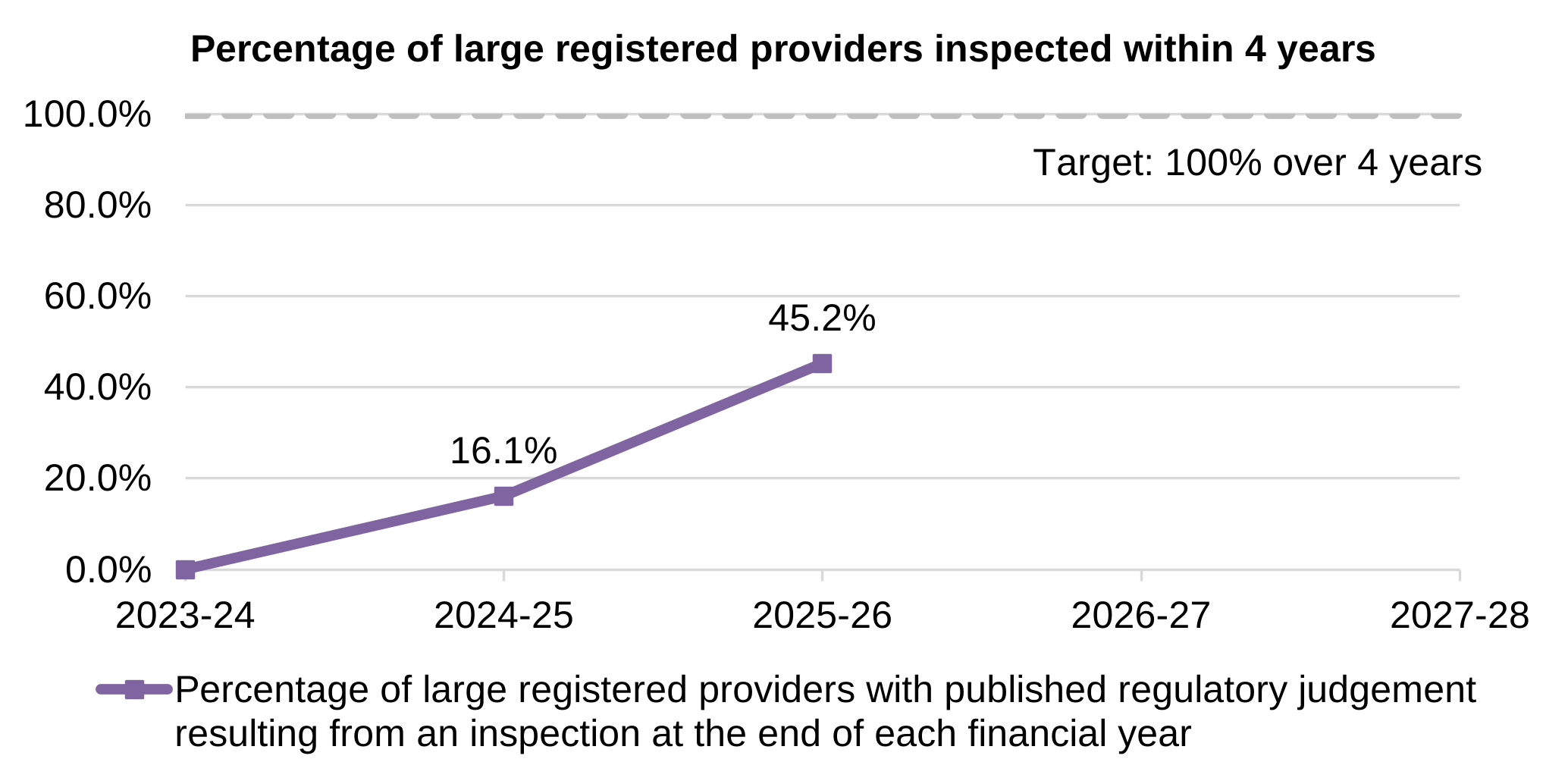
| 2023-24 | 2024-25 | 2025-26 | 2026-27 | 2027-28 | |
|---|---|---|---|---|---|
| Percentage of large registered providers with published regulatory judgement resulting from an inspection at the end of each financial year | 0.0% | 16.1% | 45.2% | ||
| Target over 4 years | 100.0% |
KPI 2: Percentage of large landlords receiving regulatory judgements each year
Our strategic objective on driving improvement requires robust regulation to ensure registered landlords deliver improved outcomes for tenants. Regulatory judgements – our published view of how well a landlord is delivering the outcomes of our standards – are central to our approach. They allow tenants and other stakeholders to understand how each landlord is delivering and provide a source of insight for landlords across the sector. In addition to regulatory judgements resulting from inspections (see KPI 1), we also publish regulatory judgements resulting from information we gather about registered landlords through other routes.
Every year we carry out a stability check of large private registered landlords to review their financial performance and risk profile. This helps us to identify any risks the landlord might face in delivering the outcomes of our standards. Following a stability check, where we have not identified that there are any material risks which may result in a change to their gradings we reflect this by updating a landlord’s regulatory judgement publication. Where the stability check highlights risks which indicate that an existing judgement may need to be revised, we may carry out responsive engagement or an inspection.
We also receive information about registered landlords from a range of other sources. Where we assess an issue or a potential issue to be material to a landlord’s delivery of the outcomes of our standards, we may carry out responsive engagement with that landlord. Where this leads us to form or change our view of how well the landlord is delivering the outcomes of our standards, we may reflect this in a published regulatory judgement and grading.
This KPI measures the percentage of large registered landlords that have received a regulatory judgement through inspections, stability checks and responsive engagement at the end of each financial year, across consumer, governance and viability gradings. This indicates how much of the sector is subject to our regulatory judgements in any given year. In the data presented below, landlords that received more than one regulatory judgement in the year are counted once, based on their most recent judgement. Note that all registered landlords are subject to consumer standards, but only private registered landlords are subject to stability checks and governance and viability gradings.
Our target level for inspections is set by KPI 1; all large landlords inspected in a four-year period. It would be inappropriate to set a target for responsive engagement as our regulation is risk-based – the level of this activity should be set by the scale of issues materialising in the sector.
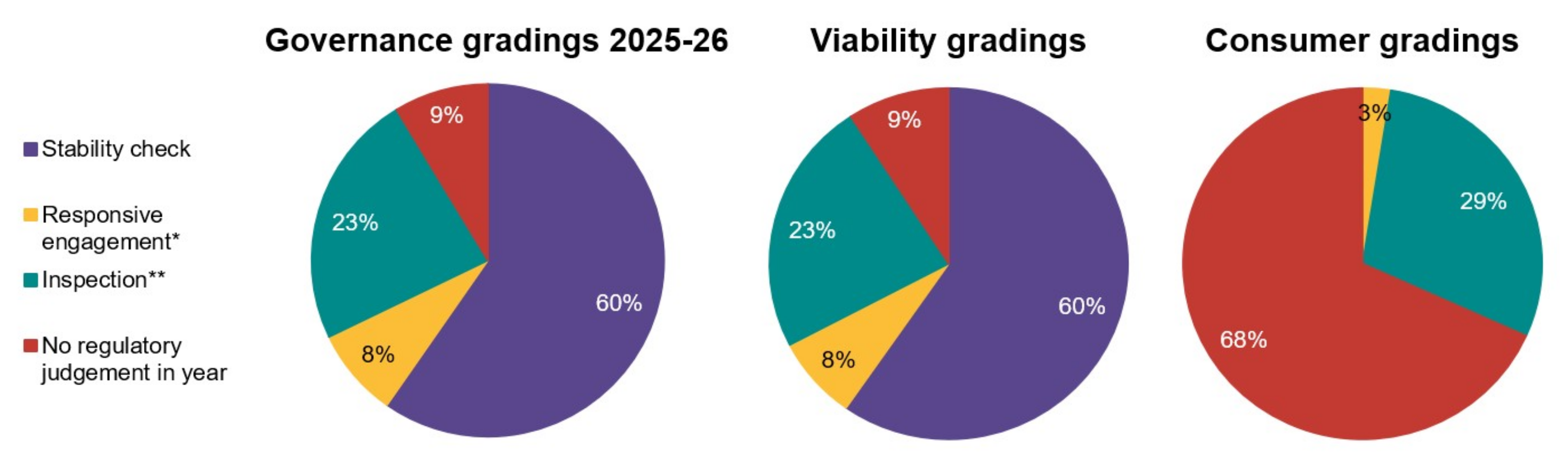
| Governance gradings | 2025-26 |
|---|---|
| Number of large PRPs receiving G grading from a stability check | 60% |
| Number of large PRPs receiving G grading from responsive engagement | 8% |
| Number of large PRPs receiving G grading from inspection | 23% |
| Number of large PRPs receiving no G grading in the year | 9% |
| Viability gradings | 2025-26 |
|---|---|
| Number of large PRPs receiving V grading from a stability check | 60% |
| Number of large PRPs receiving V grading from responsive engagement | 8% |
| Number of large PRPs receiving V grading from inspection | 23% |
| Number of large PRPs receiving no V grading in the year | 9% |
| Consumer gradings | 2025-26 |
|---|---|
| Number of large PRPs receiving C grading from a stability check | N/A |
| Number of large RPs receiving C grading from responsive engagement | 3% |
| Number of large RPs receiving C grading from inspection | 29% |
| Number of large RPs receiving no C grading in the year | 68% |
*For governance and viability gradings, includes landlords that were subject to responsive engagement following a stability check (not counted under gradings issued directly after stability checks)
**Includes landlords that received an inspection following responsive engagement (not counted under responsive engagement)
KPI 3: Distribution of large landlords by current regulatory judgement
Our strategic objective on driving improvement requires registered landlords to deliver improved outcomes for tenants. Our regulatory judgements are our view of how well registered landlords are delivering the outcomes of our standards. Where we have need to engage with a landlord, we normally continue our engagement until the landlord has supplied evidence that gives us sufficient assurance that it has addressed the identified weaknesses or failings. All landlords should aim for G1 and C1 grades. However, with viability gradings, we consider landlords at V1 and V2 to be meeting our viability requirements. All other things being equal, we would expect registered landlords to move towards our top grades.
This KPI measures the distribution of large landlords by governance, viability and consumer gradings at the end of each financial year. We also report the number of grades issued over the year. We track these measures over time to show how landlords are moving between grades and to indicate the changes in the overall performance of the sector in delivering the outcomes of our standards.
Landlords’ delivery, and therefore their grades, are affected by many factors other than our regulation, such as the prevailing economic climate. For this reason, it would be inappropriate to set a target for the distribution of landlords across grades, and any trends identified through this KPI should be interpreted with caution.
All large private landlords have governance and viability gradings in place. Local authorities are not subject to these gradings. The results show that we consider a significant majority of landlords to be at G1. They meet our governance requirements, with no aspects that need improvement. For viability, we consider most landlords to be at V2. They meet our viability requirements and have the financial capacity to deal with a reasonable range of adverse scenarios, but need to manage material risks to ensure continued compliance.
All large landlords, both private and local authorities, are subject to consumer regulation and we have assessed and graded 45% of landlords so far (see KPI 1). The distribution across consumer grades is therefore based on a sample of just under half of the sector. So far, we have rated most landlords at C2. They have some weaknesses in delivering the outcomes of the consumer standards and improvement is needed.
In addition to the gradings reported below, as at 31 March 2026, 28 landlords were still subject to regulatory notices made prior to 1 April 2024, under our former regulatory regime. Of these, 17 were in relation to the economic standards, and 11 were in relation to the consumer standards. Of the 17 landlords with a regulatory notice in relation to the economic standards, 12 had been unable to demonstrate compliance with the rent standard. There were also a further three landlords that had been unable to demonstrate compliance with the rent standard as part of regulatory judgement made between 1 April 2024 and 31 March 2025.
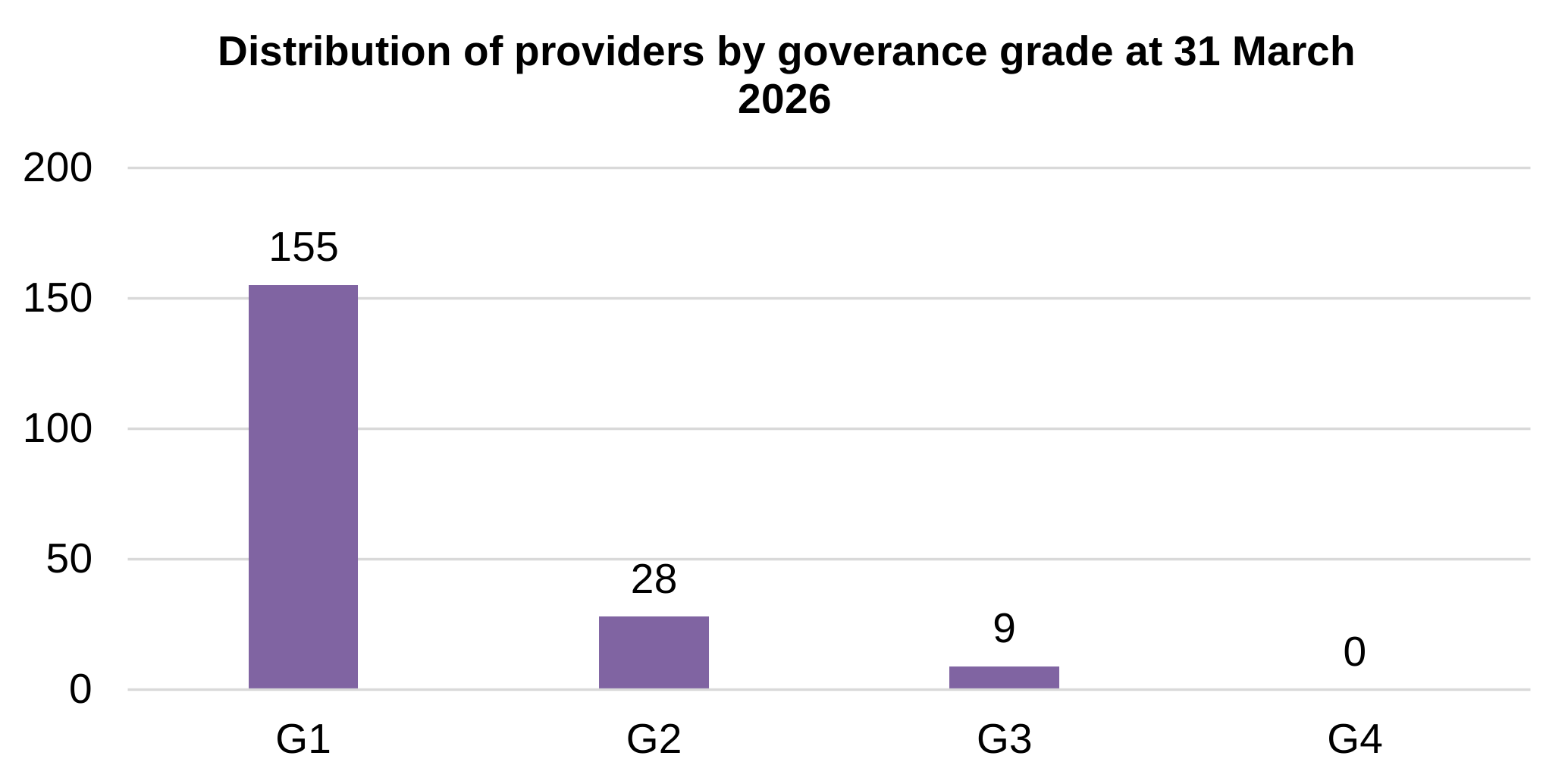
| G1 | 155 |
| G2 | 28 |
| G3 | 9 |
| G4 | 0 |
| Total | 192 |
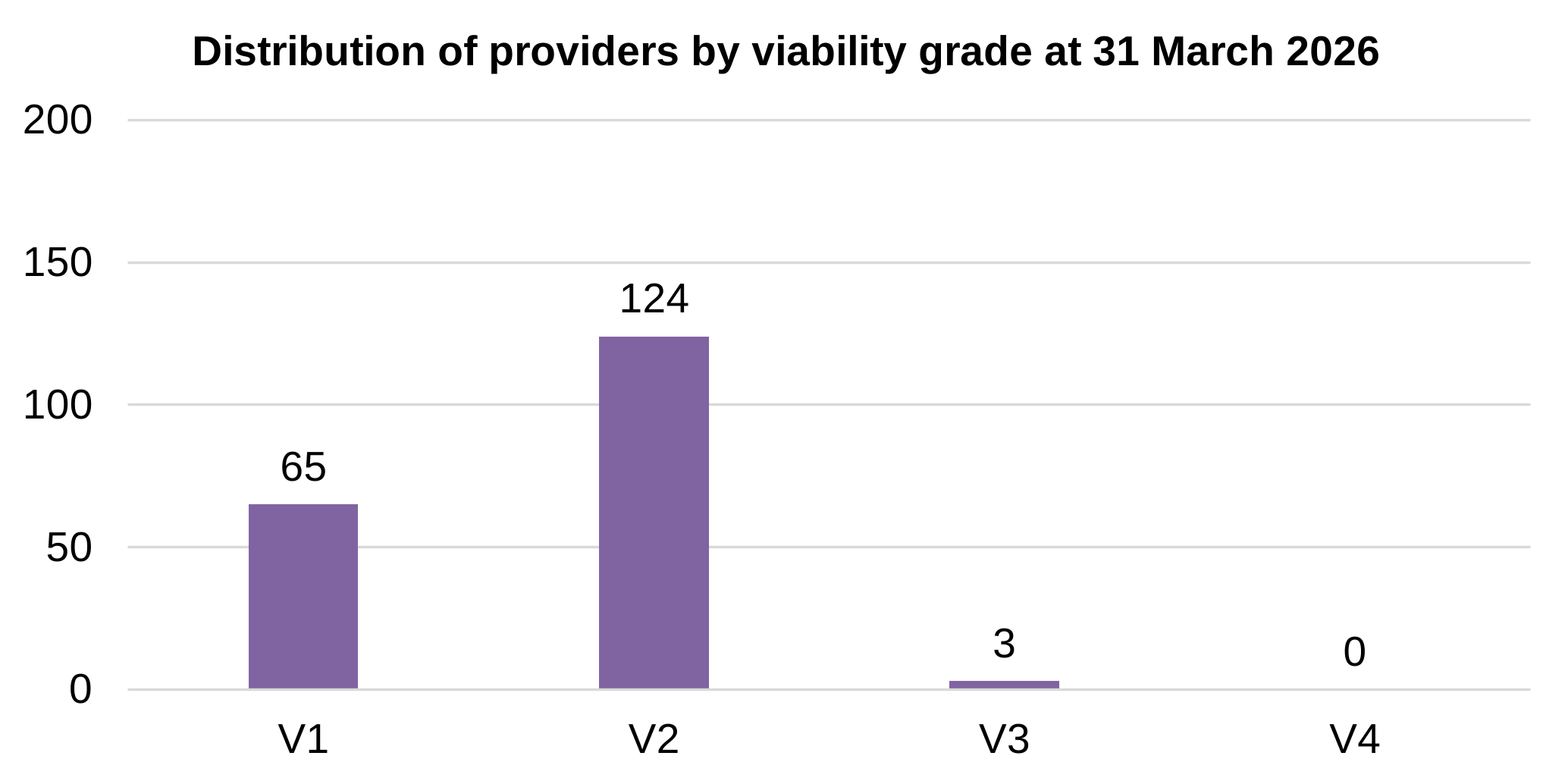
| V1 | 65 |
| V2 | 124 |
| V3 | 3 |
| V4 | 0 |
| Total | 192 |
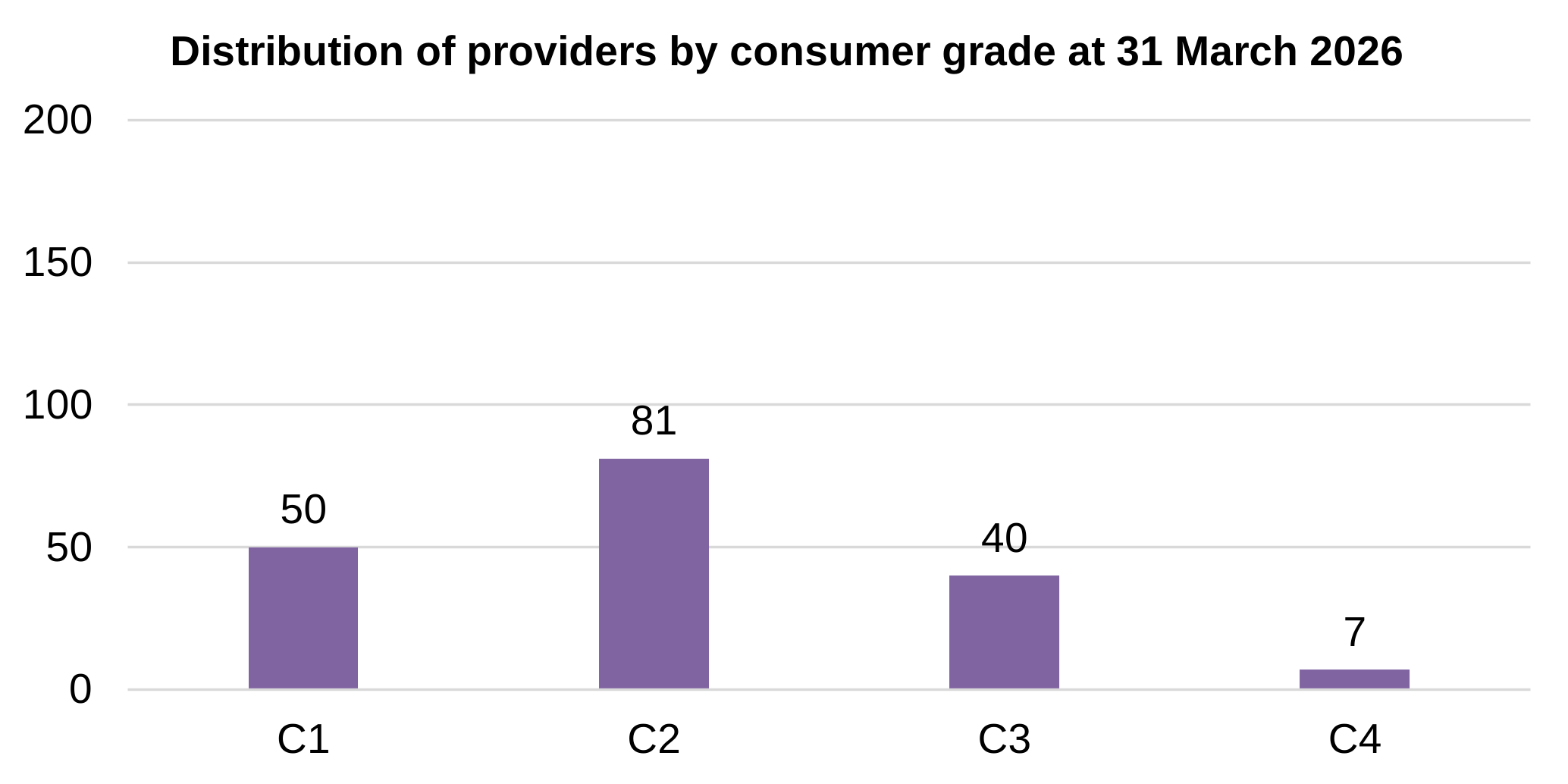
| C1 | 50 |
| C2 | 81 |
| C3 | 40 |
| C4 | 7 |
| Total | 178 |
Number of grades issued in 2025-26
| Governance | Viability | Consumer | |
|---|---|---|---|
| Upgrades | 8 | 4 | 6 |
| Downgrades | 15 | 12 | 1 |
| Assessed and unchanged | 172 | 176 | 0 |
| First grading | 6 | 6 | 106 |
| Total | 201 | 198 | 113 |
KPI 4: Percentage of stakeholders who agree our regulation is consistent with our objectives
Our strategic objective on driving improvement requires robust regulation to ensure registered landlords deliver improved outcomes for tenants. It is important to understand whether our standards and our approach to regulation are helping the sector to achieve these improvements, as articulated out in our statutory fundamental objectives. Results from the annual RSH stakeholder survey are used in KPIs 4-7 and 10. Respondents to the survey include landlords, individual tenants, tenant organisations, trade bodies, lenders, investors, credit rating agencies, and government departments.
Whilst covering similar topics, the overall questionnaire used for the most recent 2025-26 survey this year differed substantially from those used previously. KPIs 4-7 and 10 are based on questions that had the same or similar wording to previous years and so we consider the data sufficiently comparable. However, minor variations in wording may have influenced responses and could account for some of the observed differences. Therefore, year-on-year comparisons should be interpreted with caution.
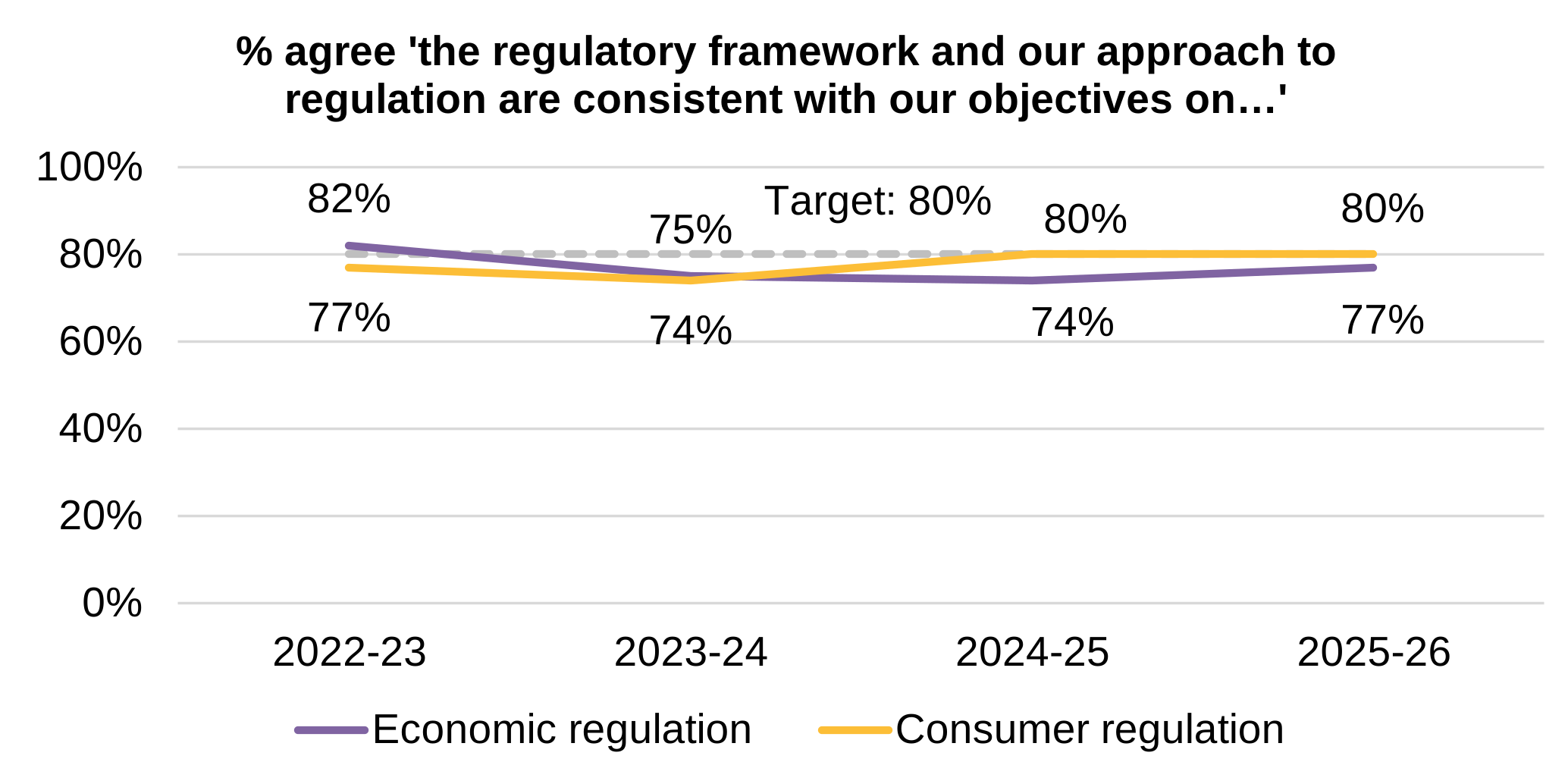
This KPI measures the percentage of respondents to our annual stakeholder survey who agree that “the regulatory framework and our approach to regulation are consistent with our objectives on economic/consumer regulation.” This indicates stakeholder perceptions of our approaching to driving improvement. We have set a target of 80% for this KPI. In the most recent survey, we met this target for stakeholder perceptions of our consumer regulation. However, we were three percentage points short of the target for stakeholder perceptions of our economic regulation.
| 2022-23 | 2023-24 | 2024-25 | 2025-26 | |
|---|---|---|---|---|
| Economic regulation | 82% | 75% | 74% | 77% |
| Consumer regulation | 77% | 74% | 80% | 80% |
| Target | 80% | 80% | 80% | 80% |
KPI 5: Percentage of stakeholders who agree we take action to ensure confidence in the sector
Our strategic objective on maintaining confidence requires that the actions we take within our remit maintain stakeholder and investor confidence in social housing. It is important to understand stakeholder views on whether we are maintaining investor confidence and ensuring access to finance for landlords.
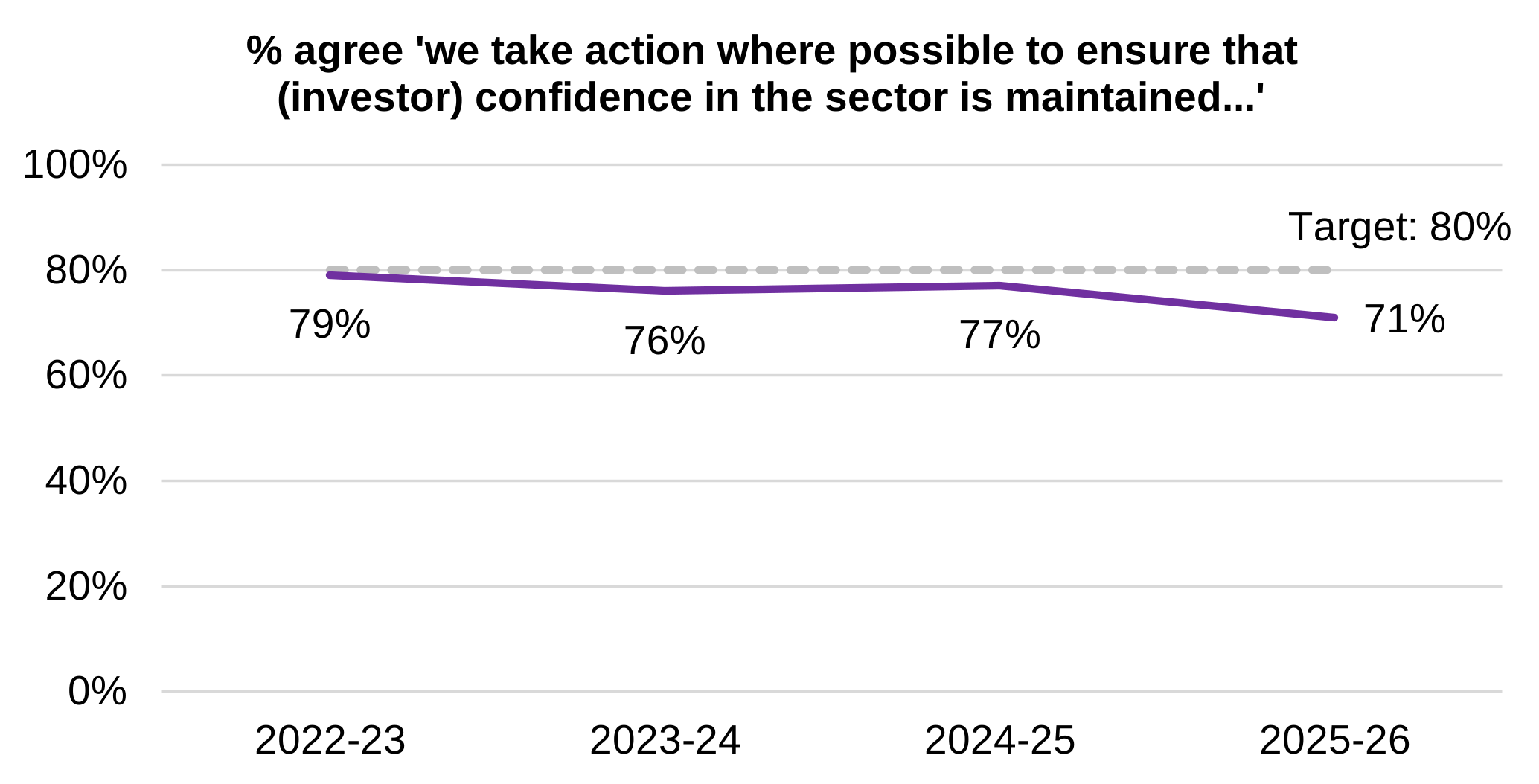
This KPI measures the percentage of respondents to our annual stakeholder survey who agree that “where possible, RSH acts to ensure investor confidence in the sector is maintained.” This indicates stakeholder perceptions of our approach to maintaining confidence. We have set a target of 80% for this KPI and were several percentage points below this in the most recent survey. Some of this difference is likely attributable to the different approach we took to asking this question in the most recent survey. In previous surveys we asked respondents the extent to which they agreed that “we take action where possible to ensure that confidence in the sector is maintained, and access to finance on competitive terms continues.”
| 2022-23 | 2023-24 | 2024-25 | 2025-26 | |
|---|---|---|---|---|
| Percentage of stakeholders who agree we take action where possible to ensure that confidence in the sector is maintained, and access to finance on competitive terms continues | 79% | 76% | 77% | 71% |
| Target | 80% | 80% | 80% | 80% |
KPI 6: Percentage of stakeholders who agree we take appropriate action in line with our remit
Our strategic objective on maintaining confidence requires that we act appropriately within our remit. It is important to understand stakeholder views on whether we are maintaining confidence in social housing through a stable, proportionate regulatory regime.
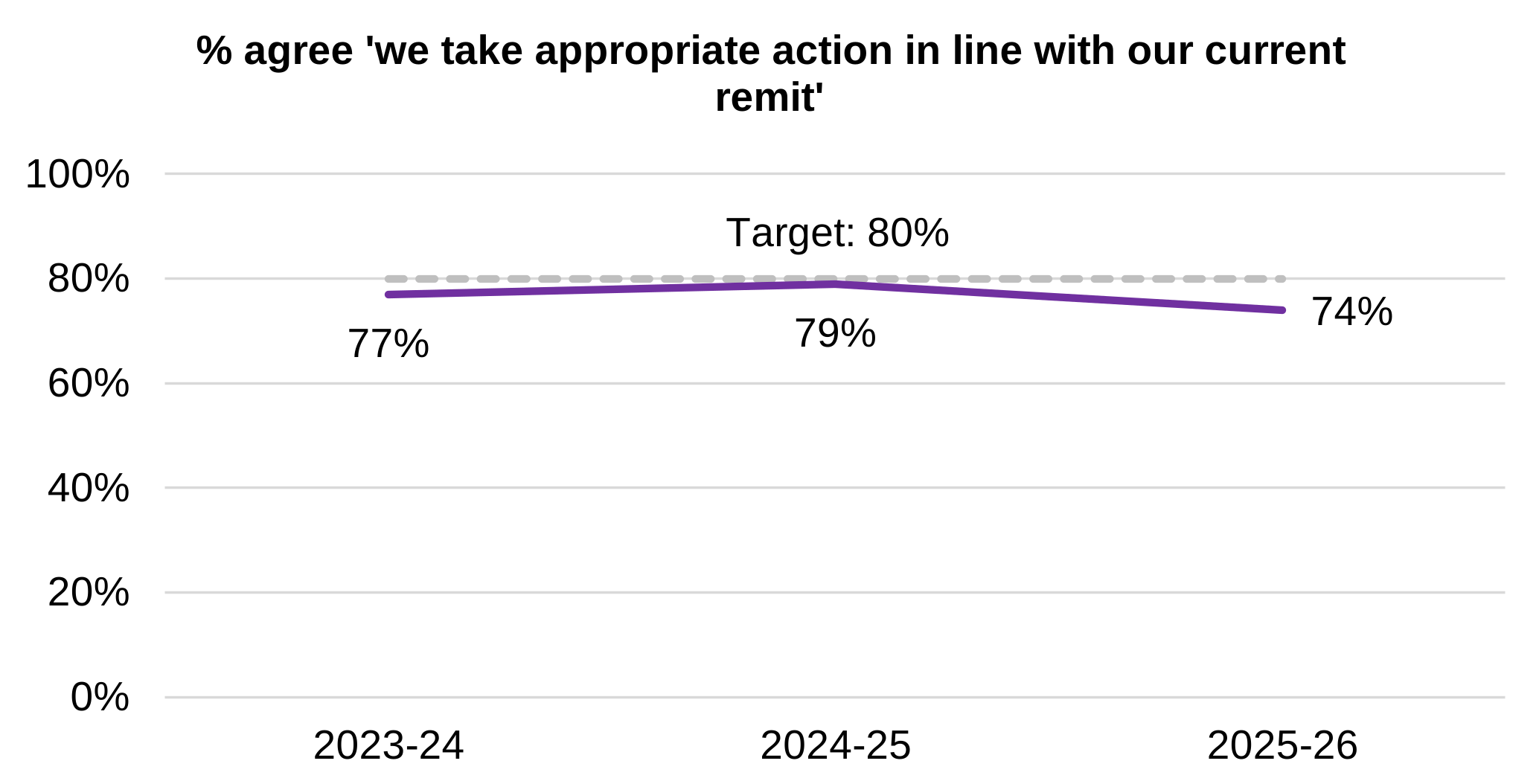
This KPI measures the percentage of respondents to our annual stakeholder survey who agree that “RSH takes appropriate action in line with our powers and remit when landlords do not meet the standards.” This indicates stakeholder perceptions of our approach to maintaining confidence. We have set a target of 80% for this KPI and were several percent point below this for the most recent survey. Some of this difference is likely attributable to the different approach we took to asking this question in the most recent survey. In previous surveys we asked respondents the extent to which they agreed that “we take appropriate action in line with our remit.”
| 2022-23 | 2023-24 | 2024-25 | 2025-26 | |
|---|---|---|---|---|
| Percentage of stakeholders who agree we take appropriate action in line with our remit | N/A | 77% | 79% | 0.74 |
| Target | 80% | 80% | 80% | 0.8 |
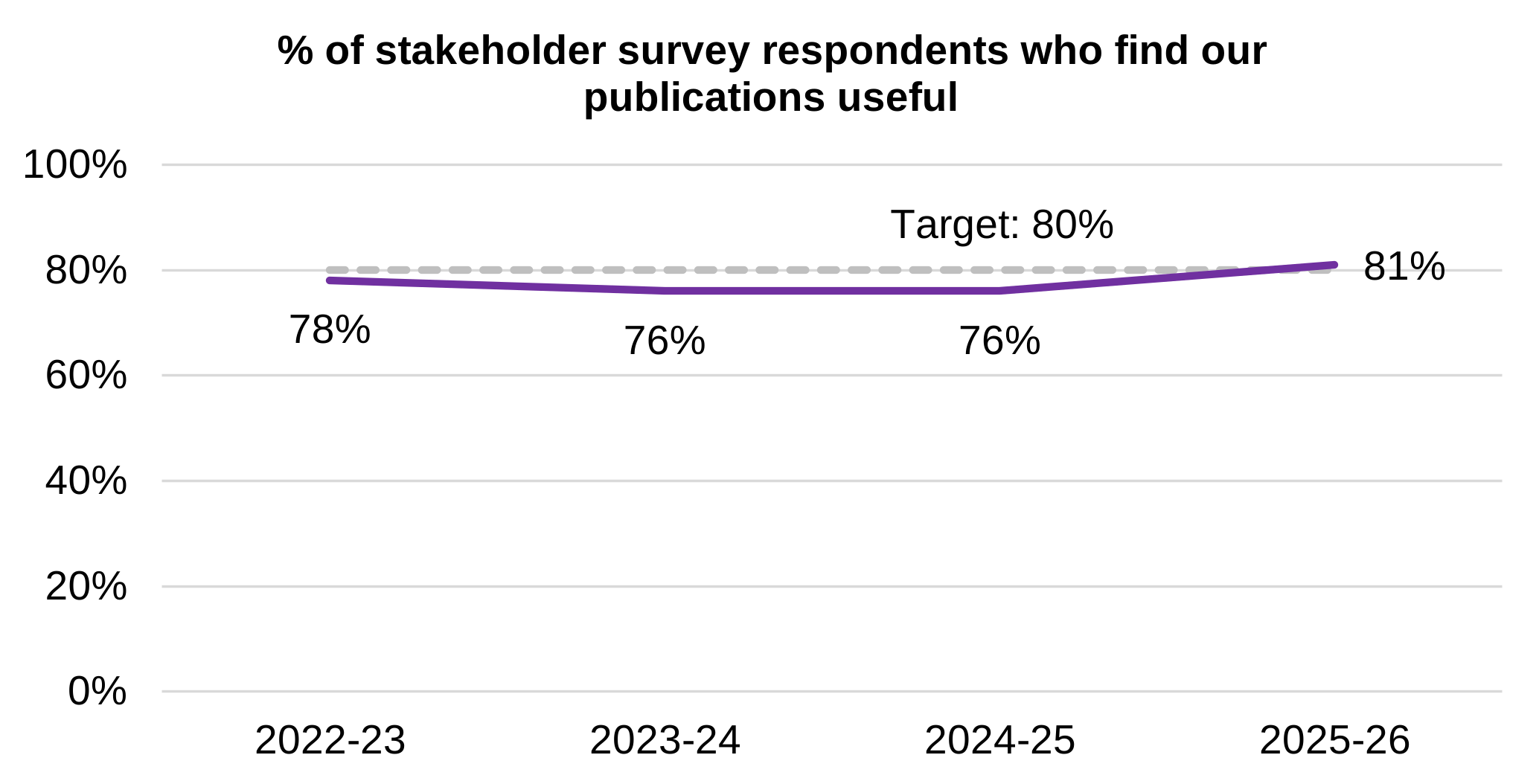
KPI 7: Percentage of stakeholders who find our publications useful
Our strategic objective on maintaining confidence requires that we publish insight, research and analysis to enable landlords to respond appropriately to sector risks, challenges and opportunities. It is important to understand stakeholder views on whether we are maintaining confidence in social housing through our publications.
This KPI measures the percentage of respondents to our annual stakeholder survey who find our publications useful. This indicates stakeholder perceptions of our approach to maintaining confidence. We have set a target of 80% for this KPI which was met in the most recent survey.
| 2022-23 | 2023-24 | 2024-25 | 2025-26 | |
|---|---|---|---|---|
| Percentage of stakeholders who find RSH publications very or somewhat useful | 78% | 76% | 76% | 81% |
| Target | 80% | 80% | 80% | 80% |
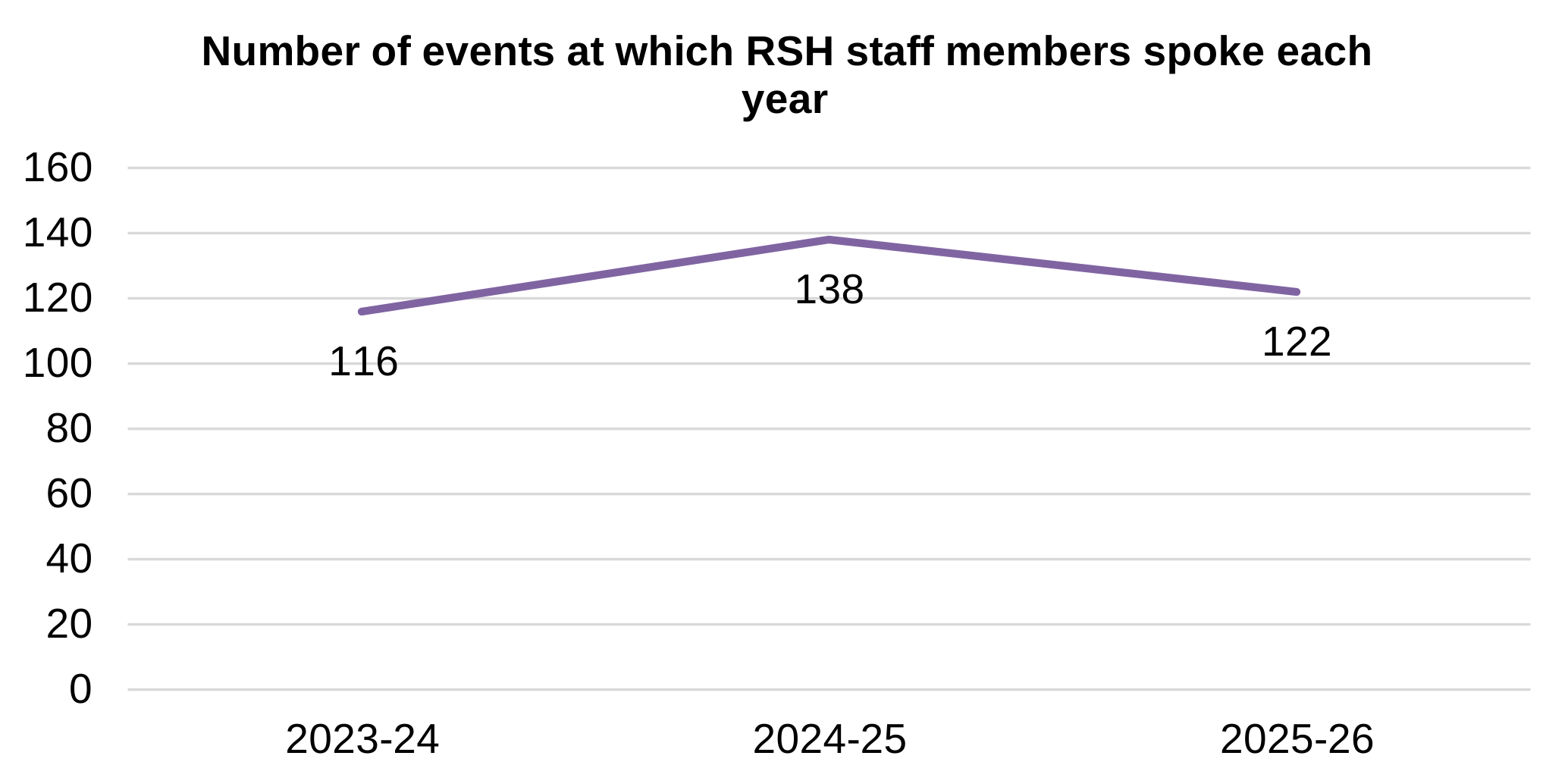
KPI 8: Number of external speaking engagements delivered by RSH staff each year
Our strategic objective on working with others requires communication and engagement with our stakeholders. A central element of our approach is ensuring that our staff speak at and contribute to widely attended national and regional social housing events.
This KPI measures the number of external events at which senior RSH staff speak each year. This covers events that are in-person and online – including speeches, panel events, Q&As and briefings to stakeholder groups – but excludes regular bilateral meetings we have with our main stakeholders, and any events arranged by RSH. Where several RSH staff members deliver sessions at large events, we count these as multiple speaking engagements. This indicates our level of engagement with stakeholders.
| 2023-24 | 2024-25 | 2025-26 | |
|---|---|---|---|
| Number of external speaking engagements delivered by RSH staff each year | 116 | 138 | 122 |
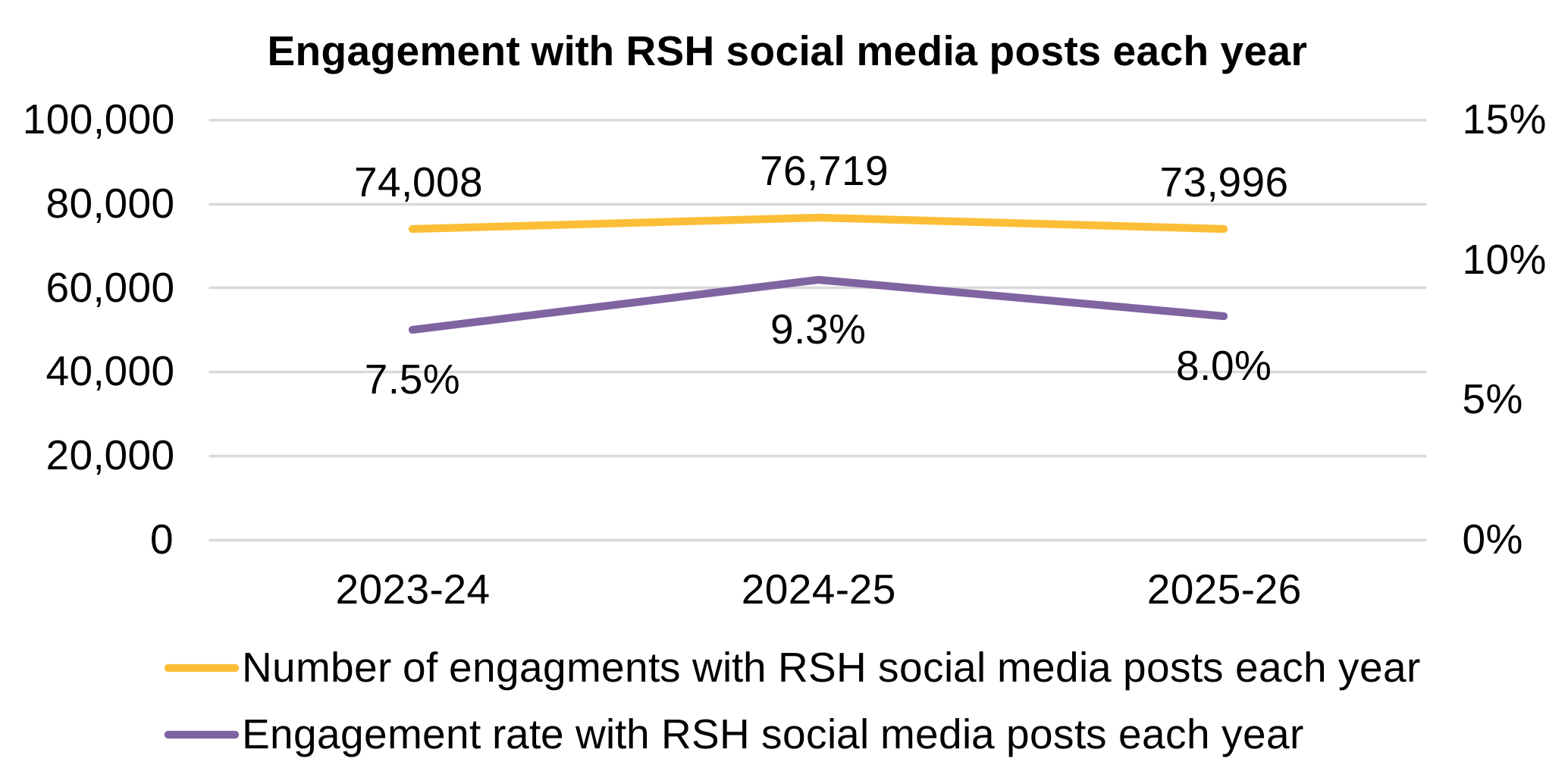
KPI 9: Engagement with RSH social media posts each year
Our strategic objective on working with others requires communication and engagement with our stakeholders. A central element of our approach is ensuring that we use our social media channels (X and LinkedIn) effectively.
This KPI measures our social media engagement rate for each year. It is calculated by dividing the total number of engagements (such as likes, comments, shares, saves, and clicks –reported as a separate figure on the graph) by the total number of people who saw the content. This indicates our level of engagement with stakeholders.
| 2023-24 | 2024-25 | 2025-26 | |
|---|---|---|---|
| Number of engagments with RSH social media posts each year | 74,008 | 76,719 | 73,996 |
| Engagement rate with RSH social media posts each year | 7.5% | 9.3% | 8.0% |
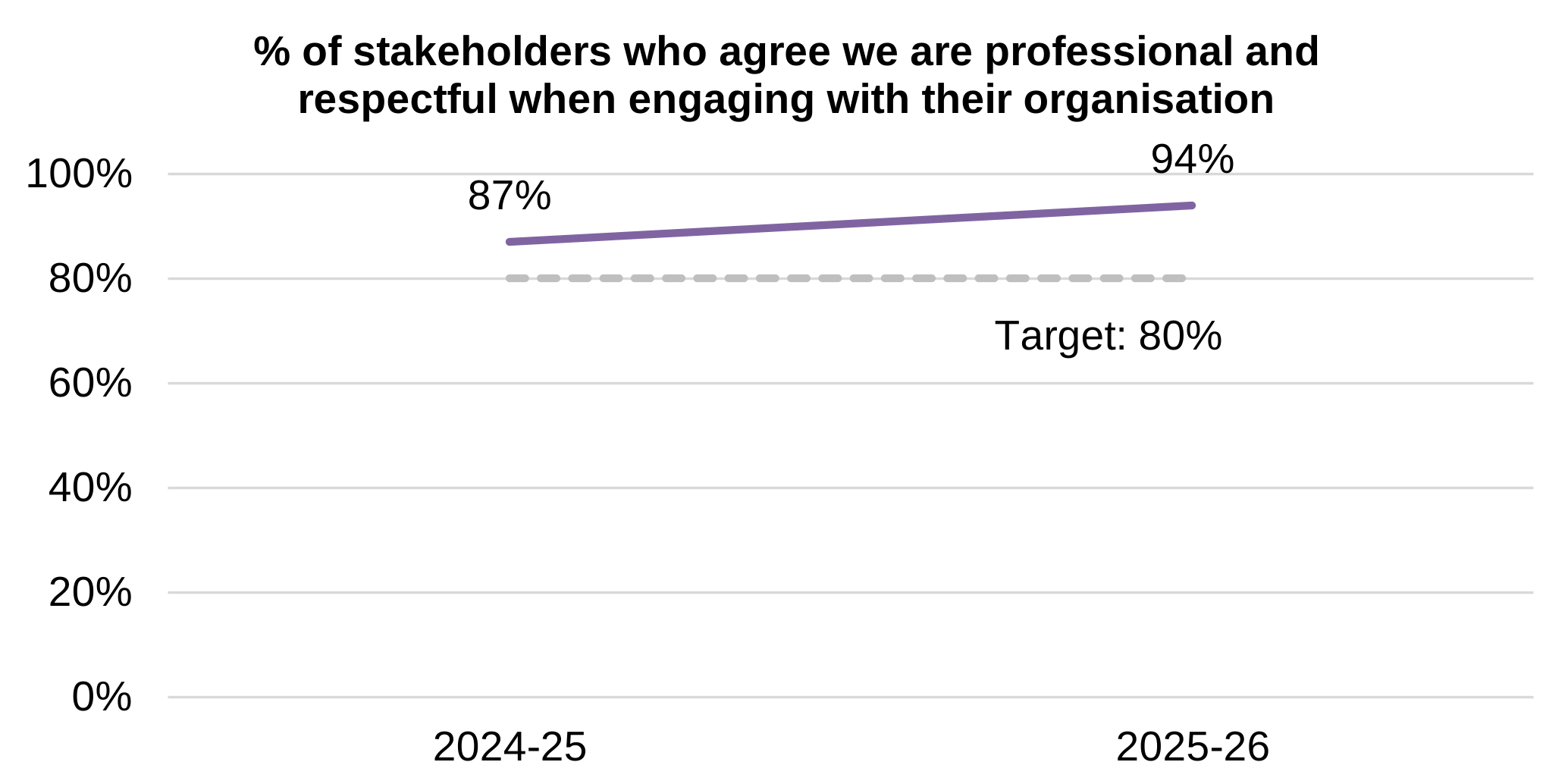
KPI 10: Percentage of stakeholders who agree we are professional and respectful when we engage
Our strategic objective on working with others requires building good relationships with our stakeholders. It is important to understand stakeholder views on our interactions with them.
This KPI measures the percentage of respondents to our annual stakeholder survey who agree that “RSH staff are professional and respectful when engaging with you or your organisation.” This indicates stakeholder perceptions of our ability to work effectively with others. We have set a target of 80% for this KPI and were several percentage points above this in the most recent survey. Some of this difference is likely attributable to the different approach we took to asking this question in the most recent survey. In previous surveys we asked respondents the extent to which they agreed that “we are professional and respectful when we engage.”
| 2024-25 | 2025-26 |
|---|---|
| 87% | 94% |
KPI 11: Staff engagement score
Our strategic objective on building the organisation requires us to develop and maintain an engaged workforce. We regularly survey our staff to determine levels of engagement.
This KPI measures our staff engagement score, based on the results of the staff survey we carry out every two years. The engagement score is calculated as average staff agreement with five statements related to engagement. This indicates our performance building an engaged workforce. We have set a benchmark of 65% for this KPI. We met this target in the 2025 RSH staff survey. Our engagement score was 81%, four percentage points above the norm for the public sector. Our employee engagement score in the previous staff survey (2023) was 67%, using slightly different engagement questions.
KPI 12: Staff turnover rate
Our strategic objective on building the organisation requires us to develop and maintain a diverse, skilled and engaged workforce. Staff with the right skills, who are engaged and working within an inclusive culture, are less likely to leave the organisation.
This KPI measures our staff turnover rate, calculated as the percentage of employees who left the organisation each year. This indicates our performance building the organisation. We have set a benchmark of below 10% for this KPI, which we met for 2025-26 with a turnover rate of just over 6%. By comparison, the Civil Service turnover rate was 6.9% in 2025-26.
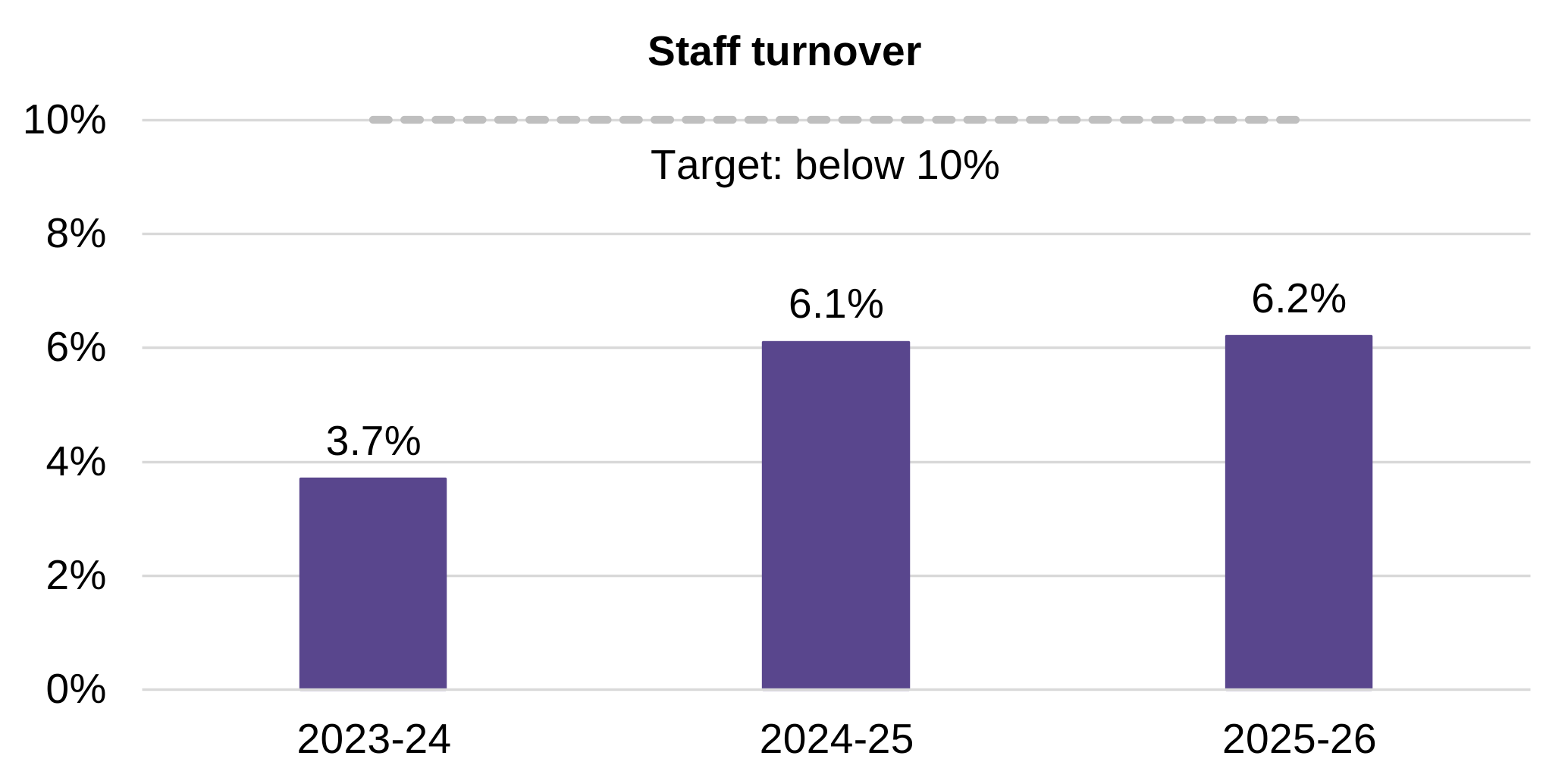
| 2023-24 | 2024-25 | 2025-26 | |
|---|---|---|---|
| Staff turnover | 3.7% | 6.1% | 6.2% |
| Target | 10.0% | 10.0% | 10.0% |
KPI 13: Number of staff sick days per head
Our strategic objective on building the organisation requires us to develop and maintain a diverse, skilled and engaged workforce. Staff with the right skills, who are engaged and working within an inclusive culture, are less likely to take sick days.
This KPI measures the number of staff sick days taken per employee each year. This indicates our performance building the organisation. From 2025-26, we have set a benchmark of below 5.5 days per head for this KPI. We missed this target in 2025-26, with a result of 7.3 days per head. By comparison, the overall Average Working Days Lost (AWDL) per staff year in the Civil Service was 8.2 days in 2024-25. Our previous target for this KPI in 2023-24 and 2024-25, was below 4 days per head.
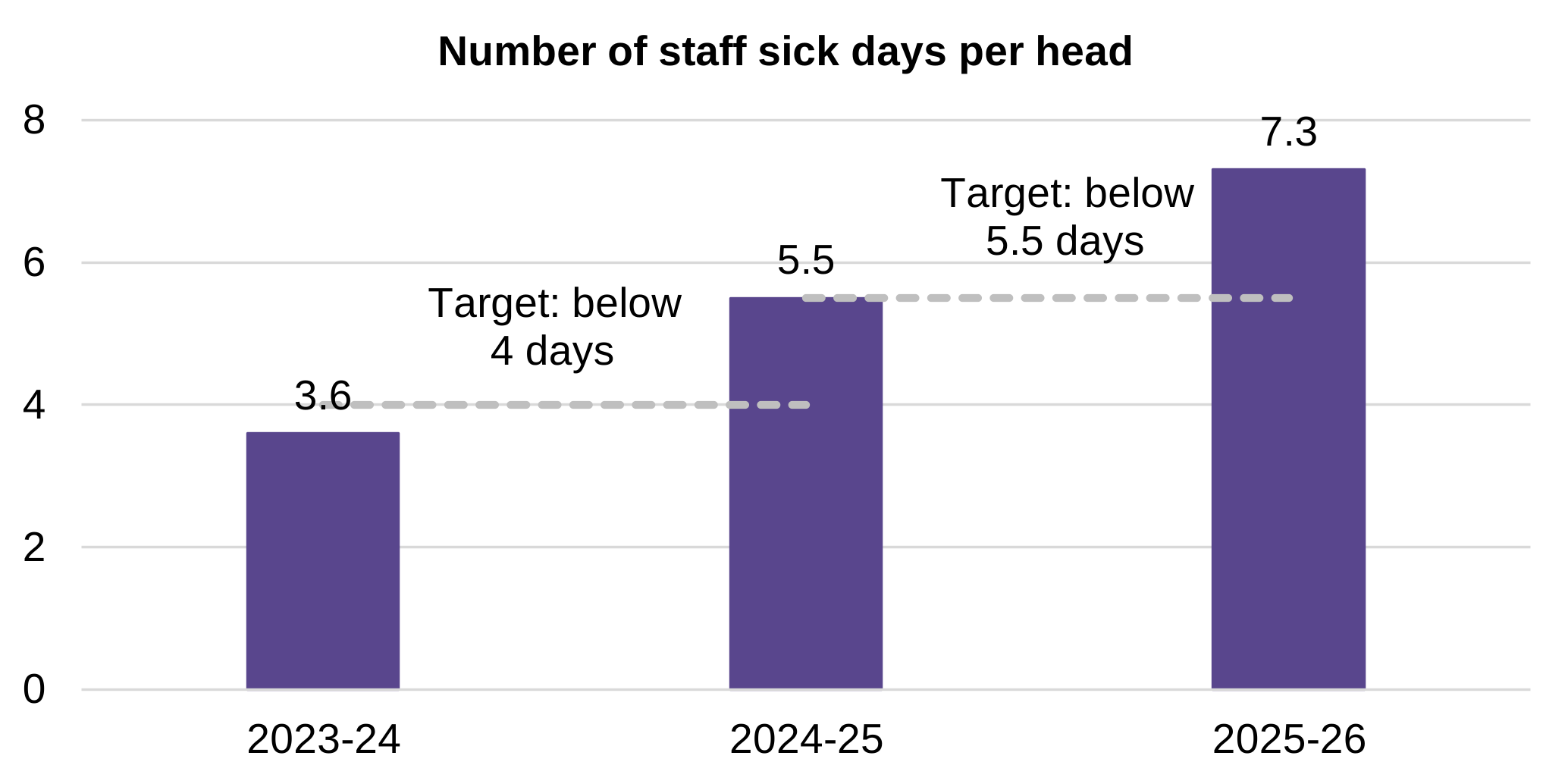
| 2023-24 | 2024-25 | 2025-26 | |
|---|---|---|---|
| Average number of staff sick days per head | 3.6 | 5.5 | 7.3 |
| Target | 4.0 | 4.0 | 5.5 |
KPI 14: Board member meeting attendance rate
Our strategic objective on building the organisation requires us to have effective corporate functions. This includes effective governance.
This KPI measures board member attendance rate, calculated as the average percentage of board meetings attended by board members each year. This indicates our performance in ensuring effective governance. We have set a target of 90% for this KPI, which we met in 2025-26 with an attendance rate just under 96%.
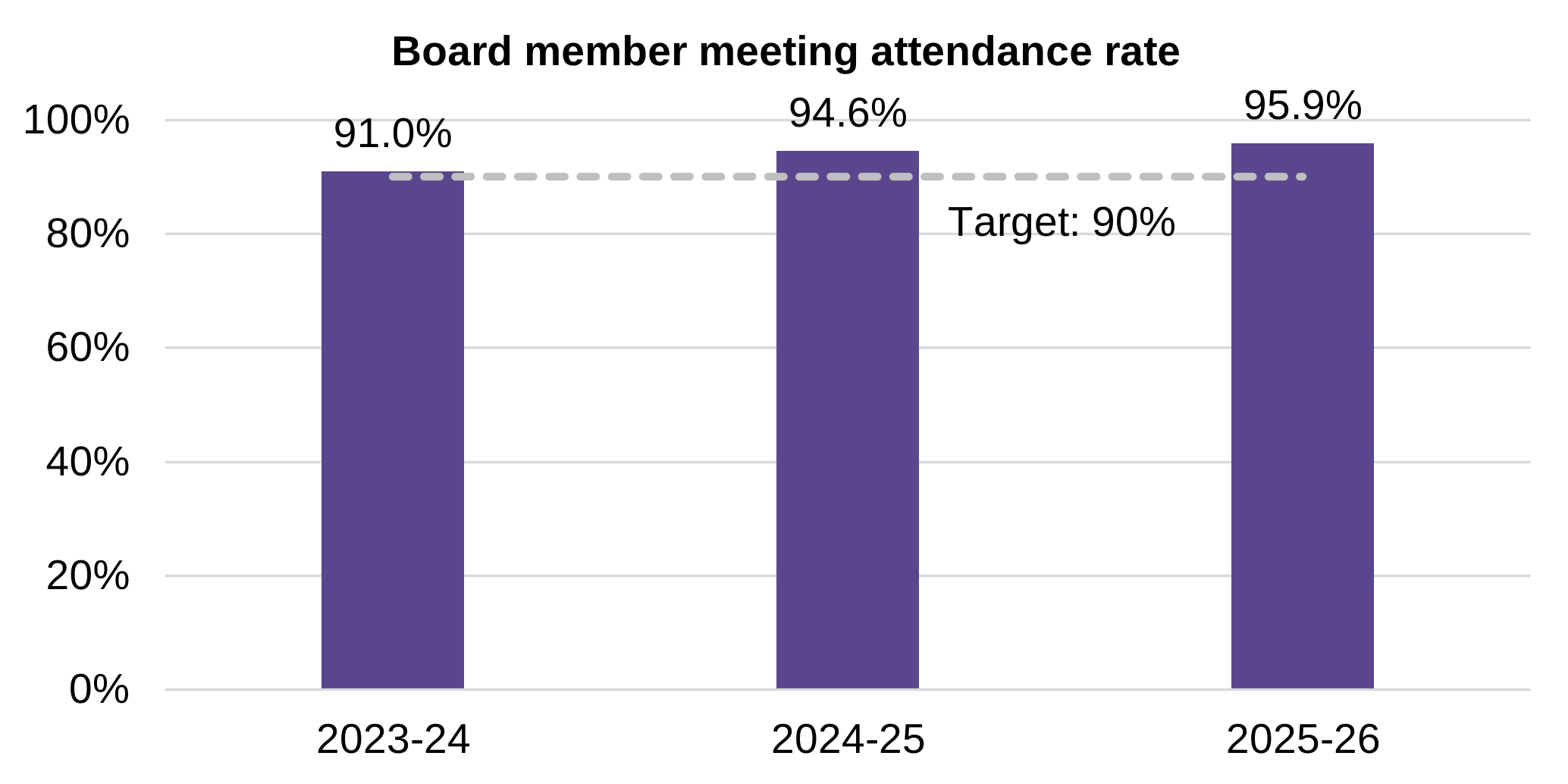
| 2023-24 | 2024-25 | 2025-26 | |
|---|---|---|---|
| Board member meeting attendance rate | 91.0% | 94.6% | 95.9% |
| Target | 90.0% | 90.0% | 90.0% |
KPI 15: Percentage of annual fees receivable that were received
Our strategic objective on building the organisation requires us to have effective corporate systems. This includes ensuring we collect the annual fees that fund our regulation.
This KPI measures the percentage of annual fees receivable that were received each year. This indicates our performance building the organisation. We have set a target of 100% for this KPI, which we met in 2025-26.
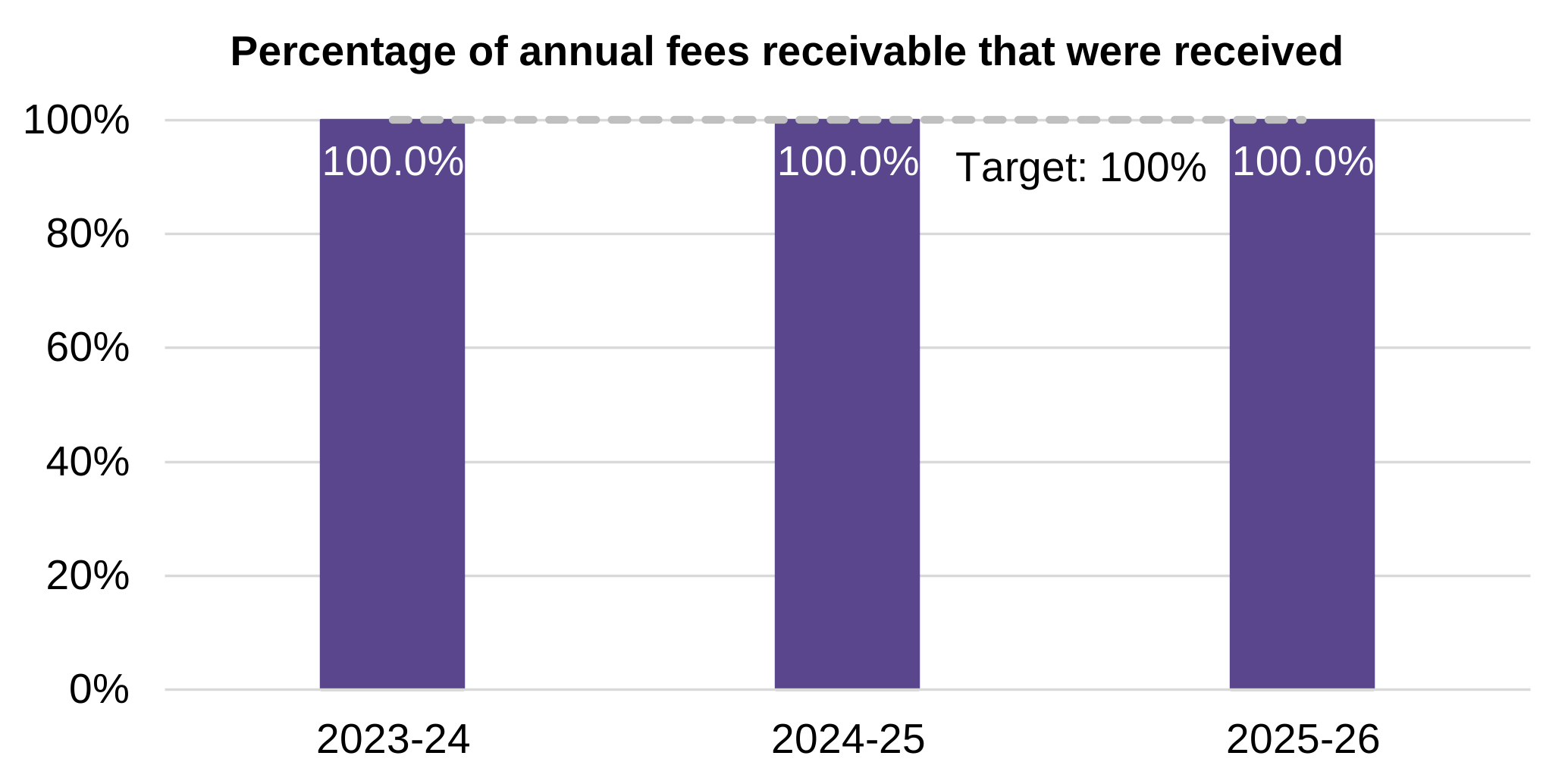
| 2023-24 | 2024-25 | 2025-26 | |
|---|---|---|---|
| Fees received | 100% | 100% | 100% |
| Target | 100% | 100% | 100% |
Contextual measures
As well as the performance measures above, we also report below on contextual indicators (CIs) that can be used to assess the performance of the social housing sector in England. Movement in these indicators will be impacted by a range of factors as well as RSH’s regulation. However, they represent a set of key measures that we monitor to inform our future strategy, alongside the many other sources of evidence, intelligence and data that we gather across our consumer, governance and financial regulation.
CI 1: Overall satisfaction from Tenant Satisfaction Measures
Our Transparency, Influence and Accountability Standard requires all registered landlords to generate and report Tenant Satisfaction Measures (TSMs) that we specify, and 2024 was the first year that this took place. Overall satisfaction (TSM TP01) is the headline tenant perception measure in the surveys landlords were required to carry out. Surveys asked tenants their overall level of satisfaction with the service provided by their landlord, taking everything into account. Overall satisfaction is a well-established performance measure that is used in similar satisfaction surveys across a range of sectors.
This CI measures the percentage of tenants in low-cost rental accommodation across all large landlords who reported that they were either ‘very satisfied’ or ‘fairly satisfied’ with the overall service provided by their landlord. The results are based on 455,000 responses from tenants for the initial 2023-24 survey and 464,000 responses for the 2024-25 survey.
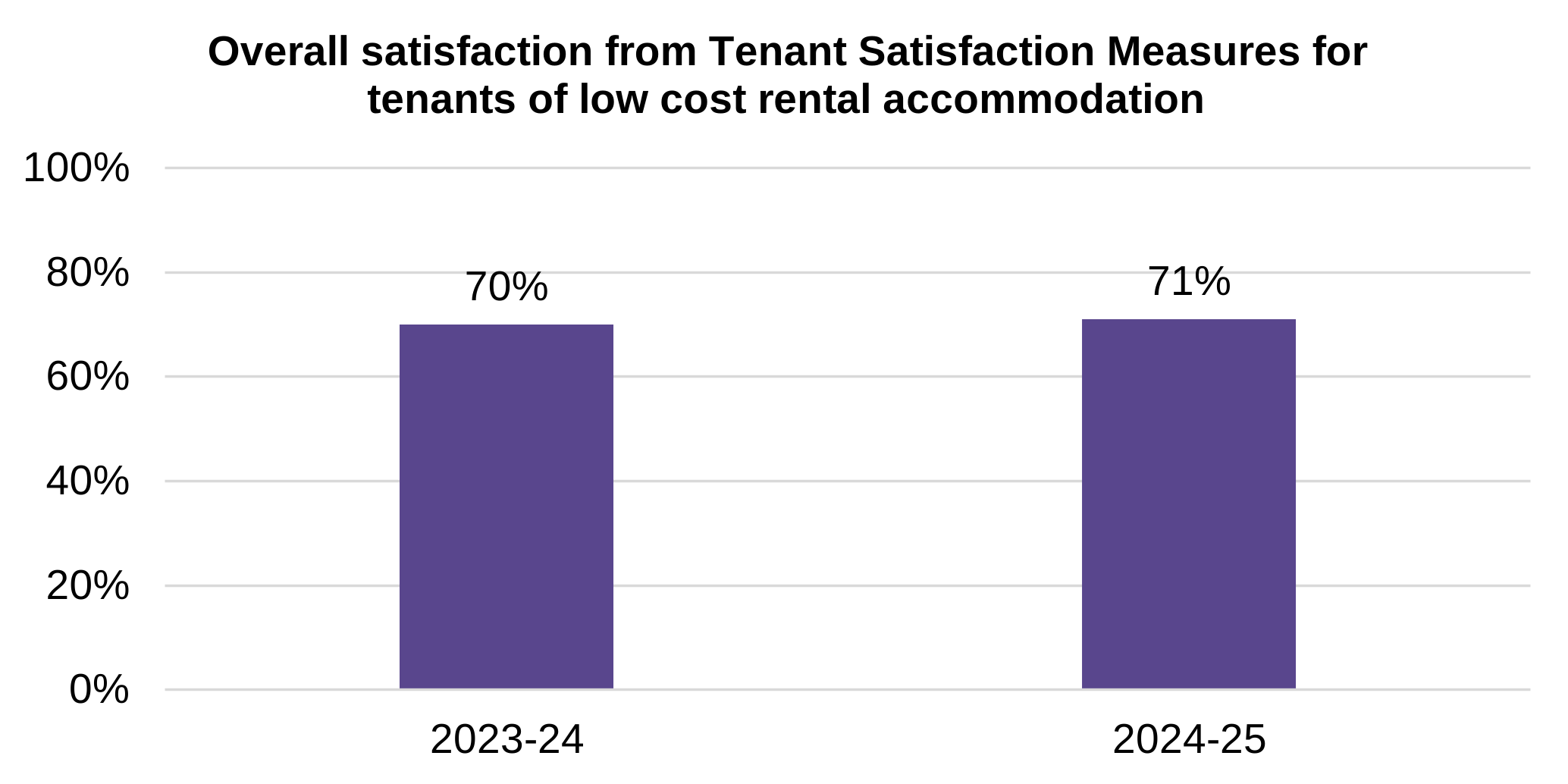
| 2023-24 | 2024-25 | |
|---|---|---|
| Overall satisfaction from TSMs | 70% | 71% |
CI 2: Percentage of social homes that do not meet the Decent Homes Standard
Our Safety and Quality Standard requires registered landlord to ensure that tenants’ homes meet the government’s Decent Homes Standard. For a dwelling to be considered ‘decent’ under the Decent Homes Standard it must meet minimum requirements for health and safety, state of repair, facilities and services, and thermal comfort. The level housing decency, including in the social rent sector, is measured by the English Housing Survey (EHS). This is a national survey of people’s housing circumstances and the condition and energy efficiency of housing in England.
This CI measures the percentage of homes in the social rent sector in England that fail to meet the Decent Homes Standard, as measured by the EHS. The 2021 data was modelled from 2018 and 2019 data due to the COVID-19 pandemic. Comparisons between years should be made with caution.
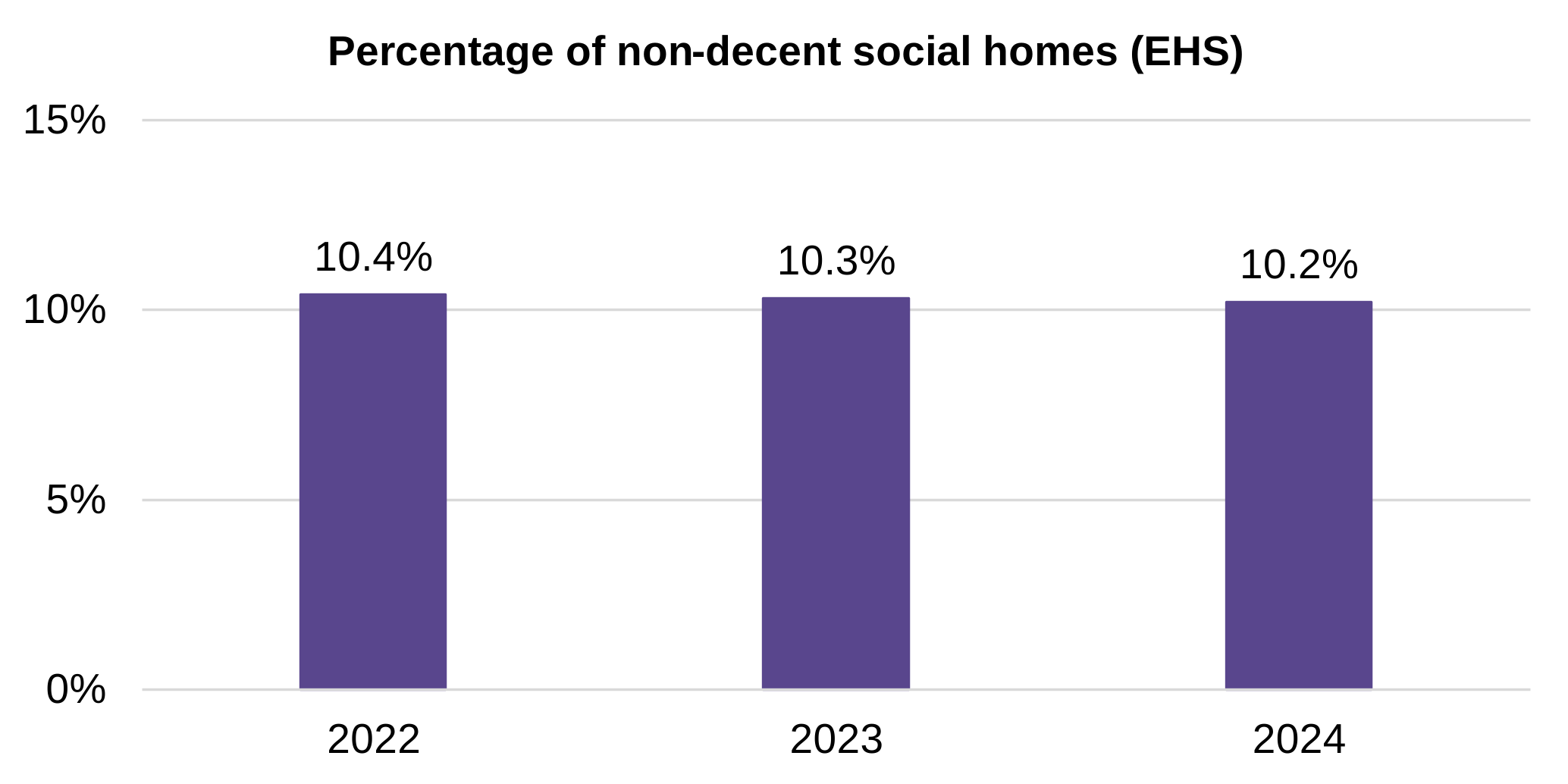
| 2022 | 2023 | 2024 | |
|---|---|---|---|
| Percentage of social homes that do not meet the Decent Homes Standard | 10.4% | 10.3% | 10.2% |
CI 3: Median headline social housing cost per unit
Our Value for Money Standard requires private registered providers to annually report on their performance against a suite of value for money metrics defined by us. One of these measures is the headline social housing cost per unit. This aggregates the costs of management, maintenance, repairs and other social housing costs, and then divides the total by the number of social housing units being managed. It is a ‘proxy cash’ measure that excludes non-cash items such as depreciation, amortisation and write downs.
This CI measures the median headline social housing cost per unit for the sector overall. The times series is adjusted for inflation (CPI).
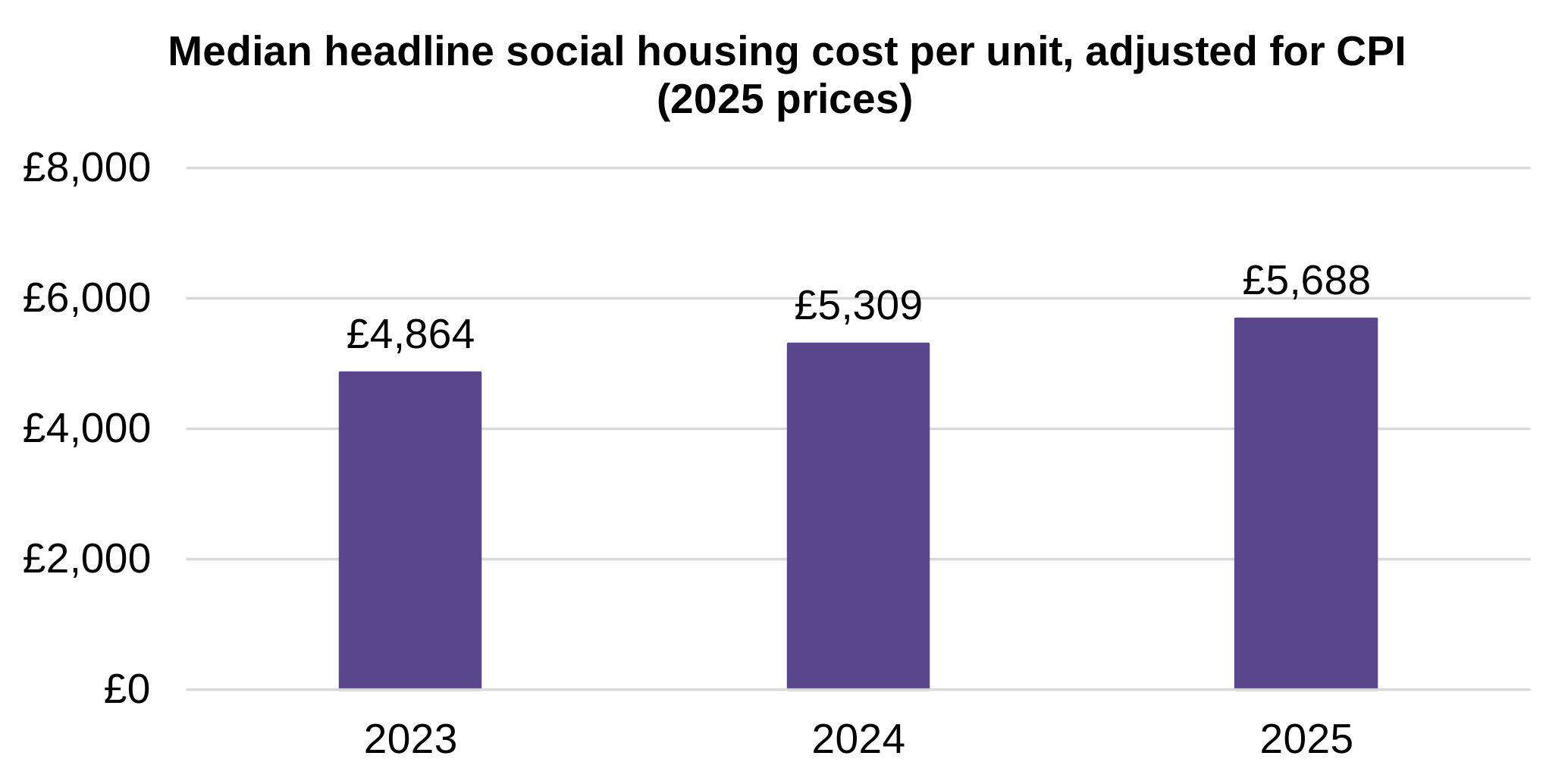
| 2023 | 2024 | 2025 | |
|---|---|---|---|
| Headline social housing cost per unit | £4,586 | £5,136 | £5,688 |
| ONS CPI INDEX 00: ALL ITEMS 2015=100 | 130.5 | 133.9 | 138.4 |
| Headline social housing cost per unit (2025 prices) | £4,864 | £5,309 | £5,688 |
CI 4: Total new facilities agreed each year
Our Governance and Financial Viability Standard includes a specific expectation for landlords to communicate with us in an accurate and timely manner, including through regulatory returns. Based on analysis of submitted regulatory returns and statements, our Global Accounts set out information about private registered providers’ finances. This includes data on funds raised by these providers from lenders to support investment in new and existing supply.
This CI measures the total new facilities agreed each year by private registered providers in aggregate. The times series is adjusted for inflation (CPI).
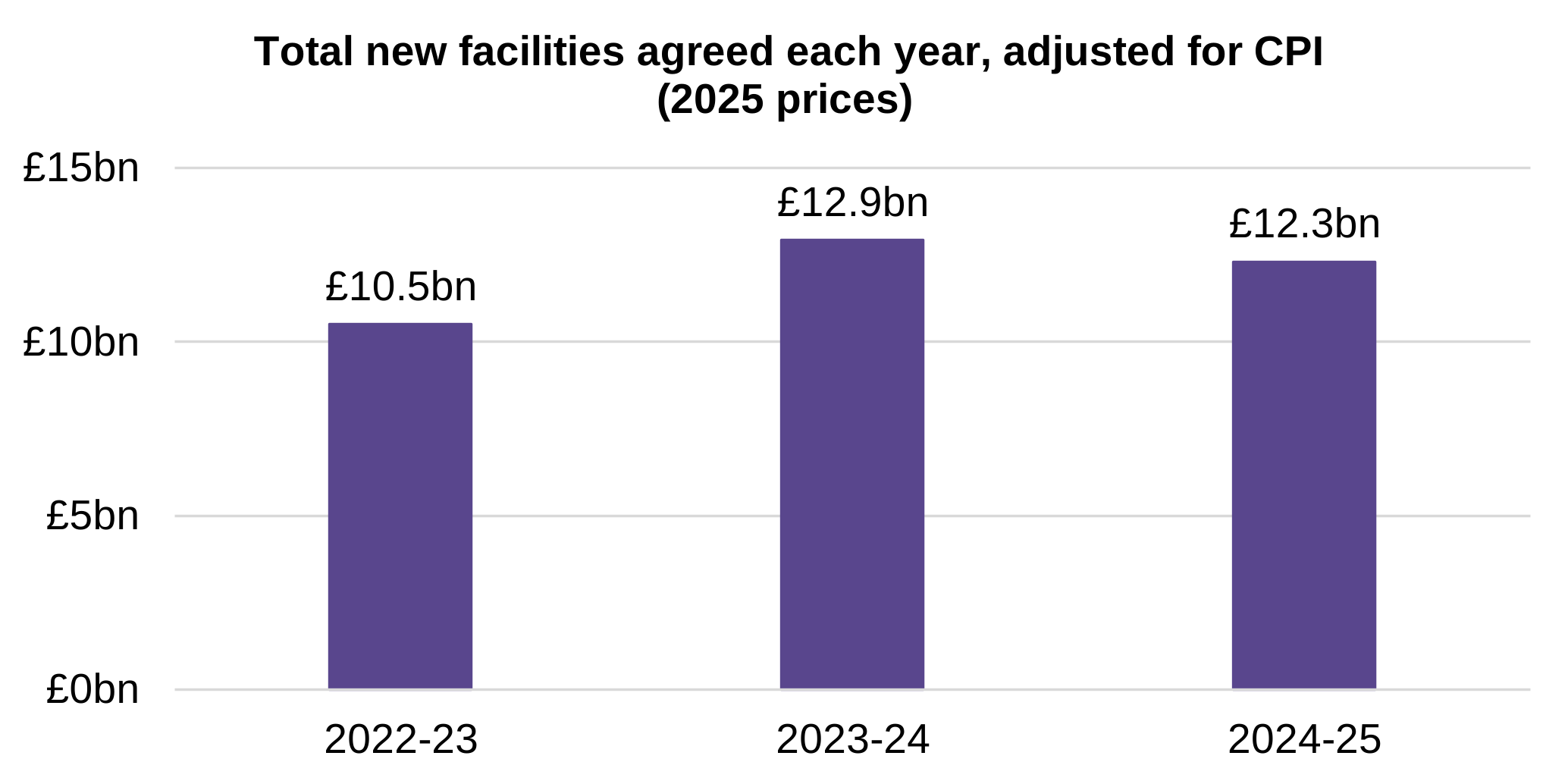
| 2022-23 | 2023-24 | 2024-25 | |
|---|---|---|---|
| Total new facilities agreed | £9.9bn | £12.5bn | £12.3bn |
| ONS CPI INDEX 00: ALL ITEMS 2015=100 | 130.5 | 133.9 | 138.4 |
| Total new facilities agreed (2025 prices) | £10.5bn | £12.9bn | £12.3bn |
CI 5: Total social housing units gains each year
We collect data from registered providers of social housing to inform our operational approach to regulating our standards. One such return for large private registered providers is the Statistical Data Return (SDR). This includes data on social housing stock movement.
This CI measures the total number of social housing units (including low-cost home ownership stock) gained each year by large private registered providers. It does not include units lost. The data is for individual private registered providers submitting the SDR, not for group structures within which they may operate.
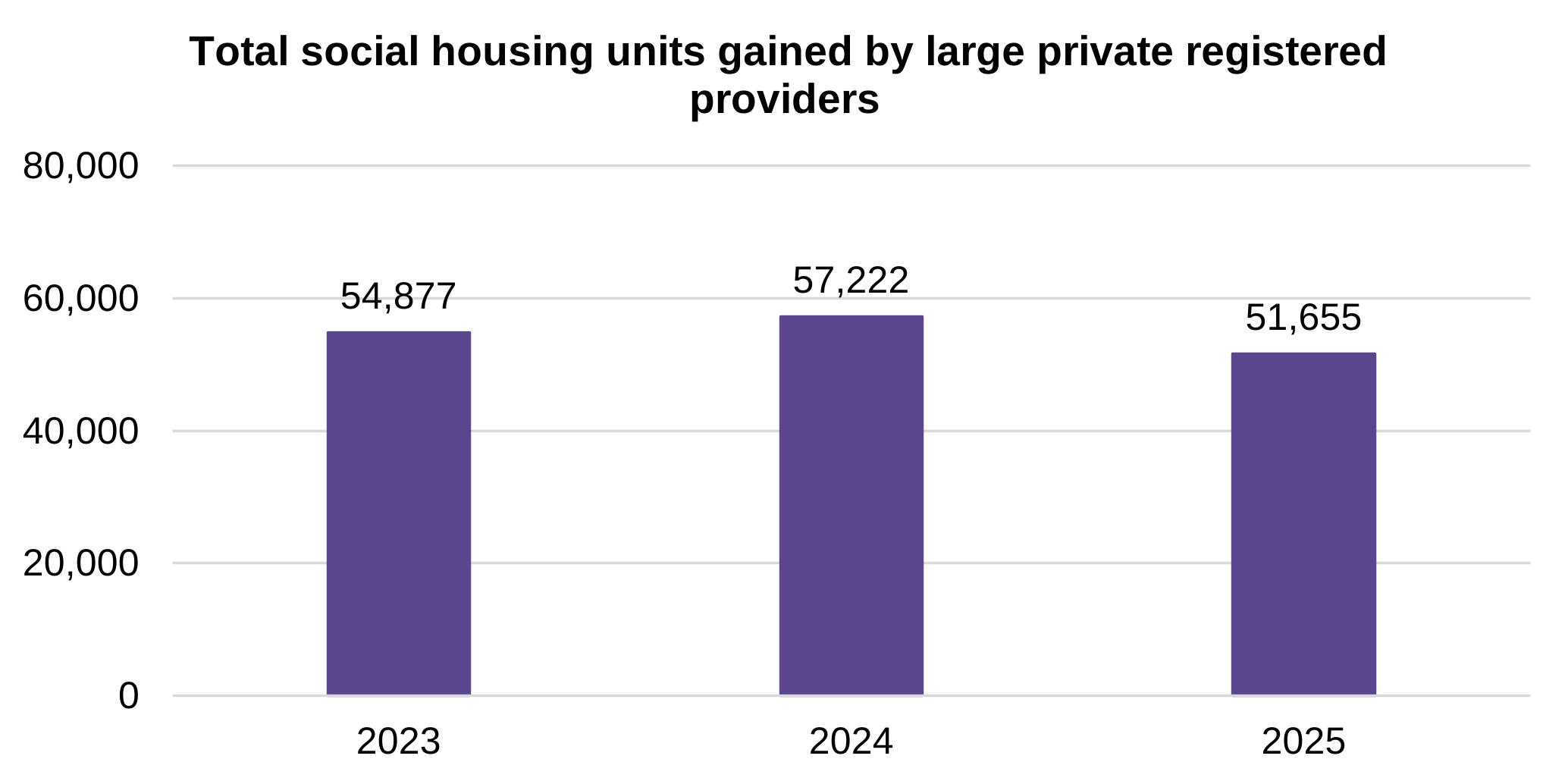
| 2023 | 2024 | 2025 | |
|---|---|---|---|
| Gross supply of social housing units for large private registered providers | 54,877 | 57,222 | 51,655 |
Strategic risks
RSH considers strategic risks to be uncertain events that, should they occur, will adversely impact on our ability to deliver the strategic objectives set out in our Corporate Plan and thereby to meet our fundamental objectives. We recognise that we have more control over some risks than others, and our controls measures are articulated accordingly. Where risks relate to factors in the external operating environment that we do not have direct control over, we work with our stakeholders to influence and shape thinking through our engagement programme, publications and analyses. Where they relate to internal capacity and capability, we have systems, processes and controls in place that help us to directly control the risks.
Strategic risks are formally reviewed quarterly by executive-level risk owners and the senior officers who are control owners. The Executive Team and the Audit and Risk Assurance Committee review the risk register quarterly and Board review it twice per annum, with a summary of the risk position provided through the quarterly performance and risk report. The strategic risks considered to be the most significant to the achievement of the RSH objectives are set out in the table below.
| Risks to the delivery of the Corporate Plan | Controls in place |
|---|---|
| Our approach is not seen to drive sector improvement | We use our publications and wider communications, together with our stakeholder engagement programme, to raise awareness of our role and remit, how the regulatory action that we take supports sector improvement, and how quickly improvement might be seen. |
| We cannot evidence our effectiveness in delivering our fundamental or strategic objectives | We are developing a robust approach to monitoring and evaluating our regulatory approach to assess whether it is having the desired impact. This is supported by the expansion of our data collection systems and working with the sector to improve data quality and triangulate multiple data sources. |
| Our regulatory approach does not align with landlords’ greatest risk exposures | Our regulatory approach is informed by horizon scanning, with processes and outputs that enable delivery of our fundamental objectives. We have set up two projects that will test whether our regulatory principles and approach and understanding of the sector environment continues to be robust and to make any changes to address areas where we can improve our operations. |
| We cannot manage conflicting stakeholder expectations or demands | We carry out stakeholder mapping and analysis of stakeholder groups to understand expectations and maintain close working relationships with key stakeholders in the housing and financial sectors as well as government to seek to manage their expectations. We use our publications and wider communications, together with our stakeholder engagement programme, to put out consistent messaging about our role, remit and approach. |
| We do not maintain an appropriate level and mix of capacity and/ or capability | We have an adequately resourced structure which is aligned to our corporate objectives, HR policies and processes in place, and an appropriate budget for recruitment and retention. Our People Strategy and underpinning People Plan are designed to build on these foundations and implement and embed additional tools to support our capacity and capability. |