Re-use of Public Sector Information Regulations 2015 and Crown copyright in Knowledge Asset Commercialisation
Published 29 October 2025

© Crown copyright 2025
This publication is licensed under the terms of the Open Government Licence v3.0 except where otherwise stated. To view this licence, visit nationalarchives.gov.uk/doc/open-government-licence/version/3 or write to the Information Policy Team, The National Archives, Kew, London TW9 4DU, or email: psi@nationalarchives.gov.uk.
Where we have identified any third party copyright information you will need to obtain permission from the copyright holders concerned.
This publication is available at https://www.gov.uk/government/publications/re-use-of-public-sector-information-regulations-2015-and-crown-copyright-in-knowledge-asset-commercialisation/re-use-of-public-sector-information-regulations-2015-and-crown-copyright-in-knowledge-asset-commercialisation
1. Introduction
This guide has been produced by the Government Office for Technology Transfer (GOTT) to support public sector bodies (PSBs) that want to commercialise their Knowledge Assets (KAs) outside of the public sector, where the Re-use of Public Sector Information Regulations 2015 (‘the Regulations’) and/or Crown copyright may apply.
This has been developed in collaboration with The National Archives (TNA).
The guide summarises the following as they relate to KA commercialisation:
- compliance with the Regulations
- Crown copyright and its licensing requirements
- different KA types and key considerations for determining the best route for commercialisation
- potential routes for commercialisation
It also includes tools to guide your decision making (visit section 4 and section 5).
This guide supplements GOTT’s Knowledge Asset Commercialisation Guide, which describes how public sector bodies can commercialise their KAs.
KAs are intangible assets including software, know-how, data, and intellectual property (IP) such as patents, trade marks and copyright. KAs can have considerable social, economic and financial value, and impact beyond their original purpose, and PSBs are encouraged to exploit them. Exploitation can take the form of PSBs sharing their KAs for external re-use, which can include licensing on commercial terms or non-commercial terms, and assignment (though this is not typical in the public sector).
This guidance only applies to the copyright and database right materials of PSBs and does not apply to other intellectual property rights and methods of protection such as patents and trade marks.
Non-Crown PSBs can focus primarily on the sections that cover the Regulations, except for where they hold some Crown copyright or Crown database right material. [footnote 1]
The Regulations enable the re-use of public sector information. Crown copyright and Crown database rights apply to public sector information produced by officers or servants of the Crown. They impact the ways and extent to which public sector KAs can be commercialised. The Regulations, Crown copyright and the Open Government Licence (OGL) perform distinct functions but also overlap:
- the Regulations govern the re-use of public sector information
- Crown copyright applies to works created by the Crown
- the OGL enables re-use of most Crown copyright information but can be adopted by non-Crown PSBs
This guidance covers the Regulations and Crown copyright only in the context of KA commercialisation. Please visit the Regulations, and the TNA website for more general information on Crown copyright. You can email TNA at psi@nationalarchives.gov.uk for any specific enquiries. The Information Commissioner’s Office (ICO) oversees and enforces compliance with the Regulations. Visit the ICO’s website for more on compliance. For more information about the Regulations and Crown copyright in the context of commercialising KAs, please contact GOTT at GOTT@dsit.gov.uk.
Context
This guidance covers three areas of government policy. PSBs are required to balance the requirements of these areas, and their application will vary according to each PSB’s own situation.
1. Knowledge Asset Management
HM Treasury’s Managing Public Money 2023 sets out the requirement for PSBs to effectively manage their KAs, which may include commercialisation (visit the Rose Book and Commercialisation Guide).
Managing Public Money recommends PSBs develop a KA Management Strategy as part of their wider asset management strategy, and appoint a Senior Responsible Owner for KAs who has clear responsibility for the PSB’s KA management strategy.
The Rose Book builds on Managing Public Money, offering detailed guidance on managing KAs, setting out the various routes for identifying, protecting and exploiting KAs.
This guide helps PSBs that want to commercialise their KAs consider the Regulations and Crown copyright, where applicable.
2. Re-use
The use and re-use of public sector information held by PSBs is governed by, among other things, the Regulations, which aim to encourage the re-use of public sector information by removing obstacles that stand in the way of re-use. [footnote 2]
Information, documents, and KAs
‘Public sector information’ is any content produced, held or disseminated by a PSB, including central and local government, in whatever form, including print, digital or electronic, and sound recordings.
The Regulations refer to this information as ‘documents’.
KAs can consist of one or multiple sets of information or documents.
3. Crown copyright
Many PSBs are Crown bodies and the information they create is Crown copyright or Crown database right. The Keeper of Public Records has been appointed by His Majesty by Letters Patent to hold and administer copyrights and database rights belonging to the Crown on His behalf. The Keeper manages Crown copyright and Crown database rights and ultimately decides whether Crown copyright and Crown database right material can be made available on terms other than the OGL, which is the default position.
Non-Crown PSBs will usually own the copyright or database right in any material that they create. Government policy is to encourage the use of the OGL by these PSBs. This is underpinned by the Regulations.
GOTT works continuously to improve the support it offers to clients and welcomes feedback from PSBs. Please let us know about your experience of commercialising information KAs, and utilising this guide, by emailing GOTT at GOTT@dsit.gov.uk.
2. The Regulations, Crown copyright and the Open Government Licence
This section introduces the Regulations, Crown copyright and the Open Government Licence, and what they mean together for PSBs that want to commercialise their KAs.
Key takeaways
-
The Regulations are applicable to most KAs produced, held and/or disseminated within scope of a PSB’s current public task, regardless of whether they are Crown copyright or otherwise
-
The Regulations do not apply to computer programs and any associated source code material within
-
PSBs are required to comply with all the Regulations:
- competition
- cost-recovery limits
- fairness and non-discrimination
- transparency
-
Prospective re-users may make a complaint to the Information Commissioner if a PSB’s response to a re-use request is not, in their view, in line with the Regulations
-
The following are exceptions where a PSB may charge more than marginal cost recovery:
- if it is a library, museum, or archive
- when revenue generation is required to recover a substantial part of the costs of the PSB’s public task
- where there is a requirement to cover the costs of supply of a KA (for example, through legislation or a fees regulation)
-
The following are exceptions where a PSB may discriminate when licensing:
- entering an exclusive licensing arrangement when necessary for the provision of a service in the public interest (that is, where the market requires exclusivity to provide a service)
- for the digitisation of cultural resources
2.1 Re-use of Public Sector Information Regulations 2015
The Regulations are legislation that apply to the re-use of public sector information, requiring PSBs to make the information that they produce, hold or disseminate accessible for wider re-use, unless the information is otherwise restricted or excluded. The rationale for this is, by making the information available with minimal restrictions, the value of information can be maximised through economic and other beneficial activity. Visit the legislation online for more information.
For KA commercialisation, where there is no exception and the Regulations apply in full to accessible public task information, their main effect is to give a PSB and external actors equal commercial opportunity to re-use the information.
The Regulations include the concept of the ‘public task’, and they encourage PSBs to publish a statement setting out their role and functions as defined in legislation and/or established through custom and practice. The Regulations only apply to KAs that are produced, held and/or disseminated within the scope of the PSB’s public task (that is, KAs that play a part in fulfilling the PSB’s current public task). This is irrespective of whether the KAs contain Crown copyright material or otherwise (visit section 2.2 for more on Crown copyright).
Therefore, if a KA is produced, held and/or disseminated outside of the scope of the PSB’s current public task, it is excluded from the Regulations. This could apply if the PSB:
- produces a KA for a wider issue that is not directly related to its current public task, for example, producing a report to raise awareness on a broader issue
- engages in research as one of its functions and undertakes paid work for a commercial client, which is not within its public task
- is testing technology or a process that has not yet been integrated as part of its current public task
- collaborates with another PSB in a research project or pilot initiative to produce a KA, which is not directly related to its current public task
In such cases, the KA could be licensed under commercial terms. If a PSB does not have a published public task that is open to challenge by a re-user or a potential re-user, the Regulations treat all information held by the PSB as being held within the scope of its current public task, so the Regulations will apply to that information regardless of it not being held within the scope of the PSB’s current public task (visit section 3.2 for more on the public task statement).
Public task statement
This is a statement published by PSBs capturing their core role and functions, as defined in legislation and/or established through custom and practice. The statement is typically signed off either by the responsible Accounting Officer or the minister before it is published.
PSBs need to be aware of the following regarding their public task statements:
- PSBs should review their public task statement to determine whether the Regulations apply to the KA(s) being considered
- If a public task statement for the PSB does not exist, the PSB should raise this with their body’s corporate governance team and outline that one should be developed. If the PSB does not have a published public task statement that is open to challenge, the Regulations will apply to all information regardless of it not being held within the scope of the PSB’s public task
- If the PSB’s existing public task statement does not reflect its current public task, it should be updated
Visit section 3.2 for more on public task statements.
2.1.1 Scope
For the purposes of the Regulations, PSBs in scope include:
- government departments
- the Corporate Officer of the House of Commons
- the Corporate Officer of the House of Lords
- the Northern Ireland Assembly Commission
- Scottish Ministers
- the Scottish Parliament
- the Scottish Parliamentary Corporate Body
- the National Assembly for Wales Commission
- Welsh Ministers
- local authorities
Visit Regulation 3 online for a complete list. Please email TNA at psi@nationalarchives.gov.uk for any specific enquiries regarding the Regulations.
Under Regulation 2 (Interpretation), KAs subject to the Regulations include “information recorded in any form, including any part of such information, whether in writing or stored in electronic form, or as a sound, visual or audio-visual recording”. Computer programs are excluded.[footnote 3]
Re-use refers to the use of a PSB’s KAs (that are produced, held and/or disseminated within the scope of the PSB’s current public task) for a purpose that does not fall within the PSB’s current public task. This can include re-use by the PSB itself or by a third-party re-user. However, the internal transfer within a PSB of KAs that were produced or held for one purpose within its public task to serve another purpose within the PSB’s public task is not a re-use, and nor is the transfer of KAs between PSBs for the purpose of either body carrying out their public task.
When a PSB creates a value-added product or service using a KA for a purpose outside of its public task, it becomes a re-user of its own KA. This means that the PSB must then apply the same licensing terms and conditions to external re-users seeking to re-use the KA for comparable purposes to the PSB, in accordance with the fairness and non-discrimination Regulation (visit section 2.1.2). PSBs should note that the underlying KAs of a value-added product or service will be subject to the Regulations rather than the product or service itself.
For example, if a PSB were creating a service for a purpose outside of its public task, and it was using data produced as part of its public task, for example, using traffic data to help truck drivers avoid delays, it should establish internally agreed terms and conditions for its re-use (visit ‘Developing a value-added product or service’ box below). If a third party asked to use the same traffic data for a comparable purpose (for example, creating a comparable service which also helped truck drivers avoid delays), they must have equivalent licensing terms and conditions as agreed internally by the PSB. However, if the third party’s re-use was not a comparable purpose (for example, helping developers understand road noise and pollution), different terms and conditions could be applied by the PSB.
Developing a value-added product or service
When a PSB re-uses its own KA (that is produced, held and/or disseminated within the scope of the PSB’s current public task) to create a value-added product or service for a purpose outside of its public task, it becomes a re-user. This means the same terms and conditions must be applied to external re-users seeking to use the KA for comparable purposes, that is, these terms and conditions become the benchmark for external re-use requests for comparable purposes.
It is recommended that PSBs consider the following:
- Charging structure – is there an established internal charging model for re-use? Visit ‘Cost-recovery limits’ in section 2.1.2
- Licensing terms – are the internal licensing terms clear, fair, and non-discriminatory? Visit ‘Fairness and non-discrimination’ in section 2.1.2. If Crown copyright material is present, the PSB should confirm the licensing arrangement for its re-use; for example, whether the material is currently being re-used by the PSB under the OGL, or there is a bespoke licensing arrangement in place under the General Delegation for non-public task Crown copyright material, or under a Delegation of Authority for Crown copyright material within scope of the PSB’s current public task. The PSB will need to provide the same licensing arrangements for a third party that is requesting re-use for comparable purposes (visit section 2.2 for more on Crown copyright)
- Defined scope of re-use – are there specified internal limitations on how the KA is re-used, such as for certain use cases (for example, function or purpose)?
- Transparency and documentation – are these internal decisions documented to support transparency and to enable the PSB to respond to external requests? Visit ‘Transparency’ in section 2.1.2
PSBs should note that the underlying KAs of a value-added product or service will be subject to the Regulations rather than the product or service itself.
2.1.2 The Regulations and exceptions
PSBs are required to ensure that the licensing of their KAs complies with the following Regulations, and to consider any associated exceptions, where applicable:
- Competition: any conditions imposed on re-use, where appropriate through a licence, must not unnecessarily restrict competition.
-
Cost-recovery limits: any charge for re-use must be limited to the marginal costs incurred to reproduce, provide and/or disseminate the information. In most cases this cost will be negligible, particularly if the PSB is publishing material online. The exclusions to this are if the PSB:
- is a library, museum, or archive
- is required (not necessarily by statute) to generate revenue to cover a substantial part of its costs relating to the performance of its public task (for example, PSBs established as trading funds, such as the UK Hydrographic Office)
- has KAs for which the PSB is required to charge in order to cover a substantial part of the costs of its collection, production, reproduction or dissemination (for example, the fees set for providing copies of entries in HM Land Registry)
-
Fairness and non-discrimination: all re‑users who make a request for re-use for comparable purposes to each other must be treated equally by applying the same terms and conditions to licences and not favouring one re-user over another without justification. The exception to this is:
- when it is necessary for the provision of a service in the public interest to enter an exclusive licensing arrangement (for example, where the market requires exclusivity to provide a service. Visit ‘Case study – entering an exclusive agreement in the public interest’ in section 2.1.3)
- for the digitisation of cultural resources[footnote 4]
- Transparency: publishing clear information about conditions for re-use, any charges and exclusive arrangements where permissible, and a complaints procedure for applicants on re-use.
Considerations for non-Crown PSBs regarding the ‘public interest’ exception and exclusive licensing
Non-Crown PSBs which determine that a given KA qualifies for a ‘public interest’ exception (Regulation 14) in relation to the fairness and non-discrimination Regulation should keep an audit trail of their decision making, and a rationale outlining why entering an exclusive licensing arrangement is necessary for the provision of a product or service in the public interest. Complaints, though rare, can be made to the ICO about compliance with the Regulations. Visit ICO’s website for more information about complaints.
Crown PSBs and the ‘public interest’ exception for exclusive licensing
A PSB may determine that a given KA qualifies for an exception (Regulation 14) in relation to the fairness and non-discrimination Regulation: either that it is necessary for the provision of a service in the public interest (that is, where the market requires exclusivity to provide a service. Visit ‘Case study – entering an exclusive agreement in the public interest’ in section 2.1.3), or for the digitisation of cultural resources.
If the given KA contains Crown copyright material, the PSB would need to discuss their proposal to license this material outside of the OGL with TNA and to obtain a Delegation of Authority (visit section 2.3 for more on the OGL).
2.1.3 Exclusions from the Regulations
Restrictions under the Regulations on charging for information and entering an exclusive licensing arrangement are not applicable in the following circumstances:
- if the KA being shared for re-use was produced, held and/or disseminated outside of the scope of the PSB’s current public task
- if the KA is a logo, crest, or insignia
- if the KA is a computer program
- for certain types of PSBs such as public sector broadcasters, educational and research establishments (other than university libraries) and cultural establishments (other than libraries, museums, and archives)
- if a third party owns relevant intellectual property rights in the KA[footnote 5]
- for information that would be excluded from disclosure under information access legislation (for example, Data Protection Act, Freedom of Information Act, Environmental Information Regulations), including on the grounds of protection of national security, defence or public security, statistical confidentiality or commercial confidentiality
Visit the ICO’s website for more about exclusions. Visit Regulation 5 for full detail of exclusions.
Computer programs, software, and source code
Software KAs are compound KAs, that is, formed of a collection of KAs (visit section 3.3 for more information). A software KA generally comprises computer programs. A computer program comprises multiple libraries of source code that form the basis of computer programs. If a given software KA only comprises computer programs, it and any associated source code material can be excluded from the Regulations under the computer program exclusion.
However, if a software KA comprises a collection of KAs along with computer programs (such as data), some of its constitutive KAs may be subject to the Regulations and Crown copyright. The PSB must ensure that they have the freedom to operate Visit section 6.1 of the Commercialisation Guide.
Computer programs are not defined in the Regulations. It is recommended that PSBs seek legal advice if they are unsure about this.
Case study – entering an exclusive agreement in the public interest
A Crown PSB develops a potentially life-saving product that a reputable pharmaceutical company wants to take to market. The pharmaceutical product itself is protected by a patent, which falls outside of the Regulations and Crown copyright.
The pharmaceutical company wants to enter an exclusive licensing arrangement with the PSB to access certain Crown copyright data subcomponents that they require to take this product to market. An exclusive licensing arrangement is the industry norm, as substantial investment is required to develop a pharmaceutical product and take it through clinical trials.
The Crown PSB considers their request, concludes that the eventual product would be in the public interest, and so approaches TNA with their rationale to license the Crown copyright data component outside of OGL terms.
2.2 Crown copyright and database rights
Key takeaways
- Crown copyright applies to works created by officers or servants of the Crown in the course of their duties, which typically applies to the works of Crown PSBs, but can also apply to some works of non-Crown PSBs
- Most Crown copyright materials are licensed under the OGL by default, which promotes their open and free re-use
- PSBs cannot charge others for the re-use of any information licensed under the OGL, that is, it is non-exclusive, perpetual and royalty-free
- Non-Crown PSBs are encouraged to license KAs containing their own copyright under the OGL, but they are not obliged to and can consider alternative means
Copyright is an automatic right which provides protection against the copying of original creative works such as books and papers, music, photographs, film and animation, art and design. It also protects software code, but only the written coding that is used, not what the coding does. Read more about copyright in the Guide to Managing Intellectual Property and Confidentiality.
Crown copyright applies to all such works created by officers or servants of the Crown and ministers in the course of their duties. This includes any material such as software, training materials, data, social media content, government reports, academic articles and many public records. Much of the KAs made by government departments and agencies that have Crown status (‘Crown PSBs’)[footnote 6] will contain Crown copyright material, depending on whether the material has been produced by officers or servants of the Crown. PSBs are required to license Crown copyright material under the OGL as the default for Crown copyright material (visit section 2.3 for more on the OGL).
TNA has a list of Crown and non-Crown PSBs that is no longer updated, but it is available to see archived online.
Crown database right is a distinct intellectual property right for databases created by the Crown, which protects, in some circumstances, the investment, the arrangement and the structuring of a given database, rather than the content within. PSBs are required to license Crown database rights under the OGL as default, as with Crown copyright material. Visit the Copyright and Rights in Databases Regulations 1997 online for more information.
Delegation of Authority
PSBs may be able to license their Crown copyright material outside of OGL terms (that is, to grant exclusive licences, impose geographic limitations on usage or charge fees for KAs containing Crown copyright material) by obtaining a Delegation of Authority from TNA (visit section 3.5 for more on conditions).
The works of non-Crown PSBs do not typically contain Crown copyright or Crown database right material because they retain their own copyright and database right, and so they are not required to license them under the OGL. There are cases where non-Crown PSBs can come to hold Crown copyright material and would need to follow Crown PSBs in licensing it under the OGL. This can include:
- KAs produced in collaboration with a Crown PSB, and where that copyright is assigned or transferred to the Crown
- KAs that a Crown PSB commissions a non-Crown PSB to produce, and where that copyright is assigned or transferred to the Crown[footnote 7]
- non-Crown PSBs that Crown servants work for, such as police authorities – any works produced by police officers will be Crown copyright
- museums and other institutions that hold Crown copyright information as part of their collections
- organisations that were previously PSBs that have been privatised or floated off and retain Crown copyright information from their prior Crown status
Crown copyright does not automatically apply to any works that Crown PSBs commission non-Crown PSBs or other third parties to produce. Other copyrights and database rights may sometimes come into Crown ownership through assignment. Unless specific provision is made in the commissioning contract for the copyright in commissioned works to be assigned to the Crown, the copyright will continue to rest with the creator and not be transferred to Crown ownership. Read more about this on the TNA’s website.
2.3 The Open Government Licence
The OGL is the default licence for Crown copyright and Crown database rights material, facilitating their external re-use free of charge. The OGL satisfies requirements under the Regulations for PSBs to make any accessible information available for wider re-use with minimal conditions.
If seeking to license the re-use of Crown copyright material under an alternative licence visit section 3.4.
The OGL has the following licensing terms:
- Worldwide: Allowing the information to be used by anyone, anywhere.
- Royalty-free: No charge for the data or information.
- Perpetual: Not subject to an expiration date, which means it does not have a termination date, and its application to a re-use will continue indefinitely.
- Non-exclusive: Licensable to many different people at once on the same terms, with no exclusivity conferred on any of them.
The OGL enables others to:
- copy, publish, distribute and transmit the information
- adapt the information
- exploit the information commercially and non-commercially, for example by combining it with other material, or by including it in their own product or application
If a PSB is licensing under the OGL, it is required to abide by all of the licensing terms. In practice, this means that a PSB licensing under the OGL generally cannot:
- enter other licensing arrangements, including granting exclusive licences
- impose geographic limitations on usage
- charge fees for KAs licensed under the OGL
PSBs that license their information under OGL terms do so on a royalty-free basis. However, in the rare event that a re-use request requires a marginal cost charge (for example, for the reproduction, provision or dissemination of the KA), the PSB can do so without conflicting with the OGL terms, as this is considered a charge for the service of providing the material, rather than for the licence to re-use. For the most part, the licensing of Crown copyright material under the OGL will be free.
Non-Crown PSBs seeking to license their copyright material may use the OGL, which is recommended by TNA, but they are not required to and may use alternative licences which comply with the Regulations. Some may choose the OGL, for example, to promote interoperability with Crown-licensed work. Others may choose alternative licences, such as a Non-Commercial Government Licence, other open licences such as a Creative Commons licence, or a bespoke licence which sets out tailored terms for re-use, subject to the Regulations. Version 3 is the latest version of the OGL.
The OGL is the default licence for Crown copyright software, but developers may choose a different open source licence if there are technical or cost benefits, or to reflect the Government Design Principles without needing to obtain a Delegation from TNA. Visit TNA’s guidance on open software licences.
Factors to consider when deciding what information should be made re-usable under the OGL
- Is the material subject to the Regulations, for example, was it created within the scope of the PSB’s public task?
- Is the information exempt from being released, for example, for national security, personal data protection, third-party rights or commercial sensitivity?
- Is there a strong commercial case to share the material for re-use through non-OGL routes?
- Does the PSB wish to maintain the freedom to use this KA outside of OGL terms should a use-case be identified later?
- Does the PSB wish to recover the cost of maintaining / developing this KA?
Databases, database right, and Crown database right
For databases, database right and/or Crown database right could apply. Databases have separate protection under the Copyright and Rights in Databases Regulations 1997, and the database right is held by the PSB that made the arrangements for the database to be created. Database right would apply to a selection or arrangement of the contents of the database, whereas Crown copyright could apply to any materials arranged in or accessed via a database belonging to the Crown. For example, for a database created by a Crown PSB, Crown copyright and database right could both apply.
Case study – third-party rights and limitations for licensing
A Crown PSB commissions a third party (not in the public sector) to produce a dataset. Under the terms of the procurement contract, the third party retains ownership of the dataset, but it awards the Crown PSB a perpetual, non-exclusive, royalty-free licence to use the dataset.
The Crown PSB can use this dataset as part of its public task, but it is not able to publish this dataset under the OGL as it doesn’t have ownership of the dataset.
Case study – deciding whether open sourcing is the best route for commercialisation
A Crown PSB releases on GitHub, under the OGL, the source code for a software tool it develops. A non-public sector developer identifies a potential market for this source code. Under the OGL, the developer develops a commercial product based on the source code, and it is able to provide value-added services to both private and public sector users, including the Crown PSB, supporting service delivery and helping to grow the economy.
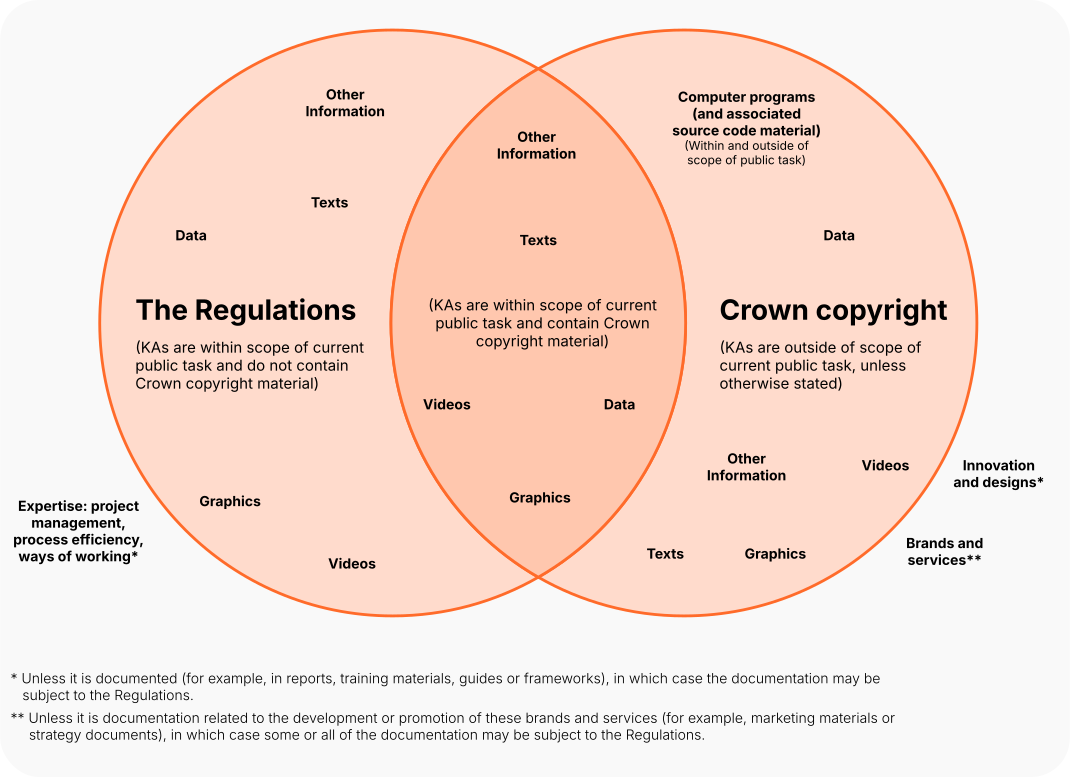
2.4 Visualising the Regulations and Crown copyright across Knowledge Asset type
The Regulations, Crown copyright, and the OGL perform distinct functions but also overlap:
- the Regulations govern the re-use of public sector information
- Crown copyright applies to works created by the Crown
- the OGL enables re-use of most Crown copyright information but can be adopted by non-Crown PSBs
The following diagram illustrates which KA types are typically subject to either the Regulations, Crown copyright, both or none. Expertise, innovation and designs, and brands and services are not covered by either the Regulations or Crown copyright.
Software
A software KA type is generally a compound KA, that is, formed of a collection of KAs (visit section 3.3). Software KAs typically comprise computer programs (for which source code forms the basis).
Computer programs and any associated source code material are exempt from the Regulations. Some software KAs only comprise computer programs: these KAs would be exempt from the Regulations, but Crown copyright may apply.
However, if a software KA comprises a collection of KAs along with computer programs (such as data), some of its constitutive KAs may be subject to the Regulations and Crown copyright. The PSB must ensure that they have the freedom to operate (visit section 6.1 of the Commercialisation Guide).
It is recommended that PSBs follow the process outlined in section 3.3 for their compound KAs to understand what obligations apply under the Regulations and Crown copyright.
Source code and computer programs
Source code forms the basis of computer programs. While exempt from the Regulations, computer programs and any associated source code may be subject to Crown copyright and can be licensed in line with other materials that are subject to the Regulations.
Non-Crown PSBs
The KAs of Crown PSBs typically contain Crown copyright material. The KAs of non-Crown PSBs generally do not contain Crown copyright material as non-Crown PSBs usually own the copyright or database right in any material they create. However, there are cases where non-Crown PSBs can come to hold Crown copyright material. It is recommended that PSBs consider their KAs against this Venn diagram on a case-by-case basis.
Visit the tables in section 5 for how obligations for the Regulations, Crown copyright and the OGL differ for Crown copyright and non-Crown copyright material.
3. Commercialising your Knowledge Asset
Key takeaways
-
The ‘public task’ is a statement published by a PSB that captures its core role and functions as defined in legislation and/or established through custom and practice
-
A PSB should review its public task statement or develop one if it hasn’t yet done so and then consider the implications of the Regulations on their KAs
-
It is the PSB’s responsibility to define the scope of its public task
-
For any compound KAs that are formed of a collection of KAs (for example, a software package containing data, computer programs and a user manual), the PSB would need to consider whether the Regulations and Crown copyright (where relevant) apply to each constitutive KA and work within any applicable restrictions
The Rose Book outlines the iterative nature of the process to manage KAs effectively. The first stage consists of the PSB undertaking a high-level assessment of the potential social, economic and financial value of their identified KAs. Visit the KA evaluation tool in Annex B of the Rose Book.
As part of this assessment, PSBs should determine whether restrictions from the Regulations and Crown copyright may apply.
The following section outlines key steps for PSBs to take when considering how the Regulations and Crown copyright may apply to their KAs and the possible commercialisation routes:
- define the objectives and desired outcomes for commercialisation
- review the public task statement
- understand the KA composition to determine the extent to which the Regulations and Crown copyright apply, including:
a. whether the KA is singular or compound (formed of a collection of KAs)
b. whether the KA was produced, held and/or disseminated within the scope of the PSB’s current public task
- assess the potential routes to commercialise the KA and how well they meet the exploitation objectives and desired outcomes
3.1 Defining the objectives and outcomes for commercialisation
As part of developing a Knowledge Asset Management Strategy, PSBs should consider how KA commercialisation can help deliver their organisation’s strategic objectives.
When assessing an individual KA for commercialisation, PSBs should also identify how this aligns with the PSB’s objectives and strategy.
3.2 Reviewing the public task statement
The ‘public task’ is a concept introduced in the Regulations. The Regulations only apply to KAs that are produced, held and/or disseminated within the scope of the PSB’s current public task.
The public task is a statement published by a PSB capturing its core role and functions as defined in legislation and/or established through custom and practice. The statement is typically signed off by either the responsible Accounting Officer or the minister before it is published.
PSBs need to be aware of the following regarding their public task statements:
- PSBs should review their public task statement to determine whether the Regulations apply to the KA(s) being considered
- If a public task statement for the PSB does not exist, the PSB should raise this with their body’s corporate governance team and tell it that one should be developed. If the PSB does not have a published public task statement that is open to challenge, the Regulations will apply to all information regardless of it not being held within the scope of the PSB’s public task
- If the PSB’s existing public task statement does not reflect its current public task, it should be updated
Reviewing, or developing the public task statement is important because it helps to ensure compliance and clarifies the areas that a PSB must take into account when considering commercialising its KAs.
Visit TNA’s Guidance on public task statements for detailed guidance and examples of public task statements.
Case study – Reviewing the public task statement
Officials of a non-Crown PSB are interested in commercialising their KAs following a change of strategic direction. To date, the non-Crown PSB has only licensed its KAs under the OGL, and there is uncertainty around whether their public task statement provides the necessary clarity as to which KAs would be subject to the Regulations.
The officials run an exercise across the body to seek views regarding the accuracy of their current public task. Having refined their public task statement, officials are then able to map which KAs are not subject to the Regulations and easy to commercialise, and the extent to which those that are subject to the Regulations could be commercialised.
The ICO oversees and enforces compliance with the Regulations. Any complaints made by re-users about any aspect of how the PSB handled a re-use request (for example, regarding failure to respond to their request, refusing to allow re-use, placing unnecessary restrictions on re-use, or incorrectly charging a fee above marginal cost) are investigated and resolved by the ICO. Such complaints may include consideration of the public task and a challenge of the public task statement. Visit the ICO’s website for more on compliance.
If the KA is produced, held and/or disseminated outside of the scope of the PSB’s current public task, then, for the purposes of this guidance, PSBs only need to consider whether Crown copyright applies to the KA in question. Therefore, subject to Crown copyright policy and Managing Public Money annex 6.2, a PSB could license a KA free of any restrictions from the Regulations (for example, on fully commercial terms).
The KA Senior Responsible Owner (SRO)
PSBs should work with their KA SRO to build consensus across the PSB to prioritise and review or draft the public task statement.
GOTT’s Rose Book recommends that PSBs appoint a KA SRO to act as a senior sponsor for KA management in the PSB, and help realise the benefits of this.
As part of this, the SRO checklist outlines a KA SRO’s core responsibilities. These include:
- acting as a visible leader for KA management within the PSB
- providing and ensuring PSB-wide oversight and coordination of KA management
The Knowledge Asset Management strategy
GOTT’s Rose Book recommends that PSBs draft a Knowledge Asset Management Strategy (KAMS) to embed effective KA management within an organisation. As part of this, the KAMS checklist highlights the value of PSBs identifying the most important types of KAs that they hold.
Here, PSBs may also find it useful to review their public task statement (or draft a statement if one does not exist) and consider whether:
- it accurately reflects the PSB’s current strategic focus, core role and functions
- the KAs being identified fall within scope of the current public task
These factors will impact the following:
- the PSB’s process for identifying and recording their KAs
- the feasibility of the PSB’s preferred route(s) for commercialisation, or the next steps required to realise the chosen route(s) for commercialisation
3.3 Understanding your Knowledge Asset composition
Understanding the composition of a KA is key to determining whether the Regulations and Crown copyright apply and therefore the possible routes for commercialisation.
KAs can be singular (composed of a single element such as data) or can be compound (formed of a collection of KAs).
When considering whether the Regulations apply, PSBs with a singular KA can apply the guidance in section 2.1. For compound KAs which are composed of a collection of KAs (for example, a software package could consist of data, computer programs, libraries and a user manual), the PSB would need to consider whether the Regulations apply to each constitutive KA and work within any applicable restrictions. The PSB might still be able to commercialise the compound KA if the constitutive KA, which is deemed as key to the compound KA, can be sufficiently protected, for example, via a licence or a patent. Visit Table 1C in Annex A of the Rose Book for more on protecting KAs.
When considering whether Crown copyright applies, PSBs with a singular KA can apply the guidance in section 2.2. For compound KAs, the PSB would also need to consider whether Crown copyright applies to each constitutive KA, which will all be subject to forms of copyright, and work within the restrictions of the OGL as default for Crown copyright material. The PSB could still commercialise the compound KA if their Crown copyright material qualifies for an exception under the Regulations, or if TNA grants a Delegation of Authority. For commercialisation, the PSB would ultimately require a Delegation of Authority (visit section 3.5 for more information).
Example of a compound KA
The table below outlines the type of KAs that could be found in a software tool (a common form of compound KA), and the possible obligations under the Regulations and Crown copyright. The table describes fictional software developed by a Crown PSB, where the data could be drawn from different sources, and both Crown copyright and the Regulations would apply.
Table 1 - Knowledge Asset: A software tool developed by a Crown PSB
| Component | Description | Owner | Crown copyright and the Regulations |
|---|---|---|---|
| Data | Data collected, stored and disseminated by Crown PSB | Crown PSB | Crown copyright and the Regulations Database rights may apply |
| Data | Data collected, stored and disseminated by a non-Crown PSB | Non-Crown PSB | The Regulations Database rights may apply |
| Data | Third-party data | External | Check licensing terms for right to use |
| Algorithm | Novel algorithm with an inventive step developed to provide a technical solution | Crown PSB | Crown copyright May be eligible for patent protection |
| Code | User Interface | Crown PSB | Crown copyright |
| User manual | Paper/electronic user manual and training materials | Crown PSB | Crown copyright and the Regulations |
| Logo | Trademarked logo | Crown PSB | None[footnote 8] Logos containing Royal Arms may require approval from Cabinet Office (visit TNA’s website) |
| Know-how | Subject expert knowledge | Crown PSB | Crown copyright, only if that knowledge has been recorded in some form. Crown copyright would apply to the way it is recorded, rather than the know-how itself. If recorded, the Regulations may apply |
A similar tool developed by a non-Crown PSB would generally only need to consider obligations under the Regulations and any rights held by a third party.[footnote 9]
Table 2 - Knowledge Asset: A software tool developed by a Non-Crown PSB containing no Crown copyright material
| Component | Description | Owner | The Regulations |
|---|---|---|---|
| Data | Data collected, stored and disseminated by a non-Crown PSB | Non-Crown PSB | The Regulations Database rights may apply |
| Data | Third-party data | External | Check licensing terms for right to use |
| Algorithm | Novel algorithm with an inventive step which provides a technical solution, developed by a non-Crown PSB | Non-Crown PSB | May be eligible for patent protection |
| Code | User Interface developed by a non-Crown PSB | Non-Crown PSB | - |
| User manual | Paper/electronic user manual and training materials developed by a non-Crown PSB | Non-Crown PSB | The Regulations |
| Logo | Trademarked logo | Non-Crown PSB | None[footnote 10] Logos containing Royal Arms may require approval from Cabinet Office (visit TNA’s website) |
| Know-how | Subject expert knowledge | Non-Crown PSB | If the know-how has been recorded in some form, the Regulations may apply |
PSBs can use this method to identify considerations regarding the Regulations and Crown copyright within a compound KA and determine its commercial potential.
If a sub-component of the compound KA is within the scope of the PSB’s public task, the licensing terms for the entire KA will be restricted by what is permitted under the Regulations. If multiple sub-components of the KA are already published under the OGL, the commercial potential of the tool may be limited as it may be possible for any re-user to replicate the tool without entering a licensing agreement.
Knowing the components within a compound KA can help PSBs to compile a list of all Crown copyright materials if they plan to obtain a Delegation (visit section 3.5). Read about the IP due diligence process in section 6.1 of the Commercialisation Guide.
Case study – understanding sub-components of a compound KA
A Crown PSB has developed a software tool, a compound KA, which attracts commercial interest from a third party. The PSB wants to grant a non-exclusive, royalty-bearing licence to the third party, for them to further develop the tool for the wider commercial market. To enter this arrangement, the PSB needs to identify all the subcomponents (other KAs) that were used to develop the tool, as well as all the other KAs that the third party will need to exploit this tool.
The PSB had used a database to train the AI model underpinning the software tool, and this database had been published by another PSB under the OGL. As such, the PSB did not require additional permission to incorporate this database within the tool, nor does it require permission to exploit it commercially because of the nature of the OGL. The PSB is aware that, because this database is publicly available under the OGL, other software developers will also have access to this and could use it to train their own AI models. This could impact on the commercial appetite for the PSB’s software tool, and their timelines for exploiting the tool.
The PSB identifies the subcomponents: the AI model, the user interface, a dataset and the user manual. All of them, except for the dataset, are Crown copyright and were produced outside of the scope of its current public task. The PSB does not require a new Delegation to license them outside of OGL terms, because of the general Delegation from TNA for KAs produced, held and/or disseminated outside of the scope of a PSB’s current public task. To see the general Delegation, visit TNA’s website.
The dataset, which was produced within the scope of its current public task, is subject to the Regulations and is Crown copyright. Although the PSB could publish the dataset under the OGL, it seeks a Delegation from TNA as it considers the protection of this database as crucial to the successful commercialisation of the overall KA. The proposal, while noting that the Crown copyright material does not qualify for an exception under the Regulations, demonstrates that it aligns with the Regulations, Managing Public Money, and that there is a clear ministerial requirement to license outside of the OGL.
3.4 Assessing potential routes for commercialisation
After having clarified the KA composition, PSBs can consider the potential routes for commercialising their asset and how they would comply with the Regulations and Crown copyright, where applicable.
The route chosen for commercialisation will depend on various factors, including PSB strategy, the KA itself and its market. Each route renders different impacts on the ability to commercialise KAs.
For more on routes to commercialisation, including direct sales (of product or service), licensing, spinouts and joint ventures, visit section 4 of the Commercialisation Guide. Re-use of the KA should be considered in all of these scenarios.
This subsection introduces the following routes for facilitating re-use:
- licensing under the OGL
- licensing outside of OGL terms, and the Delegation of Authority process
- assignment
- other licences under the UK Government Licensing Framework (UKGLF)[footnote 11]
3.4.1 Licensing under the Open Government Licence (OGL)
The OGL is the default licence for most Crown copyright information (mostly applicable to Crown PSBs) or recommended licence for non-Crown copyright material (mostly applicable to non-Crown PSBs), and it satisfies the Regulations.
Visit section 2.3 for more details on the OGL.
The OGL’s terms provide non-exclusivity and free and open re-use, which means that it is not possible to apply commercial terms to KAs published under the OGL retrospectively.
Considering any existing licensing under the OGL
Consider, for example, whether any element of the KA has already been released in the public domain under a Freedom of Information (FOI) or Environmental Information Regulations (EIR) request.
Any information released by a Crown PSB under an FOI or EIR may already be licensed under the OGL, which may limit a PSB’s ability to commercialise the information effectively once it has been released into the public domain. PSBs should liaise with their internal FOI/EIR teams, where relevant, which will inform their approach to commercialisation.
3.4.2 Licensing outside of OGL terms: Delegations of Authority
Unless an exclusion applies, if a PSB wishes to license Crown copyright material outside of OGL terms, they are required to obtain a Delegation of Authority from TNA for the information concerned.
A Delegation of Authority is an agreement between the Keeper of Public Records (based at TNA) and a PSB to enable it to license the re-use of its Crown copyright material outside of OGL terms.[footnote 12] A Delegation can enable Crown PSBs to commercialise their Crown copyright material in line with the requirements of the Regulations. Visit section 3.5 for more information about the Delegation, including the application process, and the renewal process for an existing Delegation.
3.4.3 Assignment
KAs are typically licensed, not sold or assigned. If the commercialisation fails (for example, agreed milestones are not hit or the venture fails), the KA may revert back to the PSB by means of revoking the licence, enabling the PSB to make further attempts to realise the KA’s potential.
There may be circumstances where it is determined that assignment is the most appropriate way to provide rights to the KA.
Only the Keeper of Public Records at TNA may execute an assignment of copyright ownership away from the Crown. In the exceptional cases where a PSB wants to assign Crown copyright to a new legal owner, they must seek permission from TNA. TNA’s website provides more details on assignments, including an assignment checklist. Further advice can be obtained by contacting TNA at psi@nationalarchives.gov.uk.
Case study – assignment of Crown copyright materials to a commercial venture – a project delivery framework
A PSB develops a project delivery framework, comprising several best management practice standards supporting effective programme, project and risk management, and IT service management activities.
To achieve wider adoption, the PSB initially licenses the framework for commercial use to a third party, who administers the training and certification of the framework on behalf of the PSB as it does not have the capacity to do so, while the PSB retains Crown copyright. This public-private arrangement leverages private-sector expertise in certification without relinquishing ownership.
Some years later, the PSB recognises the success of the framework and recognises how it could be better exploited commercially through dedicated investment and expertise.
As a result, a new joint venture is formed between the PSB and a third party, and much of the Crown copyright material within the framework is assigned to the joint-venture company. This enables significant private investment in updates, marketing and worldwide distribution of the framework. At the same time, the Crown retains any materials that are not deemed suitable for commercial exploitation under Crown copyright.
The copyright assignment allows the realisation of greater impact by expanding and improving the tools within the framework for broader use while also enabling commercial returns for the PSB and the third party.
3.4.4 Other licences under the UK Government Licensing Framework (UKGLF)
The UK Government Licensing Framework:
- provides a policy and legal overview of the arrangements for licensing the use and re-use of public sector information
- sets out best practice
- standardises the licensing principles for government information
- mandates the OGL as the default for Crown PSBs and the recommended licence for other PSBs
It also sets out other licences, which standardise and simplify the licensing of public sector information in situations where the OGL is not being used.
A PSB considering licensing Crown copyright information under these licences would need to first obtain a Delegation of Authority. Some of these licences include:
- Developer Licence: more restrictive than the OGL, it enables PSBs to provide structured access to sensitive or complex information, or KAs that are predominately composed of structured data to developers for experimental use or development projects. The assets are usually shared free of charge, but subject to terms, and use is typically limited to non-commercial testing.
- Non-Commercial Government Licence: this permits the use of public sector KAs, including any copyright or database-protected materials, for non-commercial purposes only.
A PSB considering licensing Crown copyright information under these licences would need to first obtain a Delegation of Authority.
Visit TNA’s website for more information about these and other licences.
3.5 Delegation of Authority for licensing Crown copyright
Key takeaways
-
PSBs can license their Crown copyright material outside of OGL terms by obtaining a Delegation of Authority from TNA if the proposal qualifies for a relevant exception under the Regulations and in the Keeper’s judgement justifies deviation from Crown copyright policy
-
If the Crown copyright material does not qualify for a relevant exception under the Regulations, the PSB may still be able to obtain a Delegation if they can demonstrate to TNA that their proposal to do so is aligned with the Regulations, Managing Public Money and wider government policy (that is, where there is a clear ministerial requirement)
-
Formal Delegation documentation must be co-signed by the Keeper of Public Records and the Accounting Officer of the PSB applying for a Delegation
A Delegation of Authority is an agreement between the Keeper of Public Records and a PSB to enable it to license the re-use of Crown copyright material outside of OGL terms.
If seeking to license Crown copyright material (and Crown database right material) outside of OGL terms, the PSB needs to discuss its proposal with TNA to gauge the possibility of obtaining a Delegation. PSBs can obtain a Delegation of Authority if the proposal qualifies for a relevant exception under the Regulations (visit section 2.1).
TNA’s role is to consider the PSB’s proposal to license their Crown copyright material outside of the OGL.
The following represent the possible scenarios in which a PSB could be granted a Delegation of Authority:
- Crown PSBs with Trading Fund status or which have similar models that qualify for an exception to charge above marginal cost recovery because they are required to generate revenue to cover a substantial part of their costs relating to the performance of their public task
- Crown PSBs that need to protect sensitivities within the information they share with partners, which requires entering an exclusive licensing arrangement
- Crown PSBs that wish to use the Non-Commercial Government Licence (visit section 3.4.4) to ensure that the market is not able to exploit, amend or misrepresent the information being shared for re-use
- A laboratory owned by the Crown that is enabling re-use of Crown copyright for commercial work with an external contractor to make a bespoke research output as part of wider government policy
- A PSB that holds Crown copyright information that does not qualify for an exception, but where there is a clear ministerial requirement where it is necessary for charges above marginal costs or other restrictions to be made for the licensing of the information in question, which means it is not possible to use the OGL
- Non-Crown public sector cultural institutions that hold Crown copyright information in their collections and qualify for an exception to charge above marginal cost recovery because they are a library, museum or archive
If the Crown copyright material does not qualify for a relevant exception under the Regulations, the PSB may still be able to obtain a Delegation if they can demonstrate to TNA that their proposal to do so is aligned with the Regulations, Managing Public Money, and wider government policy (that is, where there is a clear ministerial requirement).
Considering how many KAs your team or the wider PSB hold, for example, one asset, or a pipeline of assets
PSBs can apply for a Delegation for a single KA, or a grouping of KAs, which can include KAs that have not been produced yet. The latter approach means that PSBs avoid multiple sign-offs, saving time and effort. Visit TNA’s website for examples of existing Delegations.
The process for obtaining a Delegation and any subsequent modifications, where permissible, requires sign-off by the most senior member of a PSB, usually the Permanent Secretary or equivalent, or a nominated representative. TNA will decide whether extra items can be added to an existing Delegation, or if it is necessary for the PSB to make a new application for a separate Delegation.
3.5.1 Scope of a Delegation
A Delegation can apply to a single KA, several KA types or a particular team or policy area. PSBs work with TNA to establish which Crown copyright materials can be licensed outside OGL terms.
TNA publishes a list of material licensed under a Delegation of Authority for PSBs that have successfully obtained a Delegation. The examples below illustrate the diversity of Delegations:
- Example 1: A specific compound KA such as a tool containing Crown copyright material.
- Example 2: Certain types of data, databases and software that fall within a specified thematic domain of the Crown PSB’s operations.
- Example 3: All Crown copyright KAs held by a PSB. (This is usually applicable to Crown PSBs with a Trading Fund status that allows them by default to generate income from the supply of goods and services).
- Example 4: All KAs containing Crown copyright material within certain sub‑bodies/departments of a PSB.
3.5.2 Applying to obtain a Delegation
Applying for a Delegation typically consists of a series of discussions with TNA’s copyright and policy teams to determine whether a proposal merits a Delegation. Visit TNA workflow diagram to read more on the Delegation application process.
It is recommended that PSBs contact TNA’s copyright and policy teams at psi@nationalarchives.gov.uk as early as possible to discuss their proposal. The process comprises the following:
-
PSBs may find it helpful to prepare an outline proposal to support discussions, which outlines the following, where information is available:
- a list of all the Crown copyright materials that they intend to license outside of OGL terms
- a rationale for why this needs to be licensed outside of OGL terms
- information about prospective licensees and the licensing approach, if the PSB is considering entering an exclusive licensing arrangement
- It is the responsibility of the Accounting Officer of the PSB applying for a Delegation to confirm that the licensing of Crown copyright material will comply with the requirements of the Regulations and Managing Public Money (particularly Annex 6.2) – this person is often the Permanent Secretary, although this varies by PSB
- The material to be covered by the Delegation will be listed in a schedule within it, which can be amended, subject to TNA’s agreement
- TNA will provide the formal Delegation document for signature by the Keeper of Public Records and the Accounting Officer of the PSB applying for a Delegation
PSBs considering a Delegation should consider the following:
- The process for obtaining a Delegation has no fixed timeline and depends on TNA and the PSB reaching a mutual understanding. Therefore, it is recommended that PSBs prepare the aforementioned information to support their discussions with the copyright team
- The PSB might need to discuss matters that are commercially sensitive to support their requirement for a Delegation. These discussions will be treated as confidential
- Where the Crown copyright material is held by a non-Crown PSB, they can approach TNA directly to obtain a Delegation without having to consult with another Crown PSB
- Where the Crown copyright material is jointly owned by a Crown and a non-Crown PSB/third party, the Crown PSB is required to obtain the Delegation
Roles and responsibilities
TNA does not play a role in reviewing a PSB’s business case. Primarily, they consider the PSB’s proposal to license their Crown copyright material outside of the OGL to ensure that it complies with the Regulations and Crown policy. For some cases, TNA may also consider whether the proposal aligns with wider government policy, that is, where there is a clear ministerial requirement to license outside of the OGL.
The Accounting Officer of the PSB applying for a Delegation is responsible for confirming that the licensing of Crown copyright material will comply with Managing Public Money, particularly Annex 6.2.
Charging
Annex 6.2 of Managing Public Money outlines how PSBs should charge for the use and re-use of information. This includes the requirement for free or low-cost provision of public sector information where possible, the need for clear terms as to which information is made available, the circumstances where charging is permissible for the supply of information, and the provisions for charging under the Regulations.
3.5.3 Modifying an existing Delegation
Some PSBs may need to modify their existing Delegation when circumstances change. This may arise from the PSB later identifying the need to expand the scope of an existing Delegation, or if the PSB’s status or responsibilities change.
Modification may be particularly relevant for PSBs that are working on a case-by-case basis, for example, having identified one KA (and its associated Crown copyright material) for commercialisation, in contrast to having a Delegation for a specified scope of KAs (including those not yet developed) and the associated Crown copyright materials across them.
In such a case, the copyright and policy teams at TNA will review the nature of the additional Crown copyright materials and decide whether extra material can be added to an existing schedule, or if it is necessary to make a new application.
3.5.4 Review process for an existing Delegation
A Delegation is granted for five years, after which TNA will contact the PSB and check that the Delegation is still required and whether any modifications are needed. A renewed Delegation will need to be re-signed by the Keeper of Public Records at TNA and the Accounting Officer of the PSB.
An existing Delegation can be revoked or cancelled by TNA in the following circumstances:
- if there is substantive change to the status and/or responsibility of the PSB, or
- if the PSB is not meeting its responsibilities under the Delegation agreement
PSBs may cancel their Delegation if it is no longer required, for example if they no longer need to charge for information, or if they become able to license the information under the OGL due to a change in circumstances.
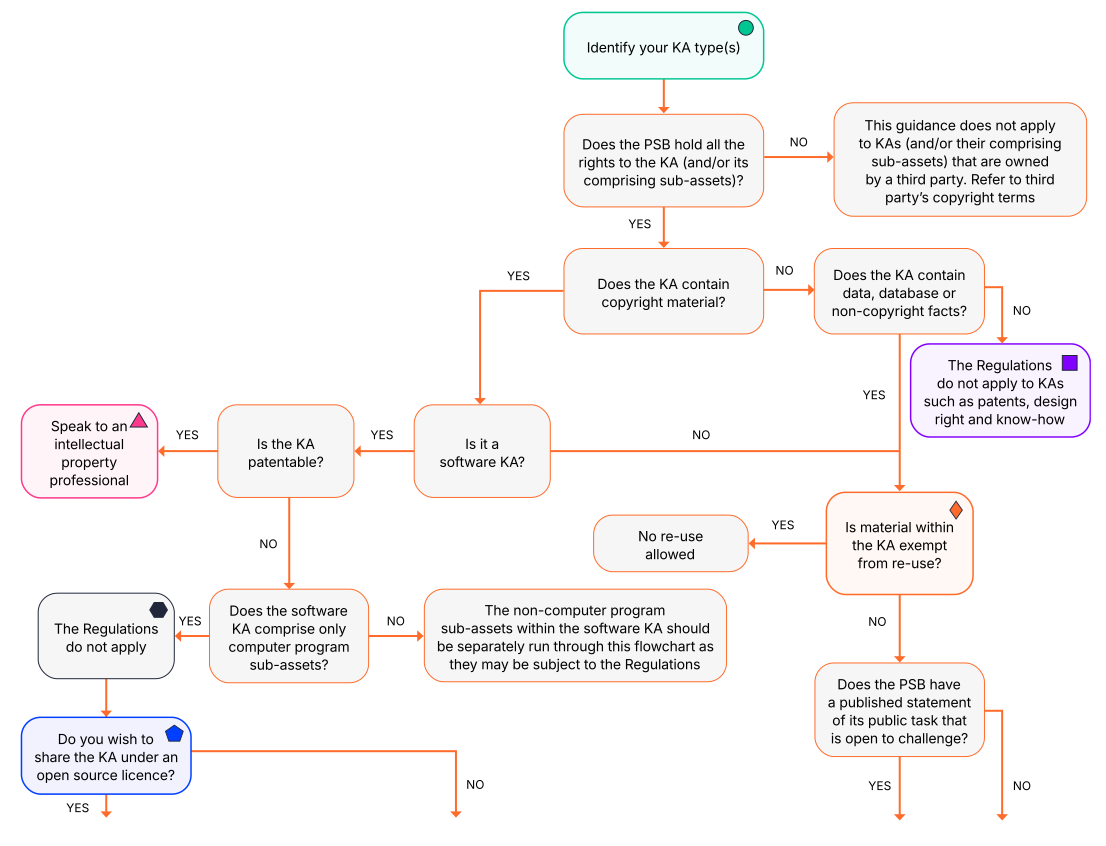
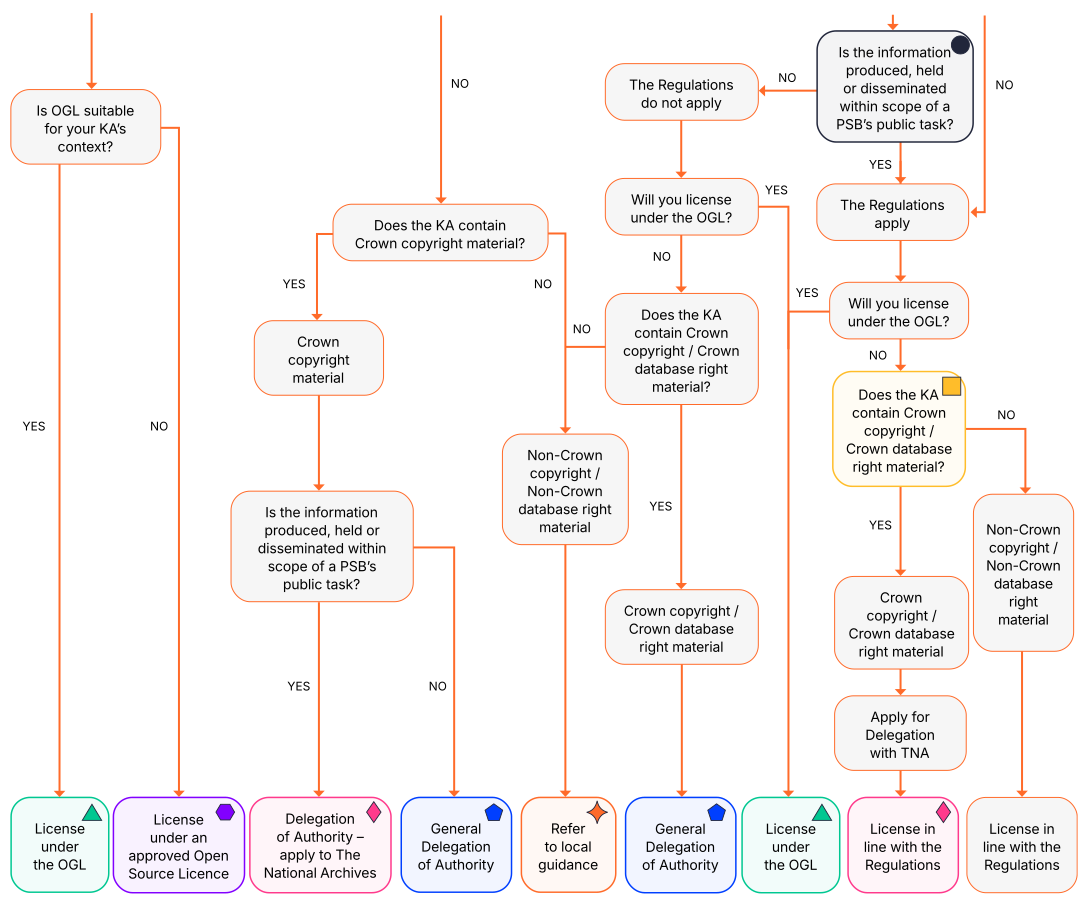
4. Tool 1: Decision-making flowchart
The flowchart is designed to assist Crown and non-Crown PSBs in determining whether the Regulations and Crown copyright apply to their KAs and the possible commercialisation routes.
Some KA types may require additional or particularly important considerations in addition to the Regulations, such as UK General Data Protection Regulation (GDPR), ethics, public perception and the access model, which will inform what route for commercialisation is preferred.
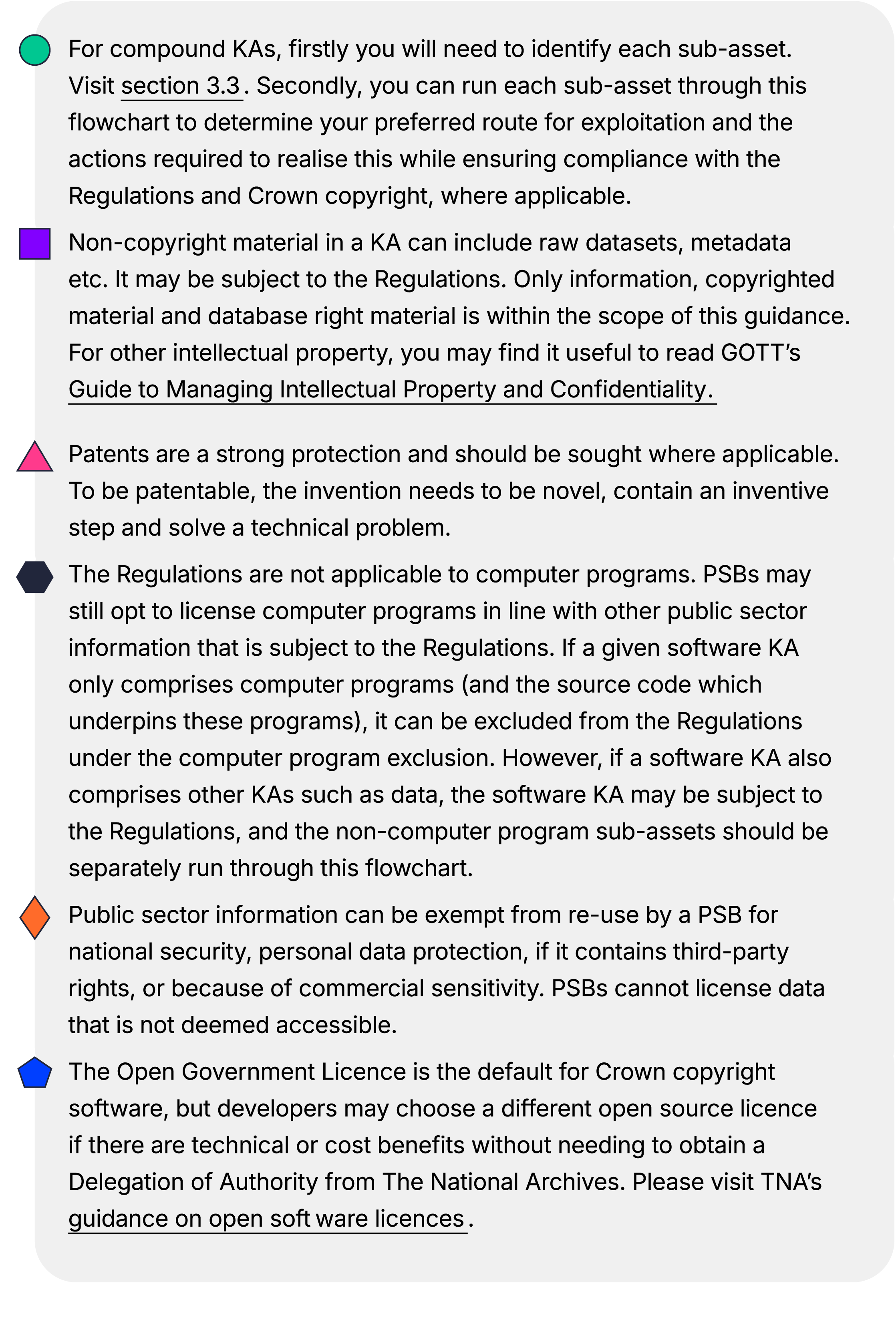
Flowchart notes
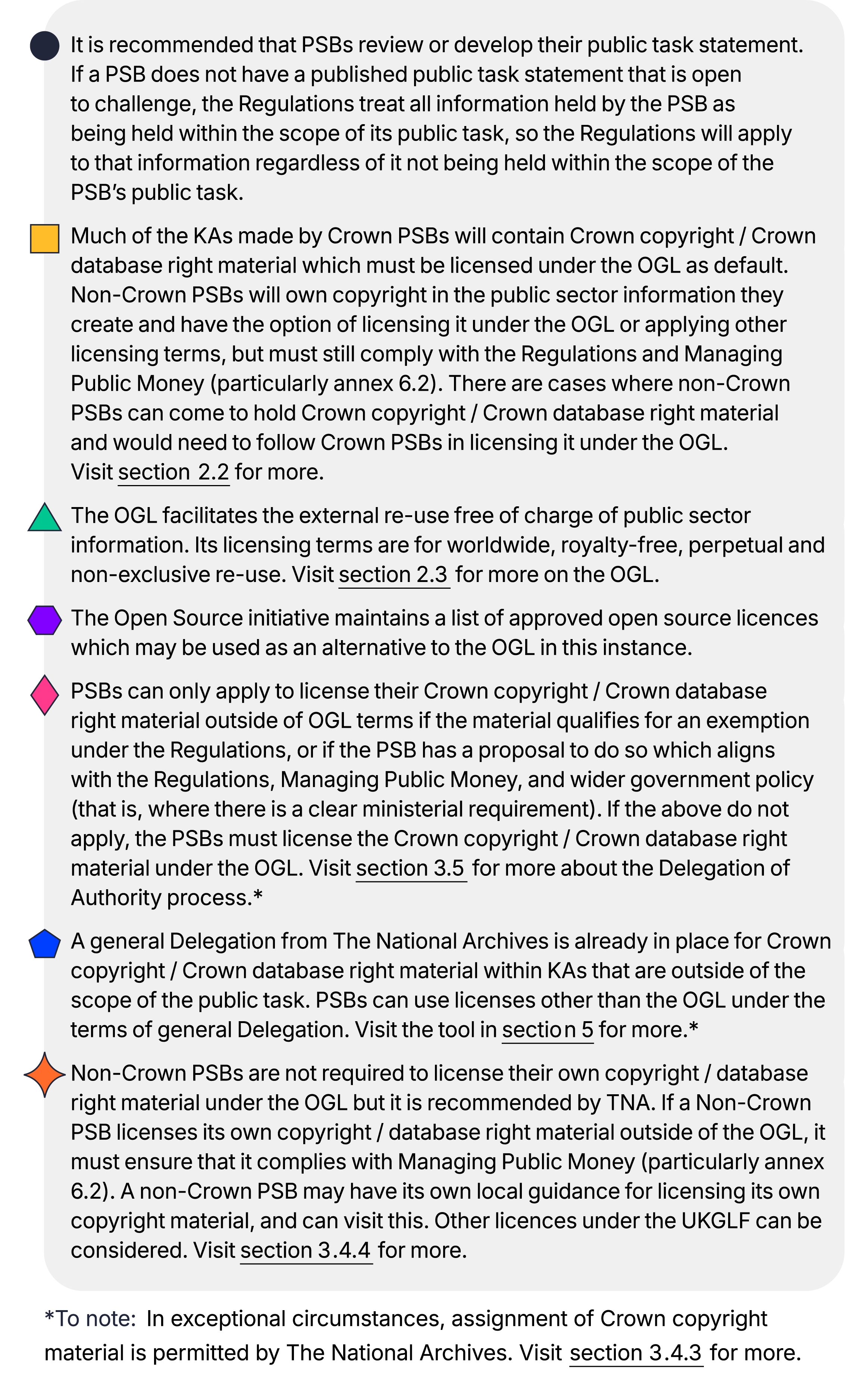
5. Tool 2: Restrictions and exceptions for licensing table
With reference to the Regulations and Crown copyright, the tables below illustrate how considerations differ between Crown and non-Crown PSBs, and for KAs that are within or outside of the scope of the PSB’s public task. Where applicable, PSBs are required to comply with all of the Regulations.
The tables clarify:
- what restrictions on licensing apply – if ‘No restrictions’ is listed, this is only regarding the Regulations and Crown copyright (other regimes such as UK GDPR may apply)
- what exceptions there are under the Regulations to allow for charging above marginal cost recovery, and to enter an exclusive licensing arrangement
- when a PSB is required to obtain a Delegation of Authority to license outside of OGL terms
Crown copyright and Crown database right materials
(A Crown PSB’s KAs will contain Crown copyright material and may contain Crown database right material)
| The supply of KAs within the scope of the public task | The supply of KAs outside of the scope of the public task | |
|---|---|---|
| Competition | - OGL is default licence. | - OGL is default licence. |
|
Cost-recovery limits Ability to charge for re-use |
- The OGL is default. The PSB may be able to charge for marginal cost recovery for the service (that is, for reproduction, provision, or dissemination), but this will almost always be negligible. - May be able to charge above marginal cost recovery if the asset qualifies for an exception under the Regulations, that is, for libraries, museums and archives; to recuperate the costs of sharing when it is cost-intensive; or for statutory obligations. However, the PSB would first need to obtain a Delegation of Authority. - If the asset does not qualify for an exception under the Regulations, may still be able to charge above marginal cost recovery. Must demonstrate to TNA that the proposal to do so is aligned with the Regulations, Managing Public Money and wider government policy (that is, where there is a clear ministerial requirement). The PSB would need to obtain a Delegation of Authority. |
- The OGL is default. The PSB may be able to charge for marginal cost recovery for the service (that is, for reproduction, provision, or dissemination), but this will almost always be negligible. - Can charge above marginal cost recovery without obtaining a separate Delegation. A general Delegation from TNA is already in place for KAs that are outside of the scope of the public task. Visit TNA’s website for more on the general Delegation. |
|
Fairness and non-discrimination Partnerships (for example, exclusivity) |
- The OGL is default and ensures as open and free re-use as possible. While the Regulations do apply, the non-exclusive nature of the OGL means that the PSB cannot enter an exclusive licensing arrangement. - May be able to enter an exclusive licensing arrangement if the KA qualifies for an exception under the Regulations, that is, where it is necessary for the provision of a service in the public interest (that is, where the market requires exclusivity to provide a service); or for the digitisation of cultural resources. However, the PSB would first need to obtain a Delegation of Authority. - If the asset does not qualify for an exception under the Regulations, may still be able to enter an exclusive and/or licensing arrangement. Must demonstrate to TNA that the proposal to do so is aligned with the Regulations, Managing Public Money and wider government policy (that is, where there is a clear ministerial requirement). The PSB would need to obtain a Delegation of Authority. |
- The OGL is default licence and is non-exclusive and non-discriminate. - Can enter an exclusive and custom licensing arrangement without obtaining a separate Delegation. A general Delegation from TNA is already in place for KAs that are outside of the scope of the public task. Visit TNA’s website for more on the general Delegation. |
| Transparency | - OGL is default licence. | - OGL is default licence. |
Non-Crown copyright and non-Crown database right materials
(A non-Crown PSB’s KAs usually contains non-Crown copyright and non-Crown database right materials as the PSB retains its own copyright and database right)
| The supply of KAs within the scope of the public task | The supply of KAs outside of the scope of the public task | |
|---|---|---|
| Competition | - Must provide fair access for re-use where possible. | - No restrictions. |
|
Cost-recovery limits Ability to charge for re-use |
- Can only charge for marginal cost recovery. - May be able to charge above marginal cost recovery if it qualifies for an exception under the Regulations, that is, for libraries, museums and archives; if revenue generation is required to recuperate substantial costs of sharing when it is cost-intensive; or for statutory obligations. The PSB would only need to obtain a Delegation of Authority if the KA contains Crown copyright or Crown database right material. |
- No restrictions. |
|
Fairness and non-discrimination Partnerships (for example, exclusivity) |
- Can enter an exclusive licensing agreement if the asset qualifies for an exception under the Regulations, where it is necessary for the provision of a service in the public interest (that is, where the market requires exclusivity to provide a service); or for the digitisation of cultural resources. The PSB would only need to obtain a Delegation of Authority if the KA contains Crown copyright or Crown database right material. | - No restrictions. |
| Transparency | - For a non-OGL licence, the PSB must ensure they issue clear and consistent communication and make this accessible to all users on an equal basis. This includes being transparent about any charging. | - No restrictions. |
6. Glossary
- Creative Commons Licence: a standardised way to grant the public permission to use an entity’s creative work under copyright law. Non-Crown PSBs can use this licence as an alternative to the OGL.
- Crown copyright: a copyright protection that covers the materials created by government departments and agencies, including by civil servants and ministers. This includes legislation, government codes of practice, social media content, government reports, official press releases, academic articles and many public records.
- Crown PSB: a public sector body that has Crown status. The copyright material produced by Crown PSBs is Crown copyright.
- Delegation of Authority: a formal document granted by TNA which enables PSBs to license the re-use of Crown copyright material they produce outside the terms of the OGL, where permitted by the Regulations.
- Keeper of Public Records: the Chief Executive of TNA. The Keeper is the Monarch’s officeholder appointed to hold and manage Crown copyright and database rights, including those that come into the ownership of the Crown through assignment, and they have the sole legal authority to do so. They may grant Delegations of Authority to a PSB to license the re-use of Crown copyright material outside the terms of the OGL. The Keeper is the only person who can execute any assignment of Crown copyright.
- Knowledge Assets: the intangible assets that an organisation holds. These include inventions, designs, certain research and development outcomes, data and information, creative outputs such as text, video, graphics, software and source code, knowledge and expertise, business processes, services and other intellectual resources, as well as the reputation of the organisation itself.
- Non-Crown PSB: a PSB that does not have Crown status. The material produced by non-Crown PSBs is generally not subject to Crown copyright. However, non-Crown PSBs can sometimes hold or jointly produce material that is Crown copyright.
- Open Government Licence (OGL): the recommended licence by TNA for the free and open re-use of public sector information. It is the default licence for Crown copyright, and the recommended licence for non-Crown PSBs and their non-Crown copyright information.
- Public sector body (PSB): the Regulations specify that this includes a minister of the Crown; a government department; the Corporate Officer of the House of Commons; the Corporate Officer of the House of Lords; the Northern Ireland Assembly Commission; Scottish Ministers; the Scottish Parliament; the Scottish Parliamentary Corporate Body; the National Assembly for Wales Commission; Welsh Ministers; local authorities etc. (visit Regulation 3 for a complete list).
- Re-use of Public Sector Information Regulations 2015 (the Regulations): legislation which governs the re-use of information created by public sector bodies.
- UK Government Licensing Framework: it provides a policy and legal overview of the arrangements for licensing the use and re-use of public sector information. It sets out best practice, standardises the licensing principles for government information, and mandates the Open Government Licence as the default for Crown PSBs and as the recommended licence for other PSBs.
-
Public sector bodies that have Crown status are referred to as Crown PSBs in this guidance. TNA has a list of Crown and non-Crown PSBs that is no longer updated but is available to see archived online, visit ‘UK Crown bodies’. Visit section 2.2 of this guide for information on Crown PSBs, non‑Crown PSBs, and Crown copyright. ↩
-
In some circumstances, the Regulations may require a PSB to permit the re-use of information, where it receives a request (visit Regulation 7). ↩
-
Computer programs are not defined in the Regulations. Visit ‘Computer programs, software, and source code’ box in section 2.1.3 for more on computer programs. ↩
-
Cultural resources can include, but are not limited to, historic manuscripts, books, documents, photographs, maps, illustrations, artworks or artifacts, and audio and video recordings. ↩
-
Visit ‘Case study – third-party rights and limitations for licensing’ in section 2.3. ↩
-
Some non-Crown PSBs may have Crown servants working in them (that is, police authorities) whose works would be subject to Crown copyright. ↩
-
When the copyright of a KA is assigned to the Crown by a third party, including a non-Crown PSB, it becomes ‘Crown-owned copyright’. Crown-owned copyright is subject to the same licensing conditions as Crown copyright material, that is, the OGL is the default licence. ↩
-
Departmental logos generally contain Crown intellectual property, however departments have the right to license their reproduction without seeking the agreement of the Keeper of Public Records. ↩
-
There are cases where non-Crown PSBs can come to hold Crown copyright material and would need to follow Crown PSBs in licensing it under the OGL. ↩
-
Departmental logos generally contain Crown intellectual property, however departments have the right to license their reproduction without seeking the agreement of the Keeper of Public Records. ↩
-
The UK Government Licensing Framework is designed to standardise and simplify the licensing of public sector information. ↩
-
Non-Crown PSBs would also need to obtain a Delegation of Authority from TNA if they wished to license any Crown copyright material they hold outside of OGL terms. ↩