Privacy Notice: Test, Learn, and Grow AI Frontline Service Accelerator User Research
Published 21 May 2026

© Crown copyright 2026
This publication is licensed under the terms of the Open Government Licence v3.0 except where otherwise stated. To view this licence, visit nationalarchives.gov.uk/doc/open-government-licence/version/3 or write to the Information Policy Team, The National Archives, Kew, London TW9 4DU, or email: psi@nationalarchives.gov.uk.
Where we have identified any third party copyright information you will need to obtain permission from the copyright holders concerned.
This publication is available at https://www.gov.uk/government/publications/privacy-notice-test-learn-and-grow-ai-frontline-service-accelerator-user-research/privacy-notice-test-learn-and-grow-ai-frontline-service-accelerator-user-research
AI and Data Driven Frontline Service Accelerator: User Research
How to read this notice
This notice is written so children and adults can both read it. The main text uses everyday words. Where there is extra detail you might want (like the laws we follow or how we keep your data safe) we have put it in shaded boxes like this one. You can skip the boxes if you do not need them.
1. Who we are
We work for the Cabinet Office and Public Digital. These are organisations that help the government make services better for people. We are working together on a project called Test, Learn, and Grow.
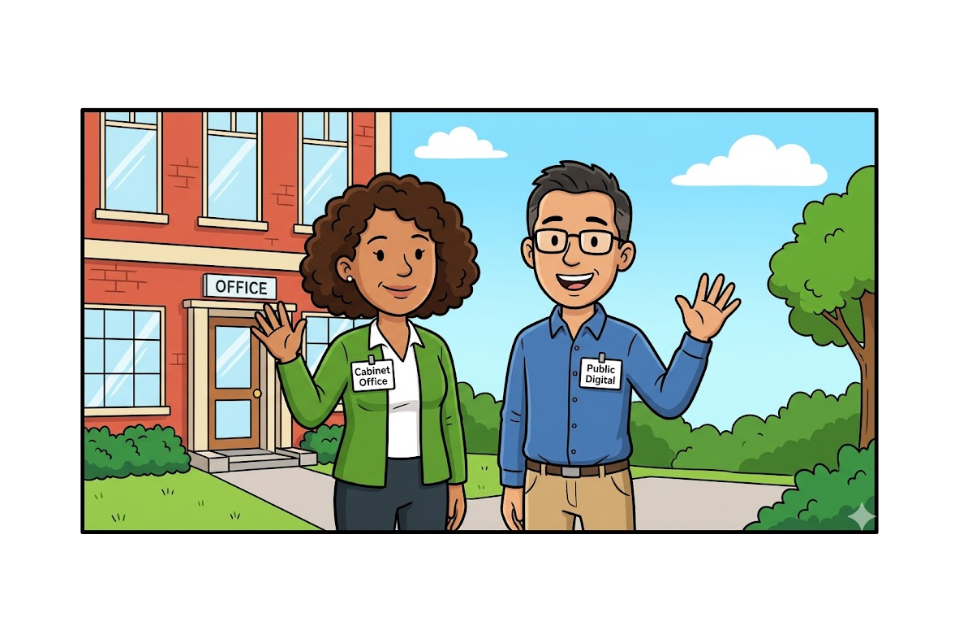
[Illustration: Two cartoon characters wave hello outside a red-brick building marked “OFFICE,” both smiling warmly. One wears a green jacket with a “Cabinet Office” name badge; the other wears a blue shirt with a “Public Digital” badge — introducing the two teams behind the project.]
Both organisations look after your information together. If you want to ask us something, start with the Cabinet Office — their details are at the end of this notice.
The Law
The Cabinet Office and Public Digital are joint controllers of your personal data under the UK GDPR. A controller is the organisation that decides how and why your personal data is used. Our full contact details are at the end of this notice.
2. What this project is about
Local councils help families and children who need support. Sometimes it is hard for them to spot who needs help early enough — especially when someone needs support from more than one service.
We want to find out if sharing data between services, and using computers to spot patterns in it, can help councils find families who need support sooner. The goal is to step in earlier, before problems get worse.
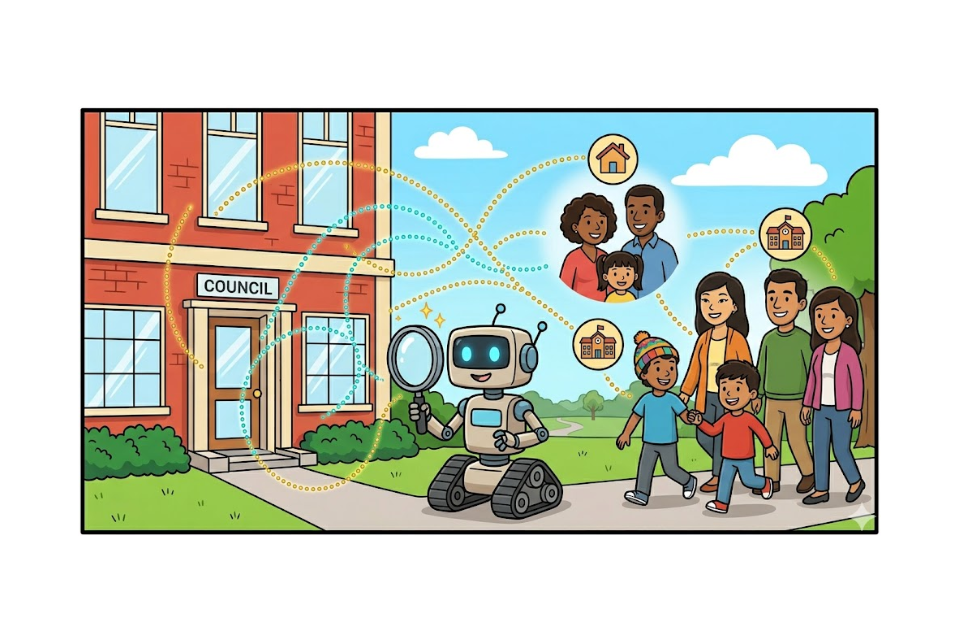
[Illustration: A friendly cartoon robot holds up a magnifying glass outside a red-brick “COUNCIL” building, with glowing dotted lines linking it to floating icons of a house, a school, and a family. Nearby, a group of smiling adults and children walk together — illustrating how councils might use data to spot families who could benefit from support.]
Before we do any of that, we want to talk to people first — including children, families, and the people who work in these services — to find out:
- what you think about these ideas
- what worries you might have
- what your experience has been like using council services
- how we can explain things clearly and honestly
- how social workers actually use information day to day
We will do this through interviews (one-to-one chats) and workshops (group activities). What you tell us will help us make sure the project works for the people it is meant to help.
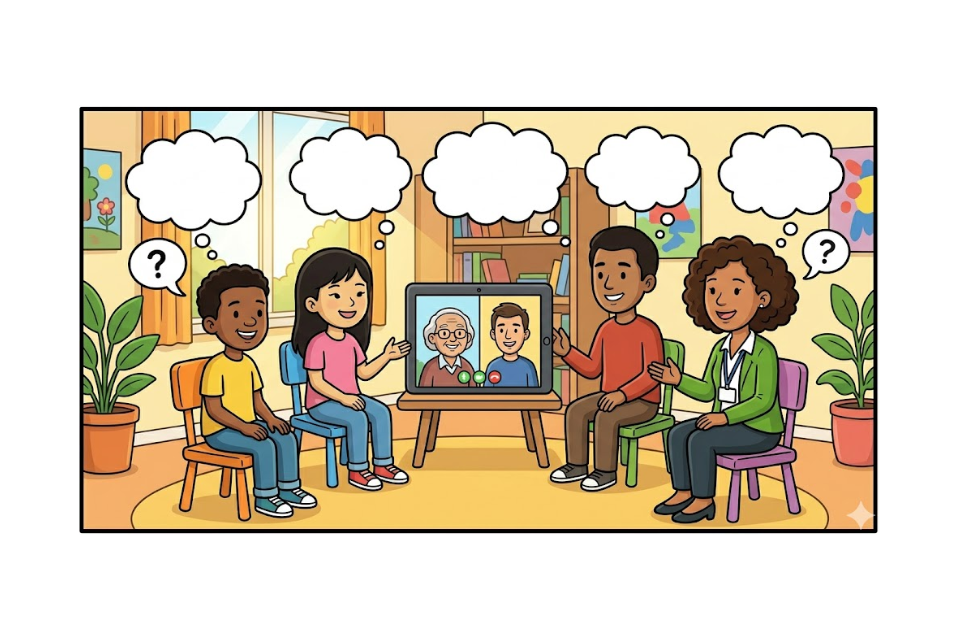
[Illustration: Four people of different ages sit in a circle of brightly coloured chairs in a sunny, plant-filled room, chatting animatedly around a tablet showing two more people on a video call. Empty thought bubbles float above each person — representing the interviews and workshops where children, families, and workers share their views.]
3. Information we collect about you
We might collect:
- Your name, email address, or home address (so we can contact you)
- Things like your age, job, or your connection to social care
- Information about your background, like your ethnicity, health, or religious beliefs
- Your opinions about the topics we discuss, which might include political opinions
- Recordings of interviews or workshops (we will always tell you beforehand if we are recording)
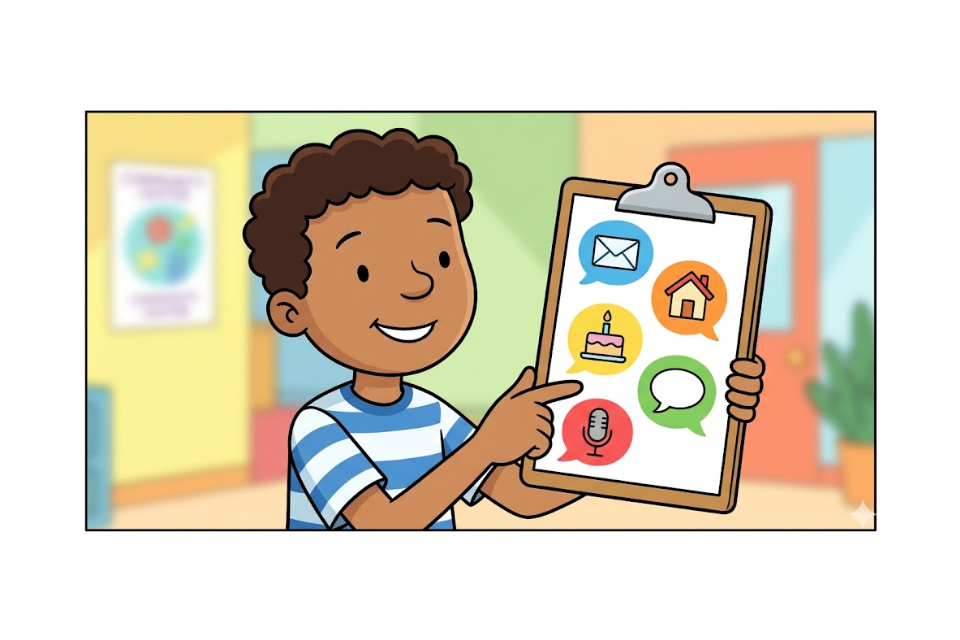
[Illustration: A cheerful cartoon child in a blue-and-white striped top holds up a clipboard displaying five colourful icons: an envelope, a house, a birthday cake, a speech bubble, and a microphone — representing the kinds of information the project might collect, like contact details, age, opinions, and interview recordings.]
4. Why we can use your information
We can only use your information because you said it was OK. That is called giving consent. You (or your parent or carer) will have agreed to take part before we collect anything.
If we collect more sensitive information, like about your health or ethnicity, we will ask for your clear permission for that too. You can change your mind at any time by contacting us. Our contact details are at the end of this notice.
Taking part is your choice. You do not have to give us any information if you do not want to, and saying no will not affect any council services or support you receive — now or in the future.
The outcomes of this research will not be used to make decisions about you or your family. The project is about understanding how AI and shared data might help councils, not putting your information through any system that decides things. We are talking to you to learn from your experience.
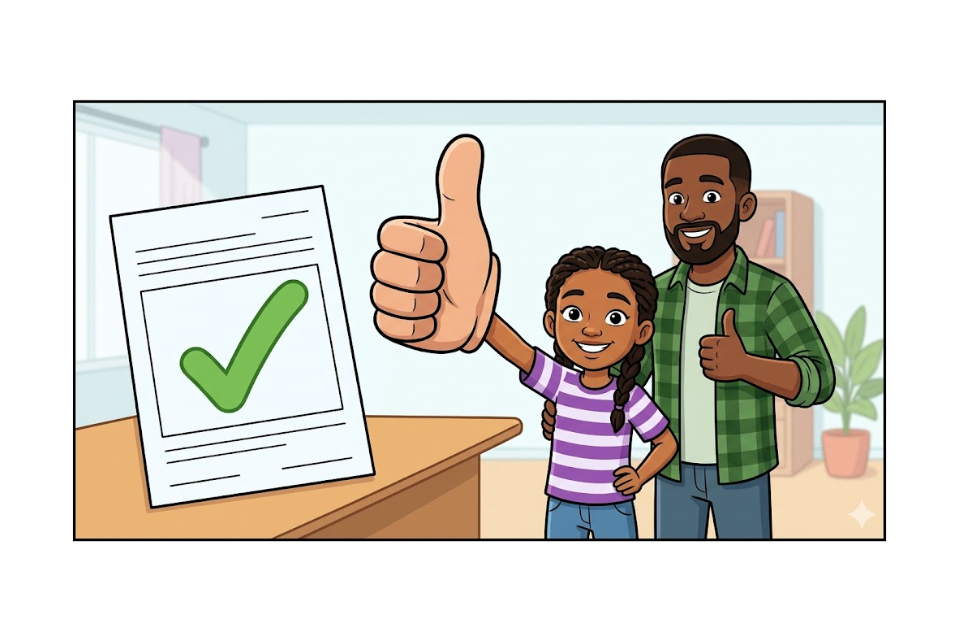
[Illustration: A young cartoon child in a purple striped top stands beside her father, a man with a beard in a green checked shirt, both grinning and giving enthusiastic thumbs-up. On a desk beside them sits a consent form marked with a bold green tick — showing that information is only collected once their consent has been given.]
The Law
Our legal reason for using your personal data is your consent (Article 6(1)(a) of the UK GDPR). For information the law treats as sensitive, also called “special category” data, we need your explicit consent (Article 9(2)(a)). For consent to be valid, it has to be your free choice, given for a specific purpose, made when you have the full picture, and a clear yes: never silence or a pre-ticked box.
You do not have to give us your data, there is no law or contract that says you must, and there are no consequences if you decide not to (Article 13(2)(e) UK GDPR).
What counts as “sensitive” (special category) personal data
Under the UK GDPR, the following kinds of information are treated as sensitive and get an extra level of protection:
- Racial or ethnic origin
- Political opinions
- Religious or philosophical beliefs
- Trade union membership
- Genetic data
- Biometric data used to identify you
- Health data
- Sex life or sexual orientation
We are not planning to collect information about every category on this list. We have listed them all because that is the legal definition, so you can see what kinds of information get this extra level of protection if they do come up.
5. Who sees your information
The people at the Cabinet Office and Public Digital who are running this research. We will also ask some companies to help us store information safely on computers (like email and file storage providers). These companies only do what we ask them to do with your information.
When we write up what we have learned, we will not include your name or anything that identifies you. If we ever want to use something you said (like a quote) and include your name with it, we will ask you first.
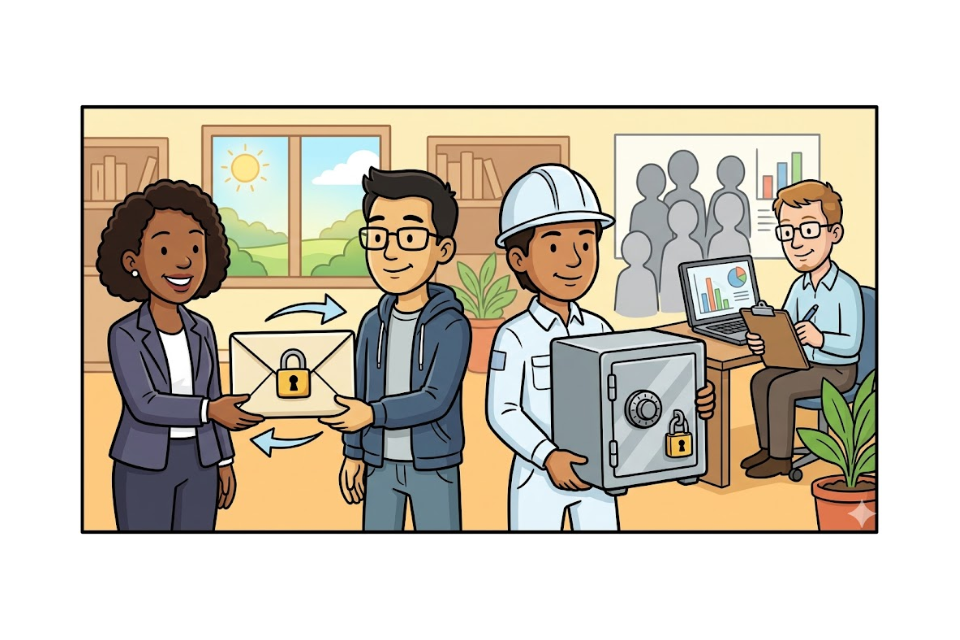
[Illustration: Four cartoon workers handle information securely in a bright office. Two pass a padlocked envelope between them, one carries a locked metal safe, and another reviews anonymous grey figures and charts on a laptop — showing who sees your information, how it is stored safely, and how identifying details are removed before anything is shared.]
6. How long we keep your information
We will keep your information for no longer than 12 months. We will try to remove anything that identifies you even sooner than that if we can.
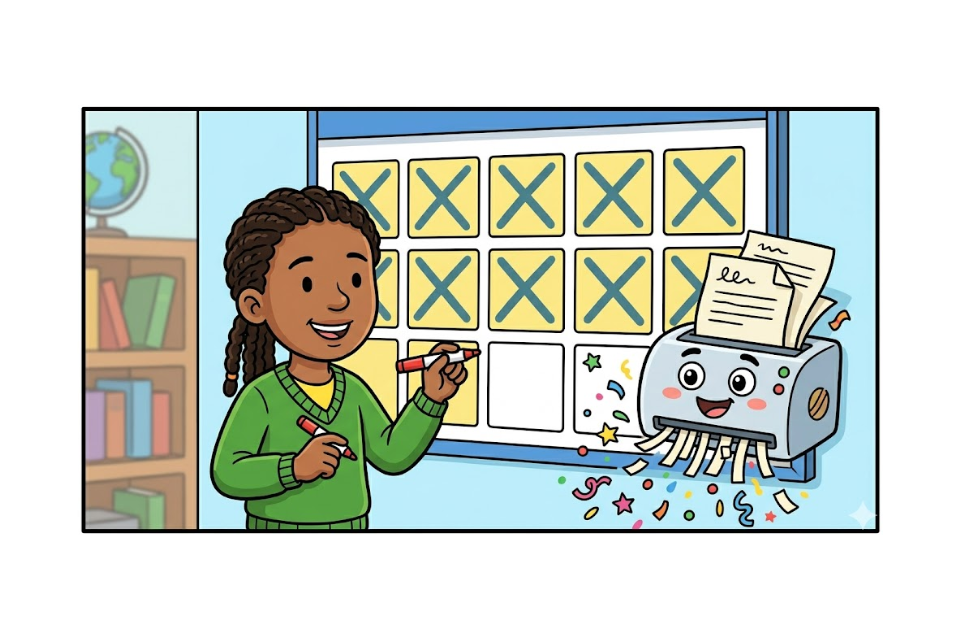
[Illustration: A cartoon child in a green jumper crosses off days on a big calendar with a crayon, grinning as a cheerful cartoon paper shredder happily chews up documents beside them, confetti and stars bursting out. It illustrates that information is kept for no longer than 12 months, then destroyed.]
7. Your rights
You have the right to:
- Find out what information we have about you and ask for a copy
- Fix anything that is wrong (the right to rectification)
- Add to any information that is incomplete
- Ask us to delete your information if there is no longer a reason for us to use it (the right to erasure)
- Ask us to stop using your information in certain situations — for example, if you think it is wrong (the right to restrict processing)
- Change your mind — you can withdraw your consent at any time, and we will stop using your data
- Get a copy of your information in a format you can take elsewhere (the right to data portability)
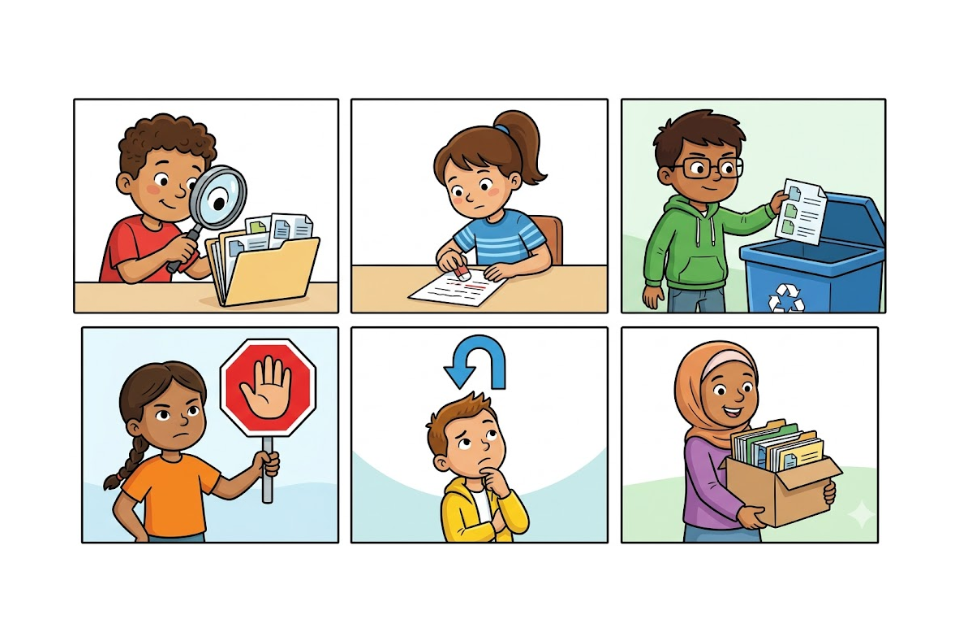
[Illustration: Six cartoon panels show young people exercising their data rights: one looks through a magnifying glass at a folder of files, another erases a line on a form, a third drops papers into a recycling bin, a fourth holds up a red stop sign, a fifth looks thoughtful under a U-turn arrow, and the last carries a box of folders. Together they illustrate the rights to see, correct, delete, restrict, withdraw consent, and take your information with you.]
The Law
The rights listed above come from Articles 15 to 22 of the UK GDPR.
8. Where your information is stored
Your information is stored securely on our computer systems. Sometimes information might be stored in other countries, but it will always be kept safe and protected by law.
The Law
If we send your data outside the UK, we will protect it using one of these legal safeguards:
- An adequacy decision: when the UK officially recognises that another country protects data as well as we do
- Standard Contractual Clauses: approved legal contracts between us and whoever receives your data
- A UK International Data Transfer Agreement: a specific legal agreement for moving data abroad safely
9. Contact us
The Cabinet Office and Public Digital are joint controllers of your data. The Cabinet Office is the main contact for queries and Subject Access Requests (formal requests to see what data we hold about you), but you can contact either of us to ask about your information.
Cabinet Office (main contact):
Address: 70 Whitehall, London, SW1A 2AS
Phone: 0207 276 1234
Webform: Contact the Cabinet Office
Email: dpo@cabinetoffice.gov.uk
Public Digital:
Legal entity: Public Digital Holdings Ltd (Company Number 10993674)
Address: 262 High Holborn, London, WC1V 7EE
Email: data-protection-officer@public.digital
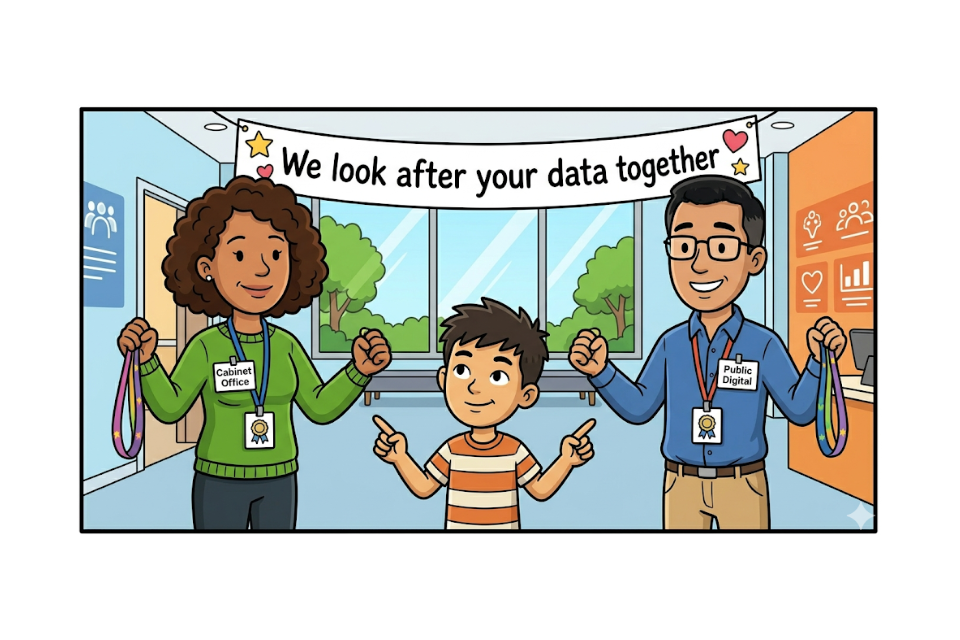
[Illustration: Two cartoon staff members — one in a green jumper with a “Cabinet Office” badge, one in a blue shirt with a “Public Digital” badge — stand either side of a smiling child in a striped top, who points to each of them in turn. A banner above reads “We look after your data together,” showing that both organisations share responsibility for protecting your information.]
10. If you want to complain
If you think we have not looked after your information properly, you can complain to the Information Commissioner’s Office (ICO). They are an independent organisation that makes sure people’s information is treated fairly.
CONTACT DETAILS
The Cabinet Office and Public Digital are Joint Controllers for your data.
You can contact them at:
Address: Information Commissioner’s Office, Wycliffe House, Water Lane, Wilmslow, Cheshire, SK9 5AF
Phone: 0303 123 1113
Email: icocasework@ico.org.uk
Making a complaint to the ICO does not stop you from also going to court if you want to.
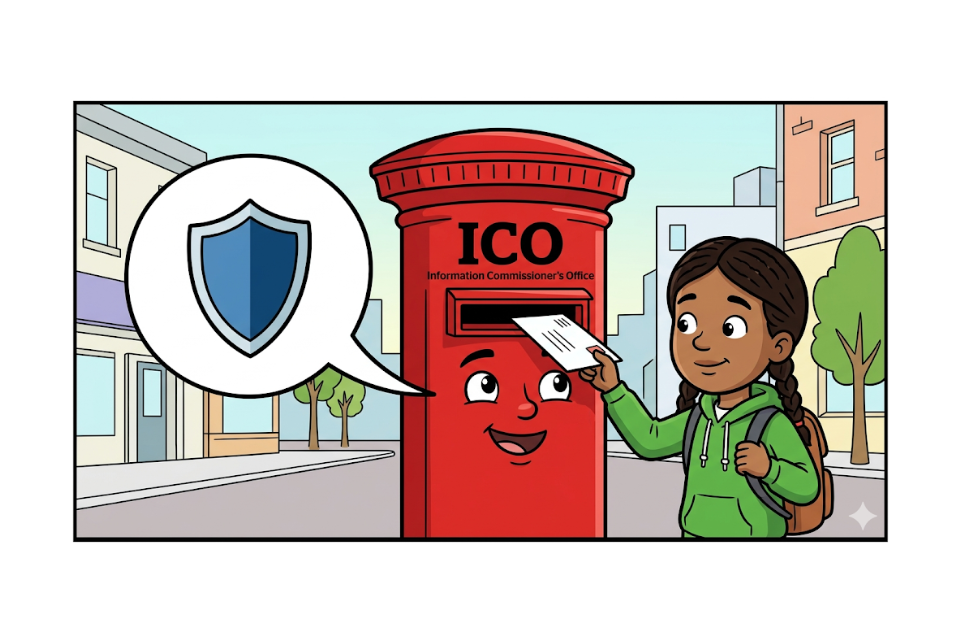
[Illustration: A calm cartoon teenager in a green hoodie and backpack posts a letter into a smiling red postbox labelled “ICO – Information Commissioner’s Office” on a quiet street. A speech bubble beside it shows a blue protective shield — representing the ICO as an independent body that helps keep people’s information safe.]