2026 phonics screening check: monitoring visits guidance
Updated 8 May 2026

© Crown copyright 2026
This publication is licensed under the terms of the Open Government Licence v3.0 except where otherwise stated. To view this licence, visit nationalarchives.gov.uk/doc/open-government-licence/version/3 or write to the Information Policy Team, The National Archives, Kew, London TW9 4DU, or email: psi@nationalarchives.gov.uk.
Where we have identified any third party copyright information you will need to obtain permission from the copyright holders concerned.
This publication is available at https://www.gov.uk/government/publications/phonics-screening-check-monitoring-visits-guidance-and-form/phonics-screening-check-monitoring-visits-guidance
Introduction
This guidance is for local authorities undertaking monitoring visits for the phonics screening check. It also contains instructions for completing the 2026 phonics screening check monitoring visit form.
Local authorities have a statutory responsibility to monitor the administration of the phonics screening check for 10% of maintained schools that are administering the check and 10 % of academies that have selected them for monitoring. The legal basis for this activity is set out in The Education (National Curriculum) (Key Stage 1 Assessment Arrangements) (England) Order 2004 (as amended). For more information on schools assigned to a local authority, refer to the phonics screening check assessment and reporting arrangements (ARA).
Monitoring visits help ensure that schools maintain the integrity, security and confidentiality of check materials and that they administer the phonics screening check correctly and consistently.
Changes for the academic year 2025 to 2026
From Monday 18 May until Friday 19 June, local authorities can access collation data by school on the National Curriculum Assessments Portal (NCA Portal). This replaces the Standards and Testing Agency’s (STA’s) delivery note generator previously provided by email. For more information, refer to Preparing for a visit.
Schools and local authorities can now also self-report allegations of maladministration on the NCA Portal. For more information, refer to Reporting allegations of maladministration.
Preparing for a visit
To carry out a monitoring visit correctly, you should ensure you have read and understood this guidance.
You should also be familiar with the following 2026 guidance:
- Phonics screening check ARA
- Phonics screening check administration guidance (in particular the section on ‘Security of check materials’)
When selecting schools for a monitoring visit, you should look for schools that have not had a recent visit.
Accessing collation data
On the NCA Portal, local authorities will be able to access collation data that shows the quantity of phonics screening check materials the school should have received.
Collation data replaces STA’s delivery note generator, previously provided by email, and is available from Monday 18 May until Friday 19 June.
To view and download a school’s phonics screening check collation data, follow these steps:
- Sign in to the NCA Portal.
- Select the ‘Activities’ tab at the top of the page.
- Select ‘Summary reports’
- Select ‘Collation data’.
- Enter a school DfE number or school name in the search box and select the relevant school from the list.
- Download and print reports, if required.
You must keep all reports secure throughout the check window and destroy them appropriately when they are no longer required.
Carrying out a visit
Depending on when your visit takes place, you will need to observe certain aspects of check administration to ensure the school is following the published guidance correctly.
When carrying out a monitoring visit, you should take with you:
- this guidance
- the phonics screening check collation data from the NCA Portal, which shows the quantity of phonics screening check materials the school should have received
- copies of the 2026 phonics screening check monitoring visit form
- photo identification to present on arrival at the school – this can be a passport, driving licence or official work pass
Complete the monitoring visit form as directed. At the end of your visit, you will need to meet with the headteacher, or delegated member of staff, to discuss your findings.
Visits before the check week
These monitoring visits take place during the week beginning Monday 1 June.
Schools should have received their phonics screening check materials in the week commencing Monday 18 May.
Schools should follow the phonics screening check administration guidance for further information about storing check materials securely.
During your visits, you should:
- check that schools have received the correct number and type of packs in their initial phonics screening check materials consignment, and that they are unopened, undamaged, and stored securely
- confirm how downloads of the check are kept secure, if applicable
- review other elements of the planned administration, such as the rooms where the checks will take place
Receipt and storage of phonics screening check packs
Use the phonics screening check collation data to confirm details of the number of phonics screening check packs delivered to the school.
Schools receive a printed delivery note in their check materials consignment. They should have:
- used it to check they received all the materials listed
- annotated it to confirm the quantity and type of materials were correct
Ask the headteacher, or delegated member of staff, to show you their delivery note and where the check materials are stored. Check that:
- the number and types of packs match the delivery note
- all check packs are sealed and stored securely
Damaged phonics screening check packs
Schools should check their phonics screening check materials on receipt and report damaged items to the national curriculum assessments helpline immediately on 0300 303 3013.
Check whether the school received any damaged phonics screening check packs and reported them. Advise the school to contact the national curriculum assessments helpline immediately if it has not reported damaged test packs yet. You should record this on the monitoring visit form.
Early opening of phonics screening check materials
Schools are not permitted to open the phonics screening check packs before the start of the administration period on Monday 8 June.
Schools that need to adapt materials, so that pupils can access them, can do so at any point within the check administration period. Schools do not need to seek approval from, or make notifications to, STA. You can find more information in the phonics screening check administration guidance.
If you find phonics screening check packs have been opened before Monday 8 June, you must record this on the monitoring visit form and discuss it with the headteacher, or delegated member of staff, at the end of your visit.
Who will administer the check?
You should speak to the headteacher, or the teacher responsible for the administration of the phonics screening check, to ensure that an appropriate member of staff will be administering it and that they fully understand the administration arrangements, including scoring.
A member of staff who is trained in phonics and known to the pupil must administer the check on a one-to-one basis. The role requires professional judgement about which responses are correct.
The check should not be administered by a teaching assistant or higher-level teaching assistant unless they are trained in phonics and have experience delivering phonics sessions to pupils. The check administrator must not be a relative, carer or guardian of the pupil taking the check.
Schools must not administer the check virtually.
Visits during the check week
These visits take place during the phonics screening check administration period, between Monday 8 June and Friday 12 June.
You should review past phonics screening check materials before the visit, so you are familiar with the kinds of words pupils will be asked to decode. This will help you judge whether any assistance given to pupils is in accordance with the guidance. You may ask the school for a list of the phonics words used in the check when you arrive. These materials must be kept secure until Monday 22 June.
Where possible, you should arrive at the school at the beginning of the school day, before any checks are administered, so that you can observe the complete administration process, including storing the check materials and answer sheets securely.
You should confirm that:
- the room in which the check is administered is suitable
- wall displays and items that could help pupils have been removed or covered up
- appropriate administrators will be administering the check and have undertaken appropriate training
- the school has made appropriate preparations to submit its data
You should also do this for any checks administered during the timetable variation period.
Pupil observation
You should aim to observe between 2 and 10 pupils, depending on the size of the cohort.
Before the check, confirm with the headteacher or check administrator whether any pupils will find the observation uncomfortable. Pupils must not be distracted by the presence of a visitor. If a pupil is likely to be distracted, you should observe another pupil instead.
You should also agree with the headteacher or check administrator whether they should explain your presence to the observed pupils.
You should only enter the room before a pupil starts the check, so that your monitoring activity does not disturb the pupil or interrupt the administration of the check.
When you observe the phonics screening check, ensure that the check administrator:
- introduces the check to the pupil appropriately
- does not give inappropriate assistance – for example, encouraging a pupil to blend words or ‘have another go’
You are not expected to score any checks in parallel with the check administrator. You might consider discussing the scoring decisions with the check administrator, but you should not overrule their judgement on a pupil’s responses to the check.
If you observe what you consider misconceptions of phonics, or the scoring of the check, you should discuss this with the check administrator after the check has been administered – for example, a visitor may think the check administrator has not realised that an alternative pronunciation of a grapheme should be scored as correct. You would not need to report this to STA. If you are unable to discuss your observation with the check administrator, you should discuss it with the headteacher or delegated member of staff at the end of your visit.
Storing opened check materials
Schools must store all phonics screening check materials and answer sheets securely until Monday 22 June. You should confirm with the school how check materials and answer sheets are securely stored once the checks have been administered.
Collating pupils’ scores and returning data
You should discuss the arrangements in place for collating pupils’ scores into the data return sheets and how this data will be provided to your local authority.
Where schools have already completed this task, you should make sure that the data return sheet has been completed correctly.
Visits after the check week
These visits take place immediately after the check week, from Monday 15 June to Friday 26 June.
You should use these visits to:
- discuss the administration of the check
- ensure the materials are stored securely
- confirm arrangements for submitting data
Timetable variations
Schools can administer the phonics screening check to pupils who were absent during the check week until Friday 19 June.
Pupils must only attempt the check once during the check period.
Where schools are administering checks as part of a timetable variation, you should complete the steps for visits during the check week.
Completing the monitoring visit form
You must complete the 2026 phonics screening check monitoring visit form for each school you visit. You must complete sections A and B in full. If you entered an ‘X’ in section A, you must also complete section C.
Form section A: Check-specific information
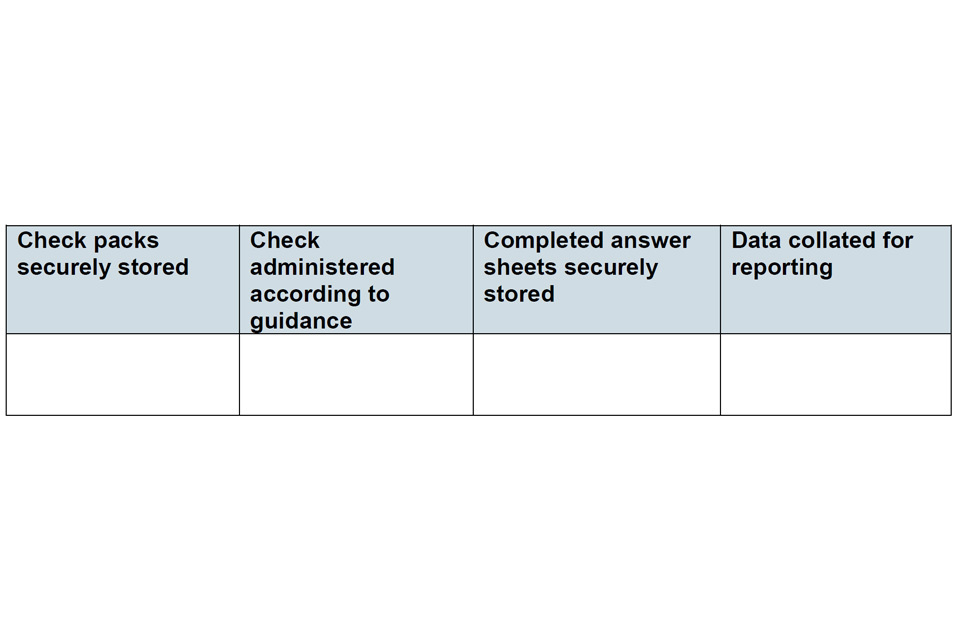
Refer to Carrying out a visit for more information on the check requirements covered by this section of the form.
Use ‘✓’ to indicate that you have observed the correct processes.
Use ‘X’ where you have concerns and briefly explain what you have observed in section C. Concerns may include:
- inappropriate support during a check
- answer sheets that have not been properly completed
- check materials or answer sheets that are not stored securely
- data from the answer sheets that has not been properly and accurately transferred to the local authority’s data system
Use ‘N/A’ to indicate you have not observed the process.
Form section B: General administration
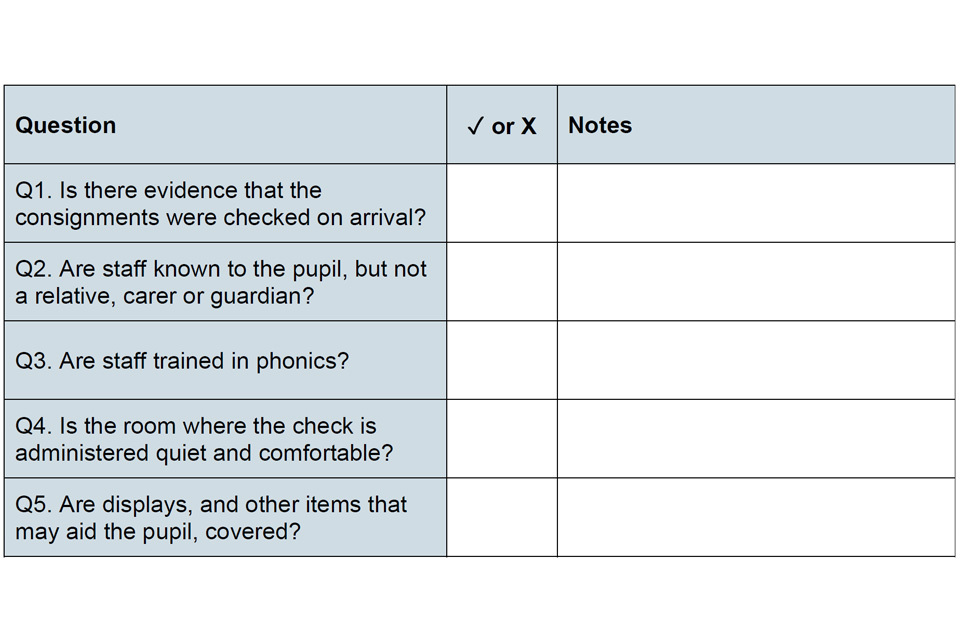
Refer to Carrying out a visit for information on:
- carrying out a visit
- check materials
- who will administer the check
Use ‘✓’ to indicate that you have observed the correct general administration.
Use ‘X’ where you have concerns and briefly explain what you have observed in the notes column.
Form section C: Notes
Record concerns only. Briefly explain your concerns if you have entered an ‘X’ in section A. Any other issues arising during the visit may also be recorded here.
If you are aware of a sensitive matter relating to potential maladministration, which you determine should remain confidential from the school, discuss your concerns with the monitoring visits manager immediately. You can also report the matter directly to sta.maladministration@education.gov.uk.
If you have concerns about the integrity of the check, contact the national curriculum assessments helpline on 0300 303 3013 for further advice. Discuss the issues with your monitoring visits manager as soon as possible.
If you identify any irregularities during your visit that require an urgent response, discuss this with your monitoring visits manager so they can immediately email the completed form to sta.maladministration@education.gov.uk.
Meeting with the headteacher
Before you leave the school, you should meet with the headteacher, or delegated member of staff, to discuss your findings from the visit. If you have placed an ‘X’ in any box on the monitoring visit form, you should advise whether the school should make changes to its check administration procedures for any remaining checks. Record your recommendations on the phonics screening check monitoring visit form. If you did not find anything that concerned you, make this clear in your verbal feedback, but do not record good practice on the monitoring visit form.
You and the headteacher, or delegated member of staff, should sign and date the monitoring visit form. This confirms that the visit took place, you have given any feedback about the administration of the check to the school, and they agree to what you have noted.
You should leave a copy of the monitoring visit form, and any delivery notes you have annotated, with the headteacher or delegated member of staff. You must not add any additional detail or make changes to the monitoring visit form after this point.
After the monitoring visit: submitting the monitoring visit form
You should keep monitoring visit forms secure throughout the check window and destroy them appropriately when they are no longer required.
Send the completed phonics screening check monitoring visit form to your local authority’s monitoring visits manager immediately after the visit and discuss any findings. The deadline for sending completed phonics screening check monitoring visit forms to your manager is Monday 30 June.
The monitoring visits manager should then email a scanned, unencrypted copy of the phonics screening check monitoring visit form to sta.maladministration@education.gov.uk using the following subject line:
PSCMVF-geographical area-local authority number (three digits)-number of schools
Example: PSCMVF-Coventry-123-8
If you identified any irregularities during your visit that require an urgent response from STA, discuss your concerns with the monitoring visits manager immediately. In this case, the monitoring visits manager should send the monitoring visit form to sta.maladministration@education.gov.uk using the following subject line instead:
Urgent-PSCMVF-geographical area-school DfE number
Example: Urgent-PSCMVF-Coventry-1234567
The final deadline for local authority monitoring visits managers to send phonics screening check monitoring visit forms to STA is Friday 3 July.
Reporting allegations of maladministration
Local authorities can report allegations of maladministration by:
- completing section C of the monitoring visit form
- emailing sta.maladministration@education.gov.uk
- contacting the national curriculum assessments helpline on 0300 303 3013 or at assessments@education.gov.uk
- completing the ‘Maladministration allegations’ form in the ‘Incidents’ section of the NCA Portal
When reporting allegations of maladministration, where possible, include:
- details of affected check materials and relevant words
- where applicable, initials of affected pupils
- details about the allegation and relevant circumstances
- the year of the assessment, if not current
- if relevant, details of other schools that are affected
Help and support
If you have questions about carrying out monitoring visits, you should speak to your monitoring visits manager.
If they are unable to help, you can contact:
-
the national curriculum assessments helpline on 0300 303 3013 or at assessments@education.gov.uk
-
STA’s maladministration team at sta.maladministration@education.gov.uk