Patterns of education, social care and youth offending: Offending overlaps and journeys
Published 14 May 2026

© Crown copyright 2026
This publication is licensed under the terms of the Open Government Licence v3.0 except where otherwise stated. To view this licence, visit nationalarchives.gov.uk/doc/open-government-licence/version/3 or write to the Information Policy Team, The National Archives, Kew, London TW9 4DU, or email: psi@nationalarchives.gov.uk.
Where we have identified any third party copyright information you will need to obtain permission from the copyright holders concerned.
This publication is available at https://www.gov.uk/government/publications/patterns-of-education-social-care-and-youth-offending/patterns-of-education-social-care-and-youth-offending-offending-overlaps-and-journeys
1. Key Findings
As set out in the ‘Education and social care background descriptive statistics’ report, knife offences tend to occur later in adolescence than other offence types. This provides important context when interpreting the findings on prior offending, reoffending and distribution of offences across offending histories.
| Most children and young people who were cautioned or sentences for an ASB and acquisitive offence did not have a knife or VAWG offence | Of the children and young people cautioned or sentenced for an ASB and acquisitive offence, 94% had not been cautioned or sentenced for a knife or VAWG offence. For VAWG offences, six in ten (61%) children and young people were only cautioned or sentenced for a VAWG offence, with no involvement in the other two offence groups. |
| Prior offending was most common among children and young people cautioned or sentenced to a knife offence compared with the other offence groups | Two-thirds (67%) of children and young people cautioned or sentenced for a knife offence had a previous offence, compared with 29% for ASB and acquisitive offences, and 35% for VAWG offences. |
| Reoffending of any type was common | Reoffending of any type was highest among children and young people cautioned or convicted for a first knife offence (60%) and lower for an initial ASB and acquisitive offence (47%) or first VAWG offence (35%). |
| Reoffending within the same offence category was less common | Children and young people cautioned or sentenced for a knife offence had the highest volume of prior offending, averaging 5.85 offences before their first knife offence, compared with 0.66 for ASB and acquisitive offences, and 2.55 for VAWG offences. |
2. Introduction
This report has been produced by the Ministry of Justice (MoJ) Data First programme, funded by Administrative Data Research UK (ADR UK). It forms part of a suite of reports which present new insights into the education and social care background of children and young people in England who have been cautioned or sentenced for any offence, with a focus on knife offences, anti-social behaviour (ASB) and acquisitive offences, and violence against women and girls (VAWG) offences. These offences are key areas of focus within the Government’s Safer Streets mission. [footnote 1][footnote 2] The offence groups are defined in the separately published Technical Guide, with offence codes provided in Annex A.
The analysis in this report explores how offending overlaps across offence groups and examines patterns of prior offending and reoffending among children and young people. Examining offender journeys in this way helps to understand how involvement in one offence type may sit alongside wider patterns of offending behaviour. This allows a more holistic understanding of children and young people’s experiences of the justice system.
While this analysis does not imply any causal link between educational outcomes, characteristics and offending, it provides critical evidence on how these factors intersect. This insight can better inform early intervention, targeted support, and efforts to prevent escalation into more serious and persistent offending.
The separately published Technical Guide contains more details on the data share and offending group definitions that this analysis is based on. The data and variables used in the analysis for this paper are presented in the accompanying tables, with the source table referenced in this paper, where relevant.
3. Methodology
The analysis draws on administrative MoJ and Department for Education (DfE) data, linking data on the Police National Computer (PNC) and the National Pupil Database (NPD).
It focusses on cohorts of children and young people who finished key stage 2 (KS2) and who were aged 10 at the start of one of the academic years from 2008/09 through to 2013/14. As a result, the cohort has key stage 4 (KS4) academic years of 2013/14, 2014/15, 2015/16, 2016/17, 2017/18 or 2018/19. The cohort comprises approximately 3.13 million pupils and covers ages 10 to 21 years. Pupil-level data are drawn from individuals’ records up to the end of KS4.
This report presents descriptive statistics only. It examines offending patterns from multiple angles both before and after a child or young person’s first knife, ASB and acquisitive or VAWG offence, and on an individual basis and an offence basis. This provides a fuller picture of when and how these offences occurred within children and young people’s wider offending histories. It does not make causal claims, and inferential statistical testing has not been conducted.
3.1 Prior offending
Prior offending is defined as any offence committed by a child or young person before their first knife offence, ASB and acquisitive offence or VAWG offence, where that prior offence subsequently resulted in a caution or sentence. It is calculated from the first (earliest recorded) date on which a knife offence, ASB and acquisitive offence or VAWG offence was committed, rather than the date of caution or conviction. This approach differs from the MoJ’s First time entrants (FTE) into the Criminal Justice System and Offender Histories statistics release which measures prior offending based on the date of caution or conviction. Offence date is used in this report to illustrate the sequencing of offending prior to a knife, ASB and acquisitive or VAWG offence. Further information on the prior offending definition is published in the Technical Guide.
3.2 Reoffending
Reoffending is defined as a child or young person who, after receiving a (non-custodial) court conviction or caution for a first knife, ASB and acquisitive or VAWG offence (referred to as the index offence)[footnote 3], commits a subsequent offence resulting in a court conviction or caution (referred to as the reoffence) within the follow up period.
The follow up period is measured from the date of conviction or caution, but excludes those who received a custodial sentence, and can cover a period of up to twelve years, depending on the individual’s age at first offence. The dataset used is restricted to offences committed between the ages of 10 and 21, to focus exclusively on offending by children and young people. The time available for reoffending within the dataset will be greater for those who commit their index offence at a younger age and could be as short as a day for those who do not commit an index offence until they are 21. This approach differs from MoJ’s standard proven reoffending measure which applies a fixed one-year follow-up period and includes individuals released from custodial sentences. Further detail on the reoffending measure used in this analysis is provided in the separately published Technical Guide.
4. Key points on the analysis: limitations and caveats
The following should be considered when interpreting the findings in this report:
-
Children and young people who had been cautioned or sentenced for a knife offence, ASB and acquisitive offence or VAWG offence represent a small group of young people. The results should not be assumed to be representative of all children and young people who have been cautioned or sentenced for any offence or children and young people more generally.
-
For the analysis of offending overlaps, individuals may appear in more than one offence category, and so findings across offence groups are not additive.
-
This analysis will not be directly comparable with other published government statistics.
-
These are descriptive statistics only. The findings do not imply a causal link between the educational or social care characteristics and being cautioned or sentenced for an offence.
-
The periods used to identify prior offending and reoffending vary between children and young people, depending on their age at first recorded offence and the timing of their index disposal. As a result, some individuals have longer periods in which prior offences or reoffences could be recorded than others. Findings should therefore be interpreted with caution, as differences between offence groups or disposals may partly reflect variation in observation periods rather than underlying differences in offending behaviour.
-
The analysis does not control for differences in offence harm[footnote 4] or disposal severity within index offence categories, which may influence prior offending, sentencing outcomes and reoffending patterns.
-
Individuals who received an immediate custodial disposal for their index offence are excluded from the reoffending analysis. These exclusions account for around 60% of knife index offences, 2.5% of ASB and acquisitive index offences, and 16% of VAWG index offences, and may include some individuals associated with more serious index offences. Reoffending findings should therefore be interpreted with this exclusion in mind.
-
Findings relating to prior offending and reoffending are not directly comparable. Reoffending patterns may also vary across disposal groups due to differences in prior offending profiles, so offending levels before and after the index disposal should not be compared.
-
The effectiveness of different sentences should not be compared because this analysis does not control for differences in offender characteristics. Factors that affect sentencing decisions, such as the severity of offence or the personal circumstances of an offender, do not form part of the data used for this analysis.[footnote 5]
Further information on data coverage, offence definitions, follow-up periods and methodological considerations is provided in the Technical Guide.
5. Findings
5.1 Offending overlaps
This analysis includes children and young people cautioned or sentenced for at least one of these offence groups, meaning individuals who have been cautioned or sentenced for multiple offence types will appear in multiple groups. Overlap count therefore reflect distinct individuals, not offence totals, and highlight the degree of intersection between these cohorts.
There are overlaps between offence codes used to define knife, ASB and acquisitive, and VAWG offences; these are outlined in Annex B of the Technical Guide. Of particular note, robbery appears in both the knife offence and ASB and acquisitive offence definitions, while a small number of offences overlap between ASB and acquisitive, and VAWG offences (such as breaches of restraining orders and soliciting sexual services in a street or public place) and between knife and VAWG offence definitions (such as offence codes relating to rape and sexual assault offences).[footnote 6] As a result, a child or young person may be classified into more than one offence group based on a single offence. The analysis illustrates how individuals are represented across the three offence groups. However, overlap between offence groups primarily reflects the use of shared offence codes across categories, rather than necessarily indicating distinct offending behaviours.
Figure 1: A Venn diagram showing the overlap of the number of children and young people cautioned or sentenced for at least one knife, ASB and acquisitive or violence against women and girls offence, for pupils matched to KS4 academic years 2013/14 to 2018/19 (Source: 3.1.1)
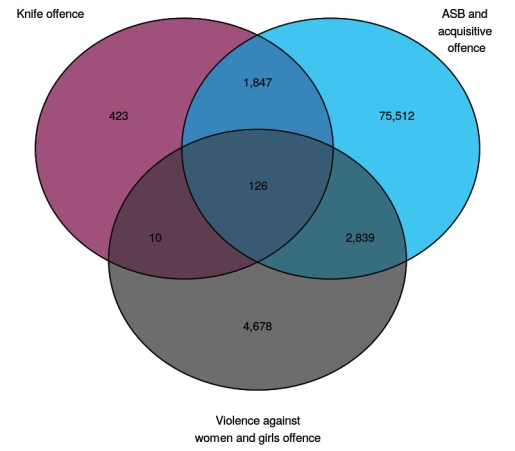
Among children and young people who were cautioned or sentenced for at least one knife, ASB and acquisitive or VAWG offence, most were cautioned or sentenced exclusively for ASB and acquisitive offences (75,512). More children and young people were cautioned or sentenced exclusively for VAWG offences (4,678) than for knife offences (423), while 126 were cautioned or sentenced for all three offence sub-groups.
Figure 2: A Venn diagram showing the proportion of children and young people cautioned or sentenced for at least one knife, ASB and acquisitive or violence against women and girls offence, for pupils matched to KS4 academic years 2013/14 to 2018/19 (Source: 3.1.1)[footnote 7]
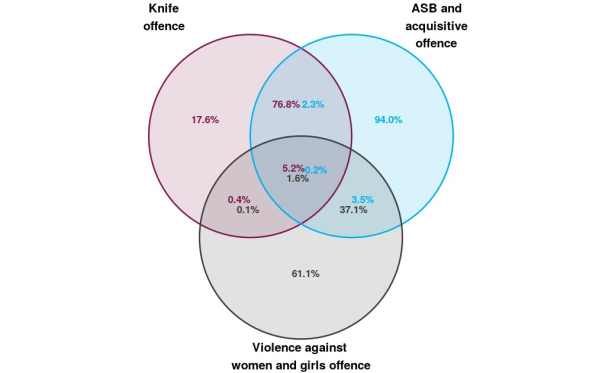
Single-offence involvement was most common for children and young people cautioned or sentenced for an ASB and acquisitive offence (94%) (Figure 2). In contrast, only 18% of those cautioned or sentenced for a knife offence had been involved solely in that offence, with 77% having also been cautioned or sentenced for an ASB and acquisitive offence. However, robbery offences accounted for 96% of this overlap, which are classified in both knife offence and ASB and acquisitive offence categories.
Of those who were cautioned or sentenced for a VAWG offence, 61% were only involved in a VAWG offence. Just over a third (37%) of children and young people cautioned or sentenced for a VAWG offence were also cautioned or sentenced for an ASB and acquisitive offence. Over half of the overlap is accounted for by breaches of restraining orders, which are counted under both offences. In contrast, a very small proportion (0.1%) of children and young people cautioned or sentenced for a VAWG offence were also cautioned or sentenced for a knife offence.[footnote 8]
5.2 Prior offending
Prior offending is defined as any offending for which a child or young person was subsequently cautioned or sentenced, committed before their first knife offence, ASB and acquisitive offence or VAWG offence. Further information on how prior offending is calculated is provided in the Technical Guide.
Figure 3: The proportion of children and young people who had been cautioned or sentenced for knife, ASB and acquisitive or violence against women and girls offences with a prior offence, for pupils matched to KS4 academic years 2013/14 to 2018/19 (Source: Table 3.2.1)
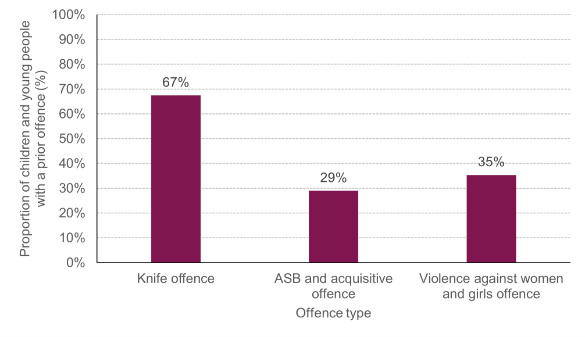
Two-thirds (67%) of children and young people cautioned or sentenced for a knife offence had a previous offence. This was lower for children and young people cautioned or sentenced for an ASB and acquisitive offence or VAWG offence, where 29% and 35% respectively had a previous offence.
The most common prior offences for children and young people who were cautioned or sentenced for knife offences were common assault and battery (41%), followed by criminal damage to property valued under £5,000 (35%) and possession of a Class B controlled drug (28%).
Similar patterns were reflected among children and young people who had been cautioned or sentenced for a VAWG offence, with common assault and battery (49%)[footnote 9], criminal damage to property valued under £5,000 (44%) and possession of a Class B controlled drug (17%) being the most common prior offences.
For children and young people who were cautioned or sentenced for ASB and acquisitive offences, the most common prior offences were common assault and battery (33%), assaults occasioning actual bodily harm (10%) and having an article with a blade or point in a public place (10%).
5.3 Reoffending
Reoffending is defined as a child or young person who, after receiving a (non-custodial) court conviction or caution for a first knife, ASB and acquisitive or VAWG offence (referred to as the index offence), commits a subsequent offence resulting in a court conviction or caution (referred to as the reoffence) within the follow-up period.[footnote 10]
Rates of reoffending were examined both for any reoffence, and a reoffence of the same type as the index offence. Reoffending rates were also examined based on the index disposal received, for those who receive cautions or non-custodial disposals.
Figure 4: Reoffending rates for children and young people cautioned or sentenced for an index offence of knife, ASB and acquisitive or violence against women and girls, for pupils matched to KS4 academic years 2013/14 to 2018/19 (Source: Table 3.4.1)
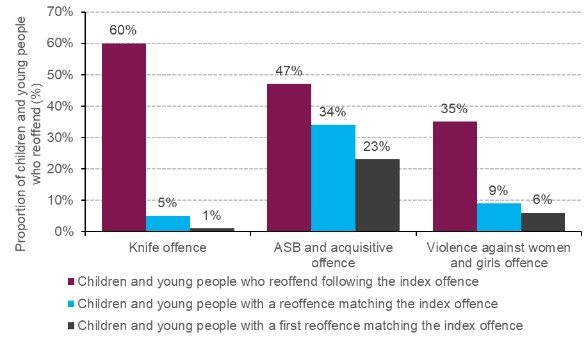
Among those who committed a knife index offence, 60% committed a further offence. Reoffending of any type was observed for 47% of those who committed an index offence of ASB and acquisitive offences, and for 35% of those who committed a VAWG index offence.[footnote 11](Figure 4).
Of those cautioned or sentenced for a knife index offence, 5% committed a knife reoffence, with an even smaller proportion (1%) of those committing a knife offence as their first reoffence. In contrast, approximately one third (34%) of children and young people with an ASB and acquisitive index offence committed an ASB and acquisitive reoffence within the follow-up period, including 23% for whom this was their first reoffence. Among those with a VAWG index offence, 9% committed a VAWG reoffence in the follow-up period, with 6% of these being their first reoffence (Figure 4).
5.4 Reoffending by index disposal
This analysis examines reoffending among children and young people who committed knife, ASB and acquisitive or VAWG index offences by the type of sentence the individual received for their index offence (referred to as the index disposal). The analysis only considers those that received cautions and non-custodial index disposals, due to a lack of release or time served information in the data used. Disposal code categories are outlined in Annex C of the Technical Guide.
Firstly, the analysis examined the overall reoffending rates – for any offence type at any time following the index disposal – by the type of index disposal received.
Figure 5: Reoffending rates, for any reoffence type, for children and young people cautioned or sentenced for an index offence of knife, ASB and acquisitive or violence against women and girls, by index disposal, for pupils matched to KS4 academic years 2013/14 to 2018/19 (Source: Table 3.5.1)[footnote 12][footnote 13]
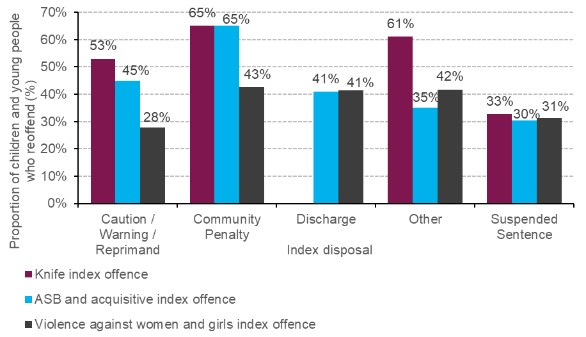
Reoffending rates varied by offence group and disposal type. For many disposals, children and young people cautioned or sentenced for a knife offence had comparatively higher reoffending rates than those in other offence groups, although this pattern was not observed for discharge, where rates are not reported. Variation between offence groups was more pronounced for certain disposal types, such as cautions and ‘other’ disposals.
Children or young people cautioned or convicted for ASB and acquisitive index offences show the widest variation in reoffending rates, ranging from 30% among those given suspended sentences to 65% of those given community penalties. In contrast, those cautioned or convicted for VAWG index offences exhibited the narrowest range of reoffending rates, from 28% for those receiving cautions to 43% for those who receive community penalties.
For all the offence groups, the highest rate of reoffending was observed for those receiving index disposals of community penalties. For both knife index offences and ASB and acquisitive index offences, the lowest reoffending rates were for those who received suspended sentences, while for VAWG index offences, the lowest rates were among those who received cautions.
The effectiveness of different sentences should not be compared because this analysis does not control for differences in offender characteristics. Factors that affect sentencing decisions, such as the severity of offence or the personal circumstances of an offender, do not form part of the data used for this analysis.
5.5 Time to reoffending
The median number of days is used as the average measure to reduce the impact of extreme values, including very short times to reoffending driven by individuals who reoffend frequently, and very long times after which the influence of the index disposal is likely to be minimal. More detail on the calculation of time to reoffending is available in the Technical Guide.
Figure 6: Median days to first reoffence, following a caution or conviction for an index offence of knife, ASB and acquisitive or violence against women and girls, by index disposal category, for pupils matched to KS4 academic years 2013/14 to 2018/19 (Source: Table 3.6.1)[footnote 14]
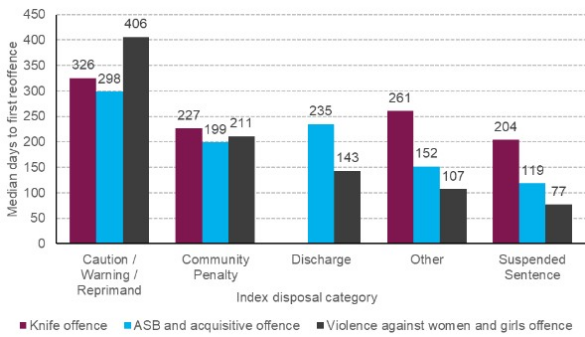
Time to first reoffence varied both by offence group and disposal type. Among those who reoffended, children and young people given suspended sentences had the shortest average time to first reoffence across all index offences (204 days for knife offences, 119 days for ASB and acquisitive offences and 77 days for VAWG offences), while ‘other’[footnote 15] disposals showed large variations by offence type.
In contrast, those who received cautions as an index disposal took the longest on average to reoffend, with average times ranging from approximately 10 months (298 days) for children and young people cautioned for ASB and acquisitive index offences to approximately 13.5 months for those cautioned for VAWG offences (406 days).
Across almost all offence groups and disposal categories, reoffending was most commonly recorded between two and six months after the index disposal, compared with earlier time periods. For children and young people cautioned or convicted of ASB and acquisitive or VAWG index offences in particular, the period between 2 and 6 months had the highest number of children and young people who reoffended across all disposal types, except cautions (Table 3.7.1).
A small proportion of children and young people reoffended very shortly after their index disposal. For ASB and acquisitive offences, over 2,000 children and young people committed a further offence within two weeks, representing around 6% of all reoffending in this group. While this is a minority of cases, it does indicate a small proportion of children and young people who reoffend within a very short period following their index disposal.
5.6 Distribution of offences across offending histories
This analysis examines offending patterns from before and after a child or young person’s first knife, ASB and acquisitive or VAWG offence on an offence basis. This is calculated from the first (earliest recorded) date on which a first knife offence, ASB and acquisitive offence or VAWG offence was committed, rather than the date of caution or conviction. These results should be interpreted as descriptive rather than comparative rates of offending over time. Additionally, this analysis is not comparable with the previous prior offending and reoffending sections of this report as those are based on individuals rather than offences.
Figure 7: Proportion of offences of any type before and after the first knife, ASB and acquisitive, and violence against women and girls offence, for pupils matched to KS4 academic years 2013/14 to 2018/19 (Source: 3.8.1)
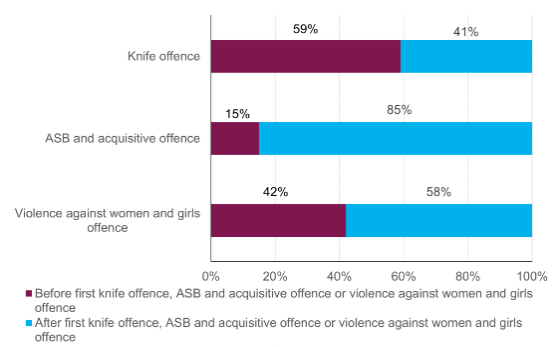
Figure 7 shows the proportion of offences of any type committed before and after a child or young person’s first knife, ASB and acquisitive or VAWG offence,[footnote 16] with offences included up to the end of the available data period.
For knife offences, a higher proportion of offences occurred prior to the first knife offence (59%) than afterwards (41%). For ASB and acquisitive offences, the pattern is reversed as most offences happened after the first offence in this group (85%), compared with 15% before. This suggests that these offences tend to appear in an early stage of children and young people’s offending histories. For VAWG offences, offending is more evenly split, with a slightly greater proportion occurring after the first VAWG offence (58%), indicating further offending often follows the first VAWG offence.
Figure 8: Average number of offences before and after the first knife, ASB and acquisitive or violence against women and girls offence by gender, for pupils matched to KS4 academic years 2013/14 to 2018/19 (Source: 3.9.1)[footnote 17]
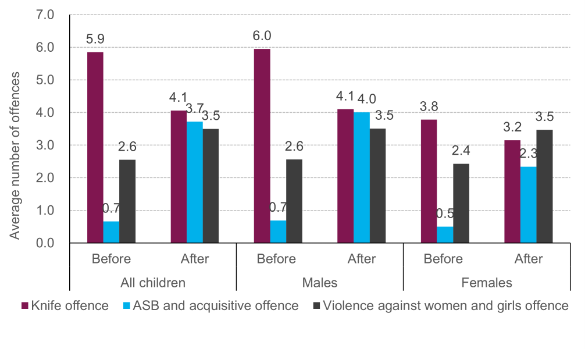
Figure 8 shows the average number of offences of any type committed before and after a child or young person’s first knife, ASB and acquisitive, or VAWG offence.[footnote 18] The highest average number of offences prior to a first offence within one of the three offence sub-groups was observed amongst those cautioned or sentenced for a knife offence (5.85). In contrast, the average number of prior offences was lower among those cautioned or sentenced for ASB and acquisitive offences, and VAWG offences (0.66 and 2.55 respectively).
The average number of offences after the first recorded offence was similar across the three offence sub-groups, at 4.06 for knife offences, 3.72 for ASB and acquisitive offences, and 3.50 for VAWG offences.
6. Contact details and feedback
These statistics have been produced by Ministry of Justice: Data First - GOV.UK
Any enquiries and feedback on these statistics can be sent to Ministry of Justice at datafirst@justice.gov.uk
6.1 Media contacts
Press enquiries should be directed to the Ministry of Justice press office: 020 3334 3536
-
Freedom from violence and abuse: a cross-government strategy - GOV.UK ↩
-
The definitions used for knife, ASB and acquisitive, and VAWG offences are outlined in the separately published Technical Guide, with offence codes provided in Annex A. ↩
-
Attempts to quantify the relative harm caused by different offences include the Cambridge Crime Harm Index, and ‘The economic and social costs of crime’ (Annex 1: Costs of crime index) published by the Home Office. ↩
-
Further information on the effectiveness of sentences given to young offenders are available in MoJ published analysis Impact of sentencing on proven reoffending for young offenders. ↩
-
No offence codes overlap across all three offence groups. ↩
-
Percentages shown within each intersection represent the proportion of children or young people that were cautioned or sentenced in each offence group who were also cautioned or sentenced for offences in the overlapping group(s). ↩
-
The offence code overlaps are detailed in Annex B of the separately published Technical Guide. ↩
-
Prior offences of common assault and battery could be domestic abuse-related; however, victim data is not available to determine whether these prior offences constitute VAWG. ↩
-
The follow-up period is measured from the date of conviction or caution, but excludes those who received a custodial sentence, and can cover a period of up to twelve years, from the individual’s first offence up to the age of 21. Further detail on the reoffending definition is available in the Technical Guide. ↩
-
Lower reoffending rates for those who committed a VAWG index offence are likely to be impacted by under-reporting of these offences and historically low rates of successful prosecution. ↩
-
One or more index disposal categories have been suppressed. ↩
-
Information on the grouping of disposal codes into categories can be found in Annex C of the Technical Guide. ↩
-
One or more index disposal categories have been suppressed. ↩
-
Full details of disposal codes included in ‘Other’ can be found in Annex C of the Technical Guide. ↩
-
This is calculated from the first (earliest recorded) date on which a knife offence, ASB and acquisitive offence or VAWG offence was committed. ↩
-
The average presented is the mean number of offences. The mean should be interpreted with caution, as it may be influenced by a small number of outliers. ↩
-
This is calculated from the first (earliest recorded) date on which a knife offence, ASB and acquisitive offence or VAWG offence was committed. ↩