OPG annual report and accounts 2025 to 2026 - web version
Published 15 July 2026
Applies to England and Wales

© Crown copyright 2026
This publication is licensed under the terms of the Open Government Licence v3.0 except where otherwise stated. To view this licence, visit nationalarchives.gov.uk/doc/open-government-licence/version/3 or write to the Information Policy Team, The National Archives, Kew, London TW9 4DU, or email: psi@nationalarchives.gov.uk.
Where we have identified any third party copyright information you will need to obtain permission from the copyright holders concerned.
This publication is available at https://www.gov.uk/government/publications/opg-annual-report-and-accounts-2025-to-2026/opg-annual-report-and-accounts-2025-to-2026-web-version
Overview
This section provides a high-level summary of the Office of the Public Guardian’s (OPG) activity over the year. It sets out our purpose, the challenges we navigated, and how we have performed against our operational targets and customer service standards for 2025 to 2026, as detailed within this section.
It includes:
-
a statement from the Public Guardian, reflecting on our progress, achievements and areas of focus throughout the year
-
an outline of OPG’s responsibilities, describing what we do, who we serve, our main stakeholders, how we work with the Ministry of Justice (MOJ), and the major risks and issues we addressed
-
a summary of our performance, highlighting how we measured up against our service delivery commitments
Across the year, we worked to maintain the service levels our customers rely on, with sustained high demand for all of OPG services. How we delivered these services, along with the risks and challenges we managed throughout the period, are explored in more detail from page 62 onwards.
The remaining pages of this report provide a fuller account of our performance, governance and accountability.
Statement from the Public Guardian and Chief Executive
I am delighted to introduce OPG’s annual report for 2025 to 2026, in my role as Public Guardian and Chief Executive. As you will read in this report, it has been a year in which demand for our services has continued to grow, and I am proud of how the organisation has stepped up to the challenges that this has presented and the innovation that has taken place in response. We have maintained a focus on our customers, while making sure we modernise and continue to transform how we deliver.
This year we received over 1.58 million applications for Lasting Powers of Attorney (LPAs) and Enduring Powers of Attorney (EPAs), averaging at almost 6,300 applications a day.
These applications have been processed by a committed and determined workforce. They have stepped up to respond to significant peaks in demand to make sure we continue to process LPAs in a timely way.
Despite this exceptionally high demand (an average increase of 19% over the last 5 years), the time it has taken to register and dispatch LPAs has been our fastest performance since 2019-2020, averaging 45 days across the year. In October 2025, we surpassed 10 million powers of attorney on the register. The quality of this service is reflected in the Customer Satisfaction levels, achieving 85% and completing 2 years of exceeding our target of 80% customer satisfaction.
High demand has been experienced across our statutory services, including a 6% increase in deputyship orders received. High demand has had the greatest impact on our Investigation service, where we experienced an increase of 17% in concerns being raised with OPG. In the past year risk assessments took place swiftly and exceeded our target, but we did not meet our target for the completion of investigations in 70 days.
To address the challenging demand in investigations, we made in-year changes and have also developed strategic interventions to improve this position, including investing in additional staff, technology and digital interventions and policy changes to improve the operating model and efficiency. It will take time for new staff to be fully trained, and for interventions to have full impact, so this will be a continued area of focus as we move into next year, to improve the time taken to investigate and take any action necessary.
For many customers our Contact Centre is their first port of call for support and this year we’ve achieved brilliant improvements in increasing the number of calls answered within 5 minutes from 57% to 89%. We achieved this by making better use of our technology to understand when demand is highest, and by ensuring we have the right people in place at the right times, including recruiting colleagues to work flexibly during peak periods.
Putting in place interventions to have a meaningful long-term impact has been a theme through the year. Continuous development and system improvements have been taking place across OPG including in Supervision, Information Assurance and in our Legal team. Our Legal team play a crucial role by ensuring we take proportionate court action, at the right time, and only where necessary. This year we introduced a new pre-action approach, which has enabled more cases to be resolved quickly by consent, delivering better outcomes for P and reduced stress for families.
The innovation that took place last year has also continued to deliver benefits this year. The change to supervision billing, by moving this service in-house, has led to a more responsive and higher-quality service for customers. We have also seen the lowest level of debts since at least 2019, when performance records began, due to better management of the process and improved support for customers who are eligible for fee remissions and exemptions to provide the necessary evidence.
We started the year anticipating a short-fall in income and set a very challenging budget to work towards achieving full cost recovery. We end the year at 103.4% cost recovery, having very closely managed the budget in-year, achieving in-year efficiencies and receiving higher than initially anticipated demand (and income) for LPAs. We also implemented an inflationary fee increase for the registration of LPAs and EPAs in November, in order to make sure we will achieve full cost recovery in the next financial year.
While we strive to provide excellent services, I recognise that we do not always get it right. We take answering and learning from customer concerns seriously, and this includes making sure they get a timely response to their correspondence. We maintained the performance achieved last year of responding to 90% of complaints within 10 working days. In the year ahead we’ll be continuing to invest and learn from the concerns customers raise, bringing together those who handle complaints into one team focused on our customer experience.
As shown by what we have achieved over the past year, people are at the heart of delivery in OPG. I’m proud to lead staff who are compassionate and determined. This year we saw a 1% increase in our staff engagement score, achieving 65%. The attrition rate has reduced further to 7.3%, an improvement from 8.5% last year. We continue to ensure that good support is available for colleagues, and I’m particularly grateful to our Mental Health First Aiders and Allies for the support that they provide.
We are also fortunate to be supported by functional colleagues with rich expertise from the Ministry of Justice, and to collaborate together to achieve OPG’s objectives. We benefit from working with a broad range of functional partners, including Finance, Digital and Technology, Data, Analysis, Justice AI, Communications, Project Delivery, Commercial, and People Services.
I am grateful to colleagues, the OPG Board, and the Ministry of Justice for their continued commitment and support this year. Together, we have made strong progress. We will build on this in the year ahead, continuing to improve how we deliver for our customers.
Ruth Duffin
Public Guardian and Chief Executive (Interim)
8 July 2026
Statement from the Non-Executive Board Chair
I am pleased to introduce this annual report for 2025 to 2026 and to reflect on a year of significant achievement for the Office of the Public Guardian (OPG).
Against a backdrop of continued high and still growing demand, colleagues across OPG have shown professionalism, resilience and a strong commitment to provide the excellent service that our customers deserve. In my visits to OPG, I have witnessed first-hand the dedication and compassion of our people in supporting our customers, who often need our services at particularly difficult times in their lives. I would like to thank everyone across the organisation for their hard work and enthusiasm in providing essential support with such care and diligence.
The board has seen some outstanding progress across the organisation, with sustained delivery of vital services whilst progressing continued improvement and modernisation in parallel. Investments in people, systems and ways of working are making a positive difference, and we have seen great results in our call centre performance and are successfully processing the highest LPA volumes in our history. It is also clear that there is real momentum behind OPG’s critical transformation journey, which is essential to enable further improvement.
At the same time, we must be realistic about the challenges that remain. There is more to do to consistently deliver the level of service to which OPG rightly aspires, particularly in areas under the greatest pressure and where customers are most vulnerable. The board remains clear that these issues must continue to be addressed with pace and focus.
Modernisation remains central to OPG’s future. Throughout the year, the board has provided oversight, challenge and support to ensure that changes are well governed, focused on customer experience and sustainable for the long term. Although some progress has been made, this is an ongoing journey, and the board is focused on accelerating change where it matters most. The year ahead will be crucial in embedding the many recent improvements and maximising transformation opportunities.
I am confident that, with the continued dedication of OPG’s people and the strong collaboration between the board and executive team, the organisation is well placed to build on this year’s achievements and drive further service improvements for customers.
Alison Sansome
Non-Executive Board Chair
About the Office of the Public Guardian
Introduction
The Public Guardian is appointed by the Lord Chancellor under section 57 of the Mental Capacity Act 2005. As the Chief Executive and Accounting Officer of OPG, the Public Guardian is personally responsible to the Lord Chancellor and Secretary of State for Justice for the effective operation of the agency, including the way the agency spends public money and manages its assets.
The Public Guardian is supported by OPG in the delivery of their statutory functions under the Mental Capacity Act 2005 and the additional functions from the Guardianship (Missing Persons) Act 2017. The Public Guardian’s responsibilities extend throughout England and Wales. Separate arrangements exist for Scotland and Northern Ireland.
The government ministers responsible for OPG during this reporting period (1 April 2025 to 31 March 2026) have been:
-
the Right Honourable Shabana Mahmood MP, Lord Chancellor and Secretary of State for Justice (from 5 July 2024 to 5 September 2025)
-
the Right Honourable David Lammy MP, Lord Chancellor and Secretary of State for Justice (from 5 September 2025)
-
Sarah Sackman KC MP, Minister of State for Courts and Legal Services (from 2 December 2024)
-
the Right Honourable The Baroness Levitt KC, Parliamentary Under-Secretary of State for Justice and the Lords Minister (from 6 September 2025)
As an executive agency, OPG is part of the MOJ departmental group, and our results are consolidated into the MOJ group annual report and accounts.
What does OPG do?
OPG was established in October 2007. We support and enable people to plan ahead for both their health and finances to be looked after should they lose capacity. We also work to protect the interests of people who may lack the mental capacity to make certain decisions for themselves.
Our principal responsibilities are:
-
registering lasting and enduring powers of attorney (LPAs and EPAs)
-
supervising deputies appointed by the Court of Protection (COP)
-
supervising guardians appointed by the High Court
-
maintaining the public registers of deputies, guardians, LPAs and EPAs, and responding to requests to search the registers
-
managing reports (including complaints) about the way in which attorneys, deputies, and guardians are exercising their powers
Our customers and stakeholders
Our customers are those who request or require our support under the Mental Capacity Act 2005 or the Guardianship (Missing Persons) Act 2017, including:
Donors
People who are making or have made an LPA or EPA to arrange for decisions to be made about their welfare, property or finances should they lose mental capacity in the future.
Clients (known as ‘P’)
People who have lost mental capacity and whose welfare, property or financial affairs are the subject of proceedings before the COP.
Missing Persons
People who have been reported missing or are absent and whose affairs are being managed by a guardian appointed by the High Court.
We recognise that our role also involves engaging with those connected to EPAs, LPAs, deputyships and guardianships, including:
Attorneys
People who have been appointed by donors to manage their welfare, property or financial affairs should they lose capacity in the future.
Deputies
Lay or professional individuals or authorities (such as solicitors or local authorities) who have been appointed by the COP to manage the welfare or finances of a client.
Guardians
Individuals who have been appointed by the High Court to manage the property and financial affairs of a person who is absent or has gone missing.
Other stakeholders
Relatives of a client or donor, GPs or other health professionals, charities, and members of the legal and financial sectors.
Performance analysis
How did we perform during 2025 to 2026?
This financial year, we responded to the largest and most sustained demand for LPAs that OPG has experienced to date. Over the year, we received 1,589,500 power of attorney applications. We are encouraged that so many people recognise the value of having a lasting power of attorney. Against this backdrop, OPG delivered its strongest performance in 5 years. The average time customers waited to receive their registered LPAs and EPAs improved again in 2025 to 2026, to 45 days, compared with 49 days in 2024 to 2025. Sustained increases in application volumes means we are reviewing our processes and performance commitments to ensure we remain transparent about delivery timescales and continue to provide a reliable and high-quality service.
Demand did not rise evenly, but came in pronounced waves throughout the year, creating periods of pressure on processing teams. These fluctuations made it more challenging and contributed to inconsistency in registration times. Despite this, we built on strong operational foundations from recent years, which helped us to manage these peaks more effectively at scale.
Our continued focus on providing excellent customer service is reflected in our highest ever customer satisfaction for power of attorney services, reaching 85%. Our customer contact centre answered the highest number of calls in any year at 396,541, up from 325,330 in 2024 to 2025. This is not an entirely like-for-like comparison to the number of calls received last year, due to operational changes that saw certain call queues move in and out of the Contact Centre’s remit. These changes were designed to better route customer queries and improve the overall customer experience. We were able to answer 89% of calls within 5 minutes, which is a significant improvement on 57% achieved in the previous year.
Demand for investigations continued to rise significantly this year, influenced by the growing number of LPAs on the register. We did not meet our target to conclude cases within 70 working days, and the investigation caseload increased compared with last year. This year we have focused on putting in place interventions to make long-term improvements to this service. In April 2025, we initiated a focused programme of work to strengthen investigative capability, improve triage, and prioritise serious concerns. We are introducing AI-enabled tools to reduce repetitive administrative tasks, allowing investigators to focus sooner on potential abuse. With demand continuing to rise, we are taking proactive steps to maintain a reliable, high-quality service. Our strengthened processes place the protected person at the centre of decision making and prioritise the most serious and high-risk cases, ensuring timely and appropriate support. These measures give us confidence that performance will continue to improve as they are fully implemented.
Alongside delivering our statutory functions, we have continued to modernise together as an organisation, strengthening how we operate today and preparing OPG for the future. We have reviewed and improved our internal structures and processes, including the creation of a dedicated Transformation Directorate. This provides a clear organisational focus on customer-centred change and ensures OPG is operationally ready to deliver and sustain future service transformation.
Over the year, we have introduced various practical improvements to modernise our services and customer experience. Sycurio’s secure payment solution was implemented to strengthen card payment security, while increased scanning capacity helped maintain service levels during periods of high demand. The new digital Raise a Concern service became the primary route for raising concerns, improving the quality of information received up front, supporting staff to operate the process more effectively, and creating a more consistent and transparent experience for those raising concerns. This reduced repeat contact and helped concerns progress more smoothly. We have also refreshed online guidance and resources for the Use and View service, improving clarity and ease of use for customers.
In addition, delivering supervision billing in-house for the first time strengthened quality control and debt management capability. This change enabled faster and more responsive recalculations and refunds, improved the accuracy of invoices, and made it easier for customers to receive clear and timely financial information. The new approach delivered financial efficiencies and resulted in savings of over £1.4 million over the financial year.
Integral to these achievements are our people, whose expertise and commitment support everything we do. We recognise that transformation is not only about systems, but about how we work together, use data and continuously improve services. The roll-out of our new Contact Centre system ‘Genesys’ during the first quarter of the year is an excellent example of our people working collaboratively to deliver significant change. This improved how we managed customer calls including call routing, agent availability and performance monitoring. Regular feedback sessions and action plans, comprehensive training and ongoing support ensured the change for our teams and customers, was effective, with minimal disruption.
Looking ahead, we expect sustained high levels of LPA demand to continue. With historical LPA backlog work cleared, our focus is on sustaining performance across core services while continuing to innovate and modernise through strengthened capability, improved triage, and expanded digital tools. Continued investment in customer service and a digitally enabled OPG leave us well placed to deliver our transformation portfolio and modernise services together.
We have continued to work with MOJ on the development of the modernised LPA service. Our focus has been on progressing the service design and the legislative changes to begin live testing. Given the scale and complexity of a service used by millions of people each year, it is important that we take the appropriate time to get the design right.
More detail on how the full range of targets and performance are measured can be found in the annex.
Performance indicators and workload
|
66,486 Supervision caseload |
|
1,589,500 Power of attorney applications received (LPAs and EPAs) |
|
10,620,245 LPAs and EPAs currently on the register |
How we performed:
|
45 working days Average actual clearance time for power of attorney applications Target: 40 working days |
|
31 working days Average time to obtain annual reports from deputies we supervise Target: 40 working days |
|
22 working days Average time to review deputies’ annual reports Target: 15 working days |
|
97% Percentage of safeguarding risk assessments carried out within 2 days Target: 95% |
|
198 working days Average time to conclude investigations Target: 70 working days |
|
89% Percentage of calls answered within 5 minutes Target: 90% |
|
85% Percentage of customers satisfied with power of attorney services Target: 80% |
|
38 working days Average working days to submit court applications Target: 35 working days |
|
90% Percentage of complaints fully responded to within 10 working days Target: 90% |
|
85% Satisfaction rate for ‘Use an LPA’ digital service Target: 80% |
|
85% Satisfaction rate for ‘Make an LPA’ digital service Target: 80% |
|
80% Satisfaction rate for ‘Complete a deputy report’ digital service Target: 80% |
Powers of attorney
LPAs and EPAs give individuals confidence that, should they lose the ability to make decisions in the future, someone they trust will be able to act on their behalf. The registration of these documents is one of OPG’s core functions.
Our customer service commitments in this area include:
-
registering and dispatching powers of attorney in an average of 40 working days
-
answering 90% of calls within 5 minutes
-
responding to 90% of complaints within 10 working days
This year, we received 1,589,500 applications to register LPAs and EPAs, marking a notable increase from last year and continuing the upward trend in demand for powers of attorney. The growth is illustrated in the graph below.
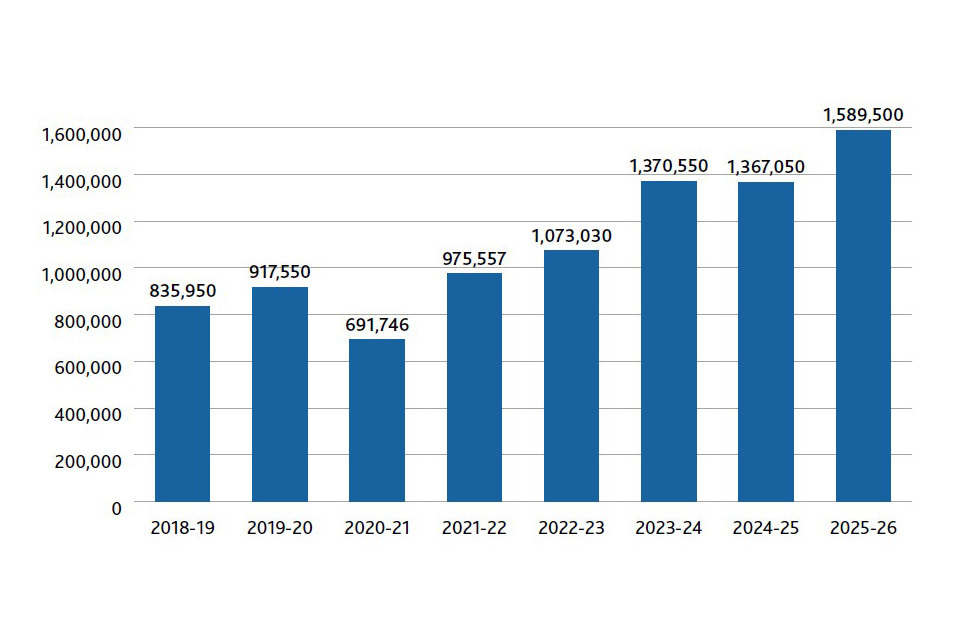
Demand for our power of attorney service remained exceptionally high throughout the year, with significant year-on-year growth in both applications and customer contact. This sustained level of activity reflects the continued importance of LPAs as a vital precaution that helps people to plan for their future and decision-making. At the end of this year, we had 10,620,245 LPAs and EPAs on our register, demonstrating the scale and reach of our service.
Application volumes remained high throughout the year, with several surges driven by a combination of seasonal factors, media attention and applications ahead of the fee change introduced during the financial year. The fee change led to an increase in application volumes, creating additional pressure on processing capacity. There was no subsequent dip in demand and volumes remained elevated for longer. We experienced several record-breaking days and weeks, including the highest daily intake (11,645) of applications ever recorded and a weekly average of (30,567) applications – our highest to date. In total 1,589,500 LPA and EPA applications were received, averaging 6,307 per day. The average time to register and dispatch LPAs and EPAs was 45 working days.
Customer service remained a strong area of performance. Satisfaction with our power of attorney service reached 85%, exceeding its satisfaction target of 80% and increasing from 84% in 2024 to 2025. This reflects our continuous improvements in service quality, greater process stability, and a strong focus on customer service throughout the year.
Service improvements
This year we continued to strengthen and modernise our power of attorney service, improving the customer experience, strengthening our digital systems, and increasing operational efficiency with:
Enhanced telephony
In 2025 to 2026 we continued to roll-out and make fuller use of the Genesys telephony platform across our service, supporting a more resilient and flexible system for both our processing teams and the Contact Centre. As our use of the system matured, we improved stability and our ability to manage high call volumes, and this contributed to a reduction in average wait times of 76%, from 6 minutes 19 seconds in 2024 to 2025 to 1 minute 18 seconds in 2025 to 2026. Enhancements to our Interactive Voice Response system, including improved routing and voice-recognition features, helped customers reach the right service more efficiently. During the year, the Genesys telephony platform was extended to additional teams, including LPA Casework.
Digital and scanning improvements
Last year, we invested in both new scanners and new software to support higher volumes of applications received throughout the year. Along with providing higher-quality images and faster processing, this also ensures we can maintain service levels and process documents efficiently during periods of increased demand.
Improvements to the Use an LPA and View an LPA Services
Enhancing the experience for customers using our ‘Use an LPA’ and ‘View an LPA’ services remained a major focus. This service allows donors and attorneys to share details of an LPA with third parties by generating a secure access code. Banks, healthcare providers or solicitors can then use the View an LPA service to access it when needed. We updated online guidance and provided clearer step-by-step information. These improvements support wider use of the service and help customers navigate it with greater confidence.
Your Voice, Your Decision campaign
Our Your Voice, Your Decision campaign is designed to raise public awareness of the importance of LPAs. We have continued to extend the campaign in specific locations across England and Wales to encourage greater uptake of LPAs among target audiences. In the last year, the campaign has been delivered in Greater Manchester, East Midlands, Leeds, West Midlands, North Wales and the North West. By working with local authorities, NHS trusts, community networks, faith groups, and local organisations trusted by the audiences we targeted, we have been able to increase the reach and impact of our campaign.
Looking ahead for the powers of attorney service
Looking ahead, we will continue to deliver a high-quality, effective powers of the attorney service that meets the needs of a growing number of people choosing to put a power of attorney in place. We are improving call routing so customers are connected to the right person first time, particularly for office copy and application fee queries, reducing unnecessary transfers and repeat contact. We also plan to introduce an updated fee remission and exemption policy to provide clearer guidance and better support for eligible customers. Together, these improvements will ensure our services remain modern, accessible, and resilient despite high demand.
Supervision
If an individual has lost mental capacity and does not have an EPA or LPA in place, the Court of Protection can appoint a deputy to make decisions about that individual’s finances or health. Deputies can be members of the public, often family members, friends or neighbours, as well as professional firms or local authorities. Members of the public who act as deputies are referred to as ‘lay’ deputies. Professional and public authority (PA) deputies are authorised to charge for the work they carry out while acting as a deputy.
Our Supervision function involves ensuring that all deputies understand their responsibilities and act in the best interests of the person they are supporting.
The caseload is determined by the total number of individuals for whom deputies have been appointed. These individuals are referred to as ‘P’ (the Protected Person) by the Mental Capacity Act 2005.
This year, there has been an increase in the number of deputyship orders received from the Court of Protection (the Court). The number of deputyships has increased by 5.6%, from 61,038 at the end of 2024 to 2025 to 64,456 at the end of 2025 to 2026.
The Deputy Standards set out the expected behaviours and responsibilities for all court appointed deputies and provides the framework for OPG’s supervision, in line with the Mental Capacity Act 2005 and Court of Protection orders. They focus on acting in P’s best interests, appropriate financial management, accurate record-keeping, timely reporting, and constructive engagement with OPG. The standards are used throughout supervision to assess risk, decide the level of oversight needed, and determine when support or further action is required.
The standards are applied proportionately. Lay deputies are mainly supported through guidance, visits and supervision to help them understand and carry out their responsibilities. Professional and public authority deputies may act for multiple protected persons and charge for their services. They are therefore held to higher expectations around governance, financial management and responsiveness, with closer scrutiny where risks are identified.
Deputies appointed by the Court of Protection must keep clear and accurate records, behave responsibly and transparently, and submit annual reports to the OPG, outlining the decisions they have made and how they have managed the individual’s affairs. Our digital reporting service, ‘Complete the deputy report online’, supports deputies to submit their annual reports more easily. Over the past year, we made further improvements to support deputies with multiple clients, and to accommodate cases where different deputies hold separate orders for the same person. The satisfaction rate for this service remains consistent with 2024 to 2025 levels at 70%.
We aim to obtain annual reports from deputies we supervise within 40 working days of the end of their reporting period, and we met this target by achieving an average of 31 working days, down from 33 working days in 2024 to 2025. This is a strong indicator of compliance with wider standards.
We aim to review deputies’ annual reports within 15 working days of receipt, but we have not achieved this target this year. This is primarily due to staffing levels and an increasing caseload. It is also linked to the prioritisation of activity to ensure newly appointed lay deputies understand their responsibilities, alongside prioritising resources for the most vulnerable cases and ensuring appropriate measures are in place to protect P where required. We are recruiting to strengthen capacity and expect to return to target in the year ahead.
Deputies are required to pay fees from P’s funds for OPG’s supervision, including a one-off assessment fee at the start of the deputyship and an ongoing annual supervision fee, depending on the level of supervision required. This year, customer service improved following last year’s investment in an in-house billing system and the transition to a new finance hub. Alongside redesigned processes for handling fee reduction or waiver requests and the removal of longstanding backlogs, this has strengthened debt recovery and improved financial transparency. As a result, outstanding supervision debt reduced from £3.1 million at the end of 2024 to 2025 to £2.7 million at the end of this financial year, giving us our best outstanding debt position in more than a decade.
Service improvements
Panel deputies
The Public Guardian oversees a panel of reserve professional deputies on behalf of the Court of Protection. They serve when no other person or party is willing or assessed as having the necessary skills and expertise to act as a deputy under a deputyship order, or where cases are particularly complex.
The previous panel of deputies, appointed in 2015 for a 10-year term, concluded their appointments on 31 December 2025. To form the new panel, we launched a recruitment campaign for professional deputies to sit on the panel. The new Panel came into effect on 1 January 2026, along with the re appointment of some panel deputies who had been on the panel previously. We also appointed a number of new panel deputies, increasing the membership from 52 deputies to 127. This significant expansion strengthens the supply of high-quality professional deputies to support the Court of Protection and broadens the availability across England and Wales, with particularly improved coverage in Wales and the north east of England.
As part of this process, we have made our expectations of panel deputies clearer. Where standards are not met, or issues need to be resolved, processes are now in place to suspend or remove a deputy from the panel, ensuring that only those who meet the required standards remain. We have also strengthened our induction process, providing greater clarity, consistency and assurance around deputies’ ongoing commitment to the role.
We intend to run regular recruitment campaigns when required in future to ensure the Panel remains resilient and continues to meet the needs of the Court of Protection and the individuals we serve.
Looking ahead for the supervision service
Looking ahead, supervision will focus on continuing to develop a modern and resilient service for the future. Recruitment will remain a priority to strengthen capacity, alongside closer collaboration with the Court of Protection to enhance data exchange. We will also continue to respond and align with judgments from the Court of Protection on how deputies discharge their responsibilities to ensure our supervision service remains robust and responsive.
Missing persons
OPG also has a statutory responsibility to supervise guardians appointed for Missing Persons. While the numbers supervised each year are low, these High Court orders provide vital support to families and friends dealing with the disappearance of a loved one, helping them manage financial matters during an already distressing time. This year we supervised 7 Guardianship orders, up from 6 in 2024 to 2025.
OPG continues to work closely with the charity Missing People, which provides support and advice for friends and families of missing persons, helping them better understand the challenges faced when applying for a Guardianship order and how these can be eased.
Investigations
The Public Guardian has a statutory role in investigating concerns about how attorneys or court-appointed deputies exercise their powers in relation to a person who lacks mental capacity. Where appropriate, we carry out investigations to assess whether the best interests of the donor or the protected person (referred to as P) are being met. Our oversight as Public Guardian ends if the donor dies, or if the power of attorney or court order ceases.
We observed continued year-on-year growth in concerns being raised with the OPG, alongside a significant increase in investigation activity. In 2025 to 2026, 13,183 concerns were raised with OPG, up from 11,266 in 2024 to 2025, representing a 17% rise. Of the 13,183 concerns received 9,538 were signposted to other services (72%), compared to 7,732 in 2024 to 2025 and 3,645 were accepted into investigations (28%) compared to 3,823 in 2024 to 2025. The slight decrease reflects an increased focus on large, complex investigations, as well as our strengthened triage process that reduces the number of invalid concerns progressing to investigations.
The continued growth in LPA demand has been contributed to a proportional increase in the number of concerns being raised with OPG and subsequent investigations we have opened. This reflects greater public awareness of the oversight provided by OPG.
This year, we have been unable to respond to demand at the pace we have set as our target. Instead, the time taken to complete an investigation increased to 198 days, from 138 days in the previous year, against a target of 70 days. This level of performance does not reflect our ambition. As a result, this year we established an Investigations Project to address the challenges we face and to put OPG in a stronger position to respond to demand in future years. Several strands of work are being progressed as part of this project, which we expect to have a meaningful impact in the next reporting year, including:
-
Increased resourcing to meet forecast demand: we have invested in and expanded our investigations teams, which increases our capacity on an ongoing basis with newly trained investigators strengthening our ability to meet demand
-
Technology interventions: developing and testing digital, data and artificial intelligence tools to support investigators in their roles and to improve efficiencies
-
Forecasting and analysis: using data to enhance forecasting and future demand to support planning, alongside analysing the underlying causes of concerns raised
-
Policy: refining our thresholds for progressing a concern to investigation, making sure that we prioritise OPG intervention for high-risk matters, and reducing the number of investigations where the concerns raised do not warrant further action
Where concerns are raised that could lead to an application to the Court to remove an attorney, our approach is to be transparent. We explain the concerns to the affected attorney and set out their rights, including the option to step down from the role.
We have maintained a strong performance in reviewing potential safeguarding concerns. Safeguarding refers to how we identify, assess and respond to concerns that a person who lacks capacity may be at risk of abuse or harm. During the year, 97% of concerns were reviewed within 2 working days, exceeding the safeguarding target of 95%. The team also responded to 95% of concerns within 5 working days, against a target of 95%.
Overall, we closed 2,982 investigations in 2025 to 2026 compared with 2,959 in the previous year. We had 3,224 active investigations as of 31 March 2026 compared to 2,566 at the same time last year. During the year:
-
13% of investigations resulted in Court of Protection action, compared with 11% last year
-
5% of investigations were resolved using alternative approaches to court action, such as asking attorneys to provide a revised account in a few months to demonstrate adherence with the code of practice, compared to 5% last year
-
82% of investigations carried out required no further action because they were resolved as a result of OPG’s investigation or there was no evidence regarding concerns raised, compared with 84% last year
The previously published figure of 3,465 closed investigations for 2024 to 2025 has been revised following a data cleanse of our case management system carried out in March 2025. This review identified that a number of historic cases were included in the closure total, despite OPG’s investigative activity having concluded in earlier years and those cases subsequently progressing through legal proceedings or being handled by other agencies. The corrected figure for investigations concluded by OPG in 2024 to 2025 is 2,959. As a result, the outcome percentages published previously were inaccurate. The corrected figures are being used for comparison against 2025 to 2026 performance.
Service improvements
Alongside the longer-term Investigations Project, we implemented several practical service improvements that are already changing how Investigations operate day-to-day.
Smarter ways of working
Increased triage work for cases currently in the backlog which has meant we have been able to gather further information that has supported the investigators to conclude investigations more efficiently. This work is now rolled out as a business-as-usual process due to its benefits.
Escalation and de-escalation improvements
Following the success of the pilot in the previous financial year, a complexity-based process for escalating and deescalating cases has been implemented in full. This allows resources to be used proportionately, based on the complexity of the concerns raised, through a more flexible approach to assessing incoming cases.
Policy Changes
Both short and long-term policy changes have been implemented to manage the current and future demand and supports more consistent and timely decision-making. This includes making the disclaimer policy clearer and easier for attorneys to understand, and easier for staff to apply.
Improving access to service
Improving accessibility to our services is essential to continuously enhance the support we provide. A new digital Raise a Concern service launched successfully in October 2025 and has already received over 1200 submissions. This has made it easier for the public to raise concerns and has streamlined the process from start to finish. It ensures that people raising a concern are prompted to provide the information needed for it to be properly assessed and, where appropriate, progressed to investigation.
Care home fees
Following the success of a care home fee pilot in the previous financial year, this has now been fully implemented. This means that where care home fees are not paid, we notify the attorneys and request action is taken, rather than commencing a full investigation to rectify the issue. This empowers attorneys to resolve concerns themselves and helps make sure investigation resource is used where intervention is required.
Looking ahead for Investigations service
Looking ahead, we will build on the work carried out this year to continue modernising our Investigations service in line with our statutory powers and to strengthen our ability to respond effectively to rising demand. Our focus is on embedding improvements that support more timely, proportionate and consistent decision making, leading to better outcomes for people we serve and investigations being concluded more efficiently.
These include targeted investment in additional investigative capacity through recruitment and training. They also include the development and testing of digital, data and AI enabled tools to reduce administrative burden and support investigators’ professional judgement, and enhanced use of data to improve forecasting, understand demand drivers and support planning. Alongside this, we are refining policy and decision-making approaches to prioritise OPG intervention on higher risk matters and that concerns are directed through the most appropriate routes.
A full review of the investigation journey is underway to support delivery of a more efficient and sustainable operating model. This work is focused on clarifying what the service of the future needs to look like to better serve our customers and stakeholders.
An example of a case that led OPG to pursue court action
Concerns were raised by a local authority that the attorneys were neglecting the donor’s care needs and misappropriating the donor’s funds through significant gifting. The donor was assessed as lacking capacity to address the concerns themselves, along with the operation of their LPA. This meant that OPG had the power to investigate.
The attorneys failed to provide accounts to OPG in relation to the management of the donor’s financial affairs. As part of the investigation, OPG obtained evidence from the relevant financial institutions. This established that the donor was in debt and, on the balance of probability, concerns about financial misappropriation were upheld.
Further evidence suggested, on the balance of probability, that the attorneys were neglecting the donor’s care needs. As a result, the donor had suffered significant injuries. Due to the severity of these injuries, the police were also involved.
Following the investigation, OPG made an application to the Court of Protection to revoke both LPAs and appoint a panel deputy to manage the donor’s affairs moving forward. The Court agreed with this position and both LPAs were revoked and a deputy was appointed.
An example of a case that required no further action
Concerns were raised to OPG after a care home served an eviction notice on the donor due to unpaid care fees and failure to provide financial information.
An investigation into the management of the donor’s finances was carried out. This included a review of their accounts and any assets owned, and their reasons for failing to provide necessary information. The investigation found no evidence of financial mismanagement or abuse of position by the attorneys. It established that the attorneys were in discussions between themselves, and considering whether to sell the donor’s property to pay the fees owed, or place a deferred payment against the donor’s property. They found the decision overwhelming and had been unable to reach a conclusion as quickly as they intended.
With the support of OPG and the local authority, the attorneys recognised the importance of prioritising this matter, and collectively agreed to opt for a deferred payment against the donor’s property. The attorneys shared the necessary financial information with the local authority following the decision. This enabled the care fee debt to be cleared, the eviction notice to be removed, and the donor’s fees met on an ongoing basis.
On this basis, OPG took no further action and closed the investigation with guidance provided to the attorneys.
Visits
We work with our Court of Protection visitors, who carry out visits to protected persons (who have active deputyship orders in place), donors, attorneys and deputies. Where required, visits are carried out by a specialist medical visitor to provide additional expertise.
Visits allow us to:
-
make sure people understand and are carrying out their duties effectively
-
make sure those who need support are receiving it
-
seek information as part of investigations (e.g. capacity assessment)
During 2025 to 2026, our Visits team commissioned 10,647 visits compared to 12,388 visits in 2024 to 2025. In addition, OPG also commissions visits on behalf of the Court of Protection, including visits carried out under section 49 of the Mental Capacity Act and Deprivation of Liberty Safeguard assessments. During the year, we carried out one Court of Protection visitor recruitment campaigns, resulting in the appointment of 30 new general visitors and re appointment of 11 existing general visitors.
In 2025 to 2026 we:
-
allocated 95% of standard visit commissions within 5 working days
-
allocated 98.6% of urgent visit commissions within 2 working days
-
processed 99.7% of all completed visit reports within 5 working days
Legal
Our Legal team provides a range of specialist legal services to support the Public Guardian to carry out their statutory functions. The team manages a large number of litigation cases issued in the Court of Protection, as well as any litigation brought against OPG. Alongside this, they provide legal advice and guidance to support the organisation’s day to-day operations and strategic priorities.
Throughout the year, our Legal team represented the Public Guardian in a range of litigation. The majority of cases involved applying to the Court of Protection to remove attorneys or deputies who were not meeting their duties under the Mental Capacity Act 2005. The team manages both standard cases (individual, unique matters) and multi-cases (multiple cases relating to the same attorney or deputy). The caseload is mainly made up of standard cases, which progress to the Court application stage once the required level of evidence has been gathered.
In 2025 to 2026, we filed 431 supervision and investigation applications with the Court, compared with 509 in 2024 to 2025. This difference reflects a combination of making sure we only filed the right cases at the right time and a change as to how we manage multi-case applications. In previous years, we typically filed the whole set of multi-case applications at the same time. However, as these applications are shaped by Court direction and external counsel advice, we now take a different approach to filing. We usually file a small number of test cases relating to the same attorney or deputy first, with the remaining applications filed later once those test cases have been heard by the Court.
We continue to have a target of an average of 35 working days to issue Court applications. This is measured from the point at which a case is formally accepted by the team as requiring Court action to the point at which the application is filed in Court. This year we issued Court proceedings in an average of 38 working days, down from 46 in 2024 to 2025. This reduction in time reflects improved team efficiency and the pre-action engagement initiative outlined below.
Multi-cases, although representing a small proportion of the overall caseload, have a disproportionate impact on the overall average time taken in the KPI. In 2025 to 2026, excluding multi-cases, we issued Court proceedings in an average of 36 working days. We are therefore monitoring this to assess whether the KPI should formally reflect this in the future.
This year, we also started reporting against a measure to determine whether OPG is making appropriate decisions when filing applications in the Court of Protection. The target is that in 98% of cases, OPG’s application is not rejected and costs are not awarded against OPG. In 2025 to 2026 we achieved 99% against this target.
We also regularly conducted litigation to clarify the legal validity of certain types of LPAs received by OPG. These applications sought judicial rulings on whether specific instructions or preferences within these LPAs were legally compliant. This enabled unlawful elements to be removed and ensured the donor’s best interests and intentions were protected. In 2025 to 2026, OPG filed 965 applications with the Court to resolve these LPAs, compared with 1,220 in the previous year. The number of applications made depends on the volume of referrals to the Legal team.
Service improvements
Given the continued growth in LPAs and deputyships, the increasing number of concerns being raised with OPG for an investigation, and the resulting demand on legal services, we have been working to make positive changes to our practices so that we can provide the best value possible for OPG and our customers.
Pre-action engagement
We have introduced a new pre-action engagement initiative. In appropriate cases, once a case has been accepted by the Legal team, we contact the relevant party to clearly set out OPG’s concerns and the outcome we are seeking. The aim is to resolve matters by consent, either through agreement to a pre-prepared consent order (a draft order setting out the actions the parties have agreed to take, which can be submitted directly to the Court for approval) or through early discussion on how to resolve outstanding issues without the need for multiple hearings or prolonged litigation. In 2025 to 2026, we filed 161 pre-action applications with the Court. In addition, applications were no longer required in 33 cases, including where the attorney disclaimed (formally stepping down as an attorney) before the application was made.
Having this comprehensive contact at the outset has led to a high level of positive engagement with the initiative. Rather than matters taking 12 to 18 months to progress through the Court system, cases where we have reached agreement through pre-action are now usually being resolved much quicker. This means fewer or no Court hearings and most importantly a better outcome for P. For comparison, the average time taken for a case that has been signed off by our Investigation and Supervision services, and receipt of the final Court Order confirming the judicial decision is 72 working days for consented pre-action applications compared with 161 working days for non-pre-action applications.
Strengthening digital processes
During 2025 to 2026, we also strengthened our digital capability by expanding the use of electronic services in our workflows. This has enabled more Court of Protection documents to be served securely by email from the initial order onwards, supported by clearer templates and early consent processes that reduce delays and improve reliability. We also increased adoption of the Document Upload Centre (DUC), with all regional Court of Protection teams now onboarded. This has improved the speed and consistency of information exchange with professionals and parties. Alongside this, we made improvements to the Case Management System (CMS), including standardised tasks, updated time-recording wording and stabilised functionality, further embedding digital ways of working and supporting more efficient case progression.
Looking ahead for Legal Services
The Legal team are focusing in the coming year on strengthening early engagement, improving customer clarity, and boosting operational efficiency. The main priorities include:
-
refining the pre-action process to encourage earlier, structured contact that reduces avoidable Court applications
-
reviewing customer facing correspondence to ensure consistency and clearer explanations
-
enhancing the case management system to better record customer preferences, service methods, and legal milestones for improved assurance and audit
The team will continue exploring safe, well governed use of AI and automation to support our lawyers, particularly in document review, template quality assurance, and workflow efficiency, in line with MOJ and Cabinet Office frameworks. AI will be used to assist and inform, not replace, professional decision-making, helping to improve customer experience, strengthen data quality and oversight, and ensure effective deployment of legal resources across all work.
Information assurance
Our Information Assurance (IA) team works closely with our Legal team in the same directorate to ensure OPG’s compliance with statutory data protection requirements. The IA team works with OPG’s Senior Information Risk Owner (SIRO) and MOJ Data Protection and Disclosure colleagues to manage risk following approved processes and in cross organisational meetings.
The team handle all Freedom of Information (FOI) requests on behalf of the Public Guardian. In this reporting period, we responded to 80 FOI requests, compared to 68 during 2024 to 2025, as well as 5 FOI reviews. FOI requests require a response within 20 working days, and we have a 90% target for compliance. This year, we have responded to 97.5% of FOI requests within 20 working days, compared to 96% during 2024 to 2025. In addition, the team handle all Subject Access Requests (SARs) on behalf of the Public Guardian. In this reporting period, we responded to 146 of these, compared to 119 during 2024 to 2025, as well as 23 SAR reviews. SARs require a response within 1 calendar month, and we have a 90% target for compliance. This year, our response rate against this statutory period was 98.6%, compared to 97% in 2024 to 2025.
The team also handle non-statutory information requests that are received by OPG. These include, but are not limited to, requests for information made by the police, local authorities, NHS Trusts, MPs and their offices, and the Solicitors Regulation Authority. In this reporting period, we managed 3,592 business as usual requests compared to 3,066 during 2024 to 2025.
Information breach management continues to be an important function for the team, using an improved incident reporting process. OPG processes high volumes of personal data, with the potential for that data to be sent to the wrong recipient in error. Some of this personal data is sensitive (health and financial information) and has a higher impact if inappropriately disclosed. OPG was responsible for 2,476 information losses and breaches of information security, in comparison with 2024 to 2025 where the number was 2,281. No information losses were deemed high enough to warrant notification by OPG to the Information Commissioner’s Office (ICO). OPG is supported in the assessment of data breaches by the central MOJ Data Protection team who independently evaluate the threshold against ICO guidance.
During 2025 to 2026, we have invested in training for staff in the Information Assurance team, to provide them with professionally certified qualifications in GDPR and FOIA.
Service improvements
Supporting transformation
The team has continued to support transformation projects across OPG, including MLPA and the testing and exploring of AI by ensuring the appropriate information governance is in place to ensure we remain compliant with UK GDPR.
Strengthening assurance and record management
The team has rolled out a comprehensive program of records audits across the organisation to provide assurance to Information Asset Owners that records are being managed appropriately.
Looking ahead for Information Assurance
The IA team will continue to work with other government departments on relevant data sharing agreements, whilst also playing a central role in the OPG Data Improvement Project to strengthen organisational data management. Alongside this, the team will maintain core records management responsibilities through ongoing audits that provide assurance to Information Asset Owners and the Senior Information Risk Owner that records across the business are being managed appropriately.
Customer contact
At OPG, we remain committed to providing a service that is supportive, efficient and positive for all our customers. During the year, our Contact Centre handled sustained and exceptionally high levels of demand and continued to deliver a strong service for our customers despite this pressure. As the primary route of contact our telephone advisors supported customers with a wide range of queries, from help completing documents to guidance on using our services, consistently demonstrating professionalism, resilience and a clear focus on customer care. Whilst performance targets were challenging in the context of demand, the service delivered represented a significant improvement and reflects the dedication and capability of our Contact Centre staff.
In 2025 to 2026, we delivered a strong and resilient customer contact service despite sustained, exceptionally high demand across all channels. Routing all calls through our single 0300 number directly to the supervision team significantly improved speed of response and helped customers reach the right service first time.
Service improvements
We expanded our digital and hybrid contact options to give customers more flexibility. This included using MS Teams Voice to improve telephone responsiveness, wider use of a secure document-sharing platform for exchanging large or sensitive information, and the further rollout of the Document Upload Centre for court bundles. For customers who prefer or require non-digital contact, we increased the number of Xerox services to issue letters and other correspondence by post more promptly. We also continued to provide communications in Welsh and large-print formats to support accessibility.
Alongside these improvements, we introduced the new digital Raise a Concern service, aligned to a standardised process that provides a clearer, more consistent customer experience and ensures we receive information required upfront. Within our Investigation services, we began piloting AI powered call transcription to support accuracy, reduce manual intervention and improve the quality of our service. Updates to case management systems, including recording customers’ preferred method of contact, further supported a more personalised response.
Overall, these developments improved efficiency, reduced delays and strengthened the customer experience across our phone, email and postal channels.
Stakeholder Engagement
We engage regularly with stakeholders, including organisations and partners who have an interest in how OPG delivers its services, and more widely to groups where increased awareness of OPG activity is valuable to our customers. We use insight from stakeholder engagement to provide strategic advice and to help shape policy and operational practice. This ensures our services remain trusted, well-informed and responsive to the needs of the public.
During the year, our strategic engagement activity expanded significantly, increasing the number of stakeholders we engaged with from 62 in 2024 to 2025 to 86 in 2025 to 2026. This was vital in strengthening OPG’s visibility. It also ensured stakeholders were given timely, advance notice of organisational messages and changes that could affect them across the legal, finance, charity, health and social care sectors, as well as other government departments and local authorities. We maintained a regular meeting cycle with main stakeholders and developed new relationships in areas where we identified gaps, including the charity sector. We also strengthened our engagement with the legal profession through closer collaboration with the Law Society and maintained our relationships with colleagues providing similar services in Scotland, Northern Ireland and Ireland. We have prioritised ensuring there is consistent dialogue with our stakeholders and clearer routes for feedback on our services and priorities.
To enhance the quality and credibility of our engagement, we involved senior leaders and subject matter experts from across the organisation to brief stakeholders and give presentations. This ensured that stakeholders heard directly from those responsible for operational delivery and policy development and demonstrated the value of drawing on expertise from across OPG. We delivered 33 webinars, reaching 3,308 attendees, covering a range of topics including the importance of LPAs, understanding deputyships, and planned service improvements. Highlights included the launch of a new webinar series for the health and social care sector, the first of which was attended by 1,465 professionals. We also hosted our first carers focused event during Carers Week, led by the Public Guardian, which reached 455 attendees.
At the request of stakeholders, we attended 7 conferences. By delivering keynote speeches, taking part in panel events and contributing to themed discussions, we raised awareness and improved understanding of our main priorities. These included fees, the digital launch of ‘Report a Concern’, and the refreshed panel deputy recruitment process. We also held 53 meetings with stakeholders from across the legal, finance, charity, and health and social care sectors, including regulators, membership bodies and professional networks. Evaluation of our outreach activity shows that these events improve attendee knowledge and understanding. Improving stakeholder understanding matters because it enables people and organisations to access and use OPG services more effectively, supporting a better customer experience and building trust and confidence in our work. We will continue to assess the effectiveness of our engagement activity to ensure it delivers value and strengthens relationships with stakeholders across all sectors.
Complaints
Customer complaints to OPG are managed through a structured, two-tiered process. At tier 1, complaints are reviewed and responded to by the business area responsible for the issue. If a customer is dissatisfied by the outcome, they can request that the complaint be escalated to tier 2. At tier 2, the complaint and its handling are reviewed by the Public Guardian or a senior leader acting on their behalf. The tier 2 team also oversees all correspondence received from members of Parliament. In total, we received 4,837 complaints this year, an increase from 3,926 in 2024 to 2025. We also handled 143 pieces of parliamentary correspondence, an increase from 87 in 2024 to 2025.
If a customer remains dissatisfied after receiving our tier 2 response, they may ask their MP to refer the matter to the Parliamentary and Health Service Ombudsman (PHSO) for an independent review. As part of its assessment, the PHSO may request additional information from OPG before deciding whether a formal investigation is required. No cases were accepted for investigation by the PHSO during 2025 to 2026.
Our response time for complaints remained strong throughout the year. Although the government standard is to respond within 20 working days, we have set ourselves a significantly more demanding target of responding to 90% of complaints within 10 working days. We successfully met this higher standard, responding to 90% of complaints within 10 working days.
Service improvements
Complaints reporting
We provide regular complaints reports to senior management, sharing essential insights across the organisation to support learning and service improvements. This reporting strengthens oversight of complaint themes and trends, helps us take timely action to address root causes, and supports monitoring of progress against agreed improvements. Analysing and sharing complaints data helps drive consistent service quality and reinforces a customer focused approach across OPG, in line with the principles of the Parliamentary and Health Service Ombudsman’s Complaint Standards.
Complaints audit
In spring, the Government Internal Audit Agency (GIAA) carried out an audit of our complaints functions and processes. Their findings included several recommendations designed to enhance governance, strengthen consistency, and further improve service quality. We have begun implementing these recommendations and have established a dedicated ‘Complaints Audit Working Group’, bringing together complaints leads from across the organisation. This group provides ongoing oversight and helps ensure that progress against all agreed actions is monitored effectively. Work to complete the recommended actions will continue into 2026 to 2027.
Looking ahead for Complaints
Centralising our Complaints function
Following a review of complaints handling across OPG, we will transition to a more centralised complaints function with single leadership and consistent, standardised processes. This model will strengthen consistency and objectivity, improve resilience across teams, and recognise complaints handling as a specialist area that requires dedicated capability. It will also enable us to make better use of complaints insight to support continuous improvement for both our customers and the wider organisation.
An example of a complaint
During the year, we received a complaint about communication regarding a Lasting Power of Attorney (LPA).
When the application was initially scanned, 2 required pages were missing. A letter was issued requesting those pages and providing a return deadline. Although the missing pages were later located and added to the record shortly afterwards, this update was not communicated to the customer.
As a result, the customer believed that action was required and contacted us to seek clarification. While these enquiries were received and reviewed, no follow up communication was issued to confirm that no further action was needed. The LPA was ultimately registered within published registration timescales, and no delay occurred to the registration itself. However, we acknowledged that the lack of proactive communication may have caused confusion and frustration for the customer. We apologised for the communication issues and offered a consolatory payment in recognition of the inconvenience caused.
This complaint highlighted the importance of timely updates where queries are resolved internally. In response, we reiterated guidance to caseworkers on confirming outcomes with customers to reduce unnecessary follow up and uncertainty.
OPG received
| 4,837 complaints in 2025 to 2026 compared to 3,926 complaints in 2024 to 2025 |
|
90% Proportion of complaints responded to in 10 working days Target: 90% |
The 2 highest areas of complaints were:
|
522 Mislaid documents |
|
484 Processing delays |
The top 3 power of attorney services complaints were about:
-
Mislaid documents
-
Processing delays
-
Decisions taken by OPG on power of attorney applications
The top 3 deputyship services complaints were about:
-
The deputy
-
Contact with OPG
-
Content of letters
Our People
Our colleagues are central to delivering high-quality services, supporting our customers, and preparing the organisation for the future.
Our People Promise
Five years ago, we created our People Promise to make OPG a great place to work, where our people feel supported, valued and able to thrive. The promise is underpinned by 5 core elements: belonging, feeling good, developing ourselves, great leaders at all levels and being fit for the future. Each year, we produce a People Plan that sets out the practical actions we will take to deliver our People Promise.
Our annual People Plan supports the delivery of the People Promise and is shaped by staff feedback from the annual People Survey and Team Your Say Conversations.
OPG People Plan
The 2025 to 2026 plan focused on 3 priorities: learning and development, leadership and managing change and tackling bullying, harassment and discrimination (BHD).
Throughout the year, we delivered a range of initiatives to support these priorities as set out in the sections below.
Learning and development
Supporting the learning and development (L&D) of our staff is central to OPG’s People Promise theme of ‘developing ourselves’. Over the reporting period, we continued to evolve our L&D offer to ensure it remained responsive, accessible and aligned to organisational priorities.
OPG Academy and digital learning
A major development this year was the transition of the OPG Academy to a new platform, supporting a more self-directed approach to learning. Since its launch in June 2025, the Academy has recorded:
- 90,457 site visits
- 3,016 unique users
The new platform provides streamlined access to learning opportunities, mandatory training and development pathways, enabling colleagues to engage in learning when and where they need it.
Cross-government collaboration
OPG has played an integral role in the design, launch and ongoing maintenance of the MOJ Service Transformation Group (STG) Leadership and Line Management Hub. This cross-government platform extends access to leadership development across 9 MOJ directorates and agencies, bringing together best practice to support leaders navigating transformation.
Together, the Academy and the STG Hub form a digitally enabled, flexible learning environment that empowers colleagues to take greater ownership of their development.
Our comprehensive offer
During the year, we delivered 225 learning events, trained 2,237 delegates, and inducted 278 new starters. The quality of our provision remained consistently high, with 97.2% of learner feedback rating delivery as good or excellent. Alongside structured programmes, we strengthened access to point-of-need learning, helping colleagues build skills flexibly while balancing operational demands.
In addition to internal learning, 1,286 colleagues accessed external learning opportunities, ensuring specialist or role-specific development needs could be met where internal training was not the most suitable route.
Leadership and management development
Leadership and management capability continued to be a crucial focus. We delivered:
-
6 line manager essentials training, supporting 48 new line managers
-
16 experienced line manager sessions, attended by 166 colleagues
-
a suite of bite-sized modules enabling timely, practical support for day-to-day leadership challenges
These programmes contribute to a more confident and capable leadership community, supporting operational delivery and organisational resilience.
In the next financial year, we will continue to strengthen our L&D offer to support organisational priorities, operational resilience and staff progression. This includes developing leadership pathways, enhancing access to learning at the point of need and ensuring continued alignment with the themes of our People Promise.
Tackling bullying, harassment and discrimination
We want everyone at OPG to feel respected, valued, and that they belong. Any bullying, harassment and discrimination experienced at OPG is not acceptable.
2025
Inclusion and fair treatment score: 76%
Experienced bullying and harassment: 9%
Experienced discrimination: 9%
2024
Inclusion and fair treatment score: 78%
Experienced bullying and harassment: 9%
Experienced discrimination: 9%
This year, we continued delivering actions to reduce BHD across the organisation and to build a safe, inclusive working environment. We introduced new learning tools and strengthened our internal capability to respond effectively to concerns.
We delivered resolving workplace disputes training and launched a new digital BHD scenario resource, designed to help teams explore real life examples of inappropriate behaviour. The interactive format enables open discussion and shared learning, supporting colleagues to address issues early and confidently.
To further increase our capacity to respond to formal reports of BHD, we trained an additional 15 investigators and expanded our pool of decision and appeal managers. This ensures we can provide timely, fair and consistent handling of cases.
We also developed a new BHD data and insights dashboard, centralising information on grievances and providing real time performance reporting. This gives leaders better visibility of trends, challenges and opportunities and enables more responsive decision making.
While the proportion of colleagues reporting BHD in the People Survey remained unchanged at 9%, confidence to report concerns increased significantly, up 7% to 56% in 2025. This reflects the impact of our continued focus on awareness, support and early intervention.
Reducing the number of people who experience BHD remains one of OPG’s highest people priorities. In 2026 to 2027, we will continue to promote early informal resolution, encourage the use of mediation and other supportive routes, and raise awareness of the help available for colleagues experiencing conflict. We will also introduce a new BHD evaluation framework to measure the effectiveness of our actions and drive further improvement.
People Survey
In 2025, OPG achieved a 71% response rate to the annual People Survey. This represents a slight decrease from 2024, where 74% responded. Over the same period, OPG headcount increased from 1,939 to 2,112.
Our overall engagement score increased from 64% to 65%. This places OPG slightly above the MOJ average of 61% and in line with the overall civil service benchmark of 65%. Our leadership and managing change remained stable at 54%, performing more strongly than both the MOJ at 50% and the civil service overall at 53%. The proportion of staff reporting experiencing BHD remains unchanged at OPG at 9%. This is lower than the MOJ average of 10%, though slightly higher than the civil service average of 7%.
For the third consecutive year, we held Your Say conversations in Teams across the organisation to discuss the survey results and gather feedback on our priority areas. Around 1,300 staff members took part in these conversations - the highest participation to date.
To respond to this feedback, our 2025 to 2026 plan is focused on two particular engagement priorities: Leadership and Managing Change, and Inclusion, with a particular focus on tackling bullying, harassment and discrimination (BHD).
Diversity and inclusion
At OPG, we are committed to building and maintaining an organisation that is open, inclusive and values the diversity of our people. Our workforce data continues to demonstrate a diverse workforce: 53% of colleagues are from ethnic minority backgrounds, 58% are female, 23% have a disability, 11.4% are carers, and 6% identify as LGBT.
We are supported by a range of active staff networks that champion diversity and inclusion across the organisation. We strengthened sponsorship of OPG networks in 2025 to 2026 by adding co-sponsors at senior grades to most networks, alongside continuing sponsorship by a member of the executive team. We also have a dedicated group of 36 mental health first aiders and allies, who provide confidential support to colleagues experiencing mental health problems at work.
Throughout the year, we continued to raise awareness of protected characteristics and promote an inclusive culture through engagement with national events, including the International Day of Persons with Disabilities, Black History Month, National Carers Week, Time to Talk Day and National Inclusion Week.
OPG has designed and delivered Elevate, a development programme for people from a black or minority ethnic background and/or with a disability. The aim is to identify and reduce barriers to progression for people with these protected characteristics so that, in the longer term, OPG’s senior leadership team better reflects wider society and the diverse demographics of the organisation. Delivered over 10 months, Elevate offers a blend of workshops, guest speakers, mentoring groups, and practical development opportunities including mock interviews, job shadowing, and experiential learning.
We delivered the pilot programme with 20 participants in 2024 and completed a second programme in November 2025 with 24 participants. Applications for the third programme opened in December 2025. It was hugely successful, with twice as many applications as places. This new programme formally launched in February 2026.
Elevate is already having a positive impact. More than a quarter of participants from the second programme have secured new roles since completing it, and all but one of the original cohort remains at OPG. Evaluation has shown significant increases in participants’ confidence and a stronger positive perception of OPG as an organisation.
OPG also benefits from wider social mobility initiatives across the MOJ which aim to attract, recruit and develop talented individuals from underrepresented groups. Our Executive Committee provides senior sponsorship for each protected characteristic, helping to champion inclusion and ensure colleagues are aware of the support available to them. We continue to participate in the Support for Care Leavers internship scheme and the Sector Based Work Academy, offering opportunities to individuals whose circumstances may have limited their access to traditional employment routes.
This year we continued to strengthen our well-being offer. In response to trends in sickness absence data, we enhanced OPG’s online wellbeing hub to provide clearer signposting to guidance, resources and support. These improvements are helping to create a more accessible and proactive wellbeing service, supporting colleagues to thrive at work.
Workforce
During 2025 to 2026, we conducted 134 recruitment campaigns, a significant achievement that required close collaboration across teams. Our average time to recruit was 69 days, against a target of 52 days.
The tables below show the number of new staff who joined OPG during the year and the number of leavers:
| New recruits | Leavers | |
| Civil servants – OPG employees | 146 (142.92 FTE) | 136 (130.72 FTE) |
| Agency workers | 159 (146.42 FTE) | 91 (85.64 FTE) |
Including Civil Servants and agency workers, our workforce totalled 2,112 in April 2026, compared with 1,939 in April 2025. At the end of March 2026, OPG’s total staff turnover had decreased to 7.3%, from 8.5% in March 2025.
Supporting Transformation
Throughout 2025 to 2026, we placed staff engagement and workforce readiness at the heart of our transformation activity, ensuring colleagues were supported through organisational and technological change.
As part of our preparations for rollout of the Genesys telephony platform, we prioritised clear communication and frequent opportunities for feedback. Targeted engagement and agile feedback loops enabled us to respond quickly to staff insights, supported by pulse surveys at important stages. This approach strengthened trust between staff and leadership and has established a model we will continue to use for future transformation programmes.
We also advanced our workforce and strategic workforce planning. A baseline workforce position for 2025 to 2026 was agreed, and a new Power BI dashboard was developed to support future planning, monitoring and decision making.
Alongside this, we provided targeted people support across a range of transformation initiatives, including role reviews to support data improvement activity, and supported reviews of our complaints function and learning and development offer.
To support colleagues through change, the People Change team has:
-
monitored outstanding assistive technology requirements linked to new systems
-
completed equality impact assessments across transformation projects
-
reviewed the Change Champions network
-
introduced a new managed move process for staff affected by organisational change
We continued to keep colleagues informed throughout the year, providing regular updates on major projects through all staff and departmental meetings, with opportunities for questions and challenge.
Financial performance
Demand and income forecasting
We have continued to work with MOJ finance colleagues in relation to our demand and income forecasting which has strengthened our forecasts and improved planning.
Cost recovery in 2025 to 2026 has achieved 103.4%, compared to 104.3% last year. This is within the 5% tolerance.
Financial performance
This section provides commentary to support the financial statements and our performance during the past year. The financial statements are set out on pages 96-125. Note 2 on the financial statements on page 110 details the fees and charges for the income below and note 3 provides further details on the expenditure across OPG. Below are the highlights of OPG’s financial performance in 2025 to 2026.
| Cost recovery 103.4% | Down from 104.3% |
|
Power of attorney income Improved performance in registering powers of attorney and fee increase in November resulting in increased income towards the year end |
£115.9 million increase (1%) |
|
Supervision income Due to an increase in supervision caseload |
£11.7 million increase (0%) |
|
Staff costs Increase due to extra permanent and agency staff being recruited to manage demand and implementation of pay awards. An increase in employers national insurance rates from 13.5% to 15% alongside a decrease in thresholds has also contributed to the increase |
£83.7 million increase (7%) |
|
Professional visitor reports Decreased due to a reduction in visit volumes and associated travel and subsistence costs |
£2.4 million decrease (15%) |
|
Postage Increase due to growth in power of attorney applications received this year |
£9.6 million increase (3%) |
Sustainability report
We are committed to reducing our impact on the natural world. To do this, we measure our impact on the environment and work to reduce our consumption of limited resources, emissions of greenhouse gases and unnecessary travel.
We have carefully considered HM Treasury’s guidance1 on applying the Task Force on Climate-related Financial Disclosure (TCFD) recommendations. OPG is required to follow this guidance by having met the criteria of employing more than 500 FTE staff across the 2025 to 2026 reporting period. Annex B of the guidance states that, “Reporting entities shall provide a TCFD Compliance Statement and the recommended disclosures for: Governance; Risk Management; Metrics and Targets”. This paragraph should be considered as our Compliance Statement, and below we have outlined how we are complying with the recommended disclosures.
Governance
As stated in the guidance, the recommended disclosures are to:
-
describe the board’s oversight of climate-related risks and opportunities
-
describe management’s role in assessing and managing climate-related risks and opportunities
The impact of our portfolio projects on sustainability and the environment is considered in the development of business cases, which undergo Portfolio and Change Board scrutiny. Sustainability is also considered in the prioritisation of projects within the portfolio. Formal gateway reviews are administered by MOJ and consider sustainability.
Metrics and Targets
The recommended disclosures are to:
-
disclose the metrics used by the organisation to assess climate-related risks and opportunities in line with its strategy and risk management process
-
disclose Scope 1, Scope 2, and, if appropriate, Scope 3 greenhouse gas emissions, and the related risks
-
describe the targets used by the organisation to manage climate-related risks and opportunities and performance against targets
We report on utilities used, travel undertaken, and waste generated. These are measured against previous years and in conjunction with targets from the Greening Government Commitments, which set out actions that government departments and agencies will take to reduce their impact on the environment. These were revised in 2021 and were applicable until 2025. The targets for 2024 to 2025 have been rolled over and used for this financial year. New targets are expected to be released for 2026 to 2030 in mid-2026.
Our data is taken directly from utility meters, suppliers, and waste disposal contractors. Where we share buildings and utility supplies, we base our consumption figures on the space occupied.
We do not have fleet vehicles, and mileage of personal vehicles used for business travel is recorded in expenses claims.
We are only required to report on back-office paper use. However, the issuing of LPA packs to customers is a significant use of paper and in the spirit of transparency we report on these as well. In 2020, off-site printing and direct posting was introduced, which has replaced a large part of in-office printing. Figures for this service are included in the paper use reporting.
Our data is also collated into MOJ’s departmental annual report and accounts. MOJ also has a Climate Change Adaptation Strategy which sets a framework for OPG to align with.
Risk Management
The recommended disclosures are to:
-
describe the organisation’s processes for identifying and assessing climate-related risks
-
describe the organisation’s processes for managing climate-related risks
-
describe how processes for identifying, assessing, and managing climate-related risks are integrated into the organisation’s overall risk management
OPG does not currently operate a standalone framework for identifying, assessing and managing climate-related risks. However, climate-related considerations are incorporated within the organisation’s wider risk management, business continuity and estates planning processes. Risk owners are expected to consider relevant internal and external factors that could affect the likelihood or impact of risks, including those arising from climate change and extreme weather events.
During 2025 to 2026, the OPG Board considered climate-related risks and their potential implications for operational resilience and service delivery. The Board recognised that climate change is unlikely to have a direct impact on demand for OPG’s statutory services. However, members considered a range of indirect risks that could arise over time, including disruption caused by extreme weather events, pressures on infrastructure and utilities, impacts on suppliers and supply chains, and broader effects on workforce availability and business continuity.
The board concluded that, while climate-related risks are relevant and evolving, they do not currently represent a material or principal risk for OPG. This assessment reflected the nature of OPG’s operations, including its leased estate and increasing reliance on digital services and automation. Nevertheless, the Board agreed that climate-related risks should continue to be monitored through existing governance, risk management and business continuity arrangements, with the position reviewed periodically as risks and guidance continue to evolve.
Climate considerations will continue to inform the development of OPG’s estates, sustainability and digital resilience planning, aligned proportionately with wider Ministry of Justice sustainability activity and guidance.
Our estates information
OPG’s main offices are in Birmingham and Nottingham. Figures for the year 2017 to 2018 set the previous baseline against which future years have been measured internally. At the end of financial year 2021 to 2022, OPG moved offices in Birmingham into a more modern, smaller site using a hybrid working model. In 2024 a further floor was occupied in Victoria Square House. Comparisons with previous years must take this into account, and narratives on building performance will use a baseline of the financial year 2024 to 2025.
OPG has a small number of staff who work from other MOJ buildings which are not included in this report as figures for these sites are reported by MOJ.
Our targets
The Greening Government Commitments and our performance against those are set out in the tables below.
As in previous years, OPG has not met the paper use reduction target due to the ongoing increase in workload and headcount since the baseline years. These areas are discussed in detail below.
Modernising LPAs and the increased use of digital innovation present opportunities for OPG to improve performance against our sustainability targets.
Carbon dioxide emissions were on track to meet the Greening Government Commitments until 2022 when emissions increased again. This is discussed below.
Comparison of the tables below to previous years should consider changes of baseline years.
| Greening Government Commitment |
MoJ target to 2025 | Our position 31 March 2026 |
Outcome | ||
| Greenhouse gas emissions | 41% reduction from 2017 to 2018 | 5% reduction | Not Met | ||
| 23% reduction in direct emissions | 242% increase | Not Met | |||
| Domestic flights | Reduce domestic flights by 30% compared to 2017 to 2018 | One reported | Not Met | ||
| Waste | Total 15% waste reduction against 2017 to 2018 | 74% increase | Not Met | ||
| less than 5% to landfill | 0% | Met | |||
| Recycle 70% of our annual waste and exceed 2017 to 2018 recycling levels | 70% | Met | |||
| Water | 8% reduction in water use compared to 2017 to 2018 levels | 24% reduction | Met | ||
| Paper | 50% reduction in paper usage compared to 2017 to 2018 levels | 43% increase | Not Met |
Total consumptions and emissions figures, along with expenditures where available are shown below
| 2025 to 2026 | 2024 to 2025 | |||||
|---|---|---|---|---|---|---|
| CO2e sources | Amounts |
Tonnes CO2e |
Expenditure | Amounts |
Tonnes CO2e |
Expenditure |
| Gas (scope 1) |
2,178,940 kWh |
392 | Unknown, as part of service charge for buildings | 2,062,500 kWh |
371 | Unknown, as part of service charge for buildings |
| Electricity (scope 2) |
771,848 kWh |
151 | Unknown, as part of service charge for buildings | 777,500 kWh |
149 | Unknown, as part of service charge for buildings |
|
Travel (scope 3) Rail (including London Underground) |
365,661 km | 12.9 | £86,143 | 484,100 km |
17.2 | £127,000 |
| Grey fleet (cars) | 42,299 km |
7.0 | £19,065 | 48,743 km |
7.9 | £21,000 |
| Air | 528 km | 0.08 | £58 | 4,974 km | 0.74 | £712 |
| 2025 to 2026 | 2024 to 2025 | ||||||
| Finite resources | Amounts | Expenditure | Amounts | Expenditure | |||
| Waste | Total | 129 tonnes | Unknown as part of the service charge for the building | Total | 139 tonnes | Unknown as part of the service charge for buildings | |
| Recycled | 90 tonnes (70%) | Unknown as part of the service charge for the building | Recycled | 97 tonnes (70%) |
Unknown as part of the service charge for buildings | ||
| Energy from waste | 13 tonnes (15%) | Unknown as part of the service charge for the building | Energy from waste | 42 tonnes (30%) | Unknown as part of the service charge for buildings | ||
| Water | 5,875 m3 | Unknown as part of the service charge for the building | 5,477 m3 | Unknown as part of the service charge for the building | |||
| Paper | 49,195 reams (back office) | £73,895 (outsourced printing excluded as that is majority made up of postal charges) | 15,545 reams (back office) 50,512 reams outsourced 10,895 reams as LPA packs |
£5.7 million | |||
Waste
We have ‘zero to landfill’ waste disposal contracts for our Birmingham and Nottingham offices. During 2025 to 2026, all waste generated was either recycled or reused through conversion to fuel oil. In addition, 100% of paper and cardboard waste was recycled through a closed-loop process, meaning it was reprocessed by suppliers into new paper products.
In 2025 to 2026, overall waste generated across both offices fell by 5% compared with 2024 to 2025. This was most likely due to the clearance of the LPA backlog in the previous year, which reduced the volume of paper requiring disposal. A significant proportion of paper waste arises from LPA packs and redundant documentation submitted by applicants, which had accumulated during 2024 to 2025. All this paper waste was recycled.
OPG’s office in Nottingham has fully separated waste streams of glass, card and paper, dry mixed recycling, and food and non-recyclables. Due to our Birmingham site being a proprietor building, OPG was unable to implement fully separate waste streams on site – waste is separated at the recycling and recovery facility. From April 2026 fully separated waste streams, including food waste, will be in place.
We have re-implemented collection of crisp and snack wrappers in both our Midlands offices, and have collected approximately 40kg for recycling.
Applicants can request an LPA pack from OPG. These are dispatched in biodegradable mailing bags made from sugar cane waste to reduce use of petrochemicals and prevent non-degrading waste going to landfill.
Water
The previous targets for water use were set on a ‘per full-time equivalent’ basis. The new targets are for an absolute reduction. Since the baseline year of 2017 to 2018, OPG’s water use has fallen by 24% to 5,875 cubic metres, again slightly more than last year due to increase in office occupation in Victoria Square House.
Paper usage
As in previous years, OPG did not meet the target of a 50% reduction in back-office paper use, primarily due to increased demand for our services since the 2017 to 2018 baseline year. Overall paper use was 43% higher than the 2017 to 2018 baseline.
However, paper use decreased by 26% compared with the previous year, likely reflecting the clearance of the LPA backlog during 2024 to 2025, meaning that paper use is now largely limited to processing and responding to newly received LPA applications only.
The amount of paper used per case also fell significantly during the year, to 18 sheets per LPA from 24 sheets per LPA, despite a 2% increase in LPAs received year on year. OPG remains committed to reducing paper use further in future years.
There was a further increase (13%) in the number of LPA packs sent directly to applicants this year. A change to default paper weight used was made in early 2026 from 90 to 80gsm. This will save approximately 10% on the weight of paper used in future years, although this won’t be reflected in the number of reams reported.
Travel
Overall, our travel is down 23% on 2024 to 2025, and 35% on the baseline year. There was one domestic return flight recorded this year emitting 78kg of carbon dioxide. No international flights have been recorded. As there were no recorded flights in 2017 to 2018 this means the target is not met but is it impossible to reduce flights below the baseline.
The overall reduction reflects efforts to minimise unnecessary travel by OPG staff. Managers were required to review travel requests, and detailed reporting was provided to the senior management team to support oversight and identify areas of higher travel expenditure.
We work closely with local councils and transport operators to enable staff to take advantage of discounted bus travel and park and ride facilities. The cycle to work scheme is promoted, with changing facilities and a secure cycle store provided.
Active travel options are also promoted as part of OPG’s wellbeing agenda to encourage exercise and healthy lifestyles.
Other utilities
Electricity usage remained effectively constant during 2025 to 2026, compared to 2024 to 2025, down 1%. Against the baseline year of 2017 to 2018, electricity emissions have fallen by 32%.
Gas use in Birmingham for heating has increased by 249% compared to 2017 to 2018. Compared to 2024 to 2025 gas use is up by 6%.
Installation of solar panels at our Nottingham office was completed in early 2022, and they generated 44,942 KWhr during 2025 to 2026. This was 10% of OPG Nottingham’s electricity usage (6% of OPG’s total) and saved 9.3 tonnes of CO2 emissions.
Sadly, due to the unusually poor weather the solar panels at the Nottingham site underperformed so while overall electricity use fell, actual emissions rose by 1%.
Biodiversity
In partnership with the landlord at our Nottingham office, a large area of the grounds is left unmown between April and September to encourage the growth of wildflowers and support pollinators, insects and birds. A bug hotel has also been installed, and trimmed timber in wooded areas is left in place to provide habitats for invertebrates.
Embedding sustainability in our future
New targets are being drawn up for the period after April 2025. We will work towards meeting these once they are released. We will continue to work closely with our Landlords and Government Property Agency partners to reduce our utilities use and will ensure that sustainability is considered in all relevant projects delivered by OPG.
Work is underway to secure a new site in Birmingham from late 2029. Energy performance will be a priority criterion in the selection process.
Ruth Duffin
Public Guardian and Chief Executive (Interim)
8 July 2025
Accountability report
Corporate governance report
Introduction
The purpose of the corporate governance report is to explain the composition and organisation of our governance structures and how they support the achievement of our objectives. Our framework document sets out the arrangements for governance, accountability, financing, staffing and operations. The document can be read in full on GOV.UK
As Accounting Officer of OPG, I am responsible for OPG’s use of resources in carrying out its functions as set out in the framework document. Managing Public Money, issued by HM Treasury, also sets out the responsibilities of an accounting officer.
I am personally responsible for safeguarding the public funds for which I have charge, ensuring propriety and regularity in the handling of public funds, and day-to-day operations and management of OPG. In addition, I must ensure that OPG as a whole is run in accordance with standards, in terms of governance, decision making and financial management.
My report outlines the governance arrangements in place to manage risks to the achievement of OPG’s agreed objectives and targets. It also provides effective oversight and control over OPG’s resources and assets. It includes a:
- directors’ report
- statement of Accounting Officer’s responsibilities
- governance statement
Directors’ report
Introduction
The structures of the OPG board, the audit and risk assurance committee and the executive committee are given below. They are responsible for setting OPG’s strategic direction and monitoring performance against agreed objectives.
Board membership
The membership of the OPG board during 2025 to 2026 consisted of:
Chair
- Alison Sansome
Non-Executive Board Members
- Greig Early
- Martyn Burke
- Veronika Neyer
Executive Board Members
- Amy Holmes (Public Guardian and CEO, until 21 April 2025)
- Ruth Duffin (Public Guardian and CEO from 22 April 2025)
- Adrian Hannell (Director of Financial Management, Control, Risk and Governance)
Non-Executive Board Members are appointed after a fair and open competition, and for a period of 3 years. All new Board members receive an induction and further training opportunities are provided to develop Board members’ understanding of OPG, our fee model and our statutory functions.
Statement of interests
All board members are required to declare any directorships and conflicts of interest on appointment. All board members are also required to declare any new conflicts of interest before the start of each meeting. The full list of declarations of interest recorded for OPG’s Board Members for 2025 to 2026 is publicly available on GOV.UK: Register of OPG Board members’ interests.
Personal data incidents
Consideration was given to whether any incident involving personal data was so serious that it should be reported to the Information Commissioner’s Office. There have been no such incidents.
Health and safety
OPG recognises its legal responsibilities and is committed to maintaining a safe and healthy environment for our employees and everyone who uses our premises.
Statement of Accounting Officer’s responsibilities
Under section 7(2) of the Government Resources and Accounts Act 2000, HM Treasury has directed OPG to prepare for each financial year a statement of accounts in the form and on the basis set out in the Accounts Direction. The accounts are prepared on an accruals basis and must give a true and fair view of the state of affairs of OPG and of its income and expenditure, statement of financial position, and cash flows for the financial year.
In preparing the accounts, the accounting officer is required to comply with the requirements of the Government Financial Reporting Manual and in particular to:
- observe the Accounts Direction issued by HM Treasury, including the relevant accounting and disclosure requirements, and apply suitable accounting policies on a consistent basis
- make judgements and estimates on a reasonable basis
- state whether applicable accounting standards as set out in the Government Financial Reporting Manual have been followed, and disclose and explain any material departures in the financial statements
- prepare the financial statements on a going concern basis
- confirm that the annual report and accounts as a whole are fair, balanced and understandable, and take personal responsibility for the annual report and accounts and the judgements required for determining that they are fair, balanced and understandable
The Principal Accounting Officer of MOJ has designated the Public Guardian as Accounting Officer of OPG. The responsibilities of an Accounting Officer, including responsibility for the propriety and regularity of the public finances for which the Accounting Officer is answerable, for keeping proper records and for safeguarding OPG’s assets, are set out in Managing Public Money published by HM Treasury. As the Accounting Officer of OPG, I confirm that:
- there is no relevant information of which OPG’s auditors are unaware, and I have taken all the steps I ought to make myself aware of relevant audit information and to establish that OPG’s auditors are aware of that information
- the annual report and accounts as a whole are fair, balanced and understandable, and I take personal responsibility for the annual report and accounts and the judgements required for determining that they are fair, balanced and understandable
Ruth Duffin
Public Guardian and Chief Executive (Interim)
8 July 2026
Governance statement
This statement explains how I, Ruth Duffin, as Accounting Officer of OPG, have discharged my responsibility to manage and control OPG’s resources during the year.
This report fulfils my responsibility to provide the Lord Chancellor with an annual report about the discharge of the Public Guardian’s functions, as per section 60 of the Mental Capacity Act 2005.
Introduction
The MOJ Permanent Secretary is the department’s Principal Accounting Officer.
The responsibilities of an Accounting Officer are set out in Chapter 3 of Managing Public Money, issued by HM Treasury. The Principal Accounting Officer designates me as the Accounting Officer for OPG’s administrative expenditure and defines my responsibilities, as well as the relationship between OPG’s Accounting Officer and the Principal Accounting Officer.
The Public Guardian is a statutory role, with the holder appointed by the Lord Chancellor under section 57 of the Mental Capacity Act 2005. This role is combined with that of Accounting Officer, and usually with the administrative role of Chief Executive Officer.
The Public Guardian must assure themselves that the processes and controls across all business areas are robust, effective, and can be evidenced. This includes regularly monitoring the agency’s financial position, risk, and performance, and identifying opportunities to improve customer service. The Board also provides assurance over this period.
Governance framework
The effectiveness of OPG’s governance arrangements, risk management and the system of internal control are set out in this governance statement.
The statement includes the required assessment of compliance with HM Treasury’s corporate governance code. While the focus of the code is on ministerial departments, where applicable OPG applies the principles it feels are appropriate for its size, status and legal framework.
The current board and committee structure is as follows:
OPG Board: Provides strategic leadership and direction supporting the delivery of objectives within the business plan.
Executive Committee: Ensures effective management and control of finance, performance, risk, workforce, HR, complaints, business delivery, leadership and celebrating success.
Audit and Risk Assurance Committee: Gives an independent view to the Chief Executive of OPG’s governance, risk management controls and assurance.
Portfolio and Change Board: Responsible for monitoring progress of OPG’s transformation portfolio, reviews and acts on risks and issues that may compromise timely delivery and benefit realisation.
Health and Safety Committee: Supports the Chief Executive in their overall responsibility for organisational compliance with the Health and Safety at Work Act 1974 and ensuring OPG is a safe and healthy place to work.
Policy and Implementation Committee: Provides a coordinated decision-making forum for OPG in relation to operational policy, ahead of endorsement by the Executive Committee.
People Committee: Coordinates the people-related activity to support OPG’s strategic direction on people and culture.
What the OPG Board does
The OPG Board supports the Executive Committee in developing and implementing OPG’s strategic objectives and business plans. The board does this by providing oversight, scrutiny, and challenge to OPG’s performance, whilst overseeing operations and managing risk via the Audit and Risk Assurance Committee. The board is also responsible for approving OPG’s Governance Framework, to ensure that the planning, performance, and financial management of OPG is carried out efficiently, effectively, and with openness and transparency.
Chair: Alison Sansome, Non-Executive Board Chair
Effectiveness and main successes
In addition to regular updates on finance, performance, change portfolio progress, and relevant MOJ policy developments, the Board:
• provided strategic direction on OPG’s main change initiatives
• reviewed organisational performance and explored measures to manage and reduce increasing workloads
• ratified new KPIs for all main operational activities for 2026 to 2027
• maintained oversight of overall performance through routine KPI reporting and transformation updates, including recognition of several operational successes
• held workshops to review and refresh OPG’s approach to risk management, improve the investigations service, and support the development of the Estates and Sustainability Strategy, including undertaking a materiality assessment on climate change risk
• discussed OPG People Plan and approach to AWDL
• maintained a data-led approach to improving customer service, including regular review of customer survey insights
Our sub-committees and independent advisory committee
The board has 2 sub-committees: the executive committee and the Portfolio and Change Board. The Audit and Risk Assurance Committee is an independent advisory committee to the Board.
The Executive Committee
This committee focuses primarily on the day-to-day operational delivery of OPG’s business, including finance, performance, risk, workforce, change and planning, complaints, HR (attendance management and recruitment), business delivery, leadership, employee engagement and celebrating successes.
Chair: Ruth Duffin, Public Guardian and Chief Executive
A range of important issues were considered during the year. The committee regularly reviewed and agreed demand projections, income modelling and the plan to improve cost recovery. As a result, full cost recovery was achieved during the financial year, supported by the implementation of a new LPA/EPA registration fee and record demand for services.
The committee also:
- completed ‘deep dive’ sessions into each strategic risk to assess the adequacy of controls and actions, ensuring alignment with the organisation’s risk appetite
- oversaw the work of OPG, including processing more LPA applications than in any previous year, alongside increased demand for deputy supervision and investigations
- supported improvements to customer service, including the review of key performance indicators
- challenged and agreed annual expenditure budgets in its capacity as the Investment Committee
- approved new policies and amendments arising from future service changes
Portfolio and Change Board
The Portfolio and Change Board brings together key stakeholders from across OPG and its partners to oversee the successful delivery of the organisation’s change portfolio.
The Board is supported by a delegated governance structure to ensure effective oversight and delivery of projects.
Chair: Ruth Duffin, Public Guardian and Chief Executive
During the year, the Board considered several significant issues and:
- continued to work with MOJ on the development of the Modernising Lasting Powers of Attorney (MLPA) service, focusing on service design and the legislative changes required to support future live testing and implementation of the Powers of Attorney Act 2023
- oversaw the successful implementation of the LPA fee change
- started the Investigations Project to modernise and improve the investigation service to address increasing demand and ensure the service meets future needs
- strengthened OPG’s organisational data capability through roll out of a data ownership model, data policies, standards and best practices to ensure data integrity and reliability across OPG
- oversaw the consolidation of office space at Nottingham Embankment House, reducing occupancy from two floors to one and improving efficiency, integration, and sustainability
- strengthened the portfolio approach through the introduction of a centralised lessons learned log and improved project initiation documentation
- undertook assurance reviews of portfolio projects
- oversaw key OPG projects, including the appointment of the new panel of deputies
Audit and Risk Assurance Committee
The committee manages and advises on how improvements may be facilitated and monitors progress on management’s responses to risks identified. The committee also approves the work of both internal and external audits, assesses if accounting policies are correct and applied appropriately to OPG’s transactions and provides recommendations to the Accounting Officer on all matters the committee considers appropriate.
Chair: Martyn Burke, Non-Executive Board Member
In addition to receiving quarterly counter fraud and information assurance reports, and annual reports on health and safety and business continuity, Audit and Risk Assurance Committee (ARAC) provided assurance to the Public Guardian and OPG Board on the management of the risk framework, specific risks, and their mitigating actions.
It reviewed the strategic risk register at every meeting and commissioned assurance deep dives into topics including mandatory learning completion rates and third-party commercial contracts.
It signed off the 2024 to 2025 annual report and accounts, allowing them to be laid before Parliament as required by the Mental Capacity Act 2005.
Terms of reference
The terms of reference for OPG’s board and committees are in line with:
- ‘Guidance on board effectiveness’ (2018) prepared by the Financial Reporting Council
- ‘Good governance standard for public services’ (2004) prepared by the Chartered Institute of Public Finance and Accountancy and the Office for Public Management Ltd
OPG Board/Committee Attendance Table 2025 to 2026
| OPG Board | Executive Committee |
Audit, Risk and Assurance Committee |
Portfolio and Change Board |
|||||
| No. of meetings attended |
No. of eligible meetings |
No. of meetings attended |
No. of eligible meetings |
No. of meetings attended |
No. of eligible meetings |
No. of meetings attended |
No. of eligible meetings |
|
| Public Guardian and Chief Executive | ||||||||
| Amy Holmes (until 21 April 2025) | 0 | 1 | ||||||
| Ruth Duffin (from 22 April 2025)* | 5 | 5 | 12 | 12 | 3 | 4 | 8 | 10 |
| Deputy Director of Legal and Information Assurance | ||||||||
| Peter Boyce | 4 | 5 | 12 | 12 | 3 | 4 | 10 | 11 |
| Deputy Director of Strategy and Central Services (Job Share) | ||||||||
| Ruth Duffin (until 21 April 2025) | 1 | 1 | ||||||
| Amy Shaw (until 5 September 2025) | 3 | 3 | 5 | 5 | 2 | 2 | 4 | 5 |
| Emma Sharp (from 26 August 2025 until 16 January 2026)* | 2 | 2 | 5 | 5 | 5 | 3 | 4 | |
| Deputy Director of Central Services | ||||||||
| Emma Sharp (from 19 January 2026) | 1 | 1 | 3 | 3 | 2 | 2 | ||
| Transformation Director | ||||||||
| Lee Hiorns (from 19 January 2026) | 1 | 1 | 3 | 3 | 1 | 1 | 2 | 2 |
*Amy Holmes moved to another role on 17 March 2025 but retained Accounting Officer and Public Guardian responsibilities until 21 April 2025. *The Strategy and Central Services Directorate was split into Central Services Directorate and Transformation Directorate from 19 January 2026.
| OPG Board | Executive Committee |
Audit, Risk and Assurance Committee |
Portfolio and Change Board |
|||||
| No. of meetings attended |
No. of eligible meetings |
No. of meetings attended |
No. of eligible meetings |
No. of meetings attended |
No. of eligible meetings |
No. of meetings attended |
No. of eligible meetings |
|
| Chief Operating Officer | ||||||||
| Julie Lindsay (until 30 June 2025) | 0 | 1 | 2 | 2 | 3 | 3 | ||
| Sara O’Byrne (from 7 July 2025) | 3 | 3 | 8 | 9 | 2 | 2 | 7 | 8 |
| Director of Finance | ||||||||
| Adrian Hannell | 5 | 5 | 2 | 4 | ||||
| Senior Finance Business Partner | ||||||||
| Louisa Harrison | 5 | 5 | 10 | 12 | 3 | 4 | 10 | 11 |
| Non-Executive Board Chair | ||||||||
| Alison Sansome | 5 | 5 | ||||||
| Non-Executive Board Member | ||||||||
| OPG ARAC Chair | ||||||||
| Martyn Burke | 4 | 5 | 4 | 4 | ||||
| Non-Executive Board Member | ||||||||
| Greig Early | 5 | 5 | 4 | 4 | 11 | 11 | ||
| Veronika Neyer | 5 | 5 | 4 | 4 | ||||
| Independent Member of OPG ARAC | ||||||||
| Emir Feisal (until 3 July 2025) | 0 | 1 |
Internal audit
One of the Public Guardian’s roles is to establish and maintain arrangements for the provision of internal audit services from the Government Internal Audit Agency (GIAA). These are in accordance with the objectives and standards for internal audit set out in HM Treasury’s ‘Public sector internal audit standards’. This enables an independent and objective evaluation on management performance in the delivery of effective arrangements for governance, risk management and internal controls.
MOJ receives copies of OPG’s annual internal audit plans and annual final opinion report. MOJ and the Cabinet Office are notified of any fraud or irregularity within the definition set out by HM Treasury.
GIAA carried out 4 audits on behalf of OPG during 2025 to 2026. Completed internal audit assignments can be rated as either substantial, moderate, limited, or unsatisfactory. These ratings are defined by GIAA as follows:
- Substantial: The framework of governance, risk management and control is adequate and effective
- Moderate: Some improvements are required to enhance the adequacy and effectiveness of the framework of governance, risk management and control
- Limited: There are significant weaknesses in the framework of governance, risk management and control such that it could be or could become inadequate and ineffective
- Unsatisfactory: There are fundamental weaknesses in the framework of governance, risk management and control such that it is inadequate and ineffective or is likely to fail
The audits that were undertaken received the following ratings:
| Audit title | Rating |
| Complaints Handling | Limited |
| Budget Management | Substantial |
| Business Continuity | Moderate |
| Policy Implementation | Limited |
Risk management, control and assurance
OPG maintains a consistent approach to the management of risk. Risk management is used to alert us to actual threats or emerging issues likely to impact the achievement of our objectives.
The risk appetite of OPG is shaped by the statutory functions of the Public Guardian. The main risks considered over the year are detailed in the next section.
Our assurance team has delivered improvements in areas including risk management and fraud detection. For example, further improvements have been made to our strategic risk register, including a more rigorous approach to assessing likelihood and impact scores in line with best practice guidance from MOJ. In line with cross-government plans to develop counter-fraud functions, we have worked to enhance OPG’s fraud detection capability, with delivery progressing well on an agreed action plan with the Public Sector Fraud Authority, including the launch of OPG’s Counter-Fraud Strategy and Policy and Response documents.
In their annual final opinion report for OPG covering 2025 to 2026, the GIAA has given OPG a ‘Moderate’ annual opinion. A moderate opinion is defined as ‘some improvements are required to enhance the adequacy and effectiveness of the framework of governance, risk management and control’.
GIAA’s work during 2025 to 2026 found that OPG continues to maintain a generally sound framework of governance, risk management and control. Audit activity identified opportunities to strengthen operational governance, reporting and oversight, and further enhance training, guidance and the capture of lessons learned. OPG will continue to focus on these areas to support effective service delivery and continuous improvement.
Key risks
During 2025 to 2026, OPG refreshed the risk descriptions, controls and risk appetite of its strategic risks, and held a risk workshop with the OPG Board to ensure its corporate risk register aligned with the organisation’s strategic priorities. The register is scrutinised by OPG executives who perform a regular deep dive on a specific risk, to challenge risk owners on the management of controls and assess any wider implications associated with the risk. The Audit and Risk Assurance committee provides further challenge on a quarterly basis which involves a full review of the current risk position. The key risks that have been managed this year are not new, but have been refined in their description and risk appetite, and include the following:
Risk: Failure to deliver coordinated, organisation-wide transformation at pace and scale, resulting in service instability and inability to meet strategic and financial objectives.
Risk appetite
Open
Key Impacts
Reduced ability to deliver efficiencies and realise transformation benefits
Increased financial pressure and risk to long-term sustainability
Inconsistent delivery across projects, limiting overall organisational outcomes
Delays to future operating model and strategic objectives
Workforce disengagement and reduced clarity on priorities
Increased costs due to duplication and lack of strategic oversight Misalignment between demand, capacity, and prioritisation
Operational disruption and reduced service performance
Risk Mitigation
Strengthened portfolio governance, including assurance and milestone reviews
Improved project initiation through embedding lessons learned
Enhanced portfolio reporting and clearer accountability for delivery
Stronger alignment between operational, financial, and analytical planning
Regular forecasting and stress-testing of demand and financial assumptions
Increased focus on business readiness, staff engagement, and communication
Alignment of workforce planning and recruitment to transformation demand
Greater transparency of activity to support resource planning and prioritisation
Impact of Mitigation
Improved oversight, consistency, and early identification of delivery risks
Better alignment between strategy, demand, and available capacity
Increased organisational readiness and staff engagement with change
More robust financial and demand planning
Reduced duplication and more efficient use of resources
Greater likelihood of delivering transformation benefits at pace and scale
Risk: Failure to deliver OPG statutory functions to agreed service standards leading to poor customer experience, weakened protection for customers, and reputational damage.
Risk appetite
Open
Key Impacts
Deterioration in service performance
against key targets due to sustained high demand
Increased backlogs, particularly in investigations and casework
Reduced timeliness in delivering statutory functions (e.g. reporting and supervision activities)
Capacity pressures leading to reliance on overtime and temporary measures
Risk to safeguarding outcomes for customers
Reputational damage arising from poor service delivery and unmet standards
Risk Mitigation
Ongoing performance monitoring through balanced scorecards and KPI tracking
Demand forecasting and regular review through governance forums
Active workforce management, including recruitment campaigns and use of overtime
Delivery of recovery and improvement plans for investigations and backlog reduction
Deployment of multi-skilled staff to address pressure points
Continued engagement with deputies and stakeholders to maintain service levels
Strengthening financial planning to support increased resource requirements
Impact of Mitigation
Improved visibility and management of operational performance
Stabilisation of service delivery in high-demand areas
Increased capacity and resilience through recruitment and workforce planning
Reduction in backlogs
and improved timeliness of key processes
Better alignment between demand and available resources
Sustained delivery of core statutory functions, protecting customer outcomes
Risk: Failure to develop and retain a skilled workforce to support the delivery of OPG business objectives and transition through transformation.
Risk appetite
Cautious
Key Impacts
Insufficient workforce capacity and capability to deliver business objectives
Increased attrition and challenges in retaining skilled staff
Reduced productivity and performance against key people metrics
Higher levels of sickness absence impacting operational delivery
Reduced staff engagement and morale
Increased risk of poor workplace behaviours, including bullying and discrimination
Capability gaps limiting delivery of transformation and future operating model
Negative impact on organisational culture and employee wellbeing
Risk Mitigation
Development and implementation of a strategic workforce plan aligned to the target operating model Succession planning for critical roles and future capability needs
Actions to reduce time to hire and improve recruitment outcomes
Investment in learning, development, and leadership capability across all levels
Introduction of career pathways and targeted capability-building programmes
Strengthening line management
capability, including wellbeing support
Delivery of engagement plans and organisational culture initiatives
Monitoring and management of sickness absence and wellbeing interventions
Impact of Mitigation
Improved workforce planning aligned to future organisational needs
Increased recruitment efficiency and strengthened talent pipelines
Enhanced capability and leadership across the organisation
Improved staff engagement, retention, and wellbeing
Reduced absence levels and improved productivity
Stronger organisational culture supporting delivery of change
Greater resilience and capacity
to deliver strategic and transformation objectives
OPG reports risks at a strategic level. Risk management aligns with our organisational objectives and links into the principles set out in HM Government’s Orange Book (‘Management of Risk – Principles and Concepts’).
The strategic risk register is reported and discussed by OPG’s executive committee in order to provide assurance to the Public Guardian on the mitigation and control of risks.
The risk and assurance team capture updates from risk owners from across the organisation. The risk team hold the risk owners to account where necessary and use risk knowledge and experience to support OPG with advice and guidance around risk control, to make sure risk is managed well in OPG.
OPG representatives also discuss risk management at regular monthly meetings with the wider MOJ Risk Business Partners and quarterly at the MOJ Risk Advisory Group, chaired by MOJ Risk Centre of Excellence. These forums have representatives from across MOJ, including arm’s length bodies and meet to discuss best practice and changes in practice or procedure, as well as to collaborate.
We continue to report risks into MOJ’s executive committee on a quarterly basis as part of the wider risk management framework of the department. Executive Committee support for the longer-term change programme is important in mitigating these risks.
The key risks that have been reported during the year are:
- Transformation: the risk of failing to deliver coordinated, organisation-wide transformation at pace and scale, impacting service stability and the achievement of strategic and financial objectives
- Operations: the risk of failing to deliver OPG statutory functions to agreed service standards, leading to poor customer experience, reduced customer protection and reputational damage
- People: the risk of failing to develop and retain a skilled workforce to support delivery of OPG objectives and transformation
OPG encourages innovation and has a balanced approach to risk. For example, it has a greater risk tolerance for advancing digital capabilities to improve OPG products, but a lower tolerance in areas such as ensuring concerns are assessed and investigated to support safeguarding of vulnerable persons and their assets.
OPG governance and assurance framework
OPG board
The OPG board is involved in setting the strategic direction and framework for operations and is responsible for ensuring high standards of corporate governance at all times. It sets the risk appetite for the agency and ensures that there is an appropriate control framework in place that provides assurance on risk assessments.
Board committees and sub-committees
Audit and Risk Assurance Committee
Provides advice and assurance to the board on risk, control and governance.
Portfolio and Change Board
Has the oversight and scrutiny of risks specific to projects and programmes.
Executive Committee
Day-to-day responsibility for monitoring of risk.
Health and Safety Committee
Oversight and scrutiny of risks in relation to health and safety.
Risk owners and sponsors
Responsible for ensuring strategic risks are understood appropriately, actively managed, reported and monitored.
MOJ Risk Advisory Group
Looks at risks across MOJ, agencies and arm’s length bodies, and ensures shared risks are reported as such and that agency risks can be escalated as necessary.
Government Internal Audit Agency internal audits
Internal audits reflect and take place in the areas of highest strategic risk and provide additional oversight and insight.
Functional reform
Corporate and professional functions play a vital role in OPG and are provided centrally by the MOJ to support more effective collaboration, drive efficiency and strengthen the organisation. These include analytical services, commercial, communications, counter fraud, debt, digital, finance, grants, people, project delivery, property, and security. The centralised Functional Leadership model brings together specialists into single unified teams and is in line with operating requirements set through the overarching Government Functional Standards.
The maturity of functions is assessed through regular ‘health checks’, supported by self-assessments using Cabinet Office continuous improvement assessment frameworks.
Whistleblowing reports
Whistleblowing relates to the internal or external disclosure of information to expose past, present or potential wrongdoing in an organisation. If an individual is asked to do something, or is aware of the actions of others, which they consider to be fundamentally wrong, illegal, or has the potential to endanger others or breach the values of the Civil Service Code, they should raise a whistleblowing concern. The process for raising a whistleblowing concern is publicised internally to staff in OPG, with a dedicated intranet page with a link to the MOJ whistleblowing policy and guidance.
We have an independent nominated officer whose role is to provide support and advice to staff about how to raise a concern. The Civil Service Integrity Hotline is also available to staff to contact if they do not feel comfortable raising a concern with management. Any concerns or suspicions about fraudulent activity can also be reported directly and anonymously to MOJ’s Counter Fraud Centre of Expertise. A number of internal communication messages were published during the year to raise awareness with our staff of whistleblowing, fraud and security and the appropriate reporting processes.
OPG received 5 whistleblowing reports between April 2025 and March 2026, all were formally investigated. One investigation identified wrongdoing, with lessons learnt reported to the CEO. One case concluded that no wrongdoing had occurred. The remaining 3 investigations are ongoing.
Business Appointment Rules
Civil servants, at all levels, are subject to rules on accepting outside appointments after leaving the Civil Service. The purpose of the Business Appointment Rules is to avoid:
- the risk that an employer might gain an improper advantage by appointing a former official who holds information about its competitors, or about impending government policy
- any suspicion that an appointment might be a reward for past favours
- the risk of a former official improperly exploiting privileged access to contacts in government
- unfair questioning or criticism of the integrity of former civil servants
Full details on the Business Appointment Rules, when they apply and the application process can be accessed by all OPG staff via the MOJ intranet. During 2025 to 2026, no applications were received from OPG employees in relation to these rules. Regular reminders are provided to senior leaders within OPG to ensure compliance with the rules.
Business continuity
Over the past year, we completed a review of all business impact assessments and business continuity plans to align with the current OPG organisational structure and critical activities. We also refreshed our Incident Management Plan and tested these arrangements through a cyber-attack tabletop exercise with senior staff. OPG made significant progress in business continuity maturity, with its business continuity self-assessment score improving from 74% to 94%, as referenced in the MOJ Departmental Business Continuity Report.
In the next financial year, we will seek to further increase awareness of OPG’s business continuity plans and run additional scenario training for staff. These steps will support OPG’s incident management response to be effective.
Counter fraud, bribery and corruption
Significant work took place during 2025 to 2026 to progress and increase the maturity of OPG’s counter fraud, bribery and corruption approach, including improving compliance with the functional standard. OPG continued to prioritise raising fraud awareness among staff through a dedicated intranet page, a range of internal communication platforms, and collaboration with Learning and Development to deliver enhanced training and workshops across the organisation.
OPG also continued delivering a suite of Fraud Risk Assessments across priority business areas. These assessments are a fundamental component of an effective counter fraud response, enabling the organisation to identify and understand its vulnerabilities to fraud. Alongside initial fraud impact assessments and fraud loss measurement work, these activities have informed the development of OPG’s Enterprise Fraud Risk Assessment, with further work planned throughout 2026 to 2027.
Increased awareness has contributed to improved detection and reporting of fraud. Internally identified cases of timesheet fraud have resulted in disciplinary action, and referrals to the Cabinet Office Internal Fraud Hub to support cross-government sanctions. OPG remains actively engaged with departmental counter fraud networks, with representation at MOJ Counter Fraud Sub-Committee and Insider Risk Stakeholder Committee meetings.
Supplier compliance
OPG follows the MOJ acquisition model for the procurement of goods and services where we utilise MOJ contracts via existing Crown Commercial Services frameworks that are already in place. Operational contract managers are identified throughout OPG to manage those contracts and suppliers on a day-to-day basis. On MOJ and cross government contracts, OPG operational contract managers provide information on supplier performance to central contract managers.
Health and safety
OPG acknowledges its legal responsibilities in relation to the health, safety and welfare of its employees and for all people using its premises. We comply with the Health and Safety at Work Act 1974 and all other relevant regulations and legislation as appropriate.
We have in place a health and safety strategy that is aligned with our business objectives and is developed to enhance occupational health and safety, as well as fire safety.
The Deputy Director for Central Services is responsible for the Health and Safety Register, informed by local risk assessments. This register is reviewed and receives scrutiny at the Health & Safety Committee to provide the Chief Executive as duty holder with assurance. It is also shared with MOJ’s Fire, Health and Safety Committee and is published on our intranet.
Our Birmingham and Nottingham offices are managed by one health and safety team. Both sites present their own challenges, but through effective training, communication, adherence to legislation and proactive engagement, the team can manage and resolve issues as they arise.
Over the past year, we have continued to provide support to our staff in their place of work, whether at home or in the office. During this reporting period we have completed 1309 display screen equipment assessments for staff, as well as a total of 224 health and safety inductions for staff across our Birmingham and Nottingham offices. We have also developed and deployed new IT tools to manage DSE and other risk assessments to improve record keeping and streamline management of outstanding actions.
During 2025 to 2026, across both offices, we experienced 24 accidents, 27 incidents (of which 20 were general health incidents), and 11 near-misses. These figures represent a slight overall increase from 2024 to 2025, when we recorded 19 accidents, 32 incidents (of which 20 were general health incidents), and 7 near misses. No reports needed to be made to the Health and Safety Executive under the Reporting of Injuries, Diseases and Dangerous Occurrences Regulations.
OPG is committed to continuous improvement of health and safety. Throughout the year, we continued to monitor and review the number of emergency responders we have in place to ensure sufficient cover in all OPG sites. We planned and organised training for fire wardens, incident control officers, evacuation chair operators and first aiders. This year the health and safety team worked with the learning and development team to obtain recognised qualifications for additional first aiders (18 staff) and provided evacuation chair training for 2 staff members.
Accounting Officer’s conclusion
As Accounting Officer of OPG, I have responsibility for reviewing the effectiveness of OPG’s system of internal control, including the risk management framework. My review is informed by the work of the internal auditors and the executive managers within OPG. They are responsible for the development and maintenance of the internal control framework and appropriately responding to comments made by the external auditors in their management letter and other reports. The system of internal control has been in place, with minor modifications, for the year 2025 to 2026, and up to the date of approval of the annual report and accounts.
In their annual report, our internal auditors have given an overall assurance level of ‘moderate’, which means that some improvements are required to enhance the adequacy and effectiveness of the framework of governance, risk management and control. I have been advised on the implications of the results of my review by the board and the audit and risk assurance committee. I am satisfied that a plan to address weaknesses in the system of internal control and ensure continuous improvement of the system is in place. I am also satisfied that all material risks have been identified and that those risks are being properly managed through our risk register.
Ruth Duffin
Public Guardian and Chief Executive (Interim)
8 July 2026
Remuneration and staff report
This report summarises OPG’s policy on remuneration of executive board members and non‑executive directors. It also provides details of actual costs and contractual arrangements. The remuneration and staff report has been prepared in accordance with the requirements of the Financial Reporting Manual as issued by HM Treasury.
Remuneration policy – senior civil servants
The remuneration of senior civil servants (SCS) is set by the Prime Minister following independent advice from the Review Body on Senior Salaries.
In reaching its recommendations, the Review Body on Senior Salaries has regard to the following considerations:
-
the need to recruit, retain and motivate suitably able and qualified people to exercise their different responsibilities
-
regional and local variations in labour markets and their effects on the recruitment and retention of staff
-
government policies for improving the public services, including the requirement on departments to meet the output targets for the delivery of departmental services
-
the funds available to departments as set out in the government’s departmental expenditure limits
-
the government’s inflation target
The Review Body on Senior Salaries takes account of the evidence it receives about wider economic considerations and the affordability of its recommendations.
Remuneration policy – non-senior civil servants
Remuneration packages fall under the schemes operated by MOJ and follow government policy guidelines for public sector pay. Performance is recognised through MOJ Performance Management and Reward and Recognition Policies. Staff at all grades are eligible for in-year reward which is used to recognise staff in a timely way throughout the financial year.
Service contracts
The Constitutional Reform and Governance Act 2010 requires Civil Service appointments to be made on merit on the basis of fair and open competition.
Unless otherwise stated below, the officials covered by this report hold appointments which are open-ended. Early termination, other than for misconduct, would result in the individual receiving compensation as set out in the Civil Service Compensation Scheme.
Remuneration of senior management (subject to audit)
| 2025 to 2026 | 2024 to 2025 | |||||||||||
| Salary | Bonuses | Taxable benefits (nearest £100) | Pension related benefits (nearest £1,000) | Severance payments | Total | Salary | Bonuses | Taxable benefits (to nearest £100) | Pension related benefits (nearest £1,000) | Severance payments | Total | |
| £000 | £000 | £000 | £000 | £000 | £000 | £000 | £000 | £000 | £000 | £000 | £000 | |
|
Amy Holmes- Chief Executive and Public Guardian 6 |
5-10 FYE 120-125 | - | - | 10 | - | 15-20 | 120-125 | 5-10 | - | 78* | - | 205-210 |
|
Julie Lindsay- Chief Operating Officer 7 |
20-25 FYE 90-95 | 5-10 | - | (6) | - | 25-30 | 85-90 | 5-10 | - | 90* | - | 180-185 |
|
Sara O’Byrne- Chief Operating Officer8 |
65-70 FYE 90-95 | - | - | 2 | - | 65-70 | - | - | - | - | - | - |
|
Ruth Duffin- Interim Chief Executive and Public Guardian 9 |
95-100 | 0-5 | - | 39 | - | 140-145 | 85-90 | 5-10 | - | 34 | - | 130-135 |
|
Emma Sharp- Deputy Director of Strategy and Central Services 10 |
50-55 FYE 85-90 | 0-5 | - | 17 | - | 70-75 | 35-40 FYE 80-85 | 0-5 | - | - | 15 | 55-60 |
|
Amy Shaw- Deputy Director of Strategy and Central Services 11 |
35-40 FYE 90-95 | - | - | 13 | - | 50-55 | 40-45 FYE 85-90 | - | - | 13 | - | 55-60 |
|
Peter Boyce- Deputy Director for Legal and Information Assurance |
90-95 | - | - | 35 | - | 125-130 | 85-90 | - | - | 34 | - | 120-125 |
|
Lee Hiorns- Transformation Director 12 |
15-20 FYE 80-85 | 0-5 | - | 18 | - | 30-35 | - | - | - | - | - | |
|
Adrian Hannell- Finance Director, Operations13 |
130-135 | 10-15 | - | 51 | - | 190-195 | 5-10 FYE 125-130 | - | - | 3 | - | 10-15 |
6 Chief Executive and Public Guardian until 21 April 2025. 7 Chief Operating Officer until 30 June 2025. 8 Chief Operating Officer from 7 July 2025. 9 Deputy Director of Strategy and Central Services until 21 April 2025. Ruth Duffin took over as interim Chief Executive and Public Guardian on 22 April 2025. 10 Deputy Director of Strategy and Central Services from 21 August 2025. 11 Deputy Director of Strategy and Central Services until 5 September 2025. Full time job share with Ruth Duffin. 12 Transformation Director from 19 January 2026. His bonus relates to his previous employment. 13 Adrian Hannell is an MOJ employee, and his salary is paid by MOJ.
*The pension benefit figures for 2024 to 2025 have been restated to reflect updated information provided by the pension scheme administrator.
Remuneration of non-executive board members (subject to audit)
| 2025-26 | 2024-25 | |||
| Fees | Taxable benefits (to nearest £100) | Fees | Taxable benefits (to nearest £100) | |
| £000 | £000 | £000 | £000 | |
| Martyn Burke | 5-10 | - | 5-10 | - |
| Alison Sansome | 10-15 | 0.3 | 0-5 FYE 10-15 | - |
| Greig Early | 5-10 | 0.2 | 10-15 | - |
| Emir Feisal 14 | 0-5 FYE 0-5 | 0.1 | 0-5 FYE 0-5 | - |
| Veronika Neyer | 5-10 | 0.2 | 0-5 FYE 5-10 | 0.3 |
None of the non-executive board members have pension entitlements with the department or receive bonuses.
Salary
Salary includes gross salary, overtime, and any other allowance to the extent that it is subject to UK taxation.
Bonuses
Bonuses are subject to in-year performance, following Cabinet Office guidance. The policy for non-consolidated performance related pay remains that such payments should be restricted to the top 25% of performers.
The bonuses reported in 2025 to 2026 relate to performance in both 2024 to 2025 and 2025 to 2026, and the comparative bonuses reported for 2024 to 2025 relate to performance in 2024 to 2025 and 2023 to 2024.
Benefits in kind
The monetary value of benefits in kind covers any benefits provided by the department and treated by HM Revenue and Customs as a taxable emolument.
Pension benefits
The value of pension benefits accrued during the year is calculated as (the real increase in pension multiplied by 20) plus (the real increase in any lump sum) less (the contributions made by the individual). The real increases exclude increases due to inflation or any increase or decreases due to a transfer of pension rights.
14 Resigned 3 July 2025
Pension benefits (subject to audit)
Pensions figures are calculated by Capita (MyCSP in 2024 to 2025), the pensions administrator, rather than by OPG. Capita have recalculated the 2024 to 2025 pension figures in 2025 to 2026. Where they have advised of corrections to the prior year figures these have been updated in the table below (marked with *).
Pension benefits of Senior management team
| Accrued pension and related lump sum at pension age as at 31 March 2026 | Real increase in pension and related lump sum at pension age | CETV at 31 March 2026 | CETV at 31 March 2025 | Real increase/ (decrease) in CETV | |
| £000 | £000 | £000 | £000 | £000 | |
| Amy Holmes- Chief Executive and Public Guardian | Pension 30‑45 Lump sum 90‑95 |
Pension 0-2.5 Lump sum 0-2.5 |
754 | 745* | 8 |
| Julie Lindsay- Chief Operating Officer | Pension 50‑55 Lump sum 95‑100 |
Pension nil Lump sum nil |
1,148 | 1,149* | (7) |
| Sara O’Byrne- Chief Operating Officer | Pension 45‑50 Lump sum 30‑35 |
Pension 0-2.5 Lump sum nil |
1,053 | 1,010 | (6) |
| Ruth Duffin- Interim Chief Executive and Public Guardian | Pension 20-25 Lump sum nil |
Pension 0-2.5 Lump sum nil |
276 | 243 | 19 |
| Emma Sharp- Deputy Director of Strategy and Central Services | Pension 15-20 Lump sum nil |
Pension 0-2.5 Lump sum nil |
215 | 197* | 8 |
| Amy Shaw- Deputy Director of Strategy and Central Services | Pension 30-35 Lump sum nil |
Pension 0-2.5 Lump sum nil |
503 | 479 | 6 |
| Peter Boyce- Deputy Director of Legal and Information Assurance | Pension 0-5 Lump sum nil |
Pension 0-2.5 Lump sum nil |
54 | 27 | 20 |
| Lee Hiorns- Transformation Director | Pension 0-5 Lump sum nil |
Pension 0-2.5 Lump sum nil |
25 | 14 | 9 |
| Adrian Hannell- Finance Director, Operations | Penson 30-35 Lump sum nil |
Pension 2.5-5 Lump sum nil |
438 | 383 | 34 |
Civil Service Pensions
www.civilservicepensionscheme.org.uk
Pension benefits are provided through the Civil Service pension arrangements. Before 1 April 2015, the only scheme was the Principal Civil Service Pension Scheme (PCSPS). It is divided into a few different sections – classic, premium, and classic plus, which provide benefits on a final salary basis, and nuvos, which provides benefits on a career average basis. From 1 April 2015 a new pension scheme for civil servants was introduced – the Civil Servants and Others Pension Scheme or alpha, which provides benefits on a career average basis. All newly appointed civil servants, and the majority of those already in service, joined the new scheme.
The PCSPS and alpha are unfunded statutory schemes. Employees and employers make contributions (employee contributions range between 4.6% and 8.05%, depending on salary). The balance of the cost of benefits in payment is met by monies voted for by Parliament each year. Pensions in payment are increased annually in line with the Pensions Increase legislation. Instead of the defined benefit arrangements, employees may opt for a defined contribution pension with an employer contribution, the partnership pension account.
In alpha, pension builds up at a rate of 2.32% of pensionable earnings each year, and the total amount accrued is adjusted annually in line with a rate set by HM Treasury. Members may opt to give up (commute) pension for a lump sum up to the limits set by the Finance Act 2004. All members who switched to alpha from the PCSPS had their PCSPS benefits ‘banked’, with those with earlier benefits in one of the final salary sections of the PCSPS having those benefits based on their final salary when they leave alpha.
The accrued pensions shown in this report are the pension the member is entitled to receive when they reach normal pension age, or immediately on ceasing to be an active member of the scheme if they are already at or over normal pension age. Normal pension age is 60 for members of classic, premium, and classic plus, 65 for members of nuvos, and the higher of 65 or State Pension Age for members of alpha. The pension figures in this report show pension earned in PCSPS or alpha – as appropriate. Where a member has benefits in both the PCSPS and alpha, the figures show the combined value of their benefits in the two schemes but note that the constituent parts of that pension may be payable from different ages.
When the Government introduced new public service pension schemes in 2015, there were transitional arrangements which treated existing scheme members differently based on their age. Older members of the PCSPS remained in that scheme, rather than moving to alpha. In 2018, the Court of Appeal found that the transitional arrangements in the public service pension schemes unlawfully discriminated against younger members (the “McCloud judgment”).
As a result, steps are being taken to remedy those 2015 reforms, making the pension scheme provisions fair to all members. The Public Service Pensions Remedy is made up of two parts. The first part closed the PCSPS on 31 March 2022, with all active members becoming members of alpha from 1 April 2022. The second part removes the age discrimination for the remedy period, between 1 April 2015 and 31 March 2022, by moving the membership of eligible members during this period back into the PCSPS on 1 October 2023.
The accrued pension benefits, Cash Equivalent Transfer Value and single total figure of remuneration reported for any individual affected by the Public Service Pensions Remedy have been calculated based on their inclusion in the PCSPS for the period between 1 April 2015 and 31 March 2022, following the McCloud judgment. The Public Service Pensions Remedy applies to individuals that were members, or eligible to be members, of a public service pension scheme on 31 March 2012 and were members of a public service pension scheme between 1 April 2015 and 31 March 2022. The basis for the calculation reflects the legal position that impacted members have been rolled back into the PCSPS for the remedy period and that this will apply unless the member actively exercises their entitlement on retirement to decide instead to receive benefits calculated under the terms of the alpha scheme for the period from 1 April 2015 to 31 March 2022.
The partnership pension account is an occupational defined contribution pension arrangement which is part of the Legal & General Master trust. The employer makes a basic contribution of between 8% and 14.75% (depending on the age of the member). The employee does not have to contribute but, where they do make contributions, the employer will match these up to a limit of 3% of pensionable salary (in addition to the employer’s basic contribution). Employers also contribute a further 0.5% of pensionable salary to cover the cost of centrally provided risk benefit cover (death in service and ill health retirement).
Further details about the Civil Service pension arrangements can be found at the website www.civilservicepensionscheme.org.uk
Cash Equivalent Transfer Values
A Cash Equivalent Transfer Value (CETV) is the actuarially assessed capitalised value of the pension scheme benefits accrued by a member at a particular point in time. The benefits valued are the member’s accrued benefits and any contingent spouse’s pension payable from the scheme. A CETV is a payment made by a pension scheme or arrangement to secure pension benefits in another pension scheme or arrangement when the member leaves a scheme and chooses to transfer the benefits accrued in their former scheme. The pension figures shown relate to the benefits that the individual has accrued as a consequence of their total membership of the pension scheme, not just their service in a senior capacity to which disclosure applies.
The figures include the value of any pension benefit in another scheme or arrangement which the member has transferred to the Civil Service pension arrangements. They also include any additional pension benefit accrued to the member as a result of them buying additional pension benefits at their own cost. CETVs are worked out in accordance with the Occupational Pension Schemes (Transfer Values) (Amendment) Regulations 2008 and do not take account of any actual or potential reduction to benefits resulting from Lifetime Allowance Tax which may be due when pension benefits are taken.
Real increase in CETV
This reflects the increase in CETV that is funded by the employer. It does not include the increase in accrued pension due to inflation, contributions paid by the employee (including the value of any benefits transferred from another pension scheme or arrangement). It uses common market valuation factors for the start and end of the period.
Fair pay disclosures (subject to audit)
Reporting bodies are required to disclose the relationship between the remuneration of the highest-paid executive in their organisation and the lower quartile, median and upper quartile remuneration of the organisation’s workforce.
Fair pay bandings and ratios
| 2025 to 2026 | 2024 to 2025 | |
| £000 | £000 | |
| Highest paid executive salary | 120-125 | 125-130 |
| Lowest paid staff member salary | 20-25 | 20-25 |
| £ | £ | |
| Lower quartile salary | 25,582 | 24,202 |
| Lower quartile total remuneration | 25,591 | 24,202 |
| Median quartile salary | 25,582 | 24,202 |
| Median quartile total remuneration | 28,496 | 26,687 |
| Upper quartile salary | 29,846 | 28,681 |
| Upper quartile total remuneration | 31,699 | 30,008 |
| Ratio | Ratio | |
| Lower quartile | 4.8:1 | 5.3:1 |
| Median quartile | 4.3:1 | 4.8:1 |
| Upper quartile | 3.9:1 | 4.2:1 |
In 2025 to 2026 and 2024 to 2025 no employee received remuneration exceeding that of the highest paid executive.
Total remuneration includes salary, overtime payments, non-consolidated performance‑related pay and benefits in kind. It does not include severance payments, employer pension contributions and the cash equivalent transfer value of pensions.
The lower quartile salary and median quartile salary are the same, as OPG has a significant number of staff receiving the same salary.
Ratio refers to between the highest paid director’s total remuneration and the total remuneration at the lower, median and upper quartiles.
Annual percentage change in total remuneration and bonuses
| Total remuneration | Bonuses % | |
| Staff average | 6.1% | (58.6%) |
| Highest paid director | 3.3% | (100%) |
In 2025 to 2026, a one year pay award was agreed, from 1 August 2025 to 31 July 2026.
Staff report
Staff costs and numbers (subject to audit)
Staff costs
| 2025 to 2026 | 2024 to 2025 | |||
| Permanently employed staff |
Others | Total | Total | |
| £000 | £000 | £000 | £000 | |
| Salaries and wages | 53,484 | 9,671 | 63,155 | 60,054 |
| Social security costs | 6,881 | - | 6,881 | 4,844 |
| Pension costs | 13,679 | - | 13,679 | 12,986 |
| Gross costs | 74,044 | 9,671 | 83,715 | 77,884 |
Civil service and other exit packages (subject to audit)
Redundancy and other departure costs are paid in accordance with the provisions of the Civil Service Compensation Scheme, a statutory scheme made under the Superannuation Act 1972. Exit costs are accounted for in full in the year the exit package is confirmed. Where the Department has agreed early retirements, the additional costs are met by the Department and not by the Principal Civil Service Pension Scheme. Ill-health retirement costs are met by the pension scheme and are not included in the table.
| 2025 to 2026 | 2024 to 2025 | ||||||
|---|---|---|---|---|---|---|---|
| Exit package cost and band | Number of compulsory redundancies | Number of other departures agreed | Total number of exit packages by cost band | Number of compulsory redundancies | Number of other departures agreed | Total number of exit packages by cost band | |
| <£10,001 | - | - | - | - | - | - | |
| £10,001-£25,000 | - | 1 | 1 | - | - | - | |
| £25,001-£50,000 | - | 3 | 3 | - | - | - | |
| £50,001-£100,000 | - | 4 | 4 | - | - | - | |
| £100,001-£150,000 | - | - | - | - | - | - | |
| £150,000+ | - | - | - | - | - | - | |
| Total number of exit packages | - | 8 | 8 | - | - | - | |
| Total cost of exit packages (£’000) | - | 394 | 394 | - | - | - |
One person (2024 to 2025: nil) retired early on ill-health grounds; the total additional accrued pension liabilities in the year amounted to £1,000 (2024 to 2025: nil).
Off-payroll engagements and consultancy costs
During 2025 to 2026, OPG reviewed off-payroll engagements where we are required to consider intermediaries, legislation (IR35) using HMRC’s guidance and on-line status indicator. We have advised any contracting body of the outcome of the status determinations so that, where appropriate, tax deductions are made at source from payments made in respect of the engagement with OPG.
During 2025 to 2026 no spend was incurred for consultancy costs (in 2024 to 2025 this was £0.191 million). The majority of spend in 2024 to 2025 related to the OPG transformation programme, and the Modernising Lasting Powers of Attorney programme.
Staff composition (subject to audit)
The average number of full-time equivalent staff employed during the year was as follows:
| 2025 to 2026 | 2024 to 2025 | |
| Permanently employed staff | 1,692 | 1,702 |
| Others | 236 | 210 |
| Total | 1,928 | 1,912 |
Staff composition
Staff headcount, excluding SCS staff, at the end of the year was as follows:
| 31 March 2026 | 31 March 2025 | |
| Male | 775 | 784 |
| Female | 1,067 | 1,037 |
| Total | 1,842 | 1,821 |
Senior civil servants (SCS)
During the year we had five roles at SCS grade:
-
SCS2 (chief executive)
-
SCS1 (chief operating officer)
-
SCS1 (Deputy Director for Transformation)
-
SCS 1 (Deputy Director of Central Services)
-
SCS1 (Deputy Director for Legal and Information Assurance)
As of 31 March 2026, the above 5 staff comprised 3 women and 2 men.
Non-Executive board members
As of 31 March 2026, OPG had 4 non-executive board members (one being the board chair) comprised of 2 women and 2 men.
Sickness absence
The average number of working days lost this year was 10.7 working days. In 2024 to 2025 this was 10.3 working days.
Staff turnover
In 2025 to 2026, staff turnover was 7.3%. In 2024 to 2025 this was 8.5%. OPG continues to monitor turnover rates and support initiatives to maintain a healthy level of turnover. The annual Civil Service People Survey, coupled with other research, helps us to understand our people’s experience of working in OPG and take appropriate action to improve effectiveness, including where turnover becomes problematic.
Staff engagement
The 71% response rate to the People Survey provides a strong representation of staff experience at OPG. This is a 3% decrease compared to the 2024 to 2025 survey, however, overall staff engagement increased by 1% in 2025 to 2026 to 65%, with notable improvements in pay and benefits (up 5% to 30%) and perceptions of effective action following the previous survey (up 4% to 43%).
To improve staff engagement, we continued to strengthen understanding of organisational change through clear, knowledge-focused updates and recognition of achievements. Local, team-level communications ensured that smaller changes and successes remained visible and aligned with wider organisational goals.
Key initiatives included the ‘Tell Me More About’ event series and the launch of the OPG Strategy. Regular all-staff calls, departmental updates, briefings, and open-door sessions provided opportunities for colleagues to stay informed and raise questions.
Alongside the Civil Service People Survey, we used ‘Your Say’ sessions and informal team discussions to reflect on results and identify next steps.
Staff policies applied during the year
OPG complies with the MOJ disability policy in relation to the recruitment, training and development of staff with disabilities. We recruit, train and develop people on the basis of their skills, aptitude and ability to do the job. As part of MOJ, we operate according to a range of human resource policies, procedures and practices, which include:
-
flexible working
-
bullying and harassment
-
mediation
-
recruitment and selection
-
equality and diversity
-
managing attendance (we have a number of staff with a disability where reasonable adjustments have been agreed to enable them to carry out their duties)
-
performance management training
Trade union facility time
| Number of employees who were relevant union officials during 2025 to 2026 | 11 |
| How many employees who were relevant union officials during the relevant period spent (a) 0%, (b)1-50%, (c) 51-99% or (d) 100% of their working hours on facility time | (a) 3, (b) 8 |
| Percentage of the total pay bill spent on facility time | 0.06% spent of facility time |
| Time spent on paid trade union activities as a percentage of total paid facility time hours | 29.04% |
Ruth Duffin
Public Guardian and Chief Executive (Interim)
8 July 2026
Parliamentary accountability and audit report
The purpose of the parliamentary accountability and audit report is to meet Parliamentary accountability and audit requirements.
Parliamentary supply
OPG is funded by MOJ from its parliamentary supply, and by income derived from fees and charges from external customers.
In common with other government agencies future funding has to be approved by our sponsor department, MOJ, and by Parliament.
Approval has already been given for 2026 to 2027 and there is no reason to question OPG’s future funding. Financial statements have therefore been prepared on a going concern basis for financial reporting and asset valuation purposes.
Regularity of expenditure (subject to audit)
There are no regularity issues to report.
Fees and charges (subject to audit)
The fee for registering a Power of Attorney is £92. This increased from £82 on 17 November 2025. This is an enhanced fee under section 180 of the Anti-Social Behaviour, Crime and Policing Act 2014, which permits the Lord Chancellor, with the consent of HM Treasury, to prescribe a fee that exceeds the cost of providing that service. The enhanced fee is used to cover the costs of exemption and remission of fees and to subsidise the operating costs of delivering supervision and other services.
The full cost of providing the agency’s services and the fees charged in relation to this is given in the table below.
| Gross income | Full cost | Unit cost | Over charge/ (cross subsidy) |
|
| £000 | £000 | £ | £000 | |
| LPAs | 115,434 | 92,994 | 67 | 22,440 |
| EPAs | 327 | 939 | 67 | (612) |
| Supervision of deputies | 10,702 | 24,328 | 358 | (13,626) |
| Appointment of deputies | 1,007 | 4,293 | 362 | (3,286) |
| Office copies | 821 | 1,419 | 44 | (598) |
| Guardianship | 2 | 0 | 0 | 2 |
Fees remitted (subject to audit)
107,506 cases were remitted or exempted. The total value was £8.490 million (2024 to 2025: 103,333 cases – £8.471 million as described in Note 2). Fee waivers are not included in these numbers.
Cost recovery
We achieved a cost recovery position of 103.4%, a decrease from 104.3% last year and remain in a negative net equity position to the taxpayer of £3.5m (2024 to 2025: £3.5m).
This recovery position is within the 5% tolerance and is outlined in Note 4 of the financial statements.
The LPA fee increase was introduced in November 2025 to ensure cost recovery in future years and has contributed to a slight over-recovery in 2025 to 2026.
Losses and special payments (subject to audit)
| 2025-26 | 2024-2025 | |||
| Volume | £000 | Volume | £000 | |
| Special payments | 50 | 31 | 40 | 5 |
| Fee waivers | 1,026 | 136 | 5,790 | 731 |
| Write offs | 31,464 | 520 | 7,147 | 674 |
| Ex gratia payments | 456 | 17 | 304 | 3 |
| Total | 32,996 | 704 | 13,281 | 1,413 |
Included within write offs in the table above is £3k relating to the write off of LPA forms which contained the old fee value. These are now obsolete. The volume of forms written off was 31,068.
Ruth Duffin
Public Guardian and Chief Executive (Interim)
8 July 2026
The certificate and report of the Comptroller and Auditor General to the House of Commons
Opinion on financial statements
I certify that I have audited the financial statements of the Office of the Public Guardian for the year ended 31 March 2026 under the Government Resources and Accounts Act 2000.
The financial statements comprise the Office of the Public Guardian’s
-
Statement of Financial Position as at 31 March 2026;
-
Statement of Comprehensive Net Income, Statement of Cash Flows and Statement of Changes in Taxpayers’ Equity for the year then ended; and
-
the related notes including the significant accounting policies.
The financial reporting framework that has been applied in the preparation of the financial statements is applicable law and UK adopted international accounting standards.
In my opinion, the financial statements:
-
give a true and fair view of the state of the Office of the Public Guardian’s affairs as at 31 March 2026 and its net operating surplus for the year then ended; and
-
have been properly prepared in accordance with the Government Resources and Accounts Act 2000 and HM Treasury directions issued thereunder.
Opinion on regularity
In my opinion, in all material respects, the income and expenditure recorded in the financial statements have been applied to the purposes intended by Parliament and the financial transactions recorded in the financial statements conform to the authorities which govern them
Basis for opinions
I conducted my audit in accordance with International Standards on Auditing (UK) (ISAs UK), applicable law and Practice Note 10 Audit of Financial Statements and Regularity of Public Sector Bodies in the United Kingdom (2024). My responsibilities under those standards are further described in the Auditor’s responsibilities for the audit of the financial statements section of my certificate.
Those standards require me and my staff to comply with the Financial Reporting Council’s Revised Ethical Standard 2024. I am independent of the Office of the Public Guardian in accordance with the ethical requirements that are relevant to my audit of the financial statements in the UK. My staff and I have fulfilled our other ethical responsibilities in accordance with these requirements.
I believe that the audit evidence I have obtained is sufficient and appropriate to provide a basis for my opinion.
Conclusions relating to going concern
In auditing the financial statements, I have concluded that the Office of the Public Guardian’s use of the going concern basis of accounting in the preparation of the financial statements is appropriate.
Based on the work I have performed, I have not identified any material uncertainties relating to events or conditions that, individually or collectively, may cast significant doubt on the Office of the Public Guardian’s ability to continue as a going concern for a period of at least twelve months from when the financial statements are authorised for issue.
My responsibilities and the responsibilities of the Accounting Officer with respect to going concern are described in the relevant sections of this certificate.
The going concern basis of accounting for the Office of the Public Guardian is adopted in consideration of the requirements set out in HM Treasury’s Government Financial Reporting Manual, which requires entities to adopt the going concern basis of accounting in the preparation of the financial statements where it is anticipated that the services which they provide will continue into the future.
Other information
The other information comprises information included in the Annual Report but does not include the financial statements and my auditor’s certificate and report thereon. The Accounting Officer is responsible for the other information.
My opinion on the financial statements does not cover the other information and, except to the extent otherwise explicitly stated in my certificate, I do not express any form of assurance conclusion thereon.
My responsibility is to read the other information and, in doing so, consider whether the other information is materially inconsistent with the financial statements or my knowledge obtained in the audit, or otherwise appears to be materially misstated.
If I identify such material inconsistencies or apparent material misstatements, I am required to determine whether this gives rise to a material misstatement in the financial statements themselves. If, based on the work I have performed, I conclude that there is a material misstatement of this other information, I am required to report that fact.
I have nothing to report in this regard.
Opinion on other matters
In my opinion the part of the Remuneration and Staff Report to be audited has been properly prepared in accordance with HM Treasury directions issued under the Government Resources and Accounts Act 2000.
In my opinion, based on the work undertaken in the course of the audit:
-
the parts of the Accountability Report subject to audit have been properly prepared in accordance with HM Treasury directions issued under the Government Resources and Accounts Act 2000;
-
the information given in the Performance and Accountability Reports for the financial year for which the financial statements are prepared is consistent with the financial statements and is in accordance with the applicable legal requirements.
Matters on which I report by exception
In the light of the knowledge and understanding of the Office of the Public Guardian and its environment obtained in the course of the audit, I have not identified material misstatements in the Performance and Accountability Report.
I have nothing to report in respect of the following matters which I report to you if, in my opinion:
-
adequate accounting records have not been kept by the Office of the Public Guardian or returns adequate for my audit have not been received from branches not visited by my staff; or
-
I have not received all of the information and explanations I require for my audit; or
-
the financial statements and the parts of the Accountability Report subject to audit are not in agreement with the accounting records and returns; or
-
certain disclosures of remuneration specified by HM Treasury’s Government Financial Reporting Manual have not been made or parts of the Remuneration and Staff Report to be audited is not in agreement with the accounting records and returns; or
-
the Governance Statement does not reflect compliance with HM Treasury’s guidance.
Responsibilities of the Accounting Officer for the financial statements
As explained more fully in the Statement of Accounting Officer’s Responsibilities, the Chief Executive as Accounting Officer is responsible for:
-
maintaining proper accounting records;
-
providing the C&AG with access to all information of which management is aware that is relevant to the preparation of the financial statements such as records, documentation and other matters;
-
providing the C&AG with additional information and explanations needed for his audit;
-
providing the C&AG with unrestricted access to persons within the Office of the Public Guardian from whom the auditor determines it necessary to obtain audit evidence;
-
ensuring such internal controls are in place as deemed necessary to enable the preparation of financial statements to be free from material misstatement, whether due to fraud or error;
-
preparing financial statements which give a true and fair view and are in accordance with HM Treasury directions issued under the Government Resources and Accounts Act 2000;
-
preparing the annual report, which includes the Remuneration and Staff Report, in accordance with HM Treasury directions issued under the Government Resources and Accounts Act 2000; and
-
assessing the Office of the Public Guardian’s ability to continue as a going concern, disclosing, as applicable, matters related to going concern and using the going concern basis of accounting unless the Accounting Officer anticipates that the services provided by the Office of the Public Guardian will not continue to be provided in the future.
Auditor’s responsibilities for the audit of the financial statements
My responsibility is to audit, certify and report on the financial statements in accordance with the Government Resources and Accounts Act 2000.
My objectives are to obtain reasonable assurance about whether the financial statements as a whole are free from material misstatement, whether due to fraud or error, and to issue a certificate that includes my opinion. Reasonable assurance is a high level of assurance but is not a guarantee that an audit conducted in accordance with ISAs (UK) will always detect a material misstatement when it exists. Misstatements can arise from fraud or error and are considered material if, individually or in the aggregate, they could reasonably be expected to influence the economic decisions of users taken on the basis of these financial statements.
Extent to which the audit was considered capable of detecting non‑compliance with laws and regulations, including fraud
I design procedures in line with my responsibilities, outlined above, to detect material misstatements in respect of non-compliance with laws and regulations, including fraud. The extent to which my procedures are capable of detecting non-compliance with laws and regulations, including fraud is detailed below.
Identifying and assessing potential risks related to non-compliance with laws and regulations, including fraud
In identifying and assessing risks of material misstatement in respect of non-compliance with laws and regulations, including fraud, I:
-
considered the nature of the sector, control environment and operational performance including the design of the Office of the Public Guardian’s accounting policies, key performance indicators and performance incentives.
-
inquired of management, Office of the Public Guardian’s head of internal audit and those charged with governance, including obtaining and reviewing supporting documentation relating to the Office of the Public Guardian’s policies and procedures on:
– identifying, evaluating and complying with laws and regulations;
– detecting and responding to the risks of fraud; and
– the internal controls established to mitigate risks related to fraud or non-compliance with laws and regulations including the Office of the Public Guardian’s controls relating to the Office of the Public Guardian’s compliance with the Government Resources and Accounts Act 2000, Managing Public Money, the Mental Capacity Act 2005 and the additional functions from the Guardianship (Missing Persons) Act 2017;
- inquired of management, Office of the Public Guardian’s head of internal audit and those charged with governance whether:
– they were aware of any instances of non-compliance with laws and regulations; – they had knowledge of any actual, suspected, or alleged fraud,
- discussed with the engagement team and the relevant internal external specialists, regarding how and where fraud might occur in the financial statements and any potential indicators of fraud.
As a result of these procedures, I considered the opportunities and incentives that may exist within the Office of the Public Guardian for fraud and identified the greatest potential for fraud in the following areas: revenue recognition, posting of unusual journals, complex transactions and bias in management estimates. In common with all audits under ISAs (UK), I am required to perform specific procedures to respond to the risk of management override.
I obtained an understanding of the Office of the Public Guardian’s framework of authority and other legal and regulatory frameworks in which the Office of the Public Guardian operates. I focused on those laws and regulations that had a direct effect on material amounts and disclosures in the financial statements or that had a fundamental effect on the operations of the Office of the Public Guardian.
The key laws and regulations I considered in this context included Government Resources and Accounts Act 2000, Managing Public Money, Supply and Appropriation (Main Estimates) Act 2026, the Mental Capacity Act 2005 and the additional functions from the Guardianship (Missing Persons) Act 2017.
Audit response to identified risk
To respond to the identified risks resulting from the above procedures:
-
I reviewed the financial statement disclosures and testing to supporting documentation to assess compliance with provisions of relevant laws and regulations described above as having direct effect on the financial statements;
-
I enquired of management, the Audit and Risk Assurance Committee and legal counsel concerning actual and potential litigation and claims;
-
I reviewed minutes of meetings of those charged with governance and the Board; and internal audit reports; and
-
I addressed the risk of fraud through management override of controls by testing the appropriateness of journal entries and other adjustments; assessing whether the judgements on estimates are indicative of a potential bias; and evaluating the business rationale of any significant transactions that are unusual or outside the normal course of business.
-
I addressed the risk of fraud through revenue recognition by testing the calculation used to determine the year-end contract liabilities balance, that accounting policies have been correctly applied and revenue throughout the financial year across main income streams to valid supporting documentation.
I communicated relevant identified laws and regulations and potential risks of fraud to all engagement team members including internal specialists and remained alert to any indications of fraud or non-compliance with laws and regulations throughout the audit.
A further description of my responsibilities for the audit of the financial statements is located on the Financial Reporting Council’s website at:www.frc.org.uk/auditorsresponsibilities. This description forms part of my certificate.
Other auditor’s responsibilities
I am required to obtain sufficient appropriate audit evidence to give reasonable assurance that the expenditure and income recorded in the financial statements have been applied to the purposes intended by Parliament and the financial transactions recorded in the financial statements conform to the authorities which govern them.
I communicate with those charged with governance regarding, among other matters, the planned scope and timing of the audit and significant audit findings, including any significant deficiencies in internal control I identify during my audit.
Report
I have no observations to make on these financial statements.
Gareth Davies
Comptroller and Auditor General
10 July 2026
National Audit Office
157-197 Buckingham Palace Road
Victoria
London SW1W 9SP
Financial statements
Statement of comprehensive net income for the year ended 31 March 2026
| 2025 to 2026 | 2024 to 2025 | |||
| Note | £000 | £000 | ||
| Revenue from contracts with customers | 2 | (128,484) | (126,221) | |
| Total operating income | (128,484) | (126,221) | ||
| Staff costs | 3 | 83,715 | 77,884 | |
| Other operating costs | 3 | 33,820 | 36,281 | |
| Depreciation, amortisation and impairment charges | 3 | 6,676 | 6,909 | |
| Total operating expenditure | 124,211 | 121,074 | ||
| Net operating surplus | (4,273) | (5,147) | ||
| Other comprehensive expenditure | ||||
| Net gain on revaluation of property, plant and equipment | 6 | (138) | (21) | |
| Total comprehensive net income | (4,411) | (5,168) |
There was no other comprehensive expenditure incurred during the year. All income and expenditure are derived from continuing operations.
The notes in the Financial statements section form part of these financial statements.
Statement of financial position at 31 March 2026
| 31 March 2026 | 31 March 2025 | ||
| Note | £000 | £000 | |
| Non-current assets | |||
| Intangible assets | 5 | 4,780 | 5,626 |
| Property, plant and equipment | 6 | 1,466 | 1,792 |
| Right-of-use assets | 7 | 7,512 | 3,026 |
| Total non-current assets | 13,758 | 10,444 | |
| Current assets | |||
| Trade and other receivables | 9 | 12,223 | 12,868 |
| Cash and cash equivalents | 10 | 19,313 | 13,024 |
| Total current assets | 31,536 | 25,892 | |
| Total assets | 45,294 | 36,336 | |
| Current liabilities | |||
| Trade and other payables | 11 | (38,741) | (33,620) |
| Other financial liabilities | 12 | (2,378) | (2,648) |
| Provisions | 13 | (1,788) | (3,588) |
| Total current liabilities | (42,907) | (39,856) | |
| Total assets less current liabilities | 2,387 | (3,520) | |
| Non-current liabilities | |||
| Other financial liabilities | 12 | (4,816) | - |
| Provisions | 13 | (1,087) | - |
| Total non-current liabilities | (5,903) | - | |
| Total assets less liabilities | (3,516) | (3,520) |
| 31 March 2026 |
31 March 2025 |
||
| Note | £000 | £000 | |
| Taxpayers’ equity | |||
| General fund | (3,748) | (3,797) | |
| Revaluation reserve | 232 | 277 | |
| Total taxpayers’ equity | (3,516) | (3,520) |
The notes in the Financial statements section form part of these financial statements.
Ruth Duffin
Public Guardian and Chief Executive (Interim)
Office of the Public Guardian
8 July 2026
Statement of cash flows for the year ended 31 March 2026
| 2025 to 2026 |
2024 to 2025 |
||
| Note | £000 | £000 | |
| Cash flows from operating activities | |||
| Net operating surplus | 4,273 | 5,147 | |
| Adjustments for notional and non-cash transactions | 3 | 21,576 | 22,198 |
| Decrease in trade and other receivables | 9 | 1,293 | 264 |
| Intradepartmental balances settled via general reserves | 6,358 | 8,864 | |
| Increase/(decrease) in trade and other payables | 11 | 5,121 | (10,950) |
| Net cash inflow from operating activities | 38,621 | 25,523 | |
| Cash flows from investing activities | |||
| Purchase of property, plant and equipment | 6 | - | 84 |
| Decrease in capital accruals | 11 | - | (8) |
| Net cash inflow/(outflow) from investing activities | - | 76 | |
| Cash flows from financing activities | |||
| Surrender of surplus cash to MOJ | (29,000) | (19,000) | |
| Repayments of principal on leases | 7 | (3,332) | (2,464) |
| Net cash outflow used in financing activities | (32,332) | (21,464) | |
| Net increase in cash and cash equivalents in year | 10 | 6,289 | 4,135 |
| Cash and cash equivalents at the beginning of the year | 10 | 13,024 | 8,889 |
| Cash and cash equivalents at the end of the year | 10 | 19,313 | 13,024 |
The notes in the Financial statements section form part of these financial statements.
Statement of changes in taxpayers’ equity for the year ended 31 March 2026
| General Fund |
Revaluation Reserve |
Total | ||
| Note | £000 | £000 | £000 | |
| Balance at 1 April 2025 | (3,797) | 277 | (3,520) | |
| Net operating surplus for the year | 4,273 | - | 4,273 | |
| Surrender of surplus cash to MoJ | (29,000) | - | (29,000) | |
| Non-cash adjustments | ||||
| Notional recharge from MoJ | 3 | 16,156 | - | 16,156 |
| Notional external audit fee | 3 | 105 | - | 105 |
| Intra-departmental balances settled via general reserves | 6,358 | - | 6,358 | |
| Asset transfer from MoJ | 5 | 1,974 | - | 1,974 |
| Net gain on revaluation of Intangible assets | - | - | - | |
| Property, plant and equipment | 6 | - | 138 | 138 |
| Revaluation transfer | (183) | (183) | - | |
| Balance at 31 March 2025 | (3,748) | 232 | (3,516) |
| General Fund | Revaluation Reserve | Total | ||
| Note | £000 | £000 | £000 | |
| Balance at 1 April 2024 | (15,338) | 445 | (14,893) | |
| Net operating surplus for the year | 5,147 | - | 5,147 | |
| Surrender of surplus cash to MoJ | (19,000) | - | (19,000) | |
| Non-cash adjustments | ||||
| Notional recharge from MoJ | 3 | 15,753 | - | 15,753 |
| Notional external audit fee | 3 | 84 | - | 84 |
| Intra-departmental balances settled via general reserves | 8,864 | - | 8,864 | |
| Asset transfer from MoJ | 5 | 504 | - | 504 |
| Net gain on revaluation of Intangible assets | 5 | - | - | - |
| Property, plant and equipment | 6 | - | 21 | 21 |
| Revaluation transfer | 189 | (189) | - | |
| Balance at 31 March 2024 | (3,797) | 277 | (3,520) |
The notes in the Financial statements section form part of these financial statements.
Notes to the financial statements for the year ended 31 March 2026
1. Statement of accounting policies
These financial statements have been prepared in accordance with the 2025 to 2026 Government Financial Reporting Manual (FReM) issued by HM Treasury. The accounting policies contained in the FReM apply International Financial Reporting Standards (IFRS) as adapted or interpreted for the public sector context.
Where a choice of accounting policy is permitted by the FReM, OPG selects the policy which best presents a true and fair view. OPG’s accounting policies have been applied consistently in dealing with items considered material in relation to the accounts.
1.a. Basis of preparation
The financial statements are presented in pounds sterling rounded to the nearest thousand (£000) unless otherwise stated. These accounts have been prepared under the historical cost convention, other than the revaluation of assets.
The financial statements, together with the notes on pages 103 to 125, have been prepared on an accrual basis in accordance with the accounts direction issued under the Government Resources and Accounts Act 2000.
OPG is primarily funded from fees and charges from external customers, but also receives funding for capital investment from MOJ, from its parliamentary supply, and, if necessary, funding to meet any deficit generated. It has therefore been considered appropriate to adopt the going concern basis for the preparation of these financial statements.
1.b. Critical accounting judgements and key sources of estimation uncertainty
In application of the accounting policies, which are described below, OPG is required to make judgements, estimates and assumptions about the carrying amounts of assets and liabilities that are not readily apparent from other sources, and to disclose material judgements here.
Key sources of estimation uncertainty
OPG considers that no material estimates have been made during the production of the financial statements.
Critical accounting judgements
The following are significant judgements used in the production of the financial statements.
OPG recognises an expected credit loss in respect of trade receivables and contract assets. Details of the estimation technique and impairment percentages applied, and a sensitivity analysis, are provided in Note 9, Trade and other receivables.
OPG also provides for likely future successful applications for remission and exemption of fees charged, based on historic levels of remissions and exemptions. Further details are provided in Note 9, Trade and other receivables.
1.c. Changes in accounting policies and disclosures New and amended standards adopted
The 2025 to 2026 FreM withdraws the option to remeasure intangible assets using the revaluation model from 1 April 2025. With permission from HM Treasury, all MOJ entities adopted this adaptation of IAS 38 early. This change was applied prospectively with carrying values at the transition date of 1 April 2024 now considered historical cost.
IFRS 17 Insurance Contracts is being applied in the FReM from 1 April 2025, with a transition date of 1 April 2024. OPG has assessed the estimated impact of IFRS 17 on its financial statements through a review of contracts, provisions, contingent assets and liabilities, and has concluded that implementation of IFRS 17 will not have a material impact on its financial statements for 2025 to 2026.
New standards, amendments and interpretations issued but not effective for the financial year beginning 1 April 2025 and not early adopted
IFRS 18 will replace IAS 1 Presentation of Financial Statements and is effective for annual reporting periods beginning on or after 1 January 2027 in the private sector. The impact of IFRS 18 on the public sector is still being assessed, and a decision has not yet been taken on an implementation date.
OPG does not consider that any other new or revised standard or interpretation will have a material impact.
Amendment due to non-publication of Office for National Statistics (ONS) Producer Price Indices
All assets other than land and buildings and assets under construction are revalued at each reporting stage using the PPI prepared by the ONS. This revaluation was not carried out for 2024 to 2025, due to the ONS flagging issues with their current and historic indices. Following the resolution of these issues, revaluation has recommenced at 31 March 2026. The effect of pausing revaluation was immaterial.
1.1. Funding
OPG’s activities are primarily paid for through fees and charges from external customers, but OPG may also receive funding for capital investment from MOJ and, if necessary, funding to meet any deficit generated.
As agreed with HM Treasury and in accordance with its budget delegation from MOJ, OPG has a financial objective of achieving within 5% of full cost recovery. Performance against this objective is detailed in Note 4, Cost recovery. Where OPG generates a cash surplus, this is surrendered to MOJ. Funding transfers to and from MOJ are recognised in the general fund and under ‘financing’ in the statement of cash flows.
1.2. Segmental reporting
OPG has one reportable operating segment under IFRS 8. It therefore does not prepare a detailed segmental analysis.
1.3. Income
Revenue from contracts with customers comprises fees for services which are set based on an OPG full cost recovery basis. Fee income consists of amounts for services rendered from power of attorney, supervision, and copies of power of attorney certificates. Income is recognised in accordance with IFRS 15 Revenue from Contracts with Customers.
Lasting and enduring powers of attorney
Power of attorney fees are payable upon receipt of the application but, in accordance with IFRS 15, income arising therefrom is not recognised until the point of completion of the service provided, either at the registration of the power of attorney or if processing actions conclude prior to registration. Where customers pay power of attorney fees online before submitting their application, these funds are also held in contract liabilities. If an online application is not received after the customer has paid, the amount paid is refunded.
Supervision of deputies
Supervision income is recognised daily for all active cases. Supervision income is invoiced on an annual cycle up to the date that supervision of a case terminates, calculated on a pro rata basis.
Income is recognised as a contract asset. A bad debt provision is calculated, based on the expected credit loss model, and is netted off contract assets, either when fees are invoiced for or as they accrue.
Exemptions and remissions
Fee income is recognised net of fee remissions and exemptions. The remissions scheme is prescribed in the Office of the Public Guardian (Fees, etc) Regulations 2007 approved by Parliament and remitted fees are not collected by OPG.
An application for a fee exemption or remission must be made with the initial power of attorney registration application or, for supervision fees, submitted within six months of the fee demand date.
In those cases where an application for an exemption or remission is not made on receipt of the fee demand there is a limitation that a completed exemption or remission application must be received within six months of the invoice being raised.
Where a fee has been paid and a subsequent exemption or remission is agreed, a refund is issued.
1.4. Employee benefits
OPG accrues for the expected cost of the annual leave entitlement of its employees in accordance with IAS 19 Employee Benefits. OPG also accrues for performance bonuses awarded but not yet paid.
1.5. Pensions
The Principal Civil Service Pension Scheme (PCSPS) is an unfunded defined benefit scheme of which OPG is unable to recognise its share of underlying assets and liabilities. In accordance with the FReM, OPG accounts for this as a defined contribution scheme. OPG recognises contributions payable to defined contribution schemes as an expense in the year in which it is incurred, and the legal or constructive obligation is limited to the amount that it agrees to contribute to the fund.
1.6. Notional recharges
The notional recharge from MOJ represents OPG’s usage of corporate services.
The notional audit fee represents the cost of the annual external audit performed by the National Audit Office on behalf of the Comptroller and Auditor General.
1.7. Accounting for value added tax
Irrecoverable VAT is charged to the relevant expenditure category or, if appropriate, capitalised with additions to non-current assets. Income and expenditure are otherwise shown net of VAT.
1.8. Assets under construction
Assets under construction are valued at historical cost within property, plant and equipment and intangible assets as appropriate, and are not depreciated or amortised.
1.9. Intangible assets
Initial recognition
Development costs that are directly attributable to the design and testing of identifiable and unique software products, such as external contractor costs and relevant employee costs, are recognised as intangible assets in accordance with IAS 38 ‘Intangible Assets’ as adapted by the FReM. Early adoption of the FReM 2025 to 2026 IAS 38 adaption has been incorporated, removing the revaluation model with effect from 1 April 2024. Other expenditure that does not meet these criteria is recognised as an expense as incurred.
Internally developed software is managed by MOJ’s Digital team. Until complete, the costs sit within MOJ’s accounts. Once complete, the assets are transferred to OPG and recognised in OPG’s accounts. OPG ‘s capitalisation threshold for software projects is £10,000 (including irrecoverable VAT).
Subsequent valuation
Until 31 March 2024, intangible assets were subsequently revalued using indices as an estimate of the current value of these assets and amortised over the useful life of the asset as estimated by the asset owners. From 1 April 2024, all MOJ group entities have been granted permission by HM Treasury to withdraw the revaluation model for intangible assets, see 1.c Changes in Accounting Policies and Disclosures. The carrying values at the transition date of 1 April 2024 are considered historical cost.
Amortisation
The useful lives of internally developed software range from two to seven years.
In accordance with IAS 38 Intangible Assets, OPG reviews the economic useful lives of its intangible assets each financial year, and assesses for impairment.
Amortisation is charged on a straight-line basis at rates calculated to write off the value of the assets, less estimated residual value, over the asset’s useful economic life.
1.10. Property, plant and equipment
Initial recognition
£10,000 (including irrecoverable VAT) are treated as capital assets. Where an item costs less than the capitalisation threshold but forms part of an asset or grouped asset, whose total value is greater than the capitalisation level, the item is treated as a capital asset.
Subsequent valuation
Subsequent to initial recognition, all assets other than assets under construction have historically been stated at current value in existing use and revalued at each reporting date, using the PPI prepared by the ONS. In March 2025, the ONS announced a pause in publication of this data following identification of historical errors; therefore, no PPI data was available for 2025 and no indexation was been applied to non-land and building assets in 2024 to 2025. Prior years’ revaluations have been immaterial, both in-year and cumulatively, and the effect of pausing revaluation for 2024 to 2025 was also immaterial. Assets have been revalued in 2025 to 2026 using the PPI prepared by the ONS.
Depreciation
Depreciation is charged on a straight-line basis at rates calculated to write off the value of the assets, less estimated residual value apportioned evenly over their estimated useful lives.
Estimated useful assets lives are within the following ranges:
-
leasehold improvements – remaining lease period
-
furniture and fittings – 10 years
-
plant and equipment – 5 to 7 years
-
information technology – 3 to 7 years
The useful lives of assets and asset categories are reviewed annually.
1.11. Leases
Scope and exclusions – OPG as lessee
In accordance with IFRS 16 Leases, contracts, or parts of contracts, that convey the right to control the use of an asset for a period of time are accounted for as leases.
Contracts for services are evaluated to determine whether they convey the right to control the use of an identified asset, incorporating both the right to obtain substantially all the economic benefits from the asset and to direct its use. If so, the relevant part of the contract is treated as a lease.
As adapted by the FReM, IFRS 16 has been applied to leases with nil or nominal (that is, significantly below market value) consideration and arrangements for accommodation between government departments.
When making the above assessments, OPG excludes two types of leases. Firstly, those relating to low value items, which it considers as those where the underlying asset would have a cost of less than £10,000 when new, provided those items are not highly dependent on or integrated with other items. Secondly, contracts whose term (comprising the non-cancellable period together with any extension options OPG is reasonably certain to exercise and any termination options OPG is reasonably certain not to exercise) is less than 12 months.
Initial recognition – OPG as lessee
At the commencement of a lease OPG recognises a right-of-use asset and a lease liability.
The lease liability is measured at the value of the remaining lease payments, discounted either by the interest rate implicit in the lease, or where this is not readily determinable, OPG’s incremental rate of borrowing. This rate is advised annually by HM Treasury and is applied to leases that commence or are remeasured in that year. OPG transitioned to IFRS16 in 2021 to 2022, and the leases capitalised were discounted at the HM Treasury 2021 rate of 0.91%.
Where the lease includes extension or termination options, the lease payments will be for the non-cancellable period together with any extension or termination options OPG is reasonably certain to exercise/not exercise.
The measurement of lease payments excludes any VAT payable, and irrecoverable VAT is expensed at the point it falls due in line with IFRIC 21 Levies. Where the Government Property Agency passes on the cost of VAT payable to a head landlord, but has not opted to tax the property, the VAT cost passed on is not expensed, it is included in the lease liability and right-of-use asset value.
The right-of-use asset is measured at the value of the lease liability, adjusted for: any lease payments made before the commencement date; any lease incentives received; any incremental costs of obtaining the lease; and any costs of removing the asset and restoring the site at the end of the lease.
Subsequent measurement – OPG as lessee
The lease liability will be adjusted for the accrual of interest, repayments, reassessments and modifications. Reassessments are reappraisals of the probability of the options given by the existing lease contract.
After initial recognition, the right-of-use assets are measured using the fair value model. OPG considers that the cost model (measurement by reference to the lease liability) is a reasonable proxy for fair value, in the case of non-property leases, and for property leases of less than five years or with regular rent reviews. For other leases, the asset will be carried at a revalued amount.
The value of the asset will be adjusted for subsequent amortisation and impairment, and for reassessments and modifications of the lease liability as described above.
Where the amount of a reduction to the asset exceeds the carrying value of the asset, the excess amount is recognised in expenditure.
Expenditure for each financial year includes interest on the lease liability and a straight-line amortisation charge on the right-of-use asset over the life of the lease, together with any impairment of the right-of-use asset and any change in variable lease payments.
Estimates and judgements
OPG has determined lease terms by assessing the level of certainty as to whether termination or extension options will be exercised.
OPG has determined that the cost model is a reasonable proxy for fair value, because the rents payable are aligned to open market rates.
1.12. Financial instruments
IFRS 7 Financial Instruments: Disclosures requires disclosure of the role that financial instruments have had during the year in creating or changing risk an entity faces in carrying out its business. This is set out in Note 8 of these financial statements.
1.13. Cash and cash equivalents
Cash and cash equivalents comprise bank balances held with commercial banks including those administered through the Government Banking Service.
1.14. Provisions
Provisions reflect the best estimate of the expenditure required to settle the obligation. OPG’s estimated provisions cashflows are not discounted, as the effect is not material.
2. Income
| 2025 to 2026 | 2024 to 2025 | |
|---|---|---|
| £000 | £000 | |
| Gross fee income | ||
| Lasting powers of attorney | 121,369 | 120,002 |
| Enduring powers of attorney | 327 | 405 |
| Supervision of deputies | 13,213 | 13,096 |
| Appointment of deputies | 1,187 | 1,090 |
| Other | 1,014 | 830 |
| 137,110 | 135,423 | |
| Remissions and exemptions | ||
| Lasting powers of attorney | (5,799) | (5,837) |
| Enduring powers of attorney | - | (4) |
| Supervision of deputies | (2,511) | (2,427) |
| Appointment of deputies | (180) | (203) |
| Discretionary fee waivers | (136) | (731) |
| (8,626) | (9,202) | |
| Total | 128,484 | 126,221 |
3. Staff and other costs
| 2025 to 2026 | 2024 to 2025 | |
|---|---|---|
| £000 | £000 | |
| Staff costs | ||
| Wages and salaries | 63,155 | 60,054 |
| Social security costs | 6,881 | 4,844 |
| Other pension costs | 13,679 | 12,986 |
| 83,715 | 77,884 | |
| Other operating costs | ||
| Visitor services | 2,427 | 2,843 |
| Postage | 9,591 | 9,299 |
| Shared services | 119 | 1,715 |
| Accommodation, maintenance and utilities | 3,367 | 3,180 |
| Lease interest | 56 | 47 |
| Office consumables | 338 | 390 |
| Professional services | 659 | 828 |
| Training and other staff related costs | 228 | 346 |
| Travel, subsistence and hospitality | 142 | 207 |
| Write off of trade and other uncollectable receivables | 517 | 671 |
| Other costs | 1,476 | 1,466 |
| Non-cash costs | ||
| Notional recharge from the MOJ | 16,156 | 15,753 |
| Notional external audit fee | 105 | 84 |
| Increase/(decrease) in bad debt provision | (648) | (548) |
| Movement in provisions | (713) | - |
| 33,820 | 36,281 | |
| Depreciation, amortisation and impairment charges | ||
| Amortisation of intangibles | 2,820 | 2,537 |
| Depreciation of property, plant and equipment | 464 | 1,102 |
| Depreciation of right-of-use assets | 3,392 | 3,270 |
| 6,676 | 6,909 | |
| Total | 124,211 | 121,074 |
4. Cost recovery
OPG is required, in accordance with Managing Public Money, to disclose results for the areas of its activities undertaken throughout the financial year, where fees and charges were made. For details about OPG fees and subsidies available to customers please visit the OPG website.
A subsidy is provided to ensure clients are not denied access to services through the inability to afford the requisite fees.
| 2025 to 2026 | 2024 to 2025 | |
|---|---|---|
| £000 | £000 | |
| Income | (128,484) | (126,221) |
| Expenditure | 124,211 | 121,074 |
| Net operating (surplus)/deficit | (4,273) | (5,147) |
| % | % | |
| Cost recovery | 103.4 | 104.3 |
| Inside/(outside) 5% tolerance | 1.6 | 0.7 |
Section 180 of the Anti-Social Behaviour, Crime and Policing Act 2014 permits the Lord Chancellor, with the consent of HM Treasury, to prescribe a fee that exceeds the cost of providing that service. Since April 2017, OPG has used this power to charge an enhanced fee for power of attorney registration to cover the costs of exemption and remission of fees and to subsidise the operating costs of delivering supervision services.
Further information on performance against the cost recovery target (as agreed with HM Treasury and in accordance with the budget delegation from MOJ) is given in the parliamentary accountability and audit report on pages 88 to 89.
5. Intangible assets
| Software | Assets under construction | Total | |
|---|---|---|---|
| £000 | £000 | £000 | |
| Cost | |||
| At 1 April 2025 | 22,247 | - | 22,247 |
| Transfer from MOJ | - | 1,974 | 1,974 |
| Reclassifications | 1,974 | (1,974) | - |
| Disposals | (938) | - | (938) |
| At 31 March 2026 | 23,283 | - | 23,283 |
| Amortisation | |||
| At 1 April 2025 | 16,621 | - | 16,621 |
| Charged in year | 2,820 | - | 2,820 |
| Disposals | (938) | - | (938) |
| At 31 March 2026 | 18,503 | - | 18,503 |
| Net book value at 31 March 2026 | 4,780 | - | 4,780 |
All intangible assets are owned by OPG.
| Software | Assets under construction | *Total | |
|---|---|---|---|
| £000 | £000 | £000 | |
| Cost | |||
| At 1 April 2024 | 22,247 | - | 22,247 |
| Transfer from MOJ | - | - | - |
| Reclassifications | - | - | - |
| Disposals | - | - | - |
| Revaluation | - | - | - |
| At 31 March 2025 | 22,247 | - | 22,247 |
| Amortisation | |||
| At 1 April 2024 | 14,084 | - | 14,084 |
| Charged in year | 2,537 | - | 2,537 |
| Disposals | - | - | - |
| Revaluation | - | - | - |
| At 31 March 2025 | 16,621 | - | 16,621 |
| Net book value at 31 March 2025 | 5,626 | - | 5,626 |
6. Property, plant and equipment
| Leasehold improvements | IT equipment | Furniture, fittings and equipment | Assets under construction | Total | |
|---|---|---|---|---|---|
| £000 | £000 | £000 | £000 | £000 | |
| Cost or valuation | |||||
| At 1 April 2025 | 956 | 1,837 | 1,187 | - | 3,980 |
| Additions | - | - | - | - | - |
| Transfer from MOJ | - | - | - | - | - |
| Reclassifications | - | - | - | - | - |
| Revaluation | (185) | 58 | 181 | - | 54 |
| Disposals | - | (1,092) | - | - | (1,092) |
| At 31 March 2026 | 771 | 803 | 1,368 | - | 2,942 |
| Depreciation | |||||
| At 1 April 2025 | 1 | 1,315 | 872 | - | 2,188 |
| Charged in year | 254 | 91 | 119 | - | 464 |
| Revaluation | (254) | 24 | 146 | - | (84) |
| Disposals | - | (1,092) | - | - | (1,092) |
| At 31 March 2026 | 1 | 338 | 1,137 | - | 1,476 |
| Net book value at 31 March 2026 | 770 | 465 | 231 | - | 1,466 |
All property, plant and equipment are owned by OPG, rather than being leased.
| Leasehold improvements | IT equipment | Furniture, fittings and equipment | Assets under construction | Total | |
|---|---|---|---|---|---|
| £000 | £000 | £000 | £000 | £000 | |
| Cost or valuation | |||||
| At 1 April 2024 | 1,684 | 1,333 | 1,019 | 409 | 4,445 |
| Additions | - | - | - | (84) | (84) |
| Reclassifications | 157 | 504 | 168 | (829) | - |
| Transfers from MOJ | - | - | - | 504 | 504 |
| Revaluation | (885) | - | - | - | (885) |
| At 31 March 2025 | 956 | 1,837 | 1,187 | - | 3,980 |
| Depreciation | |||||
| At 1 April 2024 | 1 | 1,272 | 719 | - | 1,992 |
| Charged in year | 906 | 43 | 153 | - | 1,102 |
| Disposals | - | - | - | - | - |
| Revaluation | (906) | - | - | - | (906) |
| At 31 March 2025 | 1 | 1,315 | 872 | - | 2,188 |
| Net book value at 31 March 2025 | 955 | 522 | 315 | - | 1,792 |
7. Leases
Right-of-use assets
| 2025 to 2026 | 2024 to 2025 | |
|---|---|---|
| £000 | £000 | |
| Cost or valuation | ||
| At 1 April | 12,561 | 12,378 |
| Additions/remeasurements | 7,878 | 183 |
| At 31 March | 20,439 | 12,561 |
| Depreciation | ||
| At 1 April | 9,535 | 6,265 |
| Charged in year | 3,392 | 3,270 |
| At 31 March | 12,927 | 9,535 |
| Net book value at 31 March | 7,512 | 3,026 |
OPG’s right-of-use assets are leases on offices in Nottingham and Birmingham. Both leases were extended during 2025 to 2026.
Lease liabilities
| 2025 to 2026 | 2024 to 2025 | |
|---|---|---|
| £000 | £000 | |
| Not later than one year | 2,692 | 2,659 |
| Later than one year and not later than five years | 5,130 | - |
| Gross liabilities | 7,822 | 2,659 |
| Less interest element | (628) | (11) |
| Present value of obligations | 7,194 | 2,648 |
An analysis of discounted cashflows relating to lease liabilities, between current and non-current, is presented in Note 12.
Amounts recognised in the Statement of comprehensive net (income)/expenditure
| 2025 to 2026 | 2024 to 2025 | |
|---|---|---|
| £000 | £000 | |
| Amortisation | 3,392 | 3,270 |
| Interest expense | 56 | 47 |
| Total | 3,448 | 3,317 |
Amounts recognised in the Statement of cash flows
| 2025 to 2026 | 2024 to 2025 | |
|---|---|---|
| £000 | £000 | |
| Repayment of principal on leases | 3,332 | 2,464 |
| Interest expense within operating cost | 56 | 47 |
| Total | 3,388 | 2,511 |
8. Financial instruments
IFRS 7 Financial Instruments: Requires disclosure of the role that financial instruments have had during the year in creating or changing risk an entity faces in carrying out its business.
As the cash requirements of OPG are met through the estimate process, financial instruments play a more limited role in creating and managing risk than would apply to a non-public sector body.
Receivables are valued under the expected credit loss model set out in IFRS 9. Receivables are recognised at lifetime loss and impairment (stage three under IFRS 9). The estimation technique applied in valuing receivables is set out in Note 9, accompanied by a sensitivity analysis.
All cash is held with the Government Banking Service. Where OPG generates excess cash, this is surrendered to MOJ during the year.
The carrying value of financial assets and liabilities is as follows:
| 31 March 2026 | 31 March 2025 | |
|---|---|---|
| £000 | £000 | |
| Cash and cash equivalents - GBS | 19,313 | 13,024 |
| Trade and other receivables | 12,223 | 12,868 |
| Trade and other payables | (38,741) | (33,620) |
| Other financial liabilities | (7,194) | (2,648) |
| Total | (14,399) | (10,376) |
Included within trade and other payables is £28.166 million of contract liabilities, representing power of attorney income that has been deferred as OPG has not yet processed the related applications (31 March 2025: £21.677 million).
9. Trade and other receivables
| 31 March 2026 | 31 March 2025 | |
|---|---|---|
| £000 | £000 | |
| Trade receivables | 13,892 | 3,378 |
| Contract assets | 3 | 12,313 |
| Impairment for bad and doubtful debt | (3,384) | (3,928) |
| 10,511 | 11,763 | |
| VAT receivable | 249 | 227 |
| Staff receivables | 277 | 278 |
| Amount due from MOJ | 396 | 594 |
| Amounts due from other government departments | - | 6 |
| Prepayments | 790 | - |
| Total | 12,223 | 12,868 |
All OPG’s receivables are collectable within one year. The issue of annual supervision invoices took place in March 2026, having been completed post-March in prior years, resulting in a year on year increase in receivables and decrease in contract assets.
The impairment for bad and doubtful debt is comprised as follows:
| 31 March 2026 | 31 March 2025 | |
|---|---|---|
| £000 | £000 | |
| Bad and doubtful debts | 2,840 | 3,282 |
| Remissions and exemptions provision | 544 | 646 |
| Total | 3,384 | 3,928 |
The movement in the remissions and exemptions provision is charged against income.
Impairment of bad and doubtful debts
The estimation of the provision for bad and doubtful debt involves:
-
aging debts based on the earliest invoice which the customer has not paid
-
grouping debts based as the case’s status as ‘live’ or ‘terminated’
-
impairing debt groupings by percentages reflecting past activity and expectations of future debt collection performance
The debt age groupings and impairment percentages applied at 31 March 2026 and 31 March 2025 are as follows:
| More than three years | Between two and three years | Between one and two years | Less than one year | |
|---|---|---|---|---|
| % | % | % | % | |
| Live cases | ||||
| Lay | 60 | 25 | 25 | 7.5 |
| Professional | 50 | 10 | 10 | 5 |
| Public body | 60 | 30 | 30 | 12.5 |
| Terminated cases | ||||
| 31 March 2026 | 90 | 80 | 80 | 70 |
These groupings and percentages are reviewed annually. The percentages applied are based on the data available and management’s knowledge of the customer base. Analysis of collection rates in 2025 to 2026 indicated that no change was required to impairment rates. Assessing future expected credit losses requires the application of estimation techniques and management judgement: actual credit losses may not be the same as the provision made.
A sensitivity analysis has been conducted, showing the following possible impacts of an increase/(decrease) in the impairment percentages:
| Increase/(decrease) in impairment percentage | *-10%* | -5% | +5% | +10% |
|---|---|---|---|---|
| Increase/(decrease) in provision | £m | £m | £m | £m |
| Live cases | (0.9) | (0.6) | 0.6 | 1.2 |
| Terminated cases | (0.2) | (0.1) | 0.1 | 0.2 |
| Total | (1.1) | (0.7) | 0.7 | 1.4 |
Live cases for lay and professional deputies under one year are provided against at less than 10%. This calculation assumes they are not provided for.
Exemptions and remissions provision
Applications for remissions and exemptions will be received and granted for some of the fees for which OPG has invoiced or accrued. Therefore, a provision is recognised within receivables based on past levels of remissions and exemptions granted.
Historic volumes of remissions and exemptions are assumed to be representative of future volumes.
10. Cash and cash equivalents
| 2025 to 2026 | 2024 to 2025 | |
|---|---|---|
| £000 | £000 | |
| At 1 April | 13,024 | 8,889 |
| Net change in balance | 6,289 | 4,135 |
| At 31 March | 19,313 | 13,024 |
All OPG cash is held with the Government Banking Service.
11. Trade and other payables
| 31 March 2026 | 31 March 2025 | |
|---|---|---|
| £000 | £000 | |
| Trade payables | 101 | 55 |
| Taxation and social security payable | 1,289 | 964 |
| Amount due to MOJ | 2,559 | 2,280 |
| Other payables | 1,705 | 1,958 |
| Accruals | 4,921 | 6,686 |
| Contract liabilities | 28,166 | 21,677 |
| Total | 38,741 | 33,620 |
All OPG’s payables fall due within one year.
Contract liability movements throughout the year were as follows:
| 2025 to 2026 | 2024 to 2025 | |
|---|---|---|
| £000 | £000 | |
| At 1 April | 21,677 | 31,015 |
| Power of attorney income recognised in year | (115,897) | (114,566) |
| Power of attorney income deferred | 122,386 | 105,228 |
| At 31 March | 28,166 | 21,677 |
12. Other financial liabilities
| 31 March 2026 | 31 March 2025 | |
|---|---|---|
| £000 | £000 | |
| Lease liabilities – current | 2,378 | 2,648 |
| Lease liabilities – non-current | 4,816 | - |
| Total | 7,194 | 2,648 |
Further information on lease liabilities and the related right-of-use assets is provided in Note 7.
13. Provisions
| | **Early departure** | **Dilapidations** | **Other** | **Total** | |----------------------|--------------------:|------------------:|----------:|----------:| | | **£000** | **£000** | **£000** | **£000** | | At 1 April 2025 | - | 3,588 | - | 3,588 | | Provided in year | 323 | - | 165 | 488 | | Reversed unused | - | (1,201) | - | (1,201) | | **At 31 March 2026** | **323** | **2,387** | **165** | **2,875** | | At 1 April 2024 | - | 3,400 | - | 3,400 | | Provided in year | 323 | - | 203 | 203 | | Reversed unused | - | (15 ) | - | (15) | | **At 31 March 2025** | **-** | **3,588** | **-** | **3,588** |
The expected timings of cash flows are as follows:
| Early departure | Dilapidations | Other | Total | |
|---|---|---|---|---|
| £000 | £000 | £000 | £000 | |
| Not later than one year | 323 | 1,300 | 165 | 1,788 |
| Between one and five years | - | 1,087 | - | 1,087 |
| At 31 March 2026 | 323 | 2,387 | 165 | 2,875 |
| Not later than one year | 3,588 | - | 3,588 | |
| Between one and five years | - | - | - | |
| At 31 March 2025 | 3,588 | - | 3,588 |
Dilapidations
The dilapidations provision relates to the estimated costs of dilapidations on OPG’s offices in Nottingham and Birmingham at the end of their lease terms.
14. Commitments
At 31 March 2026, OPG had no material commitments under other non-cancellable contracts (31 March 2025: nil).
15. Contingent assets and liabilities
At 31 March 2026, OPG had contingent liabilities relating to employment tribunal claims at various stages and a legal claim from a customer, with a maximum potential liability estimated at £275,500 (31 March 2025: £323,000). At 31 March 2026, OPG had no contingent assets (31 March 2025: nil).
16. Related party transactions
OPG is an executive agency of MOJ. MOJ is regarded as a related party. During the period OPG had various material transactions with MOJ.
The MOJ recharge disclosed in Note 3 is an apportionment of overheads including HR, finance, IT and estates to all MOJ departments and agencies on a notional basis.
OPG also had transactions with other government departments and entities.
None of the members of the board of OPG, essential managerial staff, or other related parties have undertaken any transactions with OPG during the financial year.
17. Events after the reporting period
In accordance with the requirements of IAS 10 Events After the Reporting Period, events are considered up to the date on which the financial statements are authorised for issue, which is interpreted as the date of the Certificate and Report of the Comptroller and Auditor General.
There are no subsequent events to report.
Performance targets
Key Performance Indicators (KPIs) are a vital tool for identifying areas of strong performance and for supporting timely corrective action where performance is not meeting expectations. Our annual Performance Framework ensures that our KPIs remain relevant and aligned with our operational activities and strategic objectives, enabling us to measure progress towards our mission.
During 2026 to 2027, we will further strengthen our suite of KPIs by making the language more accessible and by introducing shadow metrics. These will improve visibility of the wider factors that sit outside our formal KPIs but nonetheless contribute to delivery across our operational areas.
Impact indicator: powers of attorney
The average actual clearance time for powers of attorney. The target average actual clearance time is 40 working days.
Purpose
This indicator calculates the average number of working days taken to register and dispatch all powers of attorney in a given reporting period. This is the time taken between the date of application receipt and the date of dispatch.
Calculation method
The number of working days between the complete powers of attorney application being received by OPG and the date the registered power of attorney is dispatched back to the customer.
Data source
OPG’s internal case management systems.
Achieved to 31 March 2026
Average actual clearance time of 45 working days (for LPAs and EPAs) against a target of 40 working days.
Impact indicator: supervising deputies
a) The target average time to review annual reports is within 15 working days.
b) The target for annual reports outstanding for over 98 calendar days is 4.5% or less.
Purpose
These indicators help us to ensure that we provide proportional and appropriate support for all deputies.
Calculation method
a) The average number of working days between the date an annual report is received and the date it was reviewed.
b) The percentage of active deputyship cases with at least one annual report outstanding for over 98 calendar days.
Data source
OPG’s internal case management systems.
Achieved to 31 March 2026
a) The average time to review a received Annual Report was 22 working days, against a target of 15 working days.
b) 2% of annual reports were outstanding over 98 calendar days.
Impact indicator: safeguarding and investigations
a) The target is to risk assess 95% of raised safeguarding concerns within two working days
b) The target is for 95% of safeguarding risk assessments to reach final outcome within five working days
c) The target is to conclude all investigations within 70 working days
d) The target is average time taken to implement OPG-owned actions within Public Guardian recommendations, where court action has not been deemed necessary within 25 working days
Purpose
These indicators centre on OPG’s responsibility to safeguard vulnerable adults. OPG will carry out a risk assessment process to determine whether the Public Guardian has jurisdiction to investigate concerns and, if not, signpost the concern to the relevant agency.
We carry out an investigation if there are grounds to suggest that the best interests of the donor or P are not being met.
Calculation method
a) Two working days starting from the date that the concern is received by OPG. Day one is the working day the concern is received
b) Five working days starting from the date that the concern is received by OPG. Day one is the working day the concern is received
c) The 70-working day period starts the date that the concern leading to an investigation is received by OPG
d) The 25-working day period starts from the date the Public Guardian approves the report. Day one is the day the report is approved
Data source
All complaints and concerns are risk assessed and the Public Guardian’s jurisdiction is considered.
Data is sourced from the triage Case Management system and the Investigations Case Management system.
Achieved to 31 March 2026
a) 97% of concerns were risk assessed within two working days
b) 95% of concerns reached final outcome within five working days
c) Average time to conclude investigations was 198 working days
d) Average time to conclude all recommendations where court action has not been deemed necessary was 13 working days
Impact indicator: Legal
Purpose
Measuring timeliness and decision making in any litigation conducted on behalf of the Public Guardian.
Calculation method
a) We aim that, in 98% of cases, OPG’s application to the COP will not be dismissed and that costs will not be awarded against the OPG
b) The 35-working day period starts from the date the Public Guardian approves the report. Day one is the day the report is approved
Data source
Legal Case Management System
Achieved to 31 March 2026
a) 100% of cases met the criteria
b) Average time to conclude all recommendations where court action has been deemed necessary was 38 working days
Customer service and satisfaction indicators
Customer contact centre
a) The target for calls to our customer contact centre is for 90% to be answered within 5 minutes of being queued
b) The target for calls to our customer contact centre relating to Vulnerable Adults is for 95% to be answered within 3 minutes of being queued
Customer satisfaction
c) The target percentage of customers ‘very satisfied’ or ‘fairly satisfied’ with OPG digital services is 80%
d) OPG customer satisfaction survey – power of attorney services. The target percentage of customers ‘very satisfied’ or ‘fairly satisfied’ with power of attorney services is 80%
e) OPG customer satisfaction survey – deputyship services. The target percentage of customers ‘very satisfied’ or ‘fairly satisfied’ with deputyship services is 80%
Complaints
f) The target is to respond to 90% of all customer complaints within 10 working days of receipt
Purpose
This indicator measures timely and accurate support and guidance for all of OPG’s services, and signposting to COP services where appropriate.
Calculation method
a) Number of calls routed to Contact Centre agents answered within five minutes (excluding the Safeguarding Line) divided by the number of those calls received. Calls that are re-directed out of scope are deducted from the total calls to avoid double counting, as these are reported separately where required.
Data source
OPG’s telephony data management system.
Achieved to 31 March 2026
Percentage of calls answered within five minutes was 89.3% against target of 90%
Purpose
This indicator measures timely and accurate support and guidance for enquiries relating to Vulnerable Adults.
Calculation method
b) Number of calls to our Vulnerable Adults line answered within 3 minutes, divided by the total number of calls received on that line.
Data source
OPG’s telephony data management system.
Achieved to 31 March 2026
Percentage of calls answered within 3 minutes, was 99% against our target of 95%.
Purpose
This impact indicator helps to ensure we are developing our digital services to meet our customers’ needs.
Calculation method
c) Number of customers who are ‘very’ or ‘fairly satisfied’ with digital services divided by number of survey responses received answering this question.
Data source
LPA digital tool customer satisfaction survey.
Achieved to 31 March 2026
Customer satisfaction survey score at year end was 85% for our ‘Use an LPA’ service, 85% for our ‘Make an LPA’ service, and 80% for our ‘Complete a deputy report’ service.
Purpose
This indicator helps us to understand our customers’ needs and identify trends so we can continually improve our services.
Calculation method
d) Number responding ‘very’ or ‘fairly satisfied’ divided by number of survey responses.
Data source
LPA customer satisfaction surveys
Achieved to 31 March 2026
Customer satisfaction survey score at year end was 85%.
Purpose
This indicator helps us to understand our customers’ needs and identify trends so we can continually improve our services.
Calculation method
e) Number responding ‘very’ or ‘fairly satisfied’ divided by number of survey responses.
Data source
Deputyship customer satisfaction surveys
Achieved to 31 March 2026
Customer satisfaction survey score at year end was 70%.
Purpose
This indicator plays an important part in helping OPG understand to what extent we are achieving our customers’ expectations.
Calculation method
This metric measures the proportion of Tier 1 and Tier 2 complaints that were due a response in the month and were responded to within the agreed target timescales.
Data source
Management information from each individual business area
Achieved to 31 March 2026
90% of complaints were responded to within 10 working days of receipt.
People indicator: Staff engagement
a) The target is to achieve a staff engagement score at 62%.
b) The target for the percentage of staff who have experienced bullying or harassment at work is 0%, to reflect our zero-tolerance policy to bullying and harassment in the workplace.
c) The target for the percentage of staff who have experienced discrimination at work is 0%, to reflect our zero-tolerance policy for discrimination in the workplace.
Purpose
These indicators help us to create a great place to work and to support a zero-tolerance approach against bullying, harassment, and discrimination in the workplace.
Calculation method
a) Each of the five engagement questions in the survey are weighted with a score from 100 to 0 dependent on their response. The resulting scores are added together and divided by 5 (the number of questions) to create the engagement index score.
b) This indicator is calculated by dividing number of respondents declaring experience of bullying and/or harassment by total respondents.
c) This indicator is calculated by dividing number of respondents declaring experience of discrimination by total respondents.
Data source
Annual people survey and smart survey
Achieved to 31 March 2026
a) Staff engagement score was 65%.
b) 9% of staff experienced bullying and harassment.
c) 9% of staff experienced discrimination.
People Indicator: workforce data
a) The target staff turnover is 10% or less
b) The target is to achieve a score of 7.5 working days or lower lost to sickness absence
Purpose
These indicators help to assist our decision makers to ensure that OPG is sufficiently resourced, which will enable OPG to achieve its business plan objectives, carry out its vision and strive to live up to the OPG values in everything we do.
Calculation method
a) The indicator is calculated by dividing the total number of leavers in a 12-month rolling period by average total staff headcount over a 12-month rolling period
b) The indicator is calculated by dividing total working days lost in period by staff years in period
Data source
The data is provided by the MOJ analytical services team, who download the data from SOP, MOJ’s HR case management system.
Achieved to 31 March 2026
a) Staff turnover was 7.3%
b) Average working days lost was 10.7 working days
Changes to KPI’s for 2026 to 2027
The OPG has introduced three new KPIs this year to strengthen our reporting on the quality of our complaints handling and the timeliness of our responses for requests for information from the public, via the Freedom of Information act (2000) and the Data Protection Act (2018).
For the 2026 to 2027 year, OPG will commit to the following targets:
KPI title
We aim that the Parliamentary and Health Service Ombudsman (PHSO) does not uphold a complaint about OPG in 100% of cases.
KPI target: 100%
KPI title
We aim to respond to 90% of Freedom of Information requests (FOIs) within 20 working days.
KPI target: >=90%
KPI title
We aim to respond to 90% of Subject Access Requests (SARs) within one calendar month.
KPI target: >=90%
Off-payroll engagements
Highly paid off-payroll worker engagements as at 31 March 2026, earning £245 per day or greater
| Number of existing arrangements at 31 March 2026 | - |
|---|---|
| Number that have existed, at time of reporting, for | |
| Less than one year | - |
| Between one and two years | - |
| Between two and three years | - |
| Between three and four years | - |
| For four or more years | - |
There were no highly paid off-payroll worker engagements as at 31 March 2026, earning £245 per day or greater.
| Number of temporary off-payroll workers engaged during the year ended 31 March 2026 | - |
|---|---|
| Of which: | |
| Not subject to off-payroll legislation | 1 |
| Subject to off-payroll legislation and determined as in-scope of IR35 | - |
| Subject to off-payroll legislation and determined as out-of-scope of IR35 | - |
| Number of engagements reassessed for compliance or assurance purposes during the year | - |
| Number of engagements that saw a change to IR35 status following review | - |
There was 1 highly paid off-payroll worker engaged during the year ended 31 March 2026, earning £245 per day or greater.
For any off-payroll engagements of board members and/or senior officials with significant financial responsibility, between 1 April 2025 and 31 March 2026
There were zero off-payroll engagements of board members and/or senior officials with significant financial responsibility during the financial year.
There were fourteen individuals on payroll and off payroll that have been deemed ‘board members and/or senior officials with significant financial responsibility’ during the financial year, this includes both on-payroll and off-payroll engagements.
Glossary
Attorney
The person chosen to act for someone else on an EPA or an LPA.
Best interests
Any decisions made, or actions taken, on behalf of someone who has lost mental capacity must be in their best interests. There are standard steps to follow when deciding on someone’s best interests. These are set out in section 2 of the Mental Capacity Act code of practice.
Court of Protection (COP)
A specialist court responsible for making decisions on financial or welfare matters for people who lack mental capacity to make a decision for themselves
Deputy
Lay, professional individuals or public authorities (such as solicitors or local authorities) who have been appointed by the Court of Protection (CoP) to make decisions on behalf of people lacking capacity.
Donor
Someone who has created either an EPA or an LPA. They are referred to as donors because they have donated certain decision-making powers to someone else.
Enduring power of attorney (EPA)
Replaced by LPAs in October 2007. Like an LPA, it is a legal document used to appoint someone to make decisions on your behalf should you lose mental capacity.
EPAs signed and dated before 1 October 2007 are still valid and can be registered with OPG when the donor starts to lose, or has lost, mental capacity.
Guardian
A person appointed by the High Court to manage the finances of a missing person, in their best interests.
Guardianship (Missing Persons Act) 2017
Allows the court to appoint a guardian to manage the financial affairs of someone who has been missing for more than 90 days.
Investigations
OPG can carry out an investigation into the actions of a deputy, a registered attorney, or someone authorised by the CoP to perform a transaction for someone who lacks capacity, and report to the Public Guardian or CoP.
The recommendations in the investigation report are then considered by the Public Guardian, who takes overall responsibility for ensuring that they are in the best interests of the donor or client, and then signs off on the report. This is a vital part of OPG’s role to support the safeguarding of adults at risk.
Lasting power of attorney (LPA)
A legal document which is used to appoint someone to make decisions on your behalf. There are two types of LPA:
- health and welfare
- property and financial affairs
Both types of LPA must be registered with OPG before they can be used.
Mental capacity
The ability to make a specific decision at the time that it needs to be made. You can find a legal definition of mental capacity in section 2 of the Mental Capacity Act.
Mental Capacity Act (MCA) 2005
The Act in England and Wales which protects and supports people who may lack capacity to make decisions for themselves. The Act outlines OPG’s statutory responsibilities.
P
Persons who are the subject of proceedings in the CoP, and/or in relation to where there are arrangements for decisions about their personal welfare or property and affairs to be made by others – whether through an LPA or EPA, or under a deputyship order.
Supervision
The process through which OPG ensures that deputies and guardians are fulfilling the terms of their court order.
User
Anyone who makes use of OPG services. This could be donors, attorneys, deputies, persons subject to deputyship orders, partners or intermediaries. It also covers staff using OPG’s systems.