Open Book Review of Northern Ireland Executive Budget
Published 1 June 2026

© Crown copyright 2026
This publication is licensed under the terms of the Open Government Licence v3.0 except where otherwise stated. To view this licence, visit nationalarchives.gov.uk/doc/open-government-licence/version/3 or write to the Information Policy Team, The National Archives, Kew, London TW9 4DU, or email: psi@nationalarchives.gov.uk.
Where we have identified any third party copyright information you will need to obtain permission from the copyright holders concerned.
This publication is available at https://www.gov.uk/government/publications/open-book-review-of-northern-ireland-executive-budget/open-book-review-of-northern-ireland-executive-budget
Foreword
This report was prompted by the Northern Ireland Executive’s projected overspend of £467.6 million in 2025-26, which required a £400 million reserve claim from HM Treasury. As part of this, HM Treasury and Northern Ireland Executive Ministers agreed to an “open book” review of Northern Ireland departmental spending to inform future budgets and budget setting processes. This report outlines the findings of that review. It is an HM Treasury report and has been drafted with support from Northern Ireland Department of Finance officials and the Northern Ireland Office, using information provided by Northern Ireland departments.
As set out in the Terms of Reference, the objectives of the open-book exercise were:
- To undertake a comprehensive review of the Northern Ireland Executive’s budget and produce a report to inform the Executive’s decisions on funding allocations; and
- To provide an evidence base for the Northern Ireland Executive and individual Northern Ireland departments’ decisions on spending, savings and revenue raising options, and to support the Executive in agreeing a sustainable multi-year budget settlement for 2026-27 to 2028-29.
HM Treasury received Northern Ireland departments’ returns on Monday 9 March. The Northern Ireland Department of Finance requested the final report in time to inform discussions with the Executive on the multi-year budget.[footnote 1] Given the available timeframe, HM Treasury officials have drawn on existing published analysis where appropriate to supplement new analysis of departmental returns. The report also focuses on resource rather than capital spending as the Executive has faced the most substantial pressures on their resource budget in recent years. All estimates in this report are HM Treasury’s best estimates for potential costs or savings using information provided by Northern Ireland departments, supplemented by external analysis. Figures are indicative and should not be treated as exact costings. The estimates are intended to support decision making by giving the Executive a sense of scale of potential savings.
As set out in the Terms of Reference, all decisions relating to devolved funding and public service delivery are for the Executive. It would not be appropriate for HM Treasury to make specific policy recommendations; however, this report includes options for their consideration.
Ministerial oversight of the review sits with the Chief Secretary to the Treasury on behalf of the UK Government, in consultation with the Secretary of State for Northern Ireland, and with the Northern Ireland Minister of Finance on behalf of the Northern Ireland Executive.
Executive Summary
The devolved governments’ funding settlements are designed to ensure that each government is able to deliver broadly similar public services in Scotland, Wales and Northern Ireland as in England. This includes a 24% needs-based factor for the Northern Ireland Executive reflecting the higher relative need in Northern Ireland. This funding principle allows for all devolved governments to take decisions on prioritisation within their devolved responsibilities, with trade-offs and offsetting savings or revenue raising generally required where devolved governments choose to offer more generous provisions in their nations.
This report is produced by HM Treasury officials, with support from Northern Ireland Department of Finance officials and the Northern Ireland Office, so it does not provide any commentary on the prioritisation or policy choices taken by the Executive. It provides comparisons based on the analysis and identifies some of the pressures resulting from more generous provision in a number of areas in Northern Ireland delivered without sufficient savings or revenue raising to offset these costs. The result is a sustained pressure on the Executive’s budget. Detailed breakdowns of departments’ 2025-26 spending can be found in the Supplementary Estimates publication produced by the Northern Ireland Department of Finance.[footnote 2]
These pressures have led to challenges balancing the budget, as seen most recently in the 2025-26 reserve claim, but also in previous years where late in-year Barnett consequentials helped to balance pressures. The Spending Review 2025 has baselined funding for pressures in UK Government departments’ budgets. The Executive received an uplift of £1.5 billion in 2025-26 through the Barnett formula to reflect the baselining of UK Government departments’ funding uplifts.
Since the 2024 general election, the UK Government has made a renewed effort to significantly reduce the use of the Reserve for routine departmental spending. Instead, the Reserve has returned to its intended use for managing a limited number of unforeseeable, unavoidable pressures that departments cannot otherwise absorb. As it did in 2025-26, HM Treasury has also set a much smaller Reserve over Phase 2 of the Spending Review 2025 period in line with historical averages, so the Executive should expect less through in-year Barnett consequentials at Main or Supplementary Estimates.
For every £1 the UK Government spends on comparable public services elsewhere in the UK, the Northern Ireland Executive has at least £1.24 to spend. This reflects Northern Ireland’s higher levels of relative need. Over the past decade, including the non-Barnett funding packages provided to the Northern Ireland Executive, the Executive has been consistently funded above its independently assessed level of relative need. In some years it has been funded far in excess of it (Figure 4).
This review identifies that, for a number of Northern Ireland departments, funding per head is significantly in excess of 124% of comparable spend by the UK Government. For example, based on the analysis undertaken, comparable spending on health (excluding social care) is 152% of spend per head in England, policing is at 166% comparable spend and schools spending is 140%. Accordingly, in other areas spending per head is lower than 124%, including the wider justice system, where relative spending per head is 120%. This analysis is not intended to suggest that the Executive should be aiming for 124% comparable spending per head across all services, but rather to draw attention to the relative spending per head to ensure the Executive is aware of these differences when deciding how to allocate the budget. As a sense of scale, health spending of 124% of comparable spending in England would be £1.3 billion lower than current spending on health. Similarly, 124% of comparable spending in England on education would be £424 million lower than current spending on education.
Through the compilation of this report, officials have identified examples of where Northern Ireland departments have undertaken work to identify efficiencies which can drive down costs, including through projects funded by the Public Sector Transformation Fund. Such efforts make more funding available for the improvement of public services.
The Executive’s policy decisions may also be creating pressures elsewhere in the budget in Northern Ireland. As set out in more detail below, the Executive spends a higher share of Resource Departmental Expenditure Limit (RDEL) on pay across the public sector in Northern Ireland than the UK Government does (including local government on both sides to ensure comparability). If the Executive’s pay bill was even halfway between the current proportion of RDEL spent on pay in NI and the UK Government’s this would realise a saving of up to £1.25 billion RDEL which could be spent on non-pay public service delivery. This report acknowledges that given the predominance of pay in the health and education budgets, it would not be possible to release these savings in full alongside those set out in the preceding paragraph. This overlap is accounted for to avoid double-counting in reaching our indicative assessment of the total increase in spending power available to the Executive.
Similarly, the Executive’s decisions to maintain ‘super-parity’ measures with more generous provision than in England or Great Britain come at a cost which needs to be traded off against other areas in the Executive’s budget. Our analysis estimates that offering lower domestic rates and higher rates reliefs than the UK Government does in England costs the Executive around £639 million a year in revenue foregone, with a further £684 million a year from other measures where the Executive is not implementing the same fees and charges as the UK Government. Further details on these measures are set out in the sections below.
In total, this report assesses that, were the Executive to pursue even a subset of the options set out, it could unlock up to £3.3bn in additional spending power. The Executive would not need to adopt all of these options but taking forward even an eighth of these options (by value) may have avoided the need for a reserve claim in 2025-26.
As set out above, the devolved government in Northern Ireland is funded to deliver broadly similar public services for people in Northern Ireland as the UK Government delivers in England, England and Wales or Great Britain. It is for each devolved government to decide how to prioritise their budget within their devolved competence, but trade-offs are required to make decisions on more generous provision sustainable. It is acknowledged that the Executive is also required to fund costs that are unique to its local history and circumstances, some of which is reflected in Northern Ireland’s higher funding need. For example, the 124% relative funding need includes the higher costs of policing and justice in Northern Ireland compared to the rest of the UK.
This report is intended to inform the Executive’s decision-making as part of the budget process. HM Treasury and the Northern Ireland Office remain on hand to support the Executive in taking the decisions needed to balance their budget, and for further discussions on budgetary tools and levers as part of the Fiscal Framework to support a more sustainable long-term approach to the Executive’s budget.
A detailed breakdown of Northern Ireland departments’ spending for 2025-26 can be found in the Supplementary Estimates publication produced by the Northern Ireland Department of Finance.[footnote 3]
Background
Northern Ireland Executive funding
The Northern Ireland Executive is responsible for a wide range of public services in Northern Ireland, such as health, environmental services, transport, and justice. This includes responsibility for delivering some services that are delivered by local government elsewhere in the UK, such as some areas of education, social services and local transport functions.
The funding available to the Northern Ireland Executive to deliver devolved public services and policies in Northern Ireland consists of the following elements:
- Departmental Expenditure Limits (DEL) block grant funding provided by the UK Government. The block grant makes up the majority of the Northern Ireland Executive’s funding and includes Barnett consequentials from changes in UK Government spending as well as non-Barnett funding, including additional funding from Northern Ireland funding packages such as the £3.3 billion restoration financial package in February 2024.
- Annually Managed Expenditure (AME) funding provided by the UK Government. Programmes are funded by the UK Government in AME if they are demand-led and volatile. In Northern Ireland this includes welfare payments and comparable pensions.[footnote 4]
- Locally generated revenue including:
- Local and devolved taxation including the domestic and non-domestic Regional Rates and Air Passenger Duty from long-haul flights.
- Other revenue-raising powers including fees, charges, and sales of goods, services and assets.
- The use of budget management tools including:
- Capital borrowing through the Reinvestment and Reform Initiative.
- Budget Exchange which allows the carry forward of funding from one financial year to another.
Full details of the Northern Ireland Executive’s funding arrangements can be found in the Statement of Funding Policy and Managing Public Money Northern Ireland.[footnote 5] [footnote 6]
DEL block grant funding
Figure 1: Total NI Executive DEL block grant funding 2016-17 to 2028-29[footnote 7]
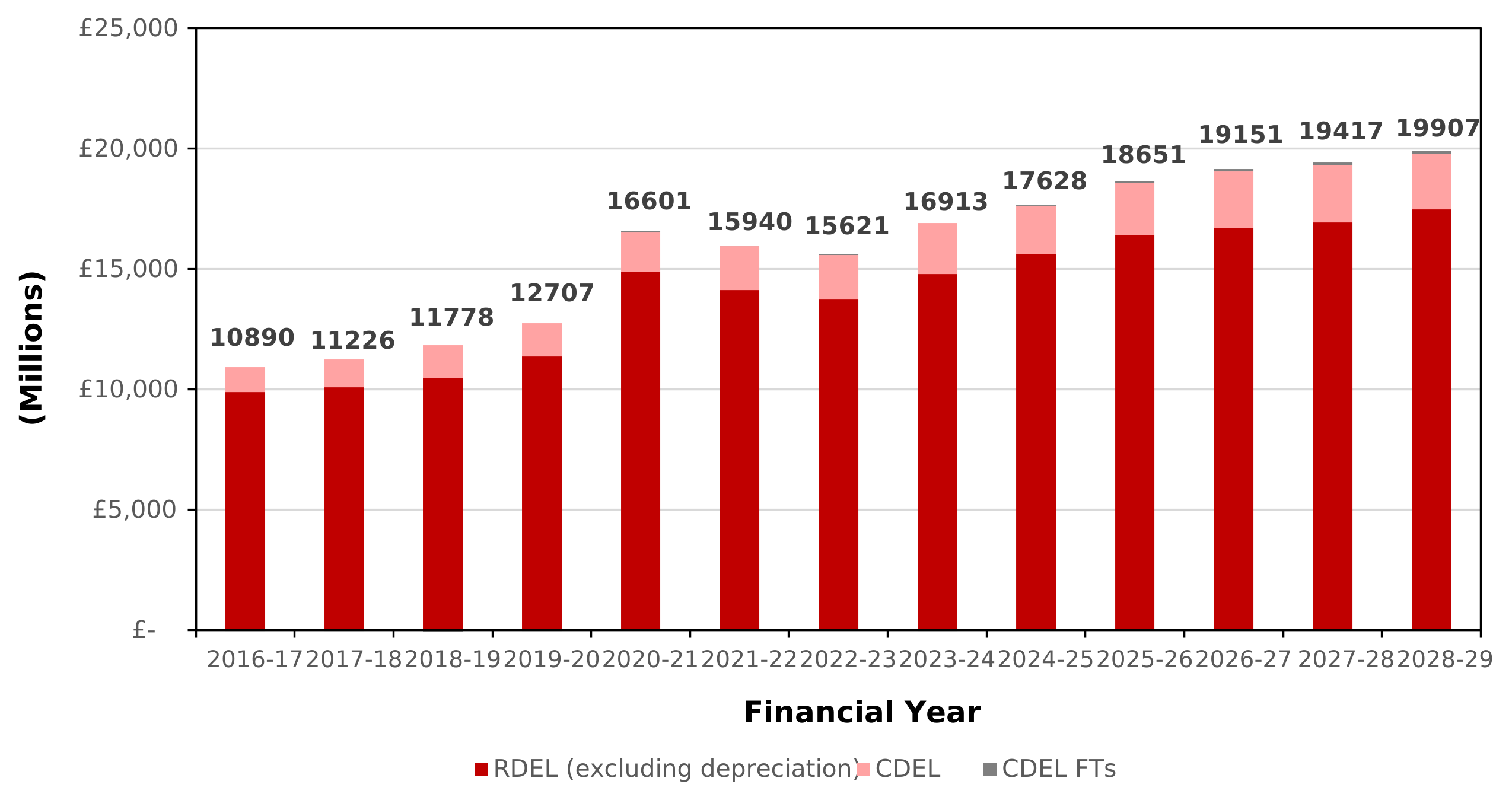
Bar Chart showing Northern Ireland Executive Total DEL block grant funding 2016-17 to 2028-29 in Millions. The chart shows growth in NIE TDEL funding, starting at 10890 million in 2016-17 rising to 19907 million in 2028-29
Note: 2016-17 to 2023-24 show Final outturn, 2024-25 shows Provisional Outturn. 2025-26 shows Provisional Outturn (net of changes at Supplementary Estimates including the £400 million Reserve claim) and 2026-27 to 2028-29 show plans at Spring Forecast 2026. Future years do not account for the repayment of the Reserve claim (which is also not shown in 25-26).
The Barnett formula
Under the Barnett formula, the Northern Ireland Executive receives a population-based proportion of changes in planned UK Government spending on services in England, England and Wales, or Great Britain.[footnote 8]
There are three factors that are multiplied together to determine changes to the Northern Ireland Executive’s block grant under the Barnett formula:
A. The change in planned spending by UK Government departments;
B. The extent to which services delivered by UK Government departments correspond to services delivered by the Northern Ireland Executive; and
C. Northern Ireland’s population as a proportion of England, England and Wales or Great Britain, as appropriate.
As set out in the Northern Ireland Executive’s Interim Fiscal Framework, a 24% needs-based factor also applies for the Executive, reflecting the assessment of relative need by the independent Northern Ireland Fiscal Council.
Changes to the Northern Ireland Executive’s block grant through the Barnett formula are abated (i.e., reduced) in relation to VAT. This reflects the fact that the Northern Ireland Executive, unlike UK Government departments and the Scottish and Welsh Governments, has many of the responsibilities of local authorities in the rest of the UK so has its VAT refunded by HMRC. Barnett formula changes for the Northern Ireland Executive are therefore abated by 2.5%.
Non-Barnett funding
The UK Government also provides block grant funding to the Northern Ireland Executive outside the Barnett-based arrangements. This funding is usually provided for a specific purpose agreed with the Northern Ireland Executive and can be ringfenced for that purpose.
Figure 2: Total non-Barnett funding per person for Devolved Governments for 2025-26 to 2029-30[footnote 9]
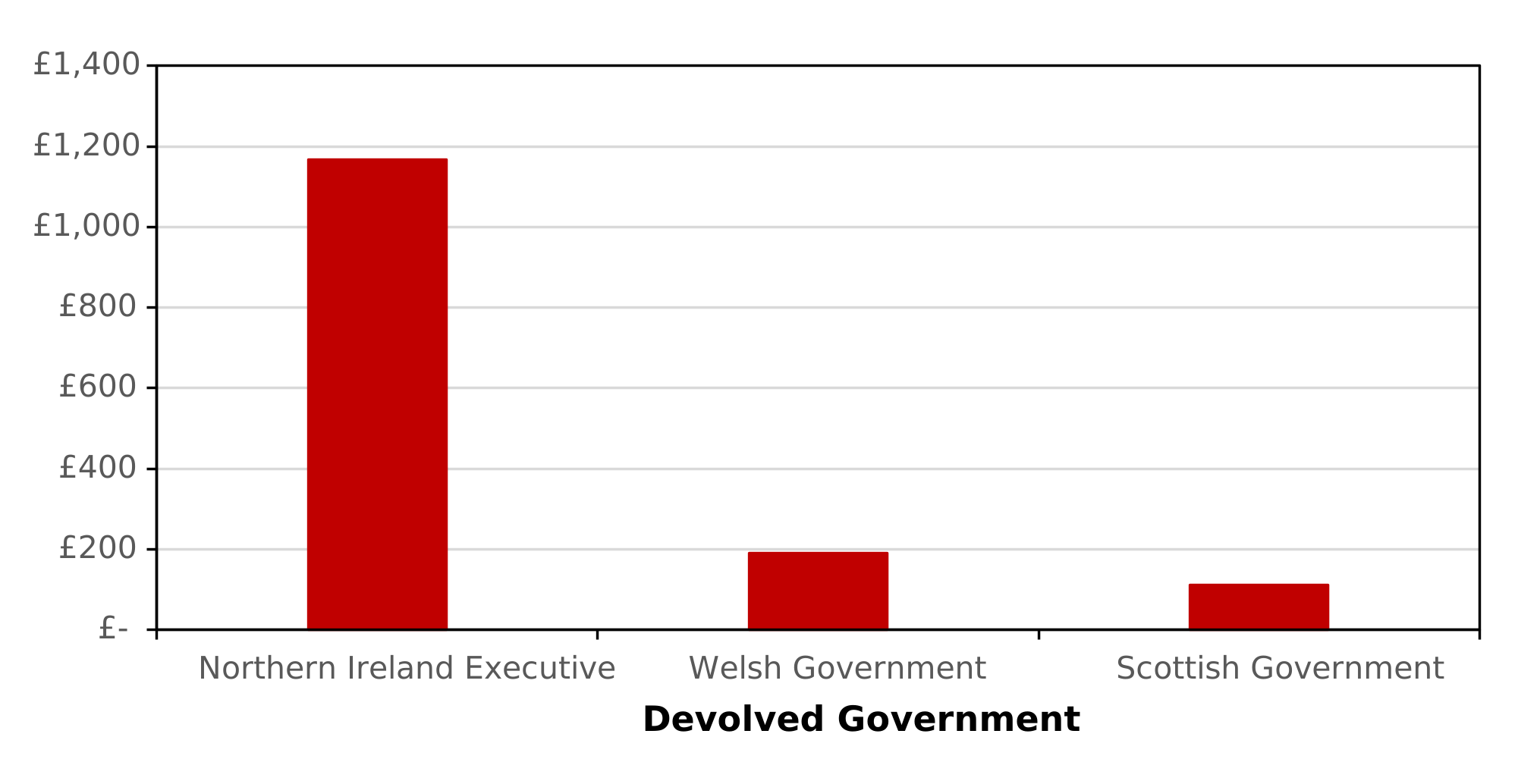
Bar Chart showing total non-Barnett funding per person for the devolved governments for 2025-26 to 2029-30. The chart shows the Northern Ireland Executive is receiving almost £1,200 per person over this period, the Welsh Government almost £200 per person, and the Scottish Government around £100 per person.
The UK Government provides limited non-Barnett funding to all devolved governments including for City and Growth Deals covering all of Scotland, Wales and Northern Ireland, as shown in Figure 2. The Northern Ireland Executive has historically received significantly higher non-Barnett funding than the Scottish Government and Welsh Government as a result of additional financial packages associated with political agreements and restoration arrangements, alongside in-year reserve claims to manage emerging pressures. This includes the £3.3 billion restoration financial package in February 2024 and the repayable £400 million reserve claim in 2025-26, which were provided on top of normal funding arrangements.[footnote 10] [footnote 11]
Needs-based funding
The UK Government recognises that Northern Ireland has a higher level of relative need than the UK average. To reflect this, and as outlined in the Northern Ireland Executive’s Interim Fiscal Framework agreed in May 2024, a needs-based funding mechanism has been in place since 2024-25.[footnote 12]
Based on assessments by the independent Northern Ireland Fiscal Council, Northern Ireland’s relative need is estimated to be 124% of UK Government spending per head in comparable policy areas.[footnote 13] To reflect these higher relative needs, the UK Government has added a 24% needs-based factor to the Barnett formula effective from 2024-25.
Professor Holtham conducted a further independent review on Northern Ireland’s level of need in June 2025 which considered whether 124% is the best estimate of Northern Ireland’s relative need for public spending or whether new evidence would indicate a different estimate.[footnote 14] Professor Holtham’s report considered the funding provided to the Executive by the UK Government for agriculture. This funding was previously ringfenced for this purpose. Professor Holtham’s report concludes that updated data and analysis suggest a level of need of 123% if agriculture funding is excluded from in the calculation of Northern Ireland Executive relative funding, or 128% as a central estimate of need if it is included. The UK Government and Northern Ireland Executive agreed to exclude agriculture funding from the calculation which assesses Northern Ireland Executive relative funding.
The methodology for calculating Northern Ireland Executive relative funding was agreed with the Northern Ireland Executive and published alongside Spending Review 2025.[footnote 15] In brief, if the Northern Ireland Executive un-ringfenced Total DEL block grant funding per head falls below 124% relative to equivalent UK Government funding in England per head, a 24% needs-based factor will apply in the Barnett formula. When Northern Ireland Executive relative funding is above 124%, a 5% transitional needs-based factor will apply. A 24% needs-based factor has applied since 2024-25 and in all years of Spending Review 2025. As illustrated in Figure 3, the 24% needs-based factor has generated over £1.4 billion for the Northern Ireland Executive since it was introduced in 2024-25 and, as a result, the Executive has been funded above its independently assessed level of relative need.
Figure 3: Additional Barnett consequentials resulting from 24% needs-based factor[footnote 16]
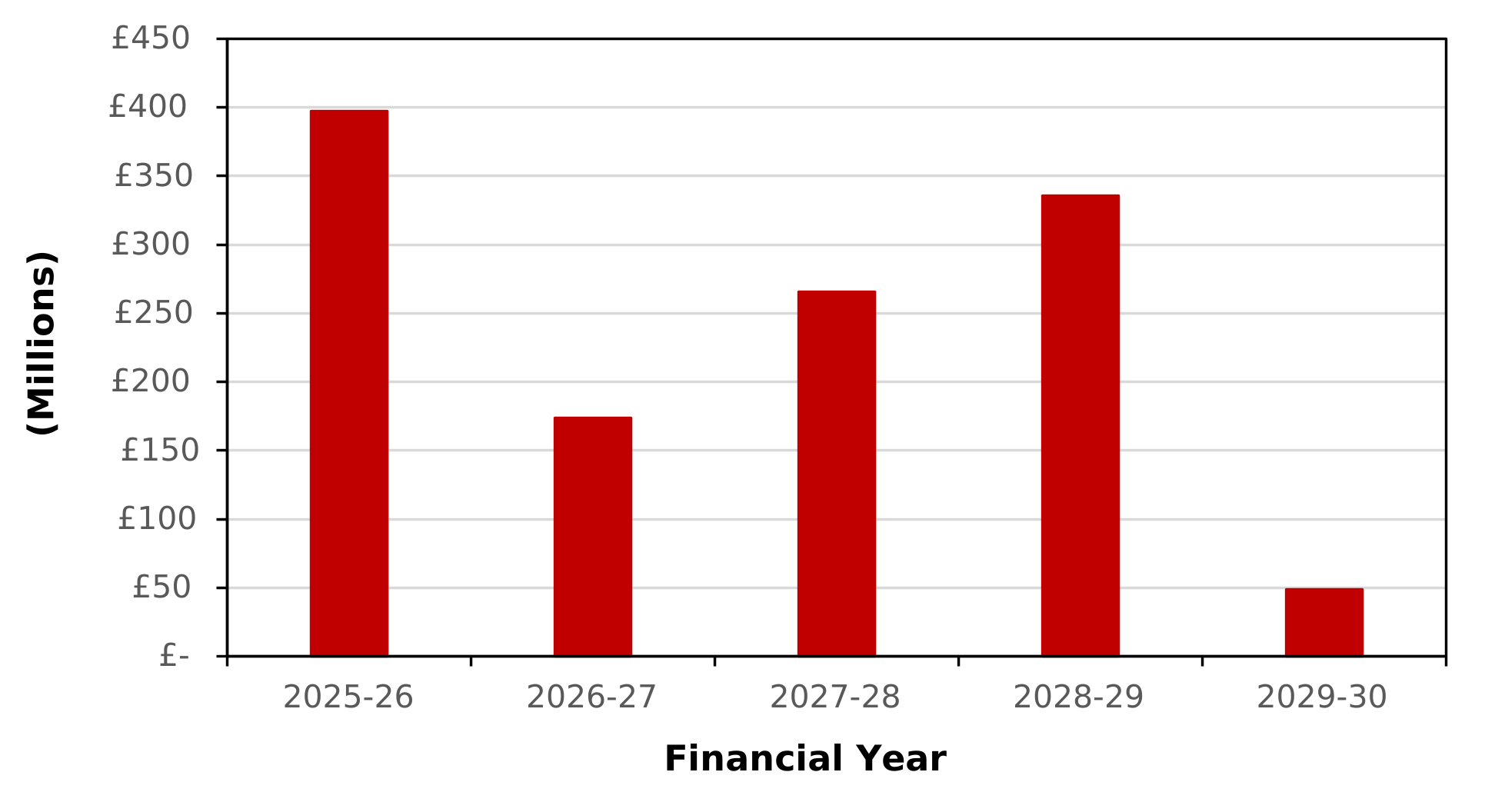
Bar Chart showing additional Barnett consequentials resulting from the 24% needs based factor in millions, for each financial year from 2025-26 to 2029-30. The chart shows an additional c.£400 million in 2025-26, c.£175 million in 2026-27, an additional c.£260 million in 2027-28, an additional £c.£340 million in 2028-29 and an additional c.£50m in 2029-30.
The Executive is funded above 124% in every year of this Spending Review period (to 2028-29). This means that, for every £1 spent by the UK Government on comparable public services elsewhere in the UK, the Northern Ireland Executive gets at least £1.24.
The Barnett formula and 24% needs-based factor mean that the Northern Ireland Executive will continue to have more to spend per person on areas of devolved responsibility than equivalent UK Government spending across the UK. This reflects the higher level of relative need in Northern Ireland. Figure 4 shows that, including non-Barnett funding, the Northern Ireland Executive has been funded above 124% across the last decade and in all years of the Spending Review 2025 period, noting that only CDEL funding has been allocated in 2029-30 and RDEL will be set at the next Spending Review.
The Northern Ireland Executive is not unique in that spending per person is higher than the UK average. All devolved governments receive at least 20% more per person than equivalent UK Government spending in the rest of the UK which is above the independently assessed level of relative need in each nation. This broadly reflects that the costs of providing public services are higher in Scotland, Wales and Northern Ireland than the UK average.
Figure 4: NI Executive Relative Funding Back-Series and Spending Review 2025[footnote 17]
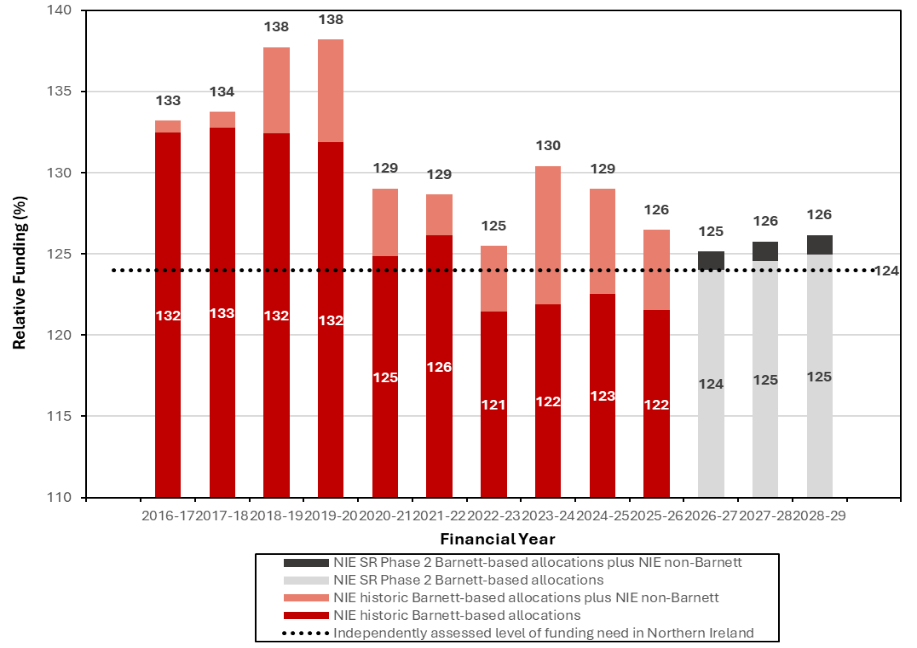
Bar chart showing Northern Ireland Executive relative funding levels between 2016-17to 2028-29. The chart shows that in each year of this period the NIE is funded above the level of its relative need of 124%. It peaks at 138% in 2019 and is at its lowest at 125% in 2026-27. NIE relative funding in the final year of the chart is 126%, showing that the level of funding fluctuates significantly over time, but never falls below the level of need.
2025-26 Northern Ireland Executive Budget Pressures
At the UK Government’s Supplementary Estimates 2025-26, the Northern Ireland Minister of Finance confirmed that the Northern Ireland Executive was forecast to overspend its DEL budget by £467.6 million RDELex. This overspend is forecast by two Northern Ireland Departments: Health and Education. Table 1 confirms the split between these two departments.
Table 1: Total Overspend by Northern Ireland Executive Departments (£m)[footnote 18]
| Department | Forecast Overspend (£m) |
|---|---|
| Department of Education | 237.7 |
| Department of Health | 229.9 |
| Total Overspend | 467.6 |
The Chief Secretary to the Treasury agreed to provide £400 million RDELex from the UK Reserve which is repayable. The repayment profile is £80 million in 2026-27, £160 million in 2027-28 and £160 million in 2028-29.
Alongside this, the Executive agreed to an “open book” review of the Executive budget to support the Executive’s decision-making for future budgets (which this report summarises). The Northern Ireland Executive also:
- Committed to agreeing a multi-year budget covering the Spending Review period.
- Committed to providing £119 million to the Northern Ireland Department of Justice in 2026-27 from within the existing block grant for the Police Service of Northern Ireland data breach.
- Agreed to establish a contingency fund for emerging pressures, subject to an appropriate carry-forward mechanism being agreed.
- Agreed to provide monthly forecast data to HM Treasury on overspends and overcommitments alongside the usual reporting.
Northern Ireland Minister of Finance’s multi-year budget proposal
In January 2026, the Northern Ireland Minister of Finance published draft Northern Ireland Budget proposals for 2026-27 to 2029-30 for consultation.[footnote 19] The publication highlighted that both the RDEL and CDEL funding positions remain constrained, particularly in 2026-27, and that the Executive collectively, and individual Ministers, will need to take challenging decisions to prioritise the available funding to deliver the desired outcomes.
Since the publication of the draft Budget proposals, the UK Government has confirmed the following changes to Northern Ireland Executive funding between 2026-27 and 2029-30:
- The repayment profile of the £400 million 2025-26 reserve claim
- An additional £387 million Total DEL resulting from UK Government spending scored at the Spring Forecast 2026
Open Book Review
The Terms of Reference set out that this review would analyse spending and revenue streams across Northern Ireland departments, including comparative analysis between:
- Northern Ireland Executive departmental spending, including on pay, and
- UK Government departmental spending, including on pay.
The Terms of Reference also set out that the review would cover:
- All Northern Ireland departments and arms-length bodies (ALBs), including their core baselines, in‑year pressures and forecast pressures over 2026‑27 to 2028‑29.
- RDELex and CDEL budgets, including associated assumptions (e.g. pay, inflation, demand‑driven services).
- Existing and planned public service transformation programmes, including any interdependencies with the use of the remaining £235 million public sector transformation funding.
- Revenue‑raising, savings, efficiencies and reform options that are within the competence of the Northern Ireland Executive, and their potential yield. Where possible, distributional and behavioural impacts should also be identified.
In line with these Terms of Reference, the Northern Ireland Department of Finance sought returns from all Northern Ireland departments and ALBs. These provided spending and income data in 2025-26 and forecasted pressures data over the period 2026-27 and 2028-29, including underlying assumptions and dependencies, and actions being taken to manage these pressures. Analysis of this data, combined with external analysis where appropriate, forms the basis of the findings set out below.
The analysis highlighted three main areas where, within the existing devolution settlement and available funding, there are options for the Executive to consider when taking decisions to balance its multi-year budget from 2026-27 to 2028-29. These are:
- Public Sector reforms and efficiencies
- Public Sector pay bill[footnote 20]
- Super-parity measures
The remainder of this report presents analysis for each of these areas, followed by options which the Executive could consider. As set out in the Terms of Reference, this report is intended to provide an evidence base to inform the Executive’s approach to the budget but, in line with the devolution settlement, HM Treasury is not recommending any particular course of action.
At the request of the Northern Ireland Department of Finance, this report has been produced at pace to align with the Executive’s budget-setting process. Where possible, indicative figures are given for the scale of savings these options could generate, although precise figures will depend on policy choices taken by the Executive. Ministers should commission detailed costings from Northern Ireland departments on savings options to inform their decisions if they choose to explore any of these options.
Public Sector Reforms and Efficiencies
There are options for the Northern Ireland Executive to drive efficiencies and savings in areas of public spending.
This report identifies some examples of where Northern Ireland departments have already taken significant steps towards putting public services on a more sustainable footing. Our discussions with departments focused on the Northern Ireland Departments of Health, Education and Justice, which are the largest departments by RDEL budgets. These discussions revealed significant ambition for improvements including through the Department of Health’s Health and Social Care Reset Plan, the Department of Education’s Five-Year Education Budget Strategy, and the Department of Justice’s Speeding up Justice programme. This report acknowledges there are also broader reform and transformation plans in place in other departments in Northern Ireland that are designed to put public services on a more sustainable footing and improve outcomes for people using those services.
However, it is also assessed through this report, and separately by external commentators over recent months, that more is needed to both transform public services, outcomes and ensure budget sustainability. Recommendations include the need to accelerate public services transformation, use the multi-year budget to plan strategically for the future, and publish credible, funded plans for long-standing challenges.[footnote 21] [footnote 22]
Despite extensive analysis and external advice, the Executive does not have an agreed, costed plan for turning public services around over a defined period.
Spending on public services
Using data provided by Northern Ireland departments and UK Government departmental Spending Review 2025 settlements, this review’s analysis finds that spending per head on key policy areas is higher in Northern Ireland than by the UK Government in the rest of the UK. This reflects some of the distinct challenges that Northern Ireland faces, which are accounted for in Northern Ireland’s relative need of 124% of comparable spending, which includes the higher costs of policing and justice in Northern Ireland. The analysis focuses on the following areas of spend:
- Delivery of hospital, medical, pharmaceutical, dental and health services (excluding social care)
- Delivery of schools
- Prisons, policing, courts and tribunal services
Broadly, the Northern Ireland Executive’s Department of Health spends 52% more per head to deliver (services listed above) than spending by the UK Government in England on comparable services. It is a similar story when looking at spending on schools, where spending per head (for the purpose of this calculation, we have used the population aged between 5-18) in Northern Ireland is roughly 40% more than spending in England.
It is for the Northern Ireland Executive to determine the level of allocation to public services it is responsible for and this report does not recommend funding any public service at a certain level compared to per person spending by the UK Government in England. However, to give a sense of scale, health spending of 124% of comparable spending in England would be £1.3 billion lower than current spending on health. Similarly, 124% of comparable spending in England on education would be £424 million lower than current spending on education.
Figure 5: Northern Ireland Executive Spending in key policy areas relative to UK Government spending[footnote 23] [footnote 24]
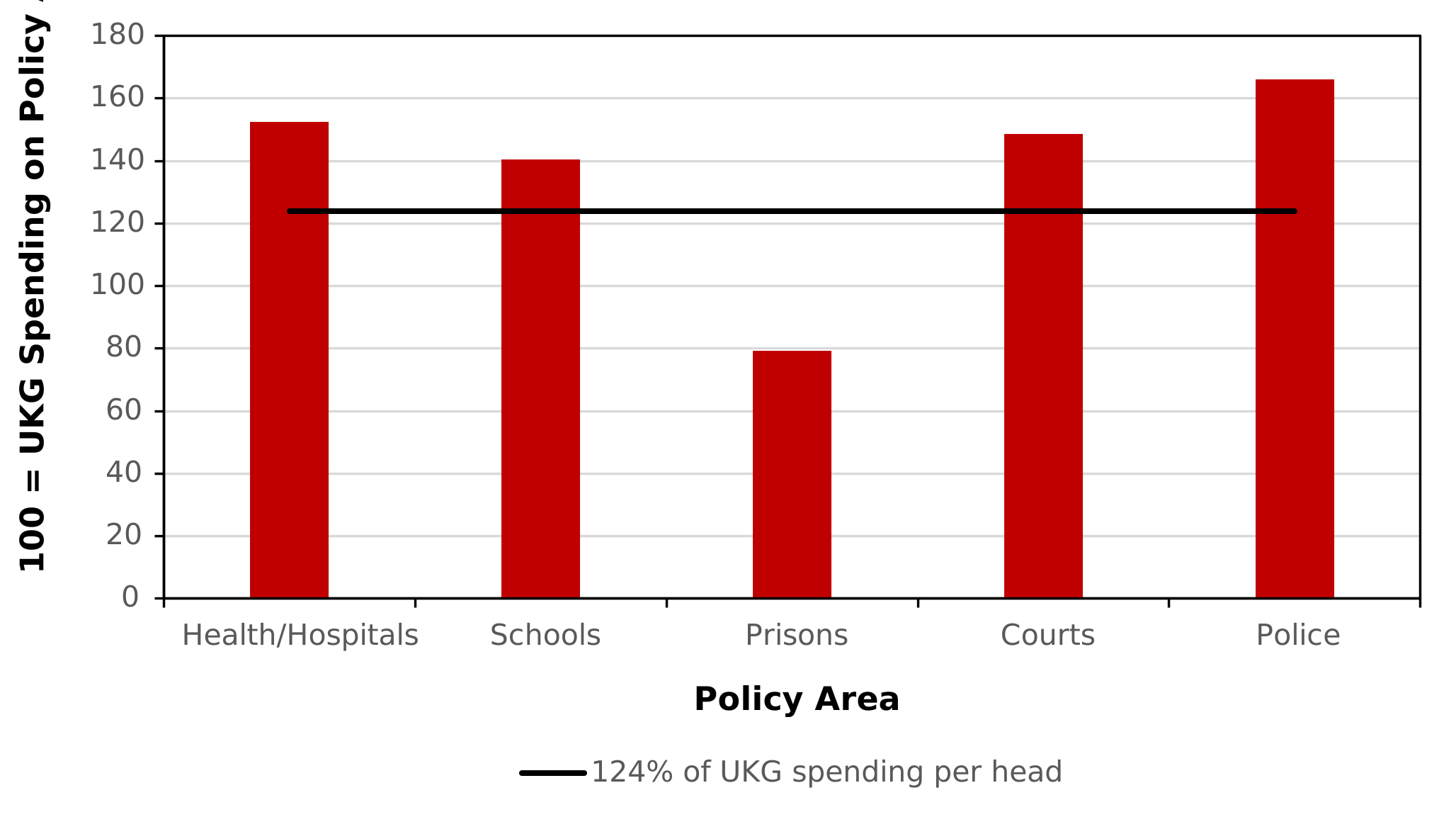
Bar chart comparing NIE spending in key policy areas relative to UK Government spending, where 100 = UKG spending on policy area and 124 represents relative need. The chart shows that relative to UKG spending on these policy areas the executive spends 150% on Education, 140% on Schools, 80% on prisons, 150% on courts, and 165% on Police.
A similar trend emerges when policing spend is considered, where spending is 166% per person. Spending on the court system is also above that of UK Government spending at 149%. That said, spending by the Northern Ireland Department of Justice on the prisons and probation services are less per head than equivalent spending in England and Wales, at 79%.
Duplication of Services
External commentators have highlighted that a key driver of higher spend per person is the cost of delivery across divided communities in Northern Ireland. This includes costs from duplicative public service delivery, with scope to deliver more efficiently by greater centralisation of public service delivery. In 2016, an Ulster University (UU) report estimated the cost of delivering public services to be between £400 million and £830 million per year higher than in comparable UK regions. They assess that this could, at least in part, be due to providing services in a “divided society” (although they acknowledge that this is one of multiple factors). While these figures should be treated with caution, and not all additional costs represent potential savings, it suggests that there are opportunities to cut down on unnecessary costs in at least some areas of public service delivery. For example, the UU report suggests that duplicative school services are feeding into an excess of school places, where Northern Ireland’s education sector is spreading its resources too thinly across more schools and pupil placements than is optimal or efficient.
The UU report assesses that addressing excess school places could result in savings of between £14 million and £93 million per year.[footnote 25] More recent commentary has identified some areas of progress, such as the growth in integrated schools, but also points to scope to make much more progress in this area, with around 92% of children and young people continuing to be educated largely separately and in line with Northern Ireland’s traditionally two largest communities. [footnote 26] [footnote 27]
Public Sector Transformation
This report assesses that there have been some positive steps on transformation projects, for example, taken forward through the ringfenced £235m Public Sector Transformation Fund provided as part of the Executive 2024 Restoration package, and also through projects funded through departments’ own budgets. However, it is recognised that this is the beginning of a wider trajectory towards transformation and faster delivery is needed, for there to be notable change in outcomes for people in Northern Ireland.
The Department of Health’s Health and Social Care Reset Plan aimed to save £300 million over 2025-26, and includes plans to optimise medicines spend, reduce central budgets and administrative costs as well as better procurement practices to reduce costs and wastage.[footnote 28] It also includes the rollout of Multi-Disciplinary Teams (MDT), which received a further £61 million from the ringfenced Public Services Transformation Fund, to meet patients’ needs at the earliest possible opportunity. MDTs are already seeing results by reducing the need for more costly onward referrals into secondary care services. This is an example of how wider departmental transformation prioritisation coupled with additional funding through the ringfenced transformation fund can deliver results. The Executive reports that the percentage of GP practices with an element of MDT has grown from 8% to 60% (March 2025 – March 2026).[footnote 29] Department of Health officials reported to HM Treasury that £300 million-£350 million of savings were achieved in 2025-26 as a result of the overall Reset Plan.
The Department of Education has published a Five-Year Education Budget Strategy in February 2026 to consider changes to ensure the long-term sustainability of education services identifying a number of areas for potential structural reforms (e.g., transport, school meals delivery, special educational needs, estates and financing model of schools).[footnote 30] This strategy shows a clear desire to prioritise; however, the potential savings remain to be costed.
The Department for Education has also launched key initiatives such as the TransformED NI plan, and the 5-year Special Educational Needs (SEN) Reform Agenda. The department was also successful in bidding for £27.5m through the transformation fund to support children with SEN and to reform services leading to better outcomes for children. [footnote 31] Early successes include delivery of the Early Years Assistant SEN Training project which commenced in January 2026, with 114 classroom assistants completing accredited SEN-specific training across the five Further Education Colleges.
The Department of Justice’s ‘Speeding Up Justice’ programme is reducing avoidable delay across the criminal justice system, helping to mitigate the budgetary strain (as well as impact on victims of crime) from delays. It has made some progress to bring average court processing times back below 200 days, from a 225 day peak in 2021-22 due to the pandemic. The programme also aims to significantly reduce the demand on the High Court system, where a significant backlog remains. ‘Speeding Up Justice’ was successful in securing £2m for an electronic tagging project to transform how prisoners are released into the community and freeing up prison places.
This report also recognises movement towards transformation across the wider NI Executive departments. For example, £15m was allocated through the Transformation Fund for the Department for Infrastructure for its Urban Drainage proposal to fund a pilot project for transforming the way in which rainwater is managed to reduce flooding risks. Investigations to identify suitable sites have almost completed, with detailed design and construction to begin in 2026/27 which are expected to be a flagship example of how natural treatment systems can reduce combined-sewer overflows, and deliver biodiversity. Such projects, if successful in their delivery, have the potential to generate more savings across Northern Ireland.
The Executive has recently agreed a second set of projects to receive the remaining £102.599 million of Transformation funding, subject to final UK Government agreement. The draft Budget proposals issued for consultation by the Northern Ireland Minister of Finance also include provision for funding for further transformation.
Capital Investment and Spending
Northern Ireland’s capital spending covers a number of areas: digital and technological infrastructure, water, transport (roads and rail), housing and other infrastructure spend. Across these areas there is a mixed delivery model in Northern Ireland with different departments owning different aspects of capital spend, but significant challenges exist in a number of key areas (including water and sewerage infrastructure, flood risk management, maintenance of roads assets, housing, school buildings and the healthcare estate). In addition, there is a direct impact on the resource budget, requiring additional resource spend to manage and maintain infrastructure that is no longer fit for purpose, and provide rolling repairs, whilst limiting further investment in new infrastructure that could deliver economic growth and improve public safety.
In the Northern Ireland context the Department for Infrastructure is the key department for delivering a capital programme in relation to water, roads and rail. This does not mean that the Department of Infrastructure is the sole body responsible for capital investment in Northern Ireland or for the prioritisation of capital projects. There is a highly fragmented delivery landscape and important interactions and interdependencies with other areas of the Executive for example housebuilding in the Department for Communities and the delivery of different aspects of the public estate that are led through the Departments of Health, Education or Justice. The Executive has not yet published a prioritised and costed capital delivery plan which could form part of an approach to public service transformation.
The Executive may wish to consider the system for delivery of major infrastructure, its level of ambition for transformation and whether more is needed. The impact of the current approach is delayed investment in critical infrastructure, leading to additional resource spend to maintain infrastructure at a standstill level. This limits the economic benefits for Northern Ireland, places additional pressure on departmental budgets and reduces available resources to help wider transformation of public services.
A fully costed, prioritised Strategic Infrastructure Plan for the Executive, committed to as part of the 2024 Executive Restoration Package but not yet delivered, could have a significant impact on wider spending and budget stability.[footnote 32] Without planned investment in infrastructure and clear, costed and prioritised capital spending, the demand on resource spending to maintain infrastructure at a standstill will continue to grow, affecting wider budget stability.
Conclusion
This review has identified some positive examples of where departments across the Northern Ireland Executive are delivering more efficiently and reducing unnecessary costs. However, there remains scope to go significantly further, with faster and deeper transformation of the Northern Ireland Executive’s current delivery structures needed to materially improve front-line public services. An agreed, costed plan for turning public services around over a defined period will also be important.
All decisions are and will remain for the Executive. However, the report provides a number of analytical comparisons:
- £1.3 billion if the Department of Health reduced spending to 124% of UK Government spending on health and hospitals
- £424 million if the Department of Education reduced spending to 124% of UK Government spending on schools
- £14 million to £93 million per year from addressing excess school places.
HM Treasury recognises that elements of these potential savings overlap, so a cumulative number would not be appropriate. However, this report notes that some of the examples identified could result in savings worth hundreds of millions. A costed plan, reflecting the inter-dependencies between departmental responsibilities, could help to focus spending choices and priorities. While this report has largely focussed on resource pressures, it also notes that there is a direct impact on the resource budget from managing infrastructure that is no longer fit for purpose (such as in water and sewerage infrastructure, flood risk management, maintenance of roads assets, housing, school buildings and the healthcare estate). The Executive has not yet published a prioritised and costed capital delivery plan which could also form part of an approach to public service transformation.
Public Sector Pay Bill
Funding for public sector pay awards for the UK Government’s workforces is provided to UK Government departments at spending reviews. The Barnett formula is applied to the additional departmental funding, resulting in Barnett consequentials for the Northern Ireland Executive. As set out in the Background section, the Executive is funded at over 124% in every year of the Spending Review, which means that the Northern Ireland Executive is funded to deliver a public sector pay bill equivalent to at least 124% of the UK Government’s public sector pay bill on a per person basis.
However, Northern Ireland’s public sector pay bill is a core affordability challenge. The Northern Ireland Executive’s forecast overspend in 2025-26 (£467.6 million) primarily resulted from the cost of public sector pay awards. The analysis undertaken has identified two drivers for this pay bill challenge:
1) The relatively large size of the public sector in Northern Ireland compared to England
2) Maintaining pay ‘parity’ between Northern Ireland and Great Britain
Northern Ireland public sector workforce size
Northern Ireland has a public sector that is relatively larger than other parts of the UK, particularly England. As a percentage of overall employment, the Northern Ireland Fiscal Council assesses that public sector employment in Northern Ireland has stayed relatively flat since 2020 at roughly 26-27%, compared to 17-18% in England.[footnote 33]
The Northern Ireland Fiscal Council’s report identifies that total Northern Ireland public sector employment is 144% per person of the level in England, twenty percentage points above the level of relative funding need. The larger public sector poses a significant budgetary challenge for the Northern Ireland Executive. If Northern Ireland has more than 124% of the workers in England per head of the population in a sector, and if the Executive maintains pay parity, then this creates a gap in funding.
The largest employer (Health Trusts) employs 149% per person of population in England and the Police Service of Northern Ireland has 137% of the officers.[footnote 34] When adjusted for comparability (including stripping out UK civil servants who work in reserved policy areas) the Northern Ireland Fiscal Council estimates that, on a per head basis, the Northern Ireland Civil Service employs 183% of the number of civil servants in England in devolved areas.[footnote 35] The Northern Ireland Fiscal Council recognises that part of this difference may be the result of the Northern Ireland Civil Service having responsibility for some roles undertaken by local authorities in England, rather than central government. There are also other material differences in delivery models and institutional design.
As part of the 2025 Spending Review, UK Government departments agreed to a rationalisation of their departmental admin costs, with departments expected to find 15% of RDEL (admin) savings.[footnote 36] Whilst RDEL (admin) for departments is not limited solely to staffing and pay, it is likely that civil service workforce reductions will form the majority of the 15% savings. These reductions are following a higher increase of UK civil service headcount compared to the Northern Ireland Civil Service in recent years (including to reflect UK-wide efforts on Covid and EU Exit), but if the Northern Ireland Executive chose to undertake a similar rationalisation, savings of £180 million could be realised on a civil service pay bill of £1.2 billion.[footnote 37]
Further, scaling the per head level of civil servants on devolved areas in Northern Ireland to 124% of England levels (using the Northern Ireland Fiscal Council’s 183% figure) would release £393 million in savings. This is broadly the same amount as the reserve claim that was provided for 2025-26. This calculation is illustrative to provide a sense of scale and does not adjust for the caveats listed above.
As can be expected with a larger public sector, the proportion of government spending on public sector pay by the Northern Ireland Executive compared to the UK Government is also higher. Based on data provided by Northern Ireland departments, total full time equivalent (FTE) headcount for the Northern Ireland Civil Service is 28,994 and 143,422 for the wider public sector in 2025-26. The same data confirms a pay bill of £1.2 billion for the Northern Ireland Civil Service and £8.9 billion for the wider public sector in 2025-26. The distinction between the civil service, and public sector is that the Northern Ireland Civil Service counts as those employed by central departments, whilst Northern Ireland’s public sector includes all those employed by the state. Combined, this equates to over 60% of the Northern Ireland Executive’s RDEL (excluding depreciation) budget in 2025-26. This number rises to 63% for the total public sector pay bill, once accounting for local government spending on pay in Northern Ireland.[footnote 38]
The Executive’s RDEL budget is higher in 2028-29 than in 2024-25 even after adjusting for inflation. In other words, in 2024-25 prices, the 2028-29 RDEL budget will be larger than the 2024-25 budget in real terms, not just in cash terms. Despite this, if the Executive’s public sector pay bill (public service and civil service) were to see no change between now and 2028-29 – or to put another way, the pay bill (excluding local government) remains £10.1 billion in cash terms - overall, it will remain at 60% of the Northern Ireland Executive’s total RDELex budget in 2026-27 and 2027-28, before dropping to 58% in 2028-29.
In comparison, both including and excluding local government pay, pay as a proportion of total UK Government RDEL spending is lower. Using a combination of the July 2025 releases of Public Spending Statistics and Public Expenditure Statistical Analyses, the proportion of UK Government spending on pay is 45% excluding local government pay and 60% including local government pay in 2025-26.[footnote 39] [footnote 40] Assuming there are no changes to the nominal pay bill, pay as a proportion of total RDELex spend falls to 41% (excluding local government pay) and 54% (including local government pay) in 2028-29. These comparisons with the assumption that there are no changes to the nominal pay bill are an illustration of equivalent spending patterns, not a statement of government policy, and there is greater scope for economies of scale, particularly on non-pay costs, when compared to Great Britain.
If the Executive matched UK Government spending on pay as a proportion of RDELex (excluding local government pay) then this could result in a saving of up to £2.5 billion per annum. This report recognises that the Northern Ireland Civil Service conducts additional responsibilities that the civil service supporting the UK Government does not. Therefore, it would not be reasonable to assume all of those savings could be realised. But even if those additional responsibilities accounted for half of the difference, then savings could be £1.25 billion.
Maintaining pay ‘parity’ between Northern Ireland and Great Britain
This challenge is compounded by the Northern Ireland Executive’s decision to match pay awards provided by UK Government departments for large parts of the public sector. For example, external commentators note how the Northern Ireland Minister of Health directed his permanent secretary to pay the NHS Pay Review Body’s recommended percentage pay uplift for all Agenda for Change staff across England, Northern Ireland and Wales, despite the Northern Ireland Executive’s 2025-26 budget already being on course to be overspent.[footnote 41]
Pay Review Bodies consider a wide range of factors and evidence when coming to their recommendations for workforces in England, including the recruitment and retention of staff, departmental affordability and wider macroeconomic factors.
UK Government departments’ Spending Review 2025 settlements include funding for an assumption on pay awards and the Northern Ireland Executive receives Barnett consequentials on this funding. It is for the Northern Ireland Executive to determine whether they wish to maintain pay parity with Great Britain. However, all else equal, the Barnett formula broadly provides funding to do so for a public sector workforce up to 124% of the population-adjusted size of that in England. Given, as set out above, the relative size of the public sector workforce in Northern Ireland is significantly above this, the cost of maintaining pay parity therefore outstrips funding growth, making it harder for the Northern Ireland Executive to balance its budget. This assessment is echoed by external commentators, such as the Northern Ireland Fiscal Council who conclude that the pay parity commitment has caused a “structural” problem for Executive budgeting.[footnote 42]
In the absence of other revenue streams, funding a pay bill in excess of the Barnett consequentials provided is likely to mean that the Executive is spending less of their RDEL budget on other areas of front-line public service delivery than comparable UK Government departments.
On average, the Northern Ireland Civil Service pay settlement increased by 6% in 2025.[footnote 43] The 2025-26 NI Civil Service pay award exceeded pay growth for the UK civil service, where pay guidance allowed departments to make average pay awards of up to 3.25% (all funded from existing budgets). If Northern Ireland Civil Service average pay had increased in 2025-26 by 3.25% rather than 6%, this would have generated savings of £32 million in 2025-26, with savings compounded in future years, demonstrating savings which could be made in future.
Conclusion
The Northern Ireland Executive is responsible for decisions on the size and pay of the public sector in Northern Ireland. This report provides factual comparisons and analysis to support the Executive’s decision-making, and does not make any recommendations.
The Northern Ireland Executive currently has a relatively larger public sector than other parts of the UK and mirrors UK Government pay increases. For this to be sustainable, the Executive would either need to find funding through savings or reductions in spending elsewhere or reduce the size of its pay bill. Savings to the pay bill could be delivered through changes in the size, structure or pay bands.
It would be for the Executive to decide whether to pursue any of these options. To provide a sense of potential savings, HM Treasury analysis suggests that:
- Mirroring the 15% admin savings approach taken at Spending Review 2025 could realise savings of £180 million in Northern Ireland.
- Based on NI Fiscal Council analysis on civil service numbers, scaling the number of civil servants per head on devolved areas in Northern Ireland to 124% of the number in England would release £393 million per annum in savings.
- Scaling public sector pay to be closer to an equivalent proportion of total RDELex spend as the UK Government could save up to £2.5 billion. Noting that the Executive has additional responsibilities, even if half of the additional pay bill was due to these, savings of £1.25 billion could be made.
- If pay in 2025-26 had increased by an equivalent amount to the UK civil service, this would have generated savings of £32 million in 2025-26.
HM Treasury recognises that some of these potential savings would overlap, so a cumulative number would not be appropriate. However, it remains the case that even if only half of the saving from scaling public sector pay to be an equivalent proportion of RDELex as the UK Government were realised, this would still generate savings of £1.25 billion.
Super-Parity Measures
In addition to receiving block grant funding from the UK Government, the Northern Ireland Executive is also able to generate revenue through local and devolved taxation, fees, charges and the sales of goods, services and assets. There are areas where the Northern Ireland Executive generates less revenue than if fees and charges were applied in line with England. There are options available to the Northern Ireland Executive to raise revenue without having to exceed the fees and charges that other people in the UK pay to use public services or the average local taxation.
Managing Public Money Northern Ireland sets out that the Northern Ireland Executive should maintain the same basic principles as the UK Government when setting fees and charges, with the standard approach being to recover full costs. This approach is designed to ensure they neither profit at the expense of consumers nor make a loss for taxpayers to subsidise. Full details on the rules governing fees and charges can be found in Managing Public Money Northern Ireland.[footnote 44]
Regional Rates
Domestic and non-domestic regional rates already generate significant revenue for the Northern Ireland Executive. Forecast revenue is £818 million in 2025-26.[footnote 45] The Northern Ireland Finance Minister’s multi-year budget proposals assume year on year increases of around 5% and 3% for the domestic and non-domestic regional rate elements of ratepayers bills respectively.
In Northern Ireland, domestic rate bills apply instead of Council Tax. There are two separate poundage multipliers within each bill, the regional rate poundage (which funds central government services via a supplement to the Block Grant) and district rate poundage (which varies across each of the 11 district council areas).[footnote 46] At Northern Ireland level, each part of the poundage represents around 50% of the rate liability although the exact split varies depending on individual expenditure decisions within each District Council.
The other difference is that Domestic Rates in Northern Ireland apply an individual discrete capital value for each individual domestic property, whereas Council Tax applies a cruder system of banding. Values in the Northern Ireland Domestic Rating are based on 2005 values and in England the bands for Council Tax utilise 1991 values. To allow for a comparison between these two models of taxation, Ulster University recognises a per dwelling comparison is the best approach, though notes there remain challenges. [footnote 47]
Using this approach, it remains the case that the Domestic Regional Rate continues to raise less revenue than Council Tax. Based on a per dwelling comparison, the Northern Ireland Fiscal Council estimate that the average Domestic Rate bill in Northern Ireland is £1,239 in 2025-26, rising to £1,296 in 2026-27.[footnote 48] [footnote 49] In comparison, the average Council Tax bill in England is £1,770 in 2025-26 – though as this report notes later, the total average household bill in England is higher due to the existence of water charging (£2,373).
Using Census 2021 data from the Northern Ireland Statistics and Research Agency, it is estimated that there are 768,810 households in Northern Ireland.[footnote 50] On this basis, an indicative estimate for the additional revenue the Northern Ireland Executive could raise from aligning the Domestic Regional Rate with Council Tax in England is £408 million.
This gap can be partially explained by the absence of precepts in Northern Ireland. In England, local authorities can choose to increase revenue from council tax by charging for specific services, the notable examples being precepts for policing, fire and rescue services and adult social care. These precepts help to fund local services. For example, in 2025-26 the police precept in England and Wales is expected to raise £6 billion,[footnote 51] which equates to £236 per household. If all domestic properties in Northern Ireland were charged a precept at the same rate, then it would raise £180 million – almost half of the £408 million gap. The Northern Ireland Executive retains the power to introduce their own precepts to fund specific services.
This analysis does not account for the lower average property value in Northern Ireland, which, using the most recent Office for National Statistics data is roughly 33% less than in England.[footnote 52] Nor does it consider the distributional impact of raising bills on lower income households, which may increase the cost of rate support. That said, the comparison is designed to offer an insight into the scale of revenue raised per household, where it is clear the Northern Ireland Executive lags behind England.
Whilst this report does not consider the Non-Domestic Regional Rate, we would expect similar conclusions, though the rateable values of Non-Domestic properties will be significantly lower in Northern Ireland. However, it is possible to look at the scale of rate reliefs in place in Northern Ireland, which also indicate scope for further revenue.
Aside from the level at which the Domestic and Non-Domestic Regional Rate are charged, there are several reliefs that the NI Executive choose to apply. In their Strategic Review of Rating Terms of Reference, the Executive assert, ‘there are many similarities between the rating systems [in Northern Ireland] and the property taxation systems in England, Scotland, Wales and the South, but there are also important local differences reflecting local priorities and circumstances, particularly around reliefs, allowances and exemptions’. For example, this includes industrial derating support for industrial manufacturing. The Strategic Review will consider a variety of these reliefs on both domestic and non-domestic properties. Using data provided by the Department of Finance, the total cost of the reliefs still to be considered by the Strategic Review is £203 million of non-domestic reliefs and £29 million of domestic reliefs (based on 2024-25, data for 2025-26 is not yet available).[footnote 53] Therefore, removal of these reliefs could raise up to £231 million of additional funding (not accounting for behavioural impacts). The Northern Ireland Minister of Finance has committed to complete this strategic review by the end of 2027-28.[footnote 54]
Water charges
Spending by Northern Ireland Water is largely funded through the Northern Ireland Executive’s budget.[footnote 55] Data from the Department of Infrastructure shows that Northern Ireland Water was allocated £520 million TDEL in 2025-26 to deliver water and sewerage services in Northern Ireland. By comparison, in England, domestic water charges to households cover the costs of providing water and sewerage services and the cost of upgrading infrastructure maintenance and upgrades.[footnote 56] Households in Wales and Scotland also pay for water supply and waste-water collection services.
Applying domestic water charges to bring the Northern Ireland system in closer alignment with elsewhere in the UK, where households are charged for services, could raise significant additional revenue for the Northern Ireland Executive.
Table 2: Potential additional revenue from water charging in Northern Ireland
| Average household water bill in England and Wales (£) | 465 |
| Potential revenue in Northern Ireland if charged at the same rate as households in England and Wales (£) | 357,455,359 |
| Potential revenue in Northern Ireland if charged at half the rate of households in England and Wales (£) | 178,727,359 |
| Potential revenue in Northern Ireland if charged at a quarter the rate of households in England and Wales (£) | 89,363,840 |
Table 2 illustrates the average household bill in England and Wales for water and sewerage, as published by the Water Services Regulation Authority. [footnote 57] [footnote 58] In 2024-25, the weighted average bill was £439 a year, growing to £585 by 2029-30 when factoring in water companies’ business plans. As an indicative estimate, based on the Northern Ireland Statistics and Research Authority[footnote 59] estimate of the number of households in Northern Ireland, the Northern Ireland Executive could raise over £357 million per annum if households were charged the same as households in England and Wales. This does not factor in any behavioural or distributional impacts. The Executive should commission further analysis from the Northern Ireland Department for Infrastructure if they want to consider this option.
Prescription charges
The Northern Ireland Executive does not currently charge for medical prescriptions in Northern Ireland while in England, prescriptions are charged at £9.90 per item, with exceptions for certain groups. Introducing prescription charging in Northern Ireland could mitigate costs to the Northern Ireland Executive. In 2024-25, NHS England raised over £730 million from prescription charges which equates to £12.46 per person.[footnote 60] [footnote 61] Were the Northern Ireland Executive to raise a similar amount per person, total revenue would exceed £24 million. This is an indicative estimate to give a sense of scale based on prescription charges per person and has not been adjusted for types of medication, average use of prescriptions or any other behavioural or other factors.
In addition, the costs of prescriptions are growing in Northern Ireland and prescribing rates and costs per person remain consistently higher than in Great Britain. The Northern Ireland Department of Health stated in the Strategy for Sustainable Use of Medicines that ‘medicines costs in Northern Ireland are increasing annually and have reached an all-time high of £875 million per year’ and they ‘need to take further action to protect access to medicines for the future’.[footnote 62]
Tuition fees
In 2025-26, tuition fees for Northern Ireland’s higher education were capped at £4,855 per student (those domiciled in Northern Ireland, the Republic of Ireland or an EU National) following a rise in line with inflation. This cap is due to increase to £4,985 in 2026-27. According to published statistics from the Higher Education Statistics Agency, there were 36,825 full-time undergraduate students in Northern Irish institutions. Of these 32,365 are subject to the maximum tuition fee cap.[footnote 63]
In England, tuition fees are capped at £9,535. Broadly, this means that the Northern Ireland Executive do not maximise the student loan system as a revenue source for universities and, in effect, have to subsidise them with public funding to make up for lower income from tuition fees.
Analysis of data from the Department for Economy shows that in 2025-26, £237 million (£150 million RDEL and £87 million CDEL) was provided directly to universities to support teaching, research and knowledge exchange. A further £68 million RDEL is provided by the Department for Economy – mainly for payments to the Student Loans Company, but also some grants to students – to deliver the system of statutory student support in Northern Ireland. This report acknowledges that the £68 million would be required to continue under any student loan system and so is not considered as a potential saving.
Increasing tuition fees could reduce the need to subsidise the university sector for teaching and research with Executive DEL funding, providing the Executive with up to an additional £237 million to support wider public services.
It is important to note that increasing tuition fees does not come without a fiscal impact. However, the fiscal impact would fall on the UK Government rather than the Executive. Provided the Northern Ireland Executive were to offer broadly similar terms for its AME student loan outlay, the UK Government will fund the cost of this outlay. In order to assess whether its student loan scheme is broadly comparable, the Northern Ireland Executive are required to demonstrate that their scheme costs less than it would cost if they were to apply UK Government student loans policy. This affordability is measured both in terms of the outlay of loans and the cost to Government in respect of the expected repayments and write-offs. Recent analysis conducted by the Department of Economy forecasts that it will require approximately £1 billion less in terms of loan issues between 2026-27 and 2029-30, than if it were to implement English levels of fees, demonstrating scope to increase tuition fees without breaching the comparability requirement.[footnote 64]
As with other estimates, this analysis is provided for illustrative purposes, and the Executive will want to consider the advice from the Northern Ireland Department of Economy setting out the full impact of any changes before taking a decision.
Travel concessions
Both Northern Ireland and England have a concessionary travel offer. A key area of difference is that, in Northern Ireland, free Translink bus and rail travel is available to people aged 60 and over, whereas in England only free bus travel is available and eligibility starts at state pension age. That said, travel concessions for under-16s in Northern Ireland are broadly in line with policy in England.
Data provided by the Northern Ireland Department for Infrastructure shows that the cost of operating the Concessionary Fares Scheme will be £55 million in 2025-26. This was an increase of 10% on the previous year due to increases in passenger numbers.
However, using the ONS’s mid-2024 population statistics, those aged 60-64 in Northern Ireland make up 24% of the over 60 population. Using this proportion as a proxy for the level of subsidy, removing free bus travel from the 60-64s (bringing the Concessionary Fares Scheme in line with England) could raise £13 million.[footnote 65] Analysis based on 2021 reporting by the Northern Ireland Fiscal Commission suggests that this figure could be even higher at £50 million on the grounds that those aged 60-64 are a higher proportion of users than their proportion of total aged over 60s would suggest.[footnote 66]
Air Passenger Duty
Since January 2013, the power to set Air Passenger Duty (APD) rates for long-haul flights has been devolved to the Northern Ireland Assembly. The Northern Ireland Executive’s block grant was initially adjusted to reflect the tax revenues foregone by the Exchequer as a result of the devolution of long-haul APD. This adjustment is updated each year according to an agreed mechanism (which can be found in the Statement of Funding Policy). The Northern Ireland Executive chose to zero-rate the duty following devolution. Between 2026-27 and 2028-29, the average cost of this adjustment per year to the Northern Ireland Executive is £3 million.[footnote 67]
There is currently a scheduled long-haul (Band B/Band C) route in operation from Northern Ireland, from Belfast International Airport to Hurghada, Egypt, which has been operating since October 2023. In addition, there are occasionally long-haul charter flights to holiday destinations such as North America and the Caribbean during the summer months.
Whilst there is a behavioural benefit of zero-rating APD in attracting these carriers, it remains the case that the Northern Ireland Executive could aim to increase its revenue by changing the rating. However, it is also recognised that given the sensitivity of airline route decisions to tax changes and competition from Dublin Airport, the major hub airport on the island where no APD is charged, it is also possible that any increase in Northern Ireland’s long haul APD rate could result in airlines cancelling routes from local airports, reducing connectivity and not yielding additional tax receipts.
Welfare mitigations
Welfare policy is devolved to the Northern Ireland Executive. The UK Government provides AME funding to maintain welfare payments to recipients in Northern Ireland at broadly the same level as in Great Britain. If the Northern Ireland Executive opts to make welfare programmes more generous those costs come from within its DEL budget.
The Northern Ireland Executive has introduced welfare mitigations which cost an average of £49 million each year of the draft Budget. Bringing the Northern Ireland Executive welfare system in closer alignment with the UK Government’s policies could release some of this funding to invest elsewhere, including in public service delivery and transformation.
Table 3: Welfare mitigations confirmed in Northern Ireland Executive’s draft Budget (£m)[footnote 68]
| Welfare Mitigations | 2026-27 | 2027-28 | 2028-29 |
| Previous executive commitments on welfare mitigations (£ millions) | 48 | 49 | 50 |
Conclusion
The indicative estimates provided illustrate the potential savings or revenue raising available to the Northern Ireland Executive to inform the Executive’s budget-setting process. Notwithstanding the indicative nature of the calculations, it is clear that significant savings and revenue could be generated if the Northern Ireland Executive were to align policy with UK Government’s policy. The Executive is funded to deliver broadly equivalent public services in Northern Ireland as in England, with uplifts to the block grant through the Barnett formula reflecting changes per head in funding in England with a 24% uplift for relative need in Northern Ireland. All else equal, maintaining more generous offers than in England or Great Britain across a range of ‘super-parity’ measures will likely mean the Executive is having to fund some public services below 124%.
As set out above, all decisions are for the Executive. However, to give a sense of scale, if the Executive were to mirror UK Government policy, it could release savings or generate revenue in the region of:
- £408 million from domestic rates
- £231 million from rates reliefs
- £357 million from domestic water charges
- £24 million in prescription charges
- £237 million from tuition fees
- Nearly £13 million from transport concessions
- Nearly £50 million from welfare mitigations
- £3 million from Air Passenger Duty
If all of these options were to be taken forward, it could generate additional revenue of up to £1.3 billion, with £639 million from increasing domestic rates and removing rates reliefs and nearly £684 million from other measures.
Conclusion
This report identifies options for savings, efficiencies, reform and revenue raising within the existing devolution settlement and available funding for the Northern Ireland Executive. It is acknowledged that, like all governments, the Executive is required to fund costs that are unique to its local history and circumstances, but these options are focused on areas where the Northern Ireland Executive spends comparably more, even once relative-need is taken into account, or generates less revenue than the UK Government in England (and/or the Scottish and Welsh Governments in Scotland and Wales respectively). In aggregate this results in unsustainable Northern Ireland budgets where spending exceeds the available funding.
The review identifies that there is a persistent gap between Northern Ireland Executive spending and available funding which is the result of a number of factors:
- Public services inefficiencies which add additional costs to delivery;
- Policy decisions to maintain both a large public sector workforce and pay parity, despite growing pay bill costs which are increasingly unaffordable for Northern Ireland departments; and
- Policy decisions to put in place super-parity measures compared to the UK Government meaning the Northern Ireland Executive foregoes comparable revenue to the UK Government from fees, charges, and local and devolved taxes.
The report provides potential options for the Northern Ireland Executive to consider and, where possible, provides indicative analysis of the savings and revenue which such options could unlock. Depending on the approach taken, indicative analysis suggests that even pursuing a subset of the options identified could increase spending power by up to £3.3 billion per year. Decisions are for the Executive, who will want to consider the delivery options and timescales, noting that some of these could be delivered more quickly than others.
Given the scale of overspends (£467.6 million in 2025-26), the Executive would not need to consider all of these options or to fully mirror policies in other parts of the UK to balance their budget. If these options are pursued by the Executive, they would improve the sustainability of the Northern Ireland budget. They could also release significant additional funding to speed up the transformation of public services and improve outcomes for people in Northern Ireland building on the £235 million of transformation funding provided by the UK Government in the 2024 restoration financial package.
-
The Open Book Review was shared with the Northern Ireland Executive on the 23 March 2026. Any charts and tables reflect the data available at this point. ↩
-
The “open book” assessment does not cover Northern Ireland Executive AME funding provided by the UK Government. ↩
-
In some limited circumstances the Northern Ireland Executive may also receive funding due to changes in planned UK Government departmental spending covering a different geographical scope. ↩
-
The £400 million reserve claim is to be repaid over three years from 2026-27. ↩
-
The six factors used by the Holtham Commission to assess relative need are the elderly population, youth population, ethnic minority population, poor health outcome rate and benefits claim rate. The Holtham Commission used regression analysis to create a model of the relationship between the six needs factors and the budget allocations. ↩
-
Holtham (June 2025), An Independent Review - NI Level of Need ↩
-
Northern Ireland Interim Fiscal Framework Implementation Update: Relative Funding Methodology ↩
-
HMT calculations using internal HMT data, Block Grant Transparency October 2025. Includes allocations up to and including Budget 2025 but no subsequent allocations. Figures have been agreed with the Northern Ireland Department of Finance. ↩
-
Data provided by the Northern Ireland Department of Finance. ↩
-
All figures calculated on the Public Sector pay bill include ALBs. ↩
-
Pivotal - Two years of the restored Northern Ireland Executive ↩
-
NIFC – The Finance Minister’s proposed 2026-27 to 28-29/29-30 Budget: an assessment ↩
-
Internal HMT analysis based on data provided by Northern Ireland departments as part of this Open Book Review ↩
-
Figures are obtained using a consistent methodology across all policy areas presented in Figure 5. For each area, we use the relevant Northern Ireland departmental returns for this Open Book Review and sum the components that align with the equivalent UK Government spending figures to ensure comparability. For example, we do not include spending on fire and rescue services by the Northern Ireland Department of Health as the UK Government’s Department for Health and Social Care does not have this responsibility. We then divide both the Northern Ireland and England totals by their respective populations to derive per person figures. The outcome in Figure 5 represents the difference between per person spending by the UK Government and Northern Ireland Executive (with UK Government spending per head indexed to 100). ↩
-
Ulster University (January 2016) Cost of Division. A benchmark of performance and expenditure, PowerPoint Presentation ↩
-
Roulston, S., & Milliken, M. (2023) The Cost of Division in Northern Ireland, Ulster University: TEUU_Report_18_Divided_Society_Divided_Education.pdf ↩
-
Northern Ireland Council For Integrated Education – evidence submitted to NI Assembly Shared and Integrated Education Inquiry ↩
-
Department of Health (July 2025), Health and Social Care NI Reset Plan, ↩
-
Information provided by the Executive to the Northern Ireland Office. ↩
-
Northern Ireland Executive Department of Education Five Year Education Budget Strategy ↩
-
Information on Transformation Fund funding and delivery has been provided by the Executive to the Northern Ireland Office ↩
-
Summary: Financial Settlement between the UK Government and the Northern Ireland Executive ↩
-
Internal HMT analysis based on data provided by Northern Ireland departments as part of the open-book exercise. ↩
-
Public Spending Statistics, July 2025, Table 7.8 confirms local government expenditure on pay in Northern Ireland is £540 million in 2024-25. To estimate a figure for 2025-26, the average growth rate over the previous five years has been applied to equal £585 million. In England locally raised revenue provides the majority of local government funding and therefore supports the majority of local government pay costs. The situation is similar in Northern Ireland where local government pay is financed in the main by district rates. ↩
-
Public Spending Statistics (PSS) July 2025: database, filtered on staff costs economic long group and departments. ↩
-
“Table 1.5 Resource DEL excluding depreciation, 2020-21 to 2025-26” and “Table 1.16 Resource DEL excluding depreciation, 2026-27 to 2028-29” https://www.gov.uk/government/statistics/public-expenditure-statistical-analyses-2025 ↩
-
Northern Ireland Fiscal Council – The Finance Minister’s proposed 2026-27 to 28-29/29-30 Budget: an assessment ↩
-
Northern Ireland Fiscal Council – The Finance Minister’s proposed 2026-27 to 28-29/29-30 Budget: an assessment ↩
-
Northern Ireland Department of Finance figures. This is net of the various Northern Ireland specific rate reliefs, allowances and reductions. ↩
-
Ulster University – Local Government rates comparisons January 2024 ↩
-
Table 7.2 Northern Ireland Fiscal Council: Sustainability Report 2025: Water ↩
-
NISRA data on the number of households in Northern Ireland ↩
-
Data provided by Department of Finance upon HM Treasury request. ↩
-
Northern Ireland Department for Infrastructure (May 2024) Water and sewerage charges – options for revenue raising ↩
-
The Average Household Water Bill in England and Wales (£) figure in this table has been calculated for 2025-26 by taking the year-on-year average water bill growth between 2024-25 and 2029-30 (years for which we have data for). This assumes constant water bill growth every year. ↩
-
NISRA – Census 2021 ↩
-
Department for Health and Social Care – Annual Report and Accounts 2024-25 ↩
-
Using the Office for National Statistics mid-2024 population estimates ↩
-
Department for Health - Valuing Medicines: A strategy for the sustainable use of medicines in Northern Ireland ↩
-
Internal HMT analysis based on data provided by Northern Ireland departments as part of the open-book exercise. ↩
-
Any reduction in generosity of concessionary travel offers may displace costs, rather than realise full savings. ↩
-
The Independent Fiscal Commission NI – More fiscal devolution for Northern Ireland?– with an HMT applied deflator for 25/26 values. The original figure published by the Independent Fiscal Commission NI figure was based on Department for Infrastructure data. ↩
-
Department of Finance (January 2026), Draft Budget 2026-29 30 Document ↩