Part 2: Compensation hierarchy and evidence required (offshore wind)
Published 21 May 2026

© Crown copyright 2026
This publication is licensed under the terms of the Open Government Licence v3.0 except where otherwise stated. To view this licence, visit nationalarchives.gov.uk/doc/open-government-licence/version/3 or write to the Information Policy Team, The National Archives, Kew, London TW9 4DU, or email: psi@nationalarchives.gov.uk.
Where we have identified any third party copyright information you will need to obtain permission from the copyright holders concerned.
This publication is available at https://www.gov.uk/government/publications/offshore-wind-compensating-for-environmental-harm/part-2-compensation-hierarchy-and-evidence-required-offshore-wind
This guidance applies to offshore wind activity that is expected to adversely affect protected sites and require environmental compensatory measures.
To understand the full requirements, you should also read Part 1: When and how to compensate for environmental harm.
This guidance explains how you should apply the compensation hierarchy in practice including:
- how to identify appropriate compensatory measures at each tier
- when and how it may be appropriate to progress through the hierarchy
It also explains:
- how to demonstrate that proposed compensatory measures deliver ecological benefits to the UK Marine Protected Areas (MPA) network that are reasonably proportionate to the adverse effect or predicted adverse effect on the integrity of the SAC, SPA, or Ramsar site
- what information and evidence is required to support those proposals
1. Identifying compensatory measures
You must apply the compensation hierarchy in a sequential manner when proposing measures to the consenting authority.
Within a given tier of the compensation hierarchy, the compensation plan should identify the most appropriate compensatory measure or measures. This should be based, in particular, on the ecological effectiveness of the measure and confidence that the measures will deliver the intended ecological outcomes, in line with a compensatory measure’s success criteria.
In assessing the appropriateness of a compensatory measure, the consenting authority will consider a number of factors, including in particular:
- the ecological effectiveness of the measures, based on best available scientific evidence
- whether the benefits of the compensatory measures are reasonably proportionate to the adverse effect of the plan or project on the SAC, SPA or Ramsar site
- the location of the compensatory measure and the proximity in relation to the adverse effect
- how feasible the measures are
- how the measures will be carried out, monitored and managed (including proposals for any adaptive management required)
The appropriateness of a compensatory measure for the adverse effect of a plan or project will be considered on a case-by-case basis by the consenting authority, taking account of the information included in the compensation plan and with advice from statutory nature conservation bodies (SNCBs).
2. The compensation hierarchy
The compensation hierarchy sets out a sequential framework for identifying and selecting compensatory measures to compensate for the adverse effects of offshore wind plans and projects on the integrity of SACs, SPAs, and Ramsar sites.
The compensation hierarchy contains tier 1, tier 2 and tier 3 measures. Tier 2 and 3 measures are wider compensatory measures. Each tier is defined by how the compensatory measure provides an ecological benefit to the UK MPA network.
You must consider tier 1 measures in the first instance. Progressing to wider compensatory measures is only possible when there is a reasoned case for doing so.
2.1 Tier 1 - Measures that benefit the impacted feature
Tier 1 measures are compensatory measures that provide ecological benefits to the impacted feature.
You can propose your own tier 1 measures as part of your compensation plan or select tier 1 measures from the library.
The library will indicate what feature or features the measure will provide ecological benefits for. Where the measure is listed as providing ecological benefits for the feature or features impacted by your plan or project, it can be selected as a tier 1 measure.
For tier 1 measures not in the library, you should evidence how the measure will provide ecological benefits for the impacted feature as part of your compensation proposals.
When proposing a tier 1 measure, you should consider the following points in relation to location in sequence:
- does the measure benefit the impacted feature at the impacted site?
- does the measure benefit the impacted feature at a different location?
Compensatory measures delivered in proximity to the impacted site are normally preferred. However, there may be circumstances where measures in proximity are not available or measures at a different location are more effective than at the impacted site.
When proposing a measure at a different location, priority should be given to benefiting the same feature within its biogeographical range in the same jurisdiction where the adverse effect of the plan or project will occur (Welsh, Northern Ireland, or English waters). For example, for adverse effects within English waters, priority should be given to benefiting the same feature within its biogeographical range in English waters.
Examples
If common tern was the impacted feature, the compensatory measure could be predator reduction for common tern at the impacted site or at a different location.
If the reef feature impacted was Annex 1 Sabellaria spinulosa reef, then the compensatory measure could be designation of a new MPA that includes an alternative Annex 1 Sabellaria spinulosa reef.
2.2 Tier 2 - Measures that benefit a similar feature
Tier 2 measures are compensatory measures that provide ecological benefits to features, or groups of features, which are ecologically similar to the impacted feature.
You can only use tier 2 measures from the library.
The library will indicate what feature or features may benefit from the compensatory measure and what impacted feature or features the measure may be appropriate for as a tier 2 measure.
SNCB advice will inform what features are listed as ecologically similar to the feature benefitting from the compensatory measure in the library. You should therefore only select a tier 2 measure from the library that is listed as appropriate as a tier 2 measure for your impacted feature or features, as informed by SNCB advice.
The following considerations may be relevant in determining potential ecologically similar features. SNCBs will apply these considerations, alongside any other relevant factors, when providing advice on potential ecologically similar features:
- the ecological function and service provision of the impacted feature and potential benefitting feature (including the ecological processes underpinning those functions and provisions)
- the location of the impacted feature and potential benefitting feature and their context or role within the UK MPA network
- the conservation value of the impacted feature and potential benefitting feature
- (for species) specific ecological similarities between the impacted and potential benefitting species, for example foraging behaviour
- (for species) any negative impacts for the impacted species that could result from delivering a compensatory measure to the potential benefitting species, for example increased competition
For seabirds only:
In addition to measures based on the above considerations, a tier 2 measure could alternatively be a measure that provides overall broad-scale benefits to breeding and passage seabirds or marine water birds, or both, that are designated features within the UK MPA network.
Examples for habitats
A tier 2 measure could be a measure that benefits a feature or features ecologically similar to the impacted feature or features in relation to the considerations above.
For example, the benefitting feature could be an ecologically similar but different habitat feature that also provides ecologically similar function to that of the impacted feature, such as in terms of supporting fish spawning or habitat suitable for benthic reef communities.
For example, if Annex 1 Sabellaria spinulosa reef was the impacted feature, the compensatory measure could be a measure to protect or restore another habitat feature of the MPA network that provides ecologically similar functions to the impacted Annex 1 Sabellaria spinulosa reef.
Examples for seabirds
A tier 2 measure could be a measure that benefits an ecologically similar feature or features to the impacted feature or features, in relation to the considerations above.
For example, if common tern was the impacted feature, the compensatory measure could be predator reduction for another breeding seabird species at the impacted site or at a different location.
A tier 2 measure could also be a measure that provides overall broad-scale benefits to breeding and passage seabirds and marine water birds that are designated features within the UK MPA network.
For example, for impacts to kittiwake, a tier 2 measure could provide broad-scale benefits to groups of breeding seabirds within a Special Protection Area site or sites.
2.3 Tier 3 - Measures that benefit the UK MPA network more widely
Tier 3 measures are compensatory measures that provide ecological benefits to the UK MPA network more widely.
You can only use tier 3 measures from the library.
A tier 3 measure could benefit the UK MPA network by:
- targeting large-scale pressures that impact a number of protected features or sites
- benefitting a feature or features of the UK MPA network, other than the impacted feature (tier 1) or ecologically similar features (tier 2), such as by improving the conservation status of other protected features of the UK MPA network
Example
If Annex 1 Sabellaria spinulosa reef was the impacted feature, the compensatory measure could be funding a water quality improvement programme or delivering a habitat restoration programme to address specific identified pressures on other protected features of the network.
3. Circumstances where it may be appropriate to progress through the compensation hierarchy
The compensation plan should consider tier 1 measures in the first instance and then provide a reasoned case for progressing through the compensation hierarchy to use a wider compensatory measure.
This should include an evidence-based justification and should draw on the best available scientific evidence, including the expert judgement of SNCBs.
There are 2 circumstances where you can make a reasoned case that it is appropriate to move wholly or partially to the next tier of the hierarchy:
- Availability: no (or not enough) tier 1 measures are available (and for tier 3 proposals, no (or not enough) tier 1 and 2 measures are available). Measures are considered available where they are feasible and ecologically effective.
- Greater ecological benefit: where there is an available tier 1 measure, but a tier 2 measure will deliver a greater ecological benefit to the UK MPA network (or for tier 3 proposals, the tier 3 measure will deliver a greater ecological benefit to the UK MPA network than available tier 1 and 2 measures).
The image below shows this process as a flow diagram.
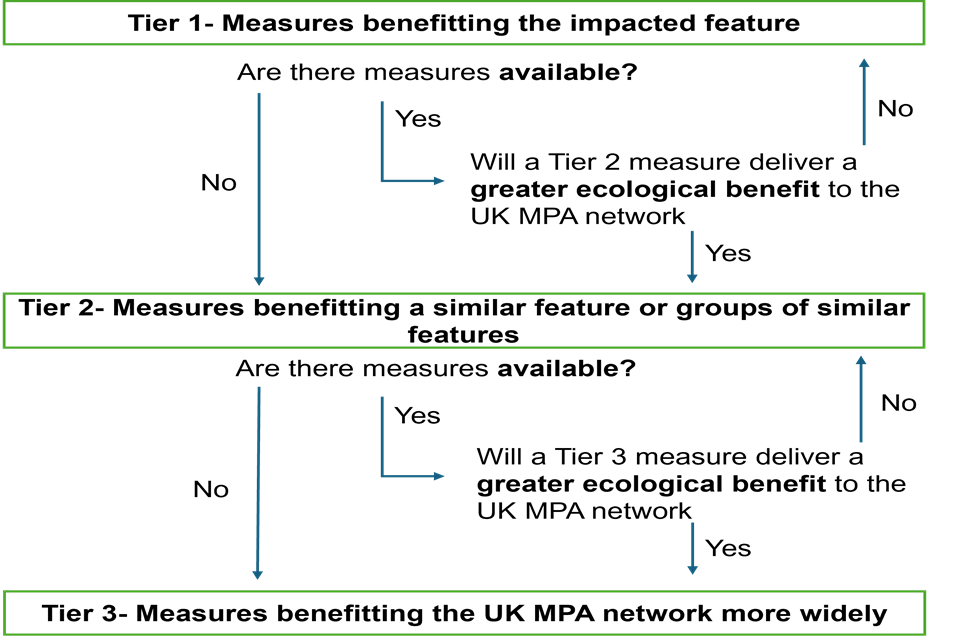
You should consult the relevant SNCBs for advice on developing your reasoned case to justify moving wholly or partially to the next tier of the compensation hierarchy.
The consenting authority will decide on the appropriateness of proposals to progress through the compensation hierarchy, having considered the reasoned case put forward and the advice of SNCBs.
3.1 Determining whether a measure is ‘available’ at a specific tier
You must consider whether any compensatory measures are available at each tier of the compensation hierarchy sequentially, beginning at tier 1.
A compensatory measure is generally considered available if it is both feasible and ecologically effective. A range of considerations may mean that a measure is not available.
Feasibility considerations
Feasibility considerations could include, but are not limited to:
- at tier 1, there are no viable, ecologically effective plan or project-proposed measures and no measures in the Library
- at tier 2 and 3, there are no viable, ecologically effective measures in the library - you should also consider whether an innovative or new measure could be proposed for consideration for the library (note that that the measure would need to be approved and included within the library before it can be selected as a compensatory measure for a plan or project)
- it is not viable for the MRFO to deliver
- it is beyond the ability of the plan or project promoter to deliver (for measures delivered by a plan or project)
Relating to the last point, a measure may be beyond the ability of the plan or project promoter to deliver if, for example:
- the measure cannot be secured (for example, you’re unable to gain necessary land agreements or access rights)
- the measure is technically or legally impossible to deliver, including where regulatory permissions cannot be achieved
- the expected outcomes cannot be delivered within an acceptable timeframe, taking account of ecological requirements
Ecological effectiveness considerations:
Ecological effectiveness considerations could include, but are not limited to:
- insufficient evidence to support ecological effectiveness or significant and unresolvable uncertainty related to available evidence - you should seek the views of SNCBs about the potential ecological effectiveness of a measure where there is limited evidence
- risks of unmanageable adverse effects, including unacceptable impacts on other designated features, for example involving ecological trade-offs that would undermine other conservation objectives
Where you intend to use a compensatory measure or measures through the MRF, you should contact the MRFO about the availability of measures for delivery through the MRF.
Where only part of a tier 1 measure is available due to either feasibility or ecological considerations, the deliverable portion should still be implemented, and any remaining deficit addressed through alternative measures further down the hierarchy in tier 2 or tier 3.
You should address the partial availability of tier 2 measures in the same way. You are still able to move wholly, or partly, to a tier 2 or tier 3 measure where you can demonstrate that it will deliver a greater ecological benefit to the UK MPA network.
3.2 Greater ecological benefit to the UK MPA network
You may progress through the hierarchy and propose a tier 2 or tier 3 measure where you can demonstrate that it will deliver a greater ecological benefit to the UK MPA network than the available measure or measures at tier 1 (if proposing a tier 2 measure) or tier 1 and 2 (if proposing a tier 3 measure) in the compensation hierarchy.
A wider compensatory measure may deliver a greater ecological benefit to the UK MPA network, through:
- the potential scale of the benefit
- the potential quality of the benefit
- both of the above
To demonstrate that a wider compensatory measure provides greater ecological benefit, it should provide either (or both):
- a greater contribution to overall ecological outcomes, recognised conservation strategies and other relevant plans and objectives
-
a benefit to a larger proportion of the UK MPA network (via the improvement of condition or resilience). For example, by:
- alleviating a pressure on a greater number of MPAs
- benefitting a greater area of habitat
- benefitting a greater number within a species population or greater proportion of a species population
- restoring and enhancing connectivity across a greater number of sites of the UK MPA network
- accelerating the recovery of a greater number of sites across the UK MPA network.
Whether a tier 2 or tier 3 measure can deliver a greater ecological benefit to the UK MPA network than a measure in a previous tier will be assessed on a case-by-case basis by the consenting authority.
The greater ecological benefit test is distinct from the reasonably proportionate test. The greater ecological benefit test is only relevant where you are proposing to move down the compensation hierarchy to a tier 2 or 3 measure.
The reasonably proportionate test applies to all compensatory measures and is used to determine the necessary scale of the benefit of a measure in relation to the adverse effect of a plan or project.
4. Information and evidence to provide to the consenting authority
Plan or project promoters will need to provide evidence to demonstrate the adverse effects of the plan or project and why the proposed compensatory measures are appropriate. This section explains those evidence requirements and the stage at which they should be submitted. To meet these requirements, you should draw on the best available scientific evidence.
For Development Consent Order (DCO) applications, you are expected to justify your compensatory measures in a compensation plan (See National Policy Statement for Renewable Energy Infrastructure (EN-3) that sits alongside your Report to Inform Appropriate Assessment (RIAA). Engaging with SNCBs throughout the Pre-Application process and the Evidence Plan Process will significantly strengthen your compensation plan and RIAA. Read the Nationally Significant Infrastructure Projects guidance for further advice on pre-application and the Evidence Plan Process. The compensation plan should provide sufficient information to support the measures you are proposing.
For other types of applications, you can use the RIAA to provide evidence on compensatory measures to the consenting authority. This should include any advice provided by the SNCBs about the appropriateness of the proposed compensatory measures.
Where a tier 2 or 3 measure is proposed, the relevant document should also include a reasoned case for moving through the compensation hierarchy.
Where library measures are proposed, the compensation plan or RIAA should reflect the information and evidence available from the library. You should provide all the relevant information to support the measures you are proposing. The library may contain much of this information for the measure within the Implementation and Monitoring Plan (IMP) for the measure. Where not all information is provided, you should consider the additional evidence you need to provide within your compensation plan.
The library will specify what feature or features may benefit from the specific compensatory measures. You should reflect the information in the library and the IMP in your compensation plan. Detailed additional evidence to demonstrate that the measure addresses the intended pressure and benefits the relevant feature may not be necessary, however, case-specific additional evidence may be required. For example, case-specific evidence includes evidence about the adverse effect of the project or plan and evidence that the benefits of compensatory measures are reasonably proportionate to the adverse effect of the plan or project.
The evidence presented will be assessed on a case-by-case basis by the consenting authority. The consenting authority, informed by advice from the SNCB, will need to be satisfied that the compensatory measures proposed are sufficient and relevant to compensate for the adverse effect. Where this conclusion cannot be reached a compensation plan may not be approved.
4.1 Using the best available scientific evidence
The concept of best available scientific evidence is applied throughout this guidance. This can include quantitative and qualitative assessments and SNCB advice. The best available scientific evidence will vary between measures, and evidence requirements are specific to the compensatory measure. Such evidence could, for example, include showing consideration of a logical case based on well understood ecological principles and their applicability to the UK environment, or by hypotheses based on expert advice and supported by appropriate monitoring, or both.
Quantitative assessments should be provided as far as possible, clearly explaining the methods and assumptions used. Where this is limited, you should describe any barriers to the quantification of evidence and provide a justification of why quantification is not possible.
4.2 Standard and sources of evidence
You can use evidence from existing programmes, reports, plans and research, as well as expert advice, to support your case. Examples could include, but are not limited to:
- expert advice from SNCBs, including that published on JNCC’s Site Information Centres and NE’s Designated Sites View
- evidence from existing reports or programmes, including but not limited to:
- actions outlined in MPA reports and national or regional action plans
- seabird monitoring programmes such as the English Seabird Conservation and Recovery Pathway (ESCaRP) and the Welsh Seabird Conservation Strategy (or other relevant UK seabird strategy)
- Protected Site Strategies
- the Threatened Species Recovery Actions 2025 baseline
- key descriptors of Good Environmental Status which relate to the UK MPA network
- the Environmental Improvement Plan (2025)
- the Joint Administrations Statement (2012)
- peer reviewed literature
- relevant outputs from research programmes
- published grey literature
- the outcomes of compensatory measures delivered by other plans or projects and whether compensatory measures were effective in those cases - you could also consider the outcomes of other relevant environmental projects
5. Evidence to provide to support your compensation proposals
5.1 Evidencing the impact
Plan and project promoters should set out the significance of the adverse effect that the relevant offshore wind activity will have on the SAC, SPA, or Ramsar site. The impacts that require compensatory measures should be clearly outlined in relation to the specific feature, its conservation status and ecological function.
You will need to refer back to this evidence when demonstrating that the benefit of any proposed compensatory measure is reasonably proportionate to the adverse effect of your plan or project on the affected site. You can read more on delivering benefits reasonably proportionate to the adverse effect.
5.2 A reasoned case for progressing through the hierarchy, where relevant
Plan and project promoters must first consider tier 1 compensatory measures and provide a reasoned case where they propose that it is appropriate to progress through the compensation hierarchy to use a wider compensatory measure. This should include an evidence-based justification and should draw on the best available scientific evidence, including the expert advice of SNCBs.
This reasoned case should be provided in addition to the information which would normally be provided to demonstrate that a measure is appropriate and deliverable.
The consenting authority will need to be satisfied, having considered SNCB advice, that the reasoned case provides sufficient justification for progressing through the compensation hierarchy in the circumstances outlined in the section ‘progressing through the hierarchy’.
If you propose a wider compensatory measure due to a lack of available measures in previous tiers, your reasoned case should include the following:
- the relevant compensatory measures you have considered in tier 1 - you will also need to have considered tier 2 measures if you are proposing a tier 3 measure
- the considerations related to effectiveness and feasibility that led you to conclude that the compensatory measures you considered are not (or are insufficiently) available and why - this should include your process and evidence in reaching this conclusion
- advice from SNCBs on the proposed measure and the measures that you considered as not available
- any other relevant considerations that justify your approach
If you propose a wider compensatory measure (tier 2 or tier 3) as it will have a greater ecological benefit to the UK MPA network than the available compensatory measure or measures in a previous tier of the compensation hierarchy, your reasoned case should include the following:
- the relevant available options considered at each tier of the compensation hierarchy
- your process and evidence for justifying that your proposed measure or measures will deliver a greater ecological benefit to the UK MPA network than other available measures in previous tiers of the compensation hierarchy
- advice from SNCBs on whether the measure will provide a greater ecological benefit than available measures in previous tiers of the compensation hierarchy
- any other relevant considerations that justify your approach
5.3 Evidence the proposed compensatory measures
Plan and project promoters should provide evidence that both:
- the proposed compensatory measure will deliver a benefit to the relevant feature or UK MPA network
- this benefit is reasonably proportionate to the adverse effect of the plan or project on the integrity of the impacted SAC, SPA or Ramsar site
The sections below set out the information and evidence required in relation to both elements of this requirement.
Evidence the pressure to be addressed
Plan and project promoters should provide the best available evidence describing the pressure that the compensatory measure is intended to address and the impact of the pressure on the relevant feature or the UK MPA network or both. This refers to the pressure targeted by the compensatory measure itself, rather than evidencing the adverse effect generated by the offshore wind project itself (which you should provide as outlined above in the section Evidencing the Impact.
Detail the proposed compensatory measure or measures
Once you have identified the tier or tiers of the compensation hierarchy you intend to propose, you should provide sufficient information on the proposed measure or measures for the consenting authority to assess its appropriateness. For library measures, much of this detail will be included within the IMP provided. Detail about the compensatory measure should include but not be limited to:
- a description of the characteristics of the proposed compensatory measure or measures
- the ecological benefit to be delivered
- the spatial scale of the measure of measures
- the location of the measure or measures
- whether the measure or measures have already been secured or whether further work (for example, Town and Country Planning Act consent or marine licensing) is required
- the timescales for delivery of the measure or measures, including consideration of whether they will be measurable and fully functional before the adverse effect arises
- an assessment of the ‘additionality’ of the measure or measures
- appropriate success criteria for the measure or measures
- specifications on how the compensatory measure is proposed to be delivered and maintained
- the degree of confidence that the measure or measures will meet the success criteria
- the risks and uncertainties around the measures, including how any uncertainties identified will be addressed
- proposed monitoring plans for the measure or measures and proposed adaptive management plans in the instance that monitoring proves that measures are not having the required impact
- consideration of any decommissioning requirements
Early engagement with SNCBs should be undertaken to ensure an appropriate level of detail is being provided.
5.4 Evidence the benefits of the proposed compensatory measure
Evidence of addressing pressures and delivering benefit
Compensatory measures are required to benefit the UK MPA network in a manner which is reasonably proportionate to the adverse effects on the integrity of the SAC, SPA or Ramsar site.
You should provide the best available evidence demonstrating how and why the proposed compensatory measure will address the identified pressure set out above and deliver the stated benefit for the relevant feature or features of the UK MPA network. This will be different for each tier:
- For tier 1 measures, you should demonstrate how your proposed compensatory measure will deliver benefits to the impacted feature.
- For tier 2 measures, you should demonstrate how your proposed compensatory measure will deliver benefits to ecologically similar features or group of features of the UK MPA network.
- For tier 3 measures, you should demonstrate how your proposed compensatory measure will deliver benefits to the UK MPA network more widely.
The benefit delivered is required to be an ecological benefit. This can be achieved via actions that enable the UK MPA network, or a feature or features within it, to improve its current condition or its resilience. This may be through actions such as:
- enabling restoration of habitats and species that are features of the UK MPA network
- alleviating key pressures impacting the UK MPA network
- improving the resilience of MPA features to stressors, such as climate change
All actions should be monitored for effectiveness against compensation success criteria.
Where relevant, you may provide additional evidence describing how the measure could deliver direct or indirect ecological benefits, or both, to another protected feature or features in the UK MPA network or to the UK MPA network more widely. This could include indirect benefits to the impacted feature.
Confidence, uncertainty and likely success of compensatory measures
Plan and project promoters should provide an assessment of confidence in the compensatory measure’s likely success.
This guidance does not require you to follow a specific confidence scoring approach. However, where a specific confidence methodology is deployed, you should justify its use.
5.5 Evidence of delivering benefits reasonably proportionate to the adverse effect
Compensatory measures are required to benefit the UK MPA network in a manner that is reasonably proportionate to the adverse effects, or predicted adverse effects, of the proposed offshore wind activity on the integrity of the impacted SAC, SPA or Ramsar site.
The level of compensation that is reasonably proportionate will depend on a range of considerations and will be assessed on a case-by-case basis by the consenting authority.
For advice on demonstrating whether the benefit of your proposed measure or measures is reasonably proportionate to the adverse effect of the plan or project, you should consult with SNCBs as early as possible in the pre-application stage. SNCBs will continue to provide advice through the consenting process in the usual way.
Assessing what may be reasonably proportionate
Broadly, evidence should consider the anticipated ecological benefits of the compensatory measure to the targeted feature or features or to the UK MPA network, in comparison to the magnitude of the adverse effect of the plan or project. This consideration should include both quantitative and qualitative factors. See the section on best available scientific evidence for information on quantitative and qualitative assessments.
Determinations of ‘reasonably proportionate’ should be based on ecological considerations only. Economic, financial or commercial considerations should not be used to reduce the scale of compensation required to address the ecological impact. The benefit of a compensatory measure may not match the adverse effect precisely, but an evidence-based judgement that the benefit of the compensatory measure appropriately compensates for the adverse effect of the plan or project should be provided.
For tier 1 measures, reasonable proportionality will normally be demonstrated through direct, feature‑specific ecological evidence. For tier 2 and tier 3 measures, a greater degree of expert ecological judgement may be required. Any such judgement should be transparent, evidence‑based and apply the appropriate level of precaution.
You should consider the evidence you have provided to support your compensation proposals to make this comparison.
Relevant considerations
Examples of relevant considerations when comparing the adverse effect of your plan or project to the benefit of your proposed measures are listed below. There will be several other relevant considerations.
The magnitude of the adverse effect on the impacted site
Considerations could include, but are not limited to:
- the scale of predicted adverse effect including:
- for habitats: size, loss and damage (for example, area of habitat impacted)
- for species: loss, disturbance (for example, number of individuals in a species impacted)
- permanence of the adverse effect
- the duration of the predicted adverse effect
- in-combination adverse effects
- the condition or conservation status of the impacted feature
- the ecological function of the impacted feature
- the ability of the impacted feature to recover
The pressure or feature to be targeted by the measure or measures
Considerations could include but are not limited to:
- the current and predicted future impact of the pressure to be targeted on the relevant feature or features or the UK MPA network
- The conservation status or condition of the feature to be targeted by the compensatory measure
- the ecological function of the feature to be targeted by the compensatory measure
- how alleviating the pressure or improving the condition of the feature would deliver a benefit to the relevant feature or the UK MPA network
- any relevant conservation strategies or action plans already in place
The measure or measures to be delivered
You should focus on implementation and how the measure will address the targeted pressure or benefit the relevant feature or features. The amount of compensation that may be considered reasonably proportionate to the adverse effect of the plan or project could vary depending on the considerations below and the evidence provided. Considerations could include, but are not limited to:
-
the scale of the anticipated benefits of the proposed measure or measures including:
- For habitats: protection, restoration and improvement in condition
- For species: benefits to the overall population, range, distribution and condition
- the ecological effectiveness of the measure
-
confidence in likely success of the measure
- technical feasibility to deliver
- overall confidence in the evidence base underpinning the measure and evidence gaps
- dependencies on other activities
- vulnerability to external factors (for example, climate change)
- evidence of the measure or similar measures being successfully implemented for offshore wind or for other purposes
- monitoring feasibility and limitations in monitoring the success criteria
- the duration of the benefit of the measure
- the contribution of the measure to existing conservation strategies such as site-specific conservation objectives, published conservation plans, reports and programmes
- how distinct the benefiting feature or features are from the impacted feature
- the location of the compensatory measure in relation to the impact
- any potential disbenefits to sites and features of the UK MPA network that could arise from the measure or measures
- the extent to which the measure or measures can be monitored for effectiveness
- the timing of the implementation of the measure
Ancillary or spill-over benefits to features other than those targeted by the compensatory measure may arise from a compensatory measure. These additional benefits may not be counted towards your overall amount of compensation, particularly when delivering a tier 1 measure. The compensatory measure at tier 1 should address your impact in full, irrespective of additional benefits to other features.
5.6 Managing risks of unintended consequences
Plan and project promoters should review the risk of potential direct or indirect negative impacts that may arise from implementing the compensatory measure, including impacts on habitats, species interactions, or ecosystem processes.
You should draw on the best available scientific evidence to identify, evaluate, and mitigate these risks early in the design process to ensure that measures do not create new pressures or undermine ecological outcomes, seeking advice from SNCBs where appropriate.
5.7 Compensation success criteria
You should clearly set out the compensation success criteria for your proposed measure or measures, against which the effectiveness can be assessed. If you are using a measure from the library, success criteria for the selected measure will usually be set out in the IMP. For measures delivered via the MRF, responsibility for meeting these criteria is passed to the MRFO. For tier 1 measures delivered outside the MRF and not taken from the library, the success criteria should be developed with SNCB advice at the pre-application stage.
The evidence provided on the proposed compensatory measures should clearly link to the compensation success criteria, and the monitoring plan should detail the monitoring required to assess progress against the success criteria using the best available scientific evidence.
Your compensation success criteria should cover both:
- the implementation of the compensatory measure or measures - these criteria should be used to assess if the compensatory measure is effectively delivered
- the success of the compensatory response – these criteria should be used to assess the ecological outcomes that the compensatory measure or measures is intended to deliver
The best available scientific evidence should be used to demonstrate whether the compensatory measure or measures are delivering the intended ecological outcome at the relevant tier.
Where direct measures of the benefits of the compensatory measure are not possible, proxy measures may be acceptable.
If the intended ecological outcome or outcomes are not being achieved, you may need to consider adaptive management.
6. Determining whether proposed measures are additional
All compensatory measures should be additional to normal practice for managing the site or sites that will benefit from the measure. For offshore wind plans and projects, normal practice could mean either:
- site conservation measures that are currently being delivered
- planned site conservation measures that have an identified delivery mechanism in place - this could include any necessary regulatory or enforcement action by a public body
An example of a conservation measure that is currently being delivered would be the existence of fencing around bird colonies in an SPA to exclude mammalian predators.
An example of a planned conservation measure with an identified delivery mechanism would be rat eradication around a seabird colony that has been contracted and with all permits and licences granted.
6.1 When a compensatory measure can be considered additional
If a proposed compensatory measure does not fall within the scope of normal practice for site management, it may be considered additional.
If a proposed compensatory measure falls within the scope of normal practice, it may still be considered additional if it can be reasonably expected to accelerate the achievement of a site’s conservation objectives by improving on normal practice. Improving on normal practice could include, but is not limited to, delivering a measure that will:
- have greater duration than if delivered as part of normal practice
- deliver the intended ecological benefits more quickly than normal practice does
- increase the area of habitat (including supporting habitat for species) that will benefit from the measure compared to what happens under normal practice
- increase the number within a species population or range of species that will benefit from the measure compared to what happens under normal practice
- enhance the condition or quality of existing protection for features that is delivered under normal practice
An example would be the replacement of existing temporary electric fencing around bird colonies in an SPA with a more effective type of permanent fencing to more reliably exclude mammalian predators over a longer period of time. Such a measure may be considered additional because it improves on normal practice for site management by enhancing the quality of the existing protection for birds and ensuring it will last for a longer time.
Only the additional environmental benefit that has resulted from improving on normal practice for site management will be considered as ecological benefit provided by the compensatory measure. In the above example, the ecological benefit of the compensatory measure would be only the additional increase in bird population that could be reasonably attributed to the fence upgrade.
6.2 Identify, propose, and deliver additional measures
When you propose a compensatory measure, you should have due regard to SNCB advice on whether it meets the criteria to be considered additional. This advice should be included in the RIAA or the compensation plan. If you want to deliver a compensatory measure via the MRF, you should also discuss this with the MRFO. The consenting authority will decide whether to accept a compensatory measure as additional to normal practice for site management.
7. Timing of compensation
Compensatory measures should typically be in place and functional by the time at which damage to a protected area begins. There may be circumstances where the consenting authority allows the adverse effect to occur before the compensatory measure is in place and functional. The level of confidence that a measure will be successfully delivered will be a relevant factor. A time lag between the adverse effect and the functioning of the compensatory measure may be acceptable where one or more of the following applies:
- the measure requires a significant lead‑in time to achieve full ecological effectiveness
- the ecological implications of the delay have been fully accounted for in the design and scale of the measure, for example through a higher benefits‑to‑impact ratio to offset any interim adverse effects
- any delay would not result in irreversible harm to the feature or network
- the measure is likely to deliver greater or more sustainable long-term benefits for the target feature or features or the UK MPA network more widely than alternative compensatory measures that could be implemented more quickly
If you consider there to be a justification for using a compensatory measure that will not be in place and functional before the adverse effect occurs, you should provide a reasoned case for the consenting authority based on the factors set out above.
Whether a compensatory measure can be delivered after the adverse effect has occurred will be assessed by the consenting authority according to the specific circumstances of the proposal and the justification and evidence provided.
8. Monitoring
Once compensatory measures are agreed, they should be monitored to ensure they are delivering their expected outcomes throughout the plan or project’s lifetime. Your IMP should meet the requirements set out in your consent or licence. It should also set out how the measure’s performance against the compensation success criteria will be monitored. In some cases, the success criteria may relate to improvements in proxy indicators. In such cases, you may use more qualitative (as well as quantitative) information show an improvement or a positive direction of change to the features or network.
Monitoring should:
- be proportionate to the scale and risk profile of the compensatory measure
- use methods that are robust and scientifically appropriate
- include clearly defined indicators set out to enable the measure’s performance against compensation success criteria to be assessed
- include review intervals and decision points that reflect the characteristics of the measure, recognising that higher‑risk or longer‑establishing measures may require earlier or more frequent reviews
- generate information at intervals that allow for early identification of emerging issues
Monitoring data should meet agreed quality standards, including requirements for accuracy and methodological consistency over time.
You are responsible for ensuring monitoring is delivered in full, in accordance with the approved IMP.
If your compensatory measures are being delivered through the MRF, responsibility for monitoring these is transferred to the MRFO.
If monitoring reveals that compensatory measures are not performing as expected, the consent conditions will require the implementation of adaptive management.
Adaptive management actions should also be monitored for effectiveness. Monitoring of adaptive management should follow the same overall principles as monitoring of compensatory measures. There may be different monitoring requirements if compensatory measures change.
9. Adaptive management
Adaptive management is the adjustment or replacement of a compensatory measure if the monitoring of such a measure demonstrates that it is not functioning as expected. Adaptive management applies to all compensatory measures.
If you are replacing compensatory measures for impacts to SACs, SPAs or Ramsar sites, you must follow the compensation hierarchy as set out in this guidance.
Adaptive management plans should be developed before compensatory measures are implemented and should set out pre‑agreed triggers for initiating adaptive management actions. Such triggers could include delayed establishment, reduced effectiveness, or unexpected ecological responses of the compensatory measures.
When monitoring of the compensatory measures shows that trigger points have been reached, adaptive management should be undertaken until the compensatory measures are functioning as intended.
9.1 Project-led compensatory measures
For project-led compensatory measures, subject to any specific conditions in the original consent or licence, the plan or project promoter is responsible for implementing all agreed adaptive management actions in a timely and effective manner. You should ensure that appropriate resources, governance arrangements, and delivery mechanisms are in place.
Where you are delivering your own compensatory measures without using the MRF, but subsequently require alternative measures as part of your adaptive management process, you can apply to the MRF. This is subject to the relevant approvals and the availability of an appropriate measure. You should check your individual consent or licence to find out what approvals would be required.
9.2 MRF-led compensatory measures
For compensatory measures delivered through the MRF, the MRFO is responsible for implementing adaptive management actions. The MRFO will ensure that the necessary resources, governance, and delivery mechanisms are in place. An adaptive management charge will be included in your MRF contract.