NRS Biodiversity Report for Wales - Jan 2023 to Dec 2025
Published 15 September 2026

© Crown copyright 2026
This publication is licensed under the terms of the Open Government Licence v3.0 except where otherwise stated. To view this licence, visit nationalarchives.gov.uk/doc/open-government-licence/version/3 or write to the Information Policy Team, The National Archives, Kew, London TW9 4DU, or email: psi@nationalarchives.gov.uk.
Where we have identified any third party copyright information you will need to obtain permission from the copyright holders concerned.
This publication is available at https://www.gov.uk/government/publications/nrs-biodiversity-reporting/nrs-biodiversity-report-for-wales-jan-2023-to-dec-2025
Introduction
Who we are
Nuclear Restoration Services (NRS) is a wholly owned subsidiary of the Nuclear Decommissioning Authority. We are responsible for the safe, secure and sustainable decommissioning of 14 nuclear sites across the UK. These include:
- The largest environmental clean-up and demolition project in Scotland at the former centre of fast reactor research and development, Dounreay
- Eleven first and second-generation nuclear sites at Berkeley, Bradwell, Chapelcross, Dungeness A, Hinkley Point A, Hunterston A, Hunterston B, Oldbury, Sizewell A, Trawsfynydd and Wylfa
- Two reactor research sites at Harwell and Winfrith
NRS also operates a hydro-electric power station at Maentwrog.
Hunterston B joined NRS on 1 April 2026 as the first advanced gas-cooled reactor site to be decommissioned. Hinkley Point B will follow in autumn 2026. Dungeness B, Torness, Heysham 1 & 2, and Hartlepool will join NRS as they are defueled over the next decade.
Part of a sustainable future
At NRS we firmly believe every former nuclear site has a valuable use for future generations. This ambition is reflected in our purpose:
We are responsible for the delivery of value for money decommissioning and restoration of nuclear sites, ensuring all our futures are safe, secure and sustainable.
The land in our care presents a unique opportunity to create a positive environmental legacy. Through the restoration and enhancement of habitats, support for priority species and the creation of resilient ecosystems, NRS aims to ensure that former nuclear sites continue to provide value for nature and communities long after decommissioning is complete; for all our futures.
Our duty to biodiversity
Our estate includes a diverse range of habitats and species and forms part of wider ecological networks across England, Scotland and Wales. As a public body operating across these three nations, NRS must meet the statutory biodiversity duties relevant to each one.
In Wales, section 6 of the Environment (Wales) Act 2016 places a duty on NRS to seek to maintain and enhance biodiversity and, in doing so, promote the resilience of ecosystems.
This report summarises the actions NRS has taken to comply with the section 6 duty during the reporting period (January 2023 to December 2025). It also sets out commitments for the next reporting period.
NRS most closely aligns with organisations described in Welsh Government guidance as ‘Group 2’, which are defined as:
- those that own, occupy or manage land, buildings and grounds
- whose functions are connected with biodiversity and/or land management, or
- that can influence those who own or manage land
Our footprint in Wales
Our operational footprint in Wales comprises three sites: Trawsfynydd, Maentwrog and Wylfa. Each site is located within a distinct ecological setting and forms part of wider ecological networks within North Wales. A summary of the biodiversity context for each site follows.
Trawsfynydd and Maentwrog site context
Landscape
Both Maentwrog hydroelectric power station and the Trawsfynydd nuclear power station are located within the Eryri National Park and have a shared reliance on Llyn Trawsfynydd. The lake was constructed in the 1920s in a remarkable feat of engineering to power the Maentwrog hydroelectric scheme, which has been generating renewable energy for nearly a century. The lake later provided the conditions needed for the UK’s first inland civil nuclear power station at Trawsfynydd. Construction started in 1959, followed by more than two decades of power generation until decommissioning began in 1991.
The Maentwrog landholding is small, less than 3 hectares, with half the site dominated by the hydroelectric buildings and hardstanding. The remaining land is woodland, scrub, and grassland habitats, with a residential building and associated gardens.
By comparison, the landholding at Trawsfynydd is large, at 27 hectares, comprising the nuclear licensed site and land surrounding Llyn Trawsfynydd. The nuclear licensed site is dominated by operational infrastructure and associated hardstanding. However, the wider site supports woodland, scrub, grassland and aquatic habitats that contribute to the ecological diversity of the area.
The sites form part of a wider network of habitats and are situated close to several nationally and internationally designated nature conservation sites. These include:
- Meirionnydd Oakwoods and Bat Sites Special Area of Conservation (SAC)
- Migneint-Arenig-Dduallt SAC, Special Protection Area (SPA) and Site of Special Scientific Interest (SSSI)
- Afon Eden – Cors Goch Trawsfynydd SAC
- Coed y Rhygen National Nature Reserve (NNR) and SSSI
- Coedydd Maentwrog NNR and SSSI
Together, these designations support a wide range of woodland, wetland, freshwater and upland habitats and form part of an important ecological network across the Eryri landscape.
Species
The sites and surrounding landscape support a variety of notable and protected species. Particular importance is attached to the lesser horseshoe bat (Rhinolophus hipposideros), which is included in the section 7 protected species list due to its declining population.
The Trawsfynydd site and surrounding area contain important maternity and hibernation roosts for this species. The woodland, scrub and freshwater habitats associated with the site also provide valuable commuting and foraging habitat. As a result, the horseshoe bat has been identified as an ‘iconic species’ for inclusion in our biodiversity action plan for this site.
The wider area also supports freshwater pearl mussel, otter, Atlantic salmon, breeding and wintering birds, bats, amphibians, reptiles and a diverse range of plant and woodland species associated with the Eryri landscape.
Wylfa site context
Landscape
The Wylfa site is located on the north coast of Anglesey, adjacent to Wylfa Head, within a landscape of significant ecological value. The centre of the site is dominated by operational buildings and associated infrastructure. However, the wider site includes areas of grassland, coastal grassland, scrub and plantation woodland that contribute to the ecological diversity of the area.
Wylfa forms part of a wider network of coastal habitats and sits adjacent, or in close proximity, to several locally, nationally and internationally designated sites. These include:
- North Anglesey Marine SAC
- Wylfa Head Local Nature Reserve
- Tre’r Gof SSSI
- Cemlyn Bay SAC and SSSI
- Anglesey National Landscape
The surrounding landscape supports a range of coastal, wetland and heathland habitats which contribute to ecosystem resilience and habitat connectivity across northern Anglesey.
Species
The site and surrounding area support a variety of notable and protected species. Particular importance is attached to the red-billed chough (Pyrrhocorax pyrrhocorax), which has established nesting sites on and around the Wylfa site. Chough are a species of principal importance under section 7 of the Environment (Wales) Act 2016 and Anglesey supports a significant proportion of the Welsh breeding population. The site also provides habitat and ecological connectivity for bats, reptiles, amphibians, invertebrates, breeding and wintering birds, and a range of terrestrial and marine species associated with the surrounding coastal environment.
Activities during the reporting period (2023 to 2025)
Growing our understanding
During the reporting period, we undertook a significant programme of work to improve understanding of biodiversity across our Welsh sites and to embed biodiversity and ecosystem resilience within business planning and decision-making processes. This included an extensive programme of baseline ecological surveys to improve our understanding of the habitats and species present across our sites and how they contribute to local and wider ecological networks.
These surveys have gone beyond standard ecological assessments, incorporating landscape character evaluations, ecological network mapping and the identification of opportunities for landscape-scale biodiversity enhancement.
Detailed assessment of risks to ecology (DARE)
Building on this evidence base, we developed a DARE for each site. These assessments identify and evaluate the biodiversity risks and opportunities associated with decommissioning and restoration activities, and inform site-specific risk and opportunity management plans.
Together, these plans provide a consistent approach across the estate, helping to meet and, where possible, exceed legal requirements relating to biodiversity mitigation, compensation and enhancement. They also align NRS activities with the restoration objectives of relevant authorities, regulators and conservation bodies.
Biodiversity action plans
As a result of this work, we have begun developing site-specific biodiversity action plans, which will provide a framework for future biodiversity enhancement and empower those working in and around our sites to actively support nature recovery.
Strengthening our management
During the reporting period, we developed or updated several documents within the NRS Management System to strengthen biodiversity considerations and support delivery of section 6 of the biodiversity and resilience of ecosystems duty under the Environment (Wales) Act 2016. These include:
- NRS Sustainability Strategy, summarised in Additional Information 1.
- NRS Company Standard for Ecology and Biodiversity, which embeds biodiversity considerations into everyday business practices and decision-making processes. This standard incorporates the NRS biodiversity duty commitments. The duty is reproduced in Additional Information 2.
- NDA Social Impact and Communities Strategy, through which we align our socio-economic activities in Wales with the well-being goals and sustainable development principle of the Well-being of Future Generations (Wales) Act 2015. Our approach to applying these principles to biodiversity and ecosystem resilience in Wales is summarised in Additional Information 3.
- Wylfa Site Sustainability Plan and the Trawsfynydd and Maentwrog Site Sustainability Plan, which translate corporate sustainability commitments into site-specific actions. Relevant biodiversity and well-being commitments from these plans are reproduced in Additional Information 4.
Collectively, these corporate and site-specific commitments provide the framework through which we deliver our biodiversity and ecosystem resilience commitments in Wales.
Appendix A demonstrates how these commitments align with and support the individual requirements of section 6 of the Environment (Wales) Act 2016.
Additional Information 1: NRS Sustainability Strategy
The NRS Sustainability Strategy was issued in 2025 and includes an environment priority that pledges to “Decommission in a way that encourages nature and people to thrive.” This priority includes five themes.
The two most relevant to the biodiversity duty statement are: * Nurture and enhance biodiversity on and around our sites * Act on climate change
These strategy commitments ensure biodiversity and ecosystem recovery considerations are integrated into the company management system and decision making.
The strategy also includes commitments that support delivery of the Well-being of Future Generations (Wales) Act 2015. For example, under Priority 3: Communities, NRS commits to:
- Support local communities in the development of thriving and resilient economies, enabling a just transition.
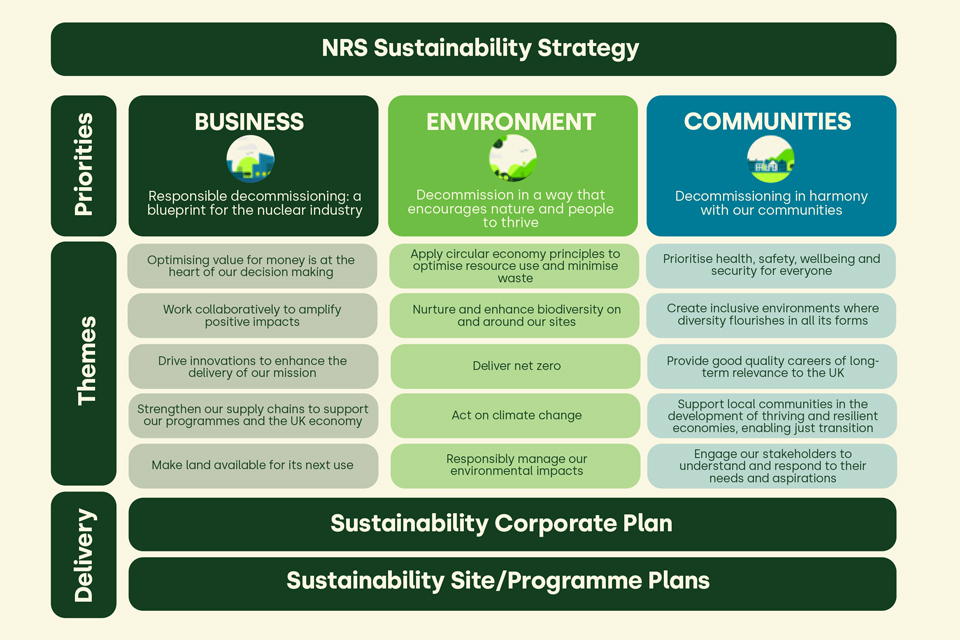
NRS Sustainability Strategy diagram
Additional Information 2: NRS biodiversity duty commitments
(copied from the NRS company standard ‘Ecology and Biodiversity’)
As a public body operating across England, Scotland and Wales, NRS must meet the statutory biodiversity duties relevant to each nation. Although these duties differ in legal wording, they share a common expectation that public bodies must conserve, maintain and enhance biodiversity through the proper exercise of their functions.
- England: Public authorities must consider, plan and act to conserve and enhance biodiversity under the Environment Act 2021.
- Scotland: Public bodies must further the conservation of biodiversity under the Nature Conservation (Scotland) Act 2004, with a requirement to publish a biodiversity duty report every three years under the Wildlife and Natural Environment (Scotland) Act 2011.
- Wales: Public bodies must maintain and enhance biodiversity and promote ecosystem resilience under section 6 of the Environment (Wales) Act 2016, with three-yearly reporting.
Across all NRS sites we, therefore, commit to:
- Consider the responsibilities and opportunities linked to biodiversity across the land we manage
- Set policies and specific objectives based on these considerations
- Act to deliver these policies and achieve our objectives in line with national statutory duties
Considering what NRS can do to enhance biodiversity
NRS are guardians of some unique areas of land comprising a vast range of habitats and species. From heathlands to wetlands and amphibians to raptors, we are responsible for protecting and enhancing our sites and all that live on them for generations.
Developing an approach to decommissioning that has sustainability at its core will ensure that protecting and enhancing nature is seen as how we do business at NRS. This includes developing strategies and processes that ensure the biodiversity value of our sites is understood, appreciated and considered in the delivery of our mission.
NRS policies and objectives based on our considerations
The NRS purpose incorporates sustainability:
We are responsible for the delivery of value for money decommissioning and restoration of nuclear sites, ensuring all our futures are safe, secure and sustainable.
The NRS Sustainability Policy commits us to:
Value the resources we use, nurture biodiversity within and around our sites, act on climate change and achieve our commitment to net zero by 2050.
The NRS Sustainability Strategy includes a strategic aim to: “
Decommission in a way that encourages nature and people to thrive.
Principles included in the sustainability strategy which are pertinent to delivering on our biodiversity duty include:
- Considering the wellbeing of current and future generations in decision making
- Supporting end states that maximise value to local communities and the UK as a whole, including the creation of unique habitats that support nature and climate resilience
- Ensuring that protecting and enhancing wildlife is a prerequisite for successful decommissioning
- Working in partnership with our communities to amplify benefits and to ensure our efforts enhance wider landscape characteristics
- Collaborating with supply chain and industry partners to maximise benefits
To meet our statutory duties in England, Scotland and Wales, and to deliver our policies and objectives to embed biodiversity considerations into all aspects of our work, NRS will:
- Understand the current biodiversity value of our sites, having regard to protected site strategies
- Employ a proactive approach to reduce risk and maximise opportunity, including incorporating nature-based solutions and climate resilience into decision making
- Develop and maintain biodiversity action plans for each site, focused on locally important habitats and species, aligned with national frameworks such as local nature recovery strategies in England and local biodiversity priorities in Scotland and Wales
- Undertake a flagship conservation project (included in site BAPs) to trailblaze and promote biodiverse end states
- Maintain a biodiversity file, register and map for each site, ensuring ecological information is accurate, accessible and kept up to date
- Update key processes in the NRS management system to mainstream biodiversity across project, operational and strategic decision making
- Ensure biodiversity is addressed in environmental impact assessments, habitat regulations assessments, business cases, including natural capital considerations
- Engage with key stakeholders and local communities to ensure our work reflects local priorities and opportunities
- Meet national reporting requirements, including three‑year biodiversity duty reports in Scotland and Wales, and contributing to England’s five‑year consideration cycle
Additional Information 3: Relationship with the Well-being of Future Generations (Wales) Act 2015
As an operating company working under the Nuclear Decommissioning Authority, NRS aligns its socio-economic and environmental activities with the Well-being of Future Generations (Wales) Act 2015 through delivery of the NDA Social Impact and Communities Strategy and the NRS Sustainability Strategy.
This approach helps ensure that long-term nuclear decommissioning and restoration activities protect people and the environment while creating lasting benefits for communities and future generations.
The majority of the requirements of the act are met through the delivery of our socio economic scheme. However we recognise that biodiversity contributes directly to the wellbeing goals of a resilient Wales, prosperous Wales, healthier Wales and globally responsible Wales. As a result, biodiversity and ecosystem resilience considerations are integrated into all of our planning and activities.
In delivering our biodiversity duty, we apply the sustainable development principle and seek to reflect the five ways of working:
- Long-term – Planning for restoration outcomes that deliver lasting environmental, social and economic benefits beyond the operational life of sites.
- Prevention – Identifying and addressing risks to biodiversity and ecosystem resilience at an early stage through ecological assessments, biodiversity action plans, climate adaptation activities and environmental management processes.
- Integration – Embedding biodiversity, climate resilience, natural capital and wider sustainability considerations into business planning, project development and decision-making processes.
- Collaboration – Working with regulators, local authorities, conservation organisations, community groups, educational institutions, supply chain partners and the NDA to maximise environmental and community benefits.
- Involvement – Engaging with local stakeholders and communities to understand local priorities and help deliver outcomes that support both nature recovery and community wellbeing.
This approach supports NRS’s commitment to deliver decommissioning and restoration programmes that contribute positively to local places, strengthen ecosystem resilience, support climate adaptation and create sustainable benefits for current and future generations.
Additional Information 4: Biodiversity and well-being commitments from Welsh site sustainability plans
The site sustainability plans for Wylfa, Trawsfynydd and Maentwrog were developed in 2025 and will be delivered during the next reporting period.
The plans set out site-specific actions that support delivery of the NRS Sustainability Strategy. Several of these actions relate directly to biodiversity, ecosystem resilience and community wellbeing, helping NRS deliver its commitments under section 6 of the Environment (Wales) Act 2016.
The actions in the plans range from long-term habitat and ecosystem enhancement initiatives to practical activities that enable employees to contribute directly to nature recovery.
NRS sites are places where people live, work and visit. Improving the quality of habitats within and around our sites can enhance access to nature, support wellbeing and foster a sense of pride and connection to the local environment.
Actions: Trawsfynydd and Maentwrog
- Develop and implement a site biodiversity action plan by March 2027, focused on enhancing habitats and ecological connectivity, with particular consideration given to the lesser horseshoe bat (a section 7 priority species in Wales).
- Deliver a 10-year habitat management programme, enhancing acid grassland, upland oakwood and wet woodland habitats on NRS-managed land on the eastern shore of Llyn Trawsfynydd. These activities will secure a net benefit for biodiversity and provide compensation for potential future ecological impacts arising from decommissioning activities, including: * Conservation grazing * Native woodland enhancement * Bat and bird habitat creation
- Improve habitat opportunities for pollinators and other wildlife through measures such as ‘No Mow May’, pollinator planting and habitat piles.
- Support local conservation initiatives, including work to help reverse the decline of freshwater pearl mussels associated with the Crawcellt Weir catchment.
- Support staff-led litter picking activities to reduce plastics and litter entering the natural environment.
- Undertake a risk workshop to understand climate risks at Trawsfynydd and Maentwrog, including risks to ecosystems.
- Support staff volunteering to promote wellbeing
Actions: Wylfa
- Review and reissue the site biodiversity action plan by March 2027, focused on habitats and species that contribute to local and regional nature recovery priorities, including the chough (a section 7 priority species in Wales).
- Host a learning event on site, e.g. Wylfa Head walk.
- Encourage biodiversity at the site, e.g. No Mow May.
- Support biodiversity enhancement projects associated with Wylfa Head and the Tre’r Gof area.
- Reduce litter and plastics entering the natural environment through site-led litter picking initiatives.
- Promote a strategic approach to biodiversity enhancement through planning applications and project delivery activities.
- Support the delivery of a workshop on Wylfa climate change risks and reflect in risk register.
- Grow the volunteering programme and develop meaningful relationships with charities and community groups that are important to the local community.
Governance
We deliver our biodiversity commitments through the NRS management system, supported by site sustainability plans, biodiversity action plans and established planning and environmental management processes. Responsibility for implementation sits within existing business functions, supported by sustainability and environmental specialists. A cross-functional biodiversity working group brings together representatives from sustainability, environment, planning, legal and technical teams to oversee delivery, share good practice and coordinate biodiversity actions across the organisation. Progress is monitored through established performance management and reporting arrangements.
Review and forward-look
This report will be reviewed at least every three years, or sooner where there are significant changes to NRS responsibilities, operations or statutory requirements. Over the next reporting period, NRS will:
- Complete site biodiversity action plans
- Begin to implement the actions identified in those plans
- Further embed biodiversity considerations within management systems and decision-making processes
- Deliver site sustainability commitments that support biodiversity and ecosystem resilience
- Develop and apply metrics to monitor performance and report against biodiversity duty requirements
By embedding biodiversity and ecosystem resilience into decommissioning and restoration, NRS is creating a positive environmental legacy that will benefit people and nature for generations to come, contributing to a safe, secure and sustainable future.
Appendix A
Alignment with the section 6 duty
| Section 6 duty element | NRS commitments and activities |
| Maintain and enhance biodiversity | NRS biodiversity duty commitments; site biodiversity action plans; habitat enhancement and management programmes; pollinator initiatives; priority species conservation (including lesser horseshoe bat and chough – section 7 priority species); biodiversity enhancement projects; restoration planning. |
| Promote ecosystem resilience | Landscape-scale ecological assessments; ecological network mapping; habitat connectivity improvements; climate adaptation activities; nature-based solutions; restoration end-state planning; DARE risk and opportunity assessments. |
| Take account of ecosystem resilience in decision making | Baseline ecological surveys; DARE studies; protected site strategy considerations; biodiversity registers, files and maps; ecology and biodiversity standard (S-438); integration of biodiversity into project development, business cases, EIAs, HRAs and operational decision-making. |
| Collaboration and involvement | Engagement with Natural Resources Wales, local authorities, conservation organisations, community groups, educational institutions, supply chain partners, NDA organisations and local communities to maximise environmental and social benefits. |
| Long-term action | NRS Sustainability Strategy; site sustainability plans; biodiversity action plans; restoration end states; climate resilience planning; periodic review of commitments; three-year biodiversity reporting cycle. |
| Evidence, monitoring and governance | Baseline ecological surveys; ecological network assessments; biodiversity records and mapping; biodiversity working group; performance management processes; development of biodiversity metrics; periodic reporting and review. |
| Supporting the Well-being of Future Generations Act | Long-term restoration planning; community engagement; volunteering initiatives; support for local conservation projects; climate adaptation; delivery of environmental, social and economic benefits for future generations. |