Next steps for electricity interconnection in Great Britain (accessible webpage)
Published 25 March 2026

© Crown copyright 2026
This publication is licensed under the terms of the Open Government Licence v3.0 except where otherwise stated. To view this licence, visit nationalarchives.gov.uk/doc/open-government-licence/version/3 or write to the Information Policy Team, The National Archives, Kew, London TW9 4DU, or email: psi@nationalarchives.gov.uk.
Where we have identified any third party copyright information you will need to obtain permission from the copyright holders concerned.
This publication is available at https://www.gov.uk/government/publications/next-steps-for-electricity-interconnection-in-great-britain/next-steps-for-electricity-interconnection-in-great-britain-accessible-webpage
Foreword from the Minister for Energy
Electricity interconnectors play a vital role in keeping costs down for households and businesses. By allowing Great Britain to import power when it is cheaper elsewhere and export surplus electricity when we are generating more than we use, interconnection helps limit system costs and makes the most efficient use of available energy. As the share of renewables grows, I am determined that we make full use of the flexibility provided by cross-border electricity flows to support a more affordable and efficient energy system.
Strengthening electricity interconnection is also essential to boosting the UK’s energy security. Interconnection enables us to draw on renewable generation across Europe, reducing our exposure to volatile global oil and gas markets and shielding consumers from sudden price shocks. That is why I am committed to deepening cooperation with our European neighbours and allies. At the North Sea Summit in Hamburg, the UK joined partners in agreeing concrete actions to improve offshore grid planning, deliver cross-border offshore wind projects, and strengthen the security of critical energy infrastructure; steps that will help build a more resilient and secure regional energy system.
The way we plan and deliver interconnection is now evolving. New infrastructure, such as Offshore Hybrid Assets that combine interconnectors with offshore wind generation, could allow us to use offshore space more efficiently while delivering greater value for consumers and communities. I want to ensure we take forward this opportunity in a way that supports the long‑term needs of our energy system. The National Energy System Operator’s (NESO) new system-wide strategic planning work will be central to this, helping ensure that future interconnectors are built in the right places and at the right scale.
Through this publication, we are setting out a clear direction for the future of interconnection. We will work closely with Ofgem and NESO to deliver new interconnectors and Offshore Hybrid Assets, strengthen cooperation with neighbouring countries, and improve the way existing assets operate. This is an important first step in a long-term programme to ensure that interconnection continues to support a cleaner, more resilient and more cost-effective electricity system.
I look forward to working with industry, international partners and stakeholders across the sector as we take forward this vital work.
Rt Hon Michael Shanks MP
Minister for Energy
Introduction
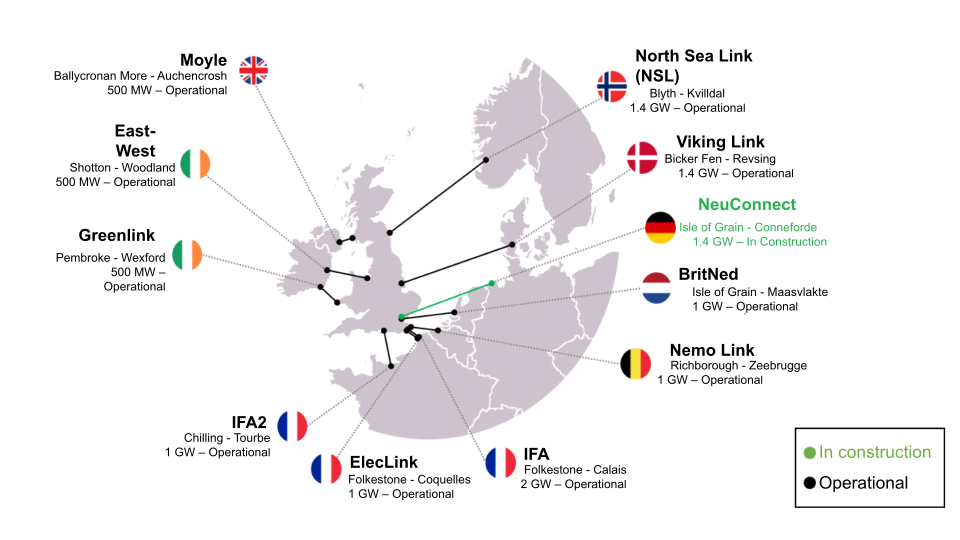
Electricity interconnectors are subsea cables that connect Great Britain’s electricity grid to those of neighbouring countries, enabling the cross-border flow of electricity. Great Britain currently has ten such interconnectors, connecting us to Norway, Denmark, the Netherlands, Belgium, France, Northern Ireland, and the Republic of Ireland, providing a total operational capacity of 10.3GW. An additional 1.4GW of interconnector capacity to Germany is under construction and a further 6.05GW of interconnection projects are in development following regulatory approval from Ofgem in 2024.
Figure 1: Map of operational and in construction interconnectors to Great Britain
Source: Internal DESNZ representation
Figure 1 description: a map of the UK and neighbouring countries with GB interconnectors.
Interconnection plays a vital role in the electricity system, strengthening our energy security and helping deliver affordable electricity to consumers. In the year to September 2025, we imported 43TWh of electricity, equivalent to 13% of gross UK electricity supply.[footnote 1] This helped reduce reliance on more expensive fossil fuel generation in Great Britain and lower overall system costs. In the same period, the UK exported 12TWh of electricity, enabling the productive use of surplus renewable generation.
As part of Great Britain’s Clean Energy Superpower Mission[footnote 2], we expect to further grow our interconnector fleet with additional projects that will enhance our energy security, support European decarbonisation, provide flexibility for the system and facilitate the export of any surplus renewable electricity.
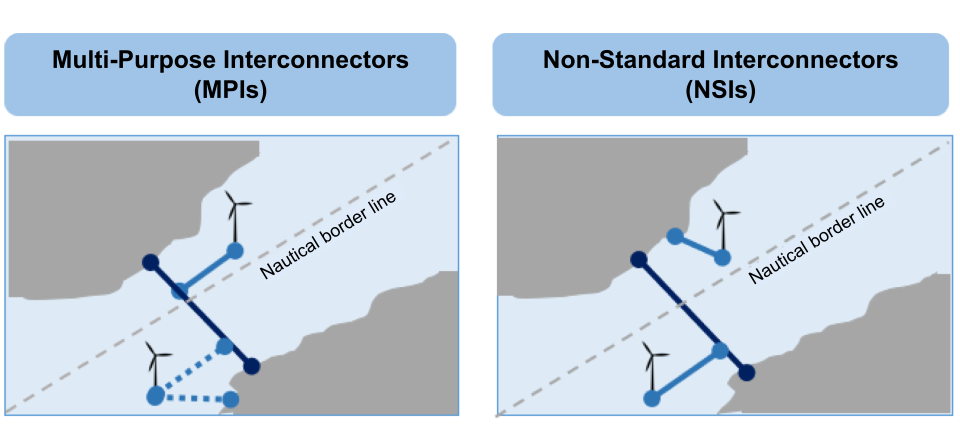
Our existing interconnectors are all ‘point‑to‑point’ links, but in the future, we also want to support Offshore Hybrid Assets (OHAs), an emerging and innovative form of interconnection that combines the interconnector with an offshore wind farm. OHAs can be either Multi-Purpose Interconnectors (MPIs), in which the connected offshore wind farm is in Great Britain’s waters or Non-Standard Interconnectors (NSIs), in which the offshore wind farm is in the connecting country’s waters.
Great Britain is playing a leading role in the development of OHAs. Two NSIs already have initial regulatory approval from Ofgem, and Government, Ofgem and the National Energy System Operator (NESO) are actively developing an innovative policy framework for MPIs. These types of assets are increasingly recognised as the future for North Sea energy infrastructure, as reflected in the shared ambition to deliver 100GW of ‘cooperation projects’ (such as OHAs) by 2050, set out in the Hamburg Declaration of Energy Ministers at the last North Sea Summit[footnote 3].
Figure 2: Multi-Purpose and Non-Standard interconnectors diagram
Source: Internal DESNZ representation
Figure 2 description: On the left a diagram of a multi purpose interconnector, showing a connected wind farm in GB waters. On the right, a diagram of a multi purpose interconnector, showing a connected wind farm not in GB waters.
In the Clean Flexibility Roadmap (2025)[footnote 4], we set out how Government, NESO and Ofgem will ensure new interconnection, including OHAs, plays an optimal role within the energy system and maximises benefits for Great Britain’s consumers.
The Government has three strategic objectives for the future of interconnection in Great Britain, to ensure that interconnectors serve the needs of consumers and the energy system:
- Delivering new interconnectors and Offshore Hybrid Assets that are strategically aligned with a Net Zero energy system
- Strengthening cooperation with international partners to support the timely delivery of projects on the right terms
- Ensuring the efficient operation of the interconnector fleet and supporting delivery of pipeline projects to ensure they provide the most value
This publication provides a framework for achieving these goals and is the first step in an ongoing programme that will evolve alongside NESO’s Strategic Energy Planning and Ofgem’s delivery programme. It sets out the context, intentions, and next steps to support the future of interconnection and is being published alongside Ofgem’s Call for Input on the future delivery and financing models.
Delivering new interconnectors and Offshore Hybrid Assets
Summary
The role of interconnection in the energy system is changing as Great Britain becomes a Clean Energy Superpower. Interconnectors and OHAs will play a critical role in reducing system costs, limiting curtailment and supporting decarbonisation. By aligning future interconnector delivery with strategic planning, we will ensure that future interconnectors continue to deliver maximum value for Great Britain’s consumers.
Ofgem’s Cap and Floor regime has helped position Great Britain at the forefront of interconnection development. Great Britain’s first interconnector, IFA, was commissioned in 1986 and operates on a merchant basis, meaning the developers are exposed to revenue uncertainty and rely solely on wholesale market arbitrage to recover costs. While three further merchant projects were built, this model created significant investment barriers, and without additional regulatory support, it is unlikely that the scale of interconnection delivered in recent years would have materialised.
The Cap and Floor regime was introduced to address these barriers by balancing risk between developers and consumers and providing the revenue certainty needed to unlock investment. This market-based approach aims to incentivise developers to deliver interconnector capacity by reducing their exposure to electricity market price risk. The first Cap and Floor pilot project, Nemo Link, became operational in 2019 and the scheme has since supported around 60% of today’s interconnection capacity in Great Britain – delivered within just six years. The regime has made projects investable by guaranteeing a minimum revenue ‘floor’, while capping excess returns to provide a benefit to consumers in return for underwriting the floor. To date, it has resulted in over £200 million being returned to consumers from ‘above cap’ revenues, and there have been no ‘floor’ payments required to top up developers’ revenues.
There is now strong investor confidence and a mature pool of developer expertise in the sector, and we will continue to work with industry to bring forward new interconnection projects, building on the success of the Cap and Floor. However, the regulatory framework now needs to be evaluated to ensure continued suitability with the strategically planned, renewables-based system we are building in Great Britain.
As Great Britain’s energy system shifts to a more intermittent, renewables-based generation mix, the drivers for additional interconnection are becoming more complex. Interconnectors can help reduce the level of renewable energy curtailment by providing access to export markets.[footnote 5] They also enable Great Britain to import when demand and weather conditions would otherwise require building more expensive domestic generation, which is primarily held in reserve. With the right market framework, our interconnectors can improve system efficiency across connected countries and can help reduce system costs for Great Britain’s consumers.
As we deliver on our Clean Energy Superpower Mission, Great Britain’s energy system is changing. As domestic clean energy grows and wholesale electricity prices fall, imports are expected to decrease and the trade balance will become more variable, with Great Britain likely to become a net exporter of electricity – although still importing significant volumes. The two-way capability of interconnectors will help the system respond rapidly to changes in supply and demand, and balance periods of higher or lower generation as we integrate more intermittent renewables. The strategic case for further interconnection is therefore evolving, with greater value coming from the flexibility interconnectors provide.
The value of any individual interconnector project depends on its specific characteristics, and its impact needs to be considered in the context of the wider system. Delivering projects with the best combination of size, location and connecting market will ensure that new interconnection can play an optimal role in our future energy system.
A strategic planning approach is required to give developers clearer signals on the zones where future energy infrastructure should be focused within Great Britain. Government has commissioned NESO to develop a Strategic Spatial Energy Plan (SSEP), the first ever spatial energy plan for Great Britain, to support a more actively planned approach to energy infrastructure across both land and sea between 2030-2050 to meet Net Zero. NESO’s strategic plans represent a major innovation in whole system planning, bringing together generation, networks and flexibility needs in a single, coordinated framework. Building on the SSEP outputs, Great Britain will have a holistic view of where interconnectors could deliver the greatest system value.
To implement a strategic approach to delivery, the Government is working with Ofgem to design a future delivery approach for projects aligned with NESO’s strategic plans. The optimal location, capacity, connecting country and commissioning timing for potential projects will be identified in NESO’s SSEP, which is expected to be published in Autumn 2027. Further details on asset type, including point-to-point and offshore hybrid assets, will follow in the Centralised Strategic Network Plan (CSNP), which is expected by the end of 2028.[footnote 6]
The future delivery approach will focus on delivering on the outputs of strategic planning, with individual projects still being owned, built and financed by developers. It will aim to ensure timely, coordinated and cost‑efficient delivery of strategically aligned interconnector projects, reducing investor risk and providing a clear route to market. Ofgem has launched a Call for Input on the delivery approach and financial framework, which sets out more detail on how they are developing the future regulatory approach.
Beyond Great Britain’s domestic planning, delivering more complex assets, such as OHAs, with international partners will also require a more structured approach to cooperation. At the North Sea Summit in January 2026, the UK and neighbouring European countries committed to enhancing regional cooperation on planning, including through recurring, sea-basin-wide planning exercises. Our domestic approach to planning future interconnection will work alongside these regional efforts.
In parallel to developing the future delivery framework, the Government is working to enable the delivery of Multi-Purpose Interconnectors. DESNZ, Ofgem and NESO are working closely with industry and other partners to develop a policy and regulatory framework to ensure MPIs are commercially viable in Great Britain. We are also exploring ways to reduce first-mover risk for these complex assets, including assessing the viability of a pilot scheme.
MPIs offer several potential benefits for the energy system and Great Britain’s consumers. By combining point-to-point interconnectors with offshore wind connections, they can reduce the amount of infrastructure needed, lowering costs and impacts on coastal communities and the environment. MPIs provide the capability for cross-border electricity exchange during periods of reduced wind output, thereby enhancing the overall utilisation of these assets. Also, by creating a more direct route to export surplus Great Britain wind generation compared with an equivalent point-to-point interconnector and radially connected wind farm, MPIs have the potential to improve the efficiency of the system.
Next Steps
The Clean Flexibility Roadmap set out our main short-term milestones including:
- DESNZ to work with NESO to inform the development of the SSEP and CSNP (milestone 19(a)).
- DESNZ to work with Ofgem to ensure an appropriate and efficient regulated route to market is in place to deliver the outputs of the CSNP (milestone 19(b)).
- Ofgem and DESNZ, with support from NESO, will develop the policy regulatory and legal framework to unblock barriers to MPI delivery, assess wider market and political environments, and engage with industry (milestone 21(a)).
Work on all these milestones is ongoing. Ofgem and DESNZ will be engaging with external stakeholders to ensure the future delivery approach is streamlined, deliverable and will work for industry and international partners. Ofgem aims to consult on the high-level regulatory framework for the delivery and financing of new interconnection in the second half of 2026. NESO expects to undertake a consultation on the draft SSEP in early 2027.
Strengthening cooperation with regional partners
Summary
Great Britain is working closely with neighbouring European countries to deliver interconnection projects that strengthen shared energy security and support the transition to clean power. Building on agreements already in place and commitments made at the North Sea Summit, we are working to align infrastructure planning, enable joint offshore wind and hybrid projects, and ensure efficient cross‑border electricity trading. By deepening regional partnerships, the UK aims to maximise system benefits and accelerate delivery of strategically aligned offshore energy projects.
Interconnectors are, by definition, international assets. They physically and operationally link Great Britain’s energy system with those of our European partners, enabling the shared use of clean power resources and strengthening our collective energy security. They play a key role in helping to end our reliance on volatile fossil fuel markets by enabling us to trade electricity with our closest allies in Europe. Delivering and operating interconnectors requires collaboration at all levels, between governments, regulators, system operators, and developers.
International cooperation has been crucial to delivering interconnection projects. Our approach has evolved as we have worked with partners to deliver projects in our shared interest. Bilateral and multilateral MoUs have enabled closer working, and Great Britain is an active participant in multilateral fora like the North Sea Energy Cooperation (NSEC).
We are committed to strengthening and expanding our international engagement to realise the benefits of coordination. We will work more closely with partners where cooperation is strategically valuable. In future, the SSEP and the CSNP could provide a basis for Great Britain’s priorities in international discussions. We will also continue to engage with all North Sea countries actively in regional and multilateral fora such as the NSEC to support regional coordination and lay the groundwork for Great Britain to deliver on the outputs of strategic planning.
Analysis by Baringa and Breakthrough Energy indicates that greater coordination and development of offshore wind in the North Sea could deliver reduced wholesale prices, investment and operational cost savings and overall reduced European emissions by 2040[footnote 7].
The UK is strongly supportive of a collaborative approach to North Sea renewable energy and grid development. Delivering more shared assets, and in particular more complex assets like OHAs, will require closer collaboration between countries. At the North Sea Summit in January 2026, the UK and our European neighbours committed to a shared ambition for 100GW of ‘cooperation projects’ such as Offshore Hybrid Assets (OHAs) by 2050, and closer working on regional planning, cost and benefit sharing principles, and financing frameworks to deliver this. We signed the Summit Declarations and Joint Declarations of Intent between the UK and Germany, as well as between the UK, Belgium, Denmark, the Netherlands, and Germany, a group of forward-leaning countries in the development of joint offshore projects.
As we move forward to deliver on these commitments, we are joining up with our European partners across organisations. As Government, we will build on our previous work to ensure the right policies and regulations are in place to support project delivery. As TSO, NESO participates in the North Sea’s Offshore Transmission System Operator Cooperation (OTC) Group, which will ensure that Great Britain’s system needs and domestic plans are factored into regional plans. Ofgem also continues to work with its counterparts in neighbouring countries on regulatory matters.
Figure 3: The North Sea Summit, 26th January 2026, Hamburg

Source: Internal DESNZ representation
Regional collaboration is critical to supporting the security and protection of subsea infrastructure like interconnectors. We work closely with owners, operators and regulators to ensure subsea energy infrastructure is proportionately protected from a range of threats. As these assets are international, collaboration with our allies is critical to our collective security and resilience, and the UK has been working closely with international partners on energy security and crisis management with regards to shared critical infrastructure.
Next Steps
The Clean Flexibility Roadmap set out international actions focused on collaboration with counterparts in connecting countries to ensure availability of efficient balancing tools for managing cross-border electricity flows (milestone 20). Further detail on these is provided in the next section of this document.
Our broader next steps on international collaboration include:
- Continuing active participation in multilateral fora, including NSEC and its associated working groups, to collaborate on regional planning, governance and market design.
- Sustaining close engagement with North Sea Countries to maintain alignment between Great Britain’s strategic planning and regional offshore grid development.
- Deepening collaboration with Germany, Belgium, Denmark and the Netherlands on OHAs under the bilateral and multilateral Joint Declarations of Intent signed at the North Sea Summit, including exploring greater alignment in our project delivery frameworks and financing mechanisms such as Joint Contracts for Difference.
Ensuring efficient operations of our interconnector fleet and supporting delivery of pipeline projects
Summary
Efficient operation of Great Britain’s interconnectors is essential to reducing system costs, supporting energy security and making best use of our growing renewable generation. Government, Ofgem and NESO are working to improve trading efficiency, strengthen coordination with European partners, and better manage network constraints. Alongside this, the UK continues to support existing pipeline projects, address regulatory and supply‑chain challenges, and prepare for a future, strategically planned approach to interconnector delivery.
Ensuring efficient operations of our interconnector fleet
Interconnection enables Great Britain to trade electricity with its neighbours, delivering the greatest value when interconnectors operate efficiently. Under market-based operation, the direction of flow of electricity is determined by price arbitrage between two connected markets. The interconnector carries electricity from the lower-priced market to the higher‑priced one, helping to bring the price down for consumers. Interconnector operators earn revenue from selling the interconnector’s capacity. This general principle is supported by cross-border electricity trading arrangements.
Ensuring efficient electricity trading through interconnection is critical to securing consumer benefits, including lower domestic wholesale prices, reduced emissions and better cooperation for delivering more complex offshore hybrid assets.
The most efficient trading arrangements are generally considered to be implicit trading where a market algorithm simultaneously determines both prices and interconnector flows. This ensures flows follow price differentials and maximise social welfare. This is how electricity is traded in the EU Internal Electricity Market (IEM). Following the UK’s exit from the EU, Great Britain no longer participates in the IEM, and most interconnector capacity rights are instead traded separately to the electricity volumes. This leads to complexity for traders in aligning both electricity and interconnector capacity prices. In turn, this can lead to periods of inefficient or sub‑optimal flows, where electricity may flow from a higher‑priced market to a lower‑priced market, and to under‑utilisation of interconnector capacity.[footnote 8]
Addressing these challenges requires cooperation with our European partners. The Trade and Cooperation Agreement (TCA) commits the UK and EU to develop arrangements for efficient electricity trade over interconnectors. The Specialised Committee on Energy (SCE) oversees its implementation and work is ongoing to agree a pragmatic, consumer-focused solution. Furthermore, the UK’s potential participation in the IEM could help address these challenges. Exploratory talks between the UK and the EU were concluded in December 2025, and the Government is now working towards negotiations. A good outcome from negotiations could cut the cost of trading electricity with European partners allowing for greater resilience and security of supply in our energy system. An agreement will support jobs in the low-carbon and renewable sector and facilitate the development of the next generation of renewables, offshore hybrid assets and grids.
Alongside efficient trading arrangements, the Government and NESO are also working to ensure interconnector flows support the needs of Great Britain’s energy system.
Interconnection is, and will continue to be, an important component of Great Britain’s energy capacity mix and its efficient use is central to the Clean Power 2030 targets. While interconnection flows can contribute to certain network constraints, they can also play an important role in securing and balancing the grid. The Government is working with NESO and Ofgem to reduce the volume and cost of network constraints, as set out in the Reformed National Pricing Delivery Plan.
In the short term, measures to improve operational efficiency of interconnection include strengthening energy relationships with European partners, improving System Operator- System Operator coordination, and exploring whether to expand the use of existing tools available to NESO.
In the long term, integrating interconnection into strategic planning will help build a more consistent and efficient system by locating it in areas that minimise network constraints.
Supporting delivery of pipeline projects
The Government is supporting current pipeline projects and working with Ofgem and NESO to effectively manage delivery risks. Although we are transitioning to a new approach aligned with strategic planning, we are continuing to support the delivery of mature projects already in the pipeline. We are continuing to progress three point-to-point interconnectors granted regulatory approval in principle through Ofgem’s cap and floor Window 3, as well as two NSIs granted regulatory approval in principle through the OHA pilot, which ran alongside Window 3.
Securing regulatory approvals in Great Britain and the connecting country can be challenging and can lead to delays in project delivery. The Government is engaging with Ofgem and partner countries to support a smooth path to regulatory approval for current projects. For the future, we are working with our North Sea neighbours on cost and benefit sharing principles and financing frameworks, as set out in Section 2, and developing common understanding in these areas will also significantly assist with the regulators in connecting countries to quickly reach agreements.
Tightness in the global supply chain for High-Voltage Direct-Current (HVDC) system components is impacting pipeline interconnection projects, potentially creating delivery risks and extending construction timelines. Interconnectors take a long time to deliver from conception, through a multi-stage process involving regulatory approvals, environmental assessments, and construction. The current constraints in the supply chain are leading to procurement costs escalating part-way through project development. This creates challenges for the business case and regulatory approval process for interconnector projects. Supply chain changes have also meant that projects need to make substantial financial commitments earlier in their development process and ahead of final regulatory approval (pre-Final-Investment-Decision). This can create significant challenges for interconnector developers.
We are working closely across Government and with Ofgem to explore mitigation options for current pipeline projects, and to consider how to best support interconnector delivery in future.
Next Steps
The Clean Flexibility Roadmap set out our main milestones including:
- Government to explore potential for Great Britain’s participation in EU balancing platforms as part of the UK-EU Reset (milestone 20(a)).
- NESO to continue to cooperate with connected TSOs to improve or complement existing balancing tools, in compliance with the operational frameworks and with a continued focus on ensuring the security and stability of the system (milestone 20(b)).
- DESNZ is exploring a range of options to mitigate supply chain challenges including measures to develop the domestic supply chain for interconnection (milestone 50(b)).
Work on all these milestones is ongoing. The Government is negotiating with the EU for UK participation in the EU’s IEM in all timeframes. In addition, further information on Government, NESO and Ofgem work to reduce the volume and cost of network constraints is set out in the Reformed National Pricing Delivery Plan.
Conclusion
This publication sets a clear and confident pathway toward a cleaner, more resilient and more affordable future energy system. By taking a strategic, whole-system approach to planning new interconnectors, including Offshore Hybrid Assets, strengthening cooperation with our regional partners, and improving the efficiency of our existing fleet, we will unlock the full value of cross-border electricity trade for Great Britain’s consumers.
As Great Britain’s energy mix becomes increasingly shaped by renewable generation, interconnectors will remain essential for balancing weather-driven supply, reducing curtailment, and accessing the lowest-cost power available across neighbouring markets. This two-way flexibility will underpin system resilience and strengthen our collective energy security. A coordinated, internationally aligned approach will reduce system costs over time, support investment in shared offshore infrastructure, and help deliver Government’s Clean Energy Superpower Mission and Net Zero by 2050.
This publication is the first step in an ongoing programme that will evolve alongside NESO’s Strategic Energy Planning and Ofgem’s delivery programme. The next Government update is expected alongside Ofgem’s planned consultation on the high-level regulatory framework for the delivery and financing of new interconnection in the second half of 2026. Information on the optimal location, capacity, connecting country and timelines for future interconnection projects will follow in NESO’s Strategic Spatial Energy Plan, which is expected to be published in Autumn 2027, with a public consultation in early 2027.
*[TWh] terrawatt hours *[OHAs]: Offshore Hybrid Assets *[MPIs]: Multi-Purpose Interconnectors *[NSIs]: Non-Standard Interconnectors *[GB]: Great Britain *[SSEP]: Strategic Spatial Energy Plan *[CSNP]: Centralised Strategic Network Plan *[MoUs]: memorandum of understanding *[NSEC]: North Sea Energy Cooperation *[OTC]: Offshore Transmission System Operator Cooperation *[IEM]: Internal Electricity Market *[EU]: European Union *[TCA]: Trade and Cooperation Agreement *[SCE]: Specialised Committee on Energy *[HVDC]: High-Voltage Direct-Current
-
Energy Trends: UK electricity - DESNZ. Updated statistics for 2025 will be published at the end of March. ↩
-
NESO outlines new timelines for Strategic Energy Plans - National Energy System Operator ↩
-
Beyond borders: Unlocking the power of UK-EU offshore wind coordination - Baringa, 2024 ↩
-
LCP Data - Power Insights: The Decline of GB Interconnector Efficiency ↩