New Zealand: information for victims of rape and sexual assault
Updated 14 November 2025

© Crown copyright 2025
This publication is licensed under the terms of the Open Government Licence v3.0 except where otherwise stated. To view this licence, visit nationalarchives.gov.uk/doc/open-government-licence/version/3 or write to the Information Policy Team, The National Archives, Kew, London TW9 4DU, or email: psi@nationalarchives.gov.uk.
Where we have identified any third party copyright information you will need to obtain permission from the copyright holders concerned.
This publication is available at https://www.gov.uk/government/publications/new-zealand-information-for-victims-of-rape-and-sexual-assault/new-zealand-information-for-victims-of-rape-and-sexual-assault
If you’ve been sexually assaulted it’s important to remember that it was not your fault. Rape and sexual assault is always wrong – no matter who commits it or where it happens. It is traumatic and it can affect you both physically and emotionally. Do not be afraid to get help.
First steps
It is your choice about what you do next, but this information may help you in coming to a decision. The most important thing is to make sure that you are as safe as you can be. You can:
- contact the emergency number on 111 and ask for police
- contact your tour operator if you are travelling with one
- contact the British High Commission Wellington. Consular staff will be empathetic, and non-judgmental, and can provide information on local police and medical procedures. Anything you tell them will be treated in the strictest confidence. They can contact your family or friends for you if you wish
If you want to report the incident to the police in New Zealand
You can call the emergency 111 number, the non-emergency 105 number, report it online to New Zealand Police, or visit your nearest police station.
If you do tell Police, read overview of what to expect.
Before you go to the police station
If you have a tour operator, they should be able to arrange for someone to support you. If you are in an area where there is a British High Commission or consulate, and you would like support, they will try to send a consular officer to support you, where timing and location allow. You will always be able to speak to trained consular staff on the telephone 24/7.
If you approach the police directly, you can also ask them to inform the British High Commission Wellington on +64 4 924 2888 and we can offer you consular support.
If you choose to report the crime, try to do so as soon as possible, so forensic evidence can be retained.
Washing yourself or your clothes may make it difficult for the police to obtain forensic evidence. If you do change your clothes, take those you were wearing to the police. You may wish to preserve evidence by retaining items such as condoms, toothbrushes, or texts.
At the police station
Tell the police if you think you have been drugged.
If you decide to report the incident to the police, they will usually come to you, and with your consent they may bring a person from a support service as well. The police will conduct a preliminary interview which includes asking for information on the date, time and circumstances.
You can request to speak with a male or female police officer, and New Zealand police will do their best to accommodate your preference.
In New Zealand, it is common for people to use support services to help them with the process of making a formal statement to police if they are not sure about approaching police directly. These services can help guide you through the process and offer emotional and practical support when making a formal statement. If you a have a support person with you while your statement is taken, they cannot usually participate directly in the police interview.
For a formal statement to be taken, a specialist interviewer will ask questions to help you remember everything you can about the incident, including a description of the person /s who assaulted you. Sometimes the process of taking a statement can last several hours or will occur over multiple meetings with the police. See New Zealand Government victim information for an overview on what to expect.
You can ask for a copy of your statement and for relevant parts of the police report. If the incident occurred within the last 1 to 7 days, the police will arrange, with your consent, a medical examination at the nearest specialist clinic. The examination can also be a chance for the doctor to collect forensic evidence, which can be used to help the police find out what happened to you and identify your attacker.
The doctors and nurses who complete these examinations are specifically trained to care for people who have experienced sexual violence. They will make the whole process as comfortable as possible for you. How much or little of the examination you choose to have, and whether or not you choose to involve the police, will be entirely up to you.
After making a statement
After your statement is finished, you will be asked to sign it. You should ask police for the report number and contact details for the police officer or detective in charge of the investigation. The interview may be electronically recorded, so that your words are preserved. If your complaint goes to court, the recorded interview may be given to lawyers. There are strict New Zealand laws around storing and security of filmed interviews. They cannot be shared, copied or disclosed without proper legal authority or permission from the court.
During the investigation, the police officer in charge of your case will keep in touch with you and let you know how the case is going. It’s hard to say how long the investigation will take because every case is different. You can contact them if you have any queries or concerns.
The Victims’ Rights Act 2002 gives you rights and requires Police to treat you with courtesy and respect, advise you of services available to you, keep you informed of progress in the investigation and advise you whether charges are laid and what the charges are, or the reasons for not laying charges. For more information about your rights, visit Victims Code of Rights, Chief Victims Advisor to government.
If you do not want to report the incident to the police in New Zealand
It is your choice on whether to report the crime. If you don’t report it, your case may not be investigated.
The British High Commission will be able to help you, including:
- helping you to contact family, friends, and your insurance company
- accompanying you to the local hospital or medical facilities, where possible
- providing you with a List of lawyers
- helping you with arrangements to travel back to the UK
- providing you with information on support in the UK
You can also report the incident to your tour operator if you are travelling with one. They may be able to help you, including accompanying you to the local medical facility.
If you do not want to report the incident to police in New Zealand, you can still access medical treatment, including a forensic medical examination at a specialist Sexual Assault Assessment and Treatment service (SAATs). Visit Specialist Sexual Assault Medical Help: MEDSAC for further information alongside a directory of services throughout New Zealand.
You can also access support from local support services near you, such as Victim Support or Safe to talk. Consular staff can help put you in touch with services in New Zealand to help you get extra support, such as counselling services, alongside specialised services in the UK should you wish to access support on your return.
The medical examination: what to expect
Where to go
Your health, safety and welfare is the first priority. Depending on the length of time since the incident and with your consent, a forensic medical examination may be used to collect evidence. Forensic medical examinations are performed by specially trained doctors or nurses and are available in cities, with rural access coordinated via on-call providers or regional referrals. These services are known as SAATS (Sexual Abuse Assessment and Treatment Services) and are available throughout New Zealand. To find your nearest SAATs Service, you can search the Online Directory, contact Safe to Talk (24/7 free and confidential service) or contact consular staff at the British High Commission Wellington.
All services that help you access these specialist health services are free in New Zealand. This includes any medicine you’re given, any tests you might need, and any follow-up appointments.
Examination
The doctors and nurses who complete these examinations are specially trained to care for people who have experienced sexual violence. They will make the whole process as comfortable as possible for you. When you meet the medical professional, they will explain the process, how they can help you, and they will discuss the different options with you. During the examination, only the doctor and nurse will be in the room, unless you ask for someone else to be there with you.
The doctor or nurse, with your consent, may take samples of your saliva, urine, blood and pubic hair. They may also collect swabs from your mouth, rectum, genitals or any other area where the person touched you. They may take photographs to document any physical injuries. You can choose what you want to happen during the examination and in what order. Nothing will happen without your consent, and you can change your mind at any time.
When a child has been assaulted, healthcare staff are required under organisational policy to initiate a referral to the appropriate child protection team for further assessment and support.
If you would like someone to accompany you to the medical facility, you can request for a person you trust, such as a family member or friend, to be with you during the examination. You can also request for a support worker or other advocate and can contact your tour operator or the British High Commission Wellington to help you ask for this.
Medical treatment in New Zealand
Medical services in New Zealand are high quality, with care and treatment available to people who have experienced rape or sexual assault.
If you need emergency medical treatment and you are unable to get to a hospital, you can call 111 for an ambulance.
If you’re a British visitor in New Zealand and need emergency medical care - including support after sexual assault - you can receive treatment free of charge under the Reciprocal Health Agreement.
This applies to conditions that arise during your visit but excludes routine care or prescriptions.
British nationals living in New Zealand on a residency visa or a two-year work visa are eligible for treatment under the public health system.
In New Zealand, emergency contraception pills are available without a prescription and can be obtained through pharmacies, doctors, sexual health clinics and community health centres.
For victims of sexual assault, emergency contraception and related medical care are free when accessed through specialist services such as The Sexual Abuse Assessment and Treatment Service (SAATS) or ACC Sensitive Claims Service. Pharmacies and general clinics may charge unless linked to these services. Emergency contraception needs to be taken within 72 hours for it to be effective.
HIV PEP (post-exposure prophylaxis) is available from hospital emergency departments and from some doctors and sexual health clinics. If you are unsure of where to go, Safe to Talk will be able to advise you. HIV PEP medication needs to be taken within 72 hours of the incident for it to be effective. PEP is free for victims of sexual assault and others who meet clinical criteria, including visitors. The NHS may be able to commence or continue the 28-day treatment on return to the UK.
If you have had medication administered overseas, you should keep the label or make a note of the name of the medication, so that you can let your local health provider know when you return home. If you received medical treatment at a hospital, you should ask for a discharge summary which will contain this information.
If you want to report the incident to the police in the UK
The support available to you and your access to justice may depend on where you report the crime. In many countries, you need to report the crime before you leave the country if you want it to be investigated and police to obtain important evidence
If you are staying in New Zealand and the crime took place there, you should report the crime to New Zealand police. If you are a British national and you need help to report the crime, you can contact the nearest British embassy, high commission or consulate, or the Foreign, Commonwealth & Development Office in London
If you do not report the crime in New Zealand and you return to the UK, you can still report the matter to your local UK police.
The UK police should send the information you provide to New Zealand police. However, foreign police forces decide whether to investigate a crime in their jurisdiction and they may not take action.
You can report the crime to the UK police even if you are not seeking an investigation abroad. The UK police can offer you access to victim support in the UK. They may still send some details of the crime to police in New Zealand. This might be necessary in order to protect vulnerable people, or to stop more crimes being committed.
Court procedures in New Zealand: what to expect
Your police officer in charge, Sexual Violence Victim Advisor or support person from a specialist support agency will keep you informed as things progress. It could be months or more than a year between arrest and trial. It can depend on if the suspect will plead guilty or not guilty. Please see the New Zealand Court Process Diagram for a step-by-step guide.
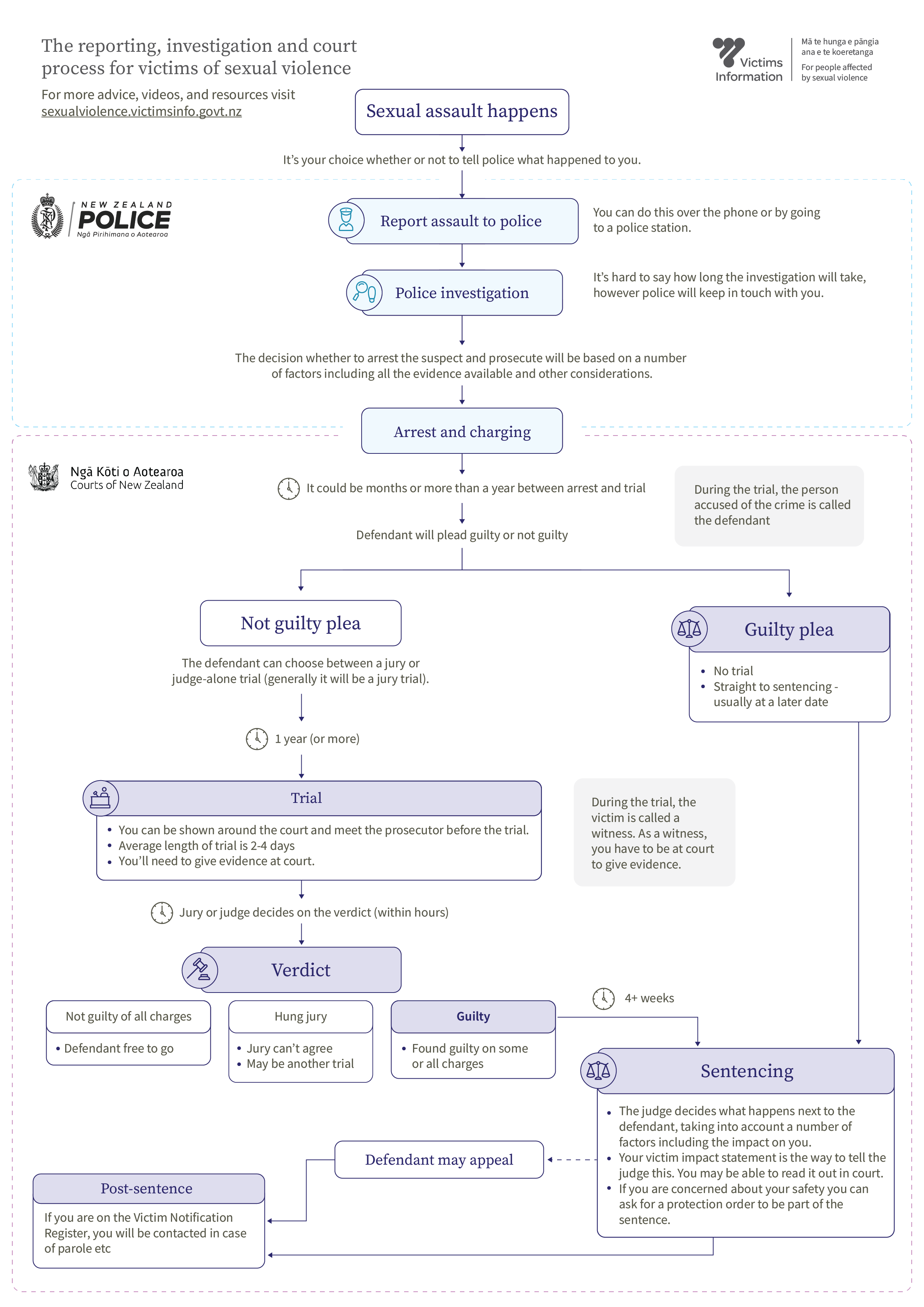
After an investigation and once charges have been filed, a date will be set for the defendant’s first appearance in court. They may appear in court a few times, but you usually won’t have to be present until you give evidence at the official trial. Usually, the trial will be held in the District Court and will be held in front of a jury. A trial may take several days, or longer depending on how complicated it is, including the number of witnesses.
There could be a wait before you give your evidence. This is where you tell the court what happened to you. The judge might allow you to give your evidence so that you don’t have to see the defendant. This might still be in the courtroom but with a screen between you and the defendant, or via closed circuit TV from another room. You can also choose to pre-record your cross-examination before the trial. If you have returned to the UK, you should speak to your prosecution team or Police officer in charge about providing this by video link.
If you no longer wish to proceed, you can speak to the police officer in charge. While your views will be considered, the decision to continue or withdraw charges rests with the prosecution.
Hiring a lawyer
The prosecuting lawyer represents the Crown and the public and presents the case against the suspect in a trial. You can still appoint your own private lawyer if you choose to. They would not play a part of the court trial against the suspect (defendant).
To find a lawyer see the New Zealand lawyers list.
Communication
The Police officer in charge will be your main point of contact. If you appoint a private lawyer, you will need to decide how you wish to receive communications and updates. This could be direct from the Police officer or through your private lawyer.
If you have returned to the UK or are not in New Zealand, you can communicate with the Police officer in charge by email.
Legal aid
You may be eligible for legal aid in New Zealand. Legal aid is considered a loan. You may have to repay some or all your legal aid, depending on how much you earn, what assets you own and whether you receive any money as a result of your case. Read information on Legal Aid for further details.
Sentencing
If the defendant pleads guilty, or is found guilty, on any or all charges, the next step is sentencing. Usually this will be scheduled for a later date.
You have the right to submit a victim impact statement, however this is not mandatory. This is a way for you to be heard in the process and to tell the court how the crime has affected you. The judge is required to consider your victim impact statement when sentencing the offender.
The Court can give a range of sentences and a combination of sentences depending on what’s appropriate in the circumstances. The court may order the offender to pay a fine or reparation, complete community work, home detention or sentence the offender to prison.
If the defendant is found not guilty on all charges, then they’re free to go without any conviction. This can be unexpected and difficult for you, and you may want to talk this over with your support person.
Compensation
Courts can order the offender to pay compensation for any injuries or losses, after they have been convicted in a criminal court.
ACC is a state-funded compensation scheme to cover physical or psychological injuries suffered as a result of a sexual or violent crime, this includes visitors. Please see ACC for further details.
Support organisations in New Zealand
It is your choice if you want to let people know about what has happened. If you are ready to talk about it, these organisations may be able to help you.
| Name | Service |
|---|---|
| Manaaki Tāngata Victim Support | Victim Support helps people affected by crime and traumatic events in every corner of Aotearoa New Zealand. Victim Support is an independent charity providing free and confidential 24/7 support – it doesn’t matter if the crime has been reported or how long ago it happened. They can also provide support if the crime happened overseas, but they may be more limited in what they can offer. |
| Safe to talk | Safe to talk offers free confidential contact with trained specialists 24/7. They can also connect you to support services in your community. |
| New Zealand Police | What can I do if I have been sexually assaulted? If this is an emergency phone 111 or non-emergency 105. |
| Local Support Service | List of support services for survivors of sexual assault in New Zealand. Phone +64 9 360 4001 |
| ACC | Sensitive claims unit Phone 0800 735 566 |
When you return to the UK
If you believe you may be at risk of having contracted a sexually transmitted infection (STI), you should ask your local health provider to test you. You should do this even if you have been tested in the country where the assault took place.
You may want to let your GP or a Sexual Assault Referral Centre (SARC) know what has happened to you so that you can talk about the experience and seek further support and advice where you live.
| Location | Service |
|---|---|
| England | NHS Choices website, or search online for ‘NHS SARC’ |
| Scotland | NHS Inform Scotland: Help after rape or sexual assault |
| Wales | New Pathways SARC, or phone 01685 379 310 |
| Ynys Saff Sexual Assault Referral Centre - Cardiff and Vale University Health Board | |
| Northern Ireland | Rowan SARC Northern Ireland, or phone 0800 389 4424 |
Disclaimer
This information has been prepared by UK Government officials who are not legally or medically trained. It should therefore never be used as a substitute for professional medical or legal advice. It is intended to help British nationals overseas make their own informed decisions. Neither the UK Government nor any official of the Consulate accept liability for any loss or damage which you might suffer as a result of relying on the information supplied.
Medical information has been provided by The Havens Sexual Assault Referral Centres of Kings College Medical facility NHS Foundation Trust and was accurate at the time of production (2 February 2022).