National Savings and Investments Annual Report and Accounts and Product Accounts 2025–26
Updated 24 November 2026

© Crown copyright 2026
This publication is licensed under the terms of the Open Government Licence v3.0 except where otherwise stated. To view this licence, visit nationalarchives.gov.uk/doc/open-government-licence/version/3 or write to the Information Policy Team, The National Archives, Kew, London TW9 4DU, or email: psi@nationalarchives.gov.uk.
Where we have identified any third party copyright information you will need to obtain permission from the copyright holders concerned.
This publication is available at https://www.gov.uk/government/publications/national-savings-and-investments-annual-report-and-accounts-2025-to-2026/national-savings-and-investments-annual-report-and-accounts-and-product-accounts-2025-26
Performance Report
Our strategy: Inspire & Invest
At a glance:
- 24 million customers
- 100% security backed by HM Treasury
- 165 years NS&I launched in 1861
Our vision
NS&I’s vision is to inspire a stronger savings culture by being the most trusted UK savings provider, giving everyone the opportunity to save confidently.
Our purpose
- Creating value through delivering cost-effective debt financing
- Providing services to government
- Helping government to deliver policy objectives
Our values
We keep our promises:
- We are true to our word
- We’re accountable for our actions
- We’re honest and clear about what’s possible, and what’s not
- We communicate clearly with purpose and direction
We are confidently curious:
- We challenge assumptions
- We learn in many ways and take responsibility for our own growth
- We proactively contribute and create space to welcome new ideas
- We embrace being part of what tomorrow brings
We build meaningful connections:
- We respectfully support as well as challenge each other
- We’re all here to contribute to something bigger than ourselves
- We keep an eye out for each other and offer support
- We feel safe to be our true selves
Chair’s statement
As Interim Chair of NS&I, I would have much preferred to be able to open this year’s Annual Report and Accounts by reflecting on a positive year for the organisation, but instead I would like to address two key issues faced by NS&I in the last year.
First, I would like to repeat the apology NS&I made in March to customers and their relatives affected by the issues related to the tracing of certain bereavement claims. Today (4 November 2026), NS&I estimates that the estates of just under 30,300 deceased NS&I customers were not repaid money from all of their accounts. Notwithstanding the fact that most bereavement claims were correctly dealt with, these errors were clearly unacceptable and I am pleased that we have now begun the process of repaying affected estates with holdings of £10 or more (up to 15,600 estates) and compensating estates; and are pursuing the completion of this process with the highest level of priority.
Secondly, our business transformation programme is significantly over budget and will be delivered far later than originally planned. It has become clear that NS&I underestimated the complexity of the programme and is not on track to deliver against the agreed budgets and targets. This is unacceptable. The transformation programme is critical to NS&I continuing to fulfil its duties both to its customers and to government, but it must ensure that its delivery offers value for money to taxpayers.
Following an analysis of five options for progressing the transformation programme, in June 2026, the NS&I Board’s Business Transformation Programme Committee endorsed a simplified solution that allows NS&I to accelerate the delivery of the plan, utilising capabilities that were not available when we began the transformation programme. This option offers the best balance of costs, benefits and delivery confidence, and Ministers agreed that we should produce a full business case for this option.
The business case was completed and approved by Ministers in October 2026.
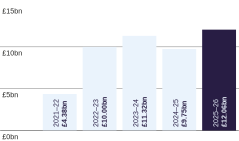
These significant issues stand in contrast to the successful delivery of our core remit: we raised £12.1 billion of financing for the Government, meeting our annual Net Financing target, and we met our key operational targets (with the exception of our efficiency ratio target, addressed below). I would like to take the opportunity to thank our customers for their loyalty and the teams across NS&I for their dedication.
To provide a fresh start for NS&I, Sir Jim Harra KCB, former HM Revenue and Customs First Permanent Secretary, was appointed at the end of March 2026 to take over as Chief Executive of NS&I on an interim basis. I welcome Sir Jim’s appointment and the vital experience he brings at a challenging time. The recruitment for a new permanent Chief Executive is in progress.
Alongside taking overall leadership of the organisation, Sir Jim has specifically been overseeing remediation of the bereavement claims related issues. This has included looking at the lessons NS&I needs to learn to ensure this sort of problem does not happen again and the organisation can move forward in a stronger position.
Focus on our transformation programme
NS&I’s transformation programme began in 2021. It aims to deliver a business that is more efficient and operationally robust, can scale to meet government Net Financing requirements, and keeps pace with changing security needs and customer expectations.
The reports about our programme published by the National Audit Office in November 2025 and by the Public Accounts Committee in February 2026, found that NS&I had underestimated the scale and complexity of rebuilding 25 years of IT infrastructure and, consequently, materially underestimated the programme’s likely cost and the timeframe needed to deliver it.
To provide additional support and expertise, in December 2025, HM Treasury and I appointed David Goldstone CBE, previously Chair of the Office for Value for Money, to advise us on our programme progress. We have benefitted from his significant experience in major government transformation programmes at Board level. Intensive work has resulted in re-setting the programme with a strong focus on delivering value for money to taxpayers.
We face a longer period of increased costs while we pay to run the existing business, alongside paying for the development of new, transformed services. Consequently, in 2025–26 we did not meet our efficiency ratio target: we delivered a performance of 8.47 basis points against a target of 7.20 basis points.
These increased costs do not in any way affect or reduce the interest rates paid on NS&I’s products or the prize fund rate for Premium Bonds.
Conclusion
This is a pivotal moment for NS&I’s transformation programme – and for NS&I more broadly. Transparency, accountability and, above all, delivery, must define our next phase. I am grateful to Sir Jim for his contributions at this difficult time. I would also like to thank our former Chief Executive, Dax Harkins, for his 22 years of public service to NS&I. I also thank my predecessor, Lord Lemos CMG CBE, for his contribution as Chair of NS&I.
NS&I has not met the high standards we set ourselves and I reiterate my apology on behalf of the entire organisation. We must actively listen to and learn from the criticism that we have received. We must and will put things right, rebuild trust and not make the same mistakes again.
NS&I is responsible for safeguarding £251 billion of customers’ savings and plays a vital role in delivering cost-effective financing for the Government. We are committed to fulfilling this mission to the highest standards and to creating an NS&I fit for the future through a re-set transformation programme.
Luke Jensen
Interim Chair
National Savings and Investments
For details of the board’s composition, committees and activities, please see the Governance statement.
Chief Executive’s overview
I was appointed as the Chief Executive of NS&I at the end of March 2026 on an interim basis to provide a fresh start for the organisation’s next phase of development. This followed an announcement to Parliament by the Minister for Pensions about an unacceptable operational failure by NS&I regarding bereavement claims.
As NS&I’s interim Chief Executive, I have three clear priorities:
- Deliver remediation of the bereavement claims issue and undertake a review into the issue and the lessons NS&I should learn.
- Re-set NS&I’s transformation programme.
- Ensure that NS&I remains focused and able to deliver its Service Delivery Measures (SDMs) in 2026–27, including its core remit of raising cost-effective financing for HM Treasury.
NS&I bereavement claims
On 26 March 2026, the Minister for Pensions, Torsten Bell MP, informed Parliament that NS&I had identified an issue where the estates of deceased customers were not always repaid money from all of their accounts following a bereavement claim. These errors happened because the search process used when handling a bereavement claim failed to identify all relevant NS&I products. NS&I is extremely sorry for these errors. The issue was resolved for current and new bereavement claims, and robust measures were introduced to ensure this sort of problem does not occur again.
On 26 March, NS&I, supported by external advisers, estimated that around 37,500 bereavement claims with a total value of £476 million may have been affected by this issue. Following further review, on 19 May, NS&I issued an updated assessment that up to 34,000 estates with a total value of approximately £367 million have been affected. Today, our estimate is that just under 30,300 estates with a value of up to £181.9 million are affected. Our immediate priority is ensuring we repay the funds to affected estates and we will also ensure that customers’ estates are appropriately compensated.
In March, we reassured families, beneficiaries and deceased customers’ estates that they did not need to take any immediate action. NS&I would contact representatives and executors for estates that are affected and would publish further information for the beneficiaries of those estates in due course.
In May 2026, we published our remediation plan and the timetable for when we expect to make payments, including compensation. We are contacting up to 15,600 affected estates with holdings of £10 or more to reunite them with the full value of those holdings that should have been returned to them earlier. To ensure estates have not been disadvantaged by the delay, this will then be adjusted upwards to include the higher of the interest accrued since the error occurred or the Bank of England base rate plus one percentage point, in line with Financial Ombudsman Service (FOS) principles. There will be a full Inheritance Tax exemption for the holdings of the remediation population affected by the NS&I tracing error which are returned to the estates to which they rightly belong. To further ease the administration of estates, the personal representatives or executors will not be liable for any Income Tax ordinarily due on interest accrued before death or in the administration period. The scheme will run over the coming months and is expected to conclude in the first half of 2027.
Net Financing
A new, more robust bereavement claim process was introduced in January 2026; however, this takes longer to carry out. Unfortunately, this meant that our response times temporarily worsened over the spring/early summer to eight weeks while we trained and deployed more staff to manage claims. We have now considerably improved the response time and expect to be able to respond to all new claims within 14-days by the end of October.
The bereavement claims issue arose after the Supplementary Estimate process, meaning it was not possible for NS&I to bid for sufficient budgetary funding for the remediation scheme. As a result, NS&I has reported an overspend against its agreed budget for the year – meaning that the Comptroller and Auditor General has reported an ‘excess vote’ qualified opinion. Details of the Comptroller and Auditor General’s opinion can be found in his report of this Annual Report and Accounts.
I have completed my review into the bereavement claims issue and the lessons NS&I should learn from it. This will be published in due course.
NS&I’s transformation programme
Our transformation programme was designed to ensure the future viability of the business to continue to provide the Government with a vital source of cost-effective funding, respond to changing customer expectations, and resolve challenges with the operational resilience of manual processes and aged technology. However, it is late and over budget.
National Audit Office report
The National Audit Office (NAO) found that there were four main reasons why NS&I’s transformation programme has not progressed as intended: NS&I had a weak understanding of the highly integrated system it was seeking to replace; it did not have an integrated plan; it lacked the capability needed for this type of programme; and it awarded contracts without a good enough understanding of the dependencies.
Appointment of David Goldstone CBE to support the transformation programme
In December 2025, the Treasury and NS&I’s Interim Chair appointed David Goldstone CBE, previously Chair of the Office for Value for Money, to advise us on our programme progress. We have benefitted from his significant experience in major government transformation programmes and are implementing his recommendations, alongside those of the NAO and the Public Accounts Committee.
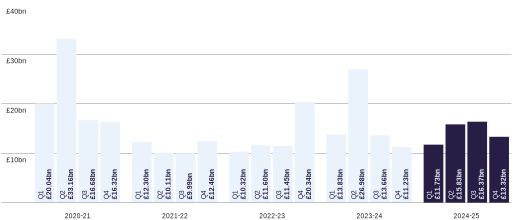
Gross inflows to NS&I (£bn)
| 2021–22 total | 2022–23 total | 2023–24 total | 2024–25 total | 2025–26 total |
| £44.86bn | £53.71bn | £65.70bn | £57.25bn | £62.42bn |
Public Accounts Committee hearing and report
Based on the report by the NAO, the Public Accounts Committee took evidence on 18 December 2025 from NS&I and HM Treasury. The hearing focused on areas including the decision to move to a multi-supplier model, progress on NS&I’s revised integrated plan and what this would mean for costs and delivery timescales, NS&I’s business culture and leadership, its approach to risk management, and its relationship with its suppliers, contractors and HM Treasury.
The Committee published its subsequent report and recommendations on 13 February 2026. Its assessment of NS&I’s transformation programme was clear and direct. It said that NS&I was over-confident about its ability to deliver its business transformation programme, had no workable plan and no idea of eventual cost. The Committee said that NS&I must demonstrate a more grounded, evidence-based approach to planning, risk management, and the use of consultants and suppliers.
Public Accounts Committee recommendations
The Committee made six formal recommendations: NS&I must develop a realistic, bottom up integrated plan; demonstrate lessons learned and cultural change; strengthen and embed its risk management framework; set out a clear resource and skills strategy; improve transparency and reporting; and strengthen HM Treasury oversight and assurance.
Government response to the Public Accounts Committee report
In April 2026, the Government published its response to the report: agreeing with the six recommendations and setting out the steps that NS&I (and for one recommendation, HM Treasury) will take to implement them.
The message was clear: NS&I should stop trying to compress work to deliver the transformation programme by March 2028. Instead, it should prepare a realistic bottom-up integrated plan with a timetable and associated estimated costs and budget, to be reviewed by its non-executives, David Goldstone and HM Treasury for realism.
NS&I therefore developed several costed options for the transformation programme and HM Treasury to identify a recommendation for submission to Ministers. These built on the options set out to the Committee during the inquiry.
Work has since taken place to assess options to improve the cost and time of programme delivery, including what will be required to live within our 2025 Spending Review settlement.
Analysis of five options has taken place: i) living within the Spending Review settlement by stopping the transformation programme and focusing on remediating NS&I’s legacy banking systems; ii) delivering the full scope of the transformation programme as quickly as possible; iii) delivering the full scope of the transformation programme over a significantly extended timescale to ease near-term funding pressures; iv) a simplified solution that allows us to accelerate the delivery of the plan, utilising capabilities that were not available when we began the transformation programme; and v) upgrading our core banking system only and not providing other new functionality, such as an enhanced mobile app.
In June 2026, the NS&I Board’s Business Transformation Programme Committee endorsed the fourth option as offering the best balance of costs, benefits and delivery confidence and creating a realistic basis for a revised business case. Ministers agreed that NS&I should produce a full business case for this option for appraisal by the Treasury Approval Process. The business case was completed and subsequently submitted to HM Treasury for approval. Following endorsement from the Treasury Approval Process, the revised Full Business Case was then submitted to Ministers for approval and this was received in October 2026.
Government Internal Audit Agency (GIAA) audit opinion
GIAA provides NS&I’s internal audit service. For 2025-26, GIAA rated the adequacy and effectiveness of NS&I’s risk management, control and governance arrangements as unsatisfactory. Specific weakness highlighted included the application of controls across NS&I and our suppliers. GIAA’s findings are discussed in more detail in our Corporate Governance Report. In response, we are implementing a detailed plan to improve our control environment.
Net Financing target met
NS&I’s core remit is to deliver cost-effective financing for the Government. Our Net Financing target for 2025–26 was originally set at £12 billion (+/- £4 billion). This was £3 billion higher than the previous year and, at the Autumn Budget in November 2025, it was increased further to £13 billion (+/- £4 billion).
By year-end, we had delivered £12.1 billion of Net Financing for the Government, landing in the target range. In the wider economic context, the financial year saw further reductions to the Bank of England base rate, eventually taking it down to 3.75%; and our pricing through the year was designed to meet this revised target, alongside meeting our operating framework of balancing the interests of our savers, taxpayers and broader market stability.
During the year, we continued to offer savers increased choice and longer-term security with new Issues of fixed-term Bonds – including having 1-, 2-, 3- and 5-year terms of British Savings Bonds (Guaranteed Growth Bonds and Guaranteed Income Bonds) all on sale together for the first time since 2010.
Total amount invested by customers at the end of the year (£bn)
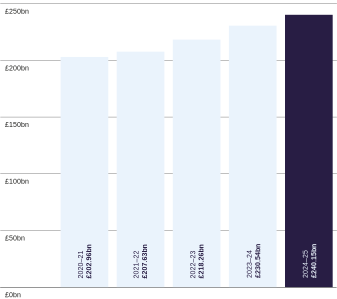
As interest rates in the savings market fluctuated through the year, our pricing movements responded accordingly across our variable and fixed-term range and in line with our operating framework. As we entered 2026, the path of market rates appeared to be downwards and in January, we made interest rate reductions to some fixed-term and variable rate products.
2026–27 Net Financing target
For 2026–27, our Net Financing target has been set at £15 billion (+/- £4 billion), a further increase from the previous year and which reaffirms the vital role that NS&I performs in delivering cost-effective financing for the Government. This is the second-highest target in NS&I’s history, bar the pandemic year of 2020–21.
Delivering cost-effective financing
The Value Indicator measure compares how much it costs to raise funding via NS&I with raising the same amount via the sale of gilts. In 2025–26, this measure showed it was £2.4 billion cheaper to do this via NS&I at year‑end.
Efficiency ratio
We did not meet our efficiency ratio target in 2025–26, delivering performance of 8.47 basis points against a target of 7.20 basis points. This is due to increased costs while we pay to run the existing business, alongside paying for the development of new, transformed services.
Customer service
Notwithstanding the significant customer issue about bereavement claims, we met our target for customer satisfaction this year, with a performance figure of 85.41%, against a target of at least 80%.
When a customer complains about our services and they are unhappy with our resolution of their complaint, they have the option to take their case to the Financial Ombudsman Service (FOS) for an independent review.
This year, FOS upheld 0.46% of complaints raised by customers against NS&I, against a target of less than 0.84% for the year. This equates to 118 complaints that were upheld by FOS, out of a total of 294 complaints that were referred to the organisation during the year.
This compares with a performance figure of 0.51% last year, against a target of less than 0.84% (equating to 222 complaints that were upheld by FOS, out of a total of 438 complaints that were referred to the organisation during 2024–25).
Business-to-business (B2B) performance
NS&I continues to support the delivery of a range of government services for other departments, including Childcare Choices, the Court Funds Office, Help to Save and the Help to Buy Mortgage Guarantee Scheme. We achieved our business-to-business SDM, but more importantly, ensured the smooth delivery of key services and financial benefits to millions of people.
Our people
Our employee engagement is 69%, up three percentage points on the previous year’s score of 66%. It puts us above the Civil Service employee engagement index benchmark of 65%.
We have focused on strategic workforce planning over the last 12 months, looking ahead over the coming years to better understand the skills we need to deliver our business effectively and efficiently.
As part of our response to the Public Accounts Committee report about the transformation programme, we provided the Committee with an update on our resource management strategy, encompassing civil service roles and how we use and effectively manage consultants. The strategy sets out how NS&I intends to develop additional capability and capacity to ensure clarity on how it will manage supplier contracts and the risk profile of the multi-supplier model.
In response to the Public Accounts Committee’s recommendation, we are developing a programme of cultural change to address the cultural and leadership issues that NS&I faces.
Looking ahead
This has been a difficult year and we need to repair and rebuild customer trust. I will do my very best to support the efforts that everyone at NS&I is making to restore that trust and confidence in the organisation.
Sir Jim Harra KCB
Interim Chief Executive
National Savings and Investments
29 October 2026
Our performance in 2025–26
The table below shows our performance against our Service Delivery Measures (SDMs). We agree these with HM Treasury as part of our corporate planning process and measure our performance in relation to our overall objectives.
| Goals and objectives | 2024–25 | 2025–26 | 2026–27 |
|
1. Net Financing Goals and objectives To raise an amount of Net Financing within an agreed range Measure Absolute amount of Net Financing from NS&I products |
Target £9 billion (+/- £4 billion) Performance £9.75 billion |
Target £13 billion (+/- £4 billion)(1) Performance £12.06 billion |
Target £15 billion (+/- £4 billion) |
|
2. Customer satisfaction Goals and objectives To exceed a threshold level of satisfaction with customer service and overall experience received from NS&I Measure Overall satisfaction with NS&I’s service |
Target At least 80% Performance 84.57% |
Target At least 80% Performance 85.41% |
Target At least 83% |
|
3. B2B Government Payment Services (GPS) delivery performance Goals and objectives To achieve or exceed the minimum threshold level of timeliness, availability and accuracy Measure Minimum 95% total of all key service levels achieved versus total contractual service levels, where service credits apply, across all GPS clients |
Target 95% Performance 97.77% |
Target 95% Performance 98.15% |
Target 95% |
|
4. Digital-first Goals and objectives To increase the number of inbound and outbound transactions and communications using digital channels (email, online and App sessions, Digital Voice Assistance, Chat-bot and secure messages) compared to inbound and outbound transactions and communications via post and real-person interactions through our contact centre (uncontained from the Digital Voice Assistance channel). Measure Number of digital transactions divided by total number of transactions |
Target 87% Performance 89.77% |
Target 87% Performance 90.70% |
Target 89% |
|
5. Efficient administration of funds Goals and objectives To improve the efficiency of administering total funds Measure Ratio of total NS&I administrative costs that are funded by Resource Departmental Expenditure Limit (DEL) to average funds invested by customers |
Target Less than 7.20 basis points Performance 6.73 basis points |
Target Less than 7.20 basis points Performance 8.47 basis points |
Target Less than 8.99 basis points |
|
6. Employee engagement Goals and objectives To deliver our values Measure Level of employee engagement in the anonymous Civil Service people survey, independently run and validated by the Cabinet Office |
Target NS&I to be a high-performing department for employee engagement Performance Not met |
Target NS&I to be a high-performing department for employee engagement Performance Met |
Target NS&I to be a high-performing department for employee engagement |
(1) NS&I’s original Net Financing target for 2025–26, set at the Spring Statement 2025, was £12 billion (+/- £4 billion). The target was revised upwards by £1 billion to £13 billion (+/- £4 billion) at the Budget on 26 November 2025. The change to the Net Financing target complemented finance raised via gilt issuance by the Debt Management Office (DMO) to meet the Government’s financing requirements in 2025–26.
How we spent taxpayers’ money
The amount of money available to NS&I is determined by Parliament through the Supply Estimates procedure. We use the money allocated to us to deliver the retail products and customer service discussed throughout this report. Our operating costs include our internal costs and the payments made to our operational service partners, which include Atos, under a Public Private Partnership (PPP) contract, IBM and Sopra Steria.
In 2025–26 we spent £328.5 million (2024–25: £284.7 million), which is £28.6 million (2024–25: £17.1 million) lower than the amount allocated by Parliament in the 2025–26 Supplementary Estimate.
However, remediation of the bereavement claims related issues has led to the recognition of a provision of £53.8 million to fund compensatory interest to impacted customer estates and operational costs. As a result, NS&I has exceeded its Resource Annually Managed Expenditure control total (RAME) by £53.1 million, as shown in the Statement of Outturn against Parliamentary Supply.
As part of the Supplementary Estimates process, it was agreed that the NS&I budget would be increased in 2025–26 by £46.8 million to £357.0 million. £40.0 million of this was a claim on the Reserve to enable continued delivery of the Business Transformation Programme.
The second table in the How we spent taxpayers’ money section provides a more detailed comparison of what we spent this year, compared with the Estimate.
Financial position
At 31 March 2026, NS&I’s total assets less total liabilities were £45.8 million, £5.5 million higher than at 31 March 2025. Non-current assets increased by £61.1 million from £110.5 million to £171.6 million. Furthermore, more than £78.0 million was added to non-current assets supporting the development of NS&I’s future operating model. Total liabilities, excluding client funds, increased by £59.6 million. A significant part of the increase was due to liabilities created in respect of remediation on death claims and the Business Transformation Programme.
For more details, see the full Statement of financial position.
Payment of suppliers: policy and performance
We are committed to paying our suppliers in accordance with our prompt payment policy. We endeavour to pay all suppliers within 30 days of acceptance of the relevant goods and services, or receipt of a legitimate invoice if that is later. In 2025–26, we paid 96.49% (2024–25: 97.8%) of bills within this standard.
Details of all expenditure over £25,000 can be found on our website, along with a list of all contracts with a value of more than £75,000, in line with government guidelines.
Spending Review
Spending Review 2025 covered the years 2024–25 through to 2028–29. Spending Review 2025 Phase One was launched in summer 2024 and set budgets for the remainder of 2024–25 and 2025–26. Phase Two of Spending Review 2025 was submitted in April 2025, covering the years 2026–27 through to 2028–29.
NS&I worked closely and transparently with HM Treasury to set out our resource and capital requirements, including for the delivery of the Business Transformation Programme aligning to the 2024 Full Business Case. The outcome was that our Resource Departmental Expenditure Limit (RDEL) and Capital Departmental Expenditure Limit (CDEL) were agreed to 2028–29 and 2029-30, respectively, which provides us with the resource to manage our operations effectively and complete the planned strategic transformation to a self-service digital business, able to respond more nimbly to government, customer and wider market needs, with greater efficiency.
We will continue to work closely with HM Treasury to plan the transformation and operational improvements in detail.
Public sector budgeting framework
NS&I’s net spending is broken down into four spending control totals for which Parliament’s approval is sought.
These are:
- Resource Departmental Expenditure Limit (RDEL): a net limit comprising day-to-day running costs, less income from the leveraging of NS&I’s core infrastructure and capabilities through its business-to-business activities. Gross RDEL expenditure is therefore offset by income.
- Capital Departmental Expenditure Limit (CDEL): investment in capital equipment such as IT equipment, Plant and Machinery, Furniture and Fittings and IT software and other intangible assets, acquired outside the PPP contract in place with NS&I’s service provider.
- Resource Annually Managed Expenditure (RAME): a limit to cover unforeseen or unplanned expenditure such as revaluation losses or provisions as and when required.
- Capital Annually Managed Expenditure (CAME): a limit to cover expenditure such as long-term capital provisions.
In addition to these control totals, Parliament votes on NS&I’s net cash requirement, which covers most of the elements outlined above where NS&I is required to pay out cash in year.
| Reconciles to SoPS Note | Outturn £000 | Estimate £000 | Variance £000 | Explanation | |
| Net Resource DEL | SoPS1.1 | 328,479 | 357,038 | 28,559 | See table below |
| Capital DEL | SoPS1.2 | 78,220 | 89,300 | 11,080 | Transformation programme |
| Resource AME | SoPS1.1 | (53,762) | 700 | (53,062) | Higher requirement for provisions |
| Capital AME | SoPS1.2 | – | – | – |
Comparison of outturn with Estimate(1)
|
2025–26 Outturn £m |
2025–26 Variance compared with Estimate £m |
2024–25 Outturn £m |
2024–25 Variance compared with Estimate £m |
|
| Net resource requirement of which: | 382.2 | (24.5) | 289.0 | 12.8 |
| Departmental Expenditure Limit (DEL)(2) | 328.5 | 28.6 | 289.0 | 12.8 |
| Annually Managed Expenditure (AME)(2) | 53.8 | (53.1) | 0.0 | 60.7 |
| Non-budget adjustments(3) | 11.7 | (11.7) | 13.3 | (13.3) |
| Net operating cost (Accounts) | 393.9 | (36.2) | 298.0 | 60.2 |
| Capital expenditure (CDEL) | 78.2 | 11.1 | 42.1 | 2.7 |
| Non-budget adjustments(3) | 0.0 | 0.0 | 0.0 | 0.0 |
| Total capital expenditure (Accounts) | 78.2 | 11.1 | 42.1 | 2.7 |
| Net cash requirement | 398.6 | 37.5 | 290.7 | 52.7 |
More information on the use of our resources is contained in the Statement of Parliamentary Supply (SoPS) and the Accounts.
| (1) Figures are presented here to the nearest £0.1 million. Note: SoPS1.1 provides figures to the nearest £1,000 and provides details of the Estimate. |
| (2) See the Glossary for definitions of these terms. |
| (3) Non-budget adjustments reflect the different treatment of items between DELs set by Parliament and the Accounts, which are prepared in accordance with International Financial Reporting Standards. |
Difference between resource outturn and Estimate(1)
| 2025–26 £m |
2025–26 £m |
|
| Higher income | 5.9 | |
| Higher accommodation costs | (1.3) | |
| Lower programme costs | 19.2 | |
| Lower depreciation costs | 6.3 | |
| Lower staff costs | 4.9 | |
| Other differences | (6.4) | |
| Total DEL underspend | 28.6 | |
| Higher requirements for provisions | (53.1) | |
| Total AME overspend | (53.1) | |
| Total overspend against Estimate | (24.5) |
(1) Figures are presented here to the nearest £0.1 million. Note: SoPS1.1 provides figures to the nearest £1,000.
Sir Jim Harra KCB
Interim Chief Executive
National Savings and Investments
29 October 2026
Our strategy
Our corporate strategy, Inspire & Invest, launched in 2018. It was subsequently extended to run through to March 2027 to align with the delayed delivery of NS&I’s Business Transformation Programme.
We had been developing a new multi‑year corporate strategy, due to begin in 2026–27. However, we recognised that the options for taking forward the transformation programme may involve material changes to its timeline and/or scope. To reflect this, we agreed with HM Treasury to continue with our current Inspire & Invest strategy for a further 12 months, until March 2027.
In the interim, we have refreshed our corporate values and developed new customer principles, aimed at ensuring that customers are at the heart of how products and services are designed and delivered.
Our Inspire & Invest strategy has three cross-cutting strategic objectives:
Building a self-service digital business
Our customers are at the heart of our business. We are building a self-service digital experience [with support for vulnerable and digitally excluded customers].
Increasing efficiency
We work in partnership with our suppliers and partners to deliver improved effectiveness and efficiencies in the running of our business.
Building a nimble, scalable and flexible business
We are transforming our business to ensure that we have a strong, resilient infrastructure and a flexible and scalable operation that can continue to serve savers and the Government for generations to come.
Looking forward, our three business priorities for 2026–27 are:
- Delivering the remediation of the bereavement claims issue, including returning all funds due to the estates of deceased customers and paying appropriate compensation.
- Resetting our transformation programme by:
- Analysing options for delivery of the programme;
- Producing a Full Business Case and integrated delivery plan for the preferred option; and
- Putting in place the necessary capabilities, controls and governance to enable the programme to deliver the plan.
- Ensuring NS&I delivers its Service Delivery Measures in 2026–27, including its core remit of raising cost-effective financing for HM Treasury.
Efficiency ratio over five years(1)
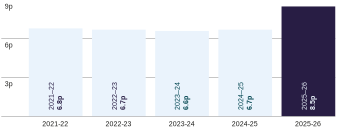
(1) For every £100 of stock held, the administration cost was 8.5p. The worsening in efficiency performance in 2025–26 reflects the increased costs of running the business while we continue to deliver our transformation programme to drive greater long-term operational efficiencies.
Unclaimed assets
We report on unclaimed assets annually and define these as all holdings in closed products (which are held in the Residual Account) and holdings in open products with no customer financial transactions for a period of 15 years or more.
This year, we identified that we had previously included incorrect figures for the amount of NS&I Savings Certificates that should be categorised as unclaimed (with no customer financial transactions for a period of 15 years or more) and an incorrect explanation for apparent movements in the unclaimed figures for the last two years.
We hold £20.0 billion in Savings Certificates. They are a fixed-term product held for up to five years. They have not been on general sale since 2011. At the end of the fixed-term, customers have the option to renew their investment into a new term or withdraw their funds. Typically, Savings Certificates have high levels of retention. We are now reviewing how we define and report the amount of Certificates that should be categorised as unclaimed.
We are also reviewing how we define the amount of unclaimed stock in all other NS&I products to ensure we are taking a consistent approach. This will include Guaranteed Growth Bonds and Guaranteed Income Bonds, where we hold £32.7 billion in stock, but which were not previously included in our unclaimed assets reporting. We are therefore not publishing unclaimed assets data this year and will provide updated figures and definitions in the 2026–27 Annual Report. We will continue to report on the amount of unclaimed Premium Bonds prizes in our monthly media announcements of the Premium Bonds jackpot winners.
Tracking down unclaimed savings
To help customers track down lost NS&I savings products, we run our own tracing service and participate in the industry-wide My Lost Account service. In 2025–26, we received more than 86,000 tracing requests and reunited customers with over £335 million.
Our product range
| Status | Tax-free | Fixed- rate | Monthly income | Manage online and by phone | Manage by post | Annual statement | |
| British Savings Bonds Guaranteed Growth Bonds (purchase online only) |
On sale | Yes | Yes | Yes | Yes | ||
| British Savings Bonds Guaranteed Income Bonds (purchase online only) |
On sale | Yes | Yes | Yes | Yes | Yes | |
| Direct ISA | On sale | Yes | Yes | Yes | |||
| Direct Saver | On sale | Yes | Yes | ||||
| Fixed Interest Savings Certificates(1) | Not currently on sale | Yes | Yes | Yes | Yes | Yes | |
| Green Savings Bonds (purchase online only) |
On sale | Yes | Yes | Yes | |||
| Income Bonds | On sale | Yes | Yes | Yes | Yes | ||
| Index-linked Savings Certificates(1) | Not currently on sale | Yes | Yes | Yes | Yes | ||
| Investment Account | On sale | Holdings can be viewed online but no transactions can be carried out | Yes | Yes | |||
| Junior ISA (purchase online only) |
On sale | Yes | Yes | Yes | |||
| Premium Bonds | On sale | Yes | Yes | Yes |
(1) Renewals at maturity still permitted.
Sales performance by principal channels
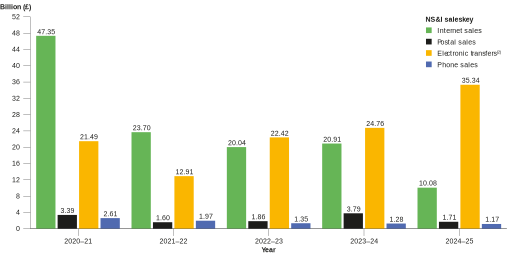
(1) This includes BACS, CHAPS, Faster Payments and Pay by bank account.
Our people
This has been a challenging 12 months for NS&I and our people. Although our employee engagement score remains strong, we recognise the need for a significant change in our organisational culture to improve the outcomes we deliver for our customers and stakeholders.
Evidence from the National Audit Office and Public Accounts Committee reviews and the bereavement claims issue highlight the need for cultural change. We are developing a programme of cultural change to address the cultural and leadership issues that NS&I faces. It aims to strengthen leadership behaviour and decision-making and treat culture as a critical enabler of leadership performance.
Employee engagement
Our employee engagement is 69%, up three percentage points on the previous year’s score of 66% and meeting our target.
Employee engagement is a workplace approach designed to ensure that employees are committed to their organisation’s goals and values and are motivated to contribute to organisational success. The Civil Service People Survey uses five questions to measure employee engagement (pride, advocacy, attachment, inspiration and motivation). Each of the engagement questions is asked using a five-point agreement scale. For each respondent, an engagement score is calculated as the average score across the five questions (where “strongly disagree” is equivalent to 0 and “strongly agree” is equivalent to 100). The engagement index is then calculated as the average engagement score in the organisation. NS&I saw year-on-year increases against all five categories in 2025.
Transformation programme: capability and skills
We have focused on strategic workforce planning over the last 12 months, looking ahead over the coming years to better understand the specific skills we need to deliver our business effectively and efficiently.
As part of our response to the Public Accounts Committee report about the transformation programme, we will provide the Committee with an update on our resource management strategy, encompassing civil service roles and how we use and effectively manage consultants. The strategy will set out how NS&I intends to develop additional capability and capacity to manage supplier contracts and the risk profile of the multi-supplier model.
Diversity and inclusion
Embedding diversity and inclusion at the heart of our business remains important for NS&I and a key element of our People Strategy. We were pleased that this year we achieved our target for ethnic diversity, where our target was no less than 16.03% ethnic minority colleagues in Senior Civil Service + NS&I bands 1–3, but disappointed that we did not meet our target for gender balance (where our target was a 50:50 balance in senior leadership, in a range of 40%–60%), but we ended the year at 31.88%.
This is a limited proportion of our population and we will rely on employee turnover to improve the position. With all our recruitment campaigns, we look to advertise in a range of places to attract as diverse a pool of candidates as possible.
Wellbeing
Our Wellbeing, Diversity and Inclusion Working Group continues to challenge ways of working and policies and procedures to encourage a better culture of wellbeing, diversity and inclusion. Read more on this in the next chapter.
Gender pay gap and pay multiples
We continue to report on gender pay differences in NS&I as part of our Remuneration and staff report. We recognise there is currently still a gender pay gap and are taking action to reduce this. Each year, where appropriate and in line with the pay remit guidance, we make adjustments to address pay disparities.
The Remuneration and staff report also includes data on pay multiples, i.e. the relationship between the total remuneration of the highest-paid Director in the organisation and the median total remuneration of the organisation’s workforce.
Environmental, Social and Governance
NS&I’s Environmental, Social and Governance (ESG) strategy looks to ensure that sustainability is fully embedded within our operations and governance. This chapter includes reporting on our performance in 2025–26 and a statement on our compliance with the Task Force on Climate-related Financial Disclosures (TCFD).
Scope and context
NS&I operates an outsourced business model and is currently mid-way through a major programme of business transformation, which sees a transition from a single outsource business partner to a multi-supplier model. Since 2024–25, NS&I has been reporting our greenhouse gas (GHG) emissions by Scopes 1, 2 and 3.
NS&I and our operational delivery partners Atos, Sopra Steria and IBM, have committed to work in partnership to help monitor and measure the environmental aspects of our operations and drive improvements in environmental performance across the whole NS&I business.
Until 2022, NS&I’s head office was located in Drummond Gate, London, where we occupied 1,998 square metres. We then moved into a temporary office space on the lower ground floor of Sanctuary Buildings, London, occupying 382 square metres. In June 2025, we moved to a new permanent head office located in Riverside House, London, where we currently occupy 1,163 square metres. As part of the move to Riverside House, we reused approximately 70% of all furniture assets which we held in store since our move out of Drummond Gate.
During the 2025–26 financial year, we also invested in our regional locations. Our Durham and Glasgow offices have been refurbished and brought up to the same standards as our London head office in terms of technology and infrastructure. These office refurbishments support the Government’s Places for Growth programme by strengthening NS&I’s ability to recruit at these regional locations, allowing for increased office occupancy and smarter and more efficient ways of working.
Further, during the 2025–26 financial year, we became the lead tenant at our Durham office. As a result, we have taken on the majority of responsibility for building services. In the 2024–25 financial year, we anticipated that our occupation of the Durham office would increase to 83% of the Net Internal Area (NIA) of the whole building. However, due to a remeasurement of NIAs in the building, our occupation apportionment of this building is now 40.69% NIA.
Given the significant changes in both our estates and supply chain, we plan to re-baseline our emissions in 2026–27, to ensure that we have a representative and stable base from which to measure our future progress against.
ESG Strategy
NS&I’s ESG Strategy was approved by our Executive Committee in May 2024 and is built around five pillars, which are each aligned to specific United Nations Sustainable Development Goals (UN SDGs):
1. Supporting Net Zero through our operations
- 11) Sustainable Cities and Communities
- 12) Repsonsible Consumption and Production
- 13) Climate Action
Goals: To ensure that NS&I supports the UK’s transition towards Net Zero by 2050 and meets the requirements of the Task Force on Climate-Related Financial Disclosures (TCFD).
We now have established governance and reporting arrangements, and continue to work closely with our new suppliers as they come onboard and deliver our transformed business. As of March 2026, 100% of NS&I’s relevant ’Gold’ and ’Silver’ tier suppliers have a Net Zero Strategy which meets UK government requirements.
For further information on how our suppliers are categorised, please see the As of March 2026 table in this section below.
We have put in place an updated climate risk assessment, documented procedures and systems for reporting sustainability performance data, along with an initial materiality assessment. We also have an ESG delivery plan, which we will iterate as we agree what action needs to be taken by NS&I and our new suppliers to meet our emissions targets.
2. Supporting Net Zero through Green Finance
- 3) Good Health and Well-Being
- 8) Decent Work and Economic Growth
- 9) Industry, Innovation and Infrastructure
- 13) Climate Action
- 15) Life on Land
Goal: Continue to deliver our Green Savings Bonds offering to support HM Treasury’s Green Finance Programme, whilst using our research and expertise to help develop the UK’s wider ESG finance market.
NS&I has supported the Government’s Green Finance Strategy by raising £1.3 billion as of March 2026, via our Green Savings Bonds, including launching our eighth issue in April 2026. For further information on Green Savings Bonds, please see our Product Accounts. Money invested in our Green Savings Bonds (GSB) contributes to HM Treasury’s Green Financing Programme and helps finance government spending on projects that tackle climate change, rebuild natural ecosystems and support jobs in green sectors.
3. Supporting Employee Welfare & Wellbeing
- 3) Good Health and Well-Being
- 5) Gender Equality
- 10) Reduced Inequalities
Goal: To run ponsible mour business in a resanner which supports the welfare and wellbeing of our employees. To continue to focus on our standards of diversity and equality.
Supporting colleague wellbeing remains an important part of our People Strategy.
Our Wellbeing, Diversity and Inclusion Working Group continues to promote awareness, learning and practical support across the business, helping to challenge barriers, improve understanding and encourage a healthy and supportive working environment.
During the year, activity included Tea & Talks, blogs and colleague communications on topics such as bereavement, caring responsibilities, financial wellbeing and mental health. We trained a new cohort of Mental Health First Aiders and established a community of practice to strengthen peer support and help signpost colleagues to appropriate support when needed.
We also joined Hospice UK’s Compassionate Employers Programme to strengthen support for colleagues experiencing bereavement, caring responsibilities or terminal illness, and continued to refresh key policies and statements, including our Equality, Diversity and Inclusion Policy and Dignity at Work Statement, to reflect current good practice.
NS&I previously retained Silver status in Mind’s Wellbeing Index in 2024–25. Although Mind has now paused the index, our earlier participation has continued to inform our approach to colleague wellbeing. Colleagues also continued to support a range of charitable and community initiatives during the year, including collecting for foodbanks and raising money for a range of charities. This included a coffee morning held across all our sites in September 2025, which brought colleagues together while raising funds for Macmillan Cancer Support.
Embedding diversity and inclusion at the heart of our business remains important for NS&I and is a key element of our People Strategy. During the year, we continued to support an inclusive and respectful workplace through the work of our Wellbeing, Diversity and Inclusion Working Group, alongside ongoing action to strengthen our policies, awareness activity and colleague support.
We were pleased to achieve our target for ethnic diversity, with ethnic minority representation in Senior Civil Service and NS&I Bands 1 to 3 remaining at or above our target level.
We did not meet our target for gender balance in senior leadership and recognise there is more to do to improve representation over time. We continue to support this through fair and open recruitment, promoting opportunities as widely as possible and encouraging a broad and diverse range of applicants.
4. Supporting Responsible Customer Interaction
- 1) No Poverty
- 16) Peace, Justice and Strong Institutions
Goal: Our customers are at the heart of our business. Everything we do is delivered in line with our Customer Principles, which set out how we want interactions with our customers to feel.
NS&I has refreshed its Customer Principles, which guide how we want customers to feel when interacting with us.
As outlined in the Chief Executive’s overview, NS&I published a timetable in May 2026 to remediate an issue where estates of deceased customers were not always paid funds from all of their accounts following a bereavement claim, due to failures in our search processes. We will deliver this remediation plan to ensure fair and timely outcomes for those who trust us to do so. We are progressing a programme to enhance efficiencies across our operations while improving the customer experience. The programme is currently under assessment, with dedicated resource in place, and is expected to deliver increasing benefits over time.
5. Supporting our Community
- 1) No Poverty
- 4) Quality Education
- 8) Decent Work and Economic Growth
Goal: NS&I will encourage our staff to support both local communities and national good causes.
We actively encourage employees to participate in activities to support national and local schemes and initiatives through our staff intranet. Our employees are entitled to three ’Giving Something Back’ days each financial year, allowing them to carry out voluntary work or engage with their local or wider community. We also support payroll giving, also known as ’give as you earn’. This allows colleagues to make donations to charities directly from their pay. As of March 2026, 32.5 Giving Something Back days were taken and 7.55% of staff were signed up to payroll giving. As we move into 2026–27, we will be looking to promote awareness and drive uptake of Giving Something Back days across NS&I.
NS&I does not have a charity partner or support any one individual charity. Instead, we encourage our staff to donate to charities of their choice, with colleagues supporting each other’s fundraising activities. Over 2025–26, colleagues continued to support a range of charitable and community initiatives, including collecting for foodbanks and raising money for a range of charities. This included a Coffee Morning held across all our sites in September 2025, which brought colleagues together while raising funds for Macmillan Cancer Support.
Greening Government Commitments (GGC) performance
The Government has not yet published the Greening Government Commitments for 2025-30. NS&I will look to review our strategy, targets and delivery plans in light of these commitments, once they have been published.
Organisational travel policies
NS&I has a travel and subsistence policy in place which asks all employees to consider whether video calls can be used as an alternative and if there is a business need to travel. We also consider the environmental impact of how we travel, for example encouraging train over car or plane use. We collect emissions data on all NS&I travel, and have a dedicated workstream as part of our wider ESG delivery plan with the aim to reduce our overall greenhouse gas emissions from business travel.
Single use items
We do not currently have a mechanism to report CSUP (consumer single-use plastics) at any of our operational sites. Use is solely for hygiene and safety where there are no viable alternatives. We support any reduction campaigns or initiatives on sites held by service providers or landlords.
Task Force on Climate-Related Financial Disclosures (TCFD) Compliance Statement
NS&I has reported on climate-related financial disclosures consistent with HM Treasury’s TCFD-aligned disclosure application guidance, which interprets and adapts the framework for the UK public sector. NS&I has also complied with the following specific TCFD recommendations:
Governance
In 2024–25, NS&I’s Executive Committee (ExCo) established an ESG Committee that has delegated authority to oversee the implementation of our ESG Strategy, ESG-related reporting (including compliance-related requirements, such as TCFD), assessment of risk and the embedding of sustainability across the business. NS&I’s Director of Communications and Strategy is NS&I’s board-level representative and Senior Responsible Officer (SRO) for sustainability. The ESG Committee is chaired by the Head of Strategy, and membership includes representatives from NS&I’s Workplace, Finance, Compliance and Commercial teams. NS&I’s key strategic suppliers are also represented as standing members of the ESG Committee.
The principal oversight route at Board level for ESG delivery is the reporting contained in this Annual Report and Accounts. We will review the reporting arrangements in 2026–27 as part of the second stage of our ESG data-reporting review, and consider whether more detailed or more frequent reporting at ExCo and Board level is needed.
Metrics and targets
We have established a new ESG reporting system in 2025–26, which we have been testing with our suppliers. We have also put in place a new ESG delivery plan, conducted an initial materiality assessment and codified our reporting and monitoring approach in a process manual.
We continue to report in line with HMT’s annual Sustainability Reporting Guidance, including disclosing emissions by Scopes 1 to 3, where appropriate. We have not included reporting against the Greening Government Commitments in this Annual Report and Accounts, as we are waiting for the publication of the commitments for the 2025–30 period to clarify what themes should be monitored and what cross-government targets need to be met. We will be working with our suppliers to establish a new emissions baseline for 2026–27 and have set interim targets which will derive from that new baseline.
Risk management
We have reviewed our initial climate risk assessment in line with NS&I’s risk framework and wider good practice and again conclude that climate is not a principal risk for NS&I. This assessment has been reviewed by our auditors. We plan in 2026–27 to also peer review this risk assessment with other departments within the HM Treasury Ministerial Group, to share good practice and assess consistency.
Strategy
Our ESG Strategy is now in place and underpinned by our new ESG delivery plan, reporting system, climate risk assessment and materiality assessment. We have independently quality-assured the individual outputs of our strategy via a series of audit actions, which we are up to date with as at 31 March 2026. The key focus of our strategy in 2026–27 will be to work with our suppliers to iterate our delivery plan and establish a revised emissions baseline that accounts for our new business model. Delivery of this new baseline is in turn dependent on the successful delivery of our transformation programme, and we may need to review this timetable in light of the current review of the programme’s business case.
Climate change adaptation
NS&I is currently working with its suppliers and office providers to understand what steps they are taking to adapt to climate change. We will continue that engagement in 2026–27, and assess as part of our ESG delivery plan whether there are any gaps in adaptation that require addressing.
Nature Recovery and Rural Proofing
NS&I is an executive agency of the Chancellor of the Exchequer and is not responsible for developing government policy. As such, we do not develop policies that affect rural proofing. NS&I’s influence in this regard is limited to our Green Savings Bonds, where our parent department (HM Treasury) uses the funds raised through this product to tackle climate change and other environmental challenges, fund infrastructure investment and create green jobs across the UK.
We work with our service providers to ensure that any buildings we occupy, either in part or in full, are compliant with all aspects of the Environment Act 2021.
Procuring sustainable products and services
We incorporate social value as a key evaluation criterion in all above-threshold procurement and also consider the social value impacts of lower-value procurement where it is relevant and proportionate to do so. A key tool in this process is the updated government social value model. Based on the social value model, we have developed a social value options appraisal template and process, which is used to identify the most relevant themes, outcomes and metrics for social value, depending on the particular contracts being procured. The Commercial Team at NS&I has undertaken social value training via the Government Commercial College, and there are in-house briefings and refresher training events, as well as in-house spotlight events run periodically to highlight the importance of social value to the wider business.
We are a certified Living Wage Employer and also seek a commitment from our suppliers, wherever possible, to commit to paying their staff the Real Living Wage and, on major contracts, to work towards becoming certified themselves. NS&I follows Government Commercial Function guidance and best practice in categorising contracts using a Gold, Silver, Bronze framework, where Gold contracts represent large, complex, and/or critical contracts with high strategic importance, Silver contracts are those of moderate value, risk and impact, and Bronze contracts are of lower value, risk, and impact. ’Certified’ means the supplier pays the real living wage to all directly employed staff and ensures that all relevant contractors in its supply chain also pay a living wage, or have a viable plan in place to ensure they do so, and that this has been accredited by the Living Wage Foundation. More information on the Living Wage Foundation can be found here: https://www.livingwage.org.uk/
As of March 2026:
| NS&I supplier type | Gold tier | Silver tier |
| Number of suppliers | 24 | 45 |
| Suppliers who were certified Living Wage employers | 15 (62.5%) | 23 (51.1%) |
| Suppliers who were covered by a contractual commitment to pay at or above the Real Living Wage for the duration of their business with NS&I | 3 (12.5%) | 6 (13.3%) |
| Total | 18 (75%) | 29 (64.4%) |
We use risk ratings to monitor the financial standing of our supply chain. We annually assess our entire supply chain, and the key sub-contractors of our suppliers, for Modern Slavery risk, and compliance with the transparency requirements of the Modern Slavery Act. Supplier compliance with the reporting requirements of the Government’s Net Zero strategy is also assessed, both periodically and at the selection stage of major procurements. All of our in-scope suppliers are assessed as meeting their Modern Slavery Act reporting obligations.
In 2023, NS&I awarded a new contract to Sopra Steria Limited to run our customer contact centre and related operations. As this service employs a relatively large number of staff and is broadly office-based but with some hybrid working, it was identified at the procurement stage that this contract should include a target related to the Government social value model theme of “reducing the disability employment gap”. Sopra Steria committed to promote opportunities for people with disabilities to participate in the contract workforce, with a target for 12% of the workforce to be people with disabilities by 2028–29. By March 2026, Sopra Steria was able to report that this target had been exceeded, with disabled persons representing 15% of the contract workforce.
2025–26 Sustainability performance and targets
GHG emissions (tCO2e)
| 2021–22 | 2022–23 | 2023–24 | 2024–25 | 2025–26 | |
| Scope 1 (Direct) | 122.4 | 186 | 169 | 133.131 | 43.34 |
| Scope 2 (Energy indirect) London site only, non-renewable | N/A | N/A | N/A | 13.95 | 3.698 |
| Scope 2 (Energy indirect) All other operational sites | N/A | N/A | N/A | 214.47 | 80.851 |
| Scope 2 (Energy indirect) Off-premise servers/data centres, private cloud and public cloud | N/A | N/A | N/A | N/A | 184.841 |
| Scope 3 (Official business travel) | 7 | 32 | 42 | 36.1 | 23.317 |
| Scope 3 (Waste generated in operations) | N/A | N/A | N/A | 0.71 | 0.161 |
| Scope 3 (Purchased goods and services) | N/A | N/A | N/A | N/A | 199.338 |
Work-related air travel
| 2024–25 | 2025–26 | |
| Total work-related air travel | 93,401 km | 54,652 km |
| Total distance travelled by domestic business flights | 75,389 km | 54,652 km |
| Total distance travelled by international business flights | 18,012 km | 0 km |
| Short haul international business flights | 6,193 km | 0 km |
| Long haul international business flights | 11,819 km | 0 km |
| International business flights by class: | ||
| Economy | 7 | 0 |
| Premium economy | 2 | 0 |
GHG emissions (tCO2e) historical
| 2021–22 | 2022–23 | 2023–24 | 2024–25 | 2025–26 | |
| Indirect emissions (Historical measurement) | 25.2 | 49 | N/A | N/A | N/A |
| Waste emissions (Historical measurement) | 9 | 1 | 1.5 | N/A | N/A |
GHG emissions financial indicators (£k)
| 2021–22 | 2022–23 | 2023–24 | 2024–25 | 2025–26 | |
| Gross expenditure on the purchase of energy | Not available | Not available | Not available | 238.965 | 24.172 |
| Total expenditure on official business travel | Not available | 135.887 | 226.395 | 165.463 | 135.859 |
| Expenditure on accredited offset purchases | N/A | N/A | N/A | N/A | N/A |
GHG emissions – footnotes
| (1) Figures expressed as CO2e (carbon dioxide equivalent). CO2e represents CO2 emissions in metric tonnes with the same global warming potential as one metric tonne of another greenhouse gas. It allows bundles of greenhouse gases to be expressed as a single number. We apply the relevant UK government conversion factors in our calculation of emissions, as appropriate. The 2025 conversion factors can be found here: Greenhouse gas reporting: conversion factors 2025 – GOV.UK. |
| (2) The way in which we calculate our emissions has changed over time. Previously reported categories, including ’Indirect emissions’ and ’Waste emissions’ have been set out in the tables above. Indirect emissions previously included electricity usage from non-renewable sources, official business travel and waste. These have now been categorised by Scope. |
| (3) As part of our ESG Strategy, we will look to work with our key strategic suppliers to measure further emissions categories and increase the quality of our sustainability data. |
| (4) Data prior to 2024–25 has been taken from the 2023–24 Annual Report and 2023–24 data revised from the 2023–24 Annual Report as part of a validation exercise. Due to changes in operational sites over the years, the data sets are not comparable. |
| (5) For an analysis of related gas and electricity consumption in kWh, including limitations to this data, please see the ’Energy consumption’ table. |
| (6) Scope 2 (Energy indirect) ’London Sanctuary Buildings only’ includes the emissions associated with electricity consumption in kWh for our occupation of London Sanctuary Buildings, which was only for Q1 of 2025–26. This site uses nuclear energy. In 2024–25, we occupied this site for the full financial year. |
| (7) Scope 2 (Energy indirect) ’All other operational sites’ includes the emissions associated with electricity consumption in kWh for the London Riverside House, Lytham, Durham and Glasgow operational sites using location-based grid average emissions factors. It should be noted that these operational sites are on a renewable energy tariff, supported by certificates. As such, this data has been published for comparative purposes. In 2024–25, this data excludes London Riverside House as we were not occupying this site. |
| (8) Data for Scope 2 (Energy indirect) ’Off-premise servers/data centres, private cloud and public cloud’ are provided via our supplier Atos. Off-premise servers/data centres and private cloud usage is calculated using their Atos on-premise carbon calculator, and public cloud usage is calculated using an Amazon Web Services (AWS) carbon footprint tool. The Scope 3 emissions as a result of this usage have been included under Scope 3 (Purchased goods and services). |
| (9) Scope 3 (Official business travel) includes emissions as a result of rail and air travel (excluding radiative forcing). Including radiative forcing from air travel, this figure is 29.2 tCO2e. |
| (10) We are unable to report on fugitive emissions from installations, operations and disposal at our operational sites due to challenges in third-party data. Going forward, we will work with our suppliers to understand how we can address this. |
| (11) NS&I did not purchase any heat, steam or cooling at our operational sites during the reporting year and as such has not reported any associated emissions. |
| (12) In line with government guidance, we do not report on emissions associated with recycled materials as the producer of waste. |
| (13) There are limitations to our Scope 3 (Waste generated in operations) emissions due to challenges in third-party data for both water supply and treatment. For more information, please see the ’Water consumption’ table. |
| (14) NS&I does not purchase or use carbon credits, nor do we have a policy of purchasing/using carbon credits. |
| (15) With regards to an accounting boundary, we assume a financial control approach over our emissions (as set out in this Annual Report and Accounts). |
Waste minimisation and management - Non-financial indicators (tonnes)
| 2021–22 | 2022–23 | 2023–24 | 2024–25 | 2025–26 | |
| Total waste arising | N/A | N/A | N/A | 62.24 | 18.761 |
| Total waste recycled | 31 | 28.4 | 65.368 | 45.109 | 18.619 |
| Recycling | N/A | N/A | N/A | N/A | 9.44 |
| Incineration with energy recovery | N/A | N/A | 0.597 | 16.964 | 6.262 |
| Incineration without energy recovery | N/A | N/A | N/A | N/A | 0 |
| Anaerobic digestion | N/A | N/A | N/A | N/A | 0 |
| Composting (including food waste) | N/A | N/A | N/A | 2.0364 | 2.917 |
| Landfill | 17.8 | 15.16 | 3.2188 | 0 | 0 |
| Hazardous waste | N/A | N/A | N/A | N/A | 0.052 |
| CSUP (single use plastics) | N/A | N/A | N/A | N/A | N/A |
| Other | N/A | N/A | N/A | N/A | 0.09 |
| Waste Electrical and Electronic Equipment (WEEE) waste | N/A | N/A | N/A | N/A | N/A |
| By waste destination: | |||||
| Other waste destination | N/A | N/A | N/A | N/A | N/A |
| Major mineral waste | N/A | N/A | N/A | N/A | N/A |
| Municipal waste | N/A | N/A | N/A | N/A | 18.761 |
Waste minimisation and management - Financial indicators (£k)
| 2021–22 | 2022–23 | 2023–24 | 2024–25 | 2025–26 | |
| Recycling | N/A | N/A | N/A | N/A | N/A |
| Incineration with energy recovery | N/A | N/A | N/A | N/A | N/A |
| Incineration without energy recovery | N/A | N/A | N/A | N/A | N/A |
| Anaerobic digestion | N/A | N/A | N/A | N/A | N/A |
| Compositing (including food waste) | N/A | N/A | N/A | N/A | N/A |
| Landfill | N/A | N/A | N/A | N/A | N/A |
| Hazardous waste | N/A | N/A | N/A | N/A | N/A |
| CSUP (single use plastics) | N/A | N/A | N/A | N/A | N/A |
| Other | N/A | N/A | N/A | N/A | N/A |
| WEEE waste | N/A | N/A | N/A | N/A | N/A |
| Total expenditure on waste disposal | N/A | N/A | N/A | N/A | Not available |
Waste minimisation and management footnotes
| (1) The way in which we report waste has changed over time as we seek to better align to government guidance. Further, there have been changes to our office locations over time, which means that the data sets are not comparable. |
| (2) All waste consumption is calculated based on the consumption for the whole operational site, where available, and multiplied by NS&I’s relevant apportionment of the space. For London Sanctuary Buildings, data is pre-apportioned based on our occupation of 2.45%. We only occupied this site for Q1 of 2025-26. For London Riverside House, data is pre-apportioned based on our 12% occupation of the fourth floor. For Glasgow, our occupation of the site is 15.22%. For Lytham, it is 2.18%, and for Durham it is 40.69%. |
| (3) All operational sites adopt a ’zero waste to landfill’ approach. |
| (4) We are unable to report on the associated cost of waste at all operational sites as these costs form part of an overall service charge payment. |
| (5) Building management teams at Lytham, Durham and Glasgow weigh waste before it leaves site. Our building management team at London Riverside House counts bags of waste used daily and estimates each bag of general waste at 8kg, recycling at 4kg, food waste at 10kg and paper and cardboard at 4kg. |
| (6) All sites use incineration with energy recovery. We are currently looking to establish if this route is R1 rated. |
| (7) No sites use incineration without energy recovery. |
| (8) All of our operational sites follow DEFRA’s ’simpler recycling’ initiative. More information can be found on the GOV.UK page Workplace recycling in England. |
| (9) NS&I does incur WEEE waste; however, none has been reported by our third-parties in 2025-26 as WEEE waste bins were not full enough for collection and disposal. |
| (10) We are unable to report on anaerobic digestion due to challenges in third-party data. |
| (11) We do not currently have a mechanism to report CSUP. Please see the ’Single use items’ section for more information. |
| (12) ’Other’ waste denotes waste occurring from office refurbishments. |
Environmental impacts from ICT waste and digital
Whilst we do hold data of numbers of hardware, peripherals and ICT currently in use and their consumption, we do not hold responsibility for how ICT products are disposed of and do not hold this data. We look to work with our providers/suppliers/stakeholders to understand our digital waste and IT footprint.
Water consumption - Non-financial indicators (m3)
| 2021–22 | 2022–23 | 2023–24 | 2024–25 | 2025–26 | |
| Total water consumption | 4,144 | 17,555 | 3,338.73 | 3,184.54 | 840.59 |
Water consumption - Financial indicators (£k)
| 2021–22 | 2022–23 | 2023–24 | 2024–25 | 2025–26 | |
| London Sanctuary Buildings | Unable to report | Unable to report | Unable to report | Unable to report | Unable to report |
| London Riverside House | Unable to report | Unable to report | Unable to report | Unable to report | Unable to report |
| Other operational sites (Lytham, Durham and Glasgow) | Unable to report | Unable to report | Unable to report | 11.88 | Unable to report |
| Total spend | Unable to report | Unable to report | Unable to report | 11.88 | Unable to report |
Water consumption footnotes
| (1) The decrease in water consumption for 2025-26 is as a result of changes in operational sites, including new agreements around apportionments of site occupation and changes in services. As such, the consumption data is not directly comparable with prior years. We expect that these factors have also consequently impacted our Scope 3 (Waste generated in operations) emissions. |
| (2) The consumption data for London Sanctuary Buildings only covers April to 20 June as per our occupation of the space. |
| (3) We are unable to report on water consumption for London Riverside House due to challenges in third-party data and reporting mechanisms. Going forward, we will look to work with our landlord to understand how we may be able to improve this. |
| (4) We are unable to report on the cost of water consumption at all operational sites as these costs form part of an overall service charge. |
| (5) Lytham Q4 water consumption data was estimated based on the prior quarter’s data. |
| (6) Consumption data is for water supply (potable water) to the relevant sites only and do not include drainage figures due to challenges in third-party data. |
| (7) Going forward, we will look to address water saving measures and water plans with our suppliers as part of our Greening Government Commitments Action Plan. |
Health and Safety
During 2025–26, NS&I has kept workspaces legally compliant in all aspects of Health and Safety, across the NS&I portfolio. With the help of our service providers, we have been able to assure our Board that there is a robust attitude to Health and Safety with zero reports under the Reporting of Injuries, Diseases and Dangerous Occurrences Regulations 2013 (RIDDOR) and stable near-miss and accident reporting. We have a focus on wellbeing and delivered upgrades to our regional offices to create a positive working environment for our colleagues.
Energy consumption - Non-financial indicators (kWh)
| 2021–22 | 2022–23 | 2023–24 | 2024–25 | 2025–26 | |
| Estates electricity consumption (non-renewable) | 45,442 | 80,358 | 70,384 | 67,367 | 20,889.85 |
| Estates electricity consumption (renewable) | 2,518,171 | 1,106,457 | 1,059,285 | 968,471 | 456,785 |
| On premise servers/data centres | Not available | Not available | Not available | Not available | Not available |
| Off premise servers/data centres and private cloud | Not available | Not available | Not available | Not available | 851,737 |
| Public cloud | Not available | Not available | Not available | Not available | Not available |
| Total electricity consumption | 2,563,613 | 1,186,815 | 1,129,669 | 1,035,839 | 1,329,413 |
| Total gas consumption | 669,111 | 1,015,798 | 829,670 | 727,893.61 | 213,802 |
Energy consumption - Financial indicators (£k)
| 2021–22 | 2022–23 | 2023–24 | 2024–25 | 2025–26 | |
| London Sanctuary Buildings | Not available | Not available | Not available | Not available | Not available |
| London Riverside House | N/A | N/A | N/A | N/A | 24.172 |
| Other operational sites (Lytham, Durham and Glasgow) | Not available | 295.1 | 398.05 | 238.96 | Not available |
| Total spend | Not available | Not available | Not available | Not available | 24.172 |
Energy consumption footnotes
| (1) We are now reporting on the power consumption as a result of our use of off-premise servers/data centres and private cloud. This only accounts for services provided by our supplier Atos and has consequently increased our total electricity consumption. Going forward, we will continue to work with our suppliers with a view to further increase reporting in this space, where practical. |
| (2) No data is available for the power consumption associated with the use of both on-premise servers/data centres and public cloud due to challenges in third-party data. Going forward, we will work with our suppliers to understand how we can address this where practical. |
| (3) The data for Estates electricity consumption (non-renewable) is for the London Sanctuary Buildings site only, covering only Q1 of 2025–26 for our occupation of the space. The electricity used at this site is nuclear. |
| (4) All other operational sites (London Riverside House, Glasgow, Lytham and Durham) use renewable electricity, supported by certificates. |
| (5) There are limitations to this year’s gas consumption data due to challenges in third-party data. Gas consumption at both London Riverside House and Glasgow is billed via a service charge, and as such consumption is unknown. |
| (6) Estimates have been made for January 2026 to March 2026 (Q4) for the Lytham and Durham sites’ gas consumption, based on data taken from the previous quarter (Q3) due to the availability of data. |
| (7) As previously noted, our percentage occupation of space at our operational sites has changed over time, which means that the estates electricity and gas consumption data is not directly comparable to previous years. |
| (8) We are unable to report on the energy costs at the London Sanctuary Buildings, Glasgow, Lytham and Durham operational sites as these costs form part of an overall service charge. The total spend represents London Riverside House only, based on meter readings for the fourth floor of the building and apportioned by our percentage occupation of the space. |
Sir Jim Harra KCB
Interim Chief Executive
National Savings and Investments
29 October 2026
Accountability Report
Corporate governance report 2025–26
Directors’ report
National Savings and Investments (NS&I) is a non‑ministerial government department and an Executive Agency of the Chancellor of the Exchequer.
Lord Lemos CMG CBE served as NS&I’s independent non-executive Chair at the start of 2025–26 and until 21 July 2025, stepping down with immediate effect due to his appointment as Lord in Waiting (Government Whip) on 22 July 2025. Luke Jensen, a non-executive NS&I board member, was appointed as Interim Chair of the NS&I board on 1 September 2025. There were no board meetings between 21 July 2025 and 1 September 2025.
Dax Harkins served as NS&I Chief Executive, Accounting Officer and Director of Savings until 25 March 2026. Sir Jim Harra KCB was appointed Interim Chief Executive on 26 March 2026. The Chief Executive and Accounting Officer of NS&I, in his capacity as the Director of Savings, contracts with third parties in respect of NS&I.
NS&I has an advisory board. The Chief Executive is expected to follow the advice of the board, except if doing so would conflict with his obligations as the Accounting Officer. The board’s terms of reference state that the board comprises:
- up to seven independent non-executive board members, one of whom will act as Chair of the board,
- the Chief Executive and other executive directors
- up to two representatives of HM Treasury, including at least one from Debt and Reserves Management (DRM).
On 31 March 2026, the board comprised four independent non-executive members, including the Interim Chair, and seven executive members, including the Interim Chief Executive. The Chief Executive and non-executive board members, including the Chair, are appointed by HM Treasury ministers. Other than interim appointments, board appointments are made following an open recruitment process. The register of NS&I board members’ interests is published on the NS&I website.
All non-executive appointments to NS&I’s board are made on merit; political activity plays no part in the selection process. All executive board members are civil servants appointed in accordance with the Civil Service Commissioners’ Recruitment Code. Each member of the board has a personal contract that stipulates the procedures for termination.
The non-executive NS&I board members who served during the year to 31 March 2026 were:
- Lord Lemos CMG CBE [to 21 July 2025]
- Nina Hingorani-Crain
- Luke Jensen
- Melanie Moreland
- David Woodward
Azin Roussos represented HM Treasury as a member of the NS&I board, and on each of the board’s committees, until 13 June 2025. Although not formally a member of the Board, HM Treasury’s Director Fiscal Policy attended NS&I’s board meetings for the remainder of 2025–26. After the reporting period and before the report was signed, Marion Ando and Chloe McCarthy-Evenson, Co‑Deputy Directors, Debt and Reserves Management, HM Treasury were appointed to represent HM Treasury as members of the NS&I board.
The executive NS&I board members in the year to 31 March 2026 were:
- Sir Jim Harra KCB, who joined as Interim Chief Executive, Accounting Officer and Director of Savings from 26 March 2026
- Dax Harkins, Chief Executive, Accounting Officer and Director of Savings to 25 March 2026
- Patrick Briscoe, Enterprise Service Management Director
- Ruth Curry, People and Finance Director
- Andrew Gudgeon OBE, Risk Director
- Gareth Headon, Communications and Strategy Director
- Matthew Smith, Chief Operating Officer and Senior Responsible Owner for the Business Transformation Programme
- Andrew Westhead, Retail Director
After the reporting period and before the report was signed, Ruth Curry retired as People and Finance Director. Her responsibilities were transferred to the Chief Finance Officer, Charlotte Goodrich, and the Chief People Officer, Lucy Windmill.
Further information regarding the membership of the board and its committees is provided below.
Board members during 2025–26
Non-executive board members
Luke Jensen
Interim Chair and independent non-executive board member
Luke was appointed as a non-executive board member on 1 April 2024 and as Interim Chair on 1 September 2025. Luke is a highly experienced senior executive, particularly within large consumer-facing retail and technology companies. He was most recently CEO of Ocado Solutions and Executive Director of Ocado Group and previously a member of Sainsbury’s leadership team. Luke is an independent non-executive director for The Co-operative Group and held previous roles as a non-executive director and executive Chair at Hana Group SAS.
Lord Lemos CMG CBE
Independent non-executive Chair
[to 21 July 2025]
Lord Lemos was appointed as a non-executive board member on 1 April 2024 and as Chair on 1 July 2024. He has had a broad non-executive and board level career across the private and public sectors spanning over 30 years. Lord Lemos resigned as a non-executive board member and Chair when he was appointed as Lord in Waiting (Government Whip) on 22 July 2025.
Nina Hingorani-Crain
Independent non-executive board member
Nina was appointed as a non-executive board member in November 2021. Nina’s executive career was largely in financial services, including 10 years advising UK and global financial services organisations, followed by 10 years in senior roles at the UK’s financial regulator. Since 2015, Nina has focused on a non-executive career. She is a member of the boards of the National Employment Savings Trust Corporation (Nest), the Institute of Chartered Accountants of England and Wales (ICAEW) and of a London mental and community health NHS Foundation Trust. Previous board roles include the Charity Commission for England & Wales.
Melanie Moreland
Independent non-executive board member
Melanie was appointed as a non-executive board member on 1 April 2024. She is an experienced executive with an extensive career in financial services. From June 2021 to July 2024, Melanie was the Head of Commercial Banking Customer Engagement, and Customer Journey Execution at NatWest. She was previously a non-executive director for Queen Margaret University for six years until December 2023.
David Woodward
Independent non-executive board member
David was appointed as a non-executive board member in January 2023. David commenced his non-executive career in 2008. He is a qualified management accountant and has over 10 years of financial services experience and over five years working with community and hospital NHS Trusts. He is an experienced audit committee chair and a former non-executive director of the Hinckley and Rugby Building Society. David is also a non-executive director of Aspire Housing Limited, a trustee of the charity the Consumers’ Association (the parent charity of Which? Limited) and a governor and trustee of Trent College.
Executive board members
Sir Jim Harra KCB
Interim Chief Executive
[from 26 March 2026]
Jim had an almost 41-year career at HM Revenue & Customs (HMRC), including over five years as HMRC’s First Permanent Secretary and Chief Executive.
During his tenure, he implemented a digital strategy to modernise the tax system – improving the customer experience and tax compliance and reducing costs. He also served as a Civil Service Champion for tackling workplace bullying and for LGBT+ inclusion. He received a Knighthood for public service in the King’s Birthday Honours in June 2024. In September 2025, Jim joined the Royal National Institute of Blind People (RNIB) as Vice Chair of the Board of Trustees and Chair of the Governance, Nominations and Remuneration Committee.
Dax Harkins
Chief Executive
[to 25 March 2026]
Dax was NS&I Chief Executive from 12 April 2023 to 25 March 2026. Prior to this, Dax was responsible for the development and delivery of NS&I’s business-to-business strategy, as well as overseeing and assuring NS&I’s operational performance. Dax worked in financial services for over 30 years. He joined NS&I in 2003 and, in 2011, became Programme Director for the re‑tender of the NS&I outsourcing contract. Dax was appointed to the board in January 2014 as Business-to-Business Director.
Patrick Briscoe
Enterprise Service Management Director
Patrick joined NS&I in December 2023 as Service Integration & Management (SIAM) and Business-to-Business (B2B) Director. The directorate was renamed Enterprise Service Management during 2024. Patrick has over 20 years’ experience delivering critical services and operations. Patrick was most recently at the Home Office, where he led various service delivery functions with scope across all the Department’s business areas, working with and integrating multiple suppliers in an extremely complex and challenging environment. Prior to joining the Civil Service, the majority of Patrick’s career was spent working in similar roles in retail and commercial banking organisations, including NatWest Group, Lloyds Banking Group and Bank of America, as well as a short period with a major B2B travel management company.
Ruth Curry
People and Finance Director
Ruth joined NS&I’s board in July 2019. Previously she had been Acting Director of Finance and Business Services at HM Land Registry. She started her Civil Service career in Cabinet Office policy roles. After qualifying as an accountant in 2006, Ruth held senior finance roles in a number of departments, including the Department for Education, the Serious Fraud Office and the Department for Business, Energy and Industrial Strategy. Prior to joining the Civil Service, Ruth was a solicitor working on company and commercial issues in the City of London. Ruth retired from the NS&I board in September 2026.
Andrew Gudgeon OBE
Risk Director
Andrew joined NS&I in December 2023 as the Risk Director. Andrew had a 29-year career in the Royal Air Force, during which he held senior leadership positions in the Ministry of Defence, the Cabinet Office and the US Pentagon. Following retirement from the Royal Air Force, he was honoured with an OBE for services to cyber warfare. Andrew entered the financial sector in 2016, first as Head of Operational Risk at Nationwide Building Society and then Head of Enterprise Risk Management and Operational Risk at Zurich Insurance (UK). Andrew recently stood down as a director of Swindon and Wiltshire Local Enterprise Partnership, where he led on the delivery of the UK’s first Business Cyber Centre, which opened in 2022.
Gareth Headon
Communications and Strategy Director
Gareth Headon joined NS&I’s board in February 2021 as Acting People and Strategy Director. In December 2022, he was appointed Communications and Strategy Director. Before joining NS&I in 2008, Gareth spent six years with Eurostar, where he worked across corporate and consumer PR and government relations. He also worked for two years in Which? magazine’s press office and began his career at a PR agency working with clients in the technology sector. Gareth sits on the board of trustees of the London Welsh Centre.
Matthew Smith
Chief Operating Officer
Matthew joined NS&I’s board in August 2018. His roles prior to joining NS&I included Director of EMEA Supply Chain for DXC Technology and Global Vice‑President and Chief Procurement Officer for Dun & Bradstreet Corporation. He is a certified practitioner of Managing Successful Programmes and in 2022 graduated from the Cabinet Office Major Projects Leadership Academy delivered by Saïd Business School, University of Oxford.
Andrew Westhead
Retail Director
Andrew joined NS&I’s board in September 2023. He is responsible for a broad remit, focusing on our customers, Net Financing, products, services, digital experience and brand. He has 19 years of financial services experience within the private sector, most recently working for Nationwide Building Society for 13 years as a Regional Director. Andrew completed his Executive MBA in 2021.
HM Treasury representative board member
Azin Roussos
HM Treasury representative
[to 13 June 2025]
While a member of NS&I’s board, Azin was Deputy Director at HM Treasury, leading the Debt Management and Reserves team. She rejoined the NS&I board in September 2023, having previously been a member of the board from December 2020 to April 2022. At HM Treasury she had responsibility for the Government’s debt financing strategy, via the Debt Management Office (DMO) and NS&I. Her team was also responsible for managing the UK’s foreign currency reserves, cash and coinage policy and the shareholder relationship with the Bank of England.
Governance statement
This governance statement explains NS&I’s governance, risk management and internal control arrangements, including its governance structures, during the period 1 April 2025 to 31 March 2026.
cVision, purpose and values
NS&I’s vision is to inspire a stronger savings culture by being the most trusted UK savings provider, giving everyone the opportunity to save confidently. NS&I’s purpose is:
- creating value through delivering cost-effective debt financing
- providing services to government
- helping government deliver policy objectives
Our values are to keep our promises, build meaningful connections and be confidently curious.
Governance framework
NS&I’s governance framework is prescribed by the Framework Document with HM Treasury, updated in March 2024, which is available on the NS&I website. It sets out requirements for how NS&I is directed and managed, and includes provisions regarding:
- the role, powers and rights of HM Treasury and its Ministers and the role of the Accounting Officer (who is the Chief Executive of NS&I)
- the role of the NS&I board and its Chair
- how strategy is determined
- corporate planning, budgets, setting targets and monitoring
- requirements for risk management and its oversight
The Framework Document will be reviewed at least every three years. NS&I maintains a corporate governance manual, which provides further detail on governance policies and terms of reference for the board and committees. The delegated authorities manual sets out how decision-making is carried out across NS&I.
Role of HM Treasury and its Ministers
The Chancellor of the Exchequer is responsible for determining the policy and financial framework within which NS&I operates. Day-to-day responsibility for NS&I may be delegated to another Minister. At the start of 2025–26, this was to the Economic Secretary to the Treasury. In February 2026, responsibility transferred to the Minister for Pensions. HM Treasury provides high-level oversight of NS&I. Some decisions are reserved for Ministerial approval, such as the approval of the corporate plan and Service Delivery Measures (SDMs), as well as changes to the pricing of NS&I products. The thresholds above which NS&I must make disclosures to, or seek approval from, HM Treasury are set out in an delegated authority letter. The Debt and Reserves Management (DRM) team within HM Treasury acts as NS&I’s sponsor team, providing advice, monitoring performance and advising HM Treasury Ministers.
The Chief Executive, Accounting Officer and Director of Savings
NS&I’s Chief Executive also holds the roles of NS&I Accounting Officer and Director of Savings.
The Chief Executive has responsibility for maintaining sound internal governance arrangements that support the achievement of NS&I’s policies, aims and objectives.
The Chief Executive is supported by the NS&I board and the Executive Committee.
The Chief Executive’s responsibilities include:
- the day-to-day operations and management of NS&I
- establishing, in agreement with HM Treasury, NS&I’s corporate and business plans in light of wider strategic aims and agreed priorities
- safeguarding the public funds for which he has charge and ensuring propriety, regularity, value for money and feasibility in the handling of those public funds
- ensuring that timely forecasts and monitoring information on performance and finance are provided to the Treasury; that the Treasury is notified promptly if overspends or underspends are likely and that corrective action is taken; and that any significant problems, whether financial or otherwise, and whether detected by internal audit or by other means, are notified to HM Treasury in a timely fashion
- advising the NS&I board on the discharge of its responsibilities and on NS&I’s performance compared with its aims and objectives
- ensuring that effective procedures are in place for handling complaints about NS&I
The Statement of Accounting Officer’s responsibilities is in the Corporate governance report section.
Role of the NS&I board
NS&I has an advisory board, with no statutory functions. The Chief Executive is expected to follow the advice of the board, except if doing so would conflict with his obligations as the Accounting Officer.
The board does not decide policy nor exercise the powers reserved to Ministers or to the Director of Savings. It works with the Chief Executive to develop corporate policy, ensure good governance and monitor performance. It assists in developing NS&I’s strategy and advises on the operational implications and effectiveness of policy proposals, as well as challenging the Executive Committee on how well NS&I is achieving its objectives.
NS&I’s board advises on five main areas:
- strategic clarity: the NS&I vision
- commercial sense: scrutinising the allocation of financial and human resources
- talented people: ensuring NS&I has sufficient capability and capacity to meet current and future needs
- results focus: advising on the proposed corporate plan and monitoring the delivery of the agreed plan
- management information: ensuring that clear, consistent, comparable performance information is used to drive improvements.
The board receives a Chief Executive’s overview and reports from each directorate at each formal board meeting. The board’s terms of reference are reviewed annually and published on the NS&I website. They provide for collegiate decision-making so that no individuals or group of individuals may dominate the board’s decision-making.
The performance of each of the executive and non-executive board members is appraised annually.
Conflicts of interest
NS&I has policies and procedures in place to ensure that its board members make decisions independently of their personal interests. Board members are required to notify the board of any relevant positions held or other interests as they occur. These are recorded in the register of board members’ interests, which is published on our website.
Board members are prompted to declare any potential conflicts of interest at the beginning of each board meeting.
If a conflict is identified, the member concerned may be asked to withdraw from the board’s discussions and/or decision-making as appropriate. NS&I’s policy on holdings of NS&I products restricts the ability of board members to transact in NS&I products when they have access to unpublished information.
The independent non-executive board members
The board has decided not to follow the Financial Reporting Council’s Corporate Governance Code in relation to the appointment of a lead non-executive board member other than the Chair. The Chair meets the non-executive board members individually and collectively and, if necessary, feeds views back to HM Treasury.
The board has identified HM Treasury as NS&I’s main stakeholder and considers that HM Treasury representation on the board, together with agreement that the independent non-executive board members, if they choose, can meet the responsible Minister annually, means that there is no need for a lead non-executive board member other than the Chair.
Company Secretary and independent advice
The Company Secretary is responsible for advising the board on all corporate governance matters and ensuring that all board procedures are followed. All board members have access to the advice and services of the Company Secretary. The board and its committees may take independent professional advice, if necessary, at NS&I’s expense.
The work of the NS&I board during 2025–26
During the period of this report, the board undertook various activities to fulfil its role, including:
- Monitoring the progress of NS&I’s business transformation programme, part of the Government Major Projects Portfolio. During 2025–26 the Board considered the findings of external reviews of the programme and advised on the development and analysis of options regarding the future delivery of the programme
- High-level monitoring of NS&I’s operations, performance and people. Following the identification that some estates of deceased customers had not always been repaid money from all of their accounts following bereavement claims, the Board held frequent briefing sessions to monitor and advise on the organisation’s response
- Reviewing evidence of the fulfilment of HM Treasury approval conditions
- Meeting strategic partners and operational staff in Glasgow
- Providing challenge, scrutiny and advice in respect of strategic matters, including reviewing the annual corporate plan and Service Delivery Measures
- Endorsing the 2024–25 Annual Report and Accounts on the recommendation of the Audit and Risk Committee.
Board induction
On joining the board, new members are given background information describing NS&I and its activities. They receive an induction pack that includes information on the governance processes of NS&I, the roles and responsibilities of the board, committees and officers, and a range of other information about NS&I, its activities and relationship with HM Treasury. Meetings are arranged with NS&I and HM Treasury management to assist with induction. Non-executive board members complete compliance-related online learning modules at the beginning of their three-year term and once again if reappointed for a second term. This includes training on Consumer Duty. The Remuneration Committee considers the skills and development needs of the executive board members and assistant directors. Board members are encouraged to attend relevant training courses at NS&I’s expense.
Board evaluation
NS&I’s board effectiveness is reviewed annually with external input at least once every three years. An external review of the board’s effectiveness, and that of its committees, was carried out by NS&I’s internal auditors during 2022–23 and reported to the board at the April 2023 meeting. The reviewers concluded that the board was operating effectively and in line with applicable governance codes. Internal reviews of the board’s effectiveness were conducted in 2024, reporting to the April 2024 board meeting, and in March 2025, with findings reported to the board’s April 2025 meeting. The 2026 board effectiveness review, facilitated by the Government Internal Audit Agency, started after the period to which this report relates.
Quality of data used by the board
The board considers the quality of the management information it receives, including the underlying data, on an ongoing basis, and actions are taken to improve this where necessary. Prior to each financial year, the board reviews the Service Delivery Measures for the year ahead. Updated performance data is presented at each board meeting.
Board committees
During 2025–26, the board delegated responsibility to three advisory committees (Audit and Risk Committee, Remuneration Committee, and Business Transformation Programme Committee) to deal with specific matters in accordance with the committees’ written terms of reference. The committees’ terms of reference are available on NS&I’s website.
Audit and Risk Committee
The Audit and Risk Committee, chaired by David Woodward, comprised at the start of the year two non-executive board members and the HM Treasury representative on the board. In the absence of a HM Treasury representative on the NS&I board, HM Treasury is invited to send another representative to committee meetings. The Chief Executive, People and Finance Director, Risk Director and Chief Operating Officer, as well as representatives of the internal and external auditors, routinely attend the committee’s meetings but are not members of the committee. The committee’s responsibilities include advising the board and Accounting Officer on:
- NS&I’s accounting policies, accounting judgements and accounting estimates
- the preparation of the annual accounts
- the planned activity and results of both internal and external audit and the adequacy of management’s response to issues identified by audit activity
- NS&I’s strategic processes for risk, control and governance and its whistleblowing (speaking up) processes.
The Audit and Risk Committee met formally five times during the year. It received regular updates on internal and external audit plans and findings, on risks and their management, and on the production of the accounts and response to audit actions. Other matters reported to the committee during the year included risk management relating to the business transformation programme, cyber security, compliance and financial crime, responses to recommendations of external reviews, and risk reports from NS&I strategic delivery partners.
The committee was informed that there had been no formal whistleblowing reports in 2025; however, staff survey results indicated greater awareness and confidence in the ‘speaking up’ process. New reporting channels via email and an anonymous online form have been introduced to simplify raising concerns.
Remuneration Committee
The Remuneration Committee, chaired by Nina Hingorani-Crain, comprises both executive and non‑executive board members, due to the nature of NS&I and the role of the Accounting Officer. Its terms of reference were amended during the year to require HM Treasury representation for committee meetings to be quorate, either through participation of the committee member from HMT or another member of HM Treasury staff.
The Remuneration Committee scrutinises the Chief Executive’s recommendations on pay and performance-related awards to confirm that they are consistent with government policy, Civil Service pay guidance and the needs of the business. The executive members of the committee are recused from discussions regarding their own pay and performance. The committee also reviews succession planning arrangements for board members and other senior staff within NS&I.
As NS&I is a government department, the functions and responsibilities of the committee are discharged subject to the Civil Service rules on pay and appointments. Details of board members’ remuneration and emoluments are set out in the Remuneration and staff report.
Business Transformation Programme (BTP) Committee
The Business Transformation Programme (BTP) Committee, chaired by Melanie Moreland, supports the board and the Accounting Officer in their responsibilities for oversight of NS&I’s business transformation programme. It comprises both executive and non‑executive board members. In the absence of a HM Treasury representative on the NS&I board, HM Treasury is invited to send another representative to committee meetings. The BTP Committee scrutinises the transformation programme’s plans, business cases and delivery progress to support assurances to be provided to HM Treasury.
Executive Committee
The Executive Committee is the senior executive leadership of NS&I, comprising all the executive board members. Supported by its sub-committees, it sets and demonstrates NS&I’s culture, develops NS&I’s strategic direction, monitors performance and leads improvements across the organisation. It is chaired by the Chief Executive and meets formally at least monthly, and informally on a weekly basis. The board reviewed and approved updated terms of reference for the Executive Committee during the year.
NS&I committee structure during 2025–26
With the exception of the Environmental, Social and Governance (ESG) Sub-Committee, each sub-committee below the Executive Committee is chaired by an executive board member. All executive board members sit on the Executive Risk Committee, chaired by the Risk Director.
Details of the membership of the board’s sub-committees are provided in the Corporate governance report.
|
Executive Committee (ExCo) Sets NS&I’s strategic direction, leads its culture, and oversees delivery and performance. |
NS&I board Advises on corporate strategy, policy, and governance and scrutinises performance. |
|
ExCo sub-committees: • Service Delivery Committee • Executive Risk Committee [supported by the Waivers & Dispensations Committee] • Retail & Pricing Committee • Customer Committee • Transformation Committee • ESG Sub-Committee |
Board sub-committees: • Audit and Risk Committee • Remuneration Committee • Business Transformation Programme Committee |
Management structure as at 31 March 2026
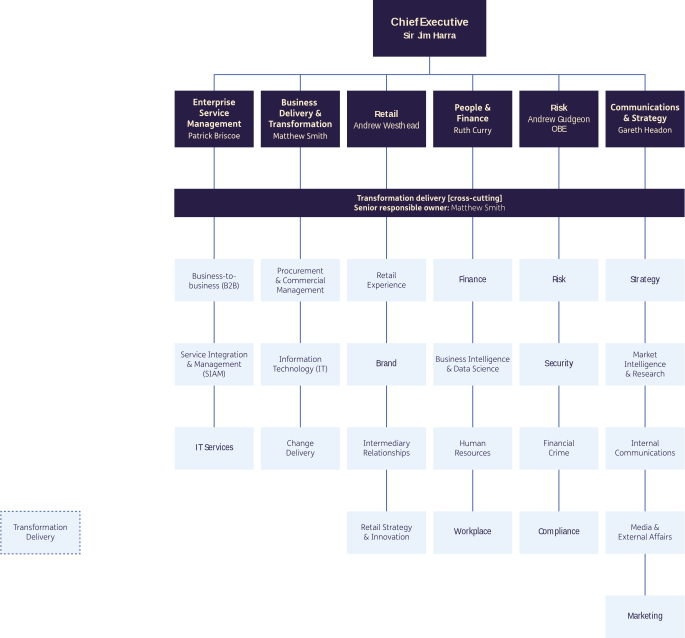
Membership of the NS&I board’s committees during 2025–26
The table below shows the membership of the board’s three committees during the year . Board members who are not listed below were not members of the committees during the year. There were no meetings of the committees between the date Sir Jim Harra KCB joined NS&I and 31 March 2026.
| Audit and Risk Committee | Business Transformation Programme Committee | Remuneration Committee | |
| Lord Lemos CMG CBE (until 21 July 2025) | Yes | ||
| Luke Jensen | Yes | Yes [from 30 July 2025] | |
| Nina Hingorani-Crain | Yes [Chair] | ||
| Melanie Moreland | Yes | Yes [Chair] | |
| David Woodward | Yes [Chair] | ||
| Azin Roussos (until 13 June 2025) | Yes | Yes | Yes |
| Dax Harkins (until 25 March 2026) | Yes | Yes | |
| Ruth Curry | Yes | Yes | |
| Andrew Gudgeon OBE | Yes | ||
| Matthew Smith | Yes |
Attendance
The attendance of members of the board and its committees at the formal meetings they were eligible to attend during 2025–26 is shown in the table below. This does not include details of those who attended committee meetings but were not members, nor details of the additional discussions that were not formal meetings of the committees or board.
| Board members during 2025–26 | Board [five meetings] |
Audit and Risk Committee [five meetings] | Business Transformation Programme Committee [11 meetings] | Remuneration Committee [four meetings] |
||||
| Possible | Actual | Possible | Actual | Possible | Actual | Possible | Actual | |
| Luke Jensen | 5 | 5 | 0 | 0 | 11 | 11 | 3 | 3 |
| Nina Hingorani-Crain | 5 | 5 | 0 | 0 | 0 | 0 | 4 | 4 |
| Melanie Moreland | 5 | 5 | 5 | 5 | 11 | 11 | 0 | 0 |
| David Woodward | 5 | 5 | 5 | 5 | 0 | 0 | 0 | 0 |
| Lord Lemos CMG CBE (until 21 July 2025) | 2 | 2 | 0 | 0 | 0 | 0 | 1 | 1 |
| Azin Roussos (until 13 June 2025) | 1 | 1 | 1 | 1 | 3 | 3 | 1 | 1 |
| Sir Jim Harra KCB (from 26 March 2026) | 0 | 0 | 0 | 0 | 0 | 0 | 0 | 0 |
| Dax Harkins (until 25 March 2026) |
5 | 5 | 0 | 0 | 11 | 11 | 4 | 4 |
| Patrick Briscoe | 5 | 5 | 0 | 0 | 0 | 0 | 0 | 0 |
| Ruth Curry | 5 | 4 | 0 | 0 | 10 | 10 | 3 | 3 |
| Andrew Gudgeon OBE | 5 | 4 | 0 | 0 | 8 | 7 | 0 | 0 |
| Gareth Headon | 5 | 5 | 0 | 0 | 0 | 0 | 0 | 0 |
| Matthew Smith | 5 | 5 | 0 | 0 | 11 | 11 | 0 | 0 |
| Andrew Westhead | 5 | 5 | 0 | 0 | 0 | 0 | 0 | 0 |
Corporate strategy
Our Inspire & Invest strategy set out our three strategic objectives for 2025–26 as:
- Building a self-service digital business
- Increasing efficiency
- Building a nimble, scalable and flexible business
Our strategic priorities for 2025–26 were to:
- Enable NS&I to become the most trusted savings provider in the UK. Transform internally and with suppliers and partners to deliver a cost-effective, secure and resilient self-service digital business
- Deliver our core remit: meet our Service Delivery Measures and seek opportunities for continuous improvement
- Make NS&I a great place to work, together aspiring to do more
- Deliver a compelling and inclusive customer offer to improve overall customer experience and inspire trust
Governance codes
NS&I is committed to achieving the highest standards of corporate governance, integrity and business ethics.
Throughout 2025–26, NS&I complied with the principles in Corporate Governance in Central Government Departments: Code of Good Practice (2017) where applicable. NS&I also looked to adopt and adhere to principles of 2024 Financial Reporting Council (FRC) Corporate Governance Code. Because of the constitutional nature of NS&I (a non-ministerial government department and an Executive Agency of the Chancellor of the Exchequer, rather than an incorporated company), it is not relevant for it to meet all the requirements in the Code.
NS&I is not authorised or directly supervised by the Financial Conduct Authority (FCA) or the Prudential Regulation Authority (PRA). However, as an Executive Agency of HM Treasury, NS&I seeks to operate in alignment with relevant regulatory standards and expectations, including those reflected in the FCA Handbook, where appropriate to its business model and statutory framework. This includes maintaining arrangements designed to support fair customer outcomes and effective management of operational, conduct and financial crime risks.
Culture and stakeholders
NS&I’s governance framework and procedures provide for consideration of its stakeholders. These include its customers, employees and operational partners and suppliers. Oversight by the board and its committees includes:
- monitoring and reporting on levels of customer satisfaction against an annual target
- receiving reports on the results of staff surveys and action plans to respond to findings from the surveys
- monitoring the relationship with, and performance of, NS&I’s outsourced delivery partners
Board discussion of culture during the year included the importance of applying lessons learned and the need to strengthen transparency, accountability and performance expectations. The board was updated on a new leadership development programme.
Ministerial Directions
There were no Ministerial Directions during 2025–26.
Major project
NS&I is undertaking a transformation programme, the only HM Treasury major project in the UK Government Major Projects Portfolio (GMPP). Matthew Smith, Chief Operating Officer, is the Senior Responsible Owner for the Business Transformation Programme.
Diversity and equal opportunity
NS&I is committed to equality of opportunity in all its employment practices, policies and procedures. It is NS&I’s policy that there should be no discrimination against any employee, contractor, agency worker, job applicant, customer, supplier or any third party with whom we come into contact. NS&I’s performance against gender and ethnic diversity measures is reported at each board meeting.
Government Functional Standards
The application of Government Functional Standards is mandated for all government departments and arm’s-length bodies. As required by Government Functional Standard GovS 001: Government Functions, NS&I’s Accounting Officer appointed four members of the Executive Committee as the senior officers accountable for managing each of the government functions applicable to NS&I. Those directors have reported on NS&I’s compliance with the standards in their 2025–26 assurance statements to the Accounting Officer.
Quality assurance
In accordance with guidance contained in The Aqua Book: guidance on producing quality analysis for government, NS&I operates business-critical models to calculate its Net Financing metrics and on the financial modelling for its business transformation programme. Robust quality assurance processes are in place around these models.
Non-financial information
During the 2025–26 financial year, NS&I:
- had no reportable data incidents and made no reports to the Information Commissioner’s Office, and
- had no reportable incidents relating to anti-corruption and anti-bribery matters
Auditors
The NS&I internal audit function is provided by the Government Internal Audit Agency (GIAA), an executive agency of HM Treasury. GIAA undertakes audits in accordance with the Global Internal Audit Standards (GIAS).
GIAA’s annual opinion on the framework of governance, risk management and control at NS&I for the year ended 31 March 2026 was ‘Unsatisfactory’, indicating that there are “fundamental weaknesses in the framework of governance, risk management and control such that it is inadequate and ineffective or is likely to fail”. The annual opinion for each of the previous three years was ‘Limited’, indicating that there were “significant weaknesses” in the framework.
Issues identified by GIAA included:
- Control weaknesses and assurance gaps. Controls were applied inconsistently across the organisation and by suppliers, generating significant weaknesses in assurance. Immature assurance mapping, uneven understanding of the three lines of defence, and reduced confidence in supplier data limit senior management’s visibility of aggregate risk and ability to prioritise gaps.
- Accountability and role clarity. Accountability was not evidenced consistently, creating gaps in the line of sight from risk decisions to named owners. Long-standing informal practices persisted in some supplier-delivered activities. Fragmented end-to-end ownership and unclear first and second-line responsibilities, particularly at cross-team and supplier interfaces, further weakened accountability.
Policies, procedures and core control disciplines. These were applied unevenly. Delegations, tolerances, quality assurance, change control and record-keeping were not documented consistently or adequately controlled, increasing the risk of false assurance.
NS&I management will work with GIAA to agree and implement measures to respond to these findings, strengthening control, assurance and accountability across the organisation and with our strategic partners. Progress will be kept under review at the Audit and Risk Committee.
NS&I’s Resource Accounts and Product Accounts are externally audited by the Comptroller and Auditor General (who leads the National Audit Office) in accordance with section 7 of the Government Resources and Accounts Act 2000. The auditor provides the Audit and Risk Committee and Accounting Officer with an audit completion report and management letter, including the auditor’s observations and recommendations on internal control.
The total notional external audit fee for the audits of the 2025–26 Product Accounts and Resource Accounts is £950,000 (2024–25: £579,000).
Risk management
Approach
NS&I’s approach to risk management is guided by Management of Risk – Principles and Concepts (the Orange Book) issued by HM Treasury and aligned with the provisions set out in the FCA Handbook.
The objectives of NS&I’s risk management framework are to:
- increase the likelihood that strategic objectives are achieved, and value is preserved and enhanced
- provide a framework, procedures and guidance to enable everyone to manage risk in the best way
- assign responsibilities and accountabilities and underpin corporate governance
- assure the board that significant business risks are systematically identified, assessed, monitored and reduced to acceptable levels.
The Executive Committee, via its Executive Risk Committee (which includes all members of the Executive Committee), has responsibility for the management of NS&I’s risk management framework. Updates on the operation of the risk management framework are provided to each meeting of the Executive Risk Committee. The Executive Risk Committee in turn provides a report to the Audit and Risk Committee.
NS&I’s risk management framework is complemented by a set of key risk policies that include definitions of the risk appetite, control objectives and key metrics for monitoring the management of risk.
NS&I’s risk universe sets out the key risks that NS&I is exposed to across three risk domains: operational risks, strategic risks and transformation risks. Each risk has been subject to regular monitoring by a risk owner and oversight from the second-line risk function. Key risks have been assessed and analysed through the utilisation of risk and control data, and additional mitigating actions are agreed where required to manage exposure. The Executive Risk Committee received quarterly reports on the risk profile across the risk universe and detailed reports on all risks assessed as red or principal. Additional deep-dive risk analysis of principal risks has been conducted throughout the year.
Central to the integrity of NS&I’s risk management is a ‘three lines of defence’ arrangement, ensuring that risks are managed at the most appropriate place and that robust assurance is achieved:
- The first line of defence is represented by line management, which is responsible for complying with and managing compliance around policies and procedures.
- The second line of defence incorporates responsibility for control and assurance, and includes risk policy owners and managers, NS&I’s risk management function, and oversight and governance committees.
- The third line of defence comprises the internal audit function, which is a team independent of day-to-day business that reports to the Audit and Risk Committee on the effectiveness of the overall risk framework.
To gain assurance that risk management is effective and to identify when further action is necessary, the risk management framework is subject to regular review.
We have worked alongside our Outsourced Partners to identify emerging risks to our business. This has included horizon scanning to identify legislative and regulatory changes that apply to NS&I and those in the wider environment in which we operate, as well as potential operational impacts, such as inflation, and changes in the employment and resourcing market. We keep our risks under review through monthly updates.
Managing and mitigating risk
Some of our key management controls are set out below:
- NS&I’s delegated authority manual and committee governance structure reflect the principles of clear delegation of authority and segregation of duties.
- Our governance committees ensure that we have a regular, systematic review of risks and controls across NS&I’s operations, including areas of significant expenditure, and that these risks are reviewed, understood and actioned at an appropriate level.
- A key corporate priority is the management of cyber and information risk based on a set of related IT and information management policies and procedures, covering corporate and personal data. Controls are in place to reduce the risks of incorrect disclosure, loss or misuse of or lack of access to customer data, as well as destruction of data, in line with our obligations under the Data Protection Act 2018, General Data Protection Regulation (GDPR) and Cabinet Office guidance.
- Fair and open recruitment, succession planning and other human resource policies and practices ensure that staff skills are aligned with NS&I’s current and future needs.
- Project management and change implementation disciplines are applied to all major projects, including new technology applications, change programmes and other major initiatives.
- The Procurement Act 2023 sets out detailed procedures for the award of contracts above a specific threshold. Details of NS&I tender opportunities and contracts awarded with a value of £10,000 or more (excluding VAT) are published on the Find a Tender Service.
- Staff are actively encouraged to report perceived illegal, dishonest or unethical activities to senior management using internal arrangements, or to a confidential reporting service via the Protect whistleblowing charity.
- We employ a range of internal controls to mitigate our fraud risk, and these are reviewed and updated regularly.
- Business continuity and disaster recovery plans are in place to manage incidents or crisis events, and these are reviewed regularly.
- Root cause analysis and lessons learned reviews are undertaken following significant incidents to ensure we improve our control environment to prevent incidents from recurring.
Risk appetite
NS&I’s board reviews annual risk appetite statements and strategic risks each financial year, following review of the draft statements and risks by the Audit and Risk Committee.
The Audit and Risk Committee also receives quarterly updates on performance in relation to risk appetite and management of principal risks. NS&I uses the following definitions of risk appetite levels:
- Averse: Avoidance of risk and uncertainty is a key organisational objective.
- Minimal: Preference for ultra-safe business delivery options that have a low degree of inherent risk and only have a potential for limited reward.
- Cautious: Preference for safe delivery options that have a low degree of residual risk and may only have limited potential for reward.
- Open: Willing to consider all potential delivery options and choose the one that is most likely to result in successful delivery while also providing an acceptable level of reward (and value for money etc.).
- Hungry: Eager to be innovative and to choose options offering potentially higher business rewards, despite greater inherent risk.
Risk appetite statements
The risk appetite statements applied during 2025–26 are shown in the table below.
| Area | Appetite | Statement |
| Business interruption affecting customers | Minimal | NS&I has minimal appetite for unplanned loss of customer-facing services, or our ability to maintain Net Financing management, for more than 48-hours. |
| Viability of transformation business case | Averse | NS&I is averse to any activity which may necessitate the need to seek additional funds from HM Treasury and/or cause significant delay to the delivery of key programme milestones. |
| Supplier failure | Minimal | As an extreme example of business interruption, NS&I has a minimal appetite for protracted service disruption because of one or more suppliers failing. |
| Failure to meet Net Financing SDM | Minimal | NS&I has a minimal appetite for any result outside of this range and takes necessary action to remain within the end-of-year parameters or within any adjustments agreed with DRM during the year. |
| Cyber & data security | Averse |
NS&I has an averse appetite for a cyber event or prolonged loss of IT that could: • lead to unauthorised access, disclosure, or misuse of NS&I data/information • impact data integrity • disrupt important business services |
| Increased fraud exposure | Averse | NS&I is averse to any loss to customers resulting from fraud and seeks to make good any such loss. NS&I expects all parties to cooperate to recover any fraudulent payments that have been made and to adjust the control environment to prevent future instances of a similar nature. |
| Data migration | Averse | NS&I is averse to the loss, corruption, misuse, or mismanagement of customer data. We will operate within the boundaries of UK GDPR (General Data Protection Regulation) and require third parties and outsourcing partners who access and/or store our data to adopt the same appetite. |
Principal risks and uncertainties
NS&I’s risk universe captures details of all key risks that could cause NS&I’s financial results or operational delivery to materially differ from expected results. When a key risk is assessed as red, it becomes a principal risk and is subject to additional monitoring and scrutiny, including reporting to the Executive Risk Committee. This section of our report describes some of the principal risk exposures that NS&I has faced during 2025–26 and how we managed or mitigated them.
Operational risk
Cyber security and technology risks are key risks for NS&I, requiring continual monitoring to ensure our control environment remains effective. Robust controls in relation to vulnerability monitoring and the management of our IT estate help ensure we have strength in depth across our security framework. The majority of our technology environment is managed by Atos, who throughout 2025–26 have delivered projects to upgrade systems that are due to become end-of-life and reduce vulnerabilities.
Financial management risk is managed through business-wide budget monitoring by the finance team, which meets with budget holders to review and challenge actual and planned expenditure to ensure that we remain within our departmental spending limits set by HM Treasury.
Customer risk is managed through alignment to Consumer Duty Regulations and Good Customer Outcomes frameworks. Throughout 2025–26, we further embedded the Consumer Duty framework into our business, including enhancements to our Consumer Duty dashboard, which enables clearer monitoring of customer outcomes.
Regulatory and legislative risk is managed in partnership with our suppliers. We oversee our suppliers to make sure they operate in compliance with regulatory and legislative requirements; this oversight is undertaken on a daily basis and formally through monthly governance meetings. We undertake horizon scanning to identify changes in the regulatory landscape and how these will impact on the services we provide.
Where areas of non-compliance are identified, we work with suppliers to develop solutions to bring us back in line with our obligations.
Transformation risk
Our transformation programme has been a key source of risk for our business in 2025–26, with the National Audit Office (NAO) and Public Accounts Committee highlighting significant failures in programme management and delivery, and risk management practices. In response to their findings, we are exploring alternative options for delivering the programme and have introduced an additional risk management forum for risk monitoring.
Lower-level programme risks are initially managed by individual projects; when a risk is more wide-ranging or requires broader input, it is escalated to the programme risk management team for inclusion in the Principal Risks Register. Some of the key risks managed within the programme include:
Resourcing risk: our ability to recruit and retain the internal resource needed to deliver the programme whilst maintaining delivery of the core business has been a persistent risk. We have procured additional specialist resource where required, either within the programme, or to backfill roles where subject matter experts have been drawn into programme delivery.
Delivery risk: delays in agreeing an integrated delivery plan with our suppliers resulted in programme milestones not being met. A recovery plan is being developed, focused on transition states across suppliers and the customer journeys through these transition phases.
Strategic risk
Net Financing risk is influenced through the highly competitive market in which we operate, where consumer uncertainty and external geo-political and economic factors persist. We scrutinise delivery of our Net Financing target throughout the year, and in conjunction with DRM colleagues, we make pricing decisions to give us the best chance of operating within our mandate.
Supplier risk is a key strategic risk for NS&I, due to our outsourced operating model. Our move from a single to a multi-supplier model will over time reduce our reliance on a single core supplier. In April 2025, our UK‑based operations transferred from Atos to Sopra Steria Limited, representing a key step in implementing our multi-supplier model; this was followed by operational staff in Chennai in October 2025. Both of these significant milestones were delivered successfully with minimal customer impact.
Significant incidents and control weaknesses
Each Executive Committee member provides an annual assurance statement to the Accounting Officer in relation to their responsibilities for supporting the effectiveness of, and highlighting exceptions in, the internal control and governance environment. During 2025–26 there have been two significant areas of control weakness, as summarised below.
Transformation programme
The National Audit Office (NAO) identified significant control weaknesses in NS&I’s Business Transformation Programme. These included inadequate programme governance and the absence of a fully integrated delivery plan, leading to poor oversight of dependencies, costs and risks.
The NAO concluded that NS&I had underestimated the complexity of transforming highly integrated legacy systems and lacked sufficient inhouse capability in digital delivery, commercial management and systems integration.
Procurement and contract management controls were ineffective, with contracts awarded before requirements were fully understood. Risk reporting did not provide timely or reliable information to support decision-making, resulting in material cost overruns, schedule delays and prolonged reliance on legacy arrangements.
In response to the NAO findings, we are exploring alternative options for delivering the business case. In the meantime, we have continued to make progress on delivering core aspects of the transformation programme.
NS&I bereavement claims
As set out earlier in this report, we have identified that, in some cases, estates of deceased customers were not returned the full value of all NS&I holdings following a bereavement claim. We sincerely apologise for this failure and for the distress and inconvenience it may have caused to bereaved families at an already difficult time.
This issue arose because the search process used when handling bereavement claims did not consistently identify all relevant NS&I products held by a customer. As a result, some funds were not repaid when they should have been. In May 2026, NS&I published an update that up to 34,000 estates, with a combined value of approximately £367 million, may have been affected. Today, our estimate is that up to 30,300 estates with a value of up to £181.9 million are affected. Our immediate priority is ensuring we repay the funds to affected estates and we will also ensure that customers’ estates are appropriately compensated.
Our immediate priority has been to put this right. We are taking comprehensive action to ensure that all affected estates are repaid the full amounts owed to them, and that they are treated fairly in recognition of the delay. We are contacting all affected estates with holdings of £10 (up to 15,600 estates) or more to reunite them with funds that should have been returned at the time of the original claim.
To ensure that no estate is disadvantaged, all repayments will be uplifted to reflect the impact of the delay. This will be calculated on the basis of the higher of either the interest that would have accrued since the error occurred, or the Bank of England base rate plus one percentage point, in line with Financial Ombudsman Service (FOS) principles.
We deeply regret that this issue occurred. The underlying cause has now been identified and addressed. The bereavement claims process has been strengthened, and enhanced controls have been implemented to ensure that all customer holdings are identified in future. These improvements are designed to provide assurance that this issue will not recur.
Overspend against Resource Annually Managed Expenditure
The bereavement claims issue arose after the Supplementary Estimates process, so NS&I was unable to secure additional funding in 2025–26 to cover the provision for the cost of redress. As a result, NS&I exceeded its voted 2025–26 Resource Annually Managed Expenditure budget. The impact on our audit opinion is provided in the Comptroller and Auditor General’s report, with further details in note 16 to the accounts.
Sources of assurance and conclusion
I have considered the evidence that supports this Governance Statement, including the independent advice provided by the Audit and Risk Committee.
The Government Internal Audit Agency (GIAA) assesses NS&I’s systems of governance, management and risk control. GIAA’s annual audit programme is designed to enable the Audit and Risk Committee and the Accounting Officer to gain assurance that NS&I’s risks are being managed, and it provides independent verification on the appropriateness of the risk management and assurance processes in place. As explained above, GIAA found NS&I’s risk management, control and governance during 2025–26 to be unsatisfactory, identifying inconsistent assurance and application of controls, fragmented end-to-end ownership, and unclear first and second line responsibilities, among other issues.
As noted in my overview at the start of this report, a range of external reviews during 2025–26 identified further areas we need to address to strengthen NS&I’s governance and risk management systems and enable successful delivery of both the transformation programme and our day-to-day business. Addressing these issues will be a priority for the year ahead.
Sir Jim Harra KCB
Interim Chief Executive and Accounting Officer
National Savings and Investments
29 October 2026
Statement of Accounting Officer’s responsibilities
Under the Government Resources and Accounts Act 2000, HM Treasury has directed NS&I to prepare, for each financial year:
- Resource Accounts detailing the resources acquired, held or disposed of during the year and the use of resources by NS&I during the year. The Resource Accounts are prepared on an accruals basis and must give a true and fair view of the state of the affairs of NS&I and of its income and expenditure, Statement of financial position and cash flows for the financial year.
- Product Accounts covering all NS&I’s products for each financial year. The Product Accounts are prepared on an accruals basis and must give a true and fair view of the state of the products’ balances at the year end and of the income, expenditure and cash flows for the financial year.
In preparing the Resource Accounts and Product Accounts, the Accounting Officer is required to comply with the requirements of the Government Financial Reporting Manual and, in particular, to:
- observe the Accounts Direction issued by HM Treasury, including the relevant accounting and disclosure requirements, and apply suitable accounting policies on a consistent basis
- make judgements and estimates on a reasonable basis
- state whether applicable accounting standards as set out in the Government Financial Reporting Manual have been followed, and disclose and explain any material departures in the accounts
- prepare the accounts on a going-concern basis
- confirm that the Annual Report and Accounts as a whole is fair, balanced and understandable, and take personal responsibility for the Annual Report and Accounts and the judgements required for determining that it is fair, balanced and understandable.
HM Treasury’s Principal Accounting Officer has appointed NS&I’s Chief Executive as NS&I’s Accounting Officer.
The responsibilities of an Accounting Officer, including responsibility for the propriety and regularity of the public finances for which the Accounting Officer is answerable, for keeping proper records and for safeguarding NS&I’s assets, are set out in Managing Public Money, published by HM Treasury.
As the Accounting Officer, I have taken all the steps that I ought to have taken to make myself aware of any relevant audit information and to establish that NS&I’s auditors are aware of that information. As far as I am aware, there is no relevant audit information of which the auditors are unaware.
Sir Jim Harra KCB
Interim Chief Executive and Accounting Officer
National Savings and Investments
29 October 2026
Remuneration and staff report 2025–26
Remuneration Committee
The Remuneration Committee, chaired by Nina Hingorani-Crain, comprises both executive and non-executive board members. Details of the committee’s membership during 2025–26 are provided in the Corporate governance report.
Remuneration policy
The remuneration arrangements for senior staff are set out in their contracts and are subject to annual review in line with awards recommended by the Chief Executive. The notice period for the majority of senior staff at NS&I is three months, with the exception of the Chief Executive and the Risk Director, for whom it is six months.
The arrangements for early termination of senior staff contracts are made in accordance with the service contract of the relevant individual. Compensation for early termination is determined by the Civil Service Compensation Scheme.
With the exception of the Chief Executive, whose remuneration is determined by HM Treasury, executive board members’ pay awards and performance-related pay are determined by the Chief Executive and reviewed by the NS&I Remuneration Committee, based on performance against targets of both NS&I and the individual Director. The People and Finance Director is recused from all discussions and decisions made by the Remuneration Committee in respect of their pay and performance.
Under the Chief Executive’s contract, provided performance is satisfactory, their salary is adjusted by HM Treasury, with reference to the annual increase in salary bands for the Senior Civil Service laid down by the Cabinet Office in accordance with the Senior Salaries Review Body report. The Chief Executive can qualify for a performance award, depending on the achievement of targets set by HM Treasury.
Non-executive board members have fixed-term appointments not exceeding three years. Normally, they can serve for two terms of office. Their remuneration is accounted for in ‘other costs’. The details of their payments are shown in Table B in the Remuneration and staff report.
Salary and pension entitlements
The salary and pension entitlements of the executive board members are shown in Tables A and C in the Remuneration and staff report.
Salary and performance-related pay
‘Salary’ includes gross salary and any other allowance to the extent that it is subject to UK taxation. Performance-related payments are made as part of NS&I’s performance management system. The payments reported in 2025–26 relate to performance in 2024–25 and the comparative payments reported for 2024–25 relate to performance in 2023–24.
In light of the problems with bereavement claims and delivery for the Business Transformation Programme, the interim Chief Executive has decided not to award executive board members performance-related payments in 2026–27 based on performance in 2025–26.
Pay multiples (Audited)
Reporting bodies are required to disclose the relationship between the total remuneration of the highest-paid Director in their organisation and the median total remuneration of the organisation’s workforce. ‘Total remuneration’ includes salary and non-consolidated performance-related pay. It does not include employer pension contributions and the cash equivalent transfer value (CETV) of pensions. ‘Workforce’ includes agency/ temporary workers covering staff vacancies and non‑executive Directors.
The total remuneration including pension benefits of the highest-paid Director in NS&I in the financial year 2025–26 was £260,000–£265,000.
No employee received remuneration in excess of the highest-paid Director in 2025–26. Remuneration bands ranged from £25,000–£30,000 to £195,000–£200,000 in 2025–26. In 2024–25, remuneration bands ranged from £15,000–£20,000 to £210,000–£215,000.
The ratio of the highest-paid Director (2025–26) was 3.4 times (2024–25: 3.9 times) the median remuneration of the workforce, which was £58,328 (2024–25: £54,500).
Following an update to guidance, 2025–26 figures do not include Non-Executive Directors but the prior year has not been restated.
TABLE A: Salary and performance-related pay entitlements of the executive board members of NS&I (Audited)
| 2025–26 | 2025–26 | 2025–26 | 2025–26 | 2025–26 | 2024–25 | 2024–25 | 2024–25 | 2024–25 | 2024–25 | |
| Salary(1) | Performance-related pay(2) | Benefits in kind(4) | Pension benefits | Total | Salary(1) | Performance-related pay(2) | Benefits in kind(4) | Pension benefits | Total | |
| £000 | £000 | £000 | £000 | £000 | £000 | £000 | £000 | £000 | £000 | |
| Dax Harkins(5) Chief Executive | 190–195 | n/a | 0.7 | 68 | 260–265 | 185–190 | 20–25 | 0.7 | 110 | 320–325 |
| Sir Jim Harra(6) Chief Executive | 0–5 (195–200 annualised equivalent) | n/a | n/a | n/a | 0–5 (195–200 annualised equivalent) | n/a | n/a | n/a | n/a | n/a |
|
Patrick Briscoe B2B and SIAM Director |
130–135 | 15–20 | n/a | 51 | 195–200 | 125–130 | 0–5 | n/a | 49 | 175–180 |
| Ruth Curry People and Finance Director | 135–140 | 10–15 | n/a | 48 | 200–205 | 135–140 | 10–15 | n/a | 85 | 230–235 |
| Andrew Gudgeon OBE Risk Director | 140–145 | 10–15 | n/a | 55 | 205–210 | 135–140 | 0–5 | n/a | 53 | 190–195 |
| Gareth Headon Communications and Strategy Director | 135–140 | 10–15 | n/a | 52 | 200–205 | 130–135 | 10–15 | n/a | 51 | 195–200 |
|
Matthew Smith Chief Operating Officer |
155–160 | 15–20 | 0.3 | 61 | 235–240 | 150–155 | 15–20 | 0.3 | 60 | 230–235 |
|
Andrew Westhead Retail Director |
135–140 | 10–15 | 0.7 | 53 | 200–205 | 130–135 | 5–10 | 0.6 | 51 | 190–195 |
| Band of highest-paid Director | 195–200 | 15–20 | 0.7 | 68 | 260–265 | 185–190 | 20–25 | 0.7 | 110 | 320–325 |
| Remuneration median for workforce(3) | £58,328 | £54,500 | ||||||||
| Ratio of highest-paid Director to median salary of workforce(3) | 3.4 | 3.9 | ||||||||
In recognition of the bereavement claims issue and the delays and cost overruns in the NS&I Business Transformation Programme, the NS&I Executive Committee Directors did not receive performance awards for 2025–26. NB: The amounts shown in the 2025–26 column above relate to the previous year, 2024–25.
| (1) Salary includes payments for unused annual leave. |
| (2) Performance-related payments are based on performance levels attained and are made as part of the appraisal process. Performance-related payments in this table for 2025–26 are performance-related payments for the 2024–25 performance year, which were paid in September 2025. Performance-related payments for 2024–25 are performance-related payments for the 2023–24 performance year. |
| (3) Calculations for remuneration median for workforce and ratio of highest-paid Director to median salary of the workforce are based on salary and performance-related pay. |
| (4) The monetary value of benefits in kind covers any benefits provided by NS&I and treated as taxable, such as gym membership subsidy. Benefits in kind are disclosed to the nearest £100. |
| (5) Dax Harkins served as NS&I Chief Executive, Accounting Officer and Director of Savings until 25 March 2026. |
| (6) Sir Jim Harra KCB was appointed Interim Chief Executive on 26 March 2026. Due to the timing of the appointment, no pension benefit is available. |
Fair pay disclosure (Audited)
The table below shows the ratio of the highest-paid Director (pay and benefits, excluding pension) compared with the workforce (pay and benefits, excluding pension) for the 25th, 50th and 75th percentile.
This year’s pay ratios have decreased for the 25th, 50th and 75th percentiles. The decrease can be attributed to the increase in the workforce included in the calculation. The median pay ratio is consistent with the pay and reward policies in place.
|
The median remuneration has increased by 7% during 2025–26 when compared with 2024–25 (£58,328 in 2025–26 and £54,500 in 2024–25). The increase is due to an increase in headcount in our workforce at our managerial level. The banded remuneration of the highest-paid Director decreased in 2025–26 when compared with 2024–25 (£195,000–£200,000 in 2025–26 and £210,000–£215,000 in 2024–25), mainly due to a decrease in bonus received.
Percentage change in total salary and bonuses for the highest-paid Director and the staff average
| 2025–26 | ||
| Total salary and allowances | Bonus payments | |
| Staff average | 14.4% | 26.9% |
| Highest-paid Director | 5.3% | -100% |
The table above shows the percentage changes in the average salary and bonuses paid to NS&I employees. This is not the pay increase received by NS&I employees. In 2025–26, NS&I eligible employees received a 3.25% pay increase. The bonus payment shows a large percentage decrease to the comparison to 2024–25 for the highest paid Director. This is because the highest paid director did not receive a bonus during 2025-26.
| 2024–25 | ||
| Total salary and allowances | Bonus payments | |
| Staff average | 0% | -30.5% |
| Highest-paid Director | 5.6% | 80% |
| 25th percentile 2025–26 |
Median 2025–26 |
75th percentile 2025–26 |
|
| Salary | £47,498 | £55,283 | £73,560 |
| Total pay and benefits | £49,520 | £58,328 | £78,598 |
| 25th percentile 2024–25 |
Median 2024–25 |
75th percentile 2024–25 |
|
| Salary | £44,470 | £53,025 | £66,769 |
| Total pay and benefits | £46,413 | £54,500 | £70,242 |
TABLE B: The remuneration of non-executive board members (Audited)
| 2025–26 | 2024–25 | |
| £000 | £000 | |
| Lord Lemos CMG CBE(1) | 5–10 (25–30 annualised equivalent) | 25–30 |
| Ed Anderson CBE (Chair)(2) | n/a | 5–10 (25–30 annualised equivalent) |
| Luke Jensen(3) | 20–25 | 15–20 |
| Nina Hingorani-Crain | 15–20 | 15–20 |
| Jill Lucas(4) | n/a | 0–5 (15–20 annualised equivalent) |
| Melanie Moreland(5) | 15–20 | 15–20 |
| David Woodward | 15–20 | 15–20 |
| (1) Lord Lemos was appointed as a non-executive board member on 1 April 2024 and was appointed Chair on 1 July 2024. Lord Lemos stepped down as Chair on 21 July 2025. |
| (2) Ed Anderson CBE served as NS&I’s independent non-executive Chair until 30 June 2024. |
| (3) Luke Jensen was appointed as a non-executive board member on 1 April 2024. Luke was appointed as interim Chair on 1 September 2025. |
| (4) Jill Lucas served as a non-executive board member until 30 June 2024. |
| (5) Melanie Moreland was appointed as a non-executive board member on 1 April 2024. |
TABLE C: Pension benefits of the executive board members of NS&I (Audited)(1)
Accrued pension benefits included in this table for any individual affected by the Public Service Pensions Remedy have been calculated based on their inclusion in the legacy scheme for the period between 1 April 2015 and 31 March 2022, following the McCloud judgment. The Public Service Pensions Remedy applies to individuals that were members, or eligible to be members, of a public service pension scheme on 31 March 2012 and were members of a public service pension scheme between 1 April 2015 and 31 March 2022. The basis for the calculation reflects the legal position that impacted members have been rolled back into the relevant legacy scheme for the remedy period and that this will apply unless the member actively exercises their entitlement on retirement to decide instead to receive benefits calculated under the terms of the Alpha scheme for the period from 1 April 2015 to 31 March 2022.
| Accrued pension at pension age as at 31 March 2026 and related lump sum | Real increase in pension and related lump sum at pension age | CETV at 31 March 2026 | CETV at 31 March 2025 | Real increase in CETV | Employer contribution to partnership pension account | |
| £000 | £000 | £000 | £000 | £000 | Nearest £100 | |
|
Dax Harkins Chief Executive |
75–80 | 2.5–5 | 1,475 | 1,346 | 45 | n/a |
|
Patrick Briscoe SIAM and B2B Director |
20–25 | 2.5–5 | 315 | 265 | 32 | n/a |
|
Ruth Curry People and Finance Director |
60–65 plus a lump sum of 140–145 | 2.5–5 plus a lump sum of 0 |
1,395 | 1,282 | 34 | n/a |
|
Andrew Gudgeon OBE Risk Director |
5–10 | 2.5–5 | 120 | 64 | 43 | n/a |
|
Gareth Headon Communications and Strategy Director |
45–50 | 2.5–5 | 703 | 640 | 33 | n/a |
|
Matthew Smith Chief Operating Officer |
25–30 | 2.5–5 | 446 | 379 | 44 | n/a |
|
Andrew Westhead Retail Director |
5–10 | 2.5–5 | 94 | 56 | 27 | n/a |
(1) The value of pension benefits accrued during the year is calculated as (the real increase in pension multiplied by 20) less (the contributions made by the individual). The real increase excludes increases due to inflation or any increase or decrease due to a transfer of pension rights.
Civil Service pensions
From 1 April 2022, all remaining active members, including partially retired members in active service, moved to the reformed Civil Service scheme Alpha, a career average pension arrangement. Civil servants will accrue reckonable service in the Alpha pension scheme. The legacy scheme (the Principal Civil Service Pension Scheme or PCSPS) was closed to future service accrual from 31 March 2022. These schemes are Classic, Premium or Classic Plus, or a whole career average scheme (Nuvos). These statutory arrangements are unfunded, with the cost of benefits met through the Civil Superannuation Vote each year from Parliament.
Pensions payable under Classic, Premium, Classic Plus, Nuvos and Alpha are increased annually in line with pensions increase legislation.
Employee contributions are salary-related and range between 4.6% and 8.05% for Alpha pension scheme. Previous PCSPS schemes (Classic, Premium, Classic Plus and Nuvos) are closed and only Alpha is in operation, benefits in Classic accrue at the rate of 1/80th of final pensionable earnings for each year of service. In addition, a lump sum equivalent to three years’ initial pension is payable on retirement. For Premium, benefits accrue at the rate of 1/60th of final pensionable earnings for each year of service. Unlike Classic, there is no automatic lump sum. Classic Plus is essentially a hybrid, with benefits for service before 1 October 2002 calculated broadly as per Classic and benefits for service from October 2002 worked out as in Premium. In Nuvos, a member builds up a pension based on pensionable earnings during their period of scheme membership. At the end of the scheme year (31 March), the member’s earned pension account is credited with 2.3% of their pensionable earnings in that scheme year and the accrued pension is uprated in line with pensions increase legislation. In Alpha, a member builds up a pension based on pensionable earnings during their period of scheme membership. At the end of the scheme year (31 March), the member’s earned pension account is credited with 2.32% of their pensionable earnings in that scheme year and the accrued pension is uprated in line with pensions increase legislation. Alpha benefits will be effective from normal state pension age without any early payment reduction. In all cases, members may opt to give up (commute) pension for a lump sum, up to the limits set by the Finance Act 2004.
The Partnership Pension Account is a stakeholder pension arrangement which is administered by Legal and General. The employer makes a basic contribution of between 8.0% and 14.75% (depending on the age of the member) into a stakeholder pension product. The employee does not have to contribute, but, where they do make contributions, the employer will match these, up to a limit of 3.0% of pensionable salary (in addition to the employer’s basic contribution). Employers also contribute a further 0.5% of pensionable salary to cover the cost of centrally provided risk benefit cover (death in service and ill-health retirement).
The accrued pension quoted is the pension the member is entitled to receive when they reach pension age, or immediately on ceasing to be an active member of the scheme if they are already at or over pension age. Pension age is 60 for members of Classic, Premium and Classic Plus and 65 for members of Nuvos. Alpha will be effective from normal state pension age.
Further details of the Civil Service pension arrangements are available at www.civilservicepensionscheme.org.uk
Cash equivalent transfer values (CETV)
Table C in the Remuneration and staff report shows the executive board members CETV at 31 March 2026.
A CETV is the actuarially assessed capitalised value of the pension scheme benefits accrued by a member at a particular point in time. The benefits valued are the member’s accrued benefits and any contingent spouse’s pension payable from the scheme. A CETV is a payment made by a pension scheme or arrangement to secure pension benefits in another pension scheme or arrangement when the member leaves a scheme and chooses to transfer the benefits accrued in their former scheme. The pension figures shown relate to the benefits that the individual has accrued as a consequence of their total membership of the pension scheme, not just their service in a senior capacity to which disclosure applies.
The figures include the value of any pension benefit in another scheme or arrangement which the member has transferred to the Civil Service pension arrangements. They also include any additional pension benefit accrued to the member as a result of their buying additional pension benefits at their own cost. CETVs are worked out in accordance with the Occupational and Personal Pension Schemes (Transfer Values) (Amendment) Regulations 2008 and do not take account of any actual or potential reduction to benefits resulting from Lifetime Allowance Tax which may be due when pension benefits are taken.
Real increase in CETV
This reflects the increase in CETV that is funded by the employer. It does not include the increase in accrued pension due to inflation or contributions paid by the employee (including the value of any benefits transferred from another pension scheme or arrangement) and uses common market valuation factors for the start and end of the period.
Staff report
In total, we made 54 external permanent and fixed-term appointments in the year. These are summarised in the table in the Remuneration and Staff Report. Full details of staff numbers can be found in Table 5 of the Departmental report information.
New permanent and fixed-term appointments made in 2025–26
| Non-executive Directors | Senior Civil Servants | Pay band 1 |
Pay band 2 |
Pay band 3 |
Pay band 4 |
Pay band 5 |
Pay band 6 |
Pay band 7 |
|
| Male | 0 | 1 | 0 | 0 | 3 | 22 | 4 | 6 | 0 |
| Female | 0 | 0 | 0 | 1 | 1 | 10 | 3 | 2 | 1 |
| White | 0 | 1 | 0 | 1 | 3 | 22 | 6 | 3 | 1 |
| Non-white | 0 | 0 | 0 | 0 | 1 | 10 | 1 | 5 | 0 |
| Non-declared | 0 | 0 | 0 | 0 | 0 | 0 | 0 | 0 | 0 |
| Disabled | 0 | 0 | 0 | 0 | 0 | 2 | 2 | 0 | 0 |
NS&I executive directors, senior managers and all employees at 31 March 2026
| Male | Female | Identify in some other way | Prefer not to say | |
| Number of persons of each sex who were executive directors of NS&I at year end | 6 | 1 | 0 | 0 |
| The number of persons of each sex who were senior managers at year end(1) | 40 | 21 | 0 | 0 |
| The total number of persons who were employed at year end | 164 | 112 | 0 | 2 |
(1) NS&I pay bands 2 and 3 combined with 1 pay band 1 who is not an executive director.
As at 31 March 2026, NS&I employed two Senior Civil Servants (SCS) 3. In addition, NS&I employed seven employees in roles equivalent to SCS 2 and nine employees equivalent to SCS 1.
| 2025–26 Permanently employed UK staff | 2025–26 Others | 2025–26 Ministers | 2025–26 Special advisers | 2025–26 Total | 2024–25 Total | |
| £000 | £000 | £000 | £000 | £000 | £000 | |
| Wages and salaries | 16,587 | 3,810 | – | – | 20,397 | 16,195 |
| Social security costs | 2,296 | - | – | – | 2,296 | 1,741 |
| Other pension costs | 4,286 | - | – | – | 4,286 | 3,838 |
| Sub-total | 23,169 | 3,810 | – | – | 26,979 | 21,774 |
| Less recoveries in respect of outward secondments | - | – | – | – | – | – |
| Total net costs | 23,169 | 3,810 | – | – | 26,979 | 21,774 |
Average number of persons employed (Audited)
The average number of whole-time equivalent persons employed during the year was as follows:
| Activity | 2025–26 Permanently employed UK staff | 2025–26 Others | 2025–26 Ministers | 2025–26 Special advisers | 2025–26 Total | 2024–25 Total |
| £000 | £000 | £000 | £000 | £000 | £000 | |
| Staff engaged on capital projects | – | – | – | – | – | – |
| Core staff | 263 | 23 | – | – | 286 | 254 |
| Total | 263 | 23 | – | – | 286 | 254 |
All NS&I staff costs are charged to administration costs as defined under the Government Financial Reporting Manual. There are no staff costs charged to programme costs.
Employee turnover
A key people metric for NS&I to measure is employee turnover. NS&I reviews the impact of turnover in two ways: unplanned employee turnover (unplanned departures, e.g. resignations) and gross turnover (unplanned and planned departures, e.g. end of fixed-term contracts).
NS&I reviews its employee turnover data against relevant industry benchmarks. NS&I has set a tolerance of 14% for unplanned employee turnover and, for the past two years, has been below this target. This remains a key people metric for NS&I to review and monitor on a regular basis.
| 2025–26 | 2024–25 | |
| Average unplanned employee turnover | 9.98% | 6.47% |
| Average gross employee turnover | 13.61% | 9.61% |
Reporting of Civil Service and other compensation schemes – exit packages (Audited)
| Exit package cost band | Number of compulsory redundancies | Number of other departures agreed | Total number of exit packages by cost band | Number of compulsory redundancies | Number of other departures agreed | Total number of exit packages by cost band |
| 2025–26 | 2025–26 | 2025–26 | 2024–25 | 2024–25 | 2024–25 | |
| <£10,000 | – | – | – | – | 1 | 1 |
| £10,000–£25,000 | – | – | – | – | – | – |
| £25,000–£50,000 | – | – | – | – | – | – |
| £50,000–£100,000 | – | – | – | – | – | – |
| £100,000–£150,000 | – | 1 | 1 | – | – | – |
| £150,000–£200,000 | – | – | – | – | – | – |
| Total number of exit packages by type | – | – | – | – | 1 | 1 |
| Total cost | – | £125,000–£130,000 | £125,000–£130,000 | – | £5,000–£10,000 | £5,000–£10,000 |
Pension costs
The Principal Civil Service Pension Scheme (PCSPS) and the Civil Servants and Others Pension Scheme (CSOPS) – known as ‘Alpha’ – are unfunded multi-employer defined benefit schemes, but NS&I is unable to identify its share of the underlying assets and liabilities. The scheme actuary valued the scheme as at 31 March 2020. Further details are available in the Resource Accounts of the Cabinet Office: Civil Superannuation.
For 2025–26, employer contributions of £4,124,087 were payable to the PCSPS (2024–25: £3,703,979) at a rate of 28.97% (2024–25: 28.97%) of pensionable earnings, based on salary bands. The scheme actuary reviews employer contributions usually every four years following a full scheme valuation. The contribution rates are set to meet the cost of the benefits accruing during 2025–26 to be paid when the member retires, and not the benefits paid during this period to existing pensioners.
Employees can opt to open a Partnership Pension Account, a stakeholder pension with an employer contribution. Employer contributions of £148,470 (2024–25: £134,434) were paid to one or more of the panel of three appointed stakeholder pension providers. Employer contributions are age-related and range from 8% to 14.75% (2024–25: 8.0% to 14.75%) of pensionable earnings. Employers also match employee contributions, up to 3.0% of pensionable earnings.
In addition, employer contributions of £4,244, 0.5% of pensionable earnings, were payable to the PCSPS to cover the cost of the future provision of lump sum benefits on death in service and ill-health retirement of these employees (2024–25: £4,334, 0.5% of pensionable earnings). Contributions due to the partnership pension providers at the Statement of financial position date were Nil (2024–25: Nil). Contributions prepaid at that date were Nil.
Recruitment monitoring
We operate fair and open competition for all recruitment, in line with the Civil Service Commissioners’ guidelines. Appointments are made against robust criteria, which are applied throughout the recruitment and assessment process. Of the 54 new employees who commenced employment during 2025–26, 27 were fixed-term appointments to meet short-term business needs (maternity cover or roles to cover a short-term resource requirement) and were recruited through the recruitment principle of fair and open competition.
We review applications against the selection criteria and anonymise personal details and educational dates and establishments. We review diversity breakdowns to ensure that the criteria are fair and robustly applied. We submit an annual audit return to the Office of the Civil Service Commissioners, which summarises campaigns, policy and processes. All activities may then be subject to a further audit review by the Civil Service Commissioners, and campaign files are kept for two years to comply with these requirements.
Pay and reward
Upon the release of the Civil Service pay guidance 2026–27, we will agree a salary budget from HM Treasury, called our delegated pay remit, which we allocate in line with our reward principles (available on request) and within Civil Service guidelines. This includes performance-related pay. In line with the Civil Service pay guidance 2025–26, our pay remit increased by 3.75% during the year.
Details of executive pay and performance-related pay can be found in the Remuneration and Staff Report. Details of our board members’ expenses can also be found online at the NS&I website.
Reward for individual senior staff members is approved by our Remuneration Committee.
Business Appointment Rules
Any employee leaving NS&I for a competitor or a supplier/partner business is required to complete an application under the Business Appointment Rules to enable NS&I to assess the risk of any conflict and to ensure that any necessary mitigants are implemented. Employees leaving through retirement are also briefed on the Business Appointment Rules.
Pension liabilities
During 2025–26, the majority of our current and previous employees were covered by the provisions of the PCSPS. The rate of employer’s contribution to this is determined by the Government Actuary and advised by HM Treasury. For 2025–26, the rate was 28.97% (2024–25: 28.97%) of pensionable pay, depending on salary.
Diversity and equal opportunity
NS&I actively promotes a culture that values difference and recognises that diversity enriches the economy and society and is an essential ingredient of change and progress.
NS&I seeks to be open and inclusive in its management policies and processes, and seeks to recruit and develop a diverse and talented workforce that is representative of the society it serves. Due to NS&I’s size, we do not have specific policies for the development and training of persons with a disability. Our refreshed Equality and Diversity Information Statement provides full details of the diversity of NS&I’s employees. It will be available on our website in 2026–27.
NS&I is one of more than 450 signatories to the Women in Finance Charter, led by HM Treasury.
Employee engagement
For highlights of NS&I’s scores in the Civil Service People Survey 2025, please see the Our people section of the Performance Report.
Gender pay gap
In 2017, the Government introduced legislation that made it statutory for organisations with 250 or more employees to report annually on their gender pay gap; the first reporting deadline was 4 April 2018. Civil Service departments and arm’s-length bodies with 250 or more employees on 31 March 2020 are covered by these regulations for reporting in 2025–26. NS&I’s gender pay gap data is published in our Equality and Diversity Information Statement, which will be available on our website in 2026–27.
Based on the ‘snapshot’ date of 31 March 2025, NS&I’s gender pay gap data is as follows:
| % | ||
| Mean gender pay gap – Ordinary pay | 10.4 | |
| Median gender pay gap – Ordinary pay | 9.7 | |
| Mean gender pay gap – Bonus paid in the 12 months ending 31 March | 7.5 | |
| Median gender pay gap – Bonus paid in the 12 months ending 31 March | 3 | |
| Proportion of male and female employees paid a bonus in the 12 months ending 31 March | ||
| Male | 80.8 | |
| Female | 84.6 | |
| Proportion of male and female employees in each quartile | ||
| Quartile | Female % | Male % |
| Lower quartile | 48.4 | 51.6 |
| Lower middle quartile | 48.4 | 51.6 |
| Upper middle quartile | 33.9 | 66.1 |
| Upper quartile | 33.9 | 66.1 |
NS&I’s gender pay gap data is calculated using salary at year end (i.e. 31 March 2025) and bonus figures paid out to the employee in the same financial year (so, 2024–25). This is consistent with how we report this data elsewhere. NS&I’s mean and median gender pay gap has reduced. NS&I’s mean gender pay gap remained static, and NS&I’s mean and median bonus gender pay gap have both decreased.
NS&I is committed to fairness and transparency in our pay, and we need to continue to analyse and understand the reason for the pay gap and continue to take action to reduce the gap in future years.
Sick absence data
The average number of sick days per person in the 12 months ending 31 March 2025 was 3.50 days (2024–25: 3.63). This figure covers all absences, including long-term absence. Short-term absences were 1.80 days (2024–25: 1.68). Overall, sickness absence levels at NS&I are below the Civil Service benchmark (based on figures to September 2025).
Off-payroll engagements
Table 1: Highly paid off-payroll worker engagements as at 31 March 2026, earning £245 per day or greater
| Number (No.) of existing engagements as of 31 March 2026 | 28 |
| Of which, no. that existed: | |
| less than 1 year | 24 |
| for between 1 and 2 years | 2 |
| for between 2 and 3 years | 2 |
| for between 3 and 4 years | 0 |
| for 4 or more years | 0 |
Table 2: All highly paid off-payroll workers engaged at any point during the year ended 31 March 2026, earning £245 per day or greater
| No. of temporary off-payroll workers engaged during the year ended 31 March 2026 | 32 |
| Of which: | |
| Not subject to off-payroll legislation | 0 |
| Subject to off-payroll legislation and determined as in-scope of IR35 | 32 |
| Subject to off-payroll legislation and determined as out-of-scope of IR35x | 0 |
| No. of engagements reassessed for compliance or assurance purposes during the year | 0 |
| Of which: No. of engagements that saw a change to IR35 status following review | 0 |
Table 3: For any off-payroll engagements of board members, and/or, senior officials with significant financial responsibility, between 1 April 2025 and 31 March 2026
| No. of off-payroll engagements of board members, and/or, senior officials with significant financial responsibility, during the financial year. | 0 |
| Total no. of individuals on payroll and off-payroll that have been deemed ‘board members, and/or, senior officials with significant financial responsibility’, during the financial year. This figure should include both on payroll and off-payroll engagements(1) | 13 |
(1) This includes executive and non-executive board members as detailed on in Tables A and B relating to 2025–26.
Sir Jim Harra KCB
Interim Chief Executive
National Savings and Investments
29 October 2026
Parliamentary accountability and audit report
Statement of Outturn against Parliamentary Supply (SoPS)
In addition to the primary statements prepared under IFRS, the Government Financial Reporting Manual (FReM) requires National Savings and Investments to prepare a Statement of Outturn against Parliamentary Supply (SoPS) and supporting notes. The SoPS and related notes are subject to audit, as detailed in the Certificate and Report of the Comptroller and Auditor to the House of Commons.
The SoPS is a key accountability statement that shows, in detail, how an entity has spent against their Supply Estimate. Supply is the monetary provision (for resource and capital purposes) and cash (drawn primarily from the Consolidated Fund), that Parliament gives statutory authority for entities to utilise. The Estimate details supply and is voted on by Parliament at the start of the financial year.
Should an entity exceed the limits set by their Supply Estimate, called control limits, their accounts will receive a qualified opinion. The format of the SoPS mirrors the Supply Estimates, published on gov.uk, to enable comparability between what Parliament approves and the final outturn.
The supporting notes detail the following: Outturn by Estimate line, providing a more detailed breakdown (note 1); a reconciliation of outturn to net operating expenditure in the Statement of Comprehensive Net Expenditure (SoCNE), to tie the SoPS to the financial statements (note 2); a reconciliation of outturn to net cash requirement (note 3); and, an analysis of income payable to the Consolidated Fund (note 4).
Summary of Resource and Capital Outturn
| 2025–26 | 2024–25 | ||||||||
| £000 | £000 | ||||||||
| Estimate | Outturn | Voted outturn compared with Estimate: Saving/(excess) | Outturn | ||||||
| SoPS note | Voted | Non- Voted |
Total | Voted | Non-Voted | Total | Total | ||
| Departmental Expenditure Limit (DEL) | |||||||||
| – Resource | 1.1 | 357,038 | – | 357,038 | 328,479 | – | 328,479 | 28,559 | 284,730 |
| – Capital | 1.2 | 89,300 | – | 89,300 | 78,220 | – | 78,220 | 11,080 | 42,126 |
| Annually Managed Expenditure (AME) | |||||||||
| – Resource () | 1.1 | 700 | – | 700 | 53,762 | – | 53,762 | (53,062) | – |
| – Capital | – | – | – | – | – | – | – | – | |
| Total budget | 447,038 | – | 447,038 | 460,461 | – | 460,461 | (13,423) | 326,856 | |
| Total | 447,038 | – | 447,038 | 460,461 | – | 460,461 | (13,423) | 326,856 | |
| Total resource | 1.1 | 357,738 | – | 357,738 | 382,241 | – | 382,241 | (24,503) | 284,730 |
| Total capital | 1.2 | 89,300 | – | 89,300 | 78,220 | – | 78,220 | 11,080 | 42,126 |
| Total | 447,038 | – | 447,038 | 460,461 | – | 460,461 | (13,423) | 326,856 | |
(1) The excess voted outturn on Resource AME is due to a higher requirement for provisions in respect of redress for bereavement claims. Further details are in the Report of the Comptroller and Auditor General on the accounts of National Savings and Investments.
Net cash requirement
| 2025–26 | 2025–26 | 2024–25 | |||
| SoPS note | Estimate | Outturn | Net total outturn compared with Estimate: saving |
Outturn | |
| £000 | £000 | £000 | £000 | ||
| 3 | 436,105 | 398,567 | 37,538 | 290,673 | |
Administration costs
| 2025–26 | 2025–26 | 2024–25 | |
| Estimate | Outturn | Outturn | |
| £000 | £000 | £000 | |
| 357,038 | 328,479 | 284,730 |
Figures in the areas outlined in bold are voted totals or other totals subject to Parliamentary control. In addition, although not a separate voted limit, any breach of the Administration Budget will also result in an excess vote.
Explanations of variances between Estimate and outturn are given in SoPS Note 1 and in the Management Commentary.
The Notes to the Statement of Outturn against Parliamentary Supply form part of these accounts.
Notes to the Statement of Outturn against Parliamentary Supply (SoPS)
SoPS1 Net outturn
SoPS1.1 Analysis of net resource outturn by section
| 2025–26 | 2024–25 | |||||||||
| Outturn | Estimate | Outturn | ||||||||
| Administration | Programme | Total | Net total | Net total compared with Estimate | ||||||
|
Gross £000 |
Income £000 | Net £000 |
Gross £000 |
Income £000 | Net £000 | £000 |
£000 |
£000 |
£000 |
|
| Spending in Departmental Expenditure Limits (DEL) | ||||||||||
| Voted | ||||||||||
| Administration | 387,463 | (58,984) | 328,479 | – | – | – | 328,479 | 357,038 | 28,559 | 284,730 |
| Spending in Annually Managed Expenditure (AME) | ||||||||||
| Voted | ||||||||||
| Administration | 53,762 | – | 53,762 | – | – | – | 53,762 | 700 | (53,062) | – |
| Total | 441,225 | (58,984) | 382,241 | – | – | – | 382,241 | 357,738 | (24,503) | 284,730 |
| 2025–26 | ||
| Difference between resource outturn and Estimate | £000 | £000 |
| Higher income | 5,923 | |
| Lower programme costs | 19,154 | |
| Lower staff costs | 4,914 | |
| Lower depreciation costs | 6,260 | |
| Higher accommodation costs | (1,295) | |
| Other difference | (6,397) | |
| Total DEL underspend | 28,559 | |
| Higher requirement for provisions | (53,062) | |
| Lower revaluation charges for NS&I properties | – | |
| Total AME overspend | (53,062) | |
| Total overspend against Estimate | (24,503) | |
SoPS1.2 Analysis of net capital outturn by section
| 2025–26 | 2024–25 | |||||
| Outturn | Estimate | Outturn | ||||
| Gross £000 | Income £000 | Net £000 |
Net £000 |
Net total compared with Estimate £000 |
Net £000 | |
| Spending in Departmental Expenditure Limits (DEL) | ||||||
| Voted | ||||||
| Administration | 78,220 | – | 78,220 | 89,300 | 11,080 | 42,126 |
| Spending in Annually Managed Expenditure (AME) | ||||||
| Voted | ||||||
| Administration | – | – | – | – | – | – |
| Total | 78,220 | – | 78,220 | 89,300 | 11,080 | 42,126 |
The capital outturn disclosed above excludes capitalised Public Private Partnership (PPP) provider assets that are brought onto NS&I’s Statement of financial position through the application of IFRIC 12.
SoPS2 Reconciliation of outturn to net operating expenditure
| 2025–26 | 2024–25 | ||
| SoPs note | £000 | £000 | |
| Total resource outturn in Statement of Parliamentary Supply | 382,241 | 284,730 | |
| SoPS1.1 | 382,241 | 284,730 | |
| Add: | |||
| Income transferred from deferred income to operating income | (756) | (1,009) | |
| PPP asset depreciation | 266 | 488 | |
| PPP asset amortisation | 12,195 | 13,797 | |
| PPP asset revaluation (gain)/ loss | – | – | |
| PPP asset impairment | – | – | |
| PPP asset loss on disposal | – | – | |
| 11,705 | 13,276 | ||
| Less: | |||
| Transfer of PPP costs to capital | – | – | |
| Profit on disposal taken through CDEL | – | – | |
| – | – | ||
| Net operating cost in Statement of comprehensive net expenditure | 393,946 | 298,006 |
As noted in the introduction to the SoPS above, outturn and the Estimates are compiled against the budgeting framework, which is similar to, but different from, IFRS. Therefore, this reconciliation bridges the resource outturn to net operating expenditure, linking the SoPS to the financial statements.
SoPS3 Reconciliation of net resource outturn to net cash requirement
| 2025–26 | 2024–25 | ||||
| Estimate | Outturn | Net total outturn compared with Estimate: saving/ (excess) | Outturn | ||
| Note | £000 | £000 | £000 | £000 | |
| Resource outturn | SoPS1.1 | 357,738 | 382,241 | (24,503) | 284,730 |
| Capital outturn: | |||||
| – Addition of property, plant and equipment | SoPS1.2 | 492 | (492) | 3,493 | |
| – Addition of intangible assets | SoPS1.2 | 89,300 | 77,728 | 11,572 | 38,633 |
| Accruals to cash adjustments | |||||
| Adjustments to remove non-cash items: | |||||
| – Depreciation | (10,653) | (4,440) | (6,213) | (1,287) | |
| – New provisions and adjustments to previous provisions | (700) | (53,762) | 53,062 | – | |
| – Other non-cash items | (580) | (950) | 370 | (579) | |
| Adjustments to reflect movements in working balances: | |||||
| – Increase/(decrease) in receivables | 4,000 | 3,735 | 265 | (766) | |
| – Decrease/(increase) in payables | (3,000) | (6,477) | 3,477 | (33,551) | |
| Net cash requirement | 436,105 | 398,567 | 37,538 | 290,673 | |
SoPS4 Income payable to the Consolidated Fund
SoPS4.1 Analysis of income payable to the Consolidated Fund
In addition to income retained by the department, the following income relates to the Department and is payable to the Consolidated Fund (cash receipts being shown in italics)
|
2025–26 Outturn |
2024–25 Outturn |
|||
|
Income £000 |
Receipts £000 |
Income £000 |
Receipts £000 |
|
| Operating income outside the ambit of the Estimate | 903 | 903 | 975 | 975 |
| Excess cash surrenderable to the Consolidated Fund | – | – | – | – |
| Total income payable to the Consolidated Fund | 903 | 903 | 975 | 975 |
Parliamentary Accountability Disclosures
1 Losses and special payments
1.1 Losses statement as at 31 March
| 2025–26 | 2024–25 | ||||
| Accounts Note | Number of cases |
£000 | Number of cases |
£000 | |
| Compensation payments | 2 | 571 | 68 | – | – |
| Fraud loss | 2 | 9 | 99 | – | – |
| Losses | 2 | – | – | 1 | 2,000 |
| Bad debts | – | – | – | – | |
| Fruitless payments | 2 | 1 | 7 | – | – |
| Special payments | 1 | 125 | – | – | |
| Total | 299 | 2,000 | |||
1.1 Losses statement
1.1.1 Compensation and fraud payments
Following transition of back-office operations under the new multi-supplier contract from 1 April 2025, due to multiple handovers and complex processes, operational loss liability is split between the suppliers and redistributed according to the supplier(s) deemed to be at fault. Where a customer is compromised through no fault of any of the suppliers, liability rests with NS&I. Previously, under the single supplier model , Atos was liable for any fraud losses that were incurred under the contract.
1.1.2 Losses
NS&I made no payments relating to losses during 2025–26. The £2,000,000 payment made during 2024–25 relates to a settlement agreement in respect of a contract previously signed in June 2023. The payment was agreed with HM Treasury and is deemed to be a loss; as such, it is disclosed within the losses statement.
1.1.3 Fruitless payments
NS&I made one fruitless payment in 2025–26. The payment relates to a cancellation charge.
1.1.4 Special payments
NS&I agreed one special payment of £125,000 (2024-25: Nil), which was approved by HM Treasury.
2 Fees and charges
NS&I is required in accordance with HM Treasury’s Managing Public Money to disclose results for the areas of its activities where fees and charges are levied. The analysis provided below is for fees and charges purposes and is not intended to meet the requirements of IFRS 8 Operating Segments. Business-to-business activities are not managed as a separate division but as a series of independent projects.
| 2025–26 | 2024–25 | |||||
|
Gross income £000 |
Full cost £000 |
Surplus £000 |
Gross income £000 |
Full cost £000 |
Surplus £000 |
|
| Business-to-business | 59,740 | 45,912 | 13,828 | 62,609 | 52,875 | 9,734 |
The financial objective of business-to-business is to recover the costs of providing payment services and make a contribution towards financing other costs. Investments that have been made in NS&I’s capabilities have enabled NS&I to offset some of its costs by offering government and third parties payment processing services within agreed spending limits. From 2010–11, NS&I started developing its business-to-business activities. Currently, NS&I is administering business-to-business activities for Ministry of Justice (Office of Accountant General (OAG)) with regard to Court of Funds, Tax-Free Childcare, the 30 hours free childcare scheme, and Help to Save for HMRC and Help to Buy for HM Treasury, for which we took on service delivery in April 2019.
3 Reconciliation of contingent liabilities included in the Supply Estimate to the Accounts (not subject to audit)
| Description of contingent liability | Supply Estimate £000 |
Amount disclosed in ARA £000 |
Variance estimate amount disclosed in ARA £000 |
| Operational losses | 460 | 460 | – |
| Fraud losses | 1,600 | 1,600 | – |
4 Regularity of Expenditure (subject to audit)
NS&I ensures that the concept of regularity is understood and complied with in all its operational activities. It ensures compliance with HM Treasury’s Managing Public Money.
Sir Jim Harra KCB
Interim Chief Executive
National Savings and Investments
29 October 2026
The Certificate of the Comptroller and Auditor General to the House of Commons (Resource Accounts)
Opinion on financial statements
I certify that I have audited the financial statements of National Savings and Investments for the year ended 31 March 2026 under the Government Resources and Accounts Act 2000.
The financial statements comprise National Savings and Investments’:
- Statement of Financial Position as at 31 March 2026;
- Statement of Comprehensive Net Expenditure, Statement of Cash Flows and Statement of Changes in Taxpayers’ Equity for the year then ended; and
- the related notes including the significant accounting policies.
The financial reporting framework that has been applied in the preparation of the financial statements is applicable law and UK adopted international accounting standards.
In my opinion, the financial statements:
- give a true and fair view of the state of National Savings and Investments’ affairs as at 31 March 2026 and its net operating expenditure for the year then ended; and
- have been properly prepared in accordance with the Government Resources and Accounts Act 2000 and HM Treasury directions issued thereunder.
Qualified opinion on regularity
In my opinion, except for the effects of the matter described in the Basis for qualified opinion on regularity section below, in all material respects:
- the Statement of Outturn against Parliamentary Supply properly presents the outturn against voted Parliamentary control totals for the year ended 31 March 2026 and shows that those totals have not been exceeded; and
- the income and expenditure recorded in the financial statements have been applied to the purposes intended by Parliament and the financial transactions recorded in the financial statements conform to the authorities which govern them.
Basis for qualified opinion on regularity
Parliament authorised a Resource Annually Managed Expenditure limit of £0.7 million for National Savings and Investments in 2025-26. Against this limit, National Savings and Investments incurred an outturn of £53.8 million, exceeding the authorised limit by £53.1 million. This excess was due to the recognition of a provision reflecting amounts it expects to pay to fund payments made by the National Savings Remediation Scheme. As a result, National Savings and Investments has exceeded its Resource Annually Managed Expenditure control total, as shown in the Statement of Outturn against Parliamentary Supply, causing an Excess Vote and a qualification of my opinion on regularity.
Basis for opinions
I conducted my audit in accordance with International Standards on Auditing (UK) (ISAs UK), applicable law and Practice Note 10 Audit of Financial Statements and Regularity of Public Sector Bodies in the United Kingdom (2024). My responsibilities under those standards are further described in the Auditor’s responsibilities for the audit of the financial statements section of my certificate.
Those standards require me and my staff to comply with the Financial Reporting Council’s Revised Ethical Standard 2024. I am independent of National Savings and Investments in accordance with the ethical requirements that are relevant to my audit of the financial statements in the UK. My staff and I have fulfilled our other ethical responsibilities in accordance with these requirements.
I believe that the audit evidence I have obtained is sufficient and appropriate to provide a basis for my opinion.
Conclusions relating to going concern
In auditing the financial statements, I have concluded that National Savings and Investments’ use of the going concern basis of accounting in the preparation of the financial statements is appropriate.
Based on the work I have performed, I have not identified any material uncertainties relating to events or conditions that, individually or collectively, may cast significant doubt on National Savings and Investments’ ability to continue as a going concern for a period of at least twelve months from when the financial statements are authorised for issue.
My responsibilities and the responsibilities of the Accounting Officer with respect to going concern are described in the relevant sections of this certificate.
The going concern basis of accounting for National Savings and Investments is adopted in consideration of the requirements set out in HM Treasury’s Government Financial Reporting Manual, which requires entities to adopt the going concern basis of accounting in the preparation of the financial statements where it is anticipated that the services which they provide will continue into the future.
Other information
The other information comprises information included in the Annual Report but does not include the financial statements and my auditor’s certificate and report thereon. The Accounting Officer is responsible for the other information.
My opinion on the financial statements does not cover the other information and, except to the extent otherwise explicitly stated in my certificate, I do not express any form of assurance conclusion thereon.
My responsibility is to read the other information and, in doing so, consider whether the other information is materially inconsistent with the financial statements or my knowledge obtained in the audit, or otherwise appears to be materially misstated.
If I identify such material inconsistencies or apparent material misstatements, I am required to determine whether this gives rise to a material misstatement in the financial statements themselves. If, based on the work I have performed, I conclude that there is a material misstatement of this other information, I am required to report that fact.
I have nothing to report in this regard.
Opinion on other matters
In my opinion the part of the Remuneration and Staff Report to be audited has been properly prepared in accordance with HM Treasury directions issued under the Government Resources and Accounts Act 2000.
In my opinion, based on the work undertaken in the course of the audit:
- the parts of the Accountability Report subject to audit have been properly prepared in accordance with HM Treasury directions issued under the Government Resources and Accounts Act 2000;
- the information given in the Performance and Accountability Reports for the financial year for which the financial statements are prepared is consistent with the financial statements and is in accordance with the applicable legal requirements.
Matters on which I report by exception
In the light of the knowledge and understanding of National Savings and Investments and its environment obtained in the course of the audit, I have not identified material misstatements in the Performance and Accountability Report.
I have nothing to report in respect of the following matters which I report to you if, in my opinion:
- adequate accounting records have not been kept by National Savings and Investments or returns adequate for my audit have not been received from branches not visited by my staff; or
- I have not received all of the information and explanations I require for my audit; or
- the financial statements and the parts of the Accountability Report subject to audit are not in agreement with the accounting records and returns; or
- certain disclosures of remuneration specified by HM Treasury’s Government Financial Reporting Manual have not been made or parts of the Remuneration and Staff Report to be audited is not in agreement with the accounting records and returns; or
- the Governance Statement does not reflect compliance with HM Treasury’s guidance.
Responsibilities of the Accounting Officer for the financial statements
As explained more fully in the Statement of Accounting Officer’s Responsibilities, the Accounting Officer is responsible for:
- maintaining proper accounting records;
- providing the C&AG with access to all information of which management is aware that is relevant to the preparation of the financial statements such as records, documentation and other matters;
- providing the C&AG with additional information and explanations needed for his audit;
- providing the C&AG with unrestricted access to persons within National Savings and Investments from whom the auditor determines it necessary to obtain audit evidence;
- ensuring such internal controls are in place as deemed necessary to enable the preparation of financial statements to be free from material misstatement, whether due to fraud or error;
- preparing financial statements which give a true and fair view and are in accordance with HM Treasury directions issued under the Government Resources and Accounts Act 2000;
- preparing the annual report, which includes the Remuneration and Staff Report, in accordance with HM Treasury directions issued under the Government Resources and Accounts Act 2000; and
- assessing National Savings and Investments’ ability to continue as a going concern, disclosing, as applicable, matters related to going concern and using the going concern basis of accounting unless the Accounting Officer anticipates that the services provided by National Savings and Investments will not continue to be provided in the future.
Auditor’s responsibilities for the audit of the financial statements
My responsibility is to audit, certify and report on the financial statements in accordance with the Government Resources and Accounts Act 2000.
My objectives are to obtain reasonable assurance about whether the financial statements as a whole are free from material misstatement, whether due to fraud or error, and to issue a certificate that includes my opinion. Reasonable assurance is a high level of assurance but is not a guarantee that an audit conducted in accordance with ISAs (UK) will always detect a material misstatement when it exists. Misstatements can arise from fraud or error and are considered material if, individually or in the aggregate, they could reasonably be expected to influence the economic decisions of users taken on the basis of these financial statements.
Extent to which the audit was considered capable of detecting non-compliance with laws and regulations, including fraud
I design procedures in line with my responsibilities, outlined above, to detect material misstatements in respect of non-compliance with laws and regulations, including fraud. The extent to which my procedures are capable of detecting non-compliance with laws and regulations, including fraud is detailed below.
Identifying and assessing potential risks related to non-compliance with laws and regulations, including fraud
In identifying and assessing risks of material misstatement in respect of non-compliance with laws and regulations, including fraud, I:
- considered the nature of the sector, control environment and operational performance including the design of National Savings and Investments’ accounting policies and performance incentives.
- inquired of management, National Savings and Investments’ head of internal audit and those charged with governance, including obtaining and reviewing supporting documentation relating to the NS&I’s policies and procedures on:
- identifying, evaluating and complying with laws and regulations;
- detecting and responding to the risks of fraud; and
- the internal controls established to mitigate risks related to fraud or non-compliance with laws and regulations including the NS&I’s controls relating to National Savings and Investments’ compliance with the Government Resources and Accounts Act 2000 and Managing Public Money;
- inquired of management, National Savings and Investments’ head of internal audit and those charged with governance whether:
- they were aware of any instances of non-compliance with laws and regulations;
- they had knowledge of any actual, suspected, or alleged fraud,
- discussed with the engagement team and the relevant internal specialists, regarding how and where fraud might occur in the financial statements and any potential indicators of fraud.
As a result of these procedures, I considered the opportunities and incentives that may exist within National Savings and Investments for fraud and identified the greatest potential for fraud in the following areas: revenue recognition, posting of unusual journals, complex transactions and bias in management estimates. In common with all audits under ISAs (UK), I am required to perform specific procedures to respond to the risk of management override.
I obtained an understanding of National Savings and Investments’ framework of authority and other legal and regulatory frameworks in which National Savings and Investments operates. I focused on those laws and regulations that had a direct effect on material amounts and disclosures in the financial statements or that had a fundamental effect on the operations of National Savings and Investments. The key laws and regulations I considered in this context included Government Resources and Accounts Act 2000, Managing Public Money and Supply and Appropriation (Main Estimates) Act 2025.
Audit response to identified risk
To respond to the identified risks resulting from the above procedures:
- I reviewed the financial statement disclosures and testing to supporting documentation to assess compliance with provisions of relevant laws and regulations described above as having direct effect on the financial statements;
- I enquired of management and the Audit and Risk Committee concerning actual and potential litigation and claims;
- I reviewed minutes of meetings of those charged with governance and the Board; and internal audit reports;
- I addressed the risk of fraud through management override of controls by testing the appropriateness of journal entries and other adjustments; assessing whether the judgements on estimates are indicative of a potential bias; and evaluating the business rationale of any significant transactions that are unusual or outside the normal course of business.
I communicated relevant identified laws and regulations and potential risks of fraud to all engagement team members including internal specialists and remained alert to any indications of fraud or non-compliance with laws and regulations throughout the audit.
A further description of my responsibilities for the audit of the financial statements is located on the Financial Reporting Council’s website. This description forms part of my certificate.
Other auditor’s responsibilities
I am required to obtain appropriate evidence sufficient to give reasonable assurance that the Statement of Outturn against Parliamentary Supply properly presents the outturn against voted Parliamentary control totals and that those totals have not been exceeded. The voted Parliamentary control totals are Departmental Expenditure Limits (Resource and Capital), Annually Managed Expenditure (Resource and Capital), Non-Budget (Resource) and Net Cash Requirement.
I am required to obtain sufficient appropriate audit evidence to give reasonable assurance that the expenditure and income recorded in the financial statements have, in all material respects, been applied to the purposes intended by Parliament and the financial transactions recorded in the financial statements conform to the authorities which govern them.
I communicate with those charged with governance regarding, among other matters, the planned scope and timing of the audit and significant audit findings, including any significant deficiencies in internal control I identify during my audit.
Gareth Davies
Comptroller and Auditor General
Date 29 October 2026
National Audit Office
157–197 Buckingham Palace Road
Victoria
London
SW1W 9SP
Report of the Comptroller and Auditor General on the accounts of National Savings and Investments
Introduction
National Savings and Investments (NS&I) is a government department and an Executive Agency of the Chancellor of the Exchequer. It plays a key role in raising finance for the government through the retail savings market. It does this by borrowing on behalf of the government from retail investors through the issue and sale of savings and investments products.
The net expenditure of NS&I is authorised by the annual Supply and Appropriation Acts of Parliament and the associated Supply Estimates. These Acts set expenditure limits for government departments and other bodies receiving Supply funding, together with a net cash requirement. Expenditure beyond any of these limits is a breach of a Parliamentary control total and results in an Excess Vote. Such expenditure potentially undermines Parliament’s control over public spending. Where a voted control total is breached, I qualify my regularity opinion on the financial statements.
Parliament authorised a Resource Annually Managed Expenditure limit of £0.7 million for NS&I in 2025–26. This limit required NS&I to incur no more than £0.7 million of Resource Annually Managed Expenditure. Its outturn against this limit was £53.762 million. NS&I therefore exceeded the authorised limit by £53.062 million.
I have therefore qualified my regularity opinion on the financial statements of NS&I in this respect.
Explanation for the qualified audit opinion in respect of the Resource Annually Managed Expenditure limit
During 2025–26, NS&I identified that the estates of up to 34,000 deceased NS&I customers were not repaid money from all of their accounts. On 27 March 2026, the Minister for Pensions made a statement in Parliament that NS&I would proactively contact affected estates and that compensation would be paid. NS&I consequently recognised a provision at the financial year end reflecting the compensation it expected to pay. The recognition of this provision resulted in expenditure of £53.762 million being recorded against the Resource Annually Managed Expenditure.
The Resource Annually Managed Expenditure limit authorised by Parliament was £0.7 million. The expenditure arising from the provision therefore caused NS&I to exceed its authorised limit by £53.062 million. The excess is reported in the Statement of Outturn against Parliamentary Supply and will require Parliamentary approval through an Excess Vote.
Gareth Davies
Comptroller and Auditor General
Date 29 October 2026
National Audit Office
157–197 Buckingham Palace Road
Victoria
London
SW1W 9SP
The Certificate and Report of the Comptroller and Auditor General to the House of Commons (Product Accounts)
Opinion on financial statements
I certify that I have audited the financial statements of the Product Accounts of National Savings and Investments for the year ended 31 March 2026 under the Government Resources and Accounts Act 2000.
The financial statements comprise the National Savings and Investment’s Product Accounts:
Statement of Financial Position as at 31 March 2026; Statement of Comprehensive Income, Statement of Cash Flows; and the related notes including the significant accounting policies.
The financial reporting framework that has been applied in the preparation of the National Savings and Investments’ Product Accounts financial statements is applicable law and UK adopted international accounting standards as adapted or interpreted for the public sector context.
In my opinion, the financial statements:
- give a true and fair view of the state of the Product Accounts of National Savings and Investments’ affairs as at 31 March 2026 and its income less cost for the year then ended; and
- have been properly prepared in accordance with the Government Resources and Accounts Act 2000 and HM Treasury directions issued thereunder.
Opinion on regularity
In my opinion, in all material respects:
the income and expenditure recorded in the financial statements have been applied to the purposes intended by Parliament and the financial transactions recorded in the financial statements conform to the authorities which govern them.
Basis for opinions
I conducted my audit in accordance with International Standards on Auditing (UK) (ISAs UK), applicable law and Practice Note 10 Audit of Financial Statements and Regularity of Public Sector Bodies in the United Kingdom (2024). My responsibilities under those standards are further described in the Auditor’s responsibilities for the audit of the financial statements section of my certificate.
Those standards require me and my staff to comply with the Financial Reporting Council’s Revised Ethical Standard 2024. I am independent of the Product accounts of National Savings and Investments in accordance with the ethical requirements that are relevant to my audit of the financial statements in the UK. My staff and I have fulfilled our other ethical responsibilities in accordance with these requirements.
I believe that the audit evidence I have obtained is sufficient and appropriate to provide a basis for my opinion.
Conclusions relating to going concern
In auditing the financial statements, I have concluded that the National Savings and Investments’ Product Accounts use of the going concern basis of accounting in the preparation of the financial statements is appropriate.
Based on the work I have performed, I have not identified any material uncertainties relating to events or conditions that, individually or collectively, may cast significant doubt on the National Savings and Investments Product Accounts’ ability to continue as a going concern for a period of at least twelve months from when the financial statements are authorised for issue.
My responsibilities and the responsibilities of the Accounting Officer with respect to going concern are described in the relevant sections of this certificate.
The going concern basis of accounting for the National Savings and Investments’ Product Accounts is adopted in consideration of the requirements set out in HM Treasury’s Government Financial Reporting Manual, which requires entities to adopt the going concern basis of accounting in the preparation of the financial statements where it is anticipated that the services which they provide will continue into the future.
Other information
The other information comprises information included in the Annual Report but does not include the financial statements and my auditor’s certificate and report thereon. The Accounting Officer is responsible for the other information.
My opinion on the financial statements does not cover the other information and, except to the extent otherwise explicitly stated in my certificate, I do not express any form of assurance conclusion thereon.
My responsibility is to read the other information and, in doing so, consider whether the other information is materially inconsistent with the financial statements or my knowledge obtained in the audit, or otherwise appears to be materially misstated.
If I identify such material inconsistencies or apparent material misstatements, I am required to determine whether this gives rise to a material misstatement in the financial statements themselves. If, based on the work I have performed, I conclude that there is a material misstatement of this other information, I am required to report that fact.
I have nothing to report in this regard.
Opinion on other matters
In my opinion the part of the Remuneration and Staff Report to be audited has been properly prepared in accordance with HM Treasury directions issued under the Government Resources and Accounts Act 2000.
In my opinion, based on the work undertaken in the course of the audit:
- the parts of the Accountability Report have been properly prepared in accordance with HM Treasury directions issued under the Government Resources and Accounts Act 2000;
- the information given in the Performance and Accountability Reports financial year for which the financial statements are prepared is consistent with the financial statements and is in accordance with the applicable legal requirements.
Matters on which I report by exception
In the light of the knowledge and understanding of the National Savings and Investments and its environment obtained in the course of the audit, I have not identified material misstatements in the Performance and Accountability Report.
I have nothing to report in respect of the following matters which I report to you if, in my opinion:
- adequate accounting records have not been kept by National Savings and Investments or returns adequate for my audit have not been received from branches not visited by my staff; or
- I have not received all of the information and explanations I require for my audit; or
- the financial statements and the parts of the Accountability Report
- certain disclosures of remuneration specified by HM Treasury’s Government Financial Reporting Manual have not been made or parts of the Remuneration and Staff Report to be audited is not in agreement with the accounting records and returns; or
- the Governance Statement does not reflect compliance with HM Treasury’s guidance.
Responsibilities of the Accounting Officer for the financial statements
As explained more fully in the Statement of Accounting Officer’s Responsibilities, the Accounting Officer is responsible for:
- maintaining proper accounting records;
- providing the C&AG with access to all information of which management is aware that is relevant to the preparation of the financial statements such as records, documentation and other matters;
- providing the C&AG with additional information and explanations needed for his audit;
- providing the C&AG with unrestricted access to persons within National Savings and Investments from whom the auditor determines it necessary to obtain audit evidence;
- ensuring such internal controls are in place as deemed necessary to enable the preparation of financial statements to be free from material misstatement, whether due to fraud or error;
- preparing financial statements which give a true and fair view, in accordance with HM Treasury directions issued under the Government Resources and Accounts Act 2000;
- preparing the annual report, which includes the Remuneration and Staff Report, in accordance with HM Treasury directions issued under the Government Resources and Accounts Act 2000; and
- assessing National Savings and Investments Product Accounts’ ability to continue as a going concern, disclosing, as applicable, matters related to going concern and using the going concern basis of accounting unless the Accounting Officer anticipates that the services provided by National Savings and Investments will not continue to be provided in the future.
Auditor’s responsibilities for the audit of the financial statements
My responsibility is to audit, certify and report on the financial statements in accordance with the Government Resources and Accounts Act 2000.
My objectives are to obtain reasonable assurance about whether the financial statements as a whole are free from material misstatement, whether due to fraud or error, and to issue a certificate that includes my opinion. Reasonable assurance is a high level of assurance but is not a guarantee that an audit conducted in accordance with ISAs (UK) will always detect a material misstatement when it exists. Misstatements can arise from fraud or error and are considered material if, individually or in the aggregate, they could reasonably be expected to influence the economic decisions of users taken on the basis of these financial statements.
Extent to which the audit was considered capable of detecting non-compliance with laws and regulations, including fraud
I design procedures in line with my responsibilities, outlined above, to detect material misstatements in respect of non-compliance with laws and regulations, are capable of detecting non-compliance with laws and regulations, including fraud is detailed below.
Identifying and assessing potential risks related to non-compliance with laws and regulations, including fraud
In identifying and assessing risks of material misstatement in respect of non-compliance with laws and regulations, including fraud, I:
- considered the nature of the sector, control environment and operational performance including the design of National Savings and Investments Product Accounts’ accounting policies.
- inquired of management, National Savings and Investments’ head of internal audit and those charged with governance, including obtaining and reviewing supporting documentation relating to the National Savings and investments Product Accounts’ policies and procedures on:
- identifying, evaluating and complying with laws and regulations;
- detecting and responding to the risks of fraud; and
- the internal controls established to mitigate risks related to fraud or non-compliance with laws and regulations including National Savings and Investment’s controls relating to the National Savings and Investments Product Accounts’ compliance with the Government Resources and Accounts Act 2000 and Managing Public Money.
- inquired of management, National Savings and Investments’ head of internal audit and those charged with governance whether:
- they were aware of any instances of non-compliance with laws and regulations;
- they had knowledge of any actual, suspected, or alleged fraud,
- discussed with the engagement team and the relevant internal including IT auditors regarding how and where fraud might occur in the financial statements and any potential indicators of fraud.
As a result of these procedures, I considered the opportunities and incentives that may exist within National Savings and Investments for fraud and identified the greatest potential for fraud in the following areas: revenue recognition, posting of unusual journals, complex transactions and bias in management estimates. In common with all audits under ISAs (UK), I am required to perform specific procedures to respond to the risk of management override.
I obtained an understanding of National Savings and Investments’ framework of authority and other legal and regulatory frameworks in which National Savings and Investments operates. I focused on those laws and regulations that had a direct effect on material amounts and disclosures in the financial statements or that had a fundamental effect on the operations of National Savings and Investments. The key laws and regulations I considered in this context included Government Resources and Accounts Act 2000, Managing Public Money, Supply and Appropriation (Main Estimates) Act 2025, the National Savings (Amendment) Regulations 2019, The National Savings (No 2) Regulations 2015 and The National Savings Regulations 2015.
Audit response to identified risk
To respond to the identified risks resulting from the above procedures:
- I reviewed the financial statement disclosures and testing to supporting documentation to assess compliance with provisions of relevant laws and regulations described above as having direct effect on the financial statements;
- I enquired of management, the Audit and Risk Committee concerning actual and potential litigation and claims;
- I reviewed minutes of meetings of those charged with governance and the Board; and internal audit reports;
- I addressed the risk of fraud through management override of controls by testing the appropriateness of journal entries and other adjustments; assessing whether the judgements on estimates are indicative of a potential bias; and evaluating the business rationale of any significant transactions that are unusual or outside the normal course of business; and
I communicated relevant identified laws and regulations and potential risks of fraud to all engagement team members including internal specialists and remained alert to any indications of fraud or non-compliance with laws and regulations throughout the audit.
A further description of my responsibilities for the audit of the financial statements is located on the Financial Reporting Council’s website at: www.frc.org.uk/auditorsresponsibilities. This description forms part of my certificate.
Other auditor’s responsibilities
I am required to obtain sufficient appropriate audit evidence to give reasonable assurance that the expenditure and income recorded in the financial statements have been applied to the purposes intended by Parliament and the financial transactions recorded in the financial statements conform to the authorities which govern them.
I communicate with those charged with governance regarding, among other matters, the planned scope and timing of the audit and significant audit findings, including any significant deficiencies in internal control I identify during my audit.
Report
I have no observations to make on these financial statements.
Gareth Davies
Comptroller and Auditor General
Date 29 October 2026
National Audit Office
157–197 Buckingham Palace Road
Victoria
London
SW1W 9SP
Financial Statements
Accounts 2025–26
Statement of comprehensive net expenditure for the period ending 31 March 2026
This account summarises the income generated and expenditure consumed on an accruals basis. It also includes other comprehensive income and expenditure, which include changes to the values of non-current assets and other financial instruments that cannot yet be recognised as income or expenditure.
| Note | 2025–26 £000 | 2024–25 £000 | |
| Income from sale of goods and services | 4 | (59,740) | (62,609) |
| Other operating income | 4 | (272) | - |
| Total operating income | (60,012) | (62,609) | |
| Staff costs | 2 | 26,979 | 21,774 |
| Purchase of goods and services | 3 | 355,207 | 322,495 |
| Depreciation and impairment charges | 3 | 16,900 | 15,572 |
| Other operating expenditure | 3 | 950 | 579 |
| Provision expense | 3 | 53,762 | - |
| Total operating expenditure | 453,798 | 360,420 | |
| Interest charges | 160 | 195 | |
| Net operating expenditure | 393,946 | 298,006 | |
| Other comprehensive net expenditure | |||
| Items that will not be reclassified to net operating costs: | |||
| – Net loss / (gain) on revaluation of non-current assets | 12 | 140 | (1,046) |
| Comprehensive net expenditure for the year | 394,086 | 296,960 | |
All income and expenditure are derived from continuing operations.
The notes to the accounts form part of these accounts.
Statement of financial position as at 31 March
This statement presents the financial position of the department. It comprises three main components: assets owned or controlled; liabilities owed to other bodies; and equity, the remaining value of the entity.
| Note | 2026 £000 | 2026 £000 | 2025 £000 | 2025 £000 | |
| Non-current assets | |||||
| Property, plant and equipment | 5 | 6,476 | 7,788 | ||
| Intangible assets | 6 | 165,160 | 102,668 | ||
| Total non-current assets | 171,636 | 110,456 | |||
| Current assets | |||||
| Trade and other receivables | 8 | 6,599 | 2,864 | ||
| Cash and cash equivalents | 9 | 3,520 | 3,387 | ||
| Client funds | 10 | 112,892 | 111,695 | ||
| Total current assets | 123,011 | 117,946 | |||
| Total assets | 294,647 | 228,402 | |||
| Current liabilities | |||||
| Trade and other payables | 11 | (77,604) | (69,823) | ||
| Client funds: Liability to HM Treasury, HMRC | 10 | (112,892) | (111,695) | ||
| Provisions | 16 | (42,464) | |||
| Total current liabilities | (232,960) | (181,518) | |||
| Total current assets less current liabilities | 61,687 | 46,884 | |||
| Non-current liabilities | |||||
| Trade and other payables | 11 | (4,625) | (6,551) | ||
| Provisions | 16 | (11,298) | |||
| Total non-current liabilities | (15,923) | (6,551) | |||
| Total assets less total liabilities | 45,764 | 40,333 | |||
| Taxpayers’ equity | |||||
| General Fund | 44,357 | 36,952 | |||
| Revaluation reserve | 12 | 1,407 | 3,381 | ||
| Total equity | 45,764 | 40,333 | |||
The notes to the accounts form part of these accounts.
Sir Jim Harra KCB
Interim Chief Executive
National Savings and Investments
29 October 2026
Statement of cash flows as at 31 March 2026
The Statement of cash flows shows the changes in cash and cash equivalents of the department during the reporting period. The statement shows how the department generates and uses cash and cash equivalents by classifying cash flows as operating, investing and financing activities. The amount of net cash flows arising from operating activities is a key indicator of service costs and the extent to which these operations are funded by way of income from the recipients of services provided by the department. Investing activities represent the extent to which cash inflows and outflows have been made for resources which are intended to contribute to the department’s future public service delivery.
| Note | 2025–26 £000 | 2024–25 £000 | |
| Cash flows from operating activities | |||
| Net operating expenditure | (393,946) | (298,006) | |
| Adjustment for non-cash transactions | 3 | 71,612 | 16,151 |
| (Increase)/Decrease in trade and other receivables | 8 | (3,735) | 766 |
| Increase/(Decrease) in trade and other payables | 11 | 5,819 | 15,786 |
| Use of provisions | 13 | – | – |
| Net cash outflow from operating activities | (320,250) | (265,303) | |
| Cash flows from investing activities | |||
| Purchase of property, plant and equipment | 5 | (492) | (30) |
| Purchase of intangible assets | 6 | (77,728) | (38,633) |
| Increase/(Decrease) in capital payables | 11 | 2,052 | 13,878 |
| Net cash flows from investing activities | (76,168) | (24,785) | |
| Cash flows from financing activities | |||
| From the Consolidated Fund (Supply) – current year | 402,087 | 294,060 | |
| To the Consolidated Fund (Supply) – prior year | (3,387) | (4,860) | |
| Capital element of payments in respect of leases | (2,149) | (585) | |
| Net cash flows from financing activities | 396,551 | 288,615 | |
| Net increase/(decrease) in cash and cash equivalents in the period before adjustment for receipts and payments to the Consolidated Fund | 133 | (1,473) | |
| Receipts due to the Consolidated Fund which are outside the scope of the department’s activities | 903 | 975 | |
| Payments of amounts due to the Consolidated Fund | (903) | (975) | |
| Net increase/(decrease) in cash and cash equivalents in the period after adjustment for receipts and payments to the Consolidated Fund | 9 | 133 | (1,473) |
| Cash and cash equivalents at the beginning of the period | 9 | 3,387 | 4,860 |
| Cash and cash equivalents at the end of the period | 9 | 3,520 | 3,387 |
Cash flows regarding client funds are not included as those monies are not accounted through the Consolidated Fund.
The notes to the accounts form part of these accounts.
Statement of changes in taxpayers’ equity as at 31 March
This statement shows the movement in the year on the different reserves held by National Savings and Investments, analysed into ‘General Fund and the revaluation reserves’ (i.e. those reserves that reflect a contribution from the Consolidated Fund). The revaluation reserve reflects the change in asset values that have not been recognised as income or expenditure. The General Fund represents the total assets less liabilities of a department, to the extent that the total is not represented by other reserves and financing items.
| Note | General Fund £000 | Revaluation reserve £000 | Taxpayers’ equity £000 | |
| Balance at 31 March 2024 | 42,082 | 3,959 | 46,041 | |
| Balance at 1 April 2024 | 42,082 | 3,959 | 46,041 | |
| Changes in taxpayers’ equity 2024–25 | ||||
| Net Parliamentary Funding – drawn down | 289,200 | – | 289,200 | |
| Net Parliamentary Funding – deemed | 4,860 | – | 4,860 | |
| Supply payable adjustment | (3,387) | – | (3,387) | |
| 290,673 | – | 290,673 | ||
| Net operating costs for the year | (298,006) | – | (298,006) | |
| Non-cash adjustments | ||||
| Auditor’s remuneration | 3 | 579 | – | 579 |
| Net gain on revaluation of non-current assets | 12 | – | 1,046 | 1,046 |
| (297,427) | 1,046 | (296,381) | ||
| Movements in reserves | ||||
| Transfer between reserves | 12 | 1,624 | (1,624) | – |
| Balance at 31 March 2025 | 36,952 | 3,381 | 40,333 | |
| Changes in taxpayers’ equity 2025–26 | ||||
| Net Parliamentary Funding – drawn down | 398,700 | – | 398,700 | |
| Net Parliamentary Funding – deemed | 3,387 | – | 3,387 | |
| Supply payable adjustment | (3,520) | – | (3,520) | |
| 398,567 | – | 398,567 | ||
| Net operating costs for the year | (393,946) | – | (393,946) | |
| Non-cash adjustments | ||||
| Auditor’s remuneration | 3 | 950 | – | 950 |
| Net loss on revaluation of non-current assets | 12 | – | (140) | (140) |
| (392,996) | (140) | (393,136) | ||
| Movements in reserves | ||||
| Transfer between reserves | 12 | 1,834 | (1,834) | – |
| Balance at 31 March 2026 | 44,357 | 1,407 | 45,764 | |
The notes to the accounts form part of these accounts.
Notes to the Departmental Resource Accounts
1 Statement of accounting policies
These Financial Statements have been prepared in accordance with the 2025–26 Government Financial Reporting Manual (FReM) issued by HM Treasury. The accounting policies contained in the FReM apply International Financial Reporting Standards (IFRS) as adapted or interpreted for the public sector context. Where the FReM permits a choice of accounting policy, the accounting policy which is judged to be most appropriate to the particular circumstances of NS&I for the purpose of giving a true and fair view has been selected. The particular policies adopted by NS&I for the accounts are described below. They have been applied consistently in dealing with items that are considered material to the accounts.
In addition to the primary statements prepared under IFRS, the FReM also requires the department to prepare one additional primary statement. The Statement of Parliamentary Supply and supporting notes show outturn against Estimate in terms of the net resource requirement and the net cash requirement. These are included in the Accountability Report.
Accounts direction for these departmental accounts is given by HM Treasury in accordance with section 5(2) of the Government Resources and Accounts Act 2000. NS&I also prepares the Product Accounts, covering transactions and balances on all NS&I products, which are prepared under a separate direction issued by HM Treasury (disclosed in Annex 1 to the Product Accounts).
1.1 Standards in issue but not in force
Certain standards, amendments and interpretations to existing standards have been published that may be mandatory for NS&I’s accounting periods beginning on or after 1 April 2026 or later periods. NS&I has not early adopted the standards, amendments or interpretations described below.
1.1.1 IFRS 18 Presentation and Disclosure in Financial Statements
IFRS 18 Presentation and Disclosure in Financial Statements will supersede IAS 1 Presentation of Financial Statements in periods beginning on or after 1 January 2027. IFRS 18 establishes new requirements for the presentation and disclosure of financial statements, introducing structured income statements, defined subtotals, and enhanced transparency for management-defined performance measures. However, implementation of this standard has not yet been included in the FReM.
1.1.2 IFRS 19 (Subsidiaries without Public Accountability: Disclosures)
IFRS 19 was issued in May 2024 and is effective for accounting periods beginning on or after 1 January 2027, which aligns with NS&I’s 2027–28 financial year.
The Standard permits reduced disclosure requirements for eligible subsidiaries when preparing their financial statements.
Based on management’s assessment, NS&I does not meet the definition of an eligible subsidiary and does not have any subsidiaries.
On this basis, management has concluded that IFRS 19 is not expected to have an impact on NS&I’s financial statements.
1.1.3 Other amendments to the FReM
Other amendments to the FReM due to come into effect on or after 1 April 2026 are considered to have no impact on NS&I.
1.2 Accounting convention
These accounts have been prepared under the historical cost convention, modified to account for the revaluation of property, plant and equipment and intangible assets.
1.3 Accounting estimates and judgements
The preparation of financial statements requires management to make judgements, estimates and assumptions that affect the reported amounts of assets, liabilities, income and expenses. Due to the inherent uncertainty in making estimates, actual results reported in future periods may be based on amounts which differ from those estimates. Estimates, judgements and assumptions are continually evaluated, and are based on historical experience and other factors, including expectations of future events that are believed to be reasonable under the circumstances. Revisions to accounting estimates are recognised in the period in which the estimate is revised and in any future periods affected.
The accounting policies set out areas involving a higher degree of judgement, complexity, assumptions and estimation techniques, such as note 1.4 (Service concession arrangements), note 1.6 (Depreciation and amortisation), note 1.7 (Impairments) and note 1.13 (Provisions). In the application of NS&I’s accounting policies, management has made a number of judgements that have a significant effect on the amounts recognised in the Financial Statements. The most significant of these are:
- Intangible assets – substantial amounts of software development costs have been capitalised since International Financial Reporting Interpretations Committee (IFRIC) 12 was implemented. Capitalisation of these costs requires considerable judgement. Development work is being carried out to modernise NS&I’s infrastructure, simplify its products and develop its business-to-business capability. NS&I capitalises the implementation costs of developments where future benefits will accrue. Management judgement has been applied in quantifying the benefit expected to accrue to NS&I over the useful life of the relevant assets. The benefits relate to the fact that such software allows NS&I to carry out its functions more efficiently and to leverage its capability. Where the software does not produce the expected benefits in terms of NS&I achieving its objectives or is no longer being used for the purpose it was developed for, then the carrying value would require adjustment.
- Impairments – NS&I carries out a comprehensive review of the value of all asset categories, with particular focus on those whose initial cost was over £50,000. The review is carried out at year end. Asset values are assessed as to whether the carrying value on the Statement of Financial Position is overstated in comparison with fair value, usually market value. Also, an assessment is carried out to ensure that the assets are performing to the levels determined in business cases and also on the organisation as a whole. This includes an assessment of assets under construction. NS&I management ensures as far as possible that asset carrying values reflect current values.
- Intangible asset impairments – for software development assets under construction, where there are significant changes to the proposed project solution, management judgement is applied in assessing the ongoing carrying value of the capitalised assets. Detailed assessments are carried out by technical experts with extensive experience within NS&I’s outsourced providers (Atos, IBM and Sopra Steria Limited) to identify work of ongoing benefit. These assessment are reviewed and considered by NS&I in forming its view on the value of its assets. Where carrying values are higher than the assessed current value, an impairment is recognised in the Statement of comprehensive net expenditure.
- In November 2025, NS&I launched its new mobile app for our Retail customers. This was a significant milestone for the transformation programme . Delivery of the mobile app has seen the introduction of complex technical architecture, including a new integration platform and new ServiceNow solution which will enable future digital releases in our transformation programme.
- Provision – The recognition and measurement of a provision require significant management judgement in determining whether a present obligation exists at the reporting date and whether an outflow of economic benefits is probable.
Measuring the provision involves significant estimation uncertainty and requires management to estimate the expenditure needed to settle the present obligation and assess the range of possible outcomes based on the best information available at the reporting date. Further details regarding the provision recognised for bereavement redress claims are provided in Note 16.
In addition, during 2025–26, NS&I’s Digital Integration and Service Operations and Digital Experience and Digital Enablement packages continued to be developed by IBM. Sopra Steria continued development work on the Customer Contact and Operations package. In addition, Atos commenced further developement work on the Core Banking Payments and Reporting package, which includes delivery of a core new banking engine. These assets are not ready for use and are included at cost as assets under construction at 31 March 2026.
The most significant estimates are:
- Depreciation and amortisation – under IFRIC 12, depreciation costs have risen substantially since NS&I has included these assets on its Statement of financial position. Depreciation is dependent on the carrying values and useful economic lives that NS&I uses for its assets. NS&I management ensures as far as is possible that the values used reasonably reflect NS&I’s position.
1.4 Service concession arrangements (Public Private Partnership)
NS&I follows the principles provided in IFRIC 12: Service Concession Arrangements, as interpreted and adapted by HM Treasury. Service concession arrangements fall within the scope of IFRIC 12 where the grantor controls or regulates what services the operator must provide with the infrastructure, to whom it must provide them, and the price; and the grantor controls, through ownership, beneficial entitlement or otherwise, any significant residual interest in the infrastructure at the end of the service arrangement.
Following a review of IFRIC 12, it was determined that NS&I’s Public Private Partnership (PPP) contract with Atos falls within the scope of the FReM interpretation of this standard. Accordingly, the assets created or acquired under the contract are treated as assets of NS&I and recorded as non-current assets in the accounts.
NS&I capitalises all assets that are used by Atos for carrying out NS&I work. The main source of asset information is provided by Atos through its asset register. NS&I reviews all additions and disposals on a monthly basis and also ensures that carrying values of the assets brought onto the Statement of financial position are not in excess of their recoverable value. NS&I also brings onto its Statement of financial position project implementation work that is carried out by Atos which provides future economic benefits to NS&I.
Assets are recognised at an amount equal to the value of work performed by Atos where:
a. it is probable that future economic benefits associated with the asset will flow to NS&I; and
b. the cost of the asset can be measured reliably.
Further information regarding NS&I’s service concession arrangements with Atos is provided in note 14.
As part of transforming NS&I’s business model from a single model to a multi-supplier one. NS&I entered into contracts with IBM for the development of NS&I’s Procurement Package A (Digital Integration and Service Operations) and Procurement Package B (Digital Experience and Digital Enablement). Further contracts were entered into with Sopra Steria for Procurement Package C (Customer Contact and Operations) and with Atos for delivery of NS&I’s Core Banking Payments and Reporting procurement package. The procurement packages include design, build and implementation work which will deliver core operational infrastructure. The development work from these Transformation Programme packages does not fall within the scope of the IFRIC 12 Service Concession arrangement NS&I has with Atos.
1.5 Non-current assets
Property, plant and equipment and intangible assets are initially recognised at cost. The threshold for capitalising non-current assets is £2,000. Where a significant purchase of individual assets which are individually below the prescribed capitalisation limit arises, then the assets are grouped together for capitalisation purposes.
Assets under construction are valued at historical cost within non-current assets and are not depreciated or amortised. An asset ceases to be classified as an asset under construction when it is ready for use. Its carrying value is then removed from assets under construction and transferred to the respective asset category. Depreciation or amortisation is then charged on the asset in accordance with the stated accounting policy.
Information technology software assets and the website are subsequently measured at fair value. As no active market exists for this asset category, information technology software is revalued at each reporting date using the Computer Service Producer Price Index produced by the Office for National Statistics.
Other non-current assets are carried at historical cost less accumulated depreciation. This is a suitable proxy for fair value and is allowable as per the FReM for those assets with short useful economic lives or low values. This includes assets held as fixtures and fittings, plant and machinery, IT equipment and intangible assets other than information technology software.
Any surplus arising on revaluation is credited to the revaluation reserve and any loss arising is debited to the revaluation reserve to the extent of the gains that have been recorded previously, with any balance being charged to the Statement of comprehensive net expenditure, within other comprehensive net expenditure. Components of an asset are separated where their value is significant in relation to the total value of the asset and where those components have different useful lives to the remainder of the asset.
1.6 Depreciation and amortisation
The charge for depreciation or amortisation is calculated to write down the cost or valuation of property, plant and equipment, and intangible assets to their estimated residual values by equal instalments over their estimated useful lives. The useful lives of buildings are reviewed annually. Where a change in asset life is determined, the asset is depreciated on a straight-line basis over its remaining assessed life.
Property, plant and equipment
Freehold buildings 20 to 50 years
Information technology 3 to 10 years
Plant and machinery 5 to 15 years
Furniture and fittings Shorter of remaining lease term or 5 to 20 years
Right of use assets Length of lease term
Intangible assets
Information technology software 3 to 10 years
Software licences 3 to 10 years
Website 3 to 5 years
Assets under construction Not depreciated
Right of use assets Length of lease term
Other
Assets available for sale Not depreciated
1.7 Impairment of non-current assets
Impairments are permanent diminutions in the service potential of non-current assets. All assets are assessed annually for indications of impairment. If an indication of impairment exists, the assets in question are tested for impairment by comparing the carrying value of those assets with their recoverable amounts. Where the recoverable amount of an asset is less than its carrying value, the carrying value of the asset is reduced to its recoverable amount.
The recoverable amount of an asset is the higher of its ’fair value less costs to sell’ and ’value in use’. Within the public sector, the FReM defines ’value in use’ of a non-cash generating asset as the present value of the asset’s remaining service potential, which can be assumed to be at least equal to the cost of replacing that service potential.
An impairment loss is recognised in the Statement of comprehensive net expenditure to the extent that it cannot be offset against the revaluation reserve. Any reversal of an impairment charge is recognised in the Statement of comprehensive net expenditure to the extent that the original charge, adjusted for subsequent depreciation, was previously recognised in the Statement of comprehensive net expenditure. The remaining amount is recognised in the revaluation reserve.
1.8 Non-current assets held for sale
Non-current assets are classified as ’held for sale’ when their carrying amount is to be recovered principally through a sale transaction and a sale is considered highly probable. Assets held for sale are stated at the lower of their carrying amount prior to classification as ’held for sale’ or their fair value less the costs of selling the asset. Any subsequent impairment or reversal is recognised in the Statement of comprehensive net expenditure. Assets classified as held for sale are not depreciated.
1.9 Leases
NS&I implemented IFRS 16 Leases from 1 April 2022.
Under IFRS 16, NS&I brings all material leases with a term of more than 12 months onto the Statement of financial position as right-of-use assets with a corresponding lease liability. At 31 March 2026, leases obligations include Wearside House in Durham and the London office at Riverside House.
NS&I values right-of-use assets and their corresponding liability at the present value of lease payments using the HM Treasury discount rate as provided in the relevant Public Expenditure System (PES) paper for the appropriate time period when bringing them onto its Statement of Financial Position under IFRS 16.
Right-of-use assets are depreciated in line with NS&I’s existing depreciation policies. Lease liabilities are measured at amortised cost and a finance charge is charged to the Statement of comprehensive net expenditure each year over the life of the lease.
VAT on rentals is charged to the Statement of comprehensive net expenditure and does not form part of the right of use asset.
1.10 Employee benefits
Short-term employee benefits (those payable within 12 months after service is rendered in a period, such as wages, bonuses, paid vacation and sick leave) are recognised in the period service is rendered. In the case of accumulating absences, such as paid annual leave, any days not taken are accrued into the relevant period.
1.11 Early departure costs
NS&I is required to meet the additional cost of benefits beyond the normal Civil Service pension benefits in respect of employees who retire early, unless the retirement is on approved medical grounds. NS&I provides for this cost when it has entered into contractual arrangements with the early retirees and creates a corresponding provision for its future payments in the Statement of financial position. In accordance with the requirements of IAS 37, this provision has been discounted. NS&I may, in certain circumstances, settle some or all of its liability in advance by making a payment for the credit of the Civil Superannuation Vote.
1.12 Pensions
Pension benefits are provided through Civil Service pension arrangements. Civil servants may be in one of five defined benefit schemes, either a final salary scheme (Classic, Premium or Classic Plus); or a whole career average scheme (Nuvos and Alpha). A defined contribution scheme (Partnership) is also available. The defined benefit schemes are unfunded. NS&I recognises the expected cost of these elements on a systematic basis over the period during which it benefits from employees’ services by payment to the Civil Service Pension Scheme of amounts calculated on an accruing basis. Liability for payment of future benefits is a charge on the scheme. In respect of the defined contribution scheme, NS&I recognises the contributions payable for the year.
1.13 Provisions
Provisions are recognised for present obligations arising as consequences of past events where it is likely that a transfer of economic benefit will be necessary to settle the obligation, and it can be reliably estimated.
The amount recognised as a provision is the best estimate of the consideration required to settle the present obligation at the Statement of financial position date, taking into consideration the risks and uncertainties surrounding the obligation. Where a provision is measured using cash flows over a number of accounting periods to settle the present obligation, its carrying amount is the present value of those cash flows, where the effect of the time value of money is material.
1.14 Contingent liabilities
Contingent liabilities are possible obligations whose existence will be confirmed only by uncertain future events or present obligations where the transfer of economic benefit is uncertain or cannot be reliably measured. Contingent liabilities are not recognised but are disclosed unless they are remote.
In addition to contingent liabilities disclosed in accordance with IAS 37, NS&I discloses for Parliamentary reporting and accountability purposes certain statutory and non-statutory contingent liabilities where the likelihood of a transfer of economic benefit is remote, but which have been reported to Parliament in accordance with the requirements of Managing Public Money.
Where the time value of money is material, contingent liabilities which are required to be disclosed under IAS 37 are stated at discounted amounts and the amount reported to Parliament separately noted. Contingent liabilities that are not required to be disclosed by IAS 37 are stated at the amounts reported to Parliament.
1.15 Financial instruments
All financial instruments are recognised at fair value. Fair value of financial instruments is determined by using the discounted future cash flow method. Financial assets and financial liabilities, including derivative financial instruments if any, are recognised in the Statement of financial position when NS&I becomes a party to the contractual provisions of the instrument. Gains and losses are dealt with through the Statement of comprehensive net expenditure. IFRS 9 has not had a material impact on NS&I’s financial instruments.
1.16 Operating income
NS&I has a number of contracts with business-to-business customers. It meets the core principle of IFRS 15 Contracts with customers in that it recognises revenue to depict the transfer of promised goods and services to customers in an amount that reflects the consideration to which NS&I expects to be entitled in exchange for those goods and services. It follows the five-step framework in the standard. All income received is assessed on receipt to determine whether it is appropriate to recognise as operating income or whether it is recognised as deferred income. Income that is deferred represents payments for implementation costs from business-to-business clients. This is accumulated over the period an asset is being developed. When the asset is ready to be used, deferred income is transferred to operating income over the useful economic life of the asset.
1.17 Value added tax
NS&I’s financial services (retail) activities are exempted under the terms of the value-added tax (VAT) legislation and therefore input VAT is not recoverable. Irrecoverable VAT is charged to the relevant expenditure category or included in the capitalised purchase of non-current assets. Most of NS&I’s business-to-business activities are also exempted from VAT under the same terms of VAT legislation. However, one business-to- business contract that NS&I operates is not exempted from VAT and in this case VAT is recovered on the costs of the activity and paid on income received. In this case, the net cost and income are charged to the relevant expenditure categories and VAT to the Statement of financial position.
1.18 Operating segments
Within the definitions of IFRS 8 Segmental Reporting, NS&I is an entity with a single reportable segment since NS&I’s financial planning and reporting is based on NS&I being one single entity. The chief operating decision‑maker as defined by IFRS 8 is NS&I’s Management Board, and financial information that is required regularly by the Management Board to make decisions about planning and resource allocation and performance assessment is reported on an NS&I entity basis. Accordingly, NS&I does not report separately for the costs of its business-to-business activities and as such does not segment business-to-business from its overall activities in these Accounts.
NS&I’s Product Accounts are reported separately in this Annual Report but are deemed not to be a separate operating segment as they relate to NS&I’s core activity with all head office functions being incidental to delivering this.
1.19 Client funds
NS&I is holding client funds on behalf of HMRC for payments under the Tax-Free Childcare scheme and the Help to Save scheme. NS&I is also holding funds on behalf of HM Treasury for the Help to Buy scheme. These amounts are held in separate bank accounts and segregated from NS&I’s voted monies. Client funds are recognised as current assets in the Statement of financial position, with corresponding liability in current liabilities.
As part of HMRC’s Tax-Free Childcare scheme, NS&I holds monies on behalf of parents. It also holds funds on behalf of savers as part of the Help to Save scheme. In both cases, these funds are classed as third party assets and are not recognised in NS&I’s Statement of financial position
2 Staff and related costs
| 2025–26 £000 | 2024–25 £000 | |
| Wages and salaries | 20,397 | 16,195 |
| Social security costs | 2,296 | 1,741 |
| Other pension costs | 4,286 | 3,838 |
| Total net costs | 26,979 | 21,774 |
| Full details of staff costs, staff numbers and superannuation are included in the Remuneration and Staff Report |
3 Expenditure
| Notes | 2025–26 £000 | 2025–26 £000 | 2025–26 £000 | 2024–25 £000 | 2024–25 £000 | 2024–25 £000 | |
| Public Private Partnership and outsourced provider costs(1) | 308,071 | 245,802 | |||||
| Transfer of PPP provider costs to capital | – | – | |||||
| Net PPP costs | 308,071 | 245,802 | |||||
| Goods and services | 46,403 | 74,593 | |||||
| Rentals under operating leases | 434 | 100 | |||||
| Losses and special payments | 299 | 2,000 | |||||
| Total goods and services | 355,207 | 322,495 | |||||
| Interest charges | 160 | 160 | 195 | 195 | |||
| Non cash items | |||||||
| Depreciation | 5 | 1,804 | 1,691 | ||||
| Amortisation | 6 | 15,096 | 13,881 | ||||
| Loss on disposal of property, plant and equipment, intangible assets | 5,6 | – | – | ||||
| Impairment loss on asset under construction | – | – | |||||
| Revaluation of non current assets | 5,6,12 | – | – | ||||
| Increase/(decrease) in provisions | 16 | 53,762 | – | ||||
| Depreciation, impairment and provisions | 70,662 | 15,572 | |||||
| Auditor’s remuneration and expenses(2) | 950 | 579 | |||||
| 71,612 | 16,151 | ||||||
| Total non-cash items | |||||||
| 426,979 | 338,841 | ||||||
| 1 Outsourced provider costs including Public Private Partnership (PPP) gross costs were £308,071,000 ( 2024–25 £245,802,000). PPP costs are reduced by infrastructure and development work, which are transferred to capital under IFRIC 12. The impact of the transfer is to reduce NS&I’s operating costs but increase NS&I’s assets on its Statement of financial position. The transfer during the year was £Nil (2024–25: Nil). The treatment is outlined in accounting policy note 1.4. |
| 2 The Audit remuneration costs includes fees for the Product Accounts statutory audit of £548,000 (£405,000 in 2024–25) and for the Resource Accounts statutory audit fees of £402,000 (£174,000 in 2024–25). |
4 Income
4.1 Operating income
| 2025–26 £000 | 2025–26 £000 | 2024–25 £000 | 2024–25 £000 | |
| Operating income comprises: | ||||
| Business-to-business | 59,740 | 62,609 | ||
| Income from sale of goods and services | 59,740 | 62,609 | ||
| Other receipts | 272 | – | ||
| Other operating income | 272 | – | ||
| Total operating income | 60,012 | 62,609 | ||
5 Property, plant and equipment
5(a) Current year
| Land £000 | Buildings(1) £000 | Information technology £000 | Plant & machinery £000 | Furniture & fittings £000 | Assets under construction £000 | Total £000 | |
| Cost or valuation | |||||||
| At 1 April 2025 | – | 15,002 | 15,561 | 836 | 2,861 | – | 34,260 |
| Additions | – | – | – | – | 492 | – | 492 |
| Transfer from ‘assets under construction’ | – | – | – | – | – | – | – |
| Disposals | – | (651) | – | (34) | – | – | (685) |
| Reclassification | – | – | – | – | – | – | – |
| Revaluation | – | – | – | – | – | – | – |
| At 31 March 2026 | – | 14,351 | 15,561 | 802 | 3,353 | – | 34,067 |
| Depreciation | |||||||
| At 1 April 2025 | – | (8,189) | (15,349) | (608) | (2,326) | – | (26,472) |
| Charged in year | – | (1,355) | (176) | (43) | (230) | – | (1,804) |
| Disposals | – | 651 | – | 34 | – | – | 685 |
| Reclassification | – | – | – | – | – | – | – |
| Revaluation | – | – | – | – | – | – | – |
| At 31 March 2026 | – | (8,893) | (15,525) | (617) | (2,556) | – | (27,591) |
| Carrying amount | |||||||
| At 31 March 2026 | – | 5,458 | 36 | 185 | 797 | – | 6,476 |
| Owned assets | – | – | 20 | 185 | 671 | – | 876 |
| Leased assets | – | 5,458 | – | – | – | 5,458 | |
| IFRIC 12 assets | – | – | 16 | – | 126 | – | 142 |
| Total | – | 5,458 | 36 | 185 | 797 | – | 6,476 |
| 1 Buildings include the lease for NS&I’s London Office at Riverside House and the lease at Wearside House in Durham, capitalised as a Right of Use (ROU) assets. Disposals relate to ROU asset for NS&I’s former London office space at Sanctuary Buildings upon expiry of the lease. |
5(b) Prior year
| Land £000 | Buildings(1) £000 | Information technology £000 | Plant & machinery £000 | Furniture & fittings £000 | Assets under construction £000 | Total £000 | |
| Cost or valuation | |||||||
| At 1 April 2024 | – | 11,621 | 15,531 | 836 | 2,861 | – | 30,849 |
| Additions | – | 3,463 | 30 | – | – | – | 3,493 |
| Transfer from ‘assets under construction’ | – | – | – | – | – | – | – |
| Disposals | – | (82) | – | – | – | – | (82) |
| Reclassification | – | – | – | – | – | – | – |
| Revaluation | – | – | – | – | – | – | – |
| At 31 March 2025 | – | 15,002 | 15,561 | 836 | 2,861 | – | 34,260 |
| Depreciation | |||||||
| At 1 April 2024 | – | (7,193) | (14,987) | (565) | (2,118) | – | (24,863) |
| Charged in year | – | (1,078) | (362) | (43) | (208) | – | (1,691) |
| Disposals | – | 82 | – | – | – | – | 82 |
| Reclassification | – | – | – | – | – | – | – |
| Revaluation | – | – | – | – | – | – | |
| At 31 March 2025 | – | (8,189) | (15,349) | (608) | (2,326) | – | (26,472) |
| Carrying amount | |||||||
| At 31 March 2025 | – | 6,813 | 212 | 228 | 535 | – | 7,788 |
| Owned assets | – | – | 42 | 228 | 297 | – | 567 |
| Leased assets | – | 6,813 | – | – | – | – | 6,813 |
| IFRIC 12 assets | – | – | 170 | – | 238 | – | 408 |
| Total | – | 6,813 | 212 | 228 | 535 | – | 7,788 |
| 1 Following the implementation of IFRS 16 Leases, NS&I capitalised its lease in Durham as a Right of Use asset (ROU). The lease commenced in January 2015. Lease extensions on two short-term leases for longer than 12 months, capitalised as ROU assets in 2022–23, are included as additions. |
6 Intangible assets
6(a) Current year
| Information technology software £000 | Software licences £000 | Website £000 | Assets under construction(1) £000 | Total £000 | |
| Cost or valuation | |||||
| At 1 April 2025 | 159,040 | 18,400 | 22,540 | 78,394 | 278,374 |
| Additions | – | – | – | 77,728 | 77,728 |
| Transfer from ‘Assets under construction’ | 51,505 | – | – | (51,505) | – |
| Revaluation(2) | (1,756) | – | (275) | – | (2,031) |
| Impairment | – | – | – | – | – |
| Disposals | (3,962) | – | – | – | (3,962) |
| At 31 March 2026 | 204,827 | 18,400 | 22,265 | 104,617 | 350,109 |
| Amortisation | |||||
| At 1 April 2025 | (135,642) | (17,708) | (22,356) | – | (175,706) |
| Charged in year | (14,658) | (254) | (184) | – | (15,096) |
| Revaluation(2) | 1,616 | 275 | – | 1,891 | |
| Disposals | 3,962 | – | – | 3,962 | |
| At 31 March 2026 | (144,722) | (17,962) | (22,265) | – | (184,949) |
| Carrying amount | |||||
| At 31 March 2026 | 60,105 | 438 | – | 104,617 | 165,160 |
| Owned assets | 48,603 | – | – | 104,617 | 153,220 |
| Leased | – | – | – | – | – |
| IFRIC 12 assets | 11,502 | 438 | – | – | 11,940 |
| Total | 60,105 | 438 | – | 104,617 | 165,160 |
| 1 Assets under construction totalled £104.62 million at 31 March 2026. Developments continued to cover a number of transformation projects that are essential in preparing for the development of NS&I’s future operating model as well as carrying out further developments to customer experience. |
| 2 Information technology software was revalued during the year using an appropriate Office for National Statistics (ONS) index. This was the Computer Services Producer Price Index produced by ONS. The net decrease in value of the assets was £140,000. |
6(b) Prior year
| Information technology software £000 | Software licences £000 | Website £000 | Assets under construction(1) £000 | Total £000 | |
| Cost or valuation | |||||
| At 1 April 2024 | 152,566 | 18,400 | 21,526 | 39,761 | 232,253 |
| Additions | – | – | – | 38,633 | 38,633 |
| Transfer from ‘Assets under construction’ | – | – | – | – | – |
| Revaluation(2) | 6,474 | – | 1,014 | – | 7,488 |
| Impairment | – | – | – | – | – |
| Disposals | – | – | – | – | – |
| At 31 March 2025 | 159,040 | 18,400 | 22,540 | 78,394 | 278,374 |
| Amortisation | |||||
| At 1 April 2024 | (117,135) | (17,115) | (21,133) | – | (155,383) |
| Charged in year | (13,071) | (593) | (217) | – | (13,881) |
| Revaluation(2) | (5,436) | (1,006) | – | (6,442) | |
| Disposals | – | – | – | – | 0 |
| At 31 March 2025 | (135,642) | (17,708) | (22,356) | – | (175,706) |
| Carrying amount | |||||
| At 31 March 2025 | 23,398 | 692 | 184 | 78,394 | 102,668 |
| Owned assets | – | – | – | 78,394 | 78,394 |
| Leased assets | – | – | – | – | – |
| IFRIC 12 assets | 23,398 | 692 | 184 | – | 24,274 |
| Total | 23,398 | 692 | 184 | 78,394 | 102,668 |
| 1 Assets under construction totalled £78.39 million at 31 March 2025. Developments continued to cover a number of transformation projects that are essential in preparing for the development of NS&I’s future operating model as well as carrying out further developments to customer experience. |
| 2 Information technology software was revalued during the year using an appropriate ONS index. This was the Computer Services Producer Price Index produced by ONS. The net increase in value of the assets was £1.046 million. |
7 Financial instruments
As the cash requirements of NS&I are met through the Estimates process, financial instruments play a more limited role in creating and managing risk than would apply to a non-public sector body of a similar size. The financial instruments that NS&I has are cash, trade receivables and trade payables. They are in line with NS&I expectations in terms of purchase and usage requirements. NS&I is therefore exposed to little credit, liquidity or market risk.
NS&I’s net revenue resource requirements, including capital expenditure, are financed by resources voted annually by Parliament which include income and expenditure on its business-to-business activities. NS&I’s Resource Accounts are not, therefore, exposed to significant liquidity risks.
There are no differences between the book value of receivables, payables or cash held and their fair value.
NS&I is not exposed to any credit or liquidity risk in its performance of business-to-business services. Customers are central government departments.
8 Trade and other receivables
at 31 March
| 2026 £000 | 2025 £000 | |
| Amounts falling due within one year: | ||
| Deposits and advances | – | 225 |
| Prepayments | 5,089 | 699 |
| Accrued income | 1,510 | 1,940 |
| Other receivables | – | – |
| Consolidated Fund-debtor due to be paid from Consolidated Fund | – | – |
| Total trade and other receivables | 6,599 | 2,864 |
9 Cash and cash equivalents
| 2026 £000 | 2025 £000 | |
| Balance at 1 April | 3,387 | 4,860 |
| Net change in cash and cash equivalent balances | 133 | (1,473) |
| Closing cash and cash equivalents balance | 3,520 | 3,387 |
| The following balances are held at: | ||
| Government Banking Service | 3,520 | 3,387 |
| Balance at 31 March | 3,520 | 3,387 |
10 Client funds
| 2026 £000 | 2025 £000 | |
| Balance at 1 April | 111,695 | 124,134 |
| Net change in Client funds balances | 1,197 | (12,439) |
| Closing Client funds balance | 112,892 | 111,695 |
| The following balances are held at: | ||
| Government Banking Service | 112,892 | 111,695 |
| Balance at 31 March | 112,892 | 111,695 |
| Corresponding liability for payments to be made on behalf of HMRC, HM Treasury | (112,892) | (111,695) |
Client funds are being held on behalf of HMRC for the operation of the Tax Free Childcare scheme, which was launched in 2017. The balance held in the account for HMRC was £98,635,000 (2025: £94,785,000). NS&I is also holding £200,669,000 (2025: £200,481,000 ) of contributions from parents. These parent monies are excluded from NS&I’s Statement of financial position as third party assets.
NS&I is holding £7,582,000 on behalf of HM Treasury (2025: £8,850,000) in the operation of the Help to Buy Scheme, which was launched in 2019.
NS&I is also holding £6,675,000 (2025: £8,060,000 ) on behalf of HMRC for the operation of the Help to Save scheme, which was launched in 2018. It is also holding £162,062,000 (2025: £168,633,000) of customers funds. These funds are also excluded from NS&I’s Statement of financial position as third party assets.
11 Trade payables and other liabilities
at 31 March
| 2026 £000 | 2025 £000 | |
| Amounts falling due within one year: | ||
| VAT | 95 | 87 |
| Taxation and social security | 492 | 418 |
| Advances and deposits | 505 | 510 |
| Trade payables | 15,691 | 13,225 |
| Other payables | 440 | 392 |
| Accruals | 54,534 | 48,500 |
| Deferred income | 756 | 1,009 |
| Lease liabilities | 1,571 | 2,295 |
| Amounts issued from the Consolidated Fund for supply but not spent at year end | 3,520 | 3,387 |
| Total trade and other payables | 77,604 | 69,823 |
| Amounts falling due after more than one year: | ||
| Deferred income(1) | – | 502 |
| Lease liabilities payable in more than one year(2) | 4,625 | 6,049 |
| Non-current liabilities | 4,625 | 6,551 |
| Total trade payables and other liabilities | 82,229 | 76,374 |
| 1 Amounts falling due after more than one year refer to deferred income that will be brought into operating income over the life of business-to- business services that NS&I operates for its clients. |
| 2 NS&I has IFRS 16 lease liabilities for its Wearside House lease to January 2030 and its Riverside House lease to June 2030. |
12 Movement in revaluation reserve
at 31 March
| Note | 2026 £000 | 2025 £000 | |
| Revaluation reserve changes: | |||
| Balance in revaluation reserve 1 April | (3,381) | (3,959) | |
| Total downward revaluation | 5,6 | 140 | – |
| Total upward revaluation | 5,6 | – | (1,046) |
| Revaluation movement | 140 | (1,046) | |
| Depreciation adjustment | 1,834 | 1,624 | |
| Subtotal | 1,834 | 1,624 | |
| Balance at 31 March | (1,407) | (3,381) | |
13 Leases
13(a) Current year
| Land £000 | Buildings £000 | Information technology £000 | Plant & machinery £000 | Furniture & fittings £000 | Total £000 | |
| Right of use assets | ||||||
| As at 1 April 2025 | – | 6,813 | – | – | – | 6,813 |
| Additions | – | – | – | – | – | – |
| Disposals | (651) | – | – | – | (651) | |
| Depreciation disposals | 651 | – | – | – | 651 | |
| Depreciation expense | – | (1,355) | – | – | – | (1,355) |
| As at 31 March 2026 | – | 5,458 | – | – | – | 5,458 |
Leased Buildings include the right of use asset for NS&I’s London office at Riverside House, the net book value of the asset at 31 March 2026 is £2.676 million (2025: £3.305 million). NS&I brought on £10.889 million right of use asset at 1 April 2022 for the lease at Wearside House in Durham. The net value of the asset at that date was £5.687 million. The net book value of the asset at 31 March 2026 was £2.782 million (2025: £3.508 million). The disposal relates to NS&I’s former London office at Sanctuary Buildings.
13(b) Prior year
| Land £000 | Buildings £000 | Information technology £000 | Plant & machinery £000 | Furniture & fittings £000 | Total £000 | |
| Right of use assets | ||||||
| As at 1 April 2024 | – | 4,428 | – | – | – | 4,428 |
| Additions | – | 3,463 | – | – | – | 3,463 |
| Disposals | (82) | (82) | ||||
| Depreciation disposals | 82 | 82 | ||||
| Depreciation expense | – | (1,078) | – | – | – | (1,078) |
| As at 31 March 2025 | – | 6,813 | – | – | – | 6,813 |
Lease liabilities
A maturity analysis of contractual undiscounted cash flows is provided below. The cashflows are balances presented net of VAT.
| 2026 £000 | 2025 £000 | |
| Buildings | ||
| Not later than one year | 1,631 | 2,368 |
| Later than one year and not later than five years | 4,832 | 6,403 |
| Later than five years | – | – |
| Total | 6,463 | 8,771 |
| Less interest element | (267) | (427) |
| Present value of obligations | 6,196 | 8,344 |
NS&I’s lease liabilities relate to the leases that it has for the right of use assets at Wearside House in Durham and the current London headquarters at Riverside House.
14 Commitments under the Public Private Partnership contract
In May 2013, following a tender, NS&I entered into a seven-year PPP contract with Atos for the provision of operational services, which came into effect on 1 April 2014. The contract is to design, develop, procure, finance and operate, including maintaining certain assets over the period of the contract to enable the provision of a back-office function and Customer Interaction Centre. The contract value is over £600 million for the seven-year operational term in nominal terms; however, this will vary depending on the level of stock and business-to-business activity. The contract with Atos was extended for a further three years from March 2021. The contract was scheduled to complete in March 2024. The value of the contract extension was estimated to be over £300 million for the three additional years. Following approval from HM Treasury and the Cabinet Office, a Termination Assistance Notice was signed in January 2023, ensuring continuity of services with Atos until 31 March 2025, prior to a move to a multi-supplier model. In December 2024 the Cabinet Office and HM Treasury granted approval for NS&I to continue services with Atos to March 2028. A contract was signed in respect of the continuation of services within the same month which will also see Atos deliver NS&I’s Core Banking Payments and Reporting procurement package as part of the Transformation Programme. The total amount payable to Atos will vary depending on the levels of stock and business-to-business activity. These amounts cannot be predicted with any certainty. If Atos meets performance standards in the contract, the service charge payable under the contract at constant price levels would be: at 31 March
| 2026 £000 | 2025 £000 | |
| Amounts falling due within one year | 80,410 | 75,671 |
| Net present value of amounts falling due within two to five years | – | 35,302 |
| Total | 80,410 | 110,973 |
15 Other commitments
Other commitments comprise future contract payments at 31 March 2026 from transformation programme contracts in respect of IBM (procurement packages A and B) and Sopra Steria (procurement package C). The following shows the future contract payments that NS&I is committed to at 31 March 2026:
| 2026 £000 | |
| Amounts falling due within one year | 126,044 |
| Value of amounts falling due within two to five years | 161,760 |
| Value of amounts falling due over five years | – |
| As at 31 March | 287,804 |
Comparable figures at March 2025 were:
| 2025 £000 | |
| Amounts falling due within one year | 99,000 |
| Value of amounts falling due within two to five years | 266,910 |
| Value of amounts falling due over five years | – |
| As at 31 March | 365,910 |
16 Provisions for liabilities and charges
16(a) Movements in provisions
| Compensatory interest £000 | Operational Costs £000 | Total £000 | |
| Balance at 1 April 2025 | – | – | |
| Provided in the year | 49,878 | 3,884 | 53,762 |
| Provisions written back | – | – | – |
| Provisions utilised in the year | – | – | – |
| Balance at 31 March 2026 | 49,878 | 3,884 | 53,762 |
16(b) Analysis of expected timing of discounted cash flows:
| Compensatory interest £000 | Operational Costs £000 | Total £000 | |
| Not later than one year | 38,580 | 3,884 | 42,464 |
| Later than one year and not later than five years | 11,298 | – | 11,298 |
| Later than five years | – | – | – |
| Balance at 31 March 2026 | 49,878 | 3,884 | 53,762 |
At 31 March 2026 NS&I recognised a provision of £53.8 million (as at 31 March 2025: £0) for the remediation of legacy bereavement claims. During the 2025-26 financial year, NS&I identified an issue relating to bereavement tracing and settlement processes, whereby NS&I failed to comprehensively trace accounts for some customers who had passed away. This meant that some estates of deceased customers may not have received full repayment of funds held across their NS&I accounts.
Management has assessed whether the matters giving rise to the provision indicate that a prior period adjustment is required. Whilst certain operational deficiencies underlying the issue may have occurred prior to the current reporting period, management concluded that no present obligation requiring recognition under IAS 37 existed at earlier reporting dates. On 26 March 2026, the Minister for Pensions announced that NS&I would ensure customers’ estates were appropriately compensated, with further details to be published subsequently. Management has assessed this announcement as the trigger for a present obligation and accordingly, the provision has been recognised in the year ended 31 March 2026, with no prior period adjustment required.
The remediation of the bereavement claims has resulted in the recognition of a provision for compensatory interest and operational and administrative costs, and disclosure of a contingent liability for consequential loss and Litigation claims in accordance with IAS 37 as outlined below:
- A provision for compensatory interest - to be applied to applicable holdings being repaid, and for operational and administrative costs associated with delivering the remediation programme, with only those costs directly attributable to settling the underlying obligation included.
- A contingent liability relating to consequential loss-for redress claims where estates of deceased customers can demonstrate additional financial detriment resulting from not having received complete repayment for a bereavement claim and Litigation (Ex-gratia exposure) related to the tracing issues
The settlement of liabilities to investors are not included in this note to the Resource Accounts but are included within the Product Accounts.
Basis of the Provision:
The compensatory interest provision represents NS&I’s best estimate of interest due to redress estates of deceased customers affected by the bereavement tracing issue. The issue resulted when processes failed to comprehensively trace some customers’ holdings where those were spread across multiple profiles or systems despite those profiles containing consistently identifying details such as name, address and date of birth, that should have made that possible. In March 2026 the Minister announced that NS&I will reconnect beneficiaries with money they are owed and provide compensation. Its valuation has been estimated following activities to identify affected customers and their product holdings.
The valuation incorporates an assessment of the affected population in scope for remediation, customer account information, compensatory interest calculations and management assumptions regarding settlement profiles and remediation timelines.
NS&I has reviewed the operational and administrative costs of the remediation programme. In accordance with IAS 37, only those costs considered directly attributable to settling the obligation created by the Minister’s announcement in March 2026 have been included within the provision. The provision for these costs totals £3.9m.
The assumptions applied in the valuation represent management’s best estimate based on information available at the reporting date. Management has not allowed for the impact of discounting on the basis that the estimated timing of expected payments means that this is not material to the estimate of the provision.
Assumptions underlying the measurement of the provision:
The key assumptions underpinning the compensatory interest provision include:
- The size of affected customer population in scope for remediation, determined through tracing activity undertaken to identify impacted customers through analysis of customer records and product holdings and the best information available at the reporting date. Management’s best estimate is that approximately 18,000 customers are within the scope of remediation at the reporting date. This has fallen from the 37,000 customers announced by the Minister in March 2026 due to ongoing analysis of the impacted population and implementing how de minimis holdings below £10 should be excluded from this exercise.
- The timing of settlements, based on management’s expected remediation and settlement timetable, considering the anticipated pace of tracing, customer engagement and claims processing. Management’s best estimate assumes a mid-point settlement date of 31 December 2026 for customers within the scope of remediation at the reporting date, with remediation and settlement activity expected to continue through to approximately the first half of 2027. These factors may be subject to change as the remediation programme progresses.
Other assumptions underpinning the compensatory interest provision include:
- The approach to calculating compensatory interest, based on a model that applies a methodology to the identified customer population that calculates interest using account balances by product, the period over which funds were not repaid and applicable interest rates. The higher of either Bank of England base rate +1 percentage point or interest accrued on the relevant holdings since the error occurred is applied in determining customer redress. Our approach is in line with Financial Ombudsman Service guidance.
- The value of incremental operational and administrative costs could impact the level of provision. Management has reviewed all costs necessary for settling the provision and included only those related to settling the provision. These costs may change as the nature of the remediation work is undertaken, for example if the scope or complexity of the programme changed.
NS&I considers that these underlying assumptions and inputs represent the most reasonable basis for estimating the provision at the reporting date. The assumptions applied in the valuation represent management’s best estimate based on information available at the reporting date. The assumptions will continue to be reviewed and refined as the remediation programme progresses and additional information becomes available. Actual outcomes may differ from those assumed and may result in changes to the provision in future reporting periods.
Estimation Uncertainty:
Key areas of estimation uncertainty relate to the size of the affected population in scope for remediation and the timing of settlements, which affect the period over which compensatory interest is calculated. The population included in the provision estimate is based on findings from historic tracing activity and customer records available at the reporting date. As tracing activities continue and underlying data is further validated, the affected population may increase or decrease.
NS&I estimates that a +/- 5% movement in the affected population, with all other assumptions remaining constant, would increase or decrease the provision by approximately £2.5 million. This sensitivity assumes that the characteristics including average holding duration of any additional or excluded customers are representative of those currently included within the provision estimate.
Changes to remediation and settlement timelines may also have a material impact on the provision through their effect on compensatory interest calculations. The provision incorporates management assumptions regarding the expected timing of the remediation and settlement activity, including the assumption that our best estimate of the mid-point settlement date for customers in scope of the remediation at the reporting data will be of 31 December 2026, with remediation and settlement activity expected to continue through to 1 July 2027.
Assuming all other assumptions remain constant, including the impact of not discounting, the compensatory interest provision would increase by approximately £8.7 million (from £49.9 million to £58.6 million), if the mid-point settlement date is assumed to occur on 01 July 2027.
Principal sensitivities impacting the valuation include inherent limitations in the underlying data and assumptions. These primarily relate to the ongoing validation of the affected population, the completeness of information available to assess eligibility for redress and the use of assumptions where complete information is not yet available. NS&I has evaluated the principal sensitivities impacting the valuation, including changes in the affected population, remediation and settlement timelines, compensatory interest calculations and the quality and completeness of the underlying data used to determine the population in scope and calculate redress.
Changes in assumptions or the availability of additional information through the ongoing remediation programme may result in the provision increasing or decreasing in future reporting periods. Accordingly, the provision will continue to be reassessed at each reporting date and updated where appropriate, to reflect the best estimate of the obligation.
The provision has therefore been recognised using the best information available at the reporting date. However, the ultimate cost of remediation may differ materially from the estimate recognised at the reporting date.
Treatment of Consequential Loss:
NS&I has treated and evaluated consequential loss separately from compensatory interest. Consequential loss is where estates may have incurred additional costs due to tracing issues, and whilst the underlying tracing incident gave rise to a past event, this has only led to a possible outflow of resources, and future events will affect the amount required to settle the obligation and therefore, there is insufficient evidence to measure its value.
NS&I considered all relevant facts and circumstances at the reporting date, together with available evidence and legal advice, and has assessed that while a present obligation existed in respect of consequential loss claims, an outflow of economic benefits was only possible, and as any consequential loss claim would be subject to individual assessment on claimant specific facts and evidence, there remains insufficient evidence to estimate its value or assess potential timings of such outflows.
Based on that assessment, NS&I concluded that the IAS 37 criteria for recognising a provision had not been met at the reporting date, but the consequential loss has been disclosed as an unquantified contingent liability in the financial statements. NS&I is currently seeking the necessary approval from HM Treasury related to this contingent liability and will continue to monitor developments and reassess whether the IAS 37 recognition criteria are met at each reporting date as further information becomes available.
Treatment of Litigation (Ex Gratia Exposure):
No provision for litigation (ex-gratia exposure) has been recognised. NS&I has assessed whether there is a present obligation for litigation exposure that meets the IAS 37 recognition criteria. Although no legal claims have been received at the reporting date (October 2026), as confirmed through management’s review of claims and legal matters, the assessment does not rely solely on the absence of litigation. NS&I also considered whether there was sufficient evidence that litigation claims could occur, and also considered the underlying facts, circumstances, available evidence and legal advice.
Based on that assessment, management concluded that the criteria for recognising a provision under IAS 37 were not met, as whilst the tracing issues gave rise to a past event this has only led to a possible outflow of resources, and future events will impact the amount and likelihood needed to settle any obligation, it has therefore been disclosed as an unquantified contingent liability.
Read-Across Activity:
A structured assessment across other operational areas involving tracing has been conducted to identify any broader accounting implications from the bereavement claims remediation programme. Following this review, NS&I has concluded that no accounting impacts requiring recognition or disclosure under IAS 37 have been identified at the reporting date. However, the read-across assessment remains ongoing and NS&I will continue to assess the outcomes of this work and consider whether any future findings require changes to accounting treatments or disclosures. Ongoing customer engagement through the remediation programme will also be used to monitor potential impacts identified through the read-across assessment and to inform future reassessments where appropriate.
17 Contingent liabilities disclosed under IAS 37
NS&I’s contingent liabilities are possible obligations that arise from past events and for which existence will be confirmed only by the occurrence of one or more future events not wholly within NS&I’s control.
NS&I has two quantifiable contingent liabilities relating to potential operational losses arising from NS&I’s transition from a single-supplier delivery model to a multi-supplier model. Where a customer is compromised through no fault of any of the suppliers, liability rests with NS&I.
These contingent liabilities are necessary to enable successful implementation of the multi-supplier service delivery model without compromising customer outcomes and relate to:
- Potential operational losses, including compensation and remediation costs arising from service delivery issues (£0.46 million).
- Potential fraud losses (a subset of operational losses) associated with the operation of the new delivery arrangements (£1.6 million).
NS&I also has one an unquantified contingent liability relating to consequential loss claims arising from the bereavement claims remediation exercise. At the reporting date, no consequential loss claims had been made. However, there remains significant uncertainty regarding the extent to which such claims, may be submitted, the timing of any such claims and the value of any compensation that may ultimately be payable. Accordingly, it is not possible to estimate reliably the financial effect of this contingent liability.
18 Related party transactions
NS&I is an Executive Agency of the Chancellor of the Exchequer and a non-ministerial government department. The Chancellor of the Exchequer is regarded as a related party. NS&I has not undertaken any material transaction with the Chancellor of the Exchequer during the year.
NS&I carried out a number of significant transactions with the Government Banking Service, Ministry of Justice Office of Accountant General, the Government Property Agency, Home Office and HM Treasury, HM Revenue & Customs, and a small number of immaterial transactions with other government departments: Government Legal Department, the Cabinet Office, Department for Work and Pensions, FCO Services, and the Financial Ombudsman Service. All related party transactions undertaken were at arm’s length.
Neither the Economic Secretary to HM Treasury nor the Minister for Pensions to HM Treasury (from February 2026), nor any board member, nor any key manager or other related party has undertaken any material transactions with NS&I during the year. Investments in NS&I products are not considered to be related-party transactions and are therefore excluded from this declaration. Ministers, board members and key managers are judged to be related parties as they have authority and responsibility for planning, directing and controlling the activities of the entity.
The following table relates to deposits (excluding Premium Bond holdings) held by key management personnel and persons connected to them in NS&I.
| Balance at 31 March | 2026 £000 | 2025 £000 |
| Executive and non-executive board members | 273 | 148 |
19 Events after the reporting period
In accordance with the requirements of IAS 10, events after the reporting period are considered up to the date on which the accounts are authorised for issue. This is interpreted as the date of the Certificate and Report of the Comptroller and Auditor General.
In June 2026, NS&I Board’s Business Transformation Programme Committee endorsed a preferred option for the ongoing Business Transformation Programme that offered the best balance of costs, benefits and delivery confidence. Ministers agreed that NS&I should produce a revised Programme Business Case for appraisal through HM Treasury’s Approval Process. The business case was completed and subsequently submitted to HM Treasury for approval.
Following endorsement from the Treasury Approval Process, the revised Programme Business Case was then submitted to Ministers for approval and this was received in October 2026.
This will allow acceleration of the Business Transformation Programme delivery plan, utilising capabilities that were not available when the programme began and delivering an upgrade to the core banking system.
In line with IAS 10, this forms a non-adjusting event as the approvals were obtained after the reporting period and do not provide evidence of conditions that existed at the reporting period.
No other material events requiring disclosure under IAS10 have occurred between the reporting date and the date on which the accounts were authorised for issue.
20 Date authorised for issue
The financial statements were authorised for issue on the date of the Comptroller and Auditor General’s signature.
Product Accounts 2025–26
Product Accounts background
Accounts
These accounts have been prepared under a direction issued by HM Treasury in accordance with section 7(2) of the Government Resources and Accounts Act 2000. This direction is at Annex 1 to these accounts.
Scope of the Product Accounts
These accounts record transactions for the year ended 31 March 2026 on retail savings and investment products administered by NS&I and balances in respect of these products as at that date. They do not include:
- The investment or use of funds. Customer funds are not directly invested by NS&I. They are passed to the National Loans Fund (NLF) to fund public sector activity.
- NS&I’s administration costs. These are funded by Parliamentary Vote. They are accounted for separately in the Accountability Report section of the Annual Report and in the Resource Accounts. However, the interest and prizes costs on NS&I products are included in the total cost of servicing the national debt, and these costs are therefore reflected as a charge on both the NLF account and these accounts.
- Business-to-business activities. NS&I holds funds on behalf of other government departments as part of its business–to-business activities. These monies are included in NS&I’s resource accounts, where relevant, and do not form part of the Product Accounts.
The National Loans Fund
The NLF is central government’s main borrowing and lending account. The NLF undertakes borrowing and uses the proceeds to meet any deficits on the Consolidated Fund. Most of the NLF’s borrowing needs are met indirectly through borrowing on its behalf by NS&I and the Debt Management Office. The NLF ends each day with a nil balance on its bank account because any cash surpluses or deficits are offset by transfers to or from the Debt Management Account. HM Treasury is responsible for the operation of the NLF and guarantees to honour NS&I’s products’ terms and conditions. In legal terms, section 120 of the Finance Act 1980 (in respect of investment deposits) and section 12 of the National Loans Act 1968 (for other NS&I payments) both make provision for such repayments to be issued from the NLF with recourse to the Consolidated Fund. Should the NLF prove insufficient, payment (customer liability) will be a charge on the Consolidated Fund and against the tax revenue being raised.
NS&I’s products and regulation
NS&I’s Product Accounts cover transactions and balances on all NS&I’s products.
The products covered by these accounts and their governing legislation and regulations are as follows:
Products governed by the National Debt Act 1972
| Children’s Bonds (previously known as Children’s Bonus Bonds) | The National Savings (No.2) Regulations 2015 |
| 65+ Guaranteed Growth Bonds | The National Savings (No.2) Regulations 2015 |
| Green Savings Bonds | The National Savings (No.2) Regulations 2015 |
| Guaranteed Income Bonds and Guaranteed Growth Bonds (previously known as Fixed Rate Savings Bonds) | The National Savings (No.2) Regulations 2015 |
| Investment Guaranteed Growth Bonds | The National Savings (No.2) Regulations 2015 |
| Income Bonds | The National Savings (No.2) Regulations 2015 |
| Premium Bonds | The National Savings (No.2) Regulations 2015 |
| Savings Certificates | The National Savings (No.2) Regulations 2015 |
Products governed by the National Savings Bank Act 1971
| Direct Saver Account | The National Savings Regulations 2015 |
| Individual Savings Account | The National Savings Regulations 2015 |
| Investment Account | The National Savings Regulations 2015 |
| Junior Individual Savings Account | The National Savings Regulations 2015 |
| Residual Account | The National Savings Regulations 2015 |
As part of NS&I’s dormancy strategy, matured fixed-term holdings, which cannot be renewed for a further term and remain unclaimed after 30 days, are transferred to the Residual Account in order to continue earning interest for customers.
Savings Certificates, Children’s Bonds, Guaranteed Income Bonds and Guaranteed Growth Bonds have had unclaimed matured funds transferred to the Residual Account in order to continue earning interest for customers.
Notable events during the year ended 31 March 2026
In the Spring Statement 2025, HM Treasury set our Net Financing (NF) target for 2025–26 to £12 billion (+/– £4 billion), representing a 33% increase compared with the previous year’s target of £9 billion (+/– £4 billion).
The NF target is one of our key Service Delivery Measures (SDMs). It is a measure of the net change of NS&I’s funds. The NF target excludes proceeds from Green Savings Bonds, which sit outside NS&I’s NF remit.
In November 2025, as part of the Budget, HM Treasury increased our NF target for 2025–26 to £13 billion (+/- £4 billion), up £1 billion from the previous £12 billion. This increase was an endorsement of NS&I’s ability to deliver cost effective finance for government.
During the financial year 2025–26, NS&I saw retail product funds grow to £251.8 billion from £240.1 billion (2024–25). We received £62.4 billion (2024–25: £57.3 billion) from investors whilst payments to investors totalled £59.4 billion (2024-25: £57.0 billion). Interest and prizes earned by investors amounted to £8.6 billion (2024–25 £9.3 billion).
The overall increase in investor funds for the financial year was £11.6 billion (2024–25: £9.6 billion). Our Net Financing for the financial year, excluding Green Savings Bonds as these are a policy product, was £12.1 billion (2024–25: £9.8 billion).
During 2025–26, NS&I made a series of interest rate adjustments across our variable and fixed-term products. The changes reflected reductions in the Bank of England base rate and movements in the wider savings market. They were implemented in line with NS&I’s operating framework, balancing the interests of savers, taxpayers, and the broader financial services sector.
In 2025–26 our biggest product, Premium Bonds, saw two changes to its prize fund rate. The first change was in April 2025, with the rate decreasing to 3.80% from 4.00% (January 2025). The second prize fund rate change was in August 2025, when the rate decreased to 3.60%. The odds of each £1 Premium Bond winning a prize remained unchanged at 22,000 to 1.
The financial year 2025–26 also saw interest rate changes on some of our variable rate products. In February 2026, Direct Saver’s interest rate decreased to 3.05% from 3.30% (March 2025) and the rate on our Income Bond’s decreased to 3.01% from 3.26% (March 2025).
In July 2025, the Junior ISA interest rate decreased to 3.55% from 4.00% (August 2023).
Throughout the year, we made several adjustments to all available terms of British Savings Bonds, including Guaranteed Growth Bonds and Guaranteed Income Bonds.
In April 2025, we brought back on general sale our 1-year and 5-year British Savings Bonds, which include Guaranteed Growth Bonds and Guaranteed Income Bonds. The new issues of our 1-year Guaranteed Growth Bonds and 1-year Guaranteed Income Bonds were made available to new customers and those with existing Bonds due to mature, with the increased interest rates of 4.05% for Guaranteed Growth Bonds and 3.98% for Guaranteed Income Bonds from 3.95% for Guaranteed Growth Bonds (December 2024) and 3.88% for Guaranteed Income Bonds (December 2024).
We made four further interest rate changes to the 1-year Guaranteed Growth Bonds and 1-year Guaranteed Income Bonds, with the final rate being 4.07% for Guaranteed Growth Bonds and 4.00% for Guaranteed Income Bonds in January 2026.
Throughout the financial year, there were four interest rate changes to our 2-year Guaranteed Growth Bonds. The first change being an increase to 4.00% in April 2025 from the previous rate of 3.60% (December 2024), with the final rate being 3.98% in January 2026.
In keeping with the Guaranteed Growth Bond rate changes, there were also four interest rate changes to our 2-year Guaranteed Income Bonds. The first change being an increase to 3.93% from the previous 3.54% (December 2024) with the final rate being 3.91% in January 2026.
During the year, there were four interest rate changes to our 3-year Guaranteed Growth Bonds and our 3-year Guaranteed Income Bonds. In April 2025, we increased interest rates on our 3-year Guaranteed Growth Bonds to 4.10% from previous rate of 3.50% in December 2024. There were a further three interest rate changes to our 3-year Guaranteed Growth Bonds, with the final rate being 4.02% in January 2026.
Similarly, our 3-year Guaranteed Income Bonds saw four interest rates changes during the year.
In April 2025 we increased interest rates on our 3-year Guaranteed Income Bonds to 4.03% from 3.44% in December 2024. There were another three rate changes throughout the year, with the final rate being 3.95% in January 2026.
Following the new issues of our 5-year Guaranteed Growth Bonds and 5-year Guaranteed Income Bonds, there were four rate changes during the year. In April 2025, the initial rate for 5-year Guaranteed Growth Bonds was 4.06%, an increase from 3.40% in December 2024. There were three subsequent rate changes, with the final rate being 4.05% in January 2026. For the 5-year Guaranteed Income Bonds, the initial rate in April 2025 was 3.99%, an increase from 3.34% in December 2024. There were a further three rate changes throughout the year, with the final rate being 3.98% in January 2026.
From November 2025, Green Savings Bonds were only available to customers renewing their maturing investment at the interest rate of 2.95% (as per January 2024), thus allowing our customers to continue to participate in the Government’s green financing framework.
Throughout the 2025–26 financial year, NS&I continued its efforts to promote a stronger savings culture through our retail product changes whilst balancing the interests of savers, taxpayers and the broader financial services sector, aligned with its Inspire & Invest strategy to become the UK’s most trusted savings provider.
Audit
These accounts have been audited by the Comptroller and Auditor General, whose Certificate and Report is included in this Annual Report and Accounts.
Statement of comprehensive income for the year ended 31 March
| Note | 2025–26 £000 | 2024–25 £000 | |
| Income | |||
| Interest and prizes financed by the National Loans Fund (NLF) | 4 | 8,599,848 | 9,315,736 |
| Interest and prizes financed by the NLF | 8,599,848 | 9,315,736 | |
| Cost | |||
| Interest and prizes earned by investors | (8,599,848) | (9,315,736) | |
| Interest and prizes earned by investors | 2 | (8,599,848) | (9,315,736) |
| Income less cost | – | – | |
The notes to the accounts form part of these accounts.
An analysis of interest and prizes by product is disclosed in note 2.
Statement of financial position at 31 March
| Note | 2026 £000 | 2025 £000 | |
| Current assets | |||
| Held by the National Loans Fund (NLF) | 4 | 249,382,859 | 237,575,107 |
| Other receivables | 5 | 94,982 | 193,012 |
| Cash and cash equivalents | 9 | 2,296,930 | 2,380,483 |
| Total current assets | 10 | 251,774,771 | 240,148,602 |
| Current liabilities | |||
| Liability to investors | 6 | (236,065,793) | (224,220,704) |
| Other payables | 7 | (4,376) | (2,464) |
| Total current liabilities | 10 | (236,070,169) | (224,223,168) |
| Net current assets | 15,704,602 | 15,925,434 | |
| Non-current liabilities | |||
| Liability to investors | 6 | (15,704,602) | (15,925,434) |
| Total non-current liabilities | 10 | (15,704,602) | (15,925,434) |
| Assets less liabilities | – | – | |
The notes to the accounts form part of these accounts.
Sir Jim Harra KCB
Interim Chief Executive
National Savings and Investments
29 October 2026
Statement of cash flows for the year ended 31 March
| Note | 2025–26 £000 | 2024–25 £000 | |
| Cash flows from operating activities | |||
| Income less cost | – | – | |
| Increase in net funds held by the National Loans Fund (NLF) | 8 | (11,807,752) | (9,348,168) |
| Increase in other receivables | 5 | 98,030 | 63,351 |
| Increase in total funds invested | 2 | 11,624,257 | 9,602,780 |
| Increase / (Decrease) in other payables | 7 | 1,912 | (3,426) |
| Net cash flow from operating activities | (83,553) | 314,537 | |
| Net (Decrease)/Increase in cash and cash equivalents in the period | 9 | (83,553) | 314,537 |
| Cash and cash equivalents at the beginning of the period | 9 | 2,380,483 | 2,065,946 |
| Cash and cash equivalents at the end of the period | 9 | 2,296,930 | 2,380,483 |
The notes to the accounts form part of these accounts.
Notes to the accounts
1 Statement of accounting policies
These accounts are prepared in accordance with the 2025–26 Government Financial Reporting Manual (FReM) issued by HM Treasury subject to exemptions outlined in clause 3 of the Product Accounts direction issued by HM Treasury, which is disclosed at Annex 1. The accounting policies contained in the FReM apply International Financial Reporting Standards (IFRS) as adapted or interpreted for the public sector context.
Where the FReM permits a choice of accounting policy, the accounting policy which is judged to be most appropriate to the particular circumstances of NS&I for the purpose of giving a true and fair view has been selected. The particular policies adopted by NS&I for the Product Accounts are described below. They have been applied consistently in dealing with items that are considered material to the accounts.
1.1 Accounting convention
These accounts have been prepared under the historical cost convention.
1.2 Standards in issue but not in force
Certain new standards, amendments and interpretations to existing standards have been published that are mandatory for NS&I’s accounting periods beginning on or after 1 April 2026. NS&I has not early adopted the standards, amendments and interpretations described below.
1.2.1 IFRS 18 Presentation and Disclosure in Financial Statements (effective from annual periods beginning on or after 1 January 2027)
IFRS 18 Presentation and Disclosure in Financial Statements will supersede IAS 1 Presentation of Financial Statements in periods beginning on or after 1 January 2027. IFRS 18 establishes new requirements for the presentation and disclosure of financial statements, introducing structured income statements, defined subtotals, and enhanced transparency for management-defined performance measures. However, implementation of this standard has not yet been included in the FReM.
1.2.2 Other amendments to the FReM
Other amendments to the FReM due to come into effect on or after 1 April 2026 are considered to have no impact on the NS&I Product Accounts.
1.3 Interest and prizes recognition
Interest and prizes are earned by investors in accordance with the terms and conditions applicable to each product. Interest is recognised in accordance with IFRS 9 using the effective interest method. The effective interest method is a method of calculating the amortised cost of a financial asset or liability and of allocating the interest income or interest expense over the expected life of a financial instrument.
Capitalised and accrued interest is included in interest and prizes payable to investors in the Statement of comprehensive income, and liability to investors in the Statement of financial position. Capitalised interest is interest that has been added to the customer’s investment and may now be earning further interest in accordance with the terms and conditions of the product. Accrued interest is interest which has been earned but not yet capitalised. Interest, where applicable, is accrued from the date of funds received or most recent capitalisation to the end of the accounting period.
The monthly Premium Bonds prizes are drawn on the first day of the following month. The prizes are accrued for Premium Bonds which are eligible and still held at the end of each month.
Interest has been disclosed in accordance with IFRS 7 and IAS 1 in these accounts.
1.4 Financed by the National Loans Fund (NLF)
The interest and prizes payable to investors are funded by the NLF. The accounting policy for the NLF interest and prizes is as outlined in note 1.3.
1.5 Cash and cash equivalents
Cash and cash equivalents include cash at bank and amounts due from banks with an original maturity of less than three months.
1.6 Financial liabilities
Financial liabilities primarily comprise the deposits and investments made by customers in NS&I’s products. All financial liabilities are measured at amortised cost using the effective interest method. The effective interest method is a method of calculating the amortised cost of a financial liability and of allocating interest over the relevant period up to the date of maturity. The effective interest rate is the rate that exactly discounts estimated future cash receipts through the expected life of the financial liability or, where appropriate, a shorter period. Financial Iiabilities include other payables. Financial liabilities are derecognised when the obligation is discharged.
A receipt from an investor is recognised as a liability when NS&I or one of its agents receives a payment for a valid investment. Repayments to investors are recognised as a reduction in the liability to the investor on the date of the payment instrument. Where payment instruments are not cashed by the investor within their stipulated time limit, the liability to the investor is reinstated.
If an investor decides to reinvest funds in the same or another product, this is termed a reinvestment and is recognised as a payment and new receipt. An automatic or default rollover of funds within the same product, which requires no action by the investor, is not recognised as a payment or receipt. The undiscounted maturity profiles for the total liability for all products are disclosed in note 12.
1.7 Relationship with the NLF
NS&I is the Government’s retail savings agency. All funds from investors are payable to the NLF, and all liabilities to investors are discharged from funds payable by the NLF, on a statutory basis. Risks relating to liabilities to investors are met wholly by the NLF. Further, the Product Accounts present only a part of the Government’s overall financing requirement managed by HM Treasury through the NLF, and which is financed ultimately from the Government’s tax revenues or borrowings.
Due to the nature of these arrangements, some of the risk management and capital disclosure requirements of IFRS 7 are not applicable to these accounts. The risk management disclosure requirements of IFRS 7 comprise qualitative and quantitative disclosures that show the extent of risks arising from financial instruments and how those risks are managed by an entity during the period and at the reporting date. The capital disclosures of IFRS 7 are disclosures that enable users of financial statements to evaluate the significance of financial instruments for an entity’s financial position and performance.
The analysis of the total funds held or financed by the NLF (note 4) does not equal the total funds invested by product (note 6), i.e. liability to investors. This is due to timing differences in the flow of funding and defunding movements between NS&I, its agents, Government Banking and the NLF (via HM Treasury’s bank account at the Bank of England). This difference is represented by net cash plus receivables minus other payables.
1.8 Financial assets
Financial assets comprise the loan with the NLF and other receivables, based on deposits and investments made by customers.
The following policies have been applied to financial assets.
Recognition, classification and measurement
Financial assets are recognised, classified and measured in accordance with IFRS 9.
IFRS 9 classifies financial assets into one of three measurement categories, based on the business model and the contractual cash flow characteristics:
- fair value through other comprehensive income (FVOCI)
- fair value through profit and loss (FVTPL), or
- amortised cost
Financial assets are classified and measured at amortised cost as NS&I’s business model is to hold financial assets in order to collect contractual cash flows which represent solely payments of principal and interest (SPPI).
On initial recognition, financial assets are recognised at fair value, plus directly attributable transaction costs. They are subsequently measured at amortised cost. Due to the agency nature of the business, the loan with the NLF is derived from the value of the financial liabilities upon which it is based (see note 1.6).
Derecognition of financial assets
Derecognition of financial assets only occurs when NS&I transfers both its contractual right to receive cash flows from the financial assets and substantially all of the risks and rewards of ownership.
2 Transactions with investors by product
2(a) Current year
| Received from investors £000 | Interest and prizes earned by investors £000 | Paid to investors £000 | Increase/ (decrease) in investors’ funds £000 | Invested 31 March 2026 £000 | |
| Children’s Bonds | – | – | (20) | (20) | 1,842 |
| Direct Saver | 20,445,893 | 1,021,075 | (20,613,036) | 853,932 | 32,144,746 |
| Guaranteed Bonds | 9,982,772 | 1,260,710 | (6,048,357) | 5,195,125 | 32,659,227 |
| Income Bonds | 5,448,758 | 563,818 | (6,481,151) | (468,575) | 17,298,651 |
| Individual Savings Account | 1,311,765 | 186,680 | (461,998) | 1,036,447 | 5,868,184 |
| Investment Account | 115,886 | 15,853 | (266,799) | (135,060) | 1,535,167 |
| Junior Individual Savings Account | 251,799 | 23,055 | (72,336) | 202,518 | 734,588 |
| Premium Bonds | 24,662,932 | 4,848,282 | (23,072,508) | 6,438,706 | 139,593,585 |
| Residual Account | 1,499 | 1,582 | (14,516) | (11,435) | 646,370 |
| Savings Certificates | 189,823 | 606,887 | (1,846,880) | (1,050,170) | 19,989,055 |
| Sub total | 62,411,127 | 8,527,942 | (58,877,601) | 12,061,468 | 250,471,415 |
| Green Savings Bonds | 4,895 | 71,906 | (514,012) | (437,211) | 1,298,980 |
| Total | 62,416,022 | 8,599,848 | (59,391,613) | 11,624,257 | 251,770,395 |
2(b) Prior year
| Received from investors £000 | Interest and prizes earned by investors £000 | Paid to investors £000 | Increase/ (decrease) in investors’ funds £000 | Invested 31 March 2025 £000 | |
| Children’s Bonds | - | - | (572) | (572) | 1,862 |
| Direct Saver | 20,586,921 | 1,076,058 | (17,254,862) | 4,408,117 | 31,290,814 |
| Guaranteed Bonds | 4,902,669 | 1,388,297 | (7,699,389) | (1,408,423) | 27,464,102 |
| Income Bonds | 6,241,081 | 652,310 | (6,619,882) | 273,509 | 17,767,226 |
| Individual Savings Account | 776,777 | 139,783 | (548,732) | 367,828 | 4,831,737 |
| Investment Account | 127,857 | 17,453 | (351,350) | (206,040) | 1,670,227 |
| Junior Individual Savings Account | 145,639 | 18,281 | (50,570) | 113,350 | 532,070 |
| Premium Bonds | 24,266,620 | 5,352,045 | (22,410,217) | 7,208,448 | 133,154,879 |
| Residual Account | 1,284 | 1,642 | (16,637) | (13,711) | 657,805 |
| Savings Certificates | 196,836 | 595,879 | (1,783,558) | (990,843) | 21,039,225 |
| Sub total | 57,245,684 | 9,241,748 | (56,735,769) | 9,751,663 | 238,409,947 |
| Green Savings Bonds | 6,262 | 73,988 | (229,133) | (148,883) | 1,736,191 |
| Total | 57,251,946 | 9,315,736 | (56,964,902) | 9,602,780 | 240,146,138 |
Net Financing for 2025–26 is £12.06 billion (2024–25: £9.75 billion). Net Financing is the net change in investor funds from the commencement of each financial year to the reporting date. Net financing excludes Green Savings Bonds as the bonds are a policy product.
Amounts received from investors include cash received in the period plus reinvestments into the same or another product due to an investor instruction. They exclude automatic or default rollovers within the same product that require no action from an investor.
Amounts paid to investors include both capital and interest payments.
Guaranteed Bonds comprise Guaranteed Income Bonds and Guaranteed Growth Bonds.
The notable events section of these accounts discloses notable occurrences in the product range during the period.
3 Interest and prizes
| Note | 2025–26 £000 | 2024–25 £000 | |
| Total interest and prizes earned in year | 2 | (8,599,848) | (9,315,736) |
| Add accrued interest and prizes opening balance | (1,650,365) | (1,654,015) | |
| Less interest capitalised in year | 3,751,764 | 3,948,390 | |
| Less interest and prizes paid in year | 4,883,836 | 5,392,664 | |
| Add movements in out-of-date warrants and outstanding prizes in year | (20,857) | (21,668) | |
| Accrued interest and prizes at 31 March | 6 | (1,635,470) | (1,650,365) |
This table reconciles the interest and prizes earned in note 2 with those accrued in note 6.
4 Amounts held by the National Loans Fund (NLF)
| Note | 2025–26 £000 | 2024–25 £000 | |
| Balance at 1 April | 237,575,107 | 228,226,939 | |
| Interest and prizes financed by the NLF | 8,599,848 | 9,315,736 | |
| Received from the NLF | 8 | (58,530,707) | (55,772,605) |
| Paid to the NLF | 8 | 61,738,611 | 55,805,037 |
| Balance at 31 March | 249,382,859 | 237,575,107 |
The amount held by the NLF includes interest and prizes accrued in 2025–26 of £1,428,426,000 (2024–25: £1,464,178,000).
The difference in the amounts held by the NLF and the total amount invested (note 2) is explained in note 1.7.
5 Other receivables
| 2026 £000 | 2025 £000 | |
| Agents | 92,857 | 192,781 |
| Other receivables | 2,125 | 231 |
| Total | 94,982 | 193,012 |
NS&I uses agents, such as Barclays Merchant Acquirer, to process debit card transactions.
6 Liability to investors
6(a) Current year
| Principal liability £000 | Accrued interest and prizes £000 | Liability 31 March 2026 £000 | |
| Current liabilities | |||
| Children’s Bonds | 1,842 | – | 1,842 |
| Direct Saver | 32,144,746 | – | 32,144,746 |
| Green Savings Bond | 1,026,172 | 28,447 | 1,054,619 |
| Guaranteed Bonds | 26,280,089 | 379,471 | 26,659,560 |
| Income Bonds | 17,228,092 | 70,559 | 17,298,651 |
| Individual Savings Account | 5,686,960 | 181,224 | 5,868,184 |
| Investment Account | 1,531,415 | 3,752 | 1,535,167 |
| Junior Individual Savings Account | 713,054 | 21,534 | 734,588 |
| Premium Bonds | 139,043,860 | 549,725 | 139,593,585 |
| Residual Account | 638,982 | 7,388 | 646,370 |
| Savings Certificates | 10,301,276 | 227,205 | 10,528,481 |
| Total current liabilities | 234,596,488 | 1,469,305 | 236,065,793 |
| Non-current liabilities | |||
| Guaranteed Bonds | 5,917,871 | 81,796 | 5,999,667 |
| Green Savings Bonds | 241,876 | 2,485 | 244,361 |
| Savings Certificates | 9,378,690 | 81,884 | 9,460,574 |
| Total non-current liabilities | 15,538,437 | 166,165 | 15,704,602 |
| Total liability to investors | 250,134,925 | 1,635,470 | 251,770,395 |
Principal liability comprises initial investment plus capitalised interest that has been added to the holding where applicable. Accrued interest and prizes comprise only interest and prizes earned that have not been paid out or capitalised and added to the holding. The accrued interest disclosed above (£1,635,470,000) is accrued interest in respect of the principal liability to investors. Note 4 discloses accrued interest (£1,428,426,000) in respect of balances held by the NLF. The difference between these amounts is due to outstanding interest liabilities (£207,044,000) which have been drawn down from the NLF and are pending settlement, such as prizes and interest warrants.
All products are repayable on demand except for investments in Savings Certificates made on or after 23 July 2023, Guaranteed Bonds from 1 May 2019 onwards and Green Savings Bonds, which repay at maturity.
6(b) Prior year
| Principal liability £000 | Accrued interest and prizes £000 | Liability 31 March 2025 £000 | |
| Current liabilities | |||
| Children’s Bonds | 1,862 | – | 1,862 |
| Direct Saver | 31,290,814 | – | 31,290,814 |
| Green Savings Bonds | 651,144 | 5,795 | 656,939 |
| Guaranteed Bonds | 19,553,764 | 350,573 | 19,904,337 |
| Income Bonds | 17,696,166 | 71,060 | 17,767,226 |
| Individual Savings Account | 4,697,326 | 134,411 | 4,831,737 |
| Investment Account | 1,666,126 | 4,101 | 1,670,227 |
| Junior Individual Savings Account | 514,899 | 17,171 | 532,070 |
| Premium Bonds | 132,586,670 | 568,209 | 133,154,879 |
| Residual Account | 651,070 | 6,735 | 657,805 |
| Savings Certificates | 13,458,732 | 294,076 | 13,752,808 |
| Total current liabilities | 222,768,573 | 1,452,131 | 224,220,704 |
| Non-current liabilities | |||
| Guaranteed Bonds | 7,457,469 | 102,296 | 7,559,765 |
| Green Savings Bonds | 1,051,393 | 27,859 | 1,079,252 |
| Savings Certificates | 7,218,338 | 68,079 | 7,286,417 |
| Total non-current liabilities | 15,727,200 | 198,234 | 15,925,434 |
| Total liability to investors | 238,495,773 | 1,650,365 | 240,146,138 |
7 Other payables
| 2026 £000 | 2025 £000 | |
| National Loans Fund | 24 | 76 |
| Other payables including sales repayments and evidence of identity repayments | 4,352 | 2,388 |
| Total | 4,376 | 2,464 |
8 Movement in net funds held by the National Loans Fund (NLF)
| 2025–26 £000 | 2024–25 £000 | |
| Received from the NLF | 58,530,707 | 55,772,605 |
| Paid to the NLF | (61,738,611) | (55,805,037) |
| Net inflow to the NLF | (3,207,904) | (32,432) |
| Interest and prizes payable to investors | (8,599,848) | (9,315,736) |
| Increase in net funds held by the NLF | (11,807,752) | (9,348,168) |
Cash received from investors is not invested by NS&I but is passed daily to the NLF for all products. Cash is drawn from the NLF for payments to investors as and when required.
9 Cash and cash equivalents
| 2026 £000 | 2025 £000 | |
| Balance at 1 April | 2,380,483 | 2,065,946 |
| Net change in cash and cash equivalent balances | (83,553) | 314,537 |
| Balance at 31 March | 2,296,930 | 2,380,483 |
All balances were held by the Exchequer. No cash balances were held with commercial banks.
10 Categorisation of financial assets and liabilities
| 2026 £ 000 | 2025 £ 000 | |
| Assets | ||
| Financial assets measured at amortised cost | 249,477,841 | 237,768,119 |
| Cash and cash equivalents | 2,296,930 | 2,380,483 |
| Total | 251,774,771 | 240,148,602 |
| Liabilities | ||
| Current financial liabilities measured at amortised cost | (236,070,169) | (224,223,168) |
| Non-current financial liabilities measured at amortised cost | (15,704,602) | (15,925,434) |
| Total | (251,774,771) | (240,148,602) |
11 Market, liquidity and credit risk
NS&I is an Executive Agency of the Chancellor of the Exchequer and a non-ministerial government department. NS&I’s principal activity is to finance a part of the Government’s borrowing by selling savings and investment products to retail savers and investors. Monies received by NS&I are passed to the NLF, which guarantees to honour the product terms and conditions in the form of a 100% HM Treasury guarantee.
NS&I’s banking services provider is Government Banking (GB). GB has contracted NatWest Group (formerly known as the Royal Bank of Scotland Group) to provide transaction processing services for NS&I. Monies held at NatWest are transferred to the Government’s accounts at the Bank of England during, and/or at the end of, each day to mitigate credit risks to both NS&I and HM Treasury. In the event that NatWest were unable to meet its obligations, HM Treasury would step in to provide NS&I with the necessary funds to meet its liabilities to investors as part of the HM Treasury underwritten guarantee. Therefore, NS&I does not face any material credit risk. Credit risk relating to the agents and other debtors is not material and is mitigated by the short settlement periods, which are typically less than seven days.
NS&I has no liquidity risk in respect of customer sales and repayments, as liquidity risk is managed through a main bank account held at the Bank of England and linked to the Ways and Means account at the NLF to ensure a smooth flow of funds between the NLF and NS&I. Interest rate risk belongs to the UK Government and is managed by the NLF in conjunction with the Debt Management Office (DMO). There is no currency exposure, as all assets and liabilities are denominated in sterling.
12 Product maturity profile
12(a) Current year
All products are repayable on demand, except for investments in Savings Certificates made on or after 23 July 2023, Guaranteed Bonds from 1 May 2019 onwards, and Green Savings Bonds, which repay at maturity. As required by IFRS 7, the undiscounted maturity profile for the total liability for all products is as follows:
| 2026 Variable rate, prize-based and index-linked products £000 | 2026 Fixed rate products £000 | 2026 Non-interest bearing products £000 | 2026 Total £000 | |
| Maturing in one year or less or repayable on demand | 207,295,358 | 28,712,106 | 58,329 | 236,065,793 |
| Maturing in more than one year but not more than two years | 2,660,148 | 3,508,817 | – | 6,168,965 |
| Maturing in more than two years but not more than five years | 5,981,822 | 3,553,815 | – | 9,535,637 |
| Total | 215,937,328 | 35,774,738 | 58,329 | 251,770,395 |
12(b) Prior year
| 2025 Variable rate, prize-based and index-linked products £000 | 2025 Fixed rate products £000 | 2025 Non-interest bearing products £000 | 2025 Total £000 | |
| Maturing in one year or less or repayable on demand | 202,483,001 | 21,693,108 | 44,595 | 224,220,704 |
| Maturing in more than one year but not more than two years | 2,574,669 | 6,374,760 | – | 8,949,429 |
| Maturing in more than two years but not more than five years | 3,927,664 | 3,048,341 | – | 6,976,005 |
| Total | 208,985,334 | 31,116,209 | 44,595 | 240,146,138 |
There are no products maturing in more than five years.
Variable rate products include Direct Saver, Income Bonds, Individual Savings Account, Junior Individual Savings Account, Investment Account and interest-earning balances in the Residual Account. Other products are prize-based Premium Bonds and Index-linked Savings Certificates.
Fixed rate products include Children’s Bonds, Guaranteed Bonds, Green Savings Bonds and Fixed Interest Savings Certificates. These are classified according to the earliest period when a customer can demand repayment.
Non-interest bearing products are historical balances on products which have been closed, and maturities which are temporarily awaiting customer instruction. These historical balances are held within the Residual Account.
13 Fair values of assets and liabilities
13(a) Current year
| 2026 Total per accounts £000 | 2026 Fair value £000 | |
| Assets | ||
| Held by the National Loans Fund | 249,382,859 | 249,280,512 |
| Other receivables | 94,982 | 94,982 |
| Cash and cash equivalents | 2,296,930 | 2,296,930 |
| Total | 251,774,771 | 251,672,424 |
| Liabilities | ||
| Fixed rate products | (35,774,738) | (35,672,391) |
| Variable rate products | (215,937,328) | (215,937,328) |
| Non-interest bearing products | (58,329) | (58,329) |
| Other payables | (4,376) | (4,376) |
| Total | (251,774,771) | (251,672,424) |
13(b) Prior year
| 2025 Total per accounts £000 | 2025 Fair value £000 | |
| Assets | ||
| Held by the National Loans Fund | 237,575,107 | 237,562,266 |
| Other receivables | 193,012 | 193,012 |
| Cash and cash equivalents | 2,380,483 | 2,380,483 |
| Total | 240,148,602 | 240,135,761 |
| Liabilities | ||
| Fixed rate products | (31,116,209) | (31,103,368) |
| Variable rate products | (208,985,334) | (208,985,334) |
| Non-interest bearing products | (44,595) | (44,595) |
| Other payables | (2,464) | (2,464) |
| Total | (240,148,602) | (240,135,761) |
Note 12 states which products are in each of the above categories.
There is no material difference between the carrying value and the fair value of the variable rate products, non-interest bearing products, other payables and receivables. The variable rate products in the fair value table include all variable rate, prize-based and index-linked products. The rates for variable rate products are determined by our operating framework and are closely linked to current retail savings rates; therefore, they are deemed to be at fair value. The fixed rate products are products with rates being fixed for the duration of the products’ term. The fair value of the fixed rate products is derived by discounting future expected cash flows using relevant gilt rates. Any impact of early repayments is ignored, as their impact is immaterial. Subject to timing differences, the fair value of the assets held by the NLF is a mirror of the related liabilities which it guarantees.
14 Fair value hierarchy disclosures
IFRS 13 Fair Value Measurement applies when another IFRS, in this case IFRS 7, requires an entity to disclose the fair value of its assets and liabilities. It sets out how to fair value assets and liabilities and requires an entity to classify these into fair value hierarchy levels, based on the significance of inputs used in the measurement. These fair value hierarchy levels are as follows:
Level 1: quoted prices (unadjusted) in active markets for identical assets and liabilities.
Level 2: inputs other than quoted prices included within Level 1 that are observable for the asset or the liability, either directly (i.e. as prices) or indirectly (i.e. derived from prices).
Level 3: inputs for the asset or liability that are not based on observable market data (unobservable inputs).
The following table presents financial assets and liabilities measured at fair value in accordance with the fair value hierarchy.
14(a) Current year
| Level 1 2026 £000 | Level 2 2026 £000 | Total 2026 £000 | |
| Assets | |||
| Held by the NLF – fixed rate products | – | 35,530,640 | 35,530,640 |
| Held by the NLF – variable rate products | – | 213,530,378 | 213,530,378 |
| Other assets(1) | 2,611,406 | – | 2,611,406 |
| 2,611,406 | 249,061,018 | 251,672,424 | |
| Liabilities | |||
| Liability to investors – fixed rate products | – | (35,672,391) | (35,672,391) |
| Liability to investors – variable rate products | – | (215,937,328) | (215,937,328) |
| Other liabilities(2) | – | (62,705) | (62,705) |
| – | (251,672,424) | (251,672,424) | |
14(b) Prior year
| Level 1 2025 £000 | Level 2 2025 £000 | Total 2025 £000 | |
| Assets | |||
| Held by the NLF – fixed rate products | - | 31,046,143 | 31,046,143 |
| Held by the NLF – variable rate products | - | 206,300,676 | 206,300,676 |
| Other assets(1) | 2,788,942 | - | 2,788,942 |
| 2,788,942 | 237,346,819 | 240,135,761 | |
| Liabilities | |||
| Liability to investors – fixed rate products | - | (31,103,368) | (31,103,368) |
| Liability to investors – variable rate products | - | (208,985,334) | (208,985,334) |
| Other liabilities(2) | - | (47,059) | (47,059) |
| - | (240,135,761) | (240,135,761) | |
| 1 Other assets include non-interest bearing products, cash and cash equivalents, and other receivables. |
| 2 Other liabilities include non-interest bearing products and other payables. |
15 Related party transactions
NS&I is an Executive Agency of the Chancellor of the Exchequer and a non-ministerial government department. The Chancellor of the Exchequer is regarded as a related party. NS&I has not undertaken any material transactions with the Chancellor of the Exchequer during the year.
The DMO, NLF and HM Treasury are related parties. NS&I’s relationships with these parties are mentioned in the Product Accounts background section. In addition, note 4 contains details of the NLF transactions.
Neither the Economic Secretary to HM Treasury nor the Minister for Pensions to HM Treasury (from February 2026), nor any NS&I board member, nor any key manager or other related party, has undertaken any material transactions with NS&I during the year. Ministers, NS&I board members and key managers are judged to be related parties as they have authority and responsibility for planning, directing and controlling the activities of the entity.
The deposits of executive and non-executive board members, with the exception of Premium Bonds, are disclosed on Accounts section of this Annual Report and Accounts and Product Accounts.
In relation to holdings in Premium Bonds, National Savings (No.2) Regulations 2015 prohibit the disclosure of the number of bonds purchased or held by any person. During 2025–26 the Accounting Officer was prohibited under NS&I’s policies from holding Premium Bonds.
16 Events after the reporting period date
There are no reportable events between the Statement of financial position date and the date of authorisation of these accounts by the Comptroller and Auditor General. The financial statements do not reflect events after that date.
17 Date authorised for issue
The financial statements were authorised for issue on the date of the Comptroller and Auditor General’s signature.
Annex 1: Product Accounts Direction
ACCOUNTS DIRECTION GIVEN BY HM Treasury IN ACCORDANCE WITH SECTION 7(2) OF THE GOVERNMENT RESOURCES AND ACCOUNTS ACT 2000
-
This direction applies to the Department of National Savings and Investments.
-
The Department of National Savings and Investments shall prepare Product Accounts for the year ending 31 March 2022 and each subsequent financial year, that give a true and fair view of the state of affairs of the Product Accounts at the reporting date and of their income and expenditure and cash flows for the year then ended. The Product Accounts shall cover transactions and balances on all NS&I products.
-
The accounts shall be prepared in accordance with applicable accounting standards, and shall be consistent with relevant requirements of the extant Government Financial Reporting Manual (FReM) except to the extent set out below:
a. a Statement of Comprehensive Income shall be prepared instead of a Statement of Comprehensive Net Expenditure; and
b. the Statement of Parliamentary Supply and the Statement of Changes in Taxpayers’ Equity are not relevant to the Product Accounts.
-
Compliance with the requirements of the FReM will, in all but exceptional circumstances, be necessary for the accounts to give a true and fair view. If, in these exceptional circumstances, compliance with the requirements of the FReM is inconsistent with the requirement to give a true and fair view, the requirements of the FReM should be departed from only to the extent necessary to give a true and fair view. In such cases, informed and unbiased judgement should be used to devise an appropriate alternative treatment which should be consistent with both the economic characteristics of the circumstances concerned and the spirit of the FReM. Any material departure from the FReM should be discussed in the first instance with the Treasury.
-
This Accounts Direction shall be reproduced as an Appendix to the Product Accounts.
-
This Accounts Direction supersedes all previous directions issued by HM Treasury.
Michael Sunderland
Deputy Director, Government Financial Reporting
Her Majesty’s Treasury
Friday, 25 March 2022
Other information
Departmental report information
The 2025–26 Departmental report information shown in the tables in this section is not consistent with the information shown in the 2025–26 Accounts. As a result, there is no direct link to the Statement of comprehensive net expenditure found in the Accounts.
The differences in the information below and the Accounts are a result of HM Treasury guidance on Departmental report content leading to a divergence in the treatment of a number of items in departmental budgets, Supply Estimates and the Accounts.
The main difference is that departmental budgets are not adjusted for IFRS, and hence they do not reflect the assets brought onto the Statement of financial position following the application of the HM Treasury adaptation of International Financial Reporting Interpretations Committee (IFRIC) 12 Service Concession Arrangements. The Departmental report tables provide information on NS&I’s expenditure within resource and capital Departmental Expenditure Limit (DEL) and resource Annual Managed Expenditure (AME) limits. Table 1, Total departmental spending, does not include any spending that is classified as non-budget.
There are also further differences brought about by treatments in HM Treasury’s required budgetary framework, which are not used in the IFRS accounts. The main items of this type are listed below:
- Creation and increases in provisions are within the resource AME limit and also in programme costs.
- Cash payments related to paying off the obligation recognised by a provision are transferred from resource AME to resource DEL. These payments are not recognised as costs in the Accounts.
- Revaluations to properties owned by NS&I are accounted for in resource AME and also in programme costs.
- IFRIC 12 adjustments for depreciation, impairment of assets and transfers to IFRIC 12 capital are accounted for under non-budget and programme costs. They do not feature in the Departmental report tables.
The above treatments have been used for the figures shown in each year of the Departmental report. As a result, the data shown in this Departmental report does not directly reconcile to the Accounts.
Table 1: Total departmental spending
|
Outturn 2018–19 £000 |
Outturn 2019–20 £000 |
Outturn 2020–21 £000 |
Outturn 2021–22 £000 |
Outturn 2022–23 £000 |
Outturn 2023–24 £000 |
Outturn 2024–25 £000 |
Outturn 2025–26 £000 |
Plans 2026–27 £000 |
|
| Resource DEL | |||||||||
| Section A: Administration | 127,285 | 118,944 | 162,258 | 156,260 | 166,079 | 182,740 | 284,730 | 328,479 | 380,266 |
| Total resource DEL | 127,285 | 118,944 | 162,258 | 156,260 | 166,079 | 182,740 | 284,730 | 328,479 | 380,266 |
| of which: | |||||||||
| Pay | 14,717 | 15,278 | 15,101 | 14,716 | 16,793 | 19,141 | 21,774 | 26,979 | 27,357 |
| Net current procurement(1) | 111,838 | 102,960 | 146,486 | 140,909 | 147,716 | 161,690 | 261,090 | 296,110 | 335,314 |
| Current grants and subsidies to the private sector and abroad | |||||||||
| Current grants to local government | |||||||||
| Depreciation(2) | 280 | 256 | 221 | 185 | 1,050 | 1,350 | 1,287 | 4,440 | – |
| Other | 450 | 450 | 450 | 450 | 520 | 559 | 579 | 950 | 600 |
| Resource AME | |||||||||
| Section B: Administration | (58) | 451 | – | – | – | – | – | 53,762 | 16,995 |
| Total resource AME | (58) | 451 | – | – | – | – | – | 53,762 | 16,995 |
| of which: | |||||||||
| Pay | |||||||||
| Net current procurement(1) | – | – | – | – | – | – | – | – | – |
| Current grants and subsidies to the private sector and abroad | – | – | – | – | – | – | – | – | – |
| Current grants to local government | – | – | – | – | – | – | – | – | – |
| Net public service pensions(3) | – | – | – | – | – | – | – | – | – |
| Take-up of provisions | – | – | – | – | – | – | – | – | – |
| Release of provisions | – | – | – | – | – | – | – | – | – |
| Depreciation(2) | (58) | 451 | – | – | – | – | – | – | – |
| Other | |||||||||
| Total resource budget | 127,227 | 119,395 | 162,258 | 156,260 | 166,079 | 182,740 | 284,730 | 382,241 | 397,261 |
| of which: | |||||||||
| Depreciation | 222 | 707 | 221 | 185 | 1,050 | 1,350 | 1,287 | 4,440 | |
| Capital DEL | |||||||||
| Section A: Administration | – | – | 16 | 58 | 11,454 | 29,030 | 42,126 | 78,220 | 81,400 |
| Total capital DEL | – | – | 16 | 58 | 11,454 | 29,030 | 42,126 | 78,220 | 81,400 |
| of which: | |||||||||
| Net capital procurement(4) | – | – | 16 | 58 | 11,100 | 28,645 | 38,663 | 78,220 | 81,400 |
| Capital grants to the private sector and abroad | – | – | – | – | – | – | – | – | – |
| Capital support for local government | – | – | – | – | – | – | – | – | – |
| Capital support for public corporations | – | – | – | – | – | – | – | – | – |
| Other(6) | – | – | – | – | 354 | 385 | 3,463 | – | – |
| Capital AME | |||||||||
| Total capital AME | – | – | – | – | – | – | – | – | – |
| of which: | – | – | – | – | – | – | – | – | – |
| Capital grants to the private sector and abroad | – | – | – | – | – | – | – | – | – |
| Net lending to the private sector | – | – | – | – | – | – | – | – | – |
| Capital support for public corporations | – | – | – | – | – | – | – | – | – |
| Other(6) | – | – | – | – | – | – | – | – | – |
| Total capital budget | – | – | 16 | 58 | 11,454 | 29,030 | 42,126 | 78,220 | 81,400 |
| Total departmental spending(5) | 127,005 | 118,688 | 162,053 | 156,133 | 176,483 | 210,420 | 325,569 | 456,021 | 478,661 |
| of which: | |||||||||
| Total DEL | 127,063 | 118,237 | 162,053 | 156,133 | 176,483 | 210,420 | 325,569 | 402,259 | 461,666 |
| Total AME | (58) | 451 | – | – | – | – | – | 53,762 | 16,995 |
| (1) Net of income from sales of goods and services. |
| (2) Includes impairments. |
| (3) Pension schemes report under IAS 19 accounting requirements. The figures therefore include cash payments made and contributions received, as well as certain non-cash items. |
| (4) Expenditure on tangible and intangible fixed assets net of sales. |
| (5) Total departmental spending is the sum of the resource budget and the capital budget less depreciation. Similarly, total DEL is the sum of the resource budget DEL and capital budget DEL less depreciation in DEL, and total AME is the sum of resource budget AME and capital budget AME less depreciation in AME. |
| (6) Includes amounts required for IFRS 16 Accounting for operating leases. |
Table 2: Public spending control
| Supply Estimate | Supplementary Estimate | Final provision | Final outturn | Differences | |||||||
| Admin | Other current | Gross total | A in A | Net total | Change in gross provision | Change in A in A | Change in net provision | ||||
| Resources | £000 | £000 | £000 | £000 | £000 | £000 | £000 | £000 | £000 | £000 | £000 |
| Spending in DEL | 390,151 | – | 390,151 | (80,000) | 310,151 | 46,887 | – | 46,887 | 357,038 | 328,479 | 28,559 |
| Spending in AME | – | – | – | – | – | 700 | – | 700 | 700 | 53,762 | (53,062) |
| 390,151 | – | 390,151 | (80,000) | 310,151 | 47,587 | – | 47,587 | 357,738 | 382,241 | (24,503) |
| Supply Estimate | Supplementary Estimate | Final provision | Final outturn | Differences | ||||||||
| Change in gross provision | Change in A in A | Change in net provision | ||||||||||
| Capital | £000 | £000 | £000 | £000 | £000 | £000 | £000 | £000 | £000 | £000 | £000 | |
| Spending in DEL | 10,560 | 78,740 | – | 78,740 | 89,300 | 78,220 | 11,080 | |||||
| Spending in AME | – | – | – | – | – | – | – | |||||
| 10,560 | 78,740 | – | 78,740 | 89,300 | 78,220 | 11,080 |
Table 3: NS&I capital employed
|
Outturn 2018–19 £000 |
Outturn 2019–20 £000 |
Outturn 2020–21 £000 |
Outturn 2021–22 £000 |
Outturn 2022–23 £000 |
Outturn 2023–24 £000 |
Outturn 2024–25 £000 |
Outturn 2025–26 £000 |
Plans 2026–27 £000 |
|
| Assets on balance sheet at end of year | |||||||||
| Non-current assets | |||||||||
| Intangible | 63,253 | 56,067 | 66,628 | 64,290 | 66,314 | 76,870 | 102,668 | 165,160 | 78,500 |
| Property plant & equipment | 9,426 | 6,715 | 3,204 | 2,623 | 7,533 | 5,986 | 7,788 | 6,476 | 2,900 |
| of which: | |||||||||
| Land and buildings | 2,750 | 2,000 | – | – | – | – | – | – | – |
| Information technology | 3,115 | 1,793 | 1,029 | 1,084 | 994 | 544 | 212 | 36 | 1,780 |
| Plant and machinery | 692 | 615 | 401 | 358 | 314 | 271 | 228 | 185 | 320 |
| Furniture and fittings | 2,869 | 2,307 | 1,774 | 1,181 | 1,040 | 743 | 535 | 797 | 600 |
| Right of use assets | – | – | – | – | 5,185 | 4,428 | 6,813 | 5,458 | 200 |
| Assets under construction | – | – | – | – | – | – | – | – | – |
| Other receivables | – | – | – | – | – | – | – | – | – |
| Current assets | 77,755 | 49,263 | 76,015 | 99,531 | 110,672 | 132,625 | 117,946 | 123,011 | 120,479 |
| Creditors <1 year | (93,868) | (69,437) | (93,261) | (124,067) | (143,572) | (163,816) | (181,518) | (190,496) | (155,299) |
| Provisions <1 year | – | – | – | – | – | – | – | – | – |
| Creditors >1 year | (15,598) | (9,129) | (4,456) | (3,530) | (7,115) | (5,624) | (6,551) | (4,625) | (5,588) |
| Provisions >1 year | – | – | – | – | – | – | – | (53,762) | – |
| Capital employed within main department | 40,968 | 33,479 | 48,130 | 38,847 | 33,832 | 46,041 | 40,333 | 45,764 | 40,992 |
Table 4: Administration budget
|
Outturn 2018–19 £000 |
Outturn 2019–20 £000 |
Outturn 2020–21 £000 |
Outturn 2021–22 £000 |
Outturn 2022–23 £000 |
Outturn 2023–24 £000 |
Outturn 2024–25 £000 |
Outturn 2025–26 £000 |
Plans 2026–27 £000 |
|
| Section A: Administration | 127,285 | 118,944 | 162,258 | 156,260 | 166,079 | 182,740 | 284,730 | 328,479 | 380,266 |
| Total administration budget | 127,285 | 118,944 | 162,258 | 156,260 | 166,079 | 182,740 | 284,730 | 328,479 | 380,266 |
| of which: | |||||||||
| Pay | 14,717 | 15,278 | 15,101 | 14,425 | 15,694 | 19,141 | 21,774 | 26,979 | 26,541 |
| Expenditure | 173,947 | 160,340 | 197,470 | 194,939 | 218,344 | 227,495 | 324,556 | 361,512 | 433,725 |
| Income | (61,379) | (56,674) | (50,313) | (53,104) | (67,959) | (63,896) | (61,600) | (60,012) | (80,000) |
Table 5: NS&I staff numbers
| Staff numbers at: | 1 April 2018(1) | 1 April 2019(1) | 1 April 2020(1) | 1 April 2021(1) | 1 April 2022 | 1 April 2023 | 1 April 2024 | 1 April 2025 | 1 April 2026 |
| Permanent | 191 | 210 | 202 | 198 | 203 | 211 | 232 | 250 | 278 |
| Others | 9 | 2 | 4 | 3 | 3 | 7 | 1 | 15 | 34 |
| Total | 200 | 212 | 206 | 201 | 206 | 218 | 233 | 265 | 312 |
Table 6: NS&I consultancy and professional services
|
Outturn 2018–19 £000 |
Outturn 2019–20 £000 |
Outturn 2020–21 £000 |
Outturn 2021–22 £000 |
Outturn 2022–23 £000 |
Outturn 2023–24 £000 |
Outturn 2024–25 £000 |
Outturn 2025–26 £000 |
|
| Consultancy services | – | – | 3,723 | 6,118 | 10,241 | 3,295 | 5,006 | 2,177 |
| Professional services | 1,796 | 1,934 | 2,252 | 6,444 | 13,918 | 21,390 | 58,148 | 29,413 |
| Contract staff | 742 | 234 | 252 | 329 | 1,099 | 1,510 | 1,575 | 3,810 |
| Other services | 1,409 | 1,051 | 1,312 | 1,241 | 1,133 | 1,411 | 1,040 | 1,235 |
| 3,947 | 3,219 | 7,539 | 14,132 | 26,391 | 27,606 | 65,769 | 36,635 |
Glossary
Accounting Officer
A person appointed by HM Treasury or designated by a department to be accountable for the operations of an organisation and the preparation of its accounts. The appointee is, by convention, usually the head of a department or other organisation, or the Chief Executive.
Accrued interest
Interest earned by the customer that has not yet been paid out or capitalised.
Annually Managed Expenditure (AME)
Spending which does not fall within Departmental Expenditure Limits (DEL). Expenditure in AME is generally less predictable and controllable than expenditure in DEL.
Appropriations in aid (A in A)
Income received by a government department which it is authorised to retain to finance-related expenditure. Such income is voted by Parliament and accounted for in departmental accounts.
Basis point
This is one-hundredth of a percentage point (0.01%).
Bonds
Apart from specific bonds issued by NS&I, a bond is another name given to fixed-term securities, including those issued by governments.
Business-to-business (B2B) services
Payment processing services provided to other government departments, agencies and arm’s-length bodies, by NS&I Government Payment Services. The ’client’ department pays NS&I to manage the payments on its behalf; payments are processed using NS&I’s established technology, skills and processes, reducing the cost to the department and ultimately to the taxpayer.
Business Transformation Programme
NS&I’s transformation programme began in 2021. It aims to deliver a business that is more efficient, operationally robust, can scale to meet government Net Financing requirements, and keeps pace with changing security needs and customer expectations.
Capitalised interest
Interest that has been added to the customer’s investment and may now be earning further interest in accordance with the terms and conditions of the product.
Consolidated Fund
The Consolidated Fund is the Government’s general bank account for revenue and expenditure. It is held at the Bank of England.
Court Funds Office
The Court Funds Office provides a banking and administration service for some 148,000 customers with a total of £4.66 billion held under the control of the civil courts in England and Wales, including the Court of Protection.
Customer Interaction Centre (CIC)
NS&I’s CIC manages all telephone sales and enquiries, as well as handling customer emails and social media queries. It is operated and managed in partnership with Atos.
Departmental Expenditure Limit (DEL)
The expenditure limit within which a government department has responsibility for resource allocation. See also Resource Departmental Expenditure Limit (RDEL) below.
Digital
In the context of channels available for customers to interact with NS&I, digital refers to all non-postal direct channels, including telephone.
Director of Savings
The person appointed by HM Treasury to manage NS&I in accordance with the statutory functions set out in the National Debt Act 1972 and the National Savings Bank Act 1971. Since we became an Executive Agency, the Director of Savings has also been the Chief Executive and the Accounting Officer.
ERNIE
ERNIE stands for Electronic Random Number Indicator Equipment, which generates the numbers each month for the Premium Bonds prize draw.
Executive Agency**
NS&I is both a government department and an Executive Agency of the Chancellor of the Exchequer. Executive Agencies have greater autonomy in making management decisions to ensure the effective delivery of their services.
Financial Conduct Authority (FCA)
The FCA is the UK’s independent body responsible for regulation of conduct in retail and wholesale financial markets, and some prudential regulation.
Financial Ombudsman Service (FOS)
The independent service for settling disputes between businesses that provide financial services and their customers.
Fixed term
The period of time for which the interest rate is fixed.
Gilts (or gilt-edged stock)
Gilts are UK Government securities issued by HM Treasury and listed on the London Stock Exchange.
Green Savings Bonds
A savings product available through NS&I, where money is held by HM Treasury, which then allocates an amount equivalent to the proceeds raised from Green Savings Bonds to its chosen green projects, within two years.
Gross inflows
The total inflows from all deposits, including retention of maturing monies.
Help to Buy: ISA
A government-backed scheme to support people buying their first home. NS&I delivers the scheme on behalf of HM Treasury.
2013–16 Help to Buy: mortgage guarantee scheme and 2021 mortgage guarantee scheme
Government-backed mortgage guarantee schemes to facilitate a range of high loan-to-value mortgage products from lenders. NS&I delivers these schemes on behalf of HM Treasury.
Help to Save
A government-backed saving scheme to support working people on low incomes to build their savings. HM Revenue & Customs (HMRC) is delivering the scheme in partnership with NS&I.
Index-linked
For Index-linked Savings Certificates, this means that the value of a certificate moves in line with inflation.
Inflows
Annual flows of total sales and repayments on NS&I products and investments.
Issue
Our fixed rate products are sold in Issues, each with its own guaranteed interest rate. We periodically bring out a new Issue and always do so when the fixed rate on offer changes.
Main Estimate/Supply Estimate
The means through which government departments seek Parliamentary approval for their spending plans for the year ahead. Estimates are presented to Parliament within five weeks of the Budget Statement.
National Loans Fund (NLF)
The Government’s main account for borrowing and lending. It is administered by HM Treasury, with the bank account maintained at the Bank of England.
Net Financing
Net Financing is the measure of the net change of NS&I funds, meaning total inflows from deposits, retention of maturing monies, and capitalised and accrued interest, less the total outflows from withdrawals and interest or Premium Bond prize draw payments.
Public Private Partnership (PPP)
A long-term partnership between a public sector organisation and a private sector organisation, designed for mutual benefit. Our PPP encompasses the provision of transaction processing, together with front- and back-office operations. Some PPPs are based on, or include, a Private Finance Initiative (PFI); NS&I’s partnership does not.
Resource Departmental Expenditure Limit (RDEL)
RDEL forms part of the voted limits on departmental spending in line with budgetary controls, along with Resource AME and capital DEL (CDEL). RDEL can be in either administration costs or programme costs. NS&I’s RDEL matches its administration costs. NS&I does not have any RDEL in programme costs. CDEL and AME are included in programme costs.
Spending Review
Spending Reviews set budgets for government departments. They outline the improvements that the public can expect from government spending.
Supplementary Estimate
This is how departments can seek to amend Parliamentary authority provided through Main Estimates by altering the limits on resources, capital and/or cash, or by varying the way in which provision is allocated. They are normally presented in January of each year.
Tax-free
When used in the context of NS&I products, this means that interest earned or prizes won are exempt from UK Income Tax and Capital Gains Tax. On 19 May 2026, the Minister for Pensions announced that there will be a full Inheritance Tax exemption for the holdings of the remediation population affected by the NS&I tracing error which are returned to the estates to which they rightly belong. To further ease the administration of estates, the personal representatives or executors will not be liable for any Income Tax ordinarily due in their role on interest accrued before death or in the administration period.
Tax-Free Childcare
A government scheme that allows eligible working parents to receive up to £2,000 per child per year towards the costs of registered childcare needed for work, and up to £4,000 for disabled children. Tax-Free Childcare is being delivered by HM Revenue & Customs in partnership with NS&I.
Treasury Bills
Ultra-short-term government bonds. They do not earn interest; instead, they are sold at a discount to their face value.
UK Debt Management Office (DMO)
Part of the HM Treasury group responsible for cash management on behalf of the Chancellor of the Exchequer and for the sale of government stock (gilts) and Treasury Bills.
UK Government securities
Our bonds and certificates are UK Government securities issued by HM Treasury under the National Loans Act 1968.
Unclaimed assets
Savings or investments belonging to a customer with whom we have lost contact. Customers who think they have unclaimed assets can contact us to trace them through www.mylostaccount.org.uk
Value Indicator
An indication of NS&I’s cost-effectiveness in raising finance for the Government. In general, it compares the total cost of delivering Net Financing and servicing existing customers’ deposits with how much it would cost the Government to raise funds through the wholesale market via equivalent gilts. Some adjustments and assumptions are made to the calculation, including in identifying and applying an equivalent gilt, in response to specific NS&I product features. The Value Indicator methodology is agreed with HM Treasury and is reviewed and revised periodically, with its agreement, to support a long-term approach to product strategy.
Calculating the Value Indicator
| The Value Indicator equals: | Comparator cost to the Government(1) |
| Less: |
• Interest and prizes earned by investors in NS&I’s products(2) • Management costs of NS&I products (net of the equivalent of the DMO’s costs and leveraging revenue) • Tax foregone on NS&I’s total stock of ’tax-free’ products |
Notes
| (1) This is the cost of raising funds in the wholesale market of an equivalent term. For fixed rate products it is the term of the product, while for variable rate products it is the average length of time the product is held by the customer. |
| (2) This does not include costs arising from policy products, which are reported separately by HM Treasury. Policy products are issued from time to time by NS&I at the request of HM Treasury in order to support particular policy objectives. |
Variable rate products
Savings and investments where the rate of interest can be changed from time to time, in accordance with the terms and conditions.
Warrant
A type of payment similar to a cheque.