Modern slavery statement for financial year 2025 to 2026
Updated 29 September 2026

© Crown copyright 2026
This publication is licensed under the terms of the Open Government Licence v3.0 except where otherwise stated. To view this licence, visit nationalarchives.gov.uk/doc/open-government-licence/version/3 or write to the Information Policy Team, The National Archives, Kew, London TW9 4DU, or email: psi@nationalarchives.gov.uk.
Where we have identified any third party copyright information you will need to obtain permission from the copyright holders concerned.
This publication is available at https://www.gov.uk/government/publications/modern-slavery-and-human-trafficking-statement-2019-to-2020/modern-slavery-statement-for-financial-year-2025-to-2026
For Financial year 2025-2026
Section 54 of the Modern Slavery Act 2015 requires commercial organisations that supply goods and services operating in the UK with an annual turnover exceeding £36 million to publish an annual statement setting out the steps taken to prevent modern slavery and human trafficking within their operations and supply chains.
As a non-departmental public body and parent organisation of the NDA group, the Nuclear Decommissioning Authority (NDA), although not legally required to publish a statement, is committed to meeting the intent of this legislation and to preventing modern slavery and human trafficking across all aspects of its business and throughout its supply chains, and therefore publishes this statement on a voluntary basis
This statement outlines the approach taken by the NDA to identify and manage modern slavery risks, including those arising within both UK and international supply chains, and sets out the key areas of focus for the forthcoming reporting period. NDA’s operating companies currently publish their own statements where they are legally required to do so or have similarly taken a voluntary approach to publication.
Organisation structure and supply chains
The NDA is a non-departmental public body formed under the Energy Act 2004 to oversee the decommissioning of the UK’s nuclear legacy. We are the ultimate parent of the NDA group, with operating companies that undertake and support decommissioning and waste management in the UK, provide specialist transport services, as well as ancillary functions such as training and socio-economic services to our local areas.
An overview of the NDA group structure
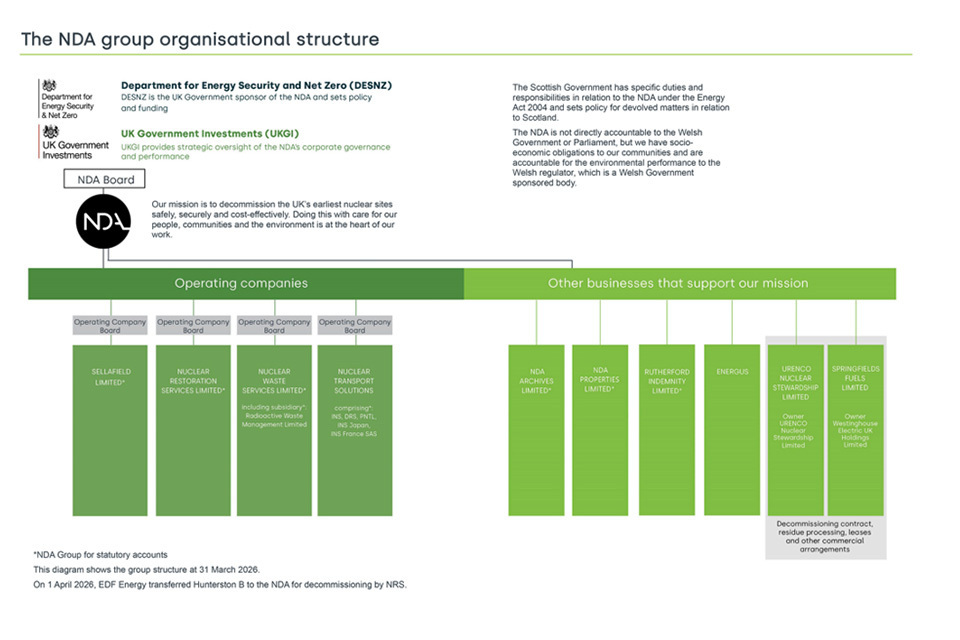
The Department for Energy Security and Net Zero (DESNZ) sponsors the Nuclear Decommissioning Authority (NDA), with oversight from UK Government Investments (UKGI). The NDA Board oversees the NDA and its mission. The diagram shows two groups of subsidiaries: operating companies comprising Sellafield Ltd, Nuclear Restoration Services Ltd, Nuclear Waste Services Ltd and Nuclear Transport Solutions; and other businesses supporting the mission, including NDA Archives Ltd, NDA Properties Ltd, Rutherford Indemnity Ltd, Energus, Urenco UK Specialised Stewardship Ltd and Springfields Fuels Ltd. Notes explain the relationship with the Scottish and Welsh Governments and statutory account arrangements.
The NDA has offices located across the UK. Additional information about the NDA can be found online.
NDA and it’s Supply Chains
The NDA has a large and diverse supply chain, figures relating to the reporting year of 1st April 2025 to 31st March 2026 are as follows: -
- 309 Suppliers (269 UK based)
- 390 Contracts
- Breakdown: 226 Standalone Contracts, 6 Framework Agreements and 158 Call-Off Contracts
- Third Party Spend is £157m
Spend is broken down across six sub-categories of spend:
- Corporate Resourcing and Professional Services
- Facilities Management and Property
- Information Technology
- Site Operations
- Manufactured Waste, Products and Services
- Capital Projects and Infrastructure
NDA Policies in relation to slavery and human trafficking
NDA recognises its responsibility to operate our business with effective policies and procedures.
Key relevant policies include:
- Supply Chain Modern Slavery Guidance: The guidance is based upon the latest Procurement Policy Note issued by the Cabinet Office (PPN 009: Tackling modern slavery in government supply chains - GOV.UK) and provides a comprehensive overview of the roles and responsibilities of the commercial practitioner in assessing and mitigating the risk of modern slavery in the supply chain. The supply chain servicing our requirements for goods, services, and works is large and includes multinational organisations, publicly owned bodies as well as small & medium sized suppliers. Through our standard terms and conditions, we require that our supply chain members (no matter of size) support the NDA in its mission to prevent modern slavery and human trafficking in any part of our business or supply chain.
- Code of Conduct and Standards of Behaviour in the Workplace: Our Code of Conduct (supported by policies such as respect at work, diversity and inclusion) sets out the expectations we have of those who work for us in relation to standards of behaviour.
- Speak Up Policy: Our speak up policy encourages the raising of concerns (whether by employees or others in the supply chain) either directly or using the independent SafeCall service to the Group Ethics and Compliance team (overseen by the Audit, Risk and Assurance Committee made up of Non-Executive Members of the NDA Board). NDA is committed to listening and acting when speak up issues are raised. No concerns relating to modern slavery were identified during this reporting period.
Due diligence processes
The NDA approach to due diligence and assessment of modern slavery risks within the supply chain is aligned with the UK Government’s and our sponsoring department (Department for Energy, Security and Net Zero) approach, in that a tiered approach is undertaken.
The following processes were undertaken as outlined below:
- Throughout the reporting year, notifiable below threshold procurements (i.e. £12,000 including VAT) were subject to the NDA Modern Slavery Categorisation Assessment Tool. To assess the potential level of modern slavery risk within the supply chain delivering the proposed contract, the tool uses the following risk indicators as assessment criteria:
- Industry Type – for example those that involve raw materials and / or are labour intensive
- Nature of Workforce – for example reliance on temporary or low skilled labour
- Supplier Location – some countries have a higher predicted risk of modern slavery
- Context in which the Supplier Operates – for example high levels of poverty and unemployment
- Commodity Type – for example imported products as identified in the Global Slavery Index
- Business / Supply Chain Model – for example sub-contracting and complex supply chains.
No contracts were identified to be at greater risk over the reporting period, nor were any issues flagged.
- Should a contract be identified as presenting a greater risk of modern slavery, we will approach the supplier to complete a self-assessment of its business using the Modern Slavery Assessment Tool (MSAT). The MSAT is a free risk identification and management tool developed by government for public bodies to use with suppliers. The tool provides tailored good practice recommendations to help suppliers improve their management of modern slavery risks.
- Where the risk identifier remains identified as “high risk” the NDA will then consider further options including deep-dives and / or site audits.
In the event of modern slavery practices being identified within our supply chain, the NDA will refer to its processes laid out in the Supply Chain Modern Slavery Guidance for referrals and support, in accordance with the principles below:
- Reports will be addressed promptly and, in a manner, proportionate to the circumstances of the case.
- We will work collaboratively with the supplier, and in accordance with our terms and conditions, to address the issues raised.
- A remediation plan will be developed where appropriate, setting out clear roles, responsibilities and actions.
Key considerations include:
- Where we suspect workers are being subjected to modern slavery, we will involve the appropriate law enforcement agencies.
- In the UK, if someone is in immediate danger, this must be reported to the police by dialling 999. Where appropriate, a potential victim may be referred to the National Referral Mechanism by a designated first responder so that they can be formally identified and offered appropriate support.
- Where we are concerned about a potential victim, or suspect a situation may be exploitative, we will call the Modern Slavery Helpline on 0800 0121 700, contact the Fair Work Agency’s modern slavery and labour exploitation referral line on 0800 432 0804, or report the matter online, as appropriate.
- If the issue arises overseas, the response will be tailored to the relevant local circumstances.
- We will continue to assess the situation and ensure that remediation plans are in place and progressed appropriately.
Risk assessment and management
Although the risk is determined to be low, modern slavery risks are documented internally within the NDA, collectively as an NDA group, and within commercial risk registers. These registers are reviewed and updated quarterly to ensure that content is and remains relevant and that allocated actions are delivered by the identified owners.
Key activities undertaken during this reporting period to address Modern Slavery risks
The following steps were taken during this reporting period to further enhance our approach to modern slavery:
-
We supported Cabinet Office user testing of the refreshed Anti-Slavery Risk Tiering Tool (ARTT) and have embedded the tool within the NDA Commercial Toolkit. Guidance and communications have been provided to the NDA Commercial team to increase awareness, encouraging its use in assessing and mitigating modern slavery risks throughout the procurement lifecycle.
-
We continued to monitor Cabinet Office activity relating to the UK National Baseline Assessment of the UN Guiding Principles on Business and Human Rights, ensuring awareness of emerging developments and considering their potential implications for our approach to responsible business conduct and supply chain due diligence.
-
We completed our annual review of modern slavery risks across the NDA group, including consideration of emerging risks arising from developments within the UK and global operating environment. This review included consideration of updates to Cabinet Office guidance, including PPN 009: Tackling Modern Slavery in Government Supply Chains, ensuring our approach to identifying and managing modern slavery risks remains aligned with current government policy and procurement requirements.
-
We undertook an annual review of the guidance available to commercial practitioners, updating materials to reflect the transition from PPN 02/23 to PPN 009 following the commencement of the Procurement Act 2023 on 24th February 2025. This ensured colleagues had access to current guidance and expectations relating to the identification and management of modern slavery risks.
-
We continued to engage with Cabinet Office through the cross-government Procurement Policy Working Group, enabling us to remain informed of policy developments and emerging best practice relating to modern slavery under the Procurement Act 2023, associated statutory guidance, and wider government procurement policy.
-
Transparency in Supply Chains: During this reporting year, we became aware of the updated Home Office guidance on transparency in supply chains and considered how the guidance may inform future developments to the NDA group’s modern slavery reporting and related activities.
Training on modern slavery and trafficking
Awareness of modern slavery and the risks it poses to the NDA group and its supply chains remains an important element of our approach to preventing and mitigating modern slavery risks.
A range of modern slavery training resources has been available to support employees and commercial practitioners in understanding modern slavery risks and their role in identifying and addressing them.
These include:
- NDA Modern Slavery Awareness Training has remained available through the NDA learning and management system for all employees. Completion of the course was mandatory for colleagues within the Commercial and Business Development Directorate in the 2025-26 Financial Year
- Government Commercial College Training, which includes learning on tackling modern slavery in supply chains through practical procurement case studies and is available to procurement and supply chain professionals.
Cabinet Office guidance and supporting resources, including materials associated with the Anti-Slavery Risk Tiering Tool (ARTT), which are used to support the assessment and management of modern slavery risks throughout the procurement lifecycle.
During the reporting period, we continued to promote the use of these training and awareness resources to strengthen understanding of modern slavery risks and support the consistent application of good procurement and supply chain management practices across the NDA group. As of 31 March 2026, the completion rate for the NDA Modern Slavery Awareness Training module amongst colleagues within the Commercial and Business Development Directorate was 100%.
Aims for the reporting year 2026/27
Below are our aims to further develop our approach to modern slavery in 2026/27:
- To strengthen modern slavery initiatives across the NDA group, including working collaboratively with operating companies to develop a more consistent, group-wide approach and explore the development of a single NDA group Modern Slavery Statement.
- Over the coming year, the NDA group will work collaboratively to review and strengthen its approach to transparency within its supply chains and to identify opportunities for continuous improvement. As part of this review, consideration will be given to the effectiveness and consistency of our approaches to modern slavery risk assessment, due diligence, supplier engagement, training, governance arrangements, and the development of aligned measures to assess the effectiveness of our activities in preventing and mitigating modern slavery risks.
- Design and implement more targeted group-based training to procurement and supply chain practitioners on how to understand, identify, and manage Modern Slavery risks in the NDA’s supply chains.
- To maintain and continuously review NDA policies, procedures, and guidance to ensure alignment with Cabinet Office requirements, relevant Procurement Policy Notes, and emerging legislative developments.
- To promote continuous improvement by monitoring emerging good practice and incorporating relevant developments into NDA commercial standards, policies, and processes.
This statement was approved on 23rd September 2026 by the NDA Board of Directors.
Signed on behalf of the NDA by:
David Peattie FREng FNucI, NDA Group Chief Executive Officer