
Modelling the impact of nature-based solutions on catchment water quality: summary
Published 9 November 2026
Applies to England

© Crown copyright 2026
This publication is licensed under the terms of the Open Government Licence v3.0 except where otherwise stated. To view this licence, visit nationalarchives.gov.uk/doc/open-government-licence/version/3 or write to the Information Policy Team, The National Archives, Kew, London TW9 4DU, or email: psi@nationalarchives.gov.uk.
Where we have identified any third party copyright information you will need to obtain permission from the copyright holders concerned.
This publication is available at https://www.gov.uk/government/publications/modelling-the-impact-of-nature-based-solutions-on-catchment-water-quality/modelling-the-impact-of-nature-based-solutions-on-catchment-water-quality-summary
1. Chief Scientist’s Group report summary
This project tested the impact of different nature-based solutions (NbS) on water quality at a river catchment scale using hydrological modelling. Its findings will help the Environment Agency and environmental practitioners to better understand the benefits and limitations of using NbS to manage agricultural nutrient pollution, as the climate continues to change.
1.1 Background
Nutrient pollution from diffuse sources, such as agriculture, remains a major barrier to achieving Good Ecological Status in many river catchments in England. NbS have the potential to help reduce the load of nutrients, including nitrogen and phosphorus, entering the water environment. Examples of NbS include small, in-field wetlands and vegetated buffer strips that intercept nutrients in runoff from the surrounding landscape. However, there is limited knowledge of how effective such interventions are at improving water quality at a catchment scale. Furthermore, there is a lack of understanding of how future rainfall and temperature patterns may alter the effectiveness of NbS to reduce diffuse nutrient pollution.
1.2 Approach
This project involved a quick scoping review to select the most suitable modelling tool to simulate the effect of NbS on catchment water quality, and the CSF-HYPE (Catchment Sensitive Farming-Hydrological Predictions for the Environment) model was selected. The impacts of three types of NbS (in-field wetlands, buffer strips and cover crops) were tested in two predominantly rural catchments, the Eden and the upper Thames. Scenarios of catchment-scale NbS use were modelled for the recent past (2000 to 2019) and for future scenarios (2020 to 2040 and 2060 to 2080) using UK climate projections under a high-emissions scenario (UKCP18, RCP8.5). Buffer strips and cover crops were represented in the model by applying reductions to nutrient loads in areas of high diffuse pollution risk. In-field wetlands were represented in the model by retaining and processing nutrients from overland flow pathways.
1.3 Results
The modelling suggested that when used in combination, buffer strips, cover crops and in-field wetlands achieved the greatest overall load reductions in the recent past. In the Thames, this combination achieved a 5% reduction in total phosphorus and 8% reduction in total nitrogen. In the Eden, it achieved a 22% reduction in total phosphorus and 17% reduction in total nitrogen. Greater nutrient reductions occurred further upstream in the catchment, suggesting that targeting headwaters can deliver proportionally greater benefits.
Climate change was found to complicate the effects of NbS on nutrient loads and concentrations in rivers. Future changes to rainfall and temperature reduced overall efficacy of the NbS, however the responses were strongly seasonal. Buffer strips and cover crops delivered greater nutrient reduction in cooler, wetter months, whereas in-field wetlands were more effective in summer. In-field wetlands reduced total phosphorus and total nitrogen concentrations in rivers by up to 3% and 4%, respectively, during 2060 to 2080, compared with up to 6% during 2020 to 2040. Confidence in these results is moderated by uncertainties in input data, the empirical evidence of the efficacy of NbS to retain nutrients, and how this is represented in the model. Whilst the model is validated against observed nutrient concentrations for the recent past scenario, a lack of suitable observational data means that the modelled effects of these NbS cannot be validated.
1.4 Conclusions
Buffer strips, cover crops and in-field wetlands applied at catchment scale currently have potential to reduce nutrient loads and concentrations in rivers. However, the effectiveness of these NbS depends on their design, location and management. Climate change is likely to reduce the effectiveness of these NbS to manage diffuse nutrient pollution. NbS should be used as part of a range of catchment interventions to improve water quality and enhance resilience to climate change.
1.5 Figure 1. Examples of a cover crop (top), vegetated buffer strip (centre), and in-field wetland (bottom).
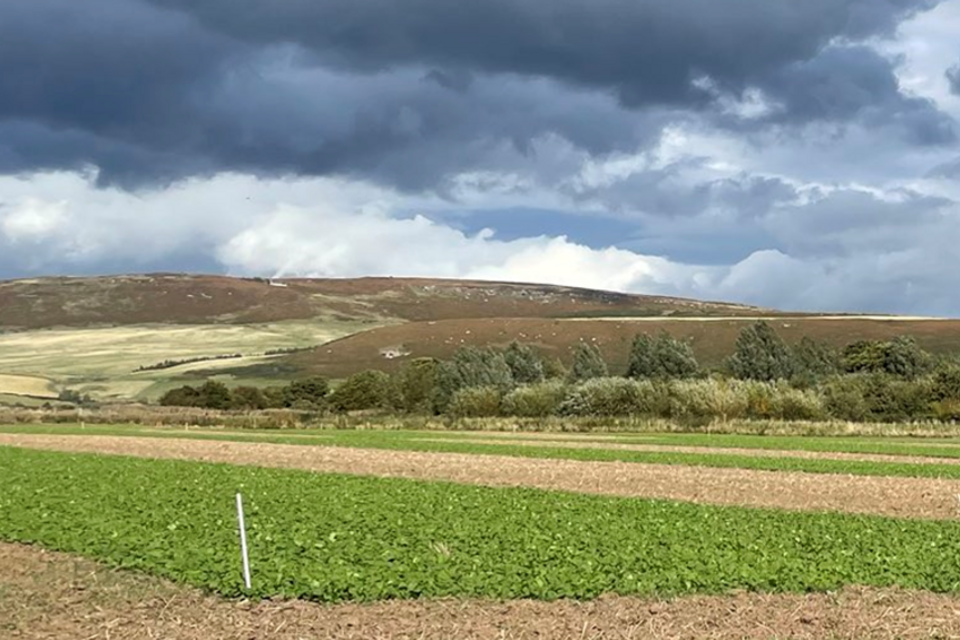
Image credit: Marta Cattin
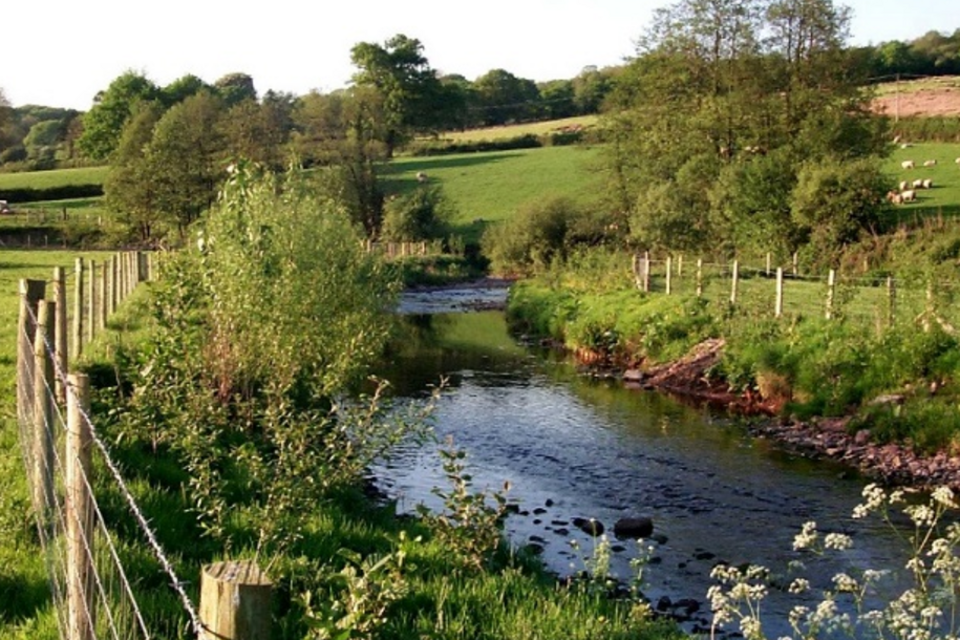
Image credit: Environment Agency
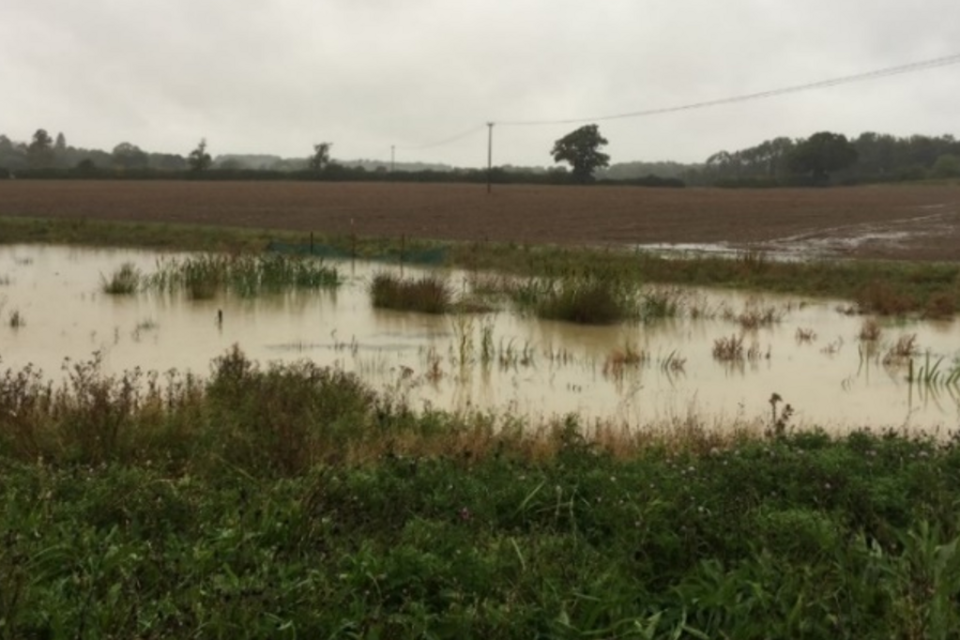
Image credit: John Robotham
1.6 Publication details
This summary relates to information from project SC250008, reported in detail in the following output:
- Report: SC250008
- Title: Modelling the impact of nature-based solutions on catchment water quality
- Science manager: John Robotham, Chief Scientist’s Group
- Research Contractor: 1) Hannah Champion, Robert Davidson, Barry Hankin, Eleanor Pearson, Nicola Wood, JBA Consulting and 2) Philip M. Haygarth, Ben Surridge, Lancaster University
This project was commissioned by the Environment Agency’s Chief Scientist’s Group, which provides scientific knowledge, tools and techniques to enable us to protect and manage the environment as effectively as possible.
Enquiries: research@environment-agency.gov.uk.
© Environment Agency